Hubbry Logo
Schwartz spaceSchwartz spaceMain
Open search
Schwartz space
Community hub
Schwartz space
logo
8 pages, 0 posts
0 subscribers
Be the first to start a discussion here.
Schwartz space
Schwartz space
from Wikipedia

In mathematics, Schwartz space is the function space of all functions whose derivatives are rapidly decreasing. This space has the important property that the Fourier transform is an automorphism on this space. This property enables one, by duality, to define the Fourier transform for elements in the dual space of , that is, for tempered distributions. A function in the Schwartz space is sometimes called a Schwartz function.

A two-dimensional Gaussian function is an example of a rapidly decreasing function.

Schwartz space is named after French mathematician Laurent Schwartz.

Definition

[edit]

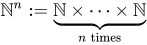
Let be the set of non-negative integers, and for any , let be the n-fold Cartesian product.

The Schwartz space or space of rapidly decreasing functions on is the function spacewhere is the function space of smooth functions from into , and Here, denotes the supremum, and we used multi-index notation, i.e. and .

To put common language to this definition, one could consider a rapidly decreasing function as essentially a function such that , all exist everywhere on and go to zero as faster than any reciprocal power of . In particular, is a subspace of .

Examples of functions in the Schwartz space

[edit]
  • If is a multi-index, and a is a positive real number, then
  • Any smooth function with compact support is in . This is clear since any derivative of is continuous and supported in the support of , so ( has a maximum in by the extreme value theorem.
  • Because the Schwartz space is a vector space, any polynomial can be multiplied by a factor for a real constant, to give an element of the Schwartz space. In particular, there is an embedding of polynomials into a Schwartz space.

Properties

[edit]

Analytic properties

[edit]

In particular, this implies that is an -algebra. More generally, if and is a bounded smooth function with bounded derivatives of all orders, then .

  1. complete Hausdorff locally convex spaces,
  2. nuclear Montel spaces,
  3. ultrabornological spaces,
  4. reflexive barrelled Mackey spaces.

Relation of Schwartz spaces with other topological vector spaces

[edit]
  • If , then is a dense subset of .
  • The space of all bump functions, , is included in .

See also

[edit]

References

[edit]
Revisions and contributorsEdit on WikipediaRead on Wikipedia
from Grokipedia
In , the Schwartz space S(Rn)\mathcal{S}(\mathbb{R}^n), also known as the space of rapidly decreasing functions, consists of all infinitely differentiable functions f:RnCf: \mathbb{R}^n \to \mathbb{C} such that ff and all its partial derivatives decay at faster than any inverse , meaning for every multi-index α\alpha and every N>0N > 0, there exists a constant CN,α>0C_{N,\alpha} > 0 satisfying αf(x)CN,α(1+x)N|\partial^\alpha f(x)| \leq C_{N,\alpha} (1 + |x|)^{-N} for all xRnx \in \mathbb{R}^n. This space was introduced by French mathematician in his foundational work on distribution theory, Théorie des Distributions (1950–1951), where it serves as a fundamental test for defining tempered distributions. The Schwartz space is equipped with a Fréchet generated by the countable family of seminorms fα,β=supxRnxαβf(x)\|f\|_{\alpha,\beta} = \sup_{x \in \mathbb{R}^n} |x^\alpha \partial^\beta f(x)|, where α,β\alpha, \beta are multi-indices, rendering it a complete, metrizable, locally convex topological vector space. A hallmark property is that the acts as a continuous on S(Rn)\mathcal{S}(\mathbb{R}^n), mapping the space bijectively onto itself and interchanging differentiation with multiplication by polynomials while preserving the rapid decay. The space contains the compactly supported smooth functions Cc(Rn)C_c^\infty(\mathbb{R}^n) as a dense subspace and embeds continuously into every Lp(Rn)L^p(\mathbb{R}^n) for 1p1 \leq p \leq \infty, with density in LpL^p for finite pp. Schwartz space plays a central role in , partial differential equations, and , where its functions provide "nice" test cases for operators and enable rigorous treatment of generalized functions like the Dirac delta. For instance, Gaussian functions such as ex2/2e^{-|x|^2/2} belong to S(Rn)\mathcal{S}(\mathbb{R}^n) and are fixed points (up to scaling) under the .

Fundamentals

Definition

The Schwartz space, denoted S(Rn)S(\mathbb{R}^n), consists of all infinitely differentiable functions ϕ:RnC\phi: \mathbb{R}^n \to \mathbb{C} that are rapidly decreasing at infinity, along with all their partial derivatives. Specifically, as introduced by , ϕ\phi belongs to S(Rn)S(\mathbb{R}^n) if and only if for every multi-index αN0n\alpha \in \mathbb{N}_0^n and every positive integer m1m \geq 1, the ϕα,m=supxRnxmDαϕ(x)<,\| \phi \|_{\alpha, m} = \sup_{x \in \mathbb{R}^n} |x|^m |D^\alpha \phi(x)| < \infty, where x|x| denotes the Euclidean norm on Rn\mathbb{R}^n, DαD^\alpha is the partial derivative of order α\alpha, and the supremum is taken over all xx. This condition ensures that ϕ\phi and its derivatives decay faster than any polynomial grows as x|x| \to \infty, capturing the notion of rapid decay. The space S(Rn)S(\mathbb{R}^n) includes complex-valued functions by definition, though the real-valued subspace S(Rn;R)S(\mathbb{R}^n; \mathbb{R}) of functions mapping to R\mathbb{R} forms a real vector space that is dense in various function spaces. The family of seminorms {α,m}\{ \| \cdot \|_{\alpha, m} \} induces a locally convex topology on S(Rn)S(\mathbb{R}^n), making it a Fréchet space (with full details of the topology addressed elsewhere).

Examples

A prototypical example of a function in the Schwartz space S(Rn)\mathcal{S}(\mathbb{R}^n) is the Gaussian ϕ(x)=eax2\phi(x) = e^{-a |x|^2} for a>0a > 0, which is infinitely differentiable and satisfies the rapid decay condition since both the function and all its partial derivatives decay faster than any at . More generally, monomials times Gaussians, such as ψ(x)=xαeax2\psi(x) = x^\alpha e^{-a |x|^2} where α\alpha is a multi-index with α<|\alpha| < \infty, also belong to S(Rn)\mathcal{S}(\mathbb{R}^n), as differentiation yields higher-order polynomials multiplied by the Gaussian, preserving the required decay. In higher dimensions, products of one-dimensional Gaussians, like ϕ(x1,,xn)=i=1neaixi2\phi(x_1, \dots, x_n) = \prod_{i=1}^n e^{-a_i x_i^2} for ai>0a_i > 0, extend this example separably to S(Rn)\mathcal{S}(\mathbb{R}^n). Smooth functions with compact support, known as , form another important class within S(Rn)\mathcal{S}(\mathbb{R}^n), as their support being bounded implies that the function and all derivatives vanish outside a compact set, hence decaying rapidly (in fact, zero) at . A standard construction of such a supported on the B(0,1)RnB(0,1) \subset \mathbb{R}^n is given by ϕ(x)={exp(x2x21)if x<1,0if x1.\phi(x) = \begin{cases} \exp\left( \frac{|x|^2}{ |x|^2 - 1 } \right) & \text{if } |x| < 1, \\ 0 & \text{if } |x| \geq 1. \end{cases} This function is CC^\infty on Rn\mathbb{R}^n because the exponential form ensures all derivatives match smoothly at the boundary x=1|x|=1, where the argument approaches -\infty. Not all smooth functions belong to the Schwartz space; counterexamples illustrate the necessity of rapid decay. Polynomials, such as p(x)=xkp(x) = x^k for any fixed k0k \geq 0, are smooth but fail the decay condition, as supxRnxβp(x)=\sup_{x \in \mathbb{R}^n} |x|^\beta p(x) = \infty for any multi-index β\beta with β>k|\beta| > k. The function f(x)=exf(x) = e^{-|x|} decays exponentially but is not smooth at the origin, since its first has a jump discontinuity there (f(x)=exf'(x) = -e^{-x} for x>0x > 0 and f(x)=exf'(x) = e^{x} for x<0x < 0). Similarly, the plane wave g(x)=eixg(x) = e^{i x} (extending componentwise to Rn\mathbb{R}^n) is entire (hence smooth) but oscillates without decaying, as g(x)=1|g(x)| = 1 for all xx, violating the seminorm bounds. To verify membership explicitly for the one-dimensional Gaussian ϕ(x)=eπx2\phi(x) = e^{-\pi x^2} on R\mathbb{R}, consider the seminorms pk,m(ϕ)=supxRxkϕ(m)(x)p_{k,m}(\phi) = \sup_{x \in \mathbb{R}} |x|^k |\phi^{(m)}(x)| for nonnegative integers k,mk, m. The derivatives satisfy ϕ(m)(x)=(1)mHem(2πx)(2π)mϕ(x)\phi^{(m)}(x) = (-1)^m He_m(\sqrt{2\pi} x) (\sqrt{2\pi})^m \phi(x)
Add your contribution
Related Hubs
User Avatar
No comments yet.