


Community hub
Recent from talks
Contribute something
Nothing was collected or created yet.
79th United States Congress
View on Wikipedia
| 79th United States Congress | |
|---|---|
78th ← → 80th | |
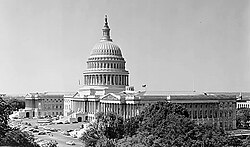
 United States Capitol (1956) | |
January 3, 1945 – January 3, 1947 | |
| Members | 96 senators 435 representatives 4 non-voting delegates |
| Senate majority | Democratic |
| Senate President | Henry A. Wallace (D)[a] (until January 20, 1945) Harry S. Truman (D)[b] (Jan 20–Apr 12, 1945) Vacant (from April 12, 1945) |
| House majority | Democratic |
| House Speaker | Sam Rayburn (D) |
| Sessions | |
| 1st: January 3, 1945 – December 21, 1945 2nd: January 14, 1946 – August 2, 1946 | |
The 79th United States Congress was a meeting of the legislative branch of the United States federal government, composed of the United States Senate and the United States House of Representatives. It met in Washington, D.C., from January 3, 1945, to January 3, 1947, during the last months of Franklin D. Roosevelt's presidency, and the first two years of Harry Truman's presidency. The apportionment of seats in this House of Representatives was based on the 1940 United States census.
Both chambers had a Democratic majority (including increasing their edge in the House). With the reelection of President Franklin D. Roosevelt to a record fourth term, the Democrats maintained an overall federal government trifecta.[1]
Major events
[edit]- January 20, 1945: President Franklin D. Roosevelt began his fourth term.
- April 12, 1945: President Roosevelt died, Vice President Harry S. Truman became President of the United States.
- September 2, 1945: World War II ended.
- September 11, 1945 – June 20, 1946: Joint Committee on the Investigation of the Pearl Harbor Attack conducted its investigation and issued a report.[2]
- November 6, 1946: 1946 United States Senate elections, 1946 United States House of Representatives elections: Republicans gained control of both houses.
- January 3, 1947: Proceedings of the U.S. Congress were televised for the first time.
Major legislation
[edit]
- March 9, 1945: McCarran-Ferguson Act
- July 31, 1945: Bretton Woods Agreements Act, Pub. L. 79–171
- July 31, 1945: Export-Import Bank Act of 1945
- December 20, 1945: United Nations Participation Act, Pub. L. 79–264, S. 1580, 59 Stat. 619, enacted December 20, 1945
- December 28, 1945: War Brides Act
- February 18, 1946: Rescission Act of 1946, Pub. L. 79–391
- February 20, 1946: Employment Act, Pub. L. 79–304, ch. 33, 60 Stat. 23
- May 13, 1946: Federal Airport Act of 1946, Pub. L. 79–377
- June 4, 1946: Richard B. Russell National School Lunch Act, ch. 281, 60 Stat. 230
- June 11, 1946: Administrative Procedure Act, ch. 324, Pub. L. 79–404, 60 Stat. 237
- July 2, 1946: Luce–Celler Act of 1946, Pub. L. 79–483
- July 3, 1946: Hobbs Anti-Racketeering Act, ch. 537, Pub. L. 79–486, 60 Stat. 420
- July 5, 1946: Lanham Trademark Act of 1946, Pub. L. 79–489
- August 1, 1946: United States Atomic Energy Act of 1946, ch. 724, Pub. L. 79–585, 60 Stat. 755
- August 2, 1946: Legislative Reorganization Act of 1946, Pub. L. 79–601, including Title III: Federal Regulation of Lobbying Act of 1946, Title IV: Federal Tort Claims Act, and Title V: General Bridge Act
- August 13, 1946: Foreign Service Act, ch. 957, titles I–X, 60 Stat. 999
- August 13, 1946: Hospital Survey and Construction Act (Hill-Burton Act), Pub. L. 79–725, ch. 958, 60 Stat. 1040
Treaties ratified
[edit]- July 28, 1945: Senate ratified the Charter of the United Nations by a vote of 89–2.[3][4]
- July 4, 1946: Senate ratified the Treaty of Manila, which gave independence to the Philippines.
Party summary
[edit]Senate
[edit]| Party (shading shows control) |
Total | Vacant | |||
|---|---|---|---|---|---|
| Democratic (D) |
Progressive (P) | Republican (R) |
|||
| End of previous congress | 56 | 1 | 39 | 96 | 0 |
| Begin | 57 | 1 | 38 | 96 | 0 |
| End | 53 | 42 | |||
| Final voting share | 55.2% | 1.0% | 43.8% | ||
| Beginning of next congress | 45 | 0 | 51 | 96 | 0 |
House of Representatives
[edit]| Party (shading shows control) |
Total | Vacant | |||||
|---|---|---|---|---|---|---|---|
| Democratic (D) |
Farmer– Labor (FL) | American Labor (AL) | Progressive (P) | Republican (R) |
|||
| End of previous congress | 212 | 1 | 1 | 2 | 210 | 426 | 9 |
| Begin | 242 | 0 | 1 | 1 | 190 | 434 | 1 |
| End | 236 | 191 | 429 | 6 | |||
| Final voting share | 55.0% | 0.0% | 0.2% | 0.2% | 44.5% | ||
| Beginning of next congress | 187 | 0 | 1 | 0 | 245 | 433 | 2 |
Leadership
[edit]Senate
[edit]- President:
- Henry A. Wallace (D), until January 20, 1945
- Harry S. Truman (D), January 20, 1945 – April 12, 1945; thereafter vacant
- President Pro Tempore: Kenneth McKellar (D)
- Majority leader: Alben W. Barkley (D)
- Minority leader: Wallace H. White Jr. (R, acting)
- Majority whip: J. Lister Hill (D)
- Minority whip: Kenneth S. Wherry (R), elected 1944
House of Representatives
[edit]Members
[edit]Senate
[edit]Senators are popularly elected statewide every two years, with one-third beginning new six-year terms with each Congress. Preceding the names in the list below are Senate class numbers, which indicate the cycle of their election, In this Congress, Class 1 meant their term ended with this Congress, facing re-election in 1946; Class 2 meant their term began in the last Congress, facing re-election in 1948; and Class 3 meant their term began in this Congress, facing re-election in 1950.
|
|
 2 Democrats 1 Democrat and 1 Republican 2 Republicans
|
House of Representatives
[edit]The names of representatives are preceded by their district numbers.

Changes in membership
[edit]The count below reflects changes from the beginning of this Congress.
Senate
[edit]| State (class) |
Vacated by | Reason for change | Successor | Date of successor's formal installation[d] |
|---|---|---|---|---|
| Washington (1) |
Monrad Wallgren (D) | Resigned January 9, 1945, after being elected Governor of Washington. Successor was appointed to serve until the next election. |
Hugh Mitchell (D) | January 10, 1945 |
| Connecticut (1) |
Francis T. Maloney (D) | Died January 16, 1945. Successor was appointed to serve until a special election. |
Thomas C. Hart (R) | February 15, 1945 |
| Missouri (1) |
Harry S. Truman (D) | Resigned January 17, 1945, after being elected Vice President of the United States. Successor was appointed to serve until the next election. |
Frank P. Briggs (D) | January 18, 1945 |
| North Dakota (3) |
John Moses (D) | Died March 3, 1945. Successor was appointed to serve until a special election, which he subsequently won. |
Milton Young (R) | March 12, 1945 |
| Nevada (1) |
James G. Scrugham (D) | Died June 23, 1945. Successor was appointed to serve until the next election. |
Edward P. Carville (D) | July 25, 1945 |
| California (1) |
Hiram Johnson (R) | Died August 6, 1945. Successor was appointed to serve until a special election, which he subsequently won. |
William F. Knowland (R) | August 26, 1945 |
| Ohio (1) |
Harold H. Burton (R) | Resigned September 30, 1945, after being appointed an Associate Justice of the Supreme Court of the United States. Successor was appointed to serve until a special election. |
James W. Huffman (D) | October 8, 1945 |
| Kentucky (2) |
Happy Chandler (D) | Resigned November 1, 1945, after becoming Commissioner of Major League Baseball. Successor was appointed to serve until a special election. |
William A. Stanfill (R) | November 19, 1945 |
| Idaho (2) |
John Thomas (R) | Died November 10, 1945. Successor was appointed to serve until a special election, which he subsequently lost. |
Charles C. Gossett (D) | November 17, 1945 |
| Virginia (2) |
Carter Glass (D) | Died May 28, 1946. Successor was appointed to serve until a special election. |
Thomas G. Burch (D) | May 31, 1946 |
| Alabama (2) |
John H. Bankhead II (D) | Died June 12, 1946. Successor was appointed to serve until a special election. |
George R. Swift (D) | June 15, 1946 |
| Vermont (1) |
Warren Austin (R) | Resigned August 2, 1946, after being appointed United States representative on the United Nations Security Council. Successor was appointed to serve until the next election. |
Ralph Flanders (R) | November 1, 1946 |
| Florida (1) |
Charles O. Andrews (D) | Died September 18, 1946. Successor was elected to finish term. |
Spessard Holland (D) | September 25, 1946 |
| Alabama (2) |
George R. Swift (D) | Resigned November 5, 1946. Successor was elected to finish term. |
John Sparkman (D) | November 6, 1946 |
| Connecticut (1) |
Thomas C. Hart (R) | Resigned November 5, 1946. Successor was elected to finish term. |
Raymond E. Baldwin (R) | December 27, 1946 |
| Kentucky (2) |
William A. Stanfill (R) | Resigned November 5, 1946. Successor was elected to finish term | John S. Cooper (R) | November 6, 1946 |
| Ohio (1) |
James W. Huffman (D) | Resigned November 5, 1946. Successor was elected to finish term. | Kingsley A. Taft (R) | November 6, 1946 |
| Virginia (2) |
Thomas G. Burch (D) | Resigned November 5, 1946. Successor was elected to finish term. |
Absalom W. Robertson (D) | November 6, 1946 |
| Idaho (2) |
Charles C. Gossett (D) | Resigned November 6, 1946. Successor was elected to finish term. |
Henry Dworshak (R) | November 6, 1946 |
| North Carolina (2) |
Josiah Bailey (D) | Died December 15, 1946. Successor was appointed to serve until a special election, which he subsequently lost. |
William B. Umstead (D) | December 18, 1946 |
| Washington (1) |
Hugh Mitchell (D) | Resigned December 25, 1946. Successor was appointed to finish the term already having to be elected the next term. | Harry P. Cain (R) | December 26, 1946 |
House of Representatives
[edit]| District | Vacated by | Reason for change | Successor | Date of successor's formal installation[d] |
|---|---|---|---|---|
| Rhode Island 2nd | Vacant | John E. Fogarty resigned during the previous Congress. | John E. Fogarty (D) | February 7, 1945 |
| Montana 2nd | James F. O'Connor (D) | Died January 15, 1945 | Wesley A. D'Ewart (R) | June 5, 1945 |
| Virginia 3rd | Dave E. Satterfield Jr. (D) | Resigned February 15, 1945, to become general counsel and executive director of the Life Insurance Association of America | J. Vaughan Gary (D) | March 6, 1945 |
| Illinois 24th | James V. Heidinger (R) | Died March 22, 1945 | Roy Clippinger (R) | November 6, 1945 |
| New Mexico at-large | Clinton P. Anderson (D) | Resigned June 30, 1945, after being appointed Secretary of Agriculture | Vacant | Not filled this term |
| New Jersey 4th | D. Lane Powers (R) | Resigned August 30, 1945, to become a member of the Public Utilities Commission of New Jersey | Frank A. Mathews Jr. (R) | November 6, 1945 |
| Oregon 1st | James W. Mott (R) | Died November 12, 1945 | A. Walter Norblad (R) | January 18, 1946 |
| North Carolina 10th | Joseph W. Ervin (D) | Died December 25, 1945 | Sam Ervin (D) | January 22, 1946 |
| New York 19th | Samuel Dickstein (D) | Resigned December 30, 1945 | Arthur G. Klein (D) | February 19, 1946 |
| Virginia 6th | Clifton A. Woodrum (D) | Resigned December 31, 1945, to become president of the American Plant Food Council, Inc. | J. Lindsay Almond (D) | January 22, 1946 |
| Georgia 5th | Robert Ramspeck (D) | Resigned December 31, 1945, to become executive vice-president of the Air Transport Association | Helen D. Mankin (D) | February 12, 1946 |
| Pennsylvania 33rd | Samuel A. Weiss (D) | Resigned January 7, 1946, after being elected judge of Common Pleas in Allegheny County, Pennsylvania | Frank Buchanan (D) | May 21, 1946 |
| Pennsylvania 23rd | J. Buell Snyder (D) | Died February 24, 1946 | Carl H. Hoffman (R) | May 21, 1946 |
| North Carolina 8th | William O. Burgin (D) | Died April 11, 1946 | Eliza Jane Pratt (D) | May 25, 1946 |
| Virginia 5th | Thomas G. Burch (D) | Resigned May 31, 1946, after being appointed to the U.S. Senate | Thomas B. Stanley (D) | November 5, 1946 |
| Texas 6th | Luther A. Johnson (D) | Resigned July 17, 1946, after becoming judge of the United States Tax Court | Olin E. Teague (D) | August 24, 1946 |
| Pennsylvania 10th | John W. Murphy (D) | Resigned July 17, 1946, to become judge of the US District Court for the Middle District of Pennsylvania | James P. Scoblick (R) | November 5, 1946 |
| Minnesota 3rd | William Gallagher (DFL) | Died August 13, 1946 | Vacant | Not filled this term |
| Puerto Rico at-large | Jesús T. Piñero (PPD) | Resigned September 2, 1946, after being appointed Governor of Puerto Rico | Antonio Fernós-Isern (PPD) | September 11, 1946 |
| New York 4th | William B. Barry (D) | Died October 20, 1946 | Vacant | Not filled this term |
| Alabama 8th | John Sparkman (D) | Resigned November 6, 1946, after being elected to the U.S. Senate | Vacant | Not filled this term |
| Idaho 2nd | Henry Dworshak (R) | Resigned November 5, 1946, after being elected to the U.S. Senate | Vacant | Not filled this term |
| Virginia 7th | Absalom W. Robertson (D) | Resigned November 5, 1946, after being elected to the U.S. Senate | Burr Harrison (D) | November 5, 1946 |
| Wisconsin 2nd | Robert K. Henry (R) | Died November 20, 1946 | Vacant | Not filled this term |
Committees
[edit]Lists of committees and their party leaders for members of the House and Senate committees can be found through the Official Congressional Directory at the bottom of this article. The directory after the pages of terms of service lists committees of the Senate, House (Standing with Subcommittees, Select and Special) and Joint and, after that, House/Senate committee assignments. On the committees section of the House and Senate in the Official Congressional Directory, the committee's members on the first row on the left side shows the chairman of the committee and on the right side shows the ranking member of the committee.
Senate[edit]
|
House of Representatives[edit]
|
Joint committees
[edit]- Atomic Energy (Chairman: Sen. Brien McMahon)
- Arrange the Inauguration for President-elect (Chairman: Sen. Harry F. Byrd)
- Conditions of Indian Tribes (Special)
- Disposition of Executive Papers
- Investigation of the Pearl Harbor Attack
- Legislative Budget
- The Library (Chairman: Sen. Alben W. Barkley)
- Organization of Congress (Chairman: Vacant; Vice Chairman: Rep. Mike Monroney)
- Printing (Chairman: Sen. Carl Hayden; Vice Chairman: Rep. Pete Jarman)
- Reduction of Nonessential Federal Expenditures (Chairman: Sen. Harry F. Byrd; Vice Chairman: Rep. Robert L. Doughton)
- Selective Service Deferments
- Taxation (Chairman: Rep. Robert F. Doughton; Vice Chairman: Sen. Walter F. George)
Caucuses
[edit]- Democratic (House)
- Democratic (Senate)
Employees
[edit]Legislative branch agency directors
[edit]- Architect of the Capitol: David Lynn
- Attending Physician of the United States Congress: George Calver
- Comptroller General of the United States: Lindsay C. Warren
- Librarian of Congress: Luther H. Evans
- Public Printer of the United States: Augustus E. Giegengack
Senate
[edit]- Chaplain: Frederick Brown Harris (Methodist)
- Parliamentarian: Charles Watkins
- Secretary: Edwin A. Halsey, until January 29, 1945
- Leslie Biffle, from February 8, 1945
- Librarian: Ruskin McArdle
- Secretary for the Majority: Leslie Biffle, until February 8, 1945
- Felton McLellan Johnston, from October 1945
- Secretary for the Minority: Carl A. Loeffler
- Sergeant at Arms: Wall Doxey
House of Representatives
[edit]- Chaplain: James Shera Montgomery (Methodist)
- Clerk: South Trimble, until November 23, 1946
- Harry Newlin Megill, from November 23, 1946
- Doorkeeper: Ralph R. Roberts
- Parliamentarian: Lewis Deschler
- Postmaster: Finis E. Scott
- Reading Clerks: George J. Maurer (D) and Alney E. Chaffee (R)
- Sergeant at Arms: Kenneth Romney
See also
[edit]- 1944 United States elections (elections leading to this Congress)
- 1946 United States elections (elections during this Congress, leading to the next Congress)
Notes
[edit]- ^ U.S. Vice President Henry A. Wallace's term as President of the Senate ended at noon January 20, 1945, when Harry S. Truman's term began.
- ^ U.S. Vice President Truman's term as President of the Senate ended on April 12, 1945 when he ascended to the presidency. President pro tempore Kenneth McKellar acted his duties as the president of the Senate.
- ^ a b The Minnesota Democratic–Farmer–Labor Party (DFL) is the Minnesota affiliate of the U.S. Democratic Party and are counted as Democrats.
- ^ a b When seated or oath administered, not necessarily when service began.
External links
[edit]References
[edit]- ^ Riddick, Floyd M. (1946). "The First Session of the Seventy-Ninth Congress". American Political Science Review. 40 (2): 256–271. doi:10.2307/1950680. ISSN 0003-0554.
- ^ "Senate archive on the Joint Committee on the Investigation of the Pearl Harbor Attack". Retrieved October 18, 2015.
- ^ Carroll, Mitchell B. “Further Action on United Nations Charter.” American Bar Association Journal, vol. 31, no. 9, 1945, pp. 457–58. JSTOR, http://www.jstor.org/stable/25715332. Accessed 4 July 2024.
- ^ Gillette, Guy M., et al. “UNITED NATIONS CHARTER REVIEW.” Proceedings of the American Society of International Law at Its Annual Meeting (1921-1969), vol. 48, 1954, pp. 191–211. JSTOR, http://www.jstor.org/stable/25657319. Accessed 4 July 2024.
- House of Representatives Session Calendar for the 79th Congress (PDF). Archived from the original (PDF) on September 7, 2016. Retrieved June 6, 2016.
- Official Congressional Directory for the 79th Congress, 1st Session.
- Official Congressional Directory for the 79th Congress, 1st Session (Revision).
- Official Congressional Directory for the 79th Congress, 2nd Session. hdl:2027/uc1.l0079661732.
- Official Congressional Directory for the 79th Congress, 2nd Session (Revision).
79th United States Congress
View on GrokipediaSessions and Timeline
First Session (January 3, 1945 – December 21, 1945)
The 79th Congress convened its first session on January 3, 1945, under Democratic majorities in both chambers, with President Franklin D. Roosevelt delivering his final State of the Union address to a joint session on March 1, 1945, emphasizing continued wartime mobilization and postwar planning.[2] Following Roosevelt's death on April 12, 1945, President Harry S. Truman addressed Congress on April 16, 1945, pledging to uphold Allied commitments amid the ongoing war in Europe and the Pacific.[6] The session adjourned sine die on December 21, 1945, after addressing the transition from wartime to peacetime priorities, including international commitments forged at conferences like Yalta and Bretton Woods.[7] Key legislative actions focused on affirming state regulatory authority over insurance and enabling U.S. participation in postwar financial institutions. On March 9, 1945, Congress enacted the McCarran-Ferguson Act (Public Law 79-15), which declared that the business of insurance remained subject to state regulation and taxation, reversing a 1944 Supreme Court decision that had threatened federal oversight by exempting it from most federal antitrust laws unless states failed to act.[8] This measure, passed amid industry lobbying, preserved decentralized control over insurance amid wartime economic strains.[9] In July 1945, as Allied victories accelerated—marking Victory in Europe Day on May 8 and culminating in Japan's surrender on September 2—the Senate ratified the United Nations Charter on July 28 by a 89-2 vote, enabling U.S. membership in the organization established to prevent future global conflicts.[10] Complementing this, Congress passed the Bretton Woods Agreements Act on July 31 (Public Law 79-171), authorizing U.S. subscriptions to the International Monetary Fund and the International Bank for Reconstruction and Development to promote stable exchange rates and fund postwar rebuilding, with appropriations of $8.8 billion for the IMF quota and related commitments.[11][12] These acts reflected bipartisan support for institutional frameworks to manage global economic recovery, though debates highlighted concerns over sovereignty and fiscal burdens. The session also advanced domestic fiscal measures, including the Public Debt Act of 1945 (Public Law 79-34), signed April 4, which raised the federal debt ceiling from $260 billion to $300 billion to finance ongoing war expenditures and initial reconversion efforts.[13] By December, Congress approved the United Nations Participation Act (Public Law 79-264, December 20), implementing U.S. obligations under the Charter by authorizing the President to negotiate agreements for UN headquarters and forces, signaling commitment to collective security without immediate troop commitments.[10] Other enactments addressed wartime extensions, such as renewing the Export-Import Bank's charter on July 31 (Public Law 79-173) to support international trade amid demobilization.[14] These measures prioritized economic stabilization and international engagement, though many of Truman's proposed domestic programs, like expanded unemployment benefits, faced delays into the second session due to partisan divisions over federal spending.[15]Second Session (January 3, 1946 – August 2, 1946)
The second session of the 79th United States Congress convened on January 14, 1946, amid postwar economic reconversion challenges, including labor strikes and demobilization of millions of service members.[16] This session, which adjourned sine die on August 2, 1946, marked one of the shortest regular sessions since 1939, yet it produced significant legislation addressing atomic energy control, economic policy, and congressional reforms.[17] Democrats retained majorities in both chambers, with the Senate at 57–38 and the House at 243–190, though internal divisions and Republican opposition shaped debates on fiscal and regulatory matters.[2] A cornerstone enactment was the Employment Act of 1946, signed by President Harry S. Truman on February 20, 1946, which declared a continuing federal policy to promote maximum employment, production, and purchasing power.[18] The act established the Council of Economic Advisers and the Joint Economic Committee to advise on economic conditions, reflecting congressional recognition of the need for coordinated postwar stabilization without expansive government intervention akin to New Deal expansions.[19] The Atomic Energy Act of 1946, enacted on August 1, 1946, transferred oversight of nuclear development from military control under the Manhattan Engineer District to a civilian Atomic Energy Commission, effective January 1, 1947.[20] This bipartisan measure, introduced by Senator Brien McMahon, aimed to harness atomic energy for peaceful purposes while maintaining national security, amid debates over international control versus domestic monopoly.[21] Congress also passed the Legislative Reorganization Act of 1946 on August 2, 1946, streamlining the committee system by reducing standing committees from 33 to 16 in the Senate and enhancing staff resources to bolster legislative oversight of the expanding executive branch.[22] Additional measures included the National School Lunch Act, providing federal aid for school nutrition programs to address child welfare in the postwar era, and extensions of veterans' benefits such as terminal-leave payments.[23] These actions underscored a focus on institutional efficiency and transitional policies rather than sweeping social reforms, with Truman vetoing several bills on spending grounds but signing key priorities before adjournment.[24]Composition
Senate Composition
The United States Senate of the 79th Congress, which convened on January 3, 1945, consisted of 96 members apportioned by state. Democrats held 57 seats, securing a majority, while Republicans occupied 38 seats, and the Progressive Party held 1 seat.[3]| Party | Seats |
|---|---|
| Democratic | 57 |
| Republican | 38 |
| Progressive | 1 |
| Total | 96 |
House of Representatives Composition
The House of Representatives of the 79th Congress comprised 435 voting members, reflecting the results of the 1944 elections held on November 7, 1944.[25] Democrats secured a majority with 244 seats, while Republicans held 189 seats; the remaining two seats were occupied by one member of the American Labor Party (Vito Marcantonio of New York) and one Progressive (from Wisconsin).[2][26] This gave Democrats a nominal 55-seat advantage over Republicans, though the effective majority was narrower due to ideological divisions within the Democratic caucus, particularly among conservative Southern Democrats who frequently aligned with Republicans on fiscal and labor issues.[26]| Party | Seats |
|---|---|
| Democratic | 244 |
| Republican | 189 |
| American Labor | 1 |
| Progressive | 1 |
| Total | 435 |