Hubbry Logo
Sida rhombifoliaSida rhombifoliaMain
Open search
Sida rhombifolia
Community hub
Sida rhombifolia
logo
8 pages, 0 posts
0 subscribers
Be the first to start a discussion here.
Sida rhombifolia
Sida rhombifolia
from Wikipedia

Sida rhombifolia
Scientific classification Edit this classification
Kingdom: Plantae
Clade: Tracheophytes
Clade: Angiosperms
Clade: Eudicots
Clade: Rosids
Order: Malvales
Family: Malvaceae
Genus: Sida
Species:
S. rhombifolia
Binomial name
Sida rhombifolia

Sida rhombifolia, commonly known as arrowleaf sida,[1] is a perennial or sometimes annual plant in the Family Malvaceae, native to the Old World tropics and subtropics. Other common names include rhombus-leaved sida, Paddy's lucerne, jelly leaf, and also somewhat confusingly as Cuban jute,[2] Queensland-hemp,[3] and Indian hemp (although S. rhombifolia is not closely related to either jute or hemp). Synonyms include Malva rhombifolia. It is used in Ayurvedic medicine, where it is known as kurumthotti.

Description

[edit]
Sprawling bush

The stems are erect to sprawling and branched, growing 50 to 120 centimeters in height, with the lower sections being woody. The dark green, diamond-shaped leaves are arranged alternately along the stem, 4 to 8 centimeters long, with petioles that are less than a third of the length of the leaves. The leaves are paler below, with short, grayish hairs. The apical half of the leaves have toothed or serrated margins while the remainder of the leaves are smooth. The petioles have small spiny stipules at their bases.

Inflorescence

[edit]

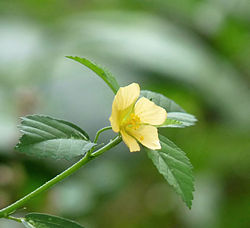
The moderately delicate flowers occur singly on flower stalks that arise from the area between the stems and leaf petioles. They consist of five petals that are 4 to 8 millimeters long, creamy to orange-yellow in color, and may be somewhat reddish in the center. Each of the five overlapping petals is asymmetric, having a long lobe on one side. The stamens unite in a short column. The fruit is a ribbed capsule, which breaks up into 8 to 10 segments. The plant blooms throughout the year.

Distribution and habitat

[edit]

Sida rhombifolia is native to tropical and subtropical areas of Africa through India and southeast Asia to Japan, as well as Indonesia and the Philippines. It has been introduced to tropical and subtropical parts of both north and south America, Australia, islands of the Pacific, and some parts of Europe.[4][5] This species is usually confined to waste ground, such as roadsides and rocky areas,[6] stock camps or rabbit warrens, but can be competitive in pasture, because of its unpalatability to livestock. It grows on savannahs, roadsides, thick scrub, hillsides, and swampy woodlands. It is such a tropical species that it is located below 2,000 meters above sea level.

Uses

[edit]
Sida rhombifolia flower, in Kerala

Arrowleaf sida stems are used as rough cordage, sacking, and for making brooms. The stems have a high quality fiber and were once exported from India and elsewhere as “hemp” (Guzmán 1975, Holm and others 1997). Chemical analysis revealed that the leaves contain respectable amounts of nutrients: 74,000 to 347,000 ppm protein, 94,000 to 475,000 ppm carbohydrates, 33,000 to 167,000 ppm fiber, 14,000 to 71,000 ppm fat, and 16,000 to 81,000 ppm ash. However, it was reported that the root contained 450 ppm alkaloids and the presence of ephedrine and saponin (Southwest School of Botanical Medicine 2002). Another source reports an alkaloid content in the root of 0.1 percent and the presence of choline, pseudoephedrine, beta-phenethylamine, vascin, hipaphorine and related indole alkaloids (Shaman Australis Ethnobotanicals 2002). Perhaps because of these chemicals, arrowleaf sida is unpalatable to cattle (Kuniata and Rapp 2001). Arrowleaf sida has significant medicinal applications for which it is cultivated throughout India. The pounded leaves are used to relieve swelling, the fruits are used to relieve headache, the mucilage is used as an emollient, and the root is used to treat rheumatism (Parrotta 2001). Leaves are smoked in Mexico and a tea is prepared in India for the stimulation it provides (Shaman Australis Ethnobotanicals 2002).[7]

See also

[edit]

References

[edit]
[edit]
Revisions and contributorsEdit on WikipediaRead on Wikipedia
from Grokipedia
Sida rhombifolia is a small in the mallow family (), commonly known as arrowleaf sida, Cuban , or Queensland , growing up to 1–1.5 meters tall with tough, branching stems that are densely covered in stellate hairs. The plant features alternate, rhomboid to lanceolate leaves, 1.5–8 cm long, with serrated margins and a dull green appearance due to the hairy underside, and produces small, solitary to pale orange flowers, each about 7–8 mm across with five petals, followed by fruits consisting of 8–12 dark brown, ribbed mericarps. Native to the tropical regions of the , it is a short-lived or that thrives in warm climates and is often found in disturbed habitats. Widely naturalized and in distribution, Sida rhombifolia occurs throughout tropical and subtropical areas of the world, including parts of (such as the from to and west to ), Central and , , , , and the Pacific islands. It prefers open, sunny positions in well-drained, light to medium soils, commonly inhabiting roadsides, waste places, pastures, old fields, scrublands, and stream banks up to elevations of 1,500 meters, and is tolerant of but sensitive to frost. In many regions, it behaves as an aggressive , infesting mesic to wet pastures and crops, and can produce up to 11,600 seeds per plant annually, aiding its rapid spread. The plant has various traditional uses, particularly in indigenous medicine and as a fiber source. Leaves are cooked as a vegetable or brewed into tea, providing about 7.4% protein, while decoctions treat ailments such as fevers, dysentery, headaches, rheumatism, and skin conditions, owing to compounds like cryptolepine and ephedrine. Its stems yield a strong fiber used for ropes, twine, and brooms, serving as a substitute for jute in some areas, and it acts as a larval host for butterflies like the tropical checkered-skipper (Pyrgus oileus). Despite these benefits, Sida rhombifolia is often regarded as invasive in agricultural settings due to its competition with crops and persistence in disturbed lands.

Taxonomy

Classification

Sida rhombifolia belongs to the kingdom Plantae, phylum Tracheophyta, class Magnoliopsida, order Malvales, family Malvaceae, genus Sida, and species S. rhombifolia. The genus Sida comprises approximately 200 species of herbs, shrubs, and subshrubs, primarily distributed in tropical and subtropical regions worldwide. S. rhombifolia is recognized as a pantropical weed, exhibiting wide ecological adaptability. Within the species, three are currently accepted: S. rhombifolia subsp. rhombifolia, characterized by rhomboid leaves and prominent stellate hairs; S. rhombifolia subsp. retusa, featuring leaves with obtuse tips and reduced pubescence; and S. rhombifolia subsp. alnifolia. Historical synonyms include Malva rhombifolia, reflecting early classifications before the species was firmly placed in Sida. The taxonomy of S. rhombifolia is complicated by its polymorphism, forming a with variations in leaf shape, pubescence, and levels (diploid and tetraploid forms), leading to debates over varietal boundaries and inclusion of related taxa like S. scabrida and S. rhomboidea.

and

The binomial name Sida rhombifolia L. was established by in his seminal work in 1753, where it was described on page 684 of volume 2, marking the formal scientific naming of the species within the genus Sida. The genus name Sida derives from the ancient Greek term sidē, originally used by Theophrastus to refer to a marsh-dwelling plant, possibly akin to Althaea or Nymphaea alba, and later adopted by Linnaeus for mallow-like species due to their shared watery habitats and morphological similarities. The specific epithet rhombifolia comes from the Latin words rhombus (meaning diamond or rhomboid shape) and folium (leaf), alluding to the characteristic rhomboid form of the plant's leaves. Common names for Sida rhombifolia vary regionally and reflect its uses or appearance, including arrowleaf sida, Cuban , Queensland , Paddy's , jelly leaf, broom , and escobilla in English and Spanish contexts; axocatzín in ; and in Ayurvedic traditions, it is known as kurumthotti or sometimes as a form of Mahabala. Several synonyms have been historically applied to Sida rhombifolia, such as Malva rhombifolia (L.) E.H.L. Krause, Sida alba Cav., Sida compressa Wall., Sida insularis Hatus., Sida hondensis Kunth, and S. rhomboidea Roxb., with some like S. alnifolia and S. retusa now recognized as subspecies due to overlapping traits. Taxonomic confusions have arisen from the species' morphological variability, leading to misidentifications in early botanical literature and difficulties in distinguishing it from closely related taxa like S. acuta or S. ulmifolia.

Description

Vegetative morphology

Sida rhombifolia exhibits a growth habit as a or sometimes annual , typically reaching 50–150 cm in height, with an erect to sprawling form featuring a woody base and herbaceous branches. The plant is many-branched from the base, producing a strong woody that supports its persistence in various environments. The stems are erect or procumbent, often dark purple and cylindrical, covered in grayish stellate hairs that give them a pubescent or tomentose appearance, though they may become glabrescent with maturity. These hairs, which are minute and stellate, contribute to the plant's overall texture and can vary in density across individuals. Leaves are arranged alternately along the stems, with blades that are rhomboid to lanceolate or ovate-oblong in , measuring 2–9 cm long and 1–4 cm wide. The leaf margins are toothed or serrate toward the apex and entire near the base, with a cuneate to subcordate base and acute to obtuse apex; the upper surface is dark and sparsely stellate-pubescent, while the lower surface is paler and more densely pubescent. Petioles are short, 2–8 mm long, and stipules are subulate, 3–6 mm in length. The consists of a deep , which enables and long-term persistence of the plant.

Reproductive morphology

The inflorescences of Sida rhombifolia consist of axillary cymes or solitary flowers borne on peduncles measuring 5–20 mm long. Flowers are bisexual, with a of 4–8 mm, featuring five sepals that are stellate-hairy and form a cup-shaped calyx 4–8 mm long. The five petals are yellow to orange, obovate, and 6–12 mm long, while the numerous stamens are fused into a central column 1–5 mm long, often with stalked glands. The superior with 7–14 locules is topped by a style with 7–14 branches. Flowering occurs year-round in tropical regions, with peaks during warm seasons, and individual flowers open in the morning. The is a schizocarpic capsule, semiglobose to subconic, 4–7 mm in diameter, and ribbed, which splits into 7–14 mericarps, each 2–4 mm long and often birostrate with awns 0.2–1.8 mm long. Seeds are reniform, 1.2–2 mm long, brown to blackish, smooth and glabrous except for pubescence near the hilum, with plants capable of producing tens of thousands annually. Pollination is primarily entomophilous, facilitated by such as (Xylocopa spp.), with the species exhibiting self-compatibility and a mixed breeding system involving and .

Biogeography and ecology

Distribution

The native range of Sida rhombifolia is uncertain and debated, with some sources attributing it to the paleotropics (tropical and subtropical regions of the ) and others suggesting origins in the Neotropics; it is often considered native to much of , such as , (including Cape Provinces, , and Northern Provinces), , , , , and numerous other countries across the continent. In , the species occurs in , (e.g., , , , , , ), , (), and the , among others. It is generally found at elevations below 2000 meters, primarily in the seasonally dry tropical . The species has been widely introduced and naturalized outside its presumed native range, becoming a . In the Neotropics, it is established from southward through to , including countries like (0–1800 m elevation), , , and , as well as several U.S. states such as , , , , and . It has also spread to , where it is naturalized as a in tropical and subtropical areas, and to Pacific islands including , , , and the Galápagos. In , recent invasive populations have been recorded in (Sicily) and , with scattered occurrences in warm temperate zones elsewhere. The global spread of Sida rhombifolia has been largely human-mediated, facilitated by , agricultural practices, and possibly , leading to its establishment as a cosmopolitan weed in disturbed habitats. If of origin, its introduction to the likely occurred either pre-Columbian or through the transatlantic slave trade from , with the documented in the United States since the early 1800s. Dispersal occurs via awned seeds that adhere to , , and vehicles, or contaminate hay and crop seeds.

Habitat and ecological interactions

Sida rhombifolia thrives in disturbed habitats across subtropical and tropical regions, including waste grounds, roadsides, savannas, agricultural fields, and riparian zones such as streamsides and waterways. It tolerates a wide range of types, from poor and compacted to fertile, and performs well in full sun to partial shade, with adaptability to conditions facilitated by its deep . The species grows from up to 1,500 elevation and favors mesic to wet environments in pastures and open woodland-grassland areas. As a , Sida rhombifolia rapidly colonizes disturbed sites during , contributing to early-stage vegetation recovery in degraded lands like uncultivated areas and open slopes. The plant serves as a host for agricultural pests, including root-knot nematodes such as Meloidogyne incognita and M. enterolobii, acting as a that exacerbates damage in infested fields. Sida rhombifolia is classified as invasive in regions including parts of the (e.g., and ), , and , where it competes aggressively with native vegetation and crops. In agricultural settings, it reduces yields by 20–50% through resource competition for light, , and nutrients, particularly when density exceeds threshold levels of 2–4 plants per square meter. Its persistent contributes to long-term infestations, with approximately 30% of buried seeds remaining viable after 16 months, enabling recurrent emergence. Globally, the species holds a secure (G5), facing no major threats but posing challenges in managed ecosystems. Management of Sida rhombifolia emphasizes integrated approaches, including mechanical control through digging or plowing before seed set to disrupt rootstocks and reduce regrowth. Herbicides such as applied via wick-wiping or at labeled rates effectively suppress populations, especially on regrowth after mowing, while prevention relies on using clean seed sources and machinery hygiene to limit spread. Biological agents like the Calligrapha pantherina have shown promise in reducing seed production in invaded areas. Ecologically, Sida rhombifolia is primarily insect-pollinated, with small flowers attracting generalist pollinators in open habitats. It exhibits allelopathic effects by releasing soil-active chemicals that inhibit the growth of nearby competitor plants, enhancing its dominance in disturbed patches. While grazed by , excessive consumption can lead to , prompting avoidance by and favoring its proliferation in overgrazed pastures.

Uses

Industrial and material uses

Sida rhombifolia stems provide a high-quality bast fiber extracted from the bark, comparable to jute or hemp in strength and luster, suitable for cordage, ropes, sacking, brooms, and paper production. The fiber is white, supple, and easily extracted, with lengths of 0.8–2.3 mm and widths of 15–25 μm, containing 74.2–74.8% cellulose and 10.2–12.7% lignin. Known commercially as "Cuban jute" or "Queensland hemp," it has been exported from regions including India and Cuba for these applications. Historically, Sida rhombifolia was cultivated as a in , , , , the Democratic Republic of Congo, and the , with processing involving —such as cold-water immersion for 3 weeks or boiling water methods—and to separate fibers from stems. Yields varied by region and method, reaching up to 1,300 kg/ha in the Democratic Republic of Congo, though lower at 240 kg/ha in 1950s trials. In traditional contexts, such as in and the , the fibers were used for fishing lines, nets, and large nets, while stems were woven into wattle-work doors or fashioned into brooms. Leaves and young shoots serve as fodder for livestock and wildlife, valued for their protein content ranging from 7.4% to 34.7% dry weight, particularly in East African pastoral systems. A 2024 study found that dietary supplementation of Sida rhombifolia enhanced plasma antioxidant status and immunity in goats. Despite its weed status limiting large-scale adoption, recent research highlights potential in bio-composites and textiles, with extracted fibers showing tensile strengths suitable for reinforcing polymers. Handmade paper from the plant's cellulose demonstrates viable tensile properties for sustainable alternatives to wood-based products.

Medicinal and phytochemical uses

Sida rhombifolia has been employed in across various cultures for treating a range of ailments. In , pounded leaves are applied to alleviate swelling, boils, and headaches, while root decoctions are used for , , and rheumatic pain. In , infusions of branches and roots address stomach pain, , ulcers, , cough, and fever, with leaves occasionally smoked for their effects. In Ayurvedic traditions, the , known as Mahabala or Devabala, serves as an anti-fever remedy and is incorporated into formulations for inflammations and general tonic purposes. Pharmacological studies have substantiated several traditional applications, revealing , , , and antibacterial properties. Extracts demonstrate effects through inhibition of production ( = 52.16 μg/mL for n-hexane extract) and protein denaturation ( = 146.03 μg/mL), as well as reduction in carrageenan-induced paw edema at 200 mg/kg. activity is evident in and FRAP assays using methanolic root extracts, supporting its role in mitigating . effects are observed in acetic acid-induced writhing and tests at 200 mg/kg, while cytotoxicity targets cancer cells, including 68.52% inhibition of SNU-1 and 47.82% of HepG2 cells at 100 μg/mL n-hexane extract concentration. Anti-cholinergic activity, with 58.55% inhibition at 100 μg/mL, aligns with uses for gastrointestinal issues like and . The phytochemical profile of Sida rhombifolia includes alkaloids such as and cryptolepine, alongside flavonoids like , , and . Phenolic compounds, including (0.057 mg/g), (0.22 mg/g), and (0.04 mg/g) in extracts, contribute to its bioactivities. Leaves contain 7.4% protein on average, ranging up to 35% in some analyses, enhancing its nutritional value in traditional preparations. Modern research explores its potential in Siddha and Unani systems for uterine disorders, with root extracts showing uterine stimulant effects at 100 μg in vitro. Animal studies confirm anti-cholinergic impacts and via induction in HepG2 cells, upregulating Bax and the Bax/ ratio. However, toxicity concerns arise from content, with overdose risks including cardiovascular effects similar to those of ephedra alkaloids, necessitating caution in therapeutic use. Preclinical assessments indicate low (LD50 >1 g/kg in mice), but potential warrants further investigation.

References

Add your contribution
Related Hubs
User Avatar
No comments yet.