Hubbry Logo
Sida (plant)Sida (plant)Main
Open search
Sida (plant)
Community hub
Sida (plant)
logo
8 pages, 0 posts
0 subscribers
Be the first to start a discussion here.
Sida (plant)
Sida (plant)
from Wikipedia

Sida
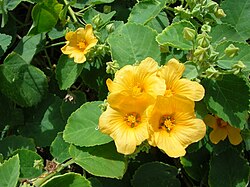
ʻIlima (Sida fallax)
Scientific classification Edit this classification
Kingdom: Plantae
Clade: Tracheophytes
Clade: Angiosperms
Clade: Eudicots
Clade: Rosids
Order: Malvales
Family: Malvaceae
Subfamily: Malvoideae
Tribe: Malveae
Genus: Sida
L.[1]
Species

98-200+, see text

Synonyms[2]
  • Diadesma Raf.
  • Dictyocarpus Wight
  • Fleischeria Steud.
  • Lamarkia Medik.
  • Malvinda Boehm.
  • Pseudomalachra (K.Schum.) Monteiro
  • Side St.-Lag., orth. var.

Sida is a genus of flowering plants in the mallow family, Malvaceae. They are distributed in tropical and subtropical regions worldwide,[3] especially in the Americas.[4] Plants of the genus may be known generally as fanpetals[1] or sidas.[5]

Description

[edit]

These are annual or perennial herbs or shrubs growing up to 2m tall (6 feet). Most species have hairy herbage. The leaf blades are usually unlobed with serrated edges, but may be divided into lobes. They are borne on petioles and have stipules. Flowers are solitary or arranged in inflorescences of various forms. Each has five hairy sepals and five petals in shades of yellow, orange, or white. There are many stamens and a style divided into several branches. The fruit is a disc-shaped schizocarp up to 2 cm (3/4 inch) wide which is divided into five to 12 sections, each containing one seed. The pollens are spherical in shape.

Three pollen grains of a plant in genus Sida

[4][5]

Ecology

[edit]

Many Sida are attractive to butterflies and moths. Arrowleaf sida (Sida rhombifolia), for example, is a larval host for the tropical checkered skipper (Pyrgus oileus).[6]

The Sida golden mosaic virus and Sida golden yellow vein virus have been first isolated from Sida species; the former specifically from Sida santaremensis.

Etymology

[edit]

The genus name Sida is from the Greek for "pomegranate or water lily".[5] Carl Linnaeus adopted the name from the writings of Theophrastus.[4]

Diversity

[edit]

Sida has historically been a wastebasket taxon, including many plants that simply did not fit into other genera of the Malvaceae. Species have been continually reclassified.[3] The circumscription of Sida is still unclear, with no real agreement regarding how many species belong there. Over 1000 names have been placed in the genus, and many authorities accept about 150 to 250 valid names today.[3] Some sources accept as few as 98 species.[7] There are many plants recognized as Sida that have not yet been described to science.[8]

Sida rhombifolia
Sida ciliaris
Sida linifolia

Selected species

[edit]

Plants of the World Online accepts 275 species. They include:[2][1][9]

Formerly placed here

[edit]

Species now in other genera include:[9]

References

[edit]
[edit]
Revisions and contributorsEdit on WikipediaRead on Wikipedia
from Grokipedia
Sida, commonly known as fanpetals, is a of flowering in the mallow family, , comprising about 200–300 of herbs, subshrubs, and shrubs that are primarily distributed in tropical and subtropical regions worldwide, with the majority native to the . These are characterized by simple, often dentate leaves with threadlike to lanceolate stipules, and flowers that are solitary or arranged in racemes or panicles, featuring a corolla that is mostly yellow but occasionally white, orange, or purplish. The fruits are schizocarpic, splitting into 5–14 mericarps, each typically containing one glabrous seed, and the calyx bears 10 prominent veins. Many are common weeds in warm-temperate to tropical areas across the , , , and , and some have traditional uses in for treating conditions such as ulcers, fever, pain, and , while their stems have been utilized for making ropes and nets.

Taxonomy

Etymology

The genus name Sida originates from the term sidē (σίδη), employed by the philosopher and botanist (c. 371–287 BCE) to denote a plant growing in the Nile River, distinct from the (Punica granatum), and likely referring to a marsh-dwelling species such as the white water lily (Nymphaea alba) or a mallow-like herb akin to Althaea. In his Enquiry into Plants, Theophrastus described sidē as an aquatic or semi-aquatic herb, highlighting its ecological niche in wet environments, which contrasted with the pomegranate's drier habitat. Carl Linnaeus first referenced this classical etymology in his Critica Botanica (1737), crediting Theophrastus as the originator of Sida and interpreting it as a name for Nymphaea alba, while noting the boldness of repurposing it for unrelated taxa. Linnaeus formally established the genus Sida within the mallow family in Species Plantarum (1753), applying the name to New World herbs with stellate hairs and schizocarpic fruits, thereby bridging ancient Greek natural history with Linnaean binomial nomenclature. In contemporary , the underscores the enduring influence of Theophrastus's observations on flexible-stemmed, wetland-adapted , though modern interpretations emphasize the name's transfer to based on morphological analogies rather than direct lineage from the original sidē. This adoption reflects Linnaeus's practice of reviving classical terms to foster a standardized, historically informed of .

Taxonomic history

The genus Sida was first described by in his in 1753, where he included 12 species based primarily on collections, establishing the foundational concept of the within the mallow family (). Subsequent expansions in the 18th and 19th centuries incorporated additional tropical and subtropical species, reflecting growing botanical explorations, though early delimitations were broad and included taxa now recognized in other genera. Within , Sida is placed in the subfamily and Malveae, with key diagnostic traits including schizocarpic fruits composed of 5–14 indehiscent mericarps that are typically reticulate and glabrous or hairy, often with apical differentiation or spines in some species. These morphological features, particularly the fruit structure and capitate stigmas on 5–14-branched styles, have been central to delimitation since early classifications. Major taxonomic revisions began in the mid-20th century, notably through the work of Paul A. Fryxell, who in 1978 segregated several Neotropical species from Sida into new genera such as Sidastrum and Pseudabutilon based on morphological differences like leaf venation and fruit wall persistence, refining the genus to emphasize more homogeneous groups. Further refinements occurred in the 1980s and 1990s, with Fryxell describing sections like Ellipticifoliae and treating North and Central American species, transferring others to Abutilon due to overlapping traits such as stellate pubescence and seed characteristics. Post-2000 phylogenetic analyses using nrDNA ITS sequences confirmed a core Sida clade while supporting additional segregations, such as species moved to Dendrosida, and highlighted polyphyly in traditional circumscriptions, leading to ongoing adjustments in generic boundaries. Currently, estimates of the number of species in Sida range from about 200 to 275 worldwide, though figures vary due to regional synonymy and unresolved complexes, with (POWO) accepting 275 (updated to 276 as of 2025) and ongoing resolutions such as new synonyms in Brazilian taxa. For instance, the of recognizes 19 species in north of , reflecting conservative delimitation informed by both morphology and molecular data.

Description

Morphology

Species of the genus Sida exhibit diverse growth habits, ranging from annual or herbs to subshrubs and shrubs reaching up to 2 m in height, often developing woody bases that render them suffruticose. These are typically erect, ascending, or procumbent, with stems that vary from glabrous to densely covered in stellate hairs, and occasionally viscid due to glandular secretions. Leaves in Sida are simple and alternate, generally lanceolate to rhomboid in shape, measuring 1–10 cm in length, with serrate or dentate margins and surfaces pubescent with stellate hairs. Stipules are threadlike to subulate, persistent or caducous, while petioles are about 1/10 to 1/2 the length of the leaf blade, with bases truncate to cuneate and apices acute to acuminate. The inflorescence consists of solitary or cymose axillary flowers, occasionally forming short racemes or panicles. Flowers feature five sepals fused at the base into a campanulate, often 10-ribbed calyx 4–8 mm long, and five free obovate petals that are yellow to orange, 4–10 mm long, resulting in a corolla of 1–2 cm. The androecium forms a pubescent or glabrous staminal column 3–6 mm long with numerous filaments and reniform anthers, while the includes a 5–14-loculed with capitate stigmas on 5–14 style branches. Fruits are schizocarpic, disk-shaped or globose, splitting into 5–14 mericarps that are 2–3 mm long, often reticulate, tuberculate, beaked, or with apical awns, and sometimes spiny or winged. Each mericarp typically contains 1 reniform , 1–1.5 mm long, that is brown, glabrous or puberulent, and occasionally with minute hairs near the hilum.

Reproduction

Sida species exhibit varied flowering depending on climatic conditions and geographic location, as exemplified by S. cordifolia. In tropical regions, such as parts of , flowering occurs year-round with peaks during –April and –September, coinciding with favorable temperatures of 11.8–38.3°C. In subtropical or seasonal environments, flowering is more restricted, typically from to following rains in , and ceasing by or . The flowers are hermaphroditic and actinomorphic, with self-compatibility facilitated by mechanisms like delayed autonomous selfing through style curling and bending. Pollination in Sida is primarily entomophilous, with bees such as Apis species and Trigona iridipennis serving as key pollinators by collecting pollen and nectar, as observed in S. cordifolia. Other insects, including wasps and butterflies from families like Pieridae and Nymphalidae, contribute by foraging for nectar. Floral rewards include traces of nectar and abundant pollen, which contains essential amino acids and has a pollen-ovule ratio around 190:1. Self-pollination also occurs, often aided by rain or autonomous floral movements, ensuring reproductive assurance in low-pollinator conditions. Fruit development follows rapidly, with schizocarps forming and maturing in 7–12 days. These fruits dehisce loculicidally at maturity into 5–14 mericarps, each containing a single , typically during –February in seasonal climates or year-round in . Dispersal is achieved through multiple vectors: via lightweight, wedge-shaped with awns; adhesion to animals or humans by spines and hairs on the mericarps; and water or rain splash. This combination promotes effective spread in disturbed habitats. Sida seeds are orthodox, capable of long-term storage under dry conditions, but often exhibit physical due to impermeable seed coats. is broken through after-ripening over 4–6 weeks, , or exposure to alternating wet-dry cycles in for several months, leading to increased permeability. Viable seeds progressively lose over 1–2 years in the , with rates up to 10–70% under optimal conditions, particularly in disturbed soils where and trigger emergence post-monsoon or rains.

Distribution and ecology

Geographic distribution

The genus Sida is native primarily to the Neotropics, encompassing tropical and subtropical regions from southward to , where the majority of its species occur. This region hosts over 189 species (as of 2020), representing the core center of diversity for the within the family. Secondary native ranges extend to (from to , including ) and (including , , and ), though these areas support fewer species compared to the . Patterns of are particularly high in and , underscoring these countries as key hotspots for Sida diversity. In , numerous endemic species have been documented, with ongoing discoveries affirming its status as a major center of native variation; for instance, the state of alone records 23 species. similarly exhibits significant diversity, with 38 species reported, many restricted to its varied terrains. Overall, the genus includes 200–275 accepted species worldwide, with the majority concentrated in the according to recent taxonomic assessments. Recent discoveries, such as Sida penambangensis in (2024), highlight continued taxonomic updates. Beyond native ranges, Sida species have been widely introduced to and subtropical zones through human-mediated dispersal, establishing populations in , Pacific islands, and parts of such as the , , and . Species like are particularly widespread as weeds in these introduced areas, thriving in disturbed habitats across the globe. Historical records indicate early introductions dating to the , often facilitated by maritime trade and human activities, such as the use of S. acuta for ship deck cleaning in regions like .

Habitat preferences

Species of the genus Sida predominantly inhabit disturbed environments, including roadsides, fields, waste places, and urban margins, where they function as ruderal capable of rapid colonization following human-induced disturbances. These are well-adapted to a variety of types, tolerating nutrient-poor, sandy, or clay substrates with varying drainage, though they perform best in well-drained conditions. Sida species are primarily found in tropical and subtropical climates, extending into warm temperate zones, with a preference for regions experiencing seasonal rainfall between 700 and 2000 mm annually. In warmer areas, many species grow as perennials or shrubs, while in cooler temperate extensions, they often behave as annuals, completing their life cycle within a single growing season. Ecologically, Sida plants are associated with open habitats such as grasslands, savannas, and forest edges, where they contribute to early successional stages by stabilizing soils in disturbed sites. However, their competitive growth in agricultural settings positions them as problematic weeds, often reducing yields in pastures, fields, and orchards through resource .

Diversity

Accepted species

The genus Sida comprises approximately 200–250 accepted , with recent estimates reaching up to 275 based on comprehensive global inventories as of 2025. These are primarily herbs or subshrubs distributed in tropical and subtropical regions, and their acceptance is determined through a combination of morphological traits—such as leaf shape, mericarp features, and indumentum—and molecular data from phylogenies that confirm the of the core Sida . Post-2010 molecular studies, including genome analyses, have further refined species boundaries by resolving polyphyletic elements and supporting the exclusion of certain previously included in the genus. Recent additions, such as Sida antonioi (2025) and Sida sivarajanii (2020), continue to update the genus diversity. Regional diversity varies significantly; for instance, the Flora of recognizes 19 across north of , many of which are introduced or weedy. In , a major center of diversity, over 100 are documented, with recent additions like Sida uniaristata contributing to this count. Notable accepted include Sida rhombifolia L., a weed known as common wireweed, characterized by rhomboid leaves and prickly fruits, widely distributed in disturbed habitats. Sida acuta Burm.f., or broomweed, is a slender annual with acute leaves and medicinal uses in traditional systems, native to the but naturalized globally. Sida cordifolia L., country mallow, features cordate leaves and is native to , often utilized for its fibers and alkaloids. Infrageneric classification employs informal sections based on morphological and phylogenetic , such as Sida . Sida, which includes with stellate pubescence and dehiscent mericarps like S. rhombifolia. Other sections, like Sida . Ellipticifoliae, encompass elliptic-leaved taxa resolved through ITS sequence data. These groupings aid in navigating the genus's taxonomic complexity without formal subgeneric ranks.

Formerly placed species

Over the course of the , numerous species previously classified within the genus Sida were reclassified into other genera based on detailed morphological and molecular analyses, refining the taxonomic boundaries of Sida to encompass more homogeneous groups. A pivotal contribution was Paul A. Fryxell's 1978 study on neotropical segregates, which transferred several species out of Sida into three distinct genera—Sidastrum (enlarged from one to seven species), the newly described Krapovickasia (four species), and Rhynchosida (two species)—primarily due to differences in mericarp structure (e.g., shape, dehiscence patterns, and surface features) and calyx morphology that distinguished them from the core Sida . Representative transfers include Sida paniculata L. to Sidastrum paniculatum (L.) Fryxell and Sida multiflora Jacq. to Sidastrum multiflorum (Jacq.) Fryxell, where the mericarps exhibit a more rounded, non-beaked form and the calyces show reduced ribbing compared to typical Sida species. Fryxell's subsequent 1988 monograph on the Malvaceae of Mexico further advanced these revisions by examining fruit dehiscence, stamen column characteristics, and pollen traits, leading to the exclusion of approximately 20–30 additional species from Sida since the 1950s, often to genera like Abutilon or Malvella based on divergent schizocarpic fruit segmentation and filament fusion patterns. For instance, species such as Sida malviflora DC. were reclassified as Sidalcea malviflora (DC.) A. Gray due to differences in carpel number and mericarp indumentum that aligned them more closely with Sidalcea. More recently, in 2022, Sida hermaphrodita (L.) Rusby was transferred to the monotypic genus Ripariosida hermaphrodita (L.) Weakley & D.B.Poind. based on phylogenetic analyses, recognizing its distinct evolutionary lineage as a tall perennial endemic to the eastern United States. These morphological distinctions helped address the historical "wastebasket" status of Sida, which once included over 250 species but has been streamlined through such targeted revisions. Molecular evidence from nrDNA ITS sequences has corroborated these reclassifications, demonstrating that segregate genera like Sidastrum and Krapovickasia form distinct clades separate from the monophyletic core Sida, which is supported by shared synapomorphies in exine and wall structure. For example, Krapovickasia physaloides (C. Presl) Fryxell, formerly Sida physalodes C. Presl, clusters outside Sida due to unique ITS motifs reflecting divergent evolutionary histories. Overall, these transfers—totaling dozens since mid-century—have stabilized Sida's boundaries at around 250 accepted species today, though some former names persist as (e.g., Sida filicaulis & A. Gray as a of Sida abutilifolia Mill.) or involve hybrid origins requiring ongoing clarification.

Uses

Medicinal applications

Species of the genus Sida have been utilized in across various cultures for their purported health benefits, particularly for anti-inflammatory, analgesic, and diuretic effects. In , Sida cordifolia (known as bala) is revered as a or rejuvenative tonic, employed to enhance strength, vitality, and neuromuscular function, and to treat conditions such as , , fever, and urinary disorders. In African folk medicine, particularly in regions like and , species such as and are used to alleviate , , , and respiratory ailments, often as decoctions or poultices. Similarly, in Latin American traditional practices, including in , Sida plants serve as remedies for gastrointestinal infections, fevers, and inflammatory conditions, reflecting their broad ethnopharmacological role in indigenous healing systems. Phytochemical analyses have identified several bioactive compounds in Sida species that underpin these traditional applications, including alkaloids such as ephedrine-like compounds (e.g., in S. cordifolia), like and , and contributing to immunomodulatory effects. For instance, S. acuta contains cryptolepine and rhombifoliamide, derivatives with potential and antimalarial properties. These compounds, along with phenolics such as rosmarinic acid in S. cordifolia and in S. acuta, are linked to and activities observed in extracts. Pharmacological investigations, primarily in vitro and in vivo, support several traditional uses of Sida species. Studies demonstrate analgesic effects in S. cordifolia and S. acuta through inhibition of nociceptive responses in rodent models, aligning with their folk use for pain relief. Antimicrobial activity has been confirmed against bacteria like Staphylococcus aureus and fungi such as Candida albicans in extracts of S. acuta and S. rhombifolia. Hypotensive properties are evident in S. rhombifolia, where vasorelaxant effects reduce via flavonoid-mediated mechanisms. Additionally, antimalarial efficacy is reported for S. acuta and S. linifolia, with rhombifoliamide showing antiplasmodial activity against Plasmodium species in preliminary assays. Ethnopharmacological reviews from the 2020s highlight these findings but emphasize the need for more standardized clinical trials to validate . Regarding safety, Sida species generally exhibit low , with oral LD50 values of 3.2 g/kg and 3.4 g/kg in rats for S. acuta and S. cordifolia, respectively; similar low is reported for S. rhombifolia with LD50 >5 g/kg in separate studies, indicating at traditional doses. Due to its content, S. cordifolia has been banned from use in dietary supplements by the FDA since 2004, as it presents an unreasonable risk of illness or injury. However, subchronic administration (e.g., 200 mg/kg for 28 days) of aqueous acetone extracts from S. acuta and S. cordifolia causes mild , evidenced by elevated liver enzymes (AST, ALT) and reduced body weight, alongside hematological changes like decreased . Alkaloids with -like structures may pose risks of cardiac stimulation or at high doses, though no significant heart weight alterations were observed in studies. Only a limited number of (three out of approximately 200) have undergone assessments, underscoring substantial research gaps in long-term and clinical validation.

Other uses

Species of the genus Sida are valued for their strong, cellulose-rich fibers, particularly from stems of S. rhombifolia and S. cordifolia, which have been cultivated in for centuries and are comparable to in quality. These fibers, containing approximately 75% , 15% , and 7% , are extracted via methods like boiling water or the and used to produce ropes, cordage, lines, nets, brooms, sacking, and biodegradable handmade suitable for or filters. In regions like and , S. rhombifolia fibers support eco-friendly s and composites, with tensile strength enhanced up to fourfold through additives like glues. Additionally, S. glutinosa provides textile fibers, while S. mysorensis fibers reinforce polymeric materials. Taller Sida species are employed in landscaping for their attractive foliage and yellow-to-orange flowers, which draw pollinators like bees and butterflies, serving as screens or accent plants in garden beds. Certain species, such as S. cordifolia, function as forage plants for livestock and raw material for insulation. S. hyssopifolia is used as animal feed, and S. linifolia aids in phytoremediation by accumulating nickel in metal-contaminated soils. Archaeological evidence from Brazilian coprolites dated 8,500–7,000 BP indicates high Sida pollen concentrations likely reflect intentional non-medicinal consumption, possibly dietary.

References

Add your contribution
Related Hubs
User Avatar
No comments yet.