Hubbry Logo
Flathead engineFlathead engineMain
Open search
Flathead engine
Community hub
Flathead engine
logo
8 pages, 0 posts
0 subscribers
Be the first to start a discussion here.
Flathead engine
Flathead engine
from Wikipedia

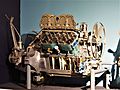
A crossflow T-head sidevalve engine
The usual L-head arrangement
Pop-up pistons may be used to increase compression ratio
Flathead with Ricardo's turbulent head

A flathead engine, also known as a sidevalve engine[1][2] or valve-in-block engine, is an internal combustion engine with its poppet valves contained within the engine block, instead of in the cylinder head, as in an overhead valve engine.

Flatheads were widely used internationally by automobile manufacturers from the late 1890s until the mid-1960s[3] but were replaced by more efficient overhead valve and overhead camshaft engines. They are currently experiencing a revival in low-revving aero-engines such as the D-Motor.[4]

The side-valve design

[edit]

The valve gear comprises a camshaft sited low in the cylinder block which operates the poppet valves via tappets and short pushrods (or sometimes with no pushrods at all). The flathead system obviates the need for further valvetrain components such as lengthy pushrods, rocker arms, overhead valves or overhead camshafts.[5] The sidevalves are typically adjacent, sited on one side of the cylinder(s), though some flatheads employ the less common "crossflow" "T-head" variant. In a T-head engine, the exhaust gases leave on the opposite side of the cylinder from the intake valve.

The sidevalve engine's combustion chamber is not above the piston (as in an OHV (overhead valve) engine) but to the side, above the valves. The spark plug may be sited over the piston (as in an OHV engine) or above the valves; but aircraft designs with two plugs per cylinder may use either or both positions.[6]

"Pop-up pistons" may be used with compatible heads to increase compression ratio and improve the combustion chamber's shape to prevent knocking.[7] "Pop-up" pistons are so called because, at top dead centre, they protrude above the top of the cylinder block.

Advantages

[edit]

The advantages of a sidevalve engine include: simplicity, reliability, low part count, low cost, low weight, compactness, responsive low-speed power, low mechanical engine noise, and insensitivity to low-octane fuel. The absence of a complicated valvetrain allows a compact engine that is cheap to manufacture, since the cylinder head may be little more than a simple metal casting. These advantages explain why side valve engines were used for passenger cars for many years, while OHV designs came to be specified only for high-performance applications such as aircraft, luxury cars, sports cars, and some motorcycles.[citation needed]

At top dead centre, the piston gets very close to the flat portion of the cylinder head above, and the resultant squish turbulence produces excellent fuel/air mixing. A feature of the sidevalve design (particularly beneficial for an aero-engine) is that if a valve should seize in its guide and remain partially open, the piston would not be damaged, and the engine would continue operating safely on its other cylinders.[citation needed]

Disadvantages

[edit]

The main disadvantages of a sidevalve engine are poor gas flow, poor combustion chamber shape, and low compression ratio, all of which result in a low-revving engine with low power output[8] and low efficiency.[9] Because sidevalve engines do not burn the fuel efficiently, they suffer from high hydrocarbon emissions.[10]

Sidevalve engines can only be used for engines operating on the Otto principle. The combustion chamber shape is unsuitable for Diesel engines,[11] which require a high compression ratio for ignition to occur.

In a sidevalve engine, intake and exhaust gases follow a circuitous route, with low volumetric efficiency, or "poor breathing", not least because the exhaust gases interfere with the incoming charge. Because the exhaust follows a lengthy path to leave the engine, there is a tendency for the engine to overheat. (Note: this is true for V-type flathead engines but less of an issue for inline engines which typically have the intake and exhaust ports on the same side of the engine block.) Although a sidevalve engine can safely operate at high speed, its volumetric efficiency swiftly deteriorates, so that high power outputs are not feasible at speed. High volumetric efficiency was less important for early cars because their engines rarely sustained extended high speeds, but designers seeking higher power outputs had to abandon the sidevalve. A compromise used by the Willys Jeep, Rover, Land Rover, and Rolls-Royce in the 1950s was the "F-head" (or "intake-over-exhaust" valving), which has one sidevalve and one overhead valve per cylinder.[12]

The flathead's elongated combustion chamber is prone to preignition (or "knocking") if compression ratio is increased, but improvements such as laser ignition or microwave enhanced ignition might help prevent knocking.[13] Turbulence grooves may increase swirl inside the combustion chamber, thus increasing torque, especially at low rpm. Better mixing of the fuel/air charge improves combustion and helps to prevent knocking.[14][15][16][17]

An advance in flathead technology resulted from experimentation in the 1920s by Sir Harry Ricardo, who improved their efficiency after studying the gas-flow characteristics of sidevalve engines.[18][9][clarification needed]

The difficulty in designing a high-compression-ratio flathead means that most tend to be spark-ignition designs, and flathead diesels are virtually unknown.

History and applications

[edit]

The sidevalve arrangement was especially common in the United States and used for motor vehicle engines, even for engines with high specific power output.[11] Sidevalve designs are still common for many small single-cylinder or twin-cylinder engines, such as lawnmowers, rotavators, two-wheel tractors and other basic farm machinery.[citation needed]

Flathead cars

[edit]

Multicylinder flathead engines were used for cars such as the Ford Model T and Ford Model A, the Ford flathead V8 engine and the Ford Sidevalve engine. Cadillac produced V-16 flathead engines for their Series 90 luxury cars from 1938 to 1940.[19] Packard and Pontiac produced flathead inline 8-cylinder engines until 1954. Also in the British Morris Eight, and Morris Minor series I.

After WWII, flathead designs began to be superseded by OHV (overhead valve) designs. Flatheads were no longer common in cars, but they continued in more rudimentary vehicles such as off-road military Jeeps. In US custom car and hot rod circles, restored examples of early Ford flathead V8s are still seen.[1][20]

Flathead aero-engines

[edit]

The simplicity, lightness, compactness and reliability might seem ideal for an aero-engine, but because of their low efficiency, early flathead engines were deemed unsuitable. Two notable exceptions were the American Aeronca E-107 opposed twin aero engine of 1930 and the Continental A40 flat four of 1931, which became one of the most popular light aircraft engines of the 1930s. Two modern flatheads are the Belgian D-Motor flat-fours and flat-sixes.[21] These are extremely oversquare and compact aero-engines with direct drive to a propeller.[22][23]

Flathead motorcycles

[edit]

Flathead designs have been used on a number of early pre-war motorcycles, in particular US V-twins such as Harley-Davidson and Indian, some British singles, BMW flat twins and Russian copies thereof.[24] The Cleveland Motorcycle Manufacturing Company produced a T-head four-cylinder in-line motorcycle engine in the 1920s.

See also

[edit]

Notes

[edit]
[edit]
Revisions and contributorsEdit on WikipediaRead on Wikipedia
from Grokipedia
The flathead engine, also known as a side-valve or L-head engine, is an design in which the poppet valves are positioned within the adjacent to the cylinders, rather than in the overhead , allowing for a simpler, more compact, and cost-effective construction. This configuration features a flat surface without valve provisions, hence the name, and relies on the block's side chambers for operation, which directs the and exhaust flows through passages in the head. The design's key technical advantage lies in its mechanical simplicity, with fewer moving parts like a single in the block driving the valves via pushrods and rockers, enabling lighter weight and easier manufacturing compared to overhead-valve (OHV) engines. However, it suffers from inherent disadvantages, including restricted airflow due to the tortuous valve paths, lower compression ratios (typically 5.5:1 to 7.5:1), and a propensity for hot spots in the that can lead to and reduced efficiency. Widely employed in automotive applications from the late 1890s through the mid-1960s, flathead engines powered a diverse range of vehicles before being largely supplanted by more efficient OHV designs that offered better breathing and higher power outputs. The most iconic implementation was Ford's Flathead V8, introduced on March 9, 1932, as the first mass-produced, affordable V8 engine, featuring a 90-degree cast-iron block with a 221-cubic-inch (3.6 L) displacement and 65 horsepower at 3,400 rpm from a 5.5:1 compression ratio. This engine revolutionized the industry by democratizing V8 performance during the Great Depression, with production exceeding 10 million units by 1953 in the U.S., including evolved variants like the 239-cubic-inch (3.9 L) version producing up to 110 horsepower by 1953, and larger truck-oriented models such as the 337-cubic-inch (5.5 L) unit delivering 152 horsepower in Lincoln applications from 1948 to 1951. Innovations during its run included the shift to insert-type main bearings in 1936 for durability, 24-stud cylinder heads in 1938 for better sealing, and water pump integrations for improved cooling, though the core side-valve architecture remained unchanged. Beyond Ford, flathead principles influenced engines in other marques, such as Chrysler's 1932-1952 straight-eight and various pre-war European designs, but the Ford Flathead's legacy endures in hot rodding culture due to its tunability—aftermarket modifications like aluminum heads, dual carburetors, and superchargers could boost output to over 200 horsepower—while its reliability made it a staple in trucks and daily drivers until overhead-valve V8s dominated post-World War II. Production continued internationally into the in some markets, but by the , advancements in fuel quality and casting techniques favored OHV engines for superior power density and efficiency, rendering the flathead obsolete in mainstream automotive use.

Design and Operation

Side-Valve Configuration

The side-valve configuration, also known as the L-head design, positions the and exhaust valves within the directly adjacent to the cylinders, rather than in the as in overhead valve systems. This layout forms an "L" shape relative to the , with the valves mounted laterally alongside the cylinder bores, allowing the to remain flat and simple. The design integrates valve seats and ports into the block itself, which extends to one side of the bores to accommodate these components. In operation, a located within the actuates the through an indirect mechanism involving pushrods and rocker arms. The cam lobes push the tappets upward, transmitting motion via the pushrods to the rocker arms, which in turn pivot to force the valve stems downward, opening the into the . Springs return the valves to their closed position. The is formed by the flat sealing the top of the cylinder, combined with recesses in the block around the valve heads and the crown, creating a compact, wedge-like space that minimizes the distance for flame travel but increases surface-to-volume ratios. This configuration was particularly suited for early due to its simpler machining requirements in the pre-CNC era, as the valves and ports could be milled directly into the block without complex head castings or overhead assemblies, reducing overall part count and assembly complexity. is dictated by the profile, with valves typically opening 10-25° before top dead center and closing 40-60° after bottom dead center, while exhaust valves open 40-70° before bottom dead center and close 5-15° after top dead center, facilitating basic four-stroke cycling. Airflow paths in side-valve engines are unique due to the lateral valve placement, where intake air enters horizontally through ports in the block, forming a conical jet that shears against the walls to generate , though with limited swirl or tumble compared to overhead designs. Exhaust gases similarly exit sideways, often requiring separate manifolds bolted to the block side, which can create longer, more tortuous paths that restrict . For visualization, the intake flow can be imagined as a radial and axial profile peaking at about 10 times the near the curtain, promoting mixing but at the cost of directional control.

Key Construction Elements

The flathead engine's is typically constructed from , providing durability and the structural integrity necessary to house the side-mounted valves and their operating mechanisms directly within the block. This design incorporates integral valve chambers adjacent to the cylinders, allowing the poppet valves to open into the space without overhead components, while jackets for cooling are cast directly into the block to circulate coolant around the cylinders and valve areas. The features a simple, flat milled surface that bolts directly onto the , serving primarily as a cover for the cylinders and chambers with no integrated ports, valves, or complex overhead structures. This non-complex construction minimizes weight and complexity, relying on the block for all integration and airflow routing. Crankshaft and piston arrangements in flathead engines commonly adopt inline-four, inline-six, or V8 configurations, with the supported by main bearings housed within the block for stability and alignment. Piston movement is facilitated by connecting rods that articulate via bearings integrated into the block's lubrication system, which directs oil through drilled passages from the main oil gallery to the journals, rod bearings, and for splash and pressure feed. A distinctive aspect of flathead involves heat dissipation challenges arising from the proximity of valves and exhaust passages to the passages within the block, where hot exhaust gases can transfer directly to the circulating , potentially elevating overall temperatures. This integrated layout, while compact, requires careful flow management to mitigate localized overheating near the valve seats.

Performance Attributes

Operational Advantages

The flathead engine's side-valve configuration contributes to its operational simplicity through a reduced number of components compared to overhead designs, with a single in the block driving the valves via pushrods and rocker arms without the need for an overhead . This integrates multiple functions into a single deep-skirted cylinder block casting that houses the cylinders, , oil galleries, and water jackets, minimizing assembly complexity and easing both manufacturing and maintenance processes. In terms of cost and weight efficiency, the flathead's compact head design and fewer parts made it cheaper to produce in high volumes, with early models like the V8 priced between $460 and $650—equivalent to roughly $10,000 to $14,000 in modern terms—while being lighter overall than comparable inline-six engines from competitors. This economic advantage stemmed from simplified machining requirements and material savings, allowing widespread adoption in mass-market vehicles without compromising basic functionality. Flathead engines excel in delivering strong low-speed torque, making them particularly suitable for applications involving heavy loads or low-RPM operation, where their responsive power delivery provides effective pulling capability without requiring high revs. Their inherent reliability further enhances this suitability, as the robust construction tolerates contaminants like dirt or poor fuel quality, enabling sustained operation even under suboptimal conditions such as in rugged environments. As one expert noted, "Flatheads’ll run with dirt in them, they’ll run on six cylinders, they’ll run with sy spark, they’ll run with sy gas," underscoring their durability for demanding, low-maintenance use. Additionally, the side-valve arrangement promotes quiet operation by positioning valves within the block, which dampens mechanical noise during running, especially after extended service, contributing to smoother and less intrusive performance compared to noisier overhead designs of the . This layout also facilitates ease of repair, as valves are accessible from the side without necessitating full engine disassembly, allowing straightforward field adjustments or fixes that support ongoing reliability in practical settings. The overall cheapness in manufacture reinforced these traits, as highlighted in early engineering analyses.

Inherent Limitations

One of the primary inherent limitations of the flathead engine stems from its side-valve configuration, where the valves are positioned in the rather than the . This placement results in circuitous and exhaust paths, often involving sharp 90-degree turns, which severely restrict airflow and reduce . At higher RPMs, these inefficiencies become pronounced, limiting the engine's ability to draw in a full air-fuel charge and expel exhaust gases effectively, thereby capping power development and responsiveness. The flathead design also imposes significant constraints on compression ratios, typically restricting them to 6:1 to 7:1 to avoid valve pocket interference with the piston and mitigate detonation risks. Higher ratios, such as the rare 8.7:1 seen in some experimental setups, lead to combustion roughness and further airflow impediments due to reduced valve-to-piston clearance. This limitation prevents the engine from fully leveraging higher-octane fuels, which became more available after World War II, and contributes to lower overall thermal efficiency compared to contemporary designs. Thermal management presents another critical shortcoming, as the chambers and valves are integrated into the block adjacent to passages. This proximity causes excessive rejection from the large surface area of the shallow chambers, resulting in uneven heating across components and approximately 20% lower than overhead-valve (OHV) engines of similar displacement. Exhaust valves, in particular, are prone to overheating because they operate in the hotter block environment without the direct cooling benefits afforded by head-mounted valves, exacerbating wear and potential failure under load. These factors culminate in a low power ceiling for flathead engines, making it difficult to achieve outputs comparable to modern standards without extensive modifications. In direct comparisons, flathead designs exhibit 20-30% less efficiency than equivalent OHV engines, primarily due to the combined effects of poor , constrained compression, and losses, which hinder high-RPM performance and fuel economy.

Historical

Origins and Early Development

The flathead engine, also known as the side-valve engine, originated in the late as internal combustion technology transitioned from stationary applications to mobile power sources in . Early concepts drew from the four-stroke cycle patented by Nikolaus Otto in 1876, with pioneers and developing a compact 100 cc single-cylinder in 1883 that ran at 600 rpm using hot-tube ignition and a float-fed . This design laid the groundwork for side-valve configurations, where valves were positioned in the engine block adjacent to the cylinders to simplify construction and reduce height compared to emerging overhead-valve alternatives. By the 1890s, side-valve engines were popularized in early automobiles by innovators like Daimler, whose high-speed engines powered licensed vehicles from manufacturers such as & Levassor starting in 1891. For instance, the 1896 & Levassor Wagonette featured a two-cylinder V-engine with an atmospheric overhead inlet valve and side-mounted exhaust valve, exemplifying the hybrid yet practical side-valve approach that balanced simplicity with functionality in the era's rudimentary designs. These engines emphasized reliability over performance, with displacements around 883 cc producing modest outputs of 3.5 hp at 700 rpm, enabling the first viable horseless carriages. Prior to widespread automotive adoption, side-valve engines dominated stationary and industrial sectors due to their robust, low-maintenance construction, powering generators, pumps, and machinery built between 1890 and 1920. Their valve-in-block layout minimized parts count and facilitated easy access, making them ideal for non-mobile uses where overhead mechanisms would have added unnecessary complexity. Key figures like Charles Yale Knight contributed to parallel developments in the early 1900s by inventing the sleeve-valve engine in 1905 as a quieter alternative to the noisy poppet valves in side-valve designs, influencing refinement efforts but ultimately reinforcing the flathead's prevalence through contrast. The transition to vehicular applications accelerated in the 1910s, with inline-four side-valve engines becoming standard in mass-produced cars, such as the introduced in 1908, which used a flathead design for its affordability and durability. Technical milestones included the shift from experimental prototypes to scalable production by the 1920s, exemplified by Chrysler's 1924 flathead six-cylinder engine developed by Fred Zeder, Owen Skelton, and Carl Breer, which prioritized valve-in-block simplicity over more complex overhead alternatives like sleeve-valves. This evolution established the flathead as a cornerstone of early , bridging industrial roots with vehicular mobility.

Mid-20th Century Dominance and Decline

The introduction of the Ford Flathead V8 in 1932 marked a pivotal breakthrough in affordable high-performance engines, featuring a 221 cubic-inch displacement that delivered 65 horsepower at 3,400 rpm. This engine powered the 1932 Ford Model 18, enabling mass-market access to V8 performance and quickly becoming a cornerstone of American automotive culture. By 1935, Ford had upgraded the design for improved efficiency, boosting output to 85 horsepower while maintaining its side-valve simplicity. These enhancements propelled the engine's adoption, with millions of units installed in Ford vehicles over the subsequent decades, transforming the industry by democratizing V8 power. Flathead engines, including Ford's V8 and various inline designs, proliferated globally during the mid-20th century, adopted by major manufacturers like (e.g., Pontiac's flathead inline-six through the 1950s) and for their cost-effectiveness and reliability. 's flathead six powered vehicles and trucks into the post-war era. European producers licensed Ford's V8 design, with in building versions for cars and military applications through and beyond. Post-war, flatheads persisted in economy cars, trucks, and utilitarian vehicles until the mid-1950s, supporting reconstruction efforts and everyday transportation worldwide. The dominance of flathead engines waned in the 1950s as overhead-valve (OHV) technologies advanced, offering superior power and efficiency that outpaced side-valve limitations in combustion and cooling. Chevrolet's 1955 small-block V8, with 265 cubic inches and up to 162 horsepower, exemplified this shift, delivering higher performance in a compact package and accelerating the transition across the industry. Emerging emissions regulations and consumer demands for greater horsepower further marginalized flatheads, rendering them obsolete for automotive use by the late 1950s. Ford produced over 10 million Flathead V8 units by 1953, underscoring their massive scale before American automotive production ended that year. While passenger car applications faded, flathead variants lingered in marine and industrial roles into the 1960s, valued for durability in non-performance contexts like boats and generators.

Major Applications

Automotive Implementations

The flathead engine found widespread application in passenger cars during the early 20th century, particularly in Ford's iconic models. The Ford Model A (1927–1931) utilized a 201 cubic-inch inline-four flathead engine producing 40 horsepower, emphasizing affordability and simplicity for mass-market appeal. The subsequent Model B (1932–1934) retained a similar inline-four flathead configuration, delivering around 50 horsepower while bridging the transition to V8 powertrains. Beginning in 1932, Ford introduced its revolutionary 221 cubic-inch V8 flathead in the Model 18, which became a cornerstone for hot rodding through 1953, with enthusiasts modifying these engines for enhanced performance in custom builds due to their compact design and availability of surplus parts post-World War II. Mercury and Lincoln variants expanded the flathead's role in higher-end automotive implementations. Mercury models from onward featured a bored-out 239 cubic-inch version of the Ford V8 flathead, later increased to 255 cubic inches by 1946, providing smoother operation and greater torque for mid-range luxury sedans. Lincoln adopted an even larger 337 cubic-inch flathead V8 in the 1948–1953 lineup, offering up to 152 horsepower in a more refined package suited to premium vehicles, though its side-valve layout limited high-revving potential compared to emerging overhead-valve competitors. In trucks and commercial vehicles, flathead engines were prized for their durability and low maintenance in demanding 1930s–1940s applications. Dodge's Job-Rated T, V, and W series trucks (1939–1947) employed Plymouth-derived flathead inline-six engines, such as the 201 cubic-inch unit producing 82 horsepower, which excelled in heavy-hauling tasks due to robust construction and reliable delivery. International Harvester's K and KB series (1940s) similarly relied on flathead sixes, including the 214 cubic-inch Green Diamond engine rated at 82 horsepower, which powered pickups and panel trucks through postwar economic recovery, valued for their longevity in fleet operations. Postwar economy models like the Willys CJ-2 and CJ-3 (1945–1953) used the 134 cubic-inch L-head "Go Devil" flathead four-cylinder, generating 60 horsepower and enabling versatile off-road utility in civilian and agricultural roles. Flathead engines left a lasting legacy in racing, particularly through modifications that transformed stock units into competitive powerplants. In the 1940s, hot rodders at dry lakes like El Mirage and Muroc employed modified Ford V8 flatheads for speed trials, achieving over 150 miles per hour in rail jobs and lakesters by optimizing and . Early drag and saw similar adaptations, with aftermarket cylinder heads improving airflow to boost output from the baseline 85 horsepower to around 150 horsepower naturally aspirated, while superchargers like the Weiand unit pushed figures beyond 200 horsepower in period competitions. Regional variations highlighted the flathead's global adaptability. In Europe, Riley automobiles of the 1920s featured side-valve inline-four flathead engines in models like the , delivering 40–50 horsepower for sporting saloons and tourers prized for their agile handling. Citroën's prewar lineup, including the Type A 10HP (1919–1922), incorporated flathead inline-four engines producing about 15 horsepower, supporting the brand's early emphasis on innovative design in cars. In Asia, prewar Japanese vehicles adopted flathead technology; Datsun's early 1930s models used 860 cubic-centimeter flathead fours yielding 25 horsepower, influencing lightweight passenger cars and influencing postwar miniaturization trends.

Aviation and Motorcycle Uses

In aviation, flathead engines found niche applications in early to mid-20th century light aircraft, where their simple construction facilitated adaptations for power-to-weight optimization. The Church V-8, developed in the late 1930s from the Ford flathead V8, was an air-cooled 4-stroke engine producing 93 hp at 2,900 rpm, used in experimental and homebuilt planes for its affordability and reliability in low-RPM propeller drive. Similarly, the Menasco M-50, a 50 hp side-valve flat-four introduced in 1937, powered light planes like the Rearwin Speedster, emphasizing compact design for visibility and propeller clearance in trainer aircraft. These engines often incorporated lightweight aluminum alloys in cylinder heads and blocks to improve the power-to-weight ratio essential for flight efficiency. By the , flathead aero-engines were largely phased out in favor of overhead-valve radial and opposed designs, which offered better cooling and higher RPM capability for performance demands. Modern exceptions persist in ultralight and experimental , such as the LF26, a liquid-cooled side-valve flat-four delivering 91.8 hp at 3,000 rpm and 58 kg dry weight, valued for its simplicity in kit-built aircraft. In motorcycles, flathead engines dominated American designs from the through the , prized for their low-end suitable for touring and reliability in rugged conditions. The Indian Scout, introduced in 1920, featured a 37 ci (600 cc) side-valve V-twin producing approximately 10 hp, enabling agile handling in sport models that competed effectively in hill climbs and board tracks. ’s 45 ci (750 cc) flathead, launched in 1929 as the Model D, powered civilian and military bikes like the WLA through , with output around 18 hp, its side-valve configuration providing smooth power delivery for long-distance travel. These side-valve twins addressed thermal limitations through extensive cooling fins on the cylinders and heads, enhancing heat dissipation in air-cooled setups exposed to varying speeds and loads. Post-World War II, motorcycle flatheads declined as overhead-valve engines gained prevalence for superior high-revving performance and efficiency in evolving designs.

Industrial and Other Adaptations

Flathead engines saw significant adoption in stationary and marine applications due to their robust construction and ease of maintenance. In marine contexts, Ford flathead V8 engines powered throughout and , where their delivery suited wooden hull and reliability ensured in saltwater environments. Similarly, Kermath marine conversions of the Ford flathead V8 were employed by builders like Chris-Craft and Garwood for high-performance runabouts, leveraging the engine's compact for inboard installations. For stationary uses, flathead designs excelled in generators, pumps, and small-scale farming equipment, where low-speed and simple valve-in-block minimized downtime in remote operations. Continental flathead engines, such as the F226 model, powered industrial equipment including forklifts, welders, and agricultural implements like pull-type choppers, remaining viable into the late for their durability under heavy loads. These applications persisted in niche farming roles, with rebuilt units supporting legacy machinery in developing regions as late as the 2020s. Post-1950s, flathead engines fueled the movement through extensive aftermarket modifications, transforming them from obsolete automotive powerplants into customizable performance icons. Vic Edelbrock Sr. pioneered key upgrades, including the 1946 aluminum cylinder heads and post-war intake manifolds that boosted output in racing applications, establishing a blueprint for grassroots engineering. Edelbrock's ongoing production of heads (e.g., PN 1103 for '49-'53 blocks) and four-barrel intakes enables modern to achieve 150-200 horsepower in street builds, often paired with superchargers from Magnuson or EFI systems for reliability. In the 2020s, custom flathead replicas support vintage restorations and assemblies, with specialists like H&H Flatheads offering turn-key s for DIY enthusiasts recreating 1930s-1950s aesthetics in contemporary . Niche revivals include restored units in off-road vehicles, where their low-end aids rugged terrain navigation, and experimental turbocharged explored for efficiency in small-scale prototypes. The flathead's legacy endures through its influence on engine design philosophy, prioritizing affordable, high-volume production that democratized power and inspired modular aftermarket ecosystems still evident in modern performance tuning. Collector value has surged, with early 21-stud blocks fetching premiums for preservation projects, bolstered by efforts from institutions like the Early Ford V-8 Foundation Museum, which as of 2025 maintains displays of original and modified examples to educate on their cultural impact.

References

Add your contribution
Related Hubs
User Avatar
No comments yet.