Hubbry Logo
MohismMohismMain
Open search
Mohism
Community hub
Mohism
logo
8 pages, 0 posts
0 subscribers
Be the first to start a discussion here.
Contribute something
Mohism
Mohism
from Wikipedia
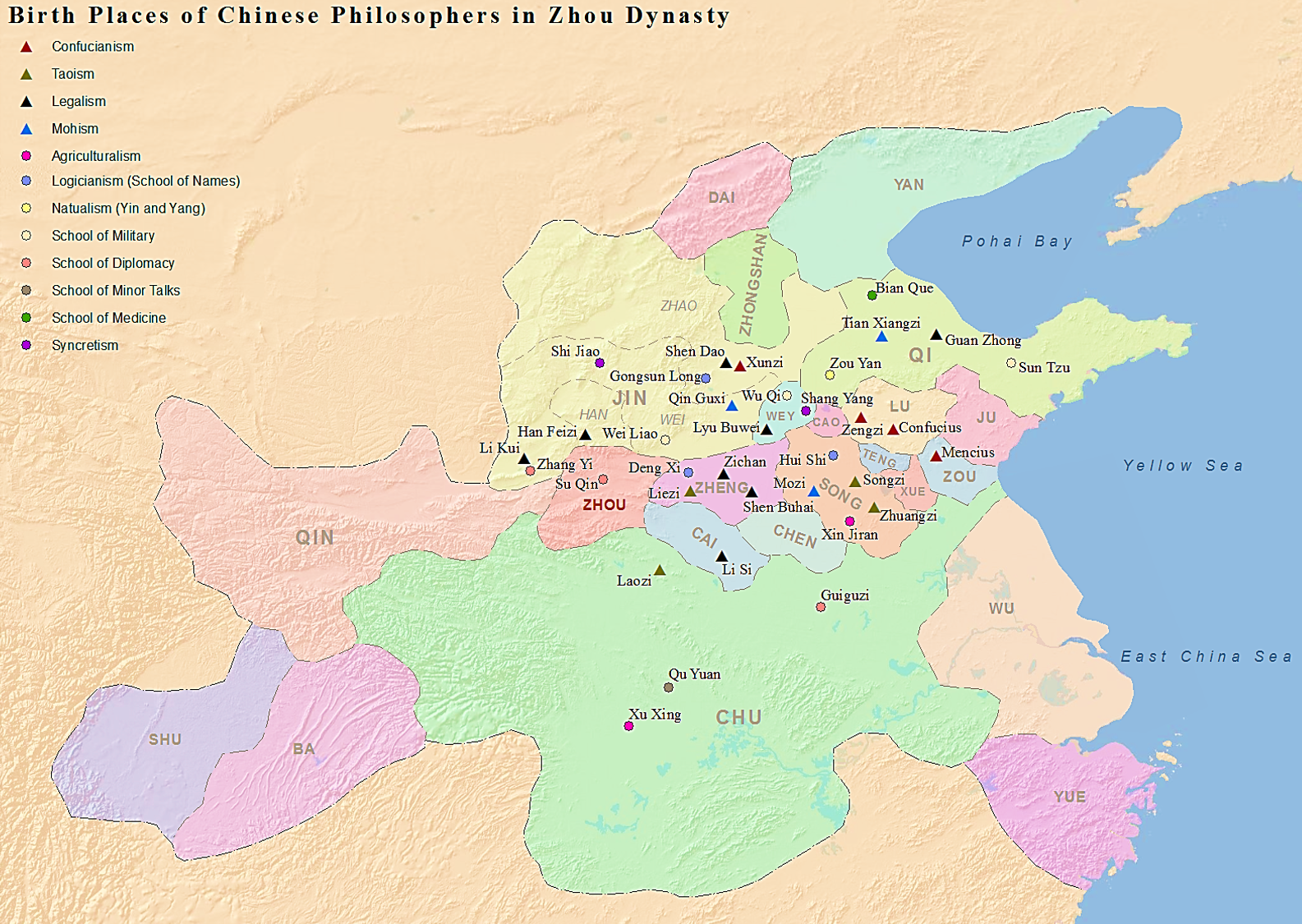
Birthplaces of notable Chinese philosophers from the Hundred Schools of Thought in the Zhou dynasty. Philosophers of Mohism are marked by triangles in blue.
Mojia
Chinese墨家
Literal meaningSchool of Mo
Transcriptions
Standard Mandarin
Hanyu PinyinMòjiā
Bopomofoㄇㄛˋ ㄐㄧㄚ
Wade–GilesMo4-chia1
Tongyong PinyinMò-jia
IPA[mwô.tɕjá]

Mohism or Moism (/ˈmɪzəm/, Chinese: 墨家; pinyin: Mòjiā; lit. 'School of Mo') was an ancient Chinese philosophy of ethics and logic, rational thought, and scientific technology developed by the scholars who studied under the ancient Chinese philosopher Mozi (c. 470 BC – c. 391 BC), embodied in an eponymous book: the Mozi. Among its major ethical tenets were altruism and a universal, unbiased respect and concern for all people, stressing the virtues of austerity and utilitarianism. Illuminating its original doctrine, later Mohist logicians were pivotal in the development of Chinese philosophy.

Mohism developed at about the same time as Confucianism, Taoism and Legalism, and was one of the four main philosophic schools from around 770–221 BC, during the Spring and Autumn and Warring States period. During that time, Mohism was seen as a major rival to Confucianism. While its influence endured, Mohism almost disappeared as an independent school of thought as it transformed and integrated into sects of Taoism in the wake of the cultural transformations of the Qin dynasty, after 221 BC.

Paramilitaries

[edit]

The Mohists formed a highly structured political organization that tried to realize the ideas they preached, the writings of Mozi. This political structure consisted of a network of local units in all the major kingdoms of China at the time, made up of elements from both the scholarly and working classes. Each unit was led by a juzi (literally, "chisel"—an image from craft making). Within the unit, a frugal and ascetic lifestyle was enforced. Each juzi would appoint his own successor. Like Confucians, they hired out their services not only for gain, but also in order to realize their own ethical ideals. They were often hired by the many warring kingdoms as advisers to the state. In this way, they were similar to the other wandering philosophers and knights-errant of the period.

Mohists believed in aiding the defensive warfare of smaller Chinese states against the hostile offensive warfare of larger domineering states. Mohists developed the sciences of fortification and statecraft, and wrote treatises on government, with topics ranging from efficient agricultural production to the laws of inheritance. One consequence of Mohist understanding of mathematics and the physical sciences, combined with their anti-militarist philosophy and skills as artisans, was that they became the pre-eminent siege-defense engineers prior to the Qin unification of China. Popular in early China, Mohist followers were employed for their ability as negotiators and as defense engineers.

Mozi and his disciples worked concertedly and systematically to invent and synthesise measures of benefit to defence, including defensive arms and strategy, and their corresponding logistics and military mobilisation. Many were actually applied, and remained an aspect of military affairs throughout history. The Mozi is hence highly respected by modern scholars, and ranks as a classic on military matters on a par with Sunzi's Art of War, the former of defensive strategy, the latter of offensive strategy.[1]

This component of Mohism is dramatized in the story of Gongshu,[2] recorded in the Mohist canon. Mozi travels 10 days and nights when he hears that Gongshu Pan has built machines for the king of Chu to use in an invasion of the smaller state of Song. Upon arriving in Chu, Mozi makes a wall out of his belt and sticks to represent machines, and shows Gongshu Pan that he can defend Song against any offensive strategy Chu might use. Mozi then announces that three hundred of his disciples are already on the walls of Song, ready to defend against Chu. The king cancels the invasion.

Overview

[edit]

Mohism is best known for the concept popularly translated as "universal love" (Chinese: 兼愛; pinyin: jiān ài; lit. 'inclusive love/care'). According to Edward Craig, a more accurate translation for 兼愛 is "impartial care" because Mozi was more concerned with ethics than morality, as the latter tends to be based on fear more than hope.[3]

Caring and impartiality

[edit]

Mohism promotes a philosophy of impartial caring; that is, a person should care equally for all other individuals, regardless of their actual relationship to them.[4] The expression of this indiscriminate caring is what makes a person a righteous being in Mohist thought. This advocacy of impartiality was a target of attack by other Chinese philosophical schools, most notably the Confucians, who believed that while love should be unconditional, it should not be indiscriminate. For example, children should hold a greater love for their parents than for random strangers.

Mozi is known for his insistence that all people are equally deserving of receiving material benefit and being protected from physical harm. In Mohism, morality is defined not by tradition and ritual, but rather by a constant moral guide that parallels utilitarianism. Tradition varies from culture to culture, and human beings need an extra-traditional guide to identify which traditions are morally acceptable. The moral guide must then promote and encourage social behaviours that maximize the general utility of all the people in that society.

The concept of Ai () was developed by the Chinese philosopher Mozi in the 4th century BC in reaction to Confucianism's benevolent love. Mozi tried to replace what he considered to be the long-entrenched Chinese over-attachment to family and clan structures with the concept of "universal love" (jiān'ài, 兼愛). In this, he argued directly against Confucians who believed that it was natural and correct for people to care about different people in different degrees. Mozi, by contrast, believed people in principle should care for all people equally. Mohism stressed that rather than adopting different attitudes towards different people, love should be unconditional and offered to everyone without regard to reciprocation, not just to friends, family and other Confucian relations. Later in Chinese Buddhism, the term Ai () was adopted to refer to a passionate caring love and was considered a fundamental desire. In Buddhism, Ai was seen as capable of being either selfish or selfless, the latter being a key element towards enlightenment.

Consequentialism

[edit]

It is the business of the benevolent man to seek to promote what is beneficial to the world and to eliminate what is harmful, and to provide a model for the world. What benefits he will carry out; what does not benefit men he will leave alone.[5]

Unlike hedonistic utilitarianism, which views pleasure as a moral good, "the basic goods in Mohist consequentialist thinking are... order, material wealth, and increase in population".[6] During Mozi's era, war and famines were common, and population growth was seen as a moral necessity for a harmonious society. The "material wealth" of Mohist consequentialism refers to basic needs like shelter and clothing.[7] Stanford sinologist David Shepherd Nivison, in The Cambridge History of Ancient China, writes that the moral goods of Mohism "are interrelated: An example of this would be, more basic wealth, then more reproduction; more people, then more production and wealth... if people have plenty, they would be good, filial, kind, and so on unproblematically".[6] In contrast to Bentham's views, state consequentialism is not utilitarian because it is not hedonistic. The importance of outcomes that are good for the state outweigh the importance of individual pleasure and pain.

Society

[edit]

Mozi posited that, when society functions as an organized organism, the wastes and inefficiencies found in the natural state (without organization) are reduced. He believed that conflicts are born from the absence of moral uniformity found in human cultures in the natural state, i.e. the absence of the definition of what is right ( shì) and what is wrong ( fēi). According to Mozi, we must therefore choose leaders who will surround themselves with righteous followers, who will then create the hierarchy that harmonizes Shi/Fei. In that sense, the government becomes an authoritative and automated tool. Assuming that the leaders in the social hierarchy are perfectly conformed to the ruler, who is perfectly submissive to Heaven, conformity in speech and behaviour is expected of all people. There is no freedom of speech [when defined as?] in this model. However, the potentially repressive element is countered by compulsory communication between the subjects and their leaders. Subjects are required to report all things good or bad to their rulers. Mohism is opposed to any form of aggression, especially war between states. It is, however, permissible for a state to use force in legitimate defense.

Meritocratic government

[edit]

Mozi opposed nepotism, which was a social norm at the time. This practice allowed important government positions to be assigned based on familial ties rather than merit, restricting social mobility. Mozi taught that as long as a person was qualified for a task, he should keep his position, regardless of blood relations. If an officer was incapable, even if he was a close relative of the ruler, he ought to be demoted, even if it meant poverty.

A ruler should be in close proximity to talented people, treasuring talents and seeking their counsel frequently. Without discovering and understanding talents within the country, the country will be destroyed. History unfortunately saw many people who were murdered, not because of their frailties, but rather because of their strengths. A good bow is difficult to pull, but it shoots high. A good horse is difficult to ride, but it can carry weight and travel far. Talented people are difficult to manage, but they can bring respect to their rulers.

Law and order was an important aspect of Mozi's philosophy. He compared the carpenter, who uses standard tools to do his work, with the ruler, who might not have any standards by which to rule at all. The carpenter is always better off when depending on his standard tools, rather than on his emotions. Ironically, as his decisions affect the fate of an entire nation, it is even more important that a ruler maintains a set of standards, and yet he has none. These standards cannot originate from man, since no man is perfect; the only standards that a ruler uses have to originate from Heaven, since only Heaven is perfect. That law of Heaven is Love.

In a perfect governmental structure where the ruler loves all people benevolently, and officials are selected according to meritocracy, the people should have unity in belief and in speech. His original purpose in this teaching was to unite people and avoid sectarianism. However, in a situation of corruption and tyranny, this teaching might be misused as a tool for oppression.

Should the ruler be unrighteous, seven disasters would result for that nation. These seven disasters are:

  1. Neglect of the country's defense, yet there is much lavished on the palace.
  2. When pressured by foreigners, neighbouring countries are not willing to help.
  3. The people are engaged in unconstructive work while useless fools are rewarded.
  4. Law and regulations becomes too heavy such that there is repressive fear and people only look after their own good.
  5. The ruler lives in a mistaken illusion of his own ability and his country's strength.
  6. Trusted people are not loyal while loyal people are not trusted.
  7. Lack of food. Ministers are not able to carry out their work. Punishment fails to bring fear and reward fails to bring happiness.

A country facing these seven disasters will be destroyed easily by the enemy.

The measure of a country's wealth in Mohism is a matter of sufficient provision and a large population. Thriftiness is believed to be key to this end. With contentment with that which suffices, men will be free from excessive labour, long-term war and poverty from income gap disparity. This will enable birth rate to increase. Mozi also encourages early marriage.

Supernatural forces

[edit]

Rulers of the period often ritually assigned punishments and rewards to their subjects in spiritually important places to garner the attention of these spirits and ensure that justice was done. The respect of these spirits was deemed so important that prehistoric Chinese ancestors had left their instructions on bamboo, plates and stones to ensure the continual obedience of their future descendants to the dictates of heaven. In Mozi's teachings, sacrifices of bulls and rams were mentioned during appointed times during the spring and autumn seasons. Spirits were described to be the preexisting primal spirits of nature, or the souls of humans who had died.

The Mohists polemicized against elaborate funeral ceremonies and other wasteful rituals, and called for austerity in life and in governance, but did not deem spiritual sacrifices wasteful. Using historical records, Mohists argued that the spirits of innocent men wrongfully murdered had appeared before to enact their vengeance. Spirits had also been recorded to have appeared to carry out other acts of justice. Mohists believed in heaven as a divine force ( Tian), the celestial bureaucracy and spirits which knew about the immoral acts of man and punished them, encouraging moral righteousness, and were wary of some of the more atheistic thinkers of the time, such as Han Fei. Due to the vague nature of the records, there is a possibility that the Mohist scribes themselves may not have been clear about this subject.

Against fatalism

[edit]

Mozi disagrees with the fatalistic mindset of people, accusing the mindset of bringing about poverty and suffering. To argue against this attitude, Mozi used three criteria (San Biao) to assess the correctness of views. These were:[8]

  1. Assessing them based on history
  2. Assessing them based on the experiences of common, average people
  3. Assessing their usefulness by applying them in law or politics[8]

In summary, fatalism, the belief that all outcomes are predestined or fated to occur, is an irresponsible belief espoused by those who refuse to acknowledge that their own lack of responsibility or the western view of sinfulness has caused the hardships of their lives. Prosperity or poverty are directly correlated with either virtue or vice,[9] respectively, so realised by deductive thinking and by one's own logic; not fate. Mozi calls fatalism that almost indefinitely ends in misanthroponic theory and behaviour, "A social heresy which needs to be disarmed, dissolved and destroyed".

Against ostentation

[edit]

By the time of Mozi, Chinese rulers and the wealthier citizens already had the practice of extravagant burial rituals. Much wealth was buried with the dead, and ritualistic mourning could be as extreme as walking on a stick hunchback for three years in a posture of mourning. During such lengthy funerals, people are not able to attend to agriculture or care for their families, leading to poverty. Mozi spoke against such long and lavish funerals and also argued that this would even create resentment among the living.

Mozi views aesthetics as nearly useless. Unlike Confucius, he holds a distinctive repulsion to any development in ritual music and the fine arts. Mozi takes some whole chapters named "Against Music" (非樂) to discuss this. Though he mentions that he does enjoy and recognize what is pleasant, he sees them of no utilization in terms of governing, or of the benefit of common people. Instead, since development of music involves man's power, it reduces production of food; furthermore, appreciation of music results in less time for administrative works. This overdevelopment eventually results in shortage of food, as well as anarchy. This is because manpower will be diverted from agriculture and other fundamental works towards ostentations. Civilians will eventually imitate the ruler's lusts, making the situation worse. Mozi probably advocated this idea in response to the fact that during the Warring States period, the Zhou king and the aristocrats spent countless time in the development of delicate music while ordinary peasants could hardly meet their subsistence needs. To Mozi, bare necessities are sufficient; resources should be directed to benefit man.[citation needed]

School of Names

[edit]

One of the offshoots of Mohism that has received some attention is the School of Names, who were interested in resolving logical puzzles. Not much survives from the writings of this school, since problems of logic were deemed trivial by most subsequent Chinese philosophers. Historians such as Joseph Needham have seen this group as developing a precursor philosophy of science that was never fully developed, but others[who?] believe that recognizing these Logicians as proto-scientists reveals too much of a modern bias.

Mathematics

[edit]

The Mohist canon (Mo Jing) described various aspects of many fields associated with physical science, and provided a small wealth of information on mathematics as well. It provided an 'atomic' definition of the geometric point, stating that a line is separated into parts, and the part which has no remaining parts (i.e. cannot be divided into smaller parts) and thus the extreme end of a line is a point.[10] Much like Euclid's first and third definitions and Plato's 'beginning of a line', the Mo Jing stated that "a point may stand at the end (of a line) or at its beginning like a head-presentation in childbirth. (As to its invisibility) there is nothing similar to it."[11] Similar to the atomists of Democritus, the Mo Jing stated that a point is the smallest unit, and cannot be cut in half, since 'nothing' cannot be halved.[11] It stated that two lines of equal length will always finish at the same place,[11] while providing definitions for the comparison of lengths and for parallels,[12] along with principles of space and bounded space.[12] It also described the fact that planes without the quality of thickness cannot be piled up since they cannot mutually touch.[13] The book provided definitions for circumference, diameter, and radius, along with the definition of volume.[14]

Decline

[edit]

With the unification of China under the Qin, China was no longer divided into various states constantly fighting each other: where previously the Mohists proved to be an asset when defending a city against an external threat, without wars, and in particular siege wars, there was no more need for their skills. The Stanford Encyclopedia of Philosophy suggests, in addition to the decline of siege warfare, "...the major factor is probably that as a social and philosophical movement, Mohism gradually collapsed into irrelevance. By the middle of the former Han dynasty, the more appealing aspects of Mohist thought were all shared with rival schools.

Their core ethical doctrines had largely been absorbed into Confucianism, though in a modified and unsystematic form. Key features of their political philosophy were probably shared with most other political thinkers, and their trademark opposition to warfare had been rendered effectively redundant by unification. The philosophy of language, epistemology, metaphysics, and science of the later Mohist Canons were recorded in difficult, dense texts that would have been nearly unintelligible to most readers (and that in any case quickly became corrupt). What remained as distinctively Mohist was a package of harsh, unappealing economic and cultural views, such as their obsession with parsimony and their rejection of music and ritual. Compared with the classical learning and rituals of the Confucians, the speculative metaphysics of Yin-Yang thinkers, and the romantic nature mysticism and literary sophistication of the Daoists, Mohism offered little to attract adherents, especially politically powerful ones."[15]

Modern perspectives

[edit]

Jin Guantao, a professor of the Institute of Chinese Studies at the Chinese University of Hong Kong, Fan Hongye, a research fellow with the Chinese Academy of Sciences' Institute of Science Policy and Managerial Science, and Liu Qingfeng, a professor of the Institute of Chinese Culture at the Chinese University of Hong Kong, have argued that without the influence of proto-scientific precepts in the ancient philosophy of Mohism, Chinese science lacked a definitive structure:[16]

From the middle and late Eastern Han to the early Wei and Jin dynasties, the net growth of ancient Chinese science and technology experienced a peak (second only to that of the Northern Song dynasty)... Han studies of the Confucian classics, which for a long time had hindered the socialization of science, were declining. If Mohism, rich in scientific thought, had rapidly grown and strengthened, the situation might have been very favorable to the development of a scientific structure. However, this did not happen because the seeds of the primitive structure of science were never formed. During the late Eastern Han, disastrous upheavals again occurred in the process of social transformation, leading to the greatest social disorder in Chinese history. One can imagine the effect of this calamity on science.[16]

See also

[edit]

References

[edit]

Further reading

[edit]
[edit]
Revisions and contributorsEdit on WikipediaRead on Wikipedia
from Grokipedia

Mohism was an ancient Chinese philosophical, social, and religious movement founded by the thinker , active from the late fifth to early fourth centuries BCE, that emphasized impartial concern for all people, , and opposition to offensive warfare and extravagant .
The school's core doctrine of jian ai (impartial love or concern) sought to promote mutual benefit and social harmony by extending care equally to all, regardless of or status, as a means to minimize conflict and maximize collective welfare in a era of incessant warfare. Mohists critiqued Confucian emphasis on familial partiality and ritual propriety as conducive to inequality and waste, instead advocating meritocratic , frugality in personal and state affairs, and the of measures and language to foster efficiency and unity. They developed early forms of consequentialist , where actions were judged by their outcomes in benefiting the populace, and contributed practical innovations in defensive , such as fortifications and weaponry, reflecting their role as itinerant technicians and advisors to states. Mohism flourished during the (475–221 BCE) as one of the "," rivaling in influence, with organized followers who lived communally and promoted their tenets through logical argumentation and empirical analogies. The Mohist corpus, compiled in the text, includes treatises on , , and later dialectical and scientific chapters that prefigure systematic logic, , and in Chinese thought. Despite initial prominence, the school declined after the Qin unification in 221 BCE, possibly due to suppression under Legalism and assimilation into other traditions, though elements of Mohist and persisted in later Chinese intellectual history.

Origins and Historical Context

Founder and Early Development

, personal name Mo Di (c. 470–391 BCE), founded Mohism during China's , emerging as a rival philosophical school to . Likely originating from a lower class rather than the scholarly elite, rejected elaborate rituals and familial hierarchies in favor of practical standards benefiting the broader populace, drawing from observable outcomes and utility as measures of validity. He traveled among feudal states, advising rulers against offensive wars through demonstrations of defensive engineering, such as when he reportedly journeyed to the state of around 440 BCE to dissuade King Hui from attacking by constructing a model city wall and siege countermeasures in ten days. Early Mohist organization formed around Mozi's direct disciples, who adopted a disciplined, communal structure emphasizing merit over birthright, with followers trained in logic, , , and fortifications to promote social utility and oppose aggression. The school's foundational texts, compiled in the Mozi corpus, include core chapters attributed to himself—such as those on impartial caring and anti-fatalism—alongside later elaborations by successors like Qin Huali and Qin Gongsun, reflecting rapid doctrinal systematization by the mid-4th century BCE. This period saw Mohists initiate structured debates, employing analogical reasoning and empirical tests to challenge rivals, establishing as a competitive enterprise in ancient .

Mohist Organization and Paramilitary Activities

The Mohist school operated as a tightly organized, quasi-religious community during the (475–221 BCE), structured hierarchically under a leader known as the juzi (grand master). This leadership model persisted after Mozi's death, with evidence from texts like the Hanfeizi indicating the emergence of at least three rival Mohist sects, each governed by its own juzi. Members, referred to as mozhe, demonstrated strict discipline, committing to the school's core doctrines through rigorous training, communal contributions of resources, and adherence to principles of austerity and mutual benefit; non-compliance could result in expulsion. The organization's reach extended across states, functioning as a network of moral reformers, craftsmen, and technical experts who advocated for practical governance and ethical conduct. Disciples underwent intensive education in Mohist theses, including universal concern, anti-aggression, and , alongside hands-on in crafts, , and , reflecting Mozi's probable background as an . This preparation equipped them for roles in state administration, diplomacy, or military support, with the community emphasizing self-sacrifice and emulation of ancient sage-kings like . By the 4th to 3rd centuries BCE, the school had branched into multiple factions, as noted in sources such as the Zhuangzi and , maintaining a focus on collective welfare over individual hierarchy. The Mohists' internal cohesion contrasted with the more diffuse Confucian networks, enabling coordinated efforts in advocacy and aid to weaker states. Certain Mohist subgroups developed capabilities, specializing in defensive warfare and forming militias renowned for their expertise in countering sieges and aggressors. Aligned with their doctrine against offensive warfare, these units rushed to assist beleaguered cities and states, providing engineering support to fortify defenses rather than initiating conflicts. Historical accounts in the describe such interventions, including Mozi's personal journey to the state of around the mid-5th century BCE, where he demonstrated defensive techniques—such as countermeasures to assault ladders—to dissuade an attack on Song, successfully averting the invasion through technical prowess and diplomatic persuasion. This role positioned Mohists as interstate defenders, leveraging their skills to promote alliances and deter aggression in an era of frequent interstate violence. The Mohists' technical manuals, preserved in the latter sections of the Mozi (chapters 40–71), detail systematic approaches to , including city wall reinforcements, gate fortifications, moat defenses, armor fabrication, and tactics against siege weapons like battering rams and cloud ladders. These texts, likely compiled by later disciples, reflect empirical testing and standardization of methods to maximize defensive efficiency, such as calculating trajectories and for prolonged sieges. While not a , the elements maintained high readiness, training in these arts to embody the school's consequentialist ethic of benefiting the world through impartial protection. Their activities waned by the late , possibly due to unification under Qin and shifts in philosophical patronage, but left a legacy of organized technical innovation in defense.

Core Ethical and Metaphysical Doctrines

Universal Concern and Impartial Caring

The doctrine of jian ai, commonly rendered as impartial caring or universal concern, constitutes a foundational ethical in Mohist thought, positing that individuals and states should extend care to all people equally, irrespective of , social proximity, or national boundaries. This , elaborated in chapters 14–16 of the Mozi, rejects partiality—such as preferential treatment for or compatriots—as a primary source of social discord, arguing instead that it fosters mutual benefit and societal harmony by encouraging reciprocal aid and discouraging . Mozi contended that partial concern, where one prioritizes close relations over strangers, inevitably leads to conflicts like , feuds, and interstate wars, as exemplified by analogies in the text: just as a benefits from inclusive rather than , states thrive through impartial alliances rather than . Impartial caring operates as a pragmatic guideline rather than an emotional mandate, emphasizing actions that maximize welfare over subjective affections; it does not require loving distant others with the intensity reserved for kin but demands policies and behaviors that distribute benefits equitably to avert harm. Mohists justified this through consequentialist reasoning, asserting that adopting jian ai empirically reduces violence and promotes order, as evidenced by historical analogies in the to periods of mutual non-aggression yielding prosperity. In , it translates to merit-based administration and defensive pacts that treat allies impartially, countering hierarchical favoritism critiqued as inefficient and destabilizing. Critics, notably (ca. 372–289 BCE), challenged jian ai as eroding by equating parental and strangerly obligations, potentially undermining social bonds; Mohist responses, preserved in the text, defend it by clarifying that the doctrine targets discriminatory practices, not natural affections, and yields superior outcomes like reduced warfare through impartial reciprocity. Scholarly analyses affirm that jian ai integrates with Mohist , aligning human actions with the Heaven's will for universal order, while avoiding the of graded Confucian loves (bie ai) by grounding in observable benefits. This extended to Mohist , where defensive fortifications and aid were offered without bias to just causes, prioritizing global stability over partisan loyalties.

Consequentialism and Benefit Maximization

Mohist ethics posits that the moral rightness of an action or doctrine is determined solely by its consequences in promoting benefit (li, 利) to all under heaven and eliminating harm (hai, 害). This consequentialist framework, articulated in the Mozi text attributed to Mozi (ca. 470–391 BCE), evaluates policies, rituals, and social practices based on empirical outcomes rather than intrinsic virtues or traditions. Benefit is concretely defined as encompassing a populous state with abundant resources, social harmony, and mutual aid, while harm includes poverty, depopulation through war or famine, and disorder from partial favoritism. Mozi argued that doctrines must be tested like mechanisms—such as wheels or boats—by their capacity to produce verifiable results, rejecting those that fail to yield net positive effects. Central to this approach is the imperative to maximize impartial benefit, where ethical standards are selected for their ability to enrich the world collectively rather than favoring kin or class. In the Mozi's core chapters (e.g., "Canon" and "Explanations"), early Mohists emphasized promoting what benefits the majority, critiquing Confucian rituals for expending resources on music, elaborate funerals, and ancestral rites that deplete wealth without enhancing security or prosperity. For instance, Mozi calculated that lavish funerals could impoverish families and states, leading to societal harm, whereas frugal practices preserve resources for defense and agriculture, yielding greater overall utility. This utility calculus prioritizes quantitative outcomes: actions are right if they increase total welfare, measured by population size, economic productivity, and peace, without aggregating subjective utilities in a formal sense in early texts. Later Mohist developments in the Canons refined this by exploring how benefits from disparate sources—such as or —might be weighed, though without explicit maximization algorithms; the focus remained on doctrines that empirically advance universal flourishing over alternatives. Unlike deontological rivals, Mohists viewed heaven's will as endorsing beneficial impartially, linking to anti-fatalism: human effort, guided by effective standards (fa), causally determines outcomes, not destiny. This ethic influenced political recommendations, such as merit-based selected for its proven capacity to deliver security and abundance, underscoring Mohism's integration of with pragmatic statecraft.

Will of Heaven and Rejection of Fatalism

The Mohist doctrine of the Will of Heaven (tian zhi 天志) conceives as an impartial moral authority that endorses policies and actions yielding widespread benefit (li 利) while condemning those causing harm (hai 害). This will is discerned through patterns in historical outcomes, where righteous rulers like Yu, Tang, King Wen, and King Wu received Heaven's favor—manifest in territorial expansion, , and security—precisely because their aligned with promoting impartial care and opposing partiality or aggression. Conversely, Heaven withdraws favor from unjust rulers, as seen in the downfall of tyrants like Jie and Zhou, whose favoritism and ostentation provoked divine displeasure expressed through famines, droughts, and military defeats. Mohists thus positioned tian zhi as a transcendent criterion superior to human rulers' whims, urging leaders to emulate 's impartiality to secure blessings rather than relying on or . Central to this framework is the rejection of fatalism (ming 命), which Mohists critiqued as a doctrine asserting predetermination of outcomes like wealth, poverty, or state survival irrespective of human conduct. In chapters 35–37 of the Mozi, they argue that fatalism erodes righteousness (yi 義) by implying effort is futile, thereby fostering idleness, economic stagnation, and social disorder; for instance, if poverty were fated, agricultural labor would cease, leading to universal want. To refute it, Mohists invoke evidentiary tests: the will of Heaven and spirits, which demonstrably reward diligence and punish sloth; the examples of sage-kings, who through deliberate policies of mutual aid and defense achieved prosperity amid adversity; and empirical verification from antiquity to the present, where states thriving under meritocratic, non-aggressive rule contrast with those crumbling under fatalistic resignation. This anti-fatalist stance underscores a causal realism: outcomes hinge on aligning actions with Heaven's beneficial intent, not inscrutable decree, thereby motivating rigorous ethical and political reforms.

Political and Social Principles

Meritocratic Governance and Anti-Hierarchy

Mohists advocated a system of governance centered on the doctrine of shang xian ("elevating the worthy"), which prescribed selecting officials and leaders based on demonstrated ability, moral integrity, and capacity to benefit the state, irrespective of social origin, family ties, or wealth. This meritocratic approach rejected and hereditary privileges prevalent in feudal , arguing that appointing incompetent kin or favorites led to disorder and inefficiency, as evidenced by historical examples of states declining under such practices. Instead, rulers were urged to promote talent universally, drawing from all classes to ensure competent administration and alignment with Heaven's will, which favors those who maximize societal welfare. The selection process outlined in Mozi's chapters on elevating the worthy involved three rigorous standards: examining candidates' past records of achievement, subjecting them to practical trials in administrative tasks, and verifying that their elevation produced tangible benefits for the populace, such as increased order and prosperity. This empirical method aimed to identify individuals capable of impartial , fostering a bureaucratic where derived from proven utility rather than . Mohists maintained that such a would incentivize behavior across , as honors, , and power would flow to the capable, encouraging widespread emulation of virtuous conduct. While endorsing a structured —from the through appointed officials to local heads—to maintain unity and enforce moral standards, Mohism opposed rigid, birth-based stratification that entrenched incompetence. This anti-hierarchical stance targeted aristocratic favoritism, positing that emulated Heaven's impartial oversight and sage kings' practices, such as those of Yao and Shun, who delegated authority based on talent alone. By centralizing power under a virtuous supported by merit-selected subordinates, the system sought to minimize internal strife and external aggression, prioritizing collective benefit over personal or familial loyalties.

Defensive Military Stance and Anti-Aggression

Mohists maintained that military action should be strictly defensive, condemning offensive warfare as contrary to the principles of universal benefit and the will of . In the Mozi text, chapters 17–19, titled "Non-Attack" (Fei Gong), articulate this stance by enumerating the harms of aggression: it depletes resources, causes and death among combatants and civilians, and yields no net profit even for victors, as the costs in lives and labor outweigh territorial gains. These arguments employ consequentialist reasoning, calculating that offensive campaigns violate impartial concern by favoring partial interests of rulers over the broader populace. The doctrine permits "righteous war" (yi zhan), defined as defensive resistance against invasion or punitive expeditions to depose tyrants who perpetrate disorder, such as the historical overthrow of the tyrant Zhou of Shang around 1046 BCE, cited as a model of justified intervention. Aggression, by contrast, is deemed inherently unjust because it targets innocent states without prior provocation, disrupting social order without moral or practical justification. Mohists critiqued rulers' motives in offensive wars, attributing them to personal greed or ostentation rather than Heaven's mandate, which demands promotion of welfare for all. In practice, Mohist followers organized into bands trained in defensive arts, including , countermeasures, and for sustaining beleaguered cities. They intervened to aid smaller states facing aggression, as recorded in anecdotes of Mohists rushing to defend threatened polities during the (475–221 BCE), deploying expertise to repel invaders without initiating hostilities. This selective involvement underscored their anti-aggression ethic: military knowledge served protection, not , aligning with efforts to dissuade warlike rulers through and demonstrations of defensive efficacy. Such activities positioned Mohism as a to the era's endemic interstate violence, prioritizing stability through restraint.

Frugality, Anti-Ostentation, and Social Efficiency

Mohists advocated in expenditures (節用, jié yòng) as a core doctrine to ensure resources were directed toward productive ends rather than waste, arguing that excessive consumption by rulers and elites depleted communal wealth needed for agriculture, defense, and public welfare. This principle critiqued the lavish lifestyles of the during the (475–221 BCE), positing that thriftiness maximized societal benefit by preventing famine, strengthening fortifications, and supporting the populace impartially. Mozi himself exemplified this by leading a austere life, wearing coarse clothing and eating simple fare, to model resource conservation for followers. Central to anti-ostentation was opposition to elaborate funerals (節葬, jié zàng) and music (非樂, fēi yuè), which Mohists viewed as non-utilitarian displays that squandered labor and materials without yielding reciprocal benefits. In the Mozi text, chapters 25–28 detail how prolonged mourning and ornate burials—common among the elite—diverted workers from essential tasks like farming and military preparation, potentially leading to starvation and vulnerability to invasion; Mohists proposed simple, brief rites limited to basic interment to honor the dead while preserving social productivity. Similarly, they condemned ritual music as an extravagant diversion that enriched musicians at public expense without enhancing order or prosperity, contrasting it with practical investments in infrastructure. These tenets underpinned Mohist social , integrating consequentialist evaluation where actions were judged by their capacity to promote widespread utility over partial or ostentatious gains. By prioritizing merit-based and minimizing hierarchy-driven extravagance, Mohists aimed to foster equitable that aligned with Heaven's will for mutual benefit, as evidenced in their organizational practices of communal labor and defensive projects that optimized collective output during interstate conflicts. This extended to critiquing Confucian rituals for inefficiency, favoring standardized, functional norms that reduced administrative waste and amplified impartial care across social strata.

Intellectual Contributions

Logic, Dialectics, and the School of Names

The Later Mohists, active during the mid-to-late (circa 4th–3rd centuries BCE), advanced a dialectical framework in chapters 40–45 of the Mozi, comprising two books of terse "Canons" (Jing) followed by explanatory commentaries (Shuo). These texts systematically explore semantics, , logic, and related metaphysics, marking the earliest known Chinese effort to codify methods for resolving disputes through reasoned (bian). The Canons consist of over 300 aphoristic propositions, each unpacked in the Explanations via examples, analogies (pi), and criteria for validity, emphasizing practical utility in distinguishing true from false claims to support ethical and political decision-making. Central to Mohist dialectics were concepts like "standard" (fa) for measuring correctness, applied to linguistic where names (ming) must correspond to actualities (shi) to avoid error. They analyzed "sameness" (tong) across types—strict identity, partial overlap, functional equivalence, or common grouping—rejecting vague in favor of objective discriminations testable by or . Epistemological canons prioritized direct () and analogical extension as reliable, while cautioning against hasty generalizations or contradictions arising from ambiguous terms. Techniques included parallel cases for and counterexamples to refute opponents, aiming not at abstract deduction but at consequential clarity for benefit-maximizing action. The School of Names (Mingjia), or Logicians, contemporaries in the Warring States era (circa 475–221 BCE), pursued similar inquiries into names, objects, and paradoxes, with figures like Gongsun Long arguing separations such as "a is not a " to highlight distinctions between universals and . Some scholarly views posit the Mingjia as evolving from Mohist dialectical traditions, given overlaps in semantic analysis and disputation methods, though Mohists critiqued extreme nominalist positions for eroding shared standards essential to and rejecting . Mohist texts counter such paradoxes by insisting on contextual : names serve to guide conduct only if aligned with empirical realities, dismissing purely verbal sophistries (pian) that yield no practical benefit. This pragmatic orientation distinguished Mohist logic from the Mingjia's more relativistic explorations, which later texts like the Zhuangzi lampooned but which influenced broader debates on language's limits.

Scientific and Mathematical Advancements

The later Mohists advanced proto-scientific inquiry through the Mohist Canons (Mò jīng), a corpus of terse propositions and explanations composed around the BCE, which systematically addressed natural phenomena using definitions, analogies, and empirical verification. These texts reflect an instrumental approach to knowledge, prioritizing observable regularities and causal explanations over metaphysical speculation, with applications to practical technologies like fortifications and defenses. In , (ca. 470–391 BCE) provided the earliest known description of image inversion via a pinhole, observing that light rays from an object passing through a small project an upside-down image on an opposing surface, demonstrating straight-line propagation and foreshadowing geometric principles. The Canons further elaborated on shadow formation, distinguishing umbra and penumbra, and explained eclipses through aligned circular projections, integrating qualitative with direct to refute superstitious interpretations. Mechanics in the Canons centered on the lever principle, positing equilibrium as a balance of and arm length—e.g., "a small effort moves a large load" when the effort arm is longer than the load arm—reducing pulleys, balances, and catapults to this core mechanism without full deductive proofs but with qualitative proportionality. This analysis, applied to weighing devices and siege engines, approximated the equilibrium later quantified in Hellenistic science, emphasizing empirical testing over abstract deduction. Mathematically, the Canons incorporated elementary for , including calculations of areas (e.g., circles as limits of inscribed polygons), volumes of solids like pyramids and cylinders, and equivalences between rotational and linear forms (e.g., a wheel's "thickness without thickness" resolving paradoxes in ). Mohists advocated of measures—rulers, weights, and capacities—to ensure precision in and , viewing inconsistency as a barrier to social utility and causal reliability in predictions.

Technological and Engineering Innovations

Mohists applied their consequentialist emphasis on utility and efficiency to practical engineering, developing innovations primarily in defensive military technologies and proto-scientific fields like optics and mechanics, as documented in the Mozi text's later chapters. These efforts reflected a commitment to benefiting society through tangible, verifiable methods rather than ritualistic or ornamental pursuits, with Mozi (c. 470–391 BCE) himself credited as an accomplished engineer who advised states on fortifications. In , Mohists specialized in defense, forming militias that countered offensive weapons with mechanical countermeasures. The describes techniques to repel "cloud ladders" (escalade devices for scaling walls) using interlocking hooks, pivoting arms, and weighted counterbalances to topple attackers, alongside reinforcements and rapid wall repairs with layered earth and timber. These innovations prioritized resource-efficient defense over aggression, enabling smaller forces to withstand larger assaults, as evidenced by Mohist interventions in Warring States conflicts (475–221 BCE). The Mohist Canon, a later dialectical appendix to the Mozi, advances early through analyses of levers, pulleys, balances, and , defining concepts like "support" (forces countering weight) and "heaviness" via empirical tests with scales and inclined planes. In optics, it outlines principles of propagation, shadow formation, and image inversion—such as explaining why pinhole projections reverse scenes—using analogical reasoning from observable phenomena like mirrors and eclipses, predating similar European insights by centuries. These treatises employed rigorous to test hypotheses, fostering a proto-experimental method aligned with Mohist . Mohists also promoted standardization of tools, measures, and crafts to enhance social efficiency, arguing in the that uniform gauges for wheels, vessels, and buildings minimized waste and disputes, as seen in prescriptions for aligning rituals and production to fixed metrics like the chi (ancient unit ≈23 cm). This extended to , with contributions to practical computations for fortifications, such as area calculations for ramparts, underscoring their integration of theory and application. While these advancements waned with Mohism's decline, they influenced later Chinese engineering traditions.

Philosophical Rivalries and Criticisms

Core Debates with Confucianism

Mohists, led by (c. 470–391 BCE), engaged in direct philosophical polemics against , viewing its doctrines as detrimental to social order and state welfare during the (479–221 BCE). In the Mozi text's "Condemning the Ru" (Fei Ru) chapters (39, 48–49), Mohists outlined "four elements sufficient to ruin the empire" in Confucian teachings, including excessive ritualism, , and prioritization of kin over the collective good. These critiques emphasized consequentialist utility—assessing doctrines by their outcomes in benefiting the people—contrasting with Confucian reliance on tradition and moral cultivation through li (ritual propriety). A central ethical dispute concerned impartial concern (jian ai) versus Confucian graded love. Mohists argued in Mozi chapters 14–16 that equal moral regard for all individuals, regardless of , minimizes strife and promotes mutual benefit, using analogies like preferring an impartial stranger to guard one's family over a partial kinsman prone to favoritism. Confucians, including (c. 372–289 BCE), countered that such undermines natural familial bonds and ren (humaneness), equating it to moral deviance akin to "beast-like" behavior devoid of hierarchy. Mohists responded by clarifying that entails equal concern but differentiated treatment based on reciprocity and (yi), not strict equality of action. On rituals, funerals, and music, Mohists condemned Confucian extravagance as wasteful and unjust. In "Frugality in Funerals" (chapter 25) and "Against Music" (chapter 32), they asserted that prolonged mourning, elaborate burials, and aristocratic performances divert resources from the needy, imposing undue burdens without enhancing moral order or productivity. These practices, Mohists claimed, exemplify Confucian detachment from the people's welfare, fostering inequality rather than utility. Confucians defended rituals and music as essential for harmonizing and cultivating per ancient models, dismissing Mohist as crude and insufficient for ethical refinement. Politically, Mohists advocated meritocratic governance in "Elevating the Worthy" (chapters 8–10), insisting rulers appoint officials based on proven ability rather than birth or , to ensure competent administration and impartial justice. This opposed Confucian deference to hereditary and familial hierarchies, which Mohists saw as breeding incompetence and partiality, exacerbating state disarray amid Warring States conflicts. Later Mohists extended critiques to personal attacks on , portraying him as inconsistent and self-interested. Debates also touched on fate and Heaven's will. Mohists rejected Confucian acquiescence to ming (fate) as paralyzing action, promoting instead as an impartial arbiter rewarding benevolent rule through observable prosperity (chapters 26–28). This providential view clashed with more naturalistic Confucian interpretations of as a moral correlate to virtue, without direct intervention. Such exchanges, often public and dialectical, highlighted Mohism's emphasis on empirical verification and social utility over Confucian tradition.

Critiques of Other Contemporary Schools

The Mohists mounted pointed critiques against the doctrine of ming (fate or ), which they associated primarily with and Song Xing, viewing it as a form of Daoist that justified resignation to natural outcomes and undermined human agency, effort, and meritocratic governance. In chapters 16–18 of the Mozi, they argued that acceptance of ming leads to social disorder by discouraging rulers from promoting virtuous conduct and by implying that success in warfare or administration stems from inevitability rather than strategic preparation or moral standards, thus contradicting of variable outcomes based on action. This rejection extended to the broader Daoist emphasis on naturalistic passivity (wuwei), which Mohists saw as incompatible with their utilitarian imperative to maximize societal benefit through deliberate intervention, such as defensive fortifications and impartial resource allocation. Later Mohist texts, particularly the dialectical canons in chapters 40–45 of the Mozi, engaged critically with the (Mingjia), including figures like Hui Shi and Gongsun Long, whose paradoxical arguments on relativity, hardness/softness, and linguistic ambiguity challenged objective standards of naming and . Mohists countered these by developing a systematic logic of definitions, analogies, and empirical tests to affirm fixed referents for terms like "same" and "different," arguing that unchecked sophistry erodes reliable essential for , , and ethical adjudication. For instance, they refuted claims of universal sameness (as in Hui Shi's "I know the way of heaven and earth, but not that 'this' differs from 'that'") by invoking perceptual and practical , positioning their method as a corrective to what they deemed frivolous disputation detached from real-world consequences. Mohist writings also implicitly targeted Legalist precursors and the School of Diplomacy (Zonghengjia), critiquing reliance on raw power (shi) and opportunistic alliances over righteous standards (yi), as seen in their advocacy for Heaven's will as an impartial arbiter rather than coercive laws or vertical/horizontal stratagems that prioritized state interest above universal benefit. They contended that such approaches foster aggression and instability, evidenced by the Warring States' persistent conflicts despite diplomatic maneuvers, and instead promoted treaties and mutual defense grounded in reciprocal verification of moral claims. This stance aligned with their anti-aggression principle but diverged from Legalist realpolitik by insisting on consequentialist evaluation through historical analogies, such as successful defensive pacts versus failed conquests driven by might alone.

Internal Mohist Developments and Self-Critique

Later Mohists, from the late 4th to mid-3rd century BCE, extended the school's foundational into technical domains, producing the Mohist Canons as a corpus of 87 terse aphorisms (jing) paired with 86 explanatory theses. These anonymous texts, comprising books 40–45 of the Mozi compilation, systematized doctrines on semantics—positing reference through similarity and shared practices—, analogical reasoning, and , while applying rigorous standards (fa) to discern right from wrong in and disputation. This evolution marked a shift from Mozi's direct appeals to Heaven's will toward pragmatic , emphasizing measurable benefits (li) and welfare as criteria for moral and practical judgments. The Canons' dialectical format—presenting a core statement, potential objection, and rebuttal—facilitated internal refinement by anticipating challenges to Mohist positions, such as critiques of inclusive care (jian ai) for undermining or state hierarchy. For instance, canon B73 addresses objections to equal concern by introducing "relation ranking," prioritizing benefits according to social roles and outcomes without abandoning , thus reconciling theory with practical gradations in application. This method extended to self-examination of argumentation limits, as in canon B2's analysis of the "difficulty of extending kinds," which highlights fallibility in analogical extensions due to contextual variances, underscoring the school's commitment to testable, non-absolute standards over dogmatic assertion. Doctrinal branches proliferated by the 4th–3rd centuries BCE, forming six factions each under a grand master (juzi), with evidence of quarrels over altruism's demands, including debates on extreme self-sacrifice and austerity that some texts portray as excessively rigid. These internal tensions prompted clarifications, such as balancing equal moral concern with differentiated practice—e.g., starting from kin while extending outward—to counter impracticality charges, reflecting adaptive responses to both external rivals like Confucians and intra-school scrutiny. Such developments fortified Mohist against erosion, prioritizing empirical utility and causal efficacy in ethical deliberation over ritual tradition.

Decline and Enduring Influence

Factors Contributing to Decline Post-Warring States

Following the unification of under the in 221 BCE, Mohism experienced a sharp decline in influence, primarily due to the obsolescence of its practical role as providers of defensive military technology and strategy to feuding states. During the (475–221 BCE), Mohists served as itinerant experts in fortifications, siege warfare, and cloud ladders, gaining patronage from rulers amid constant interstate conflicts; however, Qin's conquest eliminated such fragmented warfare, rendering Mohist expertise redundant in a centralized empire. This loss of patronage as defense specialists marked an initial erosion of their socioeconomic base, as articulated by A.C. Graham in his analysis of Mohist institutional decline. The subsequent (206 BCE–220 CE) accelerated Mohism's marginalization through state-sponsored ideological consolidation. In 136 BCE, elevated to orthodox status via the taixue imperial academy, effectively sidelining rival schools including Mohism by prioritizing Confucian texts for bureaucratic examinations and governance. While some Mohist concepts, such as consequentialist benefit (li) and inclusive care, were selectively incorporated into later Confucian thought (e.g., in Xunzi's works), the school's core anti-ritual and anti-musical prescriptions clashed with Han elites' preferences for cultural elaboration, making Mohism ideologically unviable under a regime that favored graded familial loyalties over impartial . Mohism's rigid and doctrinal further contributed to its fade from prominence. The school's paramilitary-like and rejection of ostentatious rituals alienated potential adherents among the , who gravitated toward Confucianism's accommodation of and Daoism's flexibility; post-unification stability diminished the appeal of Mohist and meritocratic absolutism in a increasingly staffed by Confucian literati. By the early Han, Mohist texts fell into neglect, with later dialectical and scientific chapters (e.g., on and ) largely lost until rediscovery in Daoist canon fragments, reflecting both active disfavor and passive transmission failure amid the elevation of singular orthodoxy.

Subterranean Persistence in Chinese History

Despite the dissolution of Mohism as an organized school by the early (circa 200 BCE), core Mohist principles of merit-based governance and administrative standardization subtly informed Legalist reforms that underpinned the imperial Chinese state structure for centuries. Legalist thinkers such as (d. 338 BCE) and (d. 233 BCE) incorporated Mohist emphases on impartiality in rewarding utility over ritual hierarchy, state-controlled resource allocation, and uniform laws to minimize social discord, elements that persisted in Qin (221–206 BCE) unification policies like the abolition of feudal in favor of appointed officials based on competence. These mechanisms, while stripped of Mohist ethical , enabled centralized that echoed Mohist anti-partisan , influencing Han administrative codes such as the dictionary's standardization efforts around 100 CE. Mohist technological legacies endured among artisan guilds and military engineers, bypassing philosophical discourse. Defensive innovations like scaled ladders, cloud vehicles for resistance, and optical theories documented in the (preserved circa 200 BCE despite Qin book burnings of 213 BCE due to their practical utility) informed Han engineering treatises, such as those on fortifications and in the Yiwen Zhi catalog (compiled 28–92 CE), where Mohist-derived methods for efficient resource use in persisted without attribution to the school. This subterranean transmission through technical manuals and craft traditions contributed to imperial projects, including the Grand Canal expansions under the Sui (581–618 CE), reflecting Mohist frugality and utility in large-scale . Religiously, Mohist conceptions of (Heaven) as an impartial arbiter enforcing moral causality integrated into syncretic folk practices and early Daoist sects, diverging from elite Confucian orthodoxy. The Mohist doctrine of Heaven's will rewarding collective benefit over kin favoritism paralleled elements in Han popular cults and later Daoist texts like the Huainanzi (compiled circa 139 BCE), where utilitarian ethics and anti-fatalistic agency subtly echoed Mohist critiques of ritual excess. By the (618–907 CE), these traces manifested in meritocratic examinations that prioritized practical , indirectly sustaining Mohist opposition to hereditary privilege amid Confucian dominance.

Modern Scholarship and Interpretations

20th-Century Rediscovery and Textual Analysis

In the late 19th and early 20th centuries, textual scholarship laid the groundwork for Mohism's revival through critical editions of the Mozi. Sun Yirang's Mozi jiangu (1903), a comprehensive resolving textual corruptions and lacunae in the received Mozi from the Warring States era, enabled systematic study by clarifying passages on , logic, and technology. Building on this, Wu Yujiang's 1940 amended edition further refined Sun's work, incorporating paleographic evidence from excavated texts to authenticate Mohist doctrines. Liang Qichao initiated broader intellectual engagement in 1904 with his essay "Mozi xueshuo," framing Mohism as a utilitarian, meritocratic alternative to Confucian , emphasizing its advocacy for impartial concern (jian ai) and anti-aggression policies as pragmatic responses to social disorder. He critiqued Mohist as theoretically sound but practically unattainable without state enforcement, yet praised its empirical bent—evident in defenses of defensive warfare via cost-benefit calculations—as aligning with modern . This interpretation resonated during the , positioning Mohism against entrenched Confucian orthodoxy amid calls for scientific governance. Hu Shi advanced the rediscovery in the 1910s–1920s, integrating Mohism into his pragmatist philosophy during the . In works like his 1919 lectures on , he highlighted Later Mohist texts (chapters 40–71 of Mozi, known as the Mohist Canon or Mo jing) for their proto-scientific method, including analogical reasoning (mou) and definitions distinguishing essence from attributes. Hu argued these anticipated Western experimentalism, as in Mohist optics experiments verifying light's rectilinear propagation via pinhole projections, countering Daoist relativism. He viewed Mohism's decline as self-inflicted by over-rigid , yet urged its revival for China's modernization, prioritizing verifiable outcomes over ritual. 20th-century textual analysis centered on the Mohist Canon's dialectical chapters, revealing structured argumentation akin to syllogisms. Scholars like Luan Tiaofu and Tan Jiefu in the parsed aphoristic propositions (e.g., "To know is to distinguish sameness and difference"), identifying biconditional inferences and error theories that prefigured formal logic. These efforts, spurred by translations of Western logic texts, uncovered Mohist contributions to —such as criteria for "this" versus "that" in spatial judgments—and mechanics, including lever principles for fortifications. Post-1949 analyses in emphasized materialist elements, attributing Mohism's eclipse to feudal suppression rather than inherent flaws, though Western-influenced readings persisted in and abroad.

Contemporary Comparisons and Applications

Mohist , which evaluates actions based on their capacity to maximize collective benefit (li) and minimize harm, exhibits parallels to modern , particularly in prioritizing outcomes over or tradition. Both frameworks advocate in moral judgment, with Mohists applying standards of to social policies like and defense, akin to how utilitarians such as assessed laws by their tendency to promote the greatest happiness for the greatest number. However, key divergences exist: Mohism grounds its impartial "universal love" (jian ai) in the will of (tian), positing a divine mandate for egalitarian concern rather than aggregating individual preferences or hedonic calculations, as in Benthamite or Millian variants. Scholars argue this theistic foundation renders Mohism distinct from secular , which derives norms from empirical or rational choice, potentially leading Mohists to reject egoistic underpinnings even while sharing outcome-oriented reasoning. In and , Mohist emphases on empirical testing, , and practical utility resonate with contemporary standards for and innovation, where prototypes and fortifications in ancient Mohist texts prefigure modern iterative methods in . Mohist critiques of wasteful extravagance inform discussions on resource-efficient technologies, such as in , aligning with causal analyses of efficiency gains over ostentatious displays. Applications extend to merit-based models, influencing debates on technocratic policies in , where Mohist anti-nepotism principles challenge hierarchical traditions in favor of competence-driven administration.

References

Add your contribution
Related Hubs
Contribute something
User Avatar
No comments yet.