Hubbry Logo
SingtamSingtamMain
Open search
Singtam
Community hub
Singtam
logo
8 pages, 0 posts
0 subscribers
Be the first to start a discussion here.
Singtam
Singtam
from Wikipedia

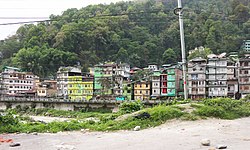
Singtam is a town which lies mostly in Gangtok District and partly in Pakyong District in the Indian state of Sikkim about 30 kilometres (19 mi) from the state capital Gangtok. The town lies on the banking of the rivers Teesta and Ranikhola, which join together just below the town. NH10 and NH510 meet in Singtam. The Indreni Bridge and Sherwani Bridge over the river Teesta are in the town. Singtam District Hospital, the district hospital of Pakyong District,[1] lies at Golitar, Singtam.

Key Information

Geography

[edit]

Singtam is located at 27°09′N 88°23′E / 27.15°N 88.38°E / 27.15; 88.38.[2] It has an average elevation of 1396 feet. As the town lies on the bank of two rivers River Teesta and Ranikhola, so during Monsoon especially from June to September the volume of both the river increases heavily, as a result destruction is caused on the low lying areas of the town especially at Adarsh gaon and Jublee line part of the town.

Demographics

[edit]

As of 2001 India census,[3] Singtam had a population of 5,868. Males constitute 56% of the population and females 44%. Singtam has an average literacy rate of 71%, higher than the national average of 59.5%: male literacy is 75%, and female literacy is 66%. In Singtam, 12% of the population is under 6 years of age.

Religion

[edit]
Religious Demographic in Singtam Nagar Panchayat (2011)[4]
  1. Hinduism (77.9%)
  2. Islam (8.54%)
  3. Buddhism (8.11%)
  4. Christianity (5.28%)
  5. Others (0.17%)

Languages

[edit]
Languages spoken in Singtam Nagar Panchayat (2011)[5]
  1. Nepali (39.2%)
  2. Hindi (34.0%)
  3. Bhojpuri (18.3%)
  4. Urdu (2.84%)
  5. Bengali (1.22%)
  6. Bhutia (0.97%)
  7. Marwari (0.85%)
  8. Others (2.64%)

Transportation

[edit]
Air

The nearest airport to Singtam is 33 kilometres (21 mi) at Pakyong Airport in Sikkim from where flights operate to and from Delhi, Guwahati and Kolkata and 92 kilometres (57 mi) away at Bagdogra in West Bengal, where scheduled flights operate to and from Kolkata, Delhi, Bangalore, Chennai, Jaipur, Hyderabad, Mumbai, Patna, Ahmedabad, Dibrugarh, and Guwahati. Druk Airways from Bagdogra operate to and from Bangkok and Paro. Bagdogra airport is connected to Gangtok by a helicopter service operating between Gangtok-Bagdogra-Gangtok.

Rail

The two nearest railway stations in traffic in April 2023 are at Siliguri Junction 81 kilometres (50 mi) away and New Jalpaiguri 86 kilometres (53 mi) away. They provide links to all important cities in India.

The new under construction Sivok–Rangpo line[6] will end at the Rangpo railway station, which is 10 kilometres[citation needed] away from Singtam. If the planned prolongation to Gangtok is built, then Singtam should also get a railway station.

Road

National highway NH10 (Formerly NH-31A) passes through Singtam and connects to the town to the rest of the nation. Long-distance buses ply from major towns in Bihar, West Bengal and other neighbouring states to Siliguri. From Siliguri, it takes about 3 hours to reach Singtam. Private taxis, shared taxi jeeps ply regularly on NH10. Government buses (SNT) and Privately operated buses are also available throughout the day. These transport options mostly operate between Siliguri-Gangtok/Singtam route. Jeep services are available between Gangtok/Singtam-New Jalpaiguri (NJP) and Gangtok/Singtam-Bagdogra route.

In Singtam NH-10 is joined by the following major roads:

Daily Taxi services access almost all cities and towns of Sikkim and cities/towns of West Bengal like Siliguri, Kalimpong, Darjeeling, Kurseong, Jaigaon, Malbazar, Bagdogra, Panitanki etc.

Frequent buses operated by Sikkim Nationalised Transport (SNT) are available from Singtam to Sikkim Nationalised Transport Bus Terminus (Siliguri) and Gangtok, apart from it many private buses and NBSTC buses are available from the town to Gangtok, NJP Bus Stand and Tenzing Norgay Bus Terminus, (Siliguri).

Note: foreigners need a permit to enter Sikkim which they can easily get at Siliguri or at Rangpo, Sikkim.

Economy

[edit]

Singtam is one of largest market towns in Sikkim and is easily accessible from almost all cities and towns of Sikkim.

The trade in large cardamom, the broom plant (kuccho) and ginger is important in Singtam's economy.[7]

2023 Sikkim Flash Floods

[edit]

See also

[edit]

References

[edit]
Revisions and contributorsEdit on WikipediaRead on Wikipedia
from Grokipedia
Singtam is a town and in the East Sikkim district of the Indian state of , serving as a key commercial and trading center at the confluence of the and Rani Khola. Located at coordinates 27°9′0″N 88°22′48″E and an elevation of 423 meters above , it functions as a vital gateway for the export of Sikkim's agricultural produce, including oranges and other crops, to neighboring regions. According to the , Singtam had a of 5,868 residents across an area of 0.18 square kilometers, with a rate of 86.1% and a high reflecting its urban character. Administratively, Singtam operates as a divided into six wards, with its jurisdiction expanding to include nearby areas like Golitar, leading to an estimated municipal population of 25,665 by 2018. The town's economy is driven by , with approximately 75% of the engaged in , , or private sector jobs; notable industries include pharmaceuticals and small-scale projects that support regional energy needs. Its strategic position along major river systems has historically enhanced its role as a node, particularly after shifts in transportation routes in the late elevated its importance over nearby settlements like for agricultural transactions. Singtam faces environmental challenges typical of Himalayan towns, such as seasonal and monsoon-related damage, with its system relying on springs and reservoirs that struggle to meet a demand of 1.5 million gallons per day. Despite these issues, the town contributes to Sikkim's broader , including initiatives that bolster local . Infrastructure developments, like the declaration of the Melli-Singtam National Highway (NH-210) in 2025, underscore its growing connectivity and economic potential within the state.

Geography and Environment

Location and Topography

Singtam is situated in the northeastern Indian state of , at geographical coordinates 27°09′N 88°23′E. The town lies at an average elevation of 426 meters (1,396 feet) above , placing it in the lower reaches of the Himalayan . As part of the , Singtam occupies a strategic position within , formerly known as East Sikkim District, with portions extending into the adjacent following administrative reorganizations in 2021. It serves as a vital gateway connecting the state capital , approximately 30 kilometers to the north, with the Pakyong area and further south toward the plains of . The town is prominently located at the confluence of the , Sikkim's largest river originating from glacial sources in the north, and the Ranikhola, a significant that joins it here, forming a dynamic riverine landscape. This junction not only defines Singtam's hydrological setting but also influences its role as a transitional hub between the higher elevations of and the lower Pakyong region, facilitating trade and travel across district boundaries. Approximately 81 kilometers south of lies , the nearest major rail and air connectivity point in , underscoring Singtam's importance in regional logistics. Singtam's topography is characterized by undulating hilly terrain typical of the , with steep slopes rising from the river valleys and interspersed low-lying floodplains along the Teesta and Ranikhola that are susceptible to seasonal overflows during monsoons. The surrounding landscape features forested hills and narrow gorges, contributing to a rugged yet accessible profile that supports its function as a connectivity node. The town benefits from proximity to key transportation arteries, including National Highway 10 (NH10), which runs along the Teesta Valley linking to and passes directly through Singtam, and the intersection with National Highway 510 (NH510) nearby, enhancing its accessibility within the state's road network.

Climate and Rivers

Singtam features a subtropical highland climate (Köppen classification Cwb), marked by distinct seasonal variations and significant influence. The region receives an average annual rainfall of 1,500 to 1,800 mm, with the bulk of precipitation—peaking during the southwest —occurring from to September, contributing to lush vegetation but also heightened hydrological activity. Temperatures in Singtam are moderated by its elevation in the Himalayan foothills, typically ranging from 20–26°C during summers (May to ) to 6–16°C in winters ( to ). This temperate profile supports a diverse array of and fauna adapted to the altitudinal gradients, though occasional frost occurs in cooler months due to the proximity to higher elevations. The serves as the principal waterway through Singtam, originating from glacial sources in the and flowing southward, while the Ranikhola, a key , merges with it just below the town center. These rivers are vital for regional ecology, fostering hotspots that include endangered species like the golden and supporting riparian habitats essential for local . However, the Teesta is particularly prone to swelling during monsoons, elevating flood risks in low-lying areas near Singtam. Environmental challenges in the area encompass along riverbanks, exacerbated by heavy rains and steep , as well as upstream glacial influences that alter the Teesta's flow through increased load and variable discharge from melting ice. The Ranikhola similarly contributes to dynamics, with its rain-fed nature amplifying erosion risks during peak periods. These factors underscore the need for integrated to mitigate hydrological vulnerabilities.

History and Development

Early Settlement and Growth

Singtam's early settlement traces its roots to the indigenous , who are recognized as the original inhabitants of and established communities along the fertile valleys of the , including areas around present-day Singtam, for centuries prior to recorded history. The , migrating from starting in the 14th century, later joined these settlements, contributing to a mixed ethnic fabric under the Kingdom of , where the served as a vital lifeline for and local exchange. These early communities relied on the river's resources for , cultivation of crops like millet and maize, and rudimentary trade in forest products, fostering small hamlets that formed the foundational human presence in the region. By the , Singtam emerged as a modest within the Kingdom of , strategically positioned along the trade routes connecting to British-controlled and beyond. British influence in the region enhanced connectivity along these routes in the late , spurring economic activity as merchants transported goods such as timber, salt, and between , , and . This period marked the site's transition from isolated settlements to a nodal point in regional , with the status formalized in 1890 further integrating Sikkim's routes into broader imperial trade networks. Key milestones in Singtam's growth occurred in the late 19th and early 20th centuries, when it was formally established as a town around the late 1880s, attracting settlers and traders to its markets. The influx of Nepali migrants during this era, drawn by opportunities in and labor on British-built , significantly boosted the and diversified the local , with many taking up terraced farming along the riverbanks. By the early , the town's had solidified its role in handling agricultural produce, notably serving as a hub for trading large —a staple of Sikkim's hills—where local farmers exchanged it for essentials like and cloth. This cultural significance of traditional markets underscored Singtam's evolution into a vibrant commercial center prior to Sikkim's integration into in 1975.

Post-Independence Developments

Following Sikkim's accession to on May 16, 1975, which marked the end of the Namgyal monarchy and the state's integration as the 22nd state of the Indian Union, Singtam underwent significant administrative restructuring as part of the broader transition to democratic governance. The town was incorporated into the newly formed East Sikkim District and designated within the sub-division, facilitating localized administration and development initiatives aligned with national frameworks. This shift enabled access to central government funding and infrastructure support, laying the foundation for Singtam's evolution from a riverside settlement to a key urban node. Urbanization in Singtam accelerated in the late 20th and early 21st centuries, driven by influx and economic opportunities. A pivotal milestone was the formation of the Singtam in 2010 under the Sikkim Municipalities Act of 2007, which established a three-tier urban local body structure including nagar panchayats for smaller towns like Singtam. This body, divided into wards such as Lall Bazaar and Chisopani, was tasked with managing local , , and , marking Singtam's formal recognition as an urban center. Key infrastructure projects post-1975 bolstered Singtam's connectivity and economy. The National Highway 10 (NH10), Sikkim's lifeline linking the town to and , saw ongoing upgrades to improve resilience against landslides and monsoons, with major maintenance and widening efforts enhancing its role as a vital . Nearby hydropower development included the establishment of the 510 MW Teesta-V Hydroelectric Project by at Balutar, near Singtam, commissioned in 2008 to harness the Teesta River's potential and provide revenue for local growth. Local markets, such as the historic Lall Bazaar, expanded post-statehood to support trade in agricultural goods and handicrafts, serving as commercial hubs for surrounding villages. By the 2020s, Singtam's expansions focused on sustainable and . The town was included in the Sikkim Integrated Urban Development Project, approved by the in September 2025 with a $179 million loan, targeting improvements in , , and mobility across seven towns including Singtam. This initiative funds upgrades like climate-resilient water infrastructure and a new transit hub at Singtam, enhancing its position as a gateway between East Sikkim and border areas. Tourism promotion has emphasized Singtam's role as a transit point along NH10, with riverside attractions and proximity to drawing visitors for eco-tourism and cultural experiences.

Government and Administration

Municipal Governance

The Singtam serves as the primary local governing body for Singtam, an urban local body established in 2010 under the Sikkim Municipalities Act, 2007, to manage civic administration in the town. It is responsible for key functions including , , services, and infrastructure development to support the town's growing population and economic activities. The panchayat operates within the framework of the 74th Constitutional Amendment, empowering it to address local needs such as street lighting, public parks, and community welfare programs. Leadership of the Singtam is provided by an elected president, who chairs the body, along with councilors representing the town's five wards, elected every five years to ensure democratic representation. The executive officer, appointed by the state government, handles day-to-day operations, while oversight is maintained by the Urban Development and Housing Department of and the administration to align local efforts with state policies. Key responsibilities encompass through regular collection and segregation drives, maintenance of local roads and drainage systems, and provision of potable , all funded primarily through allocations from the state budget and grants under national schemes like Swachh Bharat Abhiyan. In recent years, particularly as of 2025, the panchayat has undergone reforms through integration with the Sikkim Integrated Urban Development Project, funded by the , aimed at enhancing civic amenities via improved water supply, sewerage systems, and sustainable infrastructure. These initiatives include community consultations and implementations to promote eco-friendly urban growth, such as connectivity enhancements for over 1,200 households and better waste disposal mechanisms, contributing to Singtam's recognition as the second cleanest urban local body in in 2025.

Administrative Divisions

Singtam, as a , is administratively subdivided into five wards under the (formerly East Sikkim District): Pipal Dara, Daragaon, Mandir Line, Lall Bazaar, and Chisopani. These wards form the core territorial units for local governance and within the town's . This compact area facilitates efficient administrative oversight, with the nagar panchayat coordinating services such as , , and basic across the wards. For instance, educational facilities like primary schools are distributed to serve residents in wards like Daragaon and Chisopani, while resources, including the District Hospital Singtam, provide centralized care accessible to all divisions. In terms of broader jurisdictions, Singtam's boundaries interface with surrounding areas in , including nearby villages, and require coordination with the adjacent for cross-boundary issues like road connectivity and resource sharing. Towns such as Rongli and Rorathang, located in , fall outside direct Singtam jurisdiction but influence regional planning due to proximity along the Rangpo River corridor. Significant boundary adjustments occurred following the Sikkim (Re-organization of Districts) Act, 2021, which divided the former East Sikkim District into and Districts. As a result, while the core of nagar panchayat remains in , portions of the town, including areas like Chhota Singtam, were reassigned to , necessitating updated administrative mappings and inter-district collaborations for services and development. This reorganization aimed to enhance localized governance without altering the internal ward structure of .

Demographics

According to the 2011 Indian census, Singtam had a total population of 5,868, comprising 3,097 s and 2,771 s. This represented a of 895 females per 1,000 males, slightly higher than the state average of 890 for . The rate stood at 86.08 percent, exceeding 's overall rate of 81.42 percent, with male at 90.35 percent and female at 81.28 percent. The age distribution in 2011 showed that approximately 11.95 percent of the —701 individuals—were children under six years old, reflecting a relatively young demographic profile. Singtam's population has exhibited steady growth, increasing from 5,432 in 2001 to 5,868 in 2011, a decadal growth rate of about 8 percent. Following expansion of its to include nearby areas like Golitar, the municipal was estimated at 25,665 as of 2018. Projections for the core area estimate the resident to reach around 8,400 by 2025, fueled by ongoing urbanization and infrastructure development in the region; however, no official updates are available due to the postponement of the 2021 census, with the next census expected later in 2025 or beyond. Migration patterns have significantly influenced Singtam's demographics, with an influx of workers attracted by trade opportunities and projects along the , such as those in the Ramphu–Singtam–Dikchu corridor. This has led to a substantial floating of over 6,000 individuals annually, often transient laborers, which exceeds the local resident base and contributes to increasing . As a , Singtam maintains an urban-rural mix, with growing urban density due to these economic pulls, though precise recent breakdowns remain limited without updated data as of November 2025. The 2023 glacial lake outburst flood along the affected thousands in Singtam and surrounding areas, leading to temporary displacement, but no comprehensive post-flood demographic data is available.

Religious and Linguistic Composition

Singtam's religious composition, as per the , is predominantly Hindu at 77.9%, followed by at 8.54%, at 8.11%, and at 5.28%, with smaller proportions of (0.02%), Jains (0.15%), and others. This distribution reflects the town's diverse ethnic influences, including the Nepali majority alongside indigenous and Lepcha communities, which contribute to the prevalence of and . Nepali is the predominant language in Singtam, serving as the official language for administration in Sikkim and facilitating daily interactions, consistent with state-level trends where it is the mother tongue for a significant portion of the population. The community exhibits strong interfaith harmony, evidenced by the coexistence of Hindu temples such as the Singtam Bazar Thakurbari Mandir and Shree Krishna Pranami Temple, alongside Buddhist sites like the Karma Thuje Choling Monastery near Singtam Bazaar.

Economy and Infrastructure

Economic Activities

Singtam's economy is predominantly agrarian, with serving as the primary livelihood for a significant portion of the local population in East . Key cash crops include large cardamom (Amomum subulatum), ginger, and broom grass (Thysanolaena maxima), which are cultivated on terraced slopes along the valley. Large cardamom, a major export-oriented crop, thrives in the region's shaded, humid conditions and contributes substantially to household incomes, with accounting for approximately 87% of India's production area dedicated to this spice. Ginger and broom grass serve as supplementary crops, providing resilience against cardamom's vulnerability to diseases and climate variability, while supporting smallholder farming on fragmented landholdings. As a central market hub for East , Singtam facilitates the aggregation and trade of agricultural produce, drawing farmers from surrounding villages for sales and auctions. The town's weekly and daily bazaars bustle with activity, where locals trade spices, , and handicrafts, bolstering regional commerce and connecting rural producers to broader markets. Large cardamom auctions, organized fortnightly by the since 2010, have significantly enhanced farmer prices, often multiplying returns sixfold and stimulating local economic circulation. Produce is subsequently exported via road links to in , a key transit point for onward shipment to national and international buyers, primarily in the and . Emerging sectors are diversifying Singtam's economic base, with small-scale projects providing ancillary employment in construction, maintenance, and services. The Teesta-V Hydroelectric Project (510 MW), located near Balutar in Singtam, exemplifies this, generating power for the national grid while supporting local jobs despite periodic disruptions. Additionally, the town functions as a vital transit point for trekkers en route to destinations like Menam Hill and Borong, offering lodging, supplies, and access to adventure routes, which indirectly boosts and retail activities. Economic activities face challenges from seasonal dependence, as heavy rainfall from May to —essential for —can lead to erratic yields and in the hilly terrain. Post-2023 recovery initiatives have focused on reviving trade volumes through loan moratoriums for affected businesses and enhancements, such as resilient bridges and roads, enabling a gradual restoration of and agricultural in East , including Singtam. These efforts include livelihood diversification programs for over 5,000 workers and investments in eco-tourism trails, projecting stabilized trade flows within 12-24 months.

Transportation Networks

Singtam's transportation infrastructure centers on an extensive road network that connects the town to major regional hubs, facilitating both local commuting and broader travel across Sikkim and beyond. National Highway 10 (NH10) serves as the primary artery, linking Singtam southward to in , approximately 81 kilometers away, with a typical travel time of about three hours under normal conditions. Northward along NH10, the route extends roughly 30 kilometers to , the state capital, taking around one hour by road. Complementing NH10, National Highway 510 (NH510) branches from Singtam westward toward Gyalsing, providing alternative access to western Sikkim districts and supporting intra-state mobility. In June 2025, the 23 km stretch from Melli to Singtam was declared National Highway 210 (NH-210), providing an alternative route to NH10 and improving resilience against disruptions. Local infrastructure includes key bridges over the , such as the Indreni Bridge, which was rebuilt and inaugurated in August 2024 following its destruction in the October 2023 flash floods, restoring vital connectivity between east and south Sikkim. Rail access remains limited but is poised for improvement with ongoing projects. The nearest operational railway stations are , about 81 kilometers south, and New Jalpaiguri Junction, approximately 86 kilometers away, both serving as gateways to broader Indian rail networks via connections to major cities like and . The Sivok–Rangpo railway line, located roughly 10 kilometers from Singtam at , represents a significant development; this 45-kilometer broad-gauge project, featuring 14 tunnels and 22 bridges, achieved over 73% physical progress as of November 2025 and is targeted for operational status by December 2027, promising direct rail linkage to Sikkim's road-dependent transport system. Air connectivity supports regional and international travel through nearby airports. , Sikkim's domestic facility, lies 33 kilometers northeast of Singtam, offering limited flights to destinations like , , and , with taxi services covering the journey in about one hour. For broader international links, in , approximately 92 kilometers southwest, provides extensive domestic and international flights, with road travel taking around three hours via NH10. Public transport in Singtam emphasizes affordability and frequency, primarily through state-run Sikkim National Transport (SNT) buses and shared or jeeps that operate along NH10 and local routes, connecting to , , and internal destinations throughout the day. These services handle moderate daily vehicle volumes, estimated at 2,000 to 3,000, reflecting the town's role as a transit hub while accommodating tourist and commuter flows.

Education and Culture

Educational Institutions

Singtam's educational landscape is anchored by a mix of and private institutions catering primarily to primary, secondary, and higher secondary levels. The Government Senior Secondary School Singtam (GSSSS), established as a key public institution, offers education up to Class XII and has been recognized under the PM SHRI scheme for its focus on holistic development. Other notable facilities include the Kendriya Vidyalaya NHPC Singtam, which provides CBSE-affiliated education from primary to senior secondary levels with an emphasis on extracurricular activities. Private options, such as and Mount Zion School, supplement these by offering English-medium instruction and smaller class sizes for local students. The Sikkim government supports through free primary and , including textbooks, uniforms, and exercise copies distributed annually to students in government schools up to Class VIII, with extensions to higher levels. These initiatives, aligned with the Right of Children to Free and Compulsory Education Act, 2009, have driven literacy improvements; Singtam's rate rose from 71% in 2001 to 86.08% in 2011, surpassing the state average of 81.42%. State programs emphasizing teacher training and infrastructure have been instrumental in this progress, particularly in rural pockets around Singtam. For higher education, residents of Singtam primarily access institutions in nearby , approximately 30 km away, including and Sikkim Government College, which offer undergraduate and postgraduate programs in , sciences, and commerce. Vocational training in is facilitated through state-run livelihood schools and the ICAR Research Complex for NEH Region in Tadong, providing short-term courses on and suited to 's terrain. Recent developments from 2024 to 2025 include statewide school mergers targeting low-enrollment institutions—97 schools identified for consolidation—to optimize resources and improve teaching quality, impacting smaller facilities near Singtam. Post the 2023 floods, digital education has advanced with mandatory online classes for Classes IX-XII during disruptions and the launch of the Digital Education Initiative to integrate hybrid learning tools across schools.

Cultural Heritage and Festivals

Singtam's cultural heritage is deeply influenced by the town's diverse ethnic composition, including the indigenous Lepcha, the Tibetan-origin , and the Nepali settlers who form the majority, alongside a notable Newar community. The Lepcha traditions emphasize harmony with nature, featuring rituals and folklore tied to the surrounding Himalayan landscape, while s contribute Buddhist practices and monastic influences. Nepali customs introduce vibrant Hindu elements, and Newars add distinct rituals rooted in their heritage, fostering a multicultural fabric that defines community life in Singtam. Traditional attire reflects these ethnic diversity: and Nepali residents often wear the bakhu, a loose, knee-length belted with a colorful and paired with sturdy boots for mountainous terrain, while Lepcha women don the dumvoot, a handwoven wrap-around complemented by silver jewelry. Men from the Lepcha community favor the thokro-dum, a simple . embodies shared influences, with staples like momos—steamed or fried dumplings filled with or —and , a hearty enriched with and spices, commonly prepared for festivals and daily meals, highlighting Tibetan and Nepali culinary techniques adapted to local ingredients such as fermented . Festivals in Singtam serve as vibrant expressions of this heritage, uniting communities through rituals and celebrations. Losar, the Bhutia and Tibetan New Year observed in February, involves family feasts, prayers at monasteries, and traditional dances to welcome prosperity. Dashain, the prominent Hindu festival in September-October, features animal sacrifices, tika ceremonies, and swings set up in neighborhoods, primarily among Nepalis. Christmas brings church processions and carol singing for the Christian minority. Local fairs at Singtam's bustling markets during these events showcase handicrafts, agricultural produce, and street food, drawing residents and visitors alike. The Newar community uniquely celebrates in August-September with masked processions, the iconic demon dance, and offerings to honor the rain god , marking a historic state-level observance in Singtam since 2014. Saga Dawa, a Buddhist festival in May commemorating Buddha's life events, includes circumambulations and lantern releases, reflecting the town's . Key heritage sites in Singtam include riverside temples along the Teesta, such as the Singtam Bazar Thakurbari Mandir and Krishna Mandir, which host daily worship and annual pujas, preserving architectural styles blending Hindu and local motifs. Folk dances enliven these spaces: the Lepcha Chu-Faat, a graceful ensemble honoring Mount Kanchenjunga with rhythmic steps and chants; the Bhutia Tashi Yangku, depicting mythical lions in masked performances; and Nepali , a with songs about , often accompanied by the damphu and madal for musical authenticity. Preservation efforts in Singtam focus on sustaining these traditions through community organizations like the Singtam Newar Kalyan Sangathan, which supports cultural programs, funeral rites, and marriage ceremonies to maintain ethnic identities. Initiatives such as the 2014 release of the documentary NEWA, highlighting and customs, underscore ongoing commitments to documentation and . Following the 2023 that devastated the region, local groups have resumed festival organization and dance workshops, as seen in performances by academies like Dance Mantra, to rebuild communal bonds and revive events amid recovery.

Natural Disasters and Recovery

2023 Sikkim Flash Floods

On October 4, 2023, a (GLOF) devastated when heavy rains triggered a massive into in North , causing the lake to breach and unleash floodwaters along the . The surge destroyed the Teesta III hydroelectric dam near and propagated downstream, severely impacting areas like Singtam approximately 50 kilometers away. This event, one of the most catastrophic in the region's recent history, was amplified by the rapid expansion of glacial lakes due to . The breach was initiated by a landslide of approximately 14.7 million cubic meters of frozen glacial sediment and ice, which overtopped the lake's dam and released a torrent equivalent to tens of thousands of Olympic-sized swimming pools of water. In Singtam, the floodwaters eroded riverbanks, completely washing away the Indreni Bridge—a critical steel structure connecting the town to —and inundating homes, markets, and agricultural lands along the Teesta. The disaster resulted in 55 deaths and 74 people missing statewide, including army personnel stationed near the dam. In the immediate aftermath, Sikkim authorities declared a state-level disaster emergency, initiating large-scale evacuations that relocated over 5,000 from vulnerable riverside locations, including in Singtam. Rescue operations involved the (NDRF), State Disaster Response Force (SDRF), , and , who airlifted stranded residents and tourists amid disrupted road networks. A Post-Disaster Needs Assessment (PDNA) conducted in December 2023 quantified the acute damages, highlighting the flood's role in displacing thousands and underscoring the need for urgent .

Post-Flood Recovery Efforts

Following the , rehabilitation efforts in Singtam prioritized the relocation of affected families and provision of financial aid to restore livelihoods. Over 500 families were displaced in the town and surrounding areas, with many relocated to temporary relief camps such as Sirwani Senior Secondary School, where essential support including , medical care, and shelter was provided. The Post-Disaster Needs Assessment (PDNA) conducted by the State Disaster Management Authority outlined a recovery framework from 2023 to 2025, estimating total damages at ₹1,048.7 and recommending financial aid packages totaling ₹2,192.59 for , , and economic restoration across affected sectors, including targeted support for Singtam's vulnerable communities. By mid-2024, rebuilding of had progressed significantly, with the completing the reconstruction of key bridges like the Indreni Bridge—a 300-foot Bailey suspension structure linking East and South —and several roads along the , restoring connectivity disrupted by flood damage. Inaugurated in August 2024, the bridge enhanced regional access. Reconstruction projects in Singtam emphasized resilience against future floods, including the ongoing restoration of the Teesta III dam upstream, which was swept away in the 2023 event. Approved by India's Ministry of Environment in January 2025, the new 118.64-meter-high concrete incorporates enhanced structural designs and an integrated to mitigate glacial lake outburst risks, with works continuing through 2025 under supervision. Local initiatives also introduced improved flood barriers along the banks and expanded early warning networks, including automated rainfall and river-level sensors linked to community alert systems, as part of the PDNA's broader strategy to fortify urban and riverine areas. Community resilience in Singtam was bolstered by NGO involvement and evolving policy frameworks. Organizations like provided aid to over 1,100 families in the region, distributing essentials such as hygiene kits, rebuilding materials, and psychosocial support, while local groups like Aayom Welfare Society focused on Singtam-specific needs including sanitary supplies and medical aid. In response to the floods' exacerbation of hydropower vulnerabilities, Sikkim's policies shifted toward sustainable practices, emphasizing better management of existing projects over new large-scale developments and integrating environmental impact assessments into disaster planning to reduce ecological risks. By 2025, recovery faced new challenges from a major triggered by heavy rains in late May near , which damaged roads and power lines in downstream areas including Singtam, with no reported casualties but requiring intensified restoration operations. Under the State Disaster Management Plan, enhanced initiatives advanced, with the Asian Development Bank-supported Sikkim Integrated Urban Development Project upgrading Singtam's systems, drainage, and flood-resilient to better withstand recurrent hazards.

References

Add your contribution
Related Hubs
User Avatar
No comments yet.