Hubbry Logo
Marwari languageMarwari languageMain
Open search
Marwari language
Community hub
Marwari language
logo
8 pages, 0 posts
0 subscribers
Be the first to start a discussion here.
Marwari language
Marwari language
from Wikipedia

Marwari
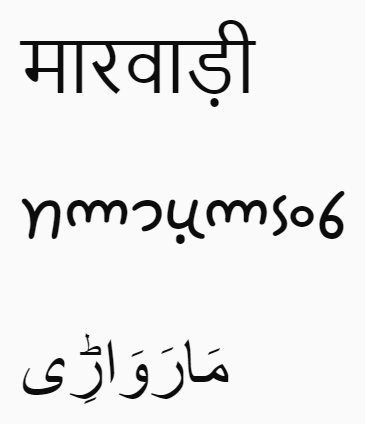
The word Marwari written in Devanagari, Mahajani and Perso-Arabic script
Pronunciation[mɑɾvɑɽi]
Native toIndia
RegionMarwar
EthnicityMarwari
Native speakers
21 million, total count (2011 census)[1]
(additional speakers counted under Hindi)[2]
Devanagari (in India)
Perso-Arabic (in Pakistan)
Mahajani (historical)
Language codes
ISO 639-2mwr
ISO 639-3mwr – inclusive code
Individual codes:
dhd – Dhundari
rwr – Marwari (India)
mve – Marwari (Pakistan)
wry – Merwari
mtr – Mewari
swv – Shekhawati
GlottologNone
raja1256  scattered in Rajasthani
Dark green indicates Marwari speaking home area in Rajasthan, light green indicates additional dialect areas where speakers identify their language as Marwari.
Geographical distribution of Rajasthani languages

Marwari (मारवाड़ी, مارواڑی, Mārwāṛī, IPA: [maɾwaɽi])[a] is a Western Indo-Aryan language belonging to the Indo-Iranian subdivision of the Indo-European languages. Marwari and its closely related varieties like Dhundhari, Shekhawati and Mewari form a part of the broader Rajasthani language family. It is spoken in the Indian state of Rajasthan, as well as the neighbouring states of Gujarat and Haryana, some adjacent areas in eastern parts of Pakistan, and some migrant communities in Nepal.[4][5][6] There are two dozen varieties of Marwari.

Marwari is popularly written in Devanagari script, as are many languages of India and Nepal, including Hindi, Marathi, Nepali, and Sanskrit; although it was historically written in Mahajani, it is still written in the Perso-Arabic script by the Marwari minority in Eastern parts of Pakistan (the standard/western Naskh script variant is used in Sindh Province, and the eastern Nastalik variant is used in Punjab Province), where it has educational status but where it is rapidly shifting to Urdu.[7]

Marwari has no official status in India and is not used as a language of education. Marwari is still spoken widely in Jodhpur, Pali, Jaisalmer, Barmer, Nagaur, and Bikaner. It is also one of the most common languages spoken by Indians in Kenya.

History

[edit]

It is believed that Marwari and Gujarati evolved from Old Western Rajasthani or Dingal.[8] Formal grammar of Gurjar Apabhraṃśa was written by Jain monk and Gujarati scholar Hemachandra Suri.[citation needed]

Geographical distribution

[edit]

Marwari is primarily spoken in the Indian state of Rajasthan. Marwari speakers have dispersed widely throughout India and other countries but are found most notably in the neighbouring state of Gujarat and in Eastern Pakistan. Speakers are also found in Bhopal. With around 7.9 million speakers in India according to the 2001 census.[9]

Some dialects of Marwari are:[10]

Marwari dialects
Dialect Spoken in
Thali/Bikaneri Bikaner, Jaisalmer, Phalodi, Balotra districts
Godwari Jalore, Sirohi, Sanchore, Pali districts
Dhatki Eastern Sindh and Barmer
Shekhawati

Jhunjhunu, Sikar, Neem ka thana districts

Standard Marwari Ajmer, Beawer, Jodhpur, Kekri, Nagore

Lexis

[edit]

Indian Marwari [rwr] in Rajasthan shares a 50%–65% lexical similarity with Hindi (this is based on a Swadesh 210 word list comparison). It has many cognate words with Hindi. Notable phonetic correspondences include /s/ in Hindi with /h/ in Marwari. For example, /sona/ 'gold' (Hindi) and /hono/ 'gold' (Marwari).

Pakistani Marwari [mve] shares 87% lexical similarity between its Southern subdialects in Sindh (Utradi, Jaxorati, and Larecha) and Northern subdialects in Punjab (Uganyo, Bhattipo, and Khadali), 79%–83% with Dhakti [mki], and 78% with Meghwar and Bhat Marwari dialects. Mutual intelligibility of Pakistani Marwari [mve] with Indian Marwari [rwr] is decreasing due to the rapid shift of active speakers in Pakistan to Urdu, their use of the Arabic script and different sources of support medias, and their separation from Indian Marwaris, even if there are some educational efforts to keep it active (but absence of official recognition by Pakistani or provincial government level). Many words have been borrowed from other Pakistani languages.[7]

Merwari [wry] shares 82%–97% intelligibility of Pakistani Marwari [mve], with 60%–73% lexical similarity between Merwari varieties in Ajmer and Nagaur districts, but only 58%–80% with Shekhawati [swv], 49%–74% with Indian Marwari [rwr], 44%–70% with Godwari [gdx], 54%–72% with Mewari [mtr], 62%–70% with Dhundari [dhd], 57%–67% with Haroti [hoj]. Unlike Pakistani Marwari [mve], the use of Merwari remains vigorous, even if its most educated speakers also proficiently speak Hindi [hin].[11]

Marwari Dialects Comparison
Dialect Lexical Similarity with Hindi Phonetic Correspondences
Indian Marwari [rwr] 50%–65% Notable: /s/ in Hindi → /h/ in Marwari (e.g., /sona/ 'gold' → /hono/ 'gold')
Pakistani Marwari [mve] 87% (Southern Sindh) / 79%–83% (Dhakti [mki]) / 78% (Meghwar, Bhat Marwari) Mutual intelligibility decreasing due to shifts in Pakistan
Merwari [wry] 82%–97% (with Pakistani Marwari [mve]) / 60%–73% (Ajmer, Nagaur) 58%–80% (Shekhawati [swv]) / 49%–74% (Indian Marwari [rwr]) / 44%–70% (Godwari [gdx]) / 54%–72% (Mewari [mtr]) / 62%–70% (Dhundari [dhd]) / 57%–67% (Haroti [hoj])
Merwari [wry] vs. Pakistani Marwari [mve] Intelligibility: 82%–97%
Merwari [wry] vs. Indian Marwari [rwr] Intelligibility: 49%–74%
Merwari [wry] vs. Shekhawati [swv] Intelligibility: 58%–80%
Merwari [wry] vs. Godwari [gdx] Intelligibility: 44%–70%
Merwari [wry] vs. Mewari [mtr] Intelligibility: 54%–72%
Merwari [wry] vs. Dhundari [dhd] Intelligibility: 62%–70%
Merwari [wry] vs. Haroti [hoj] Intelligibility: 57%–67%

Phonology

[edit]
Vowels[12]
Front Central Back
Close i u
ɪ ʊ
Mid e ə o
ɛ ɔ
Open ä
  • Nasalization of vowels is phonemic, all of the vowels can be nasalized.[12]
  • Diphthongs are /ai, ia, ae, əi, ei, oi, ui, ua, uo/[12]
Consonants[12]
Labial Dental/
Alveolar
Retroflex Post-alv/
Palatal
Velar Glottal
Nasal m n ɳ ŋ
Plosive/
Affricate
voiceless p t ʈ t͡ɕ k
aspirated ʈʰ t͡ɕʰ
voiced b d ɖ d͡ʑ ɡ
breathy ɖʱ d͡ʑʱ ɡʱ
implosive ɓ ɗ
Fricative s h
Sonorant rhotic r ɽ
lateral w l ɭ j
  • Implosives are mostly only found word initially and it formed due to the influence of neighbouring languages.[12]
  • /w/ is [ʋ] before front vowels and [w] elsewhere e.g. [ʋɪwwa] 'marriage'.[13]
  • Younis Kashali mentions aspirated implosives, fricatives and sonorants.[14]

Morphology

[edit]

Marwari languages have a structure that is quite similar to Hindustani (Hindi or Urdu).[citation needed] Their primary word order is subject–object–verb[15][16][17][18][19] Most of the pronouns and interrogatives used in Marwari are distinct from those used in Hindi; at least Marwari proper and Harauti have a clusivity distinction in their plural pronouns.[citation needed]

Vocabulary

[edit]

Marwari vocabulary is somewhat similar to other Western Indo-Aryan languages, especially Rajasthani and Gujarati, however, elements of grammar and basic terminology differ enough to significantly impede mutual intelligibility.

Word List

Swadesh 100-word list with Marwari translations and IPA transcriptions, illustrating core vocabulary for linguistic comparison and historical linguistics.

Sr. No. Marwari Meaning IPA English Word
1 म्हूं /mʰũː/ I
2 थूं /tʰũː/ you (singular)
3 आपण /aːpəɳ/ we
4 /iː/ this
5 /uː/ that
6 कोण /koːɳ/ who
7 के /keː/ what
8 नइ /nəi/ not
9 सगळो /səgəɭoː/ all
10 ढेर /ɖʰeːɾ/ many
11 एक /eːk/ one
12 बी /biː/ two
13 थाळो /tʰaːɭoː/ big
14 लांबो /laːmboː/ long
15 नान्डो /naːɳɖoː/ small
16 औरत /ɔːɾət/ woman
17 मर्द /mərd̪/ man (adult male)
18 आदमी /aːd̪miː/ person
19 माछली /maːtʃʰliː/ fish
20 चिड़ी /tʃɪɖiː/ bird
21 कुक्कुर /kʊkkʊɾ/ dog
22 जूं /d͡ʒũː/ louse
23 रुख /ɾʊkʰ/ tree
24 बीज /biːd͡ʒ/ seed
25 पात /paːt̪/ leaf
26 जड़ /d͡ʒəɽ/ root
27 छाल /tʃʰaːl/ bark (of a tree)
28 चमड़ी /tʃəmɖiː/ skin
29 मास /maːs/ meat
30 लहू /ləhʊ/ blood
31 हड्डी /ɦəɖɖiː/ bone
32 चर्बी /tʃəɾbiː/ grease
33 अंडो /əɳɖoː/ egg
34 सींग /siːŋ/ horn
35 पूंछ /pũːtʃʰ/ tail
36 पांख /paːŋkʰ/ feather
37 केस /keːs/ hair
38 माथो /maːtʰoː/ head
39 कान /kaːn/ ear
40 आँख /aːnkʰ/ eye
41 नाक /naːk/ nose
42 मुख /mʊkʰ/ mouth
43 दांत /d̪aːnt̪/ tooth
44 जिह्वा /d͡ʒɪɦʋaː/ tongue
45 नख /nəkʰ/ fingernail
46 पैर /pɛːɾ/ foot
47 टांग /ʈaːŋ/ leg
48 घुटनो /ɡʱʊʈʈʰnoː/ knee
49 हाथ /ɦaːt̪ʰ/ hand
50 पंख /pəŋkʰ/ wing
51 पेट /peːʈ/ belly
52 आंत /aːnt̪/ guts
53 गरदन /ɡəɾdən/ neck
54 पीठ /piːʈʰ/ back
55 छाती /tʃʰaːt̪iː/ breast
56 दिल /dɪl/ heart
57 कलेजा /kəleːd͡ʒaː/ liver
58 पिऊ /piːu/ drink
59 खाई /kʰaːi/ eat
60 कांट /kaːɳʈ/ bite
61 देख /d̪eːkʰ/ see
62 सुन /sʊn/ hear
63 जाण /d͡ʒaːɳ/ know
64 सूत /suːt̪/ sleep
65 मरी /məɾiː/ die
66 मार /maːɾ/ kill
67 तर /t̪əɾ/ swim
68 उड /uɖ/ fly (verb)
69 चाल /tʃaːl/ walk
70 आव /aːʋ/ come
71 लेट /leːʈ/ lie (down)
72 बैठ /bɛːʈʰ/ sit
73 खड़ो हो /kʰəɖoː ho/ stand
74 दे /d̪eː/ give
75 कह /kəɦ/ say
76 सूरज /suːɾəd͡ʒ/ sun
77 चंद /tʃənd̪/ moon
78 तारा /t̪aːɾaː/ star
79 पानी /paːniː/ water
80 बारिश /baːɾɪʃ/ rain
81 नदी /nəd̪iː/ river
82 तालाब /t̪aːlaːb/ lake
83 समुद्र /səmʊd̪ɾ/ sea
84 लवण /lʊʋəɳ/ salt
85 पाथर /paːt̪ʰəɾ/ stone
86 रेत /ɾeːt̪/ sand
87 धूळ /d̪ʰuːɭ/ dust
88 धरती /d̪ʰəɾt̪iː/ earth
89 बादल /baːd̪əl/ cloud
90 धूआं /d̪ʰuːãː/ smoke
91 आग /aːɡ/ fire
92 राख /ɾaːkʰ/ ash
93 जळ /d͡ʒəɭ/ burn
94 रोड /ɾoːɖ/ road
95 पहाड़ /pəɦaːɖ/ mountain
96 लाल /laːl/ red
97 हरो /ɦəɾoː/ green
98 पीलो /piːloː/ yellow
99 उजळो /uːd͡ʒəɭoː/ white
100 काळो /kaːɭoː/ black

Writing system

[edit]

Marwari is generally written in the Devanagari script, although the Mahajani script is traditionally associated with the language. In Pakistan, it is written in the Perso-Arabic script with modifications. Historical Marwari orthography for Devanagari uses other characters in place of standard Devanagari letters.[20]

Perso-Arabic Script

[edit]
Marwari Perso-Arabic alphabet[20][21]
Perso-Arabic
(Devanagari)
(Latin)
[IPA]
ا
‌(आ, ा)
(ā)

[]/[ʔ]/[]
ب
‌(ब)
(b)

[b]
بھ‎
‌(भ)
(bh)

[]
ٻ
‌(ॿ)
(b̤)

[ɓ]
ٻھ
‌(ॿ़)
(b̤h)

[ɓʱ]
پ
‌(प)
(p)

[p]
Perso-Arabic
(Devanagari)
(Latin)
[IPA]
پھ
‌(फ)
(ph)

[]
ت
‌(त)
(t)

[]
تھ
‌(थ)
(th)

[t̪ʰ]
ٹ
‌(ट)
(ṭ)

[ʈ]
ٹھ
‌(ठ)
(ṭh)

[ʈʰ]
ث
‌(स)
(s)

[s]
Perso-Arabic
(Devanagari)
(Latin)
[IPA]
ج
‌(ज)
(j)

[d͡ʒ]
جھ
‌(झ)
(jh)

[d͡ʒʱ]
چ
‌(च)
(c)

[t͡ʃ]
چھ
‌(छ)
(ch)

[t͡ʃʰ]
ح
‌(ह)
(h)

[h]
خ
‌(ख)
(kh)

[] ([x])
Perso-Arabic
(Devanagari)
(Latin)
[IPA]
د
‌(द)
(d)

[]
دھ
‌(ध)
(dh)

[d̪ʱ]
ڈ
‌(ड)
(ḍ)

[ɖ]
ڈھ
‌(ढ)
(ḍh)

[ɖʱ]
ذ
‌(ज़)
(z)

[z]
ڏ
‌(ॾ)
(d̤)

[]
Perso-Arabic
(Devanagari)
(Latin)
[IPA]
ڏھ
‌(ॾ़)
(d̤h)

[ᶑʱ]
ر
‌(र)
(r)

[r]
رؕ
‌(ड़)
(ṛ)

[ɽ]
رؕھ
‌(ढ़)
(ṛh)

[ɽʱ]
ز
‌(ज़)
(z)

[z]
زھ
‌(ॼ़)
(zh)

[]
Perso-Arabic
(Devanagari)
(Latin)
[IPA]
ژ
‌(झ़)
(zh)

[ʒ]
س
‌(स)
(s)

[s]
سھ
‌(स्ह)
(sh)

[]
ش
‌(श)
(ś)

[ʃ]
شھ
‌(श्ह)
(śh)

[ʃʰ]
ݾ
‌(ष)
(x)

[χ]
Perso-Arabic
(Devanagari)
(Latin)
[IPA]
ݾھ
‌(ष्ह)
(xh)

[χʰ]
ص
‌(स)
(s)

[s]
ض
‌(ज़)
(z)

[z]
ط
‌(त)
(t)

[]
ظ
‌(ज़)
(z)

[z]
ع
‌(ॽ)
( ’ )

[ʔ]
Perso-Arabic
(Devanagari)
(Latin)
[IPA]
غ
‌(ग़)
(ġ)

[ɣ] ([])
ف
‌(फ़)
(f)

[f] ([])
ق
‌(क़)
(q)

[q] ([k])
ک
‌(क)
(k)

[k]
کھ
‌(ख)
(kh)

[]
گ
‌(ग)
(g)

[k]
Perso-Arabic
(Devanagari)
(Latin)
[IPA]
گھ
‌(घ)
(gh)

[]
ل
‌(ल)
(l)

[l]
لھ
‌(ल़ / ल्ह)
(lh)

[]
ݪ
‌(ळ)
(ḷ)

[ɭ]
ݪھ
‌(ऴ / ळ्ह)
(ḷh)

[ɭʰ]
م
‌(म)
(m)

[m]
Perso-Arabic
(Devanagari)
(Latin)
[IPA]
مھ
‌(म़ / म्ह)
(mh)

[]
ن
‌(न, ङ)
(n, ṅ)

[n]/[ŋ]
نھ
‌(ऩ / न्ह)
(nh)

[]
ن٘ـ ں
‌(ं)
(◌̃)

[◌̃]
ݨ
‌(ण)
(ṇ)

[ɳ]
ݨھ
‌(ण़ / ण्ह)
(ṇh)

[ɳʰ]
Perso-Arabic
(Devanagari)
(Latin)
[IPA]
و
‌(व)
(w)

[ʋ]
ہ
‌(ह)
(h)

[h]
ی
‌(ए, ई, े, ी)
(e, ī)

[j]/[e]/[]
ے
‌(ए, े)
(e)

[e]
Marwari Perso-Arabic vowels[20]
Final Middle Initial Devanagari Initial Devanagari Diacritic Latin IPA
ـہ ـَ اَ - a [ə]
ـَا / یٰ ـَا آ ā []
N/A ـِ اِ ि i [ɪ]
ـِى ـِيـ اِی ī []
ـے‬ ـيـ اے ए, ऎ ॆ, े e []
ـَے‬ ـَيـ اَے ai [ɛː]
N/A ـُ اُ u [ʊ]
ـُو اُو ū []
ـو او ō []
ـَو اَو au [ɔː]

Sample Texts

[edit]

Below is a sample text in Marwari, in standard Devanagari Script, and transliterated into Latin as per ISO 15919.[22]

Devanagari Script ISO 15919 Latin English
सगळा मिणख नै गौरव अन अधिकारों रे रासे मांय जळम सूं स्वतंत्रता अने समानता प्राप्त छे। वणी रे गोड़े बुध्दि अन अंतरआत्मा री प्राप्ती छे अन वणी ने भैईपाळा भावना सू एकबीजे रे सारू वर्तन करणो जोयीजै छे। Sagḷā miṇakh nai gaurav an adhikārõ re rāse māy jaḷam sū̃ svatantrā ane samāntā prāpt che. Vaṇī re goṛe buddhi an antarātmā rī prāptī che an vaṇī ne bhaiīpāḷā bhāvnā sū ekbīje re sārū vartan karṇo joyījai che. All human beings are born free and equal in dignity and rights. They are endowed with reason and conscience and should act towards one another in a spirit of brotherhood.

See also

[edit]

Notes

[edit]

References

[edit]

Further reading

[edit]
[edit]
Revisions and contributorsEdit on WikipediaRead on Wikipedia
from Grokipedia
Marwari is an Indo-Aryan language primarily spoken in the region of western , , by about 7.8 million people according to the 2011 Indian census, though the actual number is likely higher as many speakers are classified under . It is one of the most widely used varieties within the Rajasthani language group. Classified under the Western Indo-Aryan branch of the Indo-European language family, it forms part of a that includes closely related speech forms like Mewari and Dhundari. The language is written in the script for modern literature and education, though it was historically recorded using the Mahajani script for trade and accounting purposes among Marwari merchants. As a stable and vigorous indigenous language, Marwari serves as a vital medium for oral traditions, folk songs, poetry, and everyday communication within the Marwari community, which extends beyond into parts of , , , and even . It encompasses several dialects, including (or Standard Marwari) and Bikaneri, among others, which exhibit varying degrees of and reflect regional cultural nuances. Despite its cultural prominence in preserving Rajasthani heritage—evident in literary forms like Dingal poetry and epic narratives—Marwari lacks official status in and is frequently classified under in national censuses, contributing to challenges in and revitalization efforts.

Overview and Classification

Linguistic Classification

Marwari belongs to the , more specifically the Indo-Iranian branch, the Indo-Aryan subbranch, the Western Indo-Aryan group, the Rajasthani division, where it functions as a macrolanguage comprising several closely related varieties and subdialects. The language is designated with the macrolanguage code mwr, while specific varieties, such as Western Marwari, receive individual codes like rwr; this classification underscores its recognition as a distinct language separate from or other Central Indo-Aryan tongues. Marwari shares its closest linguistic ties with other Rajasthani varieties, including Mewari and Dhundari, as well as with Gujarati, all forming part of the broader Western Indo-Aryan continuum marked by shared innovations in vocabulary and grammar. It differs from standard —classified under Central Indo-Aryan—through phonological features like the retention of implosive consonants and aspirated stops not fully paralleled in Hindi, as well as morphological distinctions such as unique pronominal forms and structures. Linguistic debates on Marwari's status emphasize its separation from , supported by lexical similarity percentages of 53% to 64% and mutual intelligibility levels below the conventional 80% threshold often used to delineate distinct languages from dialects.

Speakers and Status

The 2011 Indian census reported 7.9 million individuals identifying Marwari as their mother tongue, predominantly in (about 7.4 million), though this figure is widely regarded as underreported due to many speakers being subsumed under the broader category in official classifications. Broader estimates place the total number of Marwari speakers at approximately 45 to 50 million, including those classified under and diaspora populations. The language's is assessed as in rural areas of western , where it remains the primary medium of communication, but it faces challenges from toward in , media, and urban settings, particularly among younger generations. classifies Marwari as a indigenous , with no formal endangered designation from UNESCO's Atlas of the World's Languages in Danger, though some dialects show signs of decline due to and bilingualism. Efforts to promote include community-based and cultural programs by linguists and local organizations. Marwari lacks official recognition at the national level, as it is not included in the Eighth Schedule of the Indian Constitution, which recognizes 22 scheduled languages as of 2025. In Rajasthan, Hindi serves as the official state language, with no designated status for Marwari despite advocacy campaigns. Linguists, activists, and regional bodies have pushed for its inclusion in the Eighth Schedule since the early 2020s, including a 2023-2024 initiative to establish Rajasthani (encompassing Marwari) as a state official language and to advocate for a distinct census category to better capture speaker demographics. Diaspora communities maintain significant use of Marwari, particularly among trading networks in Indian cities like and in , where it supports ethnic identity and commerce. In Pakistan, Marwari persists among Hindu and Muslim communities in Sindh province, including urban centers like Hyderabad, with speakers numbering in the hundreds of thousands; however, intergenerational transmission is weakening due to shifts toward Sindhi and .

History

Origins and Early Development

The Marwari language traces its origins to the Old Western Rajasthani, also known as Dingal or Maru-Gurjar, which emerged as a distinct variety around the 10th to 12th centuries CE from the Gurjar Apabhramsha Prakrits spoken in the regions of present-day and . This transitional stage between Middle Indo-Aryan Prakrits and modern featured phonological and morphological shifts that laid the foundation for Western Rajasthani dialects, including Marwari. Early evidence includes inscriptions from the period, such as those found in and border areas, attesting to the use of Old Western Rajasthani. A key milestone in its early standardization occurred in the 12th century when Jain scholar Suri documented the grammar of Gurjar Apabhramsha, a direct precursor to Marwari and related languages, in his work Siddha-Hema-Śabdanuśāsana during the reign of Solanki king (1093–1143 CE). This comprehensive treatise on , morphology, and provided the first systematic description of the linguistic features that would evolve into Marwari and other Western Rajasthani varieties, emphasizing its poetic and literary potential. During the medieval period, , including Marwari, absorbed Persian loanwords through interactions with the and later Mughal administration, particularly in administrative and cultural domains, with terms related to governance and trade integrating into the lexicon. The language was preserved and developed in oral epics and Dingal poetry, a heroic literary tradition composed by bards that celebrated valor and history from the 13th to 15th centuries. By the 15th century, Marwari diverged from Gujarati due to geographical barriers posed by the Aravalli hills, which isolated the region and fostered independent lexical and phonological developments. This separation marked the solidification of Marwari as a distinct within the Rajasthani continuum, distinct from the emerging standard Gujarati in the south.

Modern Developments

In the , Marwari began transitioning from the traditional Dingal poetic style, which had dominated medieval Rajasthani expression, to more modern forms incorporating prose and contemporary themes influenced by colonial encounters and social . Key figures like Suryamall Misran (1815–1868) exemplified this shift through works such as Vansa Bhaskara, a historical prose-poetry blend that contributed to modern Rajasthani , blending epic narratives with accessible language to address regional identity. This period marked the rise of prose as a vehicle for historical and , moving away from Dingal's ornate verse toward clarity, though remained prominent. The 20th century saw concerted efforts toward standardization, with the establishment of the Rajasthan Sahitya Akademi in 1958 playing a pivotal role in codifying Marwari grammar and promoting its use in education and literature. Early grammars like Ram Karan Asopa's Marwadi Vyakaran (1896) laid foundational work, while later initiatives, including Sitaram Lalas's multi-volume Rajasthani Sabad Kos (1962–1979), compiled over 200,000 lexical entries to unify dialects. Poets such as Kanhaiyalal Sethia (1919–2008) advanced modern Marwari poetry, blending folk traditions with social activism in collections like Lilasi, fostering a prose-poetry hybrid that resonated with urban audiences. Digital encoding further supported this, as script—used for Marwari—gained full inclusion by the early 2000s, with specific characters like the Marwari DDA (U+0978) added in 2014 to accommodate phonetic nuances. In the 2020s, revitalization initiatives have gained momentum amid ongoing challenges. Vishes Kothari founded the Rajasthani Bhasha Academy in 2021 to teach Marwari through online courses, workshops, and digital content, including translations of folk tales by authors like to engage younger generations. Advocacy for official recognition intensified, with Rajasthani (encompassing Marwari) debated for inclusion in the Constitution's Eighth Schedule during a 2024 session, where MP highlighted its cultural significance; as of November 2025, efforts continue without resolution. has accelerated decline through Hindi's dominance in administration and media, reducing intergenerational transmission in urban areas, yet folk media thrives, with channels like RNS Rajasthani amassing over 248 million views as of November 2025 on songs blending traditional Marwari melodies with modern beats.

Geographical Distribution and Dialects

Regions Spoken

The Marwari language is predominantly spoken in the Marwar region of western , , where it serves as the primary vernacular in core districts including , Barmer, , , , and . Related varieties extend to adjacent districts such as (Merwari) and (Bikaneri). Beyond , Marwari extends to adjacent areas in , particularly the , and to northern border regions of . In eastern , communities speaking Marwari are found in the provinces of and , often among migrant groups maintaining linguistic ties to their origins. Significant urban concentrations of Marwari speakers occur in , driven by the longstanding Marwari business community that has preserved the language through family and commercial networks, as well as in . A minor presence exists in Nepal's region, linked to cross-border migration. Historical migration patterns along ancient trade routes have established pockets of Marwari speakers in states such as and , where diaspora communities continue limited use of the language.

Dialects and Varieties

The Marwari language encompasses several subdialects, primarily spoken across and adjacent border regions, which exhibit variations in , vocabulary, and while maintaining a high degree of among Indian varieties. Major subdialects include Standard Marwari, based on the variety, which serves as the prestige form used in , media, and cultural representations. Thali and represent northern varieties, spoken in areas like and , characterized by emphasis on retroflex sounds that distinguish them from central forms. Godwari, a central subdialect found in the Godwar region encompassing , , and districts, features softer consonant articulations and notable phonological traits such as increased compared to northern varieties. Dhatki, the southern subdialect prevalent in border areas of Barmer, , and , shows closer affinities to Sindhi through shared lexical and syntactic elements, forming a . Mutual intelligibility among Indian subdialects is generally high, with recorded-to-text (RTT) comprehension scores ranging from 83% to 97% between Standard Marwari, Godwari, and related forms like Merwari, allowing speakers to communicate effectively despite regional differences. In contrast, intelligibility with Pakistani Marwari varieties, such as those in , is lower at approximately 82%, dropping further to 60-70% in some cases due to extensive loanwords and phonological shifts from . These differences highlight the impact of sociolinguistic boundaries on comprehension. Lexical similarity among core Marwari varieties is 76-87%, though it ranges from 70-74% with broader subdialects like Godwari, indicating robust shared tempered by regional innovations. Phonological variations contribute to these distinctions; for instance, Godwari exhibits more pronounced , while Dhatki retains Sindhi-like implosive consonants not as prominent in northern forms. Such metrics underscore the internal cohesion of Marwari as a macrolanguage. Standardization remains challenging due to the absence of a universally accepted prestige , with no single variety dominating or official use across all regions. The Jodhpur-based Standard , however, is widely employed in media, folk literature, and emerging linguistic development efforts, promoting unity among speakers while accommodating subdialectal diversity.

Phonology

Consonants

The Marwari language features a rich inventory of approximately 31 to 32 phonemes, typical of Western , with a four-way contrast in stops across multiple places of articulation: voiceless unaspirated, voiced unaspirated, voiceless aspirated, and voiced aspirated (breathy-voiced). This system includes bilabial, dental, retroflex, palatal, and velar stops, alongside a distinct retroflex series that sets Marwari apart from neighboring varieties. The full consonant phonemes are presented in the following chart, organized by place and (using IPA notation). The following describes the of standard () Marwari; dialects may vary.
Manner/PlaceBilabialDental/AlveolarRetroflexPalatalVelarGlottal
Stop (voiceless unaspir.)ptʈt͡ɕ (c)k
Stop (voiced unaspir.)bdɖd͡ʑ (ɟ)g
Stop (voiceless aspir.)ʈʰt͡ɕʰ (cʰ)
Stop (voiced aspir.)ɖʱd͡ʑʰ (ɟʰ)
Nasalmnɳɲŋ
sʂh
Trill/Flapɾɽ
Lateral lɭ
Central wj
This inventory encompasses 20 stops, 5 nasals, 3 fricatives, 2 rhotics/flaps, 2 laterals, and 2 approximants. The retroflex series (/ʈ, ɖ, ʈʰ, ɖʱ, ɳ, ɭ, ɽ/) is phonemically distinct from the dental series (/t, d, tʰ, dʰ, n, l, ɾ/), enabling contrasts like /ʈoɽi/ "string" versus /tori/ "net," which highlight the language's articulatory precision in Rajasthan's dialects. Aspiration is a key phonemic feature, contrasting pairs such as /kɑl/ "yesterday" and /kʰɑl/ "skin," though it weakens or deaspirates in intervocalic positions, approaching fricative-like realizations (e.g., [pʰ] → [ɸ] between vowels). The flap /ɾ/ typically appears as a brief alveolar tap between vowels, as in /bɑɾɑ/ "big," while retroflex flaps /ɽ/ maintain stronger apical contact. Dialectal variations, such as stronger retroflexion in Shekhawati Marwari, further influence these realizations without altering phonemic status. In orthography, Marwari employs the script, where consonants map directly to phonemes: for instance, the dental /t/ is written as त, retroflex /ʈ/ as ट (ṭa), aspirated /tʰ/ as थ. This system preserves the four-way stop contrasts and retroflex-dental distinctions in written form.

Vowels and Suprasegmentals

The system of Marwari features a core inventory of seven to ten oral vowels, depending on the , commonly transcribed as /i, e, ɛ, ə, a, o, u/ with potential distinctions in height such as /ɪ, ʊ, ɔ/ in some varieties. Each of these vowels has a phonemic nasalized counterpart, realized as /ĩ, ẽ, ɛ̃, ə̃, ã, õ, ũ/, where is a distinctive suprasegmental feature that contrasts meaning; for instance, /mɑ̃/ denotes '' while /mɑ/ refers to 'beat' in certain contexts. In the , acoustic analysis confirms eight phonemes, analyzed through frequencies (F1-F4) from recordings of native speakers, highlighting their role in speaker identification. Diphthongs in Marwari include /ai, au, ei, ou/, with length distinctions appearing in some dialects, such as long /iː/ versus short /i/ or /ɪ/. These vowels often arise in nuclei and contribute to lexical contrasts, though the exact set varies; for example, additional forms like /əi/ and /ui/ occur in broader inventories. Suprasegmental features emphasize prosody over segmental contrasts. Stress is not phonemically distinctive but typically falls word-initially and serves emphatic functions, with minor pitch variations marking intonation patterns. Questions often exhibit rising pitch accent at the end of utterances, distinguishing them from statements through prosodic cues rather than lexical items. , as noted, functions phonemically across positions, extending to diphthongs in some cases. Dialectal variation affects the vowel system significantly. In western dialects like those in Bikaner, vowel length and central /ə/ are prominent, while eastern varieties show more centralized realizations. The Dhatki dialect, transitional to Sindhi influences, incorporates additional diphthongs beyond the core set, enhancing glide complexity. Godwari, a southern variety, exhibits limited vowel harmony, where frontness or backness spreads within words, differing from the more uniform system in standard Marwari.

Grammar

Morphology

Marwari nouns inflect for two genders—masculine and feminine—two numbers—singular and plural—and exhibit a direct-oblique case distinction, with the oblique form serving as the base for postpositional phrases. Masculine nouns typically end in -o or -u in the direct singular (e.g., ghoro 'horse'), shifting to -o or -ũ in the oblique, while feminine nouns often end in -ī (e.g., ghori 'mare'). The language displays split ergativity, where the agent of a transitive verb in the perfective aspect receives ergative marking via the postposition -nē, as in rām-nē kitāb pādhi 'Rām read the book'. Pronouns in Marwari inflect for , number, , and case, with notable distinctions in the first-person for : āmpai for inclusive 'we' (including the addressee) and mhe for exclusive 'we' (excluding the addressee). Second-person pronouns include tu (informal singular), thū̃ (informal or ), and aap (polite singular or ). For example, āmpai rākhīe 'Let's keep (it)' contrasts with mhe rākhīe 'We (not you) keep (it)'. The verbal morphology of Marwari encompasses a tense-aspect-mood (TAM) system featuring present, imperfective, perfective, and tenses, with verbs agreeing in and number with the subject (or object in ergative constructions). Finite verbs conjugate via stem + tense/aspect markers + person--number suffixes; for instance, the perfective form of 'go' is gāũ (masculine singular) or gāī (feminine singular). Compound verbs, combining a non-finite main with an auxiliary like kar- 'do', express nuances such as completive aspect, as in bol kar de 'say (it) and finish'. Derivational morphology employs suffixes to form new words, such as -ī or -ā for feminines (e.g., deriving ghorī from ghoro) and -panũ for abstracts (e.g., dhan-panũ 'wealth-ABSTRACT' meaning 'richness'). serves emphatic or distributive functions, often applying to nouns or verbs, as in rām-rām 'Rāms (many/one after another)'. Diminutives use suffixes like -nī or -ī (e.g., chhorī 'girl' from chhora 'boy/child').

Syntax

Marwari exhibits a strict subject-object-verb (SOV) , characteristic of many , where the subject precedes the object, and the follows both. For instance, a basic declarative sentence like "He goes to " is structured as wɛ posaɭ ɟawɛ hɛ, with the subject ('he'), object posaɭ (''), and ɟawɛ hɛ ('goes is'). Unlike prepositional languages, Marwari employs postpositions to indicate spatial, temporal, or relational functions, attaching to the oblique form of nouns; an example is ghar-m ('in the house'), where -m is the postposition for . Verb agreement in Marwari demonstrates , a hallmark of New Indo-Aryan languages, where the agrees with the subject in imperfective aspects but with the direct object in perfective aspects. In imperfective constructions, such as ongoing or habitual actions, the marks , number, and agreement with the nominative subject; for example, a first- singular imperfective might end in for masculine subjects. In perfective tenses, the transitive subject takes an ergative marker (often -nē), and the agrees with the and number of the object, as in māṇ nē rōtī khāī ('The man ate the bread'), where the khāī agrees with the feminine singular object rōtī. Adjectives, in contrast, consistently agree with the nouns they modify in and number, inflecting for masculine singular (-o), feminine singular (), masculine plural (-e), and feminine plural (-ī̃). Relative clauses in Marwari are formed using correlative constructions, typically introduced by the jo ('who/which/that') in the subordinate and resumed by the vo ('that') or a in the main . This structure allows the relative to precede the main , as in jo laṛkī khēl rahī hē, vī lambī hē ('The who is playing is tall'), where jo...vī links the clauses without a embedded in the . Yes/no questions are often formed by rising intonation or the addition of the particle kyā at the sentence-initial position, while wh-questions use words like kyā ('what'), kōṇ ('who'), or kadvā ('where'), maintaining SOV order. is primarily achieved through the prefix na- or the particle nā/nã, which precedes the verb or attaches to it, as in nā khāṇā ('do not eat') for imperatives or māṇ nā āyo ('The man did not come') in declaratives. Complex sentence structures in Marwari include serial verb constructions, where multiple verbs chain together to express a single event without conjunctions, often involving a main verb followed by an aspectual or modal auxiliary like dēṇā ('to give') for causatives or benefactives. For example, māṇ pāṇī piyo dē conveys 'The man drinks water (for someone)', with the serial verbs sharing arguments and tense. Conditional clauses are marked by the particle or to ('if') introducing the protasis, followed by the apodosis in subjunctive or future form, such as tā bārīsh karē tō khet sīyo ('If it rains, the field will become green'). These constructions allow for nuanced expression of causation, manner, and hypothetical scenarios while adhering to the language's head-final syntax.

Lexicon

Core Vocabulary

The core vocabulary of Marwari consists primarily of native Indo-Aryan terms inherited from Sanskrit via Prakrit and Apabhramsha stages, forming the foundational lexicon for everyday communication among its speakers. These words reflect semantic stability in basic concepts, with many retaining phonetic and morphological features traceable to ancient roots, such as the verb for "eat" deriving from Sanskrit khādati through Prakrit forms. High-frequency items in daily discourse, like khaṇo ("eat"), jaṇo ("go"), and khāṇo ("food"), underscore the language's practical orientation toward rural and familial life, often appearing in corpora of spoken Marwari. A representative selection of core vocabulary illustrates Marwari's lexicon, focusing on universal concepts with Indo-Aryan etymologies drawn from compilations like the Swadesh list. For instance, pronouns and numerals show direct inheritance: "I" as mhaṁ or meṁ (from Prakrit mahaṁ), "you" (singular) as tuṁ or tu (Sanskrit tvam), "one" as ek (Sanskrit eka), and "two" as do or be (Sanskrit dva). Natural elements and actions include "water" as paṇi (Sanskrit pānīya), "eat" as khaṇo (Sanskrit khādati), and "father" as bap (Prakrit bāpa).
EnglishMarwari (Devanagari)IPA/NotesEtymological Root
Iम्हां / मे/mə̃/Prakrit mahaṁ (Sanskrit aham)
You (sg.)तू/tu/Sanskrit tvam
Waterपाणी/paɳi/Sanskrit pānīya
Eatखाणो/kʰaɳo/Sanskrit khādati
Oneएक/ek/Sanskrit eka
Twoदो / बे/do/ or /be/Sanskrit dva
Fatherबाप/baːp/Prakrit bāpa (Sanskrit pitṛ)
Motherमां / मासा/maː/Sanskrit mātṛ
Handहाथ/haːt̪ʰ/Sanskrit hasta
Footपैर / पग/pəɾ/ or /pəg/Sanskrit pāda
This table draws from standardized Swadesh compilations adapted for Marwari. Key semantic fields in Marwari core vocabulary reveal structured kinship, numeracy, and anatomical terms, all rooted in shared Indo-Aryan heritage. Family relations prioritize paternal and maternal lines: baap or bapuji ("father," from Prakrit bāpa), maa or maasa ("mother," from Sanskrit mātṛ), bhai ("brother," Sanskrit bhrātṛ), and behen or didi ("sister," Sanskrit bhrātṛ-related forms). Numbers form a decimal system with consistent roots: ek ("one"), do ("two"), teen ("three"), chaar ("four"), and paanch ("five"), mirroring Sanskrit numerals used in counting livestock or trade. Body parts maintain concrete descriptors: haath ("hand," Sanskrit hasta), paer ("foot," Sanskrit pāda), sir ("head," Sanskrit śiras), and naak ("nose," Sanskrit nāsā). These fields constitute about 20-30% of frequently used words in conversational Marwari, facilitating essential social interactions. Frequency-based core vocabulary highlights practical terms integral to daily life, such as khana or khaṇo ("food," derived from Sanskrit khādya via Prakrit khāṇa), jaṇo ("go," from Sanskrit gacchati through Apabhramsha jāi), paṇi ("water," Sanskrit pānīya), and ghar ("house," Sanskrit gṛha). These high-use items preserve etymological links to Prakrit intermediates, with nasalization and vowel shifts as common phonological adaptations. Standard Marwari dictionaries, such as the Webonary compilation, document these core elements alongside derivatives.

Borrowings and Influences

The Marwari language exhibits substantial lexical borrowings from Persian and , dating back to the Mughal era when Persian functioned as the administrative and literary language across northern . These influences permeated Rajasthani varieties, including Marwari, through governance, trade, and cultural exchange, resulting in adopted terms such as kitaab 'book' (from Arabic kitāb) and dost 'friend' (from Persian dūst). Such loanwords often retain their original phonetic forms with minor adaptations to Marwari . Hindi and Urdu have exerted a strong ongoing influence on Marwari, particularly in contemporary domains like education, transportation, and administration. Borrowed terms include ṭreṁ 'train' and iskool 'school', reflecting shared Indo-Aryan roots and media exposure. Lexical similarity between Marwari and Hindi ranges from 50% to 65%, based on Swadesh list comparisons, with Pakistani Marwari varieties showing even closer alignment to Urdu-influenced subdialects due to regional bilingualism. English borrowings have increased in recent decades amid , , and technological adoption, entering Marwari primarily through urban speech and commerce. Examples encompass kampyũṭar 'computer', mobaail '', paarṭī 'party', and miṭiṅg 'meeting', often phonetically adapted but used interchangeably with native equivalents in informal contexts. These integrations highlight Marwari speakers' in professional settings. Conversely, Marwari has contributed to the vocabulary of adjacent languages, notably Gujarati, via extensive trade networks and cultural exchanges in . This includes shared terms in commerce and Rajasthani traditions.

Writing System

Devanagari Script

The script serves as the primary writing system for the Marwari language in , an with 47 primary characters shared with and . In this system, each consonant inherently includes the vowel /ə/ (schwa), which can be modified or suppressed using marks for other vowels, such as अ for /ə/ and इ for /i/. This structure allows for efficient representation of syllables, with the script written from left to right and featuring a horizontal line (shirorekha) atop most characters. Marwari adaptations to Devanagari incorporate standard features like the anusvara (ं) to denote nasalization of preceding vowels, enhancing the script's ability to capture the language's frequent nasal sounds. Additionally, the retroflex letter ळ is used to represent the retroflex lateral approximant /ɭ/, a phoneme prominent in Marwari and other Rajasthani varieties, distinguishing it from the dental /l/ (ल) common in Hindi. While no entirely unique letters exist for Marwari, dialectal variations appear in spellings, such as झां to indicate the aspirated affricate /d͡ʑʱ/ followed by a nasalized vowel /ɑ̃/. These adjustments reflect Marwari's phonetic profile without altering the core Devanagari inventory. Orthographic conventions in Marwari follow norms, including schwa deletion in clusters to simplify writing, as in क्त representing /kt/ rather than an explicit vowel. Standardization has been advanced through educational initiatives by the Rajasthan Board of , which incorporated Rajasthani (encompassing Marwari) as an optional subject in 1973. These efforts aim to unify spelling practices amid regional variations. In contemporary usage, dominates printed materials, literature, and media for Marwari in , facilitating its role in cultural expression and informal communication. The script's inclusion in the standard since version 1.0 in has supported digital adoption, enabling widespread online presence and software compatibility.

Alternative Scripts

Historically, the Marwari language has been recorded using several alternative scripts beyond the dominant , particularly in mercantile, literary, and regional contexts. The script, a Brahmi-derived developed in the 17th to 19th centuries, served as a primary alternative for Marwari traders across northern . This cursive script, featuring approximately 30-40 characters optimized for rapid writing, emphasized numeric forms and was extensively employed for trade ledgers, accounts, and business correspondence in Marwari and related languages like and Punjabi. Its unconnected, simplified glyphs facilitated quick notation in commercial settings but contributed to its obsolescence by the mid-20th century as standardized scripts gained prevalence. Additionally, variants of the Landa script family, characterized by tailless Brahmi-derived forms, appeared in folk writings and merchant records associated with Marwari communities in northwestern and adjoining regions. These Landa-based systems, lacking a unified standard, were practical for informal and regional documentation but faded with the rise of more formalized writing practices. In contemporary usage, particularly among Marwari speakers in , an adapted form of the Perso-Arabic script—drawing from and Sindhi traditions—remains a viable alternative. This right-to-left incorporates additional letters to accommodate Marwari's retroflex consonants, such as ڑ for the /ɖ/ sound, enabling its application in , education, and daily communication within and other eastern provinces. This script's persistence reflects cultural and linguistic ties to broader Perso-Arabic influences in the region, where it is integrated into local schooling and media. Efforts to revive historical scripts like have gained traction in the digital era, supported by its inclusion in the Standard (version 7.0, 2014), which has enabled the development of fonts and software for archival and cultural preservation projects. Meanwhile, the Perso-Arabic variant continues niche employment in Sindh's educational curricula, sustaining its role for Marwari alongside dominant regional languages.

Examples

Sample Texts

One illustrative sample of Marwari is Article 1 of the Universal Declaration of Human Rights, which demonstrates the language's formal register and syntactic structure. Devanagari:
सगळा मिणख नै गौरव अन अधिकारों रे रासे मांय जळम सूं स्वतंत्रता अने समानता प्राप्त छे। वणी रे गोड़े बुध्दि अन अंतरआत्मा री प्राप्ती छे अन वणी ने भैईपाळा भावना सू एकबीजे रे सारू वर्तन करणो जोयीजै छे।
Romanization (ISO 15919):
Sagḷā miṇakh nai gaurav an adhikāroṃ re rāse māṃ jaḷam sūṃ svatantrā ane samāntā prāpta che. Vaṇī re goṛe buddhi an antarātmā rī prāptī che an vaṇī ne bhaiīpāḷā bhāvanā sū ekbīje re sārū vartan karaṇo joyījai che.
English Translation:
All human beings are born free and equal in dignity and rights. They are endowed with reason and conscience and should act towards one another in a spirit of brotherhood.
A literary excerpt from Marwari folk tradition is a short verse from the popular "Kesariya Balam," a traditional expressing longing and , which highlights poetic and everyday . Devanagari:
केसरिया बालम आवोनी, पधारो म्हारे देश जी।
पियाँ प्यारी रा ढोला, आवोनी, पधारो म्हारे देश।
आवण जावण कह गया, तो कर गया मोल अणेर।
गिणताँ गिणताँ घिस गई, म्हारे आंगलियाँ री रेख।
Romanization (ISO 15919):
Kesariyā bālam āvoṇī, padhāro mhāre deś jī.
Piāṃ pyārī rā ḍholā, āvoṇī, padhāro mhāre deś.
Āvaṇ jāvaṇ kah gayā, to kara gayā mol aṇer.
Giṇtāṃ giṇtā ghis gaī, mhāre āglīyāṃ rī rekh.
English Translation:
Saffron beloved, come, visit our country.
The swing of my dear one, come, visit our country.
He promised to come and go, but made a bargain instead.
Counting and counting, the lines on my fingers have worn away.
These samples exemplify Marwari's subject-object-verb (SOV) word order, typical of , where verbs like "prāpta che" (are obtained) or "karaṇo joyījai" (should do) appear at the sentence end. Case marking relies on postpositions rather than inflectional endings; for instance, "re" indicates genitive or locative relations (e.g., "adhikāroṃ re" for "in rights," "vaṇī re" for "with reason"), while "nai" marks dative (e.g., "miṇakh nai" for "to beings"), and "sūṃ" denotes ablative origin (e.g., "jaḷam sūṃ" for "from birth"). Vocabulary blends native Prakrit-derived terms like "miṇakh" () and "vaṇī" (they) with Sanskrit loans such as "gaurav" (dignity), "svatantrā" (freedom), and "buddhi" (reason), reflecting historical influences. In the folk verse, poetic devices include repetition for ("āvoṇī, padhāro") and metaphors like "kesariyā bālam" ( beloved, symbolizing a valorous ). Recordings of these texts are available , including an audio rendition of the UDHR Article 1 in Marwari on Omniglot. YouTube channels featuring Rajasthani folk performances also include recitations of "Kesariya Balam" in authentic Marwari dialects.

Common Phrases

Common phrases in Marwari provide essential tools for daily communication, reflecting the language's polite and hospitable nature rooted in Rajasthani . These expressions often incorporate honorifics to denote , with formal forms using "aap" for elders or strangers and informal "tu" for peers or . Dialectal variations exist across regions like (Thali dialect) and Bikaner, where pronunciations or word choices may differ slightly, such as "kaiso" becoming "kasan" in some variants.

Greetings

  • Khamma Ghani (खम्मा घणी, kham-maa gha-nee) – Hello or formal greetings, literally meaning "many humbly accept my apologies," used to show humility and respect.
  • Ram Ram Sa (राम राम सा, raam raam saa) – Informal hello or respectful greeting, often used among acquaintances; it doubles as a farewell.
  • Aap kaiso ho? (आप कैसो हो?, aap kai-so ho?) – How are you? (formal/polite).
  • Tu kaisan hai? (तू कैसन है?, too kai-san hai?) – How are you? (informal).
  • Main thik thak hu (मैं ठीक ठाक हूं, main theek thaak hoo) – I am fine.
  • Dhanyavad (धन्यवाद, dhan-ya-vaad) – Thank you.
  • Subh Raatri (सुभ रात्री, soobh raa-tree) – Good night.

Basic Interactions

  • Tharo naam kaain hein? (थारो नाम कैण हे?, thaa-ro naam kaa-in hein?) – What is your name? (polite form).
  • Paani deo (पाणी देओ, paa-nee de-o) – Give water (requesting politely).
  • Main ghar ja riyo hu (मैं घर जा रियो हूं, main ghar jaa ri-yo hoo) – I am going home.
  • Tamme kitho ja ra ho? (तम्मे किथो जा रा हो?, tam-me ki-tho jaa raa ho?) – Where are you going? (polite).
  • Su chalyo hai? (सू चल्यो है?, soo chal-yo hai?) – What's up? or What's happening? (informal inquiry).
  • Haan (हां, haa-n) – Yes.
  • Na (ना, naa) – No.

Cultural Phrases

  • Padharo Mhare Des (पधरो म्हारे देश, pad-haa-ro mhaare des) – Welcome to my land, a hospitable invitation often extended to guests.
  • Kesariya Balam Aavo Hamare Des (केसरीया बालम आवो हमारे देश, ke-sar-i-yaa baa-lam aa-vo haa-maa-re des) – O saffron-hued beloved, come to our land; a traditional folk expression praising Rajasthan's vibrant and inviting visitors.
In polite conversation, adding honorifics like "sa" (respectful particle) enhances formality, as in "Ram Ram Sa," and is common in dialect spoken in central . Standard Marwari, influenced by urban areas like , tends to align closely with these examples, while peripheral dialects may substitute words like "kitta" for "kaain" in questions.

References

  1. https://en.wiktionary.org/wiki/Category:Gujarati_terms_borrowed_from_Marwari
  2. https://meta.wikimedia.org/wiki/Requests_for_new_languages/Wikipedia_Rajasthani
Add your contribution
Related Hubs
User Avatar
No comments yet.