


Community hub
Recent from talks
Contribute something
Nothing was collected or created yet.
Skull Tower
View on Wikipedia
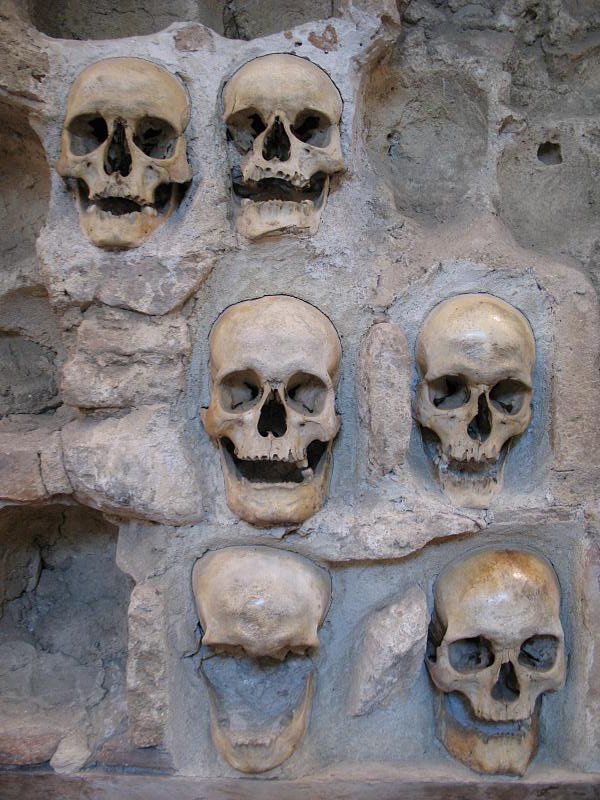
Skull Tower (Serbian Cyrillic: Ћеле кула, romanized: Ćele kula, pronounced [tɕel̩e kula]; Turkish: Kelle kulesi, lit. 'skull tower') is a stone structure embedded with human skulls located in Niš, Serbia. It was constructed by the Ottoman Empire following the Battle of Čegar of May 1809, during the First Serbian Uprising. During the battle, Serbian rebels under the command of Stevan Sinđelić were surrounded by the Ottomans on Čegar Hill, near Niš. Knowing that he and his fighters would be impaled if captured, Sinđelić detonated a powder magazine within the rebel entrenchment, killing himself, his subordinates and the encroaching Ottoman soldiers. The governor of the Rumelia Eyalet, Hurshid Pasha, ordered that a tower be made from the skulls of the fallen rebels. The tower is 4.5 metres (15 ft) high, and originally contained 952 skulls embedded on four sides in 14 rows.
Key Information


In 1861, Midhat Pasha, the last Ottoman governor of Niš, ordered that Skull Tower be dismantled. Following the Ottomans' withdrawal from Niš in 1878, the structure was partially restored, roofed over with a baldachin and some of the skulls that had been removed from it were returned. Construction of a chapel surrounding the structure commenced in 1892 and was completed in 1894. The chapel was renovated in 1937. A bust of Sinđelić was added the following year. In 1948, Skull Tower and the chapel enclosing it were declared Cultural Monuments of Exceptional Importance and came under the protection of the Socialist Republic of Serbia. Further renovation of the chapel occurred again in 1989.
As of 2026, 58 skulls remain embedded in Skull Tower's walls. The one that is said to belong to Sinđelić is enclosed in a glass container adjacent to the structure. Seen as a symbol of independence by many Serbs, it has become a popular tourist attraction, visited by between 30,000 and 50,000 people annually.
History
[edit]Construction
[edit]
The First Serbian Uprising against Ottoman rule erupted in February 1804, with Karađorđe as its leader.[2] On 19 May 1809, 3,000 Serbian rebels under the command of Stevan Sinđelić were attacked by the Ottomans at Čegar Hill,[3] near the village of Kamenica, in Niš.[4] The rebels were plagued by lack of coordination, largely due to the rivalry between commanders Miloje Petrović and Petar Dobrnjac. As a result, Sinđelić's fighters failed to receive support from the other rebel detachments.[3] The numerically superior Ottomans lost thousands of soldiers in a number of failed attacks against the rebels, but eventually overwhelmed the Serbian lines. Knowing that he and his men would be impaled if captured, Sinđelić fired at his entrenchment's gun powder magazine, setting off a massive explosion. The resulting blast killed him and everyone else in the vicinity.[5][6][7][8]

After the battle, the governor of the Rumelia Eyalet, Hurshid Pasha, ordered that the heads of Sinđelić and his men be skinned, stuffed and sent to the Ottoman sultan, Mahmud II. Upon being viewed by the sultan, the skulls were then returned to Niš, where the Ottomans built Skull Tower as a warning to residents contemplating rebellion.[7] The Ottoman Empire was known to create tower structures from the skulls of rebel fighters in order to elicit terror among its opponents.[9] Skull Tower was constructed on the road from Istanbul to Belgrade.[10] It was built of sand and limestone.[11] The structure is 4.5 metres (15 ft) high.[12] It originally consisted of 952 skulls embedded on four sides in 14 rows.[7] The locals named it ćele kula, from the Turkish kelle kulesi, which means "skull tower".[5]
The French Romantic poet Alphonse de Lamartine visited the tower while passing through Niš in 1833. By that time, the skulls had already been bleached from exposure to the elements.[11] "My eyes and my heart greeted the remains of those brave men whose cut-off heads made the cornerstone of the independence of their homeland," de Lamartine later wrote. "May the Serbs keep this monument! It will always teach their children the value of the independence of a people, showing them the real price their fathers had to pay for it."[7] De Lamartine's account attracted many Western travellers to Niš.[11] Skull Tower was also mentioned in the works of the British travel writer Alexander William Kinglake, published in 1849.[13]
Dismantling and conservation
[edit]
In the years following its construction, many skulls fell out from the tower walls, some were taken away for burial by relatives thinking they could identify the skulls of their deceased family members, and some were taken by souvenir hunters.[14] Midhat Pasha, the last Ottoman governor of Niš, ordered that Skull Tower be dismantled in 1861.[10] He realized that the structure no longer served as an effective means of discouraging potential rebels and only fostered resentment against the Ottomans, reminding locals of the empire's cruelty.[15] During the dismantling, the remaining skulls were removed from the tower.[10]
After the Ottomans withdrew from Niš in 1878, the Royal Serbian Army scoured the town and its surroundings in search of the missing skulls. One was found embedded deep inside the tower walls and sent to the National Museum in Belgrade. This was followed by the construction of a roof baldachin, which was topped off with a cross. This is how the structure is depicted in an 1883 painting by the realist Đorđe Krstić. In 1892, work commenced on the construction of a chapel that was to enclose the tower. The foundations of the chapel, designed by the architect Dimitrije T. Leko, were consecrated in 1894.[15] A plaque dedicated near the chapel in 1904 reads: "To the first Serbian liberators after Kosovo."[14]
The chapel was renovated in 1937 and a bust of Sinđelić was added the following year. In 1948, Skull Tower and the chapel were declared Cultural Monuments of Exceptional Importance and came under the protection of the Socialist Republic of Serbia. Further renovation of the chapel occurred again in 1989.[16] As of 2026, 58 skulls remain embedded in the tower walls.[17] The one said to belong to Sinđelić rests in a glass container adjacent to the structure.[14]
Legacy
[edit]
Skull Tower remains one of the most prominent symbols of Ottoman rule in Serbia.[18] It "continues to serve as an important heritage site for Serbian national identity," the political scientist Bilgesu Sümer writes.[10] In Serbia, and among Serbs both inside and outside the country, it is considered a symbol of the country's struggle for independence from the Ottoman Empire.[19] In the centuries following its construction, it has become a place of Serb pilgrimage.[14] Prior to the breakup of Yugoslavia, tens of thousands of schoolchildren from across Yugoslavia visited the structure.[14] Skull Tower remains one of the most visited destinations in Serbia, attracting between 30,000 and 50,000 visitors annually.[16]
The Serbian poet Milan Đorđević considers Skull Tower to be emblematic of what he terms "Balkan horror".[20] Drawing on themes from Serbian history, in 1957, composer Dušan Radić composed the cantata Ćele kula.[21] Skull Tower is also the subject of the eponymous fourth cycle of modernist Vasko Popa's fourth collection of poems, Uspravna zemlja (Earth Erect), which was completed in 1971.[22] The structure was featured on the cover of the Serbian rock band Riblja Čorba's 1985 album Istina, with the band members' faces embedded in the tower walls. The cover was designed by the artist Jugoslav Vlahović.[23]
An exhibition at the Military Museum in Belgrade contains a replica of the tower.[8] In 2024, a group of anthropologists from Serbia began the forensic reconstruction of the faces of the remaining skulls; a DNA analysis of the skulls was not carried out as this would damage both the skulls and the tower. The project was funded with private donations from Serbia and several surrounding countries.[24]
Gallery
[edit]- Skull Tower
-
 South side
 -
 North side
 -
 East side
 -
 Detail of a row of skulls
 -
 Skull that is said to have belonged to Stevan Sinđelić


Notes
[edit]- ^ "Информациони систем непокретних културних добара".
- ^ Judah 2000, p. 51.
- ^ a b Damnjanović & Merenik 2004, pp. 65–66.
- ^ Castellan 1992, p. 241.
- ^ a b Vucinich 1982, p. 141.
- ^ Hall 1995, p. 297.
- ^ a b c d Judah 2000, p. 279.
- ^ a b Merrill 2001, p. 178.
- ^ Quigley 2001, p. 172.
- ^ a b c d Sümer 2021, p. 141.
- ^ a b c Jezernik 2004, p. 144.
- ^ Hürriyet Daily News 27 February 2014.
- ^ Longinović 2011, pp. 38–39.
- ^ a b c d e Judah 2000, p. 280.
- ^ a b Makuljević 2012, pp. 36–37.
- ^ a b Babović 14 July 2009.
- ^ Pavićević 2021, p. 148.
- ^ Garcevic 19 December 2016.
- ^ Levy 2015, p. 222.
- ^ Merrill 2001, p. 179.
- ^ Milin 2009, pp. 86–87.
- ^ Lekić 1993, p. 38.
- ^ Kostić 28 December 2015.
- ^ Euronews Srbija 5 June 2024.
References
[edit]- Books
- Castellan, Georges (1992). History of the Balkans: From Mohammed the Conqueror to Stalin. Boulder, Colorado: East European Monographs. ISBN 978-0-88033-222-4.
- Damnjanović, Nebojša; Merenik, Vladimir (2004). The First Serbian Uprising and the Restoration of the Serbian State. Belgrade, Serbia: Historical Museum of Serbia. ISBN 978-86-7025-371-1.
- Hall, Brian (1995). Impossible Country: A Journey Through the Last Days of Yugoslavia. New York City: Penguin. ISBN 978-0-14-024923-1.
- Jezernik, Božidar (2004). Wild Europe: The Balkans in the Gaze of Western Travellers. London, England: Saqi. ISBN 978-0-86356-574-8.
- Judah, Tim (2000). The Serbs: History, Myth and the Destruction of Yugoslavia. New Haven, Connecticut: Yale University Press. ISBN 978-0-300-08507-5.
- Lekić, Anita (1993). The Quest for Roots: The Poetry of Vasko Popa. Bern, Switzerland: Peter Lang. ISBN 978-0-820417-77-6.
- Levy, Michele Frucht (2015). "From Skull Tower to Mall: Competing Victim Narratives and the Politics of Memory in the Former Yugoslavia". In Mitroiu, Simona (ed.). Life Writing and Politics of Memory in Eastern Europe. New York City: Palgrave Macmillan. pp. 202–221. ISBN 978-1-137-48552-6.
- Longinović, Tomislav (2011). Vampire Nation: Violence as Cultural Imaginary. Durham, North Carolina: Duke University Press. ISBN 978-0-8223-5039-2.
- Makuljević, Nenad (2012). "Public Monuments, Memorial Churches and the Creation of Serbian National Identity in the 19th Century". In Zimmermann, Tanja (ed.). Balkan Memories: Media Constructions of National and Transnational History. Bielefeld, Germany: transcript Verlag. pp. 33–40. ISBN 978-3-8394-1712-6.
- Merrill, Christopher (2001). Only the Nails Remain: Scenes from the Balkan Wars. Lanham, Maryland: Rowman & Littlefield. ISBN 978-0-74251-686-1.
- Milin, Melita (2009). "Serbian Music of the Second Half of the 20th Century: From Socialist Realism to Postmodernism". In Romanou, Katy (ed.). Serbian and Greek Art Music: A Patch to Western Music History. Bristol, England: Intellect Books. pp. 81–96. ISBN 978-1-84150-338-7.
- Pavićević, Aleksandra (2021). Funerary Practices in Serbia. Bingley, West Yorkshire: Emerald Group Publishing. ISBN 978-1-78769-179-7.
- Sümer, Bilgesu (2021). "The Invisible Dimension of Institutional Violence and the Political Construction of Impunity: Necropopulism and the Averted Medicolegal Gaze". In Ribas-Mateos, Natalia; Dunn, Timothy J. (eds.). Handbook on Human Security, Borders and Migration. Northampton, Massachusetts: Edward Elgar Publishing. pp. 137–147. ISBN 978-1-83910-890-7.
- Quigley, Christine (2001). Skulls and Skeletons: Human Bone Collections and Accumulations. Jefferson, North Carolina: McFarland. ISBN 978-0-7864-1068-2.
- Vucinich, Wayne S. (1982). "The Serbian Insurgents and the Russo-Turkish War of 1809–1812". In Vucinich, Wayne S. (ed.). First Serbian Uprising, 1804–1813. New York City: Columbia University Press. pp. 141–174. ISBN 978-0-930888-15-2.
- Websites
- Babović, S. (14 July 2009). "Ćele-kula za svetsku baštinu". Večernje novosti (in Serbian). Retrieved 24 April 2021.
- Garcevic, Srdjan (19 December 2016). "Finding a Serbian Thread in the Silk Road". Balkan Insight. Retrieved 20 November 2022.
- Kostić, Petar (28 December 2015). "Himna slobode: 30 godina Istine i "Anđela"". BalkanRock (in Serbian). Retrieved 24 April 2021.
- ""Novo lice Ćele-kule": Projekat rekonstrukcije lica junaka čije su lobanje ugrađene u zidove". Euronews Srbija (in Serbian). 5 June 2024. Retrieved 12 September 2024.
- "Ottoman tower tops list of buildings made with bones". Hürriyet Daily News. 27 February 2014. Retrieved 24 April 2021.
External links
[edit]
- Battle of Čegar, official website of the municipality of Niš (in English)
- Ćele-kula National Museum Niš (in Serbian)

Skull Tower
View on GrokipediaHistorical Background
First Serbian Uprising
The First Serbian Uprising erupted in February 1804 as a response to the oppressive rule of the Dahije, renegade Janissary officers who had usurped power in the Belgrade Pashalik following a coup against Ottoman authority in 1801, marked by widespread corruption, extortion, and violence against the Serbian population.[6] The immediate trigger was the Slaughter of the Knezes in late January to early February 1804, during which the Dahije executed over 70 prominent Serbian leaders and notables to preempt resistance, an event that instead unified rural haiduks (guerrilla fighters) and peasants in revolt.[6] This uprising, initially localized in the Šumadija region, rapidly expanded as Serbs sought to expel Ottoman forces and restore pre-Dahije privileges, fueled by Orthodox Christian identity and oral epic traditions glorifying resistance.[6] Đorđe Petrović, known as Karađorđe ("Black George"), emerged as the supreme leader after being elected by an assembly of rebels in early 1804; a former Austro-Turkish War veteran and cattle trader with no formal nobility, he centralized command over disparate haiduk bands, imposing military discipline and organizing a rudimentary state apparatus including assemblies and taxation.[6] Early successes included the killing of the Dahije leaders by July 1804 and decisive victories such as the Battle of Ivankovac on August 18, 1805, against Ottoman reinforcements under Hafiz Pasha, followed by triumphs at Mišar and Deligrad in August 1806, culminating in the capture of Belgrade on December 7, 1806, after a prolonged siege.[6] These gains established de facto Serbian control over central regions, with Karađorđe negotiating recognition from Russia amid the Napoleonic Wars, though internal rivalries with commanders like Milenko Stojković and Jakov Nenadović strained unity.[6] The uprising's momentum waned after 1807 due to Ottoman alliances with European powers and Serbian overextension into eastern fronts like the Siege of Niš; by 1813, three Ottoman armies under Suleiman Pasha overwhelmed rebel defenses, leading to the fall of Belgrade on October 7, 1813, and the flight of Karađorđe to Habsburg territories.[6] [7] Despite its suppression and the execution or exile of thousands of participants, the revolt demonstrated Serbian military capacity, disrupted Ottoman control, and laid groundwork for the Second Serbian Uprising in 1815, eventual autonomy by 1830, and the erosion of Janissary influence culminating in their 1826 massacre.[6]Battle of Čegar
The Battle of Čegar occurred on May 31, 1809, during the First Serbian Uprising, as Serbian forces sought to capture the Ottoman fortress of Niš by establishing artillery positions on the strategically elevated Čegar hill approximately 3 kilometers north of the city.[8] Under the command of vojvoda Stevan Sinđelić, leader of the Resava Brigade, around 3,000 Serbian irregular fighters entrenched themselves, digging six deep trenches including a central powder magazine to store ammunition and support bombardment of Niš.[9] Ottoman forces, commanded by serasker Hurşid Pasha from the Niš garrison augmented by reinforcements totaling over 30,000 troops, launched a counteroffensive to dislodge the Serbs and relieve the besieged fortress.[10] The engagement began with intense Ottoman assaults on the Serbian positions, where the defenders inflicted heavy casualties through rifle fire and limited artillery despite being outnumbered and low on supplies after weeks of prior skirmishing since mid-April.[9] Serbian resistance held through the day, repelling multiple waves, but as Ottoman troops overran the main trench by dusk, Sinđelić opted to deny the enemy a complete victory by igniting the powder magazine with a single shot from his pistol, triggering a massive explosion that killed nearly all remaining Serbs in the vicinity—estimated at around 3,000 combatants—and numerous Ottoman assailants who had penetrated the defenses.[10] This act, rooted in the Serbian fighters' determination to avoid capture and enslavement, resulted in Ottoman estimates of up to 6,000 of their own troops lost in the battle and blast combined, though exact figures remain contested due to limited contemporaneous Ottoman records.[11] The explosion marked the battle's decisive turn, allowing Ottoman forces to secure Čegar hill but at prohibitive cost, effectively stalling their broader advance and underscoring the uprising's guerrilla tactics against superior imperial numbers.[9] Sinđelić's sacrifice became emblematic of Serbian resolve, with survivors' accounts preserved in oral traditions and later commemorations emphasizing the causal link between such desperate measures and the prolonged resistance against Ottoman reconquest efforts.[8]Construction and Ottoman Intent
Immediate Aftermath of the Battle
Following the catastrophic explosion ignited by Stevan Sinđelić on May 31, 1809, Ottoman troops under Hurşid Pasha swiftly overran the remnants of the Serbian entrenchments on Čegar Hill, securing control of the strategic position overlooking Niš. The detonation annihilated nearly the entire Serbian contingent of approximately 3,000–4,000 fighters, including Sinđelić himself, while Ottoman casualties from the blast and fighting were heavy, with contemporary estimates suggesting 1,000–3,000 killed or wounded, though Serbian accounts claim up to four Ottoman deaths for every Serb lost.[9] Ottoman forces proceeded to scour the site for the remains of fallen Serbs, decapitating intact corpses to harvest skulls as symbols of subjugation, sparing those shattered by the gunpowder blast. Hurşid Pasha, the Ottoman governor of Niš, explicitly ordered this macabre collection to instill terror in the rebellious Christian population and quash any resurgence of the uprising, viewing the tower-to-be as a stark warning against defiance.[12][13] This vengeful response exacerbated the fragility of the First Serbian Uprising in the Niš region, contributing to the Ottomans' ability to relieve the siege of the fortress and reassert dominance, though sporadic resistance persisted amid broader revolutionary setbacks. Approximately 952 Serbian skulls were ultimately gathered for the structure, underscoring the scale of the defeat and the punitive intent behind Ottoman reprisals.[14]Building Process and Symbolism of Terror
Following the Ottoman recapture of Čegar Hill on May 31, 1809, Hurshid Pasha, the vizier of Niš, ordered the Skull Tower's construction using skulls from the approximately 2,000 Serbian rebels killed or executed in the battle's aftermath.[3][14] Local Serbian furriers, compelled under threat, skinned the heads to prepare the 952 skulls, which were then embedded into a limestone mortar structure forming a 4.5-meter-high tower.[3][14] The assembly, completed over several days, arranged the skulls in 14 rows across the four sides, with 17 skulls per row per side.[3] The uppermost row incorporated the unskinned heads of 30 freshly slain Serbian captives, underscoring the structure's role in immediate retribution.[3] Intended as a stark warning against insurgency, the tower embodied Ottoman strategy to perpetuate subjugation through visceral intimidation, compelling locals to witness the desecrated remains of rebels and associate defiance with annihilation.[3][14] This macabre edifice, positioned prominently on the road to Constantinople, aimed to erode morale and forestall further revolts by evoking unrelenting imperial reprisal.[14]Physical Description
Original Structure
The Skull Tower, known in Serbian as Ćele Kula, was originally constructed as a quadrangular masonry structure approximately 4.5 meters (15 feet) in height and 4 meters (13 feet) in width, with its walls embedded with human skulls arranged in 14 rows per side.[14][4] The total of 952 skulls, sourced from Serbian rebels killed at the Battle of Čegar on May 31, 1809, were positioned facing outward to maximize visibility and deterrent effect, secured within the lime-and-sand mortar that bound the stone framework.[1][2] This arrangement yielded roughly 17 skulls per row across the four facades, forming a grim pyramidal or tiered profile that emphasized the tower's role as a symbol of Ottoman retribution.[14] Erected along the main road from Niš toward Constantinople (modern Istanbul), the tower's design integrated the skulls directly into the load-bearing walls rather than as mere ornamentation, ensuring structural integrity while exposing the bleached remains to weathering and public view.[4] Historical accounts indicate no internal chambers or decorative elements beyond the skulls themselves, prioritizing raw intimidation over architectural embellishment; the base likely rested on simple footings suited to the local terrain near the Nišava River.[2] Over time, natural erosion and deliberate removals reduced the visible skulls, but the original form's uniformity across sides—without asymmetry or additional motifs—underscored its utilitarian purpose as a warning monument rather than a fortified edifice.[1]Surviving Elements
Of the original 952 skulls embedded in the Ćele Kula's limestone structure following the Battle of Čegar on May 31, 1809, only a small fraction persists today due to natural decay, theft by relatives for burial, and exposure to the elements.[3][1] Approximately 58 skulls remain visible, arranged in irregular rows within the surviving portions of the tower's walls, which now stand about 4.5 meters high but represent merely a remnant of the original edifice.[3][1] These enduring skulls, primarily from Serbian insurgents, continue to exhibit darkened, weathered bone with hollow eye sockets and exposed dentition, serving as direct artifacts of the Ottoman reprisal.[15] The stone tower itself has eroded significantly, with much of the masonry crumbling or dismantled over time, leaving primarily one fragmented wall intact amid the ruins.[16] Among the preserved elements, one skull purportedly belonging to the rebel leader Stevan Sinđelić is separated from the main structure and encased in glass for protection, distinguishable by its prominent position and historical attribution.[1] This separation occurred during later conservation efforts to safeguard it from further deterioration.[17] The remaining skulls are secured within the limestone matrix, preventing their removal while exposing them to ongoing environmental degradation.[18]Preservation and Alterations
Ottoman Dismantling Efforts
In 1861, Midhat Pasha, the Ottoman governor of Niš, ordered the Skull Tower's dismantling after observing that the structure, originally intended as a terror symbol, had instead galvanized Serbian resistance and ceased to intimidate the local population.[19][20] This decision reflected a pragmatic shift in Ottoman policy amid declining imperial control in the Balkans, where monuments of repression increasingly backfired by fostering nationalist sentiment rather than submission.[21] The order led to the removal of numerous skulls from the tower's walls, though the process was incomplete, leaving an estimated several dozen embedded due to logistical challenges, natural decay, or surreptitious interventions by locals seeking to preserve remnants.[22] Prior to this formal effort, sporadic Ottoman-sanctioned or incidental removals occurred as skulls detached from weathering or were extracted by relatives for burial, reducing the original count of approximately 952 to fewer by the mid-19th century; however, Midhat Pasha's directive marked the most systematic Ottoman attempt to eradicate the monument's physical presence.[23] These actions aligned with broader Ottoman strategies to mitigate symbols of past atrocities that undermined authority, particularly as European pressures mounted for reforms in the empire's European provinces.[17] By the time of the Ottoman withdrawal from Niš in 1878, the tower's core framework persisted, with surviving skulls later recovered from nearby burial sites during Serbian searches.[2]Serbian Conservation Measures
Following the Ottoman withdrawal from Niš in 1878 during the Russo-Turkish War, Serbian forces secured the tower and initially roofed it over to shield the structure from weather damage and prevent further desecration.[24][1] In 1892, under the Kingdom of Serbia, authorities initiated construction of a protective chapel around the tower, enclosing the remaining 58 skulls embedded in its walls to safeguard them as a enduring emblem of resistance against Ottoman rule.[14][2] The chapel, funded by public donations from Serbian citizens, was completed in 1894 and designed to allow visitors to view the site while preserving its macabre integrity.[25] The chapel received renovations in 1937, which included structural reinforcements and the addition of a bust commemorating Stevan Sinđelić, the rebel leader who detonated explosives at Čegar, symbolizing Serbian defiance.[19][24] These measures transformed the tower from a site of Ottoman terror into a national memorial, with ongoing maintenance ensuring its status as protected cultural heritage under Serbian oversight.[1][4]Cultural and National Legacy
Symbolism in Serbian Nationalism
The Skull Tower, erected in 1809 following the Ottoman victory at the Battle of Čegar, was intended to instill fear and deter further rebellion but evolved into a potent symbol of Serbian resilience and national awakening. Rather than quelling resistance, the structure's macabre display of approximately 952 severed heads—primarily from Serbian insurgents—galvanized collective memory of sacrifice, transforming Ottoman retribution into a narrative of heroism that underscored the First Serbian Uprising's (1804–1813) fight against centuries of subjugation.[17][4] Central to this symbolism is the figure of Stevan Sinđelić, the rebel leader who, facing imminent defeat on May 31, 1809, ignited the gunpowder magazine within the Čegar fortress, killing himself and hundreds of Ottoman assailants in an act of ultimate defiance. His skull, originally placed atop the tower, now preserved in a glass reliquary adjacent to the monument, embodies the ethos of unyielding freedom over submission, inspiring generations of Serbs to view the tower not as defeat but as foundational to their identity as a people forged in martyrdom.[26][1] In the broader context of 19th-century Serbian nationalism, the tower reinforced narratives of endurance against imperial oppression, serving as a visceral reminder that propelled subsequent uprisings and the push for autonomy under the 1830s Hatt-i Sharif. Historians note its role in embedding the uprising's casualties—estimated at over 4,000 in the final standoff—into the cultural fabric, where it functions as an impetus for liberation rather than a relic of terror.[27][12] Today, with 58 skulls remaining embedded in its walls, it continues to anchor Serbian national identity, evoking pride in historical struggle while cautioning against narratives that might inflate casualty figures without primary Ottoman or contemporary accounts for verification.[1][4]International Accounts and Recognition
The Skull Tower garnered international attention through accounts by 19th-century European travelers, who documented its gruesome construction as a symbol of Ottoman reprisals during the First Serbian Uprising.[2] British travel writer Alexander William Kinglake referenced the structure in his 1844 book Eöthen: Traces of Travel Brought Home from the East, describing it as a pyramidical edifice built from skulls of rebellious Serbs—estimating an exaggerated 30,000—erected along the road from Belgrade to Constantinople to deter further resistance, though he and his companions passed it unnoticed in predawn darkness, lamenting the missed opportunity to appreciate its purported "simple grandeur" and "exquisite beauty of the fretwork."[28] French Romantic poet Alphonse de Lamartine provided a more vivid and sympathetic portrayal after visiting Niš in 1833, as recorded in his Voyage en Orient (published 1835). He depicted the tower's walls covered in sun-bleached skulls, some still bearing hair that fluttered in the breeze like "leaves on trees," and hailed it as a poignant monument to Serbian valor: "My eyes and my heart saluted the remains of those brave men whose cut off heads made the corner stone of their homeland’s independence. May the Serbs keep the monument! It will always teach their children the value of Serbian independence, showing them the real price their fathers had to pay for it."[29] Lamartine's emotive narrative framed the tower not as Ottoman terror but as an enduring lesson in the cost of liberty, influencing European perceptions of Balkan struggles against Ottoman rule.[30] These literary depictions, circulated widely in Western Europe, elevated the Skull Tower's profile beyond local lore, associating it with themes of heroism and resistance in travelogues that shaped philhellenic and proto-nationalist sentiments toward Christian populations under Ottoman dominion.[12] No formal international heritage designation, such as UNESCO listing, has been conferred, though its notoriety persists in historical scholarship and attracts global visitors as a testament to the era's atrocities.[14]Modern Significance
Tourism and Museum Status
![Ćele Kula monument in Niš][float-right]The Skull Tower, known as Ćele Kula, functions as a prominent tourist attraction in Niš, Serbia, attracting visitors seeking insight into the First Serbian Uprising and Ottoman reprisals. Managed by the National Museum Niš, the site preserves the tower's remnants within a protective chapel constructed in 1892 to safeguard the structure and its embedded skulls from further deterioration.[4][14] Annual visitation figures highlight its appeal, with over 45,000 tourists in 2018 and more than 55,000 in 2019, according to records from the National Museum Niš; estimates place yearly visitors between 30,000 and 50,000 even post-pandemic.[31] The monument draws international and domestic tourists, often as part of guided tours exploring Niš's Ottoman heritage, including the nearby Niš Fortress. Visitors access the interior to observe the approximately 58 surviving skulls embedded in the walls, providing a tangible connection to the 1809 Battle of Čegar.[1][32] As a designated cultural monument of great importance, the Skull Tower receives ongoing conservation efforts to maintain its structural integrity and historical authenticity for public education and tourism. The site's museum status emphasizes its role in commemorating Serbian resistance, with interpretive elements detailing the events leading to its construction by Ottoman forces under Hurşid Pasha.[1][4]
Contemporary Interpretations
In modern Serbian cultural and historical narratives, Ćele Kula is predominantly interpreted as an inverted symbol of defiance, transforming Ottoman intent to terrorize into a testament to collective sacrifice and unyielding pursuit of autonomy. Originally constructed to demoralize potential rebels following the Battle of Čegar on May 31, 1809, the tower instead galvanized further resistance, with contemporary accounts emphasizing how its gruesome display fueled the Second Serbian Uprising in 1815 by evoking outrage rather than submission.[1] This reframing aligns with Serbia's post-independence historiography, where the structure exemplifies the rebels' strategic desperation—exemplified by Stevan Sinđelić's detonation of gunpowder stores to deny Ottoman victory—and the regime's retaliatory excess, embedding approximately 952 skulls to project imperial dominance.[27] Within discussions of national identity, the tower serves as a focal point for memory politics, reinforcing themes of resilience against prolonged Ottoman subjugation from the 14th to 19th centuries. Serbian analysts portray it as a cornerstone of ethnic continuity, where the preservation of 58 remaining skulls within a protective chapel since 1894 symbolizes not victimhood but heroic agency, visited annually by thousands to honor the insurgents' role in nascent state formation.[27] Recent initiatives, including the 2024 "New Face of Ćele Kula" restoration project, underscore its enduring relevance in cultural heritage efforts, aiming to enhance accessibility while preserving authenticity amid public debates on commemoration versus commodification.[25] Academic examinations in Balkan studies frame Ćele Kula as emblematic of early 19th-century asymmetric warfare and the psychological tactics of declining empires, with Ottoman records corroborating the skull collection as a punitive measure post-surrender, though Serbian sources accentuate the moral victory in Sinđelić's final act.[33] Critiques within regional historiography occasionally highlight risks of mythicization in nationalist retellings, yet empirical evidence from eyewitness sketches and diplomatic reports affirms the event's veracity without substantiating alternative causal narratives. Internationally, it is invoked in analyses of transitional justice and atrocity memory, paralleling other Ottoman-era reprisals but distinguished by its physical longevity as a site of contested heritage.[27]References
- https://en.wikisource.org/wiki/Eothen/Chapter_2