Hubbry Logo
Small-world experimentSmall-world experimentMain
Open search
Small-world experiment
Community hub
Small-world experiment
logo
8 pages, 0 posts
0 subscribers
Be the first to start a discussion here.
Small-world experiment
from Wikipedia
Milgram concluded from his small-world experiments that any two random people in the United States would be linked by a chain of (on average) six steps.

The small-world experiment comprised several experiments conducted by Stanley Milgram and other researchers examining the average path length for social networks of people in the United States.[1] The research was groundbreaking in that it suggested that human society is a small-world-type network characterized by short path-lengths. The experiments are often associated with the phrase "six degrees of separation", although Milgram did not use this term himself.

Historical context of the small-world problem

[edit]

Guglielmo Marconi's conjectures based on his radio work in the early 20th century, which were articulated in his 1909 Nobel Prize address,[2][failed verification] may have inspired[3] Hungarian author Frigyes Karinthy to write a challenge to find another person to whom he could not be connected through at most five people.[4] This is perhaps the earliest reference to the concept of six degrees of separation, and the search for an answer to the small world problem.

Mathematician Manfred Kochen and political scientist Ithiel de Sola Pool wrote a mathematical manuscript, "Contacts and Influences", while working at the University of Paris in the early 1950s, during a time when Milgram visited and collaborated in their research. Their unpublished manuscript circulated among academics for over 20 years before publication in 1978. It formally articulated the mechanics of social networks, and explored the mathematical consequences of these (including the degree of connectedness). The manuscript left many significant questions about networks unresolved, and one of these was the number of degrees of separation in actual social networks.

Milgram took up the challenge on his return from Paris, leading to the experiments reported in "The Small World Problem" in the May 1967 (charter) issue of the popular magazine Psychology Today, with a more rigorous version of the paper appearing in Sociometry two years later. The Psychology Today article generated enormous publicity for the experiments, which are well known today, long after much of the formative work has been forgotten.

Milgram's experiment was conceived in an era when a number of independent threads were converging on the idea that the world is becoming increasingly interconnected. Michael Gurevich had conducted seminal work in his empirical study of the structure of social networks in his MIT doctoral dissertation under Pool. Mathematician Manfred Kochen, an Austrian who had been involved in statist urban design, extrapolated these empirical results in a mathematical manuscript, Contacts and Influences, concluding that, in an American-sized population without social structure, "it is practically certain that any two individuals can contact one another by means of at least two intermediaries. In a [socially] structured population it is less likely but still seems probable. And perhaps for the whole world's population, probably only one more bridging individual should be needed."[5] They subsequently constructed Monte Carlo simulations based on Gurevich's data, which recognized that both weak and strong acquaintance links are needed to model social structure. The simulations, running on the slower computers of 1973, were limited, but still were able to predict that a more realistic three degrees of separation existed across the U.S. population, a value that foreshadowed the findings of Milgram.

Milgram revisited Gurevich's experiments in acquaintanceship networks when he conducted a highly publicized set of experiments beginning in 1967 at Harvard University. One of Milgram's most famous works is a study of obedience and authority, which is widely known as the Milgram Experiment.[6] Milgram's earlier association with Pool and Kochen was the likely source of his interest in the increasing interconnectedness among human beings. Gurevich's interviews served as a basis for his small world experiments.

Milgram sought to develop an experiment that could answer the small world problem. This was the same phenomenon articulated by the writer Frigyes Karinthy in the 1920s while documenting a widely circulated belief in Budapest that individuals were separated by six degrees of social contact. This observation, in turn, was loosely based on the seminal demographic work of the Statists who were so influential in the design of Eastern European cities during that period. Mathematician Benoit Mandelbrot, born in Poland and having traveled extensively in Eastern Europe, was aware of the Statist rules of thumb, and was also a colleague of Pool, Kochen and Milgram at the University of Paris during the early 1950s (Kochen brought Mandelbrot to work at the Institute for Advanced Study and later IBM in the U.S.). This circle of researchers was fascinated by the interconnectedness and "social capital" of social networks.

Milgram's study results showed that people in the United States seemed to be connected by approximately three friendship links, on average, without speculating on global linkages; he never actually used the phrase "six degrees of separation". Since the Psychology Today article gave the experiments wide publicity, Milgram, Kochen, and Karinthy all had been incorrectly attributed as the origin of the notion of "six degrees"; the most likely popularizer of the phrase "six degrees of separation" is John Guare, who attributed the value "six" to Marconi.

The experiment

[edit]

Milgram's experiment developed out of a desire to learn more about the probability that two randomly selected people would know each other.[7] This is one way of looking at the small world problem. An alternative view of the problem is to imagine the population as a social network and attempt to find the average path length between any two nodes. Milgram's experiment was designed to measure these path lengths by developing a procedure to count the number of ties between any two people.

Basic procedure

[edit]
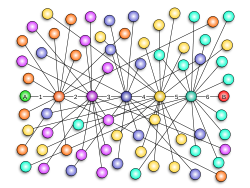
One possible path of a message in the "Small World" experiment by Stanley Milgram
  1. Though the experiment went through several variations, Milgram typically chose individuals in the U.S. cities of Omaha, Nebraska, and Wichita, Kansas, to be the starting points and Boston, Massachusetts, to be the end point of a chain of correspondence. These cities were selected because they were thought to represent a great distance in the United States, both socially and geographically.[4]
  2. Information packets were initially sent to "randomly" selected individuals in Omaha or Wichita. They included letters, which detailed the study's purpose, and basic information about a target contact person in Boston. It additionally contained a roster on which they could write their own name, as well as business reply cards that were pre-addressed to Harvard.
  3. Upon receiving the invitation to participate, the recipient was asked whether he or she personally knew the contact person described in the letter. If so, the person was to forward the letter directly to that person. For the purposes of this study, knowing someone "personally" was defined as knowing them on a first-name basis.
  4. In the more likely case that the person did not personally know the target, then the person was to think of a friend or relative who was more likely to know the target. They were then directed to sign their name on the roster and forward the packet to that person. A postcard was also mailed to the researchers at Harvard so that they could track the chain's progression toward the target.
  5. When and if the package eventually reached the contact person in Boston, the researchers could examine the roster to count the number of times it had been forwarded from person to person. Additionally, for packages that never reached the destination, the incoming postcards helped identify the break point in the chain.[citation needed]

Results

[edit]

Shortly after the experiments began, letters would begin arriving to the targets and the researchers would receive postcards from the respondents. Sometimes the packet would arrive to the target in as few as one or two hops, while some chains were composed of as many as nine or ten links. However, a significant problem was that often people refused to pass the letter forward, and thus the chain never reached its destination. In one case, 232 of the 296 letters never reached the destination.[7]

However, 64 of the letters eventually did reach the target contact. Among these chains, the average path length fell around five and a half or six. Hence, the researchers concluded that people in the United States are separated by about six people on average. Although Milgram himself never used the phrase "six degrees of separation", these findings are likely to have contributed to its widespread acceptance.[4]

In an experiment in which 160 letters were mailed out, 24 reached the target in his home in Sharon, Massachusetts. Of those 24 letters, 16 were given to the target by the same person, a clothing merchant Milgram called "Mr. Jacobs". Of those that reached the target at his office, more than half came from two other men.[8]

The researchers used the postcards to qualitatively examine the types of chains that are created. Generally, the package quickly reached a close geographic proximity, but would circle the target almost randomly until it found the target's inner circle of friends.[7] This suggests that participants strongly favored geographic characteristics when choosing an appropriate next person in the chain.

Criticisms

[edit]

There are a number of methodological criticisms of the small-world experiment, which suggest that the average path length might actually be smaller or larger than Milgram expected. Four such criticisms are summarized here:

  1. Judith Kleinfeld argues[9] that Milgram's study suffers from selection and non-response bias due to the way participants were recruited and high non-completion rates. First, the "starters" were not chosen at random, as they were recruited through an advertisement that specifically sought people who considered themselves well-connected. Another problem has to do with the attrition rate. If one assumes a constant portion of non-response for each person in the chain, longer chains will be under-represented because it is more likely that they will encounter an unwilling participant. Hence, Milgram's experiment should underestimate the true average path length. Several methods have been suggested to correct these estimates; one uses a variant of survival analysis in order to account for the length information of interrupted chains, and thus reduce the bias in the estimation of average degrees of separation.[10]
  2. One of the key features of Milgram's methodology is that participants are asked to choose the person they know who is most likely to know the target individual. But in many cases, the participant may be unsure which of their friends is the most likely to know the target. Thus, since the participants of the Milgram experiment do not have a topological map of the social network, they might actually be sending the package further away from the target rather than sending it along the shortest path. This is very likely to increase route length, overestimating the average number of ties needed to connect two random people. An omniscient path-planner, having access to the complete social graph of the country, would be able to choose a shortest path that is, in general, shorter than the path produced by a greedy algorithm that makes local decisions only.
  3. A description of heterogeneous social networks still remains an open question. Though much research was not done for a number of years, in 1998 Duncan Watts and Steven Strogatz published a breakthrough paper in the journal Nature. Mark Buchanan said, "Their paper touched off a storm of further work across many fields of science" (Nexus, p60, 2002). See Watts' book on the topic: Six Degrees: The Science of a Connected Age.
  4. Some communities, such as the Sentinelese, are completely isolated, disrupting the otherwise global chains. Once these people are discovered, they remain more "distant" from the vast majority of the world, as they have few economic, familial, or social contacts with the world at large; before they are discovered, they are not within any degree of separation from the rest of the population. However, these populations are invariably tiny, rendering them of low statistical relevance.

In addition to these methodological criticisms, conceptual issues are debated. One regards the social relevance of indirect contact chains of different degrees of separation. Much formal and empirical work focuses on diffusion processes, but the literature on the small-world problem also often illustrates the relevance of the research using an example (similar to Milgram's experiment) of a targeted search in which a starting person tries to obtain some kind of resource (e.g., information) from a target person, using a number of intermediaries to reach that target person. However, there is little empirical research showing that indirect channels with a length of about six degrees of separation are actually used for such directed search, or that such search processes are more efficient compared to other means (e.g., finding information in a directory).[11]

The Reversal Small-World Experiment

[edit]

The Reversal Small-World Experiment is a 1978 study conducted by Peter D. Killworth and H. Russell Bernard, aiming to test and refine the understanding of the small-world phenomenon. This phenomenon suggests that individuals in a social network are connected by surprisingly short chains of acquaintances. The study builds upon the pioneering work of Stanley Milgram. Killworth and Bernard introduced a reversal approach to the experiment, addressing key limitations in Milgram’s methodology and testing the validity of his conclusions regarding the structure and reachability of social networks.

Motivation

[edit]

Milgram’s original experiment relied on forward routing, where participants were tasked with passing messages to a target person by selecting acquaintances they believed were closest to the destination. However, Milgram’s findings were limited by:

  1. High attrition rates: Many message chains never reached their destination, leading to incomplete data.
  2. Cognitive biases: Participants might not have accurately assessed who among their acquaintances was closest to the target.
  3. Structural biases: The small-world model assumes a connected network, but real-world networks contain isolated subgroups.

To address these issues, Killworth and Bernard designed an experiment where messages started from the target person and traced paths backward through networks to the originating participants. This reversal method aimed to provide a more accurate measure of social reachability and improve the understanding of network structures.

Methodology

[edit]

Experimental Design

[edit]

Killworth and Bernard conducted their study using two separate experimental setups:

  1. Forward Small-World Task – Similar to Milgram’s method, participants attempted to send a message to a known target by passing it through their acquaintances.
  2. Reversal Small-World Task – Instead of moving forward, the target person initiated the process by attempting to trace how messages would have traveled in reverse through the social network.

Data Collection

[edit]

The study involved diverse groups of participants from different social settings, aiming to compare various types of social networks. The researchers asked participants: to estimate how many intermediaries would be needed to connect them to a randomly chosen person, to list and categorize their acquaintances, including professional, familial, and casual relationships and to assess how well they could predict social distances. The key differences from Milgram’s experiment were: the reverse tracking of connections rather than relying on participants' ability to forward messages. An emphasis on estimating social ties, rather than simply measuring completion rates of message chains. An analysis of clustering patterns, determining whether certain groups (e.g., work colleagues vs. family) were more effective in forming short chains.

Results and Findings

[edit]
  1. Overestimation of Social Distances: Participants in the experiment overestimated the number of intermediaries needed to connect to a random person. While Milgram’s study suggested an average of six degrees of separation, Killworth and Bernard found that people often believed longer chains were necessary. This suggests that humans have difficulty perceiving their true connectivity within a social network.
  2. Higher Completion Rates in Reverse Networks: The reversal method produced higher completion rates compared to Milgram’s forward method. This suggested that targets were better at identifying people who could link them to participants than participants were at identifying paths forward and social networks are structured in a way where certain central individuals (hubs) play a crucial role in connectivity.
  3. Network Clustering and Social Categories: Killworth and Bernard found that people tend to cluster into distinct social categories, such as: family networks, workplace/professional networks, friendship networks and community/religious groups. Interestingly, different networks exhibited varying levels of efficiency in message passing. Professional networks tended to be more interconnected, while family networks were more closed but highly efficient within small groups.
  4. Limitations of Milgram’s Forward Routing: One of the most significant findings was that Milgram’s experiment might have underestimated the number of connections needed to reach a target. Since many messages in Milgram’s study never reached their destination, his estimate of “six degrees of separation” may have been biased. Killworth and Bernard’s reverse approach suggested that actual connectivity varied widely based on network structure.
  5. Role of “Hubs” in Social Connectivity: The reversal experiment highlighted that certain individuals act as highly connected nodes, or hubs, in social networks. These individuals often play a disproportionate role in connecting distant groups, reinforcing the idea that social networks are not random but structured around a few key connectors.[12]

Influence

[edit]

The social sciences

[edit]

The Tipping Point by Canadian journalist Malcolm Gladwell, based on articles originally published in The New Yorker,[13] elaborates on the "funneling" concept. Gladwell condenses sociological research, which argues that the six-degrees phenomenon is dependent on a few extraordinary people ("connectors") with large networks of contacts and friends: these hubs then mediate the connections between the vast majority of otherwise weakly connected individuals.

Recent work in the effects of the small world phenomenon on disease transmission, however, have indicated that due to the strongly connected nature of social networks as a whole, removing these hubs from a population usually has little effect on the average path length through the graph (Barrett et al., 2005).[citation needed]

A corollary of network structures is that if the edges that connect nodes in a network, even a randomly constructed one, are above a certain threshold, then the shortest path between nodes, averaged across the entire network, is short. Subsequent research following Milgram’s experiment, namely by Watts and Strogatz, have aimed to reflect the highly-connected and highly-clustered networks of reality.[14] By combining lattice structures and random graphs in their model, these researchers successfully captured the interconnection across large groups of individuals that Milgram illustrates in his famous experiment. When applied with game theory dynamics to construct small-scale yet highly dynamic models, these clustered small-network graphs have had broad reach across academic domains, including economics,[15] behavioral science,[16] neuroscience,[17] computer science,[18] and epidemiology.[19] As with Milgram’s original experiment, the small-network model is commonly used in understanding social systems, since networks represent individuals as a node embedded in a community of other nodes. A focus has been understanding the influence of social dynamics such as herding on individual behavior.[20] Ferreira, Hong, Rutherford et. al explore social networks as a contemporary analogy that propagates the message of protests around the globe, making a phenomenon like the Arab Spring more likely than in earlier societies. They found an increase in the number of simultaneous protests beginning in 2005 and 2006, when Twitter, Facebook and other social networks began to be broadly used. They also note that central hubs, or nodes that connect to many otherwise unconnected nodes and subnetworks, play a crucial role in spreading the message of a protest.[21]

Mathematicians and actors

[edit]

Smaller communities, such as mathematicians and actors, have been found to be densely connected by chains of personal or professional associations. Mathematicians have created the Erdős number to describe their distance from Paul Erdős based on shared publications. A similar exercise has been carried out for the actor Kevin Bacon and other actors who appeared in movies together with him — the latter effort informing the game "Six Degrees of Kevin Bacon". There is also the combined Erdős-Bacon number, for actor-mathematicians and mathematician-actors. Players of the popular Asian game Go describe their distance from the great player Honinbo Shusaku by counting their Shusaku number, which counts degrees of separation through the games the players have had.[22]

Current research on the small-world problem

[edit]

The small-world question is still a popular research topic today, with many experiments still being conducted. For instance, Peter Dodds, Roby Muhamad, and Duncan Watts conducted the first large-scale replication of Milgram's experiment, involving 24,163 e-mail chains and 18 targets around the world.[23]

Dodds et al. also found that the mean chain length was roughly six, even after accounting for attrition. A similar experiment using popular social networking sites as a medium was carried out at Carnegie Mellon University. Results showed that very few messages actually reached their destination. However, the critiques that apply to Milgram's experiment largely apply also to this current research.[citation needed]

Recent research suggests that the small-world effect is a phenomenon that appeared rather recently in human history, leading to a drastic reduction in the average chain distance in social and physical networks. This can be justified by studying evolution patterns of infectious diseases throughout history, notably the Black Plague in Medieval Europe. Past epidemics have been noticed to spread in waves from well-defined central points, which can be explained through the localized nature of interactions of medieval populations. More recent epidemics have exhibited qualitatively different properties, as diseases no longer spread from one location outward, but rather with many starting clusters, due to travel and long-range physical (and social) interactions. This means that new long-distance connections were made through the development of transportation and communication technologies and that the likelihood of two individuals knowing each other if they live far away from each other has increased enough to drastically change the pattern of disease spread. This serves as an indication that the graph of physical and social connections in the world’s population has structurally changed.[24]

Network models

[edit]
There are three graphs side by side. The titles on top from left to right are: "Regular Ring Graph (p = 0)", "Small-World Graph (p = 0.2), and "Random Graph (p = 1)".
Comparison of Watts-Strogatz graphs with different randomization probability. A regular ring graph (left), a small-world graph with some edges randomly rewired (center), and a random graph with all edges randomly rewired (right).

In 1998, Duncan J. Watts and Steven Strogatz from Cornell University published the first network model on the small-world phenomenon. They showed that networks from both the natural and man-made world, such as power grids and the neural network of C. elegans, exhibit the small-world phenomenon. Watts and Strogatz showed that, beginning with a regular lattice, the addition of a small number of random links reduces the diameter—the longest direct path between any two vertices in the network—from being very long to being very short.[25] The research was originally inspired by Watts' efforts to understand the synchronization of cricket chirps, which show a high degree of coordination over long ranges as though the insects are being guided by an invisible conductor. The mathematical model which Watts and Strogatz developed to explain this phenomenon has since been applied in a wide range of different areas. In Watts' words:[26]

I think I've been contacted by someone from just about every field outside of English literature. I've had letters from mathematicians, physicists, biochemists, neurophysiologists, epidemiologists, economists, sociologists; from people in marketing, information systems, civil engineering, and from a business enterprise that uses the concept of the small world for networking purposes on the Internet.

Generally, their model demonstrated the truth in Mark Granovetter's observation that it is "the strength of weak ties"[27] that holds together a social network. Although the specific model has since been generalized by Jon Kleinberg[citation needed], it remains a canonical case study in the field of complex networks. In network theory, the idea presented in the small-world network model has been explored quite extensively. Indeed, several classic results in random graph theory show that even networks with no real topological structure exhibit the small-world phenomenon, which mathematically is expressed as the diameter of the network growing with the logarithm of the number of nodes (rather than proportional to the number of nodes, as in the case for a lattice). This result similarly maps onto networks with a power-law degree distribution, such as scale-free networks.

In computer science, the small-world phenomenon (although it is not typically called that) is used in the development of secure peer-to-peer protocols, novel routing algorithms for the Internet and ad hoc wireless networks, and search algorithms for communication networks of all kinds.

Modern Studies and Digital Networks

[edit]

With the rise of digital communication and online social networks, researchers have revisited the small-world phenomenon in large-scale, real-world contexts. Modern studies indicate that the degrees of separation have significantly decreased, particularly due to the widespread use of social media platforms.

One of the most extensive studies on digital networks was conducted by Facebook and the University of Milan. In 2011, researchers analyzed the connections between 721 million active Facebook users—over 10% of the global population at the time. They found that the average number of intermediaries between any two users was 4.74, suggesting a much smaller world than previously estimated.[28] By 2016, an updated study by Facebook revealed that this number had further decreased to just 3.57 degrees of separation, highlighting the growing interconnectedness of individuals through digital platforms. [29]

The increasing reach of digital networks has profound implications across various domains:

  • Networking and Employment: Online professional platforms enable job seekers and employers to connect across geographic boundaries, facilitating career opportunities beyond traditional networks.
  • Marketing and Business: Social media allows businesses to reach global audiences, using targeted advertising and personalized content to engage consumers more effectively.
  • Information Dissemination: News, trends, and social movements spread rapidly across digital networks, sometimes within minutes, reshaping the way societies consume and react to information.

While digital connectivity has brought people closer, it also presents challenges such as misinformation spread, privacy concerns, and the impact of online interactions on real-world relationships. Nonetheless, these studies demonstrate how technology continues to reshape social structures, reducing the degrees of separation and further validating the small-world phenomenon in the digital age.

Linking Social Capital to the Small-World Phenomenon

[edit]

The small-world phenomenon, originally demonstrated by Stanley Milgram's experiment, suggests that individuals in large social networks are connected through surprisingly short chains of acquaintances. This structural property has significant implications for social capital, which refers to the resources and benefits that individuals or groups can access through their social connections. Research has shown that small-world networks optimize both local clustering and global reach, facilitating the efficient flow of information and trust. In such networks, social capital is enhanced as weak ties—bridges between otherwise distant clusters—enable access to diverse resources and opportunities. These weak ties, often described in Mark Granovetter's strength of weak ties theory, act as conduits for novel information and social mobility. Moreover, small-world structures support both bonding social capital, by reinforcing strong community ties, and bridging social capital, by connecting disparate social groups.[30]

Empirical studies have linked the small-world topology to innovation diffusion, job-market efficiency, and collective action, demonstrating that network structure plays a crucial role in shaping social capital at both individual and societal levels.[31]

[edit]

Social networks pervade popular culture in the United States and elsewhere. In particular, the notion of six degrees has become part of the collective consciousness. Social networking services such as Facebook, Linkedin, and Instagram have greatly increased the connectivity of the online space through the application of social networking concepts.

See also

[edit]
  • Bacon number – Parlor game on degrees of separation
  • Dunbar's number – Suggested cognitive limit important in sociology and anthropology
  • Erdős number – Closeness of someone's association with mathematician Paul Erdős
  • Erdős–Bacon number – Closeness of someone's association with mathematician Paul Erdős and actor Kevin Bacon
  • Percolation theory – Mathematical theory on behavior of connected clusters in a random graph
  • Personal network – Set of human contacts known to an individual
  • Random walk – Process forming a path from many random steps
  • Random graph – Graph generated by a random process
  • Richard Gilliam – American writer

References

[edit]
[edit]
Revisions and contributorsEdit on WikipediaRead on Wikipedia
from Grokipedia
The small-world experiment, conducted by social psychologist Stanley Milgram between 1967 and 1969, sought to empirically test the hypothesis that any two individuals in the United States are connected through a short chain of no more than six acquaintances. In the primary study, 296 randomly selected "starters" from Nebraska received a packet containing a cover letter, a document to be delivered to a specific target—a Boston stockbroker—and a list of instructions to forward it to a personal acquaintance deemed progressively closer to the target in profession or location. Only 64 chains completed successfully, yielding an average path length of 4.4 intermediaries, which Milgram extrapolated to suggest an average separation of about six degrees across the population. This finding popularized the "six degrees of separation" concept and influenced subsequent network science, including the development of small-world network models that balance local clustering and global connectivity. Despite its impact, the experiment's results have been scrutinized for methodological limitations, notably a low completion rate of approximately 22 percent, which likely introduced survivor bias favoring shorter or more motivated chains, and funneling through sociometric hubs such as the target's social circle rather than reflecting random connectivity. Later replications, including email-based studies, have produced mixed outcomes, with some confirming short paths in specific online contexts but others indicating longer effective diameters in real-world social graphs when accounting for incomplete participation and search inefficiencies. These critiques underscore that while the experiment demonstrated localized clustering in forwarding behaviors, claims of universally small-world social structures remain empirically contested due to non-random dropout and incomplete data.

Origins of the Small-World Idea

Pre-Milgram Concepts and Early Studies

In 1929, Hungarian author Frigyes Karinthy published the short story "Láncszemek" (Chain-links) in his collection Minden másként van (Everything is Different), positing that technological advances in communication had shrunk the world such that any two individuals could be connected through a chain of no more than five mutual acquaintances. Karinthy illustrated this with hypothetical chains linking figures like a Budapest dentist to the King of England or an American actress to a Fijian chieftain, emphasizing interpersonal links over direct global connectivity. During the 1950s, political scientist Ithiel de Sola Pool and mathematician Manfred Kochen at MIT and , respectively, developed theoretical models of acquaintance networks to quantify the "small world" problem mathematically, without empirical . Their unpublished manuscripts, later compiled as "Contacts and Influence" (published in ), simulated social graphs assuming probabilistic acquaintance formation based on factors like and interaction rates, predicting average chain lengths of 3 to 4 intermediaries in networks of 1,000 to 2,300 nodes—far shorter than exhaustive enumeration would suggest. These models highlighted how local clustering combined with long-range ties could yield unexpectedly short global paths, influencing later experimental designs. Parallel advancements in provided a formal basis for small-diameter networks. In 1959 and 1960, mathematicians and introduced the model G(n, p), where edges form between n vertices with probability p, demonstrating that connected components emerge rapidly and the graph's diameter scales logarithmically with n for p above the (approximately ln n / n). This implied that even sparse s exhibit "small world" properties, with typical path lengths on the order of log n / log (np), offering an abstract precedent for social connectivity hypotheses though not tailored to real-world tie formation rules. No large-scale empirical tests of interpersonal chain lengths preceded Milgram's work, leaving these concepts largely speculative or simulation-based.

Literary and Theoretical Precursors

In 1929, Hungarian author published the short story "Láncszemek" (translated as "Chains" or "Chain-Links"), which articulated an early speculative notion of interconnected social worlds. In the narrative, Karinthy described a parlor game among intellectuals who hypothesized that, amid rapid advancements in communication and transportation, any two people on could be connected through a chain of no more than five personal acquaintances, regardless of or . This literary emphasized the shrinking effective size of human society due to expanding relational links, predating empirical and serving as a conceptual antecedent to later investigations into path lengths in acquaintance graphs. Theoretical groundwork emerged in the mid-20th century through mathematical modeling of social ties. In the early , political Ithiel de Sola Pool and mathematician Manfred Kochen at MIT began simulating random acquaintance networks to quantify the "small world problem"—specifically, determining the minimal number of intermediaries required to link any two individuals in a population of millions. Their models, which assumed probabilistic connections among a fixed number of acquaintances per person (typically 100–1,000), demonstrated via methods that average chain lengths remained surprisingly short, often around six steps for populations approximating the in the . This work, initially circulated informally and unpublished until 1978 as "Contacts and Influence," highlighted the tension between local clustering in real networks and global reachability, providing a formal probabilistic basis for testing short-path hypotheses empirically. These precursors converged on the intuition that sparse, random-like connections could yield logarithmic path lengths in large graphs, influencing Stanley Milgram's design of a real-world chain-tracing protocol. Karinthy's offered intuitive appeal rooted in observed societal compression, while Pool and Kochen's simulations supplied quantitative predictions under simplifying assumptions of uniformity in tie formation, though later critiques noted deviations from and in actual human interactions.

Milgram's 1967 Experiment

Experimental Design and Procedure

In the experiment conducted by Jeffrey Travers and , 296 individuals served as starting participants: 196 from (100 selected from stockholder lists and 96 chosen randomly) and 100 randomly selected residents of . The target recipient was specified as a living in , with biographical details provided to starters including his name, address, occupation, college attended, military service record, and his wife's maiden name to facilitate recognition of potential connections. Each starting participant received by a folder containing a explaining the study's aim—to investigate the structure of social connections —a description of the target person, a roster sheet for recording chain participants, and fifteen postage-paid reply postcards. Instructions directed starters to forward the folder via first-class mail to a single personal acquaintance (defined as someone known on a first-name basis) whom they judged more likely than themselves to personally know the target; if the starter knew the target directly, the folder was to be sent to him immediately. Upon receiving the folder, intermediary recipients followed identical forwarding rules, selecting only one acquaintance perceived as geographically or socially closer to the target based on the provided biographical clues, while avoiding anyone already listed on the roster to prevent cycles. Each person in the chain was required to complete and mail a reply postcard separately to the researchers, providing their name, address, and relationship to the next forwardee; this mechanism enabled real-time tracking of chain progress, dropout rates, and participant demographics without relying solely on completed chains. No financial incentives were offered, and participation relied entirely on voluntary compliance, with the process designed to simulate natural acquaintance networks under minimal researcher intervention. The Nebraska starters tested long-distance connectivity across the country, while the Boston group provided a baseline for shorter geographic spans to the nearby target.

Data Collection and Participant Behavior

In Milgram's small-world experiment, data were collected through a series of business reply cards, known as rosters, mailed by each participant in the chain to the researchers at . Initial starters received a packet containing a , the target's identifying (a named Karl Lederer, including his occupation, residence, and personal details), and the roster; upon deciding to participate, starters completed the roster with their own details and mailed it back before forwarding the packet to an acquaintance. Each subsequent followed the same process: reviewing the target's clues to select a closer connection, completing the roster with their information and that of the next recipient, and mailing the roster separately to the researchers, ensuring that chain progress was tracked independently of the forwarded packet. Upon reaching the target, Lederer completed a final roster confirming receipt without further forwarding. This method yielded 453 rosters from intermediaries across all chains, providing data on participant demographics, forwarding choices, and step-by-step progression. Participant behavior revealed significant attrition, with only 217 of the 296 recruited starters (approximately 73%) initiating a chain by forwarding the packet, while 79 starters (27%) failed to respond or forward at all. Among initiated chains, 64 reached the target (a 29% completion rate), with the average completed chain involving 5.2 intermediaries, whereas incomplete chains averaged 2.6 links before dropout. Dropouts occurred at decreasing rates further along chains: for instance, 27% of chains died at the first step, but subsequent steps showed progressively lower attrition, suggesting initial hesitation or misunderstanding gave way to conditional compliance among those engaged. Reasons for dropout were not directly surveyed but inferred from roster patterns, including potential lack of suitable acquaintances, waning motivation due to the task's perceived futility, or reluctance to involve personal contacts in an unsolicited chain. Forwarding choices demonstrated strong , with 86% of transmissions directed to friends or acquaintances rather than relatives (14%), and selections biased toward individuals of the same sex, similar age, and comparable occupational status to the sender. Participants were instructed to prioritize contacts geographically or socially closer to the target based on the provided clues, yet chains often converged through a small number of "sociometric stars"—highly connected individuals, such as three key intermediaries who received 48% of converging paths—indicating that effective relied on hubs rather than uniform dispersion. No significant demographic differences emerged between dropouts and continuers, though the experiment's reliance on voluntary mail participation introduced self-selection, with starters primarily middle-class professionals recruited via public solicitations in (196 participants) and Boston (100 for a local comparison).

Reported Results and Chain Lengths

In Milgram's primary study, 296 "target packets" were distributed to starting individuals primarily in and , with instructions to forward each packet via a single personal acquaintance deemed socially or geographically closer to the target recipient—a in . Of these initiations, 64 chains successfully reached the target, representing a completion rate of approximately 21.6%. The number of intermediaries in these completed chains was reported as 5.2, with most falling in the range of 2 to 10 intermediaries and a of 5; this finding underpinned the conclusion of an separation of roughly six degrees between arbitrary individuals in the United States. A subsidiary experiment targeted a different recipient in , from 160 Nebraska starters, yielding 44 completions (27.5% rate) with an average chain length of 5.21 links and a mode of 6. Combined data across studies showed shorter averages for chains originating nearer the target (e.g., 4.6 links from Boston-area starters) versus more distant ones (6.1 links from ), highlighting geographic influences on reported path lengths. Dropouts occurred predominantly early in chains, with 42% failing at the first forwarding step, but completed chains exhibited a "funneling" pattern where 48% converged through just three key penultimate contacts.

Methodological Criticisms of Milgram's Study

Sampling and Self-Selection Biases

Milgram's recruitment of initial participants ("starters") relied on targeted mailing lists and advertisements that favored affluent, socially prominent individuals rather than a random cross-section of the population. In the Nebraska portion of the study, starters were drawn from lists of blue-chip stock owners, a group skewed toward higher socioeconomic status and potentially broader social networks. Similarly, the Wichita, Kansas, recruitment involved newspaper advertisements that appealed to sociable individuals eager to demonstrate their connections, further biasing the sample toward outgoing, well-networked people. The target recipient, a Boston stockbroker, also aligned with this middle-to-upper-class demographic, reducing the social distance and facilitating shorter chains within homogeneous subgroups. Self-selection exacerbated these issues, as only participants motivated to engage—often those confident in their ability to forward the packet effectively—initiated and continued chains. Of 60 starters recruited via ads, only 50 began chains, and just 3 completed them, suggesting that less connected or less enthusiastic individuals dropped out early. In , 217 chains were started from an initial solicitation of approximately 300, yielding 64 completions (a 29% rate), with the observed paths dominated by those who persisted, likely overrepresenting hubs in social networks. This dynamic favored chains among similar professions or classes, such as business executives routing packets through professional contacts, rather than bridging diverse social strata. High non-response rates introduced further distortion, as incomplete chains—comprising the majority—were excluded from analysis, biasing results toward artificially short paths. Across studies, completion rates hovered below 30%, with even lower figures (e.g., 13%) for targets outside the dominant demographic, indicating that failed chains likely spanned longer distances or encountered social barriers unreflected in the data. Critics argue this selective observation underestimated the "small-world" effect's fragility, as the visible successes masked broader network fragmentation.

Incomplete Chains and Reporting Issues

In Milgram's 1967 small-world experiments, a significant proportion of initiated chains failed to reach the target, with completion rates typically ranging from 20% to 30% across studies. For instance, in the primary -to-Boston mailing targeting a , 64 chains out of approximately 296 starters successfully arrived, yielding a 22% completion rate, while the remainder dropped out at various steps. Similarly, a follow-up study reported 44 completions from 160 initiations, or 27.5%. These incomplete chains arose primarily from participants' reluctance to forward packets to distant acquaintances, privacy concerns, loss of interest, or inability to identify closer connections, resulting in attrition that compounded with each forwarding step. The prevalence of dropouts introduced substantial , as only chains involving highly motivated or well-connected individuals were likely to persist to completion. Critics, including Judith Kleinfeld, have noted that early pilot studies exhibited even lower success rates, such as 5% in one instance, before methodological tweaks improved participation among certain demographics, yet overall incompleteness persisted. This skewed the dataset toward shorter, non-representative paths, as longer chains—more prone to dropout—were systematically underrepresented, inflating estimates of average separation. Milgram acknowledged the issue in his reporting, estimating that dropouts occurred due to "dispersion" in social ties, but emphasized completed chains to derive the "six degrees" claim, potentially understating the experiment's limitations in capturing population-wide connectivity. Reporting practices further compounded interpretive challenges, as Milgram's popular accounts in outlets like highlighted successful chains and their brevity (mean length of 4.4 to 5.2 intermediaries for completers) without fully quantifying how incompletes distorted broader inferences. Subsequent analyses argue this focus created an ascertainment bias, where observed paths funneled through urban elites (e.g., New York financial circles) rather than random links, questioning the universality of small-world properties. Kleinfeld's archival review underscores that while Milgram did not fabricate data, the selective presentation prioritized narrative appeal over rigorous accounting of failures, influencing the phenomenon's reception despite empirical gaps. Empirical adjustments for attrition, such as those proposed in later network models, suggest true average path lengths could exceed observed figures by factors accounting for unobserved dropouts.

Challenges to Path Length Claims

Analyses of Milgram's data indicate that the reported chain length of 4.4 intermediaries (corresponding to approximately five degrees of separation) among the 64 completed chains out of 296 initiated underestimates the true average due to differential attrition, as longer chains exhibit higher dropout probabilities from participant or loss of motivation. This favors the observation of shorter paths, as incomplete chains—comprising 78% of initiations—are disproportionately likely to represent extended or disrupted connections, skewing claims of universally short separations. Corrective statistical methods, such as bootstrap resampling adjusted for observed variation in completion probabilities across lengths, yield unbiased estimates of path lengths exceeding those reported in the raw data, with confidence intervals extending to 6 or more degrees even within the experimental . Harrison White's contemporaneous mathematical modeling, referenced by Milgram, further illustrates that assuming uniform completion would inflate estimated averages, but empirical dropout patterns imply a distribution where unmeasured longer chains pull the population upward. Geographic and demographic factors compound these issues: starters were drawn from rural Midwestern communities with potentially denser local ties but limited cross-country reach, while the stockbroker target occupied a socially connected niche, artificially compressing paths relative to random U.S. pairs. Notably, 16 of the 64 successful chains funneled through a single intermediary—a clothing merchant—highlighting reliance on hubs near the target rather than decentralized short paths, which undermines generalizations about network-wide brevity. Such convergence suggests that observed shortness may stem from endpoint proximity in the rather than inherent small-world properties.

Evidence Questioning the Small-World Phenomenon

Social Barriers and Clustering Effects

Social networks exhibit high clustering coefficients, where the contacts of an individual are disproportionately interconnected, fostering dense local groups rather than sparse random connections. This clustering arises from repeated interactions within homogeneous circles, such as , coworkers, or members, which prioritize familiarity over diversity. In contrast to theoretical small-world models that balance clustering with random long-range links to achieve short global paths, empirical social structures reveal that such clustering often amplifies path lengths by confining information flow to insulated subgroups. Homophily, the tendency to form ties with socially similar others based on attributes like race, class, , and , erects barriers that exacerbate clustering effects and undermine the universality of short paths. Studies confirm strong homophily across multiple dimensions: for instance, 80-90% of marital ties and 70-80% of ties occur within racial groups, while occupational homophily exceeds 50% even after controlling for other factors. These preferences limit cross-cutting weak ties, creating network silos where bridging dissimilar groups requires multiple intermediaries or fails outright, as seen in segregation patterns that persist despite geographic proximity. Replications of Milgram's design highlight these dynamics: in a 2003 global email experiment involving 60,000 participants targeting 30 diverse recipients, only about 4% of chains completed, with average lengths of 4-5 steps among successes, but frequent dropouts occurred when senders lacked ties to demographically dissimilar intermediaries. Paths often "funneled" through gateway individuals sharing the target's profile (e.g., age, location, profession), indicating that clustering and channeled forwards predictably within similar clusters rather than via efficient shortcuts. This contrasts with neutral small-world expectations, as barriers like socioeconomic disparities reduced forwarding efficacy, with rural or lower-status starters facing steeper hurdles. Further evidence from institutional networks, such as a email analysis, shows that even in dense academic environments, on research interests and department affiliation sustains high clustering (transitivity around 0.3-0.4), inflating shortest paths between peripheral nodes by 20-50% compared to randomized equivalents. Such effects question the small-world claim's applicability beyond homogeneous or elite subsets, as real-world barriers systematically elongate effective distances for most dyads, prioritizing over global reach.

Empirical Failures in Universality

Replications of Milgram's small-world experiment outside the have often yielded low completion rates and longer path lengths, challenging the universality of short social chains across diverse populations. In the 1970s, attempts in and to forward letters from random starters to designated targets resulted in few completions, with surviving chains exceeding six degrees, attributed to cultural and geographic barriers that impede weak-tie connections essential for brevity. These failures suggest that the small-world property, observed in U.S.-centric studies, does not generalize to European contexts where social networks exhibit greater insularity. Even within the U.S., reveals limitations due to socioeconomic and racial divides. Milgram's 1967 Wichita-to-Boston study achieved only a 5% completion rate among 60 initiated chains, with an average length of eight intermediaries (nine degrees) for those that reached the target, far exceeding the popularized "six degrees." His subsequent Nebraska-to-Boston replication, with a 29% completion rate from 217 starters, reported a of five intermediaries but relied on biased samples of higher-income individuals (e.g., owners), who are more likely to bridge social gaps; low-income or less connected participants showed diminished success. Similarly, Beck and Cadamagnani's 1968 study from low-income , to targets completed below 18% of chains, highlighting class barriers that prevent cross-stratum linkages. Racial homogeneity further constrains universality, as chains falter across demographic lines. Korte and Milgram's Los Angeles-to-New York experiment found completion rates of just 13% for targets versus 33% for ones, indicating segregated networks resist short paths. Lin et al.'s 1978 study within a Northeastern U.S. achieved 30% completion (112 of 375 packets) but revealed communication predominantly within racial groups, underscoring how structural divisions inflate effective path lengths beyond theoretical small-world expectations. Low participant motivation to forward unfamiliar documents, combined with these barriers, implies that uncompleted chains likely represent even longer or broken paths, eroding claims of universal connectivity. in small-world networks refers to the capacity of individuals to efficiently locate short paths to distant using only local knowledge of their immediate contacts and limited clues about the target, such as occupation or . In Milgram's 1967 experiment, participants demonstrated an apparent ability to forward letters toward a by selecting intermediaries perceived as progressively closer, with completed chains averaging around five or six hops. However, this observed success has been challenged on theoretical and empirical grounds, revealing that effective decentralized search is not a generic property of small-world structures but requires precise network conditions rarely met in social systems. Theoretical analysis by Kleinberg in 2000 established that greedy navigation—forwarding to the neighbor minimizing estimated to the target—achieves polylogarithmic search times only when long-range connections in a underlying lattice follow a power-law distribution with exponent exactly 2, enabling local cues to align with global . Deviations, such as the random long-range links in Watts-Strogatz small-world models, result in polynomial search times scaling as N1/3N^{1/3} to N2/3N^{2/3} for network size NN, rendering navigation inefficient for large populations. Human social networks, lacking verifiable evidence of this exact distribution, face inherent search inefficiencies, as local clustering and irregular tie lengths disrupt the hierarchical shortcuts needed for rapid convergence. Empirically, a 2003 global replication by Dodds, Muhamad, and Watts involving over 60,000 participants and 18 targets across 13 countries yielded only 384 completed chains out of 24,163 initiated, a success rate under 2%, with average lengths of 4 to 5 for successes—far shorter than expected under random forwarding but attributable to early passage through high-degree "supernodes" rather than systematic navigation strategies. Analysis showed that ordinary participants rarely bridged gaps effectively; instead, chains succeeded when hubs, who maintained broad connections, were encountered quickly, undermining claims of universal algorithmic searchability and highlighting dependence on heterogeneous connectivity rather than decentralized heuristics. This contrasts with Milgram's higher apparent completion rates, potentially inflated by self-selection among motivated forwarders and geographic biases toward urban professional networks. Additional search problems arise from behavioral and informational constraints: participants possess incomplete mental models of acquaintances' ties, leading to suboptimal choices, while high attrition—due to reluctance to impose on contacts or loss of motivation—truncates chains prematurely, as evidenced by drop-off rates exceeding 90% in large-scale attempts. Simulations and real-network studies confirm that human heuristics, such as prioritizing weak ties or geographic proximity, fail to exploit hidden short paths without global oversight, questioning the practicality of small-world navigation in unconstrained social contexts.

Travers-Milgram Sociometric Study (1969)

The Travers-Milgram sociometric study, published in 1969, constituted the first large-scale empirical investigation of the small-world problem in human social networks. Researchers Jeffrey Travers and recruited 296 starting participants—196 from (100 stockholders and 96 randomly selected individuals) and 100 randomly selected from the area—through mail solicitations, newspaper advertisements, and random sampling methods. These starters were instructed to forward a document packet to a personal acquaintance whom they believed was most likely to know the target individual, a stockbroker residing in , based on provided biographical details such as the target's occupation, residence, and age. The packet included instructions for recipients to continue the chain similarly until reaching the target or declining participation, thereby tracing sociometric chains of acquaintanceship defined as individuals known on a first-name basis. Of the 217 chains actually initiated after initial dropouts, only 64 reached the target, yielding a completion rate of approximately 29%. The completed chains exhibited an average path length of 5.2 intermediaries (excluding the starter and target), with variations by starter group: 4.4 for participants, 5.7 for Nebraska random starters, and 5.4 for Nebraska stockholders. Chain length distribution was bimodal, influenced by geographic proximity—shorter for local chains (mean 4.6 intermediaries) and longer for those originating in Sharon-like distant areas (mean 6.1). Incomplete chains averaged 2.6 steps before dropout, highlighting potential underestimation of true distances due to participant attrition, which affected 27% of initial recruits. A notable sociometric pattern emerged in the data: funneling through a small number of highly connected "stars" or intermediaries, with 48% of completed chains converging through just three individuals before reaching the target—for instance, one person (referred to as ) appeared in 16 chains. Gender dynamics also influenced forwarding: male senders directed packets to other males at a rate ten times higher than to females, while female senders distributed more evenly across sexes, a attributable to the male target's profile and prevailing social norms. Overall, the study supported the of a small-world structure, positing that distant individuals were interconnected via relatively short acquaintance chains averaging around five intermediaries, though the low completion rate and self-reported nature of connections raised questions about representativeness and measurement accuracy.

Reversal Small-World Approaches

The reversal small-world approach inverts the forward-chain methodology of Milgram's original experiment by focusing on outgoing links from a starter individual to a broad set of potential targets, aiming to map the extent of an individual's immediate network reach rather than tracing paths to a single endpoint. This method emphasizes cognitive decision-making in link selection, where participants nominate acquaintances as first intermediaries based on target attributes like , occupation, or , thereby estimating the "world network" size—the number of one-step connections sufficient to initiate paths across diverse populations. In the seminal implementation, Peter D. Killworth and H. Russell Bernard conducted the experiment in 1978 with 58 participants (starters) recruited from Morgantown, West Virginia, under U.S. Office of Naval Research funding. Each starter received a list of 1,267 fictitious targets, comprising 1,000 randomly selected U.S. residents, 100 local to Morgantown, 167 from specific ethnic groups, and 100 from foreign countries, with details on age, occupation, location, and ethnicity provided. Over approximately eight hours, participants selected one acquaintance per target as the presumed first link, specifying the relationship and selection rationale (categorized as location, occupation, ethnicity, or other), earning $30 compensation; 12 initially recruited individuals dropped out. This yielded complete coverage of all targets by every starter, contrasting sharply with Milgram's low completion rates in forward chains, as the reversal eliminated dependency on multi-hop compliance. Key empirical results revealed an average of 210 first-link choices per starter (ranging from 43 to 1,131), interpreted as an underestimate of true network size due to cognitive limits and task , with just 34 choices accounting for 50% of targets—suggesting concentrated reach via hubs in location (45% of rationales) and occupation (47%), while played a minor role (7%). These findings supported the small-world by demonstrating that individuals possess sufficient structured outgoing ties to bridge diverse segments of society in few steps, aligning with Milgram's observed of 5.25 intermediaries, though the reversal method forfeited direct path-length data in favor of network breadth estimation. Limitations included the small, localized sample potentially biasing toward academic or middle-class perspectives, reliance on hypothetical rather than behavioral forwarding, and underrepresentation of local targets, prompting calls for larger, diverse replications. Subsequent analyses leveraging reversal data, such as Killworth et al.'s 2009 simulation on a known network, found that small-world chains selected via this were 40-50% longer than shortest paths (mean 3.23 vs. 2.30 steps), attributing discrepancies to navigational errors in attribute-based choices rather than inherent network structure. This approach has informed network size estimates, suggesting typical personal networks of hundreds to thousands, but highlights inaccuracies in assuming optimal routing, as real-world decisions prioritize familiarity over global efficiency. No large-scale behavioral reversals have replicated these cognitive findings at scale, underscoring persistent challenges in validating small-world universality beyond controlled settings.

Harvard-Based Follow-Ups

Following Milgram's initial small-world experiments, a key follow-up was conducted under the auspices of Harvard University's Department of Psychology and Laboratory of Social Relations. In this study, researchers Jeffrey Travers and initiated 217 chains from 296 starters—comprising 196 individuals from (split between stockholders and a random sample) and 100 from —aimed at reaching a specific target in . Of these, 64 chains completed, yielding a 29% completion rate, with starters achieving 35% and groups 24-31%. The mean path length was 5.2 intermediaries (equivalent to roughly 6 degrees including starter and target), with lengths ranging from 2 to 10 steps and a of 5. Funded by Harvard's Milton Fund and the of Social Relations, the experiment tested the chain-tracing method's viability in bridging geographic distances, confirming short paths among completers but underscoring dropout challenges and participant biases. Stockholders, who were more affluent and connected, showed higher completion than random households, suggesting self-selection toward sociable, higher-status individuals influenced outcomes. No significant geographic barrier was evident in completed chains, as many paths routed through intermediaries. Archival review of Milgram's papers reveals additional early unpublished attempts during his Harvard tenure, including pilot variations with even lower completion rates (e.g., one Kansas-based effort with only 3 of 50 chains finishing at 5%, averaging 8 intermediaries). These highlighted persistent issues like barriers, where lower-income or less connected starters struggled to propagate chains, contrasting with the sociable profiles of published completers. Such findings indicate the method's sensitivity to sampling, privileging networks among elite or motivated participants over representative populations.

Theoretical Models in Network Science

Watts-Strogatz Small-World Networks (1998)

The Watts–Strogatz model constructs small-world networks by starting with a regular ring lattice of N vertices, each connected to its k nearest neighbors on either side, yielding a highly ordered structure with degree 2k. This initial configuration exhibits high local clustering, quantified by a clustering coefficient C(0) ≈ 3k/(4N), but long average shortest-path lengths L(0) ≈ N/(2k) due to the lattice's rigidity. Each of the lattice's edges is then rewired independently with probability p: one endpoint remains fixed while the other connects to a randomly chosen vertex, excluding self-loops and duplicate connections to preserve simplicity. At p = 1, the process generates a configuration-model random graph akin to the , featuring low clustering C(1) ≈ 2k/N and short path lengths L(1) ≈ \ln N / \ln(2k). For small but positive p (typically 0.01 to 0.1), the rewiring introduces long-range links that drastically reduce L(p) to logarithmic scales while preserving high C(p) near lattice levels, defining the small-world regime where networks balance local order and global efficiency. Simulations in the original study used N = 1000 and k = 10, demonstrating this transition occurs abruptly as p increases from near zero. The model explains empirical small-world traits in diverse systems, including the C. elegans (N = 282 neurons, average degree ≈ 14) and the Western U.S. power grid (N = 4941 substations, average degree ≈ 2.67), both showing elevated clustering relative to random equivalents alongside short paths. Dynamical analyses further revealed that small-world coupling accelerates signal propagation, enhances computational power in cellular automata, and improves synchronizability in coupled oscillators compared to lattices or random graphs. These properties arise causally from sparse long-range shortcuts disrupting local structure without eroding transitivity entirely.

Algorithmic Perspectives on Short Paths

In small-world networks, the existence of short paths between nodes does not guarantee their efficient discovery using decentralized algorithms that rely solely on local information, such as each node knowing only its immediate neighbors and basic attributes of distant targets. formalized this distinction in 2000, introducing a model of a d-dimensional lattice where each node connects to its nearest neighbors and adds one long-range link to a node at distance proportional to drd^{-r}, where rr governs the distribution of link lengths. This setup captures both the local clustering of social ties and the long-range connections enabling short global paths, mirroring aspects of the small-world experiment's observed chain lengths averaging around 5-6 hops. Navigability emerges precisely when r=dr = d: a greedy algorithm, which forwards messages to the neighbor minimizing estimated distance to the target (using lattice coordinates as proxies for social proximity), achieves path lengths of O(log2n)O(\log^2 n) with high probability in networks of nn nodes. For r<dr < d, long-range links cluster too locally, inflating average path lengths beyond logarithmic scales; for r>dr > d, links span too globally, yielding short paths but rendering greedy search inefficient as local decisions fail to make consistent progress, often requiring Ω(n1ϵ)\Omega(n^{1 - \epsilon}) steps for some ϵ>0\epsilon > 0. Kleinberg's analysis proves this r=dr = d condition is necessary and sufficient for polylogarithmic delivery times in decentralized settings, explaining why uniform random long-range links—as in some small-world models—permit short paths but defy algorithmic recovery without global knowledge. This algorithmic lens interprets Milgram's experiment results, where 64 of 296 chains reached targets via intuitive forwarding (e.g., based on shared professions or locations), as evidence of latent navigable structure in real social graphs, rather than mere path shortness. Extensions to inhomogeneous random graphs confirm greedy routing's viability under geometric constraints, achieving expected path lengths O(logn)O(\log n) when node positions embed in metric spaces with power-law link preferences. However, deviations from ideal distributions, such as observed in empirical networks with heavy-tailed degrees, can degrade performance unless augmented by hierarchical or multi-scale routing heuristics. These insights underpin applications like overlays, where small-world-inspired algorithms balance search efficiency and maintenance costs.

Distinctions from Random Graphs

![Comparison of regular ring lattice (p=0), small-world (p=0.2), and random graph (p=1) in the Watts-Strogatz model][float-right] The Watts-Strogatz small-world model distinguishes itself from classical random graphs, such as the Erdős–Rényi model, primarily through its combination of high clustering coefficients and short characteristic path lengths. In Erdős–Rényi random graphs, edges are independently placed between nodes with a fixed probability, resulting in low clustering where the coefficient C scales approximately as the average degree divided by the number of nodes (C ≈ k/N), reflecting sparse triangle formation by chance alone. By contrast, small-world networks derived from the Watts-Strogatz procedure maintain clustering levels comparable to regular lattices even as path lengths shorten dramatically. This distinction arises from the model's construction: beginning with a regular ring lattice of N nodes each connected to k nearest neighbors, edges are rewired with probability p to distant nodes, introducing long-range shortcuts without fully randomizing connections. For intermediate p values (e.g., p=0.01 to 0.1), the L drops from lattice-like O(N) to logarithmic O(log N), akin to random graphs, while C decays only modestly from its initial high value of roughly 3k/(4(k-1)) for even k. Pure random graphs achieve short L through uniform connectivity but at the cost of minimal local structure, lacking the dense triangles observed in real-world social networks that the small-world model emulates. Quantitative comparisons in the 1998 analysis reveal that for N=1000 and k=10, random graphs exhibit C ≈ 0.001 and L ≈ 3, whereas small-world configurations yield C ≈ 0.3–0.6 and L ≈ 3–4, bridging the gap between regular (C ≈ 0.75, L ≈ 50) and random extremes. These properties underscore why small-world models better approximate empirical networks from the original small-world experiments, where high local clustering coexists with global efficiency, unlike the structureless short paths of random graphs.

Modern Empirical Studies

Email and Messaging Network Analyses

In 2003, researchers Peter Sheridan Dodds, Roby Muhamad, and conducted a large-scale email-based replication of the small-world experiment, recruiting over 60,000 initial participants from 166 countries to forward messages to 18 specific targets in 13 countries via personal acquaintances. Only about 3% of chains reached their targets, with a path length of 4 steps among successful completions, though the high attrition rate—due to non-participation—suggested that decentralized search in networks is less efficient than theoretical small-world models predict. This study highlighted that while global connectivity exists, actual relies heavily on participants' motivation and knowledge of weak ties, challenging assumptions of effortless short paths in practice. Static analyses of email network graphs have more consistently demonstrated small-world properties, characterized by short average path lengths and high clustering coefficients. For instance, a study of an evolving corporate network found average path lengths of around 3-4 and clustering coefficients exceeding those in random graphs, confirming small-world despite temporal changes in connections. Similarly, examinations of large email datasets, such as the , revealed diameters under 6 and clustering far above random equivalents, indicating that email exchanges form clustered communities linked by short bridges. These findings derive from graph-theoretic metrics applied to aggregated communication logs, where nodes represent users and edges denote message exchanges, underscoring empirical support for small diameters in professional and organizational contexts. Instant messaging networks exhibit comparable small-world traits in planetary-scale data. A 2008 analysis of the MSN Messenger network, spanning 180 million users and 30 billion conversations from 2006-2007, reported an average shortest path length of 6.6 (median 6) and a network diameter of 11, with clustering coefficients higher than in equivalent random graphs. This structure persisted across demographics, though path lengths varied slightly by user activity levels, with core users showing even shorter distances. Such studies, based on anonymized server logs, affirm that digital messaging platforms amplify small-world effects through frequent weak ties, but real-world search remains constrained by incomplete participation, as evidenced by the Dodds experiment's low completion rates.

Social Media and Digital Platforms

Modern empirical analyses of social media platforms have confirmed the small-world phenomenon, revealing average path lengths between users far shorter than the six degrees observed in Stanley Milgram's 1967 postal experiment, typically ranging from 3 to 4 hops due to the platforms' scale and algorithmic facilitation of connections. These networks exhibit high clustering among local ties alongside long-range links that bridge distant clusters, enabling rapid information propagation across billions of users. A comprehensive 2016 study by researchers, leveraging the platform's full graph of over 1.59 billion users and 10.2 trillion friend pairs, calculated the geodesic distance between randomly selected pairs as 3.57 degrees, with paths computed via on the undirected friendship graph. This marked a reduction from an earlier 2011 estimate of 4.74 degrees on a smaller user base, attributed to network growth and increased cross-community bridging. Similarly, a 2021 algorithmic analysis of (now X) estimated an average separation of 3.43 degrees between random users, achieved through optimized queries averaging 67 requests per path, highlighting efficient short-path navigation in directed follow graphs. These findings extend to other digital platforms, where small-world properties enhance virality but also expose vulnerabilities like rapid spread; for instance, experimental forwarding tasks on tools have empirically verified paths under 4 degrees, underscoring how digital affordances compress social distances beyond offline constraints. Unlike Milgram's targeted chains reliant on voluntary participation, platform-scale computations bypass human routing biases, yielding more precise estimates while affirming the underlying topology's persistence in virtual environments.

Global vs. Localized Connectivity Findings

Empirical analyses of social and economic networks consistently reveal a signature of small-world structure through the combination of high local clustering and short global path lengths. The clustering coefficient, which measures the density of connections among neighbors of a node, remains substantially elevated compared to equivalent random graphs, indicating robust localized connectivity where acquaintances tend to share mutual contacts. For instance, in the network of Hollywood film actors spanning 1898 to 1997, the clustering coefficient reached 0.79, far exceeding the 0.00027 observed in a random graph with comparable degree distribution, reflecting strong triadic closures in professional collaborations. Conversely, global connectivity manifests in low average shortest path lengths, approximating those of random networks despite the ordered local structure. In the same actors network, the average path length was 3.65, only marginally longer than the 2.99 in the random counterpart, enabling rapid propagation across the entire graph. Similar patterns appear in corporate interlock networks; a 1982 study of 195 U.S. firms showed a of 0.24 versus 0.039 random, with path lengths of 3.15 versus 2.7, underscoring how local ties support efficient distant reach without excessive randomness. Modern experimental probes, such as the 2003 global study by Dodds, Muhamad, and Watts, further validate these properties by estimating effective chain lengths of 5 to 7 steps between disparate individuals, accounting for message attrition in voluntary forwarding chains. Participants predominantly routed messages through local acquaintances sharing demographic or geographic similarities, leveraging high clustering for initial steps while weak ties facilitated global bridging, though success rates were low (around 2-5% delivery), suggesting localized biases temper pure global efficiency. This interplay highlights that while theoretical short paths exist, practical navigation relies on the tension between dense local clusters and sparse long-range links. In broader empirical contexts, such as firm alliance networks in (1993-1997), clustering ratios exceeded 38 times random expectations with path length ratios near 1.87, confirming the small-world metric's prevalence across scales. These findings distinguish social structures from pure lattices (high clustering, long paths) or random graphs (low clustering, short paths), optimizing both community cohesion and network-wide dissemination.

Implications and Real-World Applications

Small-world network structures, with their combination of high local clustering and short global path lengths, facilitate efficient , enabling the rapid exchange of ideas necessary for . This dual property allows for localized reinforcement of concepts within dense clusters while permitting swift transmission across distant nodes, contrasting with purely hierarchical or random topologies that may bottleneck . Empirical analyses of networks, such as those in scientific communities, demonstrate that small-world configurations accelerate by minimizing delays in idea recombination, as evidenced by reduced average distances correlating with higher citation impacts and outputs. In organizational contexts, small-world properties enhance innovative capabilities by promoting diverse knowledge flows; for instance, agent-based models reveal that such networks outperform others in simulating the spread of competitive , where short paths enable early adopters to influence broader adoption thresholds. A study across 16 European countries quantified this link, finding that nations with stronger small-world metrics in their technological collaboration graphs exhibited superior innovation performance, measured by filings and R&D outputs, attributing this to improved accessibility without excessive that could dilute focus. These dynamics extend to real-world applications, where small-world effects underpin phenomena like viral idea dissemination in professional , fostering breakthroughs through serendipitous connections. However, the efficiency assumes accurate routing akin to Milgram's experimental chains; disruptions, such as homophily-induced , can impede flow, as simulations incorporating social reinforcement show slower in overly clustered small-world variants compared to balanced ones. Overall, the small-world underscores how structural shortcuts in social ties drive causal pathways from exposure to novel syntheses, with quantitative network metrics like the small-world index (ratio of actual to random graph path lengths) serving as predictors of innovative vitality.

Critiques of Social Capital Assumptions

Critiques of social capital theory often highlight its failure to account for the stratified nature of network access, a limitation particularly evident when applied to small-world structures. While small-world models assume short paths facilitate broad and information diffusion—key components of —real-world experiments reveal significant dropout rates, with only about 22% of chains completing in Milgram's 1967 study (64 out of 296 packets reaching the target). Modern replications, such as those involving over 160,000 chains across 19 countries, report completion rates as low as 0.1% to 0.5%, underscoring that structural connectivity does not guarantee effective traversal without individual incentives or knowledge. This uneven navigability stems from disparities in endowment, where higher-status actors disproportionately sustain chains; for instance, individuals with graduate education are 4% more likely to forward messages than those with high school diplomas, and those earning over $100,000 annually show 2% higher participation than those under $25,000. Such patterns contradict assumptions of egalitarian benefits, as peripheral or lower-status nodes face longer effective paths due to attrition and limited bridging ties, exacerbating inequality rather than mitigating it. Moreover, small-world configurations do not universally optimize outcomes like or , which underpin claims. An inverted U-shaped relationship exists between small-world metrics (e.g., clustering-path length quotients) and performance, where excessive erodes the local cohesion necessary for trust and , while insufficient connectivity stifles novelty. Critiques further note that these models overlook negative externalities, such as exclusionary within clusters or amplified of harmful , rendering social capital's purported causal links from structure to benefits tautological and context-insensitive. Empirical proxies like patents often inflate small-world advantages due to endogeneity and incomplete tie measurement, ignoring gatekeeping that restricts flow in heterogeneous populations.

Policy and Practical Limitations

The small-world experiment encountered substantial practical obstacles in execution, primarily due to low participant engagement and chain completion rates. In Stanley Milgram's 1967 study, only 64 out of 296 initiated chains (approximately 22%) successfully reached the target, with many intermediaries failing to forward packets despite instructions. This dropout rate stemmed from factors such as waning motivation, perceived irrelevance, or reluctance to disclose personal contacts, rendering large-scale replication resource-intensive and unreliable. Selection bias further compromised results, as completed chains disproportionately involved highly connected or target-acquainted individuals who were more likely to persist, artificially shortening observed path lengths (averaging 4.4 steps among completers, but unrepresentative of the broader population). Judith Kleinfeld's analysis highlighted that non-completers likely formed longer or disconnected paths, suggesting the experiment failed to demonstrate pervasive short chains and instead reflected self-selected, motivated subsets rather than random social structures. Modern recreations, including Peter Dodds, Roby Muhamad, and Duncan Watts' 2003 email-based study, reported success rates below 1%, underscoring persistent barriers to voluntary cooperation in diverse, anonymous settings. These empirical shortcomings limit policy applications reliant on verifiable short paths, such as contact tracing or targeted information dissemination campaigns. Assumptions of easy navigability overlook homophily-driven , where ties cluster within demographic or ideological groups, impeding cross-boundary flow as evidenced by stalled chains in Milgram's data targeting distant socioeconomic strata. In practice, data privacy regulations like the EU's (enacted 2018) restrict network tracing, prohibiting mandatory contact disclosure without consent, while computational demands for analyzing billion-scale graphs exceed real-time policy needs. Overreliance on small-world models in policy design, such as modeling, risks underestimating challenges, as short average paths mask vulnerabilities in weakly connected peripheries.

References

Add your contribution
Related Hubs
User Avatar
No comments yet.