Hubbry Logo
logo
Stability theory
Community hub

Stability theory

logo
0 subscribers
Read side by side
from Wikipedia
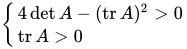
Stability diagram classifying Poincaré maps of linear autonomous system as stable or unstable according to their features. Stability generally increases to the left of the diagram.[1] Some sink, source or node are equilibrium points.

In mathematics, stability theory addresses the stability of solutions of differential equations and of trajectories of dynamical systems under small perturbations of initial conditions. The heat equation, for example, is a stable partial differential equation because small perturbations of initial data lead to small variations in temperature at a later time as a result of the maximum principle. In partial differential equations one may measure the distances between functions using Lp norms or the sup norm, while in differential geometry one may measure the distance between spaces using the Gromov–Hausdorff distance.

In dynamical systems, an orbit is called Lyapunov stable if the forward orbit of any point is in a small enough neighborhood or it stays in a small (but perhaps, larger) neighborhood. Various criteria have been developed to prove stability or instability of an orbit. Under favorable circumstances, the question may be reduced to a well-studied problem involving eigenvalues of matrices. A more general method involves Lyapunov functions. In practice, any one of a number of different stability criteria are applied.

Overview in dynamical systems

[edit]

Many parts of the qualitative theory of differential equations and dynamical systems deal with asymptotic properties of solutions and the trajectories—what happens with the system after a long period of time. The simplest kind of behavior is exhibited by equilibrium points, or fixed points, and by periodic orbits. If a particular orbit is well understood, it is natural to ask next whether a small change in the initial condition will lead to similar behavior. Stability theory addresses the following questions: Will a nearby orbit indefinitely stay close to a given orbit? Will it converge to the given orbit? In the former case, the orbit is called stable; in the latter case, it is called asymptotically stable and the given orbit is said to be attracting.

An equilibrium solution to an autonomous system of first order ordinary differential equations is called:

  • stable if for every (small) , there exists a such that every solution having initial conditions within distance i.e. of the equilibrium remains within distance i.e. for all .
  • asymptotically stable if it is stable and, in addition, there exists such that whenever then as .

Stability means that the trajectories do not change too much under small perturbations. The opposite situation, where a nearby orbit is getting repelled from the given orbit, is also of interest. In general, perturbing the initial state in some directions results in the trajectory asymptotically approaching the given one and in other directions to the trajectory getting away from it. There may also be directions for which the behavior of the perturbed orbit is more complicated (neither converging nor escaping completely), and then stability theory does not give sufficient information about the dynamics.

One of the key ideas in stability theory is that the qualitative behavior of an orbit under perturbations can be analyzed using the linearization of the system near the orbit. In particular, at each equilibrium of a smooth dynamical system with an n-dimensional phase space, there is a certain n×n matrix A whose eigenvalues characterize the behavior of the nearby points (Hartman–Grobman theorem). More precisely, if all eigenvalues are negative real numbers or complex numbers with negative real parts then the point is a stable attracting fixed point, and the nearby points converge to it at an exponential rate, cf Lyapunov stability and exponential stability. If none of the eigenvalues are purely imaginary (or zero) then the attracting and repelling directions are related to the eigenspaces of the matrix A with eigenvalues whose real part is negative and, respectively, positive. Analogous statements are known for perturbations of more complicated orbits.

Stability of fixed points in 2D

[edit]
Schematic visualization of 4 of the most common kinds of fixed points.

The paradigmatic case is the stability of the origin under the linear autonomous differential equation where and is a 2×2 matrix.

We would sometimes perform change-of-basis by for some invertible matrix , which gives . We say is " in the new basis". Since and , we can classify the stability of origin using and , while freely using change-of-basis.

Classification of stability types

[edit]

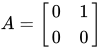
If , then the rank of is zero or one.

  • If the rank is zero, then , and there is no flow.
  • If the rank is one, then and are both one-dimensional.
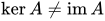
    • If , then let span , and let be a preimage of , then in basis, , and so the flow is a shearing along the direction. In this case, .
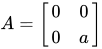
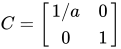
    • If , then let span and let span , then in basis, for some nonzero real number .
      • If , then it is unstable, diverging at a rate of from along parallel translates of .
      • If , then it is stable, converging at a rate of to along parallel translates of .

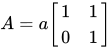
If , we first find the Jordan normal form of the matrix, to obtain a basis in which is one of three possible forms:

  • where .
    • If , then . The origin is a source, with integral curves of form
    • Similarly for . The origin is a sink.
    • If or , then , and the origin is a saddle point. with integral curves of form .
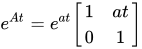
  • where . This can be further simplified by a change-of-basis with , after which . We can explicitly solve for with . The solution is with . This case is called the "degenerate node". The integral curves in this basis are central dilations of , plus the x-axis.
    • If , then the origin is an degenerate source. Otherwise it is a degenerate sink.
    • In both cases,
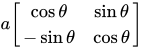
  • where . In this case, .
    • If , then this is a spiral sink. In this case, . The integral lines are logarithmic spirals.
    • If , then this is a spiral source. In this case, . The integral lines are logarithmic spirals.
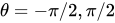
    • If , then this is a rotation ("neutral stability") at a rate of , moving neither towards nor away from origin. In this case, . The integral lines are circles.

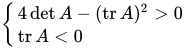
The summary is shown in the stability diagram on the right. In each case, except the case of , the values allows unique classification of the type of flow.

For the special case of , there are two cases that cannot be distinguished by . In both cases, has only one eigenvalue, with algebraic multiplicity 2.

  • If the eigenvalue has a two-dimensional eigenspace (geometric multiplicity 2), then the system is a central node (sometimes called a "star", or "dicritical node") which is either a source (when ) or a sink (when ).[2]
  • If it has a one-dimensional eigenspace (geometric multiplicity 1), then the system is a degenerate node (if ) or a shearing flow (if ).

Area-preserving flow

[edit]

When , we have , so the flow is area-preserving. In this case, the type of flow is classified by .

  • If , then it is a rotation ("neutral stability") around the origin.
  • If , then it is a shearing flow.
  • If , then the origin is a saddle point.

Stability of fixed points

[edit]

The simplest kind of an orbit is a fixed point, or an equilibrium. If a mechanical system is in a stable equilibrium state then a small push will result in a localized motion, for example, small oscillations as in the case of a pendulum. In a system with damping, a stable equilibrium state is moreover asymptotically stable. On the other hand, for an unstable equilibrium, such as a ball resting on a top of a hill, certain small pushes will result in a motion with a large amplitude that may or may not converge to the original state.

There are useful tests of stability for the case of a linear system. Stability of a nonlinear system can often be inferred from the stability of its linearization.

Maps

[edit]

Let f: RR be a continuously differentiable function with a fixed point a, f(a) = a. Consider the dynamical system obtained by iterating the function f:

The fixed point a is stable if the absolute value of the derivative of f at a is strictly less than 1, and unstable if it is strictly greater than 1. This is because near the point a, the function f has a linear approximation with slope f'(a):

Thus

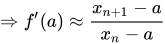
which means that the derivative measures the rate at which the successive iterates approach the fixed point a or diverge from it. If the derivative at a is exactly 1 or −1, then more information is needed in order to decide stability.

There is an analogous criterion for a continuously differentiable map f: RnRn with a fixed point a, expressed in terms of its Jacobian matrix at a, Ja(f). If all eigenvalues of J are real or complex numbers with absolute value strictly less than 1 then a is a stable fixed point; if at least one of them has absolute value strictly greater than 1 then a is unstable. Just as for n=1, the case of the largest absolute value being 1 needs to be investigated further — the Jacobian matrix test is inconclusive. The same criterion holds more generally for diffeomorphisms of a smooth manifold.

Linear autonomous systems

[edit]

The stability of fixed points of a system of constant coefficient linear differential equations of first order can be analyzed using the eigenvalues of the corresponding matrix.

An autonomous system

where x(t) ∈ Rn and A is an n×n matrix with real entries, has a constant solution

(In a different language, the origin 0 ∈ Rn is an equilibrium point of the corresponding dynamical system.) This solution is asymptotically stable as t → ∞ ("in the future") if and only if for all eigenvalues λ of A, Re(λ) < 0. Similarly, it is asymptotically stable as t → −∞ ("in the past") if and only if for all eigenvalues λ of A, Re(λ) > 0. If there exists an eigenvalue λ of A with Re(λ) > 0 then the solution is unstable for t → ∞.

The stability of a linear system can be determined by solving the differential equation to find the eigenvalues, or without solving the equation by using the Routh–Hurwitz stability criterion. The eigenvalues of a matrix are the roots of its characteristic polynomial. A polynomial in one variable with real coefficients is called a Hurwitz polynomial if the real parts of all roots are strictly negative. The Routh–Hurwitz theorem implies a characterization of Hurwitz polynomials by means of an algorithm that avoids computing the roots.

Non-linear autonomous systems

[edit]

Asymptotic stability of fixed points of a non-linear system can often be established using the Hartman–Grobman theorem.

Suppose that v is a C1-vector field in Rn which vanishes at a point p, v(p) = 0. Then the corresponding autonomous system

has a constant solution

Let Jp(v) be the n×n Jacobian matrix of the vector field v at the point p. If all eigenvalues of J have strictly negative real part then the solution is asymptotically stable. This condition can be tested using the Routh–Hurwitz criterion.

Lyapunov function for general dynamical systems

[edit]

A general way to establish Lyapunov stability or asymptotic stability of a dynamical system is by means of Lyapunov functions.

See also

[edit]

References

[edit]
[edit]
Revisions and contributorsEdit on WikipediaRead on Wikipedia
from Grokipedia
Stability theory is a branch of mathematics that investigates the behavior of solutions to differential equations and trajectories in dynamical systems, particularly how they respond to small perturbations or initial condition variations, determining whether they remain bounded, converge to equilibria, or diverge over time.[1] Originating from the foundational work of Aleksandr Lyapunov in his 1892 doctoral thesis The General Problem of the Stability of Motion, the theory provides criteria for assessing stability without necessarily solving the underlying equations explicitly.[2] Lyapunov introduced two primary methods: the direct method, which constructs a Lyapunov function—a scalar function that is positive definite and decreases along system trajectories to prove stability—and the indirect method, which linearizes the system around an equilibrium and examines the eigenvalues of the Jacobian matrix for linear stability.[3] Central concepts include Lyapunov stability, where solutions starting arbitrarily close to an equilibrium remain nearby for all future times, and asymptotic stability, where they not only stay close but also approach the equilibrium as time progresses.[4] Other notions, such as exponential stability (requiring decay at an exponential rate) and global stability (applicable across the entire state space), extend these ideas to nonlinear and infinite-dimensional systems like partial differential equations.[5] The theory underpins diverse applications, including control systems design for ensuring robust performance in engineering, analysis of oscillations and bifurcations in physics, and modeling population dynamics or neural networks in biology.[6] Modern extensions incorporate semigroup theory for infinite-dimensional problems and numerical methods for verifying stability in complex simulations.[5]

Introduction

Definition and Scope

Stability theory is a branch of mathematics dedicated to analyzing the persistence and behavior of solutions to dynamical systems in the vicinity of their equilibrium points. It examines whether small initial perturbations from an equilibrium cause solutions to remain bounded nearby or to return to the equilibrium itself. Central notions include Lyapunov stability, defined such that for every neighborhood around the equilibrium, there exists a smaller neighborhood from which all solutions stay within the larger one for all future times, ensuring perturbations remain small; and asymptotic stability, which adds the condition that solutions from a sufficiently small neighborhood converge to the equilibrium as time progresses.[7] At its core, stability theory applies to dynamical systems, which model the temporal evolution of states through ordinary differential equations (ODEs) in continuous time or difference equations in discrete time. Equilibria represent constant solutions where the system's rate of change is zero.[8][7] The scope of stability theory centers on ODEs and discrete dynamical systems, with extensions to partial differential equations (PDEs) for spatially extended phenomena and to control systems for feedback design. It is distinct from numerical stability, which concerns the robustness of computational algorithms to rounding errors, and from stability in structural engineering, which evaluates the resistance of physical constructions to buckling or collapse under loads.[7][9] This framework is essential for forecasting long-term dynamics in diverse applications, such as mechanical oscillations in physics, predator-prey interactions in biology, and regulator design in engineering, thereby underpinning reliable model predictions across these disciplines.[7]

Historical Background

The foundations of stability theory were laid in the late 19th century through Henri Poincaré's pioneering work on celestial mechanics and the qualitative theory of ordinary differential equations (ODEs). In the 1880s, while investigating the three-body problem for the King Oscar II prize, Poincaré introduced concepts of stability that emphasized the long-term behavior of trajectories without requiring explicit solutions, highlighting the limitations of perturbative methods in nonlinear systems.[10] His 1890 publication Les Méthodes Nouvelles de la Mécanique Céleste marked a shift toward analyzing stability via qualitative features, such as invariant manifolds and homoclinic tangles, influencing the understanding of non-integrable systems.[11] A major advancement came with Aleksandr Lyapunov's 1892 doctoral thesis, The General Problem of the Stability of Motion, which formalized stability analysis for dynamical systems without solving the underlying equations. Lyapunov developed direct methods using Lyapunov functions to assess asymptotic stability and indirect methods based on linearization around equilibria, providing rigorous criteria applicable to both mechanical and general ODE systems.[12] This work, defended at the University of Kharkov, established stability as a central problem in mathematics and engineering, bridging Poincaré's qualitative insights with quantitative tools.[13] In the 20th century, stability theory expanded through key classifications and theorems. In 1937, Aleksandr Andronov, Aleksandr Vitt, and Samuil Khaikin published a book on the theory of oscillations, introducing concepts of structural stability (with Leonid Pontryagin) and classifications of fixed points in two-dimensional systems based on eigenvalue analysis, incorporating notions of structural stability and bifurcations to categorize behaviors like nodes, foci, and saddles.[14] The Hartman-Grobman theorem, independently proved by David Grobman in 1959 and Philip Hartman in 1960, further linked local linear approximations to nonlinear dynamics near hyperbolic fixed points, confirming topological equivalence in a neighborhood of the equilibrium.[15] Stability theory gained prominence in chaos theory and control engineering during the mid-20th century. Edward Lorenz's 1963 paper demonstrated how sensitive dependence on initial conditions in nonlinear systems, exemplified by his atmospheric convection model, revealed chaotic attractors and challenged traditional stability assumptions in weather prediction.[16] Concurrently, Rudolf Kalman advanced stability in control theory through his late-1950s and early-1960s work on state-space methods, including criteria for controllability and observability that ensured internal stability in feedback systems.[17]

Core Concepts in Dynamical Systems

Dynamical Systems Overview

Dynamical systems describe the time evolution of states in a mathematical model, consisting of a phase space representing all possible states and a rule specifying how states change over time.[8] The phase space, often a smooth manifold such as Rn\mathbb{R}^n, encodes the system's configuration through coordinates like position and velocity.[18] Trajectories, or orbits, are the curves traced by states in this phase space, with continuous-time trajectories forming smooth paths and discrete-time ones forming sequences of points.[8] In continuous time, a dynamical system is governed by an ordinary differential equation (ODE) of the form x˙=f(x)\dot{x} = f(x), where xRnx \in \mathbb{R}^n is the state vector and ff is a vector field defining the instantaneous rate of change.[8] This equation generates a flow ϕt(x)\phi_t(x), a one-parameter family of maps satisfying ϕt+s(x)=ϕt(ϕs(x))\phi_{t+s}(x) = \phi_t(\phi_s(x)) and ddtϕt(x)=f(ϕt(x))\frac{d}{dt} \phi_t(x) = f(\phi_t(x)), which evolves the initial state xx to its position at time tt.[19] In discrete time, the system is defined by an iterative map xn+1=f(xn)x_{n+1} = f(x_n), where each application of ff advances the state by one time step, producing a sequence of iterates.[8] Systems are autonomous if ff depends only on xx (not explicit time tt), ensuring time-translation invariance in trajectories; non-autonomous systems incorporate time dependence, such as $ \dot{x} = f(x, t) $, leading to potentially crossing trajectories in an extended phase space.[8] Equilibria, or fixed points, occur where the evolution halts, satisfying f(xe)=0f(x_e) = 0 for continuous systems or f(xe)=xef(x_e) = x_e for discrete maps; these points anchor invariant sets like orbits that remain unchanged under the dynamics.[20] For illustration, the simple harmonic oscillator models a mass-spring system via q¨+ω2q=0\ddot{q} + \omega^2 q = 0, or in phase space as q˙=p\dot{q} = p, p˙=ω2q\dot{p} = -\omega^2 q, yielding periodic elliptical trajectories centered at the origin equilibrium.[21] In discrete time, the logistic map xn+1=rxn(1xn)x_{n+1} = r x_n (1 - x_n) with 0<xn<10 < x_n < 1 and parameter r>0r > 0 simulates population growth, producing sequences that converge, cycle, or exhibit complex patterns depending on rr.[22]

Equilibria and Fixed Points

In continuous-time dynamical systems described by the ordinary differential equation x˙=f(x)\dot{x} = f(x), where xRnx \in \mathbb{R}^n and f:RnRnf: \mathbb{R}^n \to \mathbb{R}^n is a sufficiently smooth vector field, an equilibrium point xx^* is a solution satisfying f(x)=0f(x^*) = 0.[20] This condition ensures that xx^* represents a constant trajectory, where the state remains unchanged over time if initialized there.[23] Equilibria are further classified as hyperbolic if all eigenvalues of the Jacobian matrix Df(x)Df(x^*) have non-zero real parts, or non-hyperbolic if at least one eigenvalue has zero real part.[20] In discrete-time dynamical systems governed by the recurrence xk+1=f(xk)x_{k+1} = f(x_k), a fixed point xx^* satisfies f(x)=xf(x^*) = x^*.[24] Periodic orbits of period p>1p > 1 can be viewed as fixed points of the iterated map fpf^p, where fp(x)=xf^p(x^*) = x^* but fj(x)xf^j(x^*) \neq x^* for 1j<p1 \leq j < p.[25] A key property of equilibria and fixed points is their invariance: the singleton set {x}\{x^*\} is an invariant set under the system's flow (in continuous case) or map (in discrete case), meaning trajectories starting at xx^* remain there.[26] Associated with each such point is its basin of attraction, the set of initial conditions whose forward trajectories converge to xx^* as time or iterations tend to infinity.[27] To identify equilibria in continuous systems or fixed points in discrete systems, one solves the equation f(x)=0f(x) = 0 (or f(x)x=0f(x) - x = 0 for fixed points). In low-dimensional cases (n3n \leq 3), algebraic methods such as factoring polynomials or symbolic solvers suffice.[20] For higher dimensions, numerical techniques like the Newton-Raphson method or continuation algorithms are used to approximate solutions.[28] A simple example is the one-dimensional linear system x˙=x\dot{x} = -x, where the origin x=0x^* = 0 is the equilibrium point since f(0)=0f(0) = 0. In discrete systems, periodic orbits generalize fixed points, as seen in maps like the logistic map where period-doubling bifurcations produce such orbits as fixed points of higher iterates.[25]

Stability Analysis of Fixed Points

Linear Stability in Continuous Systems

In continuous dynamical systems governed by autonomous ordinary differential equations (ODEs) of the form x˙=f(x)\dot{x} = f(x), where xRnx \in \mathbb{R}^n and ff is sufficiently smooth, linear stability analysis assesses the local behavior near an equilibrium point xx^* where f(x)=0f(x^*) = 0. The approach involves linearizing the system around xx^* by considering the Jacobian matrix Df(x)Df(x^*), leading to the linearized system y˙=Df(x)y\dot{y} = Df(x^*) y, where y=xxy = x - x^*.[29] The linearization theorem, known as the Hartman–Grobman theorem, states that if xx^* is a hyperbolic equilibrium—meaning no eigenvalue of Df(x)Df(x^*) has zero real part—then there exists a homeomorphism mapping the nonlinear flow near xx^* to the flow of the linearized system, preserving topological structure.[29] This implies that the local qualitative dynamics of the nonlinear system mirror those of the linear approximation sufficiently close to xx^*.[30] Stability is determined by the eigenvalues λ\lambda of the Jacobian Df(x)Df(x^*), found by solving the characteristic equation det(Df(x)λI)=0\det(Df(x^*) - \lambda I) = 0.[29] The equilibrium xx^* is asymptotically stable if all eigenvalues satisfy Re(λ)<0\operatorname{Re}(\lambda) < 0, unstable if any Re(λ)>0\operatorname{Re}(\lambda) > 0, and a center (marginally stable) if all eigenvalues are purely imaginary.[29] For the linear system x˙=Ax\dot{x} = Ax, solutions decay exponentially to zero when all Re(λ)<0\operatorname{Re}(\lambda) < 0, confirming asymptotic stability.[29] When Df(x)Df(x^*) is not diagonalizable, the Jordan canonical form provides insight into the dynamics. The matrix is similar to a block-diagonal form with Jordan blocks corresponding to each eigenvalue, where the size of the largest block for eigenvalue λ\lambda influences growth rates via terms like tk1eλtt^{k-1} e^{\lambda t} for block size kk.[29] Stability still hinges on the real parts of the eigenvalues, but larger Jordan blocks can introduce polynomial growth factors that amplify deviations if Re(λ)0\operatorname{Re}(\lambda) \geq 0.[29] A simple example is the one-dimensional case x˙=ax\dot{x} = a x, where the equilibrium at x=0x = 0 is asymptotically stable if a<0a < 0 (eigenvalue λ=a\lambda = a), stable but not asymptotic if a=0a = 0, and unstable if a>0a > 0.[29] For a two-dimensional diagonal system x˙=Ax\dot{x} = A x with A=diag(λ1,λ2)A = \operatorname{diag}(\lambda_1, \lambda_2), the origin is a stable sink if both λ1<0\lambda_1 < 0 and λ2<0\lambda_2 < 0, a saddle if one is positive and one negative, and a center if both are purely imaginary (e.g., λ1,2=±iω\lambda_{1,2} = \pm i \omega).[29] This linearization method has limitations: it fails for non-hyperbolic equilibria where some Re(λ)=0\operatorname{Re}(\lambda) = 0, as the nonlinear terms may dominate and alter stability, requiring more advanced techniques beyond linear approximation.[29] Degenerate cases, such as zero eigenvalues or resonant imaginary pairs, can lead to inconclusive results from eigenvalue analysis alone.[29]

Stability in Discrete Maps

In discrete dynamical systems, the evolution is governed by an iterative map $ x_{n+1} = f(x_n) $, where $ f: \mathbb{R}^d \to \mathbb{R}^d $ is a sufficiently smooth function and $ n $ denotes discrete time steps.[25] A fixed point $ x^* $ satisfies $ f(x^) = x^ $, representing an equilibrium where the system remains if started exactly there.[25] Stability analysis for such fixed points typically begins with linearization around $ x^* $, approximating the map's behavior for small perturbations $ y_n = x_n - x^* $, yielding the linear iteration $ y_{n+1} \approx Df(x^) y_n $, where $ Df(x^) $ is the Jacobian matrix of $ f $ at $ x^* $.[25] The long-term behavior of this linear system determines local stability: the fixed point is asymptotically stable (attracting) if perturbations decay to zero, unstable (repelling) if they grow, and neutrally stable otherwise.[25] The stability criteria hinge on the eigenvalues $ \lambda $ of the Jacobian $ Df(x^) $, known as characteristic multipliers, which are the discrete analogs of eigenvalues in continuous systems.[25] Specifically, $ x^ $ is asymptotically stable if all eigenvalues satisfy $ |\lambda| < 1 $, ensuring the spectral radius of $ Df(x^) $ is less than 1, so that iterations $ [Df(x^)]^n y_0 \to 0 $ as $ n \to \infty $.[25] Conversely, it is unstable if any $ |\lambda| > 1 $, as perturbations along the corresponding eigenspace will amplify exponentially.[25] If all $ |\lambda| = 1 $, the fixed point is neutrally stable, with perturbations neither growing nor decaying in the linear approximation, though higher-order terms may influence the actual dynamics.[25] Unlike continuous-time systems, where stability requires negative real parts of eigenvalues, discrete systems emphasize the modulus $ |\lambda| $, allowing for complex eigenvalues with $ |\lambda| < 1 $ that produce rotational spirals toward the fixed point due to oscillatory components.[31] A classic example is the one-dimensional logistic map $ f(x) = r x (1 - x) $ for $ x \in [0,1] $ and parameter $ r > 0 $, modeling population growth with carrying capacity 1.[32] The fixed points are $ x^* = 0 $ and $ x^* = (r-1)/r $ (for $ r > 1 $). For $ x^* = 0 $, the multiplier is $ f'(0) = r $, so it is attracting if $ 0 < r < 1 $ and repelling if $ r > 1 $.[32] For $ x^* = (r-1)/r $, the multiplier is $ f'(x^*) = 2 - r $, yielding attraction if $ 1 < r < 3 $ (since $ |2 - r| < 1 $) and repulsion if $ r > 3 $.[32] At $ r = 3 $, the fixed point loses stability via a period-doubling bifurcation, where the multiplier reaches -1, giving rise to a stable period-2 orbit as the primary onset of instability in this system.[33]

Nonlinear Stability Methods

In nonlinear dynamical systems, linear stability analysis via the Jacobian matrix at an equilibrium point may fail to provide conclusive results when the eigenvalues include those with zero real parts, rendering the equilibrium non-hyperbolic. In such cases, nonlinear methods are essential to determine local stability by accounting for higher-order terms that dominate the dynamics. These approaches often involve geometric reductions or transformations that isolate the critical behavior while preserving the essential nonlinear interactions. The center manifold theorem addresses non-hyperbolic equilibria by reducing the system's dimension to focus on the center eigenspace, where eigenvalues have zero real parts. This theorem asserts the existence of a locally invariant manifold, called the center manifold, that is tangent to the center eigenspace at the equilibrium and on which the dynamics are governed by a lower-dimensional nonlinear system. The stability of the original equilibrium is then determined by the behavior of this reduced system, allowing for the analysis of bifurcations and long-term dynamics in otherwise intractable high-dimensional settings. This reduction is particularly useful for infinite-dimensional systems, such as those arising in partial differential equations, where it simplifies stability assessments near critical points. Normal form theory complements this by transforming the nonlinear system into a canonical form that eliminates non-resonant terms, revealing the simplest structure of the dynamics near the equilibrium. Originating from Poincaré's work on celestial mechanics, this method employs a near-identity change of coordinates to simplify the Taylor expansion of the vector field, retaining only terms that cannot be removed due to resonance conditions with the linear part. The resulting normal form facilitates the identification of stability properties and bifurcation types by exposing resonant nonlinear interactions, such as those leading to homoclinic tangles or periodic orbits. For instance, in vector fields with a focus or node, normal forms can confirm asymptotic stability if the leading nonlinear terms dampen perturbations. For hyperbolic fixed points, where all eigenvalues have non-zero real parts, the invariant manifold approach constructs stable and unstable manifolds that locally foliate the phase space and dictate the system's qualitative behavior. These manifolds, tangent to the corresponding eigenspaces, are invariant under the flow and provide a geometric framework for understanding trajectories approaching or departing the equilibrium. In hyperbolic cases, the stable manifold consists of points that converge to the fixed point as time advances, while the unstable manifold includes those that converge backward in time; their intersections can signal complex dynamics like chaos in higher dimensions. This theory, formalized in detail by Wiggins, underpins the study of homoclinic and heteroclinic orbits, offering tools to assess global stability through manifold topology. Perturbation methods, such as the method of multiple scales, are employed for weakly nonlinear systems where the nonlinearity is small, enabling systematic approximations beyond linearization. This technique introduces multiple time scales—slow and fast—to rescale the equations, avoiding secular terms that would otherwise cause uniform approximations to break down over long times. By expanding solutions in powers of the small parameter, it captures amplitude modulation and frequency shifts in oscillatory systems, providing asymptotic stability criteria for equilibria perturbed by weak nonlinearities. Nayfeh's development of this method has been instrumental in applications like fluid dynamics, where it predicts the onset of instabilities in boundary layers. A representative example of these nonlinear methods in action is the Hopf bifurcation, where a stable equilibrium loses stability as a parameter varies, giving rise to a limit cycle that encircles the former fixed point. In this scenario, the linearization yields purely imaginary eigenvalues at the critical parameter value, making center manifold reduction and normal form analysis necessary to determine the bifurcation's direction—supercritical (stable limit cycle) or subcritical (unstable limit cycle)—based on the sign of the first Lyapunov coefficient in the reduced cubic normal form. Hopf's original analysis demonstrated that for systems like the van der Pol oscillator, this bifurcation transitions the equilibrium from asymptotically stable to unstable, with the emerging periodic orbit governing nearby dynamics. This illustrates how nonlinear techniques resolve stability in cases where linear methods predict neutral behavior, highlighting the role of quadratic and cubic terms in creating oscillatory instabilities.

Specialized Cases

Two-Dimensional Systems

In two-dimensional dynamical systems, phase portraits provide a visual representation of trajectories in the phase plane, illustrating the behavior of solutions around fixed points. These portraits are constructed by plotting the vector field defined by the system's equations and sketching integral curves that follow the flow, revealing qualitative dynamics such as attraction, repulsion, or oscillation. For linear systems, the classification relies on the eigenvalues of the Jacobian matrix at the fixed point, which determine the local structure; this can be conveniently summarized using the trace τ\tau and determinant Δ\Delta of the matrix, where the characteristic equation is λ2τλ+Δ=0\lambda^2 - \tau \lambda + \Delta = 0.[34][35] The trace-determinant plane divides the (τ,Δ)(\tau, \Delta) space into regions corresponding to distinct phase portrait types near the origin (assuming the fixed point is at the origin without loss of generality). When Δ<0\Delta < 0, the eigenvalues are real and of opposite signs, yielding a saddle point with hyperbolic trajectories approaching along one direction and departing along the other; this is unstable. For Δ>0\Delta > 0 and τ24Δ>0\tau^2 - 4\Delta > 0, the eigenvalues are real and of the same sign, resulting in a node: stable (sink) if τ<0\tau < 0, where trajectories converge linearly, or unstable (source) if τ>0\tau > 0, where they diverge. If Δ>0\Delta > 0 and τ24Δ<0\tau^2 - 4\Delta < 0, the eigenvalues are complex conjugates with nonzero real part, producing a focus or spiral: stable spiral sink if τ<0\tau < 0 (trajectories spiral inward) or unstable spiral source if τ>0\tau > 0 (spiraling outward). Centers occur when τ=0\tau = 0 and Δ>0\Delta > 0, with purely imaginary eigenvalues leading to closed elliptical orbits and neutral stability. Degenerate cases, such as repeated eigenvalues when τ2=4Δ>0\tau^2 = 4\Delta > 0, yield improper nodes with slower convergence along the eigenvector direction.[34][35][36] A topological invariant, the Poincaré index, further characterizes fixed points in 2D phase portraits by quantifying the winding of the vector field around a small closed curve enclosing the point, computed as the total angular change divided by 2π2\pi. For nodes, foci, and centers, the index is +1, reflecting a full counterclockwise rotation of the field direction; saddles have index -1 due to the characteristic X-shape where the field reverses direction. This index is additive over multiple points enclosed by a curve and equals +1 for any simple closed trajectory, implying that periodic orbits must enclose fixed points whose indices sum to +1, such as one node/focus/center or an even number of saddles compensated by others.[37][38] Illustrative examples highlight these classifications in nonlinear 2D systems. In the Lotka-Volterra predator-prey model, given by x˙=αxβxy\dot{x} = \alpha x - \beta x y, y˙=δxyγy\dot{y} = \delta x y - \gamma y (where xx is prey density, yy is predator density, and parameters α,β,δ,γ>0\alpha, \beta, \delta, \gamma > 0), the trivial fixed point at (0,0) is a saddle with eigenvalues α>0\alpha > 0 and γ<0-\gamma < 0, featuring an unstable manifold along the prey axis and a stable one along the predator axis. The coexistence fixed point at (γ/δ,α/β)(\gamma/\delta, \alpha/\beta) is a center with purely imaginary eigenvalues ±iαγ\pm i \sqrt{\alpha \gamma}, surrounded by periodic orbits representing neutral cycles of population oscillation. For the damped pendulum, modeled as θ¨+bθ˙+sinθ=0\ddot{\theta} + b \dot{\theta} + \sin \theta = 0 with damping b>0b > 0, the downward equilibrium at θ=0\theta = 0 (mod 2π2\pi) is a stable focus, where trajectories spiral inward in the (θ,θ˙)(\theta, \dot{\theta}) phase plane toward the fixed point, dissipating energy; the upward equilibrium at θ=π\theta = \pi (mod 2π2\pi) is an unstable saddle.[39][40] In 2D systems, bifurcations can alter these fixed point types as parameters vary, providing a preview of qualitative changes. A transcritical bifurcation occurs when two fixed points collide and exchange stability, as in the system x˙=μxx2\dot{x} = \mu x - x^2, y˙=y\dot{y} = -y, where for μ<0\mu < 0 the origin is stable and a saddle emerges for μ>0\mu > 0, with the origin becoming unstable. Pitchfork bifurcations involve one fixed point splitting into three: in the supercritical case x˙=μxx3\dot{x} = \mu x - x^3, y˙=y\dot{y} = -y, the origin destabilizes for μ>0\mu > 0 into a saddle, with two new stable nodes branching symmetrically; the subcritical variant x˙=μx+x3\dot{x} = \mu x + x^3, y˙=y\dot{y} = -y reverses stabilities, leading to unstable branches. These occur in the phase plane without affecting the transverse yy-direction significantly.[41]

Area-Preserving Dynamics

Area-preserving dynamics encompass flows and maps in dynamical systems that conserve the Lebesgue measure, or area in two dimensions and volume in higher dimensions, within phase space. For continuous-time systems, this property holds when the vector field ff satisfies f=0\nabla \cdot f = 0, meaning the flow is divergence-free and incompressible, preventing the contraction or expansion of phase space volumes.[42] In the context of Hamiltonian mechanics, Liouville's theorem formalizes this preservation: the phase space flow generated by the Hamiltonian equations maintains constant density of states over time, as the symplectic structure ensures volume invariance along trajectories.[43] This conservation implies that attractors, such as asymptotically stable fixed points, cannot exist in the traditional dissipative sense, since convergence to a lower-dimensional set would violate measure preservation.[44] Stability in area-preserving systems thus focuses on long-term boundedness and the persistence of nearly integrable structures rather than attraction. Elliptic fixed points, which exhibit neutral stability, are linearly characterized by purely imaginary eigenvalues in their Jacobian matrix, resulting in closed periodic orbits surrounding the point. In contrast, saddle points feature real eigenvalues of opposite signs, producing hyperbolic trajectories with expanding and contracting directions. The Kolmogorov-Arnold-Moser (KAM) theorem addresses perturbation robustness: for sufficiently small non-integrable perturbations of an integrable Hamiltonian system, most invariant tori around elliptic points persist as quasi-periodic orbits on slightly deformed tori, ensuring dynamical stability on invariant measure sets. This result, initiated by Kolmogorov in 1954 and extended by Arnold in 1963 and Moser in 1962, highlights the prevalence of regular motion amid potential chaos.[45][46] Illustrative examples clarify these concepts. The simple pendulum, modeled by the Hamiltonian H(θ,p)=p22+(1cosθ)H(\theta, p) = \frac{p^2}{2} + (1 - \cos \theta), yields an area-preserving flow in (θ,p)(\theta, p) phase space: librations form closed curves around the elliptic equilibrium at (θ,p)=(0,0)(\theta, p) = (0, 0), while rotations trace invariant curves beyond the separatrix connected to the saddle at (π,0)( \pi, 0 ). For discrete-time systems, the Chirikov standard map, defined as pn+1=pn+Ksinθnmod2πp_{n+1} = p_n + K \sin \theta_n \mod 2\pi and θn+1=θn+pn+1mod2π\theta_{n+1} = \theta_n + p_{n+1} \mod 2\pi with 0<K<10 < K < 1, exemplifies area preservation via its Jacobian determinant of unity; it displays KAM tori for small KK and chaotic layers for larger values.[47][48] Chaotic behavior emerges in conservative systems through the intricate structure of homoclinic tangles near saddle points, where stable and unstable manifolds intersect transversely, forming a complex web that generates symbolic dynamics akin to Smale's horseshoe and positive topological entropy. These tangles, first identified by Poincaré, lead to instability by enabling trajectories to wander indefinitely across phase space without dissipating energy, yet the overall measure-preserving nature confines chaos to cantori-bounded regions rather than the entire space.[49][50]

General Stability Theory

Lyapunov Functions

Lyapunov functions provide a cornerstone for the direct method of stability analysis in dynamical systems, enabling the proof of stability properties without explicitly solving the differential equations describing the system dynamics. Introduced by Aleksandr Lyapunov in his seminal 1892 doctoral thesis, this approach involves constructing a scalar function V(x)V(\mathbf{x}), often interpreted as an "energy-like" quantity, that decreases or remains non-increasing along system trajectories. Specifically, for a continuous-time autonomous system x˙=f(x)\dot{\mathbf{x}} = f(\mathbf{x}) with equilibrium at the origin, a Lyapunov function VV is continuously differentiable, positive definite (i.e., V(0)=0V(\mathbf{0}) = 0 and V(x)>0V(\mathbf{x}) > 0 for x0\mathbf{x} \neq \mathbf{0} in some neighborhood UU of the origin), and its time derivative V˙(x)=V(x)f(x)0\dot{V}(\mathbf{x}) = \nabla V(\mathbf{x}) \cdot f(\mathbf{x}) \leq 0 along trajectories in UU. This condition implies Lyapunov stability of the equilibrium, as trajectories cannot escape bounded regions where VV is level-set bounded. For asymptotic stability, the inequality is strengthened to V˙(x)<0\dot{V}(\mathbf{x}) < 0 for x0\mathbf{x} \neq \mathbf{0}, ensuring trajectories converge to the equilibrium. Lyapunov's stability theorem formalizes this: if such a VV exists with V˙0\dot{V} \leq 0 and the sublevel sets {xUV(x)c}\{ \mathbf{x} \in U \mid V(\mathbf{x}) \leq c \} compact for some c>0c > 0, then the origin is stable; with the strict inequality, it is asymptotically stable. In cases where V˙0\dot{V} \leq 0 but not strictly negative, LaSalle's invariance principle extends the result by showing that trajectories approach the largest invariant set contained in the region {xUV˙(x)=0}\{ \mathbf{x} \in U \mid \dot{V}(\mathbf{x}) = 0 \}, often identifying the equilibrium as the sole invariant set under additional conditions like smoothness of ff. This principle, developed by Joseph P. LaSalle, is particularly useful for systems with dissipative but non-strictly decreasing Lyapunov functions.[51] Constructing Lyapunov functions varies by system class. For linear systems x˙=Ax\dot{\mathbf{x}} = A \mathbf{x}, quadratic forms V(x)=xTPxV(\mathbf{x}) = \mathbf{x}^T P \mathbf{x} with P>0P > 0 symmetric serve as natural candidates, where PP solves the Lyapunov equation
ATP+PA=Q A^T P + P A = -Q
for any positive definite Q>0Q > 0. The solution P=0eATtQeAtdtP = \int_0^\infty e^{A^T t} Q e^{A t} \, dt exists if AA is Hurwitz (all eigenvalues have negative real parts), yielding V˙=xTQx<0\dot{V} = -\mathbf{x}^T Q \mathbf{x} < 0 for x0\mathbf{x} \neq \mathbf{0}, thus confirming asymptotic stability. This ties into Lyapunov's indirect method, which linearizes nonlinear systems around the equilibrium to apply the equation locally, inferring stability from the linearized system's eigenvalues when the linearization is hyperbolic. For nonlinear systems, constructing VV often relies on domain knowledge, such as energy functions in mechanical systems or sums of squares in polynomial cases.
Converse Lyapunov theorems guarantee the existence of such functions under stability assumptions, bridging sufficiency and necessity. José Luis Massera's 1949 result establishes that if an equilibrium is asymptotically stable, there exists a C1C^1 positive definite VV with V˙<0\dot{V} < 0 in a neighborhood, constructed via integrals over solution trajectories. Later extensions, such as those by Rudolf E. Kalman and others, provide smooth or quadratic converses for linear and certain nonlinear cases, ensuring VV can be chosen with desirable properties like radial unboundedness for global results. These theorems underscore the method's robustness, as stability implies the availability of a certifying Lyapunov function. Lyapunov functions find broad applications in proving global stability, particularly in control theory and ecology. In control systems, they facilitate the design of stabilizing feedback laws, such as in adaptive or robust control, by ensuring closed-loop V˙0\dot{V} \leq 0 through choice of gains. For instance, in nonlinear control problems like robot manipulator dynamics, Lyapunov-based backstepping constructs recursive VV to achieve global asymptotic tracking. In ecological models, such as Lotka-Volterra predator-prey systems, weighted sum-of-squares Lyapunov functions (e.g., V=(xixilnxi/xi)V = \sum (x_i - x_i^* \ln x_i / x_i^*)) prove global stability of coexistence equilibria by showing V˙0\dot{V} \leq 0 with equality only at the equilibrium, capturing persistence and resilience in population dynamics. These applications highlight the method's versatility for complex, high-dimensional systems beyond local linear analysis.

Asymptotic and Exponential Stability

Asymptotic stability extends the notion of Lyapunov stability by requiring that trajectories not only remain bounded near an equilibrium but also converge to it over time. For a continuous-time dynamical system x˙=f(x)\dot{x} = f(x) with equilibrium at x=0x = 0, the origin is asymptotically stable if it is stable in the sense of Lyapunov and there exists a neighborhood BB such that for any initial condition x(0)Bx(0) \in B, limtx(t)=0\lim_{t \to \infty} x(t) = 0.[52] The set of all initial conditions that converge to the equilibrium, known as the basin of attraction, characterizes the domain over which this convergence holds; if the basin encompasses the entire state space, the equilibrium is globally asymptotically stable.[52] In autonomous systems, asymptotic stability implies uniform asymptotic stability, where convergence rates are governed by time-independent estimates, ensuring that the δ\delta in the stability definition can be chosen independently of the initial time.[53] Exponential stability provides a stronger quantitative measure of convergence speed. An equilibrium x=0x = 0 is exponentially stable if there exist constants K1K \geq 1 and α>0\alpha > 0 such that
x(t)Kx(0)eαt \|x(t)\| \leq K \|x(0)\| e^{-\alpha t}
for all t0t \geq 0 and initial conditions in some neighborhood.[54] For linear systems x˙=Ax\dot{x} = Ax, exponential stability is equivalent to the matrix AA being Hurwitz, meaning all eigenvalues have negative real parts.[54] In nonlinear systems, local exponential stability holds if the linearized Jacobian at the equilibrium is Hurwitz, with the basin of attraction containing a neighborhood around the equilibrium.[54]
Lyapunov exponents quantify the average exponential rates of divergence or convergence of nearby trajectories in dynamical systems. The largest Lyapunov exponent is defined as
λ=limt1tlogDϕ(t,x0), \lambda = \lim_{t \to \infty} \frac{1}{t} \log \|D\phi(t, x_0)\|,
where ϕ(t,x0)\phi(t, x_0) is the flow map and DϕD\phi its derivative; negative values indicate contraction toward an attractor, with all exponents negative implying asymptotic stability.[55]
Exponential stability enhances robustness in perturbed systems. Specifically, an exponentially stable unforced system x˙=f(x)\dot{x} = f(x) becomes input-to-state stable (ISS) under additive disturbances uu, satisfying
x(t)β(x(0),t)+γ(u[0,t]), \|x(t)\| \leq \beta(\|x(0)\|, t) + \gamma(\|u\|_{[0,t]}),
for class KL\mathcal{KL} function β\beta and class K\mathcal{K} function γ\gamma, provided ff is Lipschitz continuous.[56]
A representative example is the linear system x˙=Ax\dot{x} = Ax where AA has eigenvalues with negative real parts, ensuring exponential decay to the origin from any initial condition, with the decay rate determined by the eigenvalue with the largest real part.[54] Exponential stability can be verified using Lyapunov functions, as discussed in prior sections on general stability theory. Extensions to stochastic dynamical systems adapt these concepts using moment-based or almost-sure criteria. For stochastic differential equations dx=f(x)dt+g(x)dWdx = f(x) dt + g(x) dW, exponential stability in mean square requires E[x(t)2]Kx(0)2eαt\mathbb{E}[\|x(t)\|^2] \leq K \|x(0)\|^2 e^{-\alpha t}, often established via Lyapunov functions ensuring negative definiteness in the infinitesimal generator.[57]

References

User Avatar
No comments yet.