Hubbry Logo
Star loreStar loreMain
Open search
Star lore
Community hub
Star lore
logo
8 pages, 0 posts
0 subscribers
Be the first to start a discussion here.
Star lore
Star lore
from Wikipedia
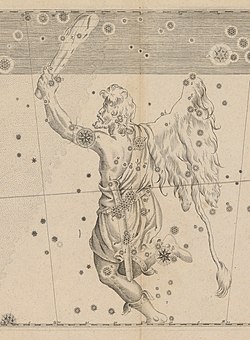
Johann Bayer's Uranometria showing the constellation Orion. Orion the Hunter is star lore created by the ancient Greeks.

Star lore or starlore is the creating and cherishing of mythical stories about the stars and star patterns (constellations and asterisms); that is, folklore based upon the stars and star patterns. Using the stars to explain religious doctrines or actual events in history is also defined as star lore. Star lore has a very long history; it has been practiced by nearly every culture recorded in history, dating as far back as 5,500 years ago. It was practiced by prehistoric cultures of the Paleolithic and Neolithic periods as well.

Orion and Scorpius

[edit]

One example of star lore is the inventing of the story of Orion the Hunter and the Scorpius the Scorpion by the ancient Greeks. This ancient culture saw a very startling pattern of bright stars in the winter sky that, from their point of view, resembled a mighty hunter, which they named Orion. During the summer, they saw another startling pattern of bright stars that resembled a scorpion. They noticed that the constellations of Orion and the scorpion were positioned at opposite ends of the sky and were never seen in the sky simultaneously. As one constellation rose above the eastern horizon, the other was setting below the western horizon, and when either one was high in the sky, the other was completely absent. The ancient Greeks felt compelled to explain this phenomenon by composing a story or myth based on the two constellations[citation needed].

The story was that Orion was a mighty and proud hunter who was stung by a scorpion. Orion died of the scorpion's sting and was placed among the stars by the gods. Although the scorpion was destroyed by the gods in vengeance for killing Orion, it was also placed among the stars. In order to prevent Orion and the scorpion from quarreling and fighting with each other in the sky, the gods placed Orion and the scorpion at opposite ends of the sky, and in opposite seasons, so that both of them can never be seen in the sky at the same time.

Andromeda

[edit]

Another example of star lore is the story behind the constellation Andromeda, also known as "the chained woman". Andromeda was the daughter of the king and queen of Ethiopia, King Cepheus and Cassiopeia. The story goes that because Cassiopeia bragged so much of Andromeda's beauty to the Nereids, daughters of Poseidon, that they complained to their father, who sent a sea monster to destroy the coast of Ethiopia. Cepheus consulted an oracle for assistance and learned that the only way to save his lands was to sacrifice his daughter to Poseidon's monster.[1]

Andromeda was chained to a rock and left for the sea monster. Perseus, the hero of the story who had just killed the Gorgon Medusa found Andromeda in her distress and immediately, the two fell in love. Perseus asked for her name and refused to leave until he knew it, talking to her until she gave in. Andromeda told him her name, her country, and the reason for her imprisonment on the rock. He then consulted with Cepheus and Cassiopeia, and they decided that if Perseus rescued Andromeda from the sea monster, he could marry her. The story of how he then defeats the monster varies. Ovid describes his killing of the monster as a drawn out bloody battle. Other sources say that Perseus killed the sea monster with the aid of Medusa's head, turning the monster to stone. Andromeda and Perseus were married soon after,[2] despite already being promised to her uncle, Phineus. At the wedding, Phineus and Perseus got into an altercation, and Perseus turned Phineus to stone using Medusa's head.

The constellation is said to have astrological influences as well. It is said that any man born at the same time Andromeda is said to rise from the sea will be one without mercy; he will be emotionally unmoved even in the presence of grieving parents. The constellation also influences the birth of the executioner, a man who will kill swiftly for money and kill willingly. Sources describe men born with the rise of Andromeda as one who would feel nothing if faced with Andromeda chained to her rock, just as Perseus did and fell in love with the girl.[3]

Draco

[edit]

The Draco is another example of star lore. In Roman mythology, the constellation is representative of Ladon, the dragon that guarded the golden apples inside the garden, Hesperides. The tree was a wedding gift to Hera when she and Zeus were married, and she planted it on Mount Atlas. Hera tasked the Hesperides to guard the tree and put Ladon around the tree as well to ensure that the Hesperides would not steal the apples. In some sources, Ladon is called the child of Typhon and Echidna, who was half woman and half viper, and had hundreds of heads. In other versions of Ladon's story, the number of heads he had is not at all mentioned and he is described as the offspring of Ceto and Phorcys, two sea deities.[4]

Contrastingly, in Roman mythology, Draco was one of the Titans who waged war on the Olympic gods for ten years. He was killed by Minerva in the battle and thrown into the sky.[5]

See also

[edit]

References

[edit]
Revisions and contributorsEdit on WikipediaRead on Wikipedia
from Grokipedia
Star lore encompasses the rich tapestry of myths, legends, and that diverse cultures worldwide have woven around the , constellations, and celestial patterns to explain the , mark time, and convey spiritual beliefs. From tales of gods and heroes to indigenous narratives of animals and spirits, star lore reflects humanity's enduring fascination with the as a source of guidance, , and . Historically, star lore dates back millennia, with early civilizations such as those in the , , and identifying 48 prominent constellations tied to mythological figures, animals, and objects, later expanded to 88 official ones by the in 1922 to standardize global astronomical nomenclature. These patterns, though appearing connected from , consist of stars at vastly different distances, serving practical roles in , seasonal , and calendar-making across societies. For instance, Chinese astronomers divided the sky into 28 lunar mansions associated with directional animals like the Black Tortoise of the North, linking celestial events to earthly governance and harmony. Indigenous cultures offer profound examples of star lore's integration with daily life and spirituality; the of the view constellations as a celestial map mirroring sacred earthly sites in the Black Hills, guiding spiritual journeys from the vernal equinox to and embodying concepts like kapemni, or , symbolizing life's cyclical reflection. Similarly, Yup’ik communities in interpret the as the caribou (Tunturyuk), often featured in stories of celestial pursuit, using such stories for navigation and seasonal timing, while groups in name stars after everyday items like blubber containers (Ursuutaattiaq), embedding moral lessons and environmental knowledge in their lore. A recurring motif in global star lore is the , often depicted as seven sisters in —daughters of Atlas pursued by Orion—but reimagined as a shattered boastful star in Polynesian tales or linked to ancestral spirits in Aboriginal Australian traditions, highlighting shared human themes of kinship, loss, and cosmic order despite cultural variations.

Fundamentals of Star Lore

Definition and Purpose

Star lore encompasses the collective body of myths, legends, and cultural narratives that attribute human figures, animals, objects, or symbolic forms to patterns formed by stars and other celestial bodies, serving as a distinctly separate from the empirical observations of scientific astronomy. These stories transform random stellar arrangements into meaningful symbols, reflecting humanity's longstanding effort to impose order and significance on the night sky through imaginative frameworks. Historically, star lore has fulfilled practical purposes in , enabling ancient voyagers to traverse vast distances by memorizing the rising and setting positions of stars as directional guides. For instance, Polynesian navigators employed a mental , dividing the horizon into 32 segments to track over 200 stars for open-ocean , a technique essential for exploration and migration before modern instruments. In timekeeping, star lore informed agricultural calendars through observations like —the first predawn appearance of a star after a period of invisibility—which signaled seasonal changes critical for farming. Ancient Egyptians, for example, aligned their civil calendar's New Year with the heliacal rising of Sirius (), marking the Nile's annual flood and the onset of the inundation season vital for crop cycles. Religious rituals also drew on these patterns, integrating stellar events into ceremonies to invoke divine favor or commemorate cosmological cycles, as seen in Egyptian associations of Sirius with the goddess for renewal rites. Beyond utility, star lore functioned as a for social , embedding lessons, societal values, and explanations of the within accessible narratives to foster cohesion and cultural identity. These tales, often transmitted orally across generations, bridged empirical skywatching with creative interpretation, allowing pre-literate societies to encode knowledge of the in memorable forms that predated written records.

Historical Origins

The origins of star lore extend into prehistoric times, with some of the earliest evidence appearing in cave art dating to around 17,000 BCE. Paintings in the Lascaux Cave in , for instance, include depictions interpreted as the star cluster, indicating that early humans recognized and possibly mythologized celestial patterns for orientation or ritual purposes. Megalithic structures further demonstrate this development; , built circa 3000–2000 BCE in , aligns with the summer and winter solstices, suggesting prehistoric communities used stellar observations to track seasonal cycles and perform astronomical rituals. By around 2000 BCE, Mesopotamian civilizations, particularly the Babylonians, advanced star lore through systematic documentation on tablets, establishing the foundations of the zodiac and recording associated myths. Texts like the compendium, rooted in traditions from this era, cataloged constellations and linked them to divine narratives, influencing later astral sciences. These Babylonian contributions emphasized predictive astronomy, where stars were seen as omens from gods, laying groundwork for zodiacal divisions that divided the into twelve segments. Greek scholars built upon these Mesopotamian influences, systematizing star lore with mythological integrations. Hesiod's , composed around 700 BCE, referenced constellations such as the and Orion to advise on farming calendars, embedding celestial events in poetic lore. This culminated in Claudius Ptolemy's (2nd century CE), which compiled 48 constellations with detailed positions and etymologies tied to myths, standardizing Greek astral knowledge for centuries. A key example of Mesopotamian transmission is the constellation Taurus, derived from Sumerian stories of the bull-god , the "Great Bull of Heaven," adopted into as the bull slain by Gilgamesh's counterpart figures.

Astronomical Elements

Stars and Constellations

Stars are massive, luminous spheres of plasma primarily composed of and , held together by and powered by in their cores, where nuclei fuse into to release . The Sun, Earth's nearest star, exemplifies a G2V-type main-sequence star, stably fusing in its core and classified as a yellow dwarf with a surface temperature of approximately 5,500 degrees . From Earth, stars' visibility depends on their , a measure of brightness as seen from our planet; for instance, Sirius, the brightest star in the night sky, has an apparent magnitude of -1.46, making it prominent even in light-polluted areas. Constellations represent arbitrary patterns formed by connecting stars in the sky, as perceived from , serving as human constructs to aid , timekeeping, and rather than reflecting physical associations among the stars. In 1922, the (IAU) officially recognized 88 such constellations, which collectively cover the entire without overlap, including zodiacal ones like Aries that align with the path of the Sun. These patterns, while appearing fixed on short timescales, are influenced by —the apparent shift in a star's position due to around the Sun—and proper motion, the actual angular movement of stars across the sky relative to distant background stars. Over millennia, these effects gradually alter the perceived shapes of constellations, though star lore traditionally depicts them as eternal, unchanging figures. Bright stars such as in and in Aquila have played key roles in star lore as seasonal markers through their heliacal risings, the first pre-dawn appearances after periods of invisibility near the Sun, signaling agricultural or environmental changes in various cultures. For example, the acronycal rising of has been associated with the time of year when birds build their nesting mounds in traditions, highlighting how observable stellar events provided practical calendars long before modern instruments.

Asterisms in Lore

Asterisms are prominent patterns of stars recognized by observers, often forming recognizable shapes that may lie entirely within a single constellation or span multiple ones, distinct from the formally defined boundaries of constellations established by astronomical organizations. Unlike constellations, which are official 88 regions of the sky delineated by the , asterisms are informal and culturally variable groupings that emphasize visual distinctiveness for practical or narrative purposes. For instance, the is a well-known asterism comprising seven bright stars within the constellation , forming a ladle-like shape that has been identified across numerous cultures for millennia. In star lore, asterisms play a crucial role by providing simpler, more memorable frameworks for and cultural transmission, allowing communities to encode moral lessons, seasonal knowledge, or historical events into the without relying on the complexity of full constellations. Their compact nature facilitates easier recognition and recall, making them ideal vehicles for narratives passed down through generations. A prime example is the in and other Indigenous North American traditions, where the four stars of the "bowl" represent a great being pursued by three hunters (the "handle" stars), with a fourth faint star as the hunters' dog; this tale illustrates themes of pursuit, renewal, and the cycle of seasons as the bear appears to "escape" in autumn only to reemerge in spring. Asterisms also exemplify cross-cultural adaptability, as seen in the , an asterism formed by the bright stars in , in Cygnus, and in Aquila, which bridges three separate constellations and covers a vast portion of the summer sky in the . In , these stars feature prominently in the Qixi legend of the Weaver Girl () and the Cowherd (), separated by the but reunited annually via a bridge of magpies (symbolized by ), a story central to the celebrating love and separation for over 2,600 years. This flexibility enables diverse interpretations while respecting official astronomical divisions, allowing asterisms to evolve as cultural tools for , calendars, and identity without altering standardized celestial maps.

Cultural Interpretations

Greco-Roman Mythology

In Greco-Roman mythology, star lore revolves around the concept of , the transformation of gods, heroes, animals, and objects into constellations as a form of divine reward, memorial, or punishment. This tradition, deeply embedded in ancient narratives, explains the origins of celestial patterns through heroic deeds and divine interventions. The Roman scholar compiled many such myths in his De Astronomia during the 1st century BCE, drawing from earlier Greek sources to describe how figures were "placed among the stars" (katasterismoi in Greek). Hyginus' work covers 42 constellations, linking them to mythological events and emphasizing the immortilization of notable beings in the heavens. Central to this lore are myths of gods and heroes elevated to stellar status, often tied to epic labors or tragedies. ( in Greek), the archetypal hero, exemplifies this through his twelve labors, several of which are reflected in constellations. For instance, the constellation Leo commemorates the , slain in his first labor, while Hydra represents the multi-headed serpent he defeated in the second, placed in the sky by Juno as a lasting adversary. These portray ' exploits as cosmic victories, with the hero himself immortalized as a constellation kneeling in eternal vigilance. Such stories underscore the theme of , where mortal achievements earn eternal placement among the immortals. Roman adaptations integrated these Greek myths into their own cultural and literary frameworks, often using stars as omens of fate and empire. In Virgil's Aeneid (1st century BCE), celestial signs, including references to constellations, guide Aeneas' journey and foreshadow Rome's destiny, blending Greek catasterismi with Roman imperialism. The constellation Gemini, depicting the twins Castor and Pollux, illustrates this fusion; in mythology, Jupiter rewarded their brotherly devotion by placing them among the stars, where they became patrons of sailors, appearing as guiding lights during storms to aid navigation. Virgil evokes these twins in prophetic visions, symbolizing divine protection for Rome's founders. Greco-Roman star lore profoundly influenced the zodiac, a system of twelve constellations tied to seasonal and astrological cycles. Aries, the Ram, embodies the golden-woolled creature from the myth of and Helle, who rode it to safety; after sacrificing the ram, Phrixus dedicated its fleece, leading to Jason's quest, with the animal itself catasterized as the zodiac's first sign. This narrative links the constellation to themes of and adventure, establishing Aries as a herald of the vernal in ancient calendars.

Eastern and Asian Traditions

In , the sky is divided into the , known as xiu (宿), which segment the and into 28 unequal parts to track the moon's monthly path and serve as an astrological and calendrical framework. These mansions, dating back to at least the (475–221 BCE), are grouped into four directional symbols—the of the East, of the South, of the West, and Black Tortoise of the North—each encompassing seven mansions and reflecting a cosmological order tied to seasonal changes and imperial rituals. A prominent myth associated with these mansions is that of the , where the stars and represent a forbidden romance between a mortal cowherd (Niulang) and the celestial weaver (), separated by the but reunited annually on the seventh day of the seventh lunar month, symbolizing enduring love and the cyclical nature of the heavens. In Indian Vedic traditions, the 27 nakshatras function as lunar stations along the , each spanning approximately 13 degrees and 20 minutes, serving as markers for timekeeping, rituals, and since the (c. 1500–500 BCE). These mansions are personified and linked to deities, influencing human affairs through their positions relative to the moon; for instance, , the first ruled by the twin horsemen gods Ashvini Kumaras, embodies swift healing and renewal, depicted as divine physicians who restore vitality and are invoked in medical rites. The integrate mythology with practical astronomy, guiding agricultural cycles and auspicious timings in texts like the . A central concept in Chinese star lore is the interpretation of celestial phenomena as imperial omens, where the stars were monitored by court astronomers to advise the emperor on governance and fate. The (Ziwei Yuan, 紫微垣), encompassing 118 stars around the north including , symbolized the emperor's heavenly palace and administrative domain, with anomalies like comets or eclipses portending dynastic upheavals or divine mandates. This enclosure, part of the Three Enclosures system, underscored the , linking stellar harmony to terrestrial rule. Japanese star lore adapts Chinese influences through the festival, blending them with elements to celebrate the as a bridge for the annual meeting of Orihime () and Hikoboshi (), the weaver princess and cowherd from the Qixi legend. Originating in the (794–1185 CE) via Chinese imports, evolved into a communal event with bamboo decorations and wishes, honoring celestial lovers while invoking for skills in weaving and writing, as documented in imperial poetry anthologies. This fusion highlights how East Asian traditions shared and localized star myths for cultural and spiritual purposes.

Indigenous and African Perspectives

Indigenous and African star lore often portrays celestial bodies as integral to oral cosmologies, where stars serve as ancestors, spiritual guides, or law-givers intertwined with seasonal and survival practices, rather than rigid mythological narratives. These traditions emphasize animistic connections to the environment, using star patterns to mark seasons, migrations, and agricultural cycles, reflecting a where the sky informs earthly rhythms and community laws passed down through generations. In Native American traditions, particularly among the Lakota (Sioux), the constellation Orion is interpreted as Tayamni, representing the three parts of a buffalo essential to their sustenance and culture. The belt stars form the spine (Tayamnicankhu), with surrounding stars depicting ribs, and the Pleiades cluster serving as the buffalo's head (Tayamnipha), symbolizing the animal's vital role in seasonal hunts and rituals. This bison imagery underscores ecological harmony, as the constellation's winter visibility guided Lakota hunters and vision quests, linking celestial positions to earthly buffalo migrations and the sacred hoop of life. The Pleiades, known in broader Native American lore as the "Seven Brothers" or similar sibling figures, further tie into seasonal timing for hunts, appearing in spring to signal renewal and communal storytelling. Australian Aboriginal cultures feature the " in the " asterism, formed by dark nebulae and dust lanes in the rather than bright stars, embodying a totemic central to Dreamtime narratives. Visible prominently in autumn, this celestial emu guides stories of creation and seasonal egg-laying, with its "head" near the Southern Cross and elongated body stretching across the galaxy, influencing laws on hunting and land stewardship. Communities like the Kamilaroi and Boorong interpret the emu's position to predict emu breeding seasons on , reinforcing ancestral connections where the sky emu acts as a law-giver for sustainable practices. Among African traditions, the of associate the Sirius system with the , amphibious ancestral spirits or fish-gods who descended from the sky to impart knowledge, including details of Sirius B (po tolo), a dense companion invisible to the . However, the origin of this detailed knowledge has been debated by scholars, who propose it was likely influenced by interactions with European astronomers in . This lore, documented through rituals and sigui ceremonies every 60 years, ties the stars to creation myths where regulate water, fertility, and cosmic order, blending astronomy with ecological cycles like the Nile's floods. In Zulu traditions, (isAndulela) functions as a brilliant messenger star heralding the end of autumn and harvest time, guiding travelers and farmers by signaling seasonal transitions and prosperous journeys across the . These perspectives highlight stars as dynamic ancestors fostering environmental attunement and communal survival.

Notable Constellation Stories

Orion and Scorpius

In , Orion was depicted as a mighty hunter and companion of the goddess , renowned for his strength and skill in pursuing game. According to one prominent version of the tale, Orion boasted that he could slay every beast on Earth, prompting the Earth goddess to send a giant scorpion—later immortalized as the constellation —to confront him in mortal combat. The scorpion stung Orion to death, after which honored both figures by placing them among the stars, positioned at opposite ends of the so they could never clash again; this arrangement ensures Orion rises in the winter sky as sets, and vice versa in summer. Within the constellation, the bright red supergiant star marks Orion's right shoulder (from the viewer's perspective), emphasizing his formidable stature in artistic and mythological representations. Cross-cultural interpretations of Orion and Scorpius reveal diverse symbolic roles tied to , sustenance, and celestial narratives. In ancient , the constellation Orion was associated with , the god of the and rebirth, whose soul was believed to reside eternally in the three stars of , symbolizing and the pharaohs' afterlife journey. Among Indigenous Australian peoples, such as the of , Orion's form represents the ancestral canoe Djulpan, paddled by brothers fishing for sustenance, with the Belt stars denoting the brothers; in their lore, the brothers were blown into the sky after one broke a by eating a king-fish, their . The Boorong people of northwestern Victoria view and sword as Kulkunbulla, two young men dancing a with the as young women. In some Australian traditions, such as among the Wardaman, represents a lizard, with its rising signaling seasonal changes and hunts that complement Orion's narratives. The red star , Alpha Scorpii, occupies the position of the scorpion's heart in and derives its name from the Greek for "rival of " (Mars), due to its vivid reddish hue resembling the war god's appearance. In Roman astronomical traditions influenced by Ptolemaic texts, was recognized as the scorpion's vital core, often evoking omens of peril in interpretive practices akin to , where its fiery glow warned of conflict or hidden threats. This antagonistic pairing of Orion and embodies an eternal chase motif across cultures, mirroring seasonal cycles: Orion dominates the winter as the hunter of cold months, while emerges in summer, representing the scorpion's pursuit and the rhythmic turnover of seasons in agrarian and navigational lore.

Andromeda and Cassiopeia

In , Cassiopeia, the queen of and wife of King Cepheus, incurred the wrath of by boasting that her beauty—or that of her daughter Andromeda—surpassed that of the , the sea nymphs. As punishment, flooded the kingdom and unleashed the Cetus to ravage the land, compelling Cepheus to chain Andromeda to a rock as a sacrificial offering to appease the god. , returning from his quest to slay , encountered the chained princess, fell in love with her, and slew the monster using the Gorgon's head to petrify it, thus rescuing Andromeda and marrying her. Following their deaths, both Cassiopeia and Andromeda were catasterized—transformed into constellations—as part of the cycle's heroic narrative, with Cassiopeia's placement serving as eternal punishment for her while Andromeda's rewarded her . Cassiopeia appears bound to a in the northern sky, her five brightest stars forming a distinctive "W" shape that symbolizes this royal seat, visible year-round as a constellation for northern observers and periodically appearing inverted, evoking her ongoing humiliation. This family curse motif underscores themes of and , with the stars depicting familial positions: Andromeda's outstretched arms evoking the chains that once bound her. The myth's setting in is preserved through Greek sources. In , Cassiopeia falls within the , representing the imperial court's inner palace, where asterisms like —a legendary charioteer—symbolize moral tales of skill and integrity among court figures, diverging from the Greek emphasis on vanity.

Draco

Draco, the Dragon constellation, holds a prominent place in ancient Greek mythology as a guardian serpent embodying vigilance and cosmic order. In one prominent tale, it represents Ladon, the hundred-headed dragon offspring of and Echidna, tasked with protecting the golden apples in the Garden of the . slew Ladon during his eleventh labor to retrieve the apples, after which placed the dragon among the stars as Draco. Alternatively, Draco is identified with the Colchian Dragon, a sleepless serpent that guarded the in the of , subdued by and during the ' quest. These myths portray Draco as an eternal sentinel, its serpentine form winding eternally in the northern sky to enforce divine boundaries. Cross-culturally, Draco's imagery extends to Babylonian lore, where it evokes the primordial chaos dragon from the Enûma Eliš epic, a serpentine force defeated by to establish cosmic structure, with her divided body forming the heavens and . In Chinese traditions, Draco aligns with the (Qīnglóng), one of the representing the eastern direction, spring, and the wood element, embodying imperial power and seasonal renewal as it oversees a quadrant of the . These interpretations highlight Draco's role as a multifaceted symbol of creation, chaos, and guardianship across ancient civilizations. Draco's circumpolar position, encircling the north near , reinforces its lore as a world-encircling serpent, akin to the Norse Serpent () that binds the realms in eternal vigilance. This positioning evokes symbolism, with the star in Draco's tail serving as the ancient around 3000 BCE, anchoring the heavens like a dragon's coil stabilizing the cosmos. In various traditions, this configuration underscores the dragon's function as a cosmic pivot, linking earthly and divine realms through its unending orbital path.

Contemporary Relevance

In Modern Astronomy

In 1922, the (IAU) established a standardized system dividing the entire into 88 constellations with defined boundaries, preserving many ancient names rooted in historical star lore, such as Orion, even amid diverse cultural interpretations worldwide. This framework, adopted at the IAU's first in , ensures uniform nomenclature for astronomers globally while maintaining continuity with traditional patterns like those from Greco-Roman traditions. Modern educational practices leverage star lore to enhance engagement and learning in astronomy. Planetariums employ mythological stories and mnemonic narratives to help audiences identify constellations, transforming abstract observations into memorable experiences that connect historical tales with current skywatching. Similarly, like Stellarium integrates constellation imagery, boundaries, and cultural depictions—drawing from over 20 sky cultures—to facilitate interactive exploration and aid in teaching star patterns through lore-based visualizations. Ethnoastronomy emerges as a key field in contemporary astronomy, systematically studying how various cultures perceive and encode astronomical knowledge into their worldviews, thereby bridging traditional lore with scientific . This discipline actively revives indigenous astronomical traditions, such as those used for and seasonal guidance, to support dark sky preservation initiatives that safeguard both ecological integrity and against . NASA's astronomical endeavors reflect this integration of lore, with features named after mythological figures to evoke historical context; for instance, the is designated after princess from ancient tales, highlighting its position in the constellation bearing her name. Such naming conventions extend to mission discoveries, where surface features on asteroids like are labeled after mythical birds, perpetuating lore's role in cataloging cosmic phenomena.

Influence on Art and Media

Star lore has profoundly shaped literary works from the onward, often serving as a metaphorical framework for character development and narrative structure. incorporated constellations into his legendarium, drawing from Norse star myths such as the "Wain" (a precursor to ) to create Valacirca, the celestial sickle of the , which symbolizes divine watchfulness and echoes ancient northern lore of Odin's . In visual and interactive media, star lore provides rich source material for adaptations and gameplay mechanics. Disney's animated series Hercules: The Animated Series (1998–1999) adapts the Greek myth of Orion in the episode "Hercules and the Falling Stars," where the hunter is released from his constellation form, blending classical lore with comedic adventure to explore themes of and celestial punishment. Video games like (2017) integrate Egyptian star lore through 12 stone circle puzzles, requiring players to align ancient constellations such as those of Serqet and with the night sky, thereby educating on Ptolemaic-era astronomy while advancing the plot. A key aspect of star lore's contemporary influence is its revival within movements, where ancient zodiacal traditions merge with pseudoscientific practices to foster personal spirituality and self-understanding. This resurgence, prominent from the onward, reinterprets constellations as archetypal influences on , exemplified by daily horoscopes that assign zodiac signs traits derived from Babylonian and Hellenistic stellar myths. Twentieth-century science fiction further illustrates this impact, with authors repurposing mythological star clusters for interstellar settings. In Isaac Asimov's Foundation series (1942–1993), the Pleiades star cluster is depicted as a populated galactic region. The Apple TV+ adaptation of Asimov's Foundation series (2021–present) continues this tradition, visualizing galactic regions and celestial elements inspired by the original novels' astronomical motifs, further embedding star lore in modern storytelling.

References

Add your contribution
Related Hubs
User Avatar
No comments yet.