

State defense force
View on Wikipedia


.jpg)
In the United States, state defense forces (SDFs) are military units that operate under the sole authority of a state government. State defense forces are authorized by state and federal law and are under the command of the governor of each state.[1][2][3]
State defense forces are distinct from their state's National Guard in that they cannot become federal entities. All state National Guard personnel (including the National Guard of the District of Columbia, the Commonwealth of Puerto Rico and the territories of Guam and the Virgin Islands) can be federalized under the National Defense Act Amendments of 1933 with the creation of the National Guard of the United States. This provides the basis for integrating units and personnel of the Army National Guard into the U.S. Army and, since 1947, units and personnel of the Air National Guard into the U.S. Air Force.[4]
The federal government recognizes state defense forces, as per the Compact Clause of the U.S. Constitution, under 32 U.S.C. § 109 which provides that state defense forces as a whole may not be called, ordered, or drafted into the armed forces of the United States, thus preserving their separation from the National Guard. However, under the same law, individual members serving in the state defense force are not exempt from service in the armed forces (i.e., they are not excluded from the draft). Under 32 USC § 109(e), "A person may not become a member of a defense force ... if he is a member of a reserve component of the armed forces."
Nearly every state has laws authorizing state defense forces, and 19 states, plus the Commonwealth of Puerto Rico, have active forces with different levels of activity, support, and strength. State defense forces generally operate with emergency management and homeland security missions. Most SDFs are organized as ground units, but air and naval units also exist.[5][6] Depending on the state, they may be variously named as state military, state military force, state guard, state militia, or state military reserve.
Every state defense force is also the command authority for the "unorganized militia", which is defined as every able bodied male between the age of 17 and 45 who is not already serving in some capacity within the armed forces or National Guard.[7] The original concept of the unorganized militia being a citizen army which could be raised immediately in times of extreme national emergency. In the modern day military, the unorganized militia is considered obsolete with very few exceptions. One of the only recognized instances where unorganized militia members wear uniforms and actively perform military duties is the Virginia Militia which actively employs officers amongst the various military schools in the state of Virginia.[8]
History
[edit]Origins
[edit]From its founding until the early 1900s, the United States maintained only a minimal army and relied on state militias to supply the majority of its troops, with the training and readiness of the latter varying widely.[9] As a result of the Spanish–American War and the performance of the militias and other volunteer units during that conflict, Congress was called upon to reform and regulate the training and qualification of state militias. In 1903, with passage of the Militia Act of 1903, the predecessor to the modern-day National Guard was formed. It required the states to divide their militias into two sections. The law recommended the title "National Guard" for the first section, for federal administration, and "Reserve Militia" for the individual states.[10]
World War I
[edit]During World War I, Congress authorized the states to maintain Home Guards, which were reserve forces outside the National Guard forces that were then being deployed by the Federal Government as part of the National Army. The Secretary of War was authorized to furnish these Home Guard units with rifles, ammunition, and supplies.[11]
Interwar years
[edit]In 1933, Congress finalized the split between the National Guard and the traditional state militias by mandating that all federally funded soldiers take a dual enlistment/commission and thus enter both the state National Guard and the newly created National Guard of the United States, a federal reserve force.
World War II
[edit]In 1940, with the onset of World War II and as a result of its federalizing the National Guard, Congress amended the National Defense Act of 1916, and authorized the states to maintain "military forces other than National Guard."[12]
Cold War
[edit]In 1950, with the outbreak of the Korean War and at the urging of the National Guard, Congress reauthorized the separate state military forces for a time period of two years. These state military forces were authorized military training at federal expense, as well as "arms, ammunition, clothing, and equipment," as deemed necessary by the Secretary of the Army.[13] At the end of the two years, however, they were not reauthorized under federal law.
In 1956, Congress finally revised the law and authorized "state defense forces" permanently under Title 32, Section 109, of the United States Code.[14] Two years later, Congress amended the law and changed the name from "State defense forces" to "defense forces."[15] Still, it was not until the early Ronald Reagan administration that many states developed their defense forces into elements that existed beyond paper, when the U.S. Department of Defense actively encouraged states to create and maintain SDF units.[16]
By the late 1980s, however, a series of high-profile reports caused several states to shut down or significantly restructure their forces. In 1987, the governor of Utah removed all but 31 officers from the Utah State Guard, after a probe revealed that its ranks were "peppered with neo-Nazis, felons and mental patients."[17] Meanwhile, in 1990, the Virginia General Assembly launched an investigation and subsequent overhaul of its state's force after receiving tips that the volunteers were "saving money to buy a tank."[18]
Contemporary
[edit]
With the end of the Cold War came a general decrease of interest in state defense forces. The September 11 attacks, however, generated additional attention and, with it, greater scrutiny from some in the United States military who questioned the training and equipment of the units and whether they provided an outlet for "warrior wannabes" who would not otherwise qualify for service in the armed forces.[19]
In 2008, Alaska disarmed its state defense force after an investigation concluded the lack of training intensity or standardization was a potential legal liability to the state.[20] By 2010 the status of the force had been downgraded even further, with the Adjutant-General of the Alaska National Guard informing volunteers that they would only be called upon as a "reserve of last resort to be used only in the most extreme emergencies."[21] The ASDF remained deliberately hamstrung for several years, until Governor Bill Walker overruled the Adjutant-General in 2016 when he announced his intention to reform the Alaska State Defense Force by expanding it further into rural Alaska and improving training standards.[22]
Further controversy was stoked by a New York Times report which found many senior officers in the New York Guard had little or no formal military training despite holding, in some cases, general officer ranks. The former commander of the force, Pierre David Lax, noted that, "if you are friendly with the governor and you always wanted to be a general, you ask the governor to make you a general, and poof, you are a brigadier general." Another former commander asserted he regularly awarded titles to members of the New York legislature in exchange for their support of budgetary allocations to the force. The report also noted that a majority of the unit's rare deployments involved providing ceremonial support, such as bands and color guards, to the state government.[23]

An April 2014 Department of Defense report by the Inspector General's office reported confusion and inconsistency among state adjutant generals as to the use and status of state defense forces. The Inspector General's office reported an under-utilization of state defense force capabilities due to a lack of clarity in the US Code regarding the use of SDFs, fueling fear that using funds and assets acquired through the federal government for state defense forces could run afoul of regulations. (While the National Guard is operated by the states, most of their equipment and funding comes from the federal government.) This fear of violating regulations also inhibited their use and integration with their National Guard counterparts, preventing them from conducting joint operations alongside one another, and also from volunteering in support of federal missions. Other problems cited by the Inspector General's office were a lack of standardization in training and physical fitness, raising questions as to the ability of SDFs to work alongside their National Guard counterparts, and a lack of coordination with and support from the Department of Defense. During a survey conducted by the Inspector General of SDF commanders and adjutant generals, 18 of 19 considered their SDFs to be part of the organized militia and subject to the Code of Military Justice, 14 of 18 considered the members of SDFs to be "soldiers", 14 of 18 considered SDF personnel to be "lawful belligerents" under the rules of war, and only 4 of 19 authorized their personnel to conduct firearms training. Almost all of the missions reported to the IG's office were non-military in nature, including small-scale search and rescue, disaster management, and other unarmed, homeland security related-tasks.[24]
Due to public fears over the Jade Helm 15 exercises held throughout a number of southwestern states, on 28 April 2015, Gov. Greg Abbott of Texas ordered a call-up of the Texas State Guard to monitor the exercises and facilitate communication between US special operations forces conducting training and the governor's office.[25]
In early 2020, a number of state defense forces were activated to combat the COVID-19 pandemic. As of April 2020, the Alaska State Defense Force,[26] the California State Guard,[27] the Governor's Guards of Connecticut,[28] the Georgia State Defense Force,[29] the Indiana Guard Reserve,[30] the Maryland Defense Force,[31] the New York Guard,[32] the Ohio Military Reserve,[33] the South Carolina State Guard,[34] the Tennessee State Guard,[35] the Texas State Guard,[36] and the Virginia Defense Force[37] had all contributed members to their respective states' efforts in combating the pandemic.
In 2022, the Florida State Guard was restored, and throughout 2023 and 2024 created aerial, maritime, land, and special units.[38] In 2023, Florida approved a $107 million budget for 2023–2024.[39] In 2024, signifying cross-state cooperation and operations by State defense forces, the Florida State Guard sent troops to Texas to support border operations.[40]
Future
[edit]A 2003 article in the United States Army War College's Parameters journal recommended that "United States Northern Command (NORTHCOM) should ensure that future contingency planning efforts for homeland security operations fully incorporate the valuable capabilities that State Defense Forces can provide."[41] In the decade following that article, however, no significant action has been taken on the recommendation.
Several bills have been unsuccessfully introduced in Congress since the early 1990s seeking to improve the readiness of state defense forces. The most recent, H.R. 206, introduced in 2009 by Rep. Joe Wilson of South Carolina, would have allowed the U.S. Secretary of Defense to transfer surplus U.S. military equipment to state defense forces. Co-sponsors of the bill included Jim Marshall and Frank Wolf. Congress took no action on the measure before adjourning.[42]
In recent years, state defense forces have focused on retooling their capabilities to be better prepared for future missions by improving their professionalism and interoperability with other agencies. The development of professional commands to support the National Guard, especially medical commands to buttress civil authorities during a civil crisis, has become an emerging trend.[43][44][45][46]
Several state defense forces have begun to shift their focus to preparing for larger emergencies which may require multiple states to coordinate relief efforts. In July 2015, the Virginia Defense Force headed a multi-state communications exercise, the first ever of its kind, where the VDF practiced long-distance radio communications with the Tennessee State Guard, Indiana Guard Reserve, Texas State Guard, and the California State Military Reserve.[47] Further efforts at standardizing training between state defense forces by setting competency requirements have been undertaken by the State Guard Association of the United States, which followed its Military Emergency Management Specialist training program with a JAG Academy[48] an Engineer Specialty Qualification Badge,[49] and plans for a Medical Academy in the future.[50]
Individual states have made efforts to increase their capabilities to be prepared to take on future missions. In March 2017, the California State Military Reserve activated its Maritime Component to lead and assist in future homeland security missions while working in conjunction with other agencies, including the Coast Guard Auxiliary, the California Department of Fish and Wildlife, CalTrans, and other civilian departments.[51] As of May 2017, the Maryland Defense Force has significantly reorganized; the number of available officer billets has been shrunk, and the job descriptions reorganized, in order to avoid having a top-heavy organizational structure. New units, including the Maryland Emergency Management Agency (MEMA) Support Unit, have been approved, and others, such as the MDDF Cyber Unit, have planned expansions. Training standards were also heightened, with the MDDF requiring that drill participation, age, height, and weight requirements be more strictly enforced. Further, all new soldiers are currently required to earn their Military Emergency Management Specialist Badge. These changes were made with the goal that the future MDDF would be able to "seamlessly integrate into missions with the National Guard."[52]
Florida, in its effort to develop its State Guard, in 2023 it received approval to construct its headquarters and training center in Flagler County.[53] In September 2024 it was reported that the Florida State Guard plans to build an airbase at Tallahassee International Airport, with the planned site consisting of two hangars, an office, and accompanying infrastructure.[54]
List of state defense forces
[edit]
There are currently 20 active state defense forces and 5 active naval militias. The Puerto Rico State Guard includes an air support component, the 1st Air Base Group, that support the operations of the Puerto Rico Air National Guard.
* Colorado does not operate an active state defense force, but rather has a statutory state defense force staffed by one individual appointed by the governor.
- NY had an active organization called the NY State Reserve Defense Force (defunct in 2013), led by a retired US Army Brigadier General, that operated similar to the NY Guard and performed funeral honor guard, disaster response, volunteer event security services, operated a year-round 500 bed homeless shelter, and performed other duties between 2003 and 2013, until it ceased operations due to the inability to obtain state/federal/grant funding and legislative recognition. The NY SRDF performed honor guard services at more than 80 funerals, responded to more than 30 local disasters/incidents, and provided event security services at more than 125 events. The NY SRDF was made up of licensed security guards, military veterans, volunteer fire/EMS personnel, doctors, chefs, and other professionals who sought to serve their local communities. Members wore a navy-blue mess dress uniform with gold buttons and trouser stripes for formal occasions, a similar navy-blue class A dress uniform for funerals, and grey tactical uniforms for disaster response and event security services. The NY SRDF had over 250 members before it ceased operations.
- Pennsylvania currently has an active ceremonial and charitable organization called the Pennsylvania State Defense Force Association that attends public events in uniform. Its members are all volunteers.
-
 Georgia State Defense Force members help recertify Georgia Army National Guard medics in CPR/AED.
 -
 South Carolina State Guard members during pack training.
 -

-
 The Texas State Guard Medical Brigade deployed in Galveston, Texas.
 -
 Members of the California State Military Reserve perform squad drills.
 -
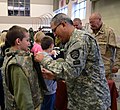 A member of the Oregon State Defense Force helps a child try on body armor.
 -
 Alaska State Defense Force Lt. Col. (AK) John James speaks with Mongolian emergency personnel.
 -
 Puerto Rico State Guard members perform inspections of National Guard facilities.


_John_James,_director_of_operations,_answers_questions_from_Col._Ariunaa_Chadraabal,_left,_and_Col._Ariunbuyan_Gombojav,_right,_both_members_of_the_Mongolian_National_Emergency_Management_Agency.jpg)

Structure
[edit]Personnel and training
[edit]Some state defense forces advertise recruitment and physical standards lower than the U.S. military with relaxed waiver standards. While other state defense forces, and specific units, advertise professional military and physical fitness standards to retain integration with National Guard counterparts and more physically demanding state and interagency missions.

California, for instance, requires no physical fitness test prior to entry and has weight/height standards significantly more relaxed than the federal service for certain units, but certain jobs — like firefighters, search and rescue, and certain maritime search and rescue/dive personnel within the Cal Guard's Emergency Response Command and Maritime Service — require passing a physical fitness test, pack hikes, and tryouts.[146] California State Guard wildland firefighters, for example, must complete the National Wildfire Coordinating Group Red Card standards, then complete a Cal Fire interagency training program alongside their National Guard counterparts.[147] In the Texas State Guard, there are minimal requirements for general accession, but joining specialized teams like the Dive, Rescue, and Recovery (DR&R) Team requires physical fitness testing and completion of the Texas Dive School.[148]
_Team_Training.jpg)
Officer Candidate Schools are also maintained by the active State Defense Forces of the United States by direction of their respective state military departments and by the state's National Guard Adjutant General. Similar to their state's National Guard counterparts who take a dual federal and state military commission, military officers who are commissioned through a SDF Officer Candidate School take a sole military commission to the state that they support, recognized by their state's military code and 32 U.S.C. § 109. In states with full integration of state military resources (SDF and National Guard counterparts) the curriculum is often similar, with the National Guard curriculum taking on additional requirements to meet federal recognition (referred to as FEDREC[149]). For example, California maintains both Officer Candidate Schools at Camp San Luis Obispo, with the State Guard OCS being 11–12 months and the National Guard OCS being 16–18 months, both celebrate a joint graduation.[150]
The Military Emergency Management Specialist Badge,[151] created by the State Guard Association of the United States, has become a common training focal point among state defense forces. Alabama, California, Indiana, Ohio and others have adopted the MEMS Badge as a basic qualification required of all members desiring promotion. Training is conducted both online, and through MEMS academies in each state, and includes course material provided by FEMA and other agencies, as well as practical experience in local disaster planning and exercise management.
Community Emergency Response Teams (CERTs) are being organized by several SDFs by utilizing training offered by the Federal Emergency Management Agency's Citizen Corps. Some states follow the lead of the Army and offer a permanent tab (worn in a similar manner as the Army's Ranger and Sapper tabs) as an incentive to become certified as part of the local or unit CERT team.
State defense forces may incorporate Medical Reserve Corps units into their organizational structure. The 47th Medical Company (MRC), of the New Mexico State Defense Force,[152] the 10th Medical Regiment of the Maryland Defense Force,[153] and the Medical Brigade of the Texas State Guard[154] receive training and recognition from the Medical Reserve Corps program sponsored by the Office of the Surgeon General of the United States through the Citizen Corps program, and are simultaneously organized as units of their respective state defense force.
Weapons qualification and training is provided in some SDFs. However, most SDFs do not require weapons proficiency. A 2006 report by the U.S. Freedom Foundation, an organization affiliated with the State Guard Association of the United States,[155] recommended minimum standards for state defense forces, including weapons training, but the report has been largely ignored. Some SDFs have laws that in the event of deployment by order of the state legislature and/or governor, they will become armed.
Uniforms
[edit]
As a general rule, state defense forces wear standard U.S. military uniforms with insignia closely matching those of their federal counterparts. SDF units generally wear red name tags on service uniforms (as specifically prescribed by AR 670–1, chapter 2–7, paragraph k and chapter 23–8, paragraph c)[156] for SDF units when adopting the Army Service Uniform or Battle Dress Uniform (BDU), and name tapes on Army Combat Uniforms (ACU) or BDUs use the state defense force name or state name rather than "U.S. Army." Standard U.S. Army branch insignia are often used or a unique "state guard" branch insignia consisting of a crossed musket and sword is alternatively used.

Where berets are worn, some state defense forces use a beret flash similar to the one the U.S. Army uses, but in bright red thread instead of the Army's blue. Other states have beret flashes that are often based on their state flag.
Uniforms vary from state to state and tend to have only subtle differences. For example, the Texas State Guard wears standard U.S. Army camouflage uniforms, a state guard unit patch, and the "U.S. Army" name tape replaced with one reading "Texas State Guard." Similarly, the California State Guard wears a uniform identical to their National Guard counterparts except for the unit patch, beret flash, and the "California" name tape. Outer garments such as a Gore-Tex jacket have a subdued "CA" beneath the rank insignia.[157] A similar pattern can be found in the New York Guard. The Georgia State Defense Force often works in tandem with and support of federal troops. The Georgia State Defense Force wears the OCP pattern of the ACU with a standard SDF red flash on the army black beret and "Georgia" in place of the "U.S. Army" uniform name tape.
The few states with both SDF air and naval units wear modified USAF and USN/USMC uniforms. Currently, only Ohio, Alaska and New York have uniformed naval militias. Only California, Vermont, and Puerto Rico have an air wing, though Indiana formerly had an Air Guard Reserve. In all cases, the state adjutant general has the final say on uniforms worn by state defense forces, though federal service regulations generally shape the policies of each state.

In March 2024, the Chief of the National Guard Bureau signed an updated Chief of the National Guard Bureau Instruction (CNGBI) 5500.01A National Guard Interaction with State Defense Forces. In this new regulation, it outlined new uniform requirements of SDFs who wear modified US Army Utility Uniforms. These new requirements are the responsibilities of State Adjutant Generals to enforce on their state's SDFs. The new regulations include: solid red background nametapes with white lettering, solid red backgrounds and white ranks for rank tabs, solid red covers with white ranks, the requirement of full color state flags, full color unit patches, and a tab on the left shoulder displaying "SDF" in white lettering on a solid red background. Notably, this regulation also disallowed the display of previously earned qualification badges on the utility uniforms if the badge was issued by the US Armed Forces. For example, if a state SDF member earned a parachutist badge while in the US Armed Forces, they are no longer allowed to display said badge on their SDF uniform. Federal awards not issued by the US Armed Forces are still authorized. This was largely seen by SDF groups, including the State Guard Association of the United States, as an attempt to discredit the legitimacy of SDFs; concerned it would cause confusion among civilians. Proponents argued that it was necessary to ensure there was no confusion between SDFs and the National Guard.[158][159]
State defense force utility uniforms
[edit]| Force | Branch tape reads | Branch, Rank, and Name Tape colors | Insignia
(SSI) |
Head covering | Uniform type |
|---|---|---|---|---|---|
| Alaska State Defense Force[160] | ALASKA | Black on OCP | Subdued | OCP patrol cap | OCP ACU |
| California State Guard[61] | CALIFORNIA[157] | White on Black |
Subdued |  Black beret with royal blue flash with yellow and red slash |
OCP ACU |
| Georgia State Defense Force[74] | GEORGIA SDF[161] | Black on Coyote | Subdued | Coyote ball cap Black beret with red SDF flash (see above) |
OCP ACU |
| Florida State Guard | FL STATE GUARD | Black on UCP | Subdued | UCP patrol cap
UCP sun hat (boonie) |
UCP ACU |
| Indiana Guard Reserve[83] | INDIANA | Maroon on OCP | Subdued | Black patrol cap | OCP ACU |
| Maryland Defense Force[91] | MARYLAND | Maroon on OCP | Subdued |  Black beret with black and yellow divided flash with white and red slashes[162] |
OCP ACU |
| Massachusetts National Lancers | MASSACHUSETTS | Black on OCP | Unsubdued | OCP patrol cap | OCP ACU
Class A and B, and ceremonial lancer uniform. |
| Michigan Defense Force[96] | MICHIGAN | Black on OCP | Subdued | OCP patrol cap | OCP ACU |
| Mississippi State Guard[99] | MS STATE GUARD | Crimson on OCP | Subdued | OCP patrol cap Black beret with red SDF flash (see above) |
OCP ACU |
| New York Guard[110] | N.Y. GUARD | Black on White | Subdued |  Black beret with gray flash (Dress Blues Only) |
OCP ACU[163] |
| New York Naval Militia[111] | N.Y. NAVAL MILITIA | Yellow on NWU Black on MARPAT White on blue |
Yellow on NWU Black on MARPAT White on blue |
Naval style 8-point cover Marine style 8-point cover baseball cap |
NWU/MARPAT/ODU |
| Ohio Military Reserve[116] | OHIO | Red on White | Unsubdued | OD patrol cap | OCP ACU |
| Ohio Naval Militia[6] | OHIO NAVY | Gold/silver on navy blue | Gold/silver on navy blue (E-4 & up) | Naval style 8-point cover | NWU |
| Oregon Civil Defense Force[119] | OREGON | Black on UCP | Subdued | UCP patrol cap | UCP ACU |
| Puerto Rico State Guard[122] | PRSG ARMY PRSG AIR FORCE |
Black on OCP | Subdued | OCP patrol cap |
OCP ACU |
| South Carolina State Guard[126] | S.C. STATE GUARD | Silver on Black | Subdued | OCP patrol cap | OCP ACU |
| Tennessee State Guard[129] | TN STATE GUARD | Maroon on UCP | Unsubdued | UCP patrol cap | UCP ACU |
| Texas State Guard | TEXAS STATE GUARD | Black on OCP | Subdued |  Black beret with red, white, and blue beret flash |
OCP ACU |
| Vermont State Guard[136] | VT STATE GUARD | Black on OCP | Unsubdued | OCP patrol cap | OCP ACU |
| Virginia Defense Force[138] | VIRGINIA | Black on OD | Subdued | BDU patrol cap | WOODLAND TRU |
| Washington State Guard[141] | WA STATE GUARD | Black on OCP | Subdued |  Black beret with yellow, green, and white beret flash |
OCP ACU |
-
 Maryland Defense Forces and Maryland Army National Guard participate in a multi-agency disaster exercise at Towson University.
 -
 Texas State Guardsmen pass out free water after flooding contaminated a local water supply.
 -
 Georgia Defense Force members unload water and ice in anticipation of incoming Hurricane Katrina evacuees.
 -
 Texas State Guard during a Land Navigation joint training exercise.
 -
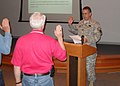 Missouri State Defense Force swearing in ceremony.
 -
 California State Military Reserve guardsmen provide security for Air Force Two.


Special units
[edit]
SDFs include a variety of special units including medical, aviation, and ceremonial units. The following are examples:
- Cyber Security Command, Maryland Defense Force[164][165]
- Cavalry Troop A, Maryland Defense Force[166]
- 121st Engineer Regiment, Maryland Defense Force
- 10th Medical Regiment, Maryland Defense Force
- 61st Medical Company, Tennessee State Guard
- Finance Corps, Maryland Defense Force
- Judge Advocate Corps, Maryland Defense Force[167]
- Georgia Defense Force Band, Georgia State Defense Force
- Maryland Defense Force Band
- Governor's Foot Guard, Governor's Horse Guard & Band, Connecticut State Militia[168]
- 1st Medical Company, Georgia State Defense Force[169]
- 1st Platoon – DECON/CBRN-e[170]
- Quick Reaction Teams (QRT) (now disbanded) – Small units attached to a number of Texas State Guard Civil Affairs (CA) regiments. QRT undergo specialized training and qualify with approved NATO 9mm sidearm. QRT compete in the Governor's Twenty competition with the Texas Army National Guard and Texas Air National Guard.[citation needed]
- Special Missions Unit: Florida State Guard. Trained for military policing, responses, and special forces missions.[171] The unit is armed with rifles and pistols.[172]
- Aviation Response Squadron: Florida State Guard. Aviation force with intelligence, recon, fire, medical, and disaster response duties.[173]
- Small Arms Training Team – Small arms and crew served weapons team of the California State Military Reserve[174]
- Search and Rescue Company, Puerto Rico State Guard[citation needed]
- The 1st Air Base Group, Puerto Rico Air State Guard
- The Georgia State Defense Force OPFOR unit[175]
- RAIDER School, South Carolina State Guard[176]
- 143rd CSMR Support Battalion, State MP Unit, California State Military Reserve.[citation needed]
- The Ohio Cyber Reserve, a dedicated cyberspace component of the Ohio SDF
Federal activation
[edit]The U.S. Constitution, coupled with several statutes and cases, details the relationship of state defense forces to the federal government. Outside of 32 U.S.C. 109, the U.S. Supreme Court noted: "It is true that the state defense forces 'may not be called, ordered, or drafted into the armed forces.' 32 U.S.C. 109(c). It is nonetheless possible that they are subject to call under 10 U.S.C. 331–333, which distinguish the 'militia' from the 'armed forces,' and which appear to subject all portions of the 'militia' – organized or not – to call if needed for the purposes specified in the Militia Clauses" (Perpich v. Department of Defense, 496 U.S. 334 (1990)).a The Court, however, explicitly noted that it was not deciding this issue.[177] The following is an extract of the laws which the Court cited as possibly giving the federal government authority to activate the state defense forces:
10 U.S.C. 251 – "Federal aid for State governments"
Whenever there is an insurrection in any State against its government, the President may, upon the request of its legislature or of its governor if the legislature cannot be convened, call into Federal service such of the militia of the other States, in the number requested by that State, and use such of the armed forces, as he considers necessary to suppress the insurrection.
10 U.S.C. 252 – "Use of militia and armed forces to enforce Federal authority"
Whenever the President considers that unlawful obstructions, combinations, or assemblages, or rebellion against the authority of the United States, make it impracticable to enforce the laws of the United States in any State or Territory by the ordinary course of judicial proceedings, he may call into Federal service such of the militia of any State, and use such of the armed forces, as he considers necessary to enforce those laws or to suppress the rebellion.
10 U.S.C. 253 – "Interference with State and Federal law"
The President, by using the militia or the armed forces, or both, or by any other means, shall take such measures as he considers necessary to suppress, in a State, any insurrection, domestic violence, unlawful combination, or conspiracy, if it -
(1) so hinders the execution of the laws of that State, and of the United States within the State, that any part or class of its people is deprived of a right, privilege, immunity, or protection named in the Constitution and secured by law, and the constituted authorities of that State are unable, fail, or refuse to protect that right, privilege, or immunity, or to give that protection; or
(2) opposes or obstructs the execution of the laws of the United States or impedes the course of justice under those laws.
In any situation covered by clause (1), the State shall be considered to have denied the equal protection of the laws secured by the Constitution.
State defense force reactivation efforts
[edit]A number of legislators have spearheaded attempts to reactivate the state defense forces of their states. In 2011, a bill was introduced in the New Hampshire General Court which, if passed, would permanently reestablish the New Hampshire State Guard. The bill did not pass.[178] The same year, Governor Jan Brewer signed a bill which authorized the organization of a state defense force in Arizona.[179]
In 2018, Kansas state senator Dennis Pyle petitioned the Governor of Kansas to reactivate the Kansas State Guard, in part to offer an additional security resource for schools.[180]
In 2019, Pennsylvania State Representative Chris Rabb proposed legislation which would reactivate and modernize the Pennsylvania State Guard in order to "address the epidemic of gun violence, domestic terrorism, and other inter-related public health crises."[181]
In December 2021, Florida Governor Ron DeSantis announced plans to reestablish the Florida State Guard as a 200-person volunteer force that would act independently of the federal government in disaster relief efforts.[182] The reactivated Florida State Guard was announced in June 2022.[183]
In January 2022, Oklahoma State Senator Nathan Dahm introduced legislation to reactivate the Oklahoma State Guard.[184][185] The bill failed in the Republican-led Oklahoma Senate Veterans Committee in February 2022.[186]
In February 2024, Arizona State Representative Joseph Chaplik introduced Arizona House Concurrent Resolution 2059 to establish the Arizona State Guard. The Resolution notably includes granting the Arizona State Guard the authority to make arrests and enforce laws.[187] That same month, multiple West Virginia State Delegates introduced West Virginia House Bill 5525, or the West Virginia State Guard Act. This bill would direct the governor of West Virginia to establish and maintain a State Defense Force for West Virginia. Prior to this, a West Virginia State Guard was authorized for creation by the governor, but this Act would direct the governor to create one. This bill notably includes several tax and education benefits for a service commitment.[188]
In 2025, Governor Kevin Stitt announced his desire to reestablish the Oklahoma State Guard.[189] The same year, Wyoming State Senator Dan Laursen introduced a bill into the Wyoming Legislature to introduce the Wyoming State Guard.[190]
Notable members
[edit]- Radio host Clark Howard retired[191] from the Georgia State Defense Force after more than 20 years of service.[192]
- Former New York state Republican Party chairman Joseph Mondello was a member of the New York Guard.
- David P. Weber, former Assistant Inspector General of the U.S. Securities and Exchange Commission and whistleblower, is a Lieutenant Colonel JAG officer in the Maryland Defense Force, attached to the Maryland Army National Guard.
- Lauren Guzman, who was crowned Miss Texas USA in 2014, is a member of the Texas State Guard.[193]
- Cooper Hefner, Son of Hugh Hefner, was a member of the California State Guard.[194]
- Alvin C. York, one of the most decorated United States Army soldiers of World War I,[195] served in the Tennessee State Guard.[16]
- Former Heavyweight champion boxer Lt. Jack Dempsey served in the New York Guard.
See also
[edit]Notes
[edit]- a.^ Pub. L. 114–328 renumbered 10 U.S.C. 331-333 as 10 U.S.C. 251-253
References
[edit]- ^ "StateDefenseForce.com". statedefenseforce.com. Retrieved 17 December 2024.
- ^ "State Guard Association of the United States - State Guard Association of the United States". sgaus.org. Retrieved 17 December 2024.
- ^ "32 U.S. Code § 109 - Maintenance of other troops".
- ^ "Legal Basis of the National Guard". Army National Guard. 2013. Archived from the original on 21 May 2013. Retrieved 17 May 2013.
- ^ a b Rodriguez, M. A. (2013). "Texas State Guard". txsg.state.tx.us. Archived from the original on 4 September 2013. Retrieved 17 May 2013.
- ^ "10 U.S. Code § 246 - Militia: Composition and classes".
- ^ Code of Virginia, Section 44-117
- ^ Halbrook, Stephen P. (2008). The Founders' Second Amendment: Origins of the Right to Bear Arms. Ivan R. Dee. pp. 299–309. ISBN 9781566637923.
- ^ 32 Stat. 775 (1903)
- ^ 40 Stat. 181 (1917)
- ^ 54 Stat. 1206 (1940)
- ^ 64 Stat. 1073 (1950)
- ^ 70A Stat. 600 (1956)
- ^ 72 Stat. 1542 (1958)
- ^ a b Stentiford, Barry M. (2002). The American Home Guard: The State Militia in the Twentieth Century. Texas A&M University Press. ISBN 9781585441815.
- ^ Anderson, Jack (21 November 1991). "Independent state defense forces costly, without purpose". Kentucky New Era. Retrieved 11 January 2014.
- ^ Kelderman, Eric (31 December 2003). "State Defense Forces Grow, Project New Image". Pew Center on the States. Archived from the original on 12 July 2012.
- ^ Hall, Mimi (7 September 2003). "State defense forces grow". USA Today. Retrieved 11 January 2014.
- ^ Hollander, Zaz (28 October 2008). "Defense commander resigns after complaints". Anchorage Daily News. Retrieved 11 January 2014.
- ^ Wood, Larry (7 December 2011). "A needless reduction in force?". Mat Su Valley Frontiersman. Retrieved 11 January 2014.
- ^ Demer, Lisa (13 January 2016). "In rural Alaska, a plan takes shape to rebuild military presence". Alaska Dispatch News. Retrieved 19 November 2017.
- ^ Vitello, Paul (14 May 2007). "For This Troop, No Battles but Plenty of Brass". The New York Times. Archived from the original on 29 September 2014. Retrieved 9 June 2022.
- ^ "DODIG-2014-065 Evaluation of Department of Defense Interaction with State Defense Forces" (PDF). Department of Defense. 30 April 2014. Archived from the original (PDF) on 24 September 2015. Retrieved 27 August 2015.
- ^ Lamothe, Dan (7 May 2015). "It isn't just Jade Helm 15: The varying and misunderstood roles of state-sponsored militias". The Washington Post. Archived from the original on 5 December 2021. Retrieved 9 June 2022.
- ^ Grove, Casey (2 April 2020). "Alaska National Guard calls up members for state coronavirus response". KAKM. Retrieved 4 April 2020.
- ^ Siguenza, Edward (24 March 2020). "Historic COVID-19 mission for California State Guard". Defense Visual Information Distribution Service. Retrieved 7 April 2020.
- ^ "Connecticut Foot Guard assists in setting up Mobile Field Hospital". statedefenseforce.com. 17 March 2020. Retrieved 7 April 2020.
- ^ "Georgia SDF assisting in relief efforts". statedefenseforce.com. 28 March 2020. Retrieved 7 April 2020.
- ^ "Hoosiers serving Hoosiers during Outbreak". statedefenseforce.com. 18 April 2020. Retrieved 18 April 2020.
- ^ Scott, Elizabeth (19 March 2020). "A service member's first stop in response to COVID-19". Defense Visual Information Distribution Service. Retrieved 7 April 2020.
- ^ "The New York Guard in Action during the COVID-19 Activation". statedefenseforce.com. 24 March 2020. Retrieved 7 April 2020.
- ^ Hughes, Shane (25 March 2020). "Operation Steady Resolve: Joint Task Force 37 helping Ohioans during COVID-19 pandemic". Defense Visual Information Distribution Service. Retrieved 7 April 2020.
- ^ Ellis, Rachel (8 April 2020). "SC State Guard helps turn MUSC fitness facility into medical center for COVID-19 patients". ABC 4. Retrieved 17 April 2020.
- ^ Jorge, Kaylin (8 April 2020). "Tennessee State Guard members volunteer in fight against COVID-19". WZTV. Retrieved 8 April 2020.
- ^ Rapaport, Wes (18 March 2020). "Texas National Guard mobilizes to assist in state response to coronavirus". KXAN. Retrieved 7 April 2020.
- ^ Coyne, A.J. (26 March 2020). "Virginia National Guard assists with planning, logistics in COVID-19 fight". vaguard.dodlive.mil. Archived from the original on 10 July 2020. Retrieved 7 April 2020.
- ^ "Florida State Guard | About the Florida State Guard". FSG 2024. Retrieved 22 September 2024.
- ^ "Florida lawmakers have included a $107 million expansion plan for the Florida State Guard". WFSU News. 12 May 2023. Retrieved 22 September 2024.
- ^ "Florida State Guard members go to Texas". WUSF. 26 February 2024. Retrieved 22 September 2024.
- ^ Tulak, Arthur; Kraft, Robert (Winter 2003). "State Defense Forces and Homeland Security" (PDF). Parameters. 33 (4). U.S. Army War College: 143. doi:10.55540/0031-1723.2179. S2CID 154171487. Archived from the original (PDF) on 12 November 2017. Retrieved 10 January 2014.
- ^ "H.R. 206 (111th): State Defense Force Improvement Act". GovTrack. Retrieved 10 January 2014.
- ^ Nelson, H. Wayne; Arday, David (2006). "Medical Aspects of Disaster Preparedness and Response: A System Overview of Civil and Military Resources and New Potential" (PDF). Defense Technical Information Center. Archived (PDF) from the original on 28 December 2016. Retrieved 9 November 2018.
- ^ Nelson, H. Wayne; Barish, Robert (2006). "Developing vibrant state defense forces: A Successful Medical and Health Service Model" (PDF). Defense Technical Information Center. Archived (PDF) from the original on 1 May 2017. Retrieved 9 November 2018.
- ^ Wiles, Charles E.; Nelson, H. Wayne (April 2009). ""The National Guard for the National Guard" State Defense Force Medical Support for the National Guard". Military Medicine. 174 (4): xii. PMID 19485099.
- ^ Austin, Elizabeth N.; Bastepe-Gray, Serap E. (September 2014). "Pediatric Mass-Casualty Education: Experiential Learning Through University-Sponsored Disaster Simulation". Journal of Emergency Nursing. 40 (5): 428–433. doi:10.1016/j.jen.2014.05.015. PMID 25194652.
- ^ "First Ever State Defense Force Multi-State COMMEX" (PDF). State Guard Association of the United States. 3 September 2015. Archived from the original (PDF) on 29 January 2016. Retrieved 13 November 2017.
- ^ "JAG Academy". State Guard Association of the United States. Archived from the original on 14 November 2017. Retrieved 13 November 2017.
- ^ "Engineer Specialty Qualification Badge". State Guard Association of the United States. Archived from the original on 14 November 2017. Retrieved 13 November 2017.
- ^ "Medical Academy". State Guard Association of the United States. Archived from the original on 14 November 2017. Retrieved 13 November 2017.
- ^ Powers, K.J. (May 2017). "California State Military Reserve Establishes Maritime Component" (PDF). State Guard Association of the United States. Archived from the original (PDF) on 14 November 2017. Retrieved 13 November 2017.
- ^ Rice, Stephen (13 April 2017). "MDDF Realigns to Better Support MILDEP". Maryland Defense Force Official Website. Retrieved 13 November 2017.
- ^ "Florida State Guard training complex, multi-agency training facility coming to Flagler County | Observer Local News | Palm Coast Observer and Ormond Beach Observer". 23 February 2024. Archived from the original on 23 February 2024. Retrieved 22 September 2024.
- ^ Otero, Arianna. "Florida State Guard looks to lease space at TLH for new air base". USA TODAY. Retrieved 22 September 2024.
- ^ "Alabama State Defense Force". 2013. Archived from the original on 22 October 2013. Retrieved 17 May 2013.
- ^ "Code of Alabama Section 31-2-8". Justia. 2016. Retrieved 12 December 2017.
- ^ "Alaska Naval Militia". Alaska Department of Military and Veterans Affairs. Archived from the original on 28 September 2007. Retrieved 27 June 2015.
- ^ "AS 26.05.100. Alaska State Defense Force". Alaska Statutes. 2011. Retrieved 18 May 2013.
- ^ "26–174. Arizona State Guard". Arizona State Legislature. 2013. Retrieved 20 March 2022.
- ^ "§ 12-61-301 – Authority for calling". statutes.laws.com. Archived from the original on 2 April 2015. Retrieved 17 March 2015.
- ^ a b "California State Military Reserve". California State Military Reserve. Archived from the original on 26 December 2018. Retrieved 17 May 2013.
- ^ Denger, Mark J. (2005). "History of California State Naval Forces (Naval Battalion and the California Naval Militia)". California Center for Military History. Retrieved 18 May 2013.
- ^ "CSMR Establishes Maritime Component" (PDF). State Guard Association of the United States. 24 May 2017. Archived from the original (PDF) on 14 November 2017. Retrieved 27 May 2017.
- ^ "Military and Veterans Code, General Provisions, Division 2, Part 2, Chapter 3, Section 550". California Code. 2013. Retrieved 18 May 2013.
- ^ a b c d "Evaluation of Department of Defense Interaction with State Defense Forces" (PDF). Department of Defense Inspector General. 30 April 2014. Archived from the original (PDF) on 24 September 2015.
- ^ "Colorado Revised Statutes 28-4-103 Supplemental military force (2012)". LexisNexis. 2013. Retrieved 18 May 2013.
- ^ "Connecticut Military Dept.: State Militia Units". 2013. Archived from the original on 13 October 2012. Retrieved 18 May 2013.
- ^ "Sec. 27-9. Organization of the Connecticut State Guard". Connecticut General Assembly. Retrieved 19 March 2015.
- ^ "Title 20, Chapter 3. State Defense Forces". Delaware Code. 2013. Retrieved 18 May 2013.
- ^ "Title 49 – Military, Chapter 4 – Composition, Organization, and Control, Subchapter I – General. § 49–407. Reserve corps; organization; composition". Justia. 2019. Retrieved 18 January 2021.
- ^ "Statutes at Large: 55th Congress, Session 2: "An Act To provide for organizing a naval battalion in the District of Columbia."" (PDF). Library of Congress. 11 May 1898. Retrieved 18 January 2021.
- ^ "Title XVII, Chapter 251, Section 1". Florida Statutes. 2013. Archived from the original on 13 April 2015. Retrieved 18 May 2013.
- ^ Ceballos, Ana; Mower, Lawrence (2023). "Florida State Guard unit received weapons training for migrant responses". Tampa Bay. Archived from the original on 10 March 2024. Retrieved 10 March 2024.
- ^ a b "The Georgia State Defense Force". 2012. Retrieved 18 May 2013.
- ^ "GA Code § 38-2-50 (2019)". Justia. Retrieved 5 December 2020.
- ^ Ellington, Sherri (5 July 2017). "At the Ready: Local officer trains with Georgia Defense Force". Jackson Progress-Argus. Retrieved 29 July 2017.
- ^ "Title 10 – Health & Safety, Division 3 – Public Safety, Chapter 64 – Guam Militia". Justia. 2019. Retrieved 18 January 2021.
- ^ "Hawaii Statutes – § 122A-2: Hawaii state defense force established". FindLaw. Retrieved 19 March 2015.
- ^ "Chapter 1: State Militia – Organization and Staff". Idaho State Legislature Official Website. Archived from the original on 5 March 2016. Retrieved 19 March 2015.
- ^ "P.A. 100-1030". ilga.gov. 2018. Retrieved 1 June 2020.
- ^ "Executive Order 2 (2006)". illinois.gov. 2013. Archived from the original on 27 May 2013. Retrieved 18 May 2013.
- ^ "20 Illinois Compiled Statutes 1805/3". Illinois General Assembly. Retrieved 19 March 2015.
- ^ a b "Indiana Guard Reserve". 2013. Retrieved 17 May 2013.
- ^ "Indiana Code 10-16-8". in.gov. 2013. Archived from the original on 8 June 2013. Retrieved 18 May 2013.
- ^ "Military Code §29A.65" (PDF). Iowa Legislature. Retrieved 17 March 2015.
- ^ "Kansas Statutes 48-501. Authority and name". Kansas Legislature. 2014. Retrieved 12 December 2017.
- ^ "37.170 Kentucky State Defense Force" (PDF). Kentucky Legislature. 2013. Archived from the original (PDF) on 7 June 2013. Retrieved 18 May 2013.
- ^ "RS 29:5 Louisiana State Guard". Louisiana Legislature. 2013. Retrieved 18 May 2013.
- ^ "The Louisiana State Guard Strengthens Security for Super Bowl LIX". statedefenseforce.com. 3 February 2025. Retrieved 7 February 2025.
- ^ "Title 37-B, §224: Maine State Guard". Maine Legislature. 2012. Retrieved 18 May 2013.
- ^ a b "Maryland Defense Force". 2013. Retrieved 17 May 2013.
- ^ "Code of Maryland". LexisNexis. 2013. Retrieved 18 May 2013.
- ^ "Massachusetts National Guard – The Nation's First". 2013. Archived from the original on 27 May 2013. Retrieved 17 May 2013.
- ^ "General Laws, Part I, Title V, Chapter 33, Section 10". The General Court of the Commonwealth of Massachusetts. Retrieved 19 March 2014.
- ^ a b "General Laws, Part I, Title V, Chapter 33, Section 4A". The 188th General Court of the Commonwealth of Massachusetts. Retrieved 9 October 2014.
- ^ a b "Michigan Volunteer Defense Force". michigan.gov. 2013. Archived from the original on 11 May 2013. Retrieved 18 May 2013.
- ^ "32.651 Michigan volunteer defense force; conditions for activating; limitation on organization; list of former officers, warrant officers, and enlisted personnel; funding; reference to Michigan defense force; affirmative action guidelines; weapons; reports". Michigan Legislature. Retrieved 19 March 2015.
- ^ "190.06 Militia; Members; Exemptions". The Office of the Revisor of Statutes. Retrieved 19 March 2015.
- ^ a b "Mississippi State Guard". 2013. Retrieved 17 May 2013.
- ^ "§ 33-5-51 – Organization of the State Guard". Justia. Retrieved 19 March 2015.
- ^ "Chapter 41, Military Forces, Section 41.070". Missouri General Assembly. Archived from the original on 3 April 2015. Retrieved 19 March 2015.
- ^ "10-1-701 : Home guard – organization and composition". Montana Code. 2011. Archived from the original on 7 October 2012. Retrieved 18 May 2013.
- ^ "55-201. Nebraska State Guard; when called into service; organization". Nebraska Legislature. Retrieved 17 March 2015.
- ^ "NRS 412.026 Composition of militia". Nevada Legislature. Retrieved 20 March 2015.
- ^ "The State Guard Act". New Hampshire General Court. Retrieved 17 March 2015.
- ^ "AR81".
- ^ "NJ Rev Stat § 38A:1-3 (2013)". Justia. Retrieved 20 March 2015.
- ^ "New Mexico State Defense Force". New Mexico Department of Military Affairs. Retrieved 15 January 2019.
- ^ "New Mexico Statutes and Codes: Section 20-5-1". laws.com. Archived from the original on 18 October 2015. Retrieved 20 March 2015.
- ^ a b "New York Guard State Volunteer Force". 2013. Retrieved 17 May 2013.
- ^ a b "New York Naval Militia". 2013. Retrieved 18 May 2013.
- ^ "NY Mil L § 44 (2012)". Justia. Retrieved 20 March 2015.
- ^ "§ 127A-5. Organized militia; State defense militia". North Carolina General Assembly Official Website. Retrieved 12 July 2015.
- ^ "Article 5, Section 127A‑80. Authority to organize and maintain North Carolina State Defense Militia". ncleg.net. 2013. Retrieved 18 May 2013.
- ^ "Chapter 37-12.1 State Defense Force" (PDF). North Dakota Legislative Assembly. Retrieved 20 March 2015.
- ^ a b "The Ohio Military Reserve". 2012. Archived from the original on 11 May 2008. Retrieved 17 May 2013.
- ^ "5920.01 Organization and maintenance of Ohio military reserve". Lawriter LLC. Retrieved 20 March 2015.
- ^ "44 OK Stat § 44-41 (2014)". Justia. Retrieved 20 March 2015.
- ^ a b "Oregon Civil Defense Force". 2019. Retrieved 15 December 2019.
- ^ "2015 ORS 399.035 Oregon Civil Defense Force". OregonLaws.org. 2015. Retrieved 18 May 2013.
- ^ "Title 51, Chapter 13 Pennsylvania Guard". legis.state.pa.us. 2014. Retrieved 2 November 2014.
- ^ a b "Puerto Rico State Guard". 2013. Archived from the original on 27 February 2012. Retrieved 17 May 2013.
- ^ "Título 25 – Seguridad Interna, Subtítulo 2 – Asuntos Militares, Parte I – Codigo Militar de Puerto Rico, Capítulo 205 – Organización y Regulación, Subcapítulo I – Guardia Estatal de Puerto Rico § 2201. Autoridad para organizarla, nombr". Justia. 2019. Retrieved 18 January 2021.
- ^ "§ 30-1-4 Classes of militia". State of Rhode Island General Assembly. Retrieved 20 March 2015.
- ^ "Rhode Island General Laws Title 30 – Military Affairs and Defense, Chapter 30-4 Independent Military Organizations". Justia. 2019. Retrieved 25 February 2021.
- ^ a b "South Carolina State Guard". 2013. Retrieved 17 May 2013.
- ^ "SECTION 25–3–10. Establishment of South Carolina State Guard". South Carolina Legislature. Retrieved 19 March 2015.
- ^ "33-14-1 South Dakota Codified Laws". legis.state.sd.us. 2013. Archived from the original on 2 July 2013. Retrieved 18 May 2013.
- ^ a b "Tennessee State Guard". Tennessee Military Department. 2013. Archived from the original on 7 February 2014. Retrieved 17 May 2013.
- ^ "58-1-401 – Governor authorized to enlist state guard". Justia. Retrieved 19 March 2015.
- ^ DeMarco, Louis (1 September 2018). "Tennessee State Guard 911 Military Police Unit Range Qualifications". Archived from the original on 12 December 2021. Retrieved 3 December 2020 – via YouTube.
- ^ "Texas State Code, Chapter 431 : State Militia". statutes.legis.state.tx.us. 2012. Retrieved 18 May 2013.
- ^ "Texas State Guard Regulation 3200.10" (PDF). tmd.texas.gov. 2020. Retrieved 19 July 2023.
- ^ "Title 23 – Internal Security and Public Order, Chapter 19 – National Guard, Subchapter I – General Provisions § 1503. Organization". Justia. 2019. Retrieved 18 January 2021.
- ^ "Utah Code, Title 39, Chapter 1". le.utah.gov. 2013. Retrieved 18 May 2013.
- ^ a b "Vermont State Guard". 2013. Archived from the original on 28 April 2021. Retrieved 18 May 2013.
- ^ "§ 1151. Organization and maintenance". Vermont General Assembly. Retrieved 20 March 2015.
- ^ a b "Virginia Defense Force". 2013. Archived from the original on 8 December 2012. Retrieved 17 May 2013.
- ^ "Commonwealth of Virginia 2012 Budget Document: Agency Details".
- ^ "Code of Virginia > 44–54.4". leg1.state.va.us. 2012. Retrieved 18 May 2013.
- ^ a b ""State Guard – Washington State Military Department, Citizens Serving Citizens with Pride & Tradition"". 2021. Retrieved 23 January 2021.
- ^ "RCW 38.14.006: Availability and composition of state guard". apps.leg.wa.gov. 2013. Retrieved 18 May 2013.
- ^ "West Virginia Code Section 15-4-1". legis.state.wv.us. 2008. Archived from the original on 14 April 2015. Retrieved 18 May 2013.
- ^ "Chapter 321, Department of Military Affairs" (PDF). Wisconsin State Legislature. 2013. Retrieved 18 May 2013.
- ^ "Wyoming Statues, Title 19, Chapter 10, Article 1". LexisNexis. 2013. Retrieved 18 May 2013.
- ^ "Join the California State Guard – California State Guard". Archived from the original on 3 August 2021. Retrieved 3 August 2021.
- ^ "Emergency Response Command – California State Guard". Archived from the original on 3 August 2021. Retrieved 3 August 2021.
- ^ "Texas Maritime Regiment 2BN Dive team step up Mission Readiness – Texas Military Department".
- ^ "Government Report Examines FEDREC Process".
- ^ "High Honors for Cal Guard's OCS Class of 2017".
- ^ "Military Emergency Management Specialist Academy". State Guard Association of the United States. Retrieved 11 December 2017.
- ^ "New Mexico Medical Reserve Corps". New Mexico Department of Health. Retrieved 11 December 2017.
- ^ "10th Medical Regiment". Maryland Defense Force. Retrieved 11 December 2017.
- ^ "Texas State Guard Medical Brigade (MRC); aka Texas Medical Rangers (157)". medicalreservecorps.gov. Archived from the original on 27 March 2016. Retrieved 20 February 2015.
- ^ "US Freedom Foundation". 2013. Retrieved 17 May 2013.
- ^ "Army Regulation 670–1 : Uniforms and Insignia Wear and Appearance of Army Uniforms and Insignia" (PDF). U.S. Army. 2012. Retrieved 17 May 2013.
- ^ a b "Wear And Appearance of California State Military Reserve Uniforms And Insignia" (PDF). California State Military Reserve. 1 April 2008. Archived from the original (PDF) on 11 February 2010. Retrieved 1 May 2020.
- ^ "Chief of the National Guard Bureau Instruction 5500.01A" (PDF). National Guard Bureau. 7 March 2024. Retrieved 13 April 2024.
- ^ "In Response to new National Guard Bureau Directive, SGAUS Lays Out Future Lobbying Plans". StateDefenseForces.com. 3 April 2024. Retrieved 13 April 2024.
- ^ "Alaska State Defense Force". 2013. Retrieved 17 May 2013.
- ^ Wear and Appearance of Uniforms and Insignia, Georgia State Defense Force Regulation 670-1, Georgia State Defense Force, dated 15 November 2009, last accessed 1 May 2020
- ^ Maryland Defense Force (MDDF) ceremony at Pikesville Armory, MDF's Facebook page, dated 3 May 2014, last accessed 1 May 2020
- ^ New York Guard Directive 1334.2
- ^ "Maryland Defense Force". Retrieved 6 December 2021.
- ^ "MDDF Recruitment Brochure" (PDF). 2014. Archived from the original on 28 February 2017. Retrieved 6 December 2021.
- ^ "Maryland Defense Force : Troop Cavalry A". 2013. Retrieved 17 May 2013.
- ^ "Maryland Judge Advocate General (JAG) Office". Maryland Defense Force. Retrieved 6 December 2021.
- ^ Cormack, Kevin (2013). "First Company Governor's Foot Guard". Retrieved 17 May 2013.
- ^ "1st Medical Company – Georgia State Defense Force". 2013. Retrieved 17 May 2013.
- ^ "CBRN Platoon – 1st Medical Company". 2013. Archived from the original on 11 January 2012. Retrieved 17 May 2013.
- ^ "Florida State Guard | About the Florida State Guard". FSG 2024. Retrieved 2 July 2024.
- ^ Admin, S. A. F. (7 March 2024). "The truth about Florida State Guard's special operations unit". Second Amendment Foundation. Retrieved 2 July 2024.
- ^ "Florida State Guard | About the Florida State Guard". FSG 2024. Retrieved 22 September 2024.
- ^ "California State Military Reserve Unit Contacts". 2013. Archived from the original on 23 May 2013. Retrieved 17 May 2013.
- ^ "GA SDF OPFOR". GASDF Public Affairs Office. Archived from the original on 24 August 2018. Retrieved 23 August 2018.
- ^ "South Carolina State Guard School Handbook" (PDF). South Carolina State Guard. 2014. Archived from the original (PDF) on 5 March 2016. Retrieved 23 February 2015.
- ^ Perpich, at 352, n.25
- ^ "Bill Text: NH HB343". LegiScan. Retrieved 27 April 2018.
- ^ Wyloge, Evan (28 April 2011). "Brewer signs bill authorizing volunteer state militia". Arizona Capitol Times. Retrieved 27 April 2018.
- ^ Holcomb, Ali (13 March 2018). "Sen. Pyle Proposes Kansas State Guard". The Holton Recorder. Retrieved 27 April 2018.
- ^ Rabb, Chris (6 May 2019). "Memorandum: Reviving Our State Defense Force to Address Community Safety & Public Health". Pennsylvania House of Representatives. Retrieved 5 November 2020.
- ^ Moline, Michael (2 December 2021). "DeSantis wants to reboot state guard to ease Florida's reliance on Biden administration". Florida Phoenix. Retrieved 3 December 2021.
- ^ "Governor Ron DeSantis Unveils the Florida State Guard". flgov.com/. 14 June 2022. Archived from the original on 22 February 2023. Retrieved 22 February 2023.
- ^ Francis-Smith, Janice (12 January 2022). "Gun rights big focus of legislative session". The Journal Record. Retrieved 12 August 2022.
- ^ "Sen. Dahm files bill revitalizing state militia". oksenate.gov. Oklahoma Senate. 12 January 2022. Retrieved 12 August 2022.
- ^ Richards, Dillon (11 February 2022). "Oklahoma Senate committee shoots down proposal to form state militia solely under governor's control". KOCO.
- ^ Chaplik, Richard (12 February 2024). "Arizona House Concurrent Resolution 2059" (PDF). Arizona House of Representatives. Archived (PDF) from the original on 13 April 2024. Retrieved 13 April 2024.
- ^ "West Virginia House House Bill 5525". West Virginia State Legislature. 8 February 2024. Retrieved 13 April 2024.
- ^ Monies, Paul (20 January 2025). "Governor unveils Oklahoma State Guard plan for 'emergencies'". Oklahoma City Free Press. Retrieved 20 February 2025.
- ^ Tallen, Bill (30 January 2025). "Wyoming State Guard". powelltribune.com. Retrieved 20 February 2025.
- ^ "Maj. Clark Howard Retires After 21 Years of Service". gsdf.georgia.gov. Archived from the original on 28 September 2023. Retrieved 9 March 2025.
- ^ Howard, Clark (4 November 2011). "Clark talks about serving in the state guard". Clark Howard. Archived from the original on 26 January 2014. Retrieved 4 December 2021.
- ^ Meza, Esperanza, Capt. (1 September 2014). "Texas State Guard Member to Miss Texas USA". Texas Military Forces. Retrieved 16 January 2016.
{{cite web}}: CS1 maint: multiple names: authors list (link) - ^ Millington, Allison (21 March 2013). "The insane life of 26-year-old Cooper Hefner, son of the late Playboy millionaire". Business Insider. Retrieved 5 October 2017.
- ^ Owens, Ron (2004). Medal of Honor: Historical Facts & Figures. Turner Publishing Company. ISBN 9781563119958.
External links
[edit]- StateDefenseForce.com
- National Guard Regulation 10-4, "National Guard Interaction With State Defense Forces", 2011.
- U.S. Army War College Paper "State Defense Forces and Homeland Security" Archived 5 March 2021 at the Wayback Machine; Arthus Tulak, Robert Kraft, and Don Silbaugh, 2004.
- DoD Report to the Senate and House Armed Services Committees on Homeland Defense Force for Homeland Defense and Homeland Security Missions, November 2005 HR Report 108–491.
- America's State Defense Forces: An Historical Component of National Defense
- The Militia You've Never Heard Of Archived 20 September 2018 at the Wayback Machine, published by the Manhattan Institute for Policy Research.
State defense force
View on GrokipediaDefinition and Legal Basis
Definition and Purpose
State defense forces (SDFs) are volunteer, state-maintained military organizations in the United States, authorized under federal law to operate solely under the command of state governors and distinct from the National Guard.[1] These forces comprise civilians who enlist without compensation, undergoing training to function as uniformed auxiliaries capable of supporting civil authorities during emergencies.[6] Unlike the National Guard, SDF members cannot be federalized or drafted into U.S. armed forces service, ensuring their availability remains confined to intrastate missions as determined by state leadership.[1] The primary purpose of SDFs is to provide governors with a ready pool of locally sourced personnel for disaster response, homeland security augmentation, and support to the National Guard without drawing on federally deployable assets.[7] This includes roles such as logistics coordination, medical assistance, communications relay, and infrastructure protection during events like hurricanes, floods, or civil unrest, where rapid, non-deployable reinforcements are needed.[5] By statute, SDFs may be employed to execute state laws, suppress insurrections, or repel invasions within their jurisdiction, emphasizing defensive and supportive functions over offensive operations.[6] SDFs address gaps in state capacity by leveraging low-cost, community-based volunteers who maintain readiness through periodic drills, thereby enhancing resilience without federal funding or oversight.[2] As of 2023, 23 states and territories actively field SDFs, with varying sizes from hundreds to thousands of members, focused on filling roles that federalized Guard units cannot during simultaneous national and local crises.[8]Statutory Framework and Constitutional Roots
The U.S. Constitution provides the foundational authority for state defense forces through Article I, Section 8, Clauses 15 and 16, which grant Congress the power to call forth the militia to execute federal laws, suppress insurrections, and repel invasions, while explicitly reserving to the states the appointment of militia officers and the direction of militia training according to congressional discipline. These provisions recognize the militia as a state-centric institution, with the federal role limited to organization, arming, and oversight, thereby preserving state sovereignty over domestic defense capabilities. The Tenth Amendment further reinforces this by reserving to the states or the people all powers not delegated to the federal government, including the inherent right to maintain forces for internal security and emergency response absent federal preemption. Federal statutory authorization for state defense forces is codified in 32 U.S.C. § 109, originally enacted as part of the National Defense Act amendments and revised in 1956 to explicitly permit states, territories, and the District of Columbia to establish and maintain such forces as supplements to their organized militia (National Guard).[1] This section stipulates that, notwithstanding restrictions on maintaining armed forces other than the National Guard during peacetime, jurisdictions may organize defense forces "to the extent prescribed by the laws of the jurisdiction concerned," ensuring these units remain under exclusive state control and cannot be federalized or deployed outside state boundaries without consent.[9] The statute defines defense forces as components of the organized militia, distinct from the unorganized militia, and prohibits membership by active federal reservists to avoid dual-service conflicts.[6] This framework balances federal supremacy in national defense with state autonomy, allowing governors to activate defense forces for missions such as disaster relief, border security support, or civil unrest response, as implemented through individual state enabling legislation that aligns with § 109's parameters.[7] For instance, while federal law sets the outer bounds, states like Texas and California have codified their defense forces under governors' executive authority, emphasizing non-deployable, volunteer-based structures for homeland missions.[10] No federal funding is mandated or typically provided, reinforcing the state-funded, state-directed nature of these forces.[5]Historical Development
Colonial Militias and Early State Forces
In the British American colonies, militias emerged as essential local defense mechanisms, drawing from English common law traditions that obligated able-bodied males to maintain arms and assemble for communal protection. The earliest formalized colonial militia was established on December 13, 1636, when the General Court of the Massachusetts Bay Colony ordered the organization of militia companies in every town for rapid response to threats such as Native American raids and potential invasions.[11] Similar requirements spread to other colonies; for instance, Virginia's 1632 militia law mandated that all fit men bear arms to church gatherings, with fines imposed on masters for non-compliance, reflecting the immediate need for self-reliance in frontier conditions.[12] By the mid-18th century, colonial statutes typically enrolled all free white males aged 16 to 50, requiring them to furnish their own firearms, ammunition, and equipment for periodic musters and patrols, primarily to counter indigenous resistance, French incursions, and internal disorders rather than distant imperial conflicts.[13] These colonial militias operated under provincial authority, with governors appointing officers and legislatures enacting enrollment and training laws tailored to local geography and threats, fostering a decentralized structure that emphasized citizen-soldiers over professional standing armies, which were viewed with suspicion due to historical abuses by royal forces.[14] Participation was compulsory for eligible white males, exempting only clergy, magistrates, and the infirm, while excluding enslaved individuals and free persons of color to align with prevailing racial hierarchies and labor systems.[15] Militias proved instrumental in events like King Philip's War (1675–1678), where Massachusetts and Plymouth forces mobilized thousands to repel coordinated Native attacks, demonstrating their role in sustaining colonial expansion despite inconsistent discipline and equipment shortages.[16] Following the American Revolution, state militias inherited and adapted this framework as the primary organized military under sovereign state governments, retaining control over enrollment, training, and deployment absent federal requisition. The U.S. Constitution's Militia Clauses (Article I, Section 8) empowered Congress to organize, arm, and discipline the militia while reserving appointment of officers and training direction to the states, ensuring dual sovereignty.[17] The Militia Act of 1792 formalized this by defining the militia nationally as all free able-bodied white male citizens aged 18 to 45, mandating personal arms provision and authorizing the president to call forth up to 100,000 men for emergencies like the Whiskey Rebellion of 1794, yet states handled routine operations and exemptions.[18] Early state forces thus functioned as extensions of gubernatorial authority for suppressing insurrections, guarding frontiers, and enforcing laws, as seen in Pennsylvania's 1794 mobilization against agrarian unrest, underscoring their evolution from colonial ad hoc assemblies to structured reserves under state primacy.[14] This era laid the groundwork for non-federalized state military components by prioritizing local accountability over centralized command.19th Century Evolution
The compulsory militia system, mandated by the Militia Act of 1792 which required able-bodied white males aged 18 to 45 to enroll and equip themselves, proved ineffective in the early 19th century due to widespread evasion, poor training, and disorganization following the War of 1812, prompting states to de-emphasize universal conscription in favor of selective volunteer units.[4] These volunteer companies, often self-formed and initially privately funded, emerged prominently in the 1830s during the Jacksonian era, serving dual roles in local defense, law enforcement, and social cohesion while conducting regular drills and parades.[19] By the 1840s, states formalized support for such organizations, distinguishing "organized" active volunteers from the broader "unorganized" citizenry, a framework that enhanced readiness for conflicts like the Mexican-American War, where governors called up state-sanctioned volunteer regiments to augment federal forces.[20] The Civil War accelerated this evolution, as both Union and Confederate states rapidly mobilized pre-existing volunteer militia companies into regiments, forming the backbone of initial responses with over 2.2 million Union enlistees and similar Confederate numbers drawn from state-organized units by 1865.[4] The Militia Acts of 1862 further reformed the system by authorizing federal bounties for volunteers and permitting African American enlistment, expanding participation beyond traditional demographics and underscoring the militias' role as state-controlled reserves adaptable to total war demands.[20] Postwar Reconstruction saw Southern states maintain or reform militias, including all-Black units in places like Louisiana and South Carolina for internal security, though political instability often led to their suppression or repurposing for suppressing unrest.[4] In the late 19th century, volunteer militias professionalized further, with states providing funding, uniforms, and armories to create standing regiments used in labor strikes, frontier campaigns, and the Spanish-American War of 1898, where units like New York's 7th Regiment demonstrated tactical competence.[20] This period marked a shift toward state-centric, non-compulsory forces emphasizing reliability over universality, laying groundwork for distinguishing deployable organized militias from residual reserves—a conceptual precursor to modern state defense forces retained under gubernatorial control without federal dual-status obligations.[4] By the 1890s, over 100,000 men served in such active state organizations across the U.S., reflecting sustained evolution toward specialized, volunteer-driven entities for homeland defense.[20]World War I Mobilization
With the United States' entry into World War I on April 6, 1917, the National Guard underwent massive federal mobilization under the National Defense Act of 1916, which integrated state militias into the federal army reserve and deployed over 400,000 Guardsmen for training and overseas service by mid-1918. This left many states without their primary organized militia for domestic security, prompting governors to authorize the rapid formation of state-only volunteer forces, often called home guards or state guards, to safeguard infrastructure, suppress potential sabotage by German sympathizers, and maintain civil order amid labor unrest and wartime shortages.[21][7] By December 1917, at least 22 states had established such units, drawing primarily from men aged 16-60 who were exempt from the draft due to age, occupation, or physical unfitness for federal service; these forces totaled tens of thousands nationwide, equipped modestly with state-issued rifles, uniforms, and limited training focused on local defense rather than combat deployment.[3] In New York, for instance, the state guard was activated on August 8, 1917, with over 10,000 volunteers organized into regiments to patrol ports, factories, and railroads against espionage, while similar units in Kansas and Washington handled guard duties at key facilities and assisted in emergency response.[21][22][23] These state guards operated under gubernatorial command without federal oversight or liability for overseas duty, emphasizing rapid mobilization for homeland protection; they quelled strikes, guarded against blackouts and hoarding, and supported Selective Service enforcement, though some faced criticism for uneven training and occasional overreach in labor disputes.[4][24] Post-armistice in November 1918, most units demobilized by 1919-1920 as National Guard elements returned, with federal legislation in 1920 reinforcing the dual state-federal Guard structure and rendering many home guards obsolete until future crises.[22][3]Interwar and World War II Expansion
Following World War I demobilization, state defense forces experienced significant decline during the interwar period, with many units disbanded due to reduced state funding and shifting priorities toward a smaller, federalized [National Guard](/page/National Guard) under the National Defense Act amendments of 1933.[4] Enrollment and readiness levels dropped sharply, as states prioritized economic recovery over maintaining volunteer militias for home defense, leaving only a handful of residual organizations in states like New York and Maryland.[4] This dormancy persisted until the late 1930s, when rising international tensions prompted limited revitalization efforts in select states, though no widespread expansion occurred prior to 1940.[25] The onset of World War II catalyzed rapid expansion of state defense forces, triggered by the federalization of the National Guard under the Selective Service Act of 1940, which began inducting Guard units into federal service on September 16, 1940.[26] To fill the resulting void in state-level defense and civil protection, nearly all states authorized the formation or reactivation of volunteer state guards, enabled by Section 61 of the National Defense Act of 1916 (as amended), which permitted governors to organize non-federalizable militias for intrastate duties such as guarding infrastructure, aiding civil authorities, and supporting emergency response.[27] By mid-1941, organizations like the Texas State Guard were established via state legislation on May 13, 1941, drawing from civilians exempt from federal draft due to age or occupation, including older men and professionals.[26] Expansion accelerated after the Japanese attack on Pearl Harbor on December 7, 1941, with virtually every state fielding a guard unit by 1942; Washington State, for instance, reorganized its force in 1940 into an infantry brigade and two regiments for coastal defense.[23] Nationwide enrollment peaked at 170,403 members across 37 active state forces by June 1943, focusing on roles like internal security, blackout enforcement, and facility protection without direct combat deployment overseas.[28] These units operated under state command, often in coordination with federal agencies like the War Department, but remained strictly non-federalizable, emphasizing local resilience amid fears of invasion or sabotage.[27]Postwar Decline and Cold War Dormancy
Following the conclusion of World War II in 1945, state guards experienced a rapid decline as National Guard units returned from federal service and resumed their traditional roles in state defense, rendering the guards redundant for homeland protection. At their wartime peak, state guards across the U.S. had enrolled over 168,000 volunteers to fill the gap left by the federalized National Guard.[27] However, with the demobilization of federal forces and shifting national priorities toward rebuilding, Congress withdrew peacetime authority for states to maintain such units in 1947, leading to the disbandment of all state guard organizations by the end of that year.[27] This postwar contraction reflected a broader reduction in militia reliance, as federal military establishments expanded under the National Security Act of 1947, which prioritized integrated regular and reserve forces over purely state-controlled militias.[4] The onset of the Korean War in 1950 prompted a temporary resurgence, with Congress reauthorizing states to organize defense forces for two years to address the renewed federalization of National Guard units and potential domestic vulnerabilities.[27] This authority expired in September 1952, after which most states again disbanded their units due to limited perceived threats to the homeland and fiscal constraints amid escalating Cold War commitments.[27] Despite this, the legal framework for state defense forces was permanently established in 1955 through congressional authorization allowing states to maintain such organizations alongside the National Guard, formalized under Title 32 of the U.S. Code in 1956.[27] [29] Throughout the Cold War era, state defense forces entered a period of dormancy characterized by minimal funding, sparse recruitment, and restricted operational roles, often functioning as small cadre units rather than active forces. Growth remained slow even during the Vietnam War era, with only 13 states and Puerto Rico sustaining organized units by 1979, reflecting institutional skepticism toward non-federalizable militias and a strategic focus on nuclear deterrence and overseas deployments.[27] Total nationwide membership hovered at low levels, far below wartime peaks, as states prioritized National Guard enhancements under the Total Force Concept adopted in the 1970s.[29] Limited activity persisted into the 1980s, when heightened U.S.-Soviet tensions spurred modest revivals in some states for internal security contingencies, but overall, the forces remained underutilized until post-Cold War shifts.[7]Post-Cold War Revival and Contemporary Growth
Following the dissolution of the Soviet Union in 1991, state defense forces largely entered a phase of reduced activity amid shifting national defense priorities and decreased perceived threats to the homeland. However, the post-Cold War era saw growing federal reliance on National Guard units for international operations, such as peacekeeping missions in the Balkans during the 1990s, which strained state-level emergency response capacities and highlighted the need for dedicated domestic forces.[30] This gap incentivized states to reactivate SDFs as a state-controlled alternative, ensuring availability for governors without federal call-up risks.[27] The terrorist attacks of September 11, 2001, accelerated this revival, as extensive National Guard deployments to Iraq and Afghanistan from 2003 onward further depleted home-front resources, prompting states to expand SDF roles in homeland security and disaster preparedness.[27] By 2010, 23 states and three territories operated active SDFs, providing low-cost, volunteer-based support for tasks including emergency management and infrastructure protection, without drawing on federal funds.[29] In the 2010s and 2020s, SDF growth manifested in heightened operational involvement amid rising natural disasters and public health crises, with units assisting in wildfire suppression, flood response, and search-and-rescue operations. For example, the Texas State Guard's Medical Regiment supported recovery efforts in Galveston following hurricanes, demonstrating SDF utility in augmenting strained state resources.[24] During the COVID-19 pandemic in 2020, several SDFs, including those in California and New York, were mobilized for logistics, medical support, and community assistance, underscoring their adaptability to modern threats.[10] This era has seen sustained advocacy for SDF expansion, emphasizing their role as a force multiplier in an age of frequent domestic emergencies and limited National Guard availability.[29]Current Active Forces
Enumeration of Active SDFs
As of 2024, 23 state defense force units operate in various states and territories, comprising volunteer components under gubernatorial control distinct from federalized National Guard units.[31] These forces support state-specific missions such as emergency response and logistics augmentation, with activity levels varying by jurisdiction.[3] The active SDFs, enumerated by state or territory and official designation, include:- Alaska: Alaska State Defense Force, focused on emergency management and disaster support.[32]
- California: California State Guard, providing administrative and operational assistance to the state military department.[32]
- Connecticut: Connecticut Governor's Guards (First and Second Companies), ceremonial and support roles with limited operational deployment.[32]
- Florida: Florida State Guard, revived in 2022 for homeland security and emergency augmentation.[33]
- Georgia: Georgia State Defense Force, engaged in search-and-rescue, medical support, and joint operations with the National Guard.[32]
- Indiana: Indiana Guard Reserve, reduced in capacity but maintaining training programs.[32]
- Louisiana: Louisiana State Guard, assisting in disaster relief and state security.[33]
- Maryland: Maryland Defense Force, active in medical, cyber, and administrative missions.[32]
- Mississippi: Mississippi State Guard, conducting regular training exercises.[32]
- New York: New York Guard, supporting disaster response despite administrative challenges.[32]
- Ohio: Ohio Military Reserve, involved in unmanned aerial systems and cyber operations.[32]
- Oregon: Oregon State Defense Force, aiding in community emergency preparedness.[3]
- Puerto Rico: Puerto Rico State Guard, performing facility inspections and support missions.[32]
- South Carolina: South Carolina State Guard, specializing in search-and-rescue and security.[32]
- Tennessee: Tennessee State Guard, providing medical and logistical support.[32]
- Texas: Texas State Guard, with extensive capabilities in search-and-rescue, cyber defense, and maritime operations, numbering over 2,000 members as of 2023.[32]
- Virginia: Virginia Defense Force, conducting communications and cyber training.[32]
- Washington: Washington State Guard, active in communications and unmanned systems missions.[32]
State-Specific Variations and Activity Levels
State defense forces exhibit substantial variations in membership size, operational engagement, and mission specialization, reflecting differences in state priorities, funding, and leadership. Texas operates the largest and most robust SDF, with membership exceeding 4,000 personnel following significant growth from 1,500 in recent years; it conducts diverse activities including disaster relief, maritime operations, and border security augmentation, often in joint task forces with the National Guard.[32][34] Georgia's SDF maintains high activity levels comparable to Texas, emphasizing search and rescue, medical support, debris clearance, and community assistance during hurricanes and floods, supported by structured training protocols.[32][35] In contrast, California's State Guard has faced diminished operations amid reorganizations, including the elimination of dedicated search and rescue, maritime, and firefighting units, resulting in lower overall activity despite its authorized role in emergency augmentation.[32] New York's Guard has similarly experienced reduced tempo, with troop strength declining by around 200 members over one to two years due to discharges and limited missions beyond occasional civil support.[32] States like Indiana and Michigan report minimal engagement, with forces shrinking to company-sized units or entering stand-down status, lacking recent documented training or deployments.[32] Moderately active SDFs, such as those in Alaska, Maryland, Ohio, South Carolina, and Virginia, typically number in the hundreds and focus on niche capabilities like communications, cyber defense, shelter management, and unmanned aerial systems, participating in joint exercises but with fewer large-scale responses.[32][31] Puerto Rico's force sustains steady involvement in facility inspections and emergency logistics, while smaller units in Vermont and New Mexico show near-dormancy with scant mission reports post-2020.[32] These disparities underscore how SDF efficacy correlates with state-specific investments in recruitment, training, and integration with National Guard operations, as evaluated in 2023-2024 assessments of mission execution and readiness.[32]| State/Territory | Approximate Activity Grade (2023-2024) | Key Variations in Focus |
|---|---|---|
| Texas | A | High-volume missions; growth to 4,000+; border/disaster emphasis[32] |
| Georgia | A | Diverse emergency roles; strong training integration[32] |
| California | F | Unit eliminations; reduced post-reorganization[32] |
| New York | F | Personnel decline; limited civil support[32] |
| Alaska/Virginia | B | Communications/cyber; joint task force participation[32] |