Hubbry Logo
Sultan BahuSultan BahuMain
Open search
Sultan Bahu
Community hub
Sultan Bahu
logo
8 pages, 0 posts
0 subscribers
Be the first to start a discussion here.
Sultan Bahu
Sultan Bahu
from Wikipedia

Key Information

Sultan Bahu[a] (also spelled as Sultan Bahoo; Punjabi: [sʊltaːn baːɦuː]; 17 January 1630 – 1 March 1691), was a Punjabi Muslim poet, Sufi, scholar, and historian of the 17th century.[1] Renowned for his mystical poetry, he was active during the reigns of Mughal emperors Shah Jahan and Aurangzeb.[2][3]

Little is known about Bahu's life, other than what was written in a hagiography called Manaqib-i Sultani seven generations after Bahu's own time.[4] According to these records, he was born in Shorkot into the Awan tribe.[5][6] He was son of Bayazid Muhammad, an officer in the Mughal Army, and Rasti.[7] He belonged to Qadiri Sufi order,[6] and started the mystic tradition known as Sarwari Qadiri.[3]

More than forty books on Sufism are attributed to him (mostly written in Persian), largely dealing with specialised aspects of Islam and Islamic mysticism. However, it was his Punjabi poetry which had popular appeal and earned him lasting fame.[4]: 14  His verses are sung in many genres of Sufi music, including qawwali and kafi, and tradition has established a unique style of singing his couplets.[4]: 14 

Education

[edit]

Sultan Bahu's first teacher was his mother, Mai Rasti. She pushed him to seek spiritual guidance from Shah Habib Gilani.[3]

Around 1668, Sultan Bahu moved to Delhi for further training under the guidance of Syed Abdul Rehman Jilani Dehlvi, a notable Sufi saint of the Qadiriyya order, and thereafter returned to Punjab where he spent the rest of his life.[3]

Literary works

[edit]

The exact number of books written by Sultan Bahu is not known, but it is assumed to be at least one hundred. Forty of them are on Sufism and Islamic mysticism. Most of his writings are in the Persian language except Abyat-e-Bahu which is in Punjabi verse.[8]

Only the following books written by Sultan Bahu can be found today:

  • Abyat e Bahu[9]
  • Risala e Ruhi
  • Sultan ul Waham
  • Nur ul Khuda
  • Aql e Baidar
  • Mahq ul Faqr
  • Aurang e Shahi
  • Jami ul Israr
  • Taufiq e Hidayat
  • Kalid Tauheed
  • Ain ul Faqr[10]
  • Israr e Qadri[10]
  • Kaleed e Jannat
  • Muhqam ul Faqr
  • Majlis un Nabi
  • Muftah ul Arifeen
  • Hujjat ul Israr
  • Kashf ul Israar
  • Mahabat ul Israr
  • Ganj ul Israr
  • Fazl ul Liqa
  • Dewaan e Bahu[10]

Spiritual lineage

[edit]

Sultan Bahu refers to Abdul Qadir Jilani as his spiritual master, even though Jilani died long before the birth of Sultan Bahu. However, most Sufis maintain that Abdul Qadir Jilani has a special role in the mystic world and that all orders and saints are always indebted to him directly or indirectly in some way. Thus, whilst referring to Jilani's Qadiriyya tradition, Sultan Bahu has left an offshoot of his own which he named Sarwari Qadiri.[11]

According to tradition, the lineage reaches Sultan Bahu as follows:[12]

The tradition has been continued to this day by Sultan Bahu's successors.

Shrine

[edit]

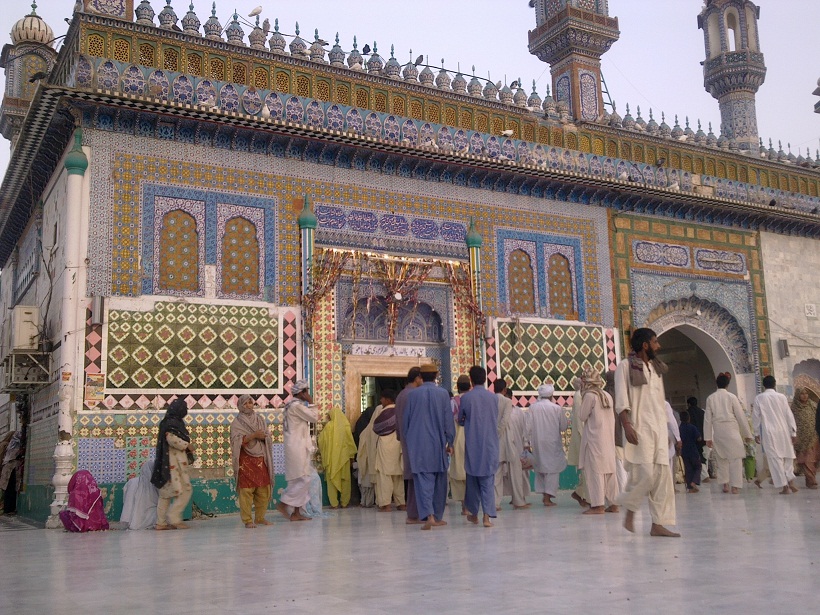
The dargah (shrine) of Sultan Bahu is located in Garh Maharaja, Punjab.[13] It was originally built on Bahu's grave site until the Chenab River changed its course causing the need to relocate twice and as witnessed by those present at the time of relocation, claims that his body was still intact at the time.[13] It is a popular Sufi shrine, and the annual Urs festival commemorating his death is celebrated there with great fervour on the first Thursday of Jumada al-Thani month. People come from far-off places to join the celebrations.[14][12]

Sultan Bahu also used to hold an annual Urs to commemorate the martyrs of Karbala from the first to the tenth day of the month of Muharram. This tradition continues to this day and every year, and thousands of pilgrims visit the shrine during this period.[12]

[edit]

See also

[edit]

References

[edit]
Revisions and contributorsEdit on WikipediaRead on Wikipedia
from Grokipedia
Sultan Bahu (c. 1630–1691) was a renowned Sufi saint, poet, and scholar from the Punjab region in present-day Pakistan, celebrated for founding the Sarwari Qadiri order and promoting the mystical path of Faqr—spiritual poverty as a means to divine knowledge and union with God. Born in Shorkot, District Jhang, to Bazayd Muhammad—a military commandant under Mughal Emperor Shah Jahan—and the saintly Bibi Rasti, he belonged to the Awan tribe, which traces its lineage to Ali ibn Abi Talib. His spiritual journey began with esoteric initiation directly from the Prophet Muhammad, guided by Ali and Abdul Qadir Jilani, and later formalized under Sheikh Abdul Rehman Jilani in Delhi, leading him to emphasize Tauheed (the oneness of God) through love, miracles, and inner purification. Bahu's teachings, disseminated through approximately 140 books, mostly in Persian, on Sufism, Sharia, and mysticism—including his influential Punjabi poetry collection Abyat-e-Bahoo and works like Ain-ul-Faqr—stressed constant Zikr (remembrance of God) via the invocation of Ism-e-Allah Zaat (the personal name of God) to achieve direct vision of the divine. He lived as a wandering mystic, performing miracles that converted many to Islam and establishing shrines that became centers of devotion, particularly in Shorkot and surrounding areas. His legacy endures through the Sarwari Qadiri lineage, which rejects formal hierarchies in favor of personal spiritual sovereignty, and his mausoleum near Garh Maharaja, a major pilgrimage site hosting annual Urs festivals that draw thousands to celebrate his poetry and ecstatic Qawwali traditions.

Early Life and Background

Birth and Family

Sultan Bahu was born on Thursday, 1st Jamadi-us-Sani, 1039 Hijri, corresponding to January 17, 1630 AD, during the reign of Mughal Emperor . His birthplace was Shorekot (also spelled Shorkot or Shore Sharif), a town in the of the region, now part of present-day . This rural setting in the suburbs of Shorekot provided the early environment for his upbringing amid the socio-political landscape of Mughal . He belonged to the Awan tribe, a community historically associated with martial and landowning traditions in Punjab. The Awans trace their origins to the progeny of Hazrat Ali ibn Abi Talib, the fourth caliph of Islam, through lines descending from his marriages other than to Hazrat Fatima. This tribal affiliation positioned Sultan Bahu within a lineage emphasizing Islamic devotion and resilience, common among Awan families in the region during the 17th century. His father, Bazayd Muhammad (also known as Sultan Bazayed Mohammad or Bayazid Muhammad), served as a and Quran memorizer (Hafiz-e-Quran) in Shah Jahan's army, earning grants of land, a fort, and wells for his service, which elevated the family's status to modest landownership. His mother, Bibi Rasti (also referred to as Mai Rasti, Bibi Bhagu, or Mai Amma), was a pious and spiritually intuitive woman recognized as an Arifa Billah (one attained in divine knowledge). She received a divine prior to his birth, inspiring her to name him "Bahu," signifying "one with the Divine Essence" (Hoo). The family maintained a devout Islamic environment focused on , Quranic recitation, and remembrance of , fostering an atmosphere of spiritual devotion despite their unassuming socioeconomic circumstances.

Childhood and Initial Influences

Sultan Bahu was recognized as a (saint or friend of ) by birth, exhibiting innate spiritual qualities from infancy that set him apart as a figure of divine favor. According to traditional accounts, he remained engrossed in heavenly experiences and spiritual revelations from an early age, often entering states of ecstatic absorption that foreshadowed his lifelong mystical orientation. These early triumphs were intuitive and unstructured, reflecting an inherent connection to the divine without reliance on external guidance. His mother, Bibi Rasti, a pious devoted to prayer and zikr (remembrance of ), played a pivotal role in shaping his initial spiritual environment. During her pregnancy, she experienced a vision foretelling the birth of a great whose light of Faqr (spiritual poverty and divine ) would guide seekers for generations, leading her to name him "Bahu," meaning "with Him" in reference to his annihilation in (Fana-fi-Hoo). This intuition underscored the prophetic significance of his arrival, as Bibi Rasti later nurtured his budding faith through her own saintly practices. Family circumstances, including the early death of his father, Bazid Muhammad, limited formal academic opportunities, further directing young Bahu's focus toward rather than conventional learning. A notable aspect of his childhood was the universal appeal of his spiritual presence, which transcended religious boundaries. Legends describe a luminous glow on his face that compelled non-Muslims, particularly in the local community, to involuntarily recite the Kalima Tayyiba (Islamic declaration of faith) upon seeing him, highlighting his innate ability to evoke divine recognition across faiths. Such incidents alarmed villagers and reinforced his reputation as a of . Additionally, like the revered Sheikh Abdul Qadir Jilani, young Bahu abstained from milk during fasting hours from Sehri to , demonstrating an intuitive observance of sacred disciplines despite his tender age. These experiences solidified his preoccupation with divine visions and unshakeable faith, laying the foundation for his future as a Sufi master.

Education and Spiritual Training

Maternal Education

Sultan Bahu's early education was informal and centered in the family home in Shorkot during his childhood years, before he undertook any journeys or external training. His mother, Bibi Rasti—a pious and spiritually enlightened woman (Arifa) who had named him Bahu following a divine dream foretelling his future as a great Sufi—served as his initial teacher and primary spiritual guide, instilling in him foundational devotion to from a tender age. Under her direct supervision in this domestic setting, Bibi Rasti taught him the Holy along with core Islamic principles, fostering a deep sense of faith and ethical conduct that shaped his spiritual outlook. She emphasized recitation and contemplation of the , drawing from her own profound to guide him toward recognizing divine presence in daily life. This maternal instruction prioritized spiritual nurturing over secular pursuits, resulting in the absence of any broader formal academic education, as his focus remained on innate mystical inclinations rather than conventional learning. As Sultan Bahu displayed early signs of spiritual aptitude, his mother encouraged him to pursue advanced by seeking a living spiritual mentor, specifically directing him toward figures like Shah Habib Gilani for further illumination beyond basic devotion. This guidance from Bibi Rasti not only solidified his devotion but also propelled him toward the deeper Sufi path, marking the transition from home-based learning to broader esoteric exploration.

Formal Training in Delhi

Around 1668, during the reign of Mughal Emperor , Sultan Bahu traveled from his native to in search of advanced spiritual guidance, building briefly on the Quranic foundation provided by his mother in his early years. This journey marked a pivotal transition from informal familial influences to structured Sufi apprenticeship in the bustling intellectual and religious center of the . In Delhi, Sultan Bahu entered into discipleship under Syed Abdul Rehman Jilani Dehlvi, a prominent Qadiri Sufi saint and descendant of the order's founder, Shaikh Abdul Qadir Jilani. The training was intensive yet remarkably concise, completed in a single profound meeting where Jilani Dehlvi administered the bay'ah (oath of allegiance) and bestowed upon him the Ism-e-Allah Zaat, the invocation of God's essential name central to Qadiriyya mystical practices. This focused immersion in the order's principles of faqr (spiritual poverty) and divine remembrance led to Sultan Bahu's rapid attainment of spiritual enlightenment, granting him direct access to the eternal divine treasure and the capacity for intuitive guidance. During his stay in Delhi, Sultan Bahu interacted with the Mughal court environment, notably attending prayers at the grand mosque where Aurangzeb was present. His spiritual presence profoundly affected the assembled crowd, evoking divine ecstasy among them, though it spared the emperor, the qazi, and the kotwal due to their perceived spiritual unreadiness. Aurangzeb later sought and received Sultan Bahu's blessings, prompting the saint to compose the verse collection Aurang Shahi as a token of favor. These encounters underscored the saint's influence amid the empire's orthodox Islamic milieu. Upon completing his training, Sultan Bahu returned to , fully empowered as a (spiritual guide) to disseminate teachings independently and benefit seekers through his enlightened vision. This phase initiated his lifelong mission of propagating faqr across the region.

Spiritual Journey and Lineage

Initiation into Qadiriyya

Sultan Bahu's initiation into the Sufi order occurred in the context of 17th-century Mughal , where the order had established a strong presence in regions like and following its introduction in the preceding century. During the reigns of emperors (1628–1658) and (1658–1707), Qadiriyya khanqahs served as centers for spiritual dissemination amid the empire's cultural and . Syed Abdul Rehman Jilani Dehlvi, who settled in around 1653 and founded a prominent khanqah, played a pivotal role in extending the order's influence in northern . The immediate catalyst for Bahu's entry into the order was his () under Syed Abdul Rehman Jilani Dehlvi, recognized as his (spiritual guide) in . This formal , occurring around 1668, marked Sultan Bahu's commitment to the path after initial spiritual seeking. Syed Abdul Rehman, a descendant in the direct lineage from the order's founder, Jilani (1077–1166), held a high rank in the (spiritual chain) and was entrusted with transmitting its teachings to select disciples. Through this bay'ah, Sultan Bahu forged a profound spiritual connection to Jilani, not only via the hereditary but also through visionary means, as he later described being entrusted to the founder by the Prophet Muhammad in a spiritual encounter. He embraced the Qadiriyya's core principles, including intense divine love (ishq-e-haqiqi), (ma'rifat), and direct communion with , which emphasized inner purification over external rituals. The initiation elevated his spiritual state, immersing him in the practice of faqr—spiritual poverty symbolizing complete annihilation of the ego in —and fostering profound mystical experiences of unity with the Divine.

Founding of Sarwari Qadiri Order

Sultan Bahu established the Sarwari Qadiri order in the late as a reformist branch of the Sufi tradition, emphasizing direct spiritual sovereignty under divine guidance alone. This founding occurred following his initiation into the Qadiriyya through an outward (bay'at) with Syed Abdul Rehman Jilani Dehlvi in on 29 Ziqa'ad 1078 Hijri (11 May 1668), after which he reorganized the path to prioritize "sarwari," denoting headship or chiefship directly under without intermediary human authorities. The order's core principle rejected conventional spiritual hierarchies, material constraints, and external pir-murid structures, advocating instead for an independent faqir's path achieved through invocation of Ism-e-Allah Zaat (the Divine Essence) and practices like Sultan-ul-Azkar (remembrance of "Hoo"), which facilitate annihilation in the Divine. A pivotal event in the order's inception was Bahu's spiritual enlightenment and declaration of independence, attained through Awaisi guidance (direct divine inspiration) in the Majlis-e-Mohammadi, where he received blessings from Prophet Muhammad and was spiritually adopted by Hazrat , entering the path of faqr (spiritual poverty) free from ancestral or institutional inheritance. This reformist stance critiqued illusory practices like physical heart-based zikr and self-conceit in Sufi lineages, promoting instead inner purification, tawakkal (trust in ), and tasleem-o-raza (submission to Divine Will) as means to direct union with . Bahu himself served as the first Khalifah-e-Akbar (supreme successor), and posthumously, through spiritual transmission, the Divine Trust was passed to initial successors, including Syed Abdullah Shah Madni Jilani, to perpetuate the lineage, ensuring continuity through a chain of seven Sultan-ul-Faqr figures. The Sarwari Qadiri order spread primarily in the region and beyond during Bahu's lifetime through his extensive travels across cities, towns, and villages in areas like and , where he disseminated teachings door-to-door without formal khanqahs or large gatherings. Posthumously, the order's influence expanded via his approximately 140 compositions, including Persian treatises and Punjabi abiyat (couplets), which embedded its doctrines of divine () and spiritual equality into local Sufi practices, attracting seekers from diverse backgrounds and fostering a that emphasized over esoteric rituals. This dissemination influenced regional mysticism by integrating faqr as a sovereign path, distinct from hierarchical branches like the Zahidi Qadri.

Literary Works

Major Compositions

Sultan Bahu is attributed with over 140 literary works, though only around 31 to 33 survive in recognizable form, consisting mainly of Persian prose treatises and Punjabi poetry collections that elucidate Sufi mysticism. These compositions were primarily produced during the , with the majority emerging after , coinciding with his mature spiritual phase following his return to and deeper immersion in the Sarwari Qadiri order. The works emphasize core themes of , faqr (spiritual poverty), and divine , serving as guides for on the path to annihilation in the divine (fana fillah) and union with God (visal-e-elahi). Among the authentic core compositions, Abyat-e-Bahu stands as the primary collection of Punjabi poetry, comprising mystical couplets (abyat) that explore spiritual awakening and the invocation of Allah's name (Ism-e-Allah ). Ain-ul-Faqr, a seminal Persian prose text, delves into the essence of spiritual poverty as the true path to divine vision (deedar-e-elahi), positioning faqr as the pinnacle of Sufi practice. Risala-e-Ruhi addresses soul purification through zikr (remembrance) and tasawur (), outlining dialogues with the divine and the stages of spiritual elevation. Kaleemullah, another key prose work, presents inward conversations with God (waham) and the progressive states of invocation leading to spiritual triumph. Attribution of these works faces challenges due to their initial oral transmission among disciples and later compilations by khalifahs (spiritual successors), as no manuscripts in Sultan Bahu's own handwriting exist. This has led to scholarly scrutiny, with only a select core verified as genuine through textual analysis and historical transmission, while many others risk misattribution from post-mortem additions or forgeries.

Poetic Style and Language

Sultan Bahu composed his poetry primarily in the Punjabi language, which distinguished his work from the Persian-dominated Sufi literature of his era and rendered Sufi mysticism accessible to the common people, including the illiterate masses of rural Punjab. This choice of vernacular tongue allowed his verses to resonate with everyday listeners, fostering a direct connection to spiritual themes that transcended elite scholarly circles. His poetic style is characterized by simplicity, rhythm, and repetition, designed to evoke a meditative state and facilitate oral recitation or singing in Sufi musical forms such as and . Bahu predominantly employed the form of abyat, concise quatrains or couplets that often conclude with his pen name "Bahu" or the mystical invocation "Hoo," reinforcing a , devotional cadence. This repetitive structure not only aids but also mirrors the cyclical nature of spiritual contemplation in Sufi practice. Bahu's poetry draws heavily on folk idioms and metaphors rooted in Punjab's rural landscape, such as rivers symbolizing the flow of divine unity, jasmine plants representing spiritual fragrance, and churning evoking the toil of pursuit. These elements ground abstract in tangible, everyday experiences, as seen in lines like "وحدت دے دریا اچھلے" (the river of oneness surges), which blend local with profound symbolism. Common mystical motifs, including wine as a for purer divine intoxication and the beloved as the divine essence, further infuse his verses with layered allegorical depth. An innovative aspect of Bahu's style lies in his seamless integration of Persian Sufi terminology—such as "Murshid" for spiritual guide and "Rasti" for truth—with indigenous Punjabi expressions, creating a hybrid lexicon that enriches the poetry's universality while preserving cultural specificity. This fusion has influenced subsequent Punjabi Sufi literature and oral traditions, with his abyat continuing to be recited and adapted in folk performances across South Asia.

Teachings and Philosophy

Core Sufi Concepts

Sultan Bahu's teachings center on the concept of faqr, or spiritual poverty, which he regards as the highest form of spiritual excellence and the pathway to divine union. In his view, faqr entails the complete of the (fanā fī ) through the of worldly desires such as power, wealth, and glory, allowing the seeker to subsist in (baqā billah) and reflect divine attributes. This process culminates in a state of unity with the Divine Essence, where "when faqr reaches its perfection then there is only ," freeing the from all needs and revealing faqr as the secret of Himself. Bahu emphasizes that true humanity emerges only through this spiritual impoverishment, distinguishing the faqīr (spiritual ) from mere animalistic existence. A pivotal element in Bahu's philosophy is , or divine , which he prioritizes over mere ritualistic observance as the transformative force propelling the soul toward . Described as a "passionate love... a fire which burns everything to ashes except [the] passionately beloved," demands total sacrifice of the ego and worldly attachments, fostering a profound vision of and immersion in the Mohammadan Assembly—the eternal gathering of the Prophet Muhammad and his saints. Bahu asserts that without this remains hollow, as "fourteen levels has the heart, where has pitched its tent," and only through can one attain the ultimate unity with the Divine, where "unless you attain ... this world is but a game." This -driven path elevates the seeker beyond external forms of worship, focusing instead on internal devotion that reveals 's presence in the heart. Bahu rejects superficial piety in favor of ma'rifat, or gnostic knowledge, which represents an intimate, experiential recognition of Allah transcending intellectual or ritualistic understanding. He contrasts external knowledge—likened to milk—with the inner gnosis of ma'rifat, which is like butter, immersing the soul in divine oneness and unveiling sacred secrets through the annihilation of the lower self (nafs). For Bahu, ma'rifat is nourished by faqr, hunger for the Divine, and ishq, functioning as the "grain" sustained by these elements, and it alone grants liberation from worldly illusions. This internal focus critiques those who prioritize outward displays, insisting that true spirituality lies in the heart's direct encounter with the Divine. Bahu's Sufism embodies universality, transcending , religious boundaries, and sectarian divisions to unite all seekers in the oneness of . He illustrates this through metaphors like the faqīr's as farming, where divine harvest arises regardless of the "seed" sown by diverse backgrounds, and stories of even idol worshippers receiving 's grace when their intentions are pure. This inclusive vision aligns with the Qur'anic assurance that "friends of will not have any fear," emphasizing faqr as a global path open to all who pursue divine love sincerely. In the context of 17th-century Mughal society, Bahu offers a sharp critique of hypocritical religious practices, condemning scholars, murshids, and faqīrs who pursue worldly gain, ostentation, or ritualism at the expense of genuine spirituality. He denounces "mammonish" guides who prioritize wealth and popularity over dhikr and ma'rifat, warning that such hypocrisy—selling "ancestor’s bones by being drunk in inclination towards creatures"—aligns with Satan's assets and devastates the soul. True faqīrs, by contrast, burn in the fire of divine love, rejecting these corruptions to embody authentic gnosis.

Practices and Faqr

Sultan Bahu emphasized daily spiritual disciplines centered on the recitation of the divine name, known as Ism-e-Dhat or Ism Zaat, which involves infusing every breath with the invocation of , such as "Allaho" on inhalation and "Hoo" on exhalation, performed silently without lip movement. This concealed (dhikr khafi) is recommended for at least 30 minutes twice daily, ideally during (pre-dawn prayers), to purify the heart and achieve spiritual elevation, with soul-based recitation deemed superior to verbal forms. Complementing this, meditation on the vision of (Deedar-e-Elahi) through (contemplative observation) focuses on visualizing via the Ism-e-Dhat, leading to the removal of ego veils () and the revival of the soul for direct encounter with the divine essence. Practitioners are said to experience up to 70,000 divine disclosures daily, resulting in ecstatic illumination from head to toe and eternal (huzoori ). Faqr, as a lived practice in Sultan Bahu's teachings, manifests as complete renunciation of worldly attachments, desires, and material pursuits, fostering a state of spiritual poverty (faqr) that aligns the seeker with pure monotheism and divine intimacy. This involves constant remembrance (dhikr) integrated into all actions, eschewing formal rituals in favor of internal, breath-based invocation that cleanses the heart like soap purifies cloth, ultimately achieving annihilation in Allah (fana fi Allah) and subsistence with Him (baqa billah). Such renunciation demands trust in Allah (tawakkal) and detachment from 11 worldly lures, including wealth and fame, transforming daily existence into a continuous act of devotion without external ceremonies. For disciples, Sultan Bahu advocated direct spiritual transmission () through a perfect (spiritual guide), who imparts the Ism-e-Dhat via a single gaze or instant immersion, bypassing prolonged guru dependency or traditional initiations in favor of the Awaisi path—receiving guidance directly from the Prophet Muhammad and Hazrat . This transmission activates inner , kills the ego, and elevates the rapidly, often requiring initial for 40 days of contemplation and obedience to the , with visits to the graves of living faqirs recommended for further blessings. Dreams and visions hold a pivotal role in personal spiritual progress, regarded as one forty-sixth of prophethood, providing divine revelations, guidance, and of advancement, such as presence in the Prophet's assembly (Majlis-e-Mohammadi). True visions disclose spiritual states and realities, exemplified by historical accounts like Rabi'ah Basri's illumination, while surpasses dreams in revealing deeper truths; negative visions are discerned through to avoid delusions. To adapt faqr for laypeople in Punjab's , Sultan Bahu integrated these practices into everyday routines using simple, heart-centered methods like pas-anfas (breath-tied ) and vocal recitations in communal gatherings, employing relatable Punjabi metaphors—such as churning milk into butter—to illustrate inner transformation without scholarly complexity. This approach allows farmers and villagers to renounce attachments while fulfilling worldly duties, emphasizing love-based devotion and shariat observance to make spiritual elevation accessible amid rural life.

Shrine and Legacy

Shrine History and Location

Sultan Bahu passed away on March 1, 1691, in Shorkot, , and was initially buried at Fort Qehrgan on the western bank of the in the Bahu Sharif area. The primary historical accounts of his life and burial derive from hagiographical texts, notably Manaqib-i Sultani, composed seven generations after his death by his descendant Sultan Hamid, which emphasize miraculous elements surrounding the events. Due to recurrent flooding and shifts in the Chenab River's course, the shrine was relocated twice—first approximately 78 years after his death, and again later—to safeguard the site, with the exhumed grave reportedly found intact and emitting a fragrant aroma during both transfers. These relocations reflect ongoing community efforts to preserve the mausoleum amid the river's volatile hydrology, a challenge that continues in the region, including a flash flood threat in August 2025. The current location of the shrine is in Garh Maharaja, Jhang District, Punjab, Pakistan, a village renamed Sultan Bahu in his honor, situated a few miles east of Shorkot near the Chenab's banks. Originally constructed as a simple over his grave, it has been progressively expanded by devotees over the centuries into a more elaborate structure. Architecturally, the embodies Punjabi Sufi aesthetics blended with Mughal influences, featuring a square-shaped building topped by an open dome, small corner turrets, an entrance arch with decorations, and tile work in geometric and calligraphic patterns typical of regional shrines. Preservation initiatives, including legal resolutions over custodianship, ensure its maintenance as a key spiritual site.

Cultural and Spiritual Impact

Sultan Bahu's Sarwari Qadiri order has endured as a vibrant spiritual lineage, maintaining a global network of followers who emphasize an egalitarian form of free from rigid rituals, dress codes, or hierarchical barriers that characterize many traditional tariqas. This accessibility allows practitioners from diverse backgrounds to engage directly in faqr, or spiritual poverty, through personal devotion and inner remembrance of the divine, without mandatory external observances. The order's emphasis on innate spiritual equality resonates in contemporary settings, with khanqahs and online communities extending its reach across , the , and . His poetic legacy profoundly shaped and musical traditions, pioneering the use of simple Punjabi quatrains infused with Sufi mysticism that influenced subsequent poets like , whose kafis echo Bahu's themes of divine love and social critique. This style democratized Sufi expression, blending folk rhythms with profound spiritual insights, and continues to inspire performances and modern Punjabi music that promote unity across sectarian lines. Bahu's abyat, ending invariably with "Hoo" to invoke , have become a meditative in Sufi gatherings, enhancing the emotional and rhythmic depth of regional artistic expressions. The annual at Sultan Bahu's shrine, observed on the first Thursday of , draws thousands of pilgrims for collective sessions and recitations, reinforcing communal bonds and spiritual renewal amid vibrant cultural festivities. Complementing this, the shrine hosts a dedicated from the 1st to 10th of to commemorate the martyrs, a Bahu himself instituted, where devotees engage in mourning rituals and reflections on , attracting interfaith participants and underscoring themes of and resilience. In the , renewed interest has led to scholarly revivals through translated editions of Bahu's works, such as Death before Dying: The Sufi Poems of Sultan Bahu, and dedicated websites that compile his Persian treatises and Punjabi poetry, filling archival gaps while highlighting his universal appeal to seekers beyond Islamic contexts. These resources facilitate cross-cultural dialogues, with Bahu's egalitarian influencing global discussions on and social harmony, as seen in academic analyses from institutions in and the West, including a conference on and Sultan Bahu held in April 2025.

References

Add your contribution
Related Hubs
User Avatar
No comments yet.