Hubbry Logo
ŚūrapadmāŚūrapadmāMain
Open search
Śūrapadmā
Community hub
Śūrapadmā
logo
8 pages, 0 posts
0 subscribers
Be the first to start a discussion here.
Śūrapadmā
Śūrapadmā
from Wikipedia
Surapadma
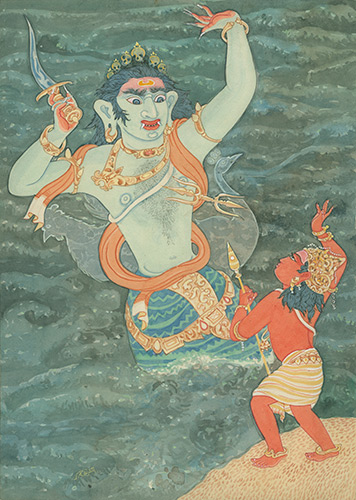
Murugan defeats Surapadman.
TextsSkanda Purana
Genealogy
ParentsKashyapa (father), Maya (mother)
SiblingsTarakasura
SpousePadmakomalai
ChildrenBanukopan, Iraniyan, various other sons

Surapadma (Sanskrit: शूरपद्मा), Surapadman (Tamil: சூரபத்மன்) is an asura featured in Hindu literature. He is the son of the sage Kashyapa and a shakti named Maya.[1] He wages war against the devas by invading Devaloka with a massive army.[2] He is defeated by Murugan, and according to Tamil tradition, turned into his vahana, the peacock. He is the brother of Tarakasura.[3] His eldest son is Banukopan.[4][5]

Legend

[edit]

The Kanda Puranam, the Tamil iteration of the Skanda Purana, describes the legend of Surapadma. He is said to have engaged in intense austerities to propitiate the deity Shiva, who appeared to grant the asura a boon. He asked for the boon of living for 108 yugas, and reign over the 1008 worlds. He marries Padmakomalai, with whom he sired several sons, the eldest of whom is Banukopan. Establishing his capital at a city named Viramakendiram located at the eastern sea, he ruled the world. An enemy of the devas, he started to harass them, and attacked a number of Indra's sons. He also desired Indrani, the wife of Indra. When Indra and his wife fled to the earth, Murugan sent his messenger named Viravakutevar to urge Surapadma to cease his activities, but to no avail. Murugan declared war on Surapadma, and in the ensuing battle, all of the latter's sons except Iraniyan were slain. Unwilling to concede his defeat, Surapadma retreated to the sea, assuming the form of a mango tree. Murugan sliced the tree in twain, from which emerged a cock and a peacock. The deity started to employ the cock as his battle standard, and the peacock as his mount.[6]

Tiruchendur is identified by adherents as the site Surapadma is slain by Murugan.[7]

In Tamil tradition, Surapadma is conceived with the same origin as Tarakasura, the asura who necessitates the birth of a son of Shiva, Murugan. The slaying of Surapadma by Murugan is also described to mark the onset of the Kali Yuga.[8] The downfall of Surapadma is the legend behind the occasion of the festival of Thaipusam.[9]

See also

[edit]

References

[edit]
[edit]
Revisions and contributorsEdit on WikipediaRead on Wikipedia
from Grokipedia
Śūrapadmā (Sanskrit: शूरपद्म, Tamil: சூரபத்மன்), also known as Surapadma or Soorapadman, is a formidable king in , renowned as the chief antagonist in the divine war led by the god Skanda ( or Murugan) against demonic forces. Born to the sage and the asura sorceress Maya (also called Surasai), Śūrapadmā performed intense austerities to obtain boons from , granting him near-invincibility and a lifespan of 108 yugas, with the provision that he could only be defeated by Shiva's son. Empowered by this boon, he and his brothers Siṃhamukha and conquered the three worlds, enslaving and tyrannizing the devas for over 108 yugas, establishing his capital at Veera Mahendrapuri. The devas, desperate for salvation, appealed to , who, through his union with and the manifestation of his fiery seed nurtured by the six Kṛttikās, birthed Skanda as their divine warrior general. Skanda assembled a celestial army and waged a six-day battle (known as Soorasamharam) against Śūrapadmā's forces, first slaying Siṃhamukha and before confronting the elder brother. In the climactic duel, Śūrapadmā transformed into a massive mythical bird and then a tree to evade Skanda's invincible (Vel), but Skanda cleaved the tree in two: one half became the peacock serving as his (mount), and the other the rooster emblazoned on his flag as a of victory over ego and darkness. This triumph symbolizes the eradication of internal impurities and the restoration of , celebrated annually during the Skanda Shashti festival in , particularly at temples like . Śūrapadmā's narrative is primarily detailed in the Skanda Purāṇa (particularly Maheśvara Khaṇḍa, sections on Skanda's exploits) and its Tamil adaptation, the Kāñcipurāṇam or Kanda Purāṇam by Kachiappa Sivāchāriyar (14th century), which elaborates the story with regional devotional elements. While the Sanskrit Skanda Purāṇa emphasizes Tārakāsura's defeat, the full account of Śūrapadmā as the overarching lord integrates motifs from earlier Vedic and epic traditions, portraying him as an embodiment of tamas (ignorance) subdued by Skanda's sattvic (pure) energy. His story underscores themes of divine intervention, the transformative power of devotion, and the cyclical battle between good and evil in .

Etymology and names

Linguistic origins

The name Śūrapadmā derives from Sanskrit as a compound word (samāsa), specifically a tatpuruṣa form combining śūra (शूर), which signifies a hero, warrior, or valiant individual, and padmā (पद्मा), the feminine form denoting a lotus flower. This etymological structure emphasizes the character's portrayal as a formidable antagonist in Hindu mythological texts. In regional linguistic evolutions, particularly within , the name adapts phonetically to Surapadmaṉ (சூரபத்மன்) in the Kanda Purāṇam, a 15th-century Tamil rendition of the Skanda Purāṇa composed by Kacciyappa Sivāchāriyar. This form preserves the core elements while incorporating Tamil orthographic conventions, such as the of the and adjustment of vowel lengths for rhythmic flow in poetic verse. The name Śūrapadmā appears prominently in the Skanda Purāṇa, one of the eighteen major Purāṇas, where it is invoked in verses detailing the asura's lineage and attributes within the broader narrative of divine conflicts. Specific references, such as those in the Maheśvara Khaṇḍa section, introduce the character through his valorous deeds, underscoring the heroic connotation of śūra.

Alternative names and epithets

Śūrapadmā appears under various names in ancient , reflecting slight phonetic and transliterative differences across traditions. In scriptures, particularly the Skanda Purāṇa, he is commonly called Surapadma or Śūrapadma, denoting his heroic yet antagonistic role as an . In and regional retellings, such as the Kanda Purāṇam—a poetic adaptation of the Skanda Purāṇa—he is known as Soorapadman, emphasizing his prominence in South Indian devotional narratives. Epithets attributed to him include "asura hero," signifying his prowess in battle as described in Puranic accounts, and "invincible demon," alluding to the formidable boons that rendered him nearly indestructible. Additionally, he is titled the " King" whose capital was an island south of , from which he launched conquests against the gods. These names and titles collectively portray Śūrapadmā as a powerful ruler whose arrogance stemmed from divine favors.

Mythological origins

Birth and parentage

Śūrapadmā, a prominent in , was born to the sage and the asura sorceress Maya. Kashyapa, one of the ancient Prajapatis and progenitor of various beings, wedded Maya, who embodied asuric lineages. Their union produced Śūrapadmā along with his siblings, marking the emergence of powerful asuric forces. As detailed in the Skanda Purāṇa, particularly the Maheśvara Khaṇḍa, and its Tamil adaptation the Kāñcipurāṇam, Śūrapadmā's birth transpired amid an era of escalating cosmic disequilibrium, where asuras increasingly challenged the dominance of the devas through intensified austerities and conquests. This period of imbalance stemmed from prior divine-asuric conflicts, amplifying the potential for Śūrapadmā's lineage to disrupt the celestial order. The sage Kashyapa's progeny from multiple consorts, including Maya, thus contributed to the proliferation of beings aligned with both divine and demonic realms. In his nascent years, subtle omens hinted at Śūrapadmā's fated antagonism toward the devas, as prophetic visions and astrological alignments foretold his role in impending wars that would necessitate divine intervention. These early indications, rooted in his asuric heritage, positioned him as a central figure in the mythic narrative of restoration and conflict.

Siblings and family dynamics

Śūrapadmā's siblings included his brothers Tārakāsura and Siṃhamukha, as well as his sister Ajamukhī, all born to the sage Kashyapa and the asura Maya. This familial network formed a core of asura power, with each member contributing to the broader demonic lineage through their shared heritage of intense tapasya and boons from higher deities. The siblings' relationships were marked by loyalty and collaborative ambition, often uniting under Śūrapadmā's leadership to expand their influence across realms. In Puranic accounts, the family dynamics revolved around collective endeavors to subvert divine authority, with Śūrapadmā as the eldest directing his brothers and Siṃhamukha in establishing fortified cities and conquering celestial domains. , empowered by a boon from Brahmā, complemented Śūrapadmā's reign by terrorizing the devas independently yet in alignment with familial goals, while Siṃhamukha provided strategic counsel and military support during joint campaigns against Indraloka. Their shared conquests, including the subjugation of the gods and the burning of heavenly cities, exemplified a unified front that intensified the threat to cosmic order, as detailed in the Skanda Purāṇa. Among the sisters, Ajamukhī played an active role in familial alliances by attempting to capture Indra's consort Śacī for Śūrapadmā, leading to her confrontation with divine forces and subsequent mutilation by Śiva, which further fueled the family's vendetta. Overall, these dynamics portrayed the family as a formidable bloc challenging , their interdependencies amplifying Śūrapadmā's tyrannical ambitions until divine intervention fragmented their unity.

Powers and boons

Boons from Brahma

Śūrapadmā, driven by the ambition to surpass his siblings and establish unchallenged dominance, undertook severe austerities known as , primarily to propitiate Lord Shiva, through which he attained merits recognized by Lord . Through prolonged meditation and self-mortification in remote Himalayan regions, such as Kailasa, he demonstrated unwavering devotion, abstaining from food and enduring extreme physical hardships for thousands of years. This rigorous penance, detailed in the , compelled Brahma to grant him divine favors in recognition of his spiritual merit. Pleased by Śūrapadmā's dedication, Brahma bestowed the boon of invincibility in battle, stipulating that no , , or human could vanquish him except for a son of Lord Shiva manifested from six sparks of divine fire—a condition rooted in the esoteric of Skanda's birth. Additionally, Brahma granted him immense physical and supernatural strength, enabling feats beyond mortal limits. These boons, collectively amplifying his prowess, were chronicled in the as pivotal to his rise, underscoring the creator's role in balancing cosmic forces through conditional . Accounts vary across Puranic texts, with the Tamil Kanda Purāṇam emphasizing boons from .

Acquisition of immortality and strength

Śūrapadmā, through prolonged and intense austerities directed toward Lord Śiva, attained a secondary boon that granted him a lifespan of 108 yugas and over 1,008 kingdoms, significantly enhancing his and dominion beyond his primary invincibility clause. This boon, bestowed upon the after rigorous that pleased the , allowed him to rule unchallenged for an extraordinarily extended period, amplifying his strength and establishing him as a formidable overlord of multiple realms. Empowered by these, he conquered the island of , transforming it into a fortified stronghold. In addition to these boons, Śūrapadmā possessed profound illusory powers inherited from his mother, the shakti named Maya, enabling him to manipulate perceptions, instill fear, and assume various forms such as birds, animals, or even a massive to evade detection. These maya-based abilities served as a counterpart to divine weapons like the spear, allowing him to create deceptions in combat and daily conquests, thereby bolstering his strategic invulnerability. He also wielded a magical adorned with a lion's head, which further augmented his mobility and intimidating presence on the battlefield. Śūrapadmā's strength was further enhanced through strategic alliances with fellow asuras, including his brothers Simhamukhan and , his sister Ajamukhi, and his son Banugopan, who collectively formed a vast network of demonic forces numbering in the lakhs. Under the guidance of his Śukrācārya, who imparted knowledge of shastras and the Sanjivani Vidya to revive fallen warriors, these alliances provided ongoing reinforcements and tactical superiority, as detailed in the Kanda Purāṇam. This coalition not only expanded his military might but also ensured a steady supply of empowered allies to sustain his .

Reign of terror

Conquests across realms

Following the boons obtained through intense penance from Lord Shiva, Śūrapadmā, along with his brothers Simhamukha and Tāraka, launched a series of aggressive military campaigns that subjugated the three worlds—earth (Bhūloka), heaven (Svarloka), and the netherworld (Pātāla). Empowered by these divine gifts, which granted immense strength and near-invincibility, Śūrapadmā's forces systematically overran celestial and terrestrial domains, establishing unchallenged dominion over vast kingdoms. This expansion was strategically guided by their guru Śukrācārya, who advised targeted assaults on divine strongholds to consolidate power. A pivotal aspect of these conquests was the establishment of as Śūrapadmā's capital, fortified as the grand city of Mahendrapuri by the divine architect Viśvakarman, who was coerced into service. From this impregnable base in the , Śūrapadmā orchestrated invasions into heaven, defeating the king of the gods, , in direct combat and capturing him along with his son Devakumāra. Indra was subsequently humiliated by being assigned menial labor as a , symbolizing the asura's reversal of cosmic . Śūrapadmā also possessed powerful divine weapons, including the Pāśupatastra granted to him by as part of his boons, which bolstered their offensive capabilities during these campaigns. The timeline of these conquests unfolded over an extended period following the boons, spanning multiple yugas in the mythological chronology, during which Śūrapadmā ruled over 1,008 kingdoms across the realms. This prolonged era of supremacy marked a profound decline in , as the subjugation disrupted sacrificial rites, celestial governance, and natural order, compelling the devas to seek intervention from higher deities. By the time of the Vaivasvata Manvantara, Śūrapadmā's hegemony had extended for 23 caturyugas, solidifying his reputation as an unparalleled conqueror before the divine counteroffensive.

Oppression of gods and humans

Following his conquests, Śūrapadmā established a across the three worlds, using the subjugated realms as bases from which to extract oppressive tributes from both divine and mortal subjects, compelling them to surrender vast resources and labor to sustain his empire. His forces systematically disrupted sacred rituals, destroying temples dedicated to the devas and interrupting yajnas, thereby severing the flow of divine blessings and offerings that sustained cosmic order. On , Śūrapadmā's demonic minions wrought havoc among humans, unleashing famines that devastated crops and communities while terrorizing populations through relentless raids and subjugation, leaving mortals in perpetual fear and destitution. In the heavens, the gods faced from Swarga after their defeat, with Śūrapadmā's armies incarcerating 's followers, including the son of and devotees of Viṣṇu, forcing them into menial servitude such as cleaning chores amid the burning of celestial abodes. The devas endured brutal physical torment, their limbs repeatedly severed in skirmishes only to regenerate through the of , yet their overall subjugation deepened the cosmic imbalance. This unrelenting oppression culminated in desperate pleas from the afflicted gods and humans to Lord Śiva, beseeching him to intervene and restore , as recounted in the Puranic narratives.

Divine opposition

Invocation of Kartikeya's birth

In response to the tyranny of the Śūrapadmā and his brothers, who had oppressed the devas through their boons of near-invincibility, the celestial beings sought divine intervention to restore cosmic order. The devas, led by , appealed fervently to Lord and , imploring them to produce an offspring capable of vanquishing the asuras, as ancient prophecies and the demons' boons explicitly stated that only a son of Shiva could defeat them—exploiting the very loophole in the boons granted by . This appeal draws from narratives in the and its Tamil adaptation, the Kanda Puranam, where the devas describe the asuras' prolonged reign of terror, including the 108-yuga domination in some traditions, emphasizing the necessity of Shiva's progeny to fulfill the prophetic conditions of the boons. Note that accounts vary: the Sanskrit often focuses on Tarakasura with semen from Shiva's union carried by , while Tamil versions highlight sparks from Shiva's against Surapadma. Shiva and Parvati's sacred union generated an intense divine energy, from which six radiant sparks emanated from Shiva's , symbolizing the multifaceted power required to counter the demons. These sparks were carried by and to the river Ganga, who nurtured them in her waters before depositing them in a reed thicket, where they manifested as six infant forms. The six Krittikas, the celestial nymphs associated with the , then suckled and raised the infants, imparting to them wisdom and strength; Parvati later merged the six into a single six-headed, twelve-armed child named , embodying unified divine valor. Upon his manifestation, was immediately recognized by the devas as their supreme war commander, or Devasenapati, with anointing him to lead the celestial forces against Śūrapadmā and his kin, affirming his destined role in upholding . This early divine endorsement underscored Kartikeya's innate authority, as described in these texts, positioning him as the prophesied warrior to exploit the boons' vulnerabilities.

Arming of the divine forces

Following the invocation and birth of as the divine warrior destined to confront Śūrapadmā, the gods mobilized their forces in preparation for the impending conflict. , embodying the divine mother, bestowed upon the sacred Vel, a radiant symbolizing unyielding power and wisdom, crafted to pierce through illusion and evil. This weapon, infused with her maternal , became 's primary instrument of victory, enabling him to lead the celestial campaign with focused resolve. To further equip the young commander, granted additional armaments, including a and other celestial weapons, while the assembly of deities like and provided blessings and tools such as a dart and banner to amplify Kartikeya's martial prowess and ensure the divine arsenal's superiority over the demon's hordes. The devas, including troops from various realms, rallied under his banner, forming a cohesive force ready to restore cosmic order. In the sacred environs of Kailasa, strategic deliberations unfolded, with assuming leadership to orchestrate the mobilization. Supported by the (divine mothers) and a vast host of deva warriors, outlined tactics emphasizing coordinated assaults and exploitation of Śūrapadmā's overextended empire. This planning underscored his role as the supreme general, uniting the fragmented divine forces into a disciplined army poised for triumph.

The great battle

Initial skirmishes

As the divine forces, freshly armed by the gods under 's command, advanced toward Śūrapadmā's stronghold, initial clashes erupted on the outskirts of Viramahendrapuri, where the demon king's armies mounted fierce resistance. dispatched his general Virabahu as a peace envoy to Śūrapadmā's capital at Viramahendrapuram, but the overture was rebuffed, igniting the preliminary engagements that set the stage for the larger conflict. These early skirmishes unfolded over the first five days of the , primarily involving battles against Śūrapadmā's key demon generals and sibling asuras, including the lion-faced Singamukha (also known as Simhamukha), Agnimukha, and Bhanukopa, with each defeated on successive days. Kartikeya's troops, marching southward to the coastal region near , clashed with these forces near Viramahendrapuri, where Singamukha led a formidable after the prior defeat of his brother Tarakasura in northern campaigns. In these encounters, Singamukha was ultimately vanquished by Kartikeya's strategic deployment of divine weapons, marking a significant tactical victory that weakened Śūrapadmā's outer defenses. Śūrapadmā's forces employed illusions and shape-shifting tactics to disorient the divine army. countered these maya illusions through his tactical acumen, invoking the Pasupatastra and weapons to dispel the deceptions and revive his depleted ranks, while systematically dismantling the formations. The escalation intensified as surviving sibling s rallied under Śūrapadmā's command, prolonging the skirmishes until the demon armies suffered heavy losses. These preliminary victories by built mounting tension, clearing the path for deeper incursions into the demon king's territory as described in the Kanda Puranam.

Climactic duel with Kartikeya

As the initial skirmishes of the great battle concluded, leaving Śūrapadmā's forces decimated, the demon king faced in a decisive one-on-one confrontation on the sixth day, as recounted in the . This climactic duel marked the peak of the conflict, with , armed with the divine Vel bestowed by his mother , embodying the unyielding power of against . Śūrapadmā, drawing upon his boon-granted maya, initiated the combat by assuming illusory forms to confound his adversary, including manifestations as Brahma and Vishnu, wild animals, fire, and wind to unleash devastating assaults. Kartikeya countered these transformations with precision strikes from his Vel, a spear infused with the combined energies of Shiva and Parvati, which nullified the demon's deceptions and forced him into more desperate measures. In a bold escalation, Śūrapadmā hurled the colossal Sudhamandara mountain toward Kartikeya to revive his fallen army and crush the god, but the Vel cleaved the mountain asunder, scattering its fragments and symbolizing the shattering of the demon's illusions of invincibility. The intensity of the duel peaked as revealed his Visvarupa, a cosmic form encompassing mountains, seas, stars, and deities within his being, overwhelming Śūrapadmā with divine splendor and calming the devas. Undeterred yet faltering, Śūrapadmā resumed the fray by deploying celestial weapons and further shape-shifting, but 's unerring Vel dismantled each assault, invoking the Pasupatastra—a supreme weapon blessed by —to decimate the remaining demonic illusions. In a final act of vulnerability, Śūrapadmā transformed into a sprawling to escape annihilation, but Kartikeya's Vel rent it in twain, causing the demon to involuntarily split into the forms of a peacock and a rooster—exposing his core weakness and heralding the imminent triumph of good. This moment, detailed in the Skanda Purana's accounts of the battle, underscored the futility of ego-driven resistance against divine will, with the rooster form crowing defiantly and the peacock displaying iridescent feathers in a last display of pride.

Defeat and transformation

Surrender and boon fulfillment

In the climactic moments of the duel with Kartikeya, Śūrapadmā realized that the divine warrior confronting him was none other than the son of Lord Shiva born from six divine sparks, thereby fulfilling the precise condition of the boon he had obtained through intense penance from Brahma—near-invincibility except against such a son of Shiva. Note that mythological accounts vary, with some sources attributing the boon to Shiva instead. This realization dawned upon Śūrapadmā as Kartikeya, embodying the prophesied savior born to Shiva and Parvati, overpowered him with unparalleled valor, shattering the demon's illusions of invincibility. Overwhelmed by the inevitability of defeat, Śūrapadmā, once arrogant in his dominion over the realms, felt profound remorse and chose to surrender unconditionally to , prostrating himself in humility. In his plea for mercy, the sought a benevolent resolution, acknowledging the futility of further resistance and craving from the divine who represented dharma's triumph over . Kartikeya, demonstrating the grace inherent in his divine nature, accepted Śūrapadmā's surrender with compassion, thereby honoring the warrior's submission and granting the requested clemency. This act of acceptance culminated the legendary between the divine forces and Śūrapadmā's legions, a narrative central to the Skanda Shashti lore that commemorates the victory of good over through surrender and redemption.

Metamorphosis into the peacock

Following his surrender to during the climactic duel, Śūrapadmā underwent a profound as an act of and redemption. Struck by Kartikeya's sacred (Vel), the demon's form split into two distinct entities: the main body transforming into a peacock and a secondary aspect manifesting as a rooster. The peacock, revered as Mayura in , was adopted as Kartikeya's , serving as the god's mount in battles and processions, symbolizing the harnessing of once-destructive forces for divine purpose. The rooster, in turn, became the emblem on Kartikeya's flag, known as the cock banner (Seval Kodiyon), representing vigilance and the proclamation of victory over adversity. This dual transformation ensured Śūrapadmā's eternal service to the deity he once opposed, embodying the Puranic theme of conversion rather than annihilation. In Tamil Shaivite theological interpretations, particularly within the framework of the Kanda Puranam, this event signifies the subjugation of the ego (ahamkara). The peacock embodies vanity and worldly pride—qualities Śūrapadmā exemplified through his conquests—now subdued and beautified under Kartikeya's gaze, illustrating spiritual discipline and the transcendence of ego through devotion. The rooster complements this by denoting assertive self-importance, tamed to herald righteousness, thus reinforcing the narrative's emphasis on inner purification in South Indian devotional traditions.

Legacy and symbolism

Role in Skanda Shashti festival

The Skanda Shashti festival, observed primarily by , reenacts the mythical between Lord (Murugan) and the demon Śūrapadmā (Surapadman), emphasizing the demon's role as the embodiment of arrogance and that disrupts cosmic order. This annual event, held in the Tamil month of Aippasi (October-November), transforms Śūrapadmā's defeat into a living of dharma's victory, with devotees participating in rituals that mirror the divine conflict to invoke protection and spiritual strength. The festival underscores Śūrapadmā's as a , where his boon-granted invincibility leads to tyranny over the devas, culminating in his surrender and transformation. Central to the celebrations is the six-day structure, each day corresponding to phases of the mythical battle, from initial divine preparations to the climactic confrontation. Devotees across engage in recitations of texts like the Kanda Puranam, which detail Śūrapadmā's forces and Kartikeya's strategic triumphs, fostering a communal reflection on perseverance against evil. The festival peaks on the sixth day with Soorasamharam, a dramatic enactment of Śūrapadmā's defeat, where temple idols or representing the are ritually vanquished by the deity's (vel), symbolizing the eradication of inner vices like ego and ignorance. This ritual, rooted in the myth's resolution, reinforces moral lessons on the inevitability of righteousness prevailing, as Śūrapadmā's story illustrates how even formidable opposition yields to divine justice. In prominent Tamil Nadu temples such as and , observances draw lakhs of devotees, with —believed to be the site of the —hosting elaborate reenactments along the seashore, including processions of the confronting asura figures. At , the (processional ) circles the hill temple on the sixth day, symbolically slaying effigies of Śūrapadmā and his brothers atop chariots, followed by fireworks and communal feasts. is a core practice, with participants observing the Skanda Shashti Vrata—ranging from full abstinence to fruit-based diets—for six days, emulating Kartikeya's ascetic focus during the war and seeking blessings for personal victories over adversity. Processions featuring kavadi (burden offerings) and chariot pulls further embody devotion, culminating in the breaking of the fast with sacred payasam, as crowds chant praises that highlight dharma's enduring triumph over Śūrapadmā's hubris.

Representations in art and literature

Śūrapadmā is prominently featured in ancient as a formidable antagonist, often portrayed with immense physical prowess and shape-shifting abilities that underscore his role as a conqueror of the divine realms. In the Skanda Purāṇa, one of the eighteen major , and its Tamil adaptation, the Kānda Purāṇam, a 15th-century poetic rendition composed by Kachiyappar Sivachariyar, his story emphasizes themes of ego () and illusion (maya), with his defeat symbolizing the restoration of cosmic order through divine intervention. These literary depictions highlight Śūrapadmā not merely as a but as an embodiment of tamas (ignorance), subdued by Skanda's sattvic energy. In visual arts, particularly South Indian temple carvings, Śūrapadmā is represented in dynamic battle scenes that capture his demonic ferocity, often shown as a towering, multi-armed figure wielding weapons like swords and shields against Murugan's lance (vel). For instance, at the Sri Murugan Temple in Kadirampura, , colorful wall paintings depict Śūrapadmā's family and his climactic transformation, illustrating the moment his form splits into a peacock and rooster under Murugan's strike, blending horror with redemption in vibrant, narrative panels. Such carvings, common in temples like Thiruchendur dedicated to the Soorasamharam legend, employ exaggerated features—fierce expressions, elongated limbs, and dark hues—to evoke his otherworldly might, drawing from Dravidian sculptural traditions that integrate mythology into architectural storytelling. South Indian bronze iconography further explores Śūrapadmā's transformation, though direct portrayals of the are rare; instead, scenes symbolize his through composite images of Murugan astride the peacock, with intricate engravings on the bird's feathers alluding to the asura's humbled essence. In modern media, Śūrapadmā's character has been adapted to dramatize themes of good versus evil, appearing in Tamil films and television as a charismatic yet tyrannical foe. The 1967 film Kandan Karunai, directed by , portrays him as the demon king terrorizing the heavens, culminating in his defeat and symbolic integration into Murugan's iconography, with actor Ashokan embodying his imposing stature through elaborate costumes and . The 2018 Tamil TV series similarly narrates his rivalry with Murugan, ending in the Soorasamharam episode that highlights his shape-shifting battles for a contemporary audience. During festivals like Thai Poosam, these portrayals extend to performative arts, where effigies or costumed figures of Śūrapadmā are ritually "slain" in reenactments, echoing the textual and sculptural traditions.

References

Add your contribution
Related Hubs
User Avatar
No comments yet.