


Community hub
Recent from talks
Contribute something
Nothing was collected or created yet.
Vakhsh (river)
View on Wikipedia| Vakhsh | |
|---|---|
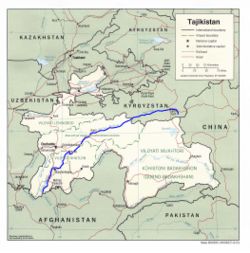
 The river Vakhsh (highlighted in blue) | |
 | |
| Location | |
| Country | Kyrgyzstan, Tajikistan |
| Physical characteristics | |
| Mouth | Amu Darya |
• coordinates | 37°06′40″N 68°18′51″E / 37.1112°N 68.3141°E |
| Length | 786 km (488 mi) |
| Basin size | 39,100 km2 (15,100 sq mi) |
| Discharge | |
| • average | 621 m3/s (21,900 cu ft/s)[1] |
| Basin features | |
| Progression | Amu Darya→ Aral Sea |

The Vakhsh (/ˈvækʃ/ VAKSH; Tajik and Russian: Вахш), also known as the Surkhob (Tajik: Сурхоб) in north-central Tajikistan and as the Kyzyl-Suu (Kyrgyz: Кызыл-Суу) in Kyrgyzstan, is a Central Asian river and one of the main rivers of Tajikistan. It is a tributary of the Amu Darya river.[2]
Geography
[edit]The Vakhsh flows through the Pamirs, passing through very mountainous territory that frequently restricts its flow to narrow channels within deep gorges.[2] Some of the largest glaciers in Tajikistan, including the Fedchenko and Abramov glaciers (the former being the longest glacier in the world outside of the polar regions), drain into the Vakhsh.[3] Its largest tributaries are the Muksu and the Obikhingou; the Vakhsh proper begins at the confluence of the Obikhingou and Surkhob rivers.
After it exits the Pamirs, the Vakhsh passes through the fertile lowlands of southwest Tajikistan.[2] It ends when it flows into the Panj to form the Amu Darya, at the border of Tajikistan and Afghanistan. The Tigrovaya Balka Nature Reserve, which was the last habitat of the now-extinct Caspian tiger in the former USSR, is located at the confluence of the Vakhsh and the Panj.[4]
The catchment area of the Vakhsh is 39,100 km2, of which 31,200 km2 (79.8%) lies within Tajikistan. The river contributes about 25% of the total flow of the Amu Darya, its parent river. Its average discharge is 538 m3/s, with an annual discharge of 20.0 km3. However, since the Vakhsh is fed mostly by melting snow and glaciers, these flow rates have great seasonal variability between winter and summer. Measurements at the Nurek Dam indicate that winter flow rates average around 150 m3/s, whereas flow rates during the summer months can exceed 1500 m3/s – a tenfold increase.[3]

Economic development
[edit]The Vakhsh has been intensively developed for human use. Electricity, aluminum, and cotton are the mainstays of Tajikistan's economy,[5] and the Vakhsh is involved with all three of these sectors. Hydroelectricity provides 91% of the country's electricity as of 2005, and 90% of that total comes from the five completed dams along the Vakhsh,[6] dominated by the world's second tallest dam, the Nurek.[3] The other four dams, downstream of Nurek, are Baipaza, Sangtuda 1, Sangtuda 2 and Golovnaya Dams. (These dams make Tajikistan the highest hydroelectric power producer per capita in the world.[7]) Hydroelectricity powers the aluminum production at the Tajik Aluminum Company in Tursunzoda, a major source of Tajikistan's industrial output and export revenue.[5] As for cotton, Vakhsh water irrigates much of Tajikistan's crop; about 85% of the water taken from the Vakhsh goes toward irrigation.[7]
Key Information


Soviet era
[edit]The leaders of the Soviet Union stressed the importance of developing the country's under-developed regions, such as the Tajik Soviet Socialist Republic (which was the predecessor to modern-day, independent Tajikistan). Not only did Vladimir Lenin’s ideology identify the decentralization of industry as a way to counter the colonial exploitation of indigenous peoples, but the USSR had strategic aims as well, especially in World War II when industry was evacuated eastward away from the German front.[8] This industrialization would be fueled by exploiting Tajikistan's enormous hydropower potential.
It took until the 1950s, however, for dam construction to begin on the Vakhsh. The Perepadnaya power station, was the first to be commissioned in 1959. It is situated on a canal off the Golovnaya Dam which was commissioned in 1963. The giant Nurek dam was constructed between 1961 and 1980. Baipaza Dam was completed in 1983.
To build transmission lines over the Pamirs would have been prohibitively expensive, so, in order to take advantage of the electricity produced by these dams, the Soviet Union built many industries nearby.[9] The Tajik Aluminum Company plant is a prime example. Other industries established locally were chemical plants, nitrogen fertilizer factories, and cotton gins.[10]
The dams, particularly the reservoirs behind them, were also built with the purpose of providing water for agriculture. The Soviet Union promoted cotton farming in the Vakhsh Valley, as well as vineyards and orchards, and drew water from the Vakhsh for irrigation. The Vakhsh Valley Canal Project, which expanded farmland along the river's lower reaches, predated the dams, having been completed in 1933. In the 1960s, after the reservoirs had been constructed, engineers dug tunnels through the surrounding mountains to irrigate other valleys.[11] Water storage in the reservoirs also helped control the river's flow, so as to provide a more reliable water supply for downstream users in Uzbekistan and Turkmenistan.[3]
After Tajik independence
[edit]Soviet Central Asia had a centrally planned economy in which the different republics supplied resources to each other at different times of the year. During the summer, when river flows were greatest, Tajikistan (located upstream) released water from its reservoirs on the Vakhsh and exported the hydroelectricity to power irrigation pumps downstream, in Uzbekistan and Turkmenistan, along the Amu Darya. In winter, Tajik dams accumulated water, and the fossil-fuel-rich downstream nations supplied Tajikistan with oil and gas to compensate for forgone hydroelectricity generation.
However, with increasing regional tension post-independence, this system is breaking down, with no conclusive cooperative arrangement yet. Fuel deliveries from downstream nations have been getting less reliable and more expensive, and impoverished Tajikistan cannot adapt by increasing winter hydroelectric generation since this would jeopardize irrigation and electricity exports in the summer. This dependence has caused energy crises in the winters of 2008 and 2009, in which the capital, Dushanbe, lost power and heating. Heightened nationalism and border disputes further complicate the search for a solution to Central Asia's water needs, according to a study conducted by the International Crisis Group.[12]
Tajikistan is therefore pursuing a course of action to increase hydroelectric capacity by building more dams on the Vakhsh, in order to promote economic growth and move towards energy independence.[13] Another four dams are planned or under construction, including the Rogun Dam. The Rogun Dam began construction in Soviet times but remains uncompleted; now Tajikistan has recommenced the project with financial support from the Russian Aluminum Company. If constructed to its full planned height, it will supersede the Nurek as tallest in the world.
This project has caused great controversy. Just as energy dependence threatens Tajikistan, so water dependence threatens the downstream nations. For this reason, Uzbekistan was highly critical of the Rogun Dam, claiming that it would “put it [Tajikistan] firmly in control of the river”.[3] The World Bank responded to these tensions by launching investigations into the social and environmental impacts of the dam.[13] However, following the death of its former leader Islam Karimov in 2016, in 2018 Uzbekistan dropped its opposition to the Rogun Dam. "Go ahead and build it, but we hold to certain guarantees in accordance with these conventions that have been signed by you," Uzbek Foreign Minister Abdulaziz Komilov said in a televised appearance on July 5, 2018.[14]
Environmental problems
[edit]Intensive agriculture in the Vakhsh basin has left the river polluted with fertilizers, pesticides, and salts. Also, chemicals have leached into groundwater from the heavy industries near the Vakhsh's dams, which has in turn contaminated surface water.[7] However, ever since Tajikistan lost their Soviet agricultural subsidies with the breakup of the Soviet Union, farms have not been able to afford as many fertilizers or pesticides as before, thus decreasing levels of pollution in the river.[15] The 2008 financial crisis has further increased poverty, which in turn has further decreased pollution.
Since the waters of the Vakhsh eventually flow into the Aral Sea, pollution in the Vakhsh contributes to eutrophication there.[7]
Climate change impacts
[edit]The Vakhsh is fed by the glaciers of the Pamirs, one of the world's most susceptible regions to climate change. Tajikistan as a whole has experienced a rise in temperatures from between 1.0-1.2 degrees Celsius between 1940 and 2000, and many glaciers that feed the Vakhsh have retreated, including the Fedchenko, which is melting at a rate of 16–20 meters/year. According to Oxfam International, up to 30% of Tajikistan's glaciers could shrink or disappear completely by 2050. The reduction in river flow could lower the Vakhsh's hydropower production, and harm agriculture dependent on its waters for irrigation.[16] Furthermore, if climate change affects precipitation patterns, it could cause more floods, landslides, and other natural disasters in the river valley.[7]
Blockages
[edit]The Vakhsh is located in a seismically active region, and earthquakes, in addition to high groundwater levels (especially during the wet season), cause hundreds of landslides per year.[17] These landslides occasionally block the river and form landslide dams.
Such blockages pose a significant threat to the river's dams and hydroelectric power generation. A large landslide 8 kilometers (5 mi) downstream from the Baipaza Dam has blocked the river twice (in 1992 and 2002) ever since this dam opened in 1985.[18] Both blockages were immediately blasted to clear the river channel, since they threatened to raise the water level high enough to flood the dam. Such an event could potentially have serious economic consequences by disrupting power generation, stopping production at the Tajik Aluminum Company, and cutting off supplies of drinking and irrigation water for downstream users. In the worst-case scenario, failure of a landslide dam could cause catastrophic floods.
Recognizing these threats, the Asian Development Bank responded to the landslide of 2002 by granting the government of Tajikistan a low-interest loan to stabilize the valley slopes and mitigate the potential for blockages in the future.[19]
Notes
[edit]- ^ "Vakhsh at Golovnaya Hyd'Elec'Power". Soviet Union Hydro-Station archive. UNESCO. 1936–1985. Archived from the original on 2016-05-27. Retrieved 2014-02-01.
- ^ a b c "Tajikistan - Topography and Drainage" Archived 2016-03-04 at the Wayback Machine in Tajikistan: a Country Study (Washington: Library of Congress, 1996)
- ^ a b c d e Kai Wegerich, Oliver Olsson, and Jochen Forebrich, “Reliving the past in a changed environment: Hydropower ambitions, opportunities and constraints in Tajikistan”, Energy Policy 35 (2007), 3815-3825
- ^ Mary Pat Silviera et al., Environmental Performance Reviews: Tajikistan. Archived 2020-09-21 at the Wayback Machine (New York and Geneva: United Nations, 2004), 124
- ^ a b Silviera et al., Environmental Performance Reviews, 4
- ^ “VIII. Regional and Country Hydropower Profiles: CIS,” in Hydropower Report: Large & Small Hydropower Archived 2011-09-03 at the Wayback Machine (London: ABS Energy Research, 2005), 59-62.
- ^ a b c d e Silviera et al., Environmental Performance Reviews, 104-109
- ^ Violet Conolly, Beyond the Urals: Economic Developments in Soviet Asia (London: Oxford University Press, 1967), pp. 61-62
- ^ Conolly, Beyond the Urals, pp. 145-149
- ^ Conolly, Beyond the Urals, p. 172
- ^ Conolly, Beyond the Urals, pp. 208-220
- ^ International Crisis Group. "Water Pressures in Central Asia Archived 2016-05-20 at the Wayback Machine", CrisisGroup.org Archived 2020-06-03 at the Wayback Machine. 11 September 2014. Retrieved 6 October 2014.
- ^ a b Murodbek Laldjebaev, “The Water-Energy Puzzle in Central Asia: The Tajikistan Perspective,” Water Resources Development 26 (2010): 23-34.
- ^ "Uzbekistan and Tajikistan: No more dam problems?". Archived from the original on 2023-12-02. Retrieved 2024-01-11.
- ^ Silviera et al., Environmental Performance Reviews, 165
- ^ Anita Swarup et al., "Reaching Tipping Point? Climate Change and Poverty in Tajikistan" Archived 2011-08-15 at the Wayback Machine (Dushanbe: Oxfam International, 2009), 1-22
- ^ Silviera et al., Environmental Performance Reviews, 17
- ^ "US$5.3 million to Tajikistan for emergency landslide stabilization measures". reliefweb.int.
- ^ Report and Recommendation of the President to the Board of Directors on a Proposed Loan to the Republic of Tajikistan for the Baipaza Landslide Stabilization Project Archived 2011-08-15 at the Wayback Machine (Manila: Asian Development Bank, 2003).
External links
[edit]- Partial map of the Vakhsh with locations of the river's nine dams Archived 2006-02-19 at the Wayback Machine
- Map of major river drainage basins within Tajikistan Archived 2005-05-09 at the Wayback Machine
- Index of maps and graphs related to Tajikistan water resources Archived 2006-05-01 at the Wayback Machine


Vakhsh (river)
View on GrokipediaThe Vakhsh River is a transboundary river originating in southern Kyrgyzstan, where it is known as the Kyzyl-Suu, and flowing primarily through Tajikistan for a total length of 524 kilometers before joining the Amu Darya river at an elevation of 316 meters above sea level.[1][2] The river forms at the confluence of the Surkhob and Obihingou rivers at 1,151 meters elevation and drains a basin of 39,100 square kilometers, with most of the area in Tajikistan and a smaller portion shared with Kyrgyzstan.[3][2] Its average discharge is approximately 156 cubic meters per second, supporting vital ecological and human uses in a region characterized by mountainous terrain descending into valleys.[4] The Vakhsh holds critical economic importance for Tajikistan, where a cascade of eight major hydroelectric dams along its course generates nearly 90% of the nation's electricity, with reservoirs enabling seasonal water storage for power production and flood control.[5][6] These facilities, including the Nurek Dam, also facilitate extensive irrigation networks that sustain agriculture in the arid Vakhsh Valley, a key agricultural zone producing cotton and other crops essential to the country's food security and export economy.[5][6] Ongoing projects like the Rogun Hydropower Plant aim to expand capacity but have sparked regional debates over water sharing and downstream impacts on the Amu Darya basin.[7]
Physical Geography
Course and Morphology
The Vakhsh River originates in southern Kyrgyzstan near the Chinese border within the Pamir-Alay range and flows westward, officially commencing at the confluence of the Obihingou and Surkhob rivers.[8] Its total length measures approximately 786 kilometers, with 262 kilometers traversing Kyrgyzstan and 524 kilometers through Tajikistan.[8] The river maintains a predominantly westward trajectory through northern Tajikistan before turning southward into the western Pamir region, ultimately joining the Panj River at the Tajikistan-Afghanistan border to form the Amu Darya.[9] [10] Throughout its upper and middle reaches, the Vakhsh courses southwestward from glacier-capped mountains in Kyrgyzstan, incising deeply into the terrain as it crosses central Tajikistan via narrow valleys and gorges.[10] [6] In its lower sections, the river transitions into broader plains in southern Tajikistan, where flow velocity diminishes and channel widths expand up to 1.5 kilometers in places.[8] [6] Elevations along the course descend from over 3,500 meters above sea level in the east to approximately 300 meters at the confluence with the Panj.[9] Morphologically, the Vakhsh features steep, incised channels with depths exceeding 100 meters in gullied sections, flanked by eroding banks and shifting beds composed of soft glacial and terrace deposits.[9] Upper reaches exhibit narrow gorges as tight as 8-10 meters wide amid alpine terrain prone to mass wasting, while downstream areas show gentler loess hillslopes and remnant fluvial islands.[8] [6] The basin's topography, with slopes up to 42 degrees, drives active incision and sediment mobilization through processes like piping and fluting erosion in unconsolidated materials.[9] [6]Drainage Basin and Tributaries
The drainage basin of the Vakhsh River encompasses approximately 39,100 square kilometers, predominantly within Tajikistan, where it supports extensive hydropower generation and irrigation systems.[8] Of this area, about 31,200 square kilometers—or 79.8%—lies in Tajikistan, with the upstream portions extending into Kyrgyzstan due to the origins of its headwater rivers.[8] The basin's terrain is predominantly mountainous, originating in the high-elevation Pamir-Alai ranges, where glacial melt from elevations exceeding 4,000 meters contributes significantly to the river's flow, alongside seasonal precipitation and snowmelt.[11] This rugged geography results in a steep longitudinal profile, with the basin featuring deep valleys, narrow gorges, and active erosion processes that influence sediment loads and channel morphology.[9] The Vakhsh River proper forms at the confluence of its two primary headstreams: the Surkhob River, originating in Kyrgyzstan's Alai Mountains at around 1,151 meters elevation, and the Obihingou (also spelled Obikhingou) River, flowing from Tajikistani highlands.[12] [8] Downstream, the largest tributaries include the Muksu River, which joins from the northeast after traversing glaciated Pamir slopes, contributing substantial discharge from its own sub-basin fed by rivers like the Muminabad and Baljuvon.[8] Other notable tributaries, such as the Kyzylsu (Kyzyl-Suu) from the southeast and smaller streams like the Yavan and Khatlon, add to the basin's network, primarily entering from right-bank (southern) tributaries in Tajikistan's arid foothills, where they drain semi-arid valleys with limited perennial flow.[11] These tributaries collectively account for the basin's high runoff coefficient, driven by the orographic precipitation in upstream highlands contrasting with drier downstream areas.[6] The basin's hydrological inputs are dominated by meltwater from approximately 10% glacial coverage, particularly in the Obihingou and Muksu sub-basins, with annual precipitation varying from over 1,000 mm in high mountains to less than 300 mm in lower valleys, underscoring the basin's role as a key water source for the transboundary Amu Darya system.[3] Human interventions, including upstream dams on tributaries like the Muksu, have altered natural drainage patterns, but the core basin morphology remains defined by tectonic uplift and Quaternary glaciation.[9]Hydrology
Flow Regime and Discharge
The hydrological regime of the Vakhsh River is dominated by glacier and snowmelt contributions, leading to a nivo-glacial flow pattern with marked seasonal fluctuations. Peak discharges typically occur from June to September, driven by intensified melting in the Pamir Mountains, while minimum flows prevail in winter, particularly February, due to reduced precipitation and frozen precipitation storage. This variability is characteristic of snow- and glacier-fed rivers in Central Asia, where summer highs can exceed winter lows by factors of 10 to 20.[6][13] Average annual discharge at key gauging stations, such as downstream of major tributaries, measures approximately 660 m³/s, corresponding to a total annual runoff of about 20.8 km³. Historical data from stations like Darband and Sangvor indicate regime curves with maximum flows up to 3,120 m³/s during flood events and minima around 130 m³/s in dry winter periods. These values reflect pre-regulation conditions, though upstream reservoirs have since attenuated extremes for downstream stability.[13][3][14]Water Balance and Seasonal Variations
The water balance of the Vakhsh River is primarily driven by meltwater inputs from snow and glaciers in its mountainous upper basin, supplemented by precipitation that falls mostly as winter snow. Snowmelt constitutes the dominant runoff component, accounting for 63–83% of annual streamflow depending on the dataset and model used, while rainfall contributes 17–37%. Glacier melt provides a lesser share, as snow accumulation and ablation outweigh glacial contributions despite extensive ice cover in the Pamir ranges. Annual precipitation in the upper basin averages 1,100–1,900 mm across evaluated datasets, with evapotranspiration ranging from 72–316 mm (2.9–25.5% of precipitation), resulting in high net runoff that sustains the river's mean annual discharge of approximately 650 m³/s or 20 km³/year.[13][15][6] Seasonal flow variations reflect the nivo-glacial regime, with low winter discharges due to minimal precipitation and frozen storage, transitioning to sharp increases in spring and peaking in summer from snowmelt. Maximum monthly discharge occurs in July, often several times the February minimum, as melt from winter-accumulated snowpack (influenced by westerly precipitation patterns) dominates from April to October. This results in 60–70% of annual flow concentrated in the June–September period, with the river's total volume reaching 20.22 km³ annually under baseline conditions. Such variability underscores the basin's sensitivity to temperature-driven melt timing, with groundwater and baseflow providing modest winter sustenance.[13][6][15]Engineering Infrastructure
Hydropower Cascade Overview
![Nurek Dam on the Vakhsh River]float-right The Vakhsh hydropower cascade consists of a series of hydroelectric power plants (HPPs) arrayed along the Vakhsh River in Tajikistan, leveraging the river's steep gradient from the Pamirs—exceeding 1,000 meters of total head—to generate electricity. This integrated system, primarily developed during the Soviet era, includes both large storage reservoirs for seasonal flow regulation and run-of-river facilities for base-load power, enabling optimized operation across wet and dry seasons. The cascade supplies over 90% of Tajikistan's electricity, with annual output from operational plants reaching billions of kilowatt-hours, critical for a mountainous country lacking fossil fuel resources.[16] Operational HPPs in the cascade include Nurek HPP, featuring a 300-meter-high earth-fill dam completed in 1980 with 3,000 MW installed capacity and nine turbines producing up to 11.4 billion kWh annually; Sangtuda-1 HPP (670 MW, commissioned 2009); Sangtuda-2 HPP (670 MW, 2012); and Baipaza HPP (600 MW). Smaller upstream plants like Golovnaya (240 MW, 1972) contribute additional capacity, bringing the current total installed power to approximately 5,200 MW. These facilities coordinate reservoir releases to maximize winter generation, when glacial melt diminishes and heating demand peaks, while mitigating downstream flooding during spring thaws.[17][18] Under construction is Rogun HPP, with a planned 335-meter rock-fill dam and 3,600–3,780 MW capacity across six turbines, positioned upstream of Nurek to enhance cascade regulation and double national output upon full operation targeted for the late 2020s. The full cascade's exploitable potential stands at 9,195 MW, capable of 36.9 billion kWh yearly, though realization depends on financing, seismic stability in the tectonically active region, and transboundary water-sharing agreements with downstream Uzbekistan. Joint dispatch modeling ensures efficient energy yield while addressing environmental flows, underscoring the cascade's role in Tajikistan's energy independence amid regional hydropower rivalries.[19][20][21]Major Dams and Reservoirs
The Nurek Dam, an earth-fill embankment structure completed between 1961 and 1980, stands at 300 meters in height, making it the second-tallest dam in the world after China's Jinping-I Dam.[22] Located on the Vakhsh River in Tajikistan, it impounds the Nurek Reservoir, which has a storage capacity of approximately 10.5 billion cubic meters and supports irrigation and flood control in addition to power generation.[23] The associated hydroelectric power plant has an installed capacity of 3,000 megawatts, accounting for about 75% of Tajikistan's total electricity production.[24] The Rogun Dam, currently under construction upstream of the Nurek Dam, is designed as a 335-meter-high rockfill embankment structure, which would surpass all existing dams in height upon completion.[25] Initiated in the 1970s during the Soviet era but halted after independence, construction resumed in earnest in the 2010s with the first generating unit commissioned in October 2024, marking progress toward a total capacity of 3,600 megawatts.[26] The Rogun Reservoir is projected to hold 13.3 billion cubic meters, enhancing seasonal water regulation for the Vakhsh Cascade.[27] Other significant dams in the Vakhsh Cascade include Sangtuda-1, operational since 2009 with a 670-megawatt capacity, and Sangtuda-2, completed in 2012 at 670 megawatts, both contributing to the downstream run-of-river hydropower sequence that regulates flow from the Nurek and future Rogun reservoirs.[20] These facilities form part of a nine-station cascade aimed at maximizing the river's hydroelectric potential while managing water for agriculture in Tajikistan and downstream Uzbekistan.[21]Irrigation and Water Management Systems
The Vakhsh River provides critical irrigation water for agriculture in Tajikistan's lower basin, supporting crops such as cotton and wheat on dehkan farms and larger fields. Irrigation schemes, including the Yovon system covering 40,600 hectares, rely on water released from upstream reservoirs like Nurek and Qayroqqum to supply canals and networks.[28] These systems feature surface canals for distribution and subsurface drains to manage salinity and maintain soil productivity, essential for high-yield farming in arid conditions.[29][30] Water management is coordinated through institutions like the Basin Water Organization “Amu Darya,” which monitors hydroposts, pumping stations, and intakes along the Vakhsh and interstate canals to allocate shares among users.[31] Local water user associations (WUAs) handle on-farm distribution and maintenance, with 45 such groups in Vakhsh schemes promoting efficient practices amid variable flows influenced by hydropower operations upstream.[32] Return flows from irrigation contribute to downstream river volumes, though inefficiencies in aging Soviet-era infrastructure lead to losses estimated at significant percentages of diverted water.[33] Recent initiatives address degradation and climate risks: The Asian Development Bank granted $30 million in 2021 to modernize Yovon’s irrigation and drainage, incorporating resilient designs against floods and earlier peak flows projected from glacial melt.[34] The World Bank’s Strengthening Water and Irrigation Management Project, initiated in 2023, enhances planning capacity and supports WUAs with climate-smart technologies across Vakhsh areas.[35] A comprehensive basin plan for Vakhsh water resources through 2040 is in development to integrate hydropower, irrigation, and environmental needs.[36] These efforts aim to sustain agricultural output, which depends on the river for roughly 20-30% of Tajikistan’s irrigated land, amid growing demands and upstream storage priorities.[37]Historical Development
Pre-20th Century Context
The Vakhsh River, flowing through the rugged terrain of what is now southern Tajikistan, supported early human settlements and Bronze Age cultures reliant on its waters for sustenance and agriculture. The Vakhsh culture, dating from the 3rd to early 2nd millennium BCE, emerged in the river's southern valley, featuring kurgan burials, fortified proto-urban sites, and evidence of agro-pastoral economies that harnessed seasonal floods for rudimentary irrigation and livestock rearing.[38] In antiquity, the Vakhsh Valley formed part of Bactria, with major archaeological complexes like Kafir Kala—an expansive settlement with defensive walls and residential structures—indicating sustained occupation from potentially Achaemenid times through the Kushan era, where the river facilitated trade, defense, and water diversion for fields amid the arid landscape.[39] The river's hydronym traces to the Avestan Vaxšu, referenced in Zoroastrian scriptures as a tributary of the sacred Oxus (Amu Darya) system, symbolizing fertility and ritual purity in ancient Iranian cosmology.[40] Medieval developments saw the Vakhsh integrated into sophisticated irrigation networks of Transoxiana, channeling its flow via canals to sustain cotton, grain, and orchard cultivation in the fertile oases, as part of the Khuttal principality that recognized Samanid suzerainty by the 9th–10th centuries CE before succumbing to Mongol incursions in the 13th century.[41] Buddhist monastic complexes, such as Ajina Tepe (constructed circa 6th–8th centuries CE), highlight the river's conduit role for Silk Road cultural diffusion, with artifacts revealing artistic and religious influences from India and China amid local agrarian societies.[42] By the 19th century, under the Bukhara Emirate, the Vakhsh continued as a vital artery for localized irrigation and seasonal pasturage, though fragmented governance limited large-scale engineering until modern interventions.[43]Soviet-Era Construction and Planning
![Nurek Dam on the Vakhsh River][float-right]The Soviet Union initiated comprehensive planning for the Vakhsh River's hydropower development in the mid-20th century as part of broader efforts to harness Central Asia's water resources for electricity generation and economic integration across republics. The Vakhsh Cascade, envisioned as a chain of hydroelectric stations, was designed to address energy demands in the region, with initial proposals for key projects like Rogun emerging in 1959 and technical designs finalized by 1965 under centralized Soviet planning authorities such as GOSPLAN.[7] This framework emphasized large-scale infrastructure to support industrialization, with the cascade intended to include multiple dams for sequential power production and flood control. Construction of major facilities began in the early 1960s, starting with the Golovnaya Dam, whose turbines were commissioned between 1962 and 1963 to provide initial regulated flow and power output along the river. The flagship Nurek Dam followed, with groundwork commencing in 1961 and full completion in 1980; this 300-meter-high embankment structure, featuring a central cement core, generated up to 3,000 MW and required the relocation of thousands of workers to a purpose-built city, exemplifying Soviet mobilization of labor and resources for megaprojects.[22] By the 1970s, planning extended upstream to Rogun, where site preparation and initial excavation started in 1976 as the cascade's uppermost link, aiming for a 335-meter dam with 3,600 MW capacity to crown the system, though progress was modest before the USSR's dissolution.[7] These efforts prioritized hydropower over irrigation specifics, integrating the Vakhsh's flow into the Amu Darya basin's broader water management without formal transboundary allocations at the time. Soviet planning incorporated geological assessments and engineering feats, such as Nurek's zoned earthfill design to withstand seismic activity in the Pamir region, but overlooked long-term environmental impacts like reservoir sedimentation, which later affected cascade efficiency. The projects relied on union-wide funding and expertise, drawing engineers from across the USSR, and by the 1980s, operational dams like Nurek supplied over 75% of Tajikistan's electricity, underscoring the cascade's role in Soviet energy security.[44] However, incomplete implementations, such as Rogun's early-stage halt in 1991, reflected shifting priorities amid economic strains, leaving the full cascade unrealized within the Soviet framework.[7]