



Community hub
Recent from talks
Contribute something
Nothing was collected or created yet.
Conversion of scales of temperature
View on WikipediaThis is a collection of temperature conversion formulas and comparisons among eight different temperature scales, several of which have long been obsolete.
Temperatures on scales that either do not share a numeric zero or are nonlinearly related cannot correctly be mathematically equated (related using the symbol =), and thus temperatures on different scales are more correctly described as corresponding (related using the symbol ≘).[citation needed]
Conversion calculator
[edit]| Celsius | Fahrenheit | Kelvin | Rankine | Delisle | Newton | Réaumur | Rømer |
|---|---|---|---|---|---|---|---|
| 0 | 32 | 273.15 | 491.67 | 150 | 0 | 0 | 7.5 |
Celsius scale
[edit]| from Celsius | to Celsius | |
|---|---|---|
| Kelvin | x °C ≘ (x + 273.15) K | x K ≘ (x − 273.15) °C |
| Fahrenheit | x °C ≘ (x × 9/5 + 32) °F | x °F ≘ (x − 32) × 5/9 °C |
| Rankine | x °C ≘ (x + 273.15) × 9/5 °R | x °R ≘ (x − 491.67) × 5/9 °C |
Kelvin scale
[edit]| from Kelvin | to Kelvin | |
|---|---|---|
| Celsius | x K ≘ (x − 273.15) °C | x °C ≘ (x + 273.15) K |
| Fahrenheit | x K ≘ (x × 9/5 − 459.67) °F | x °F ≘ (x + 459.67) × 5/9 K |
| Rankine | x K ≘ x × 9/5 °R | x °R ≘ x × 5/9 K |
Fahrenheit scale
[edit]| from Fahrenheit | to Fahrenheit | |
|---|---|---|
| Celsius | x °F ≘ (x − 32) × 5/9 °C | x °C ≘ (x × 9/5 + 32) °F |
| Kelvin | x °F ≘ (x + 459.67) × 5/9 K | x K ≘ (x × 9/5 − 459.67) °F |
| Rankine | x °F ≘ (x + 459.67) °R | x °R ≘ (x − 459.67) °F |
Rankine scale
[edit]| from Rankine | to Rankine | |
|---|---|---|
| Celsius | x °R ≘ (x − 491.67) × 5/9 °C | x °C ≘ (x + 273.15) × 9/5 °R |
| Kelvin | x °R ≘ x × 5/9 K | x K ≘ x × 9/5 °R |
| Fahrenheit | x °R ≘ (x − 459.67) °F | x °F ≘ (x + 459.67) °R |
Delisle scale
[edit]| from Delisle | to Delisle | |
|---|---|---|
| Celsius | x °De ≘ (100 − x × 2/3) °C | x °C ≘ (100 − x) × 3/2 °De |
| Kelvin | x °De ≘ (373.15 − x × 2/3) K | x K ≘ (373.15 − x) × 3/2 °De |
| Fahrenheit | x °De ≘ (212 − x × 6/5) °F | x °F ≘ (212 − x) × 5/6 °De |
| Rankine | x °De ≘ (671.67 − x × 6/5) °R | x °R ≘ (671.67 − x) × 5/6 °De |
Newton scale
[edit]| from Newton | to Newton | |
|---|---|---|
| Celsius | x °N ≘ x × 100/33 °C | x °C ≘ x × 33/100 °N |
| Kelvin | x °N ≘ (x × 100/33 + 273.15) K | x K ≘ (x − 273.15) × 33/100 °N |
| Fahrenheit | x °N ≘ (x × 60/11 + 32) °F | x °F ≘ (x − 32) × 11/60 °N |
| Rankine | x °N ≘ (60/11 x + 491.67) °R | x °R ≘ (x − 491.67) × 11/60 °N |
Réaumur scale
[edit]| from Réaumur | to Réaumur | |
|---|---|---|
| Celsius | x °Ré ≘ x × 5/4 °C | x °C ≘ x × 4/5 °Ré |
| Kelvin | x °Ré ≘ (x × 5/4 + 273.15) K | x K ≘ (x − 273.15) × 4/5 °Ré |
| Fahrenheit | x °Ré ≘ (x × 9/4 + 32) °F | x °F ≘ (x − 32) × 4/9 °Ré |
| Rankine | x °Ré ≘ (x × 9/4 + 491.67) °R | x °R ≘ (x − 491.67) × 4/9 °Ré |
Rømer scale
[edit]| from Rømer | to Rømer | |
|---|---|---|
| Celsius | x °Rø ≘ (x − 7.5) × 40/21 °C | x °C ≘ (x × 21/40 + 7.5) °Rø |
| Kelvin | x °Rø ≘ ((x − 7.5) × 40/21 + 273.15) K | x K ≘ ((x − 273.15) × 21/40 + 7.5) °Rø |
| Fahrenheit | x °Rø ≘ ((x − 7.5) × 24/7 + 32) °F | x °F ≘ ((x − 32) × 7/24 + 7.5) °Rø |
| Rankine | x °Rø ≘ ((x − 7.5) × 24/7 + 491.67) °R | x °R ≘ ((x − 491.67) × 7/24 + 7.5) °Rø |
Comparison values chart
[edit]| Celsius | Fahrenheit | Kelvin | Rankine | Delisle | Newton | Réaumur | Rømer |
|---|---|---|---|---|---|---|---|
| 500.00 | 932.00 | 773.15 | 1391.67 | −600.00 | 165.00 | 400.00 | 270.00 |
| 490.00 | 914.00 | 763.15 | 1373.67 | −585.00 | 161.70 | 392.00 | 264.75 |
| 480.00 | 896.00 | 753.15 | 1355.67 | −570.00 | 158.40 | 384.00 | 259.50 |
| 470.00 | 878.00 | 743.15 | 1337.67 | −555.00 | 155.10 | 376.00 | 254.25 |
| 460.00 | 860.00 | 733.15 | 1319.67 | −540.00 | 151.80 | 368.00 | 249.00 |
| 450.00 | 842.00 | 723.15 | 1301.67 | −525.00 | 148.50 | 360.00 | 243.75 |
| 440.00 | 824.00 | 713.15 | 1283.67 | −510.00 | 145.20 | 352.00 | 238.50 |
| 430.00 | 806.00 | 703.15 | 1265.67 | −495.00 | 141.90 | 344.00 | 233.25 |
| 420.00 | 788.00 | 693.15 | 1247.67 | −480.00 | 138.60 | 336.00 | 228.00 |
| 410.00 | 770.00 | 683.15 | 1229.67 | −465.00 | 135.30 | 328.00 | 222.75 |
| 400.00 | 752.00 | 673.15 | 1211.67 | −450.00 | 132.00 | 320.00 | 217.50 |
| 390.00 | 734.00 | 663.15 | 1193.67 | −435.00 | 128.70 | 312.00 | 212.25 |
| 380.00 | 716.00 | 653.15 | 1175.67 | −420.00 | 125.40 | 304.00 | 207.00 |
| 370.00 | 698.00 | 643.15 | 1157.67 | −405.00 | 122.10 | 296.00 | 201.75 |
| 360.00 | 680.00 | 633.15 | 1139.67 | −390.00 | 118.80 | 288.00 | 196.50 |
| 350.00 | 662.00 | 623.15 | 1121.67 | −375.00 | 115.50 | 280.00 | 191.25 |
| 340.00 | 644.00 | 613.15 | 1103.67 | −360.00 | 112.20 | 272.00 | 186.00 |
| 330.00 | 626.00 | 603.15 | 1085.67 | −345.00 | 108.90 | 264.00 | 180.75 |
| 320.00 | 608.00 | 593.15 | 1067.67 | −330.00 | 105.60 | 256.00 | 175.50 |
| 310.00 | 590.00 | 583.15 | 1049.67 | −315.00 | 102.30 | 248.00 | 170.25 |
| 300.00 | 572.00 | 573.15 | 1031.67 | −300.00 | 99.00 | 240.00 | 165.00 |
| 290.00 | 554.00 | 563.15 | 1013.67 | −285.00 | 95.70 | 232.00 | 159.75 |
| 280.00 | 536.00 | 553.15 | 995.67 | −270.00 | 92.40 | 224.00 | 154.50 |
| 270.00 | 518.00 | 543.15 | 977.67 | −255.00 | 89.10 | 216.00 | 149.25 |
| 260.00 | 500.00 | 533.15 | 959.67 | −240.00 | 85.80 | 208.00 | 144.00 |
| 250.00 | 482.00 | 523.15 | 941.67 | −225.00 | 82.50 | 200.00 | 138.75 |
| 240.00 | 464.00 | 513.15 | 923.67 | −210.00 | 79.20 | 192.00 | 133.50 |
| 230.00 | 446.00 | 503.15 | 905.67 | −195.00 | 75.90 | 184.00 | 128.25 |
| 220.00 | 428.00 | 493.15 | 887.67 | −180.00 | 72.60 | 176.00 | 123.00 |
| 210.00 | 410.00 | 483.15 | 869.67 | −165.00 | 69.30 | 168.00 | 117.75 |
| 200.00 | 392.00 | 473.15 | 851.67 | −150.00 | 66.00 | 160.00 | 112.50 |
| 190.00 | 374.00 | 463.15 | 833.67 | −135.00 | 62.70 | 152.00 | 107.25 |
| 180.00 | 356.00 | 453.15 | 815.67 | −120.00 | 59.40 | 144.00 | 102.00 |
| 170.00 | 338.00 | 443.15 | 797.67 | −105.00 | 56.10 | 136.00 | 96.75 |
| 160.00 | 320.00 | 433.15 | 779.67 | −90.00 | 52.80 | 128.00 | 91.50 |
| 150.00 | 302.00 | 423.15 | 761.67 | −75.00 | 49.50 | 120.00 | 86.25 |
| 140.00 | 284.00 | 413.15 | 743.67 | −60.00 | 46.20 | 112.00 | 81.00 |
| 130.00 | 266.00 | 403.15 | 725.67 | −45.00 | 42.90 | 104.00 | 75.75 |
| 120.00 | 248.00 | 393.15 | 707.67 | −30.00 | 39.60 | 96.00 | 70.50 |
| 110.00 | 230.00 | 383.15 | 689.67 | −15.00 | 36.30 | 88.00 | 65.25 |
| 100.00 | 212.00 | 373.15 | 671.67 | 0.00 | 33.00 | 80.00 | 60.00 |
| 90.00 | 194.00 | 363.15 | 653.67 | 15.00 | 29.70 | 72.00 | 54.75 |
| 80.00 | 176.00 | 353.15 | 635.67 | 30.00 | 26.40 | 64.00 | 49.50 |
| 70.00 | 158.00 | 343.15 | 617.67 | 45.00 | 23.10 | 56.00 | 44.25 |
| 60.00 | 140.00 | 333.15 | 599.67 | 60.00 | 19.80 | 48.00 | 39.00 |
| 50.00 | 122.00 | 323.15 | 581.67 | 75.00 | 16.50 | 40.00 | 33.75 |
| 40.00 | 104.00 | 313.15 | 563.67 | 90.00 | 13.20 | 32.00 | 28.50 |
| 30.00 | 86.00 | 303.15 | 545.67 | 105.00 | 9.90 | 24.00 | 23.25 |
| 20.00 | 68.00 | 293.15 | 527.67 | 120.00 | 6.60 | 16.00 | 18.00 |
| 10.00 | 50.00 | 283.15 | 509.67 | 135.00 | 3.30 | 8.00 | 12.75 |
| 0.00 | 32.00 | 273.15 | 491.67 | 150.00 | 0.00 | 0.00 | 7.50 |
| −10.00 | 14.00 | 263.15 | 473.67 | 165.00 | −3.30 | −8.00 | 2.25 |
| −14.26 | 6.29 | 258.86 | 465.96 | 171.43 | −4.71 | −11.43 | 0.00 |
| −17.78 | 0.00 | 255.37 | 459.67 | 176.67 | −5.87 | −14.22 | −1.83 |
| −20.00 | −4.00 | 253.15 | 455.67 | 180.00 | −6.60 | −16.00 | −3.00 |
| −30.00 | −22.00 | 243.15 | 437.67 | 195.00 | −9.90 | −24.00 | −8.25 |
| −40.00 | −40.00 | 233.15 | 419.67 | 210.00 | −13.20 | −32.00 | −13.50 |
| −50.00 | −58.00 | 223.15 | 401.67 | 225.00 | −16.50 | −40.00 | −18.75 |
| −60.00 | −76.00 | 213.15 | 383.67 | 240.00 | −19.80 | −48.00 | −24.00 |
| −70.00 | −94.00 | 203.15 | 365.67 | 255.00 | −23.10 | −56.00 | −29.25 |
| −80.00 | −112.00 | 193.15 | 347.67 | 270.00 | −26.40 | −64.00 | −34.50 |
| −90.00 | −130.00 | 183.15 | 329.67 | 285.00 | −29.70 | −72.00 | −39.75 |
| −100.00 | −148.00 | 173.15 | 311.67 | 300.00 | −33.00 | −80.00 | −45.00 |
| −110.00 | −166.00 | 163.15 | 293.67 | 315.00 | −36.30 | −88.00 | −50.25 |
| −120.00 | −184.00 | 153.15 | 275.67 | 330.00 | −39.60 | −96.00 | −55.50 |
| −130.00 | −202.00 | 143.15 | 257.67 | 345.00 | −42.90 | −104.00 | −60.75 |
| −140.00 | −220.00 | 133.15 | 239.67 | 360.00 | −46.20 | −112.00 | −66.00 |
| −150.00 | −238.00 | 123.15 | 221.67 | 375.00 | −49.50 | −120.00 | −71.25 |
| −160.00 | −256.00 | 113.15 | 203.67 | 390.00 | −52.80 | −128.00 | −76.50 |
| −170.00 | −274.00 | 103.15 | 185.67 | 405.00 | −56.10 | −136.00 | −81.75 |
| −180.00 | −292.00 | 93.15 | 167.67 | 420.00 | −59.40 | −144.00 | −87.00 |
| −190.00 | −310.00 | 83.15 | 149.67 | 435.00 | −62.70 | −152.00 | −92.25 |
| −200.00 | −328.00 | 73.15 | 131.67 | 450.00 | −66.00 | −160.00 | −97.50 |
| −210.00 | −346.00 | 63.15 | 113.67 | 465.00 | −69.30 | −168.00 | −102.75 |
| −220.00 | −364.00 | 53.15 | 95.67 | 480.00 | −72.60 | −176.00 | −108.00 |
| −230.00 | −382.00 | 43.15 | 77.67 | 495.00 | −75.90 | −184.00 | −113.25 |
| −240.00 | −400.00 | 33.15 | 59.67 | 510.00 | −79.20 | −192.00 | −118.50 |
| −250.00 | −418.00 | 23.15 | 41.67 | 525.00 | −82.50 | −200.00 | −123.75 |
| −260.00 | −436.00 | 13.15 | 23.67 | 540.00 | −85.80 | −208.00 | −129.00 |
| −270.00 | −454.00 | 3.15 | 5.67 | 555.00 | −89.10 | −216.00 | −134.25 |
| −273.15 | −459.67 | 0.00 | 0.00 | 559.725 | −90.1395 | −218.52 | −135.90375 |
| Celsius | Fahrenheit | Kelvin | Rankine | Delisle | Newton | Réaumur | Rømer |
Comparison of temperature scales
[edit]| Comment | Kelvin | Celsius | Fahrenheit | Rankine | Delisle | Newton | Réaumur | Rømer |
|---|---|---|---|---|---|---|---|---|
| Absolute zero | 0.00 | −273.15 | −459.67 | 0.00 | 559.73 | −90.14 | −218.52 | −135.90 |
| Lowest recorded surface temperature on Earth[1] | 184 | −89.2[1] | −128.6[1] | 331 | 284 | −29 | −71 | −39 |
| Fahrenheit's ice/salt mixture | 255.37 | −17.78 | 0.00 | 459.67 | 176.67 | −5.87 | −14.22 | −1.83 |
| Ice melts (at standard pressure) | 273.15 | 0.00 | 32.00 | 491.67 | 150.00 | 0.00 | 0.00 | 7.50 |
| Triple point of water | 273.16 | 0.01 | 32.018 | 491.688 | 149.985 | 0.0033 | 0.008 | 7.50525 |
| Average surface temperature on Earth | 288 | 15 | 59 | 519 | 128 | 5 | 12 | 15 |
| Average human body temperature* | 310 | 37 | 98 | 558 | 95 | 12 | 29 | 27 |
| Highest recorded surface temperature on Earth[2] | 331 | 58[2] | 136.4[2] | 596 | 63 | 19 | 46 | 38 |
| Water boils (at standard pressure) | 373.1339 | 99.9839 | 211.97102 | 671.64102 | 0.00 | 33.00 | 80.00 | 60.00 |
| Titanium melts | 1941 | 1668 | 3034 | 3494 | −2352 | 550 | 1334 | 883 |
| The surface of the Sun | 5800 | 5500 | 9900 | 10400 | −8100 | 1800 | 4400 | 2900 |
* Normal human body temperature is 36.8 °C ±0.7 °C, or 98.2 °F ±1.3 °F. The commonly given value 98.6 °F is simply the exact conversion of the nineteenth-century German standard of 37 °C. Since it does not list an acceptable range, it could therefore be said to have excess (invalid) precision.[3]
Some numbers in this table have been rounded.
Graphical representation
[edit]
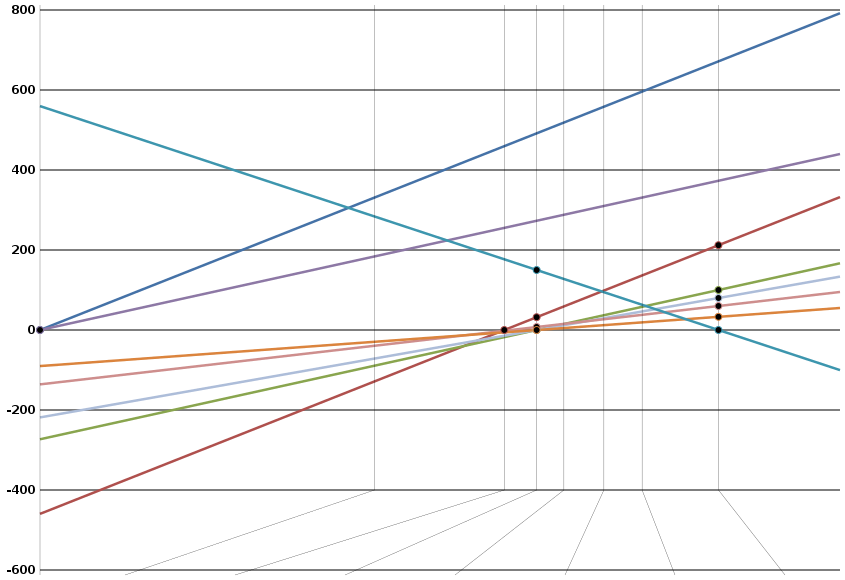 |
Rankine (°R) | |||||||||
| Kelvin (K) | ||||||||||
| Fahrenheit (°F) | ||||||||||
| Celsius (°C) Réaumur (°Ré) Rømer (°Rø) Newton (°N) | ||||||||||
| Delisle (°D) | ||||||||||
| Absolute zero | Lowest recorded surface temperature on Earth[1] | Fahrenheit's ice/water/salt mixture | Melting point of ice (at standard pressure) | Average surface temperature on Earth (15 °C) | Average human body temperature (37 °C) | Highest recorded surface temperature on Earth[2] | Boiling point of water (at standard pressure) | |||
Conversion table between the different temperature units
[edit]




Converting units of temperature differences
[edit]Converting units of temperature differences (also referred to as temperature deltas) is not the same as converting absolute temperature values, and different formulae must be used.
To convert a delta temperature from degrees Fahrenheit to degrees Celsius, the formula is {ΔT}°F = 9/5{ΔT}°C.
To convert a delta temperature from degrees Celsius to kelvin, it is 1:1 ({ΔT}°C = {ΔT}K).
See also
[edit]Notes and references
[edit]- ^ a b c d The Coldest Inhabited Places on Earth; researchers of the Vostok Station recorded the coldest known temperature on Earth on July 21st 1983: −89.2 °C (−128.6 °F).
- ^ a b c d "World: Highest Temperature". Arizona State University, School of Geographical Sciences. November 12, 2007. Archived from the original on January 4, 2013.
an Italian weather station in al 'Aziziyah (Libya) measured a temperature of 58 °C (136.4 °F) on September 13th 1922. "Although this record has gained general acceptance as the world's highest temperature recorded under standard conditions, the validity of the extreme has been questioned."
- ^ Wong, Lena (1997). Elert, Glenn (ed.). "Temperature of a healthy human (body temperature)". The Physics Factbook. Retrieved 2018-06-07.

Conversion of scales of temperature
View on GrokipediaFundamentals of Temperature Scales
Definition and Historical Context
Temperature is a fundamental physical quantity that quantifies the degree of hotness or coldness of a substance or environment, corresponding to the average kinetic energy of its microscopic particles in thermal equilibrium.[4][5] This measure enables the comparison and prediction of thermal behaviors across systems, serving as a cornerstone for fields like thermodynamics and meteorology.[6] Early human understanding of temperature relied on qualitative sensations of warmth or chill, without numerical precision, until the late 16th century when quantitative devices emerged. In 1593, Italian physicist Galileo Galilei invented the thermoscope, an air-expansion device that visually indicated relative temperature changes by the rise or fall of liquid in a tube, though it lacked a calibrated scale.[6][7] Around 1612, Italian physician Santorio Santorio refined this into the first clinical thermometer, a sealed tube used to measure body heat variations for medical diagnostics, marking an initial step toward practical application.[8][9] The 18th century saw the establishment of standardized numerical scales, driven by advances in glassblowing and liquid-filled thermometers. In 1724, German physicist Daniel Gabriel Fahrenheit developed the Fahrenheit scale using mercury in a sealed tube, defining fixed points such as the temperature of an ice-salt mixture at 0°F and the human body temperature at around 96°F for reproducibility.[10] Swedish astronomer Anders Celsius proposed his centigrade scale in 1742, initially setting water's boiling point at 0° and freezing point at 100°, which was later inverted by colleagues for intuitive use with freezing at 0°C.[6] These innovations shifted temperature measurement from relative indicators to absolute, comparable values essential for scientific experimentation.[7] Standardization became critical in the 19th and 20th centuries to ensure consistency across global scientific, industrial, and everyday contexts, facilitating accurate data exchange in physics, engineering, and weather reporting. In 1848, British physicist William Thomson (Lord Kelvin) introduced an absolute scale starting from zero thermal energy, laying groundwork for thermodynamic principles.[6] The International System of Units (SI), formalized through agreements by the General Conference on Weights and Measures, designated the kelvin as the base unit of thermodynamic temperature in 1954 (with the name 'kelvin' officially adopted in 1967), with the Celsius scale (°C) defined as a derived unit where 0°C equals 273.15 K; this relation was preserved in the 2019 redefinition of the SI, which fixed the Boltzmann constant at exactly 1.380649 × 10^{-23} J/K, defining the kelvin without reference to the triple point of water.[6][11][12]Absolute vs. Relative Scales
Absolute temperature scales, also known as thermodynamic scales, define their zero point at absolute zero, the theoretical lowest temperature where a system possesses no thermal energy and molecular motion ceases.[13] This zero corresponds to the point of minimum entropy in thermodynamics, providing a universal reference for measuring thermal energy content.[14] Such scales ensure that all temperatures are non-negative, aligning with the physical impossibility of extracting heat from a system at absolute zero without work, as per the third law of thermodynamics.[15] In contrast, relative or arbitrary temperature scales set their zero point based on convenient, empirically chosen reference points, such as the freezing or boiling of specific substances like water, without direct relation to absolute zero. These scales, exemplified by Celsius and Fahrenheit, allow negative values, which lack physical significance in terms of thermal energy but facilitate practical measurements.[16] The choice of zero is thus conventional, prioritizing usability over thermodynamic fundamentality. A key feature shared by both absolute and relative scales is the concept of equal intervals, where each unit division represents an identical increment in temperature, ensuring that differences between readings correspond to equivalent changes in thermal energy.[17] This linearity allows consistent comparisons of temperature changes across the scale, though the size of the interval varies between scales (e.g., one Celsius degree equals 1.8 Fahrenheit degrees).[18] Absolute scales are essential for scientific calculations involving thermodynamic processes, such as the ideal gas law (PV = nRT), where temperature must be measured from absolute zero to accurately relate volume, pressure, and thermal energy.[19] Relative scales, while suitable for everyday applications like weather reporting, cannot be directly substituted in such equations without adjustment, as their arbitrary zero would yield incorrect results for phenomena like gas expansion or heat transfer.[20] For instance, the Kelvin scale serves as the SI base unit for absolute temperature, while the Rankine scale provides the imperial equivalent, both maintaining equal interval sizes to Celsius and Fahrenheit, respectively.[21][22] Regarding additive properties, absolute temperatures permit meaningful subtraction for differences (e.g., ΔT in heat capacity calculations) and ratios (e.g., doubling temperature doubles kinetic energy in ideal gases), directly reflecting physical quantities in thermodynamics.[23] Relative temperatures, however, do not support such operations without offset corrections, as adding values like 20°C and 30°C lacks physical interpretation for total energy, whereas absolute scales like Kelvin enable direct use in additive contexts such as averaging molecular speeds or entropy changes.[24] For example, the Kelvin scale is absolute, while Celsius is relative but offset by 273.15 from Kelvin.[13]Primary Modern Scales
Celsius Scale
The Celsius scale, also known as the centigrade scale, is a relative temperature scale defined by setting the freezing point of water at 0°C and the boiling point of water at 100°C under standard atmospheric pressure of 1 atm (101.325 kPa).[25] This division into 100 equal intervals between these fixed points provides a practical metric for measuring temperature changes in everyday and scientific applications.[26] The scale was proposed in 1742 by Swedish astronomer Anders Celsius, who initially assigned 100° to the freezing point and 0° to the boiling point to avoid negative values in typical human environments; however, shortly after his death in 1744, the scale was reversed by botanist Carl Linnaeus to its modern orientation for greater practicality.[27] In 1948, the 9th General Conference on Weights and Measures (CGPM) officially adopted the name "degree Celsius" to honor its originator and distinguish it from the generic term "centigrade," which could imply a hundredth of a grade in angular measurement.[25] Today, the Celsius scale serves as the standard for meteorology, cooking, and non-scientific contexts in most countries worldwide, except the United States, where the Fahrenheit scale predominates for these purposes.[28] It relates to the absolute Kelvin scale by the equation t/°C = T/K − 273.15, where the interval size is identical such that a change of 1°C equals a change of 1 K.[25]Fahrenheit Scale
The Fahrenheit scale defines the freezing point of water at standard atmospheric pressure (1 atm) as 32°F and the boiling point as 212°F, dividing the interval between these fixed points into 180 equal degrees.[6] This results in a finer granularity compared to scales like Celsius, where the same interval spans 100 degrees.[1] Developed by German physicist Daniel Gabriel Fahrenheit, the scale was first detailed in a 1724 publication in the Philosophical Transactions of the Royal Society.[29] Initially, Fahrenheit calibrated his mercury thermometers using the freezing point of a brine mixture (water, ice, and ammonium chloride) as 0°F for a reproducible low reference, and the average human body temperature as 96°F, though this was later refined to 98.6°F.[30] He adjusted the scale to incorporate water's freezing and boiling points at 32°F and 212°F, respectively, enhancing its practicality for scientific and meteorological use.[6] Today, the Fahrenheit scale predominates in the United States for weather forecasts, engineering specifications, and daily life, such as cooking and HVAC systems, while it has been phased out in favor of Celsius in most other nations since the mid-20th century.[31][32] To relate it to the Celsius scale, the conversion formula is , reflecting the 180-degree Fahrenheit span versus 100 degrees Celsius and the 32-degree offset for water's freezing point.[1] An interval of 1°F equates to °C, providing higher resolution for subtle temperature variations in imperial-unit contexts.[1]Kelvin Scale
The Kelvin scale is an absolute temperature scale that serves as the SI base unit for thermodynamic temperature, denoted by the symbol K without a degree sign. It begins at 0 K, defined as absolute zero—the theoretical lowest temperature at which the thermal motion of particles ceases—ensuring no negative values are possible on this scale. The scale's interval is identical to that of the Celsius scale, where a change of 1 K corresponds to a change of 1 °C. The freezing point of water at standard atmospheric pressure is 273.15 K, while the triple point of water (the temperature at which solid, liquid, and vapor phases coexist in equilibrium) is precisely 273.16 K.[1][33] The scale originated from the work of William Thomson, later known as Lord Kelvin, who proposed an absolute thermometric scale in 1848 based on Carnot's theory of heat engines and Regnault's experimental data on air expansion. Thomson's scale shifted the Celsius framework to start at absolute zero, estimated at approximately -273 °C at the time. It was formally adopted as the kelvin (K) by the 10th General Conference on Weights and Measures (CGPM) in 1954, with the triple point of water defined as exactly 273.16 K to provide a reproducible reference for calibration. This definition anchored the scale to a physical fixed point until further refinements.[6][34] In 2019, the CGPM redefined the kelvin in the SI system by fixing the numerical value of the Boltzmann constant at J/K, linking temperature directly to fundamental physical constants rather than water's properties. This change maintains continuity with prior definitions but enhances precision and universality, as the kelvin now derives from the relation between thermal energy and temperature without reliance on material artifacts.[33][13] The Kelvin scale is indispensable in physics and chemistry for applications requiring absolute temperature measurements, such as the ideal gas law , where T must be in kelvins to accurately relate pressure (P), volume (V), amount of substance (n), and the gas constant (R). It underpins international standards in thermodynamics, spectroscopy, and quantum mechanics, enabling consistent global scientific communication and calculations involving entropy, heat capacities, and molecular kinetics.[1]/Physical_Properties_of_Matter/States_of_Matter/Properties_of_Gases/Gas_Laws/The_Ideal_Gas_Law)[33]Rankine Scale
The Rankine scale is an absolute thermodynamic temperature scale, with its zero point defined at absolute zero and the freezing point of water occurring at 491.67 °R.[35] This scale employs the degree Rankine (°R) as its unit, where the size of one degree Rankine is identical to that of one degree Fahrenheit.[35] Consequently, a temperature interval of 1 °R equals 5/9 of a kelvin interval.[36] Proposed in 1859 by Scottish engineer and physicist William John Macquorn Rankine, the scale serves as the imperial equivalent to the Kelvin scale, adapting absolute temperature measurements to Fahrenheit-based degrees for compatibility with English engineering units. The conversion between Fahrenheit and Rankine temperatures is straightforward, given by the relation °R = °F + 459.67, which shifts the zero point to absolute zero while preserving the degree size.[36] Although rarely encountered outside specialized contexts, the Rankine scale remains in use within certain U.S. engineering disciplines, including thermodynamics for imperial-unit calculations like the ideal gas law and select heating, ventilation, and air conditioning (HVAC) applications where absolute temperatures must align with Fahrenheit conventions.[37] Its adoption is niche, primarily supporting legacy systems and computations in industries favoring customary units over the International System of Units (SI).[35]Historical and Less Common Scales
Réaumur Scale
The Réaumur scale (°Re or °R) is a historical temperature scale that defines the freezing point of water as 0 °Re and the boiling point of water as 80 °Re at standard atmospheric pressure (1 atm). Developed using alcohol thermometers, it measures temperature based on the volumetric expansion of the liquid, such as a mixture of alcohol and water, between these fixed points divided into 80 equal intervals. This approach emphasized the physical properties of the thermometer fluid rather than arbitrary divisions, making it suitable for precise measurements in early scientific instruments.[38][39][40] Invented by the French naturalist and physicist René Antoine Ferchault de Réaumur (1683–1757) in 1730, the scale was initially proposed in his work on thermometry to standardize observations in natural sciences. It quickly gained traction for scientific and industrial applications across Europe, particularly in France and Russia, where it supported measurements in fields like wine-making—using wine-spirit thermometers for distillation and fermentation processes—and metallurgy for monitoring material properties during heating. By the mid-18th century, Réaumur thermometers were common in laboratories and workshops, reflecting the era's focus on empirical expansion-based calibration.[38][40][41] The scale's interval corresponds to 1 °Re = 1.25 °C, derived from the ratio of its 80-degree span to the Celsius scale's 100-degree span between the same fixed points. This relationship is expressed by the conversion formula °Re = °C × 4/5. Although influential in the 18th and early 19th centuries, the Réaumur scale declined with the widespread adoption of the metric system and the Celsius scale in France around 1795 and subsequently in other regions, rendering it largely obsolete by the late 1800s except in isolated industrial niches. Today, it persists mainly in historical contexts or specialized references, underscoring its role as an arbitrary relative scale in the evolution of thermometry.[42][40][38]Rømer Scale
The Rømer scale is a historical temperature scale developed by the Danish astronomer Ole Christensen Rømer in 1701, marking it as one of the earliest attempts at a standardized temperature measurement system. Rømer proposed the scale to provide a practical framework for thermometry, using an alcohol-based thermometer to divide the range between two reproducible fixed points into 60 equal parts. This innovation addressed the limitations of earlier, uncalibrated devices by enabling consistent interpolation of temperatures. The scale's defining fixed points were 0 °Rø at the freezing temperature of brine—a saturated solution of water and salt, approximately -14 °C under standard conditions—and 60 °Rø at the boiling point of pure water at normal atmospheric pressure. The freezing point of pure water was established at 7.5 °Rø, while human body temperature was noted at about 22.5 °Rø, reflecting Rømer's interest in physiological applications. These points provided a total span of 60 °Rø from the cold brine reference to boiling water, with the interval between water's freezing and boiling points covering 52.5 °Rø. Historically, the Rømer scale saw limited but notable adoption in Denmark and northern Germany during the early 18th century, primarily for meteorological observations and rudimentary medical diagnostics. It influenced subsequent scales, such as Fahrenheit's, which initially adapted Rømer's framework before refinements. By the mid- to late 1700s, however, the scale fell into obsolescence as more precise and water-based references, like those in the Celsius scale, gained prominence across Europe. The Rømer scale relates to the Celsius scale through the following conversion formula: Conversely, One Rømer degree corresponds to an interval of approximately 1.905 °C (precisely °C), though the scale's uneven calibration relative to modern standards arose from its unique fixed points rather than the familiar ice and steam references.Newton Scale
The Newton scale is a historical temperature scale devised by Isaac Newton, who proposed it in his 1701 publication "Scala Graduum Caloris," published anonymously in the Philosophical Transactions of the Royal Society.[43] In this work, Newton described a linseed oil-based thermometer calibrated with the freezing point of water (melting snow or ice) at 0 °N and the natural heat of the human body at 12 °N, reflecting his aim to quantify heat degrees for philosophical and experimental purposes in chemistry and physics.[44][45] This 12-degree span from the cold reference to body temperature provided a foundational arithmetic progression for measuring thermal sensations and material changes. Newton extended the scale beyond body heat through observations of melting points and fire intensities, estimating the boiling point of water at 33–34 °N depending on atmospheric conditions, with further points such as 48 °N for the melting of tin or bismuth alloys and up to 192 °N for the heat of a small coal fire.[43][44] These extensions relied on both direct thermometer readings for lower temperatures and indirect methods, including his law of cooling, which posited that the rate of heat loss is proportional to the temperature difference from the surroundings.[45] The scale's design allowed for a broad range, from everyday sensations to high-heat phenomena, but its non-uniform reference points led to variants in later applications. Although adopted briefly in 18th-century Europe for scientific thermometry—often inscribed alongside scales like Réaumur and Fahrenheit on instruments—the Newton scale was never standardized and saw limited practical use due to inconsistencies in calibration and the rise of more precise systems.[46][47] In the extended version aligned with water's phase changes (0 °N at 0 °C and 33 °N at 100 °C), the conversion to Celsius is given by °N = °C × (100/33), with each Newton degree approximating 3.03 °C in interval size.[44] By the late 18th century, it had largely fallen out of use, overshadowed by scales offering greater reproducibility.[47]Delisle Scale
The Delisle scale (°De) is an inverted temperature scale named after the French astronomer Joseph-Nicolas Delisle (1688–1768), who invented it in 1732 while serving as a professor at the Russian Academy of Sciences in Saint Petersburg. [48] [49] Unlike conventional scales, it decreases in numerical value as temperature rises, with the boiling point of water fixed at 0°De and the freezing point at 150°De under standard atmospheric pressure. [48] This design measured the contraction of mercury in a thermometer from the boiling point baseline, allowing higher readings for cooler conditions and avoiding negative values for temperatures above boiling in early mercury instruments. [50] Delisle developed the scale during his tenure in Russia (1725–1747), where he contributed to astronomical observations and cartography at the Imperial Academy; the inverted format facilitated precise proportional measurements in scientific calculations, particularly for environmental data in astronomical and navigational contexts. [48] [51] It drew loose inspiration from the contemporaneous Réaumur scale's use of water fixed points but reversed the direction and adjusted the interval for compatibility with mercury thermometers. [52] In 1738, German anatomist Josias Weitbrecht recalibrated it, standardizing the 150°De span between the fixed points to enhance accuracy for broader applications. [48] [53] The scale saw limited adoption, primarily in 18th-century Russia for meteorological, scientific, and maritime navigation purposes, where it remained in use for nearly a century before being supplanted by the Celsius scale in the early 19th century due to the latter's simpler, non-inverted alignment with rising temperatures. [48] [51] Its rarity stems from the practical drawbacks of inversion in everyday use, though it exemplified early efforts to standardize thermometry for empirical science in remote observatories. [48] The relation to the Celsius scale is given by the formula derived from the fixed points: at 0°C (freezing), °De = 150; at 100°C (boiling), °De = 0. [48] For temperature intervals, 1°De equals °C in magnitude, but the inverted direction requires adjusting the sign when converting differences (e.g., a 3°De drop corresponds to a 2°C rise). [48] This 150°De span across the 100°C interval from freezing to boiling enabled finer granularity than some contemporaries, suiting Delisle's astronomical needs for detailed thermal profiling. [51]Conversion Formulas and Methods
Formulas Between Common Scales
The conversion between temperature scales generally follows a linear model of the form , where is the temperature in the target scale, is the temperature in the source scale, is the scale factor representing the relative size of the degree intervals, and is the zero-point offset accounting for differences in the location of zero.[54] This model applies to affine scales like Celsius and Fahrenheit, which share the same physical zero but differ in degree size and reference points, as well as to absolute scales like Kelvin and Rankine.[54] The Celsius (°C) and Fahrenheit (°F) scales, both interval-based with fixed points at the freezing and boiling temperatures of water under standard atmospheric pressure, are converted using .[1] This formula derives from the defining fixed points: 0 °C equals 32 °F, and 100 °C equals 212 °F. The scale factor arises from the interval between these points (100 °C spans 180 °F, so ), while the offset aligns the zeros.[1] The inverse conversion is , obtained by solving the forward equation for °C.[1] The Kelvin (K) scale is an absolute thermodynamic scale with degree intervals identical in size to those of Celsius but with zero at absolute zero (no molecular motion). Thus, the conversion is simply , where the offset 273.15 K is the exact value defined for the triple point of water minus its depression to 0 °C at standard pressure (0.01 °C).[1] The inverse is .[1] By international agreement in the SI system, this offset is exact and does not vary.[54] The Rankine (°R) scale is the absolute counterpart to Fahrenheit, using the same degree size but with zero at absolute zero. The conversion is , where the offset 459.67 °R corresponds to the Fahrenheit value of absolute zero (-459.67 °F).[36] The inverse is .[36] Since both Kelvin and Rankine are absolute scales (no offset between them), cross-conversions rely solely on the scale factor: or , reflecting that one Rankine degree is times larger than one kelvin.[36] These relationships align at the reference point of 0 °C, as shown in the following table of equivalent values:| Scale | Value at 0 °C |
|---|---|
| Celsius | 0 °C |
| Fahrenheit | 32 °F |
| Kelvin | 273.15 K |
| Rankine | 491.67 °R |
General Conversion Principles
Temperature scales are generally defined by assigning numerical values to reproducible fixed points, such as the freezing and boiling points of water under standard atmospheric pressure, and dividing the interval between them into equal degrees. This results in linear scales where temperature readings follow a proportional relationship between the fixed points, allowing conversions between scales to be achieved through affine transformations of the form , where is the scaling factor (ratio of degree sizes) and is the offset (difference in zero points).[15] The general formula for converting a temperature from scale 1 (with fixed points and ) to scale 2 (with fixed points and ) is: This formula preserves the proportional division of the interval between the fixed points, ensuring accurate mapping across scales. To apply this, one must first identify the zero points and degree sizes for each scale. For instance, the Fahrenheit degree is smaller than the Celsius degree by a factor of , reflecting that the interval from freezing to boiling water spans 180°F but only 100°C, while the zero point offset is 32°F below 0°C. Absolute scales like Kelvin and Rankine share the same zero at absolute zero but differ in degree size; thus, conversions between them use a direct ratio without offset: . This framework applies readily to historical scales. For the Réaumur scale, defined with 0°Ré at water's freezing point (matching 0°C) and 80°Ré at its boiling point (matching 100°C), the degree size ratio yields the conversion , derived by scaling the interval proportion with no offset.[55] Virtually all historical temperature scales are linear, enabling conversions via affine transformations; non-linear scales, which would complicate such mappings, are rare and largely confined to early experimental thermometers before standardization.[15] For converting between unknown or less common scales, follow these steps: (1) determine the values of two fixed points (e.g., ice point and steam point) on both scales, (2) compute the slope , and (3) find the intercept using one fixed point via , then apply . These principles underpin the specific formulas for common modern scales.Comparisons and Visual Aids
Numerical Comparison Charts
Numerical comparison charts serve as practical tools for illustrating equivalences and differences among temperature scales, allowing users to reference values directly without computation. These tables focus on key reference points defined by physical phenomena, such as absolute zero and the phase changes of water, as well as physiological and crossover temperatures. The data presented here are based on precise conversion formulas standardized in metrology references. The first table compares absolute temperature values at selected points across all major scales: Celsius (°C), Kelvin (K), Fahrenheit (°F), Rankine (°R), Réaumur (°Re), Rømer (°Rø), Newton (°N), and Delisle (°De). Note that historical scales like Réaumur, Rømer, Newton, and Delisle were primarily calibrated to water's freezing and boiling points, with 0°C corresponding to 0°Re, approximately 7.5°Rø, 0°N, and 150°De, respectively.[56][57][58][59]| Reference Point | °C | K | °F | °R | °Re | °Rø | °N | °De |
|---|---|---|---|---|---|---|---|---|
| Absolute zero | -273.15 | 0 | -459.67 | 0 | -218.52 | -135.98 | -90.14 | 559.73 |
| Triple point of water | 0.01 | 273.16 | 32.02 | 491.69 | 0.01 | 7.50 | 0.00 | 149.99 |
| Freezing point of water | 0 | 273.15 | 32 | 491.67 | 0 | 7.5 | 0 | 150 |
| Crossover (°C = °F) | -40 | 233.15 | -40 | 419.67 | -32 | -13.5 | -13.2 | 210 |
| Human body temperature | 37 | 310.15 | 98.6 | 558.27 | 29.6 | 26.93 | 12.21 | 94.5 |
| Boiling point of water | 100 | 373.15 | 212 | 671.67 | 80 | 60 | 33 | 0 |
| Interval in °C | Equivalent Interval |
|---|---|
| 10 | 10 K 18 °F 18 °R 8 °Re 5.25 °Rø 3.3 °N -15 °De (inverted) |