


Community hub
Recent from talks
Contribute something
Nothing was collected or created yet.
Tharad
View on Wikipedia
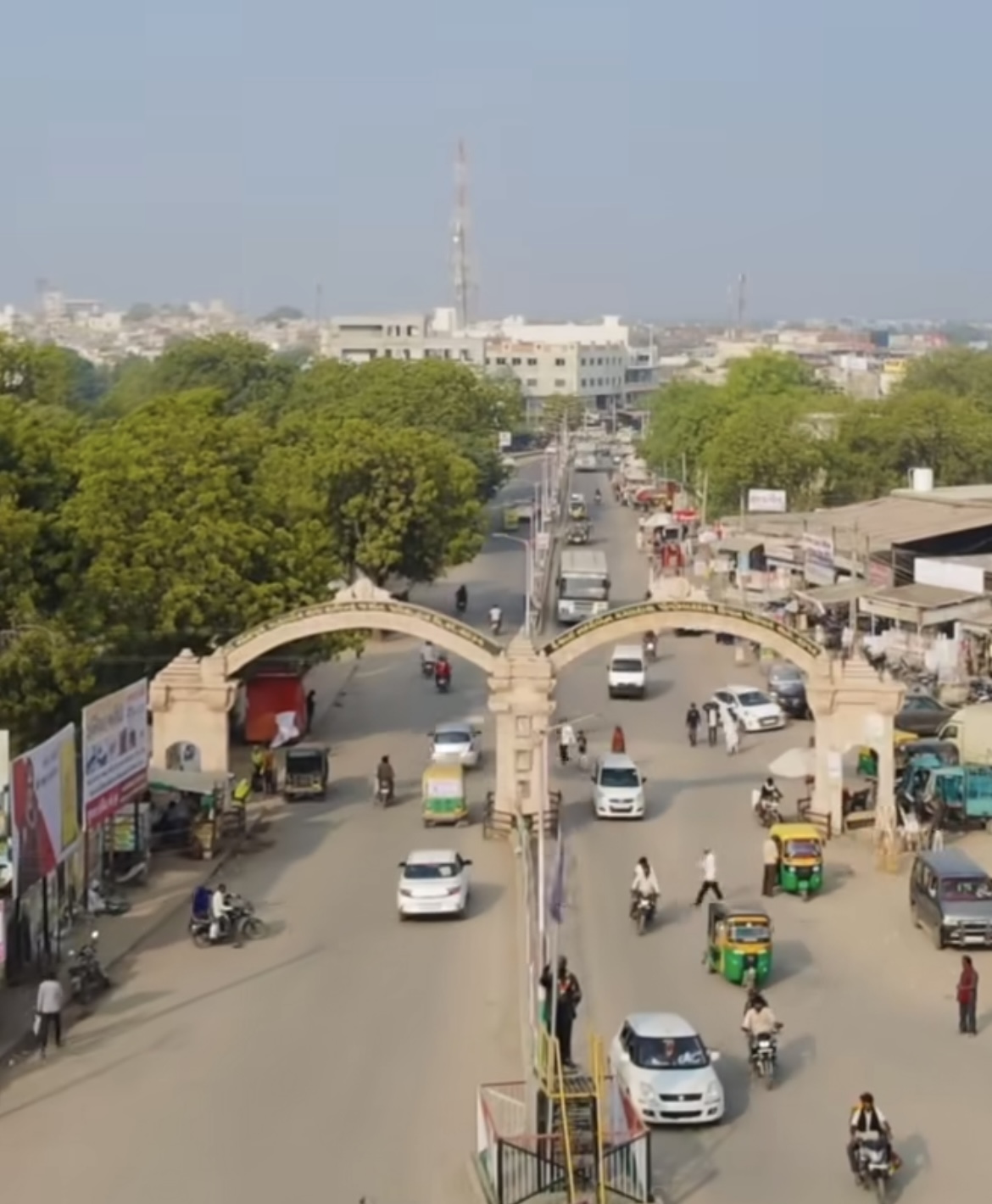
Tharad (historically known as Thirpur) is a administrative center of the Vav-Tharad district. The district consists of 134 villages. Tharad is 45kms from international border with Pakistan and 40kms from the state border with the Rajasthan state. Main industries are agriculture and private businesses. It is one of the first major towns in Gujarat on National Highway 68.
Key Information


History
[edit]The verse, dohra, about the founding of Tharad, states that in 115 (S. 171) Tharpar Parmar, leaving Shripur or Bhinmal in Marwad, went to the west and established the city of Tharad. The town continued in the hands of the Parmars till the tenth century, when it was taken by Chaulukya king Mularaja (r. c. 940 – c. 995– ).[3]
Tharad is said to have originally belonged to Parmar Rajputs, and many Parmars of the Suvar and Kalma clans were found in subordinate positions in the Tharad villages during British period.[4]
According to a Jain account, the last of the Parmar line became a convert to the Jainism, and resigned his chiefdom to his sister's son, the Chauhan Saregogji Ratansingji of Nadol, an ancestor of the Rana of Vav, in 1275 (Samvat 1331).[3] Others say that the Chauhan killed his maternal uncle and usurped the chiefdom. The Chauhans, with the title of Rana, ruled at Tharad for about six generations, till, in the reign of Rana Punjaji, they were attacked by the Muslims, their capital stormed, and their chief slain. Another account says that the Chauhan Rajputs were driven out by the Rathods of Jodhpur, who were succeeded by the Muslims in fifteenth century.[4]
Henceforward Tharad was held by Muslim rulers and for several generations a family with the patronymic Multani ruled as proprietors, Jagirdars, and commandants, Thandars. As civil administrators of an isolated crown holding, they were invested with the title of Diwan which was continued during British period.[5]
This Muslim conquest probably took place in the reign, either of Muhammad Shahab-ud-din Ghori (1174-1206) or of Kutbud-din Aibak (1206-1210). In the later monarch's reign, the change of capital from Lahore to Delhi, and his numerous wars, made the Multani family's position very difficult. That they were able to hold their own was due to the aid of a family of Naiks, had become converts to Islam. In return for their services, the Naik family received the grant of several villages which they held till British period. At this time the smaller estates were chiefly in the hands of vassals of the Gohil and Parmar clans. Kubhara and Ledan were held by Chauhans; Duva, Roha, and Tithgam by the Bhildia Vaghelas of Bhildigad; Eta Village and other villages by the descendants of Chibhadiya Brahmins who held them from the Rathods of Kanauj, and the rest by owners of whom scarce a trace remains.[5]
After the Muslim conquest of Tharad, the wife of Rana Punjaji, a Sodhi by caste, fled with her infant son to her father's house at Parkar. On growing up, her son Vajoji, returning to Tharad in 1244 built a stepwell, vav, and, successfully beating off the attacks of the Multanis, took the title of Rana, and, after his well, called his town Vav. His descendants rule there till British period. Compared with that of the Multani family, the cause of the Vav Rana was popular, and though for fear of drawing on themselves the army of the Patan governor, they dared not attempt to win back Tharad, they slowly spread their rule over many of the smaller holdings, and built up a fairly powerful chiefdom. Their cadets gradually won back many of the Tharad holdings, turning out the Gohil Suvar and Kalma Rajputs, but continuing to hold their estates from Tharad whose ruler they probably propitiated with gifts, nazaranas. In this way most of the smaller Tharad fiefs fell into the hands of Nadola Chauhans, cadets of the Vav house or of the old Ranas of Tharad by whom they are still held.[6]
On the rise of the Gujarat Sultanate (1403), the Multani family became their vassals. Later on Fateh Khan Baloch, one of the chief Gujarat nobles, held Tervada and Radhanpur, ousting the Multani family who sank into obscurity, and hold only the Tharad village of Kothigam by the end of British period.[7]
When, about 1700, the Jhalori family were driven from Jhalor and settled at Palanpur, Firoz Khan Jhalori obtained the chief power at Tharad. This lasted only a short time. About 1730, Tharad was given to Jawan Mard Khan Babi of Radhanpur State. Very soon after, when Abhaysinh of Jodhpur (1730 - 1737) was Viceroy, the Babi was turned out, and in his place a deputy was stationed at Tharad.[7]
The next ruler of Tharad was Chauhan Jetmalji, a cadet of the Vav house, who established himself there in 1736. In the following year, Rana Vajrajji, the head of the Vav house, fearing that Jetmalji might prove a dangerous rival, invited Bahadur Khan of Palanpur to oust him. Bahadur Khan agreed, and, driving out Jetmalji, kept the chiefship in his own hands. Within a few years (about 1740), the district was given either as an estate, jaghirdari, or as a charge, faujdari, to Nawab Kamal-ud-din Khan, till, in 1759, he handed it over to Vaghela Kanji, chief of Morvada, one of the supporters of the Babi family. This Kanji belonged to the Sardhara branch of the Vaghela tribe who took their name from the conquest of Sardhargadh in Saurashtra. This fortress, conquered by Vaghela Muluji from Churasam Bhim, was held by the Vaghelas for three generations. Then Vaghela Lunaji was expelled by Vibhojt, the head of the Jadeja house of Rajkot. Lunaji conquered Radhanpur, Varihi, Khorda, Santalpur, and Gidi in Kutch. In 1479 (Samvat 1535) one of his descendants, Rana Visal Dev, conquered Morvada, slaying its Chavod chief Magaji, and since then Kanji's forefathers have held Morvada.[7]
Kanji, before his death (1786), succeeded in making himself independent of his former patron. He was succeeded by his brother Harbhamji. About this time (1819), Tharad being much harassed and almost unpeopled by the raids of Khosas and other desert plunderers, the chief Harbhamji approached the British. In 1820, after the Khosas bad been driven out, the chief entered into an agreement with the British and Gaekwad on 14 February 1821 and became protectorate. In 1823 Harbhamji died and was succeeded by Karansing.[8] In 1859 Karansing died and was succeeded by Khengarsing. Khengarsig died in 1892 and was succeeded by Abhaising who died in 1910. His successor Daulatsinh ruled from 1910 to 1921 when he died. Bimsinhji succeeded him and ruled until independence of India in 1947.
Tharad was under Palanpur Agency of Bombay Presidency,[9] which in 1925 became the Banas Kantha Agency and ruled by Vaghela chieftains.[10] After Independence of India in 1947, Bombay Presidency was reorganized in Bombay State. When Gujarat state was formed in 1960 from Bombay State, it fell under Banaskantha district of Gujarat.
Places of interest
[edit]Nandevi Temple
[edit]_Temple_in_Tharad_18.jpg)
Outside the town, there is an old Hindu temple with an illegible inscription cut in stone. According to the local story, about 700 years ago before Chauhan Ratansing was driven out of Nadol, his family goddess Ashapura commanded him to leave Nadol, and, going westward, to settle in a place where the rope of his wagon should break. Starting off, the rope broke near Tharad. Here he stopped, and, in time, subduing the country round built a temple, calling it in honour of his goddess Nan Devi.[11] The original shrine was probably built in 12th century by Ratansing.[12]
Jain centres
[edit]Tharad is an ancient Jain Pilgrimage centre hosting several Jain temples, viz., Shri Jamkaar Devi Mataji Temple, Shree Mota Mahaveer / Adinath Sw. Jain Temple, Kanku Chiman Vihar Dham, Sakal tirth derasar, Jayantsen suri guru mandir, and more.[13]
Health and education
[edit]Tharad has seven government-run primary schools, and three high schools namely Rajeshwar Adarsha Vidyalaya, Janta High School and Gayatri Vidyalaya, Tharad. It also has an Arts, Commerce, and Science colleges run by the Shri Anjna Patel Kelvani Trust. In 2009, the government established a government arts and commerce college. The town has many public and privately run hospitals like J.J. hospital, Dharati hospital, including a large referral hospital and a public health centercenter. Also private school like M.S.vidhyamandir, Dharnidhar reading library,[14] & many more private institutes.
Transportation
[edit]Tharad is also a transportation center, with over 300 buses linking the town with various parts of Gujarat and Rajasthan. You can get direct bus connectivity from all major centres in Gujarat.
Economy
[edit]Economy largely depends on agriculture and trade. The Central Agriculture Market Yard represents the economic center of the town where farmers can auction their products. There are many dairy cooperatives, and a cold storage is located nearby. Tharad also has a major jewellery market.
Notable people
[edit]Gautam Adani - owner of Adani Group, his ancestors was from this town.
Parbatbhai Patel - former MP
Shankar Chaudhary - MLA Tharad
References
[edit]Notes
[edit]- ^ "Gujarat, District Census Handbook, Banas Kantha, Village And Town Wise, Primary Census Abstract (PCA)" (PDF). Series-25. Directorate Of Census Operations, Gujarat. 24 June 2015. p. 32. Archived (PDF) from the original on 13 November 2015. Retrieved 10 February 2022.
- ^ "Census of India: Search Details for Id=569377". censusindia.gov.in. Retrieved 10 February 2022.
- ^ a b Bombay Presidency 1880, p. 348.
- ^ a b Bombay Presidency 1880, p. 329, 348.
- ^ a b Bombay Presidency 1880, p. 329.
- ^ Bombay Presidency 1880, p. 329-330.
- ^ a b c Bombay Presidency 1880, p. 330.
- ^ Bombay Presidency 1880, p. 330-331.
- ^ Chisholm 1911, p. 785.
- ^ Raza, Moosa (1995). Of Nawabs and Nightingales & Other Episodes. New Delhi, India: Rupa & Company. pp. 104: to the great Gaekwads of Baroda, and fought pitched battles with the Koli cheiftains of Tharad and Wav, was a diminutive man, not more than five feet tall and slight of build. What he lacked in height and build, he made up amply in dignity. He had come down. ISBN 978-81-7167-299-8.
- ^ Bombay Presidency 1880, p. 349.
- ^ India (Republic). Superintendent of Census Operations, Gujarat (1964). Banaskantha. Director, Government Print. and Stationery, Gujarat State. p. 38.
- ^ "Welcome to Panchsohvora Parivar". Archived from the original on 27 October 2020.
- ^ "Dharnidhar reading library, Banas Kantha, gujarat, India". indiasthan.com. 23 January 2021. Retrieved 10 February 2022.
Bibliography
[edit]- Bombay Presidency (1880). Gazetteer of the Bombay Presidency. Vol. 5: Cutch, Pálanpur, and Mahi Kántha. Bombay: Government Central Press. pp. 328–331, 348–349. OCLC 908987611. Retrieved 10 February 2022.
- Chisholm, Hugh, ed. (1911). . Encyclopædia Britannica. Vol. 22 (11th ed.). Cambridge University Press.
External links
[edit]
 This article incorporates text from a publication now in the public domain: Gazetteer of the Bombay Presidency, V. 5, 1880
Tharad
View on GrokipediaGeography and Demographics
Location and Physical Features
Tharad is located in the Vav-Tharad district of northern Gujarat, India, at approximately 24°24′N 71°38′E, adjacent to the Rajasthan state border.[8] Previously part of Banaskantha district until its bifurcation in early 2025, the town serves as an administrative center in this arid northern region.[9] The terrain surrounding Tharad consists of flat, semi-arid plains characteristic of the fringes of the Thar Desert, with undulating sandy expanses and low elevations around 10 meters above sea level.[10] These plains support limited agriculture, influenced by the nearby West Banas River, which drains a watershed of about 1,876 square kilometers and contributes to seasonal water availability despite prevalent scarcity.[11] Groundwater in the Tharad area is often saline, exacerbating aridity and limiting reliable irrigation.[11] Tharad's strategic position enhances its connectivity, lying along National Highway 68, which links it to key routes extending toward Rajasthan and southern Gujarat, including planned high-speed corridors to Ahmedabad.[12] This proximity to transport arteries underscores the town's role in regional transit across the semi-desert landscape.[13]
Climate and Environment
Tharad lies in a semi-arid climatic zone typical of northern Gujarat, with hot summers and mild winters. Average annual rainfall measures 578.8 mm, almost entirely confined to the southwest monsoon period from June to September, rendering rivers ephemeral and reliant on seasonal flows.[11] Summer daytime temperatures routinely surpass 45°C, with regional maxima approaching 49°C during peak heatwaves, while winter minima dip to around 10–12°C.[14] [15] Groundwater depletion poses a primary environmental challenge, driven by extensive tubewell extraction for agriculture amid limited recharge from erratic monsoons.[16] [11] Water tables in Banaskantha district, including Tharad taluka, have shown consistent decline, exacerbated by the semi-arid hydrology where post-monsoon dryness limits natural replenishment.[17] Desertification risks amplify this vulnerability through soil erosion and vegetation loss in unirrigated fringes bordering the arid Thar landscape.[18] Irrigation infrastructure, notably branches of the Narmada Main Canal network, counters depletion by diverting surface water to supplement groundwater in Banaskantha's command areas, enabling expanded cultivation without sole reliance on aquifers.[19] [20] However, agricultural intensification introduces soil salinity, stemming from irrigation with marginal-quality canal water and inherent brackish groundwater, which raises sodicity levels and impairs crop yields on poorly drained soils.[21] [22] Farmers mitigate these pressures via adaptive techniques, including pressurized irrigation networks and micro-irrigation systems that optimize water delivery, curtail evaporation, and minimize salt accumulation compared to flood methods.[23] [19] Such practices, supported by Gujarat's state initiatives, have stabilized yields for salt-tolerant crops like cotton and millet in Tharad's agro-ecology.[22]Population and Demographics
According to the 2011 Indian census, Tharad municipality had a total population of 27,959, comprising 14,557 males and 13,402 females.[24] The town's population density stood at approximately 1,897 persons per square kilometer, reflecting its status as an urban center within a predominantly rural taluka.[4] Post-2011 estimates project the municipal population at around 40,000 by 2025, driven by an average annual growth rate of about 2.5%, consistent with regional urbanization trends and the influx of administrative functions following the formation of Vav-Tharad district in January 2025.[24] This growth outpaces Gujarat's statewide decadal rate of 19.3% from 2001-2011, attributable to improved infrastructure and economic opportunities in pastoral and trade sectors.[24] Religiously, the 2011 census recorded Hindus as the majority at 78.51% (21,946 individuals), followed by Muslims at 18.83% (5,267), Jains at 2.48% (694), and negligible shares of Sikhs (0.12%), Buddhists (0.02%), and others.[24] These figures indicate a more diverse composition in the urban town compared to the surrounding Tharad taluka, where Hindus constitute 96.27%.[25] Socially, the population includes significant Scheduled Caste (14.51% in the taluka) and Scheduled Tribe (2.44%) groups, with pastoral communities such as Rabari and Bharwad prominent among tribal herders adapted to the arid environment.[25] These nomadic or semi-nomadic groups, traditionally engaged in livestock rearing, contribute to the area's rural-urban interface.[26] Literacy in Tharad town was 68.63% per the 2011 census, with male literacy at 80.94% and female at 55.43%, exceeding the taluka average of 59.75% but trailing Gujarat's 78.03% state rate.[24] State initiatives, including Gujarat's literacy enhancement programs under the Sarva Shiksha Abhiyan, have supported gradual improvements, particularly in female education, amid historical challenges from pastoral mobility and economic priorities.[4] Demographically, the urban-rural mix is shifting toward greater urbanization, with the town's share of the taluka's 327,289 residents (2011) increasing due to district headquarters relocation and connectivity enhancements, fostering migration from surrounding villages.[5]History
Ancient and Medieval Origins
Tharad, known in ancient texts by names such as Thirpur, Tharapadra, and Thirapadra, traces its origins to Vikram Samvat 101 (approximately 44 CE), when it was founded as a settlement by the ruler Thirpal Dharu.[27] His sister, Harku, is recorded in Jain traditions as constructing a large temple there, establishing the site as an early center for Jain worship.[27] These foundational developments reflect the spread of Jainism in western India during the early centuries CE, driven by royal and mercantile patronage that linked religious infrastructure to local governance and economic stability. During the medieval period, Tharad benefited from Solanki dynasty support, with King Kumarpal (r. 1143–1172 CE) credited in historical accounts for constructing a Jain site named Kumar Vihar, underscoring the dynasty's broader promotion of Jain institutions across Gujarat.[28] This patronage aligned with causal factors such as political alliances with Jain scholars like Hemachandra and efforts to consolidate rule through religious endowments, fostering temple-building as a means of legitimacy and cultural continuity. By Vikram Samvat 136 (approximately 79 CE), Thirpal Dharu installed metal idols of Ajitnath Bhagwan, employing alloy techniques typical of early Jain iconography for durable, symbolic representations of tirthankaras.[27] A significant expansion occurred in Vikram Samvat 1444 (1387 CE), when a grand Jain temple complex housing 52 idols of various tirthankaras was erected, marking Tharad's evolution into a recognized tirtha or pilgrimage site.[28] [29] This structure, described in Jain records as vast and elevated, facilitated ritual installations, including five panch-dhatu (five-metal alloy) idols of Ajitnath Bhagwan, each 78 cm tall and depicted in lotus posture, which were ceremonially consecrated to invoke spiritual protection and communal devotion.[27] Tharad's strategic position along overland paths connecting Gujarat's coastal ports to Rajasthan's interior markets positioned it as a nodal point in medieval trade networks, where Jain merchants likely contributed to the site's prosperity through endowments tied to commerce in textiles, metals, and spices.[30] These elements—temple foundations, royal installations, and trade facilitation—causally reinforced Tharad's identity as a Jain stronghold amid regional dynastic shifts.Colonial and Post-Independence Developments
During the British colonial era, Tharad was administered as part of the Palanpur Agency, a grouping of princely states under indirect rule within the Bombay Presidency, where local rulers maintained autonomy in exchange for tribute and loyalty to the Crown.[31] This structure, which transitioned to the Banas Kantha Agency by 1925, limited direct British intervention, preserving traditional feudal governance and contributing to economic stagnation marked by subsistence agriculture and minimal infrastructure investment.[31] After India's independence, the princely state encompassing Tharad acceded to the Union on June 10, 1948, integrating into Bombay State amid the broader consolidation of princely territories.[32] The 1960 bifurcation of Bombay State along linguistic lines placed Tharad within the newly formed Gujarat, where it functioned as a taluka headquarters in Banaskantha district, supporting local revenue and judicial administration amid early post-independence land reforms aimed at abolishing intermediaries and redistributing holdings to tillers.[31] Subsequent decades saw state-led efforts to modernize agriculture in the arid region, with irrigation expansion playing a key role; national initiatives like the Green Revolution from the 1960s introduced hybrid seeds and chemical inputs, gradually boosting yields in Gujarat's semi-arid zones including Banaskantha.[33] In a notable advancement, Prime Minister Narendra Modi inaugurated projects worth Rs. 8,034 crore on October 31, 2022, in Tharad, including water supply and irrigation schemes to enhance agricultural productivity and address chronic water scarcity.[34] These developments marked a shift from colonial-era inertia toward centralized infrastructure investment, fostering continuity in Tharad's role as a regional trade and administrative hub.[35]Government and Administration
Local Governance Structure
Tharad's urban local governance is administered by the Tharad Nagar Palika, a municipal council established to manage essential services including water supply, waste management, street lighting, and urban planning within the town's limits.[36] This body operates under the Gujarat Municipalities Act, 1964, which empowers it to levy property taxes, user charges, and other local revenues to fund operations and infrastructure maintenance.[37] The Nagar Palika consists of elected councilors representing wards, overseen by a chief officer appointed by the state government, reflecting Gujarat's emphasis on decentralized urban administration to address locality-specific needs efficiently. At the taluka level, Tharad falls under a revenue administration structure led by a Mamlatdar, who handles land records, revenue collection, and dispute resolution, integrating with the broader Gujarat Revenue Department framework. Rural villages within Tharad taluka are governed by gram panchayats, forming the base of the three-tier Panchayati Raj system instituted under the Gujarat Panchayats Act, 1993, which promotes grassroots decision-making on issues like irrigation and local development.[38] This setup facilitates coordination between urban and rural governance, with taluka panchayats providing oversight for developmental schemes funded partly through state allocations derived from land revenue and agricultural cesses. The Tharad Vidhan Sabha constituency, encompassing the town and surrounding areas, elects a representative to the Gujarat Legislative Assembly every five years. The Bharatiya Janata Party (BJP) has maintained dominance in recent elections; in December 2022, BJP candidate Shankarbhai Chaudhary secured victory with 79,016 votes, defeating the Indian National Congress opponent by a margin of 26,506 votes.[39] [40] This pattern aligns with BJP's consistent wins in the constituency since 2012, underscoring voter preferences influenced by state-level policies on infrastructure and agriculture. The elected MLA participates in state legislative processes, advocating for local priorities such as water resource management, which remains a key electoral issue in the arid region.Recent District Formation
The Gujarat state cabinet, chaired by Chief Minister Bhupendra Patel, approved the creation of Vav-Tharad district on January 1, 2025, by bifurcating Banaskantha district, with Tharad designated as the administrative headquarters.[41][42] This marked Gujarat's 34th district, comprising eight talukas—Vav, Bhabhar, Tharad, Dhanera, Suigam, Lakhni, Deodar, and Kankrej—previously part of Banaskantha, which retained 10 talukas post-division.[9][41] The formal notification occurred on September 25, 2025, with the district becoming operational on October 2, 2025, including appointments for its first collector and district development officer.[1][43] Government officials justified the formation as a measure for administrative decentralization, arguing it would expedite public services, enhance local governance efficiency, and facilitate targeted development in underserved border areas sharing an international boundary with Pakistan.[44][45] This aligned with broader reforms, including the approval of 17 new talukas across the state, aimed at promoting urban-like infrastructure and integrating with national initiatives under Prime Minister Narendra Modi's emphasis on regional connectivity and growth schemes.[46][44] Proponents highlighted potential benefits such as reduced travel burdens for residents in remote talukas and streamlined implementation of rural development programs.[45] Opposition emerged promptly, with protests in talukas including Dhanera, Kankrej, and Deodar, where residents and local leaders, such as independent MLA Mavji Desai, objected to their inclusion, citing preferences to remain under Palanpur's Banaskantha administration to avoid longer travel to Tharad for services.[47][48] The Congress party and community groups criticized the process for insufficient consultation, raising concerns over resource fragmentation—such as divided budgets and duplicated administrative posts—and potential strains on fiscal capacity in a newly formed entity.[48][49] Some talukas initially withheld participation, prompting government invitations for written representations and dialogues to address local apprehensions, though tensions persisted into early 2025 with detentions during demonstrations.[50]Religious and Cultural Heritage
Jain Pilgrimage Centers
Tharad hosts several significant Jain pilgrimage centers, primarily clustered around ancient temple complexes that preserve Svetambara traditions. The Shri Tharad Tirth stands as the foremost site, featuring a main temple constructed in the Vikram Samvat 1444 (circa 1387 CE), originally housing 52 idols in a grand structure attributed to historical benefactors including Maharaja Kumarpal, who established an associated vihara known as Kumar Vihar.[30][28] The site's mulnayak consists of five panchadhatu (mixed metal) idols of Ajitnath, the second Tirthankara, depicted in padmasana (lotus posture) and measuring 78 centimeters in height, believed to embody celestial artistry and installed through ceremonial processes documented in local traditions.[27] These metal idols, resistant to corrosion and symbolizing Jain principles of non-attachment and ascetic endurance, form the core of devotional practices that draw pilgrims seeking spiritual merit. Adjacent complexes include the Shree Mota Mahavir Svetambara Jain Temple, dedicated to Mahavira, the 24th Tirthankara, and temples enshrining Adinath, the first Tirthankara, collectively housing over 100 idols across shrines dating to the medieval period. Historical records reference installations from the 13th Vikram century (circa 12th-13th CE), such as those by Shreesthi Ahaladan, an army commander who enshrined Chandraprabha idols, underscoring Tharad's role as a longstanding hub for Jain iconography and ritual continuity.[27] Architectural elements, including intricate carvings and elevated shrines from the Vikram era, reflect Solanki-influenced designs adapted for arid regional conditions, facilitating year-round access despite Tharad's desert proximity. Dharamshalas (pilgrim rest houses) attached to these tirths provide lodging, supporting extended stays for rituals like abhisheka (anointing) and parikrama (circumambulation). These centers sustain annual pilgrimages, particularly during festivals aligned with Jain calendrical events, fostering cultural preservation through community-sponsored renovations and scriptural recitations. While specific visitor statistics for Tharad remain undocumented in broader tourism data, the influx of domestic Jain devotees from Gujarat and neighboring states stimulates local commerce in prasada (offerings), transport, and hospitality, mirroring the economic multiplier effects observed in regional spiritual tourism where pilgrim spending bolsters small-scale vendors and service providers.[30] This pilgrimage ecosystem underscores Tharad's niche in maintaining Jain heritage amid modernization, with sites serving as repositories for artifacts that verify historical patronage and doctrinal fidelity.Nandevi Temple and Hindu Sites
The Nandevi Temple, dedicated to Ashapura Mataji—a manifestation of the Hindu goddess Durga—is a key Hindu religious site situated outside Tharad town in Gujarat's Banaskantha district. Local tradition attributes the installation of the temple's idol to Thirpal Dharu, a figure said to have founded the ancient settlement of Thirpur, the precursor to modern Tharad. This connection underscores the temple's role in the region's early Hindu devotional practices, particularly among communities venerating maternal deities for protection and prosperity.[7] Devotees frequent the temple during major Hindu festivals, including Navratri, when rituals and gatherings emphasize Devi worship traditions prevalent in Gujarat. These events draw local Hindu populations, fostering communal participation amid Tharad's predominant Jain heritage, thereby highlighting the town's religious pluralism. Annual observances reinforce social ties within Hindu pastoral and agrarian groups, integrating temple rites with regional customs.[52] Additional Hindu sites in Tharad include the Hanuman Temple, Shiv Mandir, and Bahuchar Mata Temple, which serve local worship needs for deities associated with strength, Shiva, and prosperity. These temples complement the Nandevi site, supporting diverse Hindu rituals and contributing to the cultural fabric without overlapping with Jain pilgrimage focuses.[53]Cultural Festivals and Traditions
Tharad's cultural festivals emphasize religious devotion and communal gatherings, drawing from Hindu, Jain, and Rabari influences prevalent in the region. Navratri, spanning nine nights in the Hindu month of Ashwin (typically September-October), features widespread participation in garba and dandiya raas dances across public venues and near Hindu temples. Devotees engage in processions, aarti rituals, and fasting, with heightened activity around sites dedicated to deities like Ashapura Mata. These celebrations foster social bonding and stimulate local commerce through sales of garba attire, sweets, and handicrafts, though specific attendance figures remain undocumented in official records.[54] The Jain community observes Paryushan Parva, an annual eight- to ten-day festival in Bhadrapad (August-September), focused on introspection, fasting, and seeking forgiveness via the phrase micchami dukkadam. Tied to Tharad's Jain temples, it involves temple visits, scripture recitations from the Kalpa Sutra, and vows of non-violence, aligning with the sect's emphasis on spiritual purification. Participation underscores the city's role as a pilgrimage hub, though empirical data on attendance is limited.[55] Rabari pastoral traditions manifest in folk practices during broader festivals like Holi and Diwali, including communal dances, songs, and livestock-related rituals that highlight animal husbandry. Local fairs in Tharad taluka, organized by associations such as the Tharad Taluka Fair Prize Association, facilitate trade in cattle and embroidered goods, preserving Rabari customs amid semi-nomadic heritage. These events contribute to seasonal economic upticks via barter and sales, reflecting empirical patterns in Gujarat's tribal economies.[56][57]Economy
Primary Sectors and Agriculture
Tharad's economy is anchored in agriculture, which employs the majority of the population and centers on drought-resistant crops including pearl millet (Bajri), cotton, and mustard (Rai), supplemented by dairy production and pastoral livestock rearing. In Banaskantha district, encompassing Tharad, crop cultivation remains the predominant activity, with mustard achieving notable prominence; Tharad taluka leads in mustard area sown and output, driven by its suitability to the semi-arid soils and rabi-season cultivation patterns.[58][59] Dairy farming contributes substantially, leveraging cooperative networks that position Banaskantha as a key milk-producing hub in Gujarat, with average yields supported by fodder from local fields.[58] Irrigation infrastructure, particularly from the West Banas project and extensions of Narmada canal networks, has enhanced productivity by expanding cultivable area and stabilizing water supply in this rain-fed zone; for instance, recent initiatives have irrigated additional hectares through pipeline systems filling local lakes, boosting crop yields amid variable monsoons.[60] Pastoral elements persist through Rabari communities, who herd sheep, goats, and camels, adapting traditional migration to seasonal pastures while integrating with crop residues for feed; livestock products are channeled to markets in Palanpur, the district headquarters, fostering linkages between herding and settled farming.[61] Persistent water scarcity poses challenges, exacerbated by groundwater depletion in the arid north Gujarat terrain, yet state interventions including subsidies for farm mechanization—such as tractors and drip systems—have promoted efficiency gains, reducing labor dependency and input costs by 10-15% in adopting areas.[19][62] These measures, alongside micro-irrigation subsidies covering upfront costs, have incrementally raised productivity, though adoption varies due to initial capital barriers for smallholders.[23]Industrial Growth and Infrastructure Projects
In August 2024, the Indian government approved the construction of the 214-km, six-lane Tharad-Deesa-Mehsana-Ahmedabad National High-Speed Corridor, a Rs 10,534 crore access-controlled highway project aimed at enhancing regional connectivity under the Bharatmala Pariyojana.[63][64] This corridor links Tharad to major economic centers, facilitating faster logistics and freight movement, which is projected to attract industrial investments by reducing travel time to Ahmedabad from over six hours to under three.[65] The project, developed on a build-operate-transfer basis, aligns with national efforts to integrate border areas like Tharad into broader economic corridors, potentially spurring small-scale manufacturing and warehousing hubs in the region.[12] Complementing this, Prime Minister Narendra Modi laid the foundation stone in October 2022 for water supply infrastructure projects worth Rs 8,034 crore initiated from Tharad, including the Kasara-Dantiwada pipeline from the Narmada main canal and augmentation of the Gagodara-Diyodar pipeline.[66][67] These schemes address chronic water scarcity in Banaskantha district, providing reliable irrigation and industrial-grade water to support emerging non-agricultural activities, with capacities to supply over 100 million liters per day to local towns and industries.[34] By improving resource availability, the initiatives create causal preconditions for industrial expansion, as evidenced by similar Gujarat projects that correlated with a 15-20% rise in manufacturing output in water-stressed areas post-implementation.[68] The prospective elevation of Tharad to district status in September 2025 has further accelerated infrastructure momentum, enabling streamlined approvals for foreign direct investment and industrial land allocation under Gujarat's Industrial Policy 2020, which offers incentives like subsidized power and tax rebates for new units in underdeveloped talukas.[69] This administrative upgrade, combined with the highway, positions Tharad for job-creating ventures in sectors like agro-processing and light engineering, though actual FDI inflows remain nascent pending project completions.[70]Infrastructure and Connectivity
Transportation Networks
Tharad is connected primarily by road networks, with National Highway 15 (NH-15) traversing the town and linking it northward to the Rajasthan border via Bhaghar, covering approximately 270 km from Samakhiali in the south.[71] This highway facilitates inter-state freight movement, including goods toward Rajasthan and beyond, underscoring Tharad's role in regional logistics corridors. State Highway 54 (SH-54) further connects Tharad eastward to Deesa and Mitha, enhancing local and district-level access within Banaskantha.[72] Recent infrastructure upgrades have bolstered road connectivity, including the Tharad-Ahmedabad Expressway, which spans Banaskantha, Patan, and Mehsana districts to improve high-speed links for commercial traffic as of 2025.[73] Additionally, in 2024, the Gujarat government allocated ₹32 crore to widen the Tharad-Dhanera road from 3.75 meters to 7 meters over about 25 km, creating two-lane segments to support increased vehicular flow.[74] A four-lane rail-over-bridge (ROB) at km 39.885 on the Tharad-Deesa road, replacing an older narrow structure at level crossing No. 149A, was under construction as of August 2025 to eliminate bottlenecks.[75] Rail access remains limited, with no station directly in Tharad; the nearest facilities include Dhanera (approximately 35 km away) and Diyodar (about 35 km), both on the Bhildi–Samdhari line, serving regional passenger and freight trains.[76] Dhanakwada (34 km) and other proximate halts like Jasali (38 km) provide supplementary connectivity for onward journeys to major hubs such as Ahmedabad.[77] Public bus services, operated by the Gujarat State Road Transport Corporation (GSRTC), form a vital supplementary network, with regular routes linking Tharad to Ahmedabad (about 225 km, 4-hour journey), Vadodara, and other cities via depots handling thousands of daily passengers.[78] These services evolved from Tharad's historical position on caravan trade routes in the arid northwest, transitioning to modern bus and truck logistics for agricultural and mineral goods.[79]Urban Development Initiatives
In September 2025, the Gujarat state cabinet approved the formation of the Vav-Tharad district, effective October 2, 2025, by carving out eight talukas from Banaskantha district, with Tharad designated as the headquarters.[9][1] This administrative reorganization included the creation of 17 new talukas statewide, with those in Vav-Tharad prioritized for accelerated urban development to enhance governance and local services.[45][44] The Mukhyamantri Gramothhan Yojana was extended to the new taluka headquarters in Vav-Tharad, mandating their development along urban lines through investments in basic amenities such as improved water distribution networks and sanitation infrastructure.[45][44] This scheme aims to reduce rural-urban disparities by funding localized projects, with initial allocations focusing on Tharad's core urban areas to support population growth projected from the district's formation.[46] Complementing these efforts, water supply enhancements have been a key component of urban planning in Tharad. In October 2024, the Gujarat government sanctioned ₹1,056 crore for a Narmada-based pipeline network serving Tharad and adjacent talukas, targeting reliable potable water for over 100 villages and urban pockets through expanded reservoirs and distribution lines.[80] Earlier, a ₹1,411 crore lift irrigation pipeline project approved in June 2023 for Tharad and Dhanera talukas was designed to replenish 200 ponds, indirectly bolstering urban water security by stabilizing groundwater levels amid arid conditions.[81] As of late 2025, these initiatives remain in phased implementation, with measurable outcomes tracked via state progress reports emphasizing completion targets for 2026 to address perennial shortages affecting urban habitability.[82] No large-scale public-private partnerships specific to Tharad's urban sustainability have been formalized post-district creation, though state-level urban schemes under the Chief Minister's Urban Development Mission integrate private sector input for efficiency in similar North Gujarat contexts.[82] Overall, these measures prioritize empirical metrics like connection coverage and project timelines over broader narrative goals, reflecting Gujarat's administrative focus on decentralized urban upgrades.[69]Education and Healthcare
Educational Institutions
Tharad's educational landscape features a combination of government-run primary and secondary schools alongside private institutions, serving a population where literacy rose modestly but remains below state averages. According to the 2011 Census, the town's overall literacy rate stood at 68.63%, with male literacy at 80.94% and female literacy at 55.43%, compared to Gujarat's state average of 78.03%.[24] This reflects persistent gender disparities and infrastructural limitations, as female enrollment in higher grades often lags due to socioeconomic factors in rural-adjacent areas like Banaskantha district. Government schools, such as those under the Adarsh Nivasi Shala system, emphasize basic education, while private options like MSD International School and Jayvir School of Science provide English-medium instruction aligned with Gujarat State Education Board curricula.[83][84] Higher education in Tharad is anchored by government colleges affiliated with Hemchandracharya North Gujarat University in Patan. The Government Arts and Commerce College, established on the Gaytri School campus, offers undergraduate programs in arts and commerce, focusing on regional economic needs like trade and administration.[85][86] Complementing this, the Government Science College provides science streams, though enrollment data indicates underutilization relative to demand in STEM fields critical for local agriculture.[87] The College of Agriculture, Tharad, a wing of Sardarkrushinagar Dantiwada Agricultural University founded in 2012, delivers a four-year B.Sc. in Agriculture, emphasizing practical training in crop management, irrigation, and sustainable farming techniques suited to the arid Banaskantha terrain.[88][89] Vocational training addresses skill gaps in Tharad's agrarian economy through the Government Industrial Training Institute (ITI), operational since 1994, which imparts trades like electricians, mechanics, and agricultural machinery repair to meet local employment needs.[90] State initiatives, including Gujarat's Gunotsav program for school quality assessments, have aimed to benchmark performance since 2009, revealing inconsistencies in teacher attendance and learning outcomes that contribute to Tharad's below-par metrics compared to urban Gujarat benchmarks.[91] Empirical evaluations under such programs highlight underperformance in foundational literacy and numeracy, underscoring the need for targeted interventions amid rising but uneven enrollment.[92]Healthcare Facilities
Tharad's primary public healthcare facility is the Civil Hospital, a sub-district hospital located at Joshi Marg, Anand Nagar, offering general medical services, emergency care, and basic surgical interventions for the taluka's population of approximately 27,000 residents.[93] The hospital serves as a referral center for surrounding villages, handling routine outpatient consultations and inpatient admissions, though it faces typical constraints of rural sub-district units such as limited specialist availability beyond general medicine and obstetrics.[94] Supporting the Civil Hospital are multiple Primary Health Centers (PHCs) in the Tharad taluka, including those at Varnoda, Dhunsol, Asodar, Dudhava, and Mota Jampur, which provide preventive care, vaccinations, maternal and child health services, and basic diagnostics for rural populations.[95] These PHCs, numbering at least five in the immediate taluka area as per district health mappings, focus on outreach programs to address access barriers in remote villages, where transportation and staffing shortages historically impede service delivery.[96] State interventions under the Ayushman Bharat Pradhan Mantri Jan Arogya Yojana (PM-JAY) have expanded coverage in Tharad, with the General Hospital Tharad empanelled to offer up to ₹5 lakh per family annually for secondary and tertiary care, including cashless treatment for eligible beneficiaries in categories like cardiology and oncology when referred.[97] This scheme, implemented statewide since 2018, has facilitated over 7 crore hospital admissions nationally by mid-2024, with Gujarat receiving central funding allocations exceeding ₹1,198 crore by early 2023 to bolster infrastructure and reduce out-of-pocket expenses.[98] [99] Private facilities, such as J.J. Hospital, supplement public options by specializing in maternity, gynecology, and surgical deliveries, often catering to pilgrims visiting nearby religious sites and contributing to higher utilization during peak tourism seasons.[100] Despite persistent rural outreach challenges, including uneven distribution of skilled personnel, immunization outcomes have improved markedly; Gujarat reported 98% full immunization coverage for one-year-olds from April 2024 to February 2025, reflecting enhanced PHC-driven campaigns that have mitigated earlier district-level gaps observed in surveys up to 2016.[101] [102]Notable Individuals
Political and Business Figures
Shankarbhai Lagdhirbhai Chaudhary, a Bharatiya Janata Party (BJP) member, has represented the Tharad Assembly constituency as MLA since winning the 2022 Gujarat Legislative Assembly election with 117,891 votes, defeating the Indian National Congress candidate by a margin of 26,506 votes.[40][103] In this role, he has advocated for regional development, including enhancements to dairy infrastructure through his unopposed re-election as chairman of Banas Dairy—the Asia's largest cooperative dairy based in Banaskantha district—on October 26, 2025, for a third term, supporting over 4.5 lakh milk producers and bolstering the local agrarian economy via expanded processing and export capacities.[104][105] He also serves as Speaker of the Gujarat Legislative Assembly, influencing state-level policy on rural electrification and water management projects pertinent to arid districts like Banaskantha.[106] Parbatbhai Savabhai Patel, born on September 4, 1948, in Bhachar village of Tharad taluka, Banaskantha district, advanced to national politics as a BJP MP from the Banaskantha Lok Sabha constituency during the 17th Lok Sabha (2019–2024), focusing on irrigation schemes and highway expansions that facilitated agricultural trade from northern Gujarat.[107] His tenure included oversight of constituency development funds allocated for rural road connectivity, contributing to improved market access for Tharad's potato and dairy exports, with Banaskantha's road network expanding by over 1,200 kilometers under related state initiatives during his active period.[108] Gautam Adani, founder and chairman of the Adani Group—a conglomerate with operations in ports, energy, and logistics—maintains ancestral ties to Tharad, where his Jain family originated before relocating to Ahmedabad; he visited the town in November 2021 to honor family roots at the local kuldevi temple.[109][110] While not a resident, Adani Group's infrastructure projects, such as the Mundra Port expansion handling over 200 million tonnes annually by 2023, have enhanced Gujarat's export capabilities, indirectly aiding Tharad's trade in commodities like textiles and grains through improved statewide logistics networks.[111] No other major local entrepreneurs from Tharad with verifiable large-scale business impacts in trade or industry are prominently documented.Cultural and Religious Contributors
Vatesvara-Suri, a Jain acharya active in the eighth century CE, influenced the founding of temples in Tharad by directing patron Ninnaya to establish Jain shrines there, marking early contributions to the town's religious architecture.[112] In the thirteenth century CE, Shristhi Ahaladan, an army commander, installed idols of the Tirthankaras Chandraprabhu and Simandhar Swami at what became Shri Tharad Tirth, solidifying the site's status as a Jain pilgrimage center.[113] Merchant Shreethi Sri Abhu from Tharad led a prominent Jain pilgrimage congregation to Shatrunjay in Vikram Samvat 1340 (1283 CE), exemplifying local lay patronage of broader religious networks.[27] A large temple complex housing 52 idols was erected in Tharad in Vikram Samvat 1444 (1387 CE), attributed to medieval Jain benefactors and reflecting sustained investment in heritage preservation.[30] In the twentieth century, Acharya Jayantsen Suri (born 1936 in Tharad) emerged as a key Jain scholar, initiating religious reforms and leading monastic orders, with the Tharad Tirth temple commemorating his birthplace and contributions to doctrinal dissemination.[114] Dayaben Dohat, a Soof community artist from the Tharad region, received a national award for her mastery of traditional appliqué techniques, sustaining local craft heritage tied to communal rituals and festivals.[115]Controversies and Social Issues
Land Acquisition Disputes
In 2024, the Ahmedabad-Tharad Expressway project, a 214 km six-lane greenfield highway under the Bharatmala Pariyojana, initiated land acquisition processes requiring approximately 1,930 hectares of non-forest land and 8.568 hectares of protected forest land across districts including Banaskantha, where Tharad is located.[73][116] The project is projected to impact around 10,000 farmers, whose agricultural lands form the primary acquisition targets, prompting refusals based on concerns over insufficient compensation rates and potential fragmentation of remaining holdings.[116][117] Acquisition follows the Right to Fair Compensation and Transparency in Land Acquisition, Rehabilitation and Resettlement Act, 2013, which mandates consent in some cases, social impact assessments, and rehabilitation packages, though farmers have challenged implementations via demands for route resurveys and alignment adjustments to spare fertile farmland.[73] Farmers in Banaskantha district, including those near Tharad, staged protests in April 2024 at the Gujarat BJP headquarters in Gandhinagar against the expressway's land demands, highlighting fears of livelihood erosion from lost irrigation access and reduced farm viability.[118] By August 2025, similar demonstrations escalated in the district over perceived undervaluation of acquired parcels under Bharatmala, with participants numbering in the dozens to hundreds per event, though no large-scale blockades or violence were reported. These oppositions underscore tensions between immediate economic displacements—such as severed access to markets and water sources—and broader development goals, where inadequate payouts fail to offset long-term income losses from converted arable land.[117] Proponents argue the corridor will generate construction-phase employment for thousands, shorten travel times from Tharad to Ahmedabad to under three hours, and facilitate faster transport of perishables like dairy and crops to urban centers, potentially boosting regional GDP through enhanced logistics.[73] As of October 2025, land acquisition remains ongoing amid negotiations for escalated compensation and alternative parcels, with state authorities pursuing voluntary buyouts and grievance redressal committees to mitigate holdouts, though full resolution awaits project clearances.[119][73]Communal Tensions and Protests
In August 2018, tension gripped Tharad town following an incident where unidentified miscreants pelted stones at a statue of B.R. Ambedkar, sparking local outrage among Dalit communities and prompting demands for immediate action. Police registered a case under relevant sections of the Indian Penal Code for vandalism and mischief, launching investigations that led to quick arrests of suspects, thereby containing potential escalation without broader communal clashes.[120] [121] In January 2025, protests unfolded in Tharad and nearby areas against the Gujarat government's bifurcation of Banaskantha district, which created the new Vav-Tharad district encompassing Tharad taluka and spanning approximately 6,257 square kilometers. Local traders and residents, including those in Tharad, shut down shops and submitted memorandums to officials, citing fears of diminished resource allocation, such as budget shares and infrastructure development, from the parent district headquartered in Palanpur.[48] [122] The state government justified the split as a measure for administrative decentralization and equitable governance, arguing that subdividing the oversized Banaskantha (previously over 10,000 square kilometers) would improve service delivery and reduce bureaucratic overload in remote talukas like Tharad and Vav.[122] [1] Administrative responses to these events emphasized de-escalation, with police deployments ensuring peaceful demonstrations and dialogues initiated between protesters and officials to address grievances. Incidents of communal friction in Tharad remain infrequent compared to other Gujarat locales, with law enforcement's rapid interventions—drawing on standard protocols for vandalism and public order—contributing to minimal recurrence, as evidenced by the absence of subsequent major escalations in official records.[120]References
- https://timesofindia.indiatimes.com/city/[ahmedabad](/page/Ahmedabad)/govt-engages-in-talks-over-banaskantha-district-split-amid-opposition/articleshow/117033894.cms