Hubbry Logo
ChandraprabhaChandraprabhaMain
Open search
Chandraprabha
Community hub
Chandraprabha
logo
8 pages, 0 posts
0 subscribers
Be the first to start a discussion here.
Chandraprabha
Chandraprabha
from Wikipedia
Chandraprabha
8th Jain Tirthankara
Chandraprabha
Idol of Chandraprabha Bhagwan at a Jain Temple in Jaisalmer Fort, Rajasthan, India
Other namesChanda Prabhu
Venerated inJainism
PredecessorSuparshvanatha
SuccessorPushpadanta
SymbolCrescent Moon
Height150 bows (450 meters)
Age1,000,000 purva (70.56 Quintillion years)
ColorWhite
Genealogy
Born
Died
Parents
  • Mahāsena (father)
  • Lakṣmaṇā (mother)
DynastyIkṣvākuvaṁśa

Chandraprabha (English: Lord of Moon[1]) or Chandranatha is the eighth Tirthankara of Tīrthaṅkara of Jainism in the present age (Avasarpini). According to traditional accounts, he was born to King Mahasena and Queen Lakshmana Devi at Chandrapuri to the Ikshvaku dynasty. According to Jain texts, his birth-date was the twelfth day of the Posh Krishna month of the Indian calendar. He is said to have become a siddha, a liberated soul which has destroyed all of its karma.

Jain biography

[edit]

Chandraprabha was the eighth Jain Tīrthankara of the present age (avasarpini).[2] He was born to King Mahasena and Queen Lakshmana Devi at Chandrapuri,[3] Varanasi on 12th day month Pausa in the Ikshvaku clan.[4][2][5][6] Nine months before the birth of Chandraprabha, Queen Lakshmana Devi dreamt the sixteen most auspicious dreams.[7] Mahasena named Tirthankar Chandraprabha because of his complexion was white as moon. According to Uttarapurana, Indra named him Chandraprabha because at his birth the earth and night-lotus were blossomed.[5]

Chandraprabha's height is mentioned as 150 dhanusha.[8] He is said to have lived for 1,000,000 purva.[8] He spent 2 lakh pūrva as youth (kumāra kāla) and ruled His kingdom for 6 lakh pūrva and 24 pūrvāṇga (rājya kāla). During his rule, Chandraprabhu was apathetic towards the ordinary delights and princely grandeur.[9] He decided to renounced his worldly life, soon after his ascension to throne and after 3 months he obtained Kevala Jnana (omniscience) while mediating under Naga tree.[5]

After a many years of spreading his knowledge, he is said to have attained nirvana at Sammed Shikharji on the seventh day of the bright half of the month of faalgun.[7][note 1]

Chandraprabha is said to have been born 900 crore sagara after his predecessor, Suparsvanatha.[8] His successor, Pushpadanta, is said to have been born 90 crore sagara after him.[8]

The yaksha and yakshi of Shantinatha are Śyāma and Jvālāmālinī according to Digambara tradition and Vijaya and Bhṛkuṭi according to Śvētāmbara tradition.[5]

According to Digambara Vaidarbha Svami and Varuṉā were the chief Ganadhara and Aryika of the Chandraprabha disciples and Dinna and Vāruṇī according to Śvētāmbara.[5][9]

Legacy

[edit]

Worship

[edit]

Jinastotrāņi is a collection of hymn dedicated to Chandraprabha along with Munisuvrata, Neminatha, Shantinatha, Mahavira, Parshvanatha and Rishabhanatha.[12]

Svayambhūstotra by Acharya Samantabhadra is the adoration of twenty-four Tīrthankaras. Its five slokas (aphorisms) are dedicated to Tīrthankara Chandraprabha.[13]

With complexation bright as the rays of the moon you had the radiated knowledge like another moon. You are worshiped by eminent beings; you are the Lord of learned ascetic; and had conquered all your karmas and internal passion. I bow to you, O Lord Chandraprabha, the processor of moonlike splendour.

— Svayambhūstotra (8-1-36)[14]

Chandraprabha is associated with crescent moon emblem, Naga tree, Vijya or Śyāma (Dig.) & Vijya (Svet.) Yaksha and Jwalamalini (Dig.) & Bhṛkuṭi (Svet.) Yakshi.[15][5][16]

In literature

[edit]

Chandraprabha-charitra composed by Haribhadra is an adoration to Chandraprabha.[17] Chandraprabha is mentioned in the Buddhist scriptures.[18]

Iconography

[edit]

Chandraprabha is usually depicted in a lotus or kayotsarga posture, with a crescent moon symbol beneath him;[5] each tīrthankara has a distinct emblem, which allows worshippers to distinguish similar idols.[19] Like all tirthankaras, he is depicted with a Shrivatsa[note 2] and downcast eyes.[22]

The earliest known sculpture of Chandraprabha was installed by Maharajadhiraja Ramagupta of Gupta dynasty in 4th century CE. Chandraprabha has been popular amongst Jain everywhere in India. The iconography of Chandraprabha is particularly popular in Eastern India in Bihar, Bengal and Orissa. Sculptures of Chandraprabha were also popular in Jain temples, Deogarh, Khajuraho Jain temples and Sonagiri.[23]

Colossal statue

[edit]

Guru mandir in Mandaragiri houses a 21 feet (6.4 m) monolithic statue of Chandraprabha.[24][25]

Main temples

[edit]
Saavira Kambada Basadi also known as "The 1000 Pillars Temple"

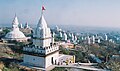
Various Jain temple complexes across India feature him, and these are important pilgrimage sites in Jainism. Sonagiri, also known as Laghu Sammed Shikhar is a Siddha-Kṣetra,[26][27] is considered one of the most important Jain Tirtha (pilgrimage site).[28] The mulnayak is a 3 metres (9.8 ft) rock cut image of Chandraprabhu dating back to the 5th to 6th century.[29] There are a total of 103 temples with 77 on hill and 26 in village.[30][31]

Saavira Kambada Basadi (Thousand Pillared Temple ) in Moodabidri (Jain Kashi[32]), built in 1430 CE, is considered an architectural wonder and is one of the most important Jain centers in Karnataka.[33][34][35] Vijayamangalam Jain temple was built in c. 678 C.E. by King Konguvelir of Velir dynasty.[36][37]

Important Chandraprabha temple complexes include: Tijara Jain temple, Jainimedu Jain temple, Chandravati, Kumbakonam Jain Temple, Mandaragiri, Prabhas Patan, Lunwa Jain temple, Chandranatha basadi Dharmasthala, and Chandraprabha temple, Pavagadh

See also

[edit]

Notes

[edit]

References

[edit]
[edit]
Revisions and contributorsEdit on WikipediaRead on Wikipedia
from Grokipedia
Chandraprabha, also known as Chandraprabhu, is the eighth in the Jain tradition, revered as a spiritual teacher who achieved enlightenment and liberation () in the current time cycle (Avasarpini). Born to King Sena and Queen in the city of Chandrapuri to the clan, he was named for his moon-like complexion and glow, embodying serenity from birth. He renounced worldly attachments to pursue , undergoing 14 years of intense to attain (omniscience). His life exemplifies the Jain ideals of inner peace, patience, and non-attachment, with teachings that emphasize maintaining composure amid adversity to foster spiritual growth and clarity. Chandraprabha's symbol, the crescent moon, signifies calmness, purity, and illumination on the path to liberation, while his attendant deities include the yaksha Shyama and yakshi Jwalamala. He attained nirvana at Sammed Shikharji (Paras Nath Hill) after a lifespan of 10 lakh purvas (immensely long cosmic years), establishing a lineage of followers including 250,000 monks and numerous lay devotees who spread his doctrine. In Jain iconography and temple architecture, Chandraprabha is depicted in meditative pose with a white body hue, often under the nagachampa tree, and holds a prominent place in sites like the , where intricate carvings honor his legacy. His narrative, preserved in texts like the Chandraprabhacharitam, inspires devotees to cultivate tranquility as a means to transcend karma and achieve status.

Biography

Birth and Early Life

Chandraprabha, the eighth Tīrthakara in the present descending time cycle (Avasarpinī) of , was born to King Mahasena and Queen Lakshmanā in the city of Chandrapurī, located near in the Bharata region. His birth occurred on the twelfth day of the dark half of the month of Pauṣa, when the moon was in conjunction with the Anurādhā nakṣatra, marking him as one of the 24 Tīrthakaras who establish the ford of across the ages. The event was heralded by auspicious omens, including fourteen great dreams experienced by his mother, signifying the advent of a future , and was celebrated with rituals performed by the dikkuṃārīs and a grand festival led by the of Saudharma heaven. Chandrapurī, under the Ikṣvāku dynasty, flourished as a prosperous urban center, benefiting from its strategic location and the benevolent rule of its royal lineage, which fostered trade, agriculture, and cultural advancement. From infancy, Chandraprabha exhibited divine traits, including a complexion as white and radiant as the , which inspired his name, meaning "luminous as the moon." As a prince of the Ikṣvāku dynasty, he received a comprehensive in the , sciences, and , growing into a figure of exceptional physical stature—150 dhanuṣ tall—and intellectual prowess. His early years were marked by the typical royal upbringing, yet subtle signs of detachment emerged, aligning with the karmic predispositions of a future Tīrthakara. Upon reaching youth, Chandraprabha ascended the following his father's command, ruling the kingdom with and for an extensive period equivalent to 6.5 pūrvas and 24 aṅgas in Jain temporal . During this time, he married several princesses selected for their virtue, and governed a realm characterized by peace, economic abundance, and social harmony, where subjects enjoyed contentment under his equitable administration. Though immersed in worldly duties, his rule served as a prelude to deeper spiritual inclinations, with periods devoted to study and reflection that hinted at his impending .

Renunciation and Spiritual Attainments

Chandraprabha ascended the throne of Chandrapuri following the of his father, Mahasena, influenced deeply by the Jain principles of detachment () and the impermanence of worldly attachments. He resolved to his kingdom and royal life to pursue spiritual liberation. This decision aligned with the core Jain ethic that true lies in mastering the self rather than material dominion, prompting him to prepare for dikshā, the sacred initiation into monkhood. The dikshā process involved a ceremonial discarding of all possessions, including his ornate garments and jewelry, and the adoption of simple white robes, symbolizing the complete surrender to ascetic discipline and commitment to the mahāvrata—the five great vows of ahiṃsā (non-violence), (truthfulness), asteya (non-stealing), (chastity), and (non-possession). Following dikshā, Chandraprabha embarked on rigorous ascetic practices to purify his soul and eradicate obstructive karmas. These included prolonged fasting, meditative contemplation on the nature of reality, and wandering without fixed abode, enduring physical hardships to cultivate and detachment. After 14 years of such intense (austerities), he attained Kevala Jñāna—absolute omniscience—while seated in deep meditation under the sacred tree (). This enlightenment marked the destruction of all knowledge-obscuring karmas, granting him infinite perception of the universe's substances, modes, and souls. In Jain , Kevala Jñāna is the culminating spiritual attainment before nirvāṇa, signifying the soul's liberation from ignorance and the realization of its innate perfection, thereby establishing the path for others through his teachings. Chandraprabha's extraordinary lifespan encompassed 1,000,000 pūrva, a vast unit in Jain temporal measurement representing an immensely long far exceeding human scales—approximately 70.56 years in contemporary terms. The pūrva, as a foundational time unit in , denotes a period of 70.56 years, emphasizing the eternal and cyclical nature of time () and the soul's journey across innumerable existences toward mokṣa. This prodigious duration highlights the progressive decline in lifespan across the era, where earlier tīrthaṅkaras like Chandraprabha embodied superhuman endurance in their ascetic quests.

Nirvana and Final Journey

Chandraprabha attained nirvana at Sammed Shikharji, located in the Parasnath Hills of , , on the seventh day of the bright half of the month of Falgun (Phalgun ), concluding his final earthly existence and achieving ultimate liberation. This event signifies the culmination of his spiritual journey, where he transcended all karmic influences after attaining under the Naga tree earlier in his life. In Jain tradition, nirvana () denotes the soul's absolute freedom from the cycle of rebirth (samsara), accomplished through the eradication of all karmic particles that bind the to worldly existence, leading to a state of infinite , , power, and bliss without physical form. Chandraprabha's attainment exemplifies this process, as he, having propagated the Jain path of non-violence and for numerous years, dissolved the final vestiges of karma at this sacred site. Sammed Shikharji holds profound significance as the primary nirvana bhumi (site of liberation) for twenty of the twenty-four Tirthankaras in the current time cycle (avasarpini), with Chandraprabha being the eighth among them to achieve there. The location, revered for its spiritual potency, draws pilgrims seeking inspiration from these liberations, underscoring its role as a focal point for and detachment in Jain practice.

Symbolism and Attributes

Emblem and Divine Attendants

In Jain tradition, Chandraprabha, the eighth Tirthankara, is identified by his primary emblem of the crescent moon, which symbolizes purity, calmness, and spiritual enlightenment. This emblem distinguishes him from other Tirthankaras, such as Rishabhanatha associated with the bull or Mahavira with the lion, serving as a unique identifier in iconographic representations. The crescent moon is typically carved or depicted on the throne or pedestal beneath the Tirthankara's seated or standing figure, emphasizing its role in visual identification. Chandraprabha is attended by shasanadevatas or guardian deities that vary by sect. In the Digambara tradition, these are the yaksha Shyama and yakshi Jwalamalini; in the Svetambara tradition, they are the yaksha Vijaya and yakshini Bhrkuti. These attendants protect the doctrine of the Tirthankara and safeguard devotees who invoke them, while also facilitating worship and granting boons such as prosperity and spiritual aid to the faithful. In depictions, the relevant yaksha and yakshi are positioned flanking Chandraprabha, reinforcing their protective roles within the broader Jain pantheon of attendant deities.

Physical Characteristics

Chandraprabha, the eighth , is depicted in Jain scriptures as towering at a height of 150 dhanush, a legendary measure approximating 450 meters, underscoring his superhuman stature among the . This immense scale symbolizes the enduring physical prowess required for his ascetic practices over a lifespan of 10 purva years, integrating bodily resilience with spiritual transcendence. His complexion is described as pure white, evoking the radiance of and signifying profound spiritual purity and inner calm. This luminous hue aligns with his name, Chandraprabha, meaning "," and reflects the supreme beauty and infinite strength attributed to his form in canonical texts. As with all Tirthankaras, Chandraprabha's body bears the 32 major auspicious marks (mahā-lakṣaṇa), including the symbol on his chest representing auspicious fortune and the elongated earlobes signifying from past spiritual adornments. His physique embodies the anuttara vaijrushabha-nārāchana —supremely adamantine and unyielding like a diamond-tipped —and the anuttara samachātur form, denoting perfect symmetry and proportion, complemented by 1008 minor auspicious traits that denote his perfected state. These features collectively highlight his role as an exemplar of physical and spiritual endurance during prolonged and .

Iconography

Artistic Depictions

In , Chandraprabha is commonly depicted in two primary postures that reflect themes of meditation and . The , known as padmāsana, portrays the seated with legs crossed and hands resting in the lap, symbolizing deep meditative absorption and spiritual enlightenment. Alternatively, the posture shows Chandraprabha standing rigidly with arms at the sides and gaze downward, representing the of the body and intense ascetic discipline. These poses emphasize the Tirthankara's transcendence over physical form and sensory attachments. Key iconographic elements further distinguish Chandraprabha's representations while aligning with broader conventions. The figure typically features downcast eyes to signify detachment from the material world, a mark—an auspicious curl or emblem—on the chest denoting divine purity, and a crescent moon symbol on the pedestal as the specific cognizance (lanchhana) evoking the Tirthankara's lunar association. Depictions often include the nagachampa tree, symbolizing the site of his enlightenment. These motifs, carved or painted with serene symmetry, underscore Chandraprabha's luminous and tranquil essence, occasionally complemented by a fair complexion that aligns with descriptions of physical attributes in Jain . Depictions of Chandraprabha have evolved from ancient rock-cut reliefs dating to the CE, such as early examples from lacking the , to more elaborate forms by the 8th–9th centuries that consistently include it. This progression continued into medieval paintings and sculptures, where stylistic consistency persists across the and Svetambara sects: both employ the same postures and symbols, though images render the figure nude to symbolize complete renunciation, while Svetambara versions drape the in simple robes. Such uniformity highlights the enduring reverence for Chandraprabha's in , from cave carvings at sites like Khandagiri to later illuminated manuscripts.

Notable Sculptures and Statues

One of the earliest surviving sculptures of Chandraprabha is a 3-meter-high rock-cut image located at hill in , dating to the 5th-6th century CE and carved directly from . This ancient depiction, often in the posture, represents a pivotal example of early Gupta-era Jain and highlights 's role as a major pilgrimage site associated with Chandraprabha's assemblies. A prominent example of large-scale is the 21-foot (6.4-meter) monolithic statue of Chandraprabha at hill (also known as Basadi ) in district, , which integrates seamlessly with the surrounding rocky landscape and ascending steps leading to ancient temples. Carved from local stone, this statue stands near the Guru Mandir and exemplifies medieval Jain devotional art from the 12th-14th century temple complex, emphasizing the tirthankara's serene meditative form amid a site revered for its Hoysala-era inscriptions and natural elevation. In Moodbidri, Karnataka, the Saavira Kambada Basadi (Thousand-Pillared Temple) features an 8-foot idol of Chandraprabha crafted from panchaloha (a five-metal alloy), installed as the principal deity when the temple was constructed in 1430 CE by local chieftain Devaraya Wodeyar. This sculpture, set within a vast hall of intricately carved granite pillars depicting Jain narratives, reflects the Vijayanagara-era patronage of Jainism in the region, formerly a center of learning known as the "Jain Kashi of the South." The temple underwent restorations in the 20th century to preserve its architectural and sculptural integrity against environmental wear.

Worship and Veneration

Rituals and Hymns

Devotees of Chandraprabha engage in rituals that emphasize purity, non-violence, and devotion, often centered on the anointing known as . This ritual involves bathing the idol of the with sacred substances such as milk, water, and sometimes herbal infusions, symbolizing the cleansing of the soul from karmic impurities. Performed during daily puja or on special occasions, is accompanied by the chanting of mantras to invoke spiritual merit and protection from adversity. Offerings of flowers, , and fruits form a core part of these practices, arranged in elaborate aarti sequences to honor Chandraprabha's luminous qualities. smoke represents the diffusion of divine grace, while flowers signify impermanence and beauty in the transient world. These elements are presented with folded hands and meditative focus, fostering a sense of . Such rituals are particularly observed on auspicious days, including the 12th day of the dark half of the month of Posh (Paush Krishna Dwadashi), commemorating Chandraprabha's birth anniversary, when extended ceremonies extend into communal gatherings. In daily puja, practitioners integrate Chandraprabha worship into morning and evening routines, reciting praises while offering these items to a small home shrine. During festivals like Dashalakshana Parva, which celebrates the Tirthankaras' virtues, Chandraprabha's rituals highlight qualities such as and enlightenment. Svetambara Jains typically adorn the idol with white cloth and jewels during these observances, emphasizing ornate devotion, whereas Digambara traditions maintain a simpler, unadorned form to underscore detachment, though both sects share the core elements of and offerings without significant procedural divergence. Hymns dedicated to Chandraprabha, known as stotras, play a vital role in invoking his blessings for protection against calamities and accumulation of spiritual merit. The Svayambhustotra, composed by Acharya Samantabhadra in the 2nd century CE, includes a verse specifically praising Chandraprabha as the dispeller of darkness akin to moonlight, recited during worship to cultivate purity and insight. This Prakrit-Sanskrit hymn praises all 24 Tirthankaras but holds particular significance for Chandraprabha's devotees in daily recitations and festival chants. Another key text is the Jinastotrani, a collection of praises to the Jinas, where verses extol Chandraprabha's serene radiance and role in guiding souls toward liberation; it is chanted to seek safeguarding from misfortunes and to enhance meditative focus. Both Svetambara and communities incorporate these stotras into their s, often melodiously rendered in temples or homes, with minor variations in intonation reflecting sectarian musical traditions. The crescent moon emblem occasionally appears in during these recitations, symbolizing Chandraprabha's illuminating presence.

Principal Temples and Pilgrimage Sites

The complex in , , stands as one of the foremost pilgrimage destinations for devotees of Chandraprabha, the eighth Jain , encompassing over 77 temples spread across a hillock revered for its association with nirvana contemplation. The central shrine, known as the Chandraprabha temple or the 57th temple on the hill, features a prominent 12-foot-tall black stone idol of Chandraprabha in a meditative posture, drawing pilgrims seeking spiritual solace and reflection on the 's attainment of liberation. Multiple shrines within the complex, including ancient rock-cut elements, underscore its role as a primary site for Jains, with the serene environment facilitating practices like and . In , the , also called the Thousand Pillars Temple, located in Moodbidri (not as sometimes misattributed), represents a significant 15th-century architectural marvel dedicated to Chandraprabha, constructed in 1430 CE by local chieftain Devaraya Wodeyar under the style. This multi-storied basadi houses a striking eight-foot standing idol of the , surrounded by intricately carved pillars—each unique in design—numbering over a thousand, symbolizing abundance and devotion. Annual festivals, including Chandraprabha Jayanti and Mahavir Jayanti, attract thousands of pilgrims for rituals and processions, reinforcing its status as a vibrant hub for Svetambara Jain worship and cultural heritage preservation. Other notable pilgrimage sites include the twelfth tunk at Sammed in , a hallowed peak where Chandraprabha is believed to have attained ; this segment features black foot-idols of the , installed with historical ties to 18th-century benefactors like Sheth Khushaldas, and serves as a focal point for karma purification during the arduous ascent by devotees. In , Chandrapuri Tirth near marks the birthplace and site of four key kalyanakas (conception, birth, , and ) of Chandraprabha, with a 18-inch white marble idol in padmasana posture as the mulanayak, drawing pilgrims to its Ganga-riverside location for immersive historical and spiritual exploration as described in ancient texts like Vividh Tirtha Kalpa.

Cultural Legacy

Representations in Jain Texts

In Jain scriptures, Chandraprabha, the eighth Tīrthaṅkara, is portrayed as an exemplar of spiritual detachment and enlightenment, with his life story serving as a model for ascetics pursuing liberation from worldly bonds. The Chandraprabha-charitra, attributed to the Svetambara scholar Vira Nandi, provides a dedicated that highlights his of royal life and attainment of , underscoring themes of moral and non-attachment to material possessions. This text, written in , functions as both a and an inspirational adoration, emphasizing how Chandraprabha's journey from prince to enlightened teacher illustrates the path of for overcoming karma. Textual traditions vary in details, such as parental names (e.g., King Sena and Queen in some accounts, or King Mahasena and Queen in others) and birthplace (Chandrapuri or Chandranana), reflecting sectarian differences. Chandraprabha receives brief but significant mentions in core canonical works such as the Kālpa Sūtra, attributed to Bhadrabāhu (fourth century BCE), which lists him among the twenty-four Tīrthaṅkaras with details on his emblem—the crescent moon—and complexion—white—while noting traditional events like his birth in Pauṣa and . In Hemacandra's twelfth-century Triṣaṣṭi-śalākāpuruṣa-caritra, a comprehensive Śvetāmbara epic, Chandraprabha's role in the Tīrthaṅkara lineage is elaborated through his , including his birth to King Padma and Queen , , kingship, with a thousand disciples, and enlightenment under a nāga tree after renouncing worldly duties. These narratives stress his establishment of the fourfold saṅgha—comprising 93 chief disciples, numerous monks, nuns, and lay followers—as a testament to his teaching mission. In the Digambara tradition, Chandraprabha's portrayal in Prakrit canonical and purāṇic texts, such as Guṇabhadra's Uttarapurāṇa (ninth century CE), emphasizes rigorous renunciation and attainment of kevala-jñāna through meditation, similar to other accounts but with potential variations in life phases. Stories across these texts, including those in the Prakrit canon like the Tiloya-paṇṇatti, present his enlightenment and nirvana at Mount Sameta (Sammed Śikharjī) as archetypes for ascetics, teaching the transcendence of sensory attachments and the pursuit of equanimity.

Influence Beyond Jainism

Chandraprabha's name, meaning "," resonates with shared mythological motifs in Buddhist scriptures, where figures bearing similar names embody themes of and enlightenment. In the Candraprabha-jātaka, a tale from the Ratnakūṭa collection referenced in Nāgārjuna's Maha-prajñāpāramitā-śāstra, Prince Candraprabha, as a incarnation, sacrifices his blood and marrow to cure a leper, symbolizing selfless and the illuminating purity of moonlight akin to Buddhist enlightenment narratives. This moon symbolism parallels the ' broader use of lunar imagery for moral clarity and rebirth cycles, suggesting cross-cultural exchanges in ancient Indian storytelling traditions. Indirect influences appear in Hindu traditions through Chandraprabha's association with the dynasty, a solar lineage central to both Jain and Hindu epics. In Jain texts, Chandraprabha is born as Prince Chandraprabha to King Mahasena and Queen Devi in Chandrapuri of the Ikshvaku line, linking him to the same ancestral framework that produces figures like in the . This shared dynastic motif fosters conceptual overlaps in , where Ikshvaku kings symbolize righteous rule across religious boundaries. Syncretic worship manifests in regions with overlapping sacred sites, such as near , where the , marking Chandraprabha's birthplace, lies along the River—a waterway revered in for purification rituals. Post-2020 scholarly discussions highlight inter-religious iconography in such contexts, noting temples that integrate figures with ; for instance, the Mañjunatha Temple in venerates alongside Chandraprabha and other icons, exemplifying harmonious coexistence in devotional practices. These examples underscore modern interfaith dialogues in , emphasizing Chandraprabha's role in broader conversations on shared spiritual heritage.

References

Add your contribution
Related Hubs
User Avatar
No comments yet.