


Community hub
Recent from talks
Contribute something
Nothing was collected or created yet.
Palanpur
View on Wikipedia
 | This article needs additional citations for verification. (October 2015) |
Palanpur (Gujarati: Pālanpur) is a city and a headquarters of Banaskantha district in the Indian state of Gujarat. Palanpur is the ancestral home to an industry of Indian diamond merchants.[2][3]
Key Information


Etymology
[edit]Palanpur in early times is said to have been called Prahladana Patan or Prahaladanapura after its founder Prahladana, mentioned in Jain texts. It was afterwards re-peopled by Palansi Chauhan from whom it took its modern name. Others say that it was founded by Pal Parmar whose brother Jagadev founded nearby Jagana village.[4]
According to Hasmukh Dhirajlal Sankalia, the name Pālanpur is derived from Pālhaṇapura, mentioned in a Chaulukya-era inscription.[5]: 71–2
History
[edit]
The Jain texts mentions that Prahladana, brother of Paramara Dharavarsha of Abu, founded Prahladanapur in 1218 and built Prahladana-vihara dedicated to Pallaviya Parshwanatha.[6] The town was re-peopled ruled by Chauhans around thirteenth century. At the start of the seventeenth century, the Palanpur State was taken over by Jhalori dynasty of the Pashtun Lohani tribe which was founded in 1373 and ruled from Jalore (Rajasthan). The dynasty came into historical prominence during the period of instability that followed the demise of Mughal emperor Aurangzeb in the early 18th century. It was overrun soon afterwards by the Marathas; the Lohanis followed the trend of seeking recourse in the British East India Company against them and finally entered the subsidiary alliance system in 1817, along with all other neighbouring states, becoming a British protectorate.[4] After independence of India in 1947, Palanpur State was dissolved in 1949 and merged with Union of India as a part of Bombay State. Subsequently, Palanpur became the capital of Banaskantha district of Gujarat.[7]
Geography and climate
[edit]Palanpur is located at 24°06′N 72°15′E / 24.10°N 72.25°E.[8] It has an average elevation of 209 metres (685 ft).
Demographics
[edit]| Year | Pop. | ±% |
|---|---|---|
| 1941 | 20,300 | — |
| 1951 | 22,600 | +11.3% |
| 1961 | 29,100 | +28.8% |
| 1981 | 61,300 | +110.7% |
| 1991 | 90,300 | +47.3% |
| 2001 | 122,300 | +35.4% |
| 2011 | 141,592 | +15.8% |
| Source: [9] | ||
In the 2011 census of India, Palanpur had a population of 141,592.[1] Males constitute 53% of the population and females 47%. Palanpur has an average literacy rate of 86%, higher than the national average of 59.5%: male literacy is 94%, and female literacy is 78%. In Palanpur, 13% of the population is under 6 years of age.
Places of interest
[edit]

In 1750 (Samvat 1806), Bahadur Khan built a brick and mortar city-wall, the Nagarkot of Palanpur. It was 3 miles round, 17 to 20 feet high and 6 feet broad with seven bastioned gateways, and, at the corners, round towers armed with guns. The gateways of the city-walls were Delhi Darwaja, Gathaman Darwaja, Malan Darwaja, Mira Darwaja, Virbai Darwaja, Salempura Darwaja, Sadarpur Darwaja or Shimla Darwaja. Only Mira Darwaja survives today.
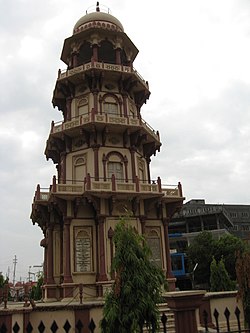
Sher Muhammad Khan attended the coronation ceremony of King George V in Delhi in 1910 and built a club named after him in 1913. In 1918, his successor Tale Muhammad Khan constructed Kirti Stambh, a 22-metre tower near the railway station commemorating the gallantry of his father and the history of town and his dynasty. He also built Balaram Palace between 1922 and 1936 and later Jorawar Palace (Currently used as Judicial Court) also. In 1939, he also built Shashivan, formerly Jahanara Baug, a garden to commemorate his second marriage with a daughter of an Australian businessman.
The old marketplaces are Nani Bazar, Moti Bazar and Dhalvas. Apart from Shahshivan, Chaman Bag is a major public garden in the town. Early Jhalori ruler Malik Mujahid Khan built Mansarovar, a lake dedicated to his queen Manbai Jadeja, in 1628.
Mithi Vav
[edit]
Mithi Vav, a stepwell is the oldest surviving monument of town. It is situated in the eastern part of the town. The five storey stepwell can be entered from the west. Based on its architectural style, it is believed that it is constructed in late medieval period but the sculptures embedded in the walls may belong to earlier period. The sculptures include that of Ganesha, Shiva, Apsaras, dancing figures, worshiping couples and floral or geometrical patterns. A worn out inscription found on one sculpture embedded in left wall can not read clearly but the year Samvat 1320 ( 1263 AD) can made out.[10]
Kirti Stambh : The 22m(72 feet) high Tower of Fame was built by a wealthy Jain merchant in the 12 century A.D. and is dedicated to Adinathji (Rishabhnatha), the first of the Tirthankaras. The tower is decorated with Jain Pantheons.
Temples
[edit]Palanpur has several temples dedicated to Hinduism and Jainism.
- Hindu Temples
The Chaulukya dynasty ruler Jayasimha Siddharaja of Anhilwad Patan is believed to be born in Palanpur. His mother Meenaldevi built Pataleshwar Temple dedicated to Shiva. Other Hindu temples are Lakshman Tekri temple, Mota Ramji Mandir, Ambaji Mata Mandir.
- Jain Temples
- Motu Derasar: The Pallaviya Parshwanath Temple, also known as Mota Derasar, was built by King Prahaladan which is dedicated to Parshwanath, 23rd tirthankar.[11]
- Nanu Derasar
Economy
[edit]Dairy, textile, diamond polishing and marble are major industries of Palanpur. Banas Dairy is one of the largest dairy in the state. The diamond polishing and evaluation industry across India and abroad is dominated by Palanpuri Jain diaspora. Palanpuri Ittars are popular for their fragrance and earned the nickname 'city of flowers' to the town.
Education and culture
[edit]During rule of Jhalori Nawabs, Palanpur became well known for Gujarati Ghazals and poetry. Combination Samosas and Kari are popular snack in the town.
Palanpur is an educational hub of Banaskantha. Major schools include Silver Bells English medium school (c.b.s.e), Vividhlakshi Vidyamandir, Shri Ram Vidhyalaya, Aadarsh Vidhyasankool, Matrushree RV Bhatol Eng Med School, M B Karnavat School, K K Gothi Highschool. Palanpur also have various colleges: Banas Medical College, Palanpur Government Engineering College, G D Modi College of Arts, C. L. Parikh College of Commerce, R. R. Mehta College of Science. Apart from these, there are two B.C.A. colleges, B.Ed. colleges, Girls Arts college.
Notable people
[edit]Several notable persons hails from Palanpur:
- Bharat Shah, a diamond merchant, Hindi film financier and
- B. K. Gadhvi, politician
- Chandrakant Bakshi, (1932–2006), Gujarati author.
- Galbabhai Nanjibhai Patel (Chaudhary), Social Leader of Banaskantha District (Founder Chairman of Banas Dairy and well known Personality among Farmers community of Banaskantha and North Gujarat)
- Haribhai P. Chaudhary, politician
- Javed Miandad, Pakistani cricketer
- Mehul Choksi, fugitive Indian-born businessman
- Parthibhai Bhatol, Politician ( Former Banas Dairy Chairman)
- Pranav Mistry, computer scientist and the inventor
- Rohit Jivanlal Parikh, mathematician, logician and philosopher
- Saeed Ahmad Palanpuri, Indian scholar of Islam
Palanpur is a native of the Palanpuri diamond merchants in Surat and Belgium.[12]
Transport
[edit]The town being the headquarters of Banaskantha district is well-connected by road and rail.

Rail
[edit]Palanpur Railway Station, on the Jaipur-Ahmedabad mainline, comes under the administrative control of Western Railway zone of the Indian Railways. It has direct rail links on the broad gauge to the cities of Chennai, Thiruvananthapuram, Mysore, Bangalore, Pune, Mumbai, Jaipur, Jodhpur, Delhi, Dehradun, Muzaffarpur, Bareilly and Jammu. It is connected to most of the cities and towns in Gujarat such as Ahmedabad, Surat, Vadodra, Bhuj, Rajkot, Jamnagar and Porbandar. Indian Railways’ proposal to double the broad gauge line between Palanpur and Samakhiali has received government backing. The doubling will benefit the districts of Kutch, Patan and Banaskantha in the state of Gujarat.
Road
[edit]National Highway 27 connecting Beawar in Rajasthan with Radhanpur in Gujarat passes through Deesa-Palanpur, thus connecting it with the cities of Abu Road, Udaipur and Pali. State Highways SH 712, SH 132 pass through Palanpur and connect it with nearby towns in Gujarat. State Highway SH 41 connects it with Mehsana & Ahmedabad.
Air
[edit]The nearest Airport is the Deesa Airport, originally built to serve the princely state of Palanpur.[13] It is just 26 km from Palanpur city. The nearest International Airport is Sardar Vallabhbhai Patel International Airport, Ahmedabad which is 139 km far from Palanpur.
Surrounding Cites
[edit]


Gallery
[edit]-
 Delhi Gate area
 -
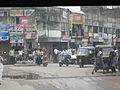 Market scene
 -
 Shimla Gate market
 -
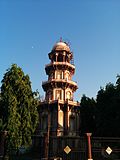 Kirti Stambha
 -
 Patthar Sadak


Nearby places of interest
[edit]- Jessore Sloth Bear Sanctuary, a reserve forest sprawling over 180 km2 is located in Jessore is about 15 kilometres (9.3 mi) away.
- Rani ki vav, Patan
- Sun Temple, Modhera
- Dantiwada Dam
- Balaram Palace Resort
- Kedarnath Mahadev Temple, located in Jessore, about 32 kilometres (20 mi) from Palanpur and Balaram Mahadev temple, located about 14 km from the town are major temples dedicated to Shiva. A temple of Dharmata, who is a patron goddess of Sundhiya family is situated near Balaram Mahadev Temple.
See also
[edit]References
[edit]- ^ a b c "Cities, Towns and Outgrowth Wards". Citypopulation.de. Retrieved 27 August 2020.
- ^ "The rise and rise of Belgium's Indian diamond dynasties". 16 October 2014.
- ^ "How Palanpur's diamond merchants conquered the world - Rediff.com".
- ^ a b Gazetteer of the Bombay Presidency: Cutch, Palanpur, and Mahi Kantha. Government Central Press. 1880. pp. 318–324.
- ^ Sankalia, Hasmukh Dhirajlal (1949). Studies in the Historical and Cultural Geography and Ethnography of Gujarat. Pune: Deccan College. Retrieved 14 July 2023.
- ^ Dhaky, Madhusudan A. (1961). Deva, Krishna (ed.). "The Chronology of the Solanki Temples of Gujarat". Journal of the Madhya Pradesh Itihas Parishad. 3. Bhopal: Madhya Pradesh Itihas Parishad: 81.
- ^ "Palanpur". Archived from the original on 15 January 2018. Retrieved 10 April 2015.
- ^ Falling Rain Genomics, Inc - Palanpur
- ^ "Historical Census of India". Archived from the original on 17 February 2013. Retrieved 23 March 2014.
- ^ Mehta, R. N. (31 March 1977). "III: Explorations in the Banaskantha District". Archaeology of the Banaskantha district, North Gujarat upto 1500 A D (Part 1) (Thesis). Department of Archaeology and Ancient History, Maharaja Sayajirao University of Baroda. pp. 77–78. hdl:10603/72152. Retrieved 7 March 2017.
- ^ "tourismguideindia.com". ww16.tourismguideindia.com. Retrieved 7 April 2024.
- ^ "Nirav Modi's Palanpuris eat, pray, live as one; control 90% of diamond trade In India - Times of India". The Times of India. Retrieved 25 October 2018.
- ^ "Helipad in every taluka headquaters [sic]". The Times of India. 28 December 2011. Retrieved 2 January 2017.


| International | |
|---|---|
| National | |
| Other | |

Palanpur
View on GrokipediaEtymology
Origin of the Name
The name Palanpur derives from the ancient designation Prahlādanapura or Prahladana Patan, honoring its founder Prahladan (also spelled Prahladana or Prahaladan Dev), a Rajput of the Paramara dynasty.[5][6] Prahladan, reportedly the brother of Dharavarsha (ruler of nearby Chandravati or Abu), received the surrounding territory as an appanage and established the settlement in the early 13th century, naming it after himself in accordance with contemporary Rajput traditions.[7][6] Jain historical texts, such as those referenced in the Kharatara-gaccha Bṛhad gurvāvali, corroborate this etymology, identifying Prahlādanapura as the original form and linking Prahladan's founding activities—including the construction of the Prahladana-vihara temple—to approximately 1218 CE (Vikrama Samvat 1275).[5][6] The evolution to Palanpur reflects phonetic shifts common in regional nomenclature over centuries, with the prefix "Prahlad-" simplifying while retaining the personal commemorative intent.[7] This origin narrative, drawn from local chronicles and Jain records rather than later colonial accounts, underscores Palanpur's ties to medieval Rajput and Jain cultural foundations, though some traditions attribute Prahladan's inspiration to Jain acharya Sheeldhaval.[8] No alternative derivations, such as topographic interpretations like "one-fourth hill," find support in primary historical sources and appear anecdotal.[9]History
Ancient and Medieval Foundations
Archaeological explorations in the Banaskantha district, encompassing Palanpur, have uncovered microlithic artifacts associated with a pre-pottery Mesolithic culture, particularly in areas bordering the Abu region, indicating early human settlement and tool use predating the Neolithic transition.[10] These findings suggest sporadic prehistoric activity in the vicinity, though no continuous ancient urban centers have been identified directly at the site of modern Palanpur. Local historical tradition attributes the founding of Palanpur, originally known as Prahladanpur, to 1218 CE, when Prahladana—a Paramara ruler and brother of Dharavarsha from Abu—established the settlement and constructed the Prahladana-vihara, a Jain temple dedicated to the tirthankara Parsvanatha.[11][7] This event marks the medieval origins of the town as a center with Jain religious significance, reflecting the influence of Paramara patronage in northern Gujarat during the early thirteenth century. The presence of such viharas underscores early medieval cultural and architectural development tied to Jainism in the region. By the thirteenth century, the area saw governance under Chauhan rulers, who re-peopled and administered the town amid the broader feudal dynamics of Gujarat before the onset of Delhi Sultanate expansion.[11] Structural remains at Garh Palanpur, including elevated fortifications, attest to medieval construction, likely from this pre-Islamic era.[12] In 1304 CE, Palanpur came under Muslim rule as part of the spreading influence of the Delhi Sultanate, transitioning from Hindu principalities to Islamic administration while retaining elements of its earlier foundations.[11]Establishment and Rule of the Palanpur Princely State
The Palanpur Princely State traces its origins to the Lohani clan of the Yusufzai Pathan tribe, who migrated from Bihar in the 12th century and established themselves in Gujarat by the late 14th century. Malik Khurram Khan, the dynasty's founder, entered the service of the ruler of Mandore and subsequently became Diwan of Jhalor (Jalor) around 1370, marking the beginning of Lohani rule in the region.[2] The dynasty initially governed Jhalor as feudatories under various Muslim sultanates, expanding their influence through military service and alliances.[11] In 1572, Mughal Emperor Akbar granted the territories of Palanpur, Deesa, and Dantivada to Malik Ghazni Khan II, the 12th Nawab of Jhalor, as a wedding gift upon his marriage to a relative of the emperor.[11] This imperial favor formalized Lohani control over Palanpur, though the family retained Jhalor as their primary seat initially. By 1616, following the loss of Jhalor in the early 17th century amid regional upheavals, the 14th Nawab, Firuz Khan, relocated the dynasty's base to Palanpur, bringing nobles, officials, and craftsmen to repopulate and fortify the area.[2] [11] This shift established Palanpur as the enduring capital of the state, which functioned as a semi-independent principality under Mughal overlordship, navigating alliances with the Gujarat Sultanate remnants and later Mughal governors. The Lohani Nawabs ruled Palanpur for over three centuries, maintaining Pathan administrative traditions while adapting to local Hindu-majority demographics through a mix of Islamic governance and pragmatic policies. Successive rulers, such as the 21st Nawab Bahadur Khan in 1764, constructed defensive fortifications including a fort with seven gates to counter Maratha incursions and internal threats.[11] The state prospered as a trade hub in northern Gujarat, leveraging its strategic location near the Aravalli hills for commerce in textiles, agriculture, and salt. Dynastic continuity was preserved through hereditary succession, with 29 Nawabs in total, culminating in Taley Muhammad Khan's reign from 1918 until accession.[2] This period of rule emphasized loyalty to imperial suzerains while asserting local autonomy, setting the stage for formal British protection in 1817.[11]British Suzerainty and Accession to India
In 1817, the Nawab of Palanpur entered into a treaty of alliance and protection with the British East India Company, effectively placing the state under British suzerainty through the subsidiary alliance system.[2][11] This agreement granted the state internal autonomy in exchange for British control over external affairs, defense, and foreign relations, aligning Palanpur with other neighboring principalities in the region.[2] The treaty followed periods of instability, including conflicts with Gaekwad forces, and marked the end of nominal independence from regional powers while preserving the Lohani dynasty's rule under Nawab Karim Khan and his successors.[11] Under British paramountcy, Palanpur maintained its status as a 9-gun salute princely state within the Palanpur Agency, contributing troops to British campaigns such as the Afghan Wars (1842, 1879, 1919), the Indian Mutiny of 1857, World War I (1914–1918), and World War II (1939–1945).[2] Modernization efforts intensified during the reigns of Nawab Sir Sher Muhammad Khan (r. 1878–1918), who focused on infrastructure and administration, and his son, Nawab Sir Taley Muhammad Khan (r. 1918–1957), who expanded education, healthcare, and economic development, including irrigation projects and railway integration via the Rajputana-Malwa line.[2] These rulers received knighthoods for their loyalty and contributions, with the state experiencing relative stability and population growth to approximately 315,855 by 1940 across 4,574 square kilometers.[2] Following the Indian Independence Act of 1947, which terminated British suzerainty, Nawab Taley Muhammad Khan signed the instrument of accession to the Dominion of India on 15 August 1947, integrating Palanpur into the new nation without resistance, in line with negotiations led by Sardar Vallabhbhai Patel.[2][11] A subsequent merger agreement on 10 June 1948 incorporated the state into Bombay Province, later part of Gujarat State, with Palanpur designated as the headquarters of Banaskantha District.[11] The Nawab retained privy purse privileges until their abolition in 1971, reflecting the relatively smooth transition compared to more contentious princely state integrations.[2]Post-Independence Integration and Growth
The princely state of Palanpur formally acceded to the Dominion of India on June 10, 1948, when Nawab Taley Muhammad Khan signed the Instrument of Accession.[11] The state was dissolved in 1949 and its territories merged into Bombay State, with Palanpur designated as the administrative headquarters of the newly created Banaskantha district. This district incorporated lands from Palanpur along with adjacent former princely states, including Radhanpur and portions of Idar, enabling unified administration and resource allocation under the Indian republic.[11] Upon the linguistic reorganization of states in 1960, Banaskantha became part of Gujarat, where Palanpur continued as the district capital, benefiting from state-level policies on agriculture and infrastructure. Economic growth in Palanpur post-independence centered on agriculture, trade, and emerging cooperatives. The region, reliant on rain-fed farming and livestock, saw advancements through land reforms and irrigation initiatives in the 1950s and 1960s, though aridity posed ongoing challenges. A pivotal development was the founding of the Banaskantha District Co-operative Milk Producers' Union (Banas Dairy) in 1969, headquartered in Palanpur, which expanded under Operation Flood to procure and process milk, elevating the district to a leading producer in Gujarat with millions of liters handled daily by the late 20th century.[13] [14] This fostered agro-processing, rural employment, and income diversification beyond traditional crops like bajra and wheat. Palanpur's role as a railway junction on the Mumbai-Delhi line enhanced connectivity, spurring commerce in textiles, minerals, and food products. The municipal population grew from 80,657 in 1981 to 122,300 in 2001 and 141,592 in 2011, indicating urbanization amid Gujarat's broader industrial surge, though Banaskantha remained relatively agrarian with human development indices improving to mid-tier rankings among state districts by 2001.[15] [16] Infrastructure expansions, including highways and small-scale industries, supported steady per capita income rises, albeit tempered by dependence on seasonal agriculture and migration for non-farm work.[4]Geography
Location and Physical Features
Palanpur serves as the headquarters of Banaskantha district in northern Gujarat, India.[17] The city is positioned at approximately 24°10′N 72°26′E.[18] Its average elevation stands at 209 meters (685 feet) above sea level.[19] The terrain surrounding Palanpur consists of low-lying plains characteristic of the Gujarat region's semi-arid landscape, with parts of the district featuring hilly and mountainous areas of high relief and rugged topography.[17] It lies between the Aravalli Range to the northeast and the Sabarmati River basin.[20] The Banas River, a tributary of the Sabarmati, and the Saraswati River flow through or near the area, supporting agricultural fertility despite the arid conditions.[20]Climate and Environmental Conditions
Palanpur features a hot semi-arid climate (Köppen classification BSh), characterized by high temperatures year-round, low humidity outside the monsoon, and rainfall concentrated in the summer monsoon season.[21] Average annual precipitation totals approximately 824 mm, with about 73 rainy days, primarily occurring between June and September when the southwest monsoon brings the bulk of the moisture.[22] Annual mean high temperatures reach 33.55°C, while lows average 23.7°C, reflecting the region's subtropical continental influences.[23] Summer months from March to June are intensely hot, with maximum temperatures frequently exceeding 40°C and peaking around 42–45°C in May; minimums hover between 25–28°C, accompanied by low rainfall under 10 mm monthly and high evaporation rates.[21] The monsoon season moderates daytime highs to 30–35°C but increases humidity, with July and August seeing the heaviest downpours—up to 200–250 mm per month—though erratic distribution often leads to droughts or floods in the Banas River basin.[24] Winter, from December to February, provides relief with mild days averaging 25–28°C highs and nights dropping to 10–15°C, minimal rain (under 5 mm monthly), and occasional fog.[21] Environmental conditions are shaped by the semi-arid landscape, with sparse natural vegetation dominated by drought-resistant thorny shrubs, acacias, and prosopis species adapted to low soil moisture and sandy loam soils prevalent in Banaskantha district. Agriculture relies heavily on irrigation from canals and groundwater due to variable monsoon reliability, while urban expansion and diamond polishing industries contribute to localized air quality issues, though comprehensive pollution monitoring data remains limited compared to larger Gujarati cities. Soil salinity and water scarcity pose ongoing challenges, exacerbated by climate variability.Demographics
Population Trends
The population of the Palanpur urban agglomeration was recorded as 122,300 in the 2001 Census of India.[25] By the 2011 Census, this had increased to 141,592, reflecting a decadal growth rate of 15.8%.[26] Within the municipal limits, the 2011 population stood at 122,344, comprising 74,088 males and 67,504 females, with a sex ratio of 911 females per 1,000 males.[27] [28] This growth rate for Palanpur was below the 24.6% decadal increase observed in Banaskantha district overall, which rose from 2,504,244 in 2001 to 3,120,506 in 2011.[29] The disparity may reflect patterns of rural-to-urban migration within the district concentrating in larger centers like Deesa, alongside selective out-migration from Palanpur for industrial employment elsewhere in Gujarat. Historical data indicate steadier urban expansion since the early 20th century; for instance, male population alone grew from 8,562 in 1911 to 74,088 in 2011.[30]| Census Year | Urban Agglomeration Population | Decadal Growth Rate (%) |
|---|---|---|
| 2001 | 122,300 | — |
| 2011 | 141,592 | 15.8 |
Religious and Caste Composition
According to the 2011 Indian census, Hindus constitute the majority religious group in Palanpur city, accounting for 79.54% of the population (approximately 112,618 individuals). Muslims form the largest minority at 19.14%, with Jains, Christians, Sikhs, Buddhists, and others comprising the remaining 1.32%.[27][28] These figures reflect urban demographics specific to Palanpur, differing slightly from the surrounding Palanpur taluka, where Hindus are 82.88% and Muslims 16.6%.[31] Caste composition data from the census is limited to Scheduled Castes (SC) and Scheduled Tribes (ST), as comprehensive enumeration of non-SC/ST castes among Hindus and Muslims is not publicly detailed. In Palanpur city, SCs represent 9.5% of the population (13,461 persons), while STs account for 3.1%.[28] These groups are socio-economically disadvantaged relative to general castes, with SCs often engaged in manual labor and STs in pastoral or tribal occupations. In the broader Banaskantha district encompassing Palanpur, Other Backward Classes (OBCs) such as Thakors (a Kshatriya-equivalent community), Chaudharys, and Maldharis (Rabari pastoralists) form influential segments of the Hindu population, exerting considerable sway in electoral and economic spheres due to their numerical strength and land holdings.[32] Muslim communities in the region include endogamous groups like Bohras and local converts, though specific proportions remain undocumented in census religion tables.[33]Linguistic and Socio-Economic Patterns
Gujarati predominates as the mother tongue and primary language of communication in Palanpur, aligning with its status as the official language of Gujarat and reflecting the region's cultural and administrative norms. The 2011 Census data for Banaskantha district, which includes Palanpur, indicates that over 96% of the population speaks Gujarati as their first language. Hindi serves as a secondary lingua franca, particularly in trade, education, and inter-community interactions, while Urdu is spoken by segments of the Muslim population, influenced by historical migrations and the legacy of Muslim rulers in the former princely state. This multilingualism supports commercial activities in markets and industries, where Hindi facilitates connections with northern India.[34][1] Socio-economic patterns in Palanpur reveal a shift from traditional agriculture to urban-based industries, with diamond polishing and gem trading emerging as key employers for the skilled labor force. The local economy integrates agrarian production—focusing on crops such as cotton, tobacco, and wheat in peri-urban areas—with processing sectors like food, textiles, and ceramics, contributing to district-level growth in agro and mineral-based activities. The 2011 Census records a literacy rate of 78.91% for Palanpur taluka, with males at 89.25% and females at 68%, exceeding the district average of 66.39% and enabling participation in technical trades; urban areas like Palanpur city report higher figures around 84-85%, underscoring education's role in occupational mobility. Non-farm diversification has reduced reliance on farming, yet patterns of income disparity persist, as small-scale diamond workers often experience seasonal employment and low formalization compared to larger agricultural or industrial operations.[4][35][1]Administration and Governance
Municipal and District Administration
Palanpur serves as the headquarters of Banaskantha district, where the District Collectorate is located at Jilla Seva Sadan in the Jorawar Palace Compound.[36] The district administration is headed by the District Collector, an Indian Administrative Service officer responsible for revenue collection, law and order, development programs, and coordination of government schemes across the district's talukas.[37] In January 2025, the Gujarat government reorganized Banaskantha by carving out the new Vav-Tharad district from its northern talukas, retaining Palanpur as the headquarters for the remaining six talukas focused on central and southern areas.[38] Local civic governance in Palanpur falls under the Palanpur Nagar Palika, a municipal body established to manage urban services including water distribution, waste management, road maintenance, and public health initiatives.[39] The Nagar Palika operates through elected councilors and is administratively led by a Chief Officer appointed by the state government, who executes policies and oversees daily operations.[40] As of 2025, it remains classified as a municipality rather than a municipal corporation, handling a population exceeding 150,000 within its jurisdiction.[41]Political Representation and Challenges
Palanpur's representation in the Gujarat Legislative Assembly is held by Aniket Girishbhai Thaker of the Bharatiya Janata Party (BJP), who secured victory in the December 2022 elections with 67,188 votes, defeating the Indian National Congress (INC) candidate by a margin of 26,980 votes in a constituency encompassing urban and rural segments of Banaskantha district.[42][43] At the national level, the area falls within the Banaskantha Lok Sabha constituency, represented since June 2024 by Geniben Nagaji Thakor of the INC, who won by 67,188 votes against the BJP's Rekhaben Hiteshbhai Chaudhary, bucking the BJP's dominance in Gujarat by securing the seat after a decade-long absence for Congress in the state's parliamentary representation.[44][45] Key political challenges include local opposition to the January 2025 bifurcation of Banaskantha district to form the new Vav-Tharad district, which has fueled protests from residents and leaders in Palanpur—the district headquarters—over fears of diminished administrative resources, reduced funding, and weakened regional influence amid Gujarat's ongoing district reorganization efforts.[46] Agricultural and commuter grievances have intensified with August 2025 protests by farmers and residents from approximately 20 villages against toll collection at the Khemana Toll Plaza on National Highway 27, highlighting burdens on local transport costs that exacerbate economic pressures in a region reliant on dairy farming and gem trade logistics.[47] Infrastructure accountability remains a persistent issue, as evidenced by the October 2023 collapse of an under-construction bridge near Palanpur, which killed three workers and prompted state directives for stricter quality controls, underscoring gaps in project oversight despite Gujarat's emphasis on rapid urban and rural connectivity development.[48]Economy
Agricultural and Dairy Sectors
Agriculture in Palanpur and surrounding Banaskantha district focuses on rainfed and irrigated cultivation of staple and cash crops suited to the semi-arid climate. Major crops include pearl millet (bajri), maize, sorghum (jowar), castor, tobacco, and pulses, with kharif-season dominance by castor and bajra.[4] The district leads Gujarat in potato production, yielding approximately 1.71 million metric tons annually, and contributes 17.67% of the state's total vegetable output, underscoring its role in horticulture.[49][4] Isabgol (psyllium husk), a key medicinal crop, positions Banaskantha as India's top producer, supporting export-oriented farming.[4] Dairy farming forms a cornerstone of the local rural economy, integrated with crop residues for fodder. The Banaskantha District Co-operative Milk Producers' Union Ltd. (Banas Dairy), headquartered in Palanpur since its founding in 1969 under Operation Flood, processes milk from over 1,000 village cooperative societies.[14] Daily procurement averages 5 million liters, peaking at 6.5 million liters during winter, with a recorded high of 5.726 million liters on December 30, 2017; over 90% arrives chilled via 1,280 bulk units.[14][4] This output, marketed through brands like Amul, elevates Banaskantha to Asia's leading milk-producing district, bolstering incomes for smallholder farmers reliant on breeds like Kankrej cows.[14][50] Agro-processing investments, comprising 57% of district inflows over two decades, further link agriculture and dairy through feed production and value addition.[4]Diamond Polishing and Gem Trade
Palanpur serves as the ancestral hub for the Palanpuri Jain community, whose merchants pioneered modern diamond cutting techniques in the late 19th century by establishing operations in Antwerp, Belgium, before repatriating skills to India in the 1880s.[51] These entrepreneurs, originating from the town in Gujarat's Banaskantha district, initially focused on polishing small diamonds, leveraging family-based networks to build a global presence that by the early 21st century accounted for an estimated 70% dominance in the international diamond market share.[52][3] The trade expanded through vertical integration, encompassing rough diamond sourcing, cutting, polishing, and export, with Palanpur's traders exporting primarily to markets in Antwerp, New York, and Tel Aviv. Locally, diamond polishing units in Palanpur emerged as small-scale, labor-intensive operations employing artisans skilled in manual cleaving, bruting, and faceting, processes that transform rough stones into gem-quality polished diamonds.[53] At its peak, the town hosted numerous such units, contributing to Gujarat's broader ecosystem where the state processes over 80% of India's diamond output, a sector that remains highly dependent on imported rough diamonds from suppliers like Russia and Africa.[54] However, by the early 2020s, the number of active processing units in Palanpur had dramatically declined due to migration of operations to Surat—Gujarat's primary polishing center—and competition from mechanized facilities elsewhere.[55] Employment in these units historically relied on local Jain and Patel communities, with workers specializing in low-value, small-stone polishing, though exact figures for Palanpur remain limited amid the sector's fragmentation into over 100,000 units nationwide. The gem trade in Palanpur complements polishing activities through merchant networks handling certified polished stones and colored gems, though it has faced cyclical downturns, including a sharp contraction post-2008 financial crisis and renewed pressures from 2022 onward.[56] By September 2025, US tariffs on Indian polished diamonds—imposed amid G7 sanctions—coupled with disruptions from the Russia-Ukraine war reducing rough supply, triggered what industry observers describe as the worst downturn in decades for Gujarat's diamond sector, indirectly eroding Palanpur's trade volumes and prompting job losses estimated in the tens of thousands regionally.[57][58] Despite these challenges, Palanpuri traders maintain influence via diaspora firms in major hubs, sustaining export revenues that historically bolstered local infrastructure like schools and hospitals in Gujarat.[59]Emerging Industries and Employment
In recent years, the castor oil and oleochemicals sector has emerged as a significant growth area in Palanpur, capitalizing on Banaskantha district's substantial castor seed production, which constitutes a major portion of Gujarat's output. Local firms like Shivam Agro Process Pvt. Ltd. and Kisan Agro Product Industries have expanded into manufacturing derivatives such as sebacic acid and ricinoleic acid, used in lubricants, cosmetics, and pharmaceuticals, establishing Palanpur as an export hub that supplied 27% of India's castor oil exports in 2019.[60][61][62] These developments have driven turnover growth for key players, with one firm reporting a 67% increase to ₹150 crore between 2017 and 2019, reflecting demand from global markets.[60] Agro-processing and value-added manufacturing represent additional emerging fronts, including units for bakery products, flour milling, and cashew processing, aligned with the district's potential for micro, small, and medium enterprises (MSMEs) in food and non-food agro-based activities. In September 2025, the Vibrant Gujarat initiative facilitated six MoUs worth ₹283 crore in Banaskantha, targeting expansions in agro-products, marble processing, and dairy extensions to enhance local value chains and attract investment.[63] Mineral-based industries, such as ceramics and dye-stuff production, are also gaining traction through clusters like those operated by Marksun Dye-Stuff Industries, supported by the district's raw material availability.[64] Employment opportunities in these sectors have expanded via skilled labor demand in processing plants and factories, with roles in production supervision, machinery operation, and sales management listed frequently in local job markets.[65] The Government Industrial Training Institute (ITI) in Palanpur provides vocational training in trades like fitter, electrician, and machinist, aiming to equip over 500 trainees annually for industrial roles and reduce reliance on seasonal agriculture.[66] While specific employment figures for emerging industries remain limited, the presence of over 50 factory-related vacancies in 2025 indicates absorption of local youth, supplemented by MSME growth potential in 20-30 agro and mineral sub-sectors.[65]Society and Culture
Education System
Palanpur's education system encompasses primary, secondary, and higher education institutions, primarily under the Gujarat government's framework, with a focus on government-run and aided schools supplemented by private entities. The city's average literacy rate stood at 85.92% as per the 2011 Census of India, exceeding the national urban average of 85%, with male literacy at 92.44% and female literacy at 77.32%; this reflects urban advantages over the broader Banaskantha district's 65.32% rate.[27][29] Primary and secondary education in Palanpur is delivered through clusters of government primary schools (GPs), higher primary schools, and secondary schools, with Palanpur-3 cluster alone hosting approximately 35 institutions serving local needs. The District Institute of Education and Training (DIET) in Palanpur, located at Gathayan Gate, Ganeshpura, provides pre-service and in-service teacher training to support elementary education quality across Banaskantha district.[67][68] Institutions like Swami Narayan Gurukul College of Education and Umiya Education B.Ed College offer specialized teacher training programs, contributing to workforce development in pedagogy. Higher education options include technical and professional streams, with the Government Engineering College, Palanpur, established in 2009, providing undergraduate engineering degrees in fields such as civil, mechanical, and computer engineering under Gujarat Technological University.[69] The Government Polytechnic College, Palanpur, focuses on diploma-level technical education in engineering disciplines.[70] Banas Medical College and Research Institute offers medical education, including MBBS programs, addressing healthcare training needs.[70] Arts, science, and commerce are covered by institutions like R.R. Mehta College of Science and C.L. Parikh College of Commerce, affiliated with Hemchandracharya North Gujarat University, which emphasize undergraduate degrees in sciences, commerce, and related fields.[71] These colleges collectively support Palanpur's role as an educational hub in northern Gujarat, though enrollment and infrastructure data indicate ongoing reliance on state funding amid regional economic pressures.[72]Religious Traditions and Festivals
Palanpur's religious composition features a Hindu majority comprising 79.54% of the population, a significant Muslim minority at 19.14%, and smaller Jain (0.34%) and other groups.[28] Hindu traditions dominate local observances, with Navratri as a central festival involving nine consecutive nights of Garba and Dandia Ras dances to honor the nine manifestations of the Mother Goddess; unmarried women fast for marital prospects, and the event recurs twice annually in Chaitra (March/April, tied to Lord Rama's birth) and Sharad (September/October, marking Ravana's defeat).[73][74] Other key Hindu celebrations include Janmashtami, featuring household worship of infant Krishna idols to commemorate his birth; Ganesh Chaturthi in August/September, with elaborate pandals seeking Ganesha's blessings for wisdom and obstacle removal; Diwali in autumn, illuminated by diyas and dedicated to Lakshmi's victory of light over darkness; and Sharad Purnima at monsoon’s end, a full-moon harvest rite attributing healing properties to lunar rays while invoking prosperity.[73] Rath Yatra involves fervent chariot processions for Krishna, Balaram, and Subhadra, paired with devotional fasting and prayers.[74] The Muslim community adheres to Islamic practices, prominently observing Ramadan—a 29- to 30-day period of dawn-to-dusk fasting, Taraweeh prayers, and spiritual reflection, typically from late February to late March in Gujarat, ending with Eid al-Fitr communal prayers and feasting.[75] Jain traditions, supported by historic temples like Motu Derasar (Pallaviya Parshwanath) and nearby Shri Mahavir Swamiji, center on ahimsa and asceticism; followers mark Mahavir Jayanti for the 24th Tirthankara's birth and Paryushana, an eight- or ten-day atonement festival with fasting, scripture study, and Pratikraman rituals for forgiveness.[76][77]Cultural Heritage and Social Norms
Palanpur's cultural heritage is deeply rooted in its historical patronage of arts under the Jhalori Nawabs, who ruled the princely state from the 14th to 20th centuries and fostered a tradition of Gujarati ghazals and poetry, contributing to the region's literary output.[7] Local perfumery, particularly Palanpuri attars known for their delicate fragrances, emerged as a hallmark craft during this era, reflecting the Nawabs' support for artisanal traditions.[7] In contemporary times, the city's heritage has evolved to emphasize the diamond trade, dominated by the Palanpuri Jain community, which traces its mercantile practices to historical gem dealings and now controls a significant portion of global polishing and trading.[3] Social norms in Palanpur are shaped by its merchant communities, particularly Jains, who prioritize close-knit family structures, intergenerational business succession, and community trust as mechanisms for trade enforcement in the diamond industry.[78] These norms include arranged marriages within the community to preserve social and economic ties, exclusionary practices to maintain intra-group solidarity, and a strong emphasis on vegetarianism and non-violence (ahimsa) derived from Jain principles.[79] The populace exhibits traits of simplicity, diligence, and peacefulness, with family units often centered on joint households that support entrepreneurial ventures, including migration for business while retaining local cultural anchors.[74] Traditional handicrafts such as Patola silk weaving and brasswork continue to embody communal craftsmanship, passed down through generations amid modernization.[74]Tourism and Attractions
Historical Monuments and Palaces
Palanpur's historical monuments and palaces primarily reflect its legacy as a princely state under the Lohani dynasty, with structures dating from the 18th to early 20th centuries emphasizing Nawabi architecture and commemorative elements. Key edifices include victory towers, fortified gates, and royal residences built during periods of prosperity and British influence. These sites, often constructed with local stone and featuring Indo-Saracenic motifs, served defensive, residential, and symbolic purposes.[80][81] The Kirti Stambh, erected in 1918 by Nawab Shri Taley Mohammed Khan adjacent to the railway station, stands as a prominent monument honoring the dynasty's history and the gallantry of Shri Sher Mohammed Khan during earlier conflicts. This multi-storied pillar, approximately 22 meters tall with a circular base, symbolizes the enduring prestige of Palanpur's rulers amid modernization under British paramountcy.[82][83] Jorawar Palace, constructed in the early 20th century under Nawab Taley Mohammed Khan's patronage following the shift of royal residence outside the city walls around 1915, exemplifies princely opulence with its expansive layout and period interiors. Originally a seat of governance, it transitioned post-independence to house judicial functions, preserving elements of Mughal-Rajput fusion in design.[84][85] The city's fortifications, established in 1764 by the 21st Nawab Bahadurkhan, featured seven gates—Mira, Delhi, Gathaman, Malan, Virbai, Salempura, and Shimla (or Sadarpur)—providing controlled access through sturdy walls now largely ruined. Mira Gate remains the sole intact example, retaining arched portals and battlements indicative of defensive architecture adapted from Afghan and Rajput traditions.[11][86] Other notable structures include the King George V Club, built during British-era collaborations to foster social and administrative ties, and remnants of palaces like Dilkhushalbaug, which underscore the blend of local and colonial influences in Palanpur's built heritage.[80]Religious Sites and Temples
Palanpur encompasses a range of religious sites, including Hindu temples, Jain shrines, mosques, and Sufi dargahs, shaped by its history under Rajput rulers, Jain patrons, and the Lohani Muslim dynasty from the 14th to 20th centuries.[87] These sites serve as focal points for local devotion, pilgrimage, and cultural continuity amid a predominantly Hindu and Jain population with a historic Muslim presence.[87] The Pallaviya Parshwanath Jain Temple, situated in the city center about 1 km from Palanpur railway station, stands as one of the oldest Jain derasars in the region.[88] Founded in Vikram Samvat 1011 (circa 13th century CE) by King Prahaladan—originally ruler of Prahaladanpur, later renamed Palanpur—the temple originated from the king's repentance after melting a sacred idol from Delvada, which led to his affliction with leprosy; he converted to Jainism under Acharya Shalibhadrasurisvarji's guidance and installed the primary idol in VS 1274.[89][88] The mulnayak is a 45 cm white marble idol of Bhagwan Pallaviya Parshwanath in padmasana posture, accompanied by shrines to Adinath and Neminath, intricate carvings, and ancient artifacts including an Ambikadevi idol dated VS 1315 and a guru idol from VS 1274; reconstruction after the 2001 Gujarat earthquake uncovered 112 additional Jain statues, though the main idol remained undamaged.[89][88] The complex houses 14 subsidiary temples and preserves scriptures and the last image of King Prahaladan, underscoring its role as a key pilgrimage center for Jains.[89] Hindu temples in and near Palanpur include the Nagneji Mata Temple, dedicated to the goddess Nagneji, a local deity revered for protection and prosperity.[87] The Pataleshwar Mahadev Mandir, located near Chaman Bagh, honors Lord Shiva and draws devotees for rituals and festivals.[87] Approximately 12 km from Palanpur toward Abu Road lies the Balaram Mahadev Temple, a Shiva shrine believed to date to Mahabharata-era times (circa 5000 years ago), where the Pandavas purportedly resided during exile; surrounded by greenery and a stream, it offers a serene setting for worship and outings.[90] The Varai Dham Golden Temple, along the Palanpur-Deesa Highway near Banas Mill, features 14 gilded idols of Hindu deities and serves as a modern devotional hub.[91] Islamic sites reflect the Nawabi legacy, with Juma Masjid constructed in 1649 by Diwan Mujahid Khan II and repurposed for congregational prayers in 1847 under Diwan Fateh Khan.[92] The Dargah of Sufi saint Murshad Bawa, accessible via Mira Gate (Mira Darwaja), contains his tomb alongside graves of family members and attracts seekers of spiritual intercession.[87] Nearby, the Makbara serves as a mausoleum tied to the ruling dynasty's commemorative traditions.[87] Jain memorial sites like Dadawadi and Jeewanwadi honor ascetics and further highlight the community's enduring influence.[87]Natural and Recreational Spots
Shashivan Garden, also known as Smt. Shashiben Kanubhai Mehta Jahanara Park, serves as a primary recreational green space within Palanpur, featuring lush landscaping, walking paths, and an open-air theater suitable for cultural events and community gatherings.[93][94] Originally known as Hathikhad, the site historically functioned as an elephant burial ground before its transformation into a public garden by the Vidyamandir Trust.[95] Approximately 23 kilometers from Palanpur, Dantiwada Dam, constructed in 1965 across the Banas River, stands 61 meters high and spans 4,832 meters in length, with a reservoir covering about 40 square kilometers used for irrigation and flood control.[96][97][98] The dam attracts visitors for picnics, birdwatching, and scenic views, particularly during the monsoon season when water levels peak and surrounding areas green up.[99][100] Adjacent to the Balaram Ambaji Wildlife Sanctuary, it provides access to limited wildlife observation opportunities focused on regional fauna.[100] The Jessore Sloth Bear Sanctuary, located 32 kilometers from Palanpur in the Aravalli hills, encompasses 180 square kilometers of forested terrain established for conservation, offering trekking trails and sightings of sloth bears alongside leopards and birds.[101][102] This protected area supports biodiversity in the semi-arid landscape, with activities centered on nature walks rather than intensive recreation.[103] Hathidra, a rural area near Palanpur, features underexplored hilly terrain suitable for day outings and light hiking amid natural rock formations and scrub vegetation, appealing to those seeking low-key escapes from urban settings.[104][105] Its proximity and minimal development preserve a raw, scenic quality, though infrastructure remains basic.[106]Transportation
Road Infrastructure
Palanpur is strategically located along National Highway 27 (NH-27), India's second-longest national highway spanning 3,507 km, which passes through the town and links it to Ahmedabad approximately 130 km to the south and Abu Road in Rajasthan to the north, serving as a vital corridor for freight and passenger movement between Gujarat and northern India.[107] The highway's four-laning in the Palanpur vicinity, including a 45 km section from km 601+000 north of Palanpur to km 646+000 south of Abu Road, has enhanced connectivity and reduced travel times, with operations managed under public-private partnerships.[108] Recent infrastructure enhancements include strengthening works on NH-27 from Malana Patiya at km 599.350 near Palanpur, aimed at improving structural integrity and safety.[109] In September 2025, Adani Enterprises acquired toll operation rights for the 262 km Palanpur–Radhanpur–Samkhiyali section of NH-27 from DP Jain & Co. for ₹1,342 crore, ensuring continued maintenance and potential upgrades under a hybrid annuity model.[110] To address urban congestion from heavy through-traffic, a proposed 25 km bypass highway encircling Palanpur received in-principle approval from the Gujarat Roads and Buildings Department in January 2022.[111] The project encountered resistance from farmers in 15 villages in 2024, who demanded reduced land acquisition, citing agricultural impacts.[112] By October 2025, construction preparations advanced, with work slated to begin imminently to divert inter-city vehicles from town roads.[113] Complementary state-level initiatives include the upgradation of the Sidhpur–Palanpur road under the National Infrastructure Pipeline, enhancing regional access, and plans for three six-lane vehicle underpasses along the Ahmedabad–Mehsana–Palanpur stretch of NH-27 to separate local and highway traffic flows.[114][115] These developments reflect broader efforts to integrate Palanpur into Gujarat's expanding road network, though implementation has occasionally been delayed by land and environmental clearances.[116]Railway Network
Palanpur Junction (station code: PNU) serves as the principal railway station for Palanpur, the administrative headquarters of Banaskantha district in Gujarat, India. Situated on the Delhi-Ahmedabad main line, it operates under the Western Railway zone of Indian Railways and functions as a key junction connecting northern Gujarat to major cities including Delhi, Mumbai, and Ahmedabad.[117] The station handles both passenger and freight traffic, with the latter augmented by its integration into the Western Dedicated Freight Corridor (DFC), where the first goods trains operated through the New Palanpur section by April 2021, featuring 98 major bridges, 531 minor bridges, and rail flyovers to enhance capacity.[118] The station comprises five platforms and offers basic passenger facilities such as waiting rooms, refreshment stalls, and a bookstall, supporting daily operations for over 5,000 commuters from nearby regions like Ambaji, Deesa, and Dhanera.[119] As a junction, it facilitates branch lines toward Abu Road, enabling access to pilgrimage sites and hill stations in Rajasthan, thereby underscoring its role in regional connectivity for tourism and commerce.[119] Recent infrastructure upgrades include the completion of the Mahesana-Palanpur rail line doubling in August 2025 at a cost of ₹537 crore, aimed at alleviating congestion, reducing train detentions, and boosting freight and passenger throughput in this critical corridor.[120] These enhancements reflect ongoing efforts to modernize the network amid increasing demand from Gujarat's industrial and agricultural sectors.Air and Regional Connectivity
Palanpur lacks a dedicated commercial airport, with air travelers relying on Sardar Vallabhbhai Patel International Airport (AMD) in Ahmedabad, situated approximately 140 kilometers southeast. This facility handles domestic and international flights from major carriers including IndiGo, Air India, and SpiceJet, serving routes to Delhi, Mumbai, and beyond. From Ahmedabad, access to Palanpur is primarily via National Highway 27 by private vehicle or taxi, taking about 2-3 hours, or by train from Ahmedabad Junction to Palanpur Junction railway station, covering the distance in roughly 2 hours on express services.[121][122] Deesa Airport, located 55 kilometers north in Banaskantha district, was historically linked to the former Palanpur princely state but remains non-operational for civilian commercial use as of 2025. Recent infrastructure developments, including a ₹394 crore runway upgrade inaugurated in February 2024, have repurposed it primarily for Indian Air Force operations at the Deesa Airbase, with no scheduled passenger flights. Efforts under the UDAN Regional Connectivity Scheme have identified Deesa for potential small-aircraft services, but no operational flights serve Palanpur directly.[123][124] Regionally, Palanpur maintains robust connectivity through road, rail, and bus networks to adjacent areas in Gujarat's Banaskantha, Patan, and Mehsana districts. National Highway 27 links it to Deesa (55 km north), Radhanpur (east), and Abu Road (south), supporting freight and passenger movement. Gujarat State Road Transport Corporation (GSRTC) operates frequent buses to nearby hubs like Mehsana (70 km) and Siddhpur, alongside private operators for inter-district travel. Rail enhancements, including the 2025 completion of the Mahesana-Palanpur doubling project at ₹537 crore, have improved capacity on the Delhi-Mumbai route, minimizing delays for regional and long-haul passengers via Palanpur Junction.[125][126][122]Notable People
Business Leaders and Entrepreneurs
Palanpur's business landscape is dominated by the Palanpuri Jain community, a subgroup originating from the town that has achieved near-monopoly control over India's diamond processing and trading sectors, handling approximately 90% of the domestic trade.[79] This community's ascent began in the early 20th century when families migrated from Palanpur to Antwerp, Belgium, leveraging liberal immigration policies and the lucrative rough diamond market to establish cutting and polishing operations.[127] By the 1970s, Palanpuri Jains had expanded into Surat's polishing hubs and Mumbai's bourse, transforming a fragmented trade into a $20 billion industry through family networks, risk-sharing practices, and vertical integration from rough sourcing to retail jewelry.[128] Prominent diamond merchants from Palanpur include Bharat Shah, who emerged as a key figure in India's diamond sector during its rapid growth phase in the late 20th century and also financed major Hindi film productions, though he faced legal scrutiny in 2001 for alleged underworld links, from which he was later acquitted.[128] Mafatlal Mehta, another early pioneer, established international diamond trading outposts and contributed to institutionalizing the community's business practices in global hubs.[129] These entrepreneurs exemplified the Palanpuri model's emphasis on ethical trading within closed networks, often prioritizing community trust over external financing, which enabled resilience amid market volatility.[3] Beyond diamonds, Palanpur has produced tech innovator Pranav Mistry, who developed the SixthSense wearable interface at MIT's Media Lab in 2009 and later led research at Samsung's ThinkTank team, patenting inventions that bridged physical and digital interactions.[130] Mistry's trajectory diverged from traditional family businesses, focusing on disruptive hardware startups and earning recognition for democratizing technology access. Local skill development efforts, such as those by Sanjay Raval through SMSR Skill Centre, have supported emerging entrepreneurs in Palanpur by training youth in vocational trades, fostering a shift toward diversified enterprises amid declining agricultural reliance.[131]Cultural and Political Figures
Chandrakant Bakshi (1932–2006), a prolific Gujarati author born in Palanpur to a Jain merchant family, authored over 178 books, including novels and short stories that challenged conventional Gujarati literary norms with progressive themes and stylistic innovation.[132][133] His works, such as those exploring social realism and human psychology, earned him recognition as a transformative figure in modern Gujarati literature, though his unconventional approach drew both acclaim and controversy during his lifetime.[134] Ojas Palanpuri (1927–1969), born Ali Miyan Saiyad in Palanpur, emerged as a renowned Gujarati poet specializing in ghazals influenced by Urdu traditions, despite limited formal education and chronic health issues from childhood.[135] His poetry, marked by introspective and melancholic tones, contributed significantly to Gujarati ghazal sahitya and remains celebrated in literary circles, with collections preserving his legacy as a local talent who bridged linguistic poetic forms.[136] B. K. Gadhvi (1937–2005), a key Indian National Congress leader with permanent residence in Palanpur, served as a three-term Lok Sabha MP from Banaskantha district (encompassing Palanpur) and held positions including Gujarat Congress president, influencing regional politics through organizational efforts and rural outreach starting from his early role as a village sarpanch.[137][138] His career highlighted agrarian and developmental priorities in north Gujarat, though internal party dynamics occasionally tested his leadership in native Banaskantha.[139] Maheshkumar Amrutlal Patel, an Indian National Congress member representing Palanpur Assembly constituency, won the seat in the 2017 Gujarat elections, focusing on local issues amid competitive electoral contests in Banaskantha district.[140][141] His tenure as MLA emphasized constituency development, though he faced challenges in subsequent polls against BJP rivals.[142]Contemporary Developments
Economic Progress and Investments
The economy of Palanpur, as the administrative center of Banaskantha district, relies heavily on agriculture and allied sectors, with dairy production playing a pivotal role through Banas Dairy, which procures over 5.7 million liters of milk daily and supports rural livelihoods.[4] Banaskantha leads Gujarat in vegetable output, contributing approximately 17.67% of the state's total, alongside significant production of oilseeds, bajra, maize, tobacco, and castor, fostering agro-based economic stability.[4] The district's agricultural base has driven steady rural income growth, though vulnerability to weather patterns and market fluctuations persists, as evidenced by consistent output rankings since the early 2000s.[143] Palanpur's diamond polishing and trading heritage, rooted in the Palanpuri Jain community, has extended global influence, with merchants from the region controlling a substantial share of the international diamond supply chain, particularly in Surat's processing hubs.[3] This sector, evolving from local workshops in the mid-20th century, generated export revenues exceeding billions annually pre-2023, though recent challenges like U.S. tariffs and supply disruptions from the Russia-Ukraine conflict have led to a downturn, reducing polishing units' operations by up to 50% in Gujarat by September 2025.[57] Marble processing and small-scale manufacturing complement these activities, contributing to urban employment but remaining secondary to agro-dairy dominance.[144] Recent investments underscore infrastructure-led progress, including the August 2025 inauguration of the ₹537 crore Mahesana-Palanpur rail line doubling, enhancing freight and passenger connectivity to northern Gujarat's trade corridors.[145] Road upgrades, such as six-lane underpasses on the Ahmedabad-Mehsana-Palanpur highway, part of a ₹5,400 crore package, aim to reduce congestion and boost logistics for agricultural exports. In renewable energy, Suzuki Motor and Banas Dairy committed ₹250 crore for two biogas plants in Banaskantha, slated for 2025 operations, while Japanese-backed initiatives added four more biogas facilities with ₹2.3 billion investment under UNIDO programs.[147] Torrent Power's ₹4,500 crore memorandum for district-wide power infrastructure further signals industrial expansion potential.[148] These developments, aligned with Gujarat's industrial policies promoting special investment regions, position Palanpur for diversified growth amid broader state FDI inflows surpassing $46 billion from 2019-2025.[149][150]Infrastructure Incidents and Safety Concerns
On October 23, 2023, a section of an under-construction railway overbridge near RTO Circle in Palanpur collapsed, killing two workers: 18-year-old Mayur Chandrethiya and 26-year-old Ajay Shrimali, both residents of Kasba Vas.[151][152] The incident involved the failure of girders on the structure along National Highway 58, with preliminary assessments indicating it was not caused by inferior materials but potential lapses in erection procedures or design execution.[151] The contractor, previously blacklisted by the Gujarat government in 2016-17 for quality issues on other projects, faced renewed scrutiny, though state officials emphasized ongoing investigations into construction protocols.[153] The collapse prompted immediate suspension of work on the site and highlighted broader vulnerabilities in Palanpur's expanding road and rail infrastructure, where rapid urbanization has increased pressure on under-maintained or hastily built overpasses.[154] Local authorities reported no additional injuries but noted disruptions to nearby traffic, underscoring safety risks from incomplete barriers and inadequate oversight during peak construction hours.[155] In response, the National Highways Authority of India initiated structural audits of similar projects in Banaskantha district, revealing that the Palanpur incident was part of a pattern of girder failures in Gujarat, though specific causal factors like overloading or seismic considerations remain under forensic review as of 2024.[156] Beyond this event, Palanpur's infrastructure safety concerns include elevated road accident rates linked to congested highways and insufficient pedestrian infrastructure around key junctions like Delhi Gate and Shimla Gate markets, with district data from 2022-2023 recording over 150 fatalities in Banaskantha, many attributed to poor lighting and pothole-ridden surfaces on NH27 approaches. Railway operations at Palanpur Junction, a busy Western Railway hub handling over 100 trains daily, have seen minor derailment avertances and track-crossing hazards, but no major crashes; however, a 2022 incident where a passenger's death halted services for five hours exposed delays in emergency protocols at the station.[157] These issues reflect systemic challenges in enforcement, with local reports citing lax adherence to safety norms amid economic pressures for infrastructure expansion.[158]References
- https://www.[ndtv](/page/NDTV).com/india-news/pm-modi-launches-rs-5-400-crore-development-projects-in-gujarat-9157971