Hubbry Logo
Spider (pulp fiction character)Spider (pulp fiction character)Main
Open search
Spider (pulp fiction character)
Community hub
Spider (pulp fiction character)
logo
8 pages, 0 posts
0 subscribers
Be the first to start a discussion here.
Spider (pulp fiction character)
from Wikipedia
The Spider
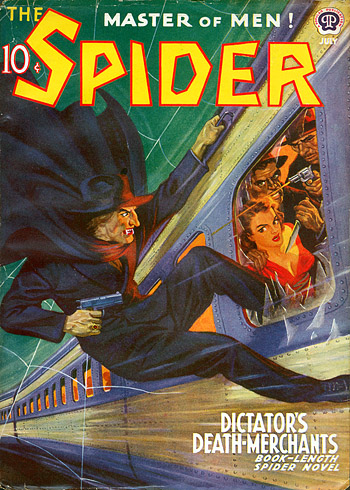
Cover of book number 82, "The Dictator's Death Merchants", with art by Rafael DeSoto
Publication information
PublisherPopular Publications
First appearanceThe Spider #1 (October 1933): "The Spider Strikes"
Created byHarry Steeger
In-story information
Alter egoRichard Wentworth
Supporting character ofNita Van Sloan
Ram Singh
Ronald Jackson
Stanley Kirkpatrick
Abilities
  • Genius intellect
  • Skilled in hand-to-hand combat
  • Expert marksman
  • Master of disguise

The Spider is an American pulp-magazine hero of the 1930s and 1940s. The character was created by publisher Harry Steeger and written by a variety of authors for 118 monthly issues of The Spider from 1933 to 1943. The Spider sold well during the 1930s, and copies are valued by modern pulp magazine collectors. Pulp magazine historian Ed Hulse has stated "Today, hero-pulp fans value The Spider more than any single-character magazine except for The Shadow and Doc Savage."[1]

Creation and publication history

[edit]

The Spider was created in 1933 by Harry Steeger at Popular Publications as direct competition to Street and Smith Publications' vigilante hero the Shadow.[1] Steeger said he got the idea for the character's name when he was playing tennis and saw a large spider walking along the edge of the court.[2] Steeger also sought to emulate the films of Douglas Fairbanks, while historians George E. Turner and Michael H. Price felt the character was also descended from Siegfried, Fantômas and The Bat.[3]

Recognizing that imitating the Shadow created the potential for lawsuits as well as the potential for strong sales, Streeger consulted his lawyer, who advised him to hire a writer with an established character and have him transform that character into the Spider. Thus, R.T.M. Scott's detective character Aurelius Smith and Hindu assistant Langa Doone became, respectively, Richard Wentworth and Ram Singh.[2] The first two novels were written by R.T.M. Scott, but they were deemed too slow-paced, so another author was brought in. Later stories were published under the house pen name of "Grant Stockbridge", which was intended to recall Maxwell Grant, the house pen name which the Shadow novels were attributed to.[2] Most of the Spider novels were actually written by Norvell Page.[2] Other authors of the series included Donald C. Cormack, Wayne Rogers, Emile C. Tepperman, and Prentice Winchell. The series was the first Popular pulp to be named after a character rather than a genre.[3]

The cover artists for The Spider magazine were Walter M. Baumhofer for the debut issue, followed by John Newton Howitt and Rafael De Soto.[4] The Spider was published monthly and ran for 118 issues from 1933 to 1943. Sales declined in the late 1930s due to surging competition from superhero comics and (despite Spider novels making concessions to the popularity of superheroes, such as an increasing number of costumed villains) never fully recovered.[2] Paper shortages during World War II and a declining readership following Page's departure to work on propaganda also played their part.[5]

A 119th Spider novel manuscript (Slaughter Incorporated) had been completed but was not published until decades later (as Blue Steel), a heavily rewritten mass-market paperback with renamed characters. In 2012, Moonstone Books finally published it as Slaughter, Inc., in its original unedited form. The novel was again reprinted in 2018 by Altus Press as a facsimile edition, this time designed to look like a 1940s pulp.

Stories

[edit]

The Spider stories often involve a bizarre menace to the country and a criminal conspiracy. They were often extremely violent, with the villains engaging in wanton slaughter of thousands as part of sometimes nationwide crime sprees. Pulp magazine historian Ed Hulse noted that "Spider novel death tolls routinely ran into the thousands".[1] The master criminal of the stories is usually unmasked only in the last few pages. The stories often end with Wentworth killing the villains and stamping their corpses' foreheads with his "Spider" mark.[1]

Will Murray would note the character's brutality and willingness to kill criminals, even occasionally pre-emptively.[5] Price and Turner also noted he was considerably more brutal and violent than other pulp heroes, especially under Page, who they stated "maintained in the character a viciousness that placed The Spider magazine in a par with the horror-anthology pulps of its day".[3]

A complete list of all 119 Spider pulps in the original series is available online at fan sites (see The Spider | List.)[6]

Characters

[edit]

The Spider

[edit]

The Spider is millionaire playboy Richard Wentworth, who served as a major in World War I, and was living in New York City unaffected by the financial deprivations of the Great Depression. The ninth pulp represents him as the last surviving member of a rich family.[7] Wentworth is easily identified as the Spider by his enemies in a number of earlier novels and is arrested by the police, only to escape. He adopts a cover identity - Tito Caliepi - and associated aliases. The Spider's earliest costume consisted of a simple black domino mask, black hat, and cape. Later in the series, vampire-like makeup appears, which is replaced with a face mask featuring grizzled hair and finally a hunchback. These are added to terrorize the criminal underworld, while the Spider dispenses his brand of violent vigilante justice.[1] Utilizing his talent as a violinist, Wentworth (posing as Caliepi), sometimes uses busking as part of his disguise.

Wentworth also ventures into the underworld disguised as small-time hood Blinky McQuade in order to gain needed information. To Scotland Yard, Wentworth is known as Rupert Barton, who holds a badge of Inspector for services rendered; by the fifth novel, he also holds the rank of lieutenant in the FBI.[8] Wentworth, according to the fifth story, is 5 ft 11 in (1.80 m) tall, and has grey eyes. He has an old battle scar on his head that flares up at times of great stress. He is an accomplished pianist and violinist, and drives a Lancia. He speaks fluent Hindustani and so talks with Ram Singh in his own language, with little fear anyone else would understand what is being said. As written by Page, Wentworth was also psychologically vulnerable and suffers frequent bouts of fear, self-doubt, despair and paranoia.[1][2]

The Spider's seal and weapons

[edit]

The Spider's calling card is a red-ink spider image (like a drop of blood) left on the foreheads of the criminals he kills, so others will not be blamed. In the sixth novel (1934), the Spider imprints his red sign on a gold ring so that any who need his help can use it by taking it to Kirkpatrick (where Wentworth will find out about it). The Spider's seal was concealed in the base of his platinum cigarette lighter,[2] and was invented by Professor Brownlee. The Spider also carried a thin silken line (his "web") which had a tensile strength of several hundred pounds. Wentworth was also a master of disguise. In the small steel case of burglar tools he carried under his arm, he also had his make-up kit and (in the early novels) his Spider's eye mask.

Like The Shadow, The Spider's usual weapons of choice are a pair of Colt .45 caliber M1911 automatic pistols.[2] He is a crack shot and normally shoots to kill. However, he would not shoot anyone in law enforcement, although they frequently are under orders to shoot to kill him on sight. Brownlee also invented the lethal and almost silent air pistol the Spider used for "quiet" kills. He acted as a sort of on-call weaponsmith for Wentworth, whom he looked upon as being close to a son. Wentworth also had a gun in one of his shoes, which he used twice in the 5th novel.

In Timothy Truman's 1990s comic book adaptation, Brownlee created the "Web-Lee", a non-lethal stun pistol that fired projectiles which erupted into a spider web-like mass, inundated with microscopic barbs of frozen curare.

"Master of Men"

[edit]

The Spider's by-name is "Master of Men", indicating that he has a voice commanding enough to get many people to do his bidding. Wentworth can also imitate other people's voices. When he imitates Kirkpatrick's voice, he can give orders to lesser policemen during a stakeout, even during one intended to capture The Spider, so he can himself escape. Wentworth was not above disguising himself as a cop to escape when surrounded by policemen.

Supporting characters

[edit]
  • Nita Van Sloan is Wentworth's longtime fiancée, who often aids him. Though they are as close as man and wife, they know they could never marry and have a family, as Wentworth believes he will eventually be unmasked or killed as The Spider, and his wife and family would then pay the price.[1] In the issue #100 story, "Death and The Spider", Wentworth expects to die. Nita disguises herself as The Spider a few times, covering for Wentworth when he has been seriously injured.
  • Ram Singh, a Sikh (originally Hindu), is Wenthworth's fanatically loyal manservant; he is a deadly knife thrower and usually carries several knives with him, including the deadly kukri. Ram Singh never views his position as a servant as demeaning or negatively impacting his self-respect, feeling that he serves a man totally above other men. At times, he and Wentworth talk in Hindustani, which only they understand.
  • Sergeant Ronald Jackson, Wentworth's chauffeur, served under Wentworth in World War I and often refers to him as "the Major". He is killed by "The Avenger" in "The Pain Emperor" (Feb 1935). However he is revived in "The Reign of the Death Fiddler" (May 1, 1935) when it is revealed that Ram Singh saved him and brought him back to full health, ignoring the fact that Jackson had been given a military burial.[2]
  • Harold Jenkyns is Wentworth's butler, an elderly man who has been in the Wentworth family's service for a long time.
  • Police Commissioner Stanley Kirkpatrick or simply "Kirk", is Wentworth's closest friend, who is sure Wentworth is The Spider but can never prove it. He has promised to arrest him, try him, and send him to the electric chair if he ever has proof.[2]
  • Professor Ezra Brownlee, an inventor and Wentworth's old war colleague, features heavily in the early Spider novels; he is killed in Dragon Lord of the Underworld (July 1935). Brownlee's son makes some appearances afterward, taking over from his late father. Brownlee's unjust arrest is what motivated Wentworth to take the law into his own hands for the first time.[2]

Enemies

[edit]

Despite The Spider's tendency to kill his enemies, he encounters several foes more than once, such as The Fly and MUNRO, a master of disguise, both of whom were killed at the conclusion of their first encounter with the Spider.[2] Some storylines featuring a struggle against a single villain run for several consecutive issues, such as The Spider's four-part battle against Tang-Akhmut, the Living Pharaoh (issues #36, 37, 38 and 39),[6][2] and The Spider's three-part battle against The Master and his Black Police (#60, 61 and 62), which was reprinted decades later in a single volume as The Spider vs The Empire State.[9] Some enemies he encountered had names like the costumed super-villains of comic books, such as Judge Torture, Red Feather, The Bloody Serpent, The Brain, The Emperor of Vermin, The Red Mandarin, The Silencer, and The Wreck.

Movie serials

[edit]
Colorized publicity still for the movie serial The Spider Returns (Columbia 1941).

Columbia Pictures produced two Spider movie serials, both 15-chapter cliffhangers starring Warren Hull as Richard Wentworth. The first, The Spider's Web (1938), was also the first film serial to be made from a popular pulp magazine series character. In this serial The Spider battles The Octopus and his henchmen, who attempt to disrupt all commercial and passenger transportation systems, and later all U. S. industry. Spider pulp magazine novelist Norvell Page was one of the writers who worked on the serial's screenplay. Compared to other light-hearted action-adventure serials, Price and Turner felt The Spider series owed more to film noir, noting The Spider's Web had a "morbid desperation" that bucked censorship standards. They ranked it as one of the best Columbia serials, and one of the few to truly do justice to its source material, noting the fast pace and high body count. The Octopus would feature in a short-lived Page-written pulp series for Popular that was rapidly reworked as The Scorpion.[3]

In the second serial, The Spider Returns (1941), The Spider battles the mysterious crime lord The Gargoyle and his henchmen, who threaten the world with acts of sabotage and wholesale murder in an effort to wreck the U. S. national defense. Price and Turner bemoaned the sequel for abandoning the two-director system, calling it a "wartime replay of Web's story", also criticising the reduced role for Nita Van Sloane, now played by novice Mary Ainslee.[3]

Both serials have The Spider's black cape and head mask over-printed with a white spider's web pattern and then matched with his usual plain black fedora. This addition gave the silver screen Spider an appearance more like that of a superhero,[2] like other pulp and comics heroes being adapted for the era's movie serials.

Reprints

[edit]

Many, if not all, of the original 118 Spider pulp magazine novels have been reprinted over the years in both mass-market paperback and trade paperback editions or some other form. Very few attempts have been made, however, to publish the novels in chronological order, making it difficult for collectors to read them in the order in which they originally appeared.

Berkley Books (then Berkley/Medallion) first reprinted the Spider in 1969 and 1970, intending to reprint all 118 novels in order, hoping to tap into the reprint phenomenon of the Doc Savage novels being published by Bantam Books. However, these first paperback reissues met with poor sales. After reprinting only the first four volumes in the original pulp series, Berkley canceled the series.

In the mid-1970s Pocket Books reprinted four Spider novels (originally published as pulps #16, 21, 26 and 100), featuring modernized pulp cover artwork by Robert A. Maguire. In this series, The Spider (renamed simply "Spider") is portrayed as a non-costumed, heavily armed muscular blond-haired hero (similar to Roger Moore's James Bond). These paperbacks also failed to sell, and the series was canceled. These four novels were re-edited and heavily modernized. In the reprint of Death and the Spider for example (originally published as pulp #100 in 1942), Nita Van Sloan drives a Jaguar E-type X-KE, a sports car not created until 1961, some 19 years later.

At roughly the same time in England, Mews Books/New American Library reprinted the same four Spider novels (#16, 21, 26 and 100) sporting entirely new cover art, but different in style and execution from those used by Pocket Books. Also called "Spider", this character also resembled a non-costumed James Bond-type character (only with black hair instead of blonde). This British Spider mass market series also ended after the four titles were released.

In 1979, Python Publishing published the never-before-seen last original Spider novel, Slaughter, Inc. (written by Donald G. Cormack), which was originally scheduled to have been published in 1944 as The Spider #119. Python published it as a one-shot mass market paperback. For copyright reasons, all of the characters' names were changed, the story was retitled Blue Steel: The Ultimate Answer To Evil, and the author was credited as "Spider Page" (a reference to the pulp series' original author, Norvell Page). The Spider was recast in this book as a character named "Blue Steel". As with Pocket Books' modernized "Spider" editions, this paperback sported a modernized pulp cover painting featuring a non-costumed, but heavily armed, blond-haired hero (said to be an unused cover painting by artist George Gross, produced but never used for a Freeway Press reprint of another pulp magazine character, Operator No. 5). In 2012, Moonstone Books finally published the 119th Spider novel Slaughter, Inc. in its original unedited form. The novel was reprinted yet again in 2018 by Altus Press as a "facsimile edition", this time designed to look exactly how The Spider #119 pulp would have looked had it been published in 1944.

In 1980 Dimedia, Inc. (a.k.a. Pulp Press) reprinted three Spider pulp novels (#9, 10 and 11) in the larger trade paperback format. In 1984, they reprinted those same three novels as mass market paperbacks, sporting new cover paintings of the original costumed Spider by artists Ken Kelly (on volumes one and two) and Frank Kelly Freas (on volume three).

In the early 1990s Carroll & Graf Publishers issued a series of eight mass market Spider paperbacks, each one reprinting two complete Spider novels. These 16 novels were the longest-running Spider reprint series done for the mass market paperback book market up to that time. The novels reprinted in this series were #14, 15, 17, 26, 30, 40, 41, 50, 52, 54, 75, 76, 78, 81, 92 and 113. All of them use the original The Spider pulp magazine artwork for their covers. (One cover was a newly done painting by Rafael DeSoto, the original pulp cover artist.)

After Carroll & Graf, several specialized small press pulp reprint houses tried their hand at reprinting The Spider series. Bold Venture Press published ten issues of The Spider (#5, 6, 7, 8, 16, 26, 31, 50, 69 and 70).[10] Wildside Press published two The Spider reprints (#78 and 92).[11]

Pulp Adventure Press (PAP) reprinted 12 Spider novels in a magazine-sized format, even including the original interior artwork from the pulps (#12, 31, 36, 37, 38, 39, 44, 45, 46, 47, 48 and 85).[6]

Girasol Collectables (aka Adventure House)[12] reissued the novels as a series of single pulp novel facsimile editions, as well as re-typeset stories in "pulp double novel" trade paperbacks. Both series use the original pulp magazine cover artwork for their books. Girasol published the first 23 issues of the original pulp series as "facsimile" editions. They also published 25 of their "double-novel format" issues, which total 50 novels reprinted in all (#1, 3, 9, 10, 11, 13, 14, 19, 20, 22, 25, 27, 28, 29, 32, 34, 35, 42, 43, 49, 51, 53, 54, 55, 57, 59, 64, 66, 70, 71, 72, 77, 82, 83, 86, 87, 91, 95, 98, 100, 101, 102, 103, 104, 105, 107, 108, 110, 112 and 114).[12][13][14]

In 2007, New York science fiction publisher Baen Books published a trade paperback featuring three Spider novel reprints (#16, 74 and 85). In 2008, they released a second companion trade paperback featuring two more Spider reprints (#26 and 75) as well as a third bonus story about another pulp hero called "The Octopus". In 2009, Baen re-issued both volumes as mass market paperbacks.[15] The Baen editions sported brand new Spider cover paintings by noted graphic designer and comics artist Jim Steranko.

Also in 2007, Moonstone Books published an original anthology of brand new Spider short story pastiches entitled The Spider Chronicles. In 2013, Moonstone published a second anthology, The Spider: Extreme Prejudice featuring 12 more brand new Spider short story pastiches.

In late 2009, Doubleday's Science Fiction Book Club reprinted (in hardcover) Baen's second Spider three-in-one volume from the previous year. This became the first Spider hardcover edition ever to be published.

In August 2009, Age of Aces reprinted The Spider's Black Police trilogy in a single volume which they titled "The Spider vs. The Empire State". This trilogy consisted of three 1938 issues that were connected plotwise: #60 (September 1938), #61 (October 1938) and #62 (November 1938).[16]

In October 2012, Moonstone Books published an original Spider pastiche novel, Shadow of Evil, by C. J. Henderson.

In 2013, Sanctum Books reprinted 20 Spider novels in ten "double novel issues". Each book contained two reprinted novels. The pulps Sanctum reprinted were # 3, 4, 5, 6, 8, 16, 17, 18, 30, 31, 68, 74, 78, 90, 92, 93, 96, 106, 111 and 118.

The Vintage Library has 34 licensed Spider novel reprints in the PDF format. For a small fee, each one can be downloaded from their website.

Facsimile Spider novels continue to appear in print from other publishers, especially Altus Press;[17] they have also been issued in the Kindle e-book format.

Altus Press has begun reprinting the entire Spider series of novels in their original order of publication beginning with #1, on a monthly basis. Altus also launched (in August 2018) a "Wild Adventures of The Spider" pastiche novel series. The first pastiche was written by Will Murray. The Doom Legion has Richard Wentworth team up with James Christopher (a.k.a. "Operator No. 5") and "G-8", two of Popular Publications' top pulp heroes. Two pastiche sequels, Fury in Steel and Scourge of the Scorpion by Will Murray, both came out in 2021.[18]

Comics and graphic novels

[edit]

Eclipse Comics

[edit]

In December 1990 American comic publisher Eclipse Comics announced plans to produce a comic book series based on the character. Writer and artist Timothy Truman based the three-issue limited series on the 1934 story "The Corpse Cargo", and the series was issued in the 'prestige' square-bound format popularised by DC Comics' The Dark Knight Returns; Enrique Alcatena contributed to the art.[19] As noted in Comics Scene #19, Truman set his version of The Spider in the "1990s as seen by the 1930s". Elements of this version of the Spider's milieu include airships as common transportation, the survival of the League of Nations into the near past - Wentworth meets Ram Singh during an intervention into India and Pakistan - and World War II, if it ever happened, taking place differently. This series featured an African-American Commissioner Kirkpatrick.[20] Truman chose to redesign the character, removing the hat and toning down the exaggerated monstrous look of Wentworth's crime-fighting guise. He had originally planned to have the character wrap his face in bandages before becoming aware of Sam Raimi's then-upcoming film Darkman. A long-time fan of the character, Truman had previous tried to get an adaptation made with First Comics early in his career.[21]

Reviewing the title for Amazing Heroes, Fred Patten gave the first issue three stars out of five, bemoaning that the beloved character had been revised to "another grim vigilante".[22] However in the same magazine T. M. Maple, who had not previously heard of the character, found it much more pleasing, though he felt it was weaker that Truman's best works.[23] The series was a moderate sales success for Eclipse.[24][25] and as a result they produced a three-issue follow-up The Spider: Reign of the Vampire King (based on "Death Reign of the Vampire King") the following year. However, Eclipse would go out of business before any further material could be produced.

Moonstone Books

[edit]

Between 2009 and 2011, Moonstone Books published several comics based on the original pulp character, including crossovers with fellow pulp heroes Domino Lady[26] and Operator No. 5[27]

Dynamite Entertainment

[edit]

In August 2011, Dynamite Entertainment announced an updated Spider comic book series, written by novelist David Liss;[28] the first issue was released in May 2012. Award-winning artist Ron Lesser painted the first three issues (May-July). The Spider's costume in this series is based on the one worn by actor Warren Hull in Columbia's 1940s Spider movie serials, but the black costume's web lines are rendered in blood red instead of white. This comics series depicts The Spider and his allies fighting crime in a modern-day U. S.[29] The 17-issue series received largely positive reviews.[30]

In December 2012, Dynamite released the first issue of Masks, an eight-issue comic book miniseries that teams The Spider with Dynamite's other pulp hero-based comic book characters, including the Green Hornet and Kato, The Shadow, and a 1930s descendant of Zorro.[31] Together, they fight a powerful criminal syndicate which secretly controls New York City through the corrupt and powerful Justice Party, which has seized complete control over the city. This miniseries, set in the Depression Era of the 1930s, was not in the same continuity as Dynamite's The Spider comic book series.[32]

Influence

[edit]

Notable fans of The Spider include Charles M. Schulz, who confessed that "I could hardly stand to live from one month to another when the new Spider novel would come out."[2] and Stan Lee, who named the character as a major influence on the creation of Spider-Man in the book Origins of Marvel Comics.[33] Will Murray noted the similarity between the Spider's costume in the movie serials and the original Spider-Man costume, and the common element of both characters being perpetually sought by authorities unaware of their true identities.[5]

References

[edit]

Further reading

[edit]
[edit]
Revisions and contributorsEdit on WikipediaRead on Wikipedia
from Grokipedia
The Spider is a fictional vigilante hero from American pulp magazines, active during the 1930s and 1940s, known for his brutal crusade against crime in a dystopian vision of New York City. Created by publisher Henry Steeger of Popular Publications as a rival to The Shadow, the character debuted in the October 1933 issue of The Spider magazine, with the first two stories written by R. T. M. Scott. Under his civilian identity as Richard Wentworth—a wealthy World War I veteran and socialite—the Spider employs lethal tactics, marking slain criminals with a red seal of a spider on their foreheads to instill terror in the underworld. The Spider magazine ran for 118 issues until December 1943, becoming one of ' top-selling titles, with Norvell W. Page—writing under the house Grant Stockbridge—authoring 91 of the lead novels that defined the series' intense, apocalyptic style. Page's stories escalated from standard racketeer battles to world-threatening conspiracies, emphasizing themes of heroism, sacrifice, and , often portraying New York as a near-anarchic battleground. Supporting Wentworth are his fiancée Nita van Sloan, who aids in his operations; the loyal Sikh warrior Ram Singh as his ; and other allies like Ronald Jackson and inventor Ezra Brownlee, who provides gadgets such as the non-lethal "Web-Lee" stun pistol in later adaptations. Beyond the pulps, The Spider appeared in film serials including The Spider's Web (1938) and The Spider Returns (1941), as well as comic books from publishers like Enterprises in the and Moonstone and in the 2000s and 2010s. Modern reprints by Steeger Properties have revived the original stories in paperback, alongside new tales by authors like Will Murray and Gary Phillips, preserving the character's legacy as a proto-superhero of violent justice.

Origins and Publication

Creation

The Spider pulp fiction character originated in 1933 when publisher Henry Steeger of sought to create a direct competitor to Street & Smith's highly successful vigilante hero, . During a game, Steeger spotted a large spider crawling along the court's edge, which immediately inspired the character's name and thematic motif of a web-like network ensnaring criminals. This concept emerged amid the Great Depression's economic turmoil, reflecting widespread public anxieties over rising urban crime and social disorder. At the core of the character's inception was Richard Wentworth, envisioned as a wealthy veteran and criminologist who adopts the masked persona of the Spider to wage a relentless war against escalating criminal elements terrorizing American cities. Steeger tasked R.T.M. Scott, known for his earlier Secret Service Smith detective series, with penning the first two stories in the October and November 1933 issues under the house pseudonym Grant Stockbridge; Scott adapted elements from his prior work, including Wentworth's loyal aides, to establish the dual-identity vigilante framework. This setup positioned the Spider as a proactive force combating racketeers, gangs, and masterminds preying on Depression-era vulnerabilities, with Wentworth's daytime respectability contrasting his nocturnal ruthlessness. To distinguish the series from more restrained pulp heroes like , Steeger emphasized , moral ambiguity, and unsparing justice, allowing the to execute criminals without hesitation and mark their foreheads with a bloody spider seal as a of retribution. This approach eschewed sentimentality in favor of intense, horror-infused action sequences involving gunfire, , and apocalyptic threats, appealing to readers craving visceral from real-world hardships. Scott's initial installments set this tone, portraying Wentworth's methods as blurring the line between protector and avenger, a deliberate creative choice that propelled the character's immediate notoriety.

Publication History

The Spider pulp magazine debuted in October 1933, published by under editor Rogers Terrill, with its inaugural issue featuring the lead novel "The Spider Strikes" by R. T. M. Scott. The series was conceived as a direct competitor to Street & Smith's , launching monthly in standard pulp format at 10 cents per issue. It sustained a run of 118 issues through December 1943, one of the longest for a hero pulp of the era, before ceasing due to escalating wartime paper shortages that impacted the entire industry. An additional manuscript, "Slaughter Incorporated" by Donald G. Cormack intended for a February 1944 issue, remained unpublished at the time owing to the cancellation. The lead novels were credited to the house pseudonym Grant Stockbridge throughout most of the run, beginning with issue three. Norvell W. Page served as the primary author, penning 91 of the 118 published adventures and shaping the character's core direction from 1933 to 1942. Other contributors included , who wrote 15 novels often incorporating elements; Emile C. Tepperman, responsible for 10 issues with a focus on syndicates; and Robert Turner, who handled rewrites and later stories amid production pressures. Under Page's influence, the narrative style evolved from early detective-oriented tales of urban racketeering in the Scott issues to grandiose, apocalyptic crime epics by the mid-1930s, featuring threats of mass devastation like plague outbreaks and city-wide takeovers drawn from contemporary headlines. The magazine maintained its pulp dimensions but reduced page counts from 128 to 112 starting in 1936 to manage costs amid rising production expenses. As one of ' most durable titles, it achieved strong sales in hero pulp market, rivaling contemporaries like before wartime constraints curtailed output.

Fictional Elements

Stories and Themes

The stories of The Spider, primarily penned by Norvell W. Page under the house pseudonym Grant Stockbridge, follow a consistent plot formula centered on Richard Wentworth, a wealthy criminologist who operates as the masked vigilante known as the Spider. In a typical narrative, Wentworth investigates waves of bizarre and escalating crimes that threaten , such as plague outbreaks or organized gang terror, before donning his black cape, , and fright wig disguise to confront the perpetrators directly. As the Spider, he employs lethal force against criminals, often marking their foreheads with a crimson red seal using a specially designed ring to symbolize justice and warn the . These high-stakes confrontations culminate in the unmasking and defeat of a mastermind villain, restoring order amid chaotic violence that frequently results in hundreds of deaths per story. Recurring themes in the series emphasize as a necessary response to institutional failure, portraying the Spider as an anti-authoritarian figure who bypasses corrupt police and to deliver swift, if brutal, justice. Set against the backdrop of the and rising global tensions in , the narratives explore through depictions of economic despair, fascist-inspired takeovers, and widespread criminal anarchy that mirror contemporary fears of instability. The Spider's moral ambiguity is a core motif, as his willingness to kill indiscriminately—including occasional innocents caught in the crossfire—highlights the ethical gray areas of extralegal heroism, with body counts often exceeding those in comparable pulp series like . This relentless focus on violence and redemption underscores a messianic undertone, positioning the Spider as a lone savior in a decaying urban landscape. The series evolved significantly over its run from 1933 to 1943, shifting from early installments that emphasized straightforward mystery-solving and work to later "Reign of Evil" arcs featuring elaborate, city-wide schemes by super-villains. Initial stories, such as those in the debut issues, centered on isolated crime sprees with grotesque but contained threats, reflecting the weird menace subgenre popular in pulps. By the late , influenced by real-world events like the rise of , Page incorporated broader apocalyptic narratives, including trilogy-length sagas of totalitarian regimes and mass terror, as seen in tales like "The Spider vs. the ." This progression added layers of political allegory and emotional intensity, moving toward more serialized, horror-infused plots. Unique stylistic elements distinguish the series, including the Spider's extensive "web" of informants—loyal allies like his fiancée Nita van Sloan and bodyguard Ram Singh—who provide crucial intelligence and support during operations. Page's writing also emphasizes , vividly depicting the terror of impending doom on a "doomed city" scale, with criminals' sadistic methods and the societal panic they induce creating an atmosphere of unrelenting dread. These motifs, combined with rapid pacing and lurid action, contribute to the pulp's enduring reputation for blending crime thriller elements with visceral, nightmarish undertones.

Primary Characters

Richard Wentworth, known in his civilian identity as a wealthy and criminologist, is a veteran who operates as the vigilante hero The Spider during New York's crime-ridden . By day, he maintains a facade of , leveraging his resources and to gather on criminal activities, while at night he transforms into the masked avenger, earning the moniker "Master of Men" for his commanding presence and strategic dominance over foes. The Spider's arsenal emphasizes terror and precision, including his signature spider gun—a pair of customized Colt .45 pistols—and a special signet ring that stamps a red spider emblem onto the foreheads of slain criminals as a warning to the . He also employs a web-cord to fire silken ropes for rapid escape or restraint, alongside non-lethal gas pellets that release incapacitating vapors to subdue groups without fatalities. These tactics reflect his of swift, decisive , often involving disguises like a hunchbacked figure with fake fangs to instill fear before striking. Nita van Sloan serves as Wentworth's fiancée and primary confidante, providing emotional support and actively participating in investigations by infiltrating dangerous situations or analyzing clues from her position in society. Over the course of the series, her role evolves from a supportive partner to an occasional impersonator of The Spider himself, donning his cloak and hat to draw fire or complete missions when Wentworth is compromised, showcasing her courage and piloting skills in high-stakes pursuits. The supporting cast bolsters The Spider's operations with specialized skills: Ram Singh, a formidable Sikh manservant and expert knife thrower, acts as Wentworth's loyal bodyguard and combatant, hurling adversaries with brute strength during close-quarters battles. Ronald Jackson, Wentworth's chauffeur and fellow World War I veteran, handles vehicular escapes and reconnaissance, his unwavering loyalty stemming from their shared . Professor Ezra Brownlee, a former mentor and inventive genius, supplies custom gadgets such as concealed airguns and modified lighters that deploy the spider seal, enhancing The Spider's technological edge against sophisticated threats.

Antagonists

The antagonists in the Spider pulp stories are predominantly masterminds who orchestrate vast criminal enterprises, often with schemes designed to unleash chaos on a citywide or national scale. These villains typically command loyal cults, syndicates, or armies of thugs, employing exotic weapons, scientific gadgets, or biological agents to advance their apocalyptic agendas. Unlike heroes with enduring arch-enemies, the Spider confronts a diverse array of foes, most confined to a single story or brief arc, allowing each narrative to escalate threats anew without repetition. This structure emphasizes the immediacy of danger, with villains embodying 1930s anxieties such as economic devastation, foreign subversion, and societal breakdown. Recurring enemy types include industrial saboteurs like The Master, who systematically demolishes factories and infrastructure to corner the steel market and cripple the economy. , such as the Red Mandarin, flood markets with poisoned consumer goods to enslave populations through , turning citizens into unwitting pawns in their empires. Other masterminds lead pseudo-religious or totalitarian groups, exemplified by The Pharaoh, a recurring threat across multiple issues who deploys monstrous minions and rackets to dominate urban centers. These figures often operate from hidden lairs, blending criminal ambition with pseudoscientific horror to amplify their menace. Notable individual antagonists highlight the pulps' flair for the grotesque and catastrophic. , a plague-wielding aviator, unleashes infected pigeons over to trigger mass panic and depopulation. The Fly masterminds gas-based terror campaigns and a massive dirigible bombing to seize control of New York. The Green Hand deploys mind-control gases to subjugate , facilitating a foreign dictator's plot. Such villains frequently meet their end at the Spider's hand, reinforcing the hero's lethal vigilance against existential perils. The absence of a singular arch-nemesis underscores the episodic nature of the series, where each foe represents a self-contained embodiment of contemporary dreads like , , and moral .

Adaptations

Film Serials

The Spider was adapted into two film serials produced by during the late 1930s and early 1940s, both starring in the dual role of Richard Wentworth and his vigilante alter ego, the Spider. The first, The Spider's Web (1938), was a 15-chapter production directed by James W. Horne and Ray Taylor, with Hull portraying the criminologist who battles a masked villain known as the Octopus, who sabotages key American industries such as transportation and power plants to seize control. Produced under Jack Fier with a focus on high-energy action sequences, the serial featured supporting performances by Iris Meredith as Nita van Sloan, Wentworth's fiancée and aide, and as his driver, Jackson. The narrative emphasized threats to national infrastructure, incorporating gadgets like the Spider's signature web-shooting device for swinging and evasion, which added a layer of inventive pulp flair to the format. In adapting the source material, the serial toned down the graphic violence characteristic of the original pulp stories, where the Spider often employed lethal force against criminals; censorship standards of the era required edits to reaction shots and reduced brutality, shifting emphasis toward gadgetry, chases, and moral ambiguity in Wentworth's vigilantism while evading police suspicion. This approach maintained the character's dual identity but prioritized suspenseful espionage plots over the pulps' intense confrontations. The serial was a commercial hit, voted the most popular chapterplay of 1938 in a Motion Picture Herald exhibitor poll, appealing to audiences with its low-budget thrills and Hull's charismatic portrayal of the sophisticated yet ruthless hero. Critics noted its breakneck pacing and atmospheric tension, though some faulted occasional editing flaws and repetitive henchman antics. The sequel, The Spider Returns (1941), also comprised 15 chapters and was directed solely by James W. Horne, with production handled by Larry Darmour on a more modest budget than its predecessor. Hull reprised his lead role, now expanding to a triple performance that included the underworld informant Blinky McQuade, while Mary Ainslee took over as Nita and Dave O'Brien as Jackson; the primary antagonist was the , a targeting U.S. defense industries with schemes involving stolen blueprints for innovations like electric motors. Like the first serial, it introduced espionage elements with a wartime undertone, featuring gadgets such as explosive devices and communication tools tied to the Spider's web motif for signaling allies, but further softened the violence by having the hero collaborate more closely with authorities and rely on non-lethal tactics. Reception for The Spider Returns was mixed compared to the original, with audiences enjoying the continued low-budget cliffhangers and Hull's versatile acting in juggling multiple personas, yet critics lambasted Horne's infusion of comedic , which undermined the tension and simplified the pulp's darker brutality into lighter fare. Overall, the serials established the Spider as a viable screen hero in the genre, popularizing his web-slinging and moral complexity among theatergoers, though their legacy endures more as entertaining B-movie artifacts than faithful pulp translations.

Comic Books

The comic book adaptations of the pulp hero the Spider first appeared in a three-issue miniseries published by Eclipse Comics in 1991, reimagining the character's 1930s adventures with contemporary narrative techniques and high-production art that emphasized the vigilante's brutal methods against urban crime syndicates. This limited series, titled The Spider, updated classic elements like Richard Wentworth's dual identity and his signature web-like insignia while incorporating modern visual dynamics to appeal to 1990s readers, marking an early effort to revive pulp icons in sequential art format. A follow-up three-issue sequel, The Spider: Reign of the Vampire King, appeared in 1992 under the same publisher, shifting the tone toward supernatural horror as the hero confronted vampiric threats, further exploring themes of relentless justice amid escalating personal stakes. Moonstone Books revived the character in comics starting in 2007 with short features in anthology titles like Moonstone's Holiday Super Spectacular, before launching a dedicated two-issue miniseries in 2011 focusing on high-stakes battles against mad scientists and monstrous legions, written by various contributors including pulp enthusiasts who maintained the original's fast-paced, violence-laden style, such as Martin Powell's "Death Siege of the Frankenstein Legion" in issue #1. Moonstone also produced crossover one-shots, such as Return of the Monsters: The Spider vs. Werewolf (2011), illustrated by Jay Piscopo, which pitted the hero against lycanthropic foes in a narrative blending pulp action with horror elements, and a team-up with the Avenger in The Avenger Meets the Spider (2011), highlighting inter-pulp alliances while preserving the Spider's signature ruthlessness. These titles, often scripted by writers like Martin Powell, stressed fidelity to the source material's graphic depictions of crime-fighting, contrasting with sanitized portrayals in broader comic industry trends. In 2012, Dynamite Entertainment acquired the license and debuted a new The Spider series written by David Liss with art by Colton Worley for the initial arc, running for 18 issues through 2014 and integrating pulp-era aesthetics with modern superhero conventions like intricate conspiracies and high-tech gadgets. The storyline, collected in volumes like Terror of the Zombie Queen, portrayed Wentworth as a war hero unraveling terrorist plots tied to his family business, emphasizing psychological depth and the character's dual life in a contemporary setting while retaining the original's emphasis on lethal confrontations. Subsequent issues shifted artists but continued exploring the hero's desperation against escalating threats, such as in arcs involving missing weapons and family endangering villains, blending the pulp violence with serialized plotting akin to 21st-century event comics. Dynamite also incorporated the Spider into multicharacter events like Masks (2013), a five-issue miniseries teaming him with the Green Hornet, the Shadow, and Zorro against a shared 1930s foe, which briefly referenced the gritty tone of the 1940s film serials without delving into their production specifics. No major new comic book series featuring the Spider have been published since Dynamite's run ended in 2014, leaving a gap in adaptations that underscores the challenges of balancing the character's inherent pulp violence—often more explicit than in mainstream superhero fare—with evolving industry standards for content accessibility and audience appeal.

Legacy

Reprints and Modern Revivals

In the late 1960s and early 1970s, Berkley Medallion initiated the first major paperback reprint series of The Spider novels, releasing four volumes between 1969 and 1970 that adapted the original pulp stories into mass-market format to capitalize on the success of similar hero revivals like Doc Savage. Pocket Books followed in 1975 with a short-lived series of four paperbacks under the simplified "Spider" title, modernizing select adventures from the mid-1930s originals into men's adventure style narratives. Moonstone Books revived interest in the 2000s through series and anthologies, and culminated in 2012 with the publication of the previously unpublished 119th novel, Slaughter, Inc., by Donald Cormack in its unedited form, marking the first official release of this wartime-era story. The novel was reprinted again in 2018 by Steeger Books as a of the intended February 1944 magazine issue, complete with vintage illustrations. Since 2018, Altus Press—operating under its Steeger Books imprint—has undertaken a comprehensive reprint project, issuing the full 118 original novels in both and print formats in their sequential order on a monthly basis, alongside the unpublished Slaughter, Inc. and new adventures penned by Will Murray under the "Wild Adventures of The Spider" line. This effort has made the complete canon more accessible, with over 30 volumes released by 2025 in deluxe editions featuring restored covers and bonus material. Radio Archives produced a series of audiobooks in the 2010s, adapting all 118 novels with dramatic narration by Nick Santa Maria, available in CD, , and digital formats to bring the Spider's exploits to audio listeners. Digital expansions post-2020 have included collections from platforms like the Vintage Library, offering licensed PDF reprints of 34 novels for download. The Spider's entry into the for its early issues—specifically the first 12 from 1933–1934, due to non-renewal of copyrights—has facilitated these revivals by allowing unrestricted republication of foundational stories, though later issues remain under license from heirs to . This status has enabled diverse formats but also led to challenges, including varying quality in modernized edits that sometimes alter original texts for contemporary sensibilities or abridge content to fit lengths.

Cultural Influence

The Spider has exerted a notable influence on subsequent superhero archetypes, particularly in the realm of web-slinging vigilantes. , co-creator of Marvel's , acknowledged the pulp hero as a key inspiration during the character's development in the , citing its dark, twisted qualities and relentless crime-fighting as foundational to the web-slinger's persona. In his book Origins of Marvel Comics, Lee explicitly named The Spider as a major influence, highlighting how the pulp character's brutal tactics and dual identity shaped the archetype of a flawed, everyday hero battling urban threats. This connection underscores the pulp hero's role in bridging magazine fiction with modern narratives. Beyond comics, The Spider captured the imagination of diverse creators, including cartoonist , who was an avid fan during his youth. Schulz confessed in interviews that the stories were so compelling he "could hardly stand to live from one month to another when the new Spider issue came out," reflecting the character's grip on popular imagination and its echoes in lighter media like . The pulp hero's themes of shadowy justice and moral ambiguity also resonated in fiction and noir films, where vigilante figures confronting systemic corruption mirrored the Spider's ruthless approach to crime, influencing portrayals of gritty urban detectives in works by authors like and films such as The Maltese Falcon (1941). As a product of the , The Spider symbolized widespread societal anxieties, embodying fears of , rampant criminality, and institutional failure through its depictions of apocalyptic threats to American cities. Richard Wentworth's alter ego represented both the desperation of the era and a outlet for readers, personifying hopes for decisive action amid uncertainty. In contemporary times, fan revivals have sustained the character's legacy through podcasts like ArtsReviews, which feature discussions with descendants of writer Norvell W. Page and pulp scholars, and events at conventions such as PulpFest, where panels explore its enduring appeal. The 2020s have seen growing engagement in online pulp communities, including dedicated forums and social groups, fostering new analyses and appreciation among enthusiasts. Compared to contemporaries like , The Spider stood out for its extreme violence, often employing lethal force against villains in ways that exceeded the more restrained tactics of other pulp avengers, a trait that amplified its impact on later extreme vigilante tropes in comics and television. This brutality, evident in stories where the hero executes criminals without hesitation, prefigured characters like and contributed to the evolution of narratives emphasizing in media.

References

Add your contribution
Related Hubs
User Avatar
No comments yet.