Hubbry Logo
ThermopoliumThermopoliumMain
Open search
Thermopolium
Community hub
Thermopolium
logo
8 pages, 0 posts
0 subscribers
Be the first to start a discussion here.
Thermopolium
Thermopolium
from Wikipedia
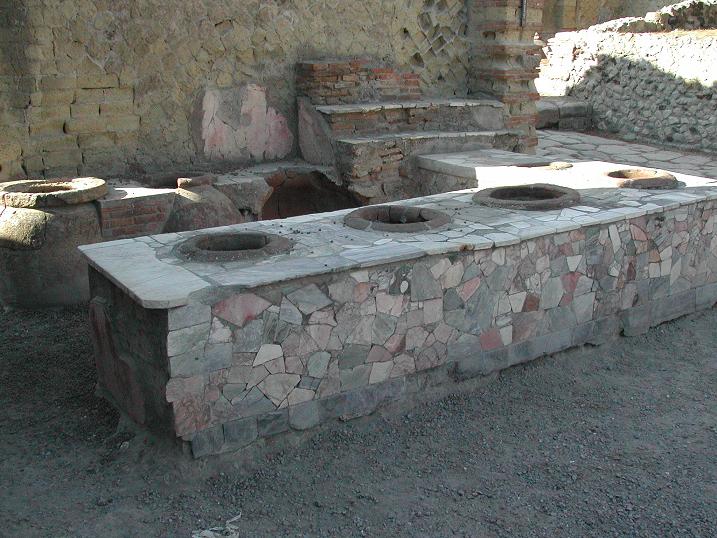
Thermopolium in Herculaneum

In the ancient Greco-Roman world, a thermopolium (pl.: thermopolia), from Greek θερμοπώλειον (thermopōlion), i.e. cook-shop,[1] literally "a place where something hot is sold", was a commercial establishment where it was possible to purchase ready-to-eat food. In Latin literature, they are also called popinae, cauponae, hospitia or stabula, but archaeologists refer to them all as thermopolia.[2] They were mainly used by those who did not have their own kitchens, often inhabitants of insulae, and this sometimes led to thermopolia being scorned by the upper class.

Design

[edit]

A typical thermopolium consists of a small room attached to, but not accessible from, a house, with a distinctive masonry counter in the front.[3] An example can be seen in the House of the Painted Vaults in Ostia Antica. Embedded in this counter were dolia, earthenware jars used to store dried food such as nuts.[2] A dolium in the thermopolium attached to the House of Neptune and Amphitrite in Herculaneum held the carbonized remains of nuts.[2] Fancier thermopolia would also be decorated with frescoes. These frescoes depicted a range of Roman mythological and religious imagery, as well as images and scenes of day to day life in the ancient city. Like modern advertisement, thermopolia frescoes were not only artistically oriented, they served a practical function. The images depicted in fresco could signify what that thermopolium was selling, e.g., fish, poultry, baked goods. Thermopolia fresco would have been an important aspect in grabbing the attention of customers in the ancient city.

Well-preserved ruins of thermopolia can be seen in Pompeii, Herculaneum and Ostia.

Thermopolium of Asellina

[edit]
A thermopolium in Pompeii

The Thermopolium of Asellina is one of the most complete examples of a thermopolium in Pompeii. Complete jugs and dishes were found on the counter, as well as a kettle filled with water. The ground floor in the Thermopolium of Asellina was used for people to eat and drink, and some stairs led to guest rooms on the second floor.[4]

It had a typical structure consisting of a wide doorway open to the street and a counter with holes where four jars were set into it (dolia) for food or wine. It had shrines for the Lares (household gods), Mercury (god of commerce) and Bacchus (god of wine), as these were the most important gods for this occupation. Upstairs, there were guest rooms as well, so this may have also been used as an inn. However, some think that this may have been a brothel due to the names of many women written as a part of an election notice on one of the outside walls of the thermopolium. Another theory is that these were the slave-girls who worked as barmaids. Behind the bar were remains of wooden racks suspended from the ceiling to stack amphorae.[2]

The Thermopolium of Regio V

[edit]

Another Pompeiian thermopolium, containing eight dolia, was completely unearthed in 2020.[5] In addition to frescoes reflecting foods available, one fresco depicts a dog with a collar on a leash, possibly a reminder for customers to leash their pets. The complete skeleton of an "extremely small" adult dog was also discovered that "attest to selective breeding in the Roman epoch to obtain this result."[6] Archaeologists have also discovered remains of food in some of the deep terracotta jars. Other discoveries include a drink shop, a decorated bronze drinking bowl known as a patera, wine flasks, amphora, and ceramic jars used for cooking stews and soups.[7][8][9]

Other thermopolia

[edit]
  • Caupona of Euxinus[10]
  • Caupona of Salvius[11]
  • Inn of Hermes[12]
  • Thermopolium of the Via Diana[13]

See also

[edit]

References

[edit]

Further reading

[edit]
[edit]
Revisions and contributorsEdit on WikipediaRead on Wikipedia
from Grokipedia
A thermopolium (from the Greek θερμοπώλιον (thermopōlion), meaning 'a place where hot food is sold', from θερμός (thermos) meaning "hot" and πωλεῖν (pōlein) meaning "to sell") was an ancient Roman establishment specializing in the sale of hot food and drinks, serving as a street-side eatery akin to a modern fast-food counter. These venues catered primarily to the urban lower classes, travelers, and laborers who lacked private cooking facilities, providing quick, affordable meals for on-the-go consumption. Over 80 such thermopolia have been identified in Pompeii alone, highlighting their ubiquity in Roman cities before the eruption of in 79 CE preserved them in ash. Thermopolia typically featured a long masonry counter embedded with large earthenware jars (dolia) that held hot foods and beverages, often warmed over a hearth or brazier behind the counter. Common offerings included mulled spiced wine (calida), lentils, boiled meats, fish, cheese, nuts, and fermented fish sauce (garum), with some sites showing evidence of frescos depicting these items or mythological scenes like a Nereid riding a seahorse. Many included small benches for limited seating, household shrines (lararia) honoring deities such as Bacchus and Mercury, and occasionally adjacent rooms for more formal dining, though takeout was the norm. Archaeological finds, such as amphorae and carbonized food remnants, confirm these spaces operated as multifunctional hubs for daily sustenance. In Roman society, thermopolia played a key social role among sub-elite populations, fostering communal interactions at busy crossroads where many were located. They were sometimes viewed with suspicion by elites, as evidenced by Emperor Claudius's short-lived ban in the CE due to associations with disorderly crowds, thieving slaves, and excessive drinking. Notable examples include the Thermopolium of Vetutius Placidus on Via dell'Abbondanza, which boasted elaborate paintings, and the recently excavated site in Regio V of Pompeii, uncovered in as part of the Great Pompeii Project, revealing pristine counters and business-related artwork. These discoveries underscore thermopolia's enduring legacy as windows into everyday Roman life, blending , , and .

History and Etymology

Origins in Greco-Roman Culture

The modern term thermopolium derives from the Greek compound thermopōlion (θερμοπώλιον), combining thermos (θερμός, meaning "hot") and pōlein (πωλεῖν, meaning "to sell"), thus denoting "a place where something hot is sold." Although the word does not appear in surviving classical Greek texts and was rarely used in Latin (appearing only four times in the comedies of Plautus, likely as a joke), it reflects Hellenistic influences on Roman commercial practices, where street vendors in urban centers like Athens and Alexandria offered ready-to-eat hot foods such as stews, grilled meats, and spiced drinks to busy citizens. In Roman Latin, these establishments were more commonly known as popina (a cookshop or tavern), caupona (an inn serving food and drink), hospitium (a guesthouse), or taberna (a general shop, often with refreshment areas), highlighting the functional overlap in everyday provisioning. The adoption of such hot-food outlets in Roman culture traces to the Republican period, with the earliest literary references to the Greek-derived term emerging in the comedies of Titus Maccius Plautus (c. 254–184 BCE). For instance, in (lines 288ff), Plautus describes a thermopolium as a disreputable spot for consuming hot wine, underscoring its role in urban street life during the 2nd century BCE. These establishments likely drew from broader Hellenistic vending traditions, adapting them to Rome's growing metropolis, where they served as precursors to more structured counters in cities like itself. Initially purposed as simple stalls for hot beverages like (calida) and basic provisions, thermopolia catered primarily to the urban poor, laborers, and those without private cooking facilities, evolving into accessible food outlets amid 's expanding population. Elite Roman writers, however, viewed them with disdain, associating popinae and similar venues with vice, , and social disorder; Juvenal's (e.g., Satire 6.121 and 8.158–162) portrays them as squalid haunts for prostitutes, thieves, and sailors, contrasting sharply with aristocratic ideals of domestic dining. This scorn reflected broader cultural tensions between plebeian necessities and patrician propriety in early Imperial .

Spread and Evolution in the Roman Empire

Thermopolia proliferated across urban centers of the , serving as essential features of daily life in bustling cities where many residents lacked private cooking facilities. Archaeological evidence reveals their concentration in , particularly in well-preserved sites like Pompeii, where approximately 89 such establishments have been identified, often clustered near gates, baths, forums, and amphitheaters to cater to passersby and locals alike. Similar examples appear in , with multiple thermopolia featuring counters embedded with dolia for storing and serving hot foods, and in , Rome's ancient port, where several have been excavated, reflecting their role in supporting trade and transit. While direct remains are scarce outside due to less favorable preservation conditions, thermopolia are documented throughout the empire's urban landscapes, from provincial towns to metropolitan hubs, underscoring their adaptation to diverse Roman environments. By the Imperial period, particularly the CE, these establishments evolved into more sophisticated operations, incorporating elaborate counters, frescoed interiors, and integrated storage jars, as seen in Pompeii and prior to the 79 CE eruption of Vesuvius, which preserved dozens in situ and marked a peak in their prevalence. This progression aligned with Rome's urban expansion and , transforming simple stalls into fixtures of imperial street culture that persisted into the later empire. In port cities like , thermopolia adapted to the needs of transient populations, including merchants, sailors, and laborers, by emphasizing quick service and portable meals suited to the demands of maritime commerce. Evidence from inscriptions and literary sources, such as Martial's epigrams depicting casual urban dining in public venues, further illustrates how these establishments integrated into the social fabric, providing accessible refreshment amid the empire's interconnected trade networks.

Design and Architecture

Structural Features

Thermopolia were typically compact commercial spaces integrated into the urban fabric of ancient Roman cities, often forming part of larger insulae or multi-story blocks. The basic layout consisted of a small front room, usually measuring 37 to 77 square meters in smaller examples, that opened directly onto the street via a wide doorway to facilitate customer access and visibility. Rearward areas, sometimes comprising one or two additional rooms, served as storage or preparation spaces, with the overall design emphasizing functionality for quick service rather than extensive indoor seating. Similar layouts are observed in other urban sites like , though port city examples occasionally featured more open courtyards for storage. Central to the structure was the counter, or mensa, positioned at waist height along the street-facing wall. These counters were commonly L-shaped to maximize serving area, though straight variants also existed, and featured circular recesses into which large jars known as dolia were embedded and sealed, allowing for the storage and serving of hot or cold foods and drinks without additional utensils. The counter served as both a sales surface and a built-in storage system. Construction materials reflected practical Roman building techniques suited to urban environments. Counters and benches were built from durable , often incorporating local stone or , while floors were laid with cocciopesto, a waterproof mortar made from crushed terracotta, lime, and to withstand spills and heavy foot traffic. Walls were typically of simple or timber-framed construction, with evidence from preserved sites like demonstrating these elements' resilience to environmental conditions.

Decorative and Functional Elements

Thermopolia featured vibrant wall frescoes that served both aesthetic and promotional purposes, often illustrating still-life scenes of food items such as , roosters, and to entice customers, as seen in the Regio V thermopolium where paintings of ducks, a rooster, and a on a lead adorned the counter sides. Mythological motifs were also common, including depictions of riding sea-horses or other marine figures on counter fronts, enhancing the establishment's allure in bustling urban settings. In the thermopolium of Vetutius Placidus, frescoes portrayed gods relevant to commerce and hospitality, such as Mercury with his money bag and Bacchus with a panther. Small shrines, or lararia, were integral decorative and protective elements, typically dedicated to the as household guardians, Mercury for prosperous trade, and Bacchus for wine-related blessings, reflecting the operators' reliance on divine favor for business success. These shrines, often niches with painted or sculptural figures, were positioned near counters or in back rooms, as exemplified in the Vetutius Placidus establishment where flanked a central genius figure alongside Mercury and Bacchus. Functional elements included bronze utensils like strainers for filtering wine and paterae (shallow ) for serving, with a first-century AD strainer recovered from Pompeii featuring a perforated central cavity for practical use in thermopolia. Amphorae for storing and transporting wine or other liquids were common, with nine examples unearthed in the Regio V thermopolium, some positioned to mirror painted motifs on the walls. Hearths, often in the form of portable braziers, allowed for on-site heating of and drinks, while embedded dolia (large jars) in counters provided accessible storage, as evidenced by carbonized wooden shelving supports in several Pompeian sites. Wall inscriptions and graffiti added both utilitarian and promotional value, including painted advertisements for menu items, price lists, and electoral endorsements that doubled as community notices, such as those in the Thermopolium of Asellina promoting candidates for local office. These writings, often in red or black paint, helped operators advertise specials visually while engaging passersby in urban thoroughfares. Urban thermopolia, particularly in Pompeii, showcased more elaborate decorations like counter inserts and frescoes, emphasizing visual appeal to attract diverse clientele.

Function and Operations

Food and Beverages Served

Thermopolia primarily offered ready-to-eat hot foods prepared from affordable, locally available ingredients, catering to the daily needs of urban dwellers who often lacked private cooking facilities. Archaeological from embedded dolia (large earthenware jars) in counters reveals residues of stews and porridges made from grains and , such as lentils and pulses, which formed the basis of simple meals. Animal proteins were also common, with chemical analyses and bone fragments indicating the use of meats from , , , , and land s in these dishes; for instance, in one well-preserved example from Regio V, residues confirmed the presence of and remains in food containers, while fava beans were found in a separate dolium used to flavor and color wine. Beverages at thermopolia were straightforward and suited to the , often served warm or at room temperature in basic or vessels. Common drinks included mulsum, a sweetened wine mixed with , and , a diluted vinegar-water mixture popular among laborers for its refreshing and preservative qualities. Hot spiced wines, such as calida, were also available, with residues in dolia showing additions like beans to alter flavor and color, as described in ancient culinary texts. These beverages complemented the hot foods, enhancing their appeal in a social setting frequented by diverse clientele. Preparation occurred on-site over small hearths integrated into the counters, allowing for immediate heating of pre-cooked items stored in dolia. Evidence from carbonized grains, faunal bones, and interdisciplinary analyses, including archaeozoological and archaeobotanical studies, underscores this efficient method, with findings from 2020 excavations highlighting the integration of diverse ingredients like duck bones and snail shells in preserved residues. Recent 2025 work at the Regio V site further revealed adjacent service areas and living quarters, illustrating the multifunctional nature of these operations. This setup ensured fresh, hot service, reflecting the thermopolium's role as an accessible source of sustenance in Roman urban life.

Social and Economic Context

Thermopolia primarily served the lower strata of Roman society, including laborers, slaves, freedmen, and free-born workers who lacked access to home cooking facilities or time for elaborate meals. These establishments catered to urban sub-elites facing food insecurity in densely populated cities like Pompeii, where many residences were small and ill-equipped for meal preparation. In contrast, the Roman elite largely avoided thermopolia, viewing public dining there as undignified and beneath their status; elite dining occurred in private homes to maintain social exclusivity and avoid association with the masses. Economically, thermopolia provided affordable, ready-to-eat options integral to the urban economy, making them accessible for daily sustenance. Often operated by freedmen or women from similar social backgrounds, such as the freedwoman Asellina who ran a prominent thermopolium in Pompeii, these venues tied into local markets by sourcing ingredients like grains, , and wine for on-site preparation and sale. With over 80 such eateries in Pompeii alone amid a landscape of more commercial spaces than homes, thermopolia supported the bustling trade networks and for sub-elite entrepreneurs. Roman authorities imposed regulations on thermopolia and similar popinae to mitigate perceived social ills, such as Emperor Claudius's banning the sale of hot water (used to dilute wine) and boiled , aimed at curbing excessive and idleness among the populace. Literary sources reinforced negative perceptions, portraying these spots as hubs for gossip, gambling, and prostitution; satirists like described popinae as squalid dens filled with drunks and vice, while decried public eating as shameful for respectable citizens. Despite such stigma, thermopolia remained vital social spaces for the working classes, fostering community interactions amid urban life.

Notable Examples in Pompeii

Thermopolium of Asellina

The Thermopolium of Asellina, located at IX.11.2 along Via dell'Abbondanza in Pompeii's Regio IX, Insula 11, was partially excavated in 1911, revealing a well-preserved example of a Roman snack bar. The site features an intact masonry counter equipped with four embedded terracotta dolia (storage jars) designed to hold hot foods and drinks, alongside artifacts such as complete jugs, dishes, and a bronze kettle that was found still containing water at the time of discovery. This setup exemplifies the typical operational layout of thermopolia, where customers could purchase ready-to-eat meals without entering the premises. Unique decorative elements include frescoes depicting everyday foods like eggs, fruits, and , as well as mythological figures and deities, which adorned the walls and provided both aesthetic appeal and a visual for patrons. A small household shrine (lararium) was also uncovered, featuring paintings of the protective (household gods), Mercury (god of commerce), and Bacchus (god of wine), highlighting the religious and commercial integration in such establishments. Upstairs from the ground-floor counter, three interconnected rooms suggest additional uses beyond food service, likely functioning as an or , with evidence pointing to women named Zmyrina, Aegle, and Maria operating there. The site is further distinguished by extensive election graffiti on its exterior walls, including endorsements for candidates like Lollius Fuscus in his bid for duumvir, inscribed in professional lettering and signed by Asellina and her associates—Smyrna (Zmyrina), Aegle, and Maria—as supporters. These inscriptions reveal the thermopolium's role in local , where such venues served as hubs for community discourse and campaigning. Overall, the diverse artifacts and features indicate multifaceted operations, encompassing food and drink sales, lodging, possible , and political activity, offering insights into the social fabric of Pompeian daily life.

Thermopolium of Regio V

The Thermopolium of Regio V is located in Pompeii's Regio V, Insula 2, with its entrance facing Vicolo delle Nozze d'Argento, at the intersection with Vicolo dei Balconi. Excavations began in 2019 as part of the Great Pompeii Project, focusing on safety and restoration in unexcavated areas, and were completed in 2020, revealing the site in its entirety. The thermopolium opened to the public on August 12, 2021, allowing visitors to view its preserved state. The site's key architectural features include a counter embedded with four terracotta dolia for storing and serving food and drinks, typical of thermopolia design. Adorning the counter's front and sides are vibrant frescoes depicting still-life scenes, such as ducks, a rooster, and a leashed , alongside a mythological figure of a Nereid riding a sea-horse, which may have served both decorative and promotional purposes by illustrating available fare. In the northwestern corner, archaeologists uncovered the complete of a small dog, approximately 20-25 cm tall at the , suggesting it may have been kept as a pet or for guarding the premises. Among the artifacts recovered are nine amphorae for storage, a patera likely used for ladling liquids, two glass flasks, and a olla, alongside food residues analyzed from the dolia and surrounding areas. These residues include bones of , swine, , , and land snails, as well as fava beans mixed with wine in one dolium, indicating a menu of stews and hot dishes common to such establishments. Further excavations starting in 2023 for conservation and expansion revealed back rooms behind the counter, enhancing understanding of the thermopolium's operational layout. In November 2025, a notable find emerged from one of these back rooms: a glass-paste , or vase, produced in , , and decorated with Egyptian-style hunting scenes, which had been repurposed as a for holding food. This artifact underscores extensive trade networks linking Pompeii to the , even in everyday commercial spaces. Human remains at the site consist of bones from at least two individuals, both over 50 years old, found dispersed across the interior. One set was associated with traces of a (evidenced by nails and wood residues), while the other was partially inside a ; their disarticulated state results from post-eruption disturbances, including 17th-century exploratory tunnels dug by early archaeologists. These remains may represent victims of the 79 CE Vesuvian eruption seeking or later intrusions, though definitive attribution remains uncertain.

Other Pompeian Thermopolia

In addition to the well-documented thermopolia, Pompeii preserves over 150 such establishments across its urban blocks, reflecting their high density in a of approximately 11,000 residents and serving as integral hubs for daily and sustenance. These sites varied in scale and features, with many clustered along major thoroughfares to cater to , underscoring the role of thermopolia in facilitating quick, affordable meals amid the bustling insulae. The Caupona of Euxinus, located at Regio I.11.11 (also known as the Thermopolium of the Phoenix), exemplifies a thermopolium integrated with outdoor space, including a modest that supported both aesthetic appeal and potential cultivation for culinary use. Its exterior featured decorative paintings, such as a painted depicting a phoenix flanked by peacocks, which likely advertised and evoked themes of renewal and . This setup highlights how some thermopolia blended functional service counters with ornamental elements to attract clientele. The of Hermes at Regio I.1.8 prioritized commercial operations, with an open-front counter designed for efficient in food and drink, complemented by interior spaces possibly used for storage or brief . Archaeological includes cult paintings on its walls, suggesting elements tied to mercantile success, such as dedications to protective deities. Further illustrating operational diversity, the Thermopolium of Vetutius Placidus at Regio I.8.8 featured a classic quick-meal configuration, with a counter embedding dolia jars to keep foodstuffs warm and accessible for immediate serving of items like , cheeses, and spiced wine. Its frescoes depicted theatrical scenes, including and actors, evoking and abundance; in 2024, reenactments with costumed figures at the site demonstrated this rapid-service model to visitors. Architectural variations among Pompeian thermopolia included attachments like stables for draft animals or extra rooms for preparation and overnight stays, as seen in properties combining retail fronts with rear utilitarian spaces. Comparatively, while basic examples relied on unadorned counters for practicality, others incorporated mosaics for visual allure, such as rooster motifs in select sites symbolizing vigilance and prosperity amid the embedded jars and serving areas. These differences reveal a spectrum from utilitarian popinae to more embellished cauponae, adapting to neighborhood demands without the elaborate still-life frescoes of sites like the Thermopolium of Regio V.

Significance and Modern Discoveries

Cultural Insights from Thermopolia

Thermopolia in Pompeii provided evidence of a diverse and affordable Roman diet, incorporating staples like grains, , , fruits, nuts, and proteins such as cheese, sausages, , and , often flavored with . This variety ensured accessible nutrition for urban dwellers, with paleonutritional analysis indicating well-nourished populations supported by local gardens and markets supplying items like figs, olives, peaches, and lentils. The integration of imported goods, including from , dates from the , and exported across the Mediterranean to regions like Britain and , highlighted extensive trade networks that enriched everyday meals beyond local resources. These establishments served as vital social hubs, fostering community interaction through casual dining, games, and conversations among neighbors, laborers, and travelers along busy streets. roles were evident in operations, with women like Asellina managing prominent thermopolia, such as the one at IX.11.2 where her service alongside staff, reflecting women's economic agency in retail and despite societal constraints. Class divides manifested in usage patterns, as thermopolia primarily catered to lower strata like plebs and freedmen lacking private kitchens, while elite literature critiqued these venues as sites of vice and excess for the masses, contrasting with refined home banquets. The high density of thermopolia—around 150 identified in Pompeii, with 67% clustered on major thoroughfares like Via dell'Abbondanza—underscored the fast-paced urban life in a city of approximately 10,000-20,000 inhabitants, where apartment dwellers in insulae relied on them for convenient meals amid limited domestic cooking facilities due to fire risks. Their preservation beneath volcanic ash from the 79 CE eruption of Vesuvius offers a unique snapshot of daily routines, capturing mid-meal scenes, storage jars, and frescoes that reveal the rhythm of street-level commerce and socialization in a bustling Roman provincial town.

Recent Archaeological Finds

Recent archaeological efforts in Pompeii have significantly advanced the understanding of thermopolia through targeted restorations and excavations post-2020. The thermopolium in Regio V, initially uncovered in 2019-2020, underwent full restoration and opened to the public in August 2021, allowing detailed study of its frescoed counters and associated structures. Excavations completed in the vicinity that year also revealed a cistern, fountain, and water tower in the adjacent square, enhancing insights into the operational infrastructure supporting these establishments. Further investigations from 2023 to 2024 focused on adjoining rooms of the Regio V thermopolium, uncovering evidence of functions such as preparation areas integrated with the main counter. These works, aimed at improving site conservation, exposed utilitarian spaces behind the public-facing thermopolium, including storage and cooking facilities. In 2024, renewed analyses highlighted thermopolia like this one—adorned with animal motifs such as ducks and roosters in frescoes—as key venues for lower-class residents, serving affordable hot meals and drinks amid everyday commerce. A notable 2025 discovery in the back room of the Regio V thermopolium was an Egyptian situla vase, a glass-paste vessel dated to the 1st century BCE and imported from . Featuring hunting scenes in Egyptian style, the artifact was repurposed domestically as a , underscoring the integration of luxury imports into routine thermopolium activities and the city's multicultural trade networks. Ongoing analyses of residues, amphorae, and animal bones from these sites continue to reveal dietary habits, with recent isotopic studies confirming diverse food sources like grains, , and in thermopolia menus. Unexcavated portions of Regio IX hold potential for additional thermopolia discoveries, as current digs in Insula 10 expose new domestic and commercial blocks.

References

Add your contribution
Related Hubs
User Avatar
No comments yet.