Hubbry Logo
TherocephaliaTherocephaliaMain
Open search
Therocephalia
Community hub
Therocephalia
logo
8 pages, 0 posts
0 subscribers
Be the first to start a discussion here.
Therocephalia
Therocephalia
from Wikipedia

Therocephalians
Temporal range: Middle PermianMiddle Triassic 266–242 Ma Possible descendant taxon Cynodontia survives to present
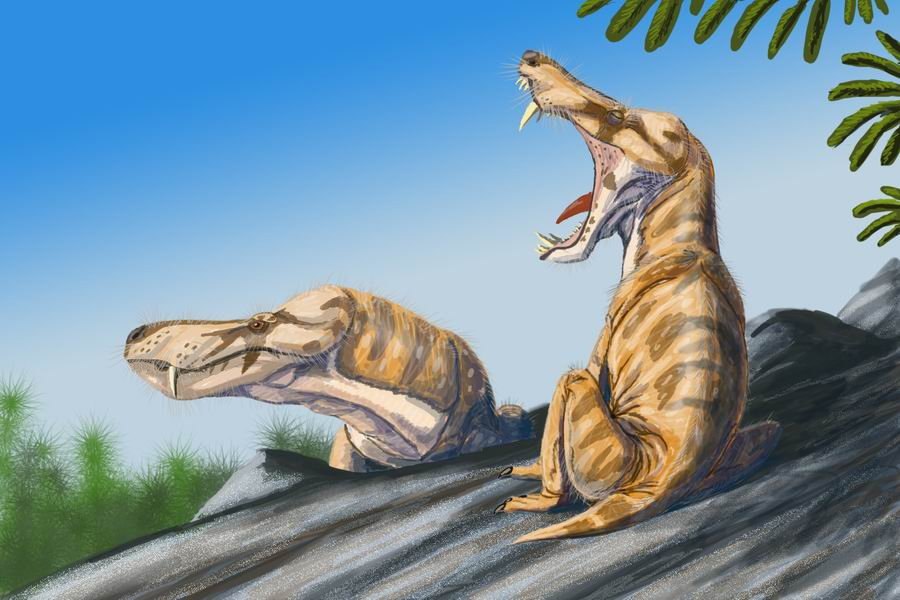
Life restoration of two representatives of the early therocephalian genus Alopecognathus
Scientific classification Edit this classification
Kingdom: Animalia
Phylum: Chordata
Clade: Synapsida
Clade: Therapsida
Clade: Eutheriodontia
Clade: Therocephalia
Broom, 1903
Subtaxa

Therocephalia is an extinct group of therapsids (mammals and their close extinct relatives) from the Permian and Triassic periods. The therocephalians ("beast-heads") are named after their large skulls, which, along with the structure of their teeth, suggest that they were carnivores. Like other non-mammalian synapsids, therocephalians were once described as "mammal-like reptiles". Therocephalia is the group most closely related to the cynodonts, which gave rise to the mammals. Indeed, it had been proposed that therocephalians themselves may have given rise to the cynodonts, and therefore that therocephalians as recognised are paraphyletic in relation to cynodonts and so not a clade. Conventionally, however, Therocephalia is regarded as the sister clade of Cynodontia, together forming the clade Eutheriodontia.

The close relationship of Therocephalia to Cynodontia takes evidence in a variety of skeletal features. Most notable is that the skull roof is narrowed between two enlarged temporal fenestra, allowing for expansive jaw musculature. At the same time, derived therocephalians also share a number of mammalian traits with cynodonts that evolved convergently, including a secondary palate, loss of the postorbital bar behind the eye and developing multi-cusped cheek teeth for herbivory. Other therocephalians retained simpler teeth for a carnivorous diet, often with large canines and sometimes a reduction or even total loss of the postcanine teeth. Such forms include genera that have even suggested to have possessed a venomous bite (namely Euchambersia), which would make therocephalians the oldest tetrapods known to have evolved this characteristic.

The fossils of therocephalians are most numerous in the Karoo of South Africa, but have also been found in Russia, China, Tanzania, Zambia, and Antarctica. Early therocephalian fossils discovered in Middle Permian deposits of South Africa support a Gondwanan origin for the group, which seems to have spread quickly across the supercontinent Pangaea. Although most therocephalian lineages died out during the Permian–Triassic extinction event, a few representatives of the subgroup Eutherocephalia survived into the ensuing Triassic period. However, only the cynodont-like subgroup Bauriamorpha survived past the Early Triassic and the last therocephalians became extinct by the early Middle Triassic, possibly due to climate change, along with competition with cynodonts and various groups of reptiles — mostly archosaurs and their close relatives, including archosauromorphs and archosauriforms.

Anatomy and physiology

[edit]
Head reconstruction of Lycosuchus, an early therocephalian

Like the Gorgonopsia and many cynodonts, most therocephalians were presumably carnivores. The earlier therocephalians were, in many respects, as primitive as the gorgonopsians, but they did show certain advanced features. There is an enlargement of the temporal opening for broader jaw adductor muscle attachment and a reduction of the phalanges (finger and toe bones) to the mammalian phalangeal formula. The presence of an incipient secondary palate in advanced therocephalians is another feature shared with mammals. The discovery of maxilloturbinal ridges in forms such as the primitive therocephalian Glanosuchus, suggests that at least some therocephalians may have been warm-blooded.[1]

The later therocephalians included the advanced Baurioidea, which carried some theriodont characteristics to a high degree of specialization. For instance, small baurioids and the herbivorous Bauria did not have an ossified postorbital bar separating the orbit from the temporal opening—a condition typical of primitive mammals. These and other advanced features led to the long-held opinion, now rejected, that the ictidosaurs and even some early mammals arose from a baurioid therocephalian stem. Mammalian characteristics such as this seem to have evolved in parallel among a number of different therapsid groups, even within Therocephalia.[1]

Skeleton of a lycosuchid on display in the University of California Museum of Paleontology, Berkeley

Several more specialized lifestyles have been suggested for some therocephalians. Many small forms, like ictidosuchids, have been interpreted as aquatic animals. Evidence for aquatic lifestyles includes sclerotic rings that may have stabilized the eye under the pressure of water and strongly developed cranial joints, which may have supported the skull when consuming large fish and aquatic invertebrates. One therocephalian, Nothogomphodon, had large sabre-like canine teeth and may have fed on large animals, including other therocephalians. Other therocephalians such as bauriids and nanictidopids have wide teeth with many ridges similar to those of mammals, and may have been herbivores.[2]

Many small therocephalians have small pits on their snouts that probably supported vibrissae (whiskers). In 1994, the Russian paleontologist Leonid Tatarinov proposed that these pits were part of an electroreception system in aquatic therocephalians.[3] However, it is more likely that these pits are enlarged versions of the ones thought to support whiskers, or holes for blood vessels in a fleshy lip.[2] The genera Euchambersia and Ichibengops, dating from the Lopingian, particularly attract the attention of paleontologists, because the fossil skulls attributed to them have some structures which suggests that these two animals had organs for distributing venom.[4][5]

Classification

[edit]
.
Fossilized skull of Gorynychus, one of the most basal therocephalians identified to date

The therocephalians evolved as one of several lines of non-mammalian therapsids, and have a close relationship to the cynodonts, which includes mammals and their ancestors. They are broadly regarded as the sister group to cynodonts by most modern researchers, united together as the clade Eutheriodontia. However, some researchers have proposed that therocephalians are themselves ancestral to cynodonts, which would render therocephalians cladistically paraphyletic relative to cynodonts. Historically, cynodonts are often proposed to descend from (or are closest to) the therocephalian family Whaitsiidae under this hypothesis, however a 2024 study instead found support for a sister relationship between cynodonts and Eutherocephalia.[6] The oldest known therocephalians first appear in the fossil record at the same time as other major therapsid groups, including the Gorgonopsia, which they resemble in many primitive features. For example, many early therocephalians possess long canine teeth similar to those of gorgonopsians. The therocephalians, however, outlasted the gorgonopsians, persisting into the early-Middle Triassic period as small weasel-like carnivores and cynodont-like herbivores.[7]

While common ancestry with cynodonts (and, thus, mammals) accounts for many similarities between these groups, some scientists believe that other similarities may be better attributed to convergent evolution, such as the loss of the postorbital bar in some forms, a mammalian phalangeal formula, and some form of a secondary palate in most taxa. Therocephalians and cynodonts both survived the Permian-Triassic mass extinction; but, while therocephalians soon became extinct, cynodonts underwent rapid diversification. Therocephalians experienced a decreased rate of cladogenesis, meaning that few new groups appeared after the extinction. Most Triassic therocephalian lineages originated in the Late Permian, and lasted for only a short period of time in the Triassic,[8] going extinct during the late Anisian.[9]

Taxonomy

[edit]
Artist's interpretation of Moschorhinus, an akidnognathid

Therocephalia was named by Robert Broom in 1903 as a new order to divide Theriodontia (then essentially containing all known carnivorous Permian and Triassic "mammal-like reptiles") into the "primitive" Permian forms, Therocephalia, and more mammal-like Triassic forms, Cynodontia,[a] based on the anatomy of their palates and the occipital condyle. Broom's Therocephalia was based primarily on Scylacosaurus (effectively the type genus of Therocephalia)[11] and Ictidosuchus, but differs strongly from modern classifications by also including various genera now recognised as gorgonopsians (a group Broom did not recognise as warranting distinction) such as Gorgonops and Aelurosaurus, and even what are now dinocephalians (e.g. Titanosuchus).[12]

From 1903 to 1907 Broom named and recognised more therocephalian genera, including several genera that are now non-therocephalian, mostly gorgonopsians, and even the anomodont Galechirus.[13] The latter's inclusion highlights Broom's view at the time of therocephalians as a 'primitive' order of therapsids and ancestral to the others, with anomodonts suggested to be descended from a therocephalian-like ancestor such as Galechirus.[14][15] Although his classification pre-dates cladistic terminology, Broom effectively conceived Therocephalia to be inherently paraphyletic from the beginning, giving rise to more 'advanced' therapsid groups. By 1908 he considered Galechirus and some other non-therocephalians inclusion in the group to be doubtful, including members of Gorgonopsia which he reinstated as a valid group in 1913. Nonetheless, for many decades after there was still confusion from him and other researchers over which genera belonged to which group. The group's rank also varied from order, suborder and infraorder depending on authors' preferred therapsid systematics.[11]

At the same time, the small 'advanced' therocephalians now classified under Baurioidea were often regarded as belonging to their own subgroup of therapsids distinct from therocephalians, the Bauriamorpha.[16] Bauriamorphs were classified separately from therocephalians for many decades, though were often inferred to have evolved from therocephalians in parallel with cynodonts, each typically from different therocephalian stock.[11] The inclusion of baurioids as deeply nested within Therocephalia was only firmly established in the 1980s, namely by Kemp (1982) and Hopson and Barghusen (1986).[17][18]

Artist's interpretation of Megawhaitsia, a whaitsiid

Various therocephalian subgroups and clades have been proposed since the group was named, although their contents and nomenclature have often been highly unstable and some previously recognized therocephalian clades have turned out to be artificial or based upon dubious taxa. This has led to some prevalent names in therocephalian literature, sometimes in use for decades, being replaced by lesser-known names that hold priority. For example, the Scaloposauridae was based on fossils with mostly juvenile characteristics and is likely represented by immature specimens from other disparate therocephalian families.

In another example, the name "Pristerognathidae" was extensively used for a group of basal therocephalians for much of the 20th century, but it has since been recognised that the name Scylacosauridae holds precedent for this group. Furthermore, the scope of "Pristerognathidae" was unstable and variably was limited to an individual subgroup of early therocephalians (alongside others such as Lycosuchidae, Alopecodontidae, and Ictidosauridae) to encompassing the entirety of early therocephalians.[11] Similarly, various names have been used for therocephalians corresponding to the family Adkidnognathidae in 20th century literature, including Annatherapsididae, Euchambersiidae (the oldest available name) and Moschorhinidae, and members have often had a confused relationship to whaitsiids. Consensus on the name and contents of Akidnognathidae was only achieved in the 21st century, asserting that a family-level group is established on the oldest referable genus and thus Akidnognathidae takes precedent for this group of non-whaitsioid eutherocephalians.[16]

On the other hand, some groups previously thought to be artificial have turned out to be valid. The aberrant therocephalian family Lycosuchidae, once identified by the presence of multiple functional caniniform teeth, was proposed to represent an unnatural group based on a study of canine replacement in early therocephalians by van den Heever in 1980 and its members referred to "Pristerognathidae".[19] However, subsequent examination by van den Heever and later analyses exposed additional synapomorphies supporting the monophyly of this group (including delayed caniniform replacement), and Lycosuchidae is currently considered a valid basal clade within Therocephalia.[20] However, most genera included in the group have since been declared dubious, and it now only includes Lycosuchus and Simorhinella.[21]

Artist's interpretation of Regisaurus, a baurioid

Modern therocephalian taxonomy is instead based upon phylogenetic analyses of therocephalian species, which consistently recognises two groups of early therocephalians (the Lycosuchidae and Scylacosauridae) while all other more derived therocephalians form the clade Eutherocephalia. Most phylogenetic analyses have found scylacosaurids to be closer to eutherocephalians than to lycosuchids, and so have been united in the clade Scylacosauria, but alternatively the two early families could be each other's sister taxa. Such a grouping has been referred to as the Pristerosauria, originally defined to include "pristerognathids" and various other therocephalian families by Lieuwe Dirk Boonstra in 1953 and redefined by Hopson and Barghusen in 1986 as the parent taxon to "Pristerognathidae", effectively uniting all primitive therocephalians (including lycosuchids).[18] In 1987, van den Heever argued against this possibility in favour of Scylacosauria, and discouraged the use of Pristerosauria for this reason and its connotations of deriving from "Pristerognathidae".[11] Most subsequent phylogenetic analyses have borne out this result, but an analysis from 2024 has recovered a clade uniting Scylacosauridae + Lycosuchidae to the exclusion of Eutherocephalia.[6]

Within Eutherocephalia, major clades corresponding to the families Akidnognathidae, Chthonosauridae, Hofmeyriidae, Whaitsiidae are recognised, along with various subclades grouped under Baurioidea. However, while individual groups of therocephalians are broadly recognised as valid, the interrelationships between them are often poorly supported.[22][23][24] As such, there are few higher-level named clades uniting the multiple subclades, with the exceptions of Whaitsiioidea (uniting Hofmeyriidae and Whaitsiidae) and Baurioidea.

Phylogeny

[edit]

Early phylogenetic analyses of therocephalians, such as that of Hopson and Barghusen (1986) and van den Heever (1994), recovered and validated many of the therocephalian subtaxa mentioned above in a phylogenetic context. However, the higher-level relationships were difficult to resolve, particularly between the subclades of Eutherocephalia (i.e. Hofmeyriidae, Akidnognathidae, Whaitsiidae and Baurioidea). For example, Hopson and Barghusen (1986) could only recover Eutherocephalia as an unresolved polytomy.[18] Despite these shortcomings, subsequent discussions of therocephalian relationships relied almost exclusively on these analyses.[16] Later analyses focused on the relationships of early cynodonts, namely Abdala (2007) and Botha et al. (2007), included some therocephalian taxa and supported the existence of Eutherocephalia, but also found cynodonts to be the sister taxon to the whaitsiid therocephalian Theriognathus and thus rendering Therocephalia paraphyletic.[25][26]

Later phylogenetic analyses of therocephalians, initiated by Huttenlocker (2009), emphasise using a broader selection of therocephalian taxa and characters. Such analyses have reinforced Therocephalia as a sister clade to cynodonts, and the monophyly of Therocephalia has been supported by subsequent researchers.[16][7]

Below is a cladogram modified from an analysis published by Christian A. Sidor, Zoe. T Kulik and Adam K. Huttenlocker in 2022, simplified to illustrate the relationships of the major recognised therocephalian subclades.[27] It is based on the data matrix first published by Huttenlocker et al. (2011),[8] and represents the broad topologies found by other iterations of this dataset, such as Sigurdsen et al. (2012), Huttenlocker et al. (2014), and Liu and Abdala (2022).[28][29][22] An example of the lability of these relationships is demonstrated by Liu and Abdala (2023), who recovered an alternative topology with Chthonosauridae nested deeply within Akidnognathidae.[30] Relationships are not shown within bolded terminal clades on the cladogram below.

Therapsida

Below is a cladogram modified from Pusch et al. (2024) analysing the relationships of therocephalians and early cynodonts. Their analysis focused on including endocranial characteristics to help resolve the relations of therocephalians and cynodonts to supplement previous analyses that relied almost entirely on superficial cranial and dental characteristics that are subject to convergent evolution, and as such only includes taxa with available applicable data. Of these, only four therocephalians could be included. However, they each represent four major groups within therocephalian phylogeny: the two 'basal therocephalians' Lycosuchus (Lycosuchidae) and Alopecognathus (Scylacosauridae) and two derived members of Eutherocephalia, Olivierosuchus (Akidnognathidae) and Theriognathus (Whaitsiidae).[6]

Notably, their analyses consistently found cynodonts and eutherocephalians to be sister taxa, with the basal therocephalians Lycosuchus and scylacosaurids in a more basal position, rendering therocephalians as they are traditionally conceived paraphyletic. This differs from previous proposals of a paraphyletic Therocephalia which typically regarded cynodonts as being closest to derived whaitsiid therocephalians.[6]

Traditional therocephalians

See also

[edit]

Notes

[edit]

References

[edit]
[edit]
Revisions and contributorsEdit on WikipediaRead on Wikipedia
from Grokipedia
Therocephalia is an extinct of non-mammalian eutheriodont therapsids within the synapsid lineage of amniotes, characterized by advanced cranial features such as a wide, dorsally open and an expanded epipterygoid bone contributing to the braincase sidewall. These therapsids first appeared in the early Wordian stage of the (Middle ) and persisted until the stage of the , spanning approximately 25 million years across Pangea. They exhibited predatory habits with prominent canines and incisors, alongside diverse body sizes and morphotypes that included both small insectivores and larger carnivores. The earliest known therocephalians are recorded from the Eodicynodon Assemblage Zone of the Beaufort Group in the Karoo Basin, , dating to the Middle Permian (Wordian). Notable early taxa include macrops and Ictidosaurus angusticeps, both assigned to the family Scylacosauridae, a basal group of therocephalians. Therocephalians coexisted with other major therapsid lineages, such as dinocephalians, anomodonts, and gorgonopsians, in these early Permian faunas, highlighting their role in the initial diversification of eutheriodonts. evidence from this period underscores as a key locality for their origin, with no confirmed records from contemporaneous Laurasian assemblages like those in or . Therocephalians displayed remarkable ecological diversity, encompassing insectivorous forms (e.g., Bauriamorpha), herbivorous taxa (e.g., Bauriidae), and carnivorous species with specialized like enlarged canines (e.g., Scylacosauridae). Their distribution was widespread across Pangea during the late Permian (), with principal fossil sites in () and ( and ), as exemplified by the shared genus Euchambersia between South African and Chinese localities. Distinctive features in advanced forms, such as Euchambersia, include an enormous maxillary fossa behind the canine, potentially associated with scent or glands, and a reduced postcanine . Subgroups like Whaitsioidea diversified in the late but largely vanished after major extinction events. In terms of evolutionary history, therocephalians underwent an following the end-Guadalupian extinction, achieving peak diversity during the before declining sharply after the end-Permian mass extinction (EPME). They were one of only three therapsid clades (alongside anomodonts and cynodonts) to survive the EPME, the most severe mass extinction in Earth history, yet their post-extinction recovery was limited, with survivors showing reduced disparity compared to Permian ancestors. As to cynodonts—the direct ancestors of mammals—therocephalians illustrate critical transitional adaptations in synapsid evolution, including enhancements in cranial structure that foreshadowed mammalian traits.

Overview

Definition and distinguishing features

Therocephalia is an extinct of non-mammalian eutheriodont therapsids within the synapsid lineage of amniotes, first appearing in the fossil record during the early Wordian stage of the Middle Permian and persisting until the stage of the . The name Therocephalia derives from Greek roots meaning "beast heads," referring to the large size of their skulls relative to body proportions, a feature that contributed to their distinctive appearance among early therapsids. Key distinguishing cranial features of therocephalians include a wide, dorsally open accommodating expansive jaw adductor musculature for powerful biting, as well as robust lower jaws adapted for carnivory. Basal forms typically exhibit serrated marginal teeth and elongated canines, indicative of hypercarnivorous diets, while advanced eutherocephalians developed mammal-like traits such as differentiated incisors and canines, along with an incipient secondary bony formed by the and bones that partially separated the nasal and oral cavities. In terms of overall , therocephalians were predominantly quadrupedal predators or insectivores, with a diversity of morphotypes ranging from small-bodied forms ( lengths under 10 cm, such as in bauriids) to larger ( lengths exceeding 50 cm, as in basal scylacosaurids and lycosuchids). Phylogenetically, therocephalians represent a more derived group than basal synapsids like pelycosaurs, featuring advanced cranial modifications for improved feeding efficiency, but they are less derived than their closest relatives, the cynodonts, in traits such as full endothermy and extensive dental heterodonty.

Temporal and geographic distribution

Therocephalia first appeared in the fossil record during the Middle Permian, specifically the Wordian stage (approximately 268 Ma), with the earliest known fossils including primitive forms such as from the Beaufort Group of . The group reached its peak diversity in the late stage of the Middle Permian, maintaining high diversity through the Late Permian (), before surviving the end-Permian mass extinction and extending into the (Induan to stages, ca. 252–247 Ma), with some records persisting into the Middle Triassic (Anisian stage, ca. 247–237 Ma). Fossils are most abundant in the Permian to sedimentary sequences of the South African Karoo Basin, particularly the Beaufort Group, where they occur across multiple assemblage zones including the Tropidostoma, Cistecephalus, and zones. In , therocephalians are prominent in Late Permian deposits such as those from the Region and European Russian basins, representing key Laurasian occurrences. records include the Jiucaiyuan Formation in China, yielding baurioids like Jiucaiyuangnathus confusus, and the Fremouw Formation in Antarctica, which has produced bauriamorphs and other forms from the Transantarctic Basin. Geographically, therocephalians show a Gondwanan dominance during the Permian, with major sites in , , , and , reflecting their origins in southern Pangea. Triassic distributions expanded into , including , , and sparse records in (e.g., Eastern European platforms), while North American occurrences are virtually absent beyond a single problematic Early Permian . Known localities number around 20 worldwide, primarily floodplain and riverine deposits that favored preservation. Recent discoveries in the Fremouw Formation have further highlighted biases toward Gondwanan high-latitude sites, expanding understanding of their southern range post-extinction.

History of research

Initial discoveries

The initial scientific recognition of Therocephalia began in the mid-19th century with the description of fossil specimens from Permian deposits in South Africa's Karoo Basin. In 1876, British paleontologist published the first detailed accounts of several therapsid fossils collected from these strata, including forms that would later be classified as therocephalians, such as Pristerodon oweni; Owen's work laid the foundation for recognizing these as distinct "mammal-like reptiles" with beast-like cranial features, though he did not yet formalize the group name Therocephalia. These discoveries stemmed from shipments of fossils to the (Natural History) by colonial collectors and early expeditions in the during the 1840s and 1850s, which brought hundreds of therapsid skulls and skeletons to for study. Early classifications often confused therocephalians with gorgonopsians due to similarities in their robust, carnivorous skulls featuring prominent canine teeth and temporal fenestrae, leading to their initial grouping under broader terms like . By the 1880s, Harry Govier Seeley, a British paleontologist who examined South African collections at the , advanced the through detailed comparisons of skull morphology, proposing subdivisions within theriodonts and coining the name Therocephalia in 1895 to highlight their "beast-headed" structure distinct from other synapsids. Seeley's contributions included redescriptions of key specimens like Pristerodon oweni (originally noted by Owen in 1876 but refined by Seeley), emphasizing their transitional traits between reptiles and mammals. In the early 20th century, D.M.S. Watson further clarified therocephalian anatomy through redescriptions of South African material, such as his 1931 study of bauriamorph skeletons, which highlighted postcranial features and refined their placement as a monophyletic group bridging basal therapsids and more mammal-like forms. Initially, therocephalians were viewed primarily as "mammal-like reptiles" that illustrated evolutionary progression toward mammals, based almost exclusively on South African evidence, fostering a limited global perspective. This changed with Russian discoveries in the 1890s, when paleontologist Vladimir Amalitsky unearthed Upper Permian therapsid faunas along the River, including therocephalian remains that expanded the known distribution beyond .

Major taxonomic developments

In the mid-20th century, Robert Broom's classifications from the 1930s and 1940s established foundational groupings for Therocephalia, dividing the clade into primitive forms such as members of Scylacosauridae—characterized by long snouts and saber-like canines—and more advanced Eutherocephalia, which exhibited enhanced cranial features like reduced temporal fenestrae and incipient secondary palates. These divisions emphasized evolutionary progression toward mammal-like traits, influencing subsequent studies on therapsid relationships. Parrington's 1934 contribution to the morphology of the mammal-like reptiles of the suborder Therocephalia further refined cranial anatomy descriptions, highlighting shared synapsid features such as the structure of the basicranium and across therocephalian lineages. By the late 20th century, taxonomic debates centered on the of Therocephalia and the placement of bauriamorphs, with Kemp's analysis arguing for their deep nesting within the based on shared eutheriodont synapomorphies like expanded dentaries. Hopson and Barghusen in 1986 solidified this view through phylogenetic assessment, confirming Therocephalia as a to Cynodontia via characters including the configuration of the quadrate and reflected lamina of the angular. These revisions resolved earlier uncertainties about paraphyletic arrangements proposed in the early 20th century. In the , key advances included the 2012 taxonomic revision of therocephalians, which synonymized forms like partial remains previously assigned to Regisaurus with South African counterparts such as Ericiolacerta, underscoring Gondwanan faunal uniformity during the . Discoveries of new species refined diversity; for instance, Microwhaitsia mendrezi and Ophidostoma tatarinovi from South Africa's Teekloof Formation in 2017 expanded whaitsioid representation in the upper Permian, revealing morphological variation in postcanine . Similarly, Caodeyao liuyufengi from China's Naobaogou Formation in 2020 introduced a peculiar short-skulled form, positioned as sister to Purlovia and highlighting Asian therocephalian near the Permian- boundary. Ongoing debates focus on the status of Permian-Triassic boundary survivors, with evidence suggesting only baurioids and derived eutherocephalians persisted into the , potentially due to ecological specialization. Integration of CT-scan data has revealed hidden anatomies, such as endocranial casts in basal forms like Lycosuchus, informing sensory and challenging prior interpretations of braincase morphology without destructive preparation.

Anatomy

Cranial features

The skulls of therocephalians are characterized by a deep and robust cranium, featuring an expanded temporal region that accommodated powerful jaw adductor muscles, as evidenced by the broadened postorbital and squamosal bones in basal forms like Lycosuchus vanderrieti. A pineal is typically present in the parietal bones of basal taxa, such as Ophidostoma, where it is situated on a raised boss with a deep underlying canal, but this structure is reduced or absent in more derived eutherocephalians like kitchingi, reflecting evolutionary trends toward mammalian-like cranial modifications. Dentition in basal therocephalians consists of homogeneous, conical teeth with serrated margins, as seen in Lycosuchus, which possesses five upper incisors, two canines, and reduced postcanines suited for a carnivorous diet. In contrast, eutherocephalians exhibit greater differentiation, with distinct incisors, enlarged canines, and multicusped postcanines; for example, whaitsiids like Microwhaitsia display four to five lower incisors, a single canine, and five conical postcanines lacking serrations, while bauriids such as Tetracynodon darti feature seven upper incisors, short canines, and postcanines with emerging multicuspation indicative of more specialized feeding. Jaw mechanics in therocephalians are adapted for strong biting forces, with large zygomatic arches providing extensive attachment surfaces for the masseter muscles, particularly evident in the robust, boomerang-shaped dentary and tall coronoid process of whaitsiids. Advanced eutherocephalians, including akidnognathids, developed an incipient secondary formed by a maxillovomerine bridge, which separated the nasal and oral cavities to facilitate continuous breathing during mastication, as observed in forms like Nothogomphodon. Sensory structures include large orbits, suggesting enhanced , as in the broad-snouted Lycosuchus with prominent orbital margins formed by the lacrimal and jugal. Some basal eutherocephalians, such as mirabilis, possess canines with longitudinal grooves and a maxillary fossa potentially housing a , though this interpretation remains debated due to uncertainties in groove function and gland presence.

Postcranial skeleton

The postcranial skeleton of therocephalians exhibits a range of adaptations reflecting their transition from basal to more derived forms within Therapsida, with variations in axial and appendicular elements that inform locomotor capabilities. The vertebral column typically comprises 25–27 presacral vertebrae, including seven cervicals and the remainder thoracic and lumbar, as documented in taxa such as Moschorhinus kitchingi and Cynariognathus platyrhinus. Basal therocephalians, like those in Scylacosauridae, display features consistent with a sprawling posture, including laterally oriented zygapophyses and relatively short cervical vertebrae. In contrast, advanced eutherocephalians show a straighter overall posture, with more elongated cervical regions suggesting enhanced neck mobility for terrestrial foraging. Limb girdles are robust, supporting , with a dorsoventrally elongated featuring a prominent glenoid and a sturdy ilium bearing anterodorsal and anteroventral processes. The includes an entepicondylar , facilitating attachment of flexor muscles for powerful extension in predatory or behaviors. These features underscore a predominantly terrestrial lifestyle across therocephalian diversity. The generally features a pentadactyl manus and pes, with phalangeal formulas approximating 2-3-4-5-3/4 in non-mammalian therapsids, including therocephalians like Tetracynodon. In advanced taxa such as bauriids, the limbs are more gracile, with relatively shorter and broader metapodials potentially reflecting shifts toward herbivory and reduced cursoriality. The tail is elongated, consisting of numerous caudal vertebrae with fused for structural support, aiding balance during locomotion in both basal and derived forms.

Paleobiology

Diet and ecology

Basal therocephalians were predominantly carnivorous, functioning as apex predators in middle to late Permian ecosystems, where they likely preyed on herbivorous taxa such as dicynodonts and pareiasaurs. Their , featuring serrated incisors, elongated canines, and robust lower jaws, was adapted for capturing and dismembering large prey, with wear patterns further indicating frequent bone-crushing during feeding. Coprolites attributed to basal therocephalians, such as those from the Late Permian Beaufort Group in , contain abundant bone fragments from small dicynodonts and other s, providing direct evidence of a hypercarnivorous diet dominated by terrestrial prey. Advanced eutherocephalians underwent notable dietary shifts, transitioning from strict carnivory to more specialized feeding strategies, with some taxa developing multicusped, molariform postcanines suggestive of insectivory, durophagy, or even partial herbivory akin to contemporaneous anomodonts. In bauriids like Microgomphodon oligocynus, the reduced number of postcanines with crushing capabilities points to a diet incorporating hard-shelled or small vertebrates, reflecting adaptation to mid-sized niches in post-Permian environments. These modifications allowed eutherocephalians to exploit diverse resources, including tougher or more abrasive foods, as inferred from occlusal wear on their specialized teeth. Recent analysis of digestive tract contents from a Late Permian therocephalian in the Kotel'nich assemblage () reveals direct evidence of predation on small tetrapods, confirming carnivorous habits in Eurasian taxa. Ecologically, therocephalians primarily occupied top- or mid-tier roles within Permian floodplain habitats of the Basin, contributing to trophic dynamics by regulating populations in seasonally arid landscapes. survivors, particularly bauriids, filled opportunistic niches in recovering post-extinction faunas, co-occurring with archosauromorphs and competing for small to medium prey in more open terrestrial settings. Stable analyses of from taxa like confirm exclusively terrestrial diets, with δ¹⁸O values aligning with those of modern land-dwelling and excluding aquatic influences.

Growth and sensory capabilities

Bone histological analyses of limb elements from various therocephalians reveal rapid juvenile growth rates characterized by fibrolamellar bone tissue with high cortical vascularity (up to 25%) and large primary osteon diameters (75–168 µm), particularly in basal Permian taxa such as Lycosuchus and . This growth strategy produced thick cortices with cyclic growth marks, indicating faster overall rates than those observed in extant crocodilians, which exhibit slower, less vascularized bone deposition despite superficial histological similarities. In the eutherocephalian Moschorhinus kitchingi, early subadult humeri and femora display woven- and parallel-fibered bone dominated by dense radial and reticular vascular canals, supporting accelerated skeletal expansion before transitioning to slower deposition in maturity. Multiple ontogenetic stages are discernible in well-preserved therocephalian specimens, with histological evidence from long bones showing three or more lines of arrested growth (LAGs) that demarcate annual pauses in Permian forms like Theriognathus and Tetracynodon, and fewer in bauriids, suggesting shorter lifespans post-extinction. Dental in juveniles reflects polyphyodont replacement patterns, with incisors undergoing at least two cycles and upper canines at least four, often alternating between distichous alveoli to maintain function during growth; this ceases in adults, yielding more permanent akin to early mammalian conditions. Comparative studies with coeval cynodonts highlight shared therapsid trends toward reduced replacement frequency, though therocephalians retain greater flexibility in juvenile tooth number (e.g., 6–7 incisors). Advanced therocephalians, particularly eutherocephalians, possessed relatively large braincases with endocranial volumes up to 2.36 cm³ in small-bodied forms like Microgomphodon, indicating encephalization quotients approaching those of basal mammals and potential enhancements in sensory processing. These structures suggest improved olfaction, as inferred from prominent ridges on the ventral braincase surface in taxa such as Ictidorhinus that likely anchored cartilaginous supports for expanded olfactory epithelia. Hearing capabilities may have been augmented by a prominent cerebellar flocculus in the endocranial cast, implying superior vestibular sensitivity for balance and low-frequency sound detection, comparable to trends in cynodonts. The in therocephalians evolved transitional features toward the mammalian condition, exemplified by where the contacts the quadrate and a thin reflected lamina overlies an air-filled recess, facilitating rudimentary via a small area between the lamina and vestibular window. In eutherocephalians, postdentary elements (e.g., angular, articular) began decoupling from the dentary to form an incipient secondary jaw joint with the squamosal, enhancing auditory transmission while retaining primitive amniote-like attachments. This configuration, documented through thin-section analyses, parallels early stages in cynodont middle ear evolution but remains less specialized, with likely filling gaps for ligamentous support.

Classification

Higher-level placement

Therocephalia represents a major of non-cynodont therapsids within the larger group Therapsida, which encompasses the stem lineage leading to mammals. In contemporary phylogenetic frameworks, Therocephalia is positioned as the monophyletic to Cynodontia, collectively forming the subclade under the broader theriodont radiation. This placement situates Therocephalia as one of the advanced therapsid lineages, branching after basal groups such as , , Anomodontia, and in maximum parsimony-based cladograms derived from morphological datasets. The of Therocephalia is supported by up to 15 cranial and dental synapomorphies, including the absence of a naso-lacrimal contact on the external surface and a reduced postorbital bar, distinguishing it from more basal therapsids while sharing broader therapsid features like expanded temporal fenestrae for enhanced musculature and progressive expansion of the dentary bone toward a mammalian-like lower structure. These shared traits underscore Therocephalia's position within the theriodonts, a group characterized by increasingly mammalian cranial . Cladistic analyses employing maximum parsimony on matrices of 100+ morphological characters consistently recover this , emphasizing Therocephalia's role in the diversification of Permian synapsids without reliance on molecular data. Early cladistic studies proposed for Therocephalia, suggesting that cynodonts arose from within the group, potentially from whaitsiid therocephalians, based on limited sampling and character coding. However, refined phylogenies from the mid-2000s onward, incorporating broader sampling and revised scorings, robustly affirm Therocephalia's as the to Cynodontia, resolving prior ambiguities through searches and character optimization in software like PAUP or TNT. Some alternative analyses continue to debate fine-scale relationships, such as potential nesting of certain eutherocephalian subgroups closer to cynodonts, but the consensus holds for Therocephalia's distinct higher-level placement within Therapsida.

Major subgroups

Therocephalia encompasses a diverse array of families, with approximately 10 recognized in total, spanning basal and more derived forms. Basal therocephalians include the families Scylacosauridae and Lycosuchidae, which represent primitive carnivorous forms from the middle Permian, characterized by homogeneous consisting of simple, conical teeth suited for piercing prey. Scylacosauridae, for example, includes genera such as Scylacosaurus and Simorhinella, featuring large-bodied predators with robust skulls but lacking advanced mammalian traits. Similarly, Lycosuchidae comprises apex predators like Lycosuchus, distinguished by strong jaw muscles and a build adapted for active , though these groups declined by the end of the stage. The advanced Eutherocephalia forms a monophyletic group containing the majority of Triassic survivors and most of the approximately 50-70 valid genera within Therocephalia. This subgroup is defined by more mammal-like features, such as expanded temporal regions and incipient secondary in some lineages. Whaitsioidea represents a key superfamily within Eutherocephalia, encompassing small- to large-bodied forms with a wide suborbital bar and boomerang-shaped dentaries; notable genera include Theriognathus and recent additions like Microwhaitsia mendrezi from 2017, which exhibits a median frontonasal crest. Bauriamorpha includes robust, mid-sized taxa such as Bauria, characterized by slender and numerous postcanine teeth adapted for varied diets. Akidognathidae, another prominent family, features genera like Akidnognathus with fluted teeth and a well-developed secondary , marking further advancements toward mammalian cranial . Other notable groups include Nothogomphodontidae, a family with specialized, sectorial postcanine teeth resembling those of basal cynodonts, as seen in Nothogomphodon, suggesting adaptations for shearing tough food items. Recent discoveries, such as Caodeyao liuyufengi from 2020 in China's Naobaogou Formation, add to the diversity of late Permian forms, representing a peculiar short-snouted therocephalian potentially allied with basal eutherocephalians like Purlovia. Overall, Eutherocephalia dominates the taxonomic composition, with its supported by shared derived traits and its role in persisting through the Permian- boundary.

Evolutionary history

Origins and diversification

Therocephalia originated in the Middle Permian, during the Wordian stage (approximately 265–268 million years ago), in southern , with the earliest known fossils recovered from the Eodicynodon Assemblage Zone of the Beaufort Group in the Basin of . These initial representatives, such as Glanosuchus macrops and Ictidosaurus angusticeps, exhibit primitive features linking them to biarmosuchian-like ancestors among early therapsids, marking the group's emergence as part of a broader therapsid radiation that included dinocephalians, anomodonts, and gorgonopsians. Small-bodied forms dominated this early phase, suggesting an initial occupation of insectivorous or small vertebrate niches within forested environments of the . Diversification accelerated in the late (Guadalupian, Middle Permian), coinciding with ecological opportunities following the end-Guadalupian , which reduced competition from other therapsid lineages. This period saw the rise of eutherocephalians, including whaitsioids, expanding morphological disparity through variations in shapes adapted to diverse diets, from carnivory to insectivory. By the (Late Permian), therocephalian diversity peaked, with over 30 genera documented from South African Permian deposits alone, driven by adaptive radiations in the Basin's terrestrial ecosystems. Fossil records from the Database indicate sustained generic richness through the , with disparity metrics—such as sum of ranges and mean distance from centroid in morphospace—reaching maxima, reflecting increased ecological roles as macro-predators alongside rising herbivorous dicynodont populations. In the Karoo Basin, therocephalians co-occurred with up to 20 or more species in single assemblage zones by the late Permian, underscoring their integration into complex food webs where predatory forms likely exerted selective pressures on dicynodont herbivores, though direct co-evolutionary links remain unconfirmed. This peak diversity, analyzed across 49 genera in comprehensive datasets, highlights therocephalia's success in exploiting post-extinction vacancies, with cranial innovations like specialized enabling niche partitioning.

Decline and extinction

The End-Permian mass extinction, occurring approximately 252 million years ago, decimated Therocephalia, with only a small fraction of lineages surviving the event; primarily within the eutherocephalian subgroups Akidnognathidae and Bauriidae, while others like Whaitsioidea were entirely wiped out. diversity remained markedly low, with around 10–15 genera documented across the period, reflecting a failure to recover Permian-level richness and a decoupling of species counts from morphological disparity. Recent discoveries, such as a new small baurioid from the Lower Jiucaiyuan Formation in (as of 2024), highlight ongoing findings of post-extinction survivors. This post-extinction fauna was characterized by small-bodied, carnivorous forms adapting to harsh environmental conditions, including hypoxia and climatic instability. Elevated extinction rates persisted into the , preventing diversification and leading to the clade's ultimate demise. The last known therocephalians are recorded from the ( stage), including the bauriamorph Ericiolacerta from Antarctica's Fremouw Formation and basal forms like Tetracynodon from South Africa's Basin. In , specimens such as Nothogomphodon from the Ermaying Formation represent potential latest occurrences, dating to the late or early , though their exact stratigraphic placement and implications for holdover survival remain debated. By the stage of the , therocephalians had vanished entirely from the fossil record. Despite their extinction, therocephalians left a significant evolutionary legacy, particularly through features like the incipient secondary palate observed in advanced eutherocephalians such as whaitsiids and bauriids, which parallels developments in cynodonts and contributed to the mammalian ground plan for improved feeding efficiency. Morphometric studies indicate that post-End-Permian disparity initially recovered to near-Permian levels in the but declined sharply by the late , underscoring reduced morphological variety as the clade faded.

References

Add your contribution
Related Hubs
User Avatar
No comments yet.