


Community hub
Recent from talks
Contribute something
Nothing was collected or created yet.
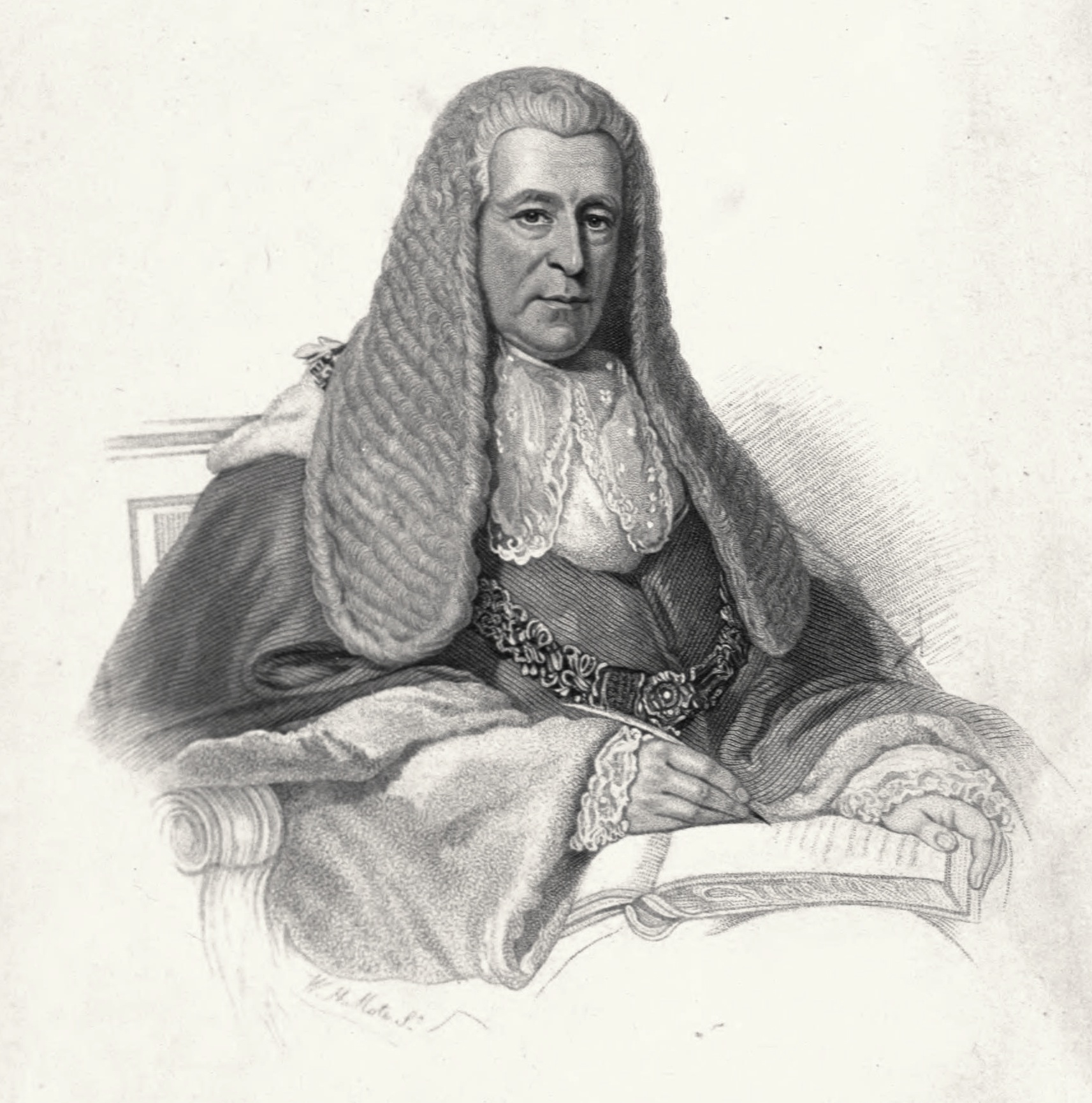
Thomas Langlois Lefroy
View on Wikipedia
 | This article has multiple issues. Please help improve it or discuss these issues on the talk page. (Learn how and when to remove these messages)
|

Thomas Langlois Lefroy (8 January 1776 – 4 May 1869) was an Irish politician and judge. He served as an MP for the constituency of Dublin University in 1830–1841, Privy Councillor of Ireland in 1835–1869 and Lord Chief Justice of Ireland in 1852–1866.
Key Information


Early life
[edit]Thomas Lefroy was born in Limerick, Ireland.[1] He had an outstanding academic record at Trinity College Dublin, from 1790 to 1793. His great-uncle, Benjamin Langlois, sponsored Tom's legal studies at Lincoln's Inn, London. One year later, Lefroy served as Auditor of Trinity's College Historical Society, the still-active debating society of the college. Later still, he became a prominent member of the Irish bar (having been called to it in 1797) and published a series of Law Reports on the cases of the Irish Court of Chancery.[2]
Tom Lefroy and Jane Austen
[edit]In 1796, Lefroy began a flirtation with Jane Austen, who was a friend of an older female relative. Jane Austen wrote two letters to her sister Cassandra mentioning "Tom Lefroy", and some have suggested that it may have been he whom Austen had in mind when she invented the character of Mr. Darcy in Pride and Prejudice, as the courtship between Tom Lefroy and Jane Austen took place over the year or so that Pride and Prejudice was written. In his 2003 biography, Becoming Jane Austen, Jon Spence suggests that Jane Austen actually used her and Tom Lefroy's personalities as the models for Mr. Darcy and Elizabeth Bennet, but not in an expected way. Spence suggests that Jane Austen used Tom Lefroy's more gregarious personality as the model for the novel's heroine Elizabeth Bennet, and her own measured demeanor was used as the model for the male protagonist, Mr. Darcy.
In a letter dated Saturday (9 January 1796), Austen mentioned:
You scold me so much in the nice long letter which I have this moment received from you, that I am almost afraid to tell you how my Irish friend and I behaved. Imagine to yourself everything most profligate and shocking in the way of dancing and sitting down together. I can expose myself however, only once more, because he leaves the country soon after next Friday, on which day we are to have a dance at Ashe after all. He is a very gentlemanlike, good-looking, pleasant young man, I assure you. But as to our having ever met, except at the three last balls, I cannot say much; for he is so excessively laughed at about me at Ashe, that he is ashamed of coming to Steventon, and ran away when we called on Mrs. Lefroy a few days ago.
. . .
After I had written the above, we received a visit from Mr. Tom Lefroy and his cousin George. The latter is really very well-behaved now; and as for the other, he has but one fault, which time will, I trust, entirely remove – it is that his morning coat is a great deal too light. He is a very great admirer of Tom Jones, and therefore wears the same coloured clothes, I imagine, which he did when he was wounded.[3]: 1
In a letter started on Thursday (14 January 1796), and finished the following morning, there was another mention of him.
Friday. – At length the day is come on which I am to flirt my last with Tom Lefroy, and when you receive this it will be over. My tears flow as I write at the melancholy idea.[3]: 4
Austen's surviving correspondence contains only one other mention of Tom Lefroy, in a November 1798 letter that Austen biographer Claire Tomalin believes demonstrates the author's "bleak remembrance, and persistent interest"[4] in Lefroy. In the letter to her sister, Austen writes that Tom's aunt Mrs. Lefroy had been to visit, but had not said anything about her nephew...
"...to me, and I was too proud to make any enquiries; but on my father's afterwards asking where he was, I learnt that he was gone back to London in his way to Ireland, where he is called to the Bar and means to practise."[3]: 19
Another possible mention of Lefroy is in Austen's Emma (1815). In chapter 9, Emma Woodhouse and Harriet Smith discuss a poem. Austen may have hidden the word TOLMEYFOR—an anagram of TOM LEFROY—in the poem.[5]
Upon learning of Jane Austen's death (18 July 1817), Lefroy travelled from Ireland to England to pay his respects to the British author.[6] In addition, at an auction of Cadell's papers (possibly in London), one Tom Lefroy bought a Cadell publisher's rejection letter—for Austen's early version of Pride and Prejudice, titled First Impressions. Caroline Austen said in her letter to James Edward Austen-Leigh on 1 April 1869:
I enclose a copy of Mr. Austen's letter to Cadell—I do not know which novel he would have sent—The letter does not do much credit to the tact or courtesy of our good Grandfather for Cadell was a great man in his day, and it is not surprising that he should have refused the favour so offered from an unknown—but the circumstance may be worth noting, especially as we have so few incidents to produce. At a sale of Cadell's papers &c Tom Lefroy picked up the original letter—and Jemima copied it for me –
It was unlikely that Caroline Austen would address the Chief Justice Lefroy as only 'Tom Lefroy' (she indeed addressed him as the still living 'Chief Justice' in the later part of the letter). However, if it is true that the original Tom Lefroy purchased the Cadell letter after Jane's death, it is possible that he later handed it over to Thomas Edward Preston Lefroy (T.E.P. Lefroy; husband of Jemima Lefroy who was the daughter of Anna Austen Lefroy and Benjamin Lefroy). T.E.P. Lefroy later would give Cadell's letter to Caroline for reference. Cadell & Davies firm was closed down in 1836 after the death of Thomas Cadell Jr.[7] The sale of Cadell's papers took place in 1840, possibly in November.[7]
In the latter years of Tom Lefroy's life, he was questioned about his relationship with Jane Austen by his nephew, and admitted to having loved Jane Austen, but stated that it was a "boyish love".[8] As is written in a letter sent from T.E.P. Lefroy to James Edward Austen Leigh in 1870,
My late venerable uncle ... said in so many words that he was in love with her, although he qualified his confession by saying it was a boyish love. As this occurred in a friendly & private conversation, I feel some doubt whether I ought to make it public.[9]
A fictional account of their relationship is at the center of the 2007 historical romance film Becoming Jane. In this film, Lefroy is played by James McAvoy, and Austen by Anne Hathaway.
Political career
[edit]Lefroy contested Dublin University in an 1827 by-election, as a Tory, but finished third.
An idea of Lefroy's politics is given by the opening of an editorial in The Times (of London) on Friday 27 February 1829 when he was opposing the Roman Catholic Relief Act 1829, whose effect was to admit Irish Catholics to parliament (if they met a high property qualification).
Serjeant Lefroy and Mr Saurin have been… re-edifying their Orange disciples in Dublin with much curious but rather apocryphal twaddle, touching the coronation oath, the Act of Settlement and so on.
The learned Serjeant expresses his hostility to the proposed law by declaring that he is averse to the removal of ancient landmarks. Now, if the saintly Serjeant means that the letter of a law can constitute a political landmark, we can assure him he is in pitiable error.
Lefroy may have been influenced by Huguenot family memories of persecution by French Catholics; this was the case with other opponents of Catholic emancipation such as William Saurin mentioned above.
Richard Lalor Sheil published a profile of Lefroy stating (amongst many hostile remarks on his combination of piety and moneymaking) that Lefroy was well known for his interest in the conversion of Jews to Protestantism, leading Daniel O'Connell to joke during a lawsuit over a collection of antique coins that Lefroy should be given the Hebrew coins as his fee while O'Connell received those with a Roman inscription. Patrick Geoghegan's life of O'Connell, King Dan, states that O'Connell held Lefroy's legal abilities in contempt and regarded him as a prime example of a lawyer promoted above more meritorious Catholics (notably O'Connell himself) because of his Protestant religion and Tory politics.
He was elected to the House of Commons for the Dublin University seat in 1830, as a Tory (the party later became known as Conservative). He became a member of the Privy Council of Ireland on 29 January 1835. In 1838, Thomas Langlois Lefroy received American politician Charles Sumner during Sumner's visit to Ireland.[10] Tom Lefroy continued to represent the university until he was appointed an Irish judge (with the title of a Baron of the Exchequer) in 1841. In 1848 he presided over the sedition trial of the Young Irelander John Mitchel.
He was promoted to Chief Justice of the Court of Queen's Bench in Ireland in 1852. Despite some allegations in Parliament, that he was too old to do the job, Lefroy did not resign as Chief Justice until he was aged 90 and a Conservative government was in office to fill the vacancy. This was in July 1866. One apocryphal story (in the memoirs of the Home Rule MP JG Swift MacNeill) describes Lefroy's son as denying in Parliament that his father was too old to perform his duties, but being himself so visibly old and feeble as to produce the opposite effect on parliamentary opinion. Another version of this story has the son defending his father's capacity although he himself had applied to be excused certain official duties on account of advanced age. The Hansard report of the debate can be found here.
In a satirical pamphlet on the Trinity College Dublin election of 1865 Joseph Sheridan Le Fanu suggests that Lefroy was so old that he had "ridden on the mastodon to hunt the megatherium" and mocks the manner in which the Conservative lawyer-politicians Joseph Napier and James Whiteside allegedly insisted whenever the Conservatives were in power (and might appoint them to replace him) that Lefroy is too old to perform his duties, only to insist whenever a Whig government is in power that he is in perfect health.
Interest in astronomy
[edit]Tom Lefroy was also interested in astronomy. On 30 March 1846, he visited William Parsons, the 3rd Earl of Rosse in Parsonstown to try Parsons's new telescope called Leviathan of Parsonstown. Tom later said to his wife (Letter 31 March 1846):[11]
Yesterday was indeed a most interesting day. Lord Rosse and his wife were as kind to me as possible. The wonders of his telescope are not to be told. He says—with as much ease as another man would say, "Come and I'll show you a beautiful prospect"—"Come and I'll show you a universe, one of a countless multitude of universes, each larger than the whole universe hitherto known to astronomers." The planet Jupiter, which through an ordinary glass is no larger than a good star, is seen twice as large as the moon appears to the naked eye. It was all true what Doherty [a Chief Justice, more than six feet high] said, that he walked upright in the tube with an umbrella over his head before it was set. But the genius displayed in all the contrivances for wielding this mighty monster even surpasses the design and execution of it. The telescope weighs sixteen tons, and yet Lord Rosse raised it single-handed off its resting place, and two men with ease raised it to any height.
Family
[edit]According to the website of Carrigglas Manor at the Wayback Machine (archived 2 February 2003) (Tom Lefroy's house in Longford, Ireland), the Lefroy family came from the town of Cambrai in the northwestern corner of France. They were a Huguenot family, and one of their heads of the family, the Lord L'Offroy, died at the Battle of Agincourt in 1415.
Tom Lefroy's siblings
[edit]Tom Lefroy was born of the Irish Lefroys, descendants of a Huguenot Lefroy who migrated to England in the 16th century,[12] hence the French-sounding name (the family head being a Lord L'Offroy). In 1765, Tom's father Anthony Peter Lefroy was secretly married to Ann Gardner in Limerick, Ireland. Five girls were born (Radovici mentioned five, but Cranfield mentioned four; it is possible that one of Tom's elder sisters died in infancy) without the knowledge of Benjamin Langlois, Tom's great-uncle and his family's benefactor. Thomas Langlois Lefroy was the sixth child, also the first son. The list of Tom's siblings (including him) is as follows:[13]
- Unnamed fifth elder sister (actual birth order unknown)
- Lucy (1 January 1768 – May 1853)
- Phoebe (15 April 1770 – 5 December 1839)
- Catherine (18 September 1771 – 3 September 1805)
- Sarah (18 March 1773 – 1836)
- Thomas Langlois (8 January 1776 – 4 May 1869)
- Anthony (19 October 1777 – 7 September 1857)
- Anthony's son (Thomas Edward Preston Lefroy, 1815–1887) later married Anna Jemima Lefroy (1815–1855, daughter of Anna Austen Lefroy) on 9 September 1846
- Elizabeth (17 April 1780 – 22 July 1867)
- Benjamin (5 May 1782 – 1 September 1869)
- Christopher (26 June 1784 – 14 February 1805)
- Anne (26 January 1786 – ?)
- Henry (5 May 1789 – 29 January 1876) – Vicar of Santry (St. Pappan's Church)
Tom Lefroy's children
[edit]Tom Lefroy married Mary Paul on 16 March 1799 in north Wales.[11] From their marriage, they had seven children as listed in the Visitation of Ireland:[14]
- Anthony Lefroy (21 March 1800 – 11 January 1890), subsequently MP for his father's old seat of Dublin University.
- Jane Christmas Lefroy (24 June 1802 – 3 August 1896)
- Anne Lefroy (25 April 1804 – 24 February 1885)
- Thomas Paul Lefroy (31 December 1806 – 29 January 1891; wrote Memoir of Chief Justice Lefroy, published in 1871)
- The Very Rev. Jeffry Lefroy (25 March 1809 – 10 December 1885)
- George Thomson Lefroy (26 May 1811 – 19 March 1890)
- Mary Elizabeth Lefroy (19 December 1817 – 23 January 1890)
Another son (Benjamin, born 25 March 1815) died in infancy. Tom Lefroy's daughters never married.
Jane Christmas Lefroy
[edit]Tom Lefroy's first daughter was named Jane Christmas Lefroy.[14] Scholars debate the derivation of this name. Some believe that the name Jane was derived from Lady Jane Paul (Tom's mother-in-law).[9] Others believe the name referred to Jane Austen.[12] The second theory is implied in the 2007 film Becoming Jane. Christmas was a family name coming from the Paul family[15]
Carrigglas Manor
[edit]
Carrigglas Manor was a Gothic-style great house built for Lefroy and his family circa 1830 (Memoir of Chief Justice Lefroy). The family had lived in Carrigglas before 1837 (one of Tom's letters for Mary was dated 5 October 1834). James Gandon the famous architect of Dublin's Custom House designed and built a stable block and farmyard and walled garden for Lefroy. In 1837, Lefroy renovated the Manor with the help of Daniel Robertson, Esq., a famous English architect. A hurricane on 6 January 1839 destroyed some parts of the house, and Lefroy had to rebuild it.[11]
The Lefroy family sold the Manor and Estate in 2006. As of 2010[update], the plan to adapt the manor house to be part of a newly built hotel, and to turn the 660 acres (270 ha) park into a golf course and housing estate collapsed and work at Carrigglas was terminated before the hotel or any of the new houses were occupied.[16] In 2014, the estate was bought by the Longford family and company Glennon's who are the current owners.[17]
Arms
[edit]
|
References
[edit]- ^ Slater, Sharon (18 April 2013). "5 AmazingWays Limerick Changed the World". Limerick's Life. Retrieved 6 April 2022.
- ^ Hamilton, John Andrew (1892). . In Lee, Sidney (ed.). Dictionary of National Biography. Vol. 32. London: Smith, Elder & Co.
- ^ a b c Le Faye, Deirdre (1997). Jane Austen's letters (3rd ed.). Oxford: Oxford University Press. ISBN 0-19-811764-7. LCCN 96038253. OCLC 30739492. OL 999408M.
- ^ McKernan, Maggie (1997). Jane Austen : a life. London: Bloomsbury. p. 119. ISBN 0-7475-3403-9. OCLC 59603723.
- ^ Sheehan, Colleen A. (25 November 2021). "Breaking News From 1795: Jane Austen Falls in Love". The Wall Street Journal. ISSN 0099-9660. Retrieved 4 December 2021.
- ^ "Lefroy family history". Archived from the original on 13 February 2003.
- ^ a b Besterman, Theodore (1938). The Publishing Firm of Cadell & Davies: Select Correspondence and Accounts, 1793-1836. Oxford University Press, H. Milford.
- ^ Spence, Jon. Becoming Jane Austen. Hambledon Continuum. London, 2003. ISBN 1-84725-046-7
- ^ a b Walker, Linda Robinson (Winter 2006). "Jane Austen and Tom Lefroy: Stories". Persuasions On-line. Jane Austen Society of North America. Retrieved 5 September 2018.
- ^ Pierce. (1877–1893). Memoir and letters of Charles Sumner. Boston. OCLC 982179807.
- ^ a b c Lefroy, Thomas (1871). Memoir of Chief Justice Lefroy. Robarts – University of Toronto. Dublin, Hodges. OL 7049854M.
- ^ a b Nahmias-Radovici, Nadia (1995). A youthful love : Jane Austen and Tom Lefroy?. Braunton: Merlin Books. ISBN 0-86303-681-3. OCLC 38746704.
- ^ Cranfield, R. E. (1960). From Ireland to Western Australia: The Establishment of a Branch of the Lefroy Family at Walebing, Western Australia, 1842 to 1960. Printed in Western Australia by Service Printing Company. ISBN 9789900052210.
{{cite book}}: ISBN / Date incompatibility (help) - ^ a b Howard, Joseph Jackson (1973). Visitation of Ireland. Frederick Arthur Crisp. Baltimore: Genealogical Pub. Co. ISBN 0-8063-0543-6. OCLC 508024.
- ^ Burke, John (1839). A Genealogical and Heraldic Dictionary of the Peerage and Baronetage of the British Empire. London: Henry Colburn. pp. 817–.
- ^ Carrigglas Manor Archived 30 September 2007 at the Wayback Machine
- ^ "Buyer found for Carrigglas Manor". Longford Leader. 15 January 2014. Retrieved 5 September 2018.
- ^ "Grants and Confirmations of Arms Vol. F". National Library of Ireland. p. 108. Retrieved 28 June 2022.
Further reading
[edit]- Who's Who of British members of parliament: Vol. I 1832–1885, edited by Michael Stenton (The Harvester Press 1976)
- Hogan, Daire. "Lefroy, Thomas Langlois". Oxford Dictionary of National Biography (online ed.). Oxford University Press. doi:10.1093/ref:odnb/16344. (Subscription, Wikipedia Library access or UK public library membership required.)
- Letters of Jane Austen – Brabourne Edition available on line at http://www.pemberley.com/janeinfo/brablet1.html#letter1 (The letters are public domain)
- Shiel's Sketches of the Irish Bar: Vol. I & II 1880 (Donohue & Henneberry Press, Chicago)
External links
[edit]- Hansard 1803–2005: contributions in Parliament by Thomas Langlois Lefroy
- Becoming Jane Fansite: About Tom Lefroy


| Works |
| _hires.jpg) | ||||||
|---|---|---|---|---|---|---|---|---|
| Places | ||||||||
| Family and people | ||||||||
| Analysis | ||||||||
| Portrayals |
| |||||||


Thomas Langlois Lefroy
View on GrokipediaEarly Life and Education
Ancestry and Birth
Thomas Langlois Lefroy was born on 8 January 1776 in Limerick, Ireland, as the eldest son of Lieutenant-Colonel Anthony Peter Lefroy, commander of the 9th Light Dragoons, and Anne Gardiner, daughter of Colonel Thomas George Gardiner of Doonass, County Clare.[2][5][6] The Lefroy family derived from Huguenot Protestants who fled religious persecution, with paternal ancestors led by Antoine Loffroy emigrating from Cambrai in Picardy, northern France, to Canterbury, England, in 1587.[7][8] This migration exemplified the broader exodus of French Calvinists following the revocation of the Edict of Nantes, fostering a legacy of resilience as the family integrated into English society before establishing branches in Ireland.[9] Hailing from a modest Anglo-Irish military lineage, the Lefroys relied on service in the British Army for social position; Anthony Peter Lefroy, born in Leghorn, Italy, in 1742, conducted most of his career in Ireland.[9][2] Key relatives included great-uncle Benjamin Langlois, a prosperous banker whose influence steered Lefroy's early ambitions toward the legal profession.[2]Formal Education and Training
Thomas Langlois Lefroy entered Trinity College Dublin on 2 November 1790, at the age of 14, where he pursued a classical education emphasizing rhetoric, history, and debating skills essential for legal training.[1][10] He revived the College Historical Society, serving as auditor and earning distinction through competitive oratory, which helped overcome his initial shyness and honed argumentative prowess.[1] Lefroy graduated with a Bachelor of Arts degree in 1795, having secured three gold medals for academic excellence in examinations.[1][11] Transitioning to legal studies, Lefroy enrolled at Lincoln's Inn in London in 1793, under sponsorship from his great-uncle Benjamin Langlois, who envisioned a career at the English bar; however, family circumstances and opportunities in Ireland redirected his path.[2] Concurrently, he was admitted to the King's Inns in Dublin during Trinity term 1794, the primary institution for barrister training in Ireland, where he completed the required curriculum of lectures, moots, and apprenticeship under established practitioners.[1][2] This rigorous preparation culminated in Lefroy's call to the Irish Bar in Easter Term 1797, after approximately three years of intensive study and practical exercises designed to instill mastery of common law precedents, equity principles, and courtroom advocacy.[1][12] The King's Inns regimen, supplemented by his London exposure, equipped him with a dual familiarity of English and Irish legal traditions, though he prioritized practice in Dublin courts thereafter.[2]Association with Jane Austen
Circumstances of Their Acquaintance
Thomas Langlois Lefroy encountered Jane Austen during the Christmas and New Year festivities spanning late 1795 to early 1796 in rural Hampshire, England.[3] At the time, Lefroy, born on 8 January 1776 and thus aged 19 turning 20, had traveled from Ireland to visit relatives amid a pause in his legal training at Lincoln's Inn in London.[4][13] He stayed as a guest at Ashe Rectory, the home of his uncle, the Reverend George Lefroy, rector of the parish, and aunt Anne Brydges Lefroy, approximately two miles north of Steventon village.[4][3] Austen, born 16 December 1775 and thereby aged 20, resided with her family at the nearby Steventon Rectory, her father's clerical residence.[3] The pair's acquaintance arose through overlapping social circles in the tightly knit gentry community of north Hampshire, where seasonal gatherings such as balls and dinners at local estates facilitated interactions among young people from neighboring households.[3] Lefroy's visit aligned with these holiday events, enabling casual meetings during dances and other amusements typical of the period's rural elite.[13]Evidence from Contemporary Accounts
Jane Austen's letters to her sister Cassandra from early 1796 provide the primary contemporary documentation of her interactions with Thomas Lefroy, portraying a brief flirtation marked by playful attention rather than deep attachment. In a letter dated 9 January 1796, Austen described Lefroy as a "very gentlemanlike, good-looking, pleasant young man" with whom she had danced and conversed at local balls, noting his distinctive attire and anticipating his imminent departure from the neighborhood after 15 January.[14] She emphasized the superficial nature of their exchanges, including instances where Lefroy avoided prolonged contact, such as fleeing during a visit by the Austen family to Ashe Rectory.[15] By 16 January 1796, Austen explicitly forecasted the end of their association, writing, "At length the day is come on which I am to flirt my last with Tom Lefroy, and when you receive this it will be over," while expressing indifference toward him, stating she did not "care sixpence" about confining her attentions to him.[14] The letters convey awareness of financial barriers to any serious match, given Lefroy's status as a law student without independent means, though Austen framed the matter in jest without evidence of earnest pursuit or proposal from either side.[15] The flirtation concluded shortly thereafter, with no record of ongoing correspondence or reunion in Austen's subsequent letters. Lefroy departed for London and ultimately returned to Ireland in early 1797 to pursue his legal career, having been called to the Irish bar that year; a November 1798 letter from Austen confirms his relocation and focus on professional practice there, as relayed by his aunt, Madam Lefroy, who indicated no romantic intentions toward Austen.[15] [16] Decades later, Lefroy recounted the episode to his nephew, Thomas Edward Preston Lefroy, admitting a "boyish love" for Austen during his 1795-1796 visit, but described it as a youthful, non-committal affection without subsequent contact or commitment.[4] This recollection, shared in the 1860s, aligns with the absence of primary evidence for any proposal, sustained correspondence, or efforts at reunion, underscoring the transient character of the association as reflected in Austen's contemporaneous accounts.[15]Historical Interpretations and Debates
Historians and Austen scholars have debated whether Lefroy served as a direct model for characters in Pride and Prejudice, particularly Mr. Darcy, though empirical evidence remains scant and indirect at best. Contemporary descriptions portray Lefroy as short in stature with dark hair, contrasting with Darcy's depiction as tall and aristocratic, while some analyses suggest superficial similarities in charm and Irish vivacity align more closely with the character of George Wickham, the novel's fleeting suitor. No surviving correspondence or Austen manuscripts explicitly link Lefroy to these figures, and the first draft of the novel, First Impressions, was composed in late 1796 shortly after their acquaintance, but revisions over subsequent decades dilute any causal connection.[17][18] A prevailing conservative interpretation frames the association as a brief youthful flirtation constrained by Regency-era class and financial pragmatism, rather than a profound romance destined for tragedy. Lefroy, from a modestly prosperous Anglo-Irish Huguenot family, faced expectations to secure a advantageous match to support his legal ambitions, marrying Mary Elizabeth Paul, daughter of a High Court judge, in March 1799—merely three years after departing Hampshire. This swift union, producing eight children and aligning with his later Tory affiliations emphasizing duty and stability, underscores a pragmatic outlook incompatible with elopement or prolonged sentimentality. Scholars like Joan Klingel Ray argue Lefroy's principled character and preexisting ties to an Irish acquaintance precluded deeper entanglement, prioritizing verifiable social realities over speculative passion.[15][19] Romanticized narratives, amplified by the 2007 film Becoming Jane, have drawn criticism for anachronistic projections of modern individualism onto the period, fabricating elements like a secret engagement and ignoring Austen's own ironic detachment in her writings. Such portrayals overlook Lefroy's subsequent life as a conservative jurist focused on career advancement, and the era's marital economics where neither party's modest circumstances favored impractical infatuation. Academic critiques emphasize that these myths, often propagated in popular media rather than primary sources, distort causal realism by retrofitting emotional intensity unsupported by diaries, letters, or family testimonies beyond lighthearted contemporary allusions.[15]Legal and Political Career
Admission to the Bar and Early Practice
Thomas Langlois Lefroy was called to the Irish Bar in 1797 following his legal training in London and Dublin.[11] He commenced practice in Dublin, initially concentrating on equity jurisprudence within the High Court of Chancery, where opportunities for junior barristers depended on demonstrated competence amid the competitive pre-Union legal environment.[10] [11] From 1802, during John Mitford, Lord Redesdale's chancellorship of Ireland (1802–1806), Lefroy gained prominence as a reporter of Chancery cases, collaborating with John Schoales on detailed volumes documenting Redesdale's judgments.[20] These reports, covering proceedings from Easter Term 1802 onward, highlighted Lefroy's precision in transcribing complex equitable rulings, earning him recognition for scholarly rigor at King's Inns and among equity practitioners.[21] His work emphasized fidelity to judicial reasoning over interpretive flourish, aiding the standardization of Irish equity precedents in an era of institutional flux post-Act of Union.[12] By 1806, Lefroy's reputation for meticulous case reporting and advocacy led to his elevation as King's Counsel, signaling a foundational ascent built on professional merit rather than entrenched patronage networks prevalent in Dublin's bar.[11] This early phase solidified his standing in Tory-aligned legal circles, where his outputs served as reliable references for practitioners navigating post-Union jurisprudence.[2]Parliamentary Service as a Tory MP
Thomas Langlois Lefroy was elected to the House of Commons as one of the members for the University of Dublin in the general election of 1830, securing the seat amid opposition to impending parliamentary reform.[2] Representing Protestant academic interests at Trinity College, he aligned with the Tory party, embodying an "old school" conservatism that prioritized the established Protestant ascendancy in Ireland.[22] His tenure lasted until 1841, during which he consistently opposed Whig administrations' legislative initiatives, voting steadily against measures perceived as undermining the constitutional status quo. Lefroy advocated Tory policies defending the Irish Church of Ireland against encroachments, serving on the select committee appointed 15 December 1831 to examine tithes, which funded the Protestant clergy but were largely paid by Catholic tenants.[2] He opposed the abolition of tithes as proposed in February 1832 debates and voted against the appropriation of church revenues for secular purposes on 13 July 1832, arguing such steps would erode the Protestant establishment.[2] Similarly, he rejected the Maynooth College grant on 26 September 1831, viewing increased state funding for Catholic seminary education as a concession that weakened Anglican primacy.[2] On the Act of Union, Lefroy warned during Reform Bill discussions on 25 May 1832 that electoral changes risked fueling repeal agitation, thereby threatening the 1801 union between Great Britain and Ireland.[2] In parliamentary divisions, Lefroy frequently upheld minority Tory positions against Whig majorities, acting as a teller—responsible for counting votes—in several instances, including against the Irish union of parishes bill on 19 August 1831 and the Irish party processions bill on 25 June 1832.[2] He voted against the second reading of the English Reform Bill on 22 March and 6 July 1831, and proposed a wrecking amendment to it on 25 May 1832, while also opposing its extension to Ireland as a radical overhaul favoring Catholic influence.[2][10] A vocal critic of Catholic emancipation—having seconded a resolution against its 1829 bill—Lefroy clashed with Daniel O'Connell in June 1831 debates over Irish unrest, attributing disorders to demagogic agitation rather than systemic grievances.[2][1] Lefroy's parliamentary efforts reflected a commitment to preserving Protestant ascendancy and resisting what he saw as Whig capitulations to Irish nationalism, though his opposition to reforms limited broader influence amid shifting majorities. He retired from the Commons in 1841 to pursue judicial roles, having earned recognition among Tories for steadfast defense of establishment principles.[2]Judicial Roles and Notable Rulings
Lefroy ascended to high judicial office in Ireland with his appointment as Baron of the Court of Exchequer in 1841, following his parliamentary service.[23] In this role, he presided over several politically charged trials amid the unrest of the late 1840s, including those stemming from the Young Ireland movement's revolutionary activities.[10] In May 1848, Lefroy sat as judge in the trial of John Mitchel, a prominent Young Irelander, charged under the Treason Felony Act 1848—a statute hastily passed by Parliament to criminalize advocacy for the overthrow of British rule by force, punishable by up to life transportation. Mitchel was convicted of sedition for editorials in his newspaper The United Irishman urging armed resistance, and Lefroy sentenced him to 14 years' transportation to Van Diemen's Land.[10] [24] This ruling exemplified strict statutory interpretation to preserve civil order, as the Act targeted seditious writings amid fears of continental-style revolution spilling into Ireland; empirical outcomes included the containment of Young Ireland's July 1848 uprising to a minor skirmish at Ballingarry, suggesting effective deterrence through legal enforcement rather than military escalation alone.[25] Contemporary accounts praised Lefroy's adherence to judicial impartiality and competence, with a 1842 parliamentary debate affirming him as "a more competent, efficient, or useful judge on the Irish bench," reflecting his reputation for applying law dispassionately irrespective of political pressures.[26] Irish nationalists, however, decried the proceedings as punitive overreach, attributing the Act's retroactive-like severity to systemic bias against separatist agitation and viewing Mitchel's conviction as emblematic of broader suppression of Irish self-determination claims.[27] Such critiques, often rooted in partisan advocacy for repeal of the Union, overlook the causal chain wherein unchecked sedition risked escalating famine-era instability into full insurgency, as evidenced by the Act's role in preempting coordinated violence. Promoted in 1852 by Tory Prime Minister Lord Derby to Lord Chief Justice of the Queen's Bench in Ireland—a senior appellate position overseeing civil and criminal appeals—Lefroy served until July 1866, navigating legal challenges during post-Famine recovery and nascent Fenian agitation.[11] His tenure emphasized rule-of-law fidelity amid agrarian unrest, though parliamentary inquiries in 1856 and 1866 questioned his capacity owing to age (nearing 80 and 90, respectively), prompting debates on mandatory retirement absent evident incapacity.[1] Despite these, Lefroy's decisions consistently prioritized statutory application over expedient leniency, bolstering institutional stability in a polity prone to factional disorder.Family and Personal Life
Marriage and Offspring
Thomas Langlois Lefroy married Mary Paul, daughter of Sir Robert Paul, 1st Baronet, on 16 March 1799 at Llanystumdwy, Caernarfonshire, Wales.[28] The union produced eight children—five sons and three daughters—with one son dying in infancy—reflecting a stable domestic life that complemented Lefroy's demanding legal and political commitments.[29] Mary Paul Lefroy predeceased her husband, dying on 31 January 1858 at age 83 or 84.[30] The children were:| Name | Birth–Death Dates | Notes |
|---|---|---|
| Anthony Lefroy | 21 March 1800 – 11 January 1890 | Eldest son; succeeded father as Tory MP for University of Dublin (1858–1865).[2] |
| Jane Christmas Lefroy | 24 June 1802 – 3 August 1896 | Eldest daughter; remained unmarried; name possibly evoking seasonal birth and ties to Jane Austen's circle through family acquaintances.[29] |
| Anne Lefroy | 25 April 1804 – 24 February 1885 | Remained unmarried.[29] |
| Thomas Paul Lefroy | 31 December 1806 – 29 January 1869 | Pursued legal career.[29] |
| Jeffrey Lefroy | 25 March 1809 – 5 December 1885 | Entered clergy; became Dean of Dromore.[29][31] |
| George Thomson Lefroy | 13 May 1811 – 21 July 1891 | Served in British Army.[29] |
| Benjamin Langlois Lefroy | 25 March 1815 – infancy | Died young.[32] |
| Mary Elizabeth Lefroy | circa 1817 – 1890 | Youngest daughter; remained unmarried.[32] |
Siblings and Extended Kinship
Thomas Langlois Lefroy was born into a family of ten children as the eldest son and sixth child overall, with his parents, Lieutenant-Colonel Anthony Peter Lefroy and Anne Gardiner, producing four elder daughters—Lucy (born 1 January 1768, died May 1853), Phoebe (born 15 April 1770, died 5 December 1839), Catherine (born 18 September 1771, died 5 December 1846), and Sarah (born 18 March 1773, died 20 January 1862)—along with a possible fifth sister who died in infancy.[33][31] His younger siblings included Anthony (born 1777, died 1819), who served as a barrack master in York; Jeffrey (born circa 1780); Benjamin (born 1785), who held the position of Justice of the Peace; and Henry (born 1786), who pursued a clerical career as a reverend.[2][31] These siblings' entries into military administration, justice, and the clergy reflected the family's orientation toward roles within Ireland's Protestant establishment. Extended kinship ties traced back to the Lefroys' Huguenot origins, with Protestant forebears fleeing Flanders for England around 1580 before settling in Ireland, where they preserved their faith amid the island's religious and political dynamics.[29] A pivotal figure was Lefroy's great-uncle Benjamin Langlois (1727–1802), a prosperous banker and Member of Parliament whose financial support and guidance enabled Lefroy's legal education at Trinity College Dublin from 1790 and subsequently at Lincoln's Inn in London from 1793, steering him toward the bar despite the family's modest circumstances.[2][23] Langlois's influence exemplified broader Langlois-Lefroy connections, including relatives like Peter Langlois, Grand Master of Ordnance in the Austrian Empire, which bolstered the clan's position in Protestant networks across Europe and Ireland.[7] This kinship web reinforced the family's alignment with Ireland's Protestant Ascendancy, a landowning and administrative elite that maintained Anglican dominance post the Williamite Wars, with Lefroy siblings and uncles leveraging such ties for institutional roles rather than commercial ventures abandoned by earlier generations.[7][34]Intellectual Pursuits and Later Years
Engagement with Astronomy
Thomas Langlois Lefroy demonstrated an amateur interest in astronomy through personal observations and philosophical reflections on celestial phenomena, though he produced no formal scientific publications or professional contributions. In a letter to his daughter from the Limerick Assizes, Lefroy invoked the "regular and uniform motions of the almost infinite host of heavenly bodies" as an illustration of divine order and the value of precision in human endeavors, reflecting a contemplative engagement with astronomical concepts rather than empirical study. A notable instance of his hands-on involvement occurred in late March 1846, when Lefroy visited William Parsons, 3rd Earl of Rosse, at Parsonstown (now Birr, Ireland) to view the Leviathan telescope, a 72-inch reflector weighing 16 tons that represented the era's pinnacle of observational technology. During the visit, Lefroy observed Jupiter magnified to appear roughly twice the apparent size of the Moon to the naked eye, marveling at the instrument's capacity, which allowed a single person to elevate it and two to adjust its elevation with ease. In correspondence recounting the experience, he described the telescope's revelations: "The wonders of his telescope are not to be told. He says—with as much ease as another man would say, ‘Come and I'll show you a beautiful prospect'—'Come and I’ll show you a universe, one of a countless multitude of universes, each larger than the whole universe hitherto known to astronomers.'"[18] This encounter underscored Lefroy's appreciation for astronomical instrumentation amid his judicial duties on the Munster Circuit, aligning with broader Enlightenment-era empiricism that valued empirical verification, yet it remained a personal pursuit without extension into systematic research or societal affiliations such as the Royal Astronomical Society.Retirement, Death, and Enduring Influence
Lefroy retired as Lord Chief Justice of the Queen's Bench in Ireland in July 1866, after serving 14 years in the role since his appointment in 1852, amid parliamentary concerns over his advanced age of 90 but with his mental acuity intact.[1][10] He declined offers of a baronetcy and a Privy Council seat for his son upon resignation, reflecting a preference for personal integrity over familial honors.[10] He died on 4 May 1869 at his home, Newcourt near Bray, County Wicklow, at the age of 93, and was buried in Mount Jerome Cemetery, Dublin, on 12 May.[1][10] Lefroy retained his faculties until the end, embodying the resilience of 19th-century judicial figures who prioritized duty over physical decline.[10] Lefroy's legacy endures as an exemplar of merit-based advancement in the British-Irish judiciary, rising from bar practitioner to apex judge through Tory-aligned legal acumen rather than patronage or reformist alliances.[2] His rulings, including sentencing Young Ireland leader John Mitchel to 14 years' transportation in 1848 for sedition, reinforced British common law precedents amid Irish nationalist agitation, prioritizing causal stability and evidentiary rigor over separatist pressures.[1] This conservative adherence to legal traditions minimized disruptions from repeal movements, establishing benchmarks in felony trials that influenced subsequent Irish jurisprudence with scant revision in modern courts beyond tangential biographical speculations.[1][2] As a "thorough impersonation of the better class of Tory of the old school," his influence underscores the role of principled conservatism in sustaining institutional continuity against ideological threats.[2]Properties and Heraldry
Carrigglas Manor
Carrigglas Manor, situated in County Longford, Ireland, became the Lefroy family seat following Thomas Langlois Lefroy's acquisition of the estate around 1833, initially through lease before outright purchase. Previously held by the Newcomen family and later by Trinity College Dublin, the property underwent significant transformation under Lefroy, who demolished the existing structure and commissioned a new Tudor Revival mansion in 1837, designed by Scottish architect Daniel Robertson. This architectural endeavor reflected the era's Gothic influences, featuring a symmetrical facade with castellated towers, battlements, and extensive fenestration overlooking a designed landscape.[35][36][37] As a prominent Protestant landowner of Huguenot descent, Lefroy embodied the Anglo-Irish ascendancy managing vast holdings amid Ireland's 19th-century agrarian challenges, including post-Famine tenant pressures and land reform debates. The estate encompassed over 4,000 acres by the 1870s, with Lefroy listed as a principal lessor in parishes such as Killoe and Templemichael, supporting agricultural operations through leasing arrangements typical of the period's landlord system. Improvements likely focused on infrastructural enhancements to sustain productivity, though detailed records of specific agricultural innovations at Carrigglas remain sparse.[37][38] The manor anchored the family's economic interests, underscoring Lefroy's role in perpetuating Protestant landownership in a predominantly Catholic region fraught with social tensions. Upon the estate's transfer to descendants, it retained family occupancy for over a century before sale in 2005 to a development firm, which collapsed amid Ireland's property crisis, exemplifying the terminal decline of many such demesnes through economic shifts, inheritance taxes, and maintenance burdens.[39][37]
Family Arms
The Lefroy family arms, borne by Thomas Langlois Lefroy as head of the Irish branch at Carrigglas Manor, County Longford, are described in heraldic records as quarterly: first and fourth, vert fretty argent on a chief of the second a Phrygian cap between two wyverns gules; second and third, azure a chevron or between three lions' heads erased of the last.[40] The core Lefroy charges feature a green field overlaid with a silver latticework (fretty), surmounted by a silver chief bearing a red Phrygian cap—symbolizing liberty and emancipation—flanked by two red wyverns, mythical guardians evoking vigilance and strength.[41] These arms, rooted in the family's Huguenot origins from Flemish Protestant refugees who fled Cambrai during 16th-century persecutions and later settled in England before branching to Ireland, underscore themes of faith under duress and steadfast loyalty.[42] No specific grant date is documented for the Irish Lefroys, but their adoption and quartering with allied arms (such as Langlois) served to validate gentry standing amid land acquisitions like Carrigglas in the late 18th century, aligning with Ulster King of Arms conventions for Protestant settler families.[40] Genealogical sources note the absence of a recorded family motto, though the visual elements alone convey Protestant resilience in an Irish context.[42]References
- https://en.wikisource.org/wiki/Protestant_Exiles_from_France/Book_First_-_Chapter_9_-_Section_VI
- https://en.wikisource.org/wiki/Page:Protestant_Exiles_from_France_Agnew_vol_1.djvu/200
- https://en.wikisource.org/wiki/Dictionary_of_National_Biography%2C_1885-1900/Lefroy%2C_Thomas_Langlois