Hubbry Logo
Tim FarronTim FarronMain
Open search
Tim Farron
Community hub
Tim Farron
logo
8 pages, 0 posts
0 subscribers
Be the first to start a discussion here.
Tim Farron
Tim Farron
from Wikipedia

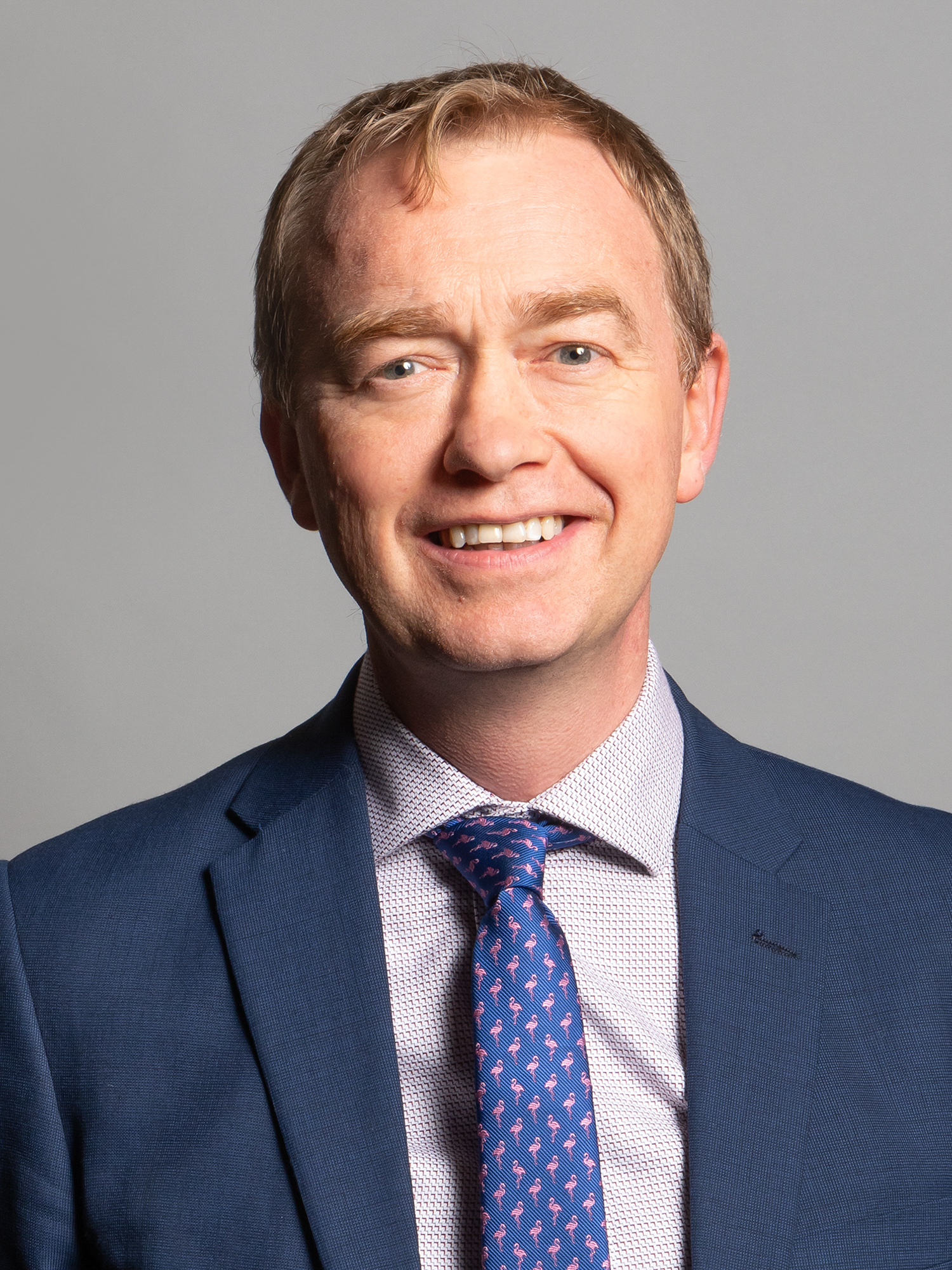
Timothy James Farron (born 27 May 1970) is a British politician who served as Leader of the Liberal Democrats from 2015 to 2017. He has been the Member of Parliament (MP) for Westmorland and Lonsdale since 2005 and is the Liberal Democrat spokesperson for Environment, Food and Rural Affairs.[1] Before entering politics, he worked in higher education.[2]

Key Information

Farron was the president of the Liberal Democrats from 2011 to 2014.[3][4][5] He was the Liberal Democrats' shadow foreign secretary in 2015 under Nick Clegg's leadership and Spokesperson for Housing, Communities and Local Government from 2019 to 2022, with responsibility for the Northern Powerhouse from 2019 to 2020.[6] He served as Spokesperson for Work and Pensions under Jo Swinson from 2019 to 2020.

Early life and education

[edit]

Tim Farron was born on 27 May 1970 in Preston, and was educated at Lostock Hall High School and Runshaw College, Leyland,[7] before going on to Newcastle University, where he gained a BA in Politics in 1992.[8] Farron has described how, in his youth, his bedroom bore pictures of widely differing politicians, such as the assassinated United States President John F. Kennedy, former Liberal Party leader Jo Grimond, and then–Prime Minister Margaret Thatcher.[9]

From 1987 to 1992, Farron fronted the Preston-based band Tim Farron and the Voyeurs, also known as Fred The Girl.[10] According to Farron, the band was popular amongst Lancashire's youth after a series of highly successful tours. Farron said the band was offered a record deal with Island Records.[11] However, this claim has been countered by former band members instead describing 'Tim Farron and the Voyeurs' as a "fourth rate New Order".[12]

In 1990, he was elected to the National Union of Students' National Executive.[8] The following year, he was elected president of Newcastle University Students' Union, the first Liberal Democrat to hold the position,[8] having joined the Liberal Party at the age of 16.[7] Before his election to Parliament, Farron worked in higher education at Lancaster University from 1992 to 2002[8] and St Martin's College, Ambleside, from 2002 to 2005.[13]

Parliamentary career

[edit]

Positions before 2005

[edit]

Farron contested North West Durham at the 1992 general election, coming third with 14.6% of the vote behind the incumbent Labour Party MP Hilary Armstrong and Conservative candidate Theresa May.[14][15]

He then served on Lancashire County Council from 1993 to 2000 and was also a councillor for Leyland Central ward on South Ribble Borough Council from 1995 to 1999.[16]

Farron stood in South Ribble at the 1997 general election, coming third with 10.6% of the vote behind the Labour candidate David Borrow and the Conservative candidate Robert Atkins.[17]

He stood for the Liberal Democrats in the North West region in the 1999 European Parliament elections.[18]

At the 2001 general election, Farron contested the Westmorland and Lonsdale seat and finished second, reducing the majority of the sitting Conservative MP Tim Collins to 3,167.[19] He then served as a councillor for the Milnthorpe ward on the South Lakeland District Council from 2004 to 2008.[20]

Westmorland and Lonsdale from 2005 win to 2009

[edit]
Farron in 2008

At the 2005 general election, Farron again fought Collins in Westmorland and Lonsdale, and this time won the election by a narrow margin of just 267 votes.[13] He made his maiden speech in Parliament on 25 May 2005.[21] As a new MP, he became a member of the Education and Skills Select committee and was appointed as Youth Affairs Spokesperson for the Liberal Democrats.[7] In 2005 he founded the all-party parliamentary group on hill farming, of which he was still chair as of March 2015.[22][23]

During Menzies Campbell's period as the Liberal Democrat leader, Farron was Campbell's parliamentary private secretary.[7] In 2007 he was made a Liberal Democrat spokesman for Home Affairs.[24]

Farron resigned from the front bench of the Liberal Democrats on 5 March 2008 in protest at the party's abstention from a parliamentary vote on a proposed Conservative referendum on Britain's accession to the Lisbon Treaty. However he later returned to the party's front bench as spokesperson for Environment, Food and Rural Affairs.[25] He is a member of the Beveridge Group within the Liberal Democrats.[26][27]

2010–2015

[edit]

At the 2010 general election, Farron was re-elected, increasing his share of the vote to 60% and increasing his majority to 12,264.[28][29] This result was against the run of the rest of the party, making Westmorland and Lonsdale one of the few Liberal Democrat strongholds.[30]

On 27 May 2010, Farron stood for the position of Deputy Leader of the Liberal Democrats, made vacant by the resignation of Vince Cable. On 9 June, Farron lost the competition to the former party President, Simon Hughes. Hughes won by 20 votes; having had 38 nominations from the parliamentary party, compared to Farron's 18.

Farron in March 2014
Farron the day before the 2017 General Election

On 16 September 2010, Farron stood for the position of President of the Liberal Democrats following Baroness Scott's decision not to seek re-election. He won the election with 53% of the vote, beating fellow candidate Susan Kramer on 47%.[31]

In March 2012, Farron was one of three MPs who signed a letter sent to the Advertising Standards Authority, criticising their recent decision to stop the Christian group "Healing on the Streets of Bath" from making explicit claims that prayer can heal. The letter called for the ASA to provide indisputable scientific evidence that faith healing did not work; Farron subsequently admitted that the letter was not "well-worded" and that he should not have signed it "as it was written".[32]

Farron was re-elected at the 2015 general election with a decreased vote share of 51.5% and a decreased majority of 8,949.[33] After the election, he was considered a favourite to succeed Nick Clegg as Leader of the Liberal Democrats.[34]

Leadership of the Liberal Democrats

[edit]

In May 2015, Farron confirmed his candidacy for the 2015 Liberal Democrats leadership election on BBC Radio 4.[35] On 16 July he won the leadership election with 56.5% of the vote, ahead of Norman Lamb who achieved 43.5%.[36]

Farron's first speech at the September 2015 Liberal Democrat Conference in Bournemouth was praised in the press.[37]

At the 2017 general election, Farron was again re-elected, decreasing his share of the vote to 45.8% and seeing his majority cut to just 777.[38] He stated he would step down as party leader following the election, stating that he had become "torn between living as a faithful Christian and serving as a political leader".[39] He remained in office until the unopposed election of Vince Cable as party leader.[40][41]

Career after party leadership

[edit]

Farron was again re-elected at the 2019 general election, increasing his share of the vote to 48.9% and increasing his majority to 1,934.[42][43]

At the 2024 general election, Farron was again re-elected with an increased vote share of 62.7% and an increased majority of 21,472.[44] He received 31,061 votes, the highest number of any candidate in the election.[45]

Political positions

[edit]

Among political observers, Farron is widely seen as being of left-leaning political position.[46][47][48] In a September 2016 interview, he identified the Liberal Democrats under his leadership as being centre-left.[49]

Policy as Liberal Democrat leader

[edit]

In August 2015, Farron identified seven campaigning priorities for the Liberal Democrats. These were rural affairs, the EU referendum, mental health, immigration, civil liberties, the green economy, and housing.[50]

Welfare

[edit]

Farron was one of only two Liberal Democrat MPs to vote against the under-occupancy penalty (also known as the bedroom tax) in 2012.[13]

Education

[edit]

In December 2010, he voted against increasing the cap on undergraduate university tuition fees from £3,000 to £9,000.[51] Referring to Nick Clegg's earlier pledge not to raise fees—and the previous long-standing Liberal Democrat policy of abolishing them—he said: "Integrity is important. You must not only keep your word but be seen to keep your word. You can say no."[52]

Migration

[edit]

He was the first senior British politician to back the EU proposal for a quota to take in refugees during the Mediterranean crisis. He called for the UK to accept up to 60,000 non-EU refugees to help with the influx. He attended the Refugee solidarity march in London in September 2015 and gave the opening speech.[13] In the 2016 Liberal Democrat Spring Conference, Farron accused the government of cowardice and heartlessness over their current refugee policy.[53]

Representation of women and minorities

[edit]

Farron said in June 2015 that Lib Dem members of parliament were "too male and too pale", so at least half of the party's target seats would be given women candidates and 10 per cent would have black, Asian, and minority ethnic (BAME) candidates.[54]

Farron's appointment of party spokespeople was applauded for its diversity, with twelve women and ten men given such positions. Women also took high-ranking roles, such as the defence and economics portfolios.[13][55]

LGBT rights

[edit]

In 2007, he voted against the Equality Act (Sexual Orientation) Regulations, which for the first time imposed a general restriction on businesses discriminating against people on the grounds of sexual orientation.[56] In May 2015, regarding a court ruling which found that a Belfast bakery had acted unlawfully in refusing to carry out an order for a cake in support of gay marriage, Farron said that "it's a shame it ended up in court" and "it's important that you stand up for people's rights to have their conscience," but "if you’re providing a service, that’s the key thing – you need to do so without prejudice, without discrimination against those who come through your door."[57]

He voted in favour of allowing marriage between two people of same sex at the second reading of the 2013 Marriage (Same Sex Couples) Bill, but he voted not to timetable the debate on the Bill, which would have made it much more difficult to pass had the House of Commons agreed with his position,[58] over concerns of the impact the "spousal veto" could have on trans people.[59] He was absent for the vote for gay marriage on the third reading of the Bill.[60]

In 2014, he voted in favour of extending the right to same sex marriage to Armed Forces personnel outside the United Kingdom.[61] He held a 90.4% rating on the issue of same sex marriage in September 2015, and 83.9% in February 2023, according to the website Public Whip.[61]

During an interview in 2015 with Cathy Newman for Channel 4 News, following his election as leader, Farron avoided a question from Newman on his personal beliefs regarding gay sex, saying that his "views on personal morality [did not] matter", adding that to "understand Christianity is to understand that we are all sinners".[62] In the build-up to the 2017 General Election he repeated similar lines in another Channel 4 News television interview, before Nigel Evans asked him in Parliament whether he thought being gay was a sin, to which he replied, "I do not" and said that he was "very proud" to have supported his party's efforts to introduce gay marriage.[63] Later, in a BBC interview, he further stated that he did not believe "gay sex" was a sin.[64] Despite this, Lord Paddick resigned from his post as home affairs spokesperson in June 2017 "over concerns about the leader's views on various issues".[65] In 2018, Farron expressed regret over his previous assertions that he did not consider homosexual sex to be sinful, saying he felt under pressure from his party which led him to "foolishly and wrongly" make a statement "that was not right".[66]

Farron's handling of questions regarding LGBT rights and the sinfulness of homosexuality have been heavily criticised by LGBT+ Liberal Democrats,[67][68] as has his continued association with anti-gay evangelical groups, which has been seen as a "lack of care" to the LGBT community.[69] Former head of the LGBT+ Liberal Democrats, Chris Cooke, made unsubstantiated complaints to the party about Farron's personal conduct when "drunk", and admitted that he "made up a story to cause trouble" following his suspension over Twitter comments directed at Conservative MP Anna Soubry.[70]

European Union

[edit]

Despite describing himself as "a bit of a Eurosceptic",[71] Farron strongly supported Britain's membership of the European Union,[72] but criticised David Cameron's renegotiation as "about appealing to careerist Tory MPs, who were selected by Europhobic party members, to persuade them to vote to remain".[73]

In June 2016, Farron stated following the United Kingdom European Union membership referendum in which 51.89% of the voters voted to leave the EU that if the Liberal Democrats were elected in the next parliamentary election, they would not follow through with triggering Article 50 of the Treaty on European Union and leaving the EU but would instead keep the UK in the European Union.[74]

In 2017, Farron spoke out against the government's proposed plan to return to the traditional blue British passport. He criticised the move publicly as part of "ever increasing list of the cost of Brexit" and held the position that the plan was "a completely superficial expenditure which could have been spent on our hospitals and our schools."[75]

Saudi Arabia

[edit]

Farron has criticised Britain's close ties with Saudi Arabia. In 2015 he said: "It is time to shine a light onto the shady corners of our relationship with Saudi Arabia. It is time we stood up for civil liberties, human rights and not turn a blind eye because the House of Saud are our 'allies'."[76]

Cannabis regulation

[edit]

He supports the complete legalisation of marijuana for both medical and recreational purpose, saying in 2016: "I personally believe the war on drugs is over. We must move from making this a legal issue to one of health."[77]

Personal life

[edit]

Farron is a lifelong non-conformist Protestant and says that "becoming a Christian at the age of eighteen [was] the most massive choice I have made."[78] He is a vegetarian,[79][80] and a lifelong fan of Blackburn Rovers.[81] He married his wife Rosie in 1999.[82] In January 2018 he won an edition of Celebrity Mastermind, with Blackburn Rovers as his specialist subject.[83]

In 2019 he published an autobiography A Better Ambition: Confessions of a Faithful Liberal describing his life as a Christian and a Liberal.[84]

Farron completed the 2021 London Marathon in a time of 4 h 44 min 44 s,[85] raising funds for the Brathay Trust.[86]

Selected publications

[edit]
  • Farron, Tim (2019). A Better Ambition: Confessions of a Faithful Liberal. SPCK. ISBN 978-0281083589.

References

[edit]

Further reading

[edit]
[edit]
Revisions and contributorsEdit on WikipediaRead on Wikipedia
from Grokipedia
Timothy James Farron (born 27 May 1970) is a British Liberal Democrat politician who has represented Westmorland and Lonsdale as Member of Parliament since 2005. He served as Leader of the Liberal Democrats from July 2015 to June 2017, succeeding Nick Clegg after the party's poor performance in the 2015 general election. Farron's leadership emphasized opposition to Brexit following the 2016 referendum, positioning the party as a pro-remain force, though the Liberal Democrats won only 12 seats in the 2017 election amid broader voter shifts. His tenure ended with resignation on 14 June 2017, which he attributed to an inability to reconcile his evangelical Christian faith with the party's socially liberal stances, particularly under media pressure regarding personal views on homosexuality and abortion that he regarded as sinful despite affirming legal equality. Since stepping down, Farron has continued as MP, focusing on rural and environmental issues, currently holding the role of Liberal Democrats' Spokesperson for Environment, Food and Rural Affairs, and has advocated for constituents on local healthcare access, GP services, and transport in Cumbria. He previously served as party president from 2001 to 2006 and remains active in parliamentary debates on agriculture, flooding, and faith-related freedoms.

Early life

Family background and upbringing

Tim Farron was born on 27 May 1970 in Preston, Lancashire, to parents who married young and divorced shortly thereafter, when Farron was under five years old. His father worked as a construction worker before leaving the family. Thereafter, Farron was raised by his single mother, whom he has described as a liberal-leaning individual who read The Guardian. The family lived in modest circumstances just outside Preston, in a working-class area bordered by farmland, a , a main , and a railway line, reflecting the industrial and rural mix of northern at the time. Farron has recalled the household as not financially well-off, with everyday life emphasizing practical self-reliance amid community surroundings typical of post-industrial Lancashire towns. This environment, shaped by his mother's independent role and the locale's blend of urban edges and rural proximity, contributed to his early familiarity with northern working-class dynamics and local ties.

Education and early political involvement

Farron completed his secondary education at Lostock Hall High School in , where he obtained his O-levels. He then attended Runshaw College in Leyland for studies, pursuing A-levels in a setting rather than a school route. Farron studied politics at , where he engaged in amid the final years of Margaret Thatcher's Conservative government, whose policies on , trade unions, and reform fueled opposition among liberal-leaning students. During this period, he joined the Liberal Democrats (then the Social and Liberal Democrats, rebranded in 1989), drawn to their emphasis on and social market economics as alternatives to . He rose in student politics, becoming the first Liberal Democrat elected president of Students' Union, a role that involved advocating for student welfare and opposing nascent higher education funding reforms. After graduating, Farron took up employment in higher education administration at from 1992 to 2002, handling roles that supported academic operations and student services. He later moved to St Martin's College in from 2002 to 2005, continuing in educational support capacities that honed his understanding of regional policy issues in . Paralleling these positions, his early political engagement deepened through grassroots organizing; he was elected as a Liberal Democrat councillor in from 1993 to 2000, focusing on local campaigns against rates and for community services, which built his experience in door-to-door canvassing and constituency work independent of national parliamentary ambitions.

Parliamentary career

Pre-parliamentary positions and 2005 election

Farron worked as a researcher for a Liberal Democrat Member of the European Parliament and later for the party before taking on the role of full-time constituency organiser in the North West of England. He subsequently served as the party's general election coordinator for the North West region ahead of the 2001 general election, during which the Liberal Democrats achieved significant advances, including several gains in the area amid broader national progress from 46 to 52 seats. Prior to these organizational positions, Farron contested the 1997 general election as the Liberal Democrat candidate for Ross, Clitheroe and Preston North, a safe Labour seat, where he secured 12% of the vote against the incumbent. He stood again in 2001 for the Conservative-held seat of Keighley in Lancashire, reducing the Tory majority to 748 votes in a strong second-place finish that highlighted his growing campaign effectiveness in competitive constituencies. In preparation for the 2005 general election, Farron was selected to challenge the Conservative incumbent Tim Collins in the rural of and Lonsdale, capitalizing on local voter dissatisfaction with both major parties over issues such as service reductions in remote areas, including closures under the Labour government's network rationalization program. His campaign emphasized targeted local advocacy, such as protecting rural infrastructure and , which resonated in a constituency marked by agricultural and community concerns. Farron won the seat on May 5, 2005, defeating Collins by a narrow margin of 267 votes and capturing approximately 49% of the vote share in a 5.1% swing to the Liberal Democrats. This upset victory marked a breakthrough for Farron and contributed to the party's national tally of 62 seats.

Constituency representation 2005–2015

Farron was elected as the Liberal Democrat for the rural constituency of and Lonsdale in the 2005 general election, securing a narrow victory with a majority of 267 votes over the Conservative incumbent Tim Collins. The seat encompasses much of the , where Farron prioritized advocacy for and agricultural interests, including opposition to proposals that threatened local landscapes and farming viability. He campaigned against the coalition government's 2011 Public Bodies Bill, which included provisions for selling off public forests, publicly tearing up a copy of the legislation to protest potential impacts on the Lake District. In the 2010 general election, amid a national , Farron increased his majority to 12,264 votes, receiving 30,896 votes (60.0% of the share) against the Conservative candidate's 18,632 (36.2%). Following the formation of the Conservative-Liberal Democrat , Farron served as president from late 2010, positioning himself as a "critical friend" by highlighting internal challenges and urging distinctiveness from coalition policies, while acknowledging achievements like protections for low-paid workers. Locally, he advocated for reforms to the to benefit upland farmers in his constituency, supporting Liberal Democrat proposals for fairer subsidies and environmental incentives in a 2006 policy paper. Farron's re-election in the 2015 general election yielded a majority of 8,949 votes, with turnout at 74.3%, bucking national Liberal Democrat losses amid coalition unpopularity linked to austerity measures. His constituency work emphasized rural resilience, including pushes for democratic accountability in national park governance to balance conservation with local farming needs, and sustained support for hill farmers facing subsidy dependencies and environmental regulations. These efforts, rooted in defending Lake District heritage and agricultural livelihoods against overreach from both EU directives and domestic policy shifts, helped maintain voter loyalty in a predominantly Conservative-leaning rural area.

Liberal Democrats leadership 2015–2017

Tim Farron was elected leader of the Liberal Democrats on 16 July 2015, following Nick Clegg's resignation on 8 May 2015 after the party's catastrophic performance in the general election, which reduced its parliamentary representation from 57 seats to eight. In the leadership contest, Farron defeated , securing 56.5% of the votes from party members, positioning himself as a fresh voice to rebuild the party's credibility after its tenure with the Conservatives had alienated core supporters. Farron's election was seen as a shift toward revival, emphasizing the party's liberal values amid declining membership and public trust. Under Farron's leadership, the Liberal Democrats adopted a staunch anti- stance after the 2016 referendum, framing themselves as the primary opposition to and pledging to block a "hard Brexit" that would sever access. Farron committed the party to campaigning for a second referendum on the final deal, aiming to harness the 48% Remain vote as a route to electoral recovery. Internally, he focused on revitalizing the party through targeted mobilization of younger voters, who had drifted away post-coalition, and strengthening rural outreach in traditional strongholds like Farron's own Westmorland and Lonsdale constituency. These efforts included enhanced youth engagement strategies and , which helped stabilize membership and increase successes in the lead-up to . In the 2017 general election, Farron's strategy yielded a net gain of four seats for the Liberal Democrats, bringing the total to 12, with notable advances in urban and Remain-heavy areas such as and . However, the party failed to fully capitalize on anti-Brexit sentiment, as Labour absorbed much of the progressive , and the campaign drew criticism for prioritizing EU reversal over detailed economic proposals, resulting in only a modest 0.5% increase in national vote share to 7.4%. Farron retained his seat with a reduced of 777 votes after a recount, underscoring the challenges of translating anti-Brexit positioning into broader appeal amid polarized . Despite these limitations, the seat gains marked a partial recovery from the 2015 nadir, crediting Farron's emphasis on ideological clarity and organizational renewal within the party.

Post-leadership role as MP and spokesperson 2017–present

Following his resignation as Liberal Democrats leader in June 2017, Farron returned to his primary role representing the rural constituency of and Lonsdale, emphasizing local issues such as and community services. He was re-elected in the , securing the seat amid national challenges for his party. In the 2024 general election, Farron achieved a with 31,061 votes, representing over 60% of the vote share and a majority of 21,472 over the Conservative candidate, reflecting the Liberal Democrats' resurgence in rural and southern English seats. Farron serves as the Liberal Democrats' spokesperson for Environment, Food and Rural Affairs, a position he has held in the current parliament, focusing on , , and environmental protections. In this capacity, he has advocated against excessive overreach that could harm rural landscapes, while supporting measures to enhance production and . He has pushed for local authorities in areas like to gain powers to restrict second homes, aiming to improve affordability for primary residents. In 2025, Farron made several interventions in the on planning and housing matters. During debates on the Planning and Infrastructure Bill on 9 June, he supported amendments requiring new homes to meet net zero carbon standards and incorporate generation. On 13 May, he led a discussion in on flooding risks, criticizing developers and planners for inadequate consideration of environmental impacts in vulnerable rural areas. Additionally, at the Liberal Democrats' autumn in , Farron delivered a speech arguing that British politics is fragmenting into diverse groups rather than simply polarizing into extremes, urging the party to embrace without nationalist connotations.

Political views

Economic policies and welfare

Farron has consistently emphasized investment in as a cornerstone of , criticizing Conservative underinvestment for contributing to stalled development and weakened services. In a September 2025 parliamentary debate, he highlighted how prior government neglect led to unfinished projects and economic drag, advocating for targeted spending to boost productivity and regional growth, particularly in rural areas where infrastructure deficits exacerbate cost-of-living pressures. On taxation, Farron supports progressive structures that raise revenue from higher earners to fund essential services without broadly burdening workers, as evidenced by his 2021 opposition to the Health and Social Care Levy, which he argued should be replaced by direct increases on the wealthy. He has also backed measures like doubling on second homes to address local affordability issues in high-cost rural constituencies, aligning with Liberal Democrat principles of fairer wealth distribution to combat . Regarding welfare, Farron opposed the "bedroom tax" introduced in 2013, withdrawing Liberal Democrat support in April 2014 after evidence emerged of its disproportionate harm to vulnerable tenants, including those in social housing with spare rooms due to or family needs, which created undue financial distress without achieving intended savings. He has criticized broader welfare reforms, such as the 2015 bill's £12 billion cuts targeting low-income working families, arguing they exacerbate poverty rather than incentivize employment, while favoring reforms that avoid dependency traps through conditional work supports over unconditional reductions. Farron's rural perspective underscores flaws in systems like , where delayed payments and inadequate adjustments for higher living costs in remote areas undermine self-sufficiency, though he acknowledges the need for streamlined benefits to encourage labor market participation.

Environmental and rural affairs

Farron serves as the Liberal Democrats' spokesperson for Environment, Food and Rural Affairs, where he promotes policies balancing aggressive emissions reductions—such as widespread home insulation programs and expansion—with safeguards for agricultural productivity and rural livelihoods. He endorses the party's push for net-zero emissions through incentives for green technologies, including securing high-paying jobs in renewables to facilitate a , but insists these must not impose disproportionate costs on farmers via subsidy reductions or unfeasible mandates that erode . In representing Westmorland and Lonsdale, encompassing the , Farron has prioritized localized environmental protections grounded in biodiversity data and economic impacts. He led a five-year campaign against overhead pylons traversing the park, citing their disruption to landscapes and corridors, ultimately contributing to decisions favoring underground cabling to minimize ecological harm while preserving tourism-dependent rural economies. He has also advocated for enhanced local powers to combat fly camping, which damages sensitive habitats and burdens rural communities with cleanup costs exceeding £100,000 annually in affected areas, as evidenced by Authority reports. Additionally, Farron supported efforts to safeguard from pollution, participating in public rallies and parliamentary motions to enforce stricter standards based on monitoring data showing nutrient overloads threatening native species. Farron critiques infrastructure projects like HS2 for inefficient spending, such as "obscene amounts" allocated to preliminary structures amid delays and cost overruns totaling billions, while lobbying for northern extensions to enhance rural connectivity without southern-centric waste. On , he opposes subsidy erosion—real-terms cuts of 20% since 2015—and reforms that could force farm sales, arguing these undermine environmental schemes post-Brexit, which reward farmers for habitat restoration yielding measurable gains like increased bird populations in upland areas. In 2025, Farron emphasized threats as existential yet subordinate to pragmatic rural adaptations, faulting land-use frameworks for overlooking on agricultural viability and criticizing alarmist narratives that ignore farmer-led , such as Brexit-enabled environmental payments boosting sequestration by 15-20% in pilot schemes. He warned that budget cuts, including £100 million from farm support, exacerbate vulnerabilities to without bolstering resilience through targeted subsidies.

Social issues and cultural conservatism

Farron has advocated for parental choice in education, including the expansion of faith schools as alternatives to state-imposed uniformity in curricula. In 2015, he stated that faith schools should be permitted to maintain and practice their distinctive ethos, acknowledging a tension between this freedom and broader demands for inclusivity, while opposing the elimination of such institutions. This stance reflects a preference for pluralism over a monolithic state educational model, arguing that diverse schooling options better serve families' values and prevent ideological conformity. On migration, Farron has supported policies emphasizing controlled borders and integration to manage empirical pressures on public services and social cohesion. During his leadership of the Liberal Democrats, the party's 2017 manifesto committed to "strict control of borders, including entry and exit checks," alongside efficient asylum processing to address strains from unmanaged inflows, such as housing shortages and service overloads documented in from the period. In 2016, he highlighted the need for "clear and strong control of borders" to enable precise management and reduce chaotic entries, prioritizing integration requirements like to mitigate cultural fragmentation. These positions contrast with open-door approaches, citing of in high-migration areas like his constituency, where local services faced documented backlogs. Regarding representation of women and minorities, Farron has endorsed equality of opportunity while expressing reservations about quotas or positive discrimination, viewing them as potentially eroding . In a 2016 parliamentary appearance, he noted the Liberal Democrats' use of "lenient discrimination" mechanisms to boost female candidates but framed such measures as temporary aids rather than ideals, aligning with party principles that prioritize individual achievement over mandated outcomes. He has critiqued rigid quotas as counterproductive to liberal values, arguing they foster perceptions of and undermine in institutional competence, as evidenced by slower progress in merit-driven systems versus quota-reliant ones in comparative studies. This balanced approach supports targeted encouragement—such as training programs—but rejects systemic overrides of qualifications.

Foreign policy, EU, and international relations

Farron has maintained a staunch pro-European Union position, particularly evident during his tenure as Liberal Democrats leader from 2015 to 2017, when he framed the party as the leading voice against Brexit. In the 2017 general election manifesto, the Liberal Democrats committed to a public vote on the final Brexit agreement, explicitly including an option to remain in the EU, arguing that the 2016 referendum outcome warranted scrutiny of the economic and practical consequences of departure. He acknowledged respect for the referendum result but contended that voters deserved a say on the negotiated terms, emphasizing data-driven assessments of EU membership's benefits over ideological exit. His parliamentary voting record reflects consistent support for preserving UK-EU ties, with near-unanimous votes in favor of membership-related measures between 2016 and 2019. In the Brexit aftermath, Farron's advocacy aligned with Liberal Democrat efforts for closer EU alignment, though party strategy evolved post-2019 electoral losses toward pragmatic re-engagement rather than outright revocation, reflecting broader public sentiment on while prioritizing evidence of trade and economic harms from divergence. Farron's outlook embodies , favoring targeted multilateral interventions to address humanitarian crises while expressing skepticism toward open-ended military commitments. He endorsed the April 2017 US-led airstrikes on Syrian regime targets following chemical weapons attacks, drawing parallels to the successful 1999 intervention in under multilateral auspices to avert , and arguing that inaction enables barbarism. On potential UK action against ISIS in in late 2015, he cautioned against requiring a prior parliamentary vote, urging the to act decisively within international coalitions to uphold agreed principles of intervention without procedural delays that could undermine efficacy. This approach balances moral imperatives with realism, as seen in his support for advancing or belief globally through engagement with bodies like the UN, rather than unilateral endeavors. Farron has consistently criticized human rights violations by authoritarian regimes, notably , while advocating pragmatic scrutiny of alliances. In January 2016, he described the Saudi government as engaging in systemic abuses and a "barbaric regime," calling on the to retract support for its appointment to a UN Council panel, given documented flogging of activists and execution practices. He pushed for suspending arms exports to nations with poor records to prevent British munitions facilitating repression, as reiterated in 2015 statements prioritizing over profit in trade deals. In October 2024, Farron endorsed an opposing 's candidacy for the full UN Council, underscoring ongoing concerns amid persistent domestic repression. These positions reflect a tempered realism, critiquing "shadowy" -Saudi ties without rejecting strategic partnerships outright, provided human rights conditions improve. On development assistance, Farron opposes budget cuts, viewing them as shortsighted amid global interconnected threats like , , and instability. In June 2020, he labeled reductions in overseas aid—then targeted at 0.7% of GNI—"vice-signalling," arguing they erode UK's moral and strategic influence without addressing root causes of migration and risks. He reiterated in September 2020 that slashing the £15 billion annual commitment for domestic needs was "disgusting and unbiblical," favoring sustained multilateral channels to foster stability and counter . This stance underscores his preference for cooperative internationalism over isolationist retrenchment.

Controversies and criticisms

Conflicts between faith and party orthodoxy

Farron converted to evangelical Christianity at the age of 18, an experience that shaped his adherence to on human nature, , and sexuality, emphasizing scriptural authority as the basis for over adaptive cultural standards. This commitment led him to regard sexual acts outside heterosexual marriage—including homosexual acts—as sinful, while differentiating between unchosen orientation and deliberate behavior, a distinction grounded in traditional interpretations of texts like and 1 Corinthians 6. Such convictions inherently conflicted with the Liberal Democrats' progressive orthodoxy, which prioritizes unqualified endorsement of LGBT rights as a litmus test for party fidelity, viewing any theological reservations as antithetical to liberal tolerance. Farron encountered insistent pressures to publicly disavow faith-derived views, as the party's expectation of seamless alignment demanded suppression of personal beliefs that did not fully accommodate prevailing ideologies on sexuality and identity. This enforced purity revealed a causal tension: evangelical realism, which posits immutable moral truths derived from divine , versus the party's constructivist approach, which treats dissent from sexual as presumptive bigotry. Farron's predicament exemplifies epistemic intolerance within left-leaning parties across the West, where faith-informed politicians face systemic marginalization unless they compartmentalize or conform, as seen in parallel cases of evangelical figures navigating progressive platforms in the UK and US. Empirical patterns, including declining evangelical representation in such parties and recurrent scrutiny over private convictions, undermine claims of viable synthesis between orthodox Christianity and progressive politics, highlighting irreconcilable premises on human fallenness versus self-defined authenticity.

Media scrutiny and resignation as leader

During the campaign, Tim Farron endured persistent media interrogation over his evangelical Christian beliefs, with outlets repeatedly demanding clarification on whether he considered gay sex sinful, despite his prior affirmations of support for and LGBT rights. On 18 April 2017, Farron stated explicitly that he did not view being gay as a sin, yet questions continued, including during appearances on programs like Peston on Sunday, where he expressed frustration at the fixation on private theological matters amid policy debates on and austerity. This pattern reflected a broader journalistic emphasis on extracting concessions from personal convictions to enforce public alignment with progressive norms, often disregarding Farron's voting record in favor of speculative alignments between faith and policy. Farron subsequently acknowledged yielding to this pressure by issuing statements, such as a interview clarification that he did not believe gay sex to be a , which he later described as inauthentic and regretted as a compromise of his biblical understanding. The scrutiny, amplified by outlets like and —sources prone to framing religious conservatism as inherently illiberal—distracted from the Liberal Democrats' core anti-Brexit platform, contributing to perceptions of internal inconsistency despite the party's net gain of four seats from eight in to twelve. Farron narrowly retained his Westmorland and Lonsdale constituency by 777 votes after a recount on 9 June , a sharp reduction from his majority of 8,615. On 14 June 2017, Farron resigned as party leader, citing an irreconcilable tension: the leadership role had rendered it "impossible" to remain faithful to his Christian principles without constant evasion or , fostering an atmosphere of mutual suspicion that eroded authentic discourse. In his statement, he lamented that , ostensibly tolerant of diverse viewpoints, had devolved into demands for conformity on cultural issues, prioritizing optics over genuine pluralism—a critique echoed in analyses attributing the resignation to rather than substantive policy failures. This exit precipitated a leadership contest won by and highlighted ongoing fractures within the Liberal Democrats, where subsequent leaders navigated similar tensions between ideological purity and electoral viability, contributing to the party's uneven recovery post-coalition era.

Voting record and policy inconsistencies

Farron's parliamentary voting record reflects a high degree of alignment with Liberal Democrat positions, with rebellions against the party totaling 53 instances since entering in 2005, representing roughly 2-3% of divisions in most sessions. This rate peaked at 3.5% during the 2010-2015 , where fiscal constraints tested party unity on welfare and economic measures. One prominent divergence occurred on 19 March 2007 in Division 79, when Farron voted against the Equality Act (Sexual Orientation) Regulations, bucking the Liberal Democrat majority on a conscience-based free vote. The regulations prohibited in goods, facilities, and services, including by religious bodies, such as church adoption agencies declining same-sex placements; Farron's opposition underscored a preference for exemptions preserving institutional freedoms over expansive anti- enforcement, a stance shared by select cross-party MPs prioritizing causal protections for voluntary associations. In welfare policy, Farron's record shows pragmatic conservatism amid coalition compromises, with general support for deficit-reduction measures post-2008 but targeted rebellions against provisions deemed overly punitive. For instance, on 12 November 2013 in Divisions 126 and 127, he opposed housing benefit reductions for under-occupied social housing (the "bedroom tax"), arguing they exacerbated hardship for disabled and low-income tenants without addressing underlying housing shortages. Such deviations, while infrequent, highlight selective resistance to policies with empirically regressive impacts on vulnerable groups, contrasting with broader party acquiescence to . On issues, Farron exhibited consistent pro-membership voting, aligning with Liberal Democrats in opposing withdrawal and supporting integration, as in for the 2016 Remain campaign tailored to rural economies. Despite representing a constituency reliant on agriculture—where EU common policies have imposed regulatory costs on —his record lacks substantial rebellions favoring national control, such as the isolated 1 2019 vote in Division 398 on EU withdrawal terms. Detractors have critiqued apparent inconsistencies between unyielding pro-EU and occasional endorsements of localized rural , yet low rebellion rates and sustained party fidelity suggest deviations stemmed from principled scrutiny of policy outcomes rather than electoral opportunism.

Personal life

Marriage and family

Tim Farron is married to Rosemary Cantley, commonly known as Rosie, with whom he resides in Milnthorpe, a village in south Cumbria within his Westmorland and Lonsdale constituency. The family home allows integration with local duties, as Farron's constituency office is located in nearby Kendal. Farron and Cantley have four children: daughters Isabella and Grace, and sons Michael and Joe. Public details on the family remain limited, reflecting a deliberate approach to shielding from media scrutiny while fulfilling parliamentary responsibilities in the region.

Religious beliefs and public expression

Tim Farron adheres to evangelical within the , having converted to faith as an adult at age 18 after recognizing its truth claims. His beliefs emphasize the doctrine of and human fallenness, portraying humanity as inherently flawed and prone to self-interest, which underpins a realistic approach to that prioritizes institutional safeguards against power abuses over idealistic schemes assuming human perfectibility. This theological anthropology fosters skepticism toward utopian policies, favoring liberal mechanisms like decentralized to mitigate the effects of sin, as evidenced in his advocacy for pluralism without state-imposed ideologies, whether religious or atheistic. Farron has publicly maintained that his evangelical convictions align with liberal principles, arguing post- that authentic requires tolerance for diverse beliefs, including traditional on personal conduct, rather than enforcing conformity to progressive norms. In a , he critiqued the marginalization of active Christian expression as "dangerous" in public , positing that faith-driven —rooted in accountability to divine standards—better sustains than secular , which he sees as eroding space for dissenting views on issues like sexuality. He has described this tension as "eating itself" by suppressing faith-informed perspectives, urging instead a where religious informs but does not coerce . This faith orientation manifests politically in a commitment to truth-telling over expediency, particularly in debates on and sexuality, where Farron's adherence to biblical standards of as human failing prompts caution against policies ignoring evidence of optimal outcomes in stable, complementary-sex parent structures. Empirical studies correlating child well-being with traditional forms reinforce his resistance to normalizing arrangements that deviate from this model without rigorous substantiation, viewing such stances as fidelity to causal realities over cultural pressures. As chair of Christians in Parliament, he continues to exemplify this integration, promoting faith's public role in countering what he terms the "new state faith" of secular orthodoxy.

Publications and public engagement

Authored books

Tim Farron authored A Better Ambition: Confessions of a Faithful Liberal, published on 3 2019 by SPCK Publishing, a 304-page work blending and political reflection that recounts his upbringing, conversion to evangelical at age 21, and career in the Liberal Democrats, emphasizing how his faith shaped his liberal principles amid personal and professional challenges. The book critiques the perceived shallowness of modern politics and advocates for integrity rooted in biblical values, drawing on specific anecdotes such as his time as a student politician and early parliamentary experiences to illustrate tensions between personal conviction and demands. In A Mucky Business: Why Christians Should Get Involved in , released on 17 November 2022 by IVP, Farron contends that biblical mandates for and require believers to engage directly in political processes, countering Christian tendencies toward withdrawal or cynicism in the face of partisan deceit and institutional flaws. The 208-page text uses scriptural references, historical examples of Christian political involvement, and Farron's observations from Westminster to argue that politics, though fraught with compromise, offers opportunities for redemptive action, while warning against naive idealism that ignores power dynamics. Both works extend Farron's public advocacy for faith-informed , highlighting recurring themes of moral consistency without delving into partisan policy prescriptions.

Speeches, columns, and recent commentary

In September 2025, at the Liberal Democrats' autumn conference in , Farron opened proceedings with a speech reclaiming from nationalists, declaring himself "a proud patriot" but "no nationalist" and asserting that "our flag belongs to one people, the ." He criticized nationalists for using Union and St George's flags to "intimidate and terrify," promoting instead a community-focused that unites rather than divides. Two days later, on 22 September, Farron delivered an impassioned address supporting British family farms, praising their model for enabling "close husbandry" and sustainable practices essential to national and . In a 22 September 2025 interview with Seen & Unseen, Farron contended that politics is fragmenting rather than polarizing, with voters increasingly detaching from Labour and Conservatives post-Brexit, as shown by polling support for at around 30 per cent, Liberal Democrats at 17 per cent, and Greens at 9-10 per cent. He attributed this to a decline in high-stakes ideological debates, replaced by "ferociously" contested low-stakes identity issues, urging causal focus on economic unease in "Middle Britain" over media-amplified narratives. Farron maintains a column in Premier Christianity magazine, offering Christian-informed commentary on contemporary issues; in a 15 February 2024 piece, he drew on ' words against fearing "rumours of wars" to advocate resilient amid global instability. His recent outputs emphasize empirical voter dynamics and anti-polarization efforts, distinguishing them from identity-driven echo chambers in mainstream discourse.

References

Add your contribution
Related Hubs
User Avatar
No comments yet.