


Community hub
Recent from talks
Contribute something
Nothing was collected or created yet.
Timariots
View on Wikipedia
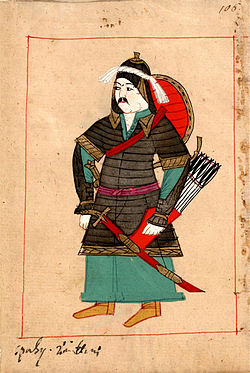
Timariot (or tımar holder; tımarlı in Turkish) was the name given to a Sipahi cavalryman in the Ottoman army. In return for service, each timariot received a parcel of revenue called a timar, a fief, which were usually recently conquered plots of agricultural land in the countryside.[1][2] Far less commonly, the sultan would grant a civil servant or member of the imperial family a timar.[3] Also non-military timar holders were obliged to supply the imperial army with soldiers and provisions.[4]
The timariots provided the backbone of the Ottoman cavalry force and the army as a whole. They were obligated to fight as cavalrymen in the Ottoman military when called upon. The timariots had to assemble with the army when at war, and had to take care of the land entrusted to him in times of peace. When at war, the timariot had to bring his own equipment and in addition a number of armed retainers (cebelu). The timariot was granted feudatory with the obligation to go mounted to war and to supply soldiers and sailors in numbers proportionate to the revenue of the appanage.[2] The timariot owed personal service for his sword in time of war and for a certain sum of money owed a number of soldiers as a substitute (cebelu). The (cebelu) was bound to live on the timariot’s estate and look after the land. When summoned for campaign the timariot and his cebelu had to present themselves with a cuirass. When a timariot failed to obey the summon he was deprived of his timar for one or two years.[5] Timariots were expected to bring cebelus or men-at-arms as well as their own equipment on campaign, the number of cebelu being determined by revenue. The number of the timariots in the sultan's army fluctuated between 50,000 and 90,000 men.[6] Timariots were themselves organized by sanjak-beys who ruled over groups of timars. The sanjak-beys were subordinate to the beylerbeyi and then the sultan himself. This semi-feudal arrangement allowed for the Ottomans to organize large armies at once, thus making an imperial army from what was still essentially a medieval economy.[7] This system of using agricultural revenue to pay troops was influenced by a similar Byzantine practice and other Near Eastern states prior to the Ottoman Empire.
During peace, timariots were expected to manage the lands they were given. Each timariot did not own the land that had been granted. All agricultural lands in the Empire that were considered state property (or miri) could be granted as timars. Timariots could be removed and transferred when the sultan deemed it necessary. However, timariots were expected to collect taxes and manage the peasantry. The kanunname of each sanjak listed the specific amount of taxes and services that the timariot could collect.[8] The central government enforced these laws rigorously, and a sipahi could lose his timar for violating regulations. The timar-holders took precautions to keep peasants on their land and were also owed certain labor from peasants, such as building a barn.[9] The maximum amount of income from one timar was 9,999 akce per year, but most timariots did not make anywhere close to that. In the 1530s, 40 percent of timariots received less than 3,000 akce in revenue.[10] Higher ranking officers could receive a ziamet (up to 100,000 akces) or a has (over 100,000 akce), depending on importance. The number of men and equipment the timariotes had to provide was dependent on the size of his land holdings. When the annual income of the holding was above 4.000 akçe the sipahi had to be accompanied by a soldier in a coat of mail, for income above 15.000 akçe by additional soldier for each additional 3.000 akçe. Above a certain income of the timar the sipahi horse had also to be equipped with armor of very thin steel. Tents for different purposes e.g., for treasury, kitchen, saddlery store, etc. had to be provided. This ensured that all equipment and troops for campaigns was determined in advance and Ottoman commanders knew the exact number of their forces for mobilization.[11]
When the Ottomans conquered new territory, it was common practice to grant timars to the local aristocracy of conquered lands.[12] The Ottomans co-opted the local nobility and eased the burden of conquest. The first group of timars in the Balkans had a strong Christian majority (60 percent in Serbia and 82 percent in Bosnia in 1467-69), but the Christian sipahis gradually disappeared due to dispossession or conversion to Islam.
Timar-status could be inherited, but the pieces of land were not inheritable to avoid the creation of any stable landed nobility. Timars were not hereditary until a decree was passed in 1585. Those who vied for timar status were fiercely competitive and the barrier to entry was high. The sipahis were also in constant competition for control of the Ottoman military with the janissary class.
References
[edit]- ^ İnalcık 1978, p. 107.
- ^ a b Hanson, Victor Davis (2007-12-18). Carnage and Culture: Landmark Battles in the Rise to Western Power. Knopf Doubleday Publishing Group. ISBN 978-0-307-42518-8.
- ^ Faroqhi & Fleet 2012, p. 229.
- ^ Mark C. Bartusis (3 January 2013). Land and Privilege in Byzantium: The Institution of Pronoia. Cambridge University Press. pp. 581–. ISBN 978-1-139-85146-6.
- ^ First Encyclopaedia of Islam: 1913-1936. BRILL. 1993. pp. 772–. ISBN 90-04-09796-1.
- ^ Faroqhi & Fleet 2012, p. 295.
- ^ İnalcık & Quataert 2003, p. 107.
- ^ İnalcık & Quataert 2003, p. 112.
- ^ Douglas 1987, p. 10.
- ^ Faroqhi & Fleet 2012, p. 290.
- ^ André Clot (13 February 2012). Suleiman the Magnificent. Saqi. pp. 43–. ISBN 978-0-86356-803-9.
- ^ İnalcık & Quataert 2003, p. 119.
Sources
[edit]- Douglas, Harry (1987). "The Ottoman 'timar' system and its transformation, 1563-1656" (Document). Indiana University. ProQuest 303473407.
- Faroqhi, Suraiya N.; Fleet, Kate, eds. (2012). The Cambridge History of Turkey Volume 2: the Ottoman Empire as a World Power 1453-1603. Cambridge University Press.
- İnalcık, Halil, ed. (1978). The Ottoman Empire : Conquest, Organization and Economy. Cambridge University Press.
- İnalcık, Halil; Quataert, Donald, eds. (2003) [1990]. An Economic and Social History of the Ottoman Empire, 1300–1914. Cambridge University Press. ISBN 0-521-57456-0. Two volumes.
Timariots
View on GrokipediaDefinition and Origins
Etymology and Terminology
The term timar derives from Ottoman Turkish tīmār (تيمار), borrowed from Persian tīmār (تیمار), connoting "care," "nurture," or "provision," which in the Ottoman administrative context evolved to signify a conditional land grant entailing oversight and revenue collection responsibilities.[7][8] This linguistic adaptation reflected the system's emphasis on the holder's duty to "care for" the assigned territory through maintenance, justice, and military readiness, with the word first appearing in an institutional fiscal sense in Ottoman registers during the reign of Murad II (1421–1451).[9] A timariot (Ottoman Turkish tımarlı, meaning "one possessing a timar") specifically designated a sipahi—a term from Persian sipāhī denoting a cavalry trooper—who held a timar yielding less than 20,000 akçe in annual revenue, distinguishing such provincial fief-holders from salaried kapıkulu sipahis (palace cavalry) or those with larger ze'amets (20,000–100,000 akçe) or has estates (over 100,000 akçe).[10] This terminology underscored the decentralized, service-based hierarchy within the Ottoman military structure, where timariots formed the bulk of the feudal cavalry obligated to provide armed retainers proportional to their grant's value, typically 2–3 horsemen per basic timar.[11] The English "timariot" emerged in European accounts as a direct calque, emphasizing the holder's tied status to land-derived income rather than cash stipends.[12]Historical Development from Pre-Ottoman Systems
The Ottoman timar system, under which timariots (sipahi cavalrymen) received revenue rights from assigned lands in exchange for military service, evolved primarily from the pre-Ottoman iqtaʿ land grant practices of the Seljuk Sultanate of Rûm in Anatolia. The iqtaʿ—an Arabic term denoting a conditional assignment of fiscal revenues from land or villages to military officers or officials—originated in the Abbasid Caliphate around the 9th century but was refined by the Great Seljuks in the 11th century as a mechanism to sustain nomadic Turkic warriors without direct cash payments. Following the Seljuk victory at the Battle of Manzikert in 1071, which opened Anatolia to Turkish settlement, the Sultanate of Rûm (established circa 1077) systematically applied iqtaʿ to administer conquered territories, granting revenues to ghazis (frontier warriors) and cavalrymen who provided personal service with equipped horses and retainers, typically numbering 2–5 armed men per basic grant. These assignments were revocable, non-hereditary, and tied to the holder's lifetime performance, ensuring loyalty to the sultan rather than feudal inheritance.[9][12] As the Ottoman beylik emerged in western Anatolia amid the fragmentation of Rûm after the Mongol invasions of the 1240s, its early rulers—Osman I (r. 1299–1324) and Orhan (r. 1324–1362)—adapted Seljuk iqtaʿ precedents to mobilize forces for expansion against Byzantine holdings. By the mid-14th century, Ottoman registers document the distribution of small land units (e.g., villages yielding 1,000–3,000 akçe annually) to sipahis, mirroring Seljuk practices where grants scaled with service obligations: a holder of a 3,000-akçe iqtaʿ might supply one armed retainer, escalating proportionally for larger assignments. This system incentivized agricultural productivity and local defense, as timariots collected taxes in kind or coin but bore administrative duties like maintaining order and reporting revenues to the center, distinct from outright ownership. Unlike cash-based Abbasid models, the Anatolian variant emphasized cavalry support, reflecting the pastoralist heritage of Turkic tribes.[11][13] Scholars debate the extent of Byzantine influence via the pronoia system, which granted tax revenues from estates to soldiers starting in the 11th century under emperors like Alexios I Komnenos (r. 1081–1118) to offset the decline of the thematic armies. Pronoia holders, often pronoiars with 100–500 households under them, provided cavalry service similar to timariots, and Ottoman conquests of Thrace and Macedonia from 1354 onward exposed administrators to these mechanisms. However, primary Ottoman defters (registers) from the 1390s show continuity in iqtaʿ-style revocability and revenue scaling absent in later, more hereditary Byzantine pronoia, suggesting adaptation rather than wholesale adoption; claims of direct Byzantine primacy often rely on etymological speculation (e.g., timar from Greek timē, meaning honor or value) rather than archival evidence of institutional transfer. The Ottoman synthesis prioritized Seljuk fiscal efficiency for rapid mobilization, enabling armies of 10,000–20,000 sipahis by the 15th century, while mitigating risks of fragmentation seen in Rûm's later beyliks.[9][12]The Timar System
Structure of Land Grants
The Ottoman timar system classified land grants, known as dirliks, into three categories based on estimated annual revenue in akçe, a silver coinage unit, to efficiently allocate state-owned miri lands for military support. Timars, the basic units yielding less than 20,000 akçe annually, were assigned primarily to sipahis, the empire's provincial cavalrymen. Zeamets, generating 20,000 to 100,000 akçe, went to higher-ranking officers such as zaims or subaşı. Hass, the largest grants exceeding 100,000 akçe, were reserved for elite officials including beys, viziers, and occasionally the sultan himself.[14][13][15] Following territorial conquests or reallocations, lands underwent tahrir cadastral surveys to assess taxable revenues from agriculture, villages, and other sources, with results recorded in defter registers for precise division into grants. The sultan issued berats or imperial decrees to authorize assignments, often recommended by provincial governors like beylerbeys via tezkere certificates, ensuring grants matched the holder's status and service record. Small timars typically encompassed revenues from one or a few villages, while larger zeamets and hass might span multiple districts, but all remained state property with holders enjoying usufruct rights rather than ownership.[13][15] Timariot sipahis administered their grants by collecting designated taxes, such as the öşür tithe and ispençe poll tax from peasants, retaining a portion after state dues to fund personal upkeep and equipment. Military obligations scaled with revenue: a minimal timar of around 3,000 akçe required one equipped horseman, escalating to several for zeamets. Grants were nominally temporary and revocable for neglect, death without qualified heirs, or failure to muster at yoklama inspections, though by the 16th century, hereditary transmission became common if successors met service requirements.[14][13][15]
Administration and Tax Collection Duties
Timariots, as sipahi cavalrymen holding timars, were primarily responsible for collecting fiscal revenues from assigned rural lands to sustain their military obligations, including equipping themselves and their cebelü retainers. These revenues derived mainly from the reaya (tax-paying peasants) through taxes such as the öşür (tithe, typically 1/10 to 1/3 of agricultural harvest), haraç (land tribute), zekât (religious alms), and örfi (customary) dues on livestock, trade, and labor, often paid in kind, cash, or produce percentages varying by land fertility and crop type.[16] Timariots retained these collections directly rather than remitting fixed quotas to the center, with the state conducting periodic tahrir surveys and mühimme defter registrations to assess yields, prevent overexploitation, and ensure revenues aligned with service requirements, such as fielding one armed retainer per 3,000-5,000 akçe in annual income.[17] Beyond taxation, timariots performed decentralized administrative functions, acting as local enforcers of sultanic order by maintaining security, pursuing wrongdoers, and protecting trade routes and rural populations from banditry.[18] They served as intermediaries between the reaya and higher authorities like sancakbeyis, organizing corvée labor for infrastructure, reporting demographic and economic data via censuses, and occasionally leasing underproductive timars to sub-farmers while overseeing compliance. Judicial roles were limited, lacking formal authority to adjudicate disputes—reserved for kadis—but timariots assisted in enforcement, investigations, and minor policing to facilitate tax compliance and public safety, with central edicts prohibiting excessive peasant burdens to preserve agricultural productivity.[16][17] This system integrated fiscal extraction with governance, minimizing central bureaucracy while incentivizing timariots' loyalty through revocable grants, though abuses like unauthorized sub-leasing or oppression prompted inspections and reallocations, as documented in 16th-century registers from regions like Erzurum.[17] By the late 16th century, fiscal pressures from inflation and warfare began eroding these duties, shifting toward cash-based tax-farming (iltizam), but in the classical era (14th-16th centuries), timariots' roles ensured efficient revenue mobilization tied to military readiness.Military Role and Organization
Recruitment and Obligations
Timariots, or timar-holding sipahis, were appointed by sultanic decree, typically to individuals demonstrating military prowess or administrative competence, with selections documented in fiscal registers like the icmal defterleri.[19] Appointments responded to strategic needs, such as frontier defense, and included diverse recruits ranging from established Ottoman elites to volunteers (gönüllüs) and outsiders (ecnebiler), whose backgrounds evolved from predominantly Turkic warriors in the 14th century to a broader mix by the 17th.[19] Initially non-hereditary to ensure loyalty and merit, the system later permitted inheritance for sons who proved capable, reflecting adaptations to maintain cavalry strength amid territorial expansion.[9] The principal obligation of timariots was to furnish military service during campaigns, equipping and leading a quota of armed horsemen (cebelü) proportional to their timar's revenue—commonly one retainer per 3,000 akçe of annual income—fully outfitted at their own expense.[20] [21] Non-compliance, such as failing to muster the required contingent upon receiving a mobilization order (ferman), incurred severe penalties including timar revocation and reassignment.[20] This service formed the backbone of the Ottoman provincial cavalry, enabling rapid deployment without direct state salaries. Beyond warfare, timariots bore administrative duties: overseeing tax collection from peasant producers (reaya), forwarding designated revenues to the treasury, and enforcing local security through policing to suppress banditry and unrest, though without formal judicial powers.[4] These responsibilities ensured the timar system's dual role in revenue extraction and military readiness, with holders deriving personal income from residual yields after state allotments.[22]
Mobilization and Campaign Participation
Timariots were mobilized via imperial ferman (decrees) issued by the sultan announcing a campaign, directing provincial governors and subaşı (local officials) to summon holders from their assigned regions to designated assembly points, often near Istanbul or frontier fortresses. Each timariot was required to appear in person as a mounted cavalryman, equipped for combat, accompanied by a retinue of cebelus—peasant retainers levied from their timar lands and armed at the timariot's expense. The quota of cebelus was scaled to the timar's revenue: one fully equipped horseman per 3,000 akçe annually in Anatolia or 5,000 akçe in Rumelia, with the timariot bearing all costs for provisioning, horses, and gear during the march and service. Muster rolls (kırklı defterleri) documented compliance, compiled before departure to verify numbers and equipment, with penalties for absence including fines, confiscation of the timar, or military replacement by substitutes.[23][24] This system enabled rapid assembly of large provincial forces, forming the majority of Ottoman field armies in the 15th and 16th centuries. In 1527, Ottoman treasury records listed 27,868 timariots, who could field approximately 23,000 cebelus, contributing to total cavalry strengths exceeding 100,000 during Sultan Süleyman I's reign (r. 1520–1566), where timariots comprised about 45,000 of a typical 60,000-man mobilization excluding auxiliaries and Janissaries. Timariots served for the campaign's duration, typically 3–6 months, performing duties such as scouting, foraging, siege support, and flanking maneuvers in battles, while local garrisons covered their home districts.[25][26][23] Participation spanned key campaigns, including Mehmed II's 1473 expedition against the Aq Qoyunlu, which mobilized around 64,000 timariot sipahis alongside central troops for decisive victories like the Battle of Otlukbeli. In Balkan and Hungarian fronts, timariots exploited terrain familiarity for raids and pursuits, sustaining Ottoman expansion until systemic strains—such as revenue shortfalls eroding cebelu recruitment—reduced their share to 11–12% of armies by the mid-17th century, supplanted by salaried kapıkulu units.[23][22]Equipment and Tactics
Armament and Personal Gear
Timariots equipped themselves for cavalry warfare using revenues from their land grants, with armament varying by the timar's productivity and the holder's status; smaller sipahis fielded basic gear, while zaims with larger estates afforded superior protection and weaponry. Primary offensive arms included the composite recurve bow for mounted archery, enabling effective ranged assaults before melee engagement, supplemented by the kilij sword for slashing cuts and a lance or spear for charges. Maces, axes, and javelins provided options for close combat, particularly against armored infantry.[2][27] Defensive equipment typically comprised a steel helmet, such as the mihriban or kolan type, a chain-mail hauberk often reinforced with breastplate or lamellar plates over vital areas, and bracers or greaves for limb protection; a round or kite shield offered additional cover during advances. Timariots generally eschewed heavy plate armor in favor of mobility, reflecting Central Asian nomadic traditions adapted to Ottoman needs.[2][5] Horses formed the core of a timariot's personal gear, barded with chain-mail coats covering the body, peytrals for the chest, crinieres for the neck, and chanfrons for the head to withstand arrows and lances; such equine armor enhanced shock tactics while maintaining speed for pursuits. Retainers (cebelu) carried lighter variants, often just bows and swords without full barding, to support the timariot in formation. This self-provisioned setup ensured rapid mobilization but tied effectiveness to local economic yields.[28][5]Cavalry Formations and Combat Methods
Timariot sipahis formed the bulk of the Ottoman provincial cavalry and were typically deployed on the flanks of the classical battle formation, protecting the central infantry corps while enabling rapid maneuvers against enemy lines. This positioning allowed them to exploit mobility for enveloping attacks or pursuits, contrasting with the static role of Janissary foot soldiers in the center. In major engagements, such as those during the 16th-century Hungarian campaigns, timariot units numbered in the tens of thousands, providing numerical superiority on the wings to outflank slower European heavy cavalry or infantry squares.[25] Combat methods relied on a combination of mounted archery and shock tactics, with sipahis using composite bows to deliver volleys from horseback at ranges exceeding 200 meters, gradually wearing down foes before closing for melee. Proficient in both ranged and close-quarters fighting, they transitioned from harassing fire to lance charges, often in wedge formations to concentrate force on breakthroughs.[29] This hybrid approach, rooted in Central Asian steppe warfare traditions, emphasized speed and attrition over direct confrontation, enabling timariots to evade countercharges while inflicting cumulative damage—evident in their effectiveness against disorganized crusader armies at Nicopolis in 1396, where flanking archery disrupted cohesion prior to decisive assaults.[29] Armored in mail and plate with conical helmets, timariots maintained versatility across terrains, incorporating feigned retreats to lure enemies into ambushes or overextend their lines, a tactic inherited from earlier Turkic forces. By the late 16th century, however, increasing integration of firearms challenged these methods, as sipahis adapted by incorporating handguns while preserving core equestrian skills for scouting and raiding.[25] Overall, their formations and tactics prioritized operational flexibility, contributing to Ottoman dominance in fluid Balkan and Anatolian campaigns until economic strains diminished mobilization efficiency.[25]Achievements and Contributions
Role in Ottoman Conquests
Timariots formed the core of the Ottoman provincial cavalry, known as sipahis, and were essential to the empire's military expansions from the mid-14th century onward, supplying self-equipped mounted troops for offensive campaigns in Anatolia and southeastern Europe. The timar system incentivized participation by tying land revenue rights to service obligations, enabling rapid mobilization of forces without direct central expenditure on salaries or logistics. This structure supported sustained warfare, as timar holders were required to present armed retainers—typically 2 to 3 for small grants up to dozens for larger ones—upon the sultan's order for muster.[3] During Sultan Murad I's reign (1362–1389), an estimated 10,000 to 15,000 timariot cavalry bolstered the army's mobility and raiding capacity, contributing to key victories like the capture of Adrianople (Edirne) in 1369, which established a European base, and the Battle of Kosovo on June 15, 1389, where Ottoman cavalry overwhelmed Serbian forces despite heavy losses on both sides. These successes fragmented Balkan principalities, allowing progressive annexation of Bulgarian and Serbian lands, with newly conquered territories promptly distributed as timars to garrison and administer them. The system's efficiency in generating loyal, locally maintained warriors from frontier gazi traditions was critical to overcoming numerically superior coalitions.[20][30] Under Mehmed II (r. 1451–1481), timariots augmented the central kapıkulu forces in major conquests, including the siege of Constantinople in 1453, where provincial sipahis provided screening, foraging, and pursuit roles amid an army totaling around 80,000 men. Post-conquest, Mehmed redistributed vast tracts of Byzantine lands as timars, rewarding participants and integrating the region into the Ottoman fiscal-military framework, which fueled further advances into the Morea, Trebizond, and Serbia by 1460. This redistribution not only secured loyalty but also expanded the pool of timar holders, perpetuating the cycle of conquest and settlement that underpinned Ottoman dominance in the region until the late 15th century.[26][31]Economic and Administrative Efficiency
The timar system underpinned Ottoman economic efficiency by linking land revenue directly to military provisioning, allowing the state to sustain a large provincial cavalry without drawing on central treasury funds. Timar-holders collected taxes from assigned villages and estates, retaining a portion to equip themselves and their retainers while remitting surplus to the sultan or higher officials, which minimized fiscal intermediation and overhead costs.[32] In the sixteenth century, this mechanism generated two-thirds to three-quarters of state revenues, primarily through agricultural taxes in kind or cash, fostering a self-financing military apparatus that supported expansive campaigns.[33] Administratively, timariots enhanced efficiency as local overseers, conducting tax surveys (tahrir), enforcing cultivation obligations on reaya peasants, and maintaining order to safeguard revenue streams, thereby obviating the need for a bloated central bureaucracy across diverse provinces. Halil İnalcık highlights how this decentralized structure enabled the empire to govern extensive territories with relatively few officials, as timar-holders' service incentives aligned local management with imperial fiscal goals.[11] The system's periodic redistribution of timars—revoked for underperformance or upon a holder's death—prevented entrenched absenteeism and promoted accountable stewardship, contributing to sustained productivity until inflationary pressures eroded yields in the late sixteenth century.[11]Criticisms and Challenges
Abuses and Corruption Issues
By the mid-16th century, the timar system increasingly suffered from nepotism in the distribution of land grants, with merit-based assignments giving way to favoritism toward palace insiders and unqualified individuals, reducing the military effectiveness of timariots.[34] Timars were often unjustly allocated to non-military personnel, violating original regulations that tied grants to cavalry service obligations, which contributed to administrative inefficiency and weakened central control over provincial revenues.[35] This corruption extended to inheritance practices, where procedural changes allowed timars to be passed down irregularly, exacerbating stagnation in the sipahi class and broader military decay by the 17th century.[36] Timariots frequently engaged in direct abuses against the reaya (peasant taxpayers), including bribery, excessive taxation beyond official quotas, and usurpation of neighboring estates, practices that became widespread across Ottoman domains and eroded the system's intended fiscal discipline.[37] As economic pressures mounted from the late 16th century, timar holders and emerging tax farmers intensified exploitation by demanding higher yields from peasants to offset revenue shortfalls, leading to widespread desertions, village abandonments, and social unrest such as the Celali rebellions around 1590–1610.[35] Ottoman firmans from the 18th century, reflecting earlier patterns, repeatedly prohibited such oppression, indicating persistent issues like illegal impositions and unjust treatment by sipahis toward non-Muslim subjects in regions like Rumeli.[38] These corruptions were compounded by timariots' evasion of mobilization duties, as holders prioritized personal enrichment over campaigning, further straining the empire's resources and prompting imperial orders to curb malpractices like estate encroachments.[37] Historians attribute much of this decline to the system's rigidity amid inflation and technological shifts, where incentives for abuse outpaced enforcement mechanisms, ultimately transitioning timars toward hereditary or monetized forms by the early 17th century.[35]Social Tensions with Local Populations
Timariots, as sipahi cavalrymen granted timars for tax collection and military obligations, frequently generated tensions with local reaya populations through over-exploitation beyond the system's regulated dues. While the timar framework theoretically limited sipahis to fixed shares of produce and labor in exchange for protection and justice, many imposed unauthorized extra taxes (tekâlif-i örfiye) and excessive corvée (angarya), such as disproportionate demands for transport, construction, or personal services, eroding peasant livelihoods and fostering resentment.[39][40] These abuses peaked during the late 16th century amid the timar system's erosion, as assignments became hereditary and centralized oversight declined, enabling sipahis to seize reaya livestock, arable land, and harvests for private gain while shifting traditional in-kind obligations to burdensome cash equivalents. Heavy impositions and sporadic violence prompted widespread peasant flight (firar), with reaya abandoning villages—documented in imperial registers as reducing taxable units by up to 30-50% in affected Anatolian and Balkan timars by the 1590s—undermining agricultural output and state revenues.[39][41] Ottoman authorities responded with periodic edicts and provincial inspections (berat) to restrain sipahi excesses and reaffirm reaya protections under kanun law, yet inconsistent enforcement—exacerbated by sipahi influence over local kadis—perpetuated cycles of petitioning, localized unrest, and intermittent revolts, such as those in 16th-century Karaman and Rumelia where peasants armed against tax enforcers. Halil İnalcık attributes this dynamic to the central government's weakening grip, which failed to consistently shield subjects from delegated authorities despite ideological commitments to equity.[39][40]Decline and Reforms
Economic Factors and Inflation
The timar system, reliant on fixed agricultural revenues to support cavalry obligations, encountered severe erosion from inflationary pressures emerging in the mid-16th century. These pressures stemmed primarily from the influx of American silver via European trade routes, alongside domestic factors such as population growth and currency debasement, which drove up prices across commodities and wages. Economic historian Şevket Pamuk documents that consumer prices in Istanbul rose approximately 500% between 1469 and 1700, with particularly acute surges in the late 16th century outpacing revenue growth from rural taxes.[42] Timariots, tasked with equipping themselves and providing mounted service proportional to their land grants, faced declining real incomes as the value of in-kind taxes—typically grain, livestock, or cash equivalents—failed to keep pace with escalating costs for horses, arms, and maintenance. By the 1580s, this mismatch intensified following the Ottoman debasement of the akçe silver coinage in 1585–1586, which reduced its silver content by 44% and doubled prices within three years, triggering widespread fiscal strain and even janissary mutinies over devalued pay.[42] Fixed timar assessments, unchanged since earlier centuries, yielded insufficient funds amid these dynamics, prompting many holders to neglect military duties or seek alternative income through subleasing or evasion.[43] The resulting revenue shortfalls at the provincial level accelerated the system's disintegration after 1585, as the central treasury shifted toward tax-farming (iltizam) to capture higher yields and monetized payments (ulus) to partially sustain cavalry forces. Ottoman state finances transitioned from surpluses in the early 16th century to deficits by its close, with military expenditures—exacerbated by timar inefficiencies—diverting resources from core obligations and fostering reliance on irregular levies.[42] This economic unraveling underscored the timar model's vulnerability to monetary disruptions, contributing to broader reforms favoring salaried infantry over feudal cavalry.[43]Shift to Salaried Forces and Monetization
In the late 16th century, the Ottoman fiscal system began transitioning from land-based revenue assignments to direct cash payments for military service, driven by the increasing monetization of the economy through expanded silver inflows from global trade and the debasement of akçe currency. This process eroded the traditional timar grants, as rising land values and tax farming (iltizam) practices allowed the state to centralize revenues previously allocated to timariots, redirecting them to fund salaried kapıkulu units. By the 1580s, significant debasements—such as the reduction in akçe silver content from 0.68 grams in 1560 to 0.20 grams by 1589—prompted the commutation of timar incomes into cash equivalents, enabling the treasury to pay ulufes (salaries) to professional troops rather than distributing fiefs.[44][45] The rise of salaried forces manifested in the expansion of the kapıkulu cavalry and infantry, who received fixed cash allotments from the central treasury, contrasting with the feudal obligations of timariots. Historical records indicate that while timariot muster rolls peaked at around 80,000–100,000 in the mid-16th century under Süleyman I, their effective numbers declined to approximately 50,000 by the early 17th century, partly because vacant timars were absorbed into state domains rather than reassigned, with revenues funneled to salary disbursements. This monetized approach supported the recruitment of irregular sekban mercenaries during campaigns, paid in cash advances, highlighting the system's vulnerability in a transitioning economy where in-kind collections proved insufficient for sustained warfare.[46][47] Administrative reforms under sultans like Murad III (r. 1574–1595) accelerated this shift, with edicts mandating cash loans to timariots for campaign expenses, effectively blurring the lines between fief-based and salaried service. However, this reliance on monetization strained the treasury, as inflationary pressures outpaced revenue growth, leading to irregular ulufe payments and the proliferation of lifetime tax farms that reduced long-term fiscal control. By the 17th century, the preference for professional, cash-paid forces over decentralized timariots aligned with tactical needs for disciplined infantry against European gunpowder armies, though it fostered dependency on short-term fiscal expedients rather than sustainable agrarian financing.[31][48]Legacy and Historiography
Influence on Successor States
The timar system, which allocated state revenues from agricultural lands to sipahi cavalrymen in exchange for military service, profoundly shaped land tenure and elite structures in the Balkan regions that later formed successor states. By the 17th century, as central Ottoman control weakened, many timars transitioned into more permanent, hereditary holdings akin to feudal estates, known as çiftliks, concentrating wealth and power among a military-administrative class often comprising Muslim landowners or converted locals. This evolution created entrenched agrarian inequalities that persisted into the 19th century, influencing the social and economic foundations of independent states emerging from Ottoman rule.[49][50] In Bulgaria, following autonomy in 1878, the government confronted this legacy through selective application of the Ottoman Land Code of 1858, prioritizing ethnic Bulgarian smallholders over absentee or Muslim proprietors descended from timariots; by 1880, reforms redistributed vast tracts, breaking up çiftlik domains to foster peasant proprietorship and undermine Ottoman-era elites. Greece, independent since 1830, similarly nationalized former timar lands, confiscating uncultivated or state-held properties to fund state-building and redistribute to Greek Orthodox farmers, a process that by 1910 had transferred over 80% of arable land from large holders to small owners. Serbia's 1830s reforms under Miloš Obrenović targeted similar Ottoman-derived estates, emancipating peasants from obligations tied to timar successors and enabling land purchases that democratized rural ownership. Romania's 1864 agrarian reform, while primarily addressing Phanariot boyar dominance under Ottoman suzerainty, indirectly dismantled timar-influenced large holdings in Wallachia and Moldavia, redistributing monastic and elite lands to over 130,000 peasant families by 1865.[51][52] In Bosnia-Herzegovina, annexed by Austria-Hungary in 1878, the timar system's remnants endured longer due to incomplete Ottoman dismantlement; Austro-Hungarian administrators compensated surviving sipahi claimants while phasing out feudal dues, with full abolition occurring only under Yugoslav rule in the 1920s, highlighting the system's sticky institutional inertia. These reforms across successor states not only addressed economic inefficiencies inherited from the timar framework—such as absenteeism and underinvestment—but also served nationalist agendas by expropriating Muslim or Ottoman-aligned holders, often without compensation, thereby fueling ethnic tensions and migrations. In the Republic of Turkey, the direct Anatolian successor, the timar's influence waned by the early 20th century after internal monetization in the 16th-17th centuries, though Republican land laws of 1926 and 1940s echoed its state-centric approach by redistributing miri (state) lands once tied to timar revenues.[53][54]Debates in Modern Scholarship
Modern scholarship on the Ottoman timar system and its holders, known as timariots or sipahis, has experienced a revival since the early 2000s, following a period of disinterest attributed to methodological skepticism toward quantitative defters (registers) and broader critiques of the Ottoman decline paradigm. Historians such as those contributing to recent anthologies argue that earlier generations overemphasized contemporary advice literature portraying timariots as corrupt or inefficient, leading to a teleological narrative of inevitable decay; instead, new approaches emphasize contextual evolution, including the diverse identities of timar-holders—from early ghazi warriors to later integrated Balkan elites—and adaptations like cash loans to supplement non-monetized revenues during 16th- and 17th-century campaigns.[13][19][46] A central debate revolves around the extent and causes of the timar system's transformation, with quantitative analyses of muster rolls showing a decline in the timariot cavalry's effective strength from approximately 40,000-50,000 in the early 16th century to under 20,000 by the late 17th, linked to fragmented timar grants, rising taxation burdens (e.g., increased resm-i çift farm taxes), and absenteeism that eroded the capacity to maintain equipped retainers. Scholars like Gábor Ágoston challenge traditional attributions to moral decay or feudal rigidity, attributing shifts instead to fiscal pressures from inflation—exacerbated by American silver inflows post-1580—and the empire's pivot toward gunpowder infantry, rendering horse-dependent timariots less viable without corresponding reforms.[22][11][55] Controversy persists over whether the timar represented a uniquely Ottoman institution or a Byzantine continuation via pronoia grants, with evidence from 14th-century endowments suggesting selective adoption of pre-Ottoman land-tenure practices but rejecting full feudal analogies due to the system's revocable, service-based nature under central sultanic control. Revisionist works, drawing on archival tahrir defters, argue against a complete 17th-century obsolescence, positing instead a gradual monetization and hybridization with salaried kapıkulu forces, though critics maintain that unaddressed vulnerabilities—like over-reliance on rural tax extraction amid commercialization—precipitated military weaknesses evident in losses such as the 1699 Treaty of Karlowitz. This reevaluation aligns with broader historiographical shifts away from Eurocentric "decline" models, prioritizing empirical data on regional variations (e.g., resilient timars in Anatolia versus Balkans) over generalized narratives.[9][56][57]References
- https://en.wiktionary.org/wiki/timar