
.jpg/250px-1988_VEB_Sachenring_Trabant_P601S_Beige_(1_bearb_Sp).jpg)


.jpg/2000px-1988_VEB_Sachenring_Trabant_P601S_Beige_(1_bearb_Sp).jpg)
Community hub
Recent from talks
Contribute something
Nothing was collected or created yet.
Trabant 601
View on Wikipedia
| Trabant 601 | |
|---|---|
_(cropped).jpg) Trabant 601 S, original condition (1988) | |
| Overview | |
| Manufacturer | VEB Sachsenring |
| Production | 1964–1990 2,818,547 built |
| Assembly | East Germany: Zwickau |
| Body and chassis | |
| Class | Supermini (B) Economy car |
| Body style | 2-door saloon ("Limousine") 3-door estate ("Universal") Doorless ATV ("Tramp"/"Kübel") |
| Layout | FF layout |
| Platform | Trabant P601 |
| Powertrain | |
| Engine | 594 cc P60-P66 two-stroke I2 |
| Transmission | 4-speed manual 4-speed Hycomat semi-automatic |
| Dimensions | |
| Wheelbase | 2,020 mm (6 ft 8 in) |
| Length | 3,555 mm (11 ft 8 in) |
| Width | 1,505 mm (4 ft 11 in) |
| Height | 1,440 mm (4 ft 9 in) |
| Kerb weight | 615 kg (1,356 lb) |
| Chronology | |
| Predecessor | Trabant 600 |
| Successor | Trabant 1.1 |
The Trabant 601 (or Trabant P601 series) is a Trabant model produced by VEB Sachsenring in Zwickau, Saxony. It was the third generation of the model, built for the longest production time, from 1964 to 1990. As a result, it is the best-known Trabant model and often referred to simply as the "Trabant" or "Trabi". During this long production run, 2,818,547 Trabant 601 units were produced overall, and it was the most common vehicle in East Germany.
Overview
[edit]In hindsight, the Trabant 601 can be considered East Germany's answer to West Germany's "People's Car", the VW Beetle.[1][2] Its purpose was to provide a cheap but still reliable car that was very affordable and also easy to repair and maintain. Still, it was at the time of its release rather modern in many ways, with front-wheel drive combined with transversely mounted motor, a low maintenance engine, unitary construction, rack and pinion steering, composite bodywork, and independent suspension all around. The car body was made of Duroplast. The main letdown was the engine, which was a two-stroke based on a pre-war DKW. It was competitive when launched, but from the late 1950s into the 1960s, small economy cars in Western countries that used two-stroke engines were replaced with cleaner and more efficient four-stroke engines, as employed from the start in the Volkswagen Beetle. Two-stroke engines of this sort, with crankcase scavenging and lubricating oil provided during fuel intake, burn their lubricating oil by design and produce smoky tailpipe emissions. However, two-stroke engines also powered cars such as the West German Auto Union 1000 that ended production in 1965, and the Swedish Saab 96 that only changed to four-stroke in 1967. It was planned to replace the two-stroke-motor with a Wankel engine; however, East Germany failed to develop a practical version of such a motor. Throughout the years the Trabant received minor visual and technical updates, such as front and rear bumpers with plastic ends, electronic ignition and a 12-volt electrical system, all in an attempt to modernise the line-up, but due to a lack of development funds in East Germany the upgrades were few and far between. The vehicle became outdated towards the end of the 1960s and it was fully obsolete by the 1980s. After the revolution in 1989, a deal was struck with Volkswagen to use one of their 1.1-litre, four-stroke engines in an attempt to modernise the car. However, the influx of cheaper, more modern cars from the West proved to be too great of a challenge, leading to the factory shutting down in early 1991.
History
[edit]

The Trabant 601 was a modern automobile when introduced in 1963, with 150 pre-production examples. The body was modified from the previous P50/P60 variants of the Trabant, with a heavy emphasis on the front and roof area. The back of the car was also modified with different taillights and a higher trunk loading height as compared to previous models. Overall, the design was praised, particularly on the then-modern double trapezoid design. Originally, production was only planned to run from 1967 to 1971, but instead continued until 1990. The original P 60 engine was only 23 PS (16.9 kW). In 1969 the new P62 version was offered with a 26 PS (19.1 kW) engine. In 1974, a needle roller bearing was added to the connecting rod, allowing for a 50/1 lubricant to be used. Through the addition of a two-stage carburetor in 1984, the fuel consumption was brought down by 1/100 L/km. With these additions, the top speed was measured to be 107 km/h.[3] Even with these improvements, the fuel consumption could still rise rapidly with extended acceleration or when towing a trailer. The P601 also had an overrunning clutch when running in fourth gear.
Over the course of decades, the design of the Trabant changed little. This caused the increasingly obsolete Trabant's reputation to worsen as time progressed. However, this had little effect on the sales figures — wait times of 10 years or longer for a new car were not uncommon. The price for a new Trabant in 1985 was 8,500 Mark for the 601 Standard, and 9,700 Mark for the most expensive model, the 601 Universal S de Luxe.[4] Available options at this time included a shelf under the instrument panel and intermittent windshield wipers. With change to 12 V in 1984, options as hazard flashers and rear window heater became available.
New models were considered with the P602, P603, and P610 being planned in Zwickau. Among other improvements researched were larger motors and also wankel engines. All improvements however were blocked by the East German (DDR) government, which considered them unnecessary and feared the extra costs.
When a successor, the Trabant 1.1, was eventually developed, it received minimal external differences. The only exterior changes were a new radiator grille, bumpers, taillights, a more square bonnet, and the movement of the fuel cap to the rear right of the car. The interior was subject to many changes.
Variants
[edit]- Trabant 601 Standard (as Limousine & Universal).
- Trabant 601 S (Sonderwunsch - Special Edition): with optional equipment such as fog lamps, rear white light, and an odometer (as Limousine & Universal).
- Trabant 601 DeLuxe: like the 601 S and additional twin-tone colouring and chrome bumper (as Limousine & Universal).
- Trabant 601 Kübel (added in 1966): Jeep version with no doors, folding roof, auxiliary heating system, the ignition system is shielded against electromagnetic interference.
- Trabant 601 Tramp (added in 1978): the civilian version of the Trabant Kübel, mainly exported to Greece.
- Trabant 601 Hycomat (P601 H): produced from 1965–1990 in limited numbers (as Limousine & Universal). Made only for users with missing or dysfunctional left leg. It had included an automatic clutching system.
- Trabant 800 RS: Rally version (1986–1988) with 771 cc engine and 5-speed manual transmission.
Hycomat
[edit]Hycomat refers to an automatic clutch actuation system, available as a factory option. Developed in 1964, it entered series production in 1965 and continued to be available on both the sedan or station wagon until the end of the two-stroke 601 in 1990. Vehicles equipped with a Hycomat were designated Trabant 601 Hycomat and received the type designation Trabant 601 H. Initially, the automatic clutch actuation was hydraulic, later electro-hydraulic.
The vehicle's operating manual explained: "The Hycomat is an automated device for engaging and disengaging the clutch, thus eliminating the need for the usual foot pedal operation. The clutch is hydraulically actuated depending on the engine speed or via contact release from the gearshift lever." A "parking lock" is located in place of the clutch pedal. The Trabant 601-H was available to order for people with and without disabilities. It was explicitly also usable for people without two fully functional legs. At that time, people with such physical disabilities comprised approximately 10 percent of the population, including many who were disabled in the war. VEB Sachsenring Automobilwerke Zwickau was among a few manufacturers in the 1960s that produced vehicles for people with disabilities directly from the factory, thus taking into account an approach now known as inclusion.[5][6]
From 1982 onwards, the Trabant Universal was also offered in a version for disabled persons, which, in addition to the automatic clutch, had other special features such as modified seats and improved equipment which meant it could be operated entirely by hand controls.
-
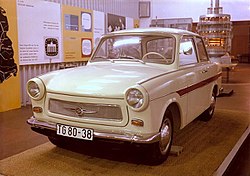 A pre-production 1963 Trabant 601
 -
 A 1986 Trabant 601 S De Luxe.
 -
 Trabant 601 Universal
 -
 A 1984 Trabant 601 S Universal.
 -
 A P 601 A Kübel of the LSK on display at the Luftwaffenmuseum Berlin-Gatow.
 -
 A Trabant 601 Tramp.
 -
 Trabant 601 S Universal (December 1989): The Hycomat sticker on the rear window indicates the automatic clutch control


_(14122036219).jpg)
Technical data
[edit]| Trabant 601 saloon | Trabant 601 Universal | |
|---|---|---|
| Engine: | Two cylinder two stroke otto engine type P65/66 | |
| Displacement: | 594.5 cc (36 cu in) | |
| Bore × Stroke: | 72 mm × 73 mm | |
| Rated power: | 19.1 kW at 4200 rpm | |
| Torque: | 54 N·m at 3000 rpm | |
| Compression ratio: | 7.8 ± 2 : 1 | |
| Cooling system: | Air-cooled | |
| Clutch: | Single disk dry clutch | |
| Gearbox: | Four-speed gearbox 1st gear: 4.08 2nd gear: 2.32 3rd gear: 1.52 4th gear: 1.103 Reverse gear: 3.83 Final drive: 4.33 | |
| Fuel type: | "Regular" gasoline 88 RON | |
| Oil type: | Two stroke engine oil MZ-22 | |
| Fuel-oil-ratio: | 1 : 50 | |
| Mass: | 615 kg | 650 kg |
| Dimensions L × W × H: | 3555 mm × 1505 mm × 1440 mm | 3560 mm × 1510 mm × 1440 mm |
| Top speed: | 100 km/h (62 mph) | |
| Source: | [7] | |
Export countries
[edit]


The 601 today
[edit]Many former DDR citizens have mixed emotions toward their "Trabi". It is very loud and uncomfortable, and still a symbol for the demised DDR,[8] as it was a part of the system.[9] However, the Trabant was a robust, functional and repair-friendly car, so many people developed a strong relationship to their Trabant. Further, the Trabant never was a symbol of Communist bureaucrats (who tended to own a Lada, Polski Fiat or Volga). Finally, the Trabant also is a symbol for breaking through the wall in 1989.
In recent years, the car has become collector's items, with growing popularity. Green Trabants are especially popular, as they are rumoured to bring good luck to their owners.[citation needed] Many Trabant owners' clubs exist throughout Europe and 601s have their fans all over the world.[10] Also, many Trabant 601s are still used as rally racing cars.
As a symbol of a bygone era, it has inspired movies such as Go Trabi Go which presented the Trabant as a kind of East German character and could make former DDR citizens laugh "not precisely at themselves, but at the absurdities of the system under which they lived until last year", symbolised by the three main aspects of the Trabant: slow, breaks down frequently and often ridiculed by Western society.[11] It has also seduced people including the US actor David Hasselhoff to drive a Trabant, although he had trouble getting into it.[12] Later he admitted he is a fan of the Trabant.[13] Stephen Kinzer of The New York Times likens the Trabant as a symbol for the people who built it, who "survive[d] through difficult times and ultimately triumph[ed]."[11] The car was also featured in the US film Everything Is Illuminated.[14]
The Trabant 601 is the subject of Jalopy, a 2016 roadtrip video game. Set in June 1990 East Germany, during the early months of German reunification, the player is tasked to maintain a fictionalized version of the Trabant 601, the Laika 601, and use it to drive the player character's uncle to Istanbul, Turkey, via Eastern and Southeastern Europe.[15]
The Trabant 601 makes an appearance in Half Life 2 as wreckage across City 17 and the surrounding area. The model is based on the Trabant 601 Universal. There are two game models, one where the vehicle is heavily damaged and one where the vehicle is abandoned.[16]
-
 A Trabant 601 S in daily use in Chemnitz in 2019.
 -
 A Trabant 601 modified into a stretch limousine.
 -
 Trabant 601s being used for tours in Berlin


References
[edit]- ^ "The Trabant was East Germany's answer to the peoples car as the Volkswagen Beetle was to West Germany". www.trabant.ca. Retrieved 2 May 2011.
- ^ "It's the VW Beetle of Eastern Europe". www.shocauto.com. Retrieved 2 May 2011.
- ^ "Trabant 601". Der Deutsche Straßenverkehr (in German). 12. 1984.
- ^ "Preis im Januar 1985 (inkl. ein Jahr Haftpflichtversicherung)". Fluter. 30: 21.
- ^ "Kleine Geschichte des Trabant". trabitechnik.com (in German). Lars Steiner. 2003-10-06. Retrieved 2020-04-01.
- ^ "Hycomat Kupplungsautomat" (PDF). trabant-original.de (in German). VEB Sachsenring Automobilwerke Zwickau - DDR. Retrieved 2020-04-01.
- ^ Sachsenring (ed.), Betriebsanleitung für den Personenkraftwagen Trabant 601 (PDF) (in German), Leipzig: Fachbuchverlag Leipzig, pp. 62–66
- ^ Rodden, John (2002). Repainting the Little Red Schoolhouse: A History of Eastern German Education, 1945-1995. Oxford University Press. p. 176. ISBN 9780195112443.
- ^ Rubin, Eli (18 September 2009). "The Trabant: Consumption, Eigen-Sinn, and Movement (Abstract)". History Workshop Journal. 68 (1, Autumn 2009): 27. doi:10.1093/hwj/dbp016.
- ^ Negyesi, Pal (2004-12-25). "Trabant [~en, ~en] 1. jackman 2. servant, companion". KTUD Archive. Archived from the original on 1 May 2011.
- ^ a b Kinzer, Stephan (7 March 1991). "Chemnitz Journal; That Good-for-Nothing Car Is Good for a Laugh". The New York Times. Retrieved 3 November 2009.
- ^ "It is really funny how he barely could fit inside". www.etrabant.com. Retrieved 2 May 2011.
- ^ Reiber, Vanessa (28 October 2019), "David Hasselhoff admits he's a fan of the Trabant", Independent News & Media
- ^ "Trabant 601 Trombi/Estate featured in Everything is Illuminated". Internet Movie Database. Retrieved 22 October 2010.
- ^ "Jalopy". Valve. Retrieved 13 June 2016.
- ^ Bruner (February 23, 2022). "𝗦𝗢𝗨𝗥𝗖𝗘 𝗩𝗘𝗛𝗜𝗖𝗟𝗘 𝗢𝗥𝗜𝗚𝗜𝗡𝗦: Half-Life 2". LambdaGeneration.com. Retrieved August 26, 2024.
External links
[edit]
- Original DDR commercial for the Trabant
- Video: How Trabants were made
- "A club that welcomes owners and drivers of these vehicles"
- Trabant 601 S de Luxe Exterior and Interior in Full 3D HD
| International | |
|---|---|
| National | |

Trabant 601
View on GrokipediaDevelopment and Production
Origins in East German Automotive Industry
The Zwickau automotive plant, originally established in 1904 for Horch vehicles and later part of Auto Union, fell under Soviet control after World War II and was partially dismantled for reparations before being repurposed for East German production.[3] In 1950, it became VEB Automobilwerke Zwickau (AWZ), focusing initially on motorcycles and outdated pre-war two-stroke designs like the DKW F8 to meet basic transport needs in the nascent German Democratic Republic (GDR).[4] By 1955, the AWZ P70 emerged as a transitional small car, addressing the obsolescence of wartime-era models amid material shortages and the GDR's emphasis on self-reliant, low-cost manufacturing under the socialist planned economy.[4] Renamed VEB Sachsenring Automobilwerke Zwickau in 1958, the factory introduced the Trabant P50 (later designated 500) on November 7, 1957, marking the first use of duroplast—a cotton-reinforced phenolic resin body—to conserve steel and enable rapid, inexpensive production for the masses.[5] This model, powered by a 500 cc two-stroke engine producing 18 horsepower, embodied the GDR's automotive priorities: simplicity, durability, and alignment with Comecon resource constraints rather than Western innovation, resulting in over 130,000 units built by 1961.[6] The Trabant series thus originated as a pragmatic response to the East German state's goal of motorized mobility for workers, prioritizing quantity over technological advancement in an isolated economic bloc. The Trabant 601 developed directly from this lineage as the successor to the interim Trabant 600, introduced in August 1961 with a slightly enlarged 600 cc engine but retaining the P50's body due to production delays.[4] Production of the 601 began in 1963, with public introduction in March 1964, featuring a redesigned body for improved aerodynamics and space while maintaining the core two-stroke architecture for cost efficiency and ease of repair in a resource-scarce environment.[4] This evolution reflected the GDR automotive industry's structural limitations, where incremental updates—such as minor engine tweaks yielding 26 horsepower—sufficed under central planning, avoiding risky overhauls that could disrupt quotas, even as global standards advanced.[6] Over 2.3 million 601 variants were eventually produced until 1991, underscoring the model's role as the backbone of East German personal transport.[1]Design Evolution and Key Milestones
The Trabant 601, designated P601, emerged as the successor to the Trabant P60, building on the established platform of Duroplast body construction, front-wheel drive, and a two-stroke engine introduced in earlier models. Development focused on refining the design for better performance and aesthetics, with pre-production examples completed in 1963.[7] The model was publicly introduced that year, marking a shift to a more modern appearance.[8] Series production of the 601 began in March 1964 at the VEB Sachsenring Automobilwerke Zwickau factory.[4] Key design features included an updated body shell with revised front fascia, bonnet, roofline, and rear, resembling a compact version of Western contemporaries like the Peugeot 404, while retaining the phenolic resin-cotton composite panels over a steel frame for lightweight construction.[1] The engine was enlarged to 594 cc, producing 26 horsepower, an increase from the P60's output, enabling a top speed of approximately 100 km/h.[6] Subsequent evolution was constrained by East Germany's centralized economy, resulting in incremental rather than transformative changes over nearly three decades of production. In 1974, significant updates included the switch to a 12-volt electrical system for improved reliability and the addition of rear coil springs to enhance ride quality.[6] Minor visual and functional refinements, such as revised bumpers and seat padding, occurred sporadically in the 1970s and 1980s.[9] By 1988, facing impending political changes, further modernizations were implemented, including MacPherson strut front suspension, a relocated rear fuel tank for safety, and enlarged rear lights.[6] These updates represented the final substantive milestones before production of the two-stroke 601 ended in 1990, after over 2.8 million units, transitioning to a Volkswagen-engined variant.[1]Production Figures and Manufacturing Process
The Trabant 601 was produced from 1964 to 1991 by VEB Sachsenring Automobilwerke at its facility in Zwickau, East Germany, with a total output of 2,818,547 units, making it the most prolific model in the Trabant lineup.[4][10] Annual production rates began modestly at around 34,000 units in the mid-1960s before scaling to approximately 100,000 units per year by the mid-1970s, reflecting incremental expansions in the plant's capacity under the constraints of East Germany's centrally planned economy.[11] This output represented the bulk of the roughly 3.7 million Trabants manufactured overall during the brand's existence from 1957 to 1991.[12] The manufacturing process emphasized simplicity and resource efficiency, utilizing a labor-intensive assembly line that relied heavily on manual operations due to limited automation and imported technology restrictions.[4] The hallmark Duroplast body panels—composed of phenolic resin mixed with recycled cotton waste from textile production—were produced by pressing semi-finished sheets into molds, a method that allowed for low-cost fabrication without steel stamping equipment, before being bonded to a one-piece steel chassis.[13] Engines and other components, including the two-stroke two-cylinder powerplant, were assembled by hand with basic tooling, contributing to the vehicle's reputation for rudimentary construction that prioritized volume over precision or advanced quality control.[11] This approach, rooted in postwar material shortages and ideological self-reliance, enabled sustained production despite chronic supply chain inefficiencies in the German Democratic Republic's state-owned industry.[14]Technical Design
Engine and Drivetrain
The Trabant 601 featured a longitudinally mounted, air-cooled, two-cylinder two-stroke inline engine designated as the type 65 or 66, with a displacement of 595 cc achieved via a bore of 72 mm and stroke of 73 mm.[15] This engine delivered a maximum output of 19 kW (26 PS) at 4200 rpm and 54 Nm of torque at approximately 3000 rpm, operating on a carbureted mixture of regular gasoline and two-stroke oil in a 50:1 ratio.[16] [17] The design prioritized simplicity and low material use, eschewing features like a water cooling system or overhead valves common in contemporary four-stroke engines, which contributed to its characteristic smoky exhaust from incomplete combustion and oil burning.[18] The drivetrain employed a front-engine, front-wheel-drive layout, with the engine positioned ahead of the transverse leaf-spring front axle and power transmitted via a dry-plate clutch to a four-speed manual gearbox lacking synchromesh on first gear.[17] [15] Gear ratios included approximately 4.08:1 for first, 2.32:1 for second, 1.52:1 for third, and 1.10:1 for fourth, paired with a final drive ratio of 4.33:1, enabling a top speed of around 100-110 km/h depending on model variant and load.[15] This configuration, unusual for its era in Eastern Bloc production vehicles, facilitated a compact footprint but resulted in modest acceleration, with 0-100 km/h times exceeding 20 seconds under optimal conditions.[16] Maintenance demands included frequent oil mixing and piston ring replacements due to the two-stroke cycle's inherent wear.[19]Body Construction and Materials
The Trabant 601 featured body panels made from Duroplast, a thermosetting composite of phenolic resin and cotton flock sourced from textile industry waste, which provided a lightweight, non-corrosive alternative to steel amid East Germany's material constraints.[1][10] This material enabled production without heavy dependence on scarce metals reserved for industrial and military uses, with panels formed by heating and pressing the mixture into shape, a process that took longer than stamping steel equivalents.[6] The underlying structure consisted of a galvanized steel chassis or frame, to which the detachable Duroplast panels were affixed, combining the rigidity of metal with the panels' resistance to rust in harsh conditions.[10][4] This hybrid construction resulted in a curb weight of around 600 kilograms for the standard sedan, prioritizing simplicity and resource efficiency over advanced forming techniques.[10] The panels' attachment via screws, adhesive, and gaskets allowed for disassembly, aiding maintenance despite the material's limited flexibility for custom repairs.[20]Chassis, Suspension, and Safety Features
The Trabant 601 employed a steel ladder frame chassis overlaid with Duroplast body panels, a construction that prioritized material efficiency and corrosion resistance over integrated unibody rigidity.[21] [22] This frame design, weighing approximately 615 kg fully laden, supported the vehicle's compact dimensions of 3,560 mm in length and 1,510 mm in width, facilitating straightforward repairs in resource-constrained manufacturing environments.[10] Suspension consisted of independent systems at both front and rear axles, utilizing transverse leaf springs with wishbone control arms and telescopic hydraulic shock absorbers.[10] [23] The front setup incorporated upper and lower A-arms for wheel location, while the rear featured trailing arms, providing adequate handling for urban and rural roads prevalent in the German Democratic Republic during the 1960s to 1980s.[24] This leaf-spring arrangement, akin to designs in mid-20th-century American vehicles, minimized production complexity but resulted in a firm ride with limited damping over uneven surfaces.[25] Safety features were rudimentary, reflecting 1960s engineering priorities focused on affordability rather than occupant protection. Early models lacked standard seatbelts, though later variants from the 1970s onward included two-point front restraints; rear seating had no such provisions.[26] Absent were advanced systems like crumple zones, padded dashboards, or head restraints. Post-production crash evaluations indicated the Duroplast panels deformed plastically rather than fragmenting, yielding energy absorption in low-to-moderate impacts that exceeded brittle alternatives and matched or surpassed some equivalent Western compact cars of the era, such as the Fiat 500 or VW Beetle in specific barrier tests.[27] [4] Nonetheless, the exposed steel frame and minimal intrusion resistance posed risks in severe frontal or side collisions, contributing to higher injury rates in real-world accidents compared to later safety-engineered vehicles.[6]Variants and Modifications
Sedan and Wagon Models
The Trabant 601 Limousine served as the primary sedan model, characterized by its two-door configuration accommodating four passengers. Production commenced in 1963 at VEB Sachsenring Automobilwerke Zwickau, with the model spanning until 1990. It featured a compact body with a length of 3,555 mm and a curb weight of 615 kg. The sedan utilized a front-wheel-drive layout powered by a 595 cc two-cylinder two-stroke engine requiring a gasoline-oil mixture for lubrication.[28][29] Available in trim levels including Standard, Sonderwunsch, and De Luxe, the sedan variants differed primarily in interior comfort and exterior accents. The Standard version included a color-matched grille, while Sonderwunsch added an aluminum grille and enhanced seating upholstery. De Luxe models incorporated additional features such as a radio, fog lights, and improved instrumentation, though options remained limited compared to Western contemporaries. All trims shared the same mechanical components, emphasizing simplicity in design and manufacturing.[9] The Trabant 601 Universal represented the wagon variant, designed for increased cargo capacity with a three-door body style. Introduced around 1964, it extended production alongside the sedan until 1990, featuring a slightly longer body at 3,560 mm and a higher curb weight of 650 kg to accommodate the enlarged rear compartment. The wagon's rear seats could often be folded or removed for versatile loading, supporting payloads up to several hundred kilograms. It retained the identical 595 cc two-stroke engine and drivetrain as the Limousine, prioritizing utility over performance.[19][30] Distinctions between sedan and wagon models included the Universal's higher tailgate loading height and modified rear lighting for practicality. Wagon trims mirrored the sedan's hierarchy—Standard, Sonderwunsch, and De Luxe—with De Luxe versions offering padded roofs and superior ventilation. Both body styles exemplified the Trabant 601's focus on affordable, mass-produced mobility under East German central planning, though material constraints limited refinements over the model's lifespan.[9][31]Special-Purpose and Limited Editions
The Trabant 601 Kübel served as a special-purpose utility vehicle, featuring an open-top design without rear side doors to facilitate cargo loading and troop transport. Introduced in 1966 as part of the 601 lineup, it was primarily allocated to East German military units, border guards, and police services, with a reinforced chassis for off-road capability.[32][4] The civilian variant, known as the Trabant 601 Tramp, debuted in 1978 and was based on the Kübel's structure, including its all-weather convertible top and seating for four. Primarily exported to Greece for leisure and light utility use, the Tramp retained the standard 26-horsepower two-stroke engine while emphasizing versatility for sport and work applications.[27][33] Limited-production adaptations included the Trabant 601 Hycomat (P601 H), manufactured from 1965 to 1990 exclusively for drivers with a missing or dysfunctional left leg. This model incorporated a hydraulic automatic clutch to eliminate manual gear-shifting demands on the left side, available in both limousine and universal body styles but in restricted quantities due to its specialized purpose.[33][27]Socioeconomic Role
Accessibility and Waiting Times in GDR
In the German Democratic Republic (GDR), acquiring a Trabant 601 involved a bureaucratic application process through local state consumer offices or automotive distribution centers, where requests were assessed based on criteria including professional utility, family size, and demonstrated need. Approved applicants were required to pay the full purchase price in advance, ranging from approximately 8,500 East German marks (M) for the standard model to 12,000 M for higher trims by the late 1980s, amounts equivalent to roughly one year's average worker salary of about 10,000–12,000 M.[13][34] Demand vastly outstripped production capacity, resulting in waiting lists that routinely extended to 10–13 years from application to delivery, with priority sometimes afforded to individuals residing near the Zwickau manufacturing plant or those with influential party affiliations.[7][6] This delay stemmed from chronic material shortages and inefficient central planning, which prioritized output quotas over consumer responsiveness, rendering the vehicle nominally accessible yet practically elusive for most citizens despite its status as the primary domestic automobile.[7] The protracted waits fostered a secondary market for used Trabants, where resale prices could inflate to 20,000–30,000 M or more, often involving barter or informal networks to circumvent official channels.[6] Consequently, car ownership remained limited, with only about one in three GDR households possessing a private vehicle by the 1980s, underscoring the Trabant 601's role as an aspirational good amid systemic scarcity rather than a readily available consumer product.[34]Symbolic Status in Planned Economy
In the German Democratic Republic's centrally planned economy, the Trabant 601 emerged as the archetypal consumer durable, monopolizing the domestic automotive market due to state restrictions on imports and production of alternatives. Ownership signified a rare achievement in a system of enforced scarcity, transforming the vehicle into a status symbol for those who navigated the bureaucratic allocation process. Applicants typically remitted a deposit equivalent to several months' wages upon ordering, yet delivery delays averaged 10 to 13 years, with some enduring up to 16 years, as production quotas prioritized output volume over demand fulfillment.[35][1] This protracted wait exemplified the distortions of central planning, where resource allocation by fiat engendered chronic shortages and inefficiencies, diverting individual savings into state-controlled queues rather than responsive supply chains. The Trabant's persistence in production from 1963 to 1991 without substantive redesign underscored a systemic aversion to iterative improvement, as planners favored meeting numerical targets over incorporating user feedback or technological upgrades, perpetuating obsolescence in pursuit of ideological self-sufficiency.[4][36] Despite state propaganda framing the Trabant as an egalitarian "people's car" accessible to the proletariat, its acquisition often hinged on informal networks or preferential treatment for regime loyalists, revealing the facade of universal provision in a hierarchy of privilege. In this milieu, the vehicle encapsulated the contradictions of socialism: a professed triumph of collective engineering that, in practice, fueled private aspiration and resentment toward the apparatus responsible for its deficiencies, thereby symbolizing the planned economy's failure to align production with human needs.[37]Impact on East German Mobility
The Trabant 601 served as the primary means of private passenger vehicle ownership in the German Democratic Republic (GDR), comprising approximately half of all registered cars by the late 1980s and enabling limited personal mobility for a population otherwise reliant on public transport and bicycles. With over 2.8 million units produced between 1963 and 1991, it represented the state's centralized effort to democratize automobile access, allowing working-class families to undertake short-distance trips for leisure, such as rural outings or vacations within bloc-approved areas, which were infeasible under strictly scheduled rail and bus systems. However, its two-stroke 594 cc engine, producing just 26 horsepower, restricted average speeds to around 80 km/h and imposed a practical travel radius of 200-300 km per tank due to its 36-liter fuel capacity and inefficiency, constraining long-haul mobility and reinforcing dependence on state infrastructure for inter-city travel.[38][7] Prospective owners faced systemic barriers to acquisition, including waiting lists averaging 10 to 13 years—extending up to 16-18 years in some cases—stemming from chronic production shortfalls at the VEB Sachsenring plant, where output rarely exceeded 150,000 units annually despite demand from millions. This delay, coupled with the requirement to pay the full purchase price (around 9,000-10,000 GDR marks) upfront, fostered a black market for used models, where prices could double the official rate, further entrenching inequality in mobility access based on connections or bribery rather than merit. Consequently, car ownership rates in the GDR lagged far behind West Germany, with private vehicles per 1,000 inhabitants estimated at under 150 by 1989 versus over 400 in the Federal Republic, perpetuating reliance on overcrowded public transport for urban commuting and limiting spontaneous or economic migration within the republic.[39][1] Despite these constraints, the Trabant 601 incrementally expanded individual agency in a command economy, facilitating door-to-door transport for shopping, family visits, and informal trade that evaded state planning rigidities, while its simple duroplast body and repairability empowered owners to maintain functionality amid parts shortages. In rural areas, it bridged gaps in bus services, enhancing access to agricultural work or markets, though frequent breakdowns—exacerbated by the smoky, oil-mixed two-stroke emissions and rudimentary suspension—often stranded users, contributing to higher accident risks on poorly maintained roads. The vehicle's role peaked symbolically in 1989, when thousands of Trabants ferried East Germans across newly opened borders during the [Peaceful Revolution](/page/Peaceful Revolution), embodying a sudden surge in unfettered mobility that exposed the prior regime's failures in delivering reliable personal transport.[40][7] Overall, the Trabant 601's impact underscored the tensions of socialist central planning: it provided a baseline of private mobility unattainable in earlier GDR decades, yet its scarcity and subpar performance—reflected in metrics like 43% of East German cars having under 45 horsepower compared to 4% in the West—hindered broader economic dynamism and personal freedom, channeling aspirations into queues rather than innovation or expansion of travel horizons.[35]Criticisms and Shortcomings
Reliability and Build Quality Problems
The Trabant 601's two-stroke engine, a 594 cc unit producing 26 horsepower, required drivers to manually mix oil with gasoline for lubrication, often leading to inconsistent ratios that caused accelerated wear, scoring of cylinder walls, and premature piston failure.[13] This design, unchanged from the 1950s-era DKW origins, resulted in frequent overheating and seizure during prolonged operation, exacerbated by inadequate cooling systems and low-quality fuels available in the German Democratic Republic (GDR).[2] Engine rebuilds were common, with mechanics reporting breakdowns every few thousand kilometers due to bearing failures and gasket leaks, reflecting material shortages that forced the use of substandard components like phenolic resins in seals.[41] The vehicle's Duroplast body panels, composed of cotton waste reinforced with phenolic resin over a steel chassis, resisted rust but suffered from brittleness, developing cracks from impacts or thermal expansion that propagated without proper flex, necessitating frequent repairs with fillers or patches.[42] Assembly tolerances were loose, leading to misaligned doors, gaps in panel fits, and vibrations that loosened trim and hardware over time, a consequence of manual production lines hampered by tool shortages and unskilled labor under central planning quotas prioritizing output over precision.[1] The underlying steel frame, exposed to road salt and moisture, corroded rapidly in underbody areas, compromising structural integrity and requiring welding interventions not accounted for in the original design.[43] Electrical systems were rudimentary and unreliable, with wiring harnesses prone to shorts from insulation degradation and poor grounding, often causing intermittent failures in lights, wipers, and ignition under wet conditions common in Eastern Europe.[2] Suspension components, including leaf springs and shock absorbers, wore quickly due to overloaded use on unpaved roads, leading to handling instability and noise, while brakes—drum units with minimal lining material—faded under repeated stops and required frequent adjustments amid shortages of replacement pads.[44] These issues, rooted in resource rationing and technological stagnation in the GDR, contrasted with contemporary Western vehicles, rendering the 601 a symbol of systemic inefficiencies where durability was sacrificed for minimal viability.[1]Performance and Environmental Deficiencies
The Trabant 601 was equipped with a 594 cc two-cylinder two-stroke engine producing 26 PS (19 kW) at 4,200 rpm in later models, with earlier variants outputting 23 PS.[45] [46] This configuration yielded a top speed of around 100-113 km/h, depending on model year and load, and acceleration from 0 to 100 km/h in approximately 22 seconds.[47] [48] Fuel economy typically ranged from 8.5 to 11 liters per 100 km in mixed driving, exacerbated by the engine's inefficient combustion process that burned a gasoline-oil mixture at a 50:1 ratio.[49] [28] These performance metrics highlighted inherent deficiencies for a small economy car produced from 1964 to 1989, including inadequate power for sustained highway speeds or inclines, especially when carrying passengers or cargo, as the vehicle's curb weight exceeded 600 kg.[18] The noisy operation and limited torque—around 54 Nm—stemmed from the two-stroke design's reliance on port timing rather than valves, resulting in uneven power delivery and vibration that compromised driver comfort and control.[50] Compared to Western contemporaries like the Volkswagen Beetle, which achieved similar speeds with greater efficiency and refinement via four-stroke engines, the Trabant's output reflected technological stagnation, prioritizing simplicity over advancement.[51] Environmentally, the two-stroke engine generated substantial pollution through incomplete fuel burning, releasing up to 30% unburned hydrocarbons and oil residues as visible blue smoke, alongside elevated carbon monoxide and particulate matter levels.[51] [52] This inefficiency—rooted in the lack of separate lubrication and exhaust scavenging—produced emissions far exceeding those of four-stroke alternatives, contributing to localized air quality degradation in East Germany without catalytic converters or modern controls.[53] By 1990 standards, such vehicles failed Western regulatory thresholds, underscoring the design's obsolescence in an era shifting toward cleaner propulsion.[54]Systemic Failures of Central Planning
The Trabant 601's protracted use of an outdated two-stroke engine, originating from 1950s designs and producing 26 horsepower from a 594 cc displacement, exemplified the technological stagnation endemic to the German Democratic Republic's (GDR) centrally planned economy, where innovation required bureaucratic approval rather than market-driven incentives. Despite spanning production from 1964 to 1991 with over 2.8 million units manufactured, the model incorporated few substantive upgrades—such as a marginally improved 26.5 horsepower variant in 1978 or basic safety features like headrests—while forgoing advancements like catalytic converters or electronic ignition that were standard in Western counterparts by the 1970s.[2][55] This inertia stemmed from the state-owned VEB Sachsenring's subordination to Five-Year Plan quotas, which emphasized output volume to fulfill ideological goals of mass mobility over iterative design improvements, as managers faced penalties for missing numerical targets but no repercussions for obsolescence.[37] Central planning's top-down resource allocation exacerbated production inefficiencies, leading to chronic material shortages that hampered quality control and maintenance; for instance, the synthetic Duroplast body, while innovative for conserving steel, often suffered from inconsistent curing due to unreliable phenol supplies, resulting in warping or delamination without recourse to competitive sourcing.[56] Planners' inability to harness dispersed knowledge—lacking price signals to reveal scarcities or consumer preferences—manifested in misaligned investments, such as prioritizing heavy industry over automotive R&D, leaving the Trabant ill-equipped for evolving standards like emissions regulations emerging in the 1980s across Europe.[7] Engineers' proposals for four-stroke engines or modern chassis were routinely shelved by the State Planning Commission, which viewed such changes as disruptive to established production lines, underscoring the system's aversion to risk and its reliance on static blueprints over adaptive feedback.[55] These failures extended to the broader Eastern Bloc automotive sector, where the Council for Mutual Economic Assistance (COMECON) coordinated but failed to foster specialization or technology transfer, as national monopolies like the Trabant's producer competed minimally and shared innovations sparingly to protect domestic quotas.[13] By 1989, the Trabant 601's obsolescence—evident in its 13 liters per 100 km fuel consumption and oil-mixed gasoline requirement—highlighted central planning's core deficiency: the absence of profit-loss mechanisms to penalize inefficiency, enabling persistence of inferior designs amid suppressed demand signals from rationed consumers.[2] This contributed to the GDR's economic unraveling, as unaddressed bottlenecks in vehicle production symbolized the regime's broader detachment from material realities.[37]Exports and Global Perception
Distribution in Eastern Bloc
The Trabant 601 was exported in limited quantities to several Eastern Bloc countries as part of intra-COMECON trade arrangements, which emphasized barter and specialization among socialist economies, though domestic demand in the German Democratic Republic (GDR) absorbed the vast majority of production.[6][57] Primary recipients included Czechoslovakia, Poland, Hungary, Bulgaria, Romania, and Yugoslavia, where the model served as an affordable small car option amid restricted private vehicle availability.[58][59] These exports were modest in scale, reflecting COMECON's division of labor that assigned automobile production roles to specific members—such as larger vehicles to the Soviet Union—while prioritizing GDR output for its own population.[4][60] No Trabant 601 units were exported to the Soviet Union, as Soviet authorities protected domestic manufacturers like AvtoVAZ from competition in the small-car segment, directing COMECON exchanges toward complementary goods instead.[4] In Poland and Czechoslovakia, imports supplemented local production from factories such as FSO and Škoda, but Trabants remained uncommon due to preferences for indigenously built models and currency constraints in bilateral trade agreements.[61] Hungary and Bulgaria absorbed small numbers for civilian and possibly institutional use, with the model's simplicity aligning with resource-scarce economies, though exact figures per country are scarce in declassified records.[62] Romania and Yugoslavia, the latter maintaining non-aligned status, received units through separate deals, often as payment for industrial goods or raw materials, but volumes never exceeded a fraction of the 2,818,547 total 601s produced between 1963 and 1991.[58] Overall, Eastern Bloc distribution underscored the Trabant's role as a niche export rather than a pan-regional staple, constrained by central planning inefficiencies and national production quotas.[6]Attempts in Western Markets
Prior to German reunification, VEB Sachsenring exported limited numbers of Trabant 601 models to select Western European countries, including the Netherlands, Belgium, and West Germany, primarily to acquire scarce hard currency. These exports targeted budget-conscious buyers but achieved negligible market penetration due to the vehicle's primitive two-stroke engine, which produced excessive smoke and noise, and its outdated suspension and interior fittings that lagged behind contemporary Western designs like the Fiat 127 or Volkswagen Golf.[62][6] In Finland during the 1960s, Trabants were marketed as the most affordable imported automobile, facilitated by bilateral trade agreements that bypassed stricter foreign exchange controls, though sales volumes remained low and confined to rural or entry-level segments. Similarly, the Trabant 601 Tramp variant, a utilitarian convertible, found minor niche export success in Greece for agricultural and recreational use. Overall, pre-1989 Western exports totaled fewer than a few thousand units annually across all destinations, reflecting the East German manufacturer's inability to adapt the model for competitive international standards amid centrally planned production constraints.[6] Following the Berlin Wall's fall on November 9, 1989, an influx of approximately 100,000 used Trabant 601s entered West Germany as East Germans traversed the border, initially viewed as emblems of newfound mobility but quickly overwhelming disposal sites and repair shops due to inherent reliability issues like frequent engine failures and rust-prone undercarriages. Official marketing efforts by the newly privatized Trabant works, under Herpa and later Volkswagen oversight, attempted to reposition the car in unified Germany's free market by introducing the Trabant 1.1 in May 1990, which replaced the smoky two-stroke with a 1.0-liter four-cylinder Volkswagen engine compliant with emerging emission norms; around 39,000 units were produced before factory closure on July 30, 1991. Despite aggressive pricing—new models sold for as low as 5,000 Deutsche Marks, equivalent to a fraction of Western competitors—sales faltered, with fewer than 10,000 registered in the West by 1992, as consumers rejected the persistent shortcomings in acceleration (0-100 km/h in over 20 seconds), crash safety, and refinement compared to established options like the Opel Corsa.[40][1][2] The post-reunification push highlighted systemic mismatches: East German vehicles, optimized for rationed parts and minimal maintenance in a shortage economy, could not withstand scrutiny in a market demanding durability, fuel efficiency, and regulatory adherence, leading to widespread scrappage incentives and the model's effective extinction outside collector circles by the mid-1990s.[6][2]Post-Reunification Reception
Following German reunification on October 3, 1990, the Trabant 601 faced immediate obsolescence as East Germans gained unrestricted access to Western automobiles, resulting in a rapid collapse in demand and usage. Previously the dominant vehicle in the German Democratic Republic, with approximately 2.8 million units produced since 1963, the Trabant was quickly supplanted by imports such as used Volkswagen Golf or Opel models, which provided markedly better acceleration, fuel efficiency, and ride quality. This shift led to mass disposals, with owners selling vehicles for mere marks, abandoning them roadside, or scrapping them outright; shortly after unification, nearly one million Trabants remained registered, but by 1995, that figure had dropped to over 600,000, continuing to decline amid stricter emissions regulations that the two-stroke models could not meet.[63][64][2] In response to competitive pressures, Sachsenring introduced the updated Trabant 1.1 in late 1990, incorporating a Volkswagen 1.0-liter four-stroke engine to address chronic pollution and performance issues, but the variant proved unviable, with production halting on April 30, 1991, after just 38,122 units. The Zwickau factory, unable to adapt to market realities, ceased all Trabant output, and Volkswagen acquired the facility for its own operations. Exports to Western markets, already limited, dried up as countries imposed bans on imports due to the vehicle's emissions exceeding European norms by up to four times.[1][2] Public reception in unified Germany underscored the Trabant's embodiment of East German industrial shortcomings, with widespread mockery in Western media and consumer circles for its sluggish 0-60 mph times exceeding 20 seconds, pervasive oil-smoke exhaust, and propensity for breakdowns. Often labeled the "worst car ever made," it symbolized the inefficiencies of central planning, where resource scarcity and innovation stifling produced a vehicle ill-suited for post-Cold War mobility demands. While the Trabant's role in the 1989 mass crossings of the inner German border lent it fleeting symbolic value as a harbinger of freedom, this gave way to disdain, accelerating its near-extinction on roads—by 2010, only about 35,000 remained nationwide, further reduced by government scrappage incentives.[2][63][40]Legacy and Contemporary Status
Cultural Icon and Historical Symbolism
The Trabant 601 emerged as a potent symbol of East German existence under communist rule, embodying both the aspirations and frustrations of ordinary citizens in the German Democratic Republic (GDR). With over 2.8 million units produced between 1964 and 1991, it represented the pinnacle of state-controlled automotive industry output, yet its persistent production delays—often requiring waits of 10 to 13 years for delivery—highlighted the inefficiencies of centrally planned economics.[1][62] In the GDR, ownership signified a rare personal achievement amid scarcity, fostering a sense of communal endurance despite the vehicle's rudimentary two-stroke engine and duroplast body, which prioritized resource conservation over comfort or performance.[40] Its cultural resonance intensified during the collapse of the Berlin Wall on November 9, 1989, when thousands of Trabants streamed across the border into West Germany, marking the end of division and the onset of reunification. This mass exodus transformed the car into an emblem of liberation, with images of smoke-belching convoys capturing the raw transition from isolation to openness. Artist Birgit Kinder immortalized this in her 1990 mural Test the Best at the East Side Gallery, depicting a white Trabant 601 crashing through the Wall, which has since become one of Berlin's most recognized artworks symbolizing unity.[65][62] Post-reunification, the Trabant evolved into a dual symbol: derided in the West for epitomizing communist technological stagnation and environmental shortcomings, yet cherished in the East for evoking nostalgia and resilience against systemic constraints. Annual rallies, such as those commemorating its production milestones, draw enthusiasts who restore and drive the vehicles, underscoring its role as a tangible relic of a bygone era rather than mere obsolescence. This ambivalence persists in popular media, where it serves as shorthand for the GDR's material culture, unburdened by romanticization but grounded in the empirical realities of restricted mobility and state monopoly.[66][1][40]Collectibility, Restorations, and Market Value
The Trabant 601 has emerged as a niche collectible item among automotive enthusiasts, particularly in Germany and Eastern Europe, valued for its representation of East German engineering and Cold War-era history rather than performance or luxury.[67] Production exceeded 2.7 million units from 1963 to 1991, but post-reunification scrappage programs reduced surviving examples, enhancing scarcity for well-preserved specimens.[68] Collector interest stems from "Ostalgie" nostalgia, with clubs like the Deutscher Trabant-Klub maintaining communities for preservation. Restoration projects are undertaken by dedicated hobbyists, often documented on forums and video platforms, focusing on the challenges of Duroplast body repair, two-stroke engine overhauls, and sourcing period-correct parts.[69] The synthetic body material resists rust but cracks under impact, requiring specialized techniques like reinforcement with fiberglass or metal inserts.[70] Engine rebuilds address wear on the 594 cc unit, with modern adaptations sometimes including oil injection systems to mitigate smoking.[71] Long-term projects, such as one spanning 24 years completed by 2024, demonstrate feasibility but highlight the labor-intensive nature, with costs potentially exceeding vehicle value.[69] Market values remain modest compared to Western contemporaries, reflecting the model's utilitarian origins and reliability issues, though demand for restored examples has driven gradual appreciation. In 2024, well-maintained 601s averaged €7,300, with project cars available under €2,000 and premium restorations reaching €10,000 or more.[67] Auction results vary: a 1989 limousine sold for $7,418 in 2024, while earlier sales included a 1969 model at £5,100 and an 1988 at £1,560.[72]| Year | Model/Variant | Sale Price | Auction House/Source |
|---|---|---|---|
| 1988 | 601 S LHD | £1,560 | Anglia Car Auctions[72] |
| 1969 | Sachsenring | £5,100 | Mathewsons[72] |
| 1989 | 601 Limousine | $7,418 | Bring a Trailer[72] |
| 1989 | 601 Limousine | $9,000 | CLASSIC.COM (top sale)[73] |