Hubbry Logo
Transfer operatorTransfer operatorMain
Open search
Transfer operator
Community hub
Transfer operator
logo
7 pages, 0 posts
0 subscribers
Be the first to start a discussion here.
Transfer operator
Transfer operator
from Wikipedia

In mathematics, the transfer operator encodes information about an iterated map and is frequently used to study the behavior of dynamical systems, statistical mechanics, quantum chaos and fractals. In all usual cases, the largest eigenvalue is 1, and the corresponding eigenvector is the invariant measure of the system.

The transfer operator is sometimes called the Ruelle operator, after David Ruelle, or the Perron–Frobenius operator or Ruelle–Perron–Frobenius operator, in reference to the applicability of the Perron–Frobenius theorem to the determination of the eigenvalues of the operator.

Definition

[edit]

The iterated function to be studied is a map for an arbitrary set .

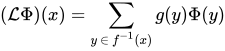
The transfer operator is defined as an operator acting on the space of functions as

where is an auxiliary valuation function. When has a Jacobian determinant , then is usually taken to be .

The above definition of the transfer operator can be shown to be the point-set limit of the measure-theoretic pushforward of g: in essence, the transfer operator is the direct image functor in the category of measurable spaces. The left-adjoint of the Perron–Frobenius operator is the Koopman operator or composition operator. The general setting is provided by the Borel functional calculus.

As a general rule, the transfer operator can usually be interpreted as a (left-)shift operator acting on a shift space. The most commonly studied shifts are the subshifts of finite type. The adjoint to the transfer operator can likewise usually be interpreted as a right-shift. Particularly well studied right-shifts include the Jacobi operator and the Hessenberg matrix, both of which generate systems of orthogonal polynomials via a right-shift.

Applications

[edit]

Whereas the iteration of a function naturally leads to a study of the orbits of points of X under iteration (the study of point dynamics), the transfer operator defines how (smooth) maps evolve under iteration. Thus, transfer operators typically appear in physics problems, such as quantum chaos and statistical mechanics, where attention is focused on the time evolution of smooth functions. In turn, this has medical applications to rational drug design, through the field of molecular dynamics.

It is often the case that the transfer operator is positive, has discrete positive real-valued eigenvalues, with the largest eigenvalue being equal to one. For this reason, the transfer operator is sometimes called the Frobenius–Perron operator.

The eigenfunctions of the transfer operator are usually fractals. When the logarithm of the transfer operator corresponds to a quantum Hamiltonian, the eigenvalues will typically be very closely spaced, and thus even a very narrow and carefully selected ensemble of quantum states will encompass a large number of very different fractal eigenstates with non-zero support over the entire volume. This can be used to explain many results from classical statistical mechanics, including the irreversibility of time and the increase of entropy.

The transfer operator of the Bernoulli map is exactly solvable and is a classic example of deterministic chaos; the discrete eigenvalues correspond to the Bernoulli polynomials. This operator also has a continuous spectrum consisting of the Hurwitz zeta function.

The transfer operator of the Gauss map is called the Gauss–Kuzmin–Wirsing (GKW) operator. The theory of the GKW dates back to a hypothesis by Gauss on continued fractions and is closely related to the Riemann zeta function.

See also

[edit]

References

[edit]
Revisions and contributorsEdit on WikipediaRead on Wikipedia
from Grokipedia
In , the transfer operator, also known as the Perron–Frobenius operator or Ruelle operator, is a linear operator associated with a T:XXT: X \to X that describes the of probability or measures under the dynamics induced by TT. For a function ψ\psi with respect to a reference measure (such as ), the transfer operator PTP_T acts such that ϕ(PTψ)dμ=(ϕT)ψdμ\int \phi \cdot (P_T \psi) \, d\mu = \int (\phi \circ T) \cdot \psi \, d\mu for suitable test functions ϕ\phi, effectively pushing forward the measure μ\mu via T#μ(A)=μ(T1(A))T_\# \mu(A) = \mu(T^{-1}(A)). In explicit form for one-dimensional expanding maps, (PTψ)(x)=yT1(x)ψ(y)T(y)(P_T \psi)(x) = \sum_{y \in T^{-1}(x)} \frac{\psi(y)}{|T'(y)|}, accounting for the inverse branches and local expansion rates. The operator originates from the in matrix theory, which analyzes the spectral properties of positive matrices, and was extended to infinite-dimensional settings for dynamical systems by David Ruelle in the 1960s to study thermodynamic formalism and of chaotic systems. Fixed points of PTP_T correspond to invariant densities, defining absolutely continuous invariant measures μ\mu with PTh=hP_T h = h, where hh is the density, which are central to . Key applications of the transfer operator include analyzing mixing properties and decay of correlations in chaotic systems, where the (the difference between the leading eigenvalue 1 and the next largest in modulus) quantifies exponential mixing rates, such as correlation decay bounded by rkr^k for r<1r < 1 and iteration kk. It also facilitates numerical approximations via methods like Ulam's method or variational techniques for data-driven discovery of eigenfunctions, extending to nonautonomous, stochastic, and high-dimensional systems such as climate models or fluid dynamics. The dual Koopman operator, acting on observables as composition with TT, complements the transfer operator, enabling linear representations of nonlinear dynamics in infinite-dimensional spaces.

Definition

Formal Definition

The transfer operator, often denoted L\mathcal{L} and also known as the Perron–Frobenius operator, is a linear operator associated with a nonsingular transformation T:XXT: X \to X on a measure space (X,A,μ)(X, \mathcal{A}, \mu), where μ\mu is a σ\sigma-finite reference measure that is quasi-invariant under TT. It acts on densities or integrable functions with respect to μ\mu, typically in spaces such as L1(X,μ)L^1(X, \mu), by transporting probability distributions forward under the dynamics induced by TT. The defining property of L\mathcal{L} arises from the requirement that it preserves integrals in the following sense: for suitable test functions ψ\psi and densities ϕ\phi, Xψ(Tx)ϕ(x)dμ(x)=Xψ(x)(Lϕ)(x)dμ(x).\int_X \psi(Tx) \, \phi(x) \, d\mu(x) = \int_X \psi(x) \, (\mathcal{L} \phi)(x) \, d\mu(x). This condition ensures that L\mathcal{L} correctly evolves expectations under the map TT, effectively pushing forward the measure ϕdμ\phi \, d\mu to T(ϕdμ)T_*(\phi \, d\mu). To derive the explicit form, substitute the change of variables y=Txy = Tx and account for the preimages under TT, yielding the action on densities. For absolutely continuous measures with respect to a volume form (e.g., Lebesgue measure on a manifold), assuming TT is C1C^1 and nonsingular (i.e., DT(y)DT(y) is invertible almost everywhere), the operator takes the explicit form (Lϕ)(x)=yT1(x)ϕ(y)detDT(y),(\mathcal{L} \phi)(x) = \sum_{y \in T^{-1}(x)} \frac{\phi(y)}{|\det DT(y)|}, where the sum runs over all preimages yy such that T(y)=xT(y) = x, and detDT(y)|\det DT(y)| is the absolute value of the Jacobian determinant at yy, which compensates for local volume contraction or expansion under TT. This formula is obtained by resolving the integral condition using the coarea formula or Fubini's theorem over the preimage fibers. In the specific case of invertible maps TT, each xx has a unique preimage T1(x)T^{-1}(x), so the expression simplifies to (Lϕ)(x)=ϕ(T1x)detDT(T1x).(\mathcal{L} \phi)(x) = \frac{\phi(T^{-1} x)}{|\det DT(T^{-1} x)|}. Here, the Jacobian determinant plays a central role in adjusting the density to maintain measure preservation when μ\mu is not necessarily invariant. Equivalently, L\mathcal{L} maps a density ϕ\phi with respect to μ\mu to the Radon–Nikodym derivative of the pushforward measure T(ϕμ)T_*(\phi \, \mu) with respect to μ\mu, ensuring A(Lϕ)(x)dμ(x)=T1(A)ϕ(x)dμ(x)\int_A (\mathcal{L} \phi)(x) \, d\mu(x) = \int_{T^{-1}(A)} \phi(x) \, d\mu(x) for measurable sets AA. Classically, the Perron–Frobenius operator is viewed as a positive linear operator on Banach spaces of functions (e.g., L1L^1 or spaces of continuous functions), preserving order and the total mass X(Lϕ)dμ=Xϕdμ\int_X (\mathcal{L} \phi) \, d\mu = \int_X \phi \, d\mu, which follows directly from the integral defining property. The transfer operator is the formal adjoint of the Koopman operator on appropriate function spaces.

Relation to Other Operators

The transfer operator LT\mathcal{L}_T, associated with a dynamical system defined by a map T:XXT: X \to X on a measure space (X,μ)(X, \mu), serves as the adjoint of the Koopman operator UT:L(X,μ)L(X,μ)U_T: L^\infty(X, \mu) \to L^\infty(X, \mu) given by UTϕ=ϕTU_T \phi = \phi \circ T for observables ϕL(X,μ)\phi \in L^\infty(X, \mu). This duality manifests in the relation X(UTϕ)ψdμ=Xϕ(LTψ)dμ\int_X (U_T \phi) \psi \, d\mu = \int_X \phi (\mathcal{L}_T \psi) \, d\mu for ϕL(X,μ)\phi \in L^\infty(X, \mu) and ψL1(X,μ)\psi \in L^1(X, \mu), allowing the transfer operator to propagate densities forward while the Koopman operator evolves observables backward along trajectories. This adjoint relationship enables the analysis of nonlinear dynamics through linear operator techniques, bridging forward and backward evolutions in function spaces. In the context of Markov chains, the transfer operator coincides with the Frobenius–Perron operator, which governs the time evolution of probability densities under the chain's transition kernel. Specifically, for a Markov chain with transition probabilities P(x,dy)P(x, dy), the operator LTψ(x)=ψ(y)P(y,dx)\mathcal{L}_T \psi(x) = \int \psi(y) P(y, dx) evolves an initial density ψ\psi to the density after one step, preserving the total probability mass and facilitating the study of stationary distributions. This connection underscores the transfer operator's role in stochastic processes, where it quantifies how uncertainties propagate through the system. The transfer operator has roots in the shift operator of symbolic dynamics, a foundational tool for encoding continuous dynamics into discrete symbol sequences. In this framework, the shift operator acts on cylinder functions over the symbol space, prefiguring the transfer operator's generalization to weighted sums over preimages in more general settings. More broadly, the transfer operator can be viewed as a specific instance of composition operators on function spaces, where the Koopman operator induces compositions with TT, and its adjoint LT\mathcal{L}_T adjusts for the Jacobian to maintain duality in weighted spaces like L1L^1 or spaces of holomorphic functions. This perspective highlights its embedding within the theory of operators generated by transformations, emphasizing preservation of integrals over invariant measures.

Properties

Spectral Properties

The eigenvalue 1 of the transfer operator L\mathcal{L} corresponds to invariant densities, satisfying the fixed-point equation Lρ=ρ\mathcal{L} \rho = \rho, where ρ\rho is the density of a stationary measure μ\mu with respect to a reference measure, such as Lebesgue measure on the phase space. This eigenvalue is simple and positive under conditions of unique ergodicity or the existence of an absolutely continuous invariant measure, with the corresponding eigenspace consisting of densities of such measures. The leading eigenvalue is 1, and in suitable function spaces, the spectral radius of L\mathcal{L} satisfies r(L)1r(\mathcal{L}) \leq 1, reflecting the operator's contractive nature in norms adapted to the dynamics. Ruelle's theorem establishes that the spectral radius equals the exponential of the topological pressure P(ϕ)P(\phi) associated with the potential defining L\mathcal{L}, i.e., r(L)=eP(ϕ)r(\mathcal{L}) = e^{P(\phi)}, which governs the growth rate of correlations and the thermodynamic formalism. For expanding maps or hyperbolic systems, the essential spectral radius is strictly less than 1 in Hölder or smooth spaces, ensuring a spectral gap that implies exponential mixing. Trace formulas for the transfer operator connect its spectrum to dynamical invariants, particularly through the traces tr(Ln)\operatorname{tr}(\mathcal{L}^n), which count fixed points weighted by expansion factors. These traces yield the Artin-Mazur zeta function via the relation ζ(z)=exp(n=1tr(Ln)znn),\zeta(z) = \exp\left( \sum_{n=1}^\infty \frac{\operatorname{tr}(\mathcal{L}^n) z^n}{n} \right), which encodes the distribution of periodic orbits and provides meromorphic continuations revealing poles at reciprocals of Ruelle resonances. The transfer operator L\mathcal{L} is continuous on Banach spaces of CkC^k functions or Hölder continuous functions with exponent α>0\alpha > 0, where the operator norm is controlled by the expansion rate of the underlying map. In these anisotropic spaces, L\mathcal{L} often induces compact perturbations, leading to discrete spectra outside annuli determined by Lyapunov exponents, with compactness ensuring finite multiplicity for eigenvalues. Resonances, as the eigenvalues of L\mathcal{L} beyond the leading one, play a crucial role in describing decay rates of correlations and the fine structure of invariant measures, with their locations in complex annuli tied to the hyperbolic structure of the system.

Ergodic Properties

The transfer operator L\mathcal{L} plays a central role in encoding ergodic behavior for measure-preserving dynamical systems. Specifically, if ρ\rho is a fixed point of L\mathcal{L}, satisfying Lρ=ρ\mathcal{L}\rho = \rho, then the measure μ=ρdx\mu = \rho \, dx is invariant under the dynamics TT. Birkhoff's ergodic theorem then applies directly to this invariant measure, asserting that for any integrable function fL1(μ)f \in L^1(\mu), the time average 1nk=0n1f(Tkx)\frac{1}{n} \sum_{k=0}^{n-1} f(T^k x) converges and in L1(μ)L^1(\mu) to the space average fdμ\int f \, d\mu, thereby equating temporal and spatial expectations for typical orbits. Mixing properties, which quantify how quickly the system forgets initial conditions, are intimately linked to the spectral structure of L\mathcal{L}. In particular, the presence of a —where the essential spectral radius of L\mathcal{L} restricted to non-constant functions is less than 1—implies of correlations: for suitable observables f,gf, g with zero mean, f(Tng)dμfdμgdμCfgrn|\int f (T^n g) \, d\mu - \int f \, d\mu \int g \, d\mu| \leq C \|f\| \|g\| r^n for some C>0C > 0 and r<1r < 1, with nn \to \infty. This decay rate is determined by the second-largest eigenvalue modulus of L\mathcal{L}, providing a precise measure of mixing speed in chaotic systems. Central limit theorems (CLTs) for sums under the dynamics, such as 1nk=0n1(f(Tkx)fdμ)\frac{1}{\sqrt{n}} \sum_{k=0}^{n-1} (f(T^k x) - \int f \, d\mu)
Add your contribution
Related Hubs
User Avatar
No comments yet.