


Community hub
Recent from talks
Contribute something
Nothing was collected or created yet.
University of North Carolina at Charlotte
View on Wikipedia

Key Information


The University of North Carolina at Charlotte (UNC Charlotte, or simply Charlotte) is a public research university in Charlotte, North Carolina, United States. UNC Charlotte offers 24 doctoral, 66 master's, and 79 bachelor's degree programs through nine colleges.[6] It is classified among "R1: Very High Research Spending and Doctorate Production".[7]
The university experienced rapid enrollment growth in the late 2000s and early-mid 2010s when it was the fastest-growing institution in the UNC System.[8]
It has two campuses: the Main Campus, located in University City, and the Center City Campus in Uptown Charlotte. The main campus sits on 1,000 wooded acres with approximately 85 buildings about 8 miles (13 km) from Uptown Charlotte.[9]
History
[edit]Prior to UNC Charlotte's founding, Charlotte had long sought a public university. In the late 1880s, the city bid for what would become North Carolina State University, but lost to Raleigh after a local farmer offered to donate land for the campus.[10] In 1946, the city sought a state-run medical school; instead, the state expanded the existing medical school at the University of North Carolina at Chapel Hill.[10]
In 1946, to handle the expected surge of applicants resulting from the G.I. Bill, the Consolidated University of North Carolina (now the University of North Carolina) opened 12 "extension centers" across North Carolina.[11] On September 23, 1946, the Charlotte Center of the University of North Carolina opened with an enrollment of 278 students.[12] The Charlotte city school system was tasked with running the center, and it named doctoral student Charles Bernard director of the center.[13] The center held night classes at Central High School in present-day Uptown Charlotte. It initially offered only freshman-level courses, but added sophomore-level courses in 1947 by demand.[11] Also that year, Bernard resigned his position to resume his doctoral studies, and the center's mathematics teacher, Bonnie Ethel Cone, was named director.[14]
By 1948, the Charlotte Center was one of only four extension centers still open.[15] The Consolidated University determined that its three campuses could handle student demand, and it announced that it would close the remaining centers on July 1, 1949.[16] On April 4, 1949, in response to local efforts led by Cone,[17] the North Carolina General Assembly created the Charlotte Community College System.[18] The system included two schools, both of which opened in 1949: Charlotte College, which served white students, and Carver College, which served black students.[18][19] In 1950, the state recognized Charlotte College as a "standard junior college", allowing students to transfer credits to senior colleges.[20]
Cone served as director—and later president—of the college, which continued to hold classes at Central High School.[21][22] The school was racially desegregated as a result of the U.S. Supreme Court case Brown v. Board of Education in 1954 (Carver College would later merge with another institution to become Central Piedmont Community College).[23] By 1957, enrollment increased to 492, and the school's leaders began searching for a permanent site for the campus. They decided on a 250-acre (100 ha) tract of land northeast of the city.[24] The college became state-supported in 1958 upon joining the newly formed North Carolina Community College System and moved to its current location in 1961. It added a junior year of study in 1963, and a senior year in 1964.[25]
On March 3, 1965, the North Carolina General Assembly designated Charlotte College the fourth campus of the University of North Carolina, under its current name, effective July 1.[26] On May 29, 1966, 81 students became the school's first graduating class as a UNC system school.[27] In 1969, the school opened its first dormitory, housing approximately 600 students,[27] and also that year, the university began offering programs leading to master's degrees. The school's first graduate degree—a master of education—was awarded in May 1970.[27] By 1973, enrollment had increased to 6,123 students, with 853 of those being graduate students.[27]
In 1992, UNC Charlotte was authorized to offer programs leading to doctoral degrees.[28]
Leaders of the university
[edit]| Order | Chancellor | Years as Chancellor |
|---|---|---|
| 1 | Bonnie Ethel Cone | (Founder; Director, 1947–1961;[22] President, 1961–1965; Acting Chancellor, 1965–1966; Vice-Chancellor Emeritus & Dean of Religious Studies, 1973–2003) |
| 2 | Dean W. Colvard | (1966–1978) |
| 3 | E.K. Fretwell | (1979–1989) |
| 4 | James H. Woodward | (1989–2005) |
| 5 | Philip L. Dubois | (2005–2020)[29] |
| 6 | Sharon Gaber | (2020–present) |
Bonnie Ethel Cone, founder
[edit]
Bonnie Ethel Cone (1907–2003), or Miss Bonnie as she was known to students, was chosen to be director of the Charlotte Center in 1947. From 1949 to 1965, she served as president of Charlotte College.[30] When Charlotte College joined the UNC system in 1965, Cone served as acting chancellor until 1966.
Chancellors
[edit]Dean W. Colvard (1913–2007) was appointed the first chancellor of the young university in 1966. A North Carolina native, Colvard had served as president of Mississippi State University (MSU). At MSU he was the first president to defy university policy of not playing against integrated teams when he ordered the men's basketball team to play Loyola University Chicago in 1963. At UNC Charlotte, Colvard took on the challenge of converting the school from a small college to a four-year member of the UNC system. Indeed, he had been chosen specifically because UNC system officials believed the newly minted UNC Charlotte needed a leader with experience running a four-year university. Colvard oversaw accreditation of the university, development of University Research Park (now one of the top five largest research parks in the country), constructed the first residence halls, created the first graduate programs, and grew the enrollment from about 1,700 to just over 8,000 students. He retired as chancellor in 1978, served as Chancellor Emeritus until his death. Colvard also received the Order of the Long Leaf Pine. The Colvard building, completed on the main campus in 1979, is named in his honor and houses the Department of Psychology.
E.K. Fretwell (1923–2012), the second chancellor of the university, was named in 1979. He came to the university from Buffalo State College where he was president. Under Fretwell, campus enrollment surged from 8,000 students to over 12,000. He oversaw the creation of the Graduate School, created more graduate degrees, integrated the library's card catalog into the Internet in 1983, created the groundwork for a major business incubator, helped to develop the university's surrounding neighborhood, and increased academic grants to over $6.1 million. Fretwell retired as chancellor in 1989. He served as interim president of the University of Massachusetts system from 1991 to 1992, and in 1998, he served as the interim president of the University of North Florida. In 1996 UNC Charlotte opened the Fretwell building, dedicated in honor of him and his wife Dorrie. The building headquarters the College of Liberal Arts & Sciences.
James H. Woodward succeeded Fretwell in 1989. Woodward came to UNC Charlotte from the University of Alabama at Birmingham where he served as dean of engineering and senior vice president of academic affairs. Under Woodward, enrollment grew to over 19,000 students. Like his predecessors, he continued the growth of the Graduate School and added new doctoral programs. He oversaw the largest fundraising campaign in the school's history and its largest building boom; in the summer of 2005, no less than six buildings were actively under construction on the main campus. He also oversaw the creation of the CRI Campus. Woodward announced his retirement in 2004 and left the office of chancellor on June 30, 2005. Woodward Hall, which houses the College of Computing & Informatics, was dedicated in his honor on November 16, 2005. He is currently Chancellor Emeritus and teaches in the university's William States Lee College of Engineering.
Philip L. Dubois was the fifth leader and fourth chancellor of the university. Dubois assumed his duties as chancellor on July 15, 2005. He returned to Charlotte after serving as the president of the University of Wyoming from 1997 through 2005. Previously, he was the Provost and Professor of Political Science in the Department of Political Science (now the Department of Political Science and Public Administration) at UNC Charlotte from 1991 until 1997. Dubois, along with his wife and children, was the first chancellor to occupy the Chancellor's Residence (known as the Bissell House) on the UNC Charlotte campus that was completed in the winter of 2005. His goal was to oversee the process of the university becoming the fourth research-extensive university in the state.
2019 mass shooting
[edit]On April 30, 2019, a mass shooting occurred in the Woodford A. Kennedy Building on campus, killing two and leaving four others injured.[31][32] The shooter, identified as Trystan Andrew Terrell, was arrested shortly afterwards.[33]
Campuses
[edit]Main Campus – University City
[edit]
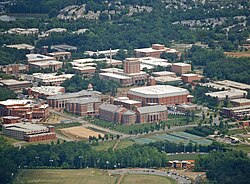
The Main Campus of the university is situated on just under 1,000 acres (4 km2) of rolling land between U.S. Route 29 and N.C. Highway 49, about 10 miles (16 km) from Uptown Charlotte in the University City neighborhood. The campus is self-contained, meaning that no major roads run through the campus. The campus boasts several man-made lakes, and is heavily wooded. Near the center of campus are two gardens that attract over 300,000 visitors a year. The architecture of the original central campus, particularly the oldest buildings, are precast concrete and utilitarian-looking because they were built with limited state funds in the 1960s and 1970s. Starting in 2014, these buildings are being renovated to today's standards. Under the campus's third chancellor, James Woodward, the campus underwent major changes which continue today. The newest buildings, funded from state bonds, are being constructed in brick with neoclassical architecture. Concrete and asphalt sidewalks have largely been replaced by brick. The campus's road system is being upgraded to include landscaped medians and more trees.[34]
The former Charlotte Research Institute (CRI) occupied the northern portion of the Main campus. The university retired the CRI branding in 2019, and its operations are now part of the Office of Research Partnerships.[35]
Center City Campus
[edit]
The second campus—named the Dubois Center at UNC Charlotte Center City—is in the first ward of Uptown Charlotte. This campus houses the School of Professional Studies along with 23 academic programs.[36] Formerly located in the Mint Museum of Craft+Design, the Uptown campus moved into the $50.4 million Center City building at 320 East 9th Street, on August 22, 2011.[37] It is located one block away from the 9th Street Station of the Lynx Blue Line. The 12-story, 143,000 square foot Center City building was designed by architectural firm KieranTimberlake.[38] The building features cantilevered multi-story blocks which resemble a stack of books.[39]
Transportation
[edit]Charlotte Area Transit System
[edit]All UNC Charlotte students are automatically enrolled in the Charlotte Area Transit System (CATS) All-Access pass, which offers students unlimited rides to all of CATS transportation systems.
Light Rail
[edit]
Added to UNC Charlotte's campus in 2018, the Lynx Blue Line connects students with 25 other stations off-campus, including the Charlotte Transportation Center, located in Uptown, where students can transfer to the CityLynx Gold Line, CATS buses, and the airport sprinter.[40]
CATS Buses
[edit]CATS also offers bus services at UNC Charlotte. As of March 2025, CATS offers 2 bus routes, with route 29 stopping at various locations on-campus and route 22 stopping adjacent to the Engineering campus on JW Boulevard.
Niner Transit
[edit]On campus, students can catch one of 6 bus routes on campus. Green, Silver, Red Express, and Gold are operated daily by Academy Bus Lines, while the Greek Village and Shopping Shuttles are operated by UNC Charlotte's Parking and Transportation Services. Additionally, the University operates a prearranged ParaTransit service called Niner Rides.
Green and Silver buses operate every day of the week, while Red Express, Gold, and the Greek Village Shuttle run Monday through Friday. The Shopping Shuttle is only offered on Wednesday, Thursday, and Friday.[41]
| Route | Station | ||
|---|---|---|---|
| Green | Light Rail | ↔ | North Deck |
| Silver | CRI Deck | ↔ | PORTAL |
| Red Express | Student Union East | ↔ | Football Stadium/Gate 1 |
| Gold | Wallis Hall | ↔ | Student Union Deck |
| Greek Village Shuttle | Student Union West | ↔ | Student Union West |
| Shopping Shuttle | Levine Hall | ↔ | Harris Teeter |
| Niner Paratransit | Prearranged Service (54 stops) | ||
Students
[edit]| Race and ethnicity | Total | ||
|---|---|---|---|
| White | 49% | ||
| Black | 17% | ||
| Hispanic | 15% | ||
| Asian | 10% | ||
| Two or more races | 5% | ||
| International student | 2% | ||
| Unknown | 2% | ||
| Economic diversity | |||
| Low-income[a] | 35% | ||
| Affluent[b] | 65% | ||
32,207 students were enrolled in the university in the fall of 2025. Students come from 99 of North Carolina's 100 counties, 50 states, and 128 countries.[4]
Academics
[edit]UNC Charlotte is classified among "R1: Very High Research Spending and Doctorate Production"[7] The 2025 edition of the U.S. News & World Report Best Colleges ranked the university's undergraduate program 152nd overall among national universities,[43] Forbes placed the university at 225 from among 500 nationwide.[44]

| Academic rankings | |
|---|---|
| National | |
| Forbes[46] | 225 from 500 [45] |
| U.S. News & World Report[48] | 143 (tie)[47] |
| Washington Monthly[50] | 140 from 438[49] |
| Global | |
| THE[52] | 601-800[51] |
| U.S. News & World Report[54] | 714 (tie)[53] |
| USNWR | Rank |
|---|---|
| Engineering (undergraduate) | 137 |
| Social Mobility | 63 |
| Education (online Masters) | 23 |
| Curriculum & Instruction (online Masters) | 17 |
| Instructional Media (online Masters) | 13 |
| Special Education (online Masters) | 10 |
| Best Online Bachelors | 4 |
| Engineering (online Masters) | 62 |
| Nursing (online Masters) | 37 |
| Nursing Education (online Masters) | 11 |
| Part-Time MBA | 69 |
| Education-Masters | 76 |
| Engineering-Masters | 152 |
| Nursing-Masters | 95 |
| Nursing-Doctorate | 110 |
| Biological Sciences | 175 |
| Clinical Psychology | 88 |
| Computer Science | 99 |
| Healthcare Management | 43 |
| Mathematics | 115 |
| Nursing-Anesthesia | 36 |
| Physics | 122 |
| Public Affairs | 49 |
| Local Government Management | 22 |
| Public Health | 70 |
| Social Work | 72 |
| Statistics | 70 |
Colleges and programs
[edit]The university offers 171 majors that lead to 79 baccalaureate (bachelor's degree) degrees, 66 master's degree programs, and 24 doctoral programs. Fifteen degree and certificate programs are offered via distance education, from 25% to 100% online.
The university is divided into ten colleges:
- College of Humanities & Earth and Social Sciences - academic disciplines including the humanities, social sciences, and environmental sciences
- Klein College of Science - focusing on mathematics and natural sciences
- College of Arts + Architecture - fine and performing arts (art, theater, dance, and music), as well as the School of Architecture, which is housed within the college
- Cato College of Education - the school of education
- College of Health and Human Services - social work, kinesiology, and athletic training; also contains the School of Nursing and programs like public health and health administration.
- William States Lee College of Engineering - engineering college with undergraduate and graduate programs in the following: civil and environmental engineering, mechanical engineering and engineering science, electrical and computer engineering, systems engineering and engineering management, construction management, and engineering technology
- College of Computing and Informatics - computer science, computer programming, health informatics, and bioinformatics; as of April 2021, the College of Computing and Informatics is the largest computing college in North Carolina — and the number 1 producer of computer science graduates in North Carolina, South Carolina, and Virginia.[56]
- Belk College of Business - the business school, which offers undergraduate, graduate and executive education in five major departments: Accounting, Business Information Systems and Operations Management (BISOM), Economics, Finance, Management, and Marketing.[57] The college offers three undergraduate degrees (Bachelor of Science in Accounting, Bachelor of Science in Business Administration, and Bachelor of Science in economics); five master's programs (Master of Business Administration, Master of Accountancy, Master of Science in Economics, Master of Science in Real Estate, and Master of Science in Mathematical Finance as well as a Professional Science Master's (PSM) program in Data Science and Business Analytics); a Doctorate in Business Administration and a Ph.D. in Business Administration concentrating in finance.[58] The college was established in 1965, became the College of Business Administration in 1971, and was renamed the Belk College of Business in honor of the Belk family in 1990.[59]
- University College - general education college for undergraduates who have not yet declared a major
- Honors College - a selective honors college that seeks to provide students with a liberal arts college experience
- Graduate School - graduate school; works with the undergraduate colleges to organize the master's and doctoral degree programs
Scholarships
[edit]In 2009, UNC Charlotte received the largest single donation from a private source, when The Leon Levine Family Foundation donated $9.3 million to the university to form the Levine Scholars program.[60] The scholarship program, named for Leon and Sandra Levine, provides a four-year scholarship to UNC Charlotte. The scholarship includes tuition, fees, books, room, four summer experiences, and an $8,000 grant for community service initiatives.
In addition to the Levine Scholars, the university offers eleven other merit-based scholarship programs.[61]
Library system
[edit]UNC Charlotte's J. Murrey Atkins Library, named for the first chairman of the Board of Trustees of Charlotte College, has over 3.3 million volumes, including 930,000 e-books, over 400 databases, and approximately 75,000 journals, the vast majority available electronically,[62] as well as an area for special collections. The recently renovated library includes a ten-story tower that accentuates the library's place at the heart of UNC Charlotte's campus. In April 2007, Atkins received its one-millionth volume, a copy of T. S. Eliot's The Waste Land. A special collections section is housed on the tenth floor at the top of the library.[62]
Athletics
[edit]The nickname of the athletic teams are the 49ers, indicative of the fact that UNC Charlotte (then Charlotte College) was saved from permanent closure in 1949. The mascot is "Norm the Niner", a gold miner. The school's colors are green and white; gold and black are both featured in the logo and frequently used in the uniforms of several sports.
For athletics purposes, the school is known as simply "Charlotte", a change made official by the athletic department on August 23, 2000. The athletic department sponsors nineteen varsity teams and competes in the NCAA's Division I. The university is a full member of American Athletic Conference following the 2022-23 calendar season. On September 18, 2008, Chancellor Dubois recommended adding a Division I FCS football program to UNC Charlotte. On November 13, 2008, the UNC Charlotte Board of Trustees voted 8–0 in favor of adding football to the university.
Baseball
[edit]Charlotte Baseball has made six NCAA Tournament appearances with the most recent coming in 2021. The 49ers have four conference tournament championships, and eight regular season conference championships. Baseball alums with Major League experience include Bryan Harvey (Angels), Jeff Johnson (Yankees), Chris Haney (Kansas City Royals), John Maine (New York Mets), Jason Stanford (Cleveland Indians). Fieldin Culbreth is a recently retired MLB umpire who worked the 2008 World Series.
Basketball (men's)
[edit]Men's basketball, coached by Aaron Fearne. The team has reached the NCAA Tournament 11 times, including a trip to the Final Four in 1977. NBA players that once suited up for the 49ers include Boston Celtics Cedric Maxwell, DeMarco Johnson, 2001 NBA draft lottery pick Rodney White, Eddie Basden and Chad Kinch of the Cleveland Cavaliers.
Basketball (women's)
[edit]In 2003, the women's basketball team reached the NCAA Tournament for the first time. In the 2021–22 season, the team won both a CUSA regular season and tournament championship, resulting in an NCAA tournament berth.[63]
Football
[edit]
Charlotte's Division I FCS football team kicked off in 2013. It plays at Jerry Richardson Stadium, which holds approximately 15,000 people and can be expanded to hold up to 40,000 people. Its first game was a 52–7 victory against Campbell University on August 31, 2013.[64]
The football program moved up to Division I FBS in 2015 to play as members of Conference USA. The Charlotte 49ers participated in their first bowl game in 2019 against the Buffalo Bulls in the Bahamas Bowl. Charlotte would move conferences to the American Athletic Conference beginning in 2023.
Charlotte has had 5 players selected in the NFL Draft; Larry Ogunjobi, Nate Davis, Alex Highsmith, Cameron Clark and Grant DuBose.
Golf (men's)
[edit]In September 2007, the Charlotte men's golf team reached the ranking of being the top-rated golf team in the nation.[65]
Soccer (men's)
[edit]The men's soccer team reached the College Cup in 1996 and 2011. The team advanced all the way to the 2011 NCAA Division I Men's Soccer Championship, losing to UNC-Chapel Hill and finishing second in the national polls. Former 49ers soccer players who went on to play in the MLS include Floyd Franks, Donnie Smith, Brandt Bronico, and Jon Busch.
The team has won eight conference titles, including once in 2013–2014 as a member of Conference USA and twice in 2023-2024 and 2024-2025 as a member of the American Athletic Conference. The program became the first in the American since SMU in 2017, 2018, and 2019 to win back-to-back conference championships.
Student organizations
[edit]There are a large number of student organizations associated with the university. Their focuses include academic, graduate, honor societies, interest, international, multicultural, political, religious, service, secret societies, and sports. UNC Charlotte also boasts a diverse Greek life, with over 10 sororities and 14 fraternities serving the campus community.[66]
Notable alumni and faculty
[edit]Every graduate of UNC Charlotte automatically becomes a member of the Alumni Association, an organization of more than 147,000 former students whose primary purpose is to advance the interests of the university. There are no membership fees or annual dues, but there is an expectation that members will be active participants in the organization. In addition to promoting the interests of UNC Charlotte, the Alumni Association acts as a network of UNC Charlotte graduates who assist each other in their personal, professional and social development, and recognize and cheer the accomplishments of their fellow members. The association offers members a number of benefits and services. Some are in the form of information and communications, including a UNC Charlotte magazine and a quarterly electronic newsletter which keeps alumni up to date on news from the association and the university. The only requirement for membership is that alumni maintain contact with the Office of Alumni Affairs, provide an up-to-date address for alumni files, and keep the association informed about their personal progress and career achievements.
See also
[edit]Notes
[edit]- ^ The percentage of students who received an income-based federal Pell grant intended for low-income students.
- ^ The percentage of students who are a part of the American middle class at the bare minimum.
References
[edit]- ^ a b "University History – Office of News and Information – UNC Charlotte". publicrelations.uncc.edu. Archived from the original on March 4, 2016. Retrieved May 11, 2017.
- ^ Reported November 19th, 2024. UNC Charlotte launches largest fundraising campaign (Report). WFAE. November 19, 2024. Archived from the original on November 21, 2024. Retrieved November 21, 2024.
- ^ "Institution Data Profile - University of North Carolina at Charlotte". nces.ed.gov. National Center for Education Statistics. Retrieved July 31, 2025.
- ^ a b c d "UNC Charlotte's enrollment surge sets another record". inside.charlotte.edu. UNC Charlotte. Retrieved September 7, 2025.
- ^ "Branding Style Guide" (PDF). Archived (PDF) from the original on November 21, 2021. Retrieved November 21, 2021.
- ^ "Academics". July 9, 2014. Archived from the original on July 26, 2010. Retrieved May 11, 2017.
- ^ a b "Carnegie Classifications Institution Lookup". carnegieclassifications.iu.edu. Center for Postsecondary Education. Archived from the original on February 13, 2025. Retrieved February 13, 2025.
- ^ "How the N.C. budget could impact UNC Charlotte". ninertimes.com. June 27, 2017. Archived from the original on October 3, 2017. Retrieved October 2, 2017.
- ^ "About UNC Charlotte". July 9, 2014. Archived from the original on July 27, 2015. Retrieved May 11, 2017.
- ^ a b Sanford, Ken. "Charlotte and UNC Charlotte: Growing Up Together". UNC Charlotte Press, 1996, p. 5.
- ^ a b Jeffers, William Thomas. "Jewel in the Crown: Bonnie Cone and the Founding of UNC Charlotte". University of North Carolina Press, 2021, p. 12.
- ^ Sanford, Ken. "Charlotte and UNC Charlotte: Growing Up Together". UNC Charlotte Press, 1996, p. 9.
- ^ Jeffers, William Thomas. "Jewel in the Crown: Bonnie Cone and the Founding of UNC Charlotte". University of North Carolina Press, 2021, pp. 12-13.
- ^ Jeffers, William Thomas. "Jewel in the Crown: Bonnie Cone and the Founding of UNC Charlotte". University of North Carolina Press, 2021, p. 13.
- ^ Sanford, Ken. "Charlotte and UNC Charlotte: Growing Up Together". UNC Charlotte Press, 1996, pp. 29-30.
- ^ Jeffers, William Thomas. "Jewel in the Crown: Bonnie Cone and the Founding of UNC Charlotte". University of North Carolina Press, 2021, p. 19.
- ^ Ellis, Marion A. "Dean W. Colvard: Quiet Leader". University of North Carolina at Charlotte, 2004, p. 113.
- ^ a b Jeffers, William Thomas. "Jewel in the Crown: Bonnie Cone and the Founding of UNC Charlotte". University of North Carolina Press, 2021, p. 20.
- ^ Sanford, Ken. "Charlotte and UNC Charlotte: Growing Up Together". UNC Charlotte Press, 1996, pp. 31-33.
- ^ Jeffers, William Thomas. "Jewel in the Crown: Bonnie Cone and the Founding of UNC Charlotte". University of North Carolina Press, 2021, p. 21.
- ^ Jeffers, William Thomas. "Jewel in the Crown: Bonnie Cone and the Founding of UNC Charlotte". University of North Carolina Press, 2021, p. 22.
- ^ a b Jeffers, William Thomas. "Jewel in the Crown: Bonnie Cone and the Founding of UNC Charlotte". University of North Carolina Press, 2021, pp. 25-28.
- ^ Sanford, Ken. "Charlotte and UNC Charlotte: Growing Up Together". UNC Charlotte Press, 1996, p. 31.
- ^ Sanford, Ken. "Charlotte and UNC Charlotte: Growing Up Together". UNC Charlotte Press, 1996, pp. 44–46.
- ^ Sanford, Ken. "Charlotte and UNC Charlotte: Growing Up Together". UNC Charlotte Press, 1996, p. 59.
- ^ Sanford, Ken. "Charlotte and UNC Charlotte: Growing Up Together". UNC Charlotte Press, 1996, pp. 80-81.
- ^ a b c d Sanford, Ken. UNCC: The First Decade. University of North Carolina at Charlotte Board of Trustees, 1975.
- ^ "UNC Charlotte :: Public Relations :: University History". Archived from the original on October 25, 2007. Retrieved May 11, 2017.
- ^ "Philip L. Dubois - Office of the Chancellor - UNC Charlotte". chancellor.uncc.edu. Archived from the original on October 13, 2014. Retrieved May 11, 2017.
- ^ "UNC Charlotte Finding Aids - Search - Text: ms0112". library.uncc.edu. Archived from the original on July 27, 2015. Retrieved May 11, 2017.
- ^ "UNCC shooting: 2 dead, 4 injured in shooting at Charlotte campus — live updates". CBS News (published May 1, 2019). April 30, 2019. Archived from the original on May 1, 2019. Retrieved May 1, 2019.
- ^ "Live updates: 2 killed, 4 hurt in UNC Charlotte shooting". WCNC. April 30, 2019. Archived from the original on May 1, 2019. Retrieved May 1, 2019.
- ^ "UNC Charlotte shooter pleads guilty to murder". WFAE. September 20, 2019. Archived from the original on May 5, 2021. Retrieved September 20, 2019.
- ^ "About CRI - Charlotte Research Institute - UNC Charlotte". cri.uncc.edu. Archived from the original on October 9, 2011. Retrieved May 11, 2017.
- ^ "Our History - Partnerships". partnerships.charlotte.edu. Retrieved January 11, 2025.
- ^ "Mission Statement - Dubois Center at UNC Charlotte Center City". duboiscenter.charlotte.edu. Retrieved January 11, 2025.
- ^ "Charlotte Observer: UNCC hub opens in 'Rubik's Cube' building uptown, by David Perlmutt, August 23, 2011". Archived from the original on May 24, 2012. Retrieved September 12, 2011.
- ^ "Charlotte Business Journal: UNC Charlotte reveals uptown building design, by Will Boye, March 18, 2009". Archived from the original on October 29, 2020. Retrieved October 16, 2011.
- ^ Charlotte Observer: Bringing daylight indoors, by Hannah Miller, March 11, 2012
- ^ https://www.archpaper.com/2018/03/charlotte-delivers-light-rail-extension/
- ^ https://pats.charlotte.edu/transportation/niner-transit-bus-service/
- ^ "College Scorecard: University of North Carolina at Charlotte". College Scorecard. United States Department of Education. Retrieved September 1, 2025.
- ^ "UNC Charlotte". U.S. News & World Report. Retrieved September 25, 2024.
- ^ "University of North Carolina, Charlotte". Forbes. Retrieved September 25, 2024.
- ^ "America's Top Colleges 2024". Forbes. September 25, 2024. Retrieved September 25, 2024.
- ^ "America's Top Colleges 2025". Forbes. September 6, 2025. Retrieved October 3, 2025.
- ^ "2026 Best National University Rankings". U.S. News & World Report. Retrieved September 24, 2025.
- ^ "2025-2026 Best National Universities Rankings". U.S. News & World Report. September 23, 2025. Retrieved October 3, 2025.
- ^ "2023 National University Rankings". Washington Monthly. September 25, 2024. Retrieved September 25, 2024.
- ^ "2024 National University Rankings". Washington Monthly. August 25, 2024. Retrieved August 29, 2024.
- ^ "2024 World University Rankings". Times Higher Education. September 24, 2024. Retrieved September 24, 2024.
- ^ "World University Rankings 2025". Times Higher Education. October 9, 2024. Retrieved June 19, 2025.
- ^ "2025 Best Global University Rankings". U.S. News & World Report. Retrieved September 25, 2024.
- ^ "2025-2026 Best Global Universities Rankings". U.S. News & World Report. June 17, 2025. Retrieved June 17, 2025.
- ^ "2023 Best National University Rankings". U.S. News & World Report. Archived from the original on February 18, 2020. Retrieved February 17, 2023.
- ^ Thomas, Jennifer (April 6, 2021). "Here's why Lowe's is donating $1.5M to UNC Charlotte's tech programs". Charlotte Business Journal. Archived from the original on April 7, 2021. Retrieved April 6, 2021.
- ^ "Departments in the Belk College of Business - Belk College of Business - UNC Charlotte". belkcollege.uncc.edu. October 5, 2015. Archived from the original on March 27, 2021. Retrieved May 11, 2017.
- ^ "Graduate Programs - Belk College of Business - UNC Charlotte". belkcollege.uncc.edu. October 19, 2015. Archived from the original on July 21, 2018. Retrieved May 11, 2017.
- ^ "Belk, Inc. gives $5 million to the Belk College of Business - Belk College of Business - UNC Charlotte". belkcollege.uncc.edu. October 14, 2015. Archived from the original on July 21, 2018. Retrieved May 11, 2017.
- ^ "ServiceNation: Philanthropists give huge scholarship to advance community service". Archived from the original on June 21, 2010. Retrieved May 11, 2017.
- ^ "Scholarship Listing". finaid.uncc.edu. Archived from the original on March 7, 2016. Retrieved May 11, 2017.
- ^ a b "Dean's Welcome Letter - J. Murrey Atkins Library - UNC Charlotte". library.uncc.edu. Archived from the original on November 21, 2019. Retrieved May 11, 2017.
- ^ "Charlotte 49ers". Archived from the original on March 25, 2012. Retrieved June 21, 2011.
- ^ Scott, David. "Charlotte 49ers pummel Campbell in football opener, 52-7 Archived October 30, 2013, at the Wayback Machine, The Charlotte Observer, August 31, 2013.
- ^ "UNC Charlotte :: Public Relations :: News Release Detail". Archived from the original on November 20, 2007. Retrieved May 11, 2017.
- ^ "student-groups". uncc.edu.[permanent dead link]
Further reading
[edit]- Sanford, Ken. Charlotte and UNC Charlotte: Growing Up Together (2021) summary
External links
[edit] Media related to University of North Carolina at Charlotte at Wikimedia Commons
- Official website

- Charlotte Athletics website

| ||||||||||||||||||||||||||||||


| International | |
|---|---|
| National | |
| Geographic | |
| People | |
| Other | |
University of North Carolina at Charlotte
View on GrokipediaHistory
Founding and Early Development (1946–1964)
The Charlotte Center of the University of North Carolina opened on September 23, 1946, as one of twelve evening college centers established by the University of North Carolina system to address post-World War II educational demands driven by the GI Bill and returning veterans.[6] Initial enrollment stood at 278 students, comprising men and women pursuing freshman- and sophomore-level courses with transferable credits, held at Central High School in downtown Charlotte as a commuter night program.[7][8] Bonnie E. Cone served as director from the outset, overseeing operations focused on local residents unable to relocate to larger UNC campuses.[9] By 1949, declining national enrollment pressures led the state to close the UNC extension centers, but persistent advocacy from Charlotte's business leaders, veterans, and educators, including Cone and superintendent Elmer H. Garinger, secured local continuation as Charlotte College, an independent two-year junior college under the Charlotte City Board of Education.[9][7] Cone assumed the presidency, establishing school colors of light grey and maroon, while the institution emphasized affordable, accessible education for Mecklenburg County commuters.[8] In 1947, the center had fielded its first athletic team, the CCUNC Owls football squad, signaling early extracurricular development.[8] By 1958, Charlotte College integrated into the North Carolina Community College System, bolstering its regional alignment amid growing local support from industrial and civic figures.[7] Efforts for permanence accelerated in the late 1950s, with library director J. Murrey Atkins announcing a 240-acre site in 1957 for a dedicated campus north of downtown.[8] Groundbreaking occurred on November 21, 1960, followed by relocation in 1961 to a burgeoning 1,000-acre tract funded through municipal bonds and private contributions, initially featuring two buildings to accommodate expanding enrollment.[9][8] In April 1964, Mecklenburg County commissioners donated an additional 520 acres, expanding the holdings to approximately 917 acres and positioning the campus for further growth.[8] That year, the North Carolina General Assembly authorized Charlotte College's transition to a four-year, state-supported degree-granting institution, marking the culmination of nearly two decades of grassroots and legislative momentum toward senior college status.[9]Integration into UNC System and Expansion (1965–2000)
On July 1, 1965, the North Carolina General Assembly ratified legislation integrating Charlotte College into the University of North Carolina System as its fourth campus, renaming it the University of North Carolina at Charlotte; this followed the institution's transition to a four-year, state-supported college in 1964.[9][10] Bonnie E. Cone, who had led the institution since 1949, served as acting chancellor during this transitional period, overseeing initial alignment with system governance while enrollment stood at 1,815 students.[9][11] Dean W. Colvard assumed the role of first permanent chancellor in 1966, guiding UNC Charlotte through foundational expansion on its 1,000-acre University City campus, where only two buildings existed upon relocation in 1961.[9][12] Under Colvard, enrollment surged from 1,715 in 1966 to approximately 9,000 by the late 1970s, supported by a master campus plan that facilitated construction of facilities like the 1967 Dalton Tower expansion of J. Murrey Atkins Library and the 1979 Colvard Building, noted for its energy-efficient steel-frame design.[9][11][13] Colvard prioritized accreditation, program diversification, and community ties, establishing UNC Charlotte as a regionally significant institution amid Charlotte's postwar economic boom.[14] E. K. Fretwell Jr. succeeded Colvard as chancellor in 1979, leveraging his national higher education experience to elevate academic stature during a decade of steady growth.[15] Enrollment reached 9,383 by 1980 and continued climbing to over 10,000 by the mid-1980s, with emphases on faculty recruitment, research initiation, and interdisciplinary initiatives like the 1970 Urban Institute, which analyzed regional urbanization despite the campus's rural setting at launch.[11][16] Fretwell's tenure, ending in 1989, solidified UNC Charlotte's reputation for accessible, quality education, conferring institutional maturity through enhanced graduate offerings and external partnerships.[15] James H. Woodward became chancellor in 1989, accelerating modernization with a focus on research elevation and infrastructure scaling to match enrollment projected to exceed 15,000 by 2000.[17] Key advancements included approval of the university's first doctoral programs in 1992, expanding from primarily undergraduate and master's levels, alongside campus developments adapting Colvard's master plan for denser academic clustering.[18][19] By 2000, UNC Charlotte had transitioned from a nascent system affiliate to a comprehensive urban university, with enrollment nearing 19,000 under Woodward's vision, driven by state funding, regional demand, and strategic investments in computing, engineering, and business disciplines.[17][20]Rapid Growth and Modernization (2001–Present)
Under Chancellor Philip L. Dubois, who assumed office in 2005, the University of North Carolina at Charlotte underwent substantial expansion in enrollment, infrastructure, and academic offerings.[21] Enrollment increased by 40 percent during his tenure, reaching approximately 29,000 students by 2020, driven by strategic recruitment and program development.[21] This growth positioned UNC Charlotte as one of the fastest-expanding institutions in the UNC System during the late 2000s and early 2010s. By fall 2024, total enrollment hit a record 31,091 students, surpassing prior highs, and further rose to 32,207 in fall 2025.[22][23] Infrastructure modernization accelerated with over $1 billion invested in construction and renovation projects, adding roughly 5 million square feet of space.[24] Key developments included the opening of the Center City Campus in 2011, providing urban access with classrooms, studios, and galleries in Uptown Charlotte.[25] The university launched its Division I football program in 2013 following a 2008 board approval, culminating in the Jerry Richardson Stadium's completion to support athletics. Additional facilities, such as the renovated Student Union in 2009 and ongoing projects like the Burson Building expansion slated for 2025, enhanced research labs, classrooms, and student life amenities.[24][26] Research expenditures and funding also surged, with annual awards reaching a record $58 million in fiscal year 2020-21, an 11.8 percent increase from the prior year and reflecting broader growth since 2016.[27] Overall research spending rose 87 percent since 2012, elevating UNC Charlotte's national ranking among public universities by 46 spots as of 2024.[28][29] These advancements, including new doctoral programs and interdisciplinary centers established post-2001, underscored the institution's transition to a doctoral research university with heightened emphasis on STEM fields.[21]2019 Campus Shooting
On April 30, 2019, Trystan Andrew Terrell, a 22-year-old former student at the University of North Carolina at Charlotte (UNCC), carried out a shooting in Kennedy Hall on the university's main campus, killing two students and wounding four others during an anthropology class on the last day of the spring semester.[30][31] Terrell entered the building around 5:40 p.m. EDT armed with a pistol, fired multiple rounds into two classrooms, and was subdued by students and campus police within minutes, leading to an immediate campus lockdown.[32][33] The victims included Reed William Parker, an 18-year-old freshman from Middlesex, North Carolina, and Riley Howell, a 21-year-old junior from Robbinsville, North Carolina, both fatally shot; Howell was credited by authorities with tackling Terrell and disrupting the attack, actions that police stated saved numerous lives.[34][31] The four injured students, all in their late teens or early twenties, suffered gunshot wounds ranging from critical to non-life-threatening and were treated at nearby hospitals; none of the wounded were faculty members.[35] Initial police reports indicated no prior threats or manifesto from Terrell, with investigators citing his recent withdrawal from classes due to poor academic performance as a potential factor, though no definitive motive such as ideological extremism was established.[36][32] Terrell, who had been enrolled in UNCC's electrical engineering program but stopped attending classes earlier that semester, was arrested at the scene without resistance and charged the following day with two counts of first-degree murder, four counts of attempted murder, four counts of assault with a deadly weapon with intent to kill, and one count each of discharging a firearm on educational property and possession of a firearm on educational property.[37][38] On September 19, 2019, he pleaded guilty to all charges in Mecklenburg County Superior Court, receiving two consecutive life sentences without parole, a plea deal that avoided the death penalty despite objections from some victims' families who sought capital punishment.[39][40] In the aftermath, UNCC Chancellor Philip Dubois described the event as "the saddest day in UNC Charlotte's history," prompting enhanced security measures including increased police presence and active shooter training; the university commissioned an independent external review released in June 2020, which affirmed the rapid response by campus police and students but recommended improvements in threat assessment protocols.[41][42] Annual memorials honor Parker and Howell, with Howell posthumously awarded the Governor's Medal for Valor in May 2019 for his heroism.[43] The incident drew national attention to campus safety but did not reveal broader systemic issues beyond individual perpetrator actions, as confirmed by federal and state investigations.[33]Campuses and Infrastructure
Main Campus in University City
The main campus of the University of North Carolina at Charlotte is located in University City, the northeastern portion of Charlotte, North Carolina, at 9201 University City Blvd, approximately 8 miles from Uptown Charlotte.[44][45] It encompasses about 1,000 wooded acres with roughly 85 buildings, including academic facilities, administrative structures, and student housing.[46][47] Originally established as Charlotte College in 1946 on a modest site, the campus expanded rapidly after transitioning to a four-year institution in 1965 and integrating into the UNC system.[9] By 1970, it featured only nine academic buildings amid a rural landscape with grazing cows, but subsequent decades saw substantial growth, transforming it into a sprawling urban research hub by the early 21st century.[48] This development paralleled the evolution of University City as a district, bolstered by initiatives like University Research Park, a 3,200-acre industrial and tech zone adjacent to the campus.[49] Key infrastructure includes residence halls such as Belk Hall, Hunt Hall, and Greek Village, alongside academic buildings like Cato Hall and the 49th Acre Pavilion.[50][51] Transportation access is enhanced by the LYNX Blue Line light rail, with the UNC Charlotte Main Station at 9025 Cameron Blvd providing direct connectivity; UNC Charlotte students receive unlimited rides via the CATS All-Access Pass.[52][53] Complementary Niner Transit buses operate fare-free across campus and link to regional services.[54] The campus supports sustainability efforts, including water collection in select buildings and maintenance of green spaces.[46] Interactive and printable maps detail parking, disability access, and emergency features.[55]Center City Campus
The Center City Campus of the University of North Carolina at Charlotte is situated in Uptown Charlotte, serving as an urban extension of the main campus in University City. It primarily operates through the Dubois Center, a facility designed to integrate the university with the city's business and professional communities. Opened in fall 2011 at a construction cost of $50.4 million, the center embodies UNC Charlotte's role as North Carolina's urban research university, facilitating access for working professionals and fostering connections between academia and the regional economy.[56] The Dubois Center features 22 classrooms, six conference rooms, a 90-seat lecture hall, and a 300-seat auditorium, along with an atrium offering views of Charlotte's skyline. Additional amenities include the Market at Dubois cafe, a student lounge, wellness rooms, and study spaces, supporting both academic and event functions. The building, designed by KieranTimberlake, emphasizes flexible spaces for learning and community engagement, with proximity to light rail enhancing accessibility.[57][58][59] Academically, the campus hosts over 25 programs from various university colleges, including bachelor's and master's degrees in business, architecture, urban design, education, public administration, and health administration. It also supports the School of Professional Studies and continuing education, enrolling more than 1,300 degree-seeking students and 2,600 participants in certificates annually. These offerings target urban professionals, providing evening and flexible scheduling to align with career demands.[57][56]Recent Expansions and Facilities
In 2025, UNC Charlotte initiated a $70 million expansion of Jerry Richardson Stadium, its primary football venue, to enhance capacity and functionality for athletic programs. Groundbreaking occurred on August 27, 2025, with construction expected to add approximately 20,000 square feet, including a new multi-story tower above the existing press box featuring athlete training rooms, expanded premium seating, and year-round operational spaces. This project aims to increase the stadium's seating capacity by about 20 percent to roughly 20,000 seats, addressing growing attendance demands since the facility's opening in 2013.[60][61][62] The university also advanced the Burson Renovation and Expansion project in 2025, targeting improvements to engineering education infrastructure. This initiative includes the addition of project-based engineering laboratories, active learning classrooms, collaborative workspaces, and specialized facilities for data visualization and simulation, selected with DPR Construction as the construction manager at risk. These upgrades support expanded hands-on learning and research capabilities amid rising STEM enrollment.[26][63] To bolster research computing infrastructure, UNC Charlotte pursued the RUP 5 Data Center Expansion in 2025, building on the original 2020 facility of 14,800 gross square feet that houses a 3,198 square foot data center. The expansion addresses escalating computational demands from university-wide research activities, with bids solicited in March 2025. Additionally, construction commenced on the 1,460-square-foot Loy Witherspoon Center for Meditation and Reflection, sited between Poplar Terrace Drive and Parking Lot 11 to provide dedicated wellness spaces near student health services.[64][65] Ongoing facilities management efforts included summer 2025 improvements such as enhanced safety features on Craver Road and transformations like the second-floor renovation of Cameron Hall to strengthen research visualization capabilities. These projects align with the 2024 Campus Master Plan, which guides physical development including new facilities, transportation, and housing to sustain enrollment growth exceeding 3.3 million square feet of capital expansion historically.[66][67][68][69]Governance and Administration
Chancellors and Key Leaders
The University of North Carolina at Charlotte has been led by six chancellors since its transition to a four-year institution within the UNC System in 1965. Bonnie E. Cone, the founding director of Charlotte College, served as acting chancellor from 1965 to 1966 during the initial integration.[9] Dean W. Colvard was appointed as the first permanent chancellor in April 1966, overseeing early expansion including the development of graduate programs and infrastructure growth to nearly 9,000 students by the end of his tenure in 1979.[14][9]| Chancellor | Term |
|---|---|
| Bonnie E. Cone (acting) | 1965–1966 |
| Dean W. Colvard | 1966–1979 |
| E. K. Fretwell Jr. | 1979–1989 |
| James H. Woodward | 1989–2005 |
| Philip L. Dubois | 2005–2020 |
| Sharon L. Gaber | 2020–present |
Organizational Structure
The University of North Carolina at Charlotte functions as a constituent institution within the University of North Carolina System, subject to oversight by the UNC System's Board of Governors, a 24-member body elected by the North Carolina General Assembly to four-year staggered terms, which sets system-wide policies on budgets, academic programs, and personnel.[76] At the campus level, the Board of Trustees holds primary governing authority, comprising 13 members: eight elected by the Board of Governors to four-year terms, four appointed by the North Carolina General Assembly, and one ex officio seat occupied by the student body president for a one-year term.[77] The board, chaired by Dontá L. Wilson since July 10, 2025, approves major decisions on finances, facilities, and academic initiatives, with officers elected annually from its ranks.[78][77] The Chancellor serves as the chief executive, appointed by the UNC System president and confirmed by the Board of Governors, with a direct reporting line to the system president while executing policies from both the Board of Trustees and Board of Governors. Sharon L. Gaber has held the position since July 1, 2020, overseeing daily operations, strategic planning, and accountability for institutional performance metrics such as enrollment and research output.[72][71] The Chancellor is advised by the Chancellor's Cabinet, a senior leadership group that includes vice chancellors for areas like academic affairs, business affairs, student affairs, and research, facilitating coordinated decision-making across divisions.[79] Academic administration reports through the Provost and Vice Chancellor for Academic Affairs, currently Jennifer Troyer, who manages eight colleges, the Graduate School, enrollment services, and faculty personnel actions, including appointments, promotions, and tenure recommendations forwarded to the Chancellor and boards for approval.[80][73] Troyer, appointed in her role as of 2023, also holds a professorship in economics and coordinates with college deans on curriculum and resource allocation.[81] Complementary structures include the Faculty Council, led by President Xiaoxia Newton, which influences faculty policies and elects representatives to university committees, and the Staff Council, chaired by Jessica Waldman, focused on staff welfare and operational input.[79] These bodies ensure shared governance, though ultimate authority resides with the Chancellor and Board of Trustees.[82][83]Academics
Colleges, Schools, and Departments
The University of North Carolina at Charlotte structures its academic offerings across eight discipline-based colleges, which collectively house departments responsible for delivering over 170 undergraduate majors, more than 65 master's programs, and 24 doctoral degrees as of 2025.[84] These colleges emphasize interdisciplinary approaches, research integration, and professional preparation aligned with regional industry needs in areas such as engineering, business, and health sciences.[85] Departments within each college manage specific curricula, faculty research, and specialized facilities, with administrative oversight provided by college deans reporting to the provost.- Belk College of Business: Comprises six departments—Business Information Systems and Operations Management, Economics, Finance, Management, Marketing, and Real Estate and Urban Economics—focusing on analytics, entrepreneurship, and global trade; it enrolls approximately 5,000 students and maintains AACSB accreditation.[86]
- College of Arts + Architecture: Includes departments of Architecture, Art and Art History, Dance, Music, Theatre, and interdisciplinary units like the School of Film and Media Studies; emphasizes creative practice and design innovation through studios and performance spaces.
- College of Computing and Informatics: Features departments of Bioinformatics and Genomics, Computer Science, Information Technology, and Software and Information Systems; supports cybersecurity, data science, and AI research with ties to industry partners.
- Cato College of Education: Houses departments of Counseling, Educational Leadership, Middle/Secondary/K-12 Education, Reading and Elementary Education, and Special Education and Child Development; prioritizes teacher preparation and STEM education initiatives.[87]
- College of Health and Human Human Services: Encompasses departments of Kinesiology, Public Health Sciences, and Social Work, alongside the School of Nursing; addresses community health disparities and clinical training through simulation labs.
- College of Humanities & Earth and Social Sciences (CHESS): The largest college, with departments including Anthropology, Criminal Justice, English, History, Philosophy, Political Science, Psychology, Religious Studies, Sociology, and programs in Africana Studies and Geography and Earth Sciences; fosters critical inquiry and public policy analysis.[88]
- Klein College of Science: Renamed in September 2024 to honor philanthropists Gené and Fred Klein, it includes departments of Biological Sciences, Chemistry, Mathematics and Statistics, and Physics and Optical Science; drives nanoscale research and bioinformatics in the new Klein Hall facility.[89][90]
- William States Lee College of Engineering: Organizes departments of Civil and Environmental Engineering, Electrical and Computer Engineering, Mechanical Engineering and Engineering Science, and Systems Engineering and Management, plus the Department of Engineering Technology and Digital Fluency; known for energy systems and manufacturing research with ABET accreditation.
Degree Programs and Enrollment
The University of North Carolina at Charlotte offers bachelor's, master's, and doctoral degrees across disciplines including architecture, business, education, engineering, health sciences, humanities, sciences, and social sciences. It provides 171 undergraduate majors leading to bachelor's degrees, 68 master's programs, 24 doctoral programs, 57 post-baccalaureate certificates, and 7 post-master's certificates, distributed among seven colleges.[47] Undergraduate programs emphasize foundational knowledge and practical skills, with options in fields such as computer science, finance, psychology, biology, and mechanical engineering among the most popular by graduate numbers.[92] Graduate offerings include research-oriented Ph.D. programs in areas like organizational science, health psychology, and engineering, alongside professional doctorates such as the Doctor of Business Administration.[93][94] Enrollment at UNC Charlotte has grown steadily, reflecting increased demand for its programs in a rapidly expanding metropolitan area. In fall 2025, total enrollment reached a record 32,207 students, comprising 26,213 undergraduates and 5,994 graduate students.[95][96] This marked a 3.6% increase from the fall 2024 record of 31,091 students.[22] The undergraduate population constitutes the majority, with graduate enrollment supported by over 150 programs designed for career advancement and research.[97]Academic Rankings and Outcomes
In the 2026 U.S. News & World Report rankings, the University of North Carolina at Charlotte placed 143rd among national universities and 74th among public universities, marking its highest positions to date and reflecting gains of nine and seven spots, respectively, from the prior year.[2][98] These rankings incorporate metrics such as graduation and retention rates, faculty resources, student selectivity, financial resources, and alumni giving. The university also ranked 45th nationally for innovation among public institutions in the same assessment.[99] Graduation rates have shown steady improvement over the past decade. The six-year graduation rate for the most recent cohorts reached 69%, up from 54% ten years earlier, while four-year rates exceeded 50%, compared to 28% a decade prior.[100] According to the U.S. Department of Education's College Scorecard, the overall six-year graduation rate stands at 65% for full-time undergraduates.[101] The freshman retention rate, a key indicator of student persistence, is 85%.[102] Post-graduation outcomes include a median earnings figure of $57,289 for alumni ten years after entry, as reported by federal data.[101] Early-career earnings average approximately $39,000, with variations by program; for instance, certain graduate cohorts participating in optional practical training reported averages exceeding $150,000, though this reflects select international students in high-demand fields.[103][104] Employment data from the university's Next Destination Survey indicate strong placement in regional industries, particularly in finance, engineering, and technology, aligned with Charlotte's economic growth.[105]Research and Innovation
Research Classification and Expenditures
The University of North Carolina at Charlotte was classified as an R1 institution—"Research 1: Very High Research Spending and Doctorate Production"—by the Carnegie Classification of Institutions of Higher Education, with the designation announced on February 13, 2025.[106][107] This status requires doctoral universities to expend at least $50 million annually on research and development (R&D) and award at least 70 research doctorates per year on average over a five-year period; UNC Charlotte met these thresholds with $92 million in R&D expenditures for fiscal year 2023 and an average of 160 research doctorates awarded annually.[107][108] The R1 classification places UNC Charlotte among the top tier of U.S. research universities, comprising approximately 5% of institutions nationally, emphasizing substantial sponsored research activity and doctoral output.[109] Research expenditures at UNC Charlotte reached a record $92 million in fiscal year 2023, according to data reported in the National Science Foundation's Higher Education Research and Development (HERD) survey, marking an 87% increase since 2012 and contributing to the university's No. 180 national ranking in total R&D spending.[28][110] Over the prior decade, expenditures grew by 272%, driven by expansions in federal, state, and private funding for initiatives in engineering, computing, and energy research.[111] In May 2025, however, the university reported a $14 million reduction in federal research grants, attributed to policy changes under the Trump administration, potentially impacting future STEM-focused programs.[112] These figures reflect UNC Charlotte's transition from R2 to R1 status, with expenditures primarily allocated to sponsored projects rather than institutional funds.[91]Major Research Initiatives
The University of North Carolina at Charlotte emphasizes multidisciplinary research initiatives aligned with its 2022–2032 strategic plan, which prioritizes partnerships and solutions to societal challenges including energy, urban systems, and health. Key efforts include the Energy Production and Infrastructure Center (EPIC), established to advance transformational energy research through collaborations in sustainable production, grid infrastructure, and renewable technologies, drawing on expertise from engineering, sciences, and policy.[113] In 2023, EPIC supported projects addressing energy resilience amid regional growth, contributing to broader UNC system priorities in advanced manufacturing and defense-related technologies.[114] Optics and optoelectronics represent a core strength, with the Center for Optoelectronics and Optical Communications pioneering developments in light-based technologies for communications, sensing, and manufacturing; this includes the Center for Freeform Optics, which innovates in precision lens design for applications in automotive and aerospace sectors.[115] Complementing these, the Center for Precision Metrology leads in measurement science, enabling advancements in additive manufacturing and nanoscale metrology, with facilities supporting ultra-precise instrumentation used in industries requiring sub-micrometer accuracy.[116] These initiatives have positioned UNC Charlotte as a leader in metrology, with annual assessments influencing national standards.[114] Emerging priorities feature the Charlotte AI Institute, launched to integrate artificial intelligence across domains such as healthcare, education, and ethics, fostering interdisciplinary projects like the AI Cell Initiative for precision gene therapy via computational modeling of cellular responses.[117] The institute collaborates with industry partners to develop AI-driven tools for ethical decision-making and workforce training, reflecting the university's R1 classification achieved in 2023, which underscores $92 million in annual research expenditures.[91] Additionally, the Charlotte Urban Institute conducts applied research on regional socioeconomic issues, including economic mobility and urban health disparities, providing data-driven outreach since 1969 to inform policy in the Charlotte metropolitan area.[118] The Bioinformatics Research Center advances computational life sciences, applying genomics and data analytics to health threats like infectious diseases.[119]Student Body and Support
Enrollment Statistics and Demographics
As of fall 2025, the University of North Carolina at Charlotte enrolled a record 32,207 students, reflecting a 3.6% increase from the 31,091 students in fall 2024. This total comprises 26,213 undergraduates and 5,994 graduate students, with undergraduates constituting approximately 81% of the student body.[3][120] The gender distribution indicates a slight male majority, with 51.4% male students and 48.6% female students across the institution.[2] Detailed racial and ethnic demographics from fall 2023, the most recent official breakdown available via the Common Data Set, show the following for undergraduates (23,981 total):| Racial/Ethnic Category | Number | Percentage |
|---|---|---|
| White | 11,437 | 47.7% |
| Black or African American | 3,472 | 14.5% |
| Hispanic/Latino | 2,451 | 10.2% |
| Asian | 1,192 | 5.0% |
| Two or more races | 422 | 1.8% |
| Race/ethnicity unknown | 874 | 3.6% |
| Nonresident alien (international) | 551 | 2.3% |
| American Indian/Alaska Native | 68 | 0.3% |
| Native Hawaiian/Pacific Islander | 14 | 0.1% |