


Community hub
Recent from talks
Contribute something
Nothing was collected or created yet.
VECTOR
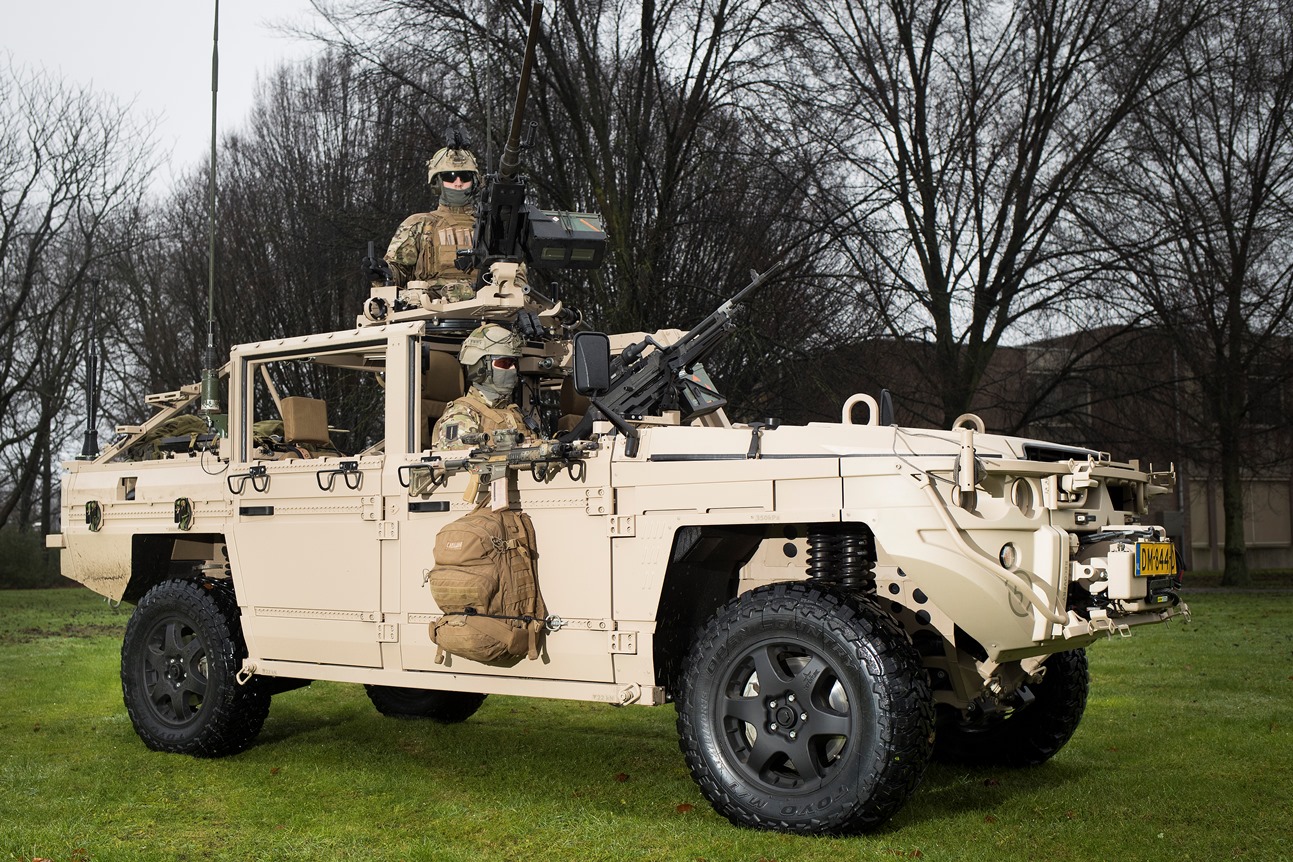
View on WikipediaThe VECTOR (Versatile Expeditionary Commando Tactial Off Road) is a Dutch light all-terrain tactical vehicle, designed and developed by defence contractor Defenture for use with special operations forces.[2] The VECTOR was developed in close cooperation with the Korps Commandotroepen (KCT) of the Royal Netherlands Army and is tailor-made for use in special operations, providing a combination of high mobility and firepower with light armour.
Key Information


Development
[edit]In 2013, the Dutch Ministry of Defence launched a procurement program aimed at replacing the Mercedes-Benz G280 CDI fleet of the KCT.[citation needed] While experiences with the Mercedes-Benz vehicles in Afghanistan and Mali were generally satisfactory, the vehicles lacked power, payload capacity and clearance deemed necessary for the SOF Mobility Concept. In addition to the engine and payload requirements, the replacement vehicles should be transportable in and under the CH-47 Chinook transport helicopters of the Royal Netherlands Air Force. Dutch entrepreneur Gerard Rond, who had extensive experience in the rallying branch, created the consortium Defenture which incorporated (among others) VDL Groep and TenCate. The consortium developed the Groundforce (GRF) platform which became the basis of the VECTOR vehicle. Consequently, Defenture submitted the bid and on 3 July 2013 it was announced that Defenture won the tender for a total of 50 vehicles with their VECTOR offer. Other bids included the General Dynamics Flyer.[3]
The research and development phase continued after the contract was awarded and involved close cooperation with the Defence Materiel Organisation (DMO) and the end-users. In 2014, the KCT received the first two prototypes which were subsequently subject to an extensive set of trials. Deliveries of serial production vehicles commenced in December 2017 at the production facilities located in Tiel.[4] In June 2018, the Ministry of Defence announced that Defenture was awarded the contract for an additional 25 vehicles, the complete order therefore amounting to 75 vehicles. Deliveries were completed in July 2020.[citation needed]
Description
[edit]
Drivetrain
[edit]The VECTOR is powered by a 3,200 cc Steyr six-cylinder diesel engine, which produces 220 hp (160 kW) and 500 Nm of torque. The maximum speed is limited at 130 km/h, the 115 L fuel tank gives the VECTOR an operational range of 800 km The Steyr engine is linked to a ZF six-speed automatic transmission. The permanent four-wheel drive with three differentials, the optional four-wheel steering allows for a turning radius of 9 metres. The maximum payload capacity of the VECTOR is 1,440 kg, the curb weight is 3070 kg with a maximum vehicle weight of 4,700 kg. The VECTOR can wade through 75 cm of water.
Cockpit
[edit]The driver and passenger seat are adjustable to the needs of the occupants and are fitted with detachable back support modules, the rear seats are foldable. The VECTOR is equipped with a digital dashboard which displays the status of all critical systems.
Weaponry
[edit]The VECTOR comes standard with two weapon mounts. The passenger has access to a swing mount which can be fitted with a FN MAG general-purpose machine gun or a FN Minimi squad automatic weapon. The height of the passenger seat is adjustable in order to enable optimal ergonomics for the shooter. The ring mount is fitted in the centre of the vehicle and can be equipped with a Browning M2 heavy machine gun or a HK GMG automatic grenade launcher. In addition, the VECTOR is equipped with 10 smoke grenade dischargers: five on the front and five on the rear of the vehicle.
Communications
[edit]The VECTOR can be equipped with a range of communication systems and comes standard with several connectivity options for antennas. Moreover, the vehicle can be fitted with counter-IED equipment and signals jammers.
Equipment
[edit]The VECTOR is fitted with blackout lighting and infrared lighting for tactical situations that require the usage of night-vision goggles.
The rear and sides of the vehicle are fitted with external weapon mounts for personal weapons, such as the HK416, and short-range anti-tank weapons, such as the M72 LAW and AT4. The VECTOR is equipped with run-flat tires which allow the vehicle to continue to be driven, at reduced speeds and for limited distances, after punctures. In addition, the vehicle is fitted with an electric winch which can be mounted on the front or rear bumper for recovery purposes. The VECTOR can be optionally fitted with four hydraulically powered extendable pods which can lift the rear, front or both axles. This feature allows for rapid and convenient tire changes, and quick recovery.
Protection
[edit]The standard variant only has limited ballistic protection in the bulkhead, the front and rear doors and the tailgate. The ballistic protection can be expanded with a 'low' ballistic package, which includes four ballistic panels for the doors and behind the rear seats. The 'high' ballistic package consist of bulletproof windows and a mine protection package.
The ballistic packages are compliant with STANAG 4569 Level 1 and provides protection from 5.56×45mm NATO and 7.62 mm caliber munitions fired from a distance of 30 metres. Moreover, Level 1 provides protection from 155 mm High Explosive (HE) at 100 metres, hand grenades, unexploded artillery fragmenting submunitions and small anti-personnel explosive devices.
Transport
[edit]The vehicle can be transported as underslung as well as internal load with the CH-47 Chinook transport helicopter. To enable the vehicle to be transported inside the CH-47, the central ring mount can be collapsed through the use of several hinges while the weapon does not have to be dismounted. Additionally, the VECTOR can be transported in a 20-foot container.
-
 Front view
 -
 Side view
 -
 Rear view


Operators
[edit]Current operators
[edit] Austrian Armed Forces (unknown quantity)
- Selected in April 2024 to replace the PUCH G 290/LP "Sandviper", purchased as the new light tactical and air-loadable mobile platform for the Jagdkommando. The first deliveries are planned for 2024.[5]
- As of June 2025, it is known that some vehicles are in service.[6]

 German Armed Forces (80)
- In June 2021 the Bundestag approved the budget for the development of a new special operations vehicle family based on Defenture's GRF platform, intended to replace the Aufklärungs- und Gefechtsfahrzeug (AGF) Serval of the Kommando Spezialkräfte. Budgets for an initial 49 vehicles have been approved, the total program requirements amount to 80 vehicles. Defenture will supply the Bundeswehr with four prototypes for trials and configuration optimisations. The initial order consists of 26 vehicles in the reconnaissance/combat variant (AGF 2), 8 fire support vehicles with the M621 20 mm automatic cannon by Nexter and 15 general support vehicles (UFK).[7]

 Netherlands Armed Forces (75 in service + 41 on order)
- The Korps Commandotroepen (KCT) of the Royal Netherlands Army operates 75 VECTOR vehicles. Deliveries commenced in 2017 and were completed in 2020. While the vehicles are administratively assigned to the KCT, the Netherlands Maritime Special Operations Forces have access to the vehicles when deemed necessary by the Netherlands Special Operations Command (NLD SOCOM).
- In October 2023, 41 were ordered for the 11 Luchtmobiele Brigade. [8]
Future operators
[edit] Lithanian Armed Forces (32)
- The GRA (Lithuanian Ministry of Defence's Armaments Procurement Agency) announced in January 2025 having purchased 32 GRF vehicles for an estimated value of €20 million (without VAT).[9]
 Polish Armed Forces (2 + option)
- The Polish special forces (Jednostka Wojskowa 2305) decided to acquire the Defenture GRF in September 2024. In November, Defenture was commissioned for 2 vehicles with an option for additional vehicles.[10][11][12]
 Swiss Armed Forces (1 prototype + unknown quantity ordered)
- In March 2021 it was announced that Armasuisse, the procurement agency of the Swiss Armed Forces, had received a Defenture demonstrator vehicle based on the GRF platform under the name LAUF 20. The LAUF 20 demonstrator vehicle will be utilised to determine the optimal configuration for a follow-up order of 20 vehicles. The LAUF 20 vehicles are intended to replace the dated Serval vehicles, designated Leichte Aufklärungs- und Unterstützungsfahrzeug (LAUF), that were acquired in 2007.[13][14] An order for further vehicles was confirmed in December 2023, for an unknown amount and quantity.[15][16] The supplier of the sub-systems include Comrod and General Dynamics, to be integrated by Defenture. The planned equipment is:[17]
- weapon systems
- a communication suit
- optical systems, including a mast


See also
[edit]References
[edit]- ^ "GROUNDFORCE – 5.12". defenture.com. Defenture. Retrieved 10 July 2021.
- ^ "Vector-terreinwagen (SOF)". defensie.nl. Ministry of Defence. Archived from the original on 4 July 2019. Retrieved 10 July 2021.
- ^ Westerhoven, Leo van (2014-12-08). "De VECTOR: het ultieme Special Operation Forces-voertuig die de commando's altijd al hadden willen hebben". Dutch Defence Press (in Dutch). Retrieved 2020-07-01.
- ^ "Eerste SF-voertuig VECTOR voor commando's". defensie.nl. Ministry of Defence. 21 December 2017. Archived from the original on 2018-03-09. Retrieved 10 July 2021.
- ^ "Österreichische Sondereinsatzkräfte erhalten Groundforce Fahrzeuge". soldat-und-technik.de (in German). 2024-04-10. Retrieved 2024-04-18.
- ^ Rosenkranz, Martin (2025-06-09). "Defenture - das neue „Rallyeauto" des Jagdkommandos". militaeraktuell.at (in German). Retrieved 2025-06-10.
- ^ Geiger, Waldemar (23 June 2021). "Bundestag billigt Haushaltsmittel für neue Spezialkräfte-Fahrzeugfamilie". Soldat & Technik. Retrieved 10 July 2021.
- ^ Oosbree, Gerard van (2023-10-16). "Defenture GRF voor 11 Luchtmobiele Brigade". Dutch Defence Press (in Dutch). Retrieved 2024-02-07.
- ^ "Litauische Spezialkräfte beschaffen GRF-Plattform von Defenture" (in German). 2025-04-02. Retrieved 2025-04-03.
- ^ "GROM – polnische Spezialkräfte beschaffen GRF von Denfenture" (in German). 2024-11-06. Retrieved 2024-11-06.
- ^ Peter Felstead (15 November 2024). "Polish armed forces place order for Defenture GRF vehicles". European Security & Defence.
- ^ "Defenture and Polish Defence Force sign contract for delivery of GRF platform". EDR Online. 7 November 2024.
- ^ van Osbree, Gerard (1 March 2021). "LAUF 20 – Defenture levert prototype aan Zwitserland". Dutch Defence Press. Retrieved 10 July 2021.
- ^ Heiming, Gerhard (2 March 2021). "Mobilität für Spezialkräfte: Prototyp LAUF 20 an die Schweiz geliefert". Soldat & Technik. Retrieved 10 July 2021.
- ^ "Defenture to deliver GRF Groundforce 4x4x4 vehicles to Swiss Army". Army Recognition. 19 December 2023.
- ^ admin (2023-12-19). "Defenture Signs Contract With Armasuisse For Delivery Of GRF Lightweight Tactical Vehicle - MilitaryLeak.COM". militaryleak.com. Retrieved 2023-12-26.
- ^ "Defenture signs contract with armasuisse for delivery of GRF". Defenture. 2023-12-19. Retrieved 2024-05-02.

Further reading
[edit]- Leo de Rooij (20 February 2018). "Vette Vector". Materieelgezien (in Dutch). Defensie.nl.
VECTOR
View on GrokipediaDevelopment
Origins and Requirements
The VECTOR tactical vehicle originated from the need to modernize the fleet of the Korps Commandotroepen (KCT), the special operations forces of the Royal Netherlands Army, by replacing the outdated Mercedes-Benz G280 CDI vehicles that had proven inadequate for evolving mission demands. These older vehicles, with their limited payload and mobility constraints, no longer fully supported the KCT's requirements for rapid deployment and versatile operations in challenging environments. The Dutch Ministry of Defence initiated a procurement program in 2013 to address these shortcomings, seeking a next-generation light tactical platform tailored to special forces needs.[4][2][5] In July 2013, Defenture, a Dutch defense contractor, was awarded the development contract by the Defence Materiel Organisation for an initial batch of 50 vehicles, marking the inception of the VECTOR project. This award followed a competitive tender process where Defenture's proposal stood out for its innovative approach to meeting KCT specifications. The contract emphasized rapid prototyping and close collaboration between Defenture, the KCT, and the Ministry of Defence to ensure the vehicle aligned with operational priorities.[6][4][5] Key requirements shaped by the Royal Netherlands Army focused on creating a light all-terrain tactical vehicle optimized for special operations, featuring a 4x4 configuration for enhanced off-road capability and a payload capacity of up to 1,440 kg to accommodate personnel, equipment, and supplies. Emphasis was placed on modularity to allow rapid reconfiguration for diverse missions, such as reconnaissance or logistics support, while ensuring superior mobility across varied terrains including urban, desert, and forested areas. Integration with SOF missions was paramount, requiring air-transportability by assets like the CH-47 Chinook helicopter and compatibility with advanced communication systems for seamless joint operations. The Army's involvement in defining these specs ensured the VECTOR would enhance force projection and survivability in high-threat environments.[2][4][5]Prototyping and Testing
The initial prototypes of the VECTOR vehicle were delivered to the Dutch Korps Commandotroepen (KCT) in 2014 for initial evaluation, following a rapid development phase that began in 2013 with the completion of the first prototype in just eight months.[5][7] These prototypes underwent virtual engineering to ensure compatibility with Chinook helicopter transport parameters, emphasizing lightweight design for special operations forces (SOF) requirements.[5] Testing phases encompassed a comprehensive evaluation protocol overseen by the Dutch Ministry of Defence's procurement agency, Defensie Materieel Organisatie (DMO), including mobility trials across diverse terrains such as off-road tracks simulating KCT driver training in Tiel, Netherlands, and extreme climates from arctic to desert conditions.[5][7] Integration testing focused on the vehicle's modular 4x4 platform, verifying the compatibility of cassette-based armor systems and payload configurations up to 1.4 tonnes, while SOF-specific evaluations by Dutch and Swiss special forces assessed rapid deployment capabilities, including air transportability and operational handling.[7] These trials highlighted the VECTOR's 4-wheel steering for enhanced maneuverability and a top speed of 170 km/h with 500 Nm torque, prioritizing agility over heavy protection.[5] Key refinements emerged iteratively during testing, with adjustments to the chassis improving off-road performance through purpose-built components and off-the-shelf integrations for stability and speed.[7][5] Protection options were initially integrated to meet STANAG 4569 Level 1 standards via an optional 662 kg armor package, including ProTEK seats, balancing ballistic and mine resistance with the vehicle's core mobility focus.[5][8] The testing timeline progressed from prototype delivery and public unveiling in June 2014 at the European Land Robot Trial, through iterative DMO evaluations spanning 2014–2016, to operational validation in Mali under the MINUSMA mission as a final milestone, culminating in production approval and serial manufacturing commencement in 2017.[5][9]Production Contracts
Following the successful prototyping and testing phases, the initial 2013 contract for 50 VECTOR vehicles was increased in mid-2018, leading to a production order for a total of 75 units primarily for the Korps Commandotroepen (KCT). Deliveries of these units began in 2017 and were fully completed by July 2020.[10][2][11] Defenture, a specialist Dutch defence manufacturer headquartered in Tiel, Netherlands, handled the full production at its dedicated facility, which supports assembly, integration, and quality control for light tactical vehicles.[12] The procurement process emphasized domestic industry capabilities, with Defenture selected for its proven expertise in air-transportable platforms developed in close collaboration with Dutch special forces.[11] In December 2022, the Defence Materiel Organization (now COMMIT) awarded Defenture a follow-on contract for 41 additional VECTOR vehicles to expand equipping for both the KCT and the 11 Luchtmobiele Brigade, addressing growing operational needs.[2] Initial deliveries under this agreement commenced in autumn 2023, with the full batch completed by mid-2024, procured through a framework that allows for potential future expansions.[4][2] Post-2020, Defenture initiated international export contracts for the VECTOR/GRF platform, including a December 2023 agreement with Switzerland's Armasuisse for delivery of vehicles starting in 2024, marking the first overseas procurement.[12] Additional exports followed, such as an order for Austria's Jagdkommando special forces announced in April 2024, with deliveries commencing that year.[13] In 2025, Defenture signed a multi-year contract with Poland's Defence Force for delivery of GRF platforms, further expanding the vehicle's international adoption.[14] These contracts highlight the platform's growing global appeal for special operations mobility.Design and Features
Chassis and Mobility
The VECTOR features a robust 4x4 all-wheel-drive chassis designed as a high-mobility platform, utilizing a central spine tubular structure that enables rapid reconfiguration for various mission profiles while maintaining structural integrity under demanding conditions.[2][6] This design prioritizes expeditionary operations for special forces, allowing transport via helicopter such as the CH-47 Chinook, with dimensions of 5,100 mm in length, 1,800 mm in width, and 2,205 mm in height to facilitate internal loading and underslung carriage.[15] The curb weight stands at 3,070 kg, balancing payload capacity with air transportability requirements.[16] The vehicle's independent suspension system on all four wheels enhances off-road traversal by providing equal articulation and stability across uneven terrain, contributing to its classification as a light tactical all-terrain vehicle optimized for commando units.[15] The vehicle features optional four-wheel steering, enabling extreme maneuverability, small turning circles, and speedy action in tight spaces.[15] This setup supports water fording depths up to 0.75 m (extendable to 0.86 m) without preparation, enabling operations in varied environmental conditions.[17] Ground clearance measures 340 mm when unloaded, complemented by approach and departure angles of 46.5° and 43.5°, respectively, which allow the VECTOR to navigate steep inclines, obstacles, and rough landscapes typical of special operations scenarios.[15][18] These mobility attributes integrate seamlessly with the drivetrain for overall expeditionary effectiveness, ensuring the chassis supports high-speed off-road maneuvers without compromising transportability.[19]Drivetrain and Performance
The VECTOR employs a 3.2-liter Steyr six-cylinder diesel engine, a multi-fuel unit capable of operating on various military diesel specifications such as F-34, F-35, F-44, F-54, and F-63. This engine produces 220 horsepower (160 kW) at maximum output and delivers 500 Nm of torque, providing robust low-end power for demanding operational environments.[15][2] The powerplant connects to an eight-speed automatic transmission within a permanent 4x4 drivetrain configuration, featuring a transfer case with high/low range selection and lockable differentials. These elements allow for selectable drive modes that adapt torque distribution to specific terrains, such as engaging low-range for steep inclines or locking differentials for loose surfaces, thereby maintaining traction and control in high-mobility scenarios.[15][5] Performance metrics underscore the VECTOR's emphasis on versatility and endurance, with a top speed of 130 km/h electronically limited to balance speed and vehicle stability. The 115-liter fuel tank enables an operational range of 800 km on standard fuel, reflecting efficient combustion and torque management that supports prolonged missions without frequent refueling. This setup ensures consistent power delivery, particularly in off-road conditions where torque vectoring enhances maneuverability.[2][4][15]Crew Compartment
The crew compartment of the VECTOR light tactical vehicle is configured to seat up to six personnel in a modular layout optimized for special operations forces, featuring two forward-facing seats for the driver and commander alongside four rear seats for troops or passengers. This design supports flexible mission roles, with the rear seating suspended from the sides rather than the floor to enhance space utilization and accessibility.[20][2] Ergonomic considerations prioritize operator efficiency and comfort during high-mobility SOF missions, including adjustable seats with four-point harnesses and removable back padding to accommodate body armor and battle belts without compromising fit. Visibility enhancements, such as large transparent windows and optional roof hatches, provide comprehensive situational awareness for the crew. Quick-access controls are integrated via a rally-car-style dashboard equipped with electronic screens, enabling intuitive operation of vehicle systems.[20][5][2] Access to the compartment is streamlined for rapid deployment, with forward-opening doors at the front for the driver and commander, and two rear doors facilitating quick entry and exit for the troop section. This arrangement supports fast embarkation and disembarkation in dynamic operational environments.[20] Environmental controls maintain habitability for extended operations, including standard air conditioning and operability across a temperature range of -32°C to +49°C, ensuring crew performance in diverse climates. The compartment briefly ties into communications electronics for coordinated mission execution.[20][17][2]Armament Systems
The VECTOR's armament systems emphasize modularity and rapid reconfiguration to support special operations missions, allowing crew members to engage threats from protected positions. Primary armament options include the Heckler & Koch GMG 40 mm automatic grenade launcher or the M2 Browning .50 caliber heavy machine gun, which provide suppressive fire capabilities against infantry and light vehicles.[2][11] These weapons are mounted on a foldable ring carriage positioned centrally over the crew compartment, enabling 360-degree traversal and elevation adjustments for versatile targeting while maintaining the vehicle's low profile for air transport.[2][6] Secondary armament consists of the FN Minimi 5.56 mm light machine gun or the FN MAG 7.62 mm general-purpose machine gun, offering sustained fire support for close-range engagements.[2][11] These are typically installed on pintle or swing mounts at the front or rear, facilitating quick positioning by the commander or passengers and allowing for 360-degree coverage without exposing the crew.[11][6] The vehicle's chassis integrates modular Picatinny rails and attachment points along the roll bars and body, enabling swift weapon swaps and integration of ancillary equipment like smoke grenade launchers for tactical obscuration.[2][6] Ammunition storage is accommodated within the VECTOR's 1,440 kg payload capacity, utilizing dedicated internal boxes and secure compartments to carry sufficient rounds for the primary and secondary weapons during prolonged patrols.[2][6] Firing controls are ergonomically integrated into the crew stations, with the co-driver able to operate the secondary machine gun via a height-adjustable seat and manual triggers, ensuring effective engagement without dismounting.[2] The primary ring-mounted weapon is similarly controlled from within the compartment, promoting survivability by minimizing exposure to incoming fire.[11]Protection and Survivability
The VECTOR incorporates optional modular ballistic armor packages that provide protection up to STANAG 4569 Level 1, defending against 7.62×51 mm NATO ball rounds at 30 meters from all directions.[6][8] This lightweight composite armor, supplied by partners such as TenCate Advanced Armour, can be rapidly installed or removed to balance protection with the vehicle's emphasis on mobility and payload capacity for special operations missions.[6] To counter mine and improvised explosive device (IED) threats, the VECTOR supports optional anti-mine kits that achieve STANAG 4569 Level 1 protection through reinforced underbody plating designed to deflect and dissipate blast energy.[8] Complementing this, the crew compartment features ProTEK shock-absorbing seats with four-point harnesses, which mitigate the impact of explosions by reducing transmitted forces to occupants during blast events.[5] These elements enhance overall survivability in asymmetric environments without significantly compromising the vehicle's low ground pressure or air-transportability. Mobility after damage is maintained via run-flat tire systems, where 18-inch aluminum rims incorporate solid rubber rings as an emergency running element, allowing the vehicle to continue operations for up to 50 km at reduced speeds following tire compromise.[2] Additionally, the fuel system includes self-sealing tanks to prevent leakage from ballistic impacts, further supporting post-hit operational continuity.[2] For special operations forces roles, the VECTOR emphasizes low observability through its compact, low-profile chassis design and compatibility with multi-spectral camouflage nets and paints that reduce visual, infrared, and radar signatures.[8] Integrated smoke grenade launchers at the front and rear provide on-demand obscuration to mask movement during tactical maneuvers, contributing to the vehicle's signature management strategy.[2]Communications and Electronics
The VECTOR's communications and electronics systems are engineered for robust command and control in special operations environments, emphasizing reliability and interoperability. Central to these capabilities is the integration of C4ISR (Command, Control, Communications, Computers, Intelligence, Surveillance, and Reconnaissance) frameworks, which support secure data exchange and situational awareness while adhering to NATO STANAG standards for compatibility across allied forces.[21] Secure radio systems facilitate SOF interoperability, enabling short-range voice and data communications over long distances with NATO-compatible features to ensure seamless coordination in multinational operations.[2][21] The vehicle includes dedicated connections for signal jammers, enhancing electronic warfare resilience against adversarial interference.[2] Navigation relies on integrated GPS/INS systems with anti-jam features, providing precise positioning and dead-reckoning in GPS-denied scenarios to maintain operational tempo.[21] Vehicle electronics feature a central control unit that handles diagnostics, system monitoring, and power management through separated IP67-rated 24V circuits compliant with STANAG 2601, alongside a 12V auxiliary installation for ancillary functions.[2] These systems are electromagnetic compatibility (EMC) proven per STANAG 4370, minimizing interference risks.[17] Integration points for night vision and targeting optics are embedded within the optronics suite, allowing crew access via the electronic dashboard for real-time monitoring and enhanced visibility in low-light conditions.[21][5]Payload and Modular Equipment
The VECTOR possesses a payload capacity of 1,440 kg, allowing it to accommodate personnel, supplies, weapons, ammunition, or other mission-essential gear to support extended operations. This capacity supports configurations for up to five occupants plus equipment, balancing load distribution to maintain vehicle performance across varied terrains.[15] The vehicle's modular design incorporates versatile mounting systems, enabling rapid integration of mission-adaptable equipment such as medical kits for MEDEVAC roles, sensors for reconnaissance tasks, or cargo racks for logistics support. These mounting points adhere to NATO-compatible standards, facilitating quick customization without permanent modifications to the chassis. Representative examples include a front-mounted Ramsey winch for self-recovery and vehicle extraction, comprehensive tool kits for on-site maintenance, and deployable expeditionary shelters that enhance field sustainment capabilities.[15][5] In its transport role, the VECTOR is optimized for rapid deployment, being fully air-transportable either internally within a Boeing CH-47 Chinook helicopter or as an underslung load beneath it, which ensures compatibility with air assault operations. This feature, combined with its lightweight construction, allows for efficient aerial insertion into remote areas while preserving the full payload potential upon landing.[2][17]Variants and Upgrades
Base Model
The base model of the VECTOR is a 4x4 utility variant designed as a light tactical vehicle for special operations forces (SOF), featuring basic ballistic and mine protection armor, a Steyr 3.2-liter six-cylinder multi-fuel diesel engine, and a pintle-mounted general-purpose machine gun (GPMG) for self-defense.[2][22][23] It accommodates a default crew of 2 to 4 operators, including a driver and passengers, enabling flexible configurations for reconnaissance, patrol, or rapid insertion missions in austere environments.[22][5] This configuration serves as the production baseline for the initial 75 units procured by the Dutch Ministry of Defense, primarily for the Korps Commandotroepen.[24]| Specification | Details |
|---|---|
| Mass (curb weight) | 3,050 kg[22] |
| Dimensions (L × W × H) | 5,100 mm × 1,800 mm × 1,870 mm (without turret)[5][15] |
| Engine | Steyr 3.2L six-cylinder diesel, 160 kW (220 hp), 500 Nm torque[2] |
| Maximum speed | 130 km/h (road), 95 km/h (off-road)[2] |
| Operational range | 800 km[2] |
Specialized Configurations
The VECTOR platform supports a range of specialized configurations tailored to mission-specific requirements, particularly for special operations and export markets, leveraging its modular design for rapid adaptations in payload, protection, and mobility. These variants build on the core air-transportable chassis while incorporating user-specific enhancements to address unique operational environments. For special operations forces, the VECTOR is configured with options for reconnaissance, assault, and medical evacuation roles, including modular integrations for weapons systems and sensors that enable low-signature operations. The Dutch Korps Commandotroepen (KCT) employs these SOF-optimized variants, which feature a multi-fuel diesel engine supporting extended operational range of up to 800 km on a 115-liter tank, facilitating prolonged missions in austere terrains.[15][2] Export configurations include adaptations for national requirements, such as the German Bundeswehr's MAMMOTH variant, an upscaled evolution of the GRF platform with a gross vehicle weight of 8,800 kg and payload capacity of 3,500 kg. Designed for the Kommando Spezialkräfte (KSK), the MAMMOTH incorporates modular ballistic and mine-blast protection to provide enhanced survivability in high-threat scenarios, while maintaining off-road mobility and air-transportability. In April 2024, the first four MAMMOTH (designated AGF 2) reconnaissance vehicles were delivered to the German special forces.[25][19][26] In January 2025, Lithuania ordered 32 VECTOR (GRF) vehicles as a light utility platform for its Special Operations Forces, with deliveries supporting integration into special operations and general mobility roles suited to regional conditions.[27] In April 2024, Austria ordered a batch of GRF patrol vehicles for its Jagdkommando special operations forces, with deliveries starting in 2024 in cooperation with local partner Achleitner.[13] In November 2024, Poland signed a multi-year contract with Defenture for the delivery of GRF platforms to its GROM special operations unit.[28] The Swiss Armed Forces evaluated a prototype designated LAUF 20, based on the GRF chassis, through extensive testing starting in 2021; this led to a production contract with Armasuisse for light reconnaissance vehicles equipped for special forces use, signed in December 2023.[27][29][30] Post-2020 developments include follow-on production series for existing operators, such as the 2022 contract for 41 additional units to the Dutch 11 Air Mobile Brigade, featuring improved electronics integration for command and control systems to enhance interoperability in joint operations. These configurations prioritize modular upgrades over full retrofits, allowing for scalable enhancements in communications and sensor suites without compromising the vehicle's lightweight profile.[31][32]Operational History
Initial Deployments
The VECTOR entered service with the Royal Netherlands Army's Korps Commandotroepen (KCT) in 2017, with initial deliveries commencing that year to support training exercises. The first batch of vehicles was officially handed over on December 21, 2017, marking the start of their integration into special forces operations.[22] These early units replaced older Mercedes-Benz G-Class vehicles and were used primarily for familiarization and capability demonstrations within the KCT.[11] Initial missions focused on non-combat patrols and expeditionary support during training scenarios, allowing operators to test the vehicle's off-road mobility and payload capacity in controlled environments. Drivers underwent specialized training at Defenture's facilities and through military instructors, emphasizing air-transport compatibility with CH-47 Chinook helicopters and modular configurations.[5] The vehicle's design features, such as its 1,440 kg payload for supplies and 800 km range, proved effective for these scenarios, enabling extended field exercises without logistical strain.[2] Integration into service presented logistical challenges, particularly in establishing maintenance protocols and a dedicated supply chain for the new platform, which relied on commercial off-the-shelf components for commonality with existing wheels and field repairs. Collaboration between Defenture and the Dutch Defence Materiel Organisation addressed these through rapid prototyping and concept development, completing the transition from design to operational use in under a year for initial prototypes.[5][6] By July 2020, deliveries of the full order of 75 units to the KCT were completed, achieving full operational capability and enabling comprehensive deployment readiness for special operations.[2] This timeline reflected an expanded contract from an initial 50 vehicles ordered in 2013, with additional units added by mid-2018 to meet evolving requirements.[11]Combat and Training Use
The VECTOR vehicle, introduced to Dutch special operations forces in 2017, has been utilized primarily in training scenarios and operational missions tailored to the demands of special forces activities. It supports roles in special operations simulations, enabling rapid mobility and reconfiguration for tasks such as reconnaissance and troop transport in contested environments. Since 2020, VECTOR-equipped units from the Korps Commandotroepen have participated in joint NATO exercises, including those focused on interoperability and high-intensity operations, such as deployments in northern Norway under exercises like Cold Response. These training activities emphasize the vehicle's ability to operate in extreme conditions, from arctic terrains to desert environments, enhancing allied coordination in multinational settings.[19][2] In terms of combat exposure, the VECTOR has seen limited but documented operational use in counter-terrorism missions, with deployments to hostile areas including the Mali desert as part of Dutch contributions to international stability operations. Details remain classified due to the sensitive nature of special forces activities, but the vehicle has been described as operationally proven in frontline scenarios, providing long-range support for special operations in enemy territory. No public records indicate widespread combat engagements, reflecting its role as a specialized, low-signature asset rather than a frontline combat platform.[19] No major incidents or accidents involving the VECTOR have been publicly reported between 2022 and 2024, underscoring its design for reliability in demanding conditions. Field feedback from initial deployments has informed subsequent procurements, such as the 2022 order for 41 additional vehicles to the 11 Air Mobile Brigade, with deliveries commencing in October 2023 and expected completion by mid-2024.[32] Performance evaluations highlight the vehicle's robustness, with an operational temperature range of -32°C to +49°C (optionally down to -40°C) and a range of 800 km, demonstrating high uptime in extreme environments without specific failure rates disclosed. These attributes have contributed to its adoption in varied operational theaters, prioritizing mission endurance over conventional battlefield metrics.[19][2][32]Operators
Current Operators
The Netherlands operates the largest fleet of VECTOR vehicles, with 75 units in service with the Korps Commandotroepen (KCT) of the Royal Netherlands Army since July 2020, primarily serving as transport for special operations forces (SOF). An additional 41 vehicles were delivered to the 11 Luchtmobiele Brigade (11 LMB) starting in October 2023, enhancing patrol and support capabilities for airborne operations.[2] Austria's Jagdkommando special operations forces introduced VECTOR (GRF variant) vehicles into service following a contract signed in April 2024, replacing older PUCH G 290/LP Sandviper platforms for improved mobility in tactical roles; the exact quantity remains unspecified but deliveries commenced in 2024.[33] Switzerland's armed forces maintain a limited fleet under the LAUF20 program, including at least one prototype delivered in 2021 and additional units ordered via a December 2023 contract with manufacturer Defenture, focused on light tactical support for special forces, with deliveries pending as of 2025.[2] Poland received initial VECTOR deliveries in early 2025 for evaluation by the Jednostka Wojskowa GROM special forces unit, with at least two units confirmed operational by mid-2025 during multinational exercises such as BALTOPS 25. In November 2024, a multi-year contract was signed for further GRF platforms.[34]| Country | Quantity | Branch | Entry into Service |
|---|---|---|---|
| Netherlands | 75 (KCT) + 41 (11 LMB) | Royal Netherlands Army (KCT, 11 LMB) | 2020 (KCT); 2023 (11 LMB) |
| Austria | Unspecified | Austrian Armed Forces (Jagdkommando) | 2024 |
| Switzerland | Limited (≥1 prototype + follow-on) | Swiss Army (LAUF20 program) | 2021 (prototype); post-2023 (additional, pending) |
| Poland | 2 (evaluation) | Polish Armed Forces (GROM) | 2025 |