Hubbry Logo
Welsh NotWelsh NotMain
Open search
Welsh Not
Community hub
Welsh Not
logo
8 pages, 0 posts
0 subscribers
Be the first to start a discussion here.
Welsh Not
Welsh Not
from Wikipedia

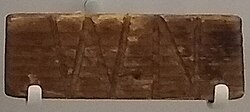
A Welsh Not from 1852 on display at St Fagans National Museum of History[a]

The Welsh Not was a token used by teachers at some schools in Wales, mainly in the 19th century, to discourage children from speaking Welsh at school, by marking out those who were heard speaking the language. It could be followed by an additional punishment; sometimes a physical punishment. There is evidence of the Welsh Not's use from the end of 18th to the start of the 20th century, but it was most common in the early- to mid- 19th century.

The token was seen as a teaching aid to help children learn English. Over time, however, excluding Welsh began to be viewed as an ineffective way of teaching English and by the end of the 19th century schools were encouraged to use some Welsh in lessons. There was a widespread desire for children to learn English among Welsh people in the 19th century and the Welsh Not was not part of any government policy.

Accounts suggest that its form and the nature of its use could vary from place to place, but the most common form was a piece of wood suspended on a string that was put around the child's neck. Terms used historically include Welsh not, Welsh note, Welsh lump, Welsh stick, cwstom, Welsh Mark, and Welsh Ticket. The token remains prominent in Welsh collective memory.

Overview

[edit]
Recreation of an old school classroom at the West Wales Museum of Childhood, Llangeler, with a Welsh Not, threaded on white string, on the right-hand side of the desk

During the 19th century the primary function of day schools in Wales was the teaching of English.[2]: 437  The teaching of English in Welsh schools was generally supported by the Welsh public and parents who saw it as the language of economic advancement.[2]: 453, 457 Some schools practised what is now commonly called total immersion language teaching[2]: 438  and banned the use of Welsh in the school and playground to force children to use and become proficient in English. Some of these schools punished children caught speaking Welsh with the Welsh Not.[3]

The Welsh Not came in several forms and with different names (Welsh not,[4] Welsh note,[5] Welsh lump,[6] Welsh stick, Welsh lead, cwstom,[7] Welsh Mark,[8]: 24  Welsh Ticket[8]: 24 ) and was used in different ways. It was a token typically made of wood often inscribed with the letters 'WN' which might be worn around the neck.[7] Typically, following the start of some prescribed period of time, a lesson, the school day or the school week, it was given to the first child heard speaking Welsh[9] and would then be successively passed on to the next child heard speaking it. At the end of the period, the child with the token or all children who had held the token, might be punished. The nature of that punishment varies from one account to another; it might have been detention, the writing out of lines, or corporal punishment.[9][10][11][12]: 94 [13]

Martin Johnes, a historian who has studied the Welsh Not, comments that it was viewed as a "mode of instruction"; forcing children to practise English.[14] Similar approaches to teaching languages were used around Western Europe.[15] The method also encouraged children to participate in enforcing discipline by listening for peers speaking Welsh and was a way to keep solely Welsh-speaking children quiet; enforcing silence was considered important for managing a school.[16] The Welsh Not was not a government policy.[17] Some of the local committees and School Boards that administered non-private schools instructed teachers to refrain from using Welsh but most did not.[18] The Welsh Not was a practice introduced by individual teachers mostly on their own initiative.[19] Parents were generally supportive of physical punishment in schools[20] and appear to have been accepting of the Welsh Not.[21]

History

[edit]

"Among other injurious effects, this custom has been found to lead children to visit stealthily the houses of their school-fellows for the purpose of detecting those who speak Welsh to their parents, and transferring to them the punishment due to themselves."

Inquiry into the State of Education in Wales, 1847.[22]: 452 

Johnes wrote that the practice may have originated in early modern grammar schools which aimed to teach Latin.[23] The first evidence of practices resembling the Welsh Not dates from around the 1790s; for instance, Rev Richard Warner wrote about schools in Flintshire "to give the children a perfect knowledge of the English tongue ... [the teachers force] the children to converse in it ... if ... one of them be detected in speaking a Welsh word, he is immediately degraded with the Welsh lump".[24] Accounts of the Welsh Not most frequently relate to the early- to mid-19th century.[25] Johnes believes it was probably widespread but not universal in the first half of the 19th century. There are records of it being used almost everywhere in Wales; but it was less common in Monmouthshire and Glamorgan where English was more established.[26] Accounts of children being beaten for speaking Welsh became less common after 1850; the penalty was increasingly likely to be non-physical where the Welsh Not was still used.[27]

Efforts by teachers to prohibit the speaking of Welsh in schools became gradually less common in the late 19th century.[28] The punishments used where prohibitions were in force were increasingly likely to be non-physical and less embarrassing for the children (e.g additional schoolwork).[29] However, some corporal punishment for speaking Welsh at school did continue.[30] Prohibitions on Welsh were most common in rural, heavily Welsh-speaking areas where teaching English was difficult.[31] Some use of the Welsh Not continued throughout the late-19th century.[32] In the late-19th century, the use and teaching of Welsh in schools began to receive moderate government support.[33] A few people, who grew up at the beginning of the 20th century, recalled in interviews that they saw or knew of the Welsh Not being used when they were children. However, there is no written evidence of the practice being used after 1900.[34]

Background

[edit]

The use of corporal punishment was legal in all schools in the United Kingdom until it was mostly outlawed in 1986;[35] flogging or caning was in widespread use in British schools throughout the 1800s and early 1900s.[36]

Under Henry VIII the Laws in Wales Acts 1535 and 1542 simplified the administration and the law in Wales. English law and norms of administration were to be used, replacing the complex mixture of regional Welsh laws and administration.[12]: 66  Public officials had to be able to speak English[12]: 66  and English was to be used in the law courts. These two language provisions probably made little difference[12]: 68  since English had already replaced French as the language of administration and law in Wales in the late 14th century.[37] In practice this meant that courts had to employ translators between Welsh and English.[38]: 587  The courts were 'very popular' with the working class possibly because they knew the jury would understand Welsh and the translation was only for the benefit of the lawyers and judges.[38]: 589  The use of English in the law courts inevitably resulted in significant inconvenience to those who could not speak English.[12]: 69  It would also have led to the realisation that to get anywhere in a society dominated by England and the English, the ability to speak English would be a key skill.[12]: 69 

Johnes writes that as the Act granted the Welsh equality with the English in law, that the result was "the language actually regained ground in Welsh towns and rural anglicised areas such as the lowlands of Gwent and Glamorgan" and that thus "Welsh remained the language of the land and the people".[12]: 69  Furthermore, Johnes writes that the religious turmoil at the time persuaded the state to support, rather than try to extinguish, the Welsh language.[12]: 69  In 1546, Brecon man John Prys had published the first Welsh-language book (Welsh: Yny lhyvyr hwnn, "In This Book"), a book containing prayers, which, as the Pope disapproved of it, endeared it to the Crown.[12]: 69  The result of the 1567 order by the Crown that a Welsh translation of the New Testament be used in every parish church in Wales (to ensure uniformity of worship in the kingdom) was that Welsh would remain the language of religion.[12]: 70  Davies says that as the (Tudor) government were to promote Welsh for worship, they had more sympathy for Welsh, than for Irish in Ireland, French in Calais, and than the government of Scotland had for Gaelic of the Highlands. The Tudors themselves were of partly Welsh origin.[39]: 235 

[Question] "as far as your experience goes, there is a general desire for education, and the parents are desirous that their children should learn the English language?" [Reply] "Beyond anything."

Anglican clergyman from Pembrokeshire giving evidence to the Inquiry for South Wales in 1843[40]

In the first half of the 19th century, the only areas of Wales where English was widely spoken were places close to the Anglo-Welsh border, the Gower Peninsula and southern Pembrokeshire. However, the language was becoming more widespread in the industrialising areas due to migration.[41] Welsh speakers were keen for their children to learn English; knowing the language was felt to be a route to social mobility, made life more convenient and was a status symbol.[42] Contemporaries often said that parents wanted schools to be conducted in English. For instance, the Rev Bowen Jones of Narberth told an inquiry following the Rebecca Riots that a school conducted in Welsh in his area was unsuccessful; while, in schools where "the schoolmaster has to teach them English, and to talk English in the school, there is no room in the school-room to admit all that come".[43] The upper- and middle-classes in Wales, who generally spoke English, were also eager for the masses to learn the language. They believed it would contribute to Wales's economic development and that tenants or employees who could speak English would be easier to manage.[44]

The three-part Reports of the Commissioners of Inquiry into the State of Education in Wales, often referred to as the "Treason of the Blue Books" in Wales, was a publication written by the commissioners for British government in 1847 which investigated the Welsh educational system. The work caused uproar in Wales, where many perceived it as disparaging the Welsh, with the publication being particularly scathing in its view of nonconformity, the Welsh language, and Welsh morality.[7]: 2  The report was critical of schools that tried to exclude Welsh, seeing it as an ineffective way of teaching English,[45] and described the Welsh Not negatively.[46] The inquiry did not lead to any governmental action and the hostile reaction was mainly aimed at the comments about Welsh morality.[12]: 96 

Reactions and impact

[edit]
Upset boy wearing a Welsh Not.
Y Welsh Note (The Welsh Note), engraving published in a Welsh language youth magazine Trysorfa y Plant (A children's treasury) (1879)[b]

Adults who experienced the Welsh Not as children recalled it with differing emotions, including anger,[47] indifference[48] and humour.[49] In the late 19th and early 20th centuries several accounts were published of this method of discipline, which described it as having been used at an unclear point in the relatively recent past.[50] Some writers in this period saw the Welsh Not as something imposed on Wales by England or the British government with the aim of destroying Welsh language; others disagreed, often seeing it as a result of Welsh people's desire to learn English.[51] The best-selling novel How Green Was My Valley (1939) by Richard Llewellyn includes an emotive description of the practice, which Johnes considers one of the most influential depictions of the punishment:[52]

"About her neck a piece of new cord, and from the cord, a board that hung to her shins and cut her as she walked. Chalked on the board … I must not speak Welsh in school … And the board dragged her down, for she was small, an infant, and the card rasped the flesh of her neck, and there were marks upon her shins where the edge of the board had cut. Loud she cried … and in her eyes the big tears of a child who is hurt, and has shame, and is frightened."

The punishment continues to be well known in Wales.[53] The Welsh Not has often been discussed in the media usually with an emphasis on its cruelty.[54] It has also featured in school teaching materials[55] and been linked to political debates.[56] It is sometimes incorrectly portrayed as a policy introduced by the British government.[57] According to the Encyclopaedia of Wales, "Welsh patriots view the Welsh Not(e) as an instrument of cultural genocide",[7] but "it was welcomed by some parents as a way of ensuring that their children made daily use of English".[7]

Government investigations in the mid-19th century indicated that excluding Welsh was not an effective way of teaching English,[58] some teachers made use of Welsh to help teach English in that period.[59] In the late 19th century, more Welsh began to be used informally in lessons to help facilitate the teaching of English. For instance, children might be given Welsh explanations of their English reading material or be given tasks translating between the two languages.[60] This frequently happened even at schools where children were punished for speaking Welsh.[61] A campaign developed for Welsh to be included in the curriculum.[62] Between 1889 and 1893, a series of changes were made to government policy: teachers in Welsh-speaking areas were now encouraged to teach English through Welsh, and schools could benefit financially from teaching Welsh as a subject.[63] The Welsh Department in the Board of Education encouraged the use of Welsh in lessons after its creation in 1907. Though teachers and parents in Welsh-speaking areas, whose priority was children learning English, often resisted this.[64]

In 2012, Chair of the Welsh Affairs Select Committee David T. C. Davies stated that the British government had not been responsible for suppressing the Welsh language in the 19th century, saying that the practice took place before government involvement in the education system began with the Education Act 1870, and that "the teachers who imposed the Welsh Not were Welsh and its imposition would have been done with the agreement of parents".[65]

The first academic study of the Welsh Not was completed by Martin Johnes in 2024.[66] He states that some government officials did want Welsh to cease to exist but the government never introduced policies to that end and believed that some use of Welsh was necessary in schools to effectively teach English.[67] He comments that the state had limited influence over the school system in the 19th century and it did not prohibit the use of Welsh in schools.[68] Johnes argued that there is little evidence to suggest that the Welsh Not caused the decline of Welsh. A large majority of children were not attending day school when it was most common and schools that attempted to completely exclude Welsh tended to be ineffective at teaching English.[69] He argued that;[70]

[The Welsh Not] was not a primary cause of linguistic change but the result of pedagogical misunderstandings and people’s desire for English. The first owed much to how underdeveloped education was, while the latter was rooted in Wales’s subordinate position within the United Kingdom. The Welsh Not was not imperialism in a direct sense, not least because the state never sanctioned it, but it was an example of how the Anglo-centricity of the United Kingdom produced cultural forces that had the similar effects to more overt imperialistic practices in the empire. The political, economic and cultural power of English was the direct cause of the decline of Welsh ... It was not beaten out of anyone.

Cultural interaction

[edit]

In 2024, the 1923 Welsh Women's Peace message was translated into the Okinawan language from the perspective of the similarities between the Okinawan dialect cards and the Welsh Not.[71] The Asahi Shimbun claimed that the reconstruction of the Okinawan language is similar to the reconstruction of the Welsh language.[72] Japanese musicians also created a short film, inspired by the similarities between the history of Okinawan dialect tags and the Welsh Not.[73]

In literature

[edit]
  • Myrddin ap Dafydd (2019). Under the Welsh Not, Llanrwst, Gwasg Carreg Gwalch ISBN 978-1845276836

See also

[edit]
  • Dialect card Hōgenfuda (方言札; "dialect card"), used to promote standard speech in Japanese schools.
  • Symbole, a similar object used in French schools as a means of punishment for students caught speaking regional dialects.

References

[edit]
[edit]
Revisions and contributorsEdit on WikipediaRead on Wikipedia
from Grokipedia
The Welsh Not was a wooden token deployed as a disciplinary measure in certain elementary schools in nineteenth-century to suppress the speaking of Welsh among pupils. Inscribed with "Welsh Not" or similar phrasing, the token was hung around the neck of a detected using Welsh and passed to any subsequent offender; the possessor at the end of the day faced penalties, frequently including such as . This practice emerged amid efforts to prioritize English in , reflecting broader anglicization pressures in a region where Welsh predominated in daily life but English was deemed essential for economic and social advancement. Historical records indicate the Welsh Not's use from the late eighteenth century into the early twentieth, though it peaked in prevalence during the early to mid-nineteenth century and was concentrated in specific locales such as , Cardiganshire, and prior to the 1870s. Evidence derives from school logbooks, teacher testimonies, pupil memoirs, and surviving artifacts, though documentation varies and some accounts suggest it was not uniformly applied across all institutions or enforced with equal rigor. Implemented at the discretion of individual teachers rather than as a centralized mandate, it complemented other sanctions like direct fines or physical discipline for infractions, aligning with the era's monitorial and rote-learning pedagogies imported from . While proponents viewed it as a pragmatic tool for linguistic assimilation—facilitating access to industrial employment and governance in an English-dominant —contemporaries and later observers decried it for fostering humiliation and resentment among Welsh-speaking children, potentially exacerbating cultural tensions. Its legacy endures as a emblem of educational , though scholarly assessments emphasize its localized nature over claims of systematic eradication, with usage waning alongside the 1870 Act's provisions for instruction and rising Welsh-medium advocacy.

Definition and Usage

Description of the Token

The Welsh Not was a rudimentary disciplinary device employed in certain Welsh schools, consisting primarily of a small wooden plaque or board inscribed with the phrase "Welsh Not," the initials "W.N.," or occasionally "Cymraeg" to denote the Welsh language. This token was fitted with a loop or cord allowing it to be hung around the neck of a pupil detected speaking Welsh, serving as a visible emblem of infraction and social stigma within the classroom. Physical examples preserved in museums, such as those displaying rough-hewn wooden slabs approximately 10-15 cm in length, confirm its simple, utilitarian construction without elaborate ornamentation. While the core design emphasized portability and durability for repeated use among students, variations in form and inscription reflected local practices rather than a mandate; some instances involved fragments or basic sticks, though predominated due to availability in rural settings. The token's inscription directly targeted the linguistic offense, reinforcing English-only norms by publicly marking the bearer as non-compliant until they transferred it to another child overheard speaking Welsh. No official blueprints or standardized specifications existed, as its implementation arose from informal schoolroom customs rather than governmental decree.

Operational Mechanism in Schools

The Welsh Not functioned as a punitive token in certain Welsh schools during the 19th and early 20th centuries, primarily to enforce English-only speech among pupils. Typically crafted from wood and inscribed with "WN" or "Welsh Not," the token was suspended by a cord and placed around the neck of any child detected speaking Welsh by the teacher or peers. The wearer bore the token as a visible mark of infraction, often enduring ridicule from classmates, until they identified another pupil committing the same offense. This passing mechanism relied on peer surveillance to propagate the , incentivizing children to monitor and report each other's use to evade prolonged wearing of the token. The transformed pupils into enforcers, fostering internal division to suppress Welsh conversation throughout the day. At the session's or day's end, the child retaining the token faced escalated discipline, commonly such as or , administered by the teacher. Variations in form existed, including slate pieces, sticks, or even belts, but the core token-transfer principle remained consistent across documented accounts from National Schools and similar institutions. While primary recollections, such as those from former pupils, detail this relay-like operation, some historical analyses question the uniformity and prevalence of the practice, suggesting embellishment in nationalist narratives. Nonetheless, the mechanism's design explicitly aimed to deter Welsh usage through , of , and deferred physical correction.

Historical Context

Educational Landscape in 19th-Century

In 19th-century , elementary education operated without a national state framework until the Elementary Education Act of , relying instead on voluntary efforts by religious organizations and philanthropists. Day schools, often fee-charging and limited in reach, included Anglican National Schools established under the National Society for Promoting the Education of the Poor in the Principles of the Established Church (founded 1811), which emphasized religious instruction alongside basic literacy and numeracy, and non-denominational British Schools supported by dissenting groups. Provision remained uneven, with rural areas underserved compared to industrializing regions where demand grew due to , though overall attendance was voluntary and irregular due to child labor. Sunday schools, affiliated with Nonconformist chapels, emerged as the dominant force in , offering free instruction primarily in Welsh and focusing on reading, , and moral training for all ages. By 1851, these schools supported high attendance, with approximately 80% of chapel worshippers participating in Nonconformist services bolstered by such . They utilized catechetical methods involving rote memorization and group questioning, fostering community-wide engagement despite work-related absences in industrial areas. This system contributed to achieving a literate majority by the mid-19th century, positioning it among Europe's most literate regions, where basic reading proficiency—often in Welsh—prevailed through religious texts. In contrast, day schools increasingly prioritized English for practical , highlighting a divide between chapel-driven Welsh literacy and formal schooling's linguistic assimilation. The Church of England's influence via National Schools reinforced Anglican principles, yet faced competition from the burgeoning Nonconformist movement, which dominated provision and reflected ' shifting religious demographics.

Influence of the 1847 Blue Books Report

The Reports of the Commissioners of Inquiry into the State of Education in Wales, published in 1847 and bound in blue covers, stemmed from a parliamentary inquiry prompted by social unrest including the of 1839–1843, which highlighted concerns over poverty, illiteracy, and inadequate schooling in rural . The three English-born commissioners—J. C. Symons, R. R. W. Lingen, and H. R. —conducted extensive interviews and school visits, concluding that educational deficiencies arose largely from the persistence of the , which they described as a "barrier to the attainment of the civilization and moral improvement of which [the Welsh] are capable." They argued that fostered isolation from broader British economic opportunities and intellectual advancement, recommending that instruction occur exclusively through English, with permitted only as a transitional tool for basic literacy before shifting to English-medium teaching. This linguistic critique directly reinforced existing school practices aimed at eradicating Welsh speech during lessons, including the Welsh Not token system, by framing such suppression as essential for progress. Prior to 1847, voluntary and church-affiliated schools in had sporadically employed punishments for vernacular use to prioritize English for scripture reading and , but the reports' authoritative endorsement—circulated to policymakers and educators—provided a pseudo-empirical rationale, portraying Welsh as causal to low attendance (averaging under 50% in many districts), poor discipline, and moral failings tied to Nonconformist influences. In response, post-1847 reforms under the Committee of Council on Education emphasized grants conditioned on English proficiency, incentivizing headmasters to intensify enforcement mechanisms like the Welsh Not; for instance, inspectors' follow-up reports from the noted increased adoption in National Schools to align with the commissioners' vision of linguistic assimilation as a prerequisite for industrial integration. Critics in , including figures like Reverend John Phillips, contested the reports' methodology—reliant on English-only questionnaires that alienated non-bilingual respondents and overstated Welsh's role in , ignoring data showing higher Welsh rates in religious contexts than English equivalents elsewhere. Nonetheless, the reports' influence endured, embedding the notion that punishing Welsh utterance accelerated cognitive and socioeconomic gains; by the 1860s, Education Department circulars echoed this by mandating English as the primary medium, sustaining usage into the late despite localized resistance. Empirical outcomes were mixed: while English fluency rose among urban youth, correlating with migration to English-speaking factories (e.g., coalfields employing over 100,000 by 1870), rural Welsh-speaking communities experienced accelerated , with census data indicating a 10–15% decline in Welsh-only households between 1851 and 1881.

Implementation Details

Geographic and Institutional Prevalence

The Welsh Not was employed in elementary schools across various Welsh-speaking regions of Wales during the 19th and early 20th centuries, with documented instances concentrated in rural areas of the north and west where Welsh predominated as the community language. Specific examples include its use at Garth School in Bangor, located in what is now Gwynedd county in northwest Wales, where the token served as a disciplinary tool to enforce English usage among pupils. Similarly, a Welsh Not dating to 1852 was utilized at Pontgarreg School in Llangrannog, Ceredigion, in west Wales, highlighting its application in coastal and inland rural settings. Institutionally, the practice was most prevalent in voluntary elementary schools, particularly those affiliated with the National Society for Promoting the Education of the Poor throughout —predominantly institutions that received government grants conditional on teaching in English. School logbooks from grant-aided schools after 1862 provide evidence of its persistence in such settings, often alongside for violations. While not a universal policy, it appeared in both Anglican national schools and occasionally in board schools established under the 1870 Elementary Education Act, though stricter enforcement tied to reports favored English in funded facilities. Geographic distribution favored counties with high rates of Welsh , such as , the former Cardiganshire (now ), and , where historical accounts confirm its deployment to curb vernacular speech in classrooms. Usage was less documented in anglicized border regions or urban industrial , reflecting targeted application in heartland areas resistant to linguistic assimilation. Overall, while not exhaustive across all institutions, the Welsh Not's presence in these locales underscores its role in grant-dependent elementary education systems aimed at standardizing English proficiency.

Timeline and Phases of Employment

The Welsh Not emerged in the late , with historical records indicating its initial use as a disciplinary tool in some Welsh schools during that period. By the early , it had become a recognized mechanism in voluntary and church-affiliated elementary schools, particularly those influenced by monitorial systems where peer enforcement was common. Usage peaked in the mid-19th century, coinciding with heightened emphasis on English-medium instruction following official inquiries into Welsh education. A specific artifact from 1852, employed at Pontgarreg School in Llangrannog, exemplifies its application during this phase, often alongside for the child holding the token at lesson's end. This period saw broader institutional adoption in rural and denominational schools across , driven by local teachers' initiatives to suppress Welsh speech amid economic pressures for English proficiency. The practice entered a decline phase by the late , becoming increasingly rare after the Elementary Education Act expanded state oversight and board schools, which began prioritizing standardized curricula over punitive language controls. By the , its deployment was considered atypical, with surviving accounts limited to isolated rural institutions resistant to reform. Instances persisted sporadically into the early , though official critiques and shifting educational policies effectively phased it out by the .

Underlying Motivations

Pragmatic Incentives for English Proficiency

In 19th-century Wales, rapid industrialization, particularly in , , and railways from the late onward, created economic imperatives for English proficiency, as English served as the dominant of , technical instruction, and . Industries attracted migrant workers and overseers from , where operational commands, contracts, and safety protocols were conducted in English, limiting Welsh-only speakers to low-skilled manual labor with minimal wages—often around 10-15 shillings weekly for versus higher supervisory roles requiring English. This structural reality incentivized families to prioritize English acquisition, viewing it as a pathway to supervisory positions or urban migration, where bilingualism correlated with 20-30% higher earning potential in export-oriented sectors tied to British markets. Welsh parents and educators actively endorsed English-focused schooling, including mechanisms like the Welsh Not, to equip children for these opportunities, often withdrawing pupils from Welsh-medium instruction to avoid hindering progress. For instance, parliamentary testimonies from the highlighted parental demands for English tuition, with figures like MP William Williams arguing that proficiency elevated the "laboring classes" from subsistence farming or pit work to skilled trades, citing his own ascent from Welsh-speaking origins to political influence via English mastery. Inspector Harry Longueville Jones observed that Welsh communities accepted English as the "language of , industry and " while retaining cultural attachment to Welsh, reflecting a pragmatic where monolingualism confined individuals to localized, agrarian economies yielding per capita incomes 40% below England's in 1850. Beyond immediate employment, English proficiency facilitated access to apprenticeships, legal documentation, and imperial administration, essential for in a where over 25% of the population by 1900 included English-born migrants influencing hiring practices. This incentive aligned with broader Victorian emphases on , as English enabled navigation of standardized curricula, scripture-based , and eventual roles, outweighing the cultural costs for many families amid from 587,000 in 1801 to 1.5 million by 1891, driven by industrial booms.

Assimilation Policies and Cultural Pressures

The broader assimilation efforts in 19th-century Britain positioned English as the essential medium for national unity, economic participation, and imperial citizenship, placing cultural pressures on peripheral languages like . Legal precedents from the , including the Laws in Wales Acts of 1535 and 1542, established English as the mandatory language for courts, , and administration, barring speakers from full without bilingual proficiency and fostering a hierarchy that disadvantaged monolingual communities. This framework persisted into the 1800s, where government education funding—introduced via the 1833 grants to voluntary schools—increasingly conditioned support on English, as prioritized its utility for moral and industrial advancement over local vernaculars. The 1847 Reports of the Commissioners of Inquiry into the State of , known as the Blue Books, intensified these pressures by depicting Welsh as an archaic impediment to progress, associating it with ignorance, immorality, and superstition among the populace. The reports employed colonial to portray Welsh-speaking society as "benighted" and in need of English-language reform to align with British norms, influencing subsequent educational practices that favored anglicization without explicit mandates to eradicate Welsh. Although not official policy, the Welsh Not reflected this milieu, as schoolmasters—often English or anglicized—enforced English-only rules to meet inspection standards and instill cultural conformity, equating Welsh usage with backwardness. Cultural attitudes from English administrators and Welsh elites further amplified assimilation, viewing Welsh as a relic incompatible with amid industrialization and , where English proficiency unlocked employment in mines, railways, and factories dominated by English-speaking overseers. Nonconformist chapels and eisteddfodau preserved Welsh, yet prevailing narratives in official reports stigmatized it as a barrier to , prompting some Welsh families to internalize these pressures despite resistance. This interplay of policy incentives and cultural denigration sustained the Welsh Not's application in certain schools, embedding linguistic conformity as a pathway to integration within the .

Immediate Reactions

School-Level and Parental Responses

School-level enforcement of the Welsh Not varied across institutions, with Welsh teachers often implementing it as a disciplinary measure to enforce English-only policies, though its use declined by the amid growing inspector disapproval. Logbooks from Welsh schools, such as those examined in historical analyses, record occasional applications by headmasters like one in the who noted its use for children speaking Welsh during lessons, reflecting localized efforts to prioritize English proficiency despite the practice's rarity later in the century. inspectors increasingly criticized the method as ineffective and outdated, advocating instead for bilingual approaches that incorporated Welsh for better comprehension of English instruction. Parental responses to the Welsh Not were predominantly pragmatic, with many families accepting or endorsing its use due to the perceived necessity of English skills for and social advancement in industrializing . Historical accounts indicate that parents, often prioritizing children's future prospects in English-dominated sectors like and , collaborated with teachers in supporting language restrictions, viewing Welsh as a home insufficient for broader opportunities. While isolated persisted in maintaining Welsh domestically, contemporary evidence shows limited organized parental opposition, as the practice aligned with community incentives for assimilation rather than provoking widespread resistance.

Official Critiques and Reforms

The Reports of the Commissioners of Inquiry into the State of Education in Wales (commonly known as the Blue Books), published in 1847, referenced the Welsh Not practice observed in some schools but critiqued it as counterproductive to the goal of English-language instruction. The commissioners noted that such punitive measures failed to achieve lasting proficiency, as pupils routinely reverted to Welsh in non-school settings, rendering the method inefficient rather than advancing assimilation. The Welsh Not was never formalized as official government policy, distinguishing it from broader emphases on in grant-aided schools; Her Majesty's Inspectors (HMI) reports from the mid-19th century onward prioritized practical bilingual approaches over outright suppression, implicitly discouraging extreme token-based punishments by focusing on teacher training and curriculum efficacy. Reforms accelerated following the , which established elected school boards in and centralized oversight, leading to a decline in localized punitive practices like the Welsh Not as standardized inspection emphasized measurable outcomes over discipline. By the 1880s, such methods were increasingly viewed as outdated, with HMI evaluations highlighting their rarity in favor of structured English lessons. Further policy shifts occurred between 1889 and 1893, when the Committee of Council on Education revised guidelines to permit and encourage the use of Welsh as an auxiliary medium for teaching English in predominantly Welsh-speaking districts, aiming to leverage native language familiarity for better comprehension rather than prohibition. This approach, formalized in revised codes for inspectorates, marked a pragmatic pivot toward bilingualism, contributing to the Welsh Not's obsolescence by the early without a singular abolition .

Long-Term Consequences

Effects on Welsh Language Usage

The Welsh Not policy, implemented primarily in the mid-to-late 19th century, enforced English-only speech in many Welsh schools, directly suppressing Welsh usage during school hours and creating an association between the language and disciplinary measures. This immediate effect reduced opportunities for Welsh-speaking children to practice their native tongue in formal educational contexts, where peer interactions and teacher-led activities predominated, potentially diminishing oral proficiency among younger generations exposed to the system. Historical records indicate that such practices persisted variably until the early 20th century, with anecdotal evidence from former pupils describing a pervasive reluctance to speak Welsh even during breaks to avoid the token's transfer. Over the longer term, the policy contributed to linguistic insecurity, as children internalized the notion that Welsh was incompatible with educational success and social advancement, influencing intergenerational transmission at home. Parents, often prioritizing economic prospects tied to English proficiency amid industrialization, may have reinforced this by limiting Welsh use in favor of bilingualism skewed toward English dominance. Census data from the period reflects a gradual erosion in Welsh speaker proportions: approximately 52% of the Welsh population reported speaking Welsh in 1881, declining to 49.6% by 1891, amid broader language shift dynamics including urbanization and English-speaking migration. While direct causation linking the Welsh Not to these figures is inferential—given confounding factors like coal industry influxes—the policy's role in stigmatizing Welsh within institutions likely amplified the shift, as evidenced by persistent declines to 36.8% by 1931. Empirical studies on language maintenance attribute part of the 19th-century transition to English or asymmetric bilingualism to educational suppression mechanisms like the Welsh Not, which eroded community-level vitality in rural strongholds. However, quantitative attribution remains limited, with scholars noting that economic incentives for English acquisition—such as access to administrative roles and urban —exerted stronger causal pressure than punishments alone. By the early , reduced Welsh usage in schools correlated with lower fluency rates among schooled cohorts, setting precedents for 20th-century revitalization challenges despite later policy reversals.

Broader Societal Shifts in Bilingualism

The suppression of Welsh in schools via the Welsh Not, prevalent in the , accelerated the transition from a where Welsh was the dominant —spoken by approximately 52% of the in the —to one increasingly oriented toward English . This shift was compounded by industrialization, , and migration, which favored English for , reducing Welsh speakers to 36.8% by 1931 and further to 26% by 1961. Practices like the Welsh Not, intended to enforce English proficiency, instead entrenched linguistic hierarchies, where bilingualism became a marker of limited access to power rather than a societal norm, contributing to intergenerational transmission failures in rural strongholds. Twentieth-century responses to this decline pivoted toward deliberate promotion of bilingualism, reversing assimilationist policies. Activism by groups like the Welsh Language Society from 1962 onward pressured for legal recognition, culminating in the , which established Welsh's equality in courts and administrative contexts for the first time since the 1536 Act of Union. The 1993 Welsh Language Act further institutionalized bilingual services, creating the Welsh Language Board to oversee implementation, while the devolved Welsh Assembly's policies since 1999 expanded , enrolling over 20% of pupils in such settings by the 2010s. These measures shifted societal incentives, framing bilingualism as a cultural asset and economic tool, with public signage, media, and governance now routinely dual-language. Contemporary embodies this policy-driven bilingual framework, where English-Welsh proficiency is encouraged across institutions, yet the overall proportion of speakers has stabilized at a low base: 17.8% per the 2021 census, with national surveys indicating up to 27.7% ability among adults. Among those proficient in Welsh, near-universal English bilingualism persists, reflecting the irreversible anglicization initiated by 19th-century suppressions like the Welsh Not, but revival efforts have mitigated further erosion in transmission, particularly in northern and western heartlands. This evolution underscores a broader causal dynamic: initial coercive in English yielded long-term bilingual resilience, albeit within an English-dominant matrix, with ongoing debates over whether top-down policies sufficiently counter demographic pressures like out-migration and low birth rates among speakers.

Scholarly and Political Debates

Evidence on Extent and Frequency

The Welsh Not, a wooden token or placard inscribed with "WN" or similar phrasing, was documented in anecdotal accounts from select Welsh schools between the late 18th and early 20th centuries, with peak usage reported in the early to mid-19th century. Primary evidence consists of personal testimonies and isolated references in educational memoirs, such as those describing its transfer among pupils caught speaking Welsh, rather than systematic records. For instance, inspector reports and school logbooks from the era, mandated under the 1862 Revised Code, contain few explicit mentions, suggesting it was not a standardized or frequently logged practice across the approximately 1,000 National Society schools operating in Wales by the 1840s. Historians have scrutinized the scarcity of archival corroboration, noting that while examples exist—such as in schools studied by David Pretty—broader prevalence lacks substantiation in government inquiries like the 1847 education reports or routine inspections by Her Majesty's Inspectors. Robert Phillips, a historian of Welsh , argues that its invocation in nationalist narratives often exceeds empirical support, with documented cases confined to a minority of rural, monoglot Welsh-speaking institutions rather than urban or anglicized ones. Similarly, John Davies, in his analysis of 19th-century schooling, concludes that the practice's extent was likely overstated in 20th-century mythology, as no comprehensive surveys or frequency data emerge from the thousands of extant school records. Quantitative estimates remain elusive due to inconsistent ; estimates from secondary analyses suggest it appeared in fewer than 10% of sampled schools in regions like north and mid-Wales, where Welsh dominance persisted, but absent in amid industrialization. This limited footprint aligns with the absence of centralized policy mandating it, contrasting with more uniformly enforced punishments. Critics of exaggerated claims, including Phillips, attribute amplified perceptions to post-1900 cultural revivalism, where oral histories and amplified isolated incidents without proportional evidentiary weight.

Modern Interpretations and Narrative Critiques

In contemporary , the Welsh Not is often reevaluated as a localized disciplinary tool rather than a systematic instrument of cultural erasure, with scholars emphasizing archival evidence over anecdotal memory. Historian Martin Johnes, drawing from school logbooks and inspection reports spanning the , argues that its use was sporadic, primarily confined to the mid-1800s in rural, Welsh-medium dominant areas, and implemented predominantly by Welsh teachers seeking to enforce English for practical employability rather than ideological conquest. This contrasts with earlier accounts that amplified its prevalence to symbolize broader Anglicization pressures, potentially inflating its role to sustain narratives of victimhood amid 20th-century Welsh revivalism. Critiques of the dominant narrative highlight how post-1847 "Blue Books" reports, which decried Welsh-speaking schools as morally deficient, fueled retrospective dramatization, yet quantitative analysis of over 1,000 surviving logbooks reveals few explicit references to the Not, suggesting it was neither universal nor enduring beyond the . Johnes contends that memory of the practice has been "over-romanticised," serving political ends by framing as externally imposed trauma rather than multifaceted, including parental aspirations for children's in an industrializing Britain. Such interpretations caution against conflating individual punitive measures with state-orchestrated , noting the absence of central mandates and the persistence of Welsh in non-school domains. Political discourse, particularly in nationalist circles, continues to invoke the Welsh Not as emblematic of imperial aggression, yet this risks historiographical distortion by prioritizing emotive symbolism over empirical sparsity—evidenced by fewer than a dozen verified artifacts and inconsistent eyewitness testimonies from the era. Balanced modern views, informed by , underscore that while the Not exemplified coercive bilingualism policies, its outsized legacy reflects selective amplification in Welsh identity construction, detached from causal data linking it directly to the language's 20th-century decline from 50% to 19% monoglot speakers by 1891. This meta-awareness prompts scrutiny of sources: revivalist memoirs may embed bias toward exaggeration, whereas disinterested archival studies reveal pragmatic, uneven enforcement amid voluntary school Anglicization.

Cultural Representations

Depictions in Literature

In Myrddin ap Dafydd's historical Under the Welsh Not (Welsh original 2018; English adaptation 2019), the Welsh Not is central to the narrative of late 19th-century rural schooling, where protagonist Bob, a monolingual Welsh-speaking , faces immediate upon entering Ysgol y Llan: the token is hung around his neck for uttering Welsh, passed to peers, and accompanied by threats of to enforce English-only speech. The depiction underscores psychological coercion and peer dynamics, with children internalizing shame to avoid escalation, reflecting broader assimilation pressures amid industrialization. S.E. Morgan's A (2021), the second in the Chronicles series, integrates the practice into 1860s fiction drawn from ancestral records, portraying young Bess Morgan shielding a classmate by accepting a hand-slapping with a "Welsh Not" switch—here rendered as an implement rather than token—for speaking Welsh in class. The frames it amid economic strife and policies, emphasizing resilience as Bess's act sparks familial defiance against perceived cultural erasure. Such literary treatments, often in post-20th-century Welsh-authored works, amplify the Not as emblematic of systemic Anglicization, evoking resistance tales akin to 1890s anecdotal stories of defiant pupils refusing English. However, these portrayals dramatize for emotional impact, contrasting with historical scholarship indicating sporadic, localized use by individual teachers rather than uniform policy, potentially inflating its role in language decline narratives.

Symbolism in Contemporary Discourse

In contemporary Welsh cultural and political rhetoric, the Welsh Not serves as a potent of historical linguistic , frequently invoked to underscore themes of cultural resilience and resistance against assimilationist policies. Activists and proponents of revitalization deploy it to highlight the coercive mechanisms employed in 19th-century systems, framing it as evidence of deliberate efforts to erode native identity in favor of English dominance. This symbolism persists in public discourse, where it symbolizes not only past oppression but also the enduring vitality of Welsh amid suppression, as articulated in analyses of national . Within advocacy for recognizing Welsh indigenous status, the Welsh Not is cited as a concrete manifestation of colonial-era psychological and physical tactics aimed at linguistic erasure, bolstering arguments for contemporary protections of minority languages. In media and opinion pieces critiquing English-Welsh linguistic dynamics, it exemplifies systemic historical bias toward English, fueling calls for equitable bilingual policies and cultural autonomy as countermeasures to perceived lingering marginalization. Such usages often extend to broader narratives of national revival, where the artifact's memory galvanizes support for and media, positioning it as a rallying point against . Historians acknowledge the Welsh Not's outsized symbolic weight in modern interpretations, even amid debates over its actual prevalence, noting its role in shaping and political mobilization around . This enduring iconography appears in discussions of global struggles, drawing parallels to other suppressed tongues and reinforcing Welsh in resilience narratives. Despite scholarly scrutiny questioning exaggerated accounts, its deployment in discourse prioritizes emotive power over granular historical verification, influencing public sentiment toward policies favoring linguistic pluralism.

References

Add your contribution
Related Hubs
User Avatar
No comments yet.