


Community hub
Recent from talks
Contribute something
Nothing was collected or created yet.
Werfen
View on WikipediaWerfen (German pronunciation: [ˈvɛɐ̯fn̩]) is a market town in the district of St. Johann im Pongau, in the Austrian state of Salzburg. It is mainly known for medieval Hohenwerfen Castle and the Eisriesenwelt ice cave, the largest in the world.
Key Information


Geography
[edit]
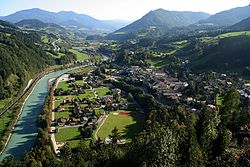
Werfen is located in the northwest of the historic Pongau region, about 40 km (25 mi) south of the city of Salzburg. The settlement is situated in the Salzach valley south of the Lueg Pass, between the Berchtesgaden Alps (Hagen Mountains and the Hochkönig massif) in the west and the Tennen Mountains in the east. The Salzburg-Tyrol Railway line (Giselabahn) and the Tauern Autobahn run parallel to the river. The region is known as the type locality of the geologic Werfen Formation, a Triassic stone layer of the Limestone Alps.
The municipality comprises the cadastral communities (Katastralgemeinden) of Reitsam, Scharten, Sulzau, Werfen Markt, and Wimm.
History
[edit]Important trade routes passed through the Salzach valley since ancient times, when the area was part of the Roman Noricum province. Werven was first mentioned about 1140 AD. The settlement arose south of Hohenwerfen Castle, erected from 1075 at the behest of the Archbishop Gebhard of Salzburg during the Investiture Controversy with King Henry IV of Germany. It is one of the oldest markets in the former Archbishopric of Salzburg, with market privileges documented since 1425. At about the same time, the nearby parish of Pfarrwerfen was established, like the neighbouring settlement of Werfenweng in the east.

As the seat of the local administration, Werfen and the castle were heavily attacked during the German Peasants' War in 1525/26. From 1675 onwards, numerous people in the environment of the local knacker Barbara Koller and her son Jakob were sentenced and executed in the Zaubererjackl witch trials. Werfen was also a centre of the expulsion of Salzburg Protestants under the rule of Prince-Archbishop Count Leopold Anton von Firmian in 1731. In the late 18th century, a large limonite deposit was developed in Sulzau, which from 1770 became the most important ironworks (Konkordiahütte) in the Salzburg archbishopric.
With the lands of the secularised prince-archbishopric, Werfen finally fell to the Austrian Empire by resolution of the Vienna Congress in 1816. The Salzburg-Tyrol Railway line from Salzburg to Wörgl opened in 1875, with stations in Sulzau, Tenneck, and Werfen.
The secluded Blühnbach Valley above the village of Tenneck is the site of the Baroque Schloss Blühnbach, a former hunting lodge of Archbishop Wolf Dietrich Raitenau, which in 1908 was acquired by Archduke Franz Ferdinand of Austria. After the archduke's assassination in 1914, the Habsburg-Lorraine dynasty sold the castle to the German Krupp industrial magnates. The Krupp dynasty held the premises until the death of Arndt von Bohlen und Halbach in 1986, today the estates are privately owned by Frederick R. Koch.
A small portion of a picnic scene from The Sound of Music was filmed on a hillside of the village of Werfen. Julie Andrews and crew filmed the opening shots of the "Do-Re-Mi" sequence with Hohenwerfen Castle in the background.[4] Hohenwerfen was also the location for some filming of Where Eagles Dare.
Politics
[edit]Seats in the municipal council (Gemeinderat) as of 2019 local elections:[5]
- Austrian People's Party (ÖVP): 10
- Social Democratic Party of Austria (SPÖ): 6
- Freedom Party of Austria (FPÖ): 3
Gallery
[edit]-
 Main square
 -
 Eisriesenwelt Cave
 -

-
 View from above
 -


.JPG)


References
[edit]- ^ "Dr. Hubert Stock".
- ^ "Dauersiedlungsraum der Gemeinden Politischen Bezirke und Bundesländer - Gebietsstand 1.1.2018" (in German). Statistics Austria. Retrieved 10 March 2019.
- ^ "Einwohnerzahl 1.1.2018 nach Gemeinden mit Status, Gebietsstand 1.1.2018" (in German). Statistics Austria. Retrieved 9 March 2019.
- ^ See "The Sound of Music Filming Locations" at The Worldwide Guide to Movie Locations. http://www.movie-locations.com/intromovies/soundmusic.html Archived 2008-06-03 at the Wayback Machine. Accessed 27 March 2007.
- ^ "Gemeindevertretungswahl 2019". Werfen (in Austrian German). Retrieved 2020-09-08.
External links
[edit]
- (in German) Werfen official website
- (in German) Werfen info website

| International | |
|---|---|
| National | |

Werfen
View on GrokipediaWerfen is a market town and municipality in the St. Johann im Pongau District of the Austrian state of Salzburg.[1]
Situated approximately 40 kilometers south of Salzburg city between the Tennengebirge and Hagengebirge mountain ranges, it covers an area of 154 square kilometers and has a population of about 3,092 as of 2025.[2][3][4]
Werfen is primarily renowned for two major landmarks: the medieval Hohenwerfen Castle, constructed between 1075 and 1078 as a strategic fortress by Archbishop Gebhard of Salzburg during the Investiture Controversy, and the Eisriesenwelt, the world's largest ice cave system spanning over 42 kilometers.[5][6][7][8]
The castle, perched on a 155-meter-high rock, historically symbolized the power of the Salzburg archbishops and later served various military purposes, including as a training base during World War II.[5][9]
Eisriesenwelt, formed over millions of years through water erosion and freezing processes, features dramatic ice formations and draws around 200,000 visitors annually via guided tours in its accessible 1-kilometer section.[7][10][11]
Geography
Location and Terrain
Werfen is situated in the St. Johann im Pongau District of the Salzburg state in Austria, approximately 40 kilometers south of the city of Salzburg.[4] The municipality lies at coordinates 47°28′N 13°11′E and reaches an elevation of 548 meters above sea level within the Salzach Valley.[4][12] The terrain features the narrow Salzach Valley, flanked to the east by the Tennen Mountains, a karstified massif primarily composed of Dachstein limestone overlying Ramsau Dolomite, which contributes to prominent steep cliffs and plateaus.[13] To the west, the Berchtesgaden Alps, including the Hagen Mountains and Hochkönig massif, rise sharply, enclosing the valley south of the Lueg Pass.[14] The Salzach River flows through the valley, shaping local hydrology with its course along the valley floor, while the surrounding alpine topography includes rugged slopes and elevated karst features conducive to natural attractions like ice caves but limiting flat arable land.[1] This alpine setting results in a topography characterized by high relief, with valley elevations around 500-600 meters contrasting against mountain peaks exceeding 2,000 meters, such as the Hundstein at 2,117 meters in the nearby Salzburg Slate Alps.[15] The geological foundation, including Triassic limestone formations like the Werfen Formation, underscores the area's karst development and resistance to erosion, fostering dramatic vertical cliffs that support structures like Hohenwerfen Castle.[1]Climate and Environment
Werfen lies in an alpine region with a continental climate featuring pronounced seasonal variations. Winters are cold, with average January lows around -5°C to -9°C and highs near 0°C, while summers are mild, with July highs averaging 22°C and lows of 11°C. Annual precipitation totals approximately 1,400-1,800 mm, much of it falling as snow during the extended cold season from late November to early March, contributing to heavy snowfall in the surrounding mountains.[16] The local environment encompasses a stable alpine ecosystem dominated by coniferous forests, limestone karst formations, and high-elevation plateaus. Biodiversity includes typical alpine flora such as pine and spruce in lower elevations transitioning to subalpine meadows, alongside fauna like chamois, marmots, and birds of prey adapted to rugged terrain. The Eisriesenwelt cave system exemplifies unique geological features, with perennial ice formations sustained by the region's cool, humid conditions and minimal summer melting.[17][10] Natural hazards, particularly avalanches, pose risks due to steep slopes and heavy winter precipitation. Historical records note significant events, including a 1982 avalanche near Werfenweng that killed 13 skiers, highlighting vulnerability in backcountry areas. Conservation efforts emphasize habitat preservation through monitoring and limited intervention, maintaining the ecosystem's integrity without altering natural dynamics.[18][19]History
Origins and Medieval Foundations
The foundations of Werfen as a settlement are tied to the strategic construction of Hohenwerfen Castle in 1077 by Archbishop Gebhard of Salzburg (r. 1060–1088), who initiated the fortress amid political instability in the region.[5] This edifice, perched on a 155-meter-high rock overlooking the Salzach Valley, formed part of a trio of defenses—including Hohensalzburg Fortress and Petersberg Castle—erected to safeguard the archdiocese's interests.[5] The archbishopric's possession of the Werfen area underscores its feudal origins under ecclesiastical authority, with the castle serving as a military stronghold rather than a residential seat.[20] Hohenwerfen's establishment occurred during the Investiture Controversy, a protracted conflict between the papacy and the Holy Roman Empire over clerical appointments, in which Gebhard aligned with Pope Gregory VII against Emperor Henry IV.[21] The fortress functioned primarily as a defensive bulwark, enabling control over the strategic Pass Lueg and the surrounding alpine passes critical for regional trade and military movement.[22] Historical records from Salzburg's archdiocesan administration confirm its role as a fortified outpost, with initial wooden structures later reinforced into stone, reflecting the era's emphasis on causal deterrence against imperial incursions.[5] The settlement of Werfen proper emerged southward of the castle, with the earliest documentary reference to "Werven" dating to circa 1140 in records noting a local prefect.[23] By the 12th century, the area's integration into the Salzburg archbishopric's domain fostered early communal development around ecclesiastical and feudal holdings, though archaeological evidence points to broader prehistoric alpine herding in the Pongau region without site-specific findings at Werfen itself.[24] Salzburg chronicles and charters verify the castle's enduring function as both a fortress and occasional prison for ecclesiastical justice in the medieval period, grounding Werfen's identity in these power dynamics.[5]Early Modern Period and Conflicts
During the German Peasants' War of 1524–1525, which spread to the Salzburg region amid grievances over feudal burdens and influenced by emerging Protestant ideas, Hohenwerfen Castle in Werfen was occupied and partially destroyed by rebel forces.[9][25] The uprising caught the fortress unprepared, reflecting broader turmoil in early modern Central Europe where peasants challenged ecclesiastical and secular authorities.[5] Prince-Archbishop Matthäus Lang von Wellenburg subsequently ordered reconstructions to bolster defenses against such revolts.[22] In the 17th and 18th centuries, as Salzburg's prince-archbishops enforced Counter-Reformation policies to suppress Protestantism and maintain Catholic dominance, Hohenwerfen primarily functioned as a state prison for political and religious offenders, including those accused of heresy or dissent.[5][26] Conditions were harsh, underscoring the archbishops' commitment to doctrinal uniformity amid ongoing regional tensions.[21] This role aligned with Salzburg's resistance to Reformation influences, prioritizing causal enforcement of religious authority over ideological tolerance. The secularization of the Prince-Archbishopric of Salzburg in 1803, part of the Reichsdeputationshauptschluss, ended ecclesiastical rule and integrated Werfen into Bavarian then Habsburg administration, marking a shift from feudal ties to emerging smallholder agriculture.[27][28] While the Napoleonic Wars disrupted the region through shifting alliances and occupations, Werfen experienced relative population stability, with local economies adapting from manorial systems to independent farming amid these transitions.[29]Modern Era and 20th Century Developments
In the 19th century, Hohenwerfen Castle underwent restoration between 1824 and 1833 under Archduke Johann, transforming it into a hunting lodge amid a period of romantic revival.[5] The nearby Eisriesenwelt, the world's largest ice cave, was discovered in 1879 by Salzburg naturalist Anton von Posselt-Cammerstätt, laying groundwork for natural tourism despite initial limited access.[30] Early 20th-century explorations advanced mapping of the cave, with speleologists like Friedrich Enzinger, Max von Mörk, and Josef Friedrich Pehany surveying approximately 18 kilometers by 1920, enhancing its appeal as a geological site.[30] The castle suffered a major fire in 1931 that destroyed its main building, but Archduke Eugene rebuilt it using private funds, preserving its structure amid broader architectural restorations continuing into the late 1930s.[5] [25] During Austria's Anschluss in 1938 and World War II, the castle served as a Gau training facility for Nazi authorities, reflecting its adaptation for military education rather than frontline operations in the rural Salzach Valley, which saw no documented major combat.[5] Post-1945, from 1945 to 1987, it functioned as a training camp for the Austrian Gendarmerie, supporting rural policing amid national reconstruction.[5] Werfen's development emphasized tourism over heavy industry, sustaining traditional agrarian and small-scale economic patterns that preserved its architectural heritage.[9] Census records indicate population stability, with 3,170 residents in 1981, fluctuating minimally to 3,070 by 2021, underscoring steady rural demographics without significant urban migration pressures.[3] Since 1987, the castle's conversion to a museum and falconry center, alongside cave infrastructure like cable cars, bolstered tourism as a core economic driver into the 21st century.[5]Demographics
Population Statistics
As of 1 January 2025, the municipality of Werfen recorded a population of 3,092 inhabitants, comprising 1,559 males (50.4%) and 1,533 females (49.6%).[31] This figure reflects relative stability, with the population hovering around 3,000 since the early 2000s.[32] Historical data indicate slow overall growth, from approximately 1,921 residents around 1900 to 3,127 by 2001, driven by gradual increases despite periods of emigration and offset by limited inflows.[32] Between 1975 and 2015, the population experienced a net decline of about 12.8%, consistent with rural depopulation trends in alpine regions before stabilizing in recent decades.[33] Projections for 2025 highlight an age distribution skewed toward working-age adults, with 1,264 individuals (approximately 42% of the total) in the 30-59 age brackets, exceeding proportions in urban Austrian locales where younger cohorts are more prominent due to higher urbanization rates.[3] Older age groups remain substantial, including 414 residents aged 60-69 and 265 aged 70-79, underscoring an aging demographic profile typical of small rural municipalities with low net migration—primarily seasonal inflows rather than permanent settlement—and birth/death balances that maintain stasis.[3]Ethnic and Social Composition
Werfen's residents are predominantly ethnic Austrians of Bavarian-German descent, reflecting the historical settlement patterns of the Pongau region in Salzburg. German is the sole official language, spoken as the mother tongue by nearly all inhabitants, with the local Austro-Bavarian dialect dominating everyday communication.[34] Data from municipal statistics show foreigners comprising 14.9% of the population, primarily EU citizens engaged in seasonal tourism or construction, though naturalization rates among long-term residents contribute to cultural continuity.[35] Socially, the community exhibits strong family-oriented structures typical of rural alpine Austria, where nuclear families predominate and intergenerational ties support local economies. The majority adheres to Roman Catholicism, with the parish church of St. James serving as a central institution for community events and rites, aligning with higher religious affiliation rates in Salzburg province compared to urban areas.[36] Vocational education through local schools emphasizes practical skills in agriculture, hospitality, and craftsmanship, fostering low outmigration and employment retention within the municipality's 3,092 residents as of January 2025.[37]Economy
Primary Sectors
In Werfen, agriculture remains a foundational economic activity, centered on dairy farming and livestock rearing suited to the alpine environment. The steep slopes and high pastures support seasonal transhumance, where cattle are moved to summer grazing lands, producing milk for regional cheeses and other dairy products; this sector aligns with Austria's broader emphasis on dairy, which generated a production value of 1.99 billion euros nationally in 2023, comprising about 19% of agricultural output.[38] Local operations emphasize small family farms, with grassland and hay production enabling self-sustained feed cycles amid challenging topography that limits arable cropping.[39] Forestry constitutes another pillar, leveraging the dense woodland cover in the surrounding Tennengau subregion, where forests occupy 61% of the land area, the highest proportion in Salzburg. Timber harvesting and management yield resources for construction and fuel, with sustainable practices governed by federal regulations to preserve protective functions against erosion and avalanches.[40] These activities contribute to rural employment stability, as primary sectors employ a higher share of the workforce in Pongau than the national average of around 3-4% in agriculture and forestry.[41] Small-scale industry complements these, primarily through wood processing mills and artisanal crafts derived from forest products, operating within Pongau's structure of predominantly small and medium-sized enterprises. This localized manufacturing fosters economic resilience by focusing on niche outputs like furniture components and tools, reducing vulnerability to global supply chains through proximity to raw materials.[42] Overall, these sectors underscore Werfen's reliance on terrain-driven viability, with operations prioritizing direct resource utilization over heavy subsidization, though integrated into Austria's EU Common Agricultural Policy framework for market support.[43]Tourism and Key Industries
 within the St. Johann im Pongau district of Salzburg, Austria, granting it historical market rights that trace back to medieval charters, enabling local trade privileges and self-governance under Austrian communal law.[49] The municipality is led by a directly elected mayor (Bürgermeister) and a municipal council (Gemeinderat), with elections held every six years as stipulated by Salzburg state regulations for local bodies.[50] The current mayor, Dr. Hubert Stock of the Austrian People's Party (ÖVP), was re-elected on March 10, 2024, securing 65.69% of the vote against his SPÖ challenger.[51] [52] Municipal operations emphasize fiscal prudence and transparency, with the budget derived primarily from local taxes, state transfers, and revenues such as the tourism levy (Kurtaxe), which supports infrastructure maintenance and public services amid Werfen's reliance on seasonal visitors.[31] Annual financial statements undergo review by district authorities in Pongau, ensuring compliance with Austria's communal accounting standards that mandate public disclosure and external audits to prevent mismanagement.[53] Decision-making prioritizes local autonomy, allowing the council to allocate funds for community-specific needs without overriding federal mandates, as evidenced by voter-approved initiatives for resilient infrastructure. A key example of this autonomy is the implementation of flood defense measures along the Salzach River, where Werfen has integrated retention areas, including repurposed sites like the former state forest garden, to enhance capacity against 100-year flood events as part of broader Pongau district strategies completed in recent years.[54] These projects, funded through municipal bonds and regional grants, demonstrate proactive risk management tailored to the town's alpine valley location, with engineering focused on natural retention over hard barriers to minimize ecological disruption.[55]Electoral History and Representation
In municipal elections, the Austrian People's Party (ÖVP) has historically maintained strong support in Werfen, reflecting the conservative leanings typical of rural communities in the Pongau district. In the 2024 Gemeinderatswahl held on March 10, the ÖVP secured 50.52% of the vote (781 votes), earning 10 of 19 seats in the local council, while the Social Democratic Party (SPÖ) received 32.99% (510 votes) for 6 seats, and the Freedom Party (FPÖ) 16.49% (255 votes) for 3 seats.[50] The ÖVP's Hubert Stock was reelected mayor with 65.69% in a direct runoff.[50] This outcome continues a pattern of ÖVP dominance in local governance, though vote shares have moderated from higher margins in prior cycles, amid stable voter turnout consistent with Salzburg's rural averages of around 60-70%.[56] At the state level, Werfen's voting aligns with Salzburg's center-right orientation, where the ÖVP has governed in coalition since the 2023 Landtagswahl, securing 28.8% province-wide despite competition from the FPÖ's 26.3%.[57] Local preferences emphasize infrastructure maintenance and tourism preservation over expansive development, with council decisions favoring balanced growth in areas like cave access and castle upkeep, though no major referenda have tested these divides in recent years. Federally, representation mirrors a rightward shift observed in rural Austria. In the September 29, 2024, Nationalratswahl, the FPÖ led with 31.8% (538 votes), narrowly ahead of the ÖVP's 29.9% (507 votes) and SPÖ's 21.3% (360 votes), a reversal from 2019 when the ÖVP held 42.5%.[58] This indicates growing FPÖ appeal on issues like immigration and economic protectionism, while maintaining low variability in turnout (approximately 75% eligible voters participated). Werfen contributes to Salzburg's delegation in the National Council, predominantly held by ÖVP and FPÖ affiliates, underscoring sustained conservative representation without significant left-wing gains.[58]| Party | 2024 Votes (%) | 2019 Votes (%) |
|---|---|---|
| FPÖ | 538 (31.8) | 265 (18.8) |
| ÖVP | 507 (29.9) | 600 (42.5) |
| SPÖ | 360 (21.3) | 345 (24.4) |
Culture and Attractions
Hohenwerfen Castle
Hohenwerfen Castle was constructed in 1077 by Archbishop Gebhard of Salzburg on a 155-meter-high rock pillar at an elevation of 623 meters above the Salzach Valley, initially featuring wooden structures that were later expanded into stone fortifications by the 15th century.[5] Architectural enhancements in the 16th century, under Archbishops Matthäus Lang and Johann Jakob Khuen-Belasy, included a bastion, rampart tower, and concealed staircase modeled on Italian designs, with walls built primarily from local limestone for durability against alpine conditions.[5][25] Key features encompass extensive ramparts, a Romanesque chapel, and an armory displaying medieval weapons such as swords and armor.[59] The fortress primarily served as a military stronghold and state prison, incarcerating political dissidents, rebellious nobles, and religious prisoners during the 17th and 18th centuries under inhumane conditions.[5] It sustained damage in the 1525 Peasants' War from occupation by rebels but was repaired by 1526, and later functioned as a Nazi training camp during World War II before being repurposed as a federal police academy from 1945 to 1987.[5][9] A devastating fire in 1931 destroyed the main building, prompting Archduke Eugene, its owner since 1898, to rebuild it using personal funds, though specific adherence to original medieval techniques is not documented beyond general restoration efforts.[5] Following the police tenure, the castle opened to the public in 1987 as a preserved historic site, now maintained with guided tours, a weapons museum, and a falconry center offering demonstrations of birds of prey in free flight, evoking historical practices.[5][46] Annual events include historical reenactments grounded in its medieval and military past, such as medieval festivals within the castle walls.[60]