Hubbry Logo
Spindle whorlSpindle whorlMain
Open search
Spindle whorl
Community hub
Spindle whorl
logo
8 pages, 0 posts
0 subscribers
Be the first to start a discussion here.
Spindle whorl
Spindle whorl
from Wikipedia
Spinning with a whorl (c) on a spindle (b) and distaff (a) (above)

A spindle whorl is a weighted object fitted to a spindle to help maintain the spindle's speed of rotation while spinning yarn.

History

[edit]

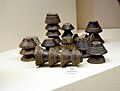
A spindle whorl may be a disk or spherical object. It is typically positioned on the bottom of the spindle. The spinner spins the weighted spindle pulling off a mass of fibers which is twisted into yarn.

Historically, whorls have been made of materials like amber, antler, bone, ceramic, coral, glass, stone, metal (iron, lead, lead alloy), and wood (oak). Local sourced materials have been also used, such as chalk, limestone, mudstone, sandstone, slate, lydite and soapstone.

Natufian artifacts unearthed in Israel at Nahal Ein Gev II, an archeological site, are believed to be the oldest spindle whorls found to date. Archaeologists say the perforated pebbles found scattered at the village site are 12,000 years old.[1][2] According to scans of the pebbles, the perforations were biconical in shape and drilled in two directions, creating an hourglass shape.[3]

[edit]

References

[edit]
Revisions and contributorsEdit on WikipediaRead on Wikipedia
from Grokipedia
A spindle whorl is a small, weighted disk or similar object with a central , attached to the lower end of a spindle—a stick used for hand-spinning fibers into —to provide rotational momentum and maintain consistent speed during the twisting process. Spindle whorls represent one of the earliest known tools for textile production, with archaeological evidence tracing their use back approximately 12,000 years to the Late Natufian period at the site of Nahal Ein-Gev II in the , , where perforated pebbles served as rudimentary whorls. These artifacts, analyzed through , featured central holes of 3–4 mm in diameter and weights ranging from 1 to 34 grams, enabling efficient fiber spinning that contributed to broader technological innovations, including the principles underlying the . Over millennia, spindle whorls became ubiquitous in global societies, from Epipaleolithic hunter-gatherers to complex civilizations, as durable remnants of otherwise perishable wooden spindles. Whorls were crafted from diverse materials suited to local resources and technological capabilities, including stone, bone, fired clay, ceramics, coral, amber, and antler, often recycled from pottery fragments in resource-scarce contexts. For instance, Iron Age examples from Britain, such as a stone whorl from Hunsbury Camp (circa 300–100 BCE), measured about 50 mm in diameter and weighed around 56 grams to optimize spin control. In early Islamic contexts (circa 640–900 CE) across regions like Iran, Spain, and the Arabian Peninsula, bone and unglazed clay whorls facilitated cotton spinning, supporting intricate textile industries including inscribed tiraz fabrics. Archaeologically, spindle whorls offer critical insights into ancient economies, gender roles, and networks, as their in sites worldwide—from Puebloan settlements in the to Maya ports in —highlights women's labor in processing and the tool's role in sustaining , cordage, and woven goods essential to daily life. Their functional design, acting as a to enhance twisting efficiency, underscores a foundational rotational technology that persisted until the mechanization of spinning in the .

Overview

Definition

A spindle whorl is a small, weighted object, typically disk-shaped with a central perforation, attached to one end (typically the lower end for drop spindles, or the top for supported spindles) of a spindle to facilitate the twisting of fibers into yarn or thread by providing rotational momentum and tension. This tool component has been essential in hand-spinning processes across cultures, aiding in the consistent draw and twist of materials like wool, flax, or cotton. The term "spindle whorl" derives from the hwyrfel, referring to the whorl or of a spindle, which evokes the of spinning; this evolved through whorle or whorvil, a variant influenced by "whirl." Historical linguistic parallels include Latin fusus for the spindle itself, denoting a tool for twisting, while Greek terms like atraktos implied weighted spindles, though specific "whorl" equivalents emphasized the rotational weight. While typically disk-shaped, whorls can also be spherical, biconical, or other forms to suit specific spinning needs. Structurally, a spindle whorl features a central hole sized to fit snugly over the spindle shaft, usually 3-6 mm in , allowing secure attachment without slippage. Overall dimensions typically range from 1 to 5 cm in , with weights of 5 to 50 grams, calibrated to the type—lighter for fine, delicate threads and heavier for coarser yarns to optimize spin dynamics.

Function in Spinning

A spindle whorl serves as a weighted component attached to a spindle, functioning primarily to provide rotational that sustains the spindle's during the hand-spinning process. By acting as a , the whorl helps maintain a consistent speed of , enabling the even insertion of twist into fibers to form . This arises from the whorl's , which leverages to generate , influencing the draft (the pulling apart of fibers) and twist rate without requiring continuous manual input. The conservation of occurs as the whorl continues spinning with the spindle, smoothing out variations in and allowing for more uniform production. In drop-spindle techniques, the whorl enhances the effect by adding weight at the bottom of the spindle, where the spinner releases the weighted end to drop and twist fibers held in the hand. This method relies on the whorl's to keep the spindle rotating freely after the initial flick, inserting twist as it descends, after which the spinner winds the newly formed onto the spindle shaft. Supported spindle variations, such as those placed in a or on the , use the whorl at the top for finer control, where the weight provides steady rotation while the spinner drafts fibers more deliberately, reducing the risk of over-twisting. These techniques depend on the whorl's balanced design to minimize wobbling and ensure prolonged spin times. The choice of whorl weight significantly affects spinning outcomes based on fiber type, with heavier whorls (typically 25-30 grams or more) suited for coarser fibers like , which require greater twist insertion to achieve strength and cohesion. Lighter whorls (under 18 grams) are preferred for finer fibers such as or , allowing for subtler twist rates that produce even, delicate s without excessive bulk. This weight-fiber matching influences yarn quality, as appropriate from the whorl's mass promotes balanced tension, resulting in yarns with improved evenness, reduced breakage, and enhanced durability for subsequent or .

Construction and Materials

Common Materials

Spindle whorls have traditionally been crafted from a variety of natural materials valued for their durability, availability, and ability to provide consistent weight and balance during spinning. Stone and clay-based materials are among the most prevalent due to their low cost and resistance to . For instance, baked clay, often in the form of terracotta or recycled from sherds in resource-scarce contexts, offers a yet sturdy option that can be easily molded and fired for uniformity. , a soft sedimentary stone, is frequently used for its workability and fine texture, allowing for precise shaping while maintaining structural over time. Baked variants, including fired clays with organic inclusions like , provide additional affordability and stability during production. Wood and represent lightweight alternatives that prioritize ease of carving and balance. Woods such as are favored for their density and grain, which can be turned on a to achieve smooth, concentric forms that minimize vibration. Animal , sourced from or other mammals, offers similar lightness with natural resilience, often hollowed or polished to ensure even weight distribution. Other materials adapted to local resources include , , and , used in coastal or forested regions for their availability and aesthetic qualities. For applications requiring greater momentum, metals like and lead provide high and heft. , an of and tin, delivers resistance and malleability for detailed . Lead, with a of approximately 11.3 g/cm³, enables compact designs that impart significant rotational without excessive bulk. , though less common, is employed for its transparency and smoothness, contributing to reduced friction in specialized whorls. In contemporary replicas, synthetic materials such as and are occasionally used for their moldability and low , though traditional organic and mineral substances remain the standard for authenticity and performance.

Shapes and Variations

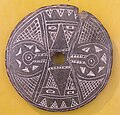
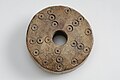
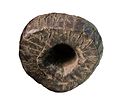
Spindle whorls exhibit a range of basic s designed to provide balanced and during spinning. The most common form is the discoid or disk , characterized by flat tops and bottoms with straight or slightly convex sides, which promotes stability and even rotation. Other prevalent shapes include the biconical, formed by joining two cones at their bases to create a symmetrical, tapered profile that aids in consistent spin; the spherical, offering uniform distribution for smoother operation; and the conical, with one flat face and a rounded, tapering opposite side for enhanced grip and . Less frequent variations encompass cylindrical forms, featuring greater height relative to diameter for added rotational , and truncated biconical types with flattened ends and an offset carination. Size variations among spindle whorls typically range from 1.5 to 6 cm in diameter and 0.5 to 3 cm in thickness, with weights spanning 3 to 40 g, allowing adaptation to different spinning needs. Low-profile, lighter whorls (under 12 g, often discoid with diameters around 2-3 cm) are suited for producing fine yarns from short fibers, providing controlled twist without overpowering delicate threads. In contrast, bulbous or heavier forms (over 20 g, such as larger biconical or spherical shapes with diameters up to 5-6 cm) facilitate spinning coarser yarns, delivering greater torque for thicker fibers. Central perforations, usually 2-12 mm in diameter and sometimes angled up to 40 degrees, accommodate the spindle shaft while influencing spin efficiency, though off-center placements are rare and primarily result from manufacturing variances rather than intentional adjustability. While functionality drives design, spindle whorls often incorporate decorative features that enhance aesthetics without compromising utility. Incised patterns, such as concentric circles, zigzags, chevrons, or dot-in-circle motifs, appear on surfaces to add visual appeal, potentially also serving as grip aids. Raised rims or grooves around the central hole provide additional stability and may prevent slippage during use. Glazing is occasionally applied to smooth surfaces and highlight engravings, though such embellishments remain secondary to the whorl's weighted form. Regional variations reflect adaptations to local spinning practices, with conical shapes prominent in Eurasian traditions for their tapered profile that suits supported spinning techniques. In contrast, discoid forms dominate in many areas for their simplicity and balance, while biconical designs show wider distribution across continents, often scaled larger in regions favoring heavy yarns. These geometric differences underscore how shape influences rotational dynamics, with broader diameters generally correlating to increased momentum in diverse cultural contexts.

Historical Development

Ancient Origins

The earliest evidence for spindle whorls dates to the Late Natufian period in the Near East, around 10,000 BCE, where perforated limestone pebbles served as rudimentary whorls at the site of Nahal Ein-Gev II in the Jordan Valley, Israel. By the Neolithic period, around 8000 BCE, they appear as more standardized tools for fiber spinning in early settled communities. In Neolithic sites in Anatolia, such as Ulucak Höyük, clay spindle whorls have been recovered, indicating organized textile production alongside the domestication of plants and animals. These artifacts, often small and disc-shaped, suggest the transition from manual fiber twisting to weighted spinning devices that improved efficiency in yarn production. By approximately 2500 BCE, spindle whorls had reached the Indus Valley Civilization, where bone examples were crafted for use in spinning and other fibers, reflecting advanced textile traditions in urban centers like . This development highlights the tool's role in supporting large-scale cloth production for trade and daily use. The technology spread through trade and migration networks, reaching by around 5500 BCE in the , where perforated stone or clay whorls appear in settlements across , evolving from rudimentary pebbles to more standardized crafted disks. In , similar diffusion occurred via cultural exchanges, adapting local materials while maintaining the core design. This dissemination paralleled the expansion of , with whorls becoming ubiquitous in agrarian toolkits. A key innovation around 3000 BCE in involved the influence of the , which promoted more uniform, wheel-thrown clay whorls, enhancing balance and spin consistency for finer yarns. Archaeologically, these refined shapes correlate with increased specialization. Spindle whorls also provide evidence of gendered labor division in early agrarian societies, with and contextual finds associating them predominantly with female burials or domestic spaces, indicating women's primary role in fiber processing while men focused on or . This pattern underscores ' centrality to economies and social structures.

Medieval and Post-Medieval Use

During the medieval period in , from approximately 500 to 1500 CE, spindle whorls were widely used in handspinning, particularly for and production, as evidenced by archaeological finds across Britain and . In , lead alloy whorls became common from the 9th to 15th centuries, with excavations at 16–22 Coppergate in uncovering 14 such examples cast in moulds, complete with production debris and a failed that indicate local in domestic workshops. These whorls, often bi-conical or disc-shaped with central perforations of 5–6 mm, facilitated everyday work in Anglo-Scandinavian and later medieval households, reflecting continuity from earlier traditions despite emerging specialization by the . In Asian and Islamic contexts, spindle whorls supported advanced production during the (618–907 CE) in , where terracotta and ceramic examples, sometimes intricately decorated, were employed to spin fine silk threads along . These whorls, often low-weight for delicate fibers, contributed to the export of high-quality textiles that influenced global trade. In early Islamic contexts across regions like , bone whorls with incised and painted motifs were used for and spinning in urban workshops. Post-medieval refinements from the 16th to 18th centuries saw spindle whorls incorporate imported materials, such as salt-glazed from the , which featured central side grooves for better thread control and were classified into three main forms based on profile. These changes improved spinning efficiency for finer yarns, particularly in and the , before the around 1760 shifted production toward mechanization. Lead and ceramic whorls persisted in rural areas, but urban use declined as spinning wheels with built-in whorls gained popularity. The introduction of the in 1764 by and the in 1769 by marked the decline of traditional handspinning with spindle whorls in the West, as these machines allowed one operator to manage multiple spindles via hand or water power, drastically reducing labor needs and rendering manual tools obsolete by the early . By the , factory-based systems had displaced domestic production, confining spindle whorls to marginal or non-Western contexts.

Cultural and Archaeological Significance

Key Artifacts and Sites

One of the earliest known examples of spindle whorls comes from the Late Bronze Age settlement at Must Farm in , , dating to around 1000–800 BCE, where eight clay spindle whorls were recovered alongside loom weights, thread bobbins, and fiber bundles, indicating active textile production in a stilt-house community destroyed by fire and preserved in a river environment. These artifacts were discovered during excavations between 2015 and 2016, revealing domestic spaces dedicated to spinning and within the pile-dwelling structures. In prehistoric contexts, such finds highlight the transition to more organized fiber processing, with whorls typically made from locally available clay to provide consistent weight for drop-spinning techniques. In ancient Egyptian contexts, spindle whorls from the New Kingdom period (ca. 1550–1070 BCE) have been excavated from cemetery sites like Lisht North, where a blue-glazed example with a central perforation was found in Pit 465 during digs in 1920–1922, demonstrating the use of durable, colorful materials in tomb assemblages associated with daily crafts. These whorls, often hemispherical or disc-shaped, were likely included in burials to represent women's labor or provisions for the , with chosen for its glossy finish and symbolic blue hue evoking the . Similar artifacts appear in other Memphite region tombs, underscoring spindle whorls' role in funerary deposits across elite and non-elite graves. Roman military and civilian sites in Britain yield numerous spindle whorls, with hundreds documented at Vindolanda fort along Hadrian's Wall (1st–4th centuries CE), including stone, bone, and ceramic varieties excavated from barracks and extramural settlements since the 1970s, pointing to on-site textile activities by soldiers' families or local women. Glass examples, though rarer, are attested in the Roman period, such as a white-trailed brown glass whorl in the British Museum collection from a 19th-century acquisition, from Amathus in Cyprus. These finds, often flat or biconical in shape, were recovered in anaerobic soil layers that aided preservation of associated organic fibers. Viking Age wooden spindle whorls were unearthed in the Oseberg ship burial in (ca. 834 CE), where turned examples with attached spindles were found amid tools during 1904 excavations, preserved by the mound's clay and acidic conditions that inhibited decay. Discovered alongside looms and winders in the high-status female grave, these lathe-turned whorls, featuring flat tops and curved edges, exemplify Scandinavian craftsmanship in organic materials for high-whorl spinning methods. Organic whorls like these rarely survive outside exceptional anaerobic environments such as bogs or waterlogged burials, where low oxygen levels prevent bacterial breakdown. These items are often preserved in waterlogged contexts that limit decay. Archaeological collections worldwide catalog spindle whorls using typologies based on shape, such as hemispherical, flat-disc, or biconical forms, to trace technological and cultural variations; for instance, the British Museum holds extensive examples from prehistoric to medieval contexts, including numerous cataloged stone and ceramic whorls from British and Mediterranean sites, facilitating comparative studies of spin direction and fiber types. These typologies, refined in works like Margarita Gleba's 2008 classification for ancient Mediterranean artifacts, emphasize how form influenced spinning speed and yarn quality without delving into symbolic interpretations.

Symbolism and Social Role

Spindle whorls have long been associated with gender roles in various cultures, predominantly symbolizing women's labor and identity in ancient mythologies and daily practices. In , the , or Fates, were depicted as three goddesses who spun, measured, and cut the thread of life using spindles and whorls, embodying the female domain of determining human destiny from birth to death. This association reinforced spinning as a for feminine and domesticity across and art. However, archaeological evidence from Andean cultures challenges this exclusively female attribution, revealing spindle whorls in male burials alongside female ones, suggesting shared or flexible gender roles in textile production during the Middle Period (AD 400–1000). For instance, at sites like Solcor 3 and Coyo Oriental in , , approximately 21% of male interments included spindle whorls, indicating possible male participation in spinning or the tools' broader symbolic significance beyond strict gender divisions. Ritual and symbolic uses of spindle whorls extended beyond practical spinning, often linking them to life cycles and protection in funerary and folk contexts. In , particularly the during the Neolithic and Early , spindle whorls were frequently deposited as , interpreted as offerings symbolizing the "thread of life" being broken at death, reflecting beliefs in continuity or transition to the . These items, found in alongside other personal artifacts, underscore their role in expressing identity and ritual closure. In medieval , spindle whorls took on amuletic qualities, serving as talismans or magical objects to ward off misfortune; a notable example is a reworked stone disc from Rattama farm in South (c. 13th–14th century), perforated and inscribed, likely functioning dually as a whorl and protective charm. Archaeological assemblages of spindle whorls often serve as indicators of economic and social structures, with their abundance pointing to widespread household-based textile industries. Copious finds at sites like Roman Vindolanda and Corbridge in Britain highlight decentralized production, where whorls' prevalence in domestic contexts suggests spinning as a key component of family economies rather than centralized workshops. Variations in materials and decoration further reflected social status, with finer examples denoting elite ownership; in the Byzantine period, intricately carved bone or imported stone whorls from urban centers like Sardis implied higher socioeconomic standing, contrasting with simpler clay versions in rural settings. Cross-culturally, the circular form of spindle whorls carried profound symbolic weight, particularly in Indigenous American traditions where it evoked the cycles of life, renewal, and interconnectedness. Among Coast Salish and other Northwest groups, the whorl's round shape has been incorporated into reviving traditional designs, representing continuity and cultural motifs. In Mesoamerican contexts, such as Aztec iconography, whorls bore motifs linking spinning to cosmic order and female power, further embedding the circle as a emblem of life's repetitive rhythms.

Modern Uses and Legacy

Contemporary Handspinning

The revival of handspinning in the emerged as part of broader folk craft movements, driven by enthusiasts seeking to reclaim pre-industrial techniques amid growing interest in fiber . Organizations like the , founded in 1969, played a key role in fostering this resurgence by uniting weavers, spinners, and dyers through education, conferences, and publications that emphasized traditional methods including spindle use. Similarly, post- fiber arts guilds, such as the Tennessee Valley Handspinners Guild tracing its roots to 1960s workshops at , promoted hands-on learning and community building around spinning tools like whorls. further contributed by integrating spindle whorls into curricula to develop fine motor skills and connect children with yarn-making processes, often using simple drop spindles for . In contemporary practice, spindle whorls remain central to drop-spinning techniques taught in workshops, where participants learn to draft and twist fibers while the whorl provides momentum for consistent production. These sessions, offered at fiber festivals and craft centers like South Philly Yarn and Craft, adapt historical methods for modern settings, emphasizing park-and-draft motions suitable for beginners. For exotic fibers such as , spinners adjust whorl weights and twist levels to accommodate the 's smoothness and lack of crimp, requiring higher twist to prevent yarn slippage and achieve durable results. Modern tools featuring spindle whorls are widely accessible, with many handmade by artisans and sold on platforms like , allowing customization in materials such as or for balanced spinning. Weights are optimized for specific yarns; for instance, lighter whorls around 20-30 grams suit fine , enabling smoother drafting of its medium staple length without overwhelming the fiber. Globally, traditional use persists in rural areas, where women in India's Himalayan regions like spin sheep's on supported spindles without whorls for garments, sustaining local economies and cultural practices. In Peru's Andean communities, pushka spindles with low whorls continue to produce yarns from and fibers for textiles, as seen in rural highland villages where spinning integrates daily life and heritage preservation.

Collecting and Reproduction

Spindle whorls have gained popularity among collectors of ancient artifacts, particularly those interested in everyday tools from prehistoric to medieval periods, with items frequently appearing in online marketplaces and auction houses. In the antiquities market, medieval lead examples often sell for $30 to $85 on platforms like eBay, reflecting their relative abundance from metal detector finds in Europe. This accessibility has fueled collecting trends, especially for decorated or patterned whorls that showcase historical craftsmanship. Reproductions of spindle whorls are produced using modern techniques to replicate ancient designs for educational, reenactment, or hobbyist purposes. Artisans employ lathe-turning on materials like to create historically accurate Viking-age copies, drawing from archaeological examples to match shapes and finishes. Additionally, enables precise duplication of prehistoric or ancient whorls, as demonstrated in projects recreating 12,000-year-old stone examples from the for . Kits for hobbyists, often including printable models or basic turning tools, allow individuals to craft their own versions using common materials like clay or wood. Authenticating spindle whorls involves examining physical evidence of age and use, such as on metal or stone surfaces, which develops through oxidation and soil exposure over centuries. Wear patterns around the central , visible under microscopic analysis, indicate prolonged spinning activity and help distinguish genuine artifacts from modern fakes. is crucial, with reputable sources tracing items to licensed excavations or established collections, often documented through databases like the Portable Antiquities Scheme; purchases from sites like or museum shops should include such verification to ensure legitimacy. The value of spindle whorls in the collector's market depends on factors like rarity and condition, with examples commanding higher prices—often exceeding $100 at auction—due to their fragility and decorative qualities. In contrast, common clay whorls from widespread sites typically sell for under $5, reflecting their in antiquity. Ethical sourcing emphasizes artifacts from authorized archaeological digs to avoid contributing to illicit trade, prioritizing items with clear excavation records over unprovenanced pieces.

References

Add your contribution
Related Hubs
User Avatar
No comments yet.