Hubbry Logo
Williams FW32Williams FW32Main
Open search
Williams FW32
Community hub
Williams FW32
logo
8 pages, 0 posts
0 subscribers
Be the first to start a discussion here.
Williams FW32
Williams FW32
from Wikipedia
Williams FW32
CategoryFormula One
ConstructorWilliams
DesignersSam Michael (Technical Director)[1]
Ed Wood (Chief Designer)[1]
Clive Cooper (Head of Design - Composites and Structures)
Christopher Brawn (Head of Design - Suspension, Steering, Breaks)
Mark Loasby (Head of Design - Systems)
Jon Tomlinson (Head of Aerodynamics)[1]
PredecessorWilliams FW31
SuccessorWilliams FW33
Technical specifications[citation needed]
ChassisCarbon-fibre and honeycomb composite monocoque
Suspension (front)Carbon-fibre double wishbone arrangement, with composite toelink and pushrod activated springs and anti-roll bar
Suspension (rear)as front
EngineCosworth CA2010 2.4 L (146 cu in) 90° V8, limited to 18,000 RPM naturally aspirated mid-mounted
TransmissionSeven-speed semi-automatic gearbox with reverse gear Electro-hydraulically actuated seamless shift
Weight620 kg (1,367 lb) (including driver)
FuelBP
TyresBridgestone
Rays Wheels (front and rear): 13"
Competition history
Notable entrantsAT&T Williams
Notable drivers9. Brazil Rubens Barrichello
10. Germany Nico Hülkenberg
Debut2010 Bahrain Grand Prix
Last event2010 Abu Dhabi Grand Prix
RacesWinsPodiumsPolesF/Laps
190010

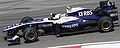
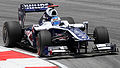
The Williams FW32 was a Formula One motor racing car made by Williams for the 2010 season and powered by the sport's brand-new entry-level Cosworth CA2010 engine.[2] The car was driven by Rubens Barrichello and 2009 GP2 Series champion Nico Hülkenberg.

Pre-season

[edit]

The car was first driven in shakedown tests at Silverstone on January 28[3] before it was officially unveiled at the Circuit Ricardo Tormo near Valencia, Spain at the first official test on February 1.[4] After Hülkenberg completed the shakedown at Silverstone, Barrichello was given the first day's running at the test, completing 75 laps.[5]

In pre-season testing, Barrichello finished at the top of the timesheets once, because of rain.[citation needed] In some sessions, Barrichello was outpaced by his rookie teammate Hülkenberg.[citation needed] Williams was the second team in terms of kilometres covered and showed some reliability, but were off pace from front-runners Red Bull, Ferrari, and McLaren.[citation needed]

2010 season

[edit]

Rounds 1-10

[edit]

The season started off with Barrichello finishing 10th at the Bahrain Grand Prix, while Hülkenberg made a mistake at turn 6 and skidded across the track, but recovered to 14th. In the next rounds, Barrichello finished 9th in Australia, while Hülkenberg was involved in a first-lap incident with Kamui Kobayashi, after the Japanese driver's front wing failed and sent him into the barrier, rebounding into the path of Hülkenberg.

At the third round in Malaysia, Hülkenberg made it to Q3 for the first time, qualifying in 5th place; out-qualifying teammate Barrichello for the first time. Barrichello stalled at the start due to an overheating clutch, while Hülkenberg started well. He looked set to finish eleventh in the race until Fernando Alonso blew his engine three laps from the end, thus promoting Hülkenberg to tenth place and with the new-for-2010 points system, Hülkenberg scored his first ever Formula One points. The car looked to be a good midfield contender, but in China the cars both finished in non-points positions.

At the Spanish Grand Prix, Barrichello was knocked out in Q1 for the first time. He claimed he had been unable to understand his engineer while out on the circuit. The Circuit de Catalunya has a history of radio-related problems. In the race, Williams gambled on a two-stop strategy for Hülkenberg, a mistake that shunted the German driver down the order where he was caught up in a duel with a struggling Rosberg. Barrichello benefited from Lewis Hamilton's late crash to score two points, finishing in 9th, despite starting 18th on the grid and equalled Ayrton Senna's record of highest-scoring Brazilian driver in Formula One. Williams felt the new Cosworth CA2010 was not good enough and demanded Cosworth to improve the new engine in every area.[6]

At the Monaco Grand Prix, Barrichello qualified 9th, and Hülkenberg 11th. Barrichello moved up to sixth position through the first corner, while Hülkenberg lost control in the middle of the tunnel and hit the wall, damaging his front left suspension and causing a safety car. Later, Barrichello had a suspension failure caused by hitting a loose drain cover coming out of turn 1, and crashed heavily up the hill. After crashing he threw the car's steering wheel out, as he was sitting in the middle of a 120 mph corner with his car on fire. The steering wheel was then run over by Karun Chandhok's Hispania. This was the first double non finish for Williams in the season.

At the Canadian Grand Prix, Barrichello qualified eleventh, narrowly missing Q3 but his anti-stall system kicked in at the start of the race. Kamui Kobayashi and Hülkenberg tangled on the run into the final corners. While Hülkenberg cut the chicane to avoid further contact, Kobayashi was not as lucky and he became the Wall of Champions' 2010 victim. Barrichello recovered well, but he later collided with Jaime Alguersuari when Alguersuari came across too late to cover his line, the damage blocking Barrichello's left brake duct.

At the European Grand Prix in Valencia, the Williams team brought big upgrades and ran their version of the F-duct. Hülkenberg and Barrichello qualified 8th and 9th respectively, with exactly the same time of 1:38.428. Barrichello made a good start, while Hülkenberg defended his 8th position from Mark Webber. Barrichello was running seventh when the safety car was deployed at the end of lap nine, and pulled straight into the pits. On lap 42, Hülkenberg's car started to emit blue smoke from the rear, but it soon stopped. Hülkenberg's right rear tyre delaminated on lap 50, causing damage to his car's exhaust system and became the race's final retirement, while Barrichello defended from Kubica to finish in a strong 4th place. After the race, both Barrichello and Hülkenberg were issued 5 second time penalties for speeding behind the safety car, but it did not affect Barrichello's finishing position because Kubica and Sutil, the two drivers behind him, also received 5 second time penalties. He became the highest-scoring Brazilian driver in Formula One history, overhauling Ayrton Senna's career tally of 614 points, which he had been tied with since Spain.

At Silverstone, Barrichello again made it into Q3, qualifying 9th. He had a strong race, and finished in 5th. Hülkenberg finished 10th.

Rounds 11-19

[edit]

At the Hungarian Grand Prix, Hülkenberg made it into Q3, with 10th, while Barrichello qualified 12th. Barrichello did not pit when the safety car came out. Williams had been attempting a similar strategy to BMW Sauber with Kamui Kobayashi in Valencia by having Barrichello pit late and charge back up through the field on super-soft tyres. But he was unable to preserve his position and slipped down the order to eleventh behind Schumacher. He then attempted to glide through the field with ease, but quickly became trapped behind his former teammate. Things came to a head late in the race when Barrichello was able to get close enough to pass Schumacher on the main straight, but Schumacher attempted to pin Barrichello to the wall and force him to back off. However, Schumacher's move came too late, and Barrichello was already alongside him when the Mercedes driver moved over. Barrichello very nearly made contact with the concrete pit wall and was forced across the pit exit, but took the place from Schumacher, who was placed under investigation by the stewards for dangerous driving. He was later issued a ten-place grid penalty for his actions, to be taken at the next race in Belgium. Meanwhile, Hülkenberg finished sixth from 10th on the grid, a career best.

Barrichello celebrated his 300th Grand Prix at the Belgian Grand Prix, but retired in damp conditions after colliding with Fernando Alonso's Ferrari on the first lap at the last chicane. Before the race, he was elected as Chairman of the Grand Prix Drivers' Association to replace the outgoing Nick Heidfeld.

In Singapore, the FW32 sported a new front wing, and Barrichello put this to good use to set the sixth fastest time in qualifying, although Williams technical director Sam Michael reckoned the car was fast enough to be a couple of positions higher. In the race, he lost positions to Robert Kubica and Nico Rosberg at the start. Hülkenberg and Petrov's wheels made contact and both drivers went off the circuit on the same lap; Hülkenberg managed to move ahead of Petrov. On lap 44, Hülkenberg, in ninth, made a mistake which allowed Massa to momentarily take advantage, but he fought back and retained ninth position. Massa then overtook both Hülkenberg and Massa, and on the last lap, Hülkenberg was fighting Sutil for 9th, but was held off, and finished 10th. Barrichello had a solid run to sixth at the finish.

At the new Korean Grand Prix, Barrichello qualified 10th and Hülkenberg 11th. In a wet race Barrichello suffered heavy tyre wear on the intermediates that he was running on. Kubica took eighth place from Hülkenberg by taking the inside line at the third corner. Hülkenberg then spun off the track on lap fifty-two and made a pit stop for new tyres because his engineer on the pit-wall told him one of his tyres had developed a slow puncture. In the closing stages of the race Barrichello was passed by Robert Kubica and Vitantonio Liuzzi, dropping him to seventh place at the finish, while Hülkenberg passed Alguersuari on the final lap to finish in tenth.

At Interlagos, with a track drying and no rain falling, the first part of qualifying eliminated the new teams and Adrian Sutil. In Q3, the top ten qualifiers saw a track drying so much that after a round of laps in intermediate tyres and times up to 1:16's, the teams opted for slick tyres. This tyre gamble proved successful for Nico Hülkenberg, who took advantage of the situation and qualified over a second ahead of the next quickest cars, taking his first pole position. This also gave the Williams team their first pole since Nick Heidfeld qualified on pole at the 2005 European Grand Prix, and the first pole for Cosworth since the 1999 French Grand Prix. Hülkenberg gained his first Formula One pole position, by 1.049 seconds over Sebastian Vettel. Barrichello qualified a strong sixth. Hülkenberg lost the lead on the first lap, and he eventually finished the race in eighth place, having been passed by drivers in more competitive cars. For Barrichello, after a delayed pitstop, his traditional bad luck on home soil returned when he suffered a puncture after briefly colliding with Jaime Alguersuari, costing him any chance of scoring points.

In Abu Dhabi Barrichello qualified strongly in seventh place, and maintained that position shortly after the start. However, when the safety car was deployed following Michael Schumacher's and Vitantonio Liuzzi's crash, many drivers like Robert Kubica, Vitaly Petrov and Nico Rosberg took advantage of this by pitting early. This had a negative effect as they did not need to pit again, and Barrichello finished outside of the points. Hülkenberg qualified 15th, and finished 16th. After the race, team boss Frank Williams confirmed that Hülkenberg would not be driving for the team in 2011, while Barrichello would be retained.

By the end of the season, they beat Force India in the constructors championship by 1 point, coming 6th with 69 points.

[edit]

Complete Formula One results

[edit]

(key) (results in bold indicate pole position; results in italics indicate fastest lap)

Year Entrant Engine Tyres Drivers 1 2 3 4 5 6 7 8 9 10 11 12 13 14 15 16 17 18 19 Points WCC
2010 AT&T Williams Cosworth CA2010 V8 B BHR AUS MAL CHN ESP MON TUR CAN EUR GBR GER HUN BEL ITA SIN JPN KOR BRA ABU 69 6th
Barrichello 10 8 12 12 9 Ret 14 14 4 5 12 10 Ret 10 6 9 7 14 12
Hülkenberg 14 Ret 10 15 16 Ret 17 13 Ret 10 13 6 14 7 10 Ret 10 8 16

References

[edit]
[edit]
Revisions and contributorsEdit on WikipediaRead on Wikipedia
from Grokipedia
The Williams FW32 was a Formula One racing car designed and built by the Williams Grand Prix Engineering team for the 2010 FIA World Championship season. It featured a carbon and honeycomb composite that exceeded FIA impact and strength standards, along with a CA2010 2.4-litre naturally aspirated producing approximately 740 horsepower at 18,000 rpm. The car utilized a seven-speed seamless sequential with electro-hydraulic gear selection, Potenza tyres (245 mm front, 325 mm rear), and pushrod suspension on both axles incorporating carbon fibre double wishbones and anti-roll bars. Measuring 1,800 mm in width, the FW32 was adapted to the season's new regulations, including a ban on mid-race refuelling that necessitated larger fuel tanks and no mandatory (KERS), which Williams opted not to use. Development of the FW32 represented a "clean-sheet" redesign from front to back, marking the second such approach in consecutive years for the Williams technical team under chief designer . Following a switch from to the customer engine in late 2009, the car was unveiled during a shakedown test at in 2010 before its on-track debut at a pre-season testing session in on February 1. Aerodynamic innovations included an updated blown rear wing tested early in the season and plans for an exhaust-blown diffuser later introduced at , aimed at improving and efficiency under the year's aero restrictions. The FW32's livery prominently featured sponsorship from , reflecting the team's status as an independent midfield constructor with limited budget compared to manufacturer-backed rivals. Driven by Brazilian veteran Rubens Barrichello—coming off a strong third-place finish in the 2009 Drivers' Championship—and German rookie Nico Hülkenberg, the 2009 GP2 Series champion who had served as Williams' reserve driver, the FW32 competed in all 19 races of the season. Barrichello scored 47 points with his best results being fourth places at the European Grand Prix in Valencia and the Italian Grand Prix at Monza, while Hülkenberg added 22 points, highlighted by a surprise pole position at the rain-affected Brazilian Grand Prix—Williams' first since 2005 and the only one of Hülkenberg's career to date. Despite early promise, including both cars reaching Q3 in Valencia, the team struggled with reliability issues like exhaust failures and inconsistent strategies, ultimately finishing sixth in the Constructors' Championship with 69 points behind Renault. The season marked a recovery from Williams' dismal 2009 campaign, re-establishing the team in the midfield but underscoring ongoing challenges in matching the pace of top outfits like Red Bull and McLaren.

Development

Design Team and Objectives

The development of the Williams FW32 was led by Technical Director , Chief Designer , and Chief Aerodynamicist Jon Tomlinson. This team initiated the project as a clean-sheet in late , building directly on lessons from the preceding FW31 to overcome the team's mid-field performance challenges in the 2009 season, where they finished sixth in the constructors' championship with inconsistent results. The primary objectives for the FW32 centered on enhancing reliability and overall competitiveness under the 2010 engine regulations, which featured the standardized 2.4-liter V8 units supplied by manufacturers like for customer teams such as Williams. Development emphasized cost-effective strategies amid broader economic pressures affecting the , aiming to position the at the front of the midfield and challenge for finishes through efficient . Key regulatory adaptations for 2010 included the mandatory use of the McLaren Electronic Systems (MES) Standard (SECU), which standardized engine management and across all teams to promote parity and reduce development costs. Additionally, the FIA introduced restrictions on exhaust positioning—requiring circular outlets angled 10 degrees upward—to limit the effectiveness of exhaust-blown diffusers and curb aerodynamic advantages from engine exhaust flow.

Key Innovations

The Williams FW32 represented the second consecutive clean-sheet redesign for the team, following the FW31, to fully adapt to the 2010 Formula 1 regulations that introduced significant aerodynamic revisions such as a narrower front wing, larger rear wing, and the elimination of refueling, alongside the switch to the CA2010 engine. This approach allowed engineers to optimize the chassis layout from the ground up, prioritizing aerodynamic efficiency and integration with the new power unit, which provided a foundational in packaging the while meeting the heightened crash test standards that accounted for the increased minimum weight. A key evolution in the FW32's rear involved retaining core principles of the FW31's double-deck diffuser while adapting to the rules banning flexible exhaust systems and bodywork, which had previously allowed subtle deformations to enhance . The design emphasized rigid structural integrity for consistent rear-end generation, with the diffuser featuring a wider vaned to improve expansion under the floor; this was further refined mid-season with the introduction of an exhaust-blown diffuser at the , directing gases more efficiently onto the diffuser surface without relying on flexibility. These modifications ensured compliance with FIA scrutiny on bodywork stiffness while maintaining competitive rear grip. Suspension kinematics were revised at both ends of the FW32 to enhance tire management amid the transition to new tire compounds specified for the 2010 season, with wider front wishbones and modified mounting joints improving cleanliness and wheel control. These tweaks optimized camber and adjustments for better mechanical grip during cornering, allowing the tires to maintain optimal contact patches under varying loads without excessive wear. The raised front suspension mounting points contributed to this by reducing drag while supporting precise handling feedback. To meet the elevated minimum weight of 620 kg (including )—a 15 kg increase from —internal packaging strategies focused on redistributing mass for improved balance, achieving near-ideal around 46-49% on the front through careful placement of systems, battery packs, and ancillary components. This enhanced cornering stability by minimizing understeer tendencies and allowing more aggressive setup options without compromising structural rigidity during high-speed impacts. Cost-saving measures were integral to the FW32's development, including the adoption of off-the-shelf components where permitted, such as the optional Kinetic Energy Recovery System (KERS), which the team ultimately opted not to deploy following FOTA's voluntary agreement among member teams not to use it to curb R&D expenses, although some teams did deploy it. This decision, alongside the cost-effective Cosworth engine partnership, freed resources for core aerodynamic and chassis work, aligning with broader 2010 initiatives to standardize non-performance-critical parts like gearboxes.

Technical Specifications

Chassis and Aerodynamics

The chassis of the Williams FW32 utilized a structure fabricated from carbon-fibre and composite materials, ensuring lightweight rigidity while the survival cell exceeded FIA crash test standards for impact resistance and structural integrity. This approach allowed the car to achieve the minimum weight of 620 kg including the driver, as mandated by 2010 FIA regulations, with a focus on lowering the center of gravity to enhance handling responsiveness. The overall dimensions adhered to FIA limits, measuring 1,800 mm in width, optimizing packaging for aerodynamic efficiency. Aerodynamically, the FW32 incorporated a raised V-shaped design compliant with the FIA technical regulations, which elevated the nose tip to reduce upstream lift and direct cleaner toward the and diffuser for improved generation. Sidepod inlets were specifically optimized for the engine's cooling requirements, featuring elongated and asymmetric shapes with added fillets to manage and heat dissipation effectively during pre-season testing. The and diffuser emphasized ground-effect , utilizing tight undercuts and bargeboards to seal the underbody and accelerate without relying on prohibited flexible or exhaust-blown elements that were scrutinized under FIA rules. The suspension system employed a double wishbone configuration at both front and rear axles, constructed primarily from carbon fibre for the front with composite toelinks, and activated via pushrods connected to springs and tuned anti-roll bars to prioritize high-speed stability and cornering balance. consisted of carbon-carbon discs paired with six-piston , integrated into the to facilitate efficient heat dissipation and maintain performance under demanding track conditions. The engine was mounted low within the chassis to further support the low center-of-gravity philosophy and overall balance.

Engine and Drivetrain

The Williams FW32 featured the CA2010 as its power unit, a 90-degree with a 2.4-litre displacement that operated as a naturally aspirated unit under the FIA's 18,000 RPM rev limit. This engine represented 's return to Formula 1 as a supplier, offering teams an accessible and durable option tailored for the era's standardized V8 formula. Williams secured a long-term partnership with in October 2009, shortly after mutually terminating their engine supply agreement with at the conclusion of the 2009 season. The CA2010 was positioned as a reliable, entry-level alternative to the higher-cost units from manufacturers like Mercedes and Ferrari, prioritizing longevity and efficiency over outright peak performance. The engine delivered approximately 740 hp (551 kW) at its maximum output, with a focus on consistent power delivery suited to race conditions. Power from the CA2010 was transmitted via a seven-speed semi-automatic sequential gearbox, equipped with carbon paddle shifters for rapid gear changes and a to enhance traction out of corners. Gear shifts were managed electro-hydraulically for seamless operation, aligning with the FIA's technical standards for the 2010 season. Engine management, , and data logging were controlled by the Electronic Systems (MES) ECU, the mandatory unit for all F1 teams that ensured standardized electronic compliance and performance monitoring. The fuel system adhered to the FIA's refuelling ban, requiring the FW32 to carry all necessary fuel—up to approximately 160 kg (around 210 litres) depending on circuit demands—for the full race distance without mid-race additions.

Pre-season Activities

Launch and Shakedown

The Williams FW32 made its initial track appearance during a private shakedown session at in the on January 28, 2010. driver handled the brief outing, which focused on basic systems checks and a promotional shoot to verify mechanical integrity ahead of the season. The car was run in a baseline configuration without its full aerodynamic package, prioritizing reliability over performance data collection. The official unveiling of the FW32 occurred on February 1, 2010, at the in , , coinciding with the first pre-season testing session. Unlike many teams that held separate launch events, Williams opted for a low-key debut directly on track, allowing immediate evaluation under controlled conditions. This approach aligned with the team's strategy to accelerate development by integrating the reveal with practical running. The FW32's livery featured a predominantly base with white and red accents, reflecting the team's sponsorship portfolio. Prominent branding included title sponsor across the sidepods, alongside on the rear wing and on the engine cover, emphasizing the commercial partnerships that supported the campaign. This design maintained a clean, professional aesthetic while highlighting key backers.

Testing Sessions

The pre-season testing program for the Williams FW32 began with a limited shakedown run at on 28 January 2010, marking the car's initial track outing ahead of its official unveiling. This brief session focused on basic systems checks and installation laps, confirming the chassis and powertrain integration without incident. The team then proceeded to the first major test at the in from 1 to 3 February, where handled the initial two days to validate core setups, before rookie took over on day three for his debut in the car. Subsequent multi-team sessions occurred at Jerez, split into two four-day blocks from 10 to 13 February and 17 to 20 February, allowing for iterative development under varying conditions. Performance during these tests highlighted the FW32's potential in challenging weather, particularly at Jerez on 18 February, where Barrichello topped the timesheets in wet and windy conditions with a best lap of 1:27.145 over 98 laps, outperforming rivals like in the . Earlier at the first Jerez session, Barrichello recorded the third-fastest time on 13 February despite late-session interruptions. The program concluded at Barcelona's Circuit de Catalunya from 25 to 28 February, with Hülkenberg setting the day's quickest lap of 1:20.614 on 26 February, demonstrating competitive pace against established drivers including . Overall, the FW32's baseline lap times placed it firmly in midfield contention, with early aerodynamic mapping and tire correlation tests providing valuable data on setup balance and degradation patterns. Reliability emerged as a strength, with the car completing substantial mileage across the sessions and no major mechanical failures reported, though minor issues arose that informed ongoing refinements. The testing prioritized durability of the and , aligning with the team's objectives for a robust platform under the new regulations. Challenges included limited evaluation of optional KERS deployment, ultimately sidelined due to weight penalty concerns that outweighed potential gains, as confirmed in pre-season assessments. Additionally, early gearbox mapping required adjustments following glitches encountered at Jerez on 13 February, which hampered Barrichello's final runs but were addressed promptly to ensure session completion. These iterations underscored the FW32's adaptability, setting a solid foundation for the upcoming season without compromising the core mechanical priorities.

Team and Personnel

Drivers and Line-up

The Williams FW32 was driven in the 2010 Formula One season by Rubens Barrichello in car number 9 and rookie Nico Hülkenberg in car number 10. Barrichello, a veteran with prior stints at Honda and Ferrari, brought extensive experience encompassing 284 Grand Prix starts by the end of 2009, positioning him as a stabilizing force for the team. Barrichello's retention was driven by his proven leadership qualities and ability to provide consistent feedback, essential for guiding car development and mentoring a novice teammate. Team principal Frank Williams emphasized this role in the announcement, noting Barrichello's status as a Grand Prix winner to foster the growth of the younger driver. Hülkenberg, the 2009 champion, was selected as Barrichello's teammate to inject fresh talent into the lineup, supplanting the outgoing whose sponsorship and performance had waned. This choice also targeted appeal to the German market through Hülkenberg's nationality and rapid rise from junior formulae. The team also appointed as official test driver for the season. No reserve drivers played a prominent role in race duties, with emphasis instead on preparing the primary duo; Barrichello focused on refining consistent setups, while Hülkenberg adapted to demands through extensive simulator sessions prior to on-track testing.

Key Engineering Staff

The operational leadership for the Williams FW32 during the 2010 Formula One season was provided by Team Principals Frank Williams and , who oversaw the overall direction, alongside Chairman Adam Parr, responsible for strategic and business aspects following his promotion in July 2010, and , who managed race engineering and on-site technical operations. Each driver, and rookie , was supported by a dedicated handling real-time strategy, setup adjustments, and communication during sessions and races, contributing to the team's execution on track. The pit crew emphasized efficiency in tire changes under the new no-refueling regulations, targeting stationary times of around 3.5 seconds or less to minimize time loss, a significant improvement over previous seasons with refueling. On-track support included aerodynamicists who fine-tuned car setups based on circuit-specific conditions and wind tunnel data correlations, as well as data analysts processing for immediate performance insights and decision-making. Following the challenges of , including the shift from to engines, the engineering team prioritized staff continuity to enhance reliability and operational stability throughout the season.

2010 Season

Early Season (Rounds 1-10)

The Williams FW32 began the 2010 season with mid-field performances, securing points in the opening rounds despite a new . In the opening round in , Barrichello finished 10th for 1 point, while Hülkenberg placed 14th. In , Barrichello claimed 8th place for 4 points, while Hülkenberg retired due to an accident. Through and , the team encountered minor challenges, with Barrichello finishing 12th in wet conditions in Sepang and 12th in , while Hülkenberg scored 1 point for 10th in Malaysia but placed 15th in . Hülkenberg adapted during his debut, though the team saw limited points in where Barrichello took 9th for 2 points and Hülkenberg 16th. In , Barrichello retired on lap 30 after suspension damage from a loose , while Hülkenberg also retired in an accident. The team showed resilience in subsequent races, with no major retirements after Monaco, allowing steady points through mid-field. In Turkey, Barrichello qualified 7th but finished 14th, and Hülkenberg 12th in qualifying but 17th in the race. Both finished outside points in Canada (14th and 13th). Barrichello then scored strongly with 4th at the European Grand Prix in Valencia for 12 points, followed by 5th at the British Grand Prix for 10 points; Hülkenberg retired in Valencia due to exhaust failure but scored 1 point for 10th in Britain. By the end of round 10 at Silverstone, Williams had amassed 31 points, placing sixth in the constructors' championship and demonstrating improved reliability and setup from pre-season testing.

Late Season (Rounds 11-19)

The late season began with challenges in , where both drivers finished outside the points (Barrichello 12th, Hülkenberg 13th). In (round 12), the team scored 9 points with Hülkenberg in 6th (8 points) and Barrichello in 10th (1 point). The FW32 showed improved competitiveness from the onward, with setup refinements aiding tire management. In , both Williams drivers retired early: Barrichello on lap 1 after colliding with Hülkenberg, who spun out. In , Barrichello finished 10th for 1 point, while Hülkenberg took 7th for 6 points. In , Barrichello scored 8 points for 6th, and Hülkenberg 1 point for 10th. Hülkenberg retired on lap 1 in after an accident with , while Barrichello finished 9th for 2 points. The team rebounded in Korea, where Barrichello ran as high as 3rd before an off-track excursion dropped him to 7th for 6 points; Hülkenberg added 1 point with 10th. The standout moment came in , where Hülkenberg secured in a rain-affected qualifying session—the first for Williams since 2005 and the only one of his career—leading the opening lap before dropping to 8th for 4 points. Barrichello qualified 6th but finished 14th after traffic issues, showing strong wet-weather capability. The FW32 performed adequately in the season finale at , with Barrichello 12th and Hülkenberg 16th, scoring no points. Williams concluded the championship sixth in the constructors' standings with 69 points, as the FW32's development plateaued after with no major upgrades. Hülkenberg finished 14th in the drivers' standings with 22 points, while Barrichello was 10th with 47 points. The focus shifted to 2011 preparations, emphasizing aerodynamic revisions for the incoming regulations.

References

Add your contribution
Related Hubs
User Avatar
No comments yet.