


Community hub
Recent from talks
Contribute something
Nothing was collected or created yet.
Williams FW18
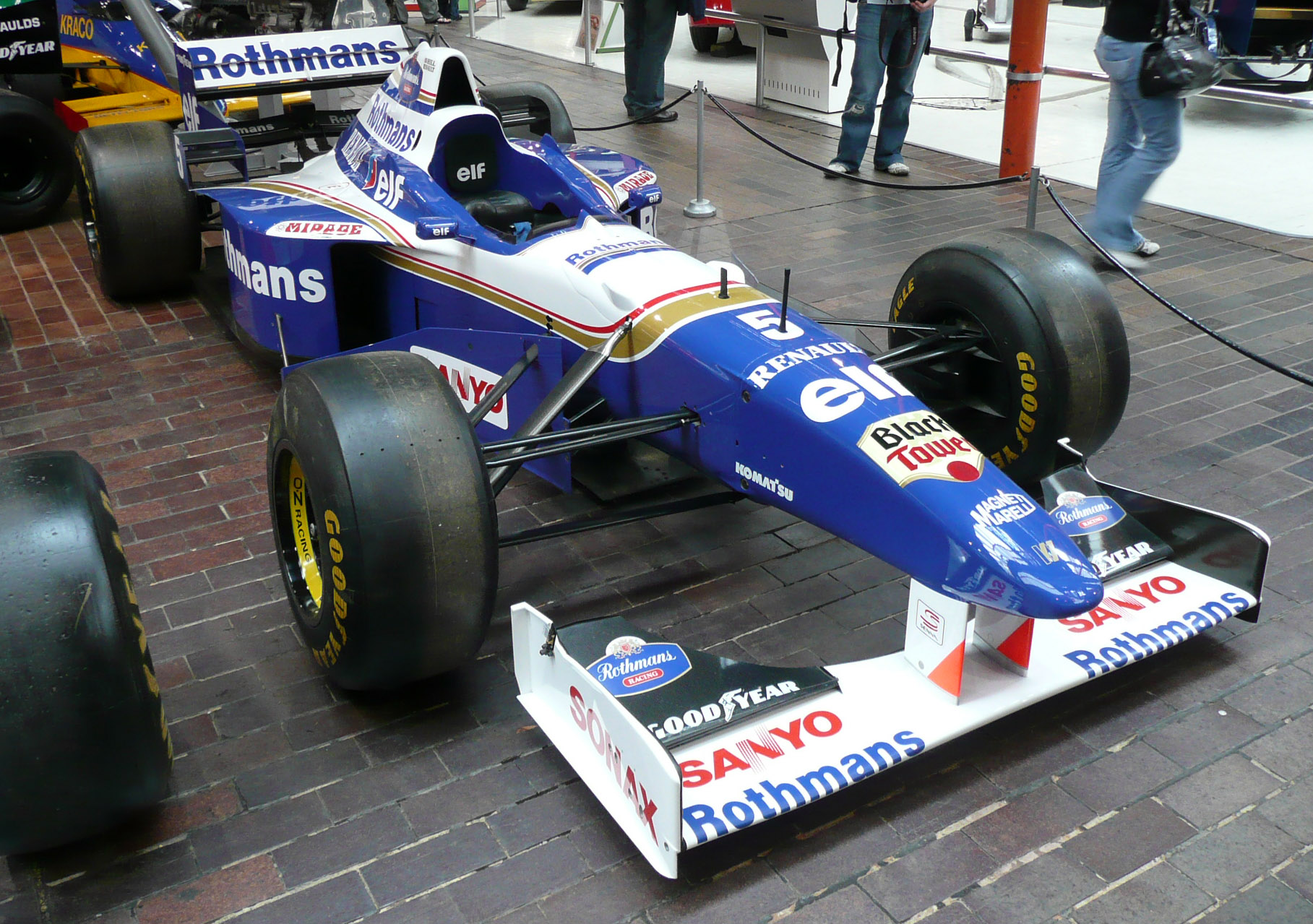
View on Wikipedia The FW18 of Damon Hill on display at the National Motor Museum, Beaulieu | |||||||||||
| Category | Formula One | ||||||||||
|---|---|---|---|---|---|---|---|---|---|---|---|
| Constructor | Williams (chassis, transmission) Renault Sport (engine) | ||||||||||
| Designers | Patrick Head (Technical Director) Adrian Newey (Chief Designer) Eghbal Hamidy (Chief Aerodynamicist) Bernard Dudot (Chief Engine Designer (Renault)) | ||||||||||
| Predecessor | Williams FW17 | ||||||||||
| Successor | Williams FW19 | ||||||||||
| Technical specifications | |||||||||||
| Chassis | Carbon/Epoxy composite monocoque | ||||||||||
| Suspension (front) | inboard torsion bars operated by pushrod bellcrank, unequal-length wishbones | ||||||||||
| Suspension (rear) | inboard torsion bars operated by pushrod bellcrank, unequal-length wishbones | ||||||||||
| Engine | Renault RS8/RS8B 2,998 cc (182.9 cu in) V10 (67°) naturally aspirated mid-mounted | ||||||||||
| Transmission | Williams 6-speed sequential semi-automatic | ||||||||||
| Power | 700 hp (522 kW; 710 PS) @ 16,000 rpm[1] | ||||||||||
| Fuel | Elf | ||||||||||
| Tyres | Goodyear | ||||||||||
| Competition history | |||||||||||
| Notable entrants | Rothmans Williams Renault | ||||||||||
| Notable drivers | 5.  Damon Hill Damon Hill6.  Jacques Villeneuve Jacques Villeneuve | ||||||||||
| Debut | 1996 Australian Grand Prix | ||||||||||
| First win | 1996 Australian Grand Prix | ||||||||||
| Last win | 1996 Japanese Grand Prix | ||||||||||
| Last event | 1996 Japanese Grand prix | ||||||||||
| |||||||||||
| Constructors' Championships | 1 (1996) | ||||||||||
| Drivers' Championships | 1 (1996 - Damon Hill) | ||||||||||
The Williams FW18 is a Formula One car used by the Williams F1 team to compete in the 1996 Formula One season. Designed by Adrian Newey and Patrick Head, it is one of the most successful F1 designs of all time.
The FW18s were driven by Damon Hill and Jacques Villeneuve. The car proved to be the most successful of the entire 1996 field; winning 12 of the 16 races during the season, with Hill winning 8 and Villeneuve winning 4. The FW18 was also the car in which Damon Hill won the Drivers' Championship title, making him the first son of a World Champion to become a Champion himself. The FW18 was also the second of three cars during the 1990s to enjoy a 1–2 finish on its Grand Prix debut, the first being the Williams FW14B at the 1992 South African Grand Prix and the third being the McLaren MP4/13 at the 1998 Australian Grand Prix. The FW18 scored 175 points in its time and was one of the most successful Formula One cars of the 1990s.[2]
Design
[edit]Powered by a 3.0 litre Renault V10 engine, the FW18 drew heavily on the 1995 Williams car, the FW17, but featured new driver protection as regulated by the FIA for the new season. The drivers sat lower in the cockpit, which lowered the car's centre of gravity, thus aiding the handling of the car.[3] Newey's aerodynamics placed the car well ahead of the Benetton B196s of Gerhard Berger and Jean Alesi and the Ferrari F310s that Michael Schumacher and Eddie Irvine had at their disposal.
In pre-season testing, Hill covered over 9,000 km refining the new car.[4] It was well balanced and pleasant to drive, responded well to setup changes, and was comfortable to sit in.[5]
Season performance
[edit]
Williams retained Damon Hill for 1996, who helped to develop the FW18, and the car seemed to respond well to his smooth driving style,[citation needed] while his new teammate, Formula One rookie Jacques Villeneuve, also quickly adapted to the FW18. The car was extremely reliable, as FW18s completed 1778 laps of a possible 2028, more than any other car that season.[6] The car responded well to set-up changes and was competitive on all types of circuits, with Hill qualifying on the front row at every track and at least one Williams driver finishing on the podium for every race except for the Monaco and Italian Grands Prix, both of which saw Hill retire from the lead due to engine failure at the former and driver error at the latter.
The FW18's dominance was also due in part to the recent personnel changes at rival teams. Benetton (running the B196s of Gerhard Berger and Jean Alesi for 1996), which had previously bested Williams in the past two seasons, had lost Michael Schumacher and several key technical people to Ferrari. However, the Ferrari F310s that Schumacher and Eddie Irvine had at their disposal were unreliable and it would not be until 1997 that they could challenge for the Constructors' title.
The FW18 proved to be extremely successful during the season, as the car won twelve of the sixteen races and won the Constructors' Championship for Williams at the Hungarian Grand Prix with four rounds to spare. Their eventual winning margin of 105 points over second placed Ferrari was the second largest recorded in history at the time, behind only the McLaren MP4/4 that dominated the 1988 season.
Hill and Villeneuve fought a good natured but close intra-team title fight, with Hill winning six of the opening nine races to open up a points cushion, which he successfully defended in the second half of the season after Villeneuve began to mount a title challenge, the foundations of which were built upon a run of seven consecutive mid-season podium finishes.
The Championship title was eventually decided in the Englishman's favour at the final round in Suzuka after Hill won the Japanese Grand Prix and Villeneuve's car lost its right-rear wheel. This was after Williams team principal, Frank Williams, took the controversial decision to not re-sign Hill for the 1997 season. Also before the season concluded, designer Adrian Newey had been placed on "gardening leave" as he would join McLaren for 1998. The departures of Hill and Newey would signal the beginning of the end of Williams dominance in Formula One, only narrowly winning the Driver's and Constructor's titles in 1997 and failing to win a race in 1998; although they remained competitive up until 2004, with Patrick Head at the helm of engineering.

Livery
[edit]Williams retained their title sponsorship from Rothmans for a third season and with it kept the blue and white livery along with the company's racing stripes of gold and red along the bodywork. The cars showcased Rothmans logos, except at the European, French, British and German Grands Prix; which was replaced by either "Racing" or a barcode with a tricoloured generic rectangle that associated with the brand. In the French Grand Prix, the logo from sponsor Black Tower on the cars nosecone was removed.
Later uses
[edit]Hill was re-united with the FW18 14 years after his championship year, as he demonstrated the car at the 2010 Bahrain Grand Prix.

Other
[edit]The car appears in the games TOCA Race Driver 3, Formula One Championship Edition and F1 2013 as one of the classic cars in those games. In June 2017, it was announced that the car will reappear in F1 2017 along with the FW14B. In July 2018, it was announced that the car will again reappear as one of the returning classic cars in F1 2018, F1 2019 and F1 2020.
Complete Formula One results
[edit](key) (results in bold indicate pole position, results in italics indicate fastest lap)
| Year | Entrant | Engine | Tyres | Drivers | 1 | 2 | 3 | 4 | 5 | 6 | 7 | 8 | 9 | 10 | 11 | 12 | 13 | 14 | 15 | 16 | Points | WCC |
|---|---|---|---|---|---|---|---|---|---|---|---|---|---|---|---|---|---|---|---|---|---|---|
| 1996 | Rothmans Williams Renault | Renault V10 | G | AUS | BRA | ARG | EUR | SMR | MON | ESP | CAN | FRA | GBR | GER | HUN | BEL | ITA | POR | JPN | 175 | 1st | |
| Damon Hill | 1 | 1 | 1 | 4 | 1 | Ret | Ret | 1 | 1 | Ret | 1 | 2 | 5 | Ret | 2 | 1 | ||||||
| Jacques Villeneuve | 2 | Ret | 2 | 1 | 11 | Ret | 3 | 2 | 2 | 1 | 3 | 1 | 2 | 7 | 1 | Ret |
Sponsors
[edit]| Brand | Country | Placed on |
|---|---|---|
| Rothmans | United Kingdom
|
Rear wing, fin, sidepods, front wing |
| Magnetti Marelli |  Italy Italy
|
Nose |
| Renault |  France France
|
Sides, nose |
| Elf | France
|
Sides, nose, mirrors, rear wing end plate |
| Sanyo |  Japan Japan
|
Front wing, barge board |
| Komatsu | Japan
|
Side |
| Black Tower |  Germany Germany
|
Nose |
| Mirage | Italy
|
Sidepods |
| Sonax | Germany
|
Front wing end plate |
Footnotes
[edit]- ^ "3rd Naturally-Aspirated Era (3NA), Part 2, 1995-2000 (end of this review)" (PDF). grandprixengines.co.uk. Retrieved 4 May 2024.
- ^ "Williams FW18". www.wi77iams.coms. 14 June 2018. Retrieved 30 January 2020.
- ^ "Motor Racing close-up: Williams-Renault FW18 Why the car is the star". The Independent. 21 April 1996. Retrieved 30 January 2020.
- ^ "Williams FW18 – This Car Won the 5th Double for the Grove-based Team". www.snaplap.net. 1 March 2017. Retrieved 30 January 2020.
- ^ "Great racing cars: Williams FW18 and FW19". Motor Sport Magazine. 19 October 2015. Retrieved 30 January 2020.
- ^ Statistics -> Driver Reliability -> 1996 Archived 2011-07-16 at the Wayback Machine F1db.com Retrieved 3 November 2006.
External links
[edit] Media related to Williams FW18 at Wikimedia Commons


Williams FW18
View on GrokipediaBackground and Development
Historical Context
During the early to mid-1990s, the Williams team established itself as the preeminent force in Formula One, largely thanks to its partnership with Renault engines. From 1992 to 1994, Williams secured three consecutive Constructors' Championships and two Drivers' titles (Nigel Mansell in 1992, Alain Prost in 1993), with Damon Hill finishing runner-up in 1994, the Renault V10 providing superior power and reliability that propelled the team to 22 race victories over the era.[6] In 1995, despite the FW17 chassis being widely regarded as the fastest car on the grid, Williams finished second in the Constructors' standings after losing the Drivers' Championship to Michael Schumacher by just one point; mechanical failures, including breakdowns that cost Hill wins in Brazil and Germany, undermined the team's potential and highlighted ongoing reliability concerns.[7] The competitive landscape entering 1996 was further altered by shifts among rival teams, particularly Benetton, which had clinched both titles in 1995. Schumacher's high-profile departure to Ferrari at the end of 1995 left Benetton without its star driver, severely hampering their title defense and contributing to a third-place finish in the Constructors' standings the following year.[8] This exodus extended to key technical staff, as technical director Ross Brawn and designer Rory Byrne announced their moves to Ferrari during the 1996 season, further weakening Benetton's engineering depth and allowing Williams to face diminished opposition from what had been its closest challenger.[9] Regulatory updates for the 1996 season aimed to enhance safety and control costs while maintaining the shift toward naturally aspirated engines introduced in 1995. The 3.0-liter engines, with configurations up to 12 cylinders permitted, produced approximately 700 horsepower, a slight refinement from the prior year's power outputs.[10] The ban on electronic driver aids, including traction control and launch control—first imposed in 1994—remained in effect, with additional restrictions on electronic differentials to ensure they mimicked mechanical systems, emphasizing driver skill over automation.[10] Safety measures were prioritized, such as enlarged cockpit openings and padded head restraints to better protect drivers.[11] In response to the narrow 1995 title defeat, Williams redirected its development efforts toward bolstering reliability without sacrificing outright performance, a strategic pivot that addressed the FW17's vulnerabilities and positioned the team for a commanding 1996 campaign.[7] This focus on dependable engineering, informed by the previous season's setbacks, allowed Williams to leverage its technical strengths amid a less formidable field.[12]Evolution from Predecessor
The Williams FW18 represented a refined evolution of its predecessor, the FW17, which had secured eight victories in the 1995 season through its mid-season 'B-spec' upgrade. Led by chief designer Adrian Newey and technical director Patrick Head, the development process emphasized incremental enhancements to the existing architecture rather than radical overhauls, given the minimal regulatory shifts for 1996. These changes built on the FW17's proven semi-monocoque carbon fiber chassis, targeting subtle optimizations in balance and driver integration to maintain competitive dominance.[13][14][15] A key focus was adapting to the 1996 FIA regulations mandating enhanced driver protection, including a lower-mounted seat and higher cockpit sides raised by 75 mm. Newey reclined the seating position, raised the pedals, and lowered the driver's head relative to the chassis, which not only complied with safety requirements but also reduced the center of gravity for improved handling and visibility. This reconfiguration necessitated adjustments to the front suspension packaging, enhancing overall responsiveness while preserving the car's targeted minimum weight of 505 kg through refined weight distribution in the carbon fiber structure. Pre-season testing, including over 9,000 km completed by Jacques Villeneuve, validated these modifications, with sessions at tracks like Estoril and Silverstone allowing drivers to fine-tune balance and initial setup.[13][16][14] Development proceeded through intensive wind tunnel work at Williams' own facility, operational five days every two weeks, to integrate aerodynamic and suspension elements seamlessly. Drawing from lessons post the 1994 active suspension ban, the team adapted passive systems with remnants of prior hydraulic principles for better pitch control and driver feedback, resulting in a more intuitive car compared to the FW17's occasionally sensitive handling. This iterative approach ensured the FW18 debuted as a reliable platform, with early testing highlighting superior balance adjustments for varied track conditions.[16][15]Design and Technical Features
Chassis and Aerodynamics
The Williams FW18 featured a carbon-fibre monocoque chassis, a standard construction for Formula One cars of the era that provided structural integrity while adhering to the 1996 FIA regulations on driver protection, including a higher cockpit surround.[17] This design evolved from the preceding FW17 through adjustments to accommodate the drivers' ergonomics, such as a more reclined seating position with elevated pedals to better fit taller pilots like Damon Hill.[18] Aerodynamically, the FW18 incorporated shortened sidepods to optimize airflow toward the rear wing, alongside larger bargeboards and an increased rake angle to manage wake from the front wheels more effectively, resulting in a notable boost in overall downforce.[18] These refinements addressed limitations observed in wind tunnel testing of the FW17, prioritizing cleaner air management over the chassis without relying on banned active suspension elements. The suspension system utilized a double wishbone configuration throughout, with pushrod actuation at both ends: the front employing torsion bar springs and the rear using coil springs, all paired with passive Williams/Penske dampers tuned for enhanced stability at high speeds.[17] Key dimensions included a wheelbase of 2,890 mm, front track width of 1,670 mm, and rear track width of 1,600 mm, contributing to the car's balanced handling profile.[17] The dry weight met the 1996 FIA minimum of 600 kg, ensuring compliance while maximizing performance potential through lightweight composite materials.[19]Engine and Drivetrain
The Williams FW18 was equipped with the Renault RS8 V10 engine, a 3.0-litre (2,998 cc) naturally aspirated unit featuring a 67-degree V configuration and mounted longitudinally behind the driver.[17] This powerplant delivered approximately 700 horsepower at 16,000 rpm, providing the high-revving performance essential for the car's dominance in the 1996 Formula One season.[17] The engine's aluminum alloy block and head construction contributed to its lightweight design while maintaining structural integrity under extreme operating conditions.[17] Power from the RS8 was transmitted to the rear wheels via a Williams-developed six-speed semi-automatic sequential gearbox, which utilized paddle shifters for rapid gear changes without compromising driver focus.[17] The drivetrain incorporated a limited-slip differential to optimize traction distribution, particularly during corner exits where the FW18's superior power needed precise control.[20] This setup, housed in a magnesium alloy casing for reduced weight, enhanced overall efficiency and responsiveness in line with mid-1990s F1 standards.[20] The fuel system, supplied by Elf, integrated specialized lubricants optimized for the RS8's demands and featured a tank with capacity sufficient for full race distances without refueling, as mandated by FIA regulations since 1994.[21] The engine's reliability proved pivotal, with only isolated failures across the season, allowing Williams to secure 12 victories.[14]1996 Season Performance
Team and Drivers
The Williams team entered the 1996 Formula One season under the leadership of founder and team principal Frank Williams, who had guided the outfit to multiple championships since its inception in 1977. Supporting him were technical director Patrick Head, responsible for overall engineering oversight, and chief designer Adrian Newey, whose aerodynamic expertise was pivotal in crafting competitive machinery. This core leadership trio ensured a seamless integration of innovative design with operational efficiency, setting the stage for the FW18's deployment.[22][23][24] The driver lineup featured Damon Hill as the retained lead, a seasoned contender with 13 prior Grand Prix victories from his previous campaigns with Williams, including six wins in 1994 and four in 1995. Joining him was rookie Jacques Villeneuve, fresh from clinching the 1995 IndyCar World Series championship and the Indianapolis 500, while carrying the legacy as the son of Ferrari icon Gilles Villeneuve. Hill's experience provided stability, while Villeneuve's raw talent from open-wheel success brought fresh dynamism to the team.[25][26][27] Behind the scenes, a dedicated support staff of key mechanics and strategists handled the FW18's meticulous setup, pit operations, and race tactics, drawing on the team's renowned engineering depth to optimize performance. Test driver duties during development were primarily undertaken by the race drivers, with Hill logging significant miles to refine the car's handling. Villeneuve, adapting from IndyCar, participated in intensive pre-season sessions, including at Jerez, to build familiarity with the FW18's responsive design and Formula One demands. This preparation underscored the human element in harnessing the car's technical prowess.[28][29]Race-by-Race Results
The Williams FW18 demonstrated exceptional dominance throughout the 1996 Formula One season, securing 12 victories out of 16 races and amassing 175 points to clinch the Constructors' Championship.[1] The team completed 1,778 of a possible 2,028 laps, achieving a 97% completion rate and showcasing superior reliability despite occasional issues like Hill's engine failure in Monaco.[30] Damon Hill and Jacques Villeneuve combined for consistent podium finishes, propelling Williams to an unassailable lead early in the campaign.| Grand Prix | Date | Winner (Driver, Team) | Hill Position/Points | Villeneuve Position/Points |
|---|---|---|---|---|
| Australia | 10 Mar | Damon Hill, Williams-Renault | 1st / 10 | 2nd / 6 |
| Brazil | 31 Mar | Damon Hill, Williams-Renault | 1st / 10 | 2nd / 6 |
| Argentina | 07 Apr | Damon Hill, Williams-Renault | 1st / 10 | 3rd / 4 |
| Europe | 28 Apr | Jacques Villeneuve, Williams-Renault | 2nd / 6 | 1st / 10 |
| San Marino | 05 May | Damon Hill, Williams-Renault | 1st / 10 | 3rd / 4 |
| Monaco | 19 May | Olivier Panis, Ligier-Mugen-Honda | DNF / 0 | DNF / 0 |
| Spain | 02 Jun | Michael Schumacher, Ferrari | 3rd / 4 | 2nd / 6 |
| Canada | 16 Jun | Damon Hill, Williams-Renault | 1st / 10 | 2nd / 6 |
| France | 30 Jun | Damon Hill, Williams-Renault | 1st / 10 | 2nd / 6 |
| Great Britain | 14 Jul | Jacques Villeneuve, Williams-Renault | 3rd / 4 | 1st / 10 |
| Germany | 28 Jul | Damon Hill, Williams-Renault | 1st / 10 | 2nd / 6 |
| Hungary | 11 Aug | Jacques Villeneuve, Williams-Renault | 2nd / 6 | 1st / 10 |
| Belgium | 25 Aug | Michael Schumacher, Ferrari | DNF / 0 | 4th / 3 |
| Italy | 08 Sep | Michael Schumacher, Ferrari | 2nd / 6 | 3rd / 4 |
| Portugal | 22 Sep | Jacques Villeneuve, Williams-Renault | 2nd / 6 | 1st / 10 |
| Japan | 13 Oct | Damon Hill, Williams-Renault | 1st / 10 | 3rd / 4 |