


Community hub
Recent from talks
Contribute something
Nothing was collected or created yet.
Williams FW28
View on Wikipedia
 | This article needs additional citations for verification. (March 2008) |
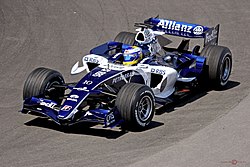
 Nico Rosberg driving the FW28 at the 2006 Canadian Grand Prix | |||||||||
| Category | Formula One | ||||||||
|---|---|---|---|---|---|---|---|---|---|
| Constructor | Williams | ||||||||
| Designers | Sam Michael (Technical Director) Jörg Zander (Chief Designer) Clive Cooper (Head of Design - Composites and Structures) Mark Loasby (Head of Design - Systems) Loïc Bigois (Chief Aerodynamicist) | ||||||||
| Predecessor | Williams FW27 | ||||||||
| Successor | Williams FW29 | ||||||||
| Technical specifications[citation needed] | |||||||||
| Chassis | Carbon-fibre and honeycomb composite structure | ||||||||
| Suspension (front) | Williams carbon-fibre double wishbone arrangement, with composite toe-link and pushrod-activated torsion springs | ||||||||
| Suspension (rear) | Williams carbon-fibre double wishbone arrangement, with composite toe-link and pushrod-activated torsion springs | ||||||||
| Engine | Cosworth CA2006 and Toyota RVX-06 (post-season testing only) 2.4-litre V8 (90°) naturally aspirated | ||||||||
| Transmission | Williams 7-speed seamless-shift sequential semi-automatic | ||||||||
| Power | 755 hp @ 19,250 rpm (314.7 hp/L)[1] | ||||||||
| Fuel | Petrobras | ||||||||
| Lubricants | Castrol | ||||||||
| Tyres | Bridgestone | ||||||||
| Competition history | |||||||||
| Notable entrants | Williams F1 Team | ||||||||
| Notable drivers | 9.  Mark Webber Mark Webber10.  Nico Rosberg Nico Rosberg | ||||||||
| Debut | 2006 Bahrain Grand Prix | ||||||||
| Last event | 2006 Brazilian Grand Prix | ||||||||
| |||||||||
| Constructors' Championships | 0 | ||||||||
| Drivers' Championships | 0 | ||||||||
The Williams FW28 was the car with which the Williams team competed in the 2006 Formula One season. The drivers were Mark Webber and rookie Nico Rosberg, the reigning GP2 Series champion. Webber was in his second year with the team, and teammate Nico Rosberg carried a hint of nostalgia, as Nico's father Keke had won the 1982 F1 championship in a Cosworth-engined Williams.
This was the first V8-powered Williams car since the FW12 in 1988 and also the first Williams car ran on Bridgestone tyres since the FW22 in 2000.
Season overview
[edit]2006 was very disappointing for the team. The car was dogged by a handling problem which affected the cars on the entry to corners. Despite the effectiveness of the Cosworth engine, the Bridgestone tyres and the two drivers, the FW28 could only display brief flashes of promise. Too often this promise was compromised by poor reliability - an embarrassment for a team that prided itself on engineering excellence.
The car seemed competitive at the beginning of the year when the cars scored a double points finish with Rosberg setting the fastest lap of the race on his F1 début at the Bahrain Grand Prix. An excellent second-row qualifying performance at Sepang was wasted when both cars suffered engine failures, and the season went downhill from there. Exceptions were Australia and Monaco, both races where Webber looked a contender for at least a podium finish until retiring on both occasions with hydraulics failure and an exhaust fire respectively.
A note of significance for Webber and Williams came on lap 21 of the 2006 Australian Grand Prix. By leading the lap Webber became the first Australian to have led his home grand prix since the last non-championship AGP was held in 1984.
Williams finished eighth in the Constructors' Championship - the team's lowest finish since its inaugural season in 1978. Unhappy by the team's reliability problems, Webber departed the team at the end of the season to join Red Bull Racing.
Livery
[edit]Williams went into the 2006 season with renewed major sponsorships such as Allianz, RBS, FedEx, Reuters, Oris, Hamleys, Budweiser, Petrobras and Castrol. The team received new sponsorships such as Mobilecast and Tata Group while Hewlett-Packard was discontinued. While it retained the dark blue on white scheme, the stylized "kidney grille" was gone from the nose with the loss of BMW as engine supplier.
FW28B
[edit]The Williams FW28B is an interim version of the FW28 the team used to prepare for the 2007 season. After an obviously disappointing 2006, Williams decided to opt for Toyota engines for 2007 and therefore built the FW28B. The car is similar to the FW28 in all aspects except for being powered by Toyota's 2006 engine, the RVX-06.
During winter practice, the team also experimented with new front wings and other aerodynamic parts which helped the development of their new car FW29 car.[2]
Gallery
[edit]-
 Mark Webber at the 2006 French Grand Prix.
 -
 Nico Rosberg at the 2006 Canadian Grand Prix.
 -
 Test driver Alexander Wurz at the 2006 Canadian Grand Prix.


Complete Formula One results
[edit](key) (results in italics indicate fastest lap)
| Year | Team | Engine | Tyres | Drivers | 1 | 2 | 3 | 4 | 5 | 6 | 7 | 8 | 9 | 10 | 11 | 12 | 13 | 14 | 15 | 16 | 17 | 18 | Points | WCC |
|---|---|---|---|---|---|---|---|---|---|---|---|---|---|---|---|---|---|---|---|---|---|---|---|---|
| 2006 | Williams | Cosworth V8 | B | BHR | MAL | AUS | SMR | EUR | ESP | MON | GBR | CAN | USA | FRA | GER | HUN | TUR | ITA | CHN | JPN | BRA | 11 | 8th | |
| Mark Webber
|
6 | Ret | Ret | 6 | Ret | 9 | Ret | Ret | 12 | Ret | Ret | Ret | Ret | 10 | 10 | 8 | Ret | Ret | ||||||
| Nico Rosberg
|
7 | Ret | Ret | 11 | 7 | 11 | Ret | 9 | Ret | 9 | 14 | Ret | Ret | Ret | Ret | 11 | 10 | Ret |
References
[edit]- Henry, Alan, ed. (2006). AUTOCOURSE 2006-2007. Crash Media Group. pp. 64–66. ISBN 1-905334-15-X.
- ^ Note 108. Cosworth 2006 Type CA Series 6 Eg SO25 grandprixengines.co.uk
- ^ "Williams FW28B". www.f1technical.net. Retrieved 25 November 2021.
External links
[edit] Media related to Williams FW28 at Wikimedia Commons


Williams FW28
View on GrokipediaBackground and Development
Regulatory Context
The 2006 Formula One World Championship operated under revised FIA technical and sporting regulations aimed at curbing escalating costs, improving safety, and fostering more competitive racing by standardizing certain components and limiting development freedoms. A pivotal change was the mandatory transition from 3.0-litre V10 engines to 2.4-litre V8 engines with a 90-degree cylinder bank configuration and four valves per cylinder. This shift reduced engine power by approximately 200 horsepower, dropping from around 950 bhp in 2005 V10s to about 750 bhp, as the smaller displacement and rev limits (capped at 19,000 rpm) curtailed peak output while emphasizing torque delivery for better drivability. The FIA permitted limited use of rev-restricted 2005-spec V10s for smaller teams like Toro Rosso to ease the transition, but customer teams such as Williams were required to adopt the new V8 formula. Tire regulations were relaxed to permit changes during races after a 2005 ban on mid-race swaps, with drivers limited to seven sets of dry-weather tires, four wet-weather sets, and three extreme wet sets per event. To promote parity, each driver was limited to one dry tire compound from the start of qualifying onwards, selected from those provided by their supplier (Bridgestone or Michelin), and teams could select their preferred manufacturer. Williams opted for Bridgestone tires, aligning with their sponsorship portfolio and anticipating better performance characteristics under the new engine rules. Aerodynamic modifications carried over from 2005 revisions continued to shape 2006 car designs, including raised front wings (minimum height increased to 150 mm) and simplified endplate configurations to minimize turbulent wake and facilitate overtaking. These rules banned overly aggressive ground-effect aids and restricted bodywork flexibility, such as limiting bargeboard complexity, to reduce downforce dependency and development spending without introducing entirely new prohibitions like those on double diffusers in later years. The regulatory overhaul directly influenced team strategies, notably for Williams, who terminated a nine-year engine supply partnership with BMW at the end of 2005—after BMW acquired Sauber to become a full works team—and partnered with Cosworth for the FW28's CA2006 V8 unit. This customer engine deal, secured amid a tight timeline, forced Williams to adapt their chassis and weight distribution around the new powerplant's characteristics, ending BMW's exclusive role in providing engines since 1997.Design Team and Process
The development of the Williams FW28 was overseen by Technical Director Sam Michael, who assembled a new core design team including Chief Designer Jörg Zander—recently recruited from BAR—and Chief Aerodynamicist Loïc Bigois, marking their first collaborative project at the team.[3][8] Significant contributions to the chassis and systems integration were provided by Clive Cooper and Mark Loasby.[9] This leadership structure emphasized a clean-sheet approach to adapt to the 2006 regulatory changes, particularly the mandated shift from 3.0-litre V10 to 2.4-litre V8 engines—the first such power unit for Williams since the FW12 in 1988.[3] The FW28 was unveiled on 27 January 2006 at Williams' Grove headquarters in Oxfordshire, England, following an intensive development timeline that leveraged two on-site wind tunnels dedicated exclusively to the project from its inception, enabling rapid iterative testing and correlation improvements over prior models.[10][3] A total of five chassis were constructed to support testing and racing demands.[2] The process prioritized aerodynamic efficiency to mitigate the inherent power deficit of the V8 configuration, incorporating advanced airflow management concepts like a tall sidepod design.[3] Key technical partnerships shaped the build: Williams secured a new engine supply from Cosworth for the CA2006 V8, integrated into a custom chassis after extensive dyno and track validation exceeding 7,000 km.[11] The team also returned to Bridgestone tires after five seasons with Michelin (2001–2005), necessitating revisions to suspension geometry and weight distribution for optimal grip.[3][10] To enhance overall performance, the FW28 featured a seven-speed seamless-shift transmission, projected to deliver up to 0.4 seconds of lap time advantage through faster gear changes.[3] These elements addressed core challenges in transitioning from V10 power and adapting to stricter FIA bodywork rules, focusing on balanced efficiency rather than raw output.[3]Technical Specifications
Chassis and Aerodynamics
The chassis of the Williams FW28 consisted of a carbon-fibre monocoque structure, incorporating honeycomb composites for enhanced strength and lightness, with an overall weight of approximately 605 kg including the driver.[2] This design adhered to the 2006 FIA regulations, prioritizing structural integrity while integrating the narrower 2.4-litre V8 engine for improved weight distribution.[3] Key dimensions contributed to balanced handling under the era's aerodynamic constraints.[3] Aerodynamic innovations focused on optimizing airflow and downforce efficiency, featuring a zero-keel front wishbone arrangement to minimize turbulence and promote cleaner air to downstream elements.[3] The front wing employed a cascaded profile, while the rear wing incorporated decambered tips to reduce induced drag without sacrificing grip; additionally, tall sidepods with pronounced undercuts facilitated smoother airflow toward the diffuser, enhancing overall downforce-to-drag ratio.[3] These elements aimed to offset the power limitations of the 2006 V8 rules by emphasizing mechanical and aerodynamic grip.[3] The suspension system utilized a double wishbone configuration, with pushrod actuation at the front and rear, both employing inboard torsion bars for precise control and packaging efficiency.[2] Braking was handled by ventilated carbon discs and calipers, providing robust stopping power suited to the car's high-speed demands.[2]Engine and Drivetrain
The Williams FW28 was powered by the Cosworth CA2006, a 90° V8 engine with a displacement of 2,398 cc, naturally aspirated configuration, and a minimum weight of 95 kg as mandated by 2006 FIA regulations.[3] This unit featured a pneumatic valve train with dual overhead camshafts (DOHC), four valves per cylinder, and construction from aluminum alloy for both the block and heads, enabling high-revving operation up to 19,250 rpm where it produced 755 hp.[12] The engine marked Williams' return to Cosworth powerplants, the first such partnership since 1988, following the conclusion of their BMW V10 collaboration that had supplied engines from 2000 to 2005.[4] The drivetrain incorporated a Williams-developed 7-speed seamless-shift sequential semi-automatic gearbox, mounted longitudinally with a carbon-fiber clutch for rapid shifts that could save up to 0.4 seconds per lap compared to non-seamless systems.[3] OZ Racing supplied the wheels, complementing Bridgestone tires under the new tire supplier rules.[3] Fuel was provided by Petrobras, with Castrol supplying lubricants, continuing long-standing technical partnerships that supported the power unit's reliability during the season.[1] In performance terms, the CA2006's output represented a roughly 20% reduction from the prior 3.0-liter V10 era due to the displacement limit, adversely affecting acceleration while achieving competitive top speeds on high-speed tracks.[13] To mitigate the power deficit, aerodynamic enhancements were pursued to improve straight-line efficiency.[3]Livery and Sponsorship
Visual Design
The Williams FW28 featured a livery that marked a notable evolution in the team's visual identity, shifting to a predominantly dark blue base with white accents as an adaptation for the new title sponsorship from Petrobras. This represented a departure from the BMW-era schemes of the early 2000s, which emphasized white and silver tones with blue highlights, toward a bolder emphasis on the team's heritage "Grove blue" to align with the Brazilian oil giant's partnership. The design retained subtle white elements from prior seasons, such as chevron patterns and nose flashes, to maintain continuity while prioritizing the darker hue for a more aggressive aesthetic.[14][15] Key visual elements included an aggressive "barbed sting" motif on the engine cover, which served as both a stylistic flourish and an integration point for aerodynamic features like the rear wing supports. Sponsor logos were prominently integrated across the car's body, with major placements on the nose cone for visibility during starts, along the sidepods for trackside exposure, and on the rear wing endplates for broadcast prominence. This layout ensured branding was optimized without compromising the car's sleek profile. The livery was unveiled alongside the FW28 at the team's Grove headquarters on January 27, 2006, receiving praise for its purposeful and modern appearance.[10][16] The livery was applied using vinyl wraps directly onto the carbon fiber chassis, a method chosen for its lightweight properties—adding minimal mass compared to traditional paint—and enhanced durability against the rigors of racing, including high-speed debris and environmental exposure. This approach allowed for precise application over complex aerodynamic surfaces while facilitating easy updates or repairs during the season.[17]Key Sponsors
The Williams FW28 entered the 2006 Formula One season backed by Petrobras as its title sponsor, the Brazilian state-owned oil company that had been a technical partner since 1998, supplying specialized race fuels developed through joint research and testing facilities in Brazil and South America. In March 2005, the partnership was extended for three years, broadening Petrobras's role to include enhanced fuel engineering support amid new regulations requiring engines to last two race weekends. This arrangement not only provided critical technical resources but also influenced the team's livery with blue elements reflective of the sponsor's branding, as detailed in the Visual Design section.[18] Major sponsors complemented Petrobras's contributions, with Allianz, the German multinational insurance and financial services firm, continuing a sponsorship that dated back to 2000 and emphasizing risk management alignment with the high-stakes nature of racing. The Royal Bank of Scotland (RBS) joined as a key financial partner in January 2005 under a three-year agreement valued in the multi-millions, bolstering the team's global branding efforts. Logistics provider FedEx maintained its involvement from a 2002 three-year deal that was renewed, supporting supply chain operations for the team's international logistics needs. Castrol, the British lubricant brand under BP, extended its long-term technical partnership originating in 1997, supplying high-performance oils essential for the Cosworth engine's reliability.[19][20][21][22] These sponsorships played a pivotal role in the team's finances, covering the approximately $18 million cost of transitioning from free BMW engines to paid Cosworth V8 supplies following the 2005 partnership dissolution and a season where Williams finished fifth with 66 points.[23][24] The revenue influx stabilized operations amid the engine switch's budgetary strain, enabling investments in development such as an additional $18 million contribution to Cosworth's CA engine program. Logos from these partners, along with others like Reuters for information services, were positioned for optimal visibility under FIA advertising guidelines to maximize brand exposure during broadcasts and events. Most agreements were multi-year, with Petrobras, RBS, and Allianz deals carrying over into 2007 to support the FW28B variant's testing and limited use.[25]2006 Season Performance
Drivers and Pre-Season Testing
The Williams FW28 was driven by Australian Mark Webber and German rookie Nico Rosberg during the 2006 Formula One season. Webber, entering his first full year with the team after stints at Jaguar (2002–2004) and [Red Bull Racing](/page/Red Bull Racing) (2005), brought experienced midfield consistency to the lineup. Rosberg, aged 21, made his Formula One debut as the 2005 GP2 Series champion and son of 1982 World Champion Keke Rosberg, who had secured the title driving for Williams; the team viewed his youth and pedigree as key to long-term development potential. The reserve and test driver roster, including Alexander Wurz, remained unchanged throughout the season, providing stable support during preparation.[3][14] Pre-season testing commenced with a shakedown run at the Valencia circuit on January 31, 2006, where the FW28 completed its initial validation laps without major incidents, focusing on basic systems integration ahead of more intensive sessions. The program then shifted to the Circuito de Jerez in southern Spain for multiple days in early February, emphasizing Cosworth CA2006 V8 engine reliability—described by Webber as impressively consistent in power delivery—and adaptation to Bridgestone tires under the new regulations. These sessions allowed the team to accumulate significant mileage, with Rosberg demonstrating early promise by posting competitive times, including fourth place on the timesheets with a 1:18.735 lap over 84 laps on February 7.[16][26] Key February sessions at Jerez underscored the FW28's seamless shift gearbox as a reliability advantage, enabling smooth progression through development programs despite two mechanical stoppages encountered by the drivers. However, aerodynamic setup challenges emerged in varying conditions, including intermittent rain that affected track grip and balance, with Webber completing high-volume runs like 86 laps at 1:18.281 on February 9 while highlighting the need for further optimization to address handling inconsistencies. Overall, the testing phase built confidence in the car's mechanical robustness, setting a foundation for the season without major reserve driver disruptions.[27][26]Race-by-Race Results
The Williams FW28 contested all 18 rounds of the 2006 Formula One World Championship, from the Bahrain Grand Prix on March 12 to the Brazilian Grand Prix on October 22, scoring a total of 11 points to finish 8th in the Constructors' Championship.[7] The team achieved no race wins or pole positions but recorded one fastest lap, set by Nico Rosberg during the season-opening Bahrain Grand Prix.[28] Reliability issues plagued the car throughout the year, contributing to 25 retirements across the two drivers, often due to mechanical failures such as hydraulic problems, engine blow-ups, and transmission faults.[29]| Race | Date | Webber Position/Points | Rosberg Position/Points | Team Notes |
|---|---|---|---|---|
| Bahrain GP | Mar 12 | 6th / 3 | 7th / 2 (Fastest Lap) | Strong start for rookie Rosberg; team scores 5 points.[28] |
| Malaysian GP | Mar 19 | DNF (Hydraulics) / 0 | DNF (Engine) / 0 | Double mechanical retirement.[30] |
| Australian GP | Apr 2 | DNF (Transmission) / 0 | DNF (Collision) / 0 | Gearbox failure for Webber; Rosberg out after contact. |
| San Marino GP | Apr 23 | 6th / 3 | 11th / 0 | Webber's solid recovery to points.[31] |
| European GP | May 7 | DNF (Hydraulics) / 0 | 7th / 2 | Rosberg's best finish of the season.[32] |
| Spanish GP | May 14 | 9th / 0 | 11th / 0 | No points; midfield battle. |
| Monaco GP | May 28 | DNF (Exhaust) / 0 | DNF (Accident) / 0 | Webber running 3rd before failure; pole contender from 2nd on grid.[33] |
| British GP | Jun 11 | DNF (Collision) / 0 | 9th / 0 | Rosberg persists to finish.[34] |
| Canadian GP | Jun 25 | 12th / 0 | DNF (Collision) / 0 | Chaotic race; no points.[35] |
| United States GP | Jul 2 | DNF (Collision) / 0 | 9th / 0 | Midfield result; no points. |
| French GP | Jul 16 | DNF (Tyre) / 0 | 14th / 0 | Mechanical woes continue. |
| German GP | Jul 30 | DNF (Engine) / 0 | DNF (Accident) / 0 | Double DNF at home race for Rosberg. |
| Hungarian GP | Aug 6 | DNF (Hydraulics) / 0 | DNF (Electrics) / 0 | Reliability hits hard. |
| Turkish GP | Aug 27 | 10th / 0 | DNF (Hydraulics) / 0 | No points.[36] |
| Italian GP | Sep 10 | 10th / 0 | DNF (Driveshaft) / 0 | Mechanical failure for Rosberg. |
| Chinese GP | Oct 1 | 8th / 1 | 11th / 0 | Webber's final point. |
| Japanese GP | Oct 8 | DNF (Accident) / 0 | 10th / 0 | No points. |
| Brazilian GP | Oct 22 | DNF (Collision) / 0 | DNF (Accident) / 0 | Season ends with retirements. |