Hubbry Logo
search
logo
2205437

Wind chime

logo
Community Hub0 Subscribers
Read side by side
from Wikipedia
A metal wind chime

Wind chimes are a type of percussion instrument constructed from suspended tubes, rods, bells, or other objects that are often made of metal or wood. The tubes or rods are suspended along with some type of weight or surface which the tubes or rods can strike when they or another wind-catching surface are blown by the natural movement of air outside.

They are usually hung outside of a building or residence as a visual and aural garden ornament. Since the percussion instruments are struck according to the random effects of the wind blowing the chimes, wind chimes have been considered an example of chance-based music. The tubes or rods may sound either indistinct pitches, or fairly distinct pitches. Wind chimes that sound fairly distinct pitches can, through the chance movement of air, create simple songs or broken chords.

History

[edit]

Ancient Rome

[edit]
Bronze tintinnabulum, Roman, 1st century AD, British Museum.

Ancient Roman wind chimes, usually made of bronze, were called tintinnabula and were hung in gardens, courtyards, and porticoes where wind movement caused them to tinkle. Bells were believed to ward off malevolent spirits and were often combined with a phallus, which was also a symbol of good fortune and a charm against the evil eye.[1] The image shows one example with a phallus portrayed with wings and the feet of an animal, and a phallus for a tail. These additions increased its protective powers.[2]

Eastern and Southern Asia

[edit]
Wind-powered bell or wind chime under temple eaves,. Banna-ji. Ashikaga, Tochigi. Japan

In India during the second century CE, and later in China, extremely large pagodas became popular with small wind bells hung at each corner; the slightest breeze caused the clapper, which was also made of bronze, to swing, producing a melodious tinkling. It is said that these bells were originally intended to frighten away not only birds but also any lurking evil spirits. Wind bells are also hung under the corners of temple, palace and home roofs; they are not limited to pagodas.[3] Japanese glass wind bells known as fūrin (風鈴) have been produced since the Edo period,[4] and those at Mizusawa Station are one of the 100 Soundscapes of Japan. Wind chimes are thought to be good luck in parts of Asia and are used in Feng Shui.

Wind chimes started to become modernized around 1100 C.E. after the Chinese began to use metal casting to create bells. A bell without a clapper, called a yong-zhong, was crafted by skilled metal artisans and primarily used in religious ceremonies. Afterwards, the Chinese created the feng-ling (風鈴), which is similar to today's modern wind bell. Feng-lings were hung from shrines and pagodas to ward off evil spirits and attract benevolent ones. Today, wind chimes are common in the East and used to maximize the flow of chi, or life's energy.

Sounds and music

[edit]
Wind chime with the audible tones a1-d2-f2-g2-a2-d3-f3-a3. The bamboo cylinder is not only the case of the instrument, but at the same time it is the resonator. The eight tones are produced by eight metal rods within the cylinder which are centrally struck by a disk attached to the cord with the wind sail.

Chimes produce inharmonic (as opposed to harmonic) spectra, although if they are hung at about 2/9 of their length[5] (22.4%[6][7]), some of the higher partials are damped and the fundamental rings the loudest.[7] This is common practice in high-quality wind chimes, which are also usually hung so the centre ball strikes the centre of the wind chime's length, also resulting in the loudest sounding fundamental.[7] Frequency is determined by the length, width, thickness, and material. There are formulas[7] that help predict the proper length to achieve a particular note, though a bit of fine tuning is often needed.

Most chimes employ pentatonic or tetratonic scales as the basis for the pitches of their individual chimes as opposed to the traditional western heptatonic scale. This is largely due to the fact that these scales inherently contain fewer dissonant intervals, and therefore sound more pleasant to the average listener when notes are struck at random.

In instruments such as organ pipes, the pitch is determined primarily by the length of the air column, because it is the resonance of the air column that generates the sound. The pipe material helps determine the "timbre" or "voice" of the pipe, but the air column determines the pitch. In a wind chime, the vibrations of the pipe itself radiate the sound after being struck, so the air column has little to do with the pitch being produced.

Sound can be produced when the tubes or rods come in contact with a suspended central clapper in the form of a ball or horizontal disk, or with each other.

Wind chimes may be used to observe changes in wind direction, depending on where they are hung when they commence to sound.

Materials

[edit]
A close-up of metal rods on a wind chime

Wind chimes can be made of materials other than metal or wood and in shapes other than tubes or rods. Other wind chimes materials include glass, bamboo, shell, stone, earthenware, stoneware, beads, keys and porcelain.[8] More exotic items, such as silverware or cookie cutters, can also be recycled (or upcycled) to create wind chimes.[9] The selected material can have a large effect on the sound a wind chime produces. The sounds produced by recycled objects such as these are not as easily tunable to specific notes and range from pleasant tinkling to dull thuds. The sounds produced by properly sized wind chime tubes are tunable to notes.[7] As aluminum is the common metal with the lowest internal damping, wind chimes are often made from aluminum to achieve the longest and loudest sounding chime.

The tone depends on factors such as the material used, the exact alloy, heat treatment, and whether a solid cylinder or a tube is used. If a tube is used, the wall thickness also affects the tone. Tone may also depend on the hanging method. The tone quality also depends on the material of the object that is used to hit the chimes.

With clay wind chimes, the higher the final firing temperature, the brighter and more ringing the resulting tone. Earthenware clay fired at lower temperatures produces a duller sound than stoneware clay fired at higher temperatures. Stoneware wind chimes are also more durable and able to resist stronger winds without suffering chipping or damage.

Mathematics of tubular wind chimes

[edit]
The mode 1 (lowest frequency) vibration of a free Euler–Bernoulli beam of length 1

A wind chime constructed of a circular tube may be modelled as a freely vibrating Euler–Bernoulli beam[10] and the dominant frequency in cycles per second is given by:
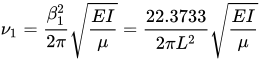
where L is the length of the tube, E is the Young's modulus for the tube material, I is the second moment of area of the tube, and μ is the mass per unit length of the tube. Young's modulus E is a constant for a given material. If the inner radius of the tube is ri and the outer radius is ro, then the second moment of area for an axis perpendicular to the axis of the tube is:
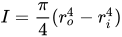
The mass per unit length is:

where ρ is the density of the tube material. The frequency is then
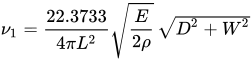
where W=ro-ri is the wall thickness and D is the average diameter D=ro+ri. For sufficiently thin-walled tubes the W2 term may be neglected, and for a given material, the main frequency is inversely proportional to L2 and proportional to the diameter D.

For the main mode of vibration, there will be two nodes on the tube, where the tube is motionless during the vibration. These nodes will be located at a distance of 22.416% of the length of the tube from each end of the tube. If the tube is simply supported (not clamped) at one or both of these nodes, the tube will vibrate as if these supports did not exist. A wind chime will give the clearest and loudest tone when it is hung using one of these node points as the attachment point. These attachment points are also the same as used by other similar instruments such as the xylophone and glockenspiel.

Use in music

[edit]
David Sitek with a wind chime suspended from his guitar

Different types of wind chimes have also been used in modern music and are listed as a percussion instrument. The following is a brief list of artists and composers who have used them:

Influence

[edit]
  • The Japanese video game franchise Pokémon used the Japanese fūrin wind chimes as the basis for the Pokémon Chimecho. Its in-game cry reflects this, as it sounds like three high-pitched bells chiming one after the other.
  • Mark trees are often mistakenly called wind chimes, but they are different instruments, though with a basic similar structure consisting of tubes of differing lengths that are meant to produce a tinkling or chiming sound.[citation needed]
[edit]

See also

[edit]

References

[edit]
[edit]
Revisions and contributorsEdit on WikipediaRead on Wikipedia
from Grokipedia
A wind chime is a type of percussion instrument consisting of suspended tubes, rods, bells, or other objects, typically made from materials such as metal, wood, clay, stone, or glass, that produce melodic or rhythmic sounds when moved by the wind.[1][2] The origins of wind chimes trace back to ancient China during the Bronze Age (ca. 1600–1046 BCE), where early forms evolved from ritual bells (zhong) and stone chimes (qing) cast in bronze or carved from jade, used in ceremonial music to invoke cosmology and ensure state stability.[2] These instruments, suspended in sets on frames, were prominent in Zhou dynasty (1046–256 BCE) rituals and continued in court ceremonies through the Qing dynasty (1644–1911 CE), with examples like a 1716 jade qing chime demonstrating their enduring role.[2] In East Asian cultures, wind chimes hold deep cultural significance, particularly in China and Japan, where they are integrated into spiritual practices to ward off evil spirits and harmonize environmental energies.[3][4][5] Known as fengling in Chinese, they originated around 1100 BCE as religious objects hung in temples to ward off evil spirits, and later adapted in Feng Shui to balance qi (energy) by easing tensions between wind and water, often using designs with five metal rods to deflect negative influences like "poison arrows" from architectural beams.[4][5] In Japan, during the Edo period (1603–1868), furin—glass wind chimes—emerged as summer symbols, traditionally employed by temples for protection and now decorated with motifs like Mount Fuji or fireworks to evoke seasonal tranquility and cultural heritage.[3] Today, wind chimes blend historical craftsmanship with modern aesthetics, crafted from diverse materials like stoneware clay, obsidian, antlers, and driftwood to create varied tones for gardens and outdoor spaces, promoting auditory harmony and reflection.[1]

Overview

Definition and Purpose

A wind chime is a type of percussion instrument consisting of suspended tubes, rods, bells, or other objects that produce sound when agitated by the wind.[6][7] These instruments are typically hung from a frame or support, allowing the wind to cause the elements to strike against one another or a central clapper, generating gentle, resonant tones.[8] The term "wind chime" derives from the English words "wind" and "chime," with "chime" denoting the harmonious ringing sound produced.[9] Related names include "wind bell," emphasizing the bell-like qualities in some designs, and the Japanese "fūrin," which literally translates to "wind bell" from the characters (wind) and rin (bell).[10] Their origins trace back to ancient Asia, where early forms served ritualistic roles.[11] Wind chimes serve multiple primary purposes, functioning as ornamental decorations in gardens, porches, or homes to enhance aesthetic appeal and create serene environments.[8] They also produce ambient or chance-based music, where unpredictable wind movements yield improvised, soothing soundscapes that promote relaxation.[12] Historically, they have been employed to ward off evil spirits through their tinkling sounds, believed to disrupt malevolent forces, or for signaling changes in weather or alerting to wind presence.[13][14] Wind chimes are distinguished by whether they are tuned or untuned: tuned versions are precisely calibrated to specific musical pitches, enabling melodic sequences, while untuned ones generate a cluster of indistinct, random tones for atmospheric effect.[15][16] This variation allows them to bridge decorative art and sonic artistry, appealing to both visual and auditory senses.

Basic Components and Operation

A wind chime consists of several essential components that work together to produce sound. The primary elements include suspended tubes, rods, or bells that serve as the sounding bodies; a striker or clapper, which is a central object designed to impact these suspended elements; a hanger or frame that supports the entire assembly; and a wind-catching sail or platform that initiates movement.[17][18] In operation, gentle breezes catch the sail, causing it to sway and pull the attached striker into contact with the suspended elements. This impact sets the elements into vibration, generating audible sound waves as the vibrations propagate through the material. The process relies on the kinetic energy from the wind being transferred mechanically from the sail to the striker and then to the elements, with the striker typically hanging centrally to ensure even strikes across multiple tubes or rods.[17][18] Several factors influence the effectiveness of this operation. Wind speed and direction determine the force applied to the sail—force increases with the square of wind speed, so even moderate gusts can produce significant motion[19]—while turbulent or single-direction winds may require adjusted sail designs for consistent strikes. Suspension methods are critical; elements are hung at nodal points, approximately 22.4% from each end, to minimize damping and allow vibrations to sustain longer without energy loss from friction or rigid supports. Environmental placement also plays a role, with outdoor positions exposing the chime to natural breezes for optimal performance, whereas indoor settings may limit motion due to reduced airflow, often necessitating proximity to vents or fans.[17][18] The vibrations initiated by the striker propagate as transverse waves along the length of the suspended elements, where the material bends perpendicular to the wave's direction of travel, creating the characteristic resonant tones. A variety of materials can be used for these components, influencing both durability in outdoor conditions and the resulting tone quality.[17][20]

History

Origins in Ancient Asia

The earliest known wind chimes date back to approximately 3000 BCE, with archaeological evidence from sites in Southeast Asia revealing primitive versions crafted from bone, wood, bamboo, and shells. These early instruments were primarily used for protective purposes, believed to ward off evil spirits and signal the presence of benevolent forces through their resonant sounds carried by the wind.[21][22] In China, during the Bronze Age around 2000 BCE and particularly from the Shang Dynasty (ca. 1600–1046 BCE), wind chimes evolved into more sophisticated bronze bells, such as the nao and zhong types, which were suspended in sets and played a central role in ritual music. These bells were hung in temples and royal palaces to accompany ceremonial ensembles, invoking ancestral spirits and maintaining cosmic harmony during offerings and political rites. By the Zhou Dynasty (1046–256 BCE), tuned sets of bronze bells became essential in court and temple rituals, often arranged in elaborate frames to produce harmonious tones that symbolized order and divine favor.[2][23] With the spread of Buddhism to China around the 1st-2nd century CE, wind bells were affixed to the eaves of temples to create melodic chimes in the breeze, serving dual purposes of deterring birds from sacred spaces and repelling malevolent spirits. This integration reflected broader Buddhist traditions of using sound to purify environments and invoke protection, with bells becoming a common feature in temple architecture across Asia.[24][25] In traditional Chinese feng shui, wind chimes have long been employed to enhance the flow of chi (vital energy) and dispel negative influences, with strategic placements in homes and gardens—such as near entrances or in open courtyards—to activate positive energies and harmonize surroundings. This practice draws from ancient principles dating back over 3,000 years, where the chimes' tones were thought to break up stagnant air and sha chi (harmful energy), promoting balance and prosperity.[26] Japanese adaptations of wind chimes began in the 6th–7th centuries CE, introduced via Buddhism from China, where metal bells known as futaku were hung from temple eaves to safeguard against evil and produce soothing sounds during rituals. By the Edo period (1603–1868), these evolved into fūrin, often featuring glass elements, which served as auditory signals for summer cooling, evoking a sense of relief through their gentle tinkling in the heat.[27][28]

Development in Other Cultures

The adaptation of wind chimes in the Roman Empire represents one of the earliest known developments outside Asia, dating to the 1st century CE. Known as tintinnabula, these devices consisted of bronze bells suspended from a central phallic figurine, often featuring exaggerated erect phalluses or hybrid creatures like winged lions or horses, designed to produce sound when moved by the wind. Archaeological evidence from sites in Pompeii, such as doorways and shop counters in Regio VI and I.6.3, reveals at least 30 examples from the Vesuvian area, with bells typically 3-4 cm in diameter and attached via chains or loops under the glans or on limbs. These artifacts, predating the 79 CE eruption of Vesuvius, were strategically placed at entrances and baths for apotropaic purposes, warding off the evil eye and malevolent forces through their jingling sounds and symbolic imagery.[29][30] Through Roman trade networks and later the Silk Road, the concept of wind-activated bells influenced Middle Eastern cultures, contributing to the broader exchange of musical instruments across Eurasia. As part of this diffusion, bells and chime-like devices were integrated into regional practices. This cultural borrowing extended to African regions connected by trans-Saharan and Indian Ocean trade, where similar sound-producing objects facilitated signaling and ritual uses.[31] In medieval and Renaissance Europe, smaller wind chimes reemerged as garden ornaments, often inspired by Asian designs or continuing Roman apotropaic traditions. Examples from Roman Britain, including phallic variants found in military and domestic sites, demonstrate continuity of the apotropaic role into northern European contexts.[32]

Evolution in the Modern Era

The industrialization of wind chime production in the 19th and early 20th centuries marked a shift from artisanal crafting to more standardized manufacturing in Europe and America, where metal and glass variants were introduced as garden ornaments through colonial trade routes. European settlers adapted these items, often producing them using basic metalworking techniques to create decorative pieces that enhanced outdoor aesthetics, reflecting Victorian-era interests in ornamental gardening.[33] In America, similar developments occurred, with wind chimes gaining traction as affordable accents for homes and patios, though large-scale mechanization remained limited until later decades.[22] A significant advancement came in the mid-to-late 20th century with the introduction of precision-tuned wind chimes, pioneered by companies like Woodstock Chimes in the 1970s. Founded by musician Garry Kvistad, Woodstock began experimenting with discarded materials in an Illinois landfill before establishing a factory in New York in 1979, where the first commercially successful tuned model, Chimes of Olympos, was sold at craft fairs. This innovation leveraged emerging computer-controlled machinery in the 1970s and 1980s to enable affordable mass production of tuned metal tubes, transforming wind chimes from simple tinklers into musical instruments accessible to broader audiences.[34] Post-World War II, their popularity surged in Western gardens, influenced by mid-century modern design's emphasis on clean lines and natural harmony, alongside increased imports of Japanese fūrin that blended traditional craftsmanship with contemporary decor.[33] Entering the 21st century, wind chime trends have emphasized sustainability and personalization, with DIY kits becoming widely available through retailers like Amazon and Etsy, allowing users to assemble and customize chimes from provided components such as tubes, strings, and strikers. Eco-friendly materials, particularly recycled metals like aluminum, have gained prominence; for instance, Woodstock Chimes now uses recycled aluminum, which requires 95% less energy to process than virgin material, aligning with broader environmental consciousness in manufacturing. Large-scale public art installations have also proliferated, exemplified by the Milwaukee Makerspace's 2011 project featuring giant wind chimes made from extended metal tubes that produce prolonged, resonant tones lasting over a minute.[35][36] As of 2025, innovations include solar-powered wind chimes that incorporate LED lights for nighttime visibility and smart integrations for customizable sounds, reflecting ongoing emphasis on eco-friendliness and technology.[37] Digital media has further shaped perceptions, integrating wind chimes into virtual and auditory experiences. The Pokémon character Chimecho, introduced in 2002, draws direct inspiration from Japanese fūrin wind chimes, popularizing their ethereal sound in global pop culture among gamers. In sound design, wind chimes feature prominently in ambient music applications, such as Super Real Wind Chime and myNoise's Japanese Garden generator, where simulated or recorded chime sounds create relaxing atmospheres for meditation and relaxation apps.[38][39]

Design and Materials

Types of Wind Chimes

Wind chimes are classified primarily by their form and structure, which determine the manner in which they produce sound through wind activation, as well as by whether they are tuned to specific musical intervals or designed for untuned ambient effects.[40] Common forms include tubular, rod or bar, and bell or shell configurations, each offering distinct acoustic characteristics based on their geometry.[41] Tubular chimes consist of suspended hollow cylinders, typically arranged in a cluster and struck by a central clapper or wind catcher, producing resonant, bell-like tones due to their elongated shape that allows for sustained vibrations.[40] Subtypes include Corinthian bells, which feature six hand-tuned aluminum tubes suspended centrally for harmonious chords, often in scales like pentatonic, creating a rich, orchestral quality.[42] Cluster styles, such as those with radial strikers, enable multiple tubes to be activated simultaneously, generating chordal effects from grouped elements.[40] Rod or bar chimes employ solid rods or flat bars, usually hung in a line or frame, which yield shorter, more percussive sounds compared to tubular designs because of their denser structure that limits resonance duration.[40] These are often crafted from wood or metal alloys, providing a crisp, rhythmic clatter suitable for decorative emphasis rather than melodic play.[43] Bell or shell chimes utilize traditional bell shapes or natural elements like seashells, focusing on tinkling or clinking effects from lighter, more irregular forms that create delicate, non-resonant noises.[41] For instance, the Japanese fūrin is a small, bowl-shaped bell with a hanging clapper and paper strip, designed to produce a soft, cooling chime in breezes.[27] Shell variants, such as those made from capiz oyster shells, feature layered, translucent pieces that generate a gentle, oceanic rustle when moved by wind.[44] Wind chimes are further distinguished as tuned or untuned based on their pitch organization. Tuned chimes are calibrated to musical scales, with pentatonic arrangements being prevalent for their consonant, calming harmonies that align with natural overtones.[40] Untuned chimes, by contrast, produce random, atonal sounds without fixed pitches, emphasizing ambient texture over melody.[41] Hybrid forms, like clustered sculptural chimes, blend these approaches by incorporating tuned elements within artistic, non-linear structures for varied sonic experiences.[40] Material choices, such as metal for rods versus bamboo for tubes, can influence suitability for these types by affecting durability in wind exposure.[40]

Common Materials and Their Properties

Wind chimes are frequently made from metals, which provide robust durability and clear acoustic resonance due to their high elasticity and density variations. Aluminum is a popular choice for its lightweight nature (density of 0.098 lb/in³) and weather resistance when anodized or coated, producing bright, crisp tones with extended sustain owing to its relatively low Young's modulus of 10 million psi, which allows easier vibration excitation and louder sound output compared to denser metals.[17] Bronze, valued for its historical application in ancient chimes, delivers warm, resonant tones through its balanced density (around 0.29 lb/in³) and elasticity (approximately 16 million psi), while offering excellent corrosion resistance that develops a protective patina over time.[45] Copper and brass, with densities of 0.323 lb/in³ and 0.308 lb/in³ respectively, generate mellow, bell-like sounds with good sustain; copper's natural patina enhances environmental durability, whereas brass provides a brighter timbre and requires shorter tube lengths for equivalent pitches due to its higher elasticity (17 million psi).[17] Natural materials like bamboo and wood contribute soft, organic tones but are generally less durable outdoors without protective treatments. Bamboo, with its hollow structure and anisotropic properties, produces hollow, echoing sounds through efficient vibration along its longitudinal fibers, though its lower density and variable moisture absorption limit longevity compared to metals; its speed of sound and radiation efficiency make it suitable for subtle, natural resonances in traditional designs.[46] Wood, such as oak or cedar used for tubes or strikers, yields warm, subdued tones influenced by grain direction and density (typically 0.02–0.05 lb/in³), with elasticity varying by species to affect vibration decay; however, it is biodegradable and prone to warping or rot unless sealed against UV and moisture.[46] Shells and glass offer delicate, high-pitched tinkling effects from their brittle, high-density compositions (glass around 0.094 lb/in³, shells varying with calcium carbonate structure), creating ethereal sounds via rapid, short-lived vibrations, but they are fragile and susceptible to cracking in harsh weather.[47] Modern synthetic materials, including recycled plastics and composites, enable affordable and customizable wind chimes with variable resonance tailored to decorative rather than precise musical applications. Recycled plastics, often polyethylene or polypropylene blends, provide lightweight (density 0.033–0.036 lb/in³) and rust-proof construction for environmental resistance, though their lower elasticity leads to damped, less sustained tones compared to metals; composites incorporating fillers can enhance vibration properties for more consistent acoustics.[48] In comparisons, denser metals like steel (0.284 lb/in³, 30 million psi Young's modulus) yield deeper pitches and longer tubes for the same frequency than lighter aluminum, while all metals outperform natural materials in durability and sustain; elasticity directly influences vibration amplitude and tone richness, with weatherproofing (e.g., galvanizing for steel) essential for outdoor use across categories.[17]

Physics and Acoustics

Mechanisms of Sound Production

Sound production in wind chimes begins with the striker, often a central clapper, colliding with the suspended elements such as tubes or rods, which excites vibrational modes within the material. This impact initiates transverse waves that propagate along the length of the element, primarily through bending deformations where the material flexes perpendicular to its axis. These bending modes are the dominant mechanism for vibration, with the striker's force causing the element to oscillate in patterns determined by its geometry and material properties.[49][50] The excited vibrations lead to resonance at the element's natural frequencies, consisting of a fundamental frequency and a series of overtones. In typical wind chimes, these tones are inharmonic, meaning the overtones do not form integer multiples of the fundamental, resulting in the characteristic bell-like or complex timbre distinct from purely harmonic sounds in tuned instruments. Tuned wind chimes, however, are designed to emphasize harmonic overtones for more musical consonance. Environmental factors influence the duration and quality of these resonances; damping occurs due to air resistance and interactions at the suspension points, which can shorten vibration if not positioned correctly. Optimal suspension at approximately 22.4% of the element's length from the top aligns with the nodal point of the fundamental bending mode, minimizing energy loss and maximizing sustained vibration.[51][40] Once initiated, the transverse vibrations of the element couple with the surrounding air through multiphysics interactions between the solid structure and fluid medium, generating longitudinal pressure waves that propagate outward as audible sound. These sound waves consist of alternating compressions and rarefactions in the air, with the tube's upward bends producing compressions and downward bends creating rarefactions, allowing the acoustic energy to radiate efficiently. Material choice briefly influences tone quality by affecting wave speed and damping rates, with metals like aluminum yielding brighter, longer-sustaining sounds compared to bamboo.[49][50]

Mathematical Modeling of Frequencies

The acoustics of tubular wind chimes are primarily governed by the flexural vibrations of cylindrical tubes modeled as slender beams under Euler-Bernoulli theory, which assumes small deflections and neglects shear deformation and rotary inertia.[52] The governing partial differential equation for transverse displacement w(x,t)w(x,t) is derived from Newton's second law and beam bending moments:
μ2wt2+EI4wx4=0, \mu \frac{\partial^2 w}{\partial t^2} + EI \frac{\partial^4 w}{\partial x^4} = 0,
where μ\mu is the mass per unit length, EE is Young's modulus, and II is the second moment of area.[18] Applying separation of variables, w(x,t)=W(x)T(t)w(x,t) = W(x) T(t), yields the spatial solution involving hyperbolic and trigonometric functions, with boundary conditions for a free-free beam (appropriate for lightly suspended tubes) requiring zero moment and shear at both ends: d2Wdx2=0\frac{d^2 W}{dx^2} = 0 and d3Wdx3=0\frac{d^3 W}{dx^3} = 0 at x=0x=0 and x=Lx=L. This leads to the characteristic equation whose roots βnL\beta_n L determine the mode frequencies.[52] The natural frequency for the nnth mode is
fn=(βnL)22πL2EIμ, f_n = \frac{(\beta_n L)^2}{2\pi L^2} \sqrt{\frac{EI}{\mu}},
where βnL\beta_n L are eigenvalues (e.g., 4.730, 7.853, 10.996 for the first three modes of a free-free beam).[18] For the fundamental frequency (dominant in wind chimes), f13.56L2EIμf_1 \approx \frac{3.56}{L^2} \sqrt{\frac{EI}{\mu}}, with LL the tube length, μ=ρA\mu = \rho A ( ρ\rho density, AA cross-sectional area), and I=π(Do4Di4)64I = \frac{\pi (D_o^4 - D_i^4)}{64} for a hollow cylinder (DoD_o, DiD_i outer and inner diameters).[52] The first flexural mode predominates due to its lowest frequency and strongest radiation efficiency for typical striking impacts.[18] Adjustments for finite diameter and wall thickness incorporate end corrections via added point masses from suspension knots (modeled as μ0=m0/(μL)\mu_0 = m_0 / (\mu L) and μ1=mL/(μL)\mu_1 = m_L / (\mu L)), which slightly lower frequencies and alter βn\beta_n through the modified characteristic equation:
cosh(βL)cos(βL)+(μ0+μ1)βL[sinh(βL)cos(βL)cosh(βL)sin(βL)]2μ0μ1(βL)2sinh(βL)sin(βL)1=0. \cosh(\beta L) \cos(\beta L) + (\mu_0 + \mu_1) \beta L [\sinh(\beta L) \cos(\beta L) - \cosh(\beta L) \sin(\beta L)] - 2 \mu_0 \mu_1 (\beta L)^2 \sinh(\beta L) \sin(\beta L) - 1 = 0.
For thin-walled tubes (DiDo2tD_i \approx D_o - 2t, tt thickness), IπDo3t8I \approx \frac{\pi D_o^3 t}{8} and μρπDot\mu \approx \rho \pi D_o t, emphasizing that frequency scales inversely with L2L^2 and increases with diameter DoD_o but decreases mildly with thickness tt.[52] To design scales, tube lengths are calculated iteratively for target frequencies in tunings like pentatonic (e.g., ratios approximating 1:1.125:1.25:1.5:1.667 for C-D-E-G-A relative to fundamental) or diatonic, fixing diameter and material while varying LL. For aluminum tubes (E=69E = 69 GPa, ρ=2700\rho = 2700 kg/m³) with 1.25-inch (31.75 mm) outer diameter and 0.035-inch wall thickness, lengths yielding an E pentatonic scale (fundamental notes E4=329.6 Hz to E5=659.3 Hz) range from approximately 7.5 inches for the highest note to 15 inches for the lowest, computed via the frequency formula and verified empirically.[18] Multiphysics simulation software, such as COMSOL Multiphysics or ANSYS, enables finite element analysis to predict inharmonicity—deviations of higher modes from integer multiples of the fundamental—by coupling structural dynamics with acoustics, accounting for nonlinear effects and radiation that analytical models overlook.

Uses and Cultural Significance

Traditional and Symbolic Roles

In various ancient cultures, wind chimes served as protective talismans believed to ward off evil spirits through their resonant sounds, which were thought to disrupt negative energies or chi. In ancient China, these instruments, often hung in temples and homes, acted as barriers against malevolent forces by creating harmonious vibrations that repelled harmful influences. Similarly, in Indian spiritual practices, wind bells were integrated into rituals to dispel evil and foster tranquility, with their chimes symbolizing a shield against disruptive energies. The Romans employed tintinnabula, phallic-shaped wind chimes adorned with bells, as apotropaic devices to avert the evil eye and protect households; these were frequently placed at entrances, where the tinkling sounds and symbolic form were deemed to frighten away supernatural threats.[53][54][30] Wind chimes also embodied principles of harmony and balance, particularly in East Asian traditions where they facilitated the flow of positive energy. In feng shui, strategic placement of chimes—such as near windows or doors—helps balance chi, dissolving stagnant or negative energies while attracting prosperity and well-being through their melodic tones. Buddhist practices further associate wind chimes with mindfulness and the concept of impermanence, as their fleeting sounds in temple settings remind practitioners of life's transience and encourage present-moment awareness during meditation.[55][56][57] Regional variations highlight unique symbolic roles tied to local environments and beliefs. In Japan, fūrin wind chimes, typically made of glass or metal, signal the arrival of summer and evoke tranquility, their soft clinking sounds providing a cooling, meditative respite from heat and promoting a sense of seasonal renewal. Among Native American tribes, wind chimes crafted from natural materials like shells or bones facilitated spiritual communication, with the chimes' imitation of wind and natural sounds serving as a bridge to ancestral spirits and aiding in healing rituals.[58][59][60] Across traditions, wind chimes carry memorial significance, representing the enduring presence of the departed, renewal, and inner peace. Their gentle activation by the breeze symbolizes the soul's continued journey and the cyclical nature of life, offering comfort as a tangible reminder of loved ones in sacred spaces or homes. In diverse cultural contexts, from Asian rituals to indigenous ceremonies, these chimes foster a sense of peaceful continuity, honoring loss while affirming life's ongoing harmony.[61][62]

Applications in Music and Art

Wind chimes have been integrated into musical compositions as percussion instruments, particularly in ambient and aleatoric genres where their unpredictable sounds enhance chance-based elements. Composer John Cage's influence is evident in works like Pierre Huyghe's "Wind Chime (after 'Dream')" (1997/2009), an installation featuring aluminum pipes tuned to Cage's indeterminate score, allowing wind to randomly recompose the melody in public spaces.[63] Tuned sets of wind chimes are also employed in percussion ensembles, providing shimmering, sustained tones that blend with orchestral or contemporary groups for atmospheric depth.[64] In contemporary performances, wind chimes add textural layers, as seen in TV on the Radio's live shows where guitarist David Sitek attaches them to his instrument, creating improvised metallic cascades during songs like "Province."[65] Film scores utilize wind chimes for ethereal effects, evoking mystery or transcendence; for instance, octave-doubled chimes inspired by the score of Stanley Kubrick's 2001: A Space Odyssey (1968) mimic the film's cosmic motifs through resonant, otherworldly harmonies.[66] Artistic installations often transform wind chimes into large-scale kinetic sculptures, such as Lyman Whitaker's copper-and-steel pieces that rotate and chime in outdoor settings, merging visual motion with auditory improvisation.[67] DIY approaches in sound art further democratize their use, with creators building custom electric or recycled-material chimes for experimental improvisation, as in student projects combining them with guitars to explore generative soundscapes.[68] Many wind chimes are tuned to pentatonic scales to produce consonant harmonies, avoiding dissonance through evenly spaced intervals that evoke universal melodic appeal, as in the major pentatonic sets from Music of the Spheres that play tunes like "Amazing Grace."[69] This acoustic property enables their seamless integration into musical contexts without clashing tones.[64]

Modern and Contemporary Uses

In contemporary settings, wind chimes serve as popular decorative elements in gardens, patios, and indoor spaces, where their gentle tones contribute to a serene ambiance that promotes relaxation. They are commonly incorporated into outdoor living areas to enhance aesthetic appeal while providing auditory comfort through random, melodic sounds triggered by breezes.[70] Beyond ornamentation, wind chimes are utilized in therapeutic practices, particularly in sound therapy sessions at spas and meditation centers, where their resonant frequencies help reduce stress and foster mindfulness by creating a calming sonic environment. This application draws on broader evidence from sound healing research indicating that vibrational sounds can lower anxiety levels and improve emotional well-being, with wind chimes offering an accessible, non-intrusive option for such benefits.[71][72] A significant modern use involves memorialization, where custom wind chimes are crafted as personalized tributes to honor deceased loved ones, often featuring engravings of names, dates, or messages on the tubes or sails. These items function as enduring sympathy gifts, with the chimes' sounds evoking cherished memories during gentle winds, and are widely available from specialized manufacturers that emphasize hand-tuning for emotional resonance. Brands like Wind River Chimes and Woodstock Chimes offer such personalized options, blending craftsmanship with sentimental value to support grief processing in homes or gardens.[73][74] Commercially, the wind chime market has experienced steady growth, valued at approximately USD 147.64 million in 2024 and projected to reach USD 266.52 million by 2032 at a compound annual growth rate (CAGR) of 7.66%, driven by rising demand for wellness and home decor products. Leading brands such as Woodstock Chimes and Wind River Chimes dominate the sector with premium, weather-resistant designs sold through retail and online channels. Complementing this, do-it-yourself (DIY) wind chime projects have surged in popularity via online tutorials, encouraging the use of recycled materials like plastic bottles, tin cans, and beads to create eco-friendly versions at home, appealing to environmentally conscious crafters and families.[75][75][76] Innovations in wind chime design include solar-powered models that illuminate at night without relying on wind alone, integrating photovoltaic panels to charge LED lights for added visual and functional appeal in low-light settings. Companies like Sunblossom Solar Gifts produce battery-free variants that activate via sunlight, extending usability into evenings. Additionally, large-scale public installations have emerged as environmental statements, such as Doug Aitken's Sonic Mountain (2019) in Sonoma, California—a 365-tube wind chime sculpture in a eucalyptus grove that harmonizes natural sounds with site-specific art to highlight ecological immersion—and Etienne Krähenbühl's massive kinetic chime Big Bang (2023), constructed from recycled metal pipes to evoke cosmic themes while promoting sustainable sculpture practices.[77][78][79]

References

User Avatar
No comments yet.