



Community hub
World Chess Championship 1961
View on Wikipedia
|
Defending champion |
Challenger | |||||
 |
 | |||||
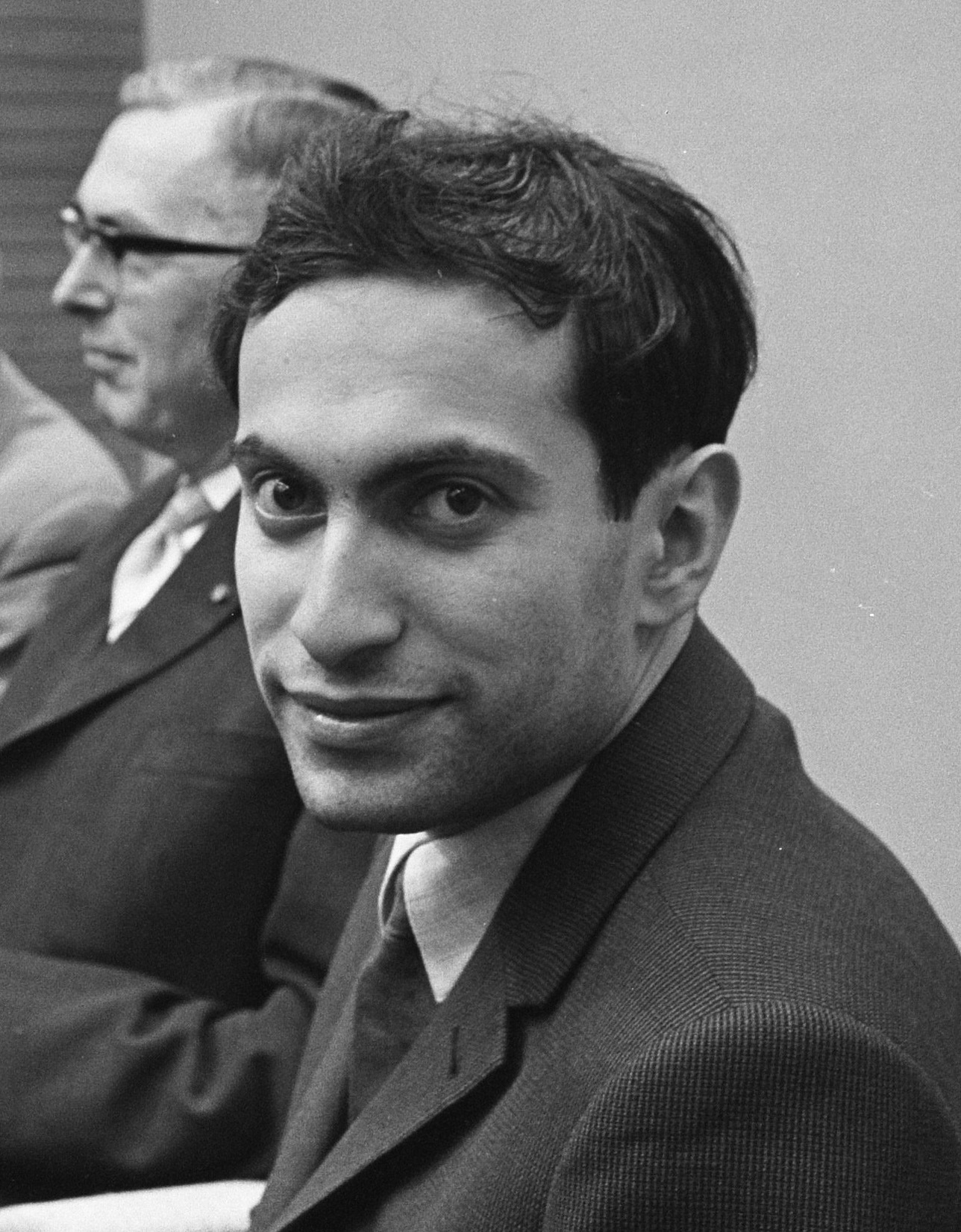
 Mikhail Tal Mikhail Tal |
Mikhail Botvinnik | |||||
| ||||||
|
Born 9 November 1936 24 years old |
Born 17 August 1911 49 years old | |||||
| Winner of the 1960 World Chess Championship | Former world champion | |||||
|
| ||||||
A World Chess Championship was played between former champion Mikhail Botvinnik and champion Mikhail Tal in Moscow from March 15[1] to May 13, 1961. Tal had unseated Botvinnik in the 1960 match; thus, Botvinnik was entitled to this rematch the next year. Tal was considered a strong favourite due to his heavy win the previous year, and being 25 years younger.[citation needed]
Botvinnik won convincingly, by a 13–8 margin, regaining the world title.[2] Although Tal suffered kidney illness in 1962, there was no hint of it at the time, and commentators put the victory down to Botvinnik playing a superior strategy, and being able to combat Tal's attacking style.[3] In 2002, however, Yuri Averbakh revealed that Tal was having health issues, and his doctors in Riga advised that he should postpone the match for health reasons. When Botvinnik would agree to a postponement only if Tal was certified unfit by Moscow doctors, Tal decided to play, thinking he would win anyway.[4]
The win made Botvinnik the first (and only) person to have three separate reigns as World Champion. At 49 years of age, it also makes him (as of 2025) the oldest player to win a World Championship match since 1892 (when 55-year-old Wilhelm Steinitz prevailed over Mikhail Chigorin).
Results
[edit]The match was played as best of 24 games. If it ended 12–12, Tal, the title holder, would retain the Championship.
| 1 | 2 | 3 | 4 | 5 | 6 | 7 | 8 | 9 | 10 | 11 | 12 | 13 | 14 | 15 | 16 | 17 | 18 | 19 | 20 | 21 | Points | |
|---|---|---|---|---|---|---|---|---|---|---|---|---|---|---|---|---|---|---|---|---|---|---|
| Mikhail Botvinnik (Soviet Union)
|
1 | 0 | 1 | ½ | ½ | ½ | 1 | 0 | 1 | 1 | 1 | 0 | 1 | ½ | 1 | ½ | 0 | 1 | 0 | ½ | 1 | 13 |
| Mikhail Tal (Soviet Union)
|
0 | 1 | 0 | ½ | ½ | ½ | 0 | 1 | 0 | 0 | 0 | 1 | 0 | ½ | 0 | ½ | 1 | 0 | 1 | ½ | 0 | 8 |
See also
[edit]References
[edit]- ^ "Tal Will Defend Crown in Chess; Latvian to Meet Botvinnik in Moscow on March 15 for World Championship", New York Times, March 5, 1961
- ^ "Botvinnik Wins Chess Title", New York Times, May 13, 1961
- ^ "Russian First to Regain World Chess Title", Montreal Gazette, June 1, 1961, p. 27
- ^ Kingston, T. (2002). "Yuri Averbakh: An Interview with History – Part 2" (PDF). The Chess Cafe. Archived from the original (PDF) on 2009-03-25.
External links
[edit]- 1961 World Chess Championship at the Internet Archive record of Graeme Cree's Chess Pages
| Outline | |||||||||||||||
|---|---|---|---|---|---|---|---|---|---|---|---|---|---|---|---|
| Equipment | |||||||||||||||
| History |
| ||||||||||||||
| Rules | |||||||||||||||
| Terms | |||||||||||||||
| Tactics | |||||||||||||||
| Strategy | |||||||||||||||
| Openings |
| ||||||||||||||
| Endgames | |||||||||||||||
| Tournaments |
| ||||||||||||||
| Art and media | |||||||||||||||
| Related | |||||||||||||||

| Pre-FIDE | |||||
|---|---|---|---|---|---|
| FIDE | |||||
| Split title |
| ||||
| FIDE | |||||
| Other world championships | |||||


World Chess Championship 1961
View on GrokipediaBackground
The 1960 Championship
The 1960 World Chess Championship match was contested between defending champion Mikhail Botvinnik and challenger Mikhail Tal in Moscow, Soviet Union, from March 15 to May 7, 1960, at the Pushkin Drama Theatre.[6][7] The format consisted of up to 24 games, with the first player to reach 12.5 points declared the winner; in the event of a 12–12 tie, Botvinnik would retain the title.[8] Tal earned the right to challenge Botvinnik by winning the 1959 Candidates Tournament in Yugoslavia, where he scored 20 out of 28 points to finish ahead of Paul Keres, Tigran Petrosian, and other top contenders including Vasily Smyslov and Bobby Fischer.[9] In the match, Tal defeated Botvinnik with a final score of 12.5–8.5 (+6 −2 =13), becoming the youngest World Chess Champion at age 23 and ending Botvinnik's second reign, which had begun after his 1958 victory over Smyslov.[10][11] Prior to this loss, Botvinnik had established himself as a dominant force in chess, holding the title multiple times since the late 1940s.[6] Tal's success stemmed from his aggressive tactical style, characterized by bold piece sacrifices and intense psychological pressure that disrupted Botvinnik's more positional approach and led to several critical errors by the veteran champion.[10][11] This victory not only elevated Tal to the pinnacle of the chess world but also highlighted a generational shift toward dynamic, risk-taking play in elite competition.[6]Rematch Provisions
The FIDE regulations introduced in 1956 included a rematch clause that granted the defeated world champion the right to a return match against the new titleholder the following year, provided the original loss was by a margin no greater than four points (equivalent to a score of 12.5–8.5 in a match to 12.5).[12] This rule, often referred to as the "Botvinnik clause" due to its initial application in his favor against Vasily Smyslov, remained in effect until its abolition after the 1961 match.[11] Following Mikhail Tal's victory over Mikhail Botvinnik in the 1960 World Chess Championship with a score of 12.5–8.5, the clause directly applied, qualifying Botvinnik for an automatic rematch in 1961 without the need for further qualification.[11] FIDE promptly scheduled the contest for March to May 1961 in Moscow, prioritizing it over the standard qualification cycle to honor the provision.[13] Within the Soviet Chess Federation, the rematch carried significant organizational weight, as Botvinnik was viewed as the established patriarch of Soviet chess and a key figure in the nation's intellectual prestige during the Cold War era. Federation officials actively supported the event, exerting influence to ensure its swift arrangement and emphasizing Botvinnik's restoration as champion to maintain continuity in Soviet dominance.[14] This context underscored the match's role beyond mere competition, aligning with broader state interests in chess as a symbol of superiority. The rematch's priority led FIDE to forgo a new Candidates Tournament in 1961, deferring it to 1962 to determine the challenger for the subsequent cycle after the title was resolved.[2] This decision streamlined the championship process while upholding the clause's intent to provide the former champion an immediate opportunity for redemption.Players
Mikhail Botvinnik
Mikhail Moiseyevich Botvinnik was born on August 17, 1911, in Kuokkala (now Repino), near Saint Petersburg, into a Jewish family.[15] He learned chess at the age of 12 in 1923 and quickly rose through the ranks, defeating José Raúl Capablanca in a simultaneous exhibition at 14 and winning the Leningrad Championship in 1930.[15] Botvinnik claimed his first Soviet Championship title in 1931 at age 20, becoming a master in 1927 and a Soviet grandmaster by 1935; he secured five more Soviet titles between 1933 and 1952.[16] His early international success, including sharing first place at the 1936 Nottingham tournament, marked him as the first Soviet player to dominate abroad, earning him the status as the patriarch of the Soviet Chess School, which he founded to train future generations.[17] In 1948, following the death of Alexander Alekhine, Botvinnik won the FIDE-organized World Championship tournament in The Hague-Moscow with a score of 14/20, finishing three points ahead of his rivals and becoming the sixth World Chess Champion.[15] Botvinnik had held the world title in two separate reigns prior to 1961 (1948–1957, when he lost it to Vasily Smyslov, and 1958–1960, after regaining it in a rematch), and would reclaim it for a third reign (1961–1963) in this match.[17] As an electrical engineer with a PhD earned in 1951, Botvinnik applied a rigorous, scientific methodology to chess, emphasizing deep opening analysis, positional strategy, and systematic preparation that influenced the Soviet school's emphasis on research and theory.[16] This approach extended to his pioneering work in computer chess, where he developed selective search algorithms in the 1950s, blending his engineering expertise with game study to treat chess as a solvable scientific problem.[17] Following his loss to Mikhail Tal in the 1960 World Championship match, Botvinnik, at age 49, prepared intensively for the 1961 rematch as the title defender under FIDE's rematch provisions, leveraging his vast experience against the younger champion.[2] His regimen included meticulous study of Tal's aggressive style, personality, and opening preferences, such as the Nimzo-Indian and King's Indian Defenses, to exploit weaknesses in closed positions.[18] Physically, he incorporated daily morning exercises and walks despite the harsh Moscow winter, avoided smoking, and used coffee to sustain concentration during long games, enhancing his endurance over the prior year.[18] Psychologically, Botvinnik focused on time management and building confidence through independent analysis without a second, adjusting to reduce errors in critical late-game phases and maintain composure under pressure.[18] This comprehensive preparation underscored his advantage as a seasoned veteran in the high-stakes rematch.[19]Mikhail Tal
Mikhail Tal was born on November 9, 1936, in Riga, Latvia, into a Jewish family, where he developed an early interest in chess despite initial struggles with the game. His rapid ascent began in the mid-1950s; by age 16, he had won the Latvian Championship in 1953, and he earned the Soviet Master title the following year. Tal's breakthrough came in 1957 when, at just 20 years old, he won the USSR Chess Championship—the youngest winner in its history—with a score of +9 -2 =10 ahead of a strong 22-player field that included established grandmasters. This triumph not only established him as a rising star but also qualified him for international competition. Building on this success, Tal dominated the 1958 Portoroz Interzonal Tournament in Yugoslavia, finishing first with an impressive performance that secured his qualification for the Candidates Tournament the next year. In the 1959 Candidates Tournament, also held in Yugoslavia as a quadruple round-robin among eight top players, Tal clinched victory with 20 out of 28 points, finishing 1.5 points ahead of Paul Keres and showcasing his tactical brilliance against rivals like Vasily Smyslov and a young Bobby Fischer, whom he defeated 4-0. This result earned him the right to challenge Mikhail Botvinnik for the world championship, a match he won in Moscow in 1960 by 12.5–8.5, becoming the eighth world champion at age 23; the provisions of the 1960 match allowed for a rematch in 1961 if the title changed hands within a year. Tal's playing style emphasized intuition over exhaustive calculation, favoring complex, dynamic attacks that often involved "magical" piece sacrifices to create chaos on the board and unsettle opponents. Known as the "Magician from Riga" for his ability to conjure seemingly unsound but ultimately devastating combinations, he prioritized imaginative aggression, turning games into tactical spectacles that highlighted his creative genius and psychological edge. This approach, rooted in bold risk-taking, contrasted sharply with more positional styles and captivated the chess world during his rise. Entering the 1961 rematch, Tal faced emerging health challenges, including kidney problems that had begun to manifest after the intense 1960 title match and required medical attention, though he managed a recovery period before the event. Despite these issues, which would plague him lifelong, Tal prepared diligently, viewing the rematch as an opportunity to solidify his reign.Organization
Format and Rules
The 1961 World Chess Championship match between Mikhail Botvinnik and defending champion Mikhail Tal followed a format similar to the 1960 match, consisting of a maximum of 24 games played under FIDE regulations.[20] The first player to reach 12.5 points would win the title, with each victory worth 1 point and each draw worth 0.5 points to both players; in the event of a 12–12 tie after all 24 games, Tal would retain the championship as the incumbent.[20] The time control for each game required players to complete 40 moves within 2.5 hours (150 minutes), followed by 16 moves in 60 minutes (60 minutes for every 16 moves thereafter).[21] Games could extend beyond this if necessary, with play typically lasting up to five hours before adjournment.[20] If a game was not completed within the five-hour session, it would be adjourned, and the player whose turn it was to move would seal their next move in an envelope to be opened at resumption the following day, preventing the opponent from seeing the decision in advance.[2] Colors alternated between games in the standard manner, with white moving first in odd-numbered games.[20] The match was organized under the oversight of the International Chess Federation (FIDE), which sanctioned the event and enforced its rules, while hosting privileges were granted to the Soviet Union due to both players' nationality, with logistical support from the USSR State Committee for Physical Culture and Sport.[21] The prize fund details were not publicly disclosed, as the event was state-organized by Soviet authorities.[21]Venue and Schedule
The World Chess Championship 1961 rematch between Mikhail Botvinnik and Mikhail Tal was hosted at the Central Chess Club in Moscow, Soviet Union, a prominent venue for major Soviet chess events.[22][23] FIDE approved the location as part of the match organization. The event spanned from March 15 to May 13, 1961, featuring 21 games scheduled on alternate days to allow for rest and analysis, with adjournments handled the following day if needed.[1][24] Playing conditions emphasized a controlled indoor environment to ensure focus, including limited seating for spectators—typically invited guests and officials—to minimize distractions and noise.[22] The matches received widespread coverage through Soviet state media, with radio broadcasts relaying moves in real-time to a national audience, reflecting chess's cultural significance in the USSR.[25] As both players were Soviet citizens—Botvinnik from Leningrad and Tal from Riga—no international travel was required; they resided in Moscow throughout, with state-provided accommodations at local hotels to facilitate preparation and recovery.[11]The Match
Opening Phase (Games 1–8)
The opening phase of the 1961 World Chess Championship rematch between Mikhail Botvinnik and Mikhail Tal, held in Moscow, began on March 15 with Botvinnik, playing White, securing a victory in Game 1 against the defending champion Tal.[26] Employing the Nimzo-Indian Defense (ECO E48), Botvinnik navigated a complex middlegame to win in 41 moves, gaining an early pawn advantage and converting it methodically after the adjournment.[27] This result set a confident tone for Botvinnik, who had meticulously prepared by analyzing Tal's aggressive style from their 1960 encounter.[11] Tal responded forcefully in Game 2 on March 17, taking White and defeating Botvinnik in a Caro-Kann Defense (B18) after 45 moves, equalizing the score at 1–1.[28] Botvinnik regained the lead in Game 3 (March 20) with another Nimzo-Indian win as White (E48, 43 moves), exploiting Tal's imprecise handling of the center.[29] Games 4 and 6 (March 22 and 27), both with Tal holding White in the Caro-Kann (B12), ended in draws after 41 and 25 moves, respectively, as Botvinnik's solid defense neutralized Tal's attempts to generate attacking chances.[30] Game 5 (March 24) saw a protracted 73-move draw in yet another Nimzo-Indian (E48) with Botvinnik White, highlighting the challenger's resilience in equal positions.[31] Botvinnik extended his advantage in Game 7 (March 29), winning as White in a Nimzo-Indian, Sämisch Variation (E24) in 33 moves after Tal's premature ...d5 advance weakened his position.[32] Tal struck back in Game 8 (March 31) with White, securing a 29-move victory in the Caro-Kann (B12) to close the phase with the score at 4½–3½ in Botvinnik's favor.[33] Throughout these games, Botvinnik's consistent use of the Nimzo-Indian as White effectively countered Tal's characteristic aggression, forcing the champion into defensive postures and limiting sacrificial opportunities.[11] Tal entered the match recovering from pre-existing kidney issues, including a reported colic, which prompted Botvinnik to demand a medical examination in Moscow, adding psychological strain and contributing to the champion's initial cautious play.[11] Despite this, Tal's wins demonstrated flashes of his dynamic style, though Botvinnik's preparation maintained early momentum.[34]Middle Phase (Games 9–15)
The middle phase of the 1961 World Chess Championship rematch, spanning games 9 through 15, saw Mikhail Botvinnik extend his lead from a 4.5–3.5 advantage after game 8 to a commanding 10–5 by the end, though Mikhail Tal demonstrated resilience with a key victory and a draw.[5] Botvinnik's precise preparation and defensive solidity neutralized Tal's aggressive attempts, while the challenger's health issues began to subtly affect his performance, leading to signs of fatigue in prolonged endgames.[11] In game 9 on April 7, Botvinnik, playing white in the English Opening (Bremen System, Keres Variation), secured a 73-move victory by exploiting Tal's overextension in the middlegame, solidifying his lead at 5.5–3.5.[5] Game 10 followed on April 10, with Tal as white in a Caro-Kann Defense; Botvinnik countered Tal's tactical initiatives effectively, winning in 42 moves to reach 6.5–3.5.[5] Botvinnik continued his dominance in game 11 on April 12, using the Queen's Gambit Declined Slav as white to target weaknesses in Tal's pawn structure, clinching another 42-move win and pushing the score to 7.5–3.5.[5][11] Tal mounted a notable challenge in game 12 on April 14, the match's only French Defense (Winawer Variation), where as white he unleashed a dynamic kingside attack against Botvinnik's solid setup, forcing resignation after 41 moves through imaginative tactical play that disrupted Black's coordination.[5][3] This narrowed the gap to 7.5–4.5, highlighting Tal's enduring attacking flair despite his ongoing kidney issues.[3] Botvinnik responded forcefully in game 13 on April 17, employing the King's Indian Defense Sämisch Variation as white; after a sharp middlegame, he transitioned into a complex endgame from the exchange variation, outmaneuvering Tal over 41 moves for an 8.5–4.5 lead.[5][2] Game 14 on April 19 saw Tal, white in another Caro-Kann, press for complications but settle for a 33-move draw after Botvinnik's accurate defense neutralized threats, adjusting the score to 9–5.[5][11] In the phase's final game on April 21, Botvinnik as white in the King's Indian Sämisch again pressured Tal's position, winning a 63-move endgame through superior technique and pawn play, despite Tal's resilient counterplay that showed emerging fatigue in the extended struggle.[5][34] Throughout these games, Tal's sacrificial attempts in dynamic openings like the French were countered by Botvinnik's prepared defenses, underscoring the challenger's tactical creativity amid mounting pressure.[2][11]Closing Phase (Games 16–21)
The closing phase of the 1961 World Chess Championship match between Mikhail Botvinnik and Mikhail Tal began with Game 16 on April 24, resulting in a draw after 90 moves in the Caro-Kann Defense, leaving the score at 10.5–5.5 in Botvinnik's favor.[1][11] Tal, playing White, equalized early but could not break through Botvinnik's solid defense, maintaining the challenger's commanding lead from the middle phase.[35] In Game 17, Tal secured his only victory in this phase, defeating Botvinnik in 83 moves with the King's Indian Defense (Samisch Variation), narrowing the gap to 10.5–6.5.[1][11] This win demonstrated Tal's lingering tactical acumen despite his mounting fatigue, as he exploited a middlegame imbalance to launch a decisive kingside attack.[35] Botvinnik responded forcefully in Game 18, winning in 41 moves again with the Caro-Kann Defense to extend his lead to 11.5–6.5.[1][11] His precise play in a sharp position overwhelmed Tal's initiative, underscoring the challenger's superior preparation and stamina.[35] Tal fought back in Game 19, claiming a win in 75 moves via the King's Indian Defense (Samisch Variation), bringing the score to 11.5–7.5 and briefly reigniting hopes of a comeback.[1][11] However, the effort appeared to exacerbate Tal's physical strain, as his aggressive style yielded complications he could no longer fully navigate.[11] Game 20 ended in a draw after a grueling 121 moves in the Caro-Kann Defense, with the score at 12–8, positioning Botvinnik just one point from the required 12.5 to reclaim the title.[1][35] The match concluded on May 13 with Game 21, where Botvinnik, as White, defeated Tal in 33 moves in the King's Indian Defense, achieving the final score of 13–8 and securing the world championship.[1][11][21] Botvinnik's methodical exploitation of an opening error led to a crushing middlegame advantage, clinching victory without the need for further games.[35] Throughout this phase, Tal's performance was hampered by declining health, including lingering effects from pre-match kidney issues and an earlier bout of influenza that had delayed proceedings, contrasting Botvinnik's consistent, error-free play.[11][36][37]Results and Analysis
Final Score
The 1961 World Chess Championship match between defending champion Mikhail Tal and challenger Mikhail Botvinnik concluded after 21 games with Botvinnik scoring 13 points to Tal's 8, securing a decisive victory and reclaiming the title.[11][21] Botvinnik achieved 10 wins, while Tal secured 5 wins, with the remaining 6 games ending in draws.[5] In chess scoring, each win is worth 1 point and each draw 0.5 points to both players, yielding Botvinnik's total of 10 (from wins) + 3 (from draws) = 13 points and Tal's 5 + 3 = 8 points.[11] As there was no tie at 12–12, the match rules dictated that Botvinnik, having exceeded the required 12.5 points threshold, regained the world championship without need for additional games.[21] The wins were distributed as follows, reflecting Botvinnik's dominance particularly when holding the white pieces (11 games) compared to black (10 games), while Tal had 10 games with white and 11 with black:| Player | Wins with White | Wins with Black | Total Wins |
|---|---|---|---|
| Botvinnik | 8 | 2 | 10 |
| Tal | 3 | 2 | 5 |