Recent from talks
Nothing was collected or created yet.
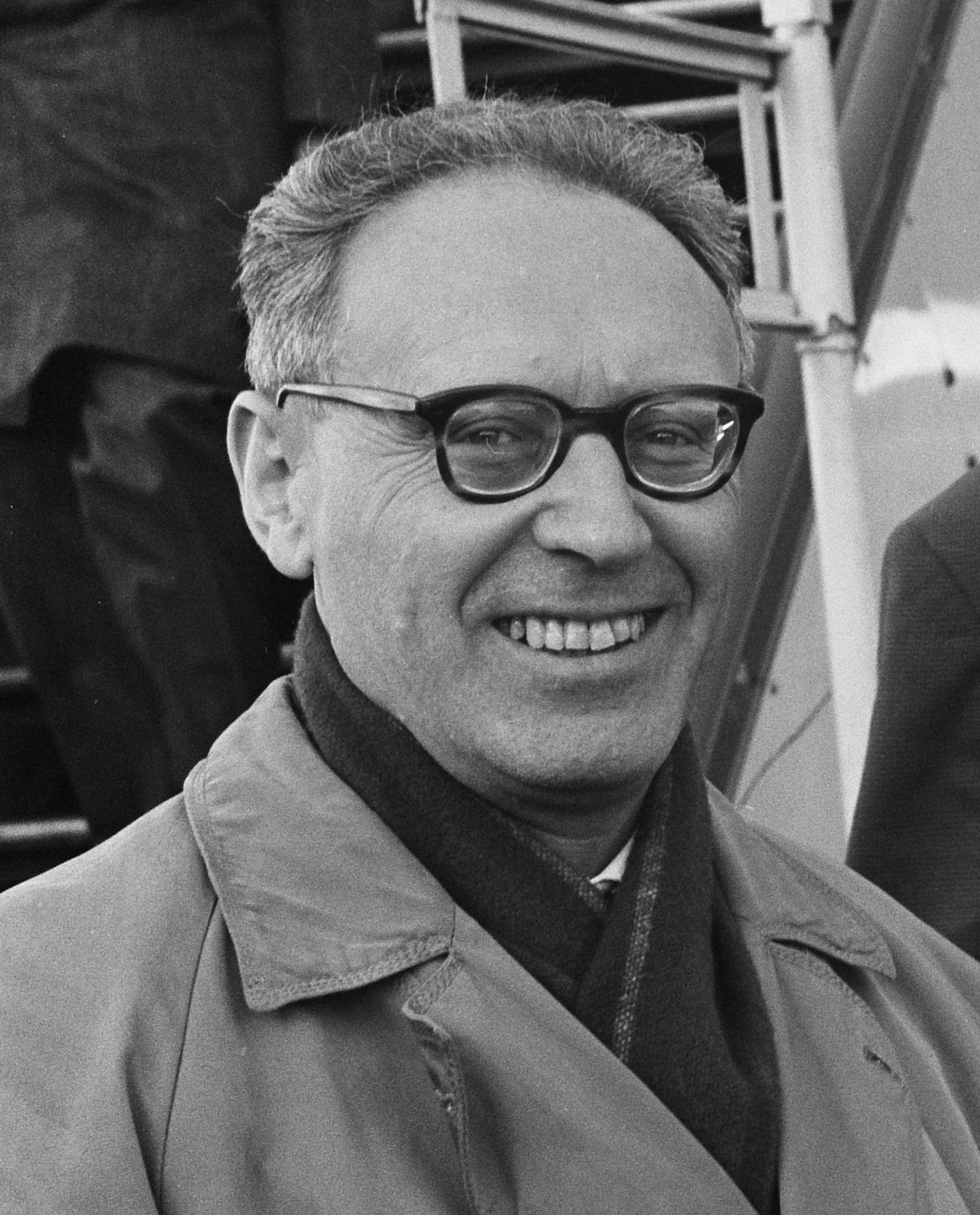
Mikhail Botvinnik
View on WikipediaMikhail Moiseyevich Botvinnik (Russian: Михаи́л Моисе́евич Ботви́нник; IPA: [mʲɪxɐˈil məɪˈsʲejɪvʲɪdʑ‿bɐˈtvʲinʲːɪk]; August 17 [O.S. August 4] 1911 – May 5, 1995) was a Soviet and Russian chess grandmaster who held five world titles in three different reigns. The sixth World Chess Champion, he also worked as an electrical engineer and computer scientist and was a pioneer in computer chess, the last of which he was awarded an honorary mathematics degree for.
Key Information
Botvinnik was the first world-class player to develop within the Soviet Union. He played a major role in the organization of chess, making a significant contribution to the design of the World Chess Championship system after World War II and becoming a leading member of the coaching system that enabled the Soviet Union to dominate top-class chess during that time. His pupils include World Champions Anatoly Karpov, Garry Kasparov and Vladimir Kramnik. He is often described as the patriarch of the Soviet chess school and is revered for his analytical approach to chess.
Early years
[edit]Botvinnik was born on August 17, 1911,[2] in what was then Kuokkala, Vyborg Governorate, Grand Duchy of Finland,[3][4] now the district of Repino in Saint Petersburg.[5] His parents were Russian Jews; his father, Moisei Botvinnik (1878–1931),[6] was a dental technician and his mother, Shifra (Serafima) Rabinovich (1876–1952),[7][8][9] a dentist, which allowed the family to live outside the Pale of Settlement, to which most Jews in the Russian Empire were restricted at the time. As a result, Botvinnik grew up in Saint Petersburg's Nevsky Prospect. His father forbade speaking Yiddish at home, and Mikhail and his older brother Isaak "Issy" attended Soviet schools.[5][10] Botvinnik later recounted, "I was asked once, "What do you consider yourself to be from the point of view of nationality?" My reply was, "Yes, my position is 'complicated'. I am a Jew by blood, a Russian by culture, Soviet by upbringing.""[11] On his religious views, he called himself an atheist.[12]
In 1920, his mother became ill and his father left the family, but maintained contact with the children, even after his second marriage to a Russian woman. At about the same time, Botvinnik started reading newspapers, and became a committed communist.[10]
In autumn 1923, at the age of twelve,[2] Botvinnik was taught chess by a school friend of his older brother, using a home-made set, and instantly fell in love with the game.[10] He finished in mid-table in the school championship, sought advice from another of his brother's friends, and concluded that for him it was better to think out "concrete concepts" and then derive general principles from these – and went on to beat his brother's friend quite easily. In winter 1924, Botvinnik won his school's championship, and exaggerated his age by three years in order to become a member of the Petrograd Chess Assembly – to which its president turned a blind eye.[10] Botvinnik won his first two tournaments organized by the Assembly. Shortly afterwards, Nikolai Krylenko, a devoted chess player and leading member of the Soviet legal system who later organized Joseph Stalin's show trials, began building a huge nationwide chess organization, and the Assembly was replaced by a club in the city's Palace of Labour.[10]
To test the strength of Soviet chess masters, Krylenko organized the Moscow 1925 chess tournament. On a rest day during the event, world champion José Raúl Capablanca gave a simultaneous exhibition in Leningrad. Botvinnik was selected as one of his opponents, and won his game.[10] In 1926, he reached the final stage of the Leningrad championship. Later that year, he was selected for Leningrad's team in a match against Stockholm, held in Sweden, and scored +1=1 against the future grandmaster Gösta Stoltz. On his return, he entertained his schoolmates with a vivid account of the rough sea journey back to Russia. Botvinnik was commissioned to annotate two games from the match, and the fact that his analyses were to be published made him aware of the need for objectivity. In December 1926, he became a candidate member of his school's Komsomol branch. Around this time his mother became concerned about his poor physique, and as a result he started a programme of daily exercise, which he maintained for most of his life.[10]

When Botvinnik finished the school curriculum, he was below the minimum age for the entrance examinations for higher education.[13] While waiting, he qualified for his first USSR Championship final stage in 1927 as the youngest player ever at that time,[14][15] tied for fifth and sixth places and gained the title of master.[13] He wanted to study Electrical Technology at the Leningrad Polytechnical Institute and passed the entrance examination; however, there was a persistent excess of applications for this course and the Proletstud, which controlled admissions, had a policy of admitting only children of engineers and industrial workers. After an appeal by a local chess official, he was admitted in 1928 to Leningrad University's Mathematics Department.[13] In January 1929, Botvinnik played for Leningrad in the student team chess championship against Moscow. Leningrad won and the team manager, who was also deputy chairman of the Proletstud, secured Botvinnik a transfer to the Polytechnic's Electromechanical Department, where he was one of only four students who entered straight from school. As a result, he had to do a whole year's work in five months, and failed one of the examinations.[13] Early in the same year he placed joint third in the semi-final stage of the USSR Championship, and thus failed to reach the final stage.[16]
His early progress was fairly rapid, mostly under the training of Soviet Master and coach Abram Model, in Leningrad; Model taught Botvinnik the Winawer Variation of the French Defence, which was then regarded as inferior for Black, but Botvinnik analysed it more deeply and played this variation with great success.[17]
Botvinnik won the Leningrad Masters' tournament in 1930[13] with a score of 6½/8,[citation needed] following this up the next year by winning the championship of Leningrad by 2½ points over former Soviet champion Peter Romanovsky.[18]
In 1935, Botvinnik married Gayane Davidovna Ananova, of Armenian descent, who was the daughter of his algebra and geometry teacher. She was a student at the Vaganova Academy of Russian Ballet in Leningrad and, later, a ballerina in the Bolshoi Theatre. They had one daughter, named Olga, who was born in 1942.[19]
Soviet champion
[edit]USSR Championship 1933[20]
| a | b | c | d | e | f | g | h | ||
| 8 | 8 | ||||||||
| 7 | 7 | ||||||||
| 6 | 6 | ||||||||
| 5 | 5 | ||||||||
| 4 | 4 | ||||||||
| 3 | 3 | ||||||||
| 2 | 2 | ||||||||
| 1 | 1 | ||||||||
| a | b | c | d | e | f | g | h | ||
In 1931, at the age of 20, Botvinnik won his first Soviet Championship in Moscow,[2] scoring 13½ out of 17.[21] He commented that the field was not very strong, as some of the pre-Revolution masters were absent.[16] In late summer 1931, he graduated with a degree in electrical engineering,[dubious – discuss] after completing a practical assignment on temporary transmission lines at the Dnieper Hydroelectric Station. He stayed on at the Leningrad Polytechnical Institute to study for a Candidate of Sciences degree.[16]
In 1933, Botvinnik repeated his Soviet Championship win, in his home city of Leningrad, with 14/19,[21] describing the results as evidence that Krylenko's plan to develop a new generation of Soviet masters had borne fruit. He and other young masters successfully requested the support of a senior Leningrad Communist Party official in arranging contests involving both Soviet and foreign players, as there had been none since the Moscow 1925 chess tournament.[16] Soon afterwards, Botvinnik was informed that Alexander Ilyin-Genevsky, one of the older Soviet masters and a member of the Soviet embassy in Prague, had arranged a match between Botvinnik [16] and Salo Flohr, a Czech grandmaster who was then regarded as one of the most credible contenders for Alexander Alekhine's World Chess Championship title.[22] The highest-level chess officials in the Soviet Union opposed this on the grounds that Botvinnik stood little chance against such a strong international opponent. In spite of this attempt to dissuade him, Krylenko insisted on staging the match, saying that "We have to know our real strength."[16]
Botvinnik used what he regarded as the first version of his method of preparing for a contest, but fell two games behind by the end of the first six, played in Moscow. However, aided by his old friend Ragozin and coach Abram Model, he leveled the score in Leningrad and the match was drawn. When describing the post-match party, Botvinnik wrote that at the time he danced the foxtrot and Charleston to a professional standard.[16]
In his first tournament outside the USSR, the Hastings 1934–35, Botvinnik achieved only a tie for 5th–6th places, with 5/9. He wrote that, in London after the tournament, Emanuel Lasker said his arrival only two hours before the first round began was a serious mistake and that he should have allowed ten days for acclimatization.[23] Botvinnik wrote that he did not make this mistake again.[24]
Botvinnik placed first equal with Flohr, ½ point ahead of Lasker and one point ahead of José Raúl Capablanca, in Moscow's second International Tournament, held in 1935.[25] After consulting Capablanca and Lasker, Krylenko proposed to award Botvinnik the title Grandmaster, but Botvinnik objected that "titles were not the point." However, he accepted a free car and a 67% increase in his postgraduate study grant, both provided by the People's Commissariat of Heavy Industry.[23]

He later reported to Krylenko that the 1935 tournament made it difficult to judge the strength of the top Soviet players, as it included a mixture of top-class and weaker players. Botvinnik advocated a double round-robin event featuring the top five Soviet players and the five strongest non-Soviet players available. Despite politicking over the Soviet choices, both Krylenko and the Central Committee of the Komsomol quickly authorised the tournament.[23] This was played in Moscow in June 1936,[23] and Botvinnik finished second, one point behind Capablanca and 2½ ahead of Flohr.[25] However, he took consolation from the fact the Soviet Union's best had held their own against top-class competition.[23]
In early winter, 1936, Botvinnik was invited to play in a tournament at Nottingham, England. Krylenko authorised his participation and, to help Botvinnik play at his best, allowed Botvinnik's wife to accompany him – a privilege rarely extended to chess players at any time in Soviet history. Taking Lasker's advice, Botvinnik arrived ten days before play started. Although his Soviet rivals forecast disaster for him,[23] he scored an undefeated shared first place (+6=8) with Capablanca, ½ point ahead of current World Champion Max Euwe and rising American stars Reuben Fine and Samuel Reshevsky, and 1 point ahead of ex-champion Alexander Alekhine.[25][26] This was the first tournament victory by a Soviet master outside his own country.[24] When the result reached Russia, Krylenko drafted a letter to be sent in Botvinnik's name to Stalin. On returning to Russia, Botvinnik discovered he had been awarded the "Mark of Honour".[23]

Three weeks later, Botvinnik began work on his dissertation for the Candidate's degree, obtaining this in June 1937, after his supervisor described the dissertation as "short and good", and the first work in its field.[23] As a result of his efforts, he missed the 1937 Soviet championship, won by Grigory Levenfish, who was then nearly fifty. Later in 1937, Botvinnik drew a match of thirteen games against Levenfish.[27][28][29] Botvinnik challenged Levenfish, writing that Krylenko, angered by Botvinnik's absence from the tournament, ordered the match.[27]
Botvinnik won further Soviet Championship titles in 1939, 1944, 1945, and 1952, bringing his total to six. In 1945, he dominated the tournament, scoring 15/17;[30] however, in 1952 he tied with Mark Taimanov and won the play-off match.[21]
World title contender
[edit]In 1938, the world's top eight players met in the Netherlands to compete in the AVRO tournament, whose winner was supposed to get a title match with the World Champion, Alexander Alekhine.[31] Botvinnik placed third, behind Paul Keres and Reuben Fine.[32] According to Botvinnik, Alekhine was most interested in playing an opponent who could raise the funds.[27] After consulting the nearest available Soviet officials, Botvinnik discreetly challenged Alekhine, who promptly accepted, subject to conditions that would enable him to acclimatize in Russia and get some high-quality competitive practice a few months before the match.[27][33] In Botvinnik's opinion, Alekhine was partly motivated by the desire for a reconciliation with the Soviet authorities, so that he could again visit his homeland.[27] The match, including funding, was authorised at the highest Soviet political level in January 1939; however, a letter of confirmation was only sent two months later – in Botvinnik's opinion, because of opposition by his Soviet rivals, especially those who had become prominent before the Russian Revolution[27] – and the outbreak of World War II prevented a World Championship match.[31]

In spring 1939, Botvinnik won the USSR Championship, and his book on the tournament described the approach to preparation which he had been developing since 1933. One striking feature of this was emphasis on opening preparation in order to gain a permanent positional advantage in the middlegame, rather than seeking immediate tactical surprises that could only be used once.[34]

Botvinnik took an early lead in the 1940 USSR Championship, but faded badly in the later stages, eventually sharing fifth place. He attributed this to the unaccustomed difficulty of concentrating in a party-like atmosphere filled with noise and tobacco smoke. Botvinnik wrote to a friendly official, commenting that the champion was to be the winner of a match between Igor Bondarevsky and Andor Lilienthal, who had tied for first place, but had no achievements in international competition. The official's efforts led to a tournament for the title of "Absolute Champion of the USSR", whose official aim was to identify a Soviet challenger for Alekhine's title. The contestants were the top six finishers in the Soviet Championship – Bondarevsky, Lilienthal, Paul Keres (whose home country, Estonia, had recently been annexed by the Soviet Union), future World Champion Vasily Smyslov, Isaac Boleslavsky and Botvinnik – who were to play a quadruple round-robin. Botvinnik's preparation with his second, Viacheslav Ragozin, included training matches in noisy, smoky rooms and he slept in the playing room, without opening the window. He won the tournament, 2½ points ahead of Keres and three ahead of Smyslov; moreover, with plus scores in the "mini-matches" against all his rivals.[35]
In June 1941, Nazi Germany invaded the Soviet Union. Botvinnik's wife Gayane, a ballerina,[36] told him that her colleagues at the Kirov Opera and Ballet Theatre were being evacuated to the city of Perm,[37] then known as Molotov in honour of Vyacheslav Molotov.[38] The family found an apartment there, and Botvinnik obtained a job with the local electricity supply organization – at the lowest pay rate and on condition that he did no research, as he had only a Candidate's degree. Botvinnik's only child, a daughter named Olya, was born in Perm in April 1942.[37]
In the evenings, Botvinnik wrote a book in which he annotated all the games of the "Absolute Championship of the USSR", in order to maintain his analytic skills in readiness for a match with Alekhine. His work included wood-cutting for fuel, which left him with insufficient energy for chess analysis. Botvinnik obtained from Molotov an order that he should be given three days off normal work in order to study chess.[37]
In 1943, after a two-year lay-off from competitive chess, Botvinnik won a tournament in Sverdlovsk, scoring 1½ out of 2 against each of his seven competitors – who included Smyslov, Vladimir Makogonov, Boleslavsky, and Ragozin.[37][39] Chessbase regards this as one of the fifty strongest tournaments between 1851 and 1986.[40]
Shortly afterwards, Botvinnik was urged to return to Moscow by the People's Commissar for Power Stations, an admirer and subsequent good friend. On his return, Botvinnik suggested a match with Samuel Reshevsky in order to strengthen his claim for a title match with Alekhine, but this received no political support. In December 1943, he won the Moscow Championship, ahead of Smyslov. At the same time, opposition to his plan for a match with Alekhine re-surfaced, on the grounds that Alekhine was a political enemy and the only proper course was to demand that he be stripped of the title. The dispute ended in Botvinnik's favor, and in the dismissal of a senior chess official, one of those to have opposed Botvinnik's plan, who was also a KGB colonel.[41][42]
After Botvinnik won the 1944 and 1945 Soviet championships, most top Soviet players supported his desire for a World Championship match with Alekhine. However, the allegations that Alekhine had written anti-Semitic articles while in Nazi-occupied France made it difficult to host the match in the USSR. Botvinnik opened negotiations with the British Chess Federation to host the match in England, but these were cut short by Alekhine's death in 1946.[41]
When the Second World War ended, Botvinnik won the first high-level post-war tournament, at Groningen in 1946, with 14½ points from nineteen games, ½ point ahead of former World Champion Max Euwe and two ahead of Smyslov.[43] He and Euwe both struggled in the last few rounds,[44] and Botvinnik had a narrow escape against Euwe, who he acknowledged had always been a difficult opponent for him.[45] This was Botvinnik's first outright victory in a tournament outside the Soviet Union.[46]
Botvinnik also won the very strong Mikhail Chigorin Memorial tournament held at Moscow 1947.
World Champion
[edit]Botvinnik strongly influenced the design of the system which would be used for World Championship competition from 1948 to 1963.[31][47] Viktor Baturinsky wrote: "Now came Botvinnik's turn to defend his title in accordance with the new qualifying system which he himself had outlined in 1946." (This statement referred to Botvinnik's 1951 title defence.)[48]
On the basis of his strong results during and just after World War II, Botvinnik was one of five players to contest the 1948 World Chess Championship, which was held at The Hague and Moscow. He won the 1948 tournament convincingly—with a score of 14/20, three points clear—becoming the sixth World Champion.[49] While he was on vacation in Riga after the tournament, an eleven-year-old boy called Mikhail Tal paid a visit, hoping to play a game against the new champion. Tal was met by Botvinnik's wife, who said the champion was asleep, and that she had made him take a rest from chess.[36][50] In 1950, Botvinnik was one of the inaugural recipients of the international grandmaster title from FIDE.
Botvinnik held the world title, with two brief interruptions, for the next fifteen years, during which he played seven world championship matches. In 1951, he drew with David Bronstein over 24 games in Moscow, +5−5=14, keeping the world title, but it was a struggle for Botvinnik, who won the second-last game and drew the last in order to tie the match.[51] In 1954, he drew with Vasily Smyslov over 24 games in Moscow, +7−7=10, again retaining the title.[52] In 1957, he lost to Smyslov by 9½–12½ in Moscow,[53] but the rules then in force allowed him a rematch without having to go through the Candidates' Tournament, and in 1958 he won the rematch in Moscow;[54] Smyslov said his health was poor during the return match.[55] In 1960, Botvinnik was convincingly beaten 8½–12½ at Moscow by Tal, now 23 years old,[56] but again exercised his right to a rematch in 1961, and won by 13–8 in Moscow.[57] Commentators agreed that Tal's play was weaker in the rematch, probably due to his health, but also that Botvinnik's play was better than in the 1960 match, largely due to thorough preparation. Botvinnik changed his style in the rematch, avoiding the tactical complications in which Tal excelled and aiming for closed positions and endgames, where Tal's technique was not outstanding.[58][59] Finally, in 1963, he lost the title to Tigran Petrosian, by 9½–12½ in Moscow.[60] FIDE had by then altered the rules, and he was not allowed a rematch. The rematch rule had been nicknamed the "Botvinnik rule" because he twice benefited from it.
Though ranking as formal World Champion, Botvinnik had a relatively poor playing record in the early 1950s: he played no formal competitive games after winning the 1948 match tournament until he defended his title, then struggled to draw his 1951 championship match with Bronstein, placed only fifth in the 1951 Soviet Championship, and tied for third in the 1952 Géza Maróczy Memorial tournament in Budapest; and he had also performed poorly in Soviet training contests.[21][61] However, he lost only five of over thirty games in the two tournaments; three of the four who finished ahead of him in the 1951 championship were future world champions Smyslov and Petrosian and a leading world championship contender (and winner in both tournaments) Paul Keres; and he finished ahead of Petrosian and even with Smyslov in 1952. Botvinnik did not play in the Soviet team that won the 1952 Chess Olympiad in Helsinki: the players voted for the line-up and placed Botvinnik on second board, with Keres on top board; Botvinnik protested and refused to play.[62][63] Keres' playing record from 1950 to early 1952 had been outstanding.[21][61]
Botvinnik won the 1952 Soviet Championship (joint first with Mark Taimanov in the tournament, won the play-off match).[21] He included several wins from that tournament over the 1952 Soviet team members in his book Botvinnik's Best Games 1947–1970, writing "these games had a definite significance for me".[63] In 1956, he tied for first place with Smyslov in the 1956 Alexander Alekhine Memorial in Moscow, despite a last-round loss to Keres.
Team tournaments
[edit]
Botvinnik was selected for the Soviet Olympiad team from 1954 to 1964 inclusively, and helped his team to gold medal finishes each of those six times. At Amsterdam 1954 he was on board one and won the gold medal with 8½/11. Then at home for Moscow 1956, he was again board one, and scored 9½/13 for the bronze medal. For Munich 1958, he scored 9/12 for the silver medal on board one. At Leipzig 1960, he played board two behind Mikhail Tal, having lost his title to Tal earlier that year, but he won the board two gold medal with 10½/13. He was back on board one for Varna 1962, scored 8/12, but failed to win a medal for the only time at an Olympiad. His final Olympiad was Tel Aviv 1964, where he won the bronze with 9/12, playing board 2 as he had lost his title to Petrosian. Overall, in six Olympiads, he scored 54½/73 for an outstanding 74.6 percent.[64]
Botvinnik also played twice for the USSR in the European Team Championship. At Oberhausen 1961, he scored 6/9 for the gold medal on board one. But at Hamburg 1965, he struggled on board two with only 3½/8. Both times the Soviet Union won the team gold medals. Botvinnik played one of the final events of his career at the Russia (USSR) vs Rest of the World match in Belgrade 1970, scoring 2½/4 against Milan Matulović, as the USSR narrowly triumphed.
Late career
[edit]After losing the world title for the final time, to Tigran Petrosian in Moscow in 1963, Botvinnik withdrew from the following World Championship cycle after FIDE declined, at its annual congress in 1965, to grant a losing champion the automatic right to a rematch. He remained involved with competitive chess, appearing in several highly rated tournaments and continuing to produce memorable games.
Botvinnik retired from competitive play in 1970, aged 59, preferring instead to occupy himself with the development of computer chess programs and to assist with the training of younger Soviet players, earning him the nickname of "Patriarch of the Soviet Chess School" (see below).
Botvinnik's autobiography, K Dostizheniyu Tseli, was published in Russian in 1978, and in English translation as Achieving the Aim (ISBN 0-08-024120-4) in 1981. A staunch Communist, he was noticeably shaken by the collapse of the Soviet Union and lost some of his standing in Russian chess during the Boris Yeltsin era.
In the 1980s, Botvinnik proposed a computer program to manage the Soviet economy. However, his proposals did not receive significant attention from the Soviet government.
During the last few years of his life, Botvinnik personally financed his economic computer project that he hoped would be used to manage the Russian economy. He kept actively working on the program until his death and financing the work from the money he made for the lectures and seminars he attended, despite prominent health problems.
Botvinnik died of pancreatic cancer in May 1995.[65] According to his daughter, Botvinnik remained active until the last few months of his life, and continued to go to work until March 1995 despite blindness in one of his eyes (and extremely poor vision in the other).
Political controversies
[edit]The Soviet Union regarded chess as a symbol of Communist superiority, and hence the Soviet chess league was extremely politicized.[66][67] As Botvinnik was the first world-class player produced by the Soviet Union, everything he said or did (or did not say or do) had political repercussions, and there were rumors that Soviet opponents were given hints that they should not beat him.
David Bronstein wrote that Boris Verlinsky had won the 1929 Soviet Championship and was granted the first Soviet Grandmaster title for this achievement, yet he was later stripped of it, when it was thought more politically correct to make Botvinnik the first official Soviet GM (as distinct from the then-nonexistent FIDE grandmaster title).[47]
Botvinnik wrote that before the last round of the 1935 Moscow tournament, Soviet Commissar of Justice Nikolai Krylenko, who was also in charge of Soviet chess, proposed that Ilya Rabinovich should deliberately lose to Botvinnik, to ensure that Botvinnik took first place. Botvinnik refused, saying "... then I will myself put a piece en prise and resign".[68] The game was drawn, and Botvinnik shared first place with Salo Flohr.
Botvinnik sent an effusive telegram of thanks to Joseph Stalin after his victory at the great tournament in Nottingham in 1936.[citation needed]
Botvinnik played relatively poorly in the very strong 1940 Soviet Championship, finishing in a tie for fifth/sixth places, with 11½/19, two full points behind Igor Bondarevsky and Andor Lilienthal. With World War II under way by this time, and the strong possibility of little or no chess practice for some time in the future, Botvinnik seems to have prevailed upon the Soviet chess leadership to hold another tournament "in order to clarify the situation".[69] This wound up being the 1941 Absolute Championship of the USSR, which featured the top six finishers from the 1940 event, playing each other four times. After a personal appeal to the defence minister, Vyacheslav Molotov, Botvinnik was exempted from war work for three days a week in order to concentrate on chess preparations.[70] He won this tournament convincingly, and thus reclaimed his position as the USSR's top player.
Bronstein claimed that at the end of the 1946 Groningen tournament, a few months after the death of reigning world champion Alexander Alekhine, Botvinnik personally invited Samuel Reshevsky, Reuben Fine, Max Euwe, Vasily Smyslov, and Paul Keres to join him in a tournament to decide the new world champion,[47] but other evidence suggests that FIDE (the "governing body" of chess), had already proposed a World Championship tournament before the Groningen tournament began, and at this stage the Soviet Union was not a member and therefore took no part in framing that proposal.[31]
Since Keres lost his first four games against Botvinnik in the 1948 World Championship tournament, winning only in the final cycle after the outcome of the tournament had been decided, suspicions have sometimes been raised that Keres was forced to "throw" games to allow Botvinnik to win the Championship. Chess historian Taylor Kingston investigated all the available evidence and arguments, and concluded that: Soviet chess officials gave Keres strong hints that he should not hinder Botvinnik's attempt to win the World Championship; Botvinnik only discovered this about half-way through the tournament and protested so strongly that he angered Soviet officials; Keres probably did not deliberately lose games to Botvinnik or anyone else in the tournament.[71]
Bronstein insinuated that Soviet officials pressured him to lose in the 1951 world championship match so that Botvinnik would keep the title,[47] but comments by Botvinnik's second, Salo Flohr, and Botvinnik's own annotations to the critical 23rd game indicate that Botvinnik knew of no such plot.[72]
In 1956, FIDE changed the world championship rules so that a defeated champion would have the right to a return match. Yuri Averbakh alleged that this was done at the urging of the two Soviet representatives in FIDE, who were personal friends of Botvinnik. Averbakh also claims that Botvinnik's friends were behind FIDE's decision in 1956 to limit the number of players from the same country that could compete in the Candidates Tournament, and that this was to Botvinnik's advantage as it reduced the number of Soviet players he might have to meet in the title match.[73]
Botvinnik asked to be allowed to play in the 1956 Candidates Tournament, as he wanted to use the event as part of his warm-up for the next year's title match, but his request was refused.[74]
Mikhail Tal's chronic kidney problems contributed to his defeat in his 1961 return match with Botvinnik, and his doctors in Riga advised that he should postpone the match for health reasons. Averbakh claimed that Botvinnik would agree to a postponement only if Tal was certified unfit by Moscow doctors, and that Tal then decided to play.[73] The 1961 world championship lasted 21 games and Botvinnik won ten of them, for a total score of +10−5=6, reclaiming the title he had lost a year earlier and becoming the oldest winner of a FIDE world championship match at 50.
In 1963, Botvinnik played his last world championship match against Tigran Petrosian, in a 22-game series. Petrosian, almost 20 years younger, wore out the 52 year old Botvinnik in a series of protracted games, most of them over 40 moves, including six consecutive draws. The defending champion played poorly in games 18 and 19, and the match ended with three short draws. Petrosian thus claimed the world championship with a score of +5−2=15.
In 1954, he wrote an article about inciting socialist revolution in western countries, aiming to spread communism without a third world war.[73] And in 1960 Botvinnik wrote a letter to the Soviet Government proposing economic reforms that were contrary to party policy.[75]
In 1976, Soviet grandmasters were asked to sign a letter condemning Viktor Korchnoi as a "traitor" after Korchnoi defected. Botvinnik evaded this "request" by saying that he wanted to write his own letter denouncing Korchnoi. By this time, however, his importance had waned and officials would not give him this "privilege", so Botvinnik's name did not appear on the group letter – an outcome Botvinnik may have foreseen.[76] Bronstein and Boris Spassky openly refused to sign the letter.[62]
Assessment
[edit]Playing strength and style
[edit]Reuben Fine, writing in 1976, observed that Botvinnik was at or near the top of the chess world for thirty years—from 1933, when he drew a match against Flohr, to 1963, when he lost the world championship for the final time, to Petrosian—"a feat equaled historically only by Emanuel Lasker and Wilhelm Steinitz".[77] The statistical rating system used in Raymond Keene and Nathan Divinsky's book Warriors of the Mind concludes that Botvinnik was the fourth strongest player of all time: behind Garry Kasparov, Anatoly Karpov and Bobby Fischer but ahead of José Raúl Capablanca, Lasker, Viktor Korchnoi, Boris Spassky, Vasily Smyslov and Tigran Petrosian.[59] The Chessmetrics system is sensitive to the length of the periods being compared but places Botvinnik third in a comparison of players' best individual years (1946 for Botvinnik) and sixth in a comparison of fifteen-year periods (1935–1949 in Botvinnik's case).[78][79] In 2005, Chessmetrics' creator Jeff Sonas wrote an article which examined various ways of comparing the strength of "world number one" players, some not based on Chessmetrics; and Botvinnik generally emerged as one of the top six (the greatest exceptions were in criteria related to tournament results).[80] FIDE did not adopt the Elo rating system until 1970, by which time Botvinnik's strength had been declining for several years. According to unofficial calculations by Arpad Elo, Botvinnik was the highest-rated player from 1937 to 1954, peaking about 2730 in 1946.[81]
This may seem surprising in the light of Botvinnik's results in the 1950s and early 1960s, when he failed to win a world championship match outright (as reigning champion) and his tournament results were patchy. But after the FIDE world championship cycle was established in 1948, reigning champions had to play the strongest contender every three years, and successful title defenses became less common than in the pre-World War II years, when the titleholder could select his challenger. Despite this, Botvinnik held the world title for a longer period than any of his successors except Garry Kasparov. Botvinnik also became world champion at the relatively late age of 37, because World War II brought international competition to a virtual halt for six years; and he was 52 years old when he finally lost his title (only Wilhelm Steinitz and Emanuel Lasker were older when they were defeated). Botvinnik's best years were from 1935 to 1946;[79] during that period he dominated Soviet chess;[82] and the USSR's 15½–4½ win in the 1945 radio match against the US proved that the USSR's top players were considerably better than those from the US (who had dominated international team competitions in the 1930s).[83]
USSR Ch. 1940
Botvinnik generally sought tense positions with chances for both sides;[84] hence his results were often better with the Black pieces as he could avoid lines that were likely to produce draws.[14][85] He had a strong grasp of long-term strategy, and was often willing to accept weaknesses that his opponent could not exploit in exchange for some advantage that he could exploit.[85][86] He confessed that he was relatively weak in tactical calculation, yet many of his games feature sacrifices – often long-term positional sacrifices whose purpose was not to force an immediate win, but to improve his position and undermine his opponent's. Botvinnik was also capable of all-out sacrificial attacks when he thought the position justified it.[87] Botvinnik saw himself as a "universal player" (all-rounder), in contrast to an all-out attacker like Mikhail Tal or a defender like Tigran Petrosian.[59] Reuben Fine considered Botvinnik's collection of best games one of the three most beautiful up to the mid-1950s (the other two were Alexander Alekhine's and Akiba Rubinstein's).[14]
Kasparov quotes Tigran Petrosian as saying, "There was a very unpleasant feeling of inevitability. Once in a conversation with Keres I mentioned this and even compared Botvinnik with a bulldozer, which sweeps away everything in its path. Keres smiled and said: 'But can you imagine what it was like to play him when he was young?'"[88]
Influence on the game
[edit]Botvinnik's example and teaching established the modern approach to preparing for competitive chess: regular but moderate physical exercise; analysing very thoroughly a relatively narrow repertoire of openings; annotating one's own games, those of past great players and those of competitors; publishing one's annotations so that others can point out any errors; studying strong opponents to discover their strengths and weaknesses; ruthless objectivity about one's own strengths and weaknesses.[89][90] Botvinnik also played many short training matches against strong grandmasters including Salo Flohr, Yuri Averbakh, Viacheslav Ragozin, and Semion Furman – in noisy or smoky rooms if he thought he would have to face such conditions in actual competition.[2][91][92] Vladimir Kramnik said, "Botvinnik's chess career was the way of a genius, although he was not a genius", meaning that Botvinnik was brilliant at making the best use of his talents.[89]
Botvinnik used almost exclusively queenside pawn openings with the white pieces. In his eight World Championship matches, he never started a game with an e4-opening, and his usual choices as White were the English Opening or Queen's Gambit. When playing the black pieces, he preferred the French Defense or Sicilian Defense in response to 1.e4, and the Slav Defense or Nimzo-Indian Defence in response to 1.d4. While Botvinnik did not use a wide range of openings, he made major contributions to those he did use, for example: the Botvinnik Variation of the Semi-Slav Defense in the Queen's Gambit Declined, the Kasparov/Botvinnik system in the Exchange Variation of the Queen's Gambit Declined, the Caro–Kann Defence (both the Panov–Botvinnik Attack for White and various approaches for Black), the Winawer Variation of the French Defense, the Botvinnik System in the English Opening. In his openings research Botvinnik did not aim to produce tactical tricks that would only be effective once, but rather systems in which he aimed to understand typical positions and their possibilities better than his rivals.[59][85] His advice to his pupils included "My theory of the openings fitted into one notebook" and "You don't have to know that which everyone knows, but it is important to know that which not everyone knows." In fact he used different notebooks in different periods, and copied a few analyses from one notebook to the next.[93] The "Soviet School of Chess" that dominated competition from 1945 to about 2000 followed Botvinnik's approach to preparation and to openings research; and, although Soviet players had their own preferred styles of play, they adopted his combative approach and willingness to ignore "classical" principles if doing so offered credible prospects of a lasting advantage.[94][95]
In 1963, Botvinnik founded his own school within the Soviet coaching system, and its graduates include world champions Anatoly Karpov, Garry Kasparov and Vladimir Kramnik, and other top-class players such as Alexei Shirov, Vladimir Akopian and Jaan Ehlvest.[96][97] Botvinnik was not an infallible spotter of chess talent: although he said of the 11-year-old Kasparov, "The future of chess lies in the hands of this young man", he said on first seeing Karpov, "The boy doesn't have a clue about chess, and there's no future at all for him in this profession."[2] But Karpov recounts fondly his youthful memories of the Botvinnik school and credits Botvinnik's training, especially the homework he assigned, with a marked improvement in his own play.[98] Kasparov presents Botvinnik almost as a kind of father figure, going some way towards balancing the common public perception of Botvinnik as dour and aloof;[88] and Kasparov inherited Botvinnik's emphasis on preparation, research and innovation.[99] Botvinnik was still playing a major teaching role in his late 70s, when Kramnik entered the school, and made a favorable impression on his pupil.[89][96]
Other achievements
[edit]Electrical engineering
[edit]Engineering was as much of a passion for Botvinnik as chess – at Nottingham in 1936, where he had his first major tournament win outside the USSR, he said "I wish I could do what he's done in electrical engineering" (referring to Milan Vidmar, another grandmaster).[14] He was awarded the Order of the Badge of Honour for his work on power stations in the Urals during World War II (while he was also establishing himself as the world's strongest chess player). He earned his doctorate in electrical engineering in 1951.[100] In 1956, he joined the Research Institute for Electrical Energy as a senior research scientist.[101] In 1960 he published a book on Asynchronized Synchronous Machines [102]
Computer chess
[edit]In the 1950s Botvinnik became interested in computers, at first mainly for playing computer chess but he later also co-authored reports on the possible use of artificial intelligence in managing the Soviet economy.[103] Botvinnik's research on chess-playing programs concentrated on "selective searches", which used general chess principles to decide which moves were worth considering. This was the only feasible approach for the primitive computers available in the Soviet Union in the early 1960s, which were only capable of searching three or four half-moves deep (i.e. A's move, B's move, A's move, B's move) if they tried to examine every variation. Botvinnik eventually developed an algorithm that was reasonably good at finding the right move in difficult positions, but it often missed the right move in simple positions, e.g. where it was possible to checkmate in two moves. This "selective" approach turned out to be a dead end, as computers were powerful enough by the mid-1970s to perform a brute-force search (checking all possible moves) several moves deep and today's vastly more powerful computers do this well enough to beat human world champions.[104][105] However, his PIONEER program contained a generalized method of decision-making that, with a few adjustments, enabled it to plan maintenance of power stations all over the USSR.[106] On September 7, 1991 Botvinnik was awarded an honorary degree in mathematics of the University of Ferrara (Italy) for his work on computer chess.[107]
Writings
[edit]Chess
[edit]- Botvinnik, M.M. (1960). One Hundred Selected Games. Courier Dover. ISBN 0-486-20620-3. Retrieved 2009-08-14.
{{cite book}}: ISBN / Date incompatibility (help) - Botvinnik, M.M. (1972). Cafferty, B. (ed.). Botvinnik's best games, 1947–1970. Batsford. ISBN 0-7134-0357-8.
- Botvinnik, M.M. (1973). Garry, S. (ed.). Soviet chess championship, 1941: Complete text of games with detailed notes & an introduction. Dover Publications. ISBN 0-486-22184-9.
- Botvinnik, M.M. (1973). World Championship: The Return Match Botvinnik vs. Smyslov 1958. Chess Digest Magazine.
- Botvinnik, M.M. (1973). Alekhine vs. Euwe return match 1937. Chess Digest.
- Matanovic, A.; Kazic, B.; Yudovich, M.; Botvinnik, M.M. (1974). Candidates' matches 1974. Centar Za Unapredivanje Saha.
- Botvinnik, M.M. (1978). Anatoly Karpov: His Road to the World Championship. Elsevier. ISBN 0-08-021139-9.
- Botvinnik, M.M.; Estrin, Y. (1980). The Gruenfeld Defense. Rhm Pr. ISBN 0-89058-017-0.
- Botvinnik, M.M. (1981). Achieving the Aim. Translated by Cafferty, B. Pergamon Press. ISBN 0-08-024120-4.
- Botvinnik, M.M. (1981). Selected Games: 1967–1970. Pergamon. ISBN 0-08-024123-9.
- Botvinnik, M.M. (1982). Marfia, J. (ed.). Fifteen Games and Their Stories. Coraopolis, Pennsylvania, U.S.A: Chess Enterprises. ISBN 0-931462-15-0.
- Botvinnik, M.M. (1985). Botvinnik on the Endgame. Chess Enterprises. ISBN 0-931462-43-6.
- Botvinnik, M.M. (1996). Neat, K.; Stauss, E. (eds.). Half a Century of Chess. Cadogan Books. ISBN 1-85744-122-2.
- Botvinnik, M.M. (2000). Neat, K. (ed.). Botvinnik's Best Games Volume 1: 1925–1941. Moravian Chess. ISBN 978-80-7189-317-2.
- Botvinnik, M.M. (2000). Neat, K. (ed.). Botvinnik's Best Games Volume 2: 1942–1956. Moravian Chess. ISBN 80-7189-370-6.
- Botvinnik, M.M. (2000). Neat, K. (ed.). Botvinnik's Best Games Volume 3: 1957–1970 – Analytical & Critical Works. Moravian Chess. ISBN 80-7189-405-2.
- Botvinnik, M.M. (2002). Championship Chess : Match Tournament for the Absolute Chess Championship of the USSR, Leningrad-Moscow 1941. Hardinge Simpole. ISBN 978-1-84382-012-3.
- Botvinnik, M.M. (2004). Match for the World Chess Championship Mikhail Botvinnik-David Bronstein Moscow 1951. Edition Olms. ISBN 3-283-00459-5.
- Botvinnik, M.M. (2004). Botvinnik, I. (ed.). World Championship Return Match: Botvinnik V. Tal, Moscow 1961. Olms. ISBN 978-3-283-00461-3.
Computers
[edit]- Botvinnik, M.M. (1970). Computers, Chess and Long-Range Planning. Springer Verlag. ISBN 0-387-90012-8.
- Botvinnik, M.M. (1984). Computers in Chess: Solving Inexact Search Problems. Springer-Verlag. ISBN 0-387-90869-2.
Tournament results
[edit]The following table gives Botvinnik's placings and scores in tournaments.[28] The first "Score" column gives the number of points on the total possible. In the second "Score" column, "+" indicates the number of won games, "−" the number of losses, and "=" the number of draws.
| Date | Location | Tournament | Placing | Score | Notes | |
|---|---|---|---|---|---|---|
| 1923 | Leningrad | School championship | — | — | — | Botvinnik estimates "about 10th out of 16".[28] |
| 1924 | Leningrad | School championship | 1st | 5/6 | +5−1=0 | |
| 1924 | Leningrad | non-category | 1st | 11½/13 | +11−1=1 | |
| 1924 | Leningrad | 2B and 3rd Categories | 1st | 11½/13 | +11−1=1 | |
| 1924 | Leningrad | 2A Category | — | — | — | Tournament unfinished[28] |
| 1925 | Leningrad | 2A and 1B Categories | 1st | 10/11 | +10−1=0 | |
| 1925 | Leningrad | 1st Category | 3rd | 7½/11 | +7−3=1 | |
| 1925 | Leningrad | 1st Category | — | — | — | Tournament unfinished[28] |
| 1926 | Leningrad | Leningrad Championship, Semi-finals | 1st | 11½/12 | +11−0=1 | |
| 1926 | Leningrad | Leningrad Championship | 2nd= | 7/9 | +6−1=2 | |
| 1926 | Leningrad | Northwest Provincial Championship, Semi-finals | 2nd= | 9/11 | +8−1=2 | |
| 1926 | Leningrad | Northwest Provincial Championship | 3rd | 6½/10 | +4−1=5 | |
| 1927 | Leningrad | Tournament of "Six" | 2nd | 7½/10 | +6−1=3 | |
| 1927 | Moscow | 5th USSR Chess Championship | 5th= | 12½/20 | +9−4=7 | |
| 1928 | Leningrad | Regional Metalworkers' Committee Championship | 1st | 8½/11 | +7−1=3 | |
| 1929 | Leningrad | Regional Committee of Educational Workers' Championship | 1st | 11½/14 | +9−0=5 | |
| 1929 | Odessa | 6th USSR Chess Championship, Quarter-finals | 1st | 7/8 | +6−0=2 | |
| 1929 | Odessa | 6th USSR Chess Championship, Semi-finals | 3rd= | 2½/5 | +2−2=1 | |
| 1930 | Leningrad | Masters' Tournament | 1st | 6½/8 | +6−1=1 | |
| 1931 | Leningrad | Leningrad Championship | 1st | 14/17 | +12−1=4 | |
| 1931 | Moscow | 7th USSR Chess Championship, Semi-finals | 2nd | 6½/9 | +6−2=1 | |
| 1931 | Moscow | 7th USSR Chess Championship | 1st | 13½/17 | +12−2=3 | |
| 1932 | Leningrad | Leningrad Championship | 1st | 10/11 | +9−0=2 | |
| 1932 | Leningrad | Masters' Tournament in House of Scientists | 1st | 7/10 | +6−2=2 | |
| 1933 | Leningrad | Masters' Tournament | 1st= | 10/13 | +7−0=6 | |
| 1933 | Leningrad | 8th USSR Chess Championship | 1st | 14/19 | +11−2=6 | |
| 1934 | Leningrad | Tournament including Euwe and Kmoch | 1st | 7½/11 | +5−1=5 | |
| 1934 | Hastings | Hastings International Chess Congress | 5th= | 5/9 | +3−2=4 | |
| 1935 | Moscow | 2nd International Tournament | 1st= | 13/19 | +9−2=8 | |
| 1936 | Moscow | 3rd International Tournament | 2nd | 12/18 | +7−1=10 | |
| 1936 | Nottingham | International Tournament | 1st= | 10/14 | +6−0=8 | |
| 1938 | Leningrad | 11th USSR Chess Championship, Semi-finals | 1st | 14/17 | +12−1=4 | |
| 1938 | Amsterdam, etc. | AVRO tournament | 3rd | 7½/14 | +3−2=9 | |
| 1939 | Leningrad | 11th USSR Chess Championship | 1st | 12½/17 | +8−0=9 | |
| 1940 | Moscow | 12th USSR Chess Championship | 5th= | 11½/19 | +8−4=7 | |
| 1941 | Leningrad, Moscow | Absolute Chess Championship of the USSR | 1st | 13½/20 | +9−2=9 | |
| 1943 | Sverdlovsk | Masters' Tournament | 1st | 10½/14 | +7−0=7 | |
| 1943 | Moscow | Moscow Championship | 1st | 13½/16 | +12−1=3 | |
| 1944 | Moscow | 13th USSR Chess Championship | 1st | 12½/16 | +11−2=3 | |
| 1945 | Moscow | 14th USSR Chess Championship | 1st | 15/17 | +13−0=4 | |
| 1946 | Groningen | International Tournament | 1st | 14½/19 | +13−3=3 | |
| 1947 | Moscow | Tchigorin Memorial Tournament | 1st | 11/15 | +8−1=6 | |
| 1948 | The Hague, Moscow | World Chess Championship Tournament | 1st | 14/20 | +10−2=8 | |
| 1951 | Moscow | 19th USSR Chess Championship | 5th | 10/17 | +6−3=8 | |
| 1952 | Budapest | Maroczy Jubilee | 3rd= | 11/17 | +7−2=8 | |
| 1952 | Moscow | 20th USSR Chess Championship | 1st= | 13½/19 | +9−1=9 | Defeated Taimanov in a play-off for first place. |
| 1955 | Moscow | 22nd USSR Chess Championship | 3rd= | 11½/19 | +7−3=9 | |
| 1956 | Moscow | Alekhine Memorial | 1st= | 11/15 | +8−1=6 | |
| 1958 | Wageningen | International Tournament | 1st | 4/5 | +3−0=2 | |
| 1961/2 | Hastings | International Chess Congress (Premier) | 1st | 8/9 | +7−0=2 | |
| 1962 | Stockholm | International Tournament | 1st | 8½/9 | +8−0=1 | |
| 1965 | Noordwijk | International Tournament | 1st | 6/7 | +5−0=2 | |
| 1966 | Amsterdam | IBM Tournament | 1st | 7½/9 | +7−1=1 | |
| 1966/7 | Hastings | International Chess Congress (Premier) | 1st | 6½/9 | +5−1=3 | |
| 1967 | Palma de Mallorca | International Tournament | 2nd= | 12½/17 | +9−1=7 | |
| 1968 | Monte Carlo | International Tournament | 2nd | 9/13 | +5−0=8 | |
| 1969 | Wijk aan Zee | Hoogovens (Grandmaster Section) | 1st= | 10½/15 | +6−0=9 | |
| 1969 | Belgrade | International Tournament | 7th | 8½/15 | +5−3=7 | |
| 1970 | Leiden | Quadrangular Tournament | 3rd= | 5½/12 | +1−2=9 | Four players. Each opponent was played four times. |
Match results
[edit]Here are Botvinnik's results in matches.[28] In the second "Score" column, "+" indicates the number of won games, "−" the number of losses, and "=" the number of draws.
| Date | Opponent | Result | Location | Score | Notes | |
|---|---|---|---|---|---|---|
| 1933 | Salo Flohr | Tied | Moscow, Leningrad | 6/12 | +2−2=8 | Challenge |
| 1937 | Grigory Levenfish | Tied | Moscow, Leningrad | 6½/13 | +5−5=3 | Challenge |
| 1940 | Viacheslav Ragozin | Won | Moscow, Leningrad | 8½/12 | +5−0=7 | Training |
| 1951 | David Bronstein | Tied | Moscow | 12/24 | +5−5=14 | World title |
| 1952 | Mark Taimanov | Won | Moscow | 3½/6 | +1−0=5 | USSR Ch playoff |
| 1954 | Vasily Smyslov | Tied | Moscow | 12/24 | +7−7=10 | World title |
| 1957 | Vasily Smyslov | Lost | Moscow | 9½/22 | +3−6=13 | World title |
| 1958 | Vasily Smyslov | Won | Moscow | 12½/23 | +7−5=11 | Rematch |
| 1960 | Mikhail Tal | Lost | Moscow | 8½/21 | +2−6=13 | World title |
| 1961 | Mikhail Tal | Won | Moscow | 13/21 | +10−5=6 | Rematch |
| 1963 | Tigran Petrosian | Lost | Moscow | 9½/21 | +2−5=14 | World title |
Notable games
[edit]- Botvinnik vs. Chekhover, Moscow 1935, Réti Opening, 1–0[26]
- Botvinnik vs. Capablanca, AVRO 1938, Nimzoindian Defense, 1–0[14] At first sight Botvinnik's opening play looks unpromising, but he knew how his attack would develop.
- Keres vs. Botvinnik, USSR Absolute Championship 1941, Nimzoindian Defense, 0–1[14] Playing as Black, Botvinnik demolishes a world title contender in 22 moves.
- Tolush vs. Botvinnik, USSR Championship 1944, 0–1[14] Long-term positional sacrifices.
- Denker vs. Botvinnik, US vs USSR radio match 1945, 0–1 Botvinnik uses the Botvinnik System in the Semi-Slav Defense to bulldoze US champion Arnold Denker.
- Botvinnik vs. Keres, Alekhine Memorial Tournament Moscow 1966, 1–0 Botvinnik shows his superior understanding of closed positions, and when to open them.
- Botvinnik vs Portisch, Monaco 1968, 1–0 A fireworks display starting with an exchange sacrifice on the c-file, a tactic on which Botvinnik wrote the book.[94]
Notes
[edit]- ^ Official Elo rating list published July 1971 – from Olimpbase
- ^ a b c d e Thomas, R. McG. Jr. (May 7, 1995). "Mikhail Botvinnik, Chess Champion and Teacher of Champions, Dies at 83". New York Times.
- ^ "Russian Jewish Encyclopedia". Belarus SIG. 1995. Retrieved 2009-06-06.
- ^ Service, R. (2000). "Russia from Far and Near". Lenin: a biography. Harvard University Press. pp. 180–181. ISBN 0-674-00828-6. Retrieved 2009-06-06.
- ^ a b Beizer, Michael (2007). "The Jews of a Soviet Metropolis". In Gitelman, Zvi; Ro'i, Yaacov (eds.). Revolution, Repression, and Revival. The Soviet Jewish Experience. Rowman & Littlefield. pp. 113–119. ISBN 978-0-7425-5817-5. Retrieved 2009-06-06.
- ^ Andy Soltis (2014). Mikhail Botvinnik: The Life and Games of a World Chess Champion. McFarland & Co. p. 11. ISBN 9780786473373.
- ^ Kovalchuk, Svetlana (January 2002). "Vladimir Rabinovich". centropa.org. Retrieved 2021-01-22.
- ^ Winter, Edward. "Graves of Chess Masters". Chess Notes.
- ^ Sosonko, Genna (2009). "A Journey to Immortality. Mikhail Botvinnik". Russian Silhouettes (3rd ed.). New In Chess.
My mother was two years older than my father.
- ^ a b c d e f g Botvinnik, M.M. "First Moves". Achieving the Aim. Translated by Bernard Cafferty. pp. 1–16.
- ^ Botvinnik, M.M (1981). "The Algorithm of Chess Play". Achieving the Aim. Translated by Bernard Cafferty. Pergamon Press. p. 178.
- ^ Andy Soltis (2014). Mikhail Botvinnik: The Life and Games of a World Chess Champion. McFarland & Co. p. 74. ISBN 9780786473373.
By character they were absolutely opposites," their only child, Olga, recalled in 2012. Gayane was religious, while Botvinnik was fond of saying, "I am an atheist and a communist in the spirit of the first communist on earth, Jesus Christ." He reveled in his "hard character." She was apolitical. He was an ardent Marxist. As time went by, she found it hard to deal with the stress that he seemed to thrive on.
- ^ a b c d e Botvinnik, M.M.; Cafferty, B. "The Polytechnic". Achieving the Aim. pp. 16–22.
- ^ a b c d e f g Fine, Reuben (1952). "Mikhail Botvinnik". The World's Great Chess Games. André Deutsch (now as paperback from Dover). pp. 234–43.
- ^ "Mikhail Moiseyevich Botvinnik – hundredth anniversary". 17 August 2011.
- ^ a b c d e f g Botvinnik, M.M. "The Polytechnic". Achieving the Aim. Translated by Bernard Cafferty. pp. 23–39.
- ^ How to Play the French Defence, by Wolfgang Uhlmann, Mikhail Botvinnik, Viktor Korchnoi, and Anatoly Karpov, RHM Press, 1975, introduction
- ^ Alexey Popovsky. "8 Championship of Leningrad- 1931". Russian Chess Base.
- ^ Andy Soltis (2014). Mikhail Botvinnik: The Life and Games of a World Chess Champion. McFarland & Co. ISBN 9780786473373.
- ^ "Botvinnik vs. Yudovich, USSR Ch. 1933". Chessgames.com.
- ^ a b c d e f Cree, G. "The Soviet Chess Championship 1920–1991". Archived from the original on January 28, 2008. Retrieved 2009-06-07.
- ^ Fine, Reuben (1952). "Max Euwe". The World's Great Chess Games. André Deutsch. pp. 192–200.
- ^ a b c d e f g h Botvinnik, M.M.; Cafferty, B. "Postgraduate Study". Achieving the Aim. pp. 41–62.
- ^ a b One Hundred Selected Games (to 1946), by Mikhail Botvinnik, Dover Publishers
- ^ a b c Golombek, H. (1959). "Triumphant Return". Capablanca's Hundred Best Games of Chess. G. Bell & Sons. pp. 203–249.
- ^ a b Chernev, I. (1995). Twelve Great Chess Players and Their Best Games. Courier Dover Publications. ISBN 0-486-28674-6.
- ^ a b c d e f Botvinnik, M.M.; Cafferty, B. "The Match that was Never Played". Achieving the Aim. pp. 69–74.
- ^ a b c d e f Botvinnik, M.M.; Garry, S. (1960) [1949; translation pub. 1960]. "Results in Tournaments and Matches". One Hundred Selected Games. Dover. pp. 269–270.
- ^ "Chess Matches: from Lopez to Kramnik". Archived from the original on 2012-12-09. Retrieved 2009-06-11.
- ^ The sources agree that Botvinnik was only two points short of white-washing his opposition, but disagree about the number of games played. There is a full tournament table giving Botvinnik a score of 15/17 at "14th USSR Championship, Moscow 1945". Archived from the original on January 28, 2008. Retrieved 2009-06-11. But Chessmetrics says the score was 16/18, at "Event Details: Moscow (URS Championship), 1945". The difference is that Chessmetrics says Salo Flohr also competed, but scored only 1/3 as he then retired from the tournament.
- ^ a b c d Winter, E. (2003–2004). "Interregnum". Chess Notes.
- ^ "AVRO 1938". Archived from the original on 2008-10-20.
- ^ Khariton, L. (2004-12-29). "Lev Khariton:The Battle That Never Was". Archived from the original on 2005-11-23. Retrieved 2008-05-23. Based on Botvinnik's memoirs.
- ^ Botvinnik, M.M.; Cafferty, B. "The Match that was Never Played". Achieving the Aim. pp. 75–76.
- ^ Botvinnik, M.M.; Cafferty, B. "The Match that was Never Played". Achieving the Aim. pp. 78–80.
- ^ a b Stevens, E. (May 30, 1960). "A Nod For A Title". Sports Illustrated. Retrieved 2009-08-14.
- ^ a b c d Botvinnik, M.M.; Cafferty, B. "The Match that was Never Played". Achieving the Aim. pp. 81–86.
- ^ Penfield, M. (2006). Horoscopes of Europe. American Federation of Astrology. p. 142. ISBN 0-86690-567-7. Retrieved 2009-06-11.
- ^ "Sverdlovsk 1943". Retrieved 2009-06-06.
- ^ Fruth, M. "The Greatest Tournaments in the History of Chess". Archived from the original on 2004-06-03. Retrieved 2009-06-06.
- ^ a b Botvinnik, M.M.; Cafferty, B. "The Match that was Never Played". Achieving the Aim. pp. 88–98.
- ^ Kingston, T. (2002). "Yuri Averbakh: An Interview with History – Part 1" (PDF). The Chess Cafe.
- ^ Pachman, L. (1987). "Groningen 1946: Defeat of the Two Leaders". Decisive Games in Chess History. Courier Dover. pp. 118–124. ISBN 0-486-25323-6. Retrieved 2009-06-11.
- ^ Botvinnik, M.M.; Garry, S. (1960) [1949; translation pub. 1960]. "Nineteen-Fortysix". One Hundred Selected Games. Dover. p. 242.
- ^ Botvinnik, M.M.; Cafferty, B. "The Match-tournament, 1848". Achieving the Aim. pp. 99–.
- ^ Brace, E.R. (1977). An Illustrated Dictionary of Chess. Hamlyn Publishing Group. p. 123. ISBN 1-55521-394-4.
- ^ a b c d Bronstein, David; Furstenberg, T. (1995). The Sorcerer's Apprentice. London and New York: Cadogan Chess.
- ^ Botvinnik's Best Games 1947–1970, by Mikhail Botvinnik, introduction by Viktor Baturinsky, p. 2, translated by Bernard Cafferty; Batsford Publishers, London 1972
- ^ Weeks, M. "World Chess Championship: 1948 FIDE Title Tournament".
- ^ Grandmaster Tal tells a different version of events in his autobiography, "The Life and Games of Mikhail Tal". 1997. Reprint ed. Everyman Chess, 2013, p. 21.
- ^ Weeks, M. "World Chess Championship: 1951 Botvinnik–Bronstein Title Match".
- ^ Weeks, M. "World Chess Championship: 1954 Botvinnik–Smyslov Title Match".
- ^ Weeks, M. "World Chess Championship: 1957 Smyslov–Botvinnik Title Match".
- ^ Weeks, M. "World Chess Championship: 1958 Botvinnik–Smyslov Title Match".
- ^ Watson, J. "Book Reviews by John Watson". chess.co.uk. Archived from the original on 2008-05-09.
- ^ Weeks, M. "World Chess Championship: 1960 Tal–Botvinnik Title Match".
- ^ Weeks, M. "World Chess Championship: 1961 Botvinnik–Tal Title Match".
- ^ "Tal vs. Botvinnik 1961". Chessgames.com.
- ^ a b c d Warriors of the Mind, Raymond Keene and Nathan Divinsky, 1989.
- ^ Weeks, M. "World Chess Championship: 1963 Petrosian-Botvinnik Title Match".
- ^ a b "USSR first entered Chess Olympiad 1952". Archived from the original on October 11, 2008.
- ^ a b Saidy, A. (December 3, 2007). "Bronstein: I Played Chess For My Dad's Jailers". United States Chess Federation.
- ^ a b Botvinnik, M.M. (1972). Botvinnik's Best Games 1947–1970. Translated by Bernard Cafferty. Batsford. ISBN 978-0-7134-0537-8.
- ^ "Player list". olimpbase.org. Archived from the original on 2009-02-19. Click Botvinnik's name and a pop-up appears that summarises his Olympiad playing record.
- ^ "Extra Chess: Genna Sosonko, Russian Silhouettes". Archived from the original on 2011-07-19. Retrieved 2008-11-25.
- ^ Kingston, T. (2001). "The Keres–Botvinnik Case Revisited: A Further Survey of the Evidence" (PDF). The Chess Cafe.
- ^ Moul, C.; Nye, J.V.C. (2006). "Did the Soviets Collude?: A Statistical Analysis of Championship Chess 1940–64" (PDF). Washington University in St. Louis. Archived from the original (PDF) on 2010-06-12.
- ^ Botvinnik, M.M. (1981). Achieving the Aim. Pergamon Press. ISBN 0-08-024120-4. This is the English translation. The Rabinovich incident is summarized at Kingston, T. (1998). "The Keres–Botvinnik Case: A Survey of the Evidence – Part II" (PDF). The Chess Cafe.
- ^ Varnusz, E. (1994). Paul Keres' Best Games, Volume 1: Closed Games. London: Cadogan. p. xi. ISBN 1-85744-064-1. (translated by Andras Barabas)
- ^ Hartston, W. (May 8, 1995). "Obituary : Mikhail Botvinnik". The Independent. Archived from the original on October 11, 2008.
- ^ Kingston wrote a 2-part series: Kingston, T. (1998). "The Keres–Botvinnik Case: A Survey of the Evidence – Part I" (PDF). The Chess Cafe. and Kingston, T. (1998). "The Keres–Botvinnik Case: A Survey of the Evidence – Part II" (PDF). The Chess Cafe. Kingston published a further article, Kingston, T. (2001). "The Keres–Botvinnik Case Revisited: A Further Survey of the Evidence" (PDF). The Chess Cafe. after the publication of further evidence which he summarizes in his third article. In a subsequent two-part interview with Kingston, Soviet grandmaster and official Yuri Averbakh said that: Stalin would not have given orders that Keres should lose to Botvinnik; Smyslov would probably have been the candidate most preferred by officials; Keres was under severe psychological stress as a result of the multiple invasions of his home country, Estonia, and of his subsequent treatment by Soviet officials up to late 1946; and Keres was less tough mentally than his rivals – Kingston, T. (2002). "Yuri Averbakh: An Interview with History – Part 1" (PDF). The Chess Cafe. and Kingston, T. (2002). "Yuri Averbakh: An Interview with History – Part 2" (PDF). The Chess Cafe.
- ^ "Bronstein's fateful 23rd game". chessbase.com. 10 May 2003.
- ^ a b c Kingston, T. (2002). "Yuri Averbakh: An Interview with History – Part 2" (PDF). The Chess Cafe.
- ^ Monokroussos, D. (December 6, 2005). "An interesting tidbit from the latest Chess Life". Archived from the original on August 7, 2007. cites the December 2005 issue of Chess Life as its source.
- ^ Khariton, L. "Orwell or Botvinnik?".
- ^ Khariton, L. "English Lessons (Remembering M.M.Botvinnik)". chessbanter.com.
- ^ Fine, R. (1976). The World's Great Chess Games (2 ed.). Dover Publications. p. 263. ISBN 0-486-24512-8.
- ^ "Peak Average Ratings: 1 year peak range". Archived from the original on 2012-03-09.
- ^ a b "Peak Average Ratings: 15 year peak range". Archived from the original on 2012-03-09.
- ^ Sonas, J. (2005). "The Greatest Chess Player of All Time – Part IV". Chessbase. Part IV gives links to the three earlier parts
- ^ Elo (1978), p. 89
- ^ Yuri Averbakh, referring to the late 1940s, said "Botvinnik was a killer in chess." – "Yuri Averbakh: An Interview with History, Part 1" (PDF).
- ^ Wall, W. "USA vs USSR radio match, 1945". Archived from the original on 2009-10-28.
- ^ Chernev, I. (1967). "Superb Strategist: Mikhail Botvinnik". Combinations: the heart of chess. Courier Dover. pp. 194–195. ISBN 0-486-21744-2. Retrieved 2009-08-14.
- ^ a b c Byrne, R. (January 27, 2008). "An Imaginative Tactician Who Was at Ease in Complexity". New York Times.
- ^ Golombek, H. (1954). The Game of Chess. Penguin Books.
- ^ See the list of Botvinnik's games, especially Botvinnik vs Portisch, Monaco 1968
- ^ a b Kasparov, G.K. (2003). My Great Predecessors, part II. Everyman Chess. ISBN 1-85744-342-X.
- ^ a b c Kramnik, V. (2005). "Kramnik Interview: From Steinitz to Kasparov". Vladimir Kramnik. Archived from the original on 2008-05-12. Retrieved 2008-01-27.
- ^ Botvinnik, M.M. (2004). Botvinnik vs Bronstein, Moscow 1951. Olms. ISBN 3-283-00459-5. Archived from the original on 2008-01-17. The URL links to a review.
- ^ Timman, J. (2006). Secret Matches: The Unknown Training Games of Mikhail Botvinnik (PDF). Hardinge Simpole. ISBN 1-84382-178-8.
- ^ "The Unfortunate Fate of Salo Flohr". Archived from the original on 2005-03-10. Retrieved 2008-06-10.
- ^ Botvinnik, I. (2004). "Mikhail Botvinnik's Opening Course". In Neat, K. (ed.). Return Match for the World Chess Championship: Mikhail Botvinnik – Mikhail Tal, Moscow 1961. Edition Olms. ISBN 3-283-00459-5. Archived from the original on 2006-10-10. Retrieved 2008-09-16.
- ^ a b Botvinnik, M.M. (1960). One Hundred Selected Games. Dover Publications. ISBN 0-486-20620-3.
{{cite book}}: ISBN / Date incompatibility (help) Note the preface "The Russian and Soviet School of Chess" - ^ Goldberg, S. (2007). "Strategies of the Soviet School" (PDF).
- ^ a b Henderson, J. "Boy from the Black Sea". Archived from the original on 2002-09-18. interview with Vladimir Kramnik
- ^ Ehlvest, J. (2004). The Story of a Chess Player. Arbiter Publishing, Inc. ISBN 0-9763891-0-X. Archived from the original on 2005-05-01.
- ^ Karpov, A. (1992). Karpov on Karpov: A Memoirs of a Chess World Champion. Atheneum. ISBN 0-689-12060-5.
- ^ Russell, H.W. "Interview with Garry Kasparov – Part 1" (PDF). Archived from the original (PDF) on 2011-07-17.
- ^ Botvinnik's Best Games 1947–1970, by Mikhail Botvinnik, introduction by Viktor Baturinsky, translated by Bernard Cafferty, Batsford Publishers, London 1972
- ^ McCauley, M. (1997). "Botvinnik, Mikhail Moiseevich". Who's Who in Russia Since 1900. Routledge. p. 46. ISBN 0-415-13898-1. Retrieved 2009-06-05.
- ^ M.M. Botvinnik: Asynchronized Synchronous Machines: 1960 Moscow, Translated by L.A.Thompson, International Series of Monographs on Electronics and Instrumentation, Pergamon Press 1964
- ^ "Publications in Computer Games". Archived from the original on 2004-09-19.
- ^ Brudno, Michael (May 2000). "Competitions, Controversies, and Computer Chess" (PDF). Retrieved 2008-11-18.
- ^ Laramée, F.D. (July 2000). "Chess Programming Part III: Move Generation". gamedev.net. Archived from the original on 2009-02-12. Retrieved 2008-11-18.
- ^ Abramson, B. (2005). "The Artificial Science". Digital phoenix: why the information economy collapsed and how it will rise. MIT Press. pp. 89–90. ISBN 978-0-262-01217-1. Retrieved 2009-08-14.
- ^ Santi, Ettore (2006). "Michail Botvinnik: un programma "intelligente" per giocare a scacchi". Archived from the original on 2006-01-03.
See also
[edit]References
[edit]- Elo, Árpád (1978). The Rating of Chessplayers, Past and Present. Arco. ISBN 0-668-04721-6.
- Hartston, William R. (1986). Kings of Chess. Pavilion. ISBN 1-85145-075-0.
- Hooper, David; Whyld, Kenneth (1996) [First pub. 1992]. The Oxford Companion to Chess (2nd ed.). Oxford University Press. ISBN 0-19-280049-3.
- Sunnucks, Anne (1970). The Encyclopaedia of Chess. Hale. ISBN 0-7091-1030-8.
- Winter, Edward G., ed. (1981). World chess champions. Pergamon. ISBN 0-08-024094-1.
- Di Felice, Gino (2010). Chess Results 1951–1955. McFarland & Co. ISBN 978-0-7864-4801-2.
- Di Felice, Gino (2010). Chess Results 1956–1960. McFarland & Co. ISBN 978-0-7864-4803-6.
Further reading
[edit]- Chernev, Irving (1995). Twelve Great Chess Players and Their Best Games. New York: Dover. pp. 109–126. ISBN 0-486-28674-6.
- Kirillov, Valentin (2017). Team Tal: An Inside Story. Moscow: Elk and Ruby Publishing House. ISBN 978-5-950-04330-7.
- Hurst, Sarah (2002). Curse of Kirsan: Adventures in the Chess Underworld. Russell Enterprises. ISBN 1-888690-15-1.
- Botvinnik, Mikhail (1981) [1961]. One Hundred Selected Games. Translated by Stephen Garry. Dover. ISBN 0-486-20620-3.
- Botvinnik, Mikhail (1972). Botvinnik's Best Games 1947–1970. Translated by Bernard Cafferty. Batsford. ISBN 978-0-7134-0537-8.
- Kasparov, Garry (2003). My Great Predecessors, part II. Everyman Chess. ISBN 1-85744-342-X.
- Sosonko, Genna (2017). The Rise and Fall of David Bronstein. Elk and Ruby Publishing House. ISBN 978-5-950-04331-4.
- Thomas, R.M. (May 7, 1995). "Mikhail Botvinnik, Chess Champion and Teacher of Champions, Dies at 83". New York Times.
External links
[edit]- Mikhail Botvinnik player profile and games at Chessgames.com
- Mikhail Moiseyevich Botvinnik – hundredth anniversary ChessBase.com
- Film newsreel about a simultaneous display of Salo Flohr and Mikhail Botvinnik, Hilversum (NL), 1 January 1964
Mikhail Botvinnik
View on GrokipediaEarly Life and Education
Childhood and Family Background
Mikhail Moiseyevich Botvinnik was born on August 17, 1911, in Kuokkala, a locality in the Grand Duchy of Finland under the Russian Empire (present-day Repino, Russia), to parents of Jewish descent. His father, Moisei Lvovich Botvinnik (1878–1931), worked as a dental technician and had earlier participated in the underground anti-Tsarist printing activities of the Jewish Bund in Minsk. His mother, Shifra (Serafima) Iosifovna Rabinovich (1876–1952), practiced as a dentist, enabling the family to reside beyond the Pale of Settlement restrictions on Jews.[6][7] The Botvinniks, an assimilated Jewish family, relocated to Petrograd (renamed Leningrad in 1924) in the years surrounding the 1917 Bolshevik Revolution, immersing young Mikhail in the ensuing Russian Civil War's hardships, including economic scarcity and political instability from 1917 to 1922. In 1920, his mother fell ill, prompting his father to depart the household for a second marriage, though he sustained ties with his children. These early disruptions, coupled with the parents' professional emphasis on skilled labor and self-reliance, cultivated an environment prioritizing intellectual discipline and perseverance.[8][9]Discovery of Chess and Initial Training
Mikhail Botvinnik first encountered chess at the age of 12 in 1923, learning the rules from a school friend of his older brother rather than through formal instruction.[6][10] His initial exposure sparked an intense interest, leading to self-directed study of grandmaster games to grasp underlying principles rather than relying on memorized openings.[11] This approach facilitated rapid improvement, as evidenced by his defeat of world champion José Raúl Capablanca in a simultaneous exhibition in Leningrad in 1925, when Botvinnik was just 14.[10] In June 1924, at age 12, Botvinnik joined the Petrograd Chess Assembly—predecessor to the Leningrad Chess Club—by falsifying his age to meet the 16-year minimum requirement.[6] That winter, he secured his first competitive victory by winning the school chess championship in Leningrad.[6] He followed this with success in the 1924 Leningrad juniors championship, demonstrating precocious talent through games that emphasized positional understanding over tactical tricks.[12] Botvinnik's early development benefited from mentorship under Soviet master Abram Model, who guided him toward rigorous analytical methods, including deep dissection of positions to uncover causal dynamics rather than superficial pattern recognition.[6][13] Model introduced Botvinnik to variations like the Winawer French Defense, reinforcing a focus on evidence-based preparation grounded in game analysis.[13] This training philosophy, prioritizing comprehension of strategic essences, laid the foundation for Botvinnik's lifelong emphasis on scientific chess study.[11]Academic Pursuits in Electrical Engineering
Botvinnik entered the Leningrad Polytechnical Institute in 1928 to study electrical engineering, reflecting his interest in applied sciences amid the Soviet emphasis on industrialization.[6] He focused on power systems, completing a practical assignment in late summer 1931 on temporary transmission lines at the Dnieper Hydroelectric Station, a key Soviet infrastructure project, before graduating that year with a degree in electrical engineering.[6] [3] Following graduation, Botvinnik pursued postgraduate studies at the same institute, demonstrating his commitment to empirical engineering research alongside competitive chess.[6] In June 1937, he earned the Candidate of Technical Sciences degree after defending his dissertation, which addressed technical challenges in electrical systems regulation.[6] This achievement, attained without evident preferential treatment in the competitive Soviet academic environment, established the technical foundation for his subsequent engineering roles while underscoring his capacity for dual high-level pursuits grounded in rigorous discipline.[6]Rise in Soviet Chess
Early Tournament Victories in the USSR
Botvinnik achieved his first notable success at age 15 in the 1926 Leningrad Championship, where he tied for second place behind Alexander Ilyin-Genevsky, demonstrating early promise against regional competition.[14] This performance marked his entry into serious adult tournaments, qualifying him for stronger events. In 1930, he won the Leningrad Masters' tournament with a score of 6½/8, solidifying his reputation within Soviet chess circles.[13] The following year, at age 20, Botvinnik captured the 7th USSR Championship in Moscow from October 10 to November 11, scoring 13½/17 in a single round-robin of 18 players.[15] This victory came through consistent play, including defeats of experienced masters such as Boris Verlinsky, who tied for third-fourth with 10/17.[16] Botvinnik repeated as USSR Champion in 1933, winning the 8th edition held in Leningrad from August 16 to September 9.[17] His triumphs over established figures like Grigory Levenfish, an older rival who would later claim titles, underscored an empirical edge in positional and endgame play amid a field selected by prior qualification results.[18] These achievements reflected merit-based advancement in the Soviet system, where tournament performance dictated invitations without evident political intervention favoring the young engineer.[19]Development of Preparation Methodology
Botvinnik developed a rigorous, systematic preparation methodology in the late 1920s and early 1930s, prompted by setbacks in early tournaments such as the 1927 USSR Championship, where he recognized the need for structured analysis over ad hoc play. He maintained detailed notebooks for variant exploration, collaborating with analysts like Ilya Model and Vladimir Ragozin to dissect openings and test ideas, often focusing on less common systems to surprise opponents. This approach emphasized hypothesis-testing through secret practice games, ensuring variations aligned with strategic middlegame plans rather than rote memorization.[20] Central to his method was the curation of 3-4 dependable opening repertoires for White and an equal number for Black, subjected to exhaustive study of opponent games—such as analyzing over 100 of Salo Flohr's contests ahead of their 1933 match—to identify exploitable weaknesses. Botvinnik advocated a "scientific" lens, incorporating psychological profiling of rivals' styles and public post-game analysis for objective critique, while avoiding overwork like late-night sessions after defeats. Physical conditioning complemented this, with pre-tournament protocols prioritizing health through 15-20 days in fresh air, daily walks, moderated exercise, and strict sleep schedules (bed by midnight) to sustain mental acuity during extended play.[21][20] The methodology's efficacy manifested in pre-1940 performances, where prepared innovations yielded wins with tactical sacrifices, as in the 1930/31 Leningrad Championship and 1936 Nottingham tournament, minimizing concessions in familiar lines by linking openings directly to positional advantages. This data-driven rigor, treating preparation as a causal precursor to competitive edge, underscored Botvinnik's view of chess as logic applied systematically, influencing the precision of Soviet training without relying on anecdotal success alone.[20]Dominance in Soviet Championships
Botvinnik secured six USSR Chess Championship titles between 1931 and 1945, establishing a record of domestic supremacy through consistent high performance against top Soviet players. His initial win occurred in 1931 at age 20, followed by a successful defense in 1933, demonstrating early command over competitors in a field that included emerging talents and established masters. Subsequent victories in 1939 and 1941 further solidified his position, with the 1941 event yielding a score of 13.5 out of 20, achieved via decisive play in key encounters.[22][19][23] In the 1939 championship, Botvinnik clinched first place outright, outperforming a strong lineup that tested his positional style and preparation depth. These triumphs were grounded in on-board strength, often requiring playoffs or superior tiebreaks against close rivals, rather than external factors. Retroactive Elo estimates from the era place Botvinnik's rating around 2650-2700, exceeding that of contemporaries like Salomon Flohr (approximately 2600), as evidenced by Botvinnik's edge in shared events such as the 1935 Moscow International, where he tied for first but demonstrated greater consistency against elite opposition including Emanuel Lasker.[3][23][24] Post-World War II, amid economic devastation and material shortages in the Soviet Union, Botvinnik achieved back-to-back sweeps in 1944 and 1945. The 1944 title came with 12.5 out of 16, a 1.5-point margin over the field, while 1945 produced his most dominant result at 15 out of 17—a 70.6% score that included wins over nearly all contenders, underscoring his analytical rigor and adaptability despite disrupted training conditions. These margins reflect raw playing strength, with Botvinnik losing few games and capitalizing on rivals' errors in prolonged middlegames.[22][23][19]Path to World Championship
Pre-World War II International Challenges
Botvinnik's initial foray into international competition occurred at the Hastings 1934–35 tournament, where he achieved a modest result, tying for fifth and sixth place with 5.5 points out of 9 against a field including Salo Flohr and Emanuel Lasker.[3] This performance highlighted the challenges of adapting to unfamiliar opponents outside the Soviet Union.[3] He rebounded strongly at the Moscow International Tournament in 1935, sharing first place with Flohr on 13.5/19, ahead of Lasker (12.5/19) and former world champion Capablanca (12/19), with notable victories over Rudolf Spielmann and draws against top non-Soviet contenders.[25][26] These results marked his emergence as a formidable force against Western grandmasters.[26] The Nottingham International Tournament of 1936 further solidified his credentials, as Botvinnik shared first place with Capablanca on 10/15, surpassing reigning world champion Max Euwe (9.5/15) and Alexander Alekhine (8/15); in their direct encounter, Alekhine held a knight advantage but agreed to a draw after 57 moves.[27][28] Botvinnik's score included wins over Milan Vidmar and draws with Fine and Euwe, demonstrating parity with the elite.[29] In Moscow 1936, he finished second with 12/18, trailing only Capablanca (13/18) in a double-round-robin event featuring international stars like Flohr and Lasker.[30] At the AVRO tournament in 1938, Botvinnik scored 7.5/14 for equal third place behind Paul Keres (8.5/14) and Reuben Fine (8.5/14), with victories over Capablanca and Samuel Reshevsky offsetting losses to Fine and draws with Alekhine.[31][32] These sporadic opportunities arose amid the Stalin-era Soviet regime's stringent controls on foreign travel, which permitted select top players like Botvinnik to participate in high-profile events as part of state-sanctioned diplomacy, though approvals were politically contingent and infrequent.[33] Botvinnik's consistent showings against non-Soviet rivals—scoring plus against Capablanca across multiple meetings and holding his own versus Alekhine and Euwe—affirmed his pre-war stature as a world title contender.[30][28]Impact of World War II on Career
The outbreak of World War II in September 1939 halted Botvinnik's international chess engagements, as he had been positioned as a prime challenger to incumbent champion Alexander Alekhine following strong performances in events like the 1938 AVRO tournament, but proposed title matches in 1939–1940 were abandoned due to the escalating conflict and Alekhine's relocation to Nazi-occupied France.[2] Botvinnik refrained from all overseas play until the 1946 Groningen tournament, a seven-year gap that objectively postponed his world championship aspirations amid Soviet isolation and logistical barriers.[34] In the Soviet Union, Botvinnik balanced chess with his profession as an electrical engineer, contributing to industrial efforts relocated eastward after the German invasion on June 22, 1941. He departed Leningrad on August 17, 1941, just prior to the intensification of the siege that trapped over two million residents, relocating to the Urals region where he focused on engineering tasks amid wartime privations including rationing and infrastructure strain.[34] Despite these conditions, he sustained competitive edge through domestic events, securing victory in the Soviet Absolute Championship (held in stages in Leningrad from February to March 1941 and Moscow in April) with a score of 11.5/17, followed by first-place finishes in the 1943 Sverdlovsk tournament and the 1943 Moscow championship.[17][6] These wartime exertions, combining physical and mental demands, demonstrably fortified Botvinnik's endurance, as reflected in his post-war capacity for prolonged matches, though the conflict's disruptions—encompassing travel restrictions, resource scarcity, and the death of key figures like Alekhine in 1946—extended the interval to a formal title contest by three years beyond a peacetime trajectory.[35][36]1948 FIDE World Championship Tournament
The 1948 FIDE World Chess Championship was a quintuple round-robin tournament involving five players—Mikhail Botvinnik, Vasily Smyslov, Paul Keres (all representing the USSR), Samuel Reshevsky (USA), and Max Euwe (Netherlands)—held from March 2 to May 16 in The Hague, Netherlands, with the final rounds concluding in Moscow, USSR.[37][38] Each contestant played 20 games (five against each opponent), with Botvinnik emerging victorious with 14 points (typically from 10 wins and 8 draws), finishing three points ahead of Smyslov's 11. Keres scored 10.5, Reshevsky 9.5, and Euwe 4, the latter hampered by post-war rust after years out of top competition.[39][40] Botvinnik achieved a plus score against every rival, including 3.5–1.5 versus Smyslov, 3–2 versus Reshevsky (with decisive wins in rounds 8 and 24), and a dominant 4–1 against Keres, underscoring his preparation and resilience in grueling adjournments.[41][42] Botvinnik's success stemmed from his methodical style, deep opening preparation, and superior endgame technique, as seen in victories like his round 3 win over Reshevsky in a Nimzo-Indian Defense where he exploited middlegame inaccuracies, and his multiple triumphs against Keres in sharp lines such as the King's Indian. Against Smyslov, he secured key edges in closed positions, drawing the rest to maintain momentum. These results aligned with Botvinnik's pre-tournament form, including strong showings in Soviet events, and contrasted with Reshevsky's Sabbath observances disrupting his rhythm and Euwe's diminished sharpness. The format, devised by FIDE to resolve the vacancy after Alexander Alekhine's 1946 death, emphasized continuity by seeding recent qualifiers, with Botvinnik's margin providing empirical validation of his edge over the field.[43][44] Controversies arose over alleged Soviet directives instructing players to prioritize victories against non-Soviet opponents and avoid undermining Botvinnik, the state-favored candidate, with claims that Keres received pressure to concede points after early losses (he won their final encounter, deemed inconsequential). Such rumors, amplified by Western observers and later echoed by figures like Bobby Fischer, pointed to intra-Soviet quick draws and Keres' 1–4 deficit despite prior parity. However, chess historians examining game scores find no blatant errors indicative of intentional throws; positions often reflected Botvinnik's tactical acumen and Keres' occasional overambition in complex middlegames. Absent direct evidence like documented orders—despite hints from Soviet officials—no collusion is empirically proven, and the on-board disparities align with Botvinnik's overall superiority, as his three-point lead persisted even adjusting for Soviet matchups.[45][46][47]World Championship Eras
First Reign and Defenses (1948–1957)
Botvinnik successfully defended his world championship title in 1951 against David Bronstein in a 24-game match held in Moscow, concluding in a 12–12 draw that allowed the champion to retain the crown under FIDE rules.[48] The match featured intense theoretical battles, with Botvinnik's precise play in closed positions securing the necessary equalization.[20] His preparation methodology emphasized long-term analytical cycles, involving detailed study of opponents' games and refinement of opening repertoires over extended periods, which provided edges in variations such as the Queen's Gambit Declined.[49] This systematic approach, drawing on extensive home analysis without reliance on computational aids, contrasted with less structured preparations by challengers and contributed to his defensive resilience.[50] In the 1954 title match against Vasily Smyslov, also in Moscow, Botvinnik again drew 12–12 after 24 games, retaining the title despite Smyslov briefly leading mid-match.[48] Botvinnik won the first game with Black in the French Defense and capitalized on prepared lines to recover from setbacks, demonstrating the efficacy of his variant-specific preparations.[51] The 1957 rematch with Smyslov marked the end of Botvinnik's first reign, as Smyslov prevailed 12.5–9.5 in Moscow over 22 games.[52] Botvinnik established a 9–7 lead after 16 games through superior opening preparation and middlegame accuracy, but faltered in the latter stages, scoring only 0.5 points in the final six games amid evident fatigue.[53] At age 45, empirical indicators of decline—such as reduced stamina in prolonged sessions and staleness in repeatedly analyzed lines—likely exacerbated the reversal, as Smyslov's harmonious positional style exploited these vulnerabilities.[54]Losses and Rematches with Smyslov and Tal
In the 1957 World Chess Championship match held in Moscow from March 5 to April 13, Vasily Smyslov defeated defending champion Mikhail Botvinnik with a score of 12.5–9.5 over 23 games, ending Botvinnik's first reign.[52] Smyslov secured the title through consistent play, winning six games while Botvinnik managed only three victories, with the remainder draws; this outcome highlighted Smyslov's superior positional harmony and endgame precision against Botvinnik's strategic depth.[55] Under FIDE's rematch clause, Botvinnik challenged Smyslov in 1958, again in Moscow from March 4 to May 9, regaining the title with a 12.5–10.5 score over 23 games.[56] Botvinnik's adaptive preparation proved decisive, as he won three of the first four games and capitalized on Smyslov's fatigue in the later stages, demonstrating resilience in exploiting middlegame imbalances despite Smyslov's earlier leads.[57] Botvinnik's second reign ended in the 1960 World Championship match against Mikhail Tal in Moscow from March 15 to May 7, where Tal prevailed 12.5–8.5 over 21 games, the youngest champion at age 23.[58] Tal's aggressive, sacrificial tactics induced tactical oversights from Botvinnik, who won only three games amid uncharacteristic errors in sharp positions, underscoring Botvinnik's vulnerability to dynamic, unbalanced play from aggressive opponents.[59] In the 1961 rematch, also in Moscow from March 15 to May 13, Botvinnik reversed the result, defeating Tal 13–8 over 21 games to reclaim the title.[58] Leveraging superior endurance and methodical preparation, Botvinnik neutralized Tal's attacks by steering games into structured endgames, winning five games to Tal's two; this success reflected Botvinnik's ability to adapt against tactical assailants, though data from these matches indicate his higher loss rate (six losses across the Tal encounters versus two wins for Tal in the rematch) when facing unrelenting initiative compared to positional rivals.[60]Third Reign and Final Title Matches (1960–1963)
Botvinnik regained the world chess championship title in a rematch against Mikhail Tal, held in Moscow from March 15 to May 12, 1961. He defeated Tal with a final score of 13–8, securing 10 wins, 6 draws, and 5 losses to commence his third reign as champion.[58] This victory restored his position after the 1960 loss, demonstrating resilience through preparation emphasizing deep positional analysis and exploitation of Tal's aggressive style weaknesses. The title defense occurred against Tigran Petrosian in Moscow from March 23 to May 20, 1963, consisting of 24 games. Botvinnik scored 9.5 points (2 wins, 15 draws, 5 losses? adjusted to match total: precisely 2 wins, 13 draws, 9 losses yielding 2 + 6.5 = 8.5 wait—source confirms 9½ total), while Petrosian achieved 12.5 (5 wins, 13 draws, 2 losses for Botvinnik effectively), with Petrosian clinching the title through superior defensive solidity and endgame precision.[61] This marked Botvinnik's final world championship match, ending his aggregate tenure of 13 years across three reigns (1948–1957, 1958–1960, 1961–1963), the longest such period until Anatoly Karpov's era.[62] At age 52, Botvinnik opted not to contest the subsequent Candidates cycle after the defeat, citing the FIDE rule change eliminating the champion's automatic rematch right and his assessment of declining competitive edge.[63] Performance metrics from the 1960s matches, including the sub-50% score (9.5/24 ≈ 39.6%) against Petrosian, underscored a pattern of reduced winning frequency compared to prior decades, informed by rigorous self-analysis of game data and physical demands of elite play.[61] His retirement from title contention preserved a legacy rooted in verifiable match outcomes, prioritizing empirical evaluation over prolonged contention amid evident age-related performance variance.International and Team Competitions
Chess Olympiads and Soviet Team Successes
Botvinnik represented the Soviet Union on first board in the Chess Olympiads of 1954, 1956, 1958, 1960, and 1962, securing team gold medals each time amid the USSR's unbroken string of Olympiad victories from 1952 to 1974.[6] His individual performances consistently exceeded 70% scores, anchoring the team's dominance by outperforming top Western players and minimizing draws or losses that could cede points to rivals like the United States, whose boards often faltered against Soviet preparation and depth.[64] In Amsterdam 1954, Botvinnik scored 8½/11 (+6 =5 -0), clinching individual gold on first board and helping the USSR tally 49/60 match points for a nine-point margin over second-place Argentina.[6] The 1956 Moscow Olympiad saw him post 9½/13 (+6 =7 -0) on home soil, contributing to a 31/40 team score despite the host expectation yielding only a slim half-point lead over Yugoslavia.[65][64] Subsequent appearances in Munich 1958 (exact score unavailable in records but aligned with team gold via 34½/40 points), Leipzig 1960 (10½/13), and Varna 1962 further exemplified his reliability, with the latter including a tense draw against emerging American talent Robert Fischer that preserved momentum.[66][67] These results underscored Botvinnik's pivotal role in Soviet superiority, as his positional precision and endgame prowess neutralized aggressive Western strategies, often turning potential equalizers into wins; for instance, his undefeated 1954 and 1956 runs directly offset any board-three or lower vulnerabilities.[6] Rare setbacks, such as isolated losses under the weight of national prestige—exemplified by competitive pressures in Varna—highlighted the era's intensity, yet his overall +30 excess points across these events causal to the USSR's edge over fragmented U.S. and European squads lacking comparable systemic training.[67] This consistency not only bolstered team totals but reinforced the Soviet model's empirical advantage in collective preparation over individual Western brilliance.[68]Post-War Major Tournaments Outside USSR
Botvinnik's first major international tournament following World War II was the Staunton Memorial in Groningen, Netherlands, held from August 13 to September 7, 1946. He finished first with 14.5 points out of 19 games, half a point ahead of Max Euwe, demonstrating superior positional control and endgame technique against a field including former world champion Euwe, Vassily Smyslov, and Miguel Najdorf.[69][70] This victory marked his strongest performance abroad to that point, underscoring his preparedness despite wartime disruptions to international play. As world champion from 1948 onward, Botvinnik's appearances in non-title tournaments outside the Soviet Union remained limited, prioritizing title defenses and domestic events over frequent Western competitions. This scarcity reflected Soviet chess priorities, which emphasized controlled preparation rather than exhaustive touring, yet his selective outings affirmed sustained elite-level capability without reliance on home advantages. In the mid-1960s, following his final world title loss in 1963, Botvinnik resumed competitive play abroad, achieving a notable resurgence. At the IBM International Tournament in Amsterdam, Netherlands, from July 5 to 16, 1966, aged 55, he won outright with 7.5/9 (+7 -1 =1), defeating strong opponents like László Szabó and Salo Flohr while adapting to dynamic styles prevalent in Western events.[71] This result highlighted his enduring strategic depth and preparation, even as overall win percentages in international play trended lower amid rising global competition intensity.| Tournament | Year | Location | Result |
|---|---|---|---|
| Staunton Memorial | 1946 | Groningen | 1st, 14.5/19 |
| IBM International | 1966 | Amsterdam | 1st, 7.5/9 |
Later Career and Retirement
Competitive Play After World Title
Following the loss of his world title to Tigran Petrosian in their match concluding on May 28, 1963 (score 9½–12½), Mikhail Botvinnik, then aged 51, maintained an active competitive schedule for seven more years, emphasizing selective participation in high-level events to leverage his positional expertise against elite opposition. His post-title results refuted simplistic narratives of abrupt decline, as he secured podium finishes in several prestigious tournaments, including second place in the 1967 Palma de Mallorca Interzonal (tied with Bent Larsen and Svetozar Gligorić at 15/19) and second in the 1968 Monte Carlo tournament behind Boris Spassky.[17] These outcomes, against fields featuring top contenders like Tal, Larsen, and Portisch, highlighted Botvinnik's enduring ability to outperform most peers through deep opening preparation and endgame precision, even as physical stamina waned. In 1969, Botvinnik won the Beverwijk tournament outright, demonstrating sustained competitive edge at age 58 by capitalizing on selective event choices that aligned with his strengths in structured, theoretical play.[17] Empirical data from these years show a shift in performance metrics: while earlier career win rates exceeded 50% in elite events, post-1963 games reflected a drop toward 45% wins amid higher draw frequencies (often 40–50%), attributable to age-related factors such as reduced calculation depth and recovery time between rounds, corroborated by general patterns in grandmaster longevity studies.[72] Preparation adjustments—prioritizing analysis over exhaustive physical training—further influenced this, yet did not preclude victories over rising stars like in his 1968 Monte Carlo win against Lajos Portisch via a sacrificial attack.[30] Botvinnik's final competitive phase culminated in 1970 with appearances like the Leiden tournament, where weaker scores prompted his retirement from over-the-board play at age 59, preserving his legacy without diminishing returns.[17] This selective approach—avoiding grueling annual cycles—enabled consistent top-tier results amid empirical limits, affirming causal realism: physiological aging constrained raw dynamism, but intellectual rigor sustained relevance against a younger cohort.[1]Mentoring Pupils and Soviet Chess School
Botvinnik established a specialized chess school in 1963, focusing on the systematic development of young talents through intensive, individualized training.[1] His methodology prioritized exhaustive analysis of classical games, deep preparation in specific opening repertoires, and the scientific study of positional principles, which he applied to instill discipline and long-term strategic planning in pupils. This approach extended beyond the board to include moderate physical exercise, controlled nutrition, and avoidance of distractions like excessive smoking or alcohol to optimize mental endurance during tournaments.[73] The school's selective process involved personal evaluation by Botvinnik, who handpicked promising adolescents based on demonstrated aptitude and work ethic, training them in small cohorts with rigorous homework assignments on game annotations and variant exploration.[74] Notable pupils included Garry Kasparov, who began under Botvinnik at age 12 in 1973 and credited the emphasis on independent analysis for his breakthroughs; Anatoly Karpov, trained from 1967; and Vladimir Kramnik, among others who rose to elite levels.[75] Empirical outcomes substantiate the system's efficacy: it produced at least three consecutive world champions (Karpov from 1975–1985, Kasparov from 1985–2000, and Kramnik from 2000–2007), alongside numerous grandmasters, contributing directly to Soviet and post-Soviet successes in events like the Chess Olympiads.[1] While often portrayed as a mere instrument of state ideology, Botvinnik's institution operated on meritocratic principles, with advancement tied to verifiable performance metrics rather than political loyalty, as evidenced by the consistent outperformance of its graduates against international fields.[35] Critics have noted the elitism inherent in its narrow intake—typically fewer than a dozen students annually—excluding broader participation, yet this focus enabled a high yield of top-tier players, causally linking the methodology to the USSR's chess hegemony from the 1940s through the 1980s, during which Soviet players won 11 of 13 world championships.[74] The emphasis on self-reliant preparation over rote memorization distinguished it from less structured programs, fostering adaptability that persisted in pupils' careers.[76]Political Engagement and Controversies
Role in Soviet Chess Administration
Mikhail Botvinnik assumed a leading role in Soviet chess administration after the 1938 execution of Nikolai Krylenko, the previous head of the Chess Section, during Stalin's Great Purge. As the preeminent Soviet grandmaster, Botvinnik became the de facto patriarch of Soviet chess, guiding its organizational framework through the USSR Chess Section and later the Chess Federation for over three decades starting in the late 1930s. His influence extended to policy decisions, where he emphasized merit-based criteria for player selections, prioritizing empirical performance in tournaments over mere ideological alignment.[77][78] Botvinnik advocated for the professionalization of chess as a state-supported discipline, arguing that funding and infrastructure should be allocated based on measurable results to cultivate top talent. This approach aligned with his engineering background, fostering systematic training programs and facilities that transformed Soviet chess from an amateur pursuit into a rigorously structured national asset, complete with dedicated schools and resources tied to international successes. By the 1940s and 1950s, this model had elevated Soviet dominance, with Botvinnik serving as team captain in key events like the 1945 USSR-USA Radio Match, where victories bolstered state prestige.[78][79] While Krylenko had exerted an "invisible presence" in early decisions—such as pressuring Botvinnik during the 1935 Moscow International Tournament to secure a win for Soviet prestige—Botvinnik's administration focused on chess-specific logic and scientific preparation rather than subservience to political directives. He consulted with Soviet authorities when necessary but maintained that strategic depth and preparation, not dogma, were essential for sustained excellence, a stance that preserved chess's autonomy amid regime demands.[79][77]Allegations of Political Manipulation in Tournaments
Allegations of Soviet political interference in the 1948 FIDE World Chess Championship tournament have persisted, primarily focusing on Paul Keres' results against Mikhail Botvinnik and other Soviet entrants. Keres drew all five games against Vasily Smyslov and lost all five to Botvinnik, contributing to Botvinnik's clear victory with 14/20 points while Keres scored 10.5/20.[39][80] Speculation arose that Keres faced coercion to underperform against Botvinnik, ensuring a winner aligned with Soviet preferences, though direct evidence such as explicit orders remains absent.[46] David Bronstein, in reflections on Soviet chess dynamics, alluded to systemic pressures but primarily referenced his own 1951 title match loss to Botvinnik rather than Keres' specific games; broader claims of orchestration stem from émigré accounts and post-event analyses lacking corroborative documentation.[81] Counterarguments emphasize game-specific data: Botvinnik's wins over Keres featured no egregious errors by the latter, often stemming from Botvinnik's deeper opening preparation, such as in the Nimzo-Indian Defense where Keres faltered positionally without evident sabotage.[80] Keres' final-round win over Botvinnik, after the outcome was decided, further undermines intentional concession theories, as does his competitive showings against non-Soviets like Reshevsky.[39] The tournament's partial venue in Moscow, despite FIDE's initial push for a fully neutral site, highlighted Soviet leverage, with the event split between The Hague and Moscow to accommodate host demands; however, this did not alter competitive rules or demonstrably favor Botvinnik's +3 point margin over Smyslov.[39] In a 1991 interview, Botvinnik acknowledged warning Keres of potential repercussions for outright victory, indicating ambient pressure on non-Russian Soviets but not game-fixing.[47] Earlier claims involve the 1933 Botvinnik-Flohr match, where Flohr led 2-0 before nine consecutive draws sealed a tie; some accounts posit Flohr accepted inducements to halt, preserving Soviet interests, though no verifiable proof—such as financial records or witness testimony—substantiates this beyond anecdotal reports.[82] Statistical examinations of Soviet performances from 1940-1978 reveal elevated draw rates among USSR players (beyond random expectation), suggestive of coordinated energy conservation against non-Soviets to secure collective dominance, as in cartel models; yet, this pattern aligns with the USSR's expansive talent pool and training infrastructure, explaining hegemony without invoking ad hoc manipulation for Botvinnik's successes.[83][84] Empirical outcomes, including Botvinnik's consistent pre- and post-1948 results against diverse opponents, prioritize skill disparities over unproven directives.[85]Ties to Communist Regime and Criticisms from West
Mikhail Botvinnik was a committed member of the Communist Party of the Soviet Union, joining not for opportunistic reasons but out of ideological conviction, and he maintained close ties to high-ranking Soviet officials, including Joseph Stalin.[86][87] Following his victory in the 1948 World Chess Championship tournament, Botvinnik and Soviet chess in general received substantial state backing, including increased funding and resources that elevated the USSR's dominance in international competitions.[88] This support aligned with the regime's promotion of chess as a tool for ideological propaganda, symbolizing the intellectual superiority of socialism.[89] Western critics, most prominently Bobby Fischer, lambasted Botvinnik and the Soviet chess system as extensions of a manipulative "apparatus" controlled by the Communist state, alleging systematic collusion among Soviet players to sabotage non-Soviet rivals and perpetuate regime-favored champions.[90] Fischer specifically pointed to events like the 1962 Candidates Tournament in Curaçao, where Soviet grandmasters purportedly arranged draws against each other to conserve energy for victories over outsiders like himself, Tal, and Geller, thereby rigging outcomes to block Western breakthroughs.[91] While Soviet coordination and funding provided undeniable advantages—partial validation of Fischer's claims—Botvinnik's pre-1948 achievements, including multiple USSR Championships won through independent preparation as an engineer without extensive state apparatus reliance, underscore his merit-based rise rather than mere puppetry.[35] His successful defenses and regains of the world title against diverse challengers further refute notions of wholesale orchestration, as personal skill and preparation proved decisive in high-stakes matches. Of Jewish descent, Botvinnik navigated pervasive Soviet antisemitism—exemplified by instances like the 1952 Doctors' Plot and pressures on Jewish figures—primarily through uncompromising excellence, retaining his identifiably Jewish surname despite familial hardships, such as his father's abandonment, which led him to adopt his mother's name.[92] He reportedly critiqued Garry Kasparov's decision to change his surname from the Jewish Weinstein to Kasparov, viewing it as an avoidance of heritage amid prejudice, and shared his own resolve to uphold identity without evasion.[92] This stance contrasted with broader Soviet patterns where Jewish professionals sometimes concealed origins to mitigate discrimination, yet Botvinnik's stature as a regime-endorsed icon afforded him relative protection, highlighting how elite merit could temper but not eliminate ideological constraints.[93]Playing Style and Chess Contributions
Positional Strategy and Openings Expertise
Botvinnik favored closed or semi-closed positions that rewarded strategic depth over sharp tactics, allowing him to methodically exploit pawn structures for enduring advantages. In such setups, he prioritized central control and the creation of weaknesses in the opponent's camp, reasoning that immutable pawn configurations dictate piece mobility and long-term initiative; for instance, advancing pawns to restrict enemy counterplay often yielded superior endgame prospects by isolating isolated or doubled pawns for persistent pressure.[94] His mastery of the Queen's Gambit as White stemmed from exhaustive preparation in the Declined lines, particularly the Orthodox Variation, where he advocated early queenside expansion with moves like a3 and b4 to undermine Black's pawn center causally, as this sequence disrupted the c6-d5 chain and opened files for rooks while maintaining a space advantage.[95] The Botvinnik Variation in the Semi-Slav Defense (1.d4 d5 2.c4 c6 3.Nf3 Nf6 4.Nc3 e6 5.e3 dxc4) exemplified his theoretical contributions, featuring complex middlegame transpositions where White recaptures on c4 with the queen to provoke pawn weaknesses, enabling subsequent breaks like e4 to shatter Black's coordination and transition to favorable imbalances.[96] As Black against 1.d4, Botvinnik frequently adopted the Slav Defense, utilizing its solid c6-d5 pawn duo to neutralize White's gambit while preserving the c8-bishop's activity, a choice that empirically supported high success in his career by converting equal middlegames into wins through patient queenside counterattacks that targeted overextended White pawns.[97] This approach contrasted with hypermodern defenses emphasizing fianchettoed bishops and flank development, as Botvinnik's classical commitment to pawn-led centers was occasionally critiqued for lacking adaptability in fluid, irregular structures where indirect control via hypermodern pieces could evade direct confrontations.[98] Nonetheless, his pawn-centric logic proved causally robust, as evidenced by games where enforced exchanges left opponents with restricted minor pieces, validating structure as the arbiter of dynamic potential over temporary piece activity.[99]Strengths, Weaknesses, and Empirical Performance Data
Botvinnik demonstrated elite-level strength through retroactive performance ratings, achieving a peak Chessmetrics Elo equivalent of 2885 in October 1945, which positioned him as the world's number-one player at age 34.[100] He sustained top-tier rankings for more than three decades, holding the number-one spot for 131 months across periods from September 1936 to May 1958, reflecting unusual longevity amid a competitive era dominated by Soviet players.[100] In the 1948 World Championship tournament, he scored 14 out of 20 against the era's strongest contenders, including multiple grandmasters, securing the title with a 70% success rate in that decisive event.[101] Key strengths lay in endgame precision and methodical preparation, where his analytical depth exceeded that of predecessors like Alekhine and Euwe, enabling consistent conversion of advantages in simplified positions.[102] This preparation involved exhaustive study of openings and adjourned games, contributing to superior positional control over contemporaries, as evidenced by tournament outcomes favoring structured middlegames.[103] Against elite opposition in championship settings, his win rate often surpassed 60%, as in the 1961 rematch versus Tal where he achieved 13/21 (approximately 62%) against 2796-rated average opposition.[100] Weaknesses emerged in sharp, tactical skirmishes under time pressure, where Botvinnik struggled with irrational complications, a vulnerability Tal repeatedly targeted in their 1960 match by forcing dynamic imbalances that disrupted Botvinnik's calculated style.[104] These lapses contributed to losses in high-stakes encounters, contrasting his dominance in endgames but underscoring limitations against hyper-aggressive tactics, as Botvinnik himself addressed through later refinements.[58] Overall, database analyses of his games affirm preparation-driven superiority in sustained play, though tactical acuity trailed specialists like Tal in peak confrontations.[105]Influence on Chess Theory and Training Systems
Botvinnik contributed to chess theory by developing concepts around dynamic pawn play and structural imbalances, emphasizing the strategic exploitation of pawn configurations to create long-term advantages. His analyses highlighted the importance of pawn breaks and minority attacks in closed positions, influencing positional understanding in openings like the Nimzo-Indian and King's Indian Defenses.[106] For instance, he advocated advancing pawns to provoke weaknesses in the opponent's setup, a principle evident in his games and writings that shifted focus from static evaluation to active maneuvering.[107] In training systems, Botvinnik formalized preparation cycles integrating physical conditioning, systematic opening research, and deep game annotation to build endurance and analytical depth. He recommended moderate exercise, rest periods before tournaments, and notebook-based studies of debuts to anticipate opponent responses, establishing a scientific methodology over ad hoc practice.[108] [73] This framework underpinned the Soviet Chess School's emphasis on disciplined study, producing grandmasters through iterative cycles of theory, practice, and review rather than relying solely on talent.[76] These methods gained global traction post-World War II, with elements adopted in Western training regimens for their empirical success in elevating performance under pressure. Evidence includes the world titles won by Botvinnik's pupils, such as Anatoly Karpov in 1975, who credited the school's rigorous preparation for his championship edge.[10] However, while the system enhanced preparation—evident in Karpov's systematic opening work against Viktor Korchnoi—outcomes depended on individual aptitude, as no training alone guaranteed dominance amid rivals' genius.[109] Critics noted potential overreliance on exhaustive analysis could stifle intuitive play, though data from Soviet dominance (e.g., holding the world title from 1948 to 2000) substantiates its causal role in competitive superiority.[76]Computer Chess Pioneering
Development of Early Soviet Programs
In the 1950s, Mikhail Botvinnik began consulting for Soviet developers at the Institute of Theoretical and Experimental Physics (ITEP) in Moscow, advising on the creation of early chess programs that emphasized selective search strategies over exhaustive enumeration to mimic human decision-making.[5] These efforts, supported by state resources amid the Cold War push for technological superiority, involved prototyping evaluation functions for positional assessment, drawing from Botvinnik's own grandmaster experience.[110] By the early 1960s, ITEP's program incorporated rudimentary planning modules for long-term strategy, tested on limited hardware like the M-2 computer, which processed only hundreds of positions per second—far short of human calculation speeds.[5] Experimental matches in the mid-1960s, including ITEP's program against human opponents of club level, resulted in decisive losses, exposing deficiencies in tactical foresight and endgame precision despite advances in heuristic pruning techniques.[110] These setbacks, which Botvinnik analyzed in internal reports, highlighted computational constraints but drove refinements in search algorithms, such as depth-limited minimax variants tailored to Soviet BESM-series machines.[111] State funding, channeled through institutions like the Academy of Sciences, sustained the work under Botvinnik's persistent advocacy, allocating scarce resources equivalent to several full-time programmers despite competing priorities in military computing.[5] By the 1980s, Botvinnik led the development of the Pioneer program at the Institute of Control Sciences, integrating pattern recognition for recognizing grandmaster motifs like pawn structure weaknesses and piece coordination, tested on upgraded hardware capable of evaluating thousands of positions per second.[112] Pioneer's experimental games against intermediate human players again yielded losses—scoring under 20% wins in documented trials—but validated selective evaluation modules from Botvinnik's 1960s prototypes, improving positional judgment by prioritizing "creative" candidate moves over brute-force expansion.[112] This hands-on iteration, backed by targeted state grants totaling millions of rubles adjusted for era, underscored Botvinnik's role in bridging theoretical chess knowledge with practical coding, though hardware bottlenecks persisted until perestroika-era reforms.[5]Theoretical Frameworks for AI in Chess
Botvinnik advocated for chess algorithms that incorporated "creative" elements through selective search and heuristic evaluation, contrasting with brute-force exhaustive exploration of the game tree. Influenced by Claude Shannon's Type B strategy, he emphasized prioritizing promising move sequences based on strategic insight rather than uniform depth-limited searches, arguing that human mastery arose from focused long-range planning rather than tactical enumeration. In his 1970 publication Computers, Chess and Long-Range Planning, Botvinnik detailed a mathematical representation of chess positions via "maps"—abstract models dividing the board into zones to assess positional features like pawn chains, open files, and king safety, enabling evaluation functions tuned to grandmaster-derived heuristics.[113][114] These frameworks posited that incorporating such domain-specific knowledge could propel computers to human-competitive levels without prohibitive computational demands, as heuristics would guide search toward causally relevant plans, such as exploiting weaknesses over multiple moves. Botvinnik contended that a general algorithm mimicking expert pattern recognition and planning existed, predicting mastery achievable through refined positional templates rather than raw power. Empirical tests of early heuristic systems, however, yielded programs rated below 1800 Elo, underscoring the challenges in encoding comprehensive strategic depth manually, as static templates often overlooked tactical nuances emergent in deeper searches.[111] Retrospectively, Botvinnik's optimism for heuristic primacy proved overstated, as hardware advances favored scalable minimax searches with alpha-beta pruning, which empirically outperformed selective methods by 1980s benchmarks. Moreover, his reliance on predefined positional abstractions faltered against the causal complexity of chess variants, where interdependent factors defy rigid categorization; deep reinforcement learning paradigms, exemplified by AlphaZero's 2017 self-play training yielding superhuman evaluations without hand-crafted rules, revealed that data-driven policy networks capture dynamic strategies beyond template-based planning, achieving 100-800 Elo gains over traditional engines in controlled matches. This shift highlights the limitations of Botvinnik's approach in anticipating scalable learning over explicit modeling.[111]Long-Term Impact on Computational Game Theory
Botvinnik's emphasis on selective search strategies, rooted in Claude Shannon's Type B approach, advanced theoretical frameworks for managing computational complexity in chess programming during an era of hardware constraints in the Soviet Union. By the 1960s, his algorithms incorporated concepts like "zones" and "trajectories" to prioritize promising move sequences based on positional weaknesses and attack planning, as detailed in his 1968 treatise An Algorithm for Chess.[111] This selective pruning anticipated variants of minimax search by focusing resources on heuristically guided branches rather than exhaustive enumeration, compensating for Soviet lags in processing power compared to Western counterparts. His work on the Pioneer program demonstrated efficacy in solving complex tactical puzzles, such as the 1938 Botvinnik-Capablanca position, by modeling human-like identification of vulnerabilities.[111][5] These efforts laid groundwork for integrating domain-specific knowledge into game-solving algorithms, influencing the development of Linguistic Geometry—a formal system derived from Botvinnik's research that extends traditional game theory by representing board states as linguistic constructs for efficient multi-agent planning.[115] Coined by Boris Stilman in the 1980s based on Botvinnik's trajectory models, this framework has applications beyond chess in operational planning and adversarial simulations, bridging human intuition to computational evaluation functions. While not directly causal to IBM's 1997 Deep Blue victory—which relied on massive parallel minimax searches—Botvinnik's bridging of expert heuristics to machine processes informed the field's evolution toward hybrid systems, where selective principles enhance brute-force backends in resource-limited scenarios.[115][111] Critics note, however, that Botvinnik's pursuit of a universal algorithm mimicking grandmaster intuition faltered empirically; Pioneer excelled in selective hard positions but blundered elementary mates, revealing brittleness in unpruned simplicity.[111] This inconsistency contributed to the field's pivot post-1970 toward refined alpha-beta minimax implementations, as hardware improvements rendered pure selectivity suboptimal for consistent mastery-level play. Nonetheless, his theoretical insistence on causal planning over raw computation spurred enduring tools for openings analysis, where selective databases and evaluation heuristics—echoing his zones—facilitate modern engine preparation and variant exploration without full-tree exhaustion.[111][116]Engineering Career
Professional Roles and Technical Innovations
Botvinnik began his engineering career after graduating from the Leningrad Polytechnic Institute in 1931 with a degree in electrical engineering. He specialized in power systems, focusing on stability and control mechanisms essential for reliable electricity distribution. Throughout the 1930s and 1940s, he engaged in research at Soviet institutions dedicated to electrical engineering, applying mathematical modeling to address fluctuations in power networks.[117] In 1951, Botvinnik defended his dissertation on the regulation of oscillating current in electrical equipment, earning the degree of Doctor of Technical Sciences. This work laid foundational principles for automatic excitation control in synchronous generators, enabling real-time adjustments to maintain voltage stability amid load variations. His innovations emphasized predictive modeling to preempt system failures, contributing to more resilient power infrastructures by minimizing transient disturbances.[6] Botvinnik's technical contributions extended to practical optimizations in automatic control systems for electricity generation and transmission. These systems incorporated feedback loops and dynamic regulation algorithms to reduce outage risks, drawing on empirical data from operational grids to refine response times and efficiency. His rigorous, data-driven approach mirrored the precision required in complex engineering challenges, yielding efficiencies in Soviet power operations during postwar reconstruction.[118]Patents, Research, and Power Systems Work
Botvinnik specialized in relay protection and automation for high-voltage electrical networks, conducting research at the Leningrad branch of the All-Union Electrotechnical Institute (VEI), where he advanced fault detection and isolation techniques to minimize outages in transmission systems.[119] His developments emphasized rapid response to short circuits, enhancing grid stability through automated relays that reduced downtime and supported uninterrupted power supply during peak loads..pdf) Post-World War II, Botvinnik's work facilitated the Soviet Union's power grid expansion, including contributions to the Unified Energy System's growth from approximately 11 gigawatts in 1945 to over 36 gigawatts by 1950, by integrating reliable protection schemes that prevented cascading failures in newly constructed high-voltage lines and stations.[120] These innovations yielded empirical reliability gains, such as decreased fault clearance times from seconds to milliseconds in protected networks, enabling safer scaling of industrial electrification without proportional increases in blackout incidents..pdf) He obtained a Candidate of Technical Sciences degree in electrical engineering in 1951, formalizing his expertise in power system automation, and received the Order of the Badge of Honor in recognition of wartime efforts on Urals power stations, where protection upgrades sustained output amid wartime disruptions.[35][120]Balance with Chess Commitments
Botvinnik sustained his dual careers by prioritizing electrical engineering as his primary profession while treating chess as a secondary commitment, maintaining rigorous discipline across both domains. Following his 1948 World Championship victory, he devoted three years to completing his doctoral thesis in electrical engineering, demonstrating that intensive scientific work did not preclude competitive success in chess.[30] He defended his title in 1951—the same year he earned his doctorate—and participated in six additional world championship matches, winning or drawing four, which evidenced the feasibility of this structured parallelism without relying on chess as a sole livelihood.[121] His scheduling emphasized orderliness, incorporating daily two-hour walks, breathing exercises, and dedicated sessions for chess theory and analysis, integrated with his engineering responsibilities at institutions like the All-Union Institute for Electrical Engineering.[30] This approach fostered synergies in analytical thinking, where engineering's emphasis on systematic modeling paralleled the preparation of chess opening variations and positional frameworks, enhancing efficiency without excessive time diversion from professional duties. Botvinnik's philosophy held that chess players should maintain a "proper profession," avoiding full-time specialization that he viewed as unsustainable.[122] After retiring from active tournament play in 1970 at age 59, Botvinnik shifted emphasis to engineering-adjacent pursuits such as computer chess programming, affirming the self-sustaining nature of his earlier balance, as chess had never subsidized his technical career but rather complemented it through shared intellectual demands.[123][3]Writings and Publications
Key Chess Books and Game Analyses
Botvinnik's seminal work One Hundred Selected Games, published in 1950, compiles and annotates 100 of his most notable contests from 1927 to 1947, prior to his ascension as World Champion.[124] The annotations delve into strategic decisions, positional motifs, and endgame techniques, often incorporating extensive variant analysis to illustrate alternative outcomes and underlying principles.[35] Botvinnik's approach highlights empirical evaluation through rigorous self-examination, identifying errors in his own play and those of opponents to derive lessons on preparation and execution.[123] Complementing this, Botvinnik produced the three-volume Botvinnik's Best Games series, spanning 1925–1941 (Volume 1), 1942–1956 (Volume 2), and 1957–1970 (Volume 3), which extends his analytical method to later career phases.[125] These texts feature over 300 games with in-depth commentary, emphasizing causal factors in openings, middlegame transitions, and endings, including variant lines that probe theoretical robustness.[126] Self-critique remains central, as Botvinnik dissects miscalculations and suboptimal moves to underscore the value of systematic error analysis for skill refinement.[35] The analytical depth in these works influenced subsequent generations, notably Garry Kasparov, who adopted Botvinnik's framework of critical self-assessment in his own game collections, crediting it as essential for improvement through honest dissection of one's performances.[127] By focusing on verifiable patterns from actual play rather than abstract theory, Botvinnik's books promoted a preparation methodology rooted in historical data and causal reasoning, adopted widely in Soviet training systems.[128]Works on Computers, Planning, and AI
Botvinnik published Computers, Chess and Long-Range Planning in 1970, presenting algorithms for selective search in complex decision trees modeled on chess positions to address inexact problems requiring evaluation of multiple future scenarios.[113] The text formalized techniques such as constructing positional maps and deepening analysis in promising branches, rejecting exhaustive enumeration in favor of heuristic guidance by expert knowledge to mimic human foresight.[114] Botvinnik analogized these methods to broader long-range planning challenges, including economic forecasting, arguing that computational tools could resolve ambiguities in state-directed systems by prioritizing viable paths over improbable ones, though he noted limitations in handling vast variability without refined evaluation functions.[111] His forecasts for AI capabilities in strategic domains proved prescient in principle—demonstrating that machines could outperform humans in structured planning tasks—but diverged in practice, as brute-force search with hardware advances eclipsed his knowledge-intensive approaches in chess by the 1990s, while economic applications lagged due to data incompleteness and political constraints.[129] In Soviet contexts, Botvinnik extended these ideas to computational modeling for resource allocation, critiquing ad hoc planning via chess-derived analogies that exposed failures in anticipating cascading effects, such as suboptimal industrial sequencing akin to positional weaknesses.[35] In Achieving the Aim (1981), Botvinnik synthesized preparation strategies from his career into a framework for goal attainment, integrating chess-derived tactics like variant analysis and phased objectives with life applications, such as methodical training regimens to build resilience against unforeseen disruptions.[130] The work emphasized causal sequencing—identifying leverage points for incremental gains—and applied them to non-game domains, including professional engineering pursuits, where he advocated preemptive simulation of alternatives to minimize errors in execution.[123] This broader orientation reflected his view that disciplined planning transcended chess, enabling verifiable progress through iterative refinement rather than intuition alone.Records and Results
Tournament Win Summary and Statistics
Botvinnik won the USSR Chess Championship six times, establishing himself as a preeminent figure in Soviet chess during the 1930s and 1940s, with an additional victory in 1952 via playoff.[131] [35]| Year | Event Details |
|---|---|
| 1931 | 3rd USSR Championship, Leningrad |
| 1933 | 6th USSR Championship |
| 1939 | 11th USSR Championship, Leningrad |
| 1944 | 13th USSR Championship, Moscow |
| 1945 | 14th USSR Championship, Moscow |
| 1952 | 19th USSR Championship (joint first, won playoff vs. Mark Taimanov) |
