Hubbry Logo
YeswanthpurYeswanthpurMain
Open search
Yeswanthpur
Community hub
Yeswanthpur
logo
8 pages, 0 posts
0 subscribers
Be the first to start a discussion here.
Yeswanthpur
Yeswanthpur
from Wikipedia

Yeshavantapura (formerly Yeshwanthpur), also known as Yeshvantpur, is a locality in the northwestern part of Bangalore in the Indian state of Karnataka. It is located to the north of Malleshwara and west of Hebbala. The biggest wholesale market for agricultural produce in the city, the Yeshwanthpur APMC Yard, is situated in the locality.[1][2] The green line of Namma Metro[3] passes through Yeshwanthpur Metro Station and allows connectivity to all the extensions of the city.

Key Information

Etymology

[edit]

Jayachamarajendra Wadiyar's association with Yeshwantrao Ghorpade led to common meetings, usually spent on hunting, and a cup of tea in the outskirts of his Bangalore Palace, which was a small village and had the proximity of Mysore sandal soap factory. The conversation went late into the night, which made it difficult to head back to the Palace. As a token of friendship to Yeshwantrao Ghorpade, Jayachamarajendra Wodeyar renamed the railway station in the area after Yeshwantrao Ghorpade. Since then, the area has been popularly known as Yeshwanthpur. The largely popular Yesvantpur Junction railway station was commissioned by Mysore Maharaja Chamarajendra Wadiyar X in 1881.

Yeshwanthpur comprises many lesser-known historic places, viz.

  • Deewanarapalya – In Kannada, Deewan means Prime Minister (Mysore State), due to its proximity to the Bangalore palace. This place was the serving quarters for the Deewan of Mysore.
  • Subedarpalya – In Kannada, Subedar means Head of a Regiment, due to its proximity to the Bangalore palace. This place was the serving quarters for the Subedar of Mysore.


Both these places, along with Vyalikaval (in Kannada, which means station of horses) and Malleshwara, were important political and strategic points to the Kingdom of Mysore.

See also

[edit]

References

[edit]
[edit]
Revisions and contributorsEdit on WikipediaRead on Wikipedia
from Grokipedia
Yeshwanthpur, also known as Yesvantpur, is a locality in the northwestern part of Bengaluru, , , serving as a key industrial, commercial, and transportation hub within the city's urban expanse. Originally a village known as Yashmanjipoor in the , located beyond Bengaluru's historical "Bound Hedge" and used primarily for grazing, it has evolved into a vital characterized by its mix of heavy industries, wholesale markets, and modern residential developments. The area's significance is underscored by the , a major terminal established in the late 19th century to alleviate congestion at Bengaluru's primary railway hub and facilitate connectivity across southern . Construction of the Bengaluru-Hindupur railway line through Yeshwanthpur began in December 1890 and was completed by 1893, marking a pivotal phase in the locality's growth as a node. During these works in 1891, workers unearthed 163 Roman silver coins back to the CE, providing evidence of ancient trade connections in the region. Complementing its rail infrastructure, Yeshwanthpur is home to the sprawling APMC Yard, Bengaluru's largest wholesale agricultural produce market, covering 85 acres and facilitating trade in over 92 commodities, attracting farmers, traders, and buyers from across . Post-independence, Yeshwanthpur underwent rapid industrialization in the mid-20th century, emerging as a center for enterprises and manufacturing units that bolstered Bengaluru's reputation as India's and industrial powerhouse. The establishment of nearby institutions like the in 1909 further spurred educational and economic expansion, while infrastructure upgrades—including the on Namma Metro's Green Line since 2014—have enhanced accessibility and fueled a boom with integrated residential, commercial, and retail spaces, continuing with developments such as a new 500-bed multi-specialty announced in August 2025 and major IT office leases in September 2025. Today, it exemplifies Bengaluru's dynamic suburban transformation, balancing historical landmarks like restored tanks (such as Matti Kere, now J.P. Park) with contemporary urban challenges like traffic and development pressures.

History

Etymology

The name Yeswanthpur, derived from the term ಯಶವಂತಪುರ (Yashavantapura), literally translates to "the town of Yashavant," where "Yashavant" signifies "famous" or "glorious" in and roots, reflecting a place of renown or . This linguistic origin underscores the area's historical significance within the administrative framework of the Kingdom. The locality was named after Yeshwantrao , a noble closely associated with the Kingdom, by in the as a mark of honor for their alliance. This act of naming was part of broader practices under the Wodeyar dynasty, where lands were granted to loyal nobles, fostering feudal ties and regional development. Over time, the name has appeared in various spellings and pronunciations in and maps, including Yeshavantapura, Yeshwanthpur, Yeshvantpur, and an earlier form Yashmanjipoor from 19th-century records, indicating evolving transliterations from to English. These variations highlight the area's integration into the Mysore Kingdom's feudal system, where Yeshwanthpur functioned as a —a sub-district unit for land revenue collection and local administration—exemplifying the dynasty's structured of agrarian territories.

Pre-colonial and colonial era

During the construction of the Bangalore-Mangalore railway line on 17 1891, near Yeshwanthpur Railway Station, workers discovered a of 163 Roman silver denarii coins buried in an earthen pot, dating from 23 BCE to 51 CE and spanning the reigns of emperors , , and . This find, documented in the Mysore Gazetteer by , provides evidence of ancient trade links between the Bangalore region and the , highlighting the area's role in Indo-Roman commerce as early as the 1st century BCE to 1st century CE. Archaeological evidence further indicates human activity in the vicinity dating back approximately 3,000 years, with pre-Iron Age tools found in nearby dating to around 1000 BCE, while established villages existed in the region 500 to 1,500 years ago under the Ganga dynasty's rule over Gangavadi. By the pre-colonial era under the Kingdom's Wodeyar rulers, Yeshwanthpur had developed as a modest agricultural village, with surrounding localities such as Deewanarapalya—named for its association with the (prime minister) of —and Subedarpalya, linked to local chieftains and administrative officials, serving as residential quarters for state functionaries due to their proximity to Bangalore. Following the and the defeat of in 1799, Bangalore and its environs, including Yeshwanthpur, were ceded to the British East India Company under the terms of the 1799 treaty, integrating the area into the as an administrative extension. During colonial rule, Yeshwanthpur functioned primarily as a rural with agricultural land use dominant, supporting minor administrative roles and serving as grazing grounds beyond the city's "Bound Hedge" boundary, as noted in 19th-century British surveys. The locality's independent settlements, including Divanarapalya and Subedarpalya, retained their village character amid the broader shift to British oversight.

20th century development

The was established in 1893, following the completion of the Bengaluru-Hindupur railway line under the patronage of of , initially serving as a key link in the region's emerging rail network. By the mid-20th century, the station had evolved into a major junction, handling increased traffic and supporting connectivity to northern and western routes, which facilitated the transport of goods and people amid Bangalore's expanding economy. Following India's independence in , Yeswanthpur was designated as an industrial suburb during the and , driven by Bangalore's broader industrialization efforts under initiatives. This period saw an influx of factories and migrant workers, transforming the area from a rural outpost into a hub for , textiles, and industries, with the railway serving as a critical divider between industrial and residential zones. Key developments in the latter half of the century included the establishment of the (APMC) Yard, covering 85 acres and serving as a central wholesale market for over 92 commodities, bolstering the area's agricultural trade infrastructure. Additionally, under the Karnataka Industrial Areas Development Board (KIADB), established in 1966, intensified in the and through land acquisitions and phased developments in the Yeshwanthpur Industrial Area to accommodate growing industrial needs.

Geography and climate

Location and topography

Yeswanthpur is situated in the northwestern part of Bengaluru, , , within the Bengaluru Urban district. Its geographic coordinates are approximately 13°01′43″N 77°32′46″E, placing it on the at an elevation of about 920 meters above sea level. This positioning contributes to its integration into Bengaluru's expansive urban fabric while maintaining proximity to key transport hubs like the . The locality is bordered by several neighboring areas, including Malleshwaram to the south, Mathikere and areas toward Hebbal to the east, to the west, and Madanayakanahalli to the north. As part of Bengaluru's West Zone under the (BBMP), Yeswanthpur forms a vital link in the city's northwestern corridor, encompassing both developed and transitioning land uses. The of Yeswanthpur consists of gently sloping terrain characteristic of the , dominated by formed from weathered crystalline rocks in regions of moderate rainfall. This , rich in iron oxides, supports urban development but requires for stability. The area, spanning Ward 37 at approximately 0.8 square kilometers, is highly urbanized with a mix of industrial zones, such as the Yeshwanthpur Industrial Area, and residential pockets, reflecting Bengaluru's blend of economic activity and habitation.

Climate

Yeswanthpur experiences a (Köppen: Aw), characterized by distinct wet and dry seasons due to its location within Bengaluru. The annual mean temperature averages around 23°C, with moderate conditions throughout the year that rarely reach extremes. Peak temperatures climb to approximately 34°C during the hot months of April and May, while winter lows dip to about 15°C in and . These patterns are tempered by the area's of around 900 meters, which contributes to milder overall conditions compared to surrounding lower-altitude regions. The region's precipitation is dominated by the southwest monsoon, which delivers the bulk of the annual rainfall—totaling 900-1,000 mm—between and . This period brings heavy but intermittent showers, often accompanied by thunderstorms, while the post-monsoon season from October to sees lighter rains. Winters from to remain largely dry, with minimal , and pre-monsoon months of March to May feature occasional showers that provide brief relief from the building heat. As an urban locality, Yeswanthpur is subject to the effect, where impervious surfaces and reduced lead to localized increases of 1-2°C above those in rural Bangalore outskirts, particularly noticeable at night. This phenomenon exacerbates summer warmth and influences microclimatic variations within the area.

Demographics

Population and growth

According to the , Yeshwanthpur Ward 37 had a total of 41,107, consisting of 21,293 males and 19,814 females. The in the ward was 930 females per 1,000 males, above the Bangalore Urban average of 916. The ward covers an area of 0.8 square kilometers, yielding a of approximately 51,384 persons per square kilometer, indicative of the intense in northwest Bangalore. In 2011, there were 10,326 households in the ward, with trends showing an increase in multi-family units as families adapt to space constraints amid ongoing industrialization. Following the 2020 BBMP ward redelimitation, Yeshwanthpur is now covered under Ward 22, with a 2019 estimated population of 46,388. in Yeshwanthpur has been fueled by in-migration, largely tied to industrial opportunities in the locality. While specific decadal growth rates for the ward are not separately documented due to administrative boundary changes, the broader Bangalore Urban district recorded a 47.18% increase from 2001 to 2011, a pattern that has driven expansion in areas like Yeshwanthpur.

Linguistic and cultural composition

Yeswanthpur exhibits a rich linguistic diversity shaped by its position as a migrant hub within Bengaluru. Kannada serves as the official language and the primary mother tongue for approximately 44% of residents in the encompassing Bengaluru Urban district, underpinning daily communication, education, and administration. However, substantial communities speak other languages as their first tongue, including Tamil (15%), Telugu (14%), (12%), and (6%), driven by influxes from neighboring states and northern . The cultural fabric of Yeshwanthpur weaves together indigenous Kannadiga customs with vibrant influences from South and North Indian traditions, fostering a cosmopolitan community spirit. Hinduism predominates, accounting for about 92% of the population in the Bangalore North taluka that includes Yeshwanthpur, while Islam comprises roughly 5% and Christianity around 2%, according to 2011 census figures. This religious mosaic manifests in the widespread observance of festivals like Ugadi, the traditional Kannada New Year; Diwali, symbolizing the victory of light over darkness; and Ganesh Chaturthi, honoring the elephant-headed deity, which unite residents across backgrounds in communal celebrations. Socially, the area is characterized by a predominantly working-class demographic, with many households tied to local industries and services, alongside pockets of emerging middle-class enclaves fueled by recent . The significant linguistic minorities stem primarily from migration attracted by industrial opportunities in Yeshwanthpur.

Economy

Industrial sector

The Yeshwanthpur Industrial Area, part of Bengaluru's northwestern industrial corridor, was established in the 1960s by the as a hub for machine tools and small-scale , evolving from pre-independence units like the Government into a key agglomeration of private industrial estates. This development occurred alongside the formation of the Karnataka Industrial Areas Development Board (KIADB) in 1966, which facilitated infrastructure for the broader Peenya-Yeshwanthpur cluster, including land acquisition and basic amenities to support orderly industrial expansion. The area now encompasses scattered small and medium enterprises focused on engineering, textiles, and garments, with some hazardous industries regulated under guidelines. Prominent operations in the area include public sector undertakings such as Bharat Electronics Limited (BEL) for defense electronics, Hindustan Machine Tools (HMT) for , and (BHEL) for heavy electrical equipment, alongside the Central Manufacturing Technology Institute (CMTI) supporting advanced manufacturing research. In textiles and garments, firms like Gokaldas Exports maintain production units, emphasizing export-oriented apparel manufacturing. Emerging IT and electronics firms have also integrated into the ecosystem, leveraging the area's proximity to transport networks for logistics and activities. As a major employment center, the Yeshwanthpur Industrial Area supports a substantial , with around 100,000 workers residing in the encompassing Planning District 18 and 42.2% of the in adjacent District 39 engaged in industrial labor as of the 2011 Census. It contributes significantly to Bengaluru's , occupying approximately 20% of industrial and commercial land in Planning District 6 and driving growth through diverse manufacturing outputs along key corridors like Magadi Road. The focus on export units underscores its role in enhancing the city's industrial productivity and regional trade.

Commercial and agricultural activities

The APMC Yeshwanthpur Yard, part of Bengaluru's established in 1955, functions as the city's largest wholesale market for fruits, , and flowers. It also serves as a key hub for wholesale agricultural inputs, particularly fertilizers suitable for rose cultivation and floriculture (such as high-potassium or flowering-specific formulas), through multiple wholesalers and retailers selling brands like IFFCO, Coromandel, and others. The market is commonly referred to as Krishi market or agricultural input market, where specific "rose fertilizer" mixes can be inquired at these dealers to serve the area's floriculture needs. Spanning 85 acres, it supports trading in over 92 commodities, drawing farmers and buyers from regions as distant as and . As of 2020, daily operations involve substantial volumes, including 1,350 tonnes of , 200 tonnes of toor , and 120 tonnes each of and , alongside fruits and handled in associated sub-yards. As of 2012, the yard sustains over 3,000 registered traders; as of 2013, it encompasses around 400 load workers and 19 weighmen; and as of 2018, the broader ecosystem supports upwards of 50,000 individuals through daily wage labor and related roles. Commercial growth in Yeswanthpur centers on retail hubs such as Yeshwanthpur Market, a vibrant area for daily goods, groceries, and fresh produce catering to local consumers. This market complements the wholesale activities by providing accessible outlets for smaller-scale trade. The locality's strategic position near National Highway 48 further amplifies commerce, with the adjacent Devaraj Urs Truck Terminal processing 600-700 trucks daily to facilitate efficient for small businesses in distribution and supply chains. As of 2025, plans are underway to relocate traders dealing in , , garlic, and ginger from the Yeshwanthpur APMC to the Dasanapura market near , with deadlines including June 1 deferred due to trader opposition and concerns over infrastructure and livelihoods. Yeswanthpur's commercial vibrancy ties closely to peri-urban in surrounding Bangalore areas, where farms supply the APMC with fresh . Traditionally focused on crops like ragi and staple vegetables, these farmlands have increasingly shifted toward commercial , emphasizing fruits, flowers, and high-value vegetables to align with urban market demands. This evolution, spurred by post-independence infrastructure expansions, has integrated rural output more seamlessly into the city's economy.

Transportation

Road infrastructure

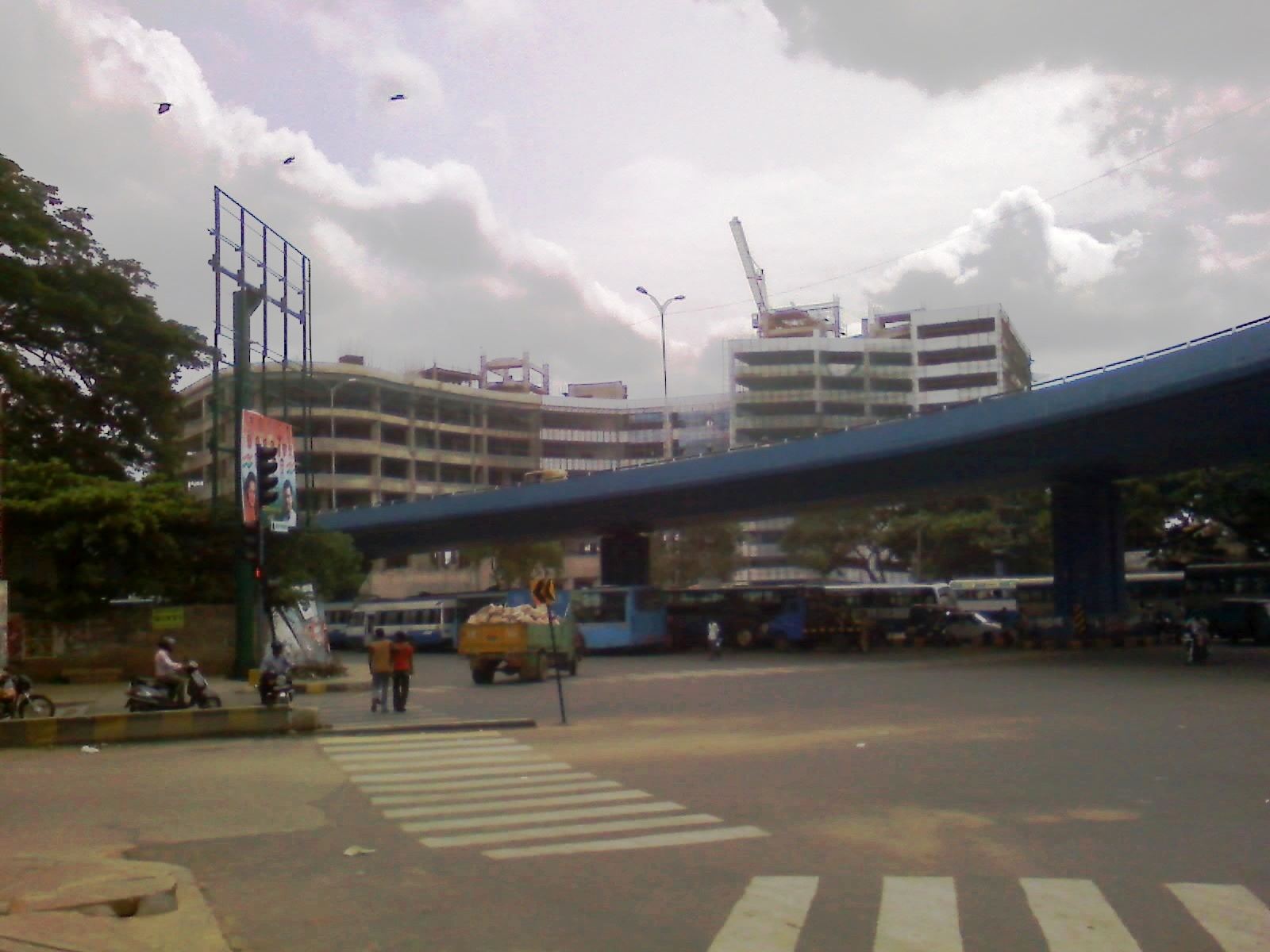
Yeswanthpur's road network is anchored by Tumkur Road, designated as National Highway 48 (NH-48), which serves as the primary arterial route connecting the locality to northern and western parts of Bengaluru and beyond to Tumakuru. This highway facilitates heavy vehicular movement, including trucks and commercial vehicles, supporting the area's industrial activities. Local connectivity is enhanced by the Bangalore Inner Ring Road, which links Yeswanthpur to adjacent industrial zones like Peenya and residential-commercial hubs such as Malleshwaram, forming a crucial loop for intra-city traffic. The total length of roads within Yeswanthpur ward (Ward 37 under BBMP) spans approximately 25 km, encompassing arterial, sub-arterial, and minor streets managed by the Bruhat Bengaluru Mahanagara Palike (BBMP). Infrastructure developments have focused on alleviating bottlenecks at key junctions. A significant flyover at Yeshwanthpur , spanning 419.9 meters and connecting NH-48 with local roads including Yeshwanthpur Main Road, was constructed starting in 2006 and opened to traffic in 2009, reducing delays at the busy intersection. More recently, BBMP has undertaken widening projects, including a 27-km stretch from K.R. Puram to Yeshwanthpur (extending to Mathikere Cross), estimated at ₹3,240 , aimed at improving capacity for mixed traffic flows. Vehicle registrations in the area fall under the KA-04 prefix, managed by the Yeshwanthpur located at Corporation Complex, Yeshwanthpur. Despite these enhancements, Yeswanthpur faces persistent , exacerbated by high volumes of industrial traffic from nearby manufacturing units and operations along NH-48. Encroachments, irregular parking in the , and inadequate contribute to bottlenecks, particularly during peak hours when heavy goods vehicles dominate the roads. The locality's PIN code, 560022, is used for postal services and coordination, underscoring its role as a distribution hub amid these mobility challenges.

Rail and public transit

Yesvantpur Junction railway station, commissioned in 1881 by Mysore Maharaja Chamarajendra Wadiyar X, serves as a primary terminal for the South Western Railway zone and one of Bengaluru's busiest railway hubs. The station, located on the Bangalore–Pune and Bangalore–Hyderabad main lines, facilitates connectivity to major cities including Mumbai, Chennai, and destinations in northern India through over 200 originating, terminating, and passing trains daily. It features six platforms and handles significant passenger traffic, contributing to the area's growth as a transport node since its early role in regional rail development. As of September 2025, the station is undergoing a ₹380 crore redevelopment project, which is 60% complete and expected to finish by the end of 2025. The upgrades include a new four-story building, green infrastructure, and smart amenities to handle over 100,000 daily passengers. The Green Line includes Yeshwanthpur station, which became operational on March 1, 2014, as part of the initial 6.7 km stretch from Nagasandra to Sampige Road (now Mantri Square Sampige Road). This elevated station connects to key northwestern suburbs like and , while linking southward to via Majestic interchange. The line was extended to Madavara in November 2024, increasing its total length to 33.46 km. As of 2025, the Green Line supports daily ridership exceeding 210,000 passengers. Integration with the adjacent railway station via a enhances multimodal access for commuters. Public bus services at Yeshwanthpur are anchored by the BMTC terminus, a key depot offering extensive intra-city routes to Bengaluru's central areas like Majestic and suburbs such as Malleswaram and . The facility also integrates with (KSRTC) operations for intercity connections to destinations across and neighboring states, handling substantial daily passenger volumes as part of BMTC's network serving over 7,000 buses and 6,000 schedules. This setup positions Yeshwanthpur as a vital node for affordable mass transit, complementing rail options for local and regional travel.

Public services

Education

Yeswanthpur, a locality in Bengaluru, benefits from a robust educational landscape supported by both private and government institutions, contributing to the Bengaluru Urban district's overall literacy rate of 87.67% as recorded in the 2011 Census. Access to education is facilitated through a mix of schools affiliated to central and state boards, serving the local population under the oversight of the Department of School Education for public institutions. Prominent schools in the area include M.S. Ramaiah Vidyaniketan, established in 1994 and affiliated to the Central Board of Secondary Education (CBSE), located in the nearby Mathikere neighborhood; it emphasizes holistic development from pre-primary to secondary levels. National Public School, Yeshwanthpur, founded in 2013 and also CBSE-affiliated, offers programs from Montessori to senior secondary, focusing on academic excellence and extracurricular activities. St. Claret High School in adjacent Jalahalli, affiliated to the Indian Certificate of Secondary Education (ICSE) and state board, provides education from nursery to Class 10, with an emphasis on value-based learning and co-curricular programs. These private schools collectively cater to thousands of students in the Yeshwanthpur vicinity, supplemented by government-run options such as GHPS Vyayamasale Yeshavanthp and GMPS Santhebeedi Yeshvanthpura, which operate under the Karnataka Department of School Education and follow the state curriculum for primary and upper primary education. At the higher education level, Christ (Deemed to be University) Yeshwanthpur Campus, inaugurated in 2022, spans 1.6 million square feet and offers undergraduate, postgraduate, and doctoral programs primarily in , sciences, , , and through its dedicated schools. The campus promotes interdisciplinary learning and research in a modern, eco-friendly environment. Additionally, students in Yeshwanthpur have convenient access to nearby institutions like , located approximately 15 km away, renowned for its engineering and technology programs.

Healthcare

Yeswanthpur, a bustling industrial suburb of Bengaluru, benefits from a mix of private multi-specialty hospitals and facilities under the (BBMP). Key private institutions include Manipal Hospital Yeshwanthpur (formerly Referral Hospital, established in 2008 and acquired by Manipal Hospitals in 2021), a 160-bed multi-specialty facility. This hospital offers comprehensive services across specialties such as , , and , with a particular emphasis on advanced cardiac care including interventional procedures and 24/7 services. Another prominent center is Sanjeevini Multispeciality Hospital, located nearby in , provides a 100-bed facility with expertise in , , , and high-risk pregnancies, emphasizing affordable multi-specialty care. Public healthcare in Yeswanthpur is supported by Primary Health Centers (PHCs) managed by BBMP, which operate in major wards to deliver essential outpatient services. These centers run drives targeting preventable diseases in children and adults, as part of the Reproductive and Child Health (RCH) program, and include initiatives such as antenatal care, postnatal support, and family welfare services. The private sector in Yeshwanthpur provides significant capacity for inpatient care amid growing urban demand. In August 2025, Aster DM Healthcare announced plans to establish a new 500-bed in the area with an of ₹580 , further enhancing local . Healthcare in the area faces challenges due to high volumes from industrial workers in nearby manufacturing hubs, who often experience occupational health issues like respiratory problems and injuries from strenuous labor. In response, post-2020 telemedicine initiatives have been expanded in Bengaluru, including adoption by local hospitals for remote consultations to improve access for workers with limited mobility.

Landmarks and culture

Notable landmarks

Yeshwanthpur serves as home to several prominent landmarks that reflect its blend of commercial vitality and urban development. , established in the early by the , is a major shopping and entertainment complex spanning over 900,000 square feet at Brigade Gateway. It houses more than 500 retail outlets, including international brands, alongside multiplex cinemas and dining options, making it a key destination for leisure in the area. The World Market, exemplified by outlets like METRO Cash & Carry, specializes in international goods and wholesale supplies, catering to diverse consumer needs with imported products.

Cultural life

Yeswanthpur's cultural life is deeply influenced by its diverse religious communities, with prominent Hindu temples such as the Sri Dari Anjaneya Swamy Temple serving as focal points for devotion and gatherings. This temple, featuring a large idol of , attracts locals for daily worship and special pujas, fostering a sense of spiritual continuity in the area's industrial backdrop. Similarly, the Sree Veeranjanaya Swamy Temple contributes to the Hindu devotional practices, hosting rituals that draw families from surrounding neighborhoods. The Muslim community is equally vibrant, centered around mosques like the Jamia Masjid on Railway Station Road, which supports five daily prayers in and , promoting interfaith harmony through community iftars during . Other nearby mosques, such as Masjid E Al Qadar and Masjid E Abu Hurairah, further enrich this religious tapestry by organizing educational programs and charitable events for residents. Annual festivals highlight the area's religious fervor, with the Sri Yeshwanthpur Navratri Yuva Mandal leading celebrations of Navratri utsav, where devotees seek blessings from Maa Ambe through garba dances and processions that unite youth from diverse backgrounds. Ram Navami processions, observed with chants and temple visits, reflect broader Hindu traditions in the locality, often involving community participation near key worship sites. These events underscore the interplay of faith and festivity, drawing migrants who incorporate regional customs into local observances. Community activities revolve around labor and cultural preservation, with industrial worker unions like those affiliated with the Chief Labour Commissioner's office in Shram Sadan advocating for workers' rights through meetings and awareness drives in Yeshwanthpur's factories. Kannada cultural groups, including the Prakriti Foundation, organize socio-cultural programs that promote regional arts and heritage, such as folk performances during celebrations in the Yeshwanthpur assembly segment. The street food scene embodies multicultural influences, featuring dosa stalls and markets offering South Indian staples alongside North Indian chaats and Bihari litti chokha, reflecting the area's migrant workforce from various states. Modern influences blend tradition with urban dynamism, as malls like Orion host fusion events combining Kannada folk music with contemporary performances, attracting young residents to interactive workshops. Venues such as Bangalore Creative Circus in Yeshwanthpur facilitate art workshops and community gatherings that explore technology-infused crafts, enhancing the locality's role in Bangalore's diverse urban culture. Migrant festivals, including Chhath Puja celebrated by Bihari communities, add layers of regional vibrancy, with processions and feasts that promote cultural exchange among workers. This mosaic of traditions illustrates Yeshwanthpur's evolving identity as a hub of inclusive community life.

References

Add your contribution
Related Hubs
User Avatar
No comments yet.