


Community hub
Recent from talks
Contribute something
Nothing was collected or created yet.
ACVR1
View on Wikipedia


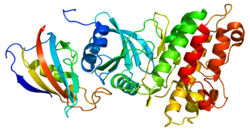
Activin A receptor, type I (ACVR1) is a protein which in humans is encoded by the ACVR1 gene; it is also known as ALK-2 (activin receptor-like kinase-2).[5] ACVR1 has been linked to the 2q23-24 region of the genome.[6] This protein is important in the bone morphogenic protein (BMP) pathway that is responsible for the development and repair of the skeletal system. While knockout models with this gene are in progress, the ACVR1 gene has been connected to fibrodysplasia ossificans progressiva, an extremely rare progressive genetic disease characterized by heterotopic ossification of muscles, tendons, and ligaments.[7] It is a bone morphogenetic protein receptor, type 1.
Function
[edit]Activins are dimeric growth and differentiation factors that belong to the transforming growth factor-beta (TGF beta) superfamily of structurally related signaling proteins. Activins signal through a heteromeric complex of receptor serine kinases that include at least two type I ( I and IB) and two type II (II and IIB) receptors. These receptors are all transmembrane proteins, composed of a ligand-binding extracellular domain with cysteine-rich region, a transmembrane domain, and a cytoplasmic domain with predicted serine/threonine specificity. Type I receptors are essential for signaling; type II receptors are required for binding ligands and for expression of type I receptors. Type I and II receptors form a stable complex after ligand binding, resulting in phosphorylation of type I receptors by type II receptors. This gene encodes activin A type I receptor that signals a particular transcriptional response in concert with activin type II receptors.[8]
Signaling
[edit]ACVR1 transduces signals of BMPs. BMPs bind either ACVR2A/ACVR2B or a BMPR2 and then form a complex with ACVR1. These go on to recruit the R-SMADs SMAD1, SMAD2, SMAD3 or SMAD6.[9]
Clinical significance
[edit]Gain-of-function mutations in the gene ACVR1/ALK2 is responsible for the genetic disease fibrodysplasia ossificans progressiva (FOP).[10] The typical FOP patient has the amino acid arginine substituted for the amino acid histidine at position 206 in this protein.[10][11] This substitution causes a change in the critical glycine-serine activation domain of the protein that will then cause the protein to bind its inhibitory ligand (FKBP12) less tightly, and thus overactivate the BMP/SMAD pathway.[6] The result of this overactivation is that endothelial cells transform to mesenchymal stem cells and then to bone.[12] Atypical mutations involving other residues work similarly, thereby causing the protein to be stuck in its active conformation despite no BMP being present.[13]
Mutations in the ACVR1 gene have also been linked to cancer, especially diffuse intrinsic pontine glioma (DIPG).[14][15][16]
References
[edit]- ^ a b c GRCh38: Ensembl release 89: ENSG00000115170 – Ensembl, May 2017
- ^ a b c GRCm38: Ensembl release 89: ENSMUSG00000026836 – Ensembl, May 2017
- ^ "Human PubMed Reference:". National Center for Biotechnology Information, U.S. National Library of Medicine.
- ^ "Mouse PubMed Reference:". National Center for Biotechnology Information, U.S. National Library of Medicine.
- ^ ten Dijke P, Ichijo H, Franzén P, Schulz P, Saras J, Toyoshima H, Heldin CH, Miyazono K (October 1993). "Activin receptor-like kinases: a novel subclass of cell-surface receptors with predicted serine/threonine kinase activity". Oncogene. 8 (10): 2879–87. PMID 8397373.
- ^ a b Pignolo RJ, Shore EM, Kaplan FS (June 2013). "Fibrodysplasia ossificans progressiva: diagnosis, management, and therapeutic horizons". Pediatr Endocrinol Rev. 10 Suppl 2 (2): 437–48. PMC 3995352. PMID 23858627.
- ^ de Ruiter RD, Smilde BJ, Pals G, Bravenboer N, Knaus P, Schoenmaker T, et al. (2021). "Fibrodysplasia Ossificans Progressiva: What Have We Achieved and Where Are We Now? Follow-up to the 2015 Lorentz Workshop". Front Endocrinol (Lausanne). 12 732728. doi:10.3389/fendo.2021.732728. PMC 8631510. PMID 34858325.
- ^ "Entrez Gene: ACVR1 (activin A receptor, type I)".
- ^ Inman GJ, Nicolás FJ, Callahan JF, Harling JD, Gaster LM, Reith AD, Laping NJ, Hill CS (July 2002). "SB-431542 is a potent and specific inhibitor of transforming growth factor-beta superfamily type I activin receptor-like kinase (ALK) receptors ALK4, ALK5, and ALK7". Molecular Pharmacology. 62 (1): 65–74. doi:10.1124/mol.62.1.65. PMID 12065756. S2CID 15185199.
- ^ a b Shore EM, Xu M, Feldman GJ, Fenstermacher DA, Cho TJ, Choi IH, Connor JM, Delai P, Glaser DL, LeMerrer M, Morhart R, Rogers JG, Smith R, Triffitt JT, Urtizberea JA, Zasloff M, Brown MA, Kaplan FS (May 2006). "A recurrent mutation in the BMP type I receptor ACVR1 causes inherited and sporadic fibrodysplasia ossificans progressiva". Nature Genetics. 38 (5): 525–7. doi:10.1038/ng1783. PMID 16642017. S2CID 41579747.
- ^ "News Release of FOP's Cause". Archived from the original on 2012-01-13. Retrieved 2012-02-29.
- ^ van Dinther M, Visser N, de Gorter DJ, Doorn J, Goumans MJ, de Boer J, ten Dijke P (June 2010). "ALK2 R206H mutation linked to fibrodysplasia ossificans progressiva confers constitutive activity to the BMP type I receptor and sensitizes mesenchymal cells to BMP-induced osteoblast differentiation and bone formation". Journal of Bone and Mineral Research. 25 (6): 1208–15. doi:10.1359/jbmr.091110. PMID 19929436. S2CID 207269687.
- ^ Petrie KA, Lee WH, Bullock AN, Pointon JJ, Smith R, Russell RG, Brown MA, Wordsworth BP, Triffitt JT (2009). "Novel mutations in ACVR1 result in atypical features in two fibrodysplasia ossificans progressiva patients". PLOS ONE. 4 (3) e5005. Bibcode:2009PLoSO...4.5005P. doi:10.1371/journal.pone.0005005. PMC 2658887. PMID 19330033.
- ^ Taylor KR, Mackay A, Truffaux N, Butterfield YS, Morozova O, Philippe C, Castel D, Grasso CS, Vinci M, Carvalho D, Carcaboso AM, de Torres C, Cruz O, Mora J, Entz-Werle N, Ingram WJ, Monje M, Hargrave D, Bullock AN, Puget S, Yip S, Jones C, Grill J (May 2014). "Recurrent activating ACVR1 mutations in diffuse intrinsic pontine glioma". Nature Genetics. 46 (5): 457–61. doi:10.1038/ng.2925. PMC 4018681. PMID 24705252.
- ^ "Cure Brain Cancer - News - Multiple Breakthroughs in Childhood Brain Cancer DIPG". Cure Brain Cancer Foundation.
- ^ Buczkowicz P, Hoeman C, Rakopoulos P, Pajovic S, Letourneau L, Dzamba M, et al. (May 2014). "Genomic analysis of diffuse intrinsic pontine gliomas identifies three molecular subgroups and recurrent activating ACVR1 mutations". Nature Genetics. 46 (5): 451–6. doi:10.1038/ng.2936. PMC 3997489. PMID 24705254.
External links
[edit]- Human ACVR1 genome location and ACVR1 gene details page in the UCSC Genome Browser.
- Overview of all the structural information available in the PDB for UniProt: Q04771 (Human Activin receptor type-1) at the PDBe-KB.

This article incorporates text from the United States National Library of Medicine, which is in the public domain.
ACVR1
View on GrokipediaGenetics
Genomic location
The ACVR1 gene is located on the long arm of human chromosome 2 at the cytogenetic band 2q24.1.[1] In the GRCh38.p14 reference assembly, it spans from nucleotide position 157,736,446 to 157,876,330 on the reverse (complement) strand, encompassing approximately 140 kb of genomic sequence.[1] The gene's orientation on the reverse strand facilitates its transcription in the opposite direction relative to the chromosomal coordinate increase.[1] In comparison, the mouse ortholog Acvr1 is situated on chromosome 2 at positions 58,336,450 to 58,456,840 (also on the complement strand) in the GRCm39 assembly, covering about 120 kb within the 58.3–58.5 Mb region.[4] Evolutionary conservation of ACVR1 is high across mammals, with the human and mouse proteins sharing 99.8% amino acid sequence identity, reflecting its essential role in conserved signaling pathways.[5] The ACVR1 gene was first cloned in 1993 as part of efforts to identify type I receptors in the transforming growth factor-beta (TGF-β) superfamily, with subsequent mapping to chromosome 2q23-q24 confirmed by fluorescence in situ hybridization in 1998.[6][7]Gene structure
The ACVR1 gene consists of 11 exons spanning approximately 140 kb of genomic DNA on chromosome 2q24.1.[8] Exon 1 includes the translation start codon (ATG) along with 5' untranslated regions (UTRs), while the subsequent exons encode the remainder of the coding sequence, interrupted by 10 introns of varying lengths that account for the gene's overall size.[8] The canonical transcript, ENST00000263640.7, utilizes these 11 exons with standard GT-AG consensus splice sites at intron-exon boundaries, producing a 3,047 bp mRNA that encodes a 509-amino-acid protein isoform.[9] Alternative splicing generates at least 52 transcripts for ACVR1, though most variants differ primarily in UTR composition rather than coding regions, with ENST00000263640.7 designated as the principal isoform due to its high conservation and expression levels.[10] Intron sizes contribute significantly to the genomic footprint; for instance, studies in bovine models have identified structural features such as indels within intron 1 (e.g., g.2715_2731del, a 17-bp deletion) and intron 2 (e.g., g.33008_33024del, another 17-bp deletion, rs380635814), highlighting the intronic variability across species.[11] Regulatory elements upstream of the coding region include a 2.9 kb promoter with a transcription start site (TSS) located 237-244 bp upstream of the ATG codon.[12] This promoter features a GC-rich minimal core (72 bp) lacking a TATA box and driven by Sp1 binding for basal transcription, while an upstream region acts as an enhancer-like element responsive to bone morphogenetic protein 2 (BMP2).[12] Transcription factors such as Egr-1, Egr-2, ZBTB7A/LRF, and Hey1 bind within this promoter, exhibiting cell-type-specific regulation that has been characterized in studies of fibrodysplasia ossificans progressiva (FOP).[13] In non-human models like Chinese beef cattle, ACVR1 variations—including the aforementioned intronic indels and exonic single nucleotide polymorphisms (SNPs) such as g.41793C>T (exon 4, rs458497709)—are associated with growth traits, including increased chest girth and cannon bone circumference, suggesting functional roles for these structural elements in phenotypic variation.[11]Protein
Primary structure
The ACVR1 protein consists of 509 amino acids and has a calculated molecular weight of approximately 57 kDa.[14] It is synthesized as a precursor with an N-terminal signal peptide comprising the first 20 amino acids (residues 1–20), which facilitates translocation across the endoplasmic reticulum membrane during biosynthesis.[15] The primary amino acid sequence of ACVR1 features characteristic motifs typical of serine/threonine kinase receptors, including a conserved serine/threonine kinase domain in the intracellular region that enables autophosphorylation and signal propagation.[16] Additionally, the sequence contains potential N-linked glycosylation sites in the extracellular domain, where asparagine residues serve as attachment points for oligosaccharide chains, contributing to protein folding, stability, and trafficking. A key post-translational modification is N-linked glycosylation, which occurs primarily in the extracellular portion and influences the protein's maturation in the secretory pathway.[14] ACVR1 exhibits strong sequence conservation across mammals, with greater than 85% identity in the coding regions between human and mouse orthologs, including the signal peptide, underscoring its evolutionary importance in conserved signaling pathways.[5] This high homology extends to functional motifs, ensuring similar biochemical properties in different species. ACVR1 is a single-pass type I transmembrane protein, with the signal peptide cleaved to yield the mature form.[15]Domain organization
The ACVR1 protein, a serine/threonine kinase receptor, exhibits a modular domain architecture typical of type I transforming growth factor-β (TGF-β) superfamily receptors, spanning 509 amino acids in its precursor form and yielding a mature protein of 489 amino acids after cleavage of the N-terminal signal peptide (residues 1-20).[14] The extracellular domain (residues 21-124 of the precursor) is cysteine-rich, facilitating ligand binding and promoting receptor dimerization through disulfide bond formation. This region contains conserved cysteine residues that stabilize the structure for interaction with bone morphogenetic proteins (BMPs) and activins.[5] Adjacent to the extracellular domain is the transmembrane domain (residues 125-147), which consists of an alpha-helical span that anchors the protein in the plasma membrane and mediates signal transduction from extracellular to intracellular compartments. The intracellular portion begins with the GS domain (residues 148-179), a glycine- and serine-rich regulatory segment that serves as a phosphorylation site for activation by type II receptors.[5] The C-terminal kinase domain (residues 180-503) harbors the catalytic activity, featuring an activation loop essential for substrate phosphorylation and downstream signaling initiation.[17] Structural studies have elucidated key features of these domains. The kinase domain has been crystallized in complex with inhibitors, as seen in PDB entry 9D8F, revealing inhibitor binding in the ATP pocket via van der Waals interactions and hydrogen bonds that stabilize the inactive conformation. Additionally, cryo-electron microscopy structures demonstrate a heterodimeric complex between the ACVR1 kinase domain and the type II receptor BMPR2, mediated by interactions between their C-terminal lobes, which positions the GS domain for trans-phosphorylation.Ligand binding and signaling
Receptor complex formation
ACVR1, also known as ALK2, functions as a type I receptor in the bone morphogenetic protein (BMP) signaling pathway, assembling into heterotetrameric complexes consisting of two type I receptors and two type II receptors to transduce extracellular signals. These complexes typically include ACVR1 alongside another type I receptor such as BMPR1A (ALK3) or BMPR1B (ALK6), paired with type II receptors like BMPR2, ACVR2A, or ACVR2B. The symmetric heterotetramer forms around a dimeric ligand, with the extracellular domains of the receptors interacting to stabilize the assembly, enabling subsequent intracellular kinase activation.[18][19] Ligand binding initiates complex formation, with BMPs such as BMP6 and BMP7 exhibiting primary affinity for these receptor assemblies, while activins can also engage ACVR1, often forming non-signaling complexes. The extracellular domain of ACVR1 plays a crucial role in facilitating dimerization by interacting with the ligand's binding sites, which have comparable affinities for type I and type II receptors in BMPs, promoting the recruitment of all four receptor subunits. Ligands bind with low affinity to type I receptors like ACVR1 in isolation, necessitating the presence of type II receptors for high-affinity, stable interactions that drive tetramerization.[20][18][21] Receptor associations exhibit both constitutive and ligand-induced characteristics, with type I and type II receptors forming transient homodimers or heterodimers in the absence of ligand, maintaining a basal state of low activity. Ligand binding enhances oligomerization, stabilizing the heterotetrameric complex and shifting it toward active signaling conformations through extracellular domain rearrangements and intracellular kinase domain interactions. Accessory proteins such as FKBP1A (also known as FKBP12) bind to the glycine-serine (GS) domain of ACVR1, regulating complex stability by inhibiting premature kinase activation and preventing leaky signaling until ligand-induced conformational changes release the inhibitor.[22][18][23]Downstream signaling
Upon ligand-induced formation of the receptor complex, the associated type II receptor (such as BMPR2 or ACVR2A/B) transphosphorylates the glycine-serine (GS) domain of ACVR1 at multiple serine residues, which activates the kinase domain of ACVR1 by relieving autoinhibition and dissociating the inhibitory protein FKBP12.[3][15] This phosphorylation event is essential for propagating the signal intracellularly, as it enables ACVR1 to adopt an active conformation capable of substrate recognition. The activated ACVR1 kinase subsequently phosphorylates the receptor-regulated SMADs (R-SMADs)—specifically SMAD1, SMAD5, and SMAD8—at the C-terminal SSXS motif, leading to their activation.[24][3] These phosphorylated R-SMADs oligomerize with the common partner SMAD4 to form heterocomplexes that translocate from the cytoplasm to the nucleus, where they interact with DNA and co-factors to induce or repress transcription of target genes such as ID1 and MSX2, which are involved in cell differentiation and proliferation.[24][25] Negative regulation of ACVR1 signaling occurs primarily through inhibitory SMADs, SMAD6 and SMAD7; SMAD6 competes with R-SMADs for binding to ACVR1 or promotes their ubiquitination via Smurf1, while SMAD7 directly inhibits type I receptor kinase activity and recruits E3 ligases for receptor degradation.[24][26] Furthermore, cross-talk with other TGF-β superfamily branches modulates pathway output, as TGF-β-activated SMAD2/3 complexes can antagonize SMAD1/5/8-driven transcription, influencing cellular responses like osteogenesis and fibrosis.[24][27]Physiological functions
Role in development
ACVR1 plays a critical role in early embryonic patterning through its mediation of BMP signaling. In mouse embryos, global ablation of Acvr1 arrests development at gastrulation stages, resulting in failure of the primitive streak to undergo proper gastrulation and mesoderm formation.[28] This receptor also contributes to dorsoventral axis formation, as its deletion disrupts primitive streak development, leading to axis defects, consistent with BMP's morphogenic role in establishing ventral fates.[29] Furthermore, ACVR1 is essential for left-right asymmetry, where BMP signaling through this receptor in chimeric mouse embryos ensures proper nodal expression and asymmetric organ positioning.[30] In skeletal development, ACVR1 regulates endochondral ossification, the process by which cartilage is gradually replaced by bone during embryogenesis. It controls the growth and differentiation of chondrocytes and osteoblasts, ensuring coordinated bone formation in the axial and appendicular skeleton.[31] Dysregulation of ACVR1, as seen in conditional knockouts, impairs this transition and leads to skeletal malformations, highlighting its necessity for proper ossification timing and progression.[3] Additionally, ACVR1 is involved in joint formation, particularly in digit development, where it influences interzone specification and cavitation to prevent fusion and enable articulation.[32] ACVR1-mediated BMP signaling is vital for cardiac morphogenesis, specifically in outflow tract septation and valve formation. In the second heart field, Acvr1 deletion causes misalignment of the outflow tract and defective septation, resulting in common arterial trunk anomalies due to impaired addition of cardiomyocytes and cushion maturation.[33] For semilunar valves, ACVR1 promotes endocardial cushion development in the outflow tract, and its deficiency leads to bicuspid aortic valve formation through reduced cushion growth and remodeling.[34] In the nervous system, ACVR1 supports neural crest cell migration and dorsal neural tube patterning via BMP pathway activation. Conditional ablation in neural crest cells using Wnt1-Cre reveals that ACVR1 is required for their proliferation and growth, essential for craniofacial structure formation.[28] It also contributes to dorsal neural tube patterning by facilitating BMP gradients that specify dorsal identities and inhibit ventral fates during neurulation.[29]Tissue-specific roles
In bone and cartilage, ACVR1 functions as a key type I receptor for bone morphogenetic proteins (BMPs), maintaining homeostasis by balancing osteoblast differentiation and osteoclast activity. Conditional knockout of Acvr1 in osteoblasts leads to increased bone mass through enhanced osteogenesis and reduced bone resorption, demonstrating its role in regulating adult skeletal remodeling.[35] In cartilage, ACVR1 supports chondrocyte proliferation and extracellular matrix production, ensuring tissue integrity during mechanical stress; its ablation impairs these processes, leading to reduced cartilage maintenance.[28] For repair and remodeling, BMP signaling through ACVR1 activates periosteal progenitor cells during fracture healing, promoting endochondral ossification and callus formation to restore bone structure.[35] In the reproductive system, ACVR1 mediates anti-Müllerian hormone (AMH) signaling in the ovaries to regulate folliculogenesis, inhibiting the activation of primordial follicles and preserving the ovarian reserve in adulthood.[36] Polymorphisms in ACVR1, such as rs1220134, are associated with altered AMH levels and follicle numbers in conditions like polycystic ovary syndrome, highlighting its influence on ovarian function.[36] In the testes, ACVR1 is expressed in Sertoli cells and spermatogonia, where it supports spermatogenesis by facilitating germ cell proliferation and differentiation through BMP and activin pathways.[37] In the heart, ACVR1 contributes to cardiomyocyte maintenance by transducing BMP signals that regulate contractility and calcium handling; disruption of this pathway, such as through elevated activin A binding, impairs diastolic function and promotes atrophy in adult cardiomyocytes.[38] During injury response, ACVR1-mediated BMP7 signaling enhances cardiomyocyte proliferation and survival post-myocardial infarction, aiding tissue repair via activation of SMAD5, ERK, and AKT pathways in adult mice.[39] In the adult nervous system, ACVR1 supports neuroprotection by modulating BMP signaling in response to injury, where its inhibition in neural precursor cells promotes survival and limits demyelination in conditions like stroke.[40]Pathophysiology
Mutations
The ACVR1 gene, encoding the activin A receptor type I (also known as ALK2), harbors several gain-of-function mutations that lead to aberrant activation of bone morphogenetic protein (BMP) signaling. The most prevalent mutation in humans is R206H, a heterozygous missense variant in the glycine-serine (GS) domain, accounting for over 95% of classic fibrodysplasia ossificans progressiva (FOP) cases.[41] This substitution reduces the receptor's binding affinity to the inhibitory protein FKBP1A (also known as FKBP12), thereby preventing FKBP1A-mediated suppression of basal kinase activity and promoting ligand-independent signaling. Less common gain-of-function variants in FOP include substitutions at glycine 328 (G328V, G328R, G328W, and G328E) within the kinase domain and R258S in the ATP-binding region. These mutations, identified in a small subset of atypical FOP patients, similarly confer constitutive kinase activity independent of ligand binding, though they exhibit variable sensitivity to BMP ligands compared to R206H.[43][44] Activating ACVR1 mutations also occur somatically in diffuse intrinsic pontine glioma (DIPG), a pediatric brainstem tumor, where approximately 20-25% of cases harbor variants such as R206H or G328 alterations (including G328V, G328R, G328E, and G328W). These mutations drive ligand-independent BMP pathway activation, often co-occurring with histone H3 K27M alterations to promote gliomagenesis.[45] Loss-of-function variants in ACVR1 are rare in humans but have been linked to congenital heart defects. Neutral variants have not been robustly linked to any diseases. In animal models, such variants are associated with altered growth traits, including increased bone mass in Acvr1-deficient mouse osteoblasts due to upregulated Wnt signaling and enhanced body weight or carcass traits in ACVR1 variant cattle.[46][47]Associated diseases
Fibrodysplasia ossificans progressiva (FOP) is a rare genetic disorder primarily caused by activating mutations in ACVR1, leading to progressive heterotopic ossification of soft tissues such as muscles, tendons, and ligaments.[48] Clinical features include congenital malformations, most notably bilateral hallux valgus (short, broad, and often clinodactylous big toes) in over 97% of cases, alongside episodic flare-ups that result in painful swellings and subsequent bone formation, severely restricting mobility.[48] The condition has a worldwide prevalence of approximately 1 in 1 to 2 million individuals, with no ethnic or geographic predisposition, and ossification is often triggered by trauma, inflammation, or even minor procedures like vaccinations.[48] Diagnosis relies on characteristic clinical findings combined with genetic testing confirming heterozygous pathogenic variants in ACVR1, such as the common R206H mutation.[48] Diffuse intrinsic pontine glioma (DIPG), a highly aggressive pediatric brainstem tumor, is associated with ACVR1 mutations in about 25% of cases, frequently co-occurring with histone H3.1 K27M mutations.[49] These mutations hyperactivate BMP signaling, promoting tumor cell proliferation, survival, and a mesenchymal phenotype that drives gliomagenesis and reduces overall survival (median around 11 months).[49] Affected children typically present with cranial nerve deficits, ataxia, and long-tract signs, with the pons location making surgical resection impossible and contributing to poor prognosis.[49] ACVR1 dysregulation has also been implicated in congenital cardiac malformations, including atrioventricular septal defects and bicuspid aortic valve, where loss-of-function mutations such as H286D and G356D impair endocardial cushion development during embryogenesis.[50][51] In the reproductive system, ACVR1 variants are linked to disorders such as polycystic ovary syndrome (PCOS) and gonadal dysgenesis, potentially contributing to premature ovarian insufficiency through disrupted anti-Müllerian hormone signaling and folliculogenesis.[3] Additionally, ACVR1 gene amplifications or altered expression have been observed in various cancers, including breast (promoting invasion) and prostate (enhancing proliferation via BMP pathway activation), though these associations are less prevalent (e.g., ~3% in endometrial cancer) and highlight a context-dependent oncogenic role.[3]References
- https://pubmed.ncbi.nlm.nih.gov/20463014/