Hubbry Logo
Serine/threonine-specific protein kinaseSerine/threonine-specific protein kinaseMain
Open search
Serine/threonine-specific protein kinase
Community hub
Serine/threonine-specific protein kinase
logo
8 pages, 0 posts
0 subscribers
Be the first to start a discussion here.
Serine/threonine-specific protein kinase
from Wikipedia
Protein-serine/threonine kinases
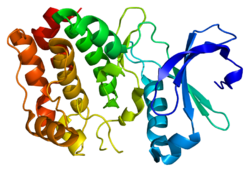
Human Aurora Kinase PDB 1mq4[1]
Identifiers
EC no.2.7.11.-
CAS no.9026-43-1
Databases
IntEnzIntEnz view
BRENDABRENDA entry
ExPASyNiceZyme view
KEGGKEGG entry
MetaCycmetabolic pathway
PRIAMprofile
PDB structuresRCSB PDB PDBe PDBsum
Gene OntologyAmiGO / QuickGO
Search
PMCarticles
PubMedarticles
NCBIproteins
serine
threonine
phosphate
phosphoserine

A serine/threonine protein kinase (EC 2.7.11.-) is a kinase enzyme, in particular a protein kinase, that phosphorylates the OH group of the amino-acid residues serine or threonine, which have similar side chains. At least 350 of the 500+ human protein kinases are serine/threonine kinases (STK).[2]

In enzymology, the term serine/threonine protein kinase describes a class of enzymes in the family of transferases, that transfer phosphates to the oxygen atom of a serine or threonine side chain in proteins. This process is called phosphorylation. Protein phosphorylation in particular plays a significant role in a wide range of cellular processes and is a very important post-translational modification.[3][4][5][6][7][8][9]

The chemical reaction performed by these enzymes can be written as

ATP + a protein ADP + a phosphoprotein

Thus, the two substrates of this enzyme are ATP and a protein, whereas its two products are ADP and phosphoprotein.

The systematic name of this enzyme class is ATP:protein phosphotransferase (non-specific).

Function

[edit]

Serine/threonine kinases play a role in the regulation of cell proliferation, programmed cell death (apoptosis), cell differentiation, and embryonic development.[citation needed]

Selectivity

[edit]

While serine/threonine kinases all phosphorylate serine or threonine residues in their substrates, they select specific residues to phosphorylate on the basis of residues that flank the phosphoacceptor site, which together comprise the consensus sequence. Since the consensus sequence residues of a target substrate only make contact with several key amino acids within the catalytic cleft of the kinase (usually through hydrophobic forces and ionic bonds), a kinase is usually not specific to a single substrate, but instead can phosphorylate a whole "substrate family" which share common recognition sequences. While the catalytic domain of these kinases is highly conserved, the sequence variation that is observed in the kinome (the subset of genes in the genome that encode kinases) provides for recognition of distinct substrates. Many kinases are inhibited by a pseudosubstrate that binds to the kinase like a real substrate but lacks the amino acid to be phosphorylated. When the pseudosubstrate is removed, the kinase can perform its normal function.[citation needed]

EC numbers

[edit]

Many serine/threonine protein kinases do not have their own individual EC numbers and use 2.7.11.1, "non-specific serine/threonine protein kinase". This entry is for any enzyme that phosphorylates proteins while converting ATP to ADP (i.e., ATP:protein phosphotransferases.)[10] 2.7.11.37 "protein kinase" was the former generic placeholder and was split into several entries (including 2.7.11.1) in 2005.[11] 2.7.11.70 "protamine kinase" was merged into 2.7.11.1 in 2004.[12]

2.7.11.- is the generic level where all serine/threonine kinases should sit in.[13]

Types

[edit]

Types include those acting directly as membrane-bound receptors (Receptor protein serine/threonine kinase) and intracellular kinases participating in Signal transduction. Of the latter, types include:

EC number Name Description
EC 2.7.11.1 CK2, also known by the misnomer casein kinase 2 was discovered in 1954 by Burnett and Kennedy.
EC 2.7.11.1 Mos/Raf kinases form part of the MAPKK Kinase family and are activated by growth factors. The enzyme functions to stimulate growth of cells. Raf inhibition has become the target for new anti-metastatic cancer drugs as they inhibit the MAPK cascade and reduce cell proliferation.
EC 2.7.11.1 Protein Kinase B, also known as AKT kinase The v-akt gene was identified as the oncogene of retrovirus AKT8. The gene codes for a protein kinase. Human homologs of the AKT8 oncogenic protein were identified in 1987.By 1995 it had been found that Akt kinases function as mitogen-activated kinases downstream from cell surface receptors that activate phosphoinositide 3-kinase. Three human akt genes exist. All three Akt kinases regulate cell proliferation and Akt2 is particularly important for insulin actions in cells. A major target of Akt kinases is glycogen synthase kinase-3.
EC 2.7.11.1 Pelle is a serine/threonine kinase that can phosphorylate itself, and also Tube and Toll.
EC 2.7.11.11 Protein kinase A consists of two domains, a small domain with several β sheet structures and a larger domain containing several α helices. The binding sites for substrate and ATP are located in the catalytic cleft between the domains (or lobes). When ATP and substrate bind, the two lobes rotate so that the terminal phosphate group of the ATP and the target amino acid of the substrate move into the correct positions for the catalytic reaction to take place.
EC 2.7.11.13 Protein kinase C ('PKC') is actually a family of protein kinases consisting of ~10 isozymes. They are divided into three subfamilies: conventional (or classical), novel, and atypical based on their second messenger requirements.
EC 2.7.11.24 Mitogen-activated protein kinases (MAPKs) respond to extracellular stimuli (mitogens) and regulate various cellular activities, such as gene expression, mitosis, differentiation, and cell survival/apoptosis.
EC 2.7.11.17 Ca2+/calmodulin-dependent protein kinases or CaM kinases (CAMK) are primarily regulated by the Ca2+/calmodulin complex.
EC 2.7.11.19 Phosphorylase kinase was in fact, the first Ser/Thr protein kinase to be discovered (in 1959 by Krebs et al.).

Clinical significance

[edit]

Serine/threonine kinase (STK) expression is altered in many types of cancer.[14] Limited benefit of serine/threonine kinase inhibitors has been demonstrated in ovarian cancer[15] but studies are ongoing to evaluate their safety and efficacy.[citation needed]

Serine/threonine protein kinase p90-kDa ribosomal S6 kinase (RSK) is in involved in development of some prostate cancers.[16]

Raf inhibition has become the target for new anti-metastatic cancer drugs as they inhibit the MAPK cascade and reduce cell proliferation.[citation needed]

See also

[edit]

References

[edit]
[edit]
Revisions and contributorsEdit on WikipediaRead on Wikipedia
from Grokipedia
Serine/threonine-specific protein kinases are a large and diverse family of enzymes that catalyze the transfer of the γ-phosphate group from ATP to the hydroxyl groups of serine or threonine residues in target proteins, thereby modulating protein activity, localization, and interactions. More than 300 such kinases are encoded in the human genome, comprising the majority of the approximately 518 protein kinases that constitute the kinome. These kinases are fundamental regulators of cellular signaling, controlling processes such as cell growth, differentiation, proliferation, metabolism, and apoptosis through phosphorylation-dependent mechanisms. Structurally, serine/threonine-specific protein kinases share a conserved catalytic domain of about 250–300 amino acids, divided into 12 subdomains that enable ATP binding in a deep cleft and precise recognition of substrate residues. This domain is flanked by regulatory sequences that confer specificity and control activation, often through conformational changes induced by phosphorylation, second messengers, or protein-protein interactions. Based on sequence homology and functional motifs, they are grouped into families such as AGC (including protein kinase A, or PKA, and protein kinase B, or Akt), CAMK (calcium/calmodulin-dependent kinases), CK1 (casein kinase 1), CMGC (cyclin-dependent kinases, or CDKs, and mitogen-activated protein kinases, or MAPKs), and STE (sterile kinases involved in MAPK pathways). In cellular contexts, these kinases integrate extracellular signals with intracellular responses, often operating in multi-tiered cascades like the MAPK/ERK pathway, which transmits growth factor signals to alter gene expression and cytoskeletal dynamics. Activation typically involves allosteric regulation by ligands such as cyclic AMP for PKA, calcium ions for CaMKs, or upstream phosphorylation in cascades, ensuring spatiotemporal precision via anchoring proteins like A-kinase anchoring proteins (AKAPs). Dysfunctions in serine/threonine-specific protein kinases contribute to pathologies including cancers (e.g., via oncogenic CDKs or Akt), metabolic disorders (e.g., through PKA dysregulation), and neurodegeneration, positioning them as key targets for small-molecule inhibitors in therapeutic development.

Definition and Overview

Biochemical Definition

Serine/threonine-specific protein kinases constitute a major subclass of protein kinases, classified under the Enzyme Commission number EC 2.7.11.-, that catalyze the transfer of the γ-phosphate group from adenosine triphosphate (ATP) to the hydroxyl groups of serine or threonine residues within substrate proteins. These enzymes play a pivotal role in post-translational modification by adding a phosphate moiety, which typically alters the target protein's activity, localization, or interactions. The phosphorylation occurs specifically on the side-chain oxygen atoms of these amino acids, enabling precise regulation of cellular processes through covalent modification. The general catalytic reaction for these kinases can be represented as: ATP+protein-Ser/ThrADP+protein-Ser/Thr-P\text{ATP} + \text{protein-Ser/Thr} \rightarrow \text{ADP} + \text{protein-Ser/Thr-P} This transfer involves the nucleophilic attack by the substrate's hydroxyl group on the γ-phosphorus of ATP, facilitated by the kinase's active site, resulting in the formation of a phosphoprotein and the release of adenosine diphosphate (ADP). The reaction is reversible under physiological conditions, often countered by protein phosphatases, allowing dynamic control of protein function. In contrast to tyrosine kinases (EC 2.7.10.-), which selectively phosphorylate the hydroxyl group of tyrosine residues, serine/threonine-specific kinases exhibit exclusivity for serine and threonine due to differences in substrate binding pockets and recognition motifs. Dual-specificity kinases, a smaller group, can phosphorylate both serine/threonine and tyrosine residues, bridging signaling pathways but distinguished by their broader substrate specificity. The discovery of serine/threonine-specific protein kinases traces back to the mid-1950s, when Edwin G. Krebs and Edmond H. Fischer identified the first such enzyme through investigations into the activation of glycogen phosphorylase in rabbit muscle. Their work on phosphorylase kinase revealed that phosphorylation of serine residues converts inactive phosphorylase b to active phosphorylase a, establishing reversible protein phosphorylation as a fundamental regulatory mechanism and earning them the 1992 Nobel Prize in Physiology or Medicine. This seminal finding laid the groundwork for understanding kinase-mediated signaling in biology.

Classification within Kinases

Serine/threonine-specific protein kinases (STKs) constitute one of the three principal classes of protein kinases, distinguished by their ability to phosphorylate the hydroxyl groups on serine and threonine residues in target proteins. The other two classes include tyrosine-specific protein kinases (TKs), which target tyrosine residues, and dual-specificity kinases capable of phosphorylating both serine/threonine and tyrosine residues. This classification is based on the specific amino acid residue serving as the phosphate acceptor, reflecting distinct structural adaptations in the kinase active site that ensure substrate selectivity. In the human genome, protein kinases comprise a significant portion of the proteome, with approximately 518 genes encoding these enzymes, representing about 2% of all genes. Of these, roughly 350 are STKs, accounting for more than 65% of the total kinome and underscoring their prevalence in eukaryotic signaling networks. This distribution highlights the central role of STKs in diverse cellular processes, from metabolism to cell cycle regulation, while TKs and dual-specificity kinases form smaller subsets focused on specialized pathways like growth factor signaling. STKs are categorized within the Enzyme Commission (EC) group 2.7, which encompasses phosphoryltransferases that utilize nucleoside triphosphates to transfer phosphate to alcohol-containing acceptors. This broader category includes not only protein kinases (primarily EC 2.7.11 for serine/threonine and tyrosine types) but also lipid kinases, such as phosphatidylinositol kinases (e.g., EC 2.7.1.30), and other enzymes targeting carbohydrates or alcohols. The shared catalytic mechanism involving ATP-dependent phosphate transfer links STKs to these related enzymes, though their substrate specificity diverges significantly. Evolutionarily, STKs trace their origins to ancient phosphoryltransferase ancestors common across bacteria, archaea, and eukarya, with the Hanks-type kinase domain representing a deeply conserved core structure. Diversification of the STK family arose through multiple gene duplication events, particularly in eukaryotes, which allowed for subfunctionalization and adaptation to complex regulatory needs, such as in response to environmental cues or developmental signals. These duplications contributed to the expansion observed in the human kinome, enabling the evolution of kinase specificity and regulatory diversity.

Molecular Structure

Conserved Catalytic Domain

The catalytic domain of serine/threonine-specific protein kinases (STKs) represents a highly conserved structural core, typically spanning 250–300 amino acids, that enables the transfer of the γ-phosphate from ATP to serine or threonine residues on substrate proteins. This domain was first structurally characterized in 1991 through the crystal structure of the catalytic subunit of cAMP-dependent protein kinase A (PKA) at 2.7 Å resolution, revealing a compact fold shared across the eukaryotic protein kinase superfamily. Subsequent structures of diverse STKs have confirmed this conservation, underscoring its role as the minimal unit for phosphotransferase activity. The domain adopts a bilobal architecture, with a smaller N-terminal lobe (approximately residues 1–100 in PKA numbering) dominated by a five-stranded antiparallel β-sheet that facilitates ATP binding, and a larger C-terminal lobe (residues 101–280) rich in α-helices that accommodates substrate positioning and catalytic residues. These lobes are linked by a flexible hinge region (β5–αD), which allows conformational flexibility during nucleotide and substrate binding. The deep cleft between the lobes forms the active site, where ATP and the protein substrate interact in an orientation optimal for phosphate transfer. Several key motifs define the functional architecture of this domain. The glycine-rich loop (G-loop), located between β1 and β2 in the N-lobe, features a GxGxG consensus sequence that acts as a flexible lid to grip the ATP ribose and position its triphosphate for catalysis. A highly conserved lysine residue (K72 in PKA, part of the VAIK motif in subdomain II) electrostatically interacts with the α- and β-phosphates of ATP, stabilizing the nucleotide and facilitating phosphate transfer. In the C-lobe, the activation loop (A-loop, spanning ~20–30 residues) begins with the invariant Asp-Phe-Gly (DFG) motif (subdomain VII), which chelates magnesium ions and orients the catalytic aspartate (D166 in PKA) for abstracting the hydroxyl proton from the substrate. Across the STK superfamily, the catalytic domain exhibits approximately 30% average sequence identity, reflecting evolutionary divergence while preserving essential catalytic residues and fold integrity; this level of conservation supports the rational design of broad-spectrum kinase inhibitors that exploit shared ATP-binding pockets.

Regulatory and Accessory Domains

Serine/threonine-specific protein kinases often feature non-catalytic regulatory and accessory domains that fine-tune their activity, localization, and specificity by modulating interactions with lipids, other proteins, or cellular compartments. These domains typically flank the conserved catalytic core and enable allosteric regulation, autoinhibition, or activation in response to cellular signals. For instance, pleckstrin homology (PH) domains, approximately 100-120 amino acids in length, bind phosphoinositides to recruit kinases to membrane sites, as seen in AGC family members like AKT and protein kinase C (PKC), where PH binding to phosphatidylinositol 3,4,5-trisphosphate (PIP3) promotes membrane localization and activation. Kinase-associated (KA) domains and autoinhibitory segments further contribute to regulation by influencing oligomerization and suppressing basal activity. The KA1 domain, a compact ~140-amino-acid module found in kinases such as MARK1/PAR1, binds anionic phospholipids for membrane targeting while also mediating autoinhibition through intramolecular interactions with the kinase domain's αD helix, thereby preventing untimely activation until relieved by upstream signals. Autoinhibitory segments, often unstructured loops or helical regions, impose steric hindrance on the catalytic site; in Raf-1 kinase, an N-terminal autoinhibitory domain sequesters the kinase domain until Ras binding disrupts it, highlighting a common mechanism across serine/threonine kinases like PAKs and WNKs. Additionally, in cyclin-dependent kinases (CDKs), small accessory proteins known as CKS subunits (~79 amino acids) bind the CDK-cyclin complex to enhance substrate specificity and facilitate progression through cell cycle checkpoints by recognizing phosphorylated motifs. In Ca2+/calmodulin-dependent protein kinases (CAMKs), a dedicated calmodulin-binding domain (CaMBD), typically 20-30 residues rich in basic and hydrophobic amino acids, interacts with Ca2+-bound calmodulin to displace autoinhibitory elements and activate the kinase. These domains also govern subcellular localization, ensuring kinases act at precise sites. Nuclear localization signals (NLS), short basic peptide motifs (e.g., PKKKRKV-like sequences), direct kinases like CaMKII to the nucleus for phosphorylating transcription factors, though phosphorylation within or near the NLS can block import, as demonstrated in CaMKII where Thr287 phosphorylation inhibits nuclear targeting. Membrane anchoring via post-translational modifications, such as N-terminal myristoylation—a 14-carbon fatty acid attachment to glycine residues—tethers kinases to lipid bilayers; in STK16 (a serine/threonine kinase), myristoylation at Gly2 facilitates Golgi localization and interaction with palmitoylated partners, enhancing signal transduction efficiency. Structurally, accessory domains exhibit high variability, often comprising 20-50% of the full kinase length (with catalytic domains ~250-300 residues), allowing diverse architectures that support allosteric control and adaptation to specific cellular contexts, as evidenced by the prevalence of at least one accessory domain in ~64% of human kinases.

Catalytic Mechanism

Phosphorylation Process

The phosphorylation process catalyzed by serine/threonine-specific protein kinases involves a multi-step enzymatic mechanism that transfers the γ-phosphate group from ATP to the hydroxyl oxygen of a substrate serine or threonine residue. This reaction proceeds via an ordered or random bi-bi kinetic scheme, beginning with ATP binding to the kinase active site, followed by substrate docking, phosphoryl transfer, and release of the phosphorylated product and ADP. A critical component is the binding of ATP in complex with two Mg²⁺ ions, which coordinate the β- and γ-phosphates to neutralize their negative charges and orient the triphosphate for nucleophilic attack; without Mg²⁺, catalysis is severely impaired as the cofactor stabilizes the transition state and facilitates phosphate transfer. Substrate docking positions the target Ser/Thr hydroxyl near the γ-phosphate, often requiring prior conformational activation of the kinase. The core catalytic step is an inline nucleophilic attack by the substrate hydroxyl on the γ-phosphorus, displacing ADP as the leaving group; a conserved aspartate residue in the catalytic loop acts as a base to abstract the proton from the attacking hydroxyl, lowering the energy barrier for bond formation. This process is enabled by kinase conformational changes, notably the repositioning of the activation loop: in the inactive state, the DFG motif (Asp-Phe-Gly) adopts a "DFG-out" conformation that disrupts ATP binding and substrate access, whereas phosphorylation or other activations shift it to the "DFG-in" state, aligning catalytic residues and stabilizing the active site. Following transfer, the proton is returned to solution, and the products—phospho-substrate and ADP—are released, with product dissociation often partially rate-limiting. Kinetic parameters reflect the efficiency of this mechanism, with typical K_m values for ATP ranging from 10 to 100 μM across many serine/threonine kinases, ensuring saturation under physiological ATP concentrations of 1–10 mM. Turnover rates (k_cat) for the phosphoryl transfer step vary but can reach up to several hundred s⁻¹ in highly active kinases, as exemplified by the ~38 s⁻¹ rate observed for ERK2 under optimal conditions.

Substrate Recognition and Selectivity

Serine/threonine-specific protein kinases achieve substrate recognition primarily through the identification of short linear motifs surrounding the target serine (Ser) or threonine (Thr) residues, which serve as phospho-acceptor sites. These motifs provide initial selectivity by aligning the substrate in the active site cleft, where the kinase's catalytic residues facilitate phosphate transfer from ATP. Approximately 60% of the human Ser/Thr kinome can be classified into three major motif clusters: those enriched in basic residues (arginine [R] or lysine [K]) N-terminal to the target residue, proline (Pro) at the +1 position C-terminal to the target, or acidic residues (aspartate [D] or glutamate [E]) and phosphorylated residues nearby. A classic example is protein kinase A (PKA), which preferentially phosphorylates Ser/Thr residues preceded by two or three basic residues, such as the consensus motif RRXS or KRRXS, allowing it to target substrates like the cAMP response element-binding protein (CREB). In contrast, mitogen-activated protein kinases (MAPKs), such as extracellular signal-regulated kinase (ERK), favor proline-directed motifs like S/TP, where the Pro at +1 induces a turn that positions the acceptor residue optimally in the active site; however, MAPKs often require additional docking motifs for full specificity. Acidic motifs are common in kinases like casein kinase 2 (CK2), which recognizes S/TP preceded by acidic residues (e.g., (S/T)XXD/E), enhancing selectivity for regulatory proteins in DNA damage responses. These motifs are not absolute but establish a baseline preference, with negative selection against non-cognate residues further refining targeting. Beyond primary motifs, docking interactions provide higher-order specificity by tethering substrates to the kinase via sites distant from the phosphorylation locus, often involving hydrophobic pockets in the C-terminal lobe (C-lobe) of the kinase domain. These pockets, formed by α-helices and loops, accommodate amphipathic docking motifs on substrates, such as the D-motif (hydrophobic residues followed by basic clusters) in MAPK substrates, which binds a groove on the kinase's C-lobe to orient the phospho-acceptor site toward the active site. For instance, in the ERK pathway, docking ensures sequential phosphorylation by MEK while preventing off-target activity by other kinases. Pseudosubstrate inhibitors exploit this mechanism by mimicking docking and consensus motifs but lacking the hydroxyl group on Ser/Thr; the protein kinase inhibitor (PKI) peptide for PKA, with sequence TTYADFIASGRTGRRNAIHD, binds the active site to block genuine substrates. Specificity is further tuned by structural determinants within the kinase, including variable loop regions flanking the conserved catalytic domain and allosteric sites that modulate substrate access. The activation segment, particularly the DFG motif and the residue immediately following it (DFG+1), acts as a key determinant: a bulky aromatic residue at DFG+1 favors Ser phosphorylation, while β-branched residues like valine or isoleucine promote Thr selectivity, as seen in ancestral reconstructions of kinase evolution. Variable loops, such as the P+1 loop near the active site, adapt to accommodate motif variations, while allosteric sites in the N-lobe can influence C-lobe docking affinity upon ligand binding. These elements collectively ensure that kinases distinguish target residues among thousands of potential sites in the proteome. Experimental elucidation of these recognition mechanisms relies on high-throughput methods like positional scanning peptide arrays (PSPAs) and phosphopeptide libraries, which systematically vary residues around a central Ser/Thr to map consensus motifs for hundreds of kinases simultaneously. For example, PSPAs profiled specificities for 303 human Ser/Thr kinases, revealing motif clusters and exceptions driven by docking. Complementary mass spectrometry-based proteomics, analyzing over 89,000 in vivo phosphorylation sites, validates these motifs by correlating them with observed phosphoproteomes under specific conditions. These approaches have been pivotal in identifying non-canonical specificities, such as those influenced by secondary structure or compartmentalization.

Classification and Types

EC Number System

The Enzyme Commission (EC) number system classifies serine/threonine-specific protein kinases under the top-level category EC 2.7.11, which encompasses enzymes that catalyze the transfer of a phosphate group from ATP to the hydroxyl group of serine or threonine residues in target proteins, thereby modulating protein function in cellular processes. This class is subdivided into numerous specific entries, reflecting distinct substrate specificities, regulatory mechanisms, or activating conditions; notable examples include EC 2.7.11.1 for non-specific serine/threonine protein kinases, EC 2.7.11.10 for IκB kinase (involved in NF-κB signaling), EC 2.7.11.11 for cAMP-dependent protein kinase (PKA), and extending to more recent assignments such as EC 2.7.11.39 for ROCK-subfamily protein kinases, with over 30 specific sub-entries documented as of the latest nomenclature. However, the EC system has limitations for this kinase class, as many serine/threonine kinases exhibit overlapping substrate activities or lack sufficient characterization for unique assignment, leading to their grouping under the heterogeneous EC 2.7.11.1 or the generic unclassified designation EC 2.7.11.- for those without specific entries. The EC database undergoes periodic revisions by the Nomenclature Committee of the IUBMB to incorporate new kinase annotations based on emerging biochemical data; for instance, in 2023, updates included the addition of EC 2.7.11.35 for CRIK-subfamily protein kinases and the transfer of EC 2.7.11.27 to EC 2.7.11.31.

Major Kinase Families

Serine/threonine-specific protein kinases (STKs) in the human genome are phylogenetically classified into several major groups based on sequence similarity in their catalytic domains, with families defined by shared evolutionary origins and typically greater than 40% amino acid identity within groups. This classification, derived from comprehensive genomic analysis, identifies approximately 360 STKs as of 2023, representing the bulk of the eukaryotic protein kinase complement excluding tyrosine kinases. The AGC group, comprising about 63 members (roughly 12% of the total kinome), includes prominent families such as protein kinase A (PKA), protein kinase B (PKB/Akt), and protein kinase C (PKC); these kinases are characteristically activated by lipids or second messengers like cAMP and diacylglycerol. The CAMK group, with around 74 members (approximately 14% of the total kinome), encompasses calcium/calmodulin-dependent kinases, exemplified by CaMKII, which feature regulatory domains responsive to calcium signaling. The CMGC group accounts for about 61 members (11% of the total kinome) and includes cyclin-dependent kinases (CDKs), mitogen-activated protein kinases (MAPKs), and casein kinases (CKs), united by conserved motifs in their activation loops and high sequence homology exceeding 40%. Other notable groups include the STE group with 48 members (9% of the total kinome), featuring sterile (STE) kinases like MAPKKKs involved in kinase cascades; the CK1 group with 12 members (2% of the total kinome), linked to regulatory phosphorylation in processes such as circadian rhythms; the TKL (tyrosine kinase-like) group with 43 members (8% of the total kinome), which includes non-receptor kinases like IRAKs despite structural resemblance to tyrosine kinases; and the "Other" group with approximately 85 members, encompassing additional diverse STKs. Atypical kinases (about 40 members) are also part of the broader kinome but are structurally divergent. These families exhibit distinct phylogenetic branches, with overall STK distribution reflecting evolutionary expansions in humans compared to simpler organisms.

Biological Functions

Roles in Cellular Signaling

Serine/threonine-specific protein kinases (STKs) serve as central mediators in cellular signal transduction, converting extracellular stimuli such as hormones and growth factors into intracellular responses through sequential phosphorylation events. These kinases form multi-layered cascades that amplify weak initial signals, enabling a single activated upstream receptor to propagate modifications across numerous downstream substrates and elicit coordinated cellular outcomes like proliferation or differentiation. This amplification is achieved via conformational changes and activation loops in the kinases, allowing each level of the cascade to activate multiple molecules at the next tier, thereby ensuring sensitive and robust signal relay. Feedback mechanisms involving the interplay between STKs and opposing phosphatases are essential for regulating signaling dynamics and preventing aberrant activation. In many pathways, such as the mitogen-activated protein kinase (MAPK) cascade, activated STKs induce the transcription of dual-specificity phosphatases that dephosphorylate and inactivate the kinases themselves, creating negative feedback loops that control signal duration and amplitude to maintain homeostasis. This kinase-phosphatase balance ensures signaling fidelity, adapting responses to sustained or transient inputs while avoiding overamplification that could lead to pathological states. Spatial compartmentalization further refines STK function by confining their activity to specific subcellular locales through association with scaffold proteins that assemble kinase complexes, often termed signalosomes. For instance, A-kinase anchoring proteins (AKAPs) tether STKs like protein kinase A to organelles such as mitochondria or the plasma membrane, facilitating localized phosphorylation of nearby substrates and insulating signals from global interference. This organization promotes efficiency, specificity, and crosstalk control within crowded cellular environments. Quantitatively, STKs dominate the human phosphoproteome, accounting for the majority of the estimated 100,000 serine and threonine phosphorylation sites identified across proteins, which represent over 90% of all known phosphosites. With approximately 80% of the 518 human protein kinases classified as STKs, these enzymes underpin the extensive repertoire of reversible modifications that orchestrate intracellular communication and homeostasis.

Involvement in Key Pathways

Serine/threonine-specific protein kinases play central roles in the mitogen-activated protein kinase/extracellular signal-regulated kinase (MAPK/ERK) pathway, a conserved cascade that transduces extracellular signals to regulate cellular processes such as proliferation and differentiation. The pathway involves sequential activation starting with Raf kinases (ARAF, BRAF, CRAF), which are serine/threonine kinases that dimerize and become active upon RAS-GTP binding, leading to phosphorylation and activation of mitogen-activated protein kinase kinases (MEK1/2). MEK1/2, also dual-specificity kinases with serine/threonine activity, then phosphorylate ERK1/2 on threonine and tyrosine residues in the TEY motif, enabling ERK nuclear translocation and phosphorylation of transcription factors like Elk-1 and c-Fos to drive gene expression for cell cycle progression and differentiation. This tiered phosphorylation ensures signal amplification and specificity in response to growth factors. In the phosphoinositide 3-kinase (PI3K)/AKT/mammalian target of rapamycin (mTOR) pathway, serine/threonine kinases AKT (also known as protein kinase B) and mTOR are pivotal for promoting cell survival and metabolic adaptation. Upon PI3K activation by receptor tyrosine kinases, AKT is recruited to the plasma membrane via PIP3, where it undergoes phosphorylation at Thr308 by PDK1 and Ser473 by mTORC2, a complex containing the serine/threonine kinase mTOR, to achieve full activation. Activated AKT phosphorylates downstream targets such as BAD (inhibiting apoptosis), FOXO transcription factors (promoting survival), and TSC2 (relieving inhibition on mTORC1), thereby enhancing protein synthesis, nutrient uptake, and glycolytic metabolism essential for cell growth and survival. mTOR exists in two complexes: mTORC1, which phosphorylates S6K1 and 4E-BP1 to boost translation and metabolism, and mTORC2, which sustains AKT activity and cytoskeletal organization. The transforming growth factor-β (TGF-β)/SMAD pathway relies on serine/threonine kinases for transcriptional regulation of growth and differentiation. TGF-β binding to type II receptor (TβRII) recruits and phosphorylates type I receptor (TβRI), a serine/threonine kinase, which in turn phosphorylates receptor-regulated SMADs (SMAD2/3) at C-terminal serine residues. Phosphorylated SMAD2/3 form complexes with SMAD4 and translocate to the nucleus to modulate genes controlling cell proliferation and extracellular matrix production. Additionally, TGF-β-activated kinase 1 (TAK1), a serine/threonine kinase, is recruited via TRAF6-mediated ubiquitination in non-canonical signaling, phosphorylating MAPKKs like MKK3/6 to activate p38 and JNK, thereby integrating stress responses that fine-tune SMAD-dependent growth control. Crosstalk between serine/threonine kinase pathways and tyrosine kinase signaling enhances pathway integration, as seen in the epidermal growth factor receptor (EGFR) activation of the Raf-MAPK cascade. EGFR, upon ligand binding, can bypass RAS in certain contexts, such as KRAS-mutant pancreatic cancer cells, to directly engage Raf kinases, leading to MEK/ERK activation and sustained proliferative signaling. This integration allows tyrosine kinase inputs to amplify serine/threonine-dependent cascades, coordinating responses to diverse stimuli like growth factors.

Regulation

Activation Mechanisms

Serine/threonine-specific protein kinases are activated through multiple mechanisms that respond to cellular signals, enabling precise control over phosphorylation events in signaling pathways. These mechanisms include phosphorylation of regulatory domains, binding of allosteric modulators, oligomerization, and scaffold-mediated assembly, each tailored to specific kinase families and contexts. A primary activation strategy involves phosphorylation of the activation loop, often termed the T-loop, which repositions key structural elements to facilitate substrate access and catalytic competence. In cyclin-dependent kinases (CDKs), binding to cyclins induces a conformation amenable to trans-phosphorylation on a conserved threonine residue in the T-loop by CAK (CDK-activating kinase), significantly enhancing activity by stabilizing the active state. Auto-phosphorylation can also occur in some kinases, where intermolecular interactions within oligomers promote T-loop modification, as seen in receptor-interacting protein kinase 1 (RIPK1). Allosteric activation occurs via binding of second messengers that induce conformational changes, relieving autoinhibition. For protein kinase A (PKA), cyclic AMP (cAMP) binds to regulatory subunits, dissociating the holoenzyme and liberating catalytic subunits for activity; this process is cooperative, with binding affinities in the nanomolar range. Similarly, Ca²⁺/calmodulin-dependent kinases (CaMKs) are activated when Ca²⁺-bound calmodulin displaces an autoinhibitory domain, increasing kinase activity by over 1,000-fold through electrostatic interactions. Protein kinase C (PKC) isoforms respond to diacylglycerol (DAG) and phorbol esters, which bind the C1 domain to recruit PKC to membranes and promote partial activation, often synergizing with Ca²⁺ for full engagement. Dimerization or oligomerization serves as an activation switch in certain kinases, particularly those involved in stress responses. In RIP kinases, such as RIPK3 during necroptosis, kinase domain dimerization induced by death domain interactions autophosphorylates activation loops and propagates signaling, with structural studies showing symmetric interfaces essential for activity. Scaffold proteins further refine activation by colocalizing kinases with activators and substrates. A-kinase anchoring proteins (AKAPs) tether PKA to specific locales, facilitating localized cAMP-dependent activation and preventing diffuse signaling; for instance, AKAP-Lbc assembles complexes that activate protein kinase D via PKA-mediated phosphorylation. This spatial organization enhances efficiency and specificity in cellular responses.

Inhibitory Controls

Serine/threonine-specific protein kinases are subject to multiple inhibitory controls that prevent aberrant activation and ensure precise spatiotemporal regulation of signaling. These mechanisms include intrinsic structural barriers, reversal of activating modifications, targeted degradation, and spatial confinement, collectively maintaining cellular homeostasis by counteracting kinase activity. Autoinhibition represents a primary intrinsic mechanism, where kinase domains are maintained in inactive conformations through interactions with regulatory elements. In protein kinase A (PKA), the regulatory subunits (RI and RII) contain pseudosubstrate sequences that mimic substrates but lack phosphorylatable residues, thereby occupying and blocking the catalytic active site of the kinase domain. This interaction stabilizes an inactive holoenzyme complex until cAMP binding induces dissociation and activation. Similar autoinhibitory strategies occur in other serine/threonine kinases, such as mixed lineage kinase 3 (MLK3), where an SH3 domain binds to a proline-rich sequence, locking the kinase in a closed, inactive state. These pseudosubstrate-mediated inhibitions allow rapid responsiveness while preventing constitutive activity. Dephosphorylation by protein phosphatases provides a dynamic counterbalance to kinase activation, rapidly reversing phosphorylations at key regulatory sites. Protein phosphatase 2A (PP2A), a major serine/threonine phosphatase, dephosphorylates regulatory sites on kinases such as the inhibitory Tyr15 on cyclin-dependent kinase 1 (CDK1) and the activation loop on extracellular signal-regulated kinase (ERK), thereby inactivating them and terminating signaling cascades. For instance, PP2A-B55 specifically targets mitotic phosphosites, promoting dephosphorylation of substrates like the kinesin EG5 to facilitate timely mitotic exit. This opposition ensures that kinase-driven phosphorylation events are transient and context-dependent. Post-translational modifications further fine-tune kinase activity by promoting degradation or altering interactions. Ubiquitination targets activated serine/threonine kinases for proteasomal degradation, serving as a feedback loop to downregulate signaling. In protein kinase C (PKC), activation by diacylglycerol leads to phosphorylation at Thr505, which recruits E3 ligases like RINCK for K48-linked polyubiquitination and subsequent degradation, limiting prolonged PKC signaling. Similarly, activated ERK1/2 is ubiquitinated by the RING domain of MEKK1, preventing sustained MAPK pathway activation. Acetylation can also modulate kinase function by altering substrate binding or regulatory interactions; for example, acetylation of lysine residues in AMP-activated protein kinase (AMPK) disrupts its association with upstream activators, indirectly inhibiting activity. These modifications integrate kinase regulation with broader cellular proteostasis. Compartmental sequestration restricts kinase access to substrates through subcellular relocation, effectively inhibiting localized activity. Nuclear export pathways, mediated by exportins like CRM1, translocate kinases from the nucleus to the cytoplasm, limiting their influence on nuclear targets. In the case of the Hog1 mitogen-activated protein kinase (MAPK), stress-induced nuclear accumulation is opposed by CRM1-dependent export, which requires Hog1 kinase activity and restores cytoplasmic sequestration to terminate nuclear signaling. Membrane dissociation similarly inactivates kinases like protein kinase D (PKD) by relocating them from lipid rafts, reducing proximity to membrane-associated substrates. These spatial controls complement biochemical inhibition by enforcing compartment-specific regulation.

Evolutionary and Organismal Distribution

In Eukaryotes

Serine/threonine-specific protein kinases are ubiquitous across eukaryotic organisms, underscoring their fundamental role in cellular regulation. In unicellular eukaryotes like the budding yeast Saccharomyces cerevisiae, approximately 116 such kinases have been identified, representing a significant portion of the kinome and enabling responses to environmental stresses and nutrient availability. In more complex multicellular eukaryotes, this number expands considerably; for instance, the human genome encodes approximately 450 serine/threonine kinases out of 518 total protein kinases, reflecting increased signaling complexity in higher organisms. This prevalence highlights their conservation from simple protists to advanced metazoans, where they mediate phosphorylation events critical for protein function and cellular homeostasis. These kinases perform essential functions in diverse eukaryotic processes, often acting as key regulators in signaling cascades. Cyclin-dependent kinases (CDKs), for example, drive cell cycle progression by phosphorylating targets that control DNA replication and mitosis, ensuring orderly cell division in all eukaryotes. In metabolic regulation, AMP-activated protein kinase (AMPK) senses energy status and promotes catabolic pathways to restore cellular ATP levels, a mechanism conserved from yeast to mammals. Additionally, TANK-binding kinase 1 (TBK1) plays a pivotal role in innate immunity by activating interferon responses to pathogens, integrating antiviral signaling in metazoans. The diversity of serine/threonine kinases in eukaryotes arose through evolutionary expansions, primarily via gene duplications following the divergence of metazoans from earlier lineages. This process generated specialized isoforms adapted to multicellular demands, such as tissue-specific signaling, with the kinome diversifying alongside increases in cell types during metazoan evolution. Studies in model organisms like Caenorhabditis elegans and Drosophila melanogaster have illuminated these developmental roles; in C. elegans, kinases such as SAX-1 regulate neuronal morphogenesis and axon guidance, while in Drosophila, the Tricornered (Trc) kinase coordinates polarized cell structures during embryogenesis and tissue patterning. These insights from genetic screens demonstrate how kinase-mediated phosphorylation sculpts organismal development, from axis formation to organogenesis.

In Prokaryotes

Serine/threonine-specific protein kinases (STPKs) are present in a significant portion of prokaryotic genomes, including both bacteria and archaea. In bacteria, analysis of sequenced genomes indicates that these kinases occur in nearly two-thirds of strains, with over 300,000 sequences identified across approximately 26,000 bacterial strains classified into 42 families. They are particularly abundant in phyla such as Actinobacteria, where up to 13 families are represented, and are often enriched in pathogenic species like Mycobacterium. In archaea, Hanks-type STPKs are also widespread, with evidence of phosphorylation on serine, threonine, and tyrosine residues, sharing a deep evolutionary root with bacterial and eukaryotic counterparts. These kinases play critical roles in prokaryotic physiology, particularly in bacteria, where they regulate cell wall synthesis, virulence, and stress responses. For instance, PrkC in Bacillus subtilis senses cell wall peptidoglycan via its PASTA domains, promoting spore germination and maintaining cell wall homeostasis during stress. In Mycobacterium tuberculosis, the Pkn family, including PknB and PknG, controls cell shape, division, and peptidoglycan synthesis essential for growth, while also enhancing intracellular survival and virulence in host cells. In archaea, STPKs interact with forkhead-associated domain proteins to mediate signaling, though their specific functions remain less characterized compared to bacteria. Overall, these kinases lack calmodulin-like equivalents but feature ligand-binding domains such as PASTA and TPR repeats for environmental sensing and protein interactions. Recent advances, including a 2025 atlas of bacterial STPKs, have illuminated their functional diversity and roles in growth, pathogenicity, and antibiotic resistance, providing a framework for structural studies and inhibitor design. This resource highlights distinctions from eukaryotic kinases, such as a unique RF motif in the C-helix, and emphasizes their expansion in certain phyla without evidence of widespread horizontal gene transfer from eukaryotes. Evolutionarily, prokaryotic STPKs share a common ancient origin predating the bacterial-eukaryotic divergence, resulting in fewer kinase families than the more diverse eukaryotic repertoire.

Clinical and Therapeutic Relevance

Associations with Diseases

Dysregulation of serine/threonine-specific protein kinases contributes to oncogenesis through uncontrolled cell proliferation, survival, and metastasis, with alterations in pathways such as PI3K/AKT/mTOR (including STKs like AKT and mTOR) affecting approximately 38% of solid tumors across various types. For instance, activating mutations in BRAF, a key mitogen-activated protein kinase kinase kinase, occur in about 50% of melanomas, leading to constitutive activation of the MAPK/ERK pathway and tumor progression. Similarly, dysregulation of the CDK4/6 pathway, often through cyclin D1 overexpression in over 50% of breast cancers or rare CDK4 amplification (~1-2%), drives cell cycle deregulation in hormone receptor-positive breast cancers, promoting G1/S phase transition and endocrine resistance. In neurodegenerative disorders, aberrant kinase activity disrupts protein homeostasis and neuronal integrity. Glycogen synthase kinase 3β (GSK3β) hyperphosphorylates tau protein at multiple sites, promoting neurofibrillary tangle formation and synaptic dysfunction in Alzheimer's disease, a process exacerbated by GSK3β overactivation in affected brains. Recent 2025 research has also implicated mechanistic target of rapamycin (mTOR) dysregulation in Parkinson's disease, where gut microbiota-derived imidazole propionate activates mTORC1, enhancing α-synuclein aggregation and dopaminergic neuron loss in preclinical models. Serine/threonine kinases play critical roles in inflammatory and autoimmune diseases by amplifying cytokine production and immune cell activation. In rheumatoid arthritis, dysregulated IκB kinase β (IKKβ) sustains NF-κB signaling in synovial fibroblasts and macrophages, driving chronic joint inflammation, pannus formation, and cartilage erosion. Likewise, TANK-binding kinase 1 (TBK1) mutations cause haploinsufficiency, impairing autophagy and mitophagy in motor neurons, which contributes to neuroinflammation and progressive degeneration in amyotrophic lateral sclerosis (ALS). Beyond these, serine/threonine kinases are linked to cardiovascular and metabolic pathologies. Protein kinase C (PKC) isoforms, particularly PKCα and PKCβ, mediate pathological cardiac hypertrophy by enhancing sarcomere reorganization and fibrosis in response to pressure overload or neurohormonal stress. In metabolic disorders, loss of AMP-activated protein kinase (AMPK) activity impairs energy sensing, leading to insulin resistance, hepatic steatosis, and dyslipidemia, as observed in type 2 diabetes and the metabolic syndrome.

Therapeutic Targeting and Inhibitors

Serine/threonine-specific protein kinases (STKs) represent a major class of therapeutic targets due to their dysregulation in cancers, inflammatory diseases, and infections, with pharmacological modulation primarily achieved through small-molecule inhibitors that disrupt kinase activity. These inhibitors are designed to bind either the conserved ATP-binding site or allosteric regions, enabling selective interference with downstream signaling pathways such as MAPK/ERK or cell cycle progression. As of October 2025, approximately 94 FDA-approved small-molecule protein kinase inhibitors include several targeting STKs, predominantly for oncology indications, highlighting their clinical impact in improving patient outcomes. Inhibitors of STKs are broadly classified into ATP-competitive and allosteric types based on their binding mechanisms. ATP-competitive inhibitors, such as sorafenib, occupy the ATP-binding pocket of the kinase domain, preventing phosphorylation; sorafenib targets Raf kinases in the MAPK pathway and is approved for hepatocellular carcinoma and renal cell carcinoma. Type II ATP-competitive inhibitors like sorafenib also engage an adjacent allosteric hydrophobic pocket, enhancing selectivity by stabilizing an inactive kinase conformation. In contrast, allosteric inhibitors bind outside the ATP site to modulate activity indirectly; for example, trametinib binds to an allosteric pocket in MEK1/2 kinases, locking them in an inactive state and is approved for BRAF-mutant melanoma when combined with dabrafenib. Another prominent example is palbociclib, an ATP-competitive inhibitor of cyclin-dependent kinases 4/6 (CDK4/6), which halts cell cycle progression in the G1 phase and is FDA-approved for hormone receptor-positive, HER2-negative breast cancer. Despite these successes, developing STK inhibitors faces significant challenges, including achieving selectivity amid the high conservation of the ATP-binding site across the kinome, which often leads to off-target effects and toxicity. For instance, multi-kinase inhibitors like sorafenib inhibit vascular endothelial growth factor receptors alongside Raf, contributing to hypertension as a common adverse effect. Resistance to STK inhibitors frequently arises through kinase domain mutations that alter binding affinity or activate bypass pathways; in BRAF-mutant cancers, resistance to type I inhibitors like vemurafenib often involves secondary mutations in NRAS or BRAF amplification. Efforts to overcome resistance include next-generation inhibitors with improved potency against mutant forms, though clinical translation remains limited. Emerging strategies for STK targeting include proteolysis-targeting chimeras (PROTACs), bifunctional molecules that recruit E3 ubiquitin ligases to induce ubiquitin-mediated degradation of the kinase, bypassing catalytic inhibition and potentially overcoming resistance. PROTACs have been developed for STKs such as Aurora-A, where compounds like JB301 achieve potent degradation in leukemic cells at low nanomolar concentrations, and RIPK2, targeted via antibody-PROTAC conjugates for selective elimination in HER2-positive cells. In infectious diseases, inhibitors of bacterial STKs offer antibiotic potential; for Mycobacterium tuberculosis, PknB is essential for growth, and 2024 studies identified antimicrobial peptides that selectively inhibit PknB, disrupting cell wall biosynthesis without cross-reactivity to human kinases. For PIM-1 kinase, implicated in hematologic malignancies, the inhibitor nuvisertib (TP-3654) received FDA Fast Track designation in June 2025 for myelofibrosis, advancing toward potential approval. These innovations underscore the evolving landscape of STK therapeutics, emphasizing degradation and selectivity to enhance efficacy and safety.

References

Add your contribution
Related Hubs
User Avatar
No comments yet.