



Community hub
Recent from talks
Contribute something
Nothing was collected or created yet.
Key Information


| Asus | |||||||||||||||||||
|---|---|---|---|---|---|---|---|---|---|---|---|---|---|---|---|---|---|---|---|
| Traditional Chinese | 華碩電腦股份有限公司 | ||||||||||||||||||
| Literal meaning | ASUS Computer Stock-share Limited Company | ||||||||||||||||||
| |||||||||||||||||||
| ASUS | |||||||||||||||||||
| Traditional Chinese | 華碩 | ||||||||||||||||||
| Literal meaning | "Chinese-Eminent" Eminence of/by the Chinese people (華人之碩) | ||||||||||||||||||
| |||||||||||||||||||
ASUSTeK Computer Inc. (/ˈeɪsuːs/,[3] /eɪˈsuːs/,[4] /ɑːˈ-/,[5] /əˈ-/;[6] ASUSTeK for short), doing business as Asus (stylized as ASUS), is a Taiwanese[7] multinational computer, phone hardware and electronics manufacturer headquartered in Beitou District, Taipei, Taiwan. Its products include desktop computers, laptops, netbooks, mobile phones, networking equipment, monitors, Wi-Fi routers, projectors, motherboards, graphics cards, optical storage, multimedia products, peripherals, wearables, servers, workstations and tablet PCs. The company is also an original equipment manufacturer (OEM).
As of 2024,[update] Asus is the world's fifth-largest personal computer vendor by unit sales.[8] Asus has a primary listing on the Taiwan Stock Exchange under the ticker code 2357 and formerly had a secondary listing on the London Stock Exchange under the ticker code ASKD.
Etymology
[edit]The company is usually referred to as ASUS or Huáshuò in Chinese (Chinese: 華碩, literally "Eminence" in Chinese[9]). According to the company website, the name ASUS originates from Pegasus, the winged horse of Greek mythology.[10] Only the last four letters of the word were used to give the name a high position in alphabetical listings.[11] As its marketing taglines, Asus has used Rock Solid. Heart Touching (2003–2009) and subsequently Inspiring Innovation Persistent Perfection (2009–2013). Since 2013, the company's tagline has been In Search of Incredible.[12]
History
[edit]![[icon]](https://en.wikipedia.org/wiki/File:Wiki_letter_w_cropped.svg) | This section needs expansion with: the company's history prior to 2005 and from 2013 to 2022. You can help by adding to it. (August 2025) |
Asus was founded in Taipei in 1989[13] by Tzu-Hsien Tung, Ted Hsu, Wayne Hsieh and M.T. Liao,[14] all four having previously worked at Acer as hardware engineers. At this time, Taiwan had yet to establish a leading position in the computer hardware business. Intel Corporation would supply any new processors to more established companies like IBM first, and Taiwanese companies would have to wait for approximately six months after IBM received their engineering prototypes. According to company history, Asus created a motherboard prototype for using an Intel 486, but it had to do so without access to the actual processor. When Asus approached Intel to request a processor to test it, Intel itself had a problem with its own 486 motherboard. Asus solved Intel's problem and it turned out that Asus's motherboard worked correctly without the need for further modification. Since then, Asus was receiving Intel engineering samples ahead of its competitors.[15][16]
In September 2005, Asus released the first PhysX accelerator card.[17] In December 2005, Asus entered the LCD TV market with the TLW32001 model.[18] In January 2006, Asus announced that it would cooperate with Lamborghini to develop the VX laptop series.[19]
On 9 March 2006, Asus was confirmed as one of the manufacturers of the first Microsoft Origami models, together with Samsung and Founder Technology.[20] On 8 August 2006, Asus announced a joint venture with Gigabyte Technology.[21] On 5 June 2007, Asus announced the launch of the Eee PC netbook computer line at the Computex trade fair. On 9 September 2007, Asus indicated support for Blu-ray, announcing the release of a BD-ROM/DVD writer PC drive, BC-1205PT.[22] Asus subsequently released several Blu-ray based notebooks.
In January 2008, Asus began a major restructuring of its operations, splitting into three independent companies: Asus (focused on applied first-party branded computers and electronics); Pegatron (focused on OEM manufacturing of motherboards and components); and Unihan Corporation (focused on non-PC manufacturing such as cases and molding).[23][24] In the process of the restructuring, a highly criticized pension-plan restructuring effectively zeroed out the existing pension balances. The company paid out all contributions previously made by employees.[25]
On 9 December 2008, the Open Handset Alliance announced that Asus had become one of 14 new members of the organization. These "new members will either deploy compatible Android devices, contribute significant code to the Android Open-Source Project, or support the ecosystem through products and services that will accelerate the availability of Android-based devices."[26]
On 1 June 2010, Asus spun off Pegatron.[27]
In October 2010, Asus and Garmin announced that they would be ending their smartphone partnership as a result of Garmin deciding to exit the product category.[28] The two companies had produced six Garmin-Asus branded smartphones over the prior two years.[28]
In December 2010, Asus launched the world's thinnest notebook, the Asus U36, with Intel processor voltage standard (not low voltage) Intel Core i3 or i5 with a thickness of only 19 mm.[29]
In January 2013, Asus officially ended production of its Eee PC series due to declining sales caused by consumers increasingly switching to tablets and Ultrabooks.[30][31] In April 2022, the company unveiled its new logo.[32][33]
Corporate affairs
[edit]The key trends for Asus are (as of the financial year ending 31 December):[34][35]
| Year | Revenue (TWD bn) | Net profit (TWD bn) |
|---|---|---|
| 2019 | 351 | 14.3 |
| 2020 | 412 | 23.9 |
| 2021 | 535 | 44.5 |
| 2022 | 537 | 14.6 |
| 2023 | 482 | 15.9 |
Operations
[edit]

Asus has its headquarters in Beitou District, Taipei, Taiwan.[36]
As of 2009[update], Asus had manufacturing facilities in Taiwan (Taipei, Luzhu, Nangang, Guishan), China (Suzhou, Chongqing), Mexico (Ciudad Juárez) and the Czech Republic (Ostrava). The Asus Hi-Tech Park, located in Suzhou, covers 540,000 m2 (5,800,000 sq ft).[37][citation needed]
Products
[edit]Asus's products include 2-in-1s, laptops, tablet computers, desktop computers, smartphones, personal digital assistants (PDAs), servers, computer monitors, motherboards, graphics cards, sound cards, DVD drives, computer networking devices, computer cases, computer components and computer cooling systems.
One of Asus main lineup is the Vivo lineup consisting of laptops (VivoBooks), All-in-Ones (Vivo AiO), desktops (VivoPC), Stick PCs (VivoStick), Mini PCs (VivoMini), smartwatches (VivoWatch), computer mouse (VivoMouse) and tablets (VivoTab).[38]
-
 Asus ZenFone
 -
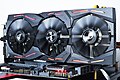 An Asus Nvidia GeForce GTX 1080 graphics card
 -
 An Asus x21 ultrabook
 -
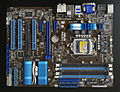 An Asus motherboard
 -
 An Asus mouse


Smartphones
[edit] | This article appears to contradict the article Asus_ZenFone#Third_generation_(2016). |
Asus also launched many Android-based smartphones, predominantly with Intel rather than ARM processors and often with two sim slots. Asus is currently very influential in big mobile markets like India, China, and other Asian countries. It is known as the ZenFone series. Before the ZenFone line, Asus released feature phones such as the Asus v70 and smartphones running on Windows Mobile during the mid-2000s.
First Generation (2014)
- ZenFone 4 (available in either 4-inch or 4.5-inch variant)
- ZenFone 5
- ZenFone 6
Second Generation (2015)
- ZenFone Zoom
- ZenFone C
- ZenFone 2
- ZenFone 2 Laser
- ZenFone Max
- ZenFone Selfie
- ZenFone Go[39]
- ZenFone 2E – made specifically for AT&T and released in 2015[40]
Third Generation (2016)
- ZenFone AR
- ZenFone 3 series
Fourth Generation (2017)
- ZenFone 4 series
Fifth Generation (2018)
- ZenFone 5 series
- ZenFone Max series (M1 and M2)
- ZenFone Live series (L1 and L2)
- ROG Phone series
Sixth Generation (2019)
- ZenFone 6 series
- ROG Phone 2 series
Additionally, Asus also produced some hybrid devices with smartphones that can be docked in a tablet screen, known as PadFone series. The product lineups are:
- PadFone (A66)
- PadFone 2 (A68)
- PadFone Infinity (A80)
- PadFone Infinity Lite (A80C)
- new PadFone Infinity (A86)
- PadFone E (A68M)
- PadFone X (A91)
- PadFone S (PF500KL)
- PadFone Mini (PF400GC)
- PadFone Mini 4.3 (A11)
- PadFone X Mini (PF450CL, US only)
Most of Asus's smartphones are powered by Intel Atom processors with the exceptions of a few Padfone series and some ZenFone 2 models that use Qualcomm Snapdragon, though later phones in the series now either use Qualcomm Snapdragon or MediaTek systems-on-chip.
Seventh Generation (2020)
- ZenFone 7 series
- ROG Phone 3 series
Eighth Generation (2021)
- ZenFone 8 series
- ROG Phone 5 series
Ninth Generation (2022)
- ZenFone 9
- ROG Phone 6 series
- ROG Phone 6D series
Tenth Generation (2023)
- ZenFone 10
- ROG Phone 7 series
Eleventh Generation (2024)
2-in-1s
[edit]- Asus Transformer
- Asus Vivobook Flip
- Zenbook Flip
- ExpertBook Flip
- Chromebook Flip
Laptops
[edit]- Zenbook
- Asus Vivobook
- AsusPro
- ExpertBook
- ProArt StudioBook
- The Ultimate Force (TUF Gaming)
- Republic Of Gamers (ROG Gaming)
- Chromebook
- EeeBook
- G Series
- N Series
- K Series
- X Series
- E Series
- Q Series
- U Series
- B Series
- V Series
- F Series
- A Series
- T Series
Discontinued series previously offered by Asus includes the EeeBook Series, K Series, X Series, E Series, Q Series, B Series, V Series, P Series, F Series, A Series, u2e Series and G Series.
Tablets
[edit]
Two generations of the Nexus 7, manufactured for and branded as Google, were announced on 27 June 2012 for release in July 2012.[44] On 24 July 2013, Asus announced a successor to the Google Nexus 7. Two days later, it was released.[45] Asus has also been working with Microsoft in developing Windows 8 convertible tablets.[46] In 2013, Asus revealed an Android-based tablet computer that, when attached to a keyboard, becomes a Windows 8 device, which it called the Transformer Book Trio.[47] The keyboard can be attached to a third-party monitor, creating a desktop-like experience. Asus is also known for the following tablet computer lines:
- Eee Pad Transformer
- Eee Pad Slider
- Eee Slate
- Memo Pad 8
- VivoTab
- ZenPad: 7.0 Z370CG, C 7.0 Z170MG/Z170CG, 8.0 Z380KL, 8.0 Z380C*, S 8.0 Z580CA*, 10 Z300C* (Released 2015); 8.0 Z380M*, Z8 ZT581KL, 3 8.0 Z581KL, 10 Z300M*, 3S 10 Z500M*, Z10 ZT500KL (2016); 3S 8.0 Z582KL, Z8s ZT582KL, 3S 10 Z500KL (2017) (* no SIM)[48]
Asus Server
[edit]- GPU Rack Server
- ESC8000 G3 (Up to 8 GPU high density & hybrid computing)
- ESC4000 G3/G3s
- 2-Way Rack Server
- RS720Q-E8-RS8-P
- RS720Q-E8-RS12
- RS700-E8-RS8 V2
- RS700-E8-RS4 V2
- RS500-E8-RS4 V2
- RS500-E8-RS4 V2
- RS400-E8-PS2-F
- RS400-E8-PS2
- RS720-E8-RS24-ECP
- RS540-E8-RS36-ECP
- RS520-E8-RS12-E V2
- RS520-E8-RS8-E V2
- 1-Way Rack Server
- RS300-E9-PS4
- RS300-E9-RS4
- RS200-E9-PS2-F
- RS200-E9-PS2
- RS100-E9-PI2
- 2-Way Tower Server
- TS700-E8 V3 Series
- TS500-E8-PS4 V2
- 1-Way Tower Server
- TS300-E9-PS4
- TS100-E9-PI4
Desktop & All-in-One PCs
[edit]- Tower PCs
- VivoPC
- ROG series
- Gaming series
- Mini PCs
- Asus Tinker Board
- VivoMini
- Chrome Devices
- All-in-One PCs
- Zen AiO
- Vivo AiO
- Portable AiO
Eee line
[edit]From its launch in October 2007 and until the line was discontinued in January 2013, the Eee PC netbook garnered numerous awards, including Forbes Asia's Product of the Year,[49] Stuff Magazine's Gadget of the Year and Computer of the Year,[50] NBC.com's Best Travel Gadget, Computer Shopper's Best Netbook of 2008, PC Pro's Hardware of the Year, PC World's Best Netbook, and DIME magazine's 2008 Trend Award Winner.
Asus subsequently added several products to its Eee lineup, including:
- Eee Box PC, a compact nettop
- Eee Top, an all-in-one touchscreen computer housed in an LCD monitor enclosure,
- Eee Stick, a plug-and-play wireless controller for the PC platform that translates users' physical hand motions into corresponding movements onscreen
- Eee Pad Transformer, is a tablet computer that runs the Android operating system.[51]
- Eee Pad Transformer Prime, the successor to the original Transformer.
On 6 March 2009, Asus debuted its Eee Box B202, which PCMag saw as "the desktop equivalent of the Asus Eee PC", (the "Asus Eee Box" computer line was later renamed in 2010 to "Asus Eee Box PC").[52]
Essentio Series
[edit]
Essentio is a line of desktop PCs. As of December 2011[update] the line consisted of the CG Series (designed for gaming), the CM series (for entertainment and home use) and the CS and CP slimline series.[53]
Digital media receivers
[edit]Asus sells digital media receivers under the name Asus O!Play.[54]
GPS devices
[edit]Asus produces the R700T GPS device, which incorporates Traffic Message Channel.[55]
Republic of Gamers
[edit]

Republic of Gamers (ROG) is a brand used by Asus since 2006, encompassing a range of computer hardware, personal computers, peripherals, and accessories.
AMD graphics cards were marketed under the Arez brand due to the Nvidia's GeForce Partner Program.[56]
In 2013, Asus launched the RAIDR Express, a PCI express-based RAID 0 SSD subsystem with two SSDs on one PCB.[57]
In January 2022, Asus announced the ROG Flow Z13 during ROG's CES 2022 launch event. Equipped with the high-performance Intel's Core i9 processor and Nvidia's GeForce RTX 3050 Ti graphic performance, making the biggest innovation breakthroughs in tablet markets. It is the world's first RTX 30 series computer in tablet form factor.[58]

In June 2023, Asus released the ROG Ally, a handheld device designed to compete with the Steam Deck. The Ally possesses a 7-inch (diagonal), 1080p touchscreen display with a 120 Hz refresh rate capability and a 16:9 aspect ratio, versus the Steam Deck's panel that only manages 800p and 60 Hz with a 16:10 aspect ratio.[59] In June 2025, the ROG Xbox Ally, co-developed by Asus and Microsoft, was unveiled during Xbox Games Showcase; it is scheduled to be released on 16 October 2025.[60]
The Ultimate Force
[edit]
The Ultimate Force (TUF) is a brand used by Asus since about 2010.[61][citation needed] The brand is for Asus affordable, mid-range gaming products focusing on performance and durability.[citation needed]
Sound cards
[edit]Asus released its first sound card, the Xonar DX, in February 2008. The Xonar DX was able to emulate the EAX 5.0 effects through the Asus GX software while also supporting Open AL and DTS-connect.[62] In July 2008 Asus launched the Xonar D1, which offered largely similar features to the Xonar DX but connected to the motherboard through the PCI interface instead of the PCI-E ×1 connection of the Xonar DX.[63] Asus then released the Xonar HDAV 1.3, which was the first solution enabling loss-less HD audio bit streaming to AV receivers.[64]
In May 2009, Asus launched the Essence ST sound card, targeted at high-end audiophiles, and featuring 124 dB SNR rating and precision audio clock tuning.[65] In the same month, Asus refreshed the HDAV family by releasing the HDAV 1.3 slim, a card targeted for HTPC users offering similar functionality to HDAV 1.3 but in a smaller form.[66] During Computex 2010, Asus introduced its Xonar Xense, an audio bundle composed of the Xense sound card and a special edition of the Sennheiser PC350 headset.[67][68] In August 2010, Asus released the Xonar DG sound card targeted at budget buyers and offering 5.1 surround sound support, 105 dB SNR rating, support for Dolby headphone and GX 2.5 support for emulating EAX 5.0 technology.[69][70]
Asus Vivo PC line
[edit]Asus entered the box-PC market with the Vivo PC line in November 2013.[71] Asus Vivo PCs come without a pre-installed Windows operating system.
On 23 October 2013, Asus launched two models of VivoPCs in India.[72] VivoPC was initially announced with Intel Celeron processor equipped VM40B model. But in India, the company released VivoPC along with a new model called VC60 which is equipped with Intel Core series processors.[73]
Portable monitors
[edit]In 2013, Asus released the MB168B, a USB 3.0-powered, portable external monitor. The base model shipped with a resolution of 1366 × 768, while the MB168B+ had a resolution of 1920 × 1080.[74] At the time of its release, the MB168B+ was the only 1080p portable monitor. According to Asus, it is the "world's slimmest and lightest USB monitor".[74]
Desktop monitors
[edit]- ROG Swift OLED PG27AQDM
- ROG Swift OLED PG42UQ
- ROG Swift OLED PG48UQ
- ROG Swift PG279QM (2560x1440, 240 Hz, IPS)
- ROG Swift PG27AQN (2560x1440, 360 Hz, IPS)
- ROG Swift PG279Q[75]
- ROG Swift PG348Q
- ROG Swift PG35VQ[76]
- ROG Swift PB27UQ
- ROG Strix XG27AQ
- ROG Strix XG27AQM
- ROG Strix XG27AQMR
- ROG Strix XG27AQV
- MX34VQ
- VZ279Q
Motherboards
[edit]
Asus motherboards sometimes include a Q-Connector which sits in between the motherboard front panel connectors and the front panel cables. The Q-Connector is marked with bigger text than the front panel connectors on the motherboard, as well as protruding from the motherboard, limiting obstruction from heatsinks and other connectors.[77][78]
The Q-connector allows the many front-panel connections to be removed as a single unit for maintenance. This greatly reduces the risk of incorrect connections when reassembling.[79]
Other initiatives
[edit]Esports
[edit]Asus ROG has been an active advocate for esports, having established some of their very own professional gaming teams.[80]
In January 2021, ROG announced the establishment of a new esports academy in India, with plans to scout and train professional gamers for the Counter-Strike: Global Offensive (CS:GO) PC game.[81] The initiative will provide shortlisted gamers with coaching, gaming equipment, and stipends to prepare them for competitive esports tournaments on both the national and international levels.[82]
Environmental record
[edit]GreenAsus
[edit]In 2000, Asus launched GreenAsus,[83] a company-wide sustainable computing initiative overseen by a steering committee led by Jonney Shih, the Chairman of Asus. According to the company, Asus pursues green policies in "Design, Procurement, Manufacturing, and Marketing."[84]
Recognition
[edit]In 2006, Asus obtained IECQ (IEC Quality Assessment System for Electronic Components) and HSPM (Hazardous Substance Process Management) certification for its headquarters and all of its manufacturing sites.[85]
In 2007, Oekom Research, an independent research institute specializing in corporate responsibility assessment, recognized Asus as a "highly environmental friendly company" in the "Computers, Peripherals and Office Electronics Industry".[86]
In October 2008, Asus received 11 Electronic Product Environmental Assessment Tool (EPEAT) Gold Awards for its products,[87] including four of its N-Series notebooks, namely the N10, N20, N50, and N80. In the following month, it received EU Flower certification for the same N-Series notebooks at an award ceremony held in Prague.[86] In December 2008, Det Norske Veritas conferred the world's first EuP (Energy-using Product) certification for portable notebooks on these machines.[86]
Recycling campaign
[edit]In April 2008, Asus launched its "PC Recycling for a Brighter Future"[88][89] program in collaboration with Intel and with Tsann Kuen Enterprise Co. The program collected more than 1,200 desktop computers, notebooks and CRT/LCD monitors, refurbished them and donated them to 122 elementary and junior high schools, five aboriginal communities and the Tzu Chi Stem Cell Center.
Controversies
[edit]In September 2008, PC Pro discovered through a reader that Asus had accidentally shipped laptops that contained cracked and unlicensed software.[90] Both physical machines and recovery CDs contained confidential documents from Microsoft and other organizations, internal Asus documents, and sensitive personal information including CVs. At the time, an Asus spokesperson promised an investigation at "quite a high level", but declined to comment on how the files got on the machines and recovery media.[91] It was demonstrated that an unattended installation of Windows Vista could accidentally copy material from a flash drive with a parameter in the "unattend.xml" file on the personal flash drive being used to script the installation.[92][unreliable source?]
In February 2014, a security vulnerability in the AiCloud functions on a number of Asus routers was compromised to distribute a text file warning of a vulnerability, disclosed in June 2013, allowing the ability to "traverse to any external storage plugged in through the USB ports on the back of the router" via the open internet. Before making the vulnerability public, the researcher was told by Asus that the behavior was "not an issue", but the vulnerability was reportedly patched shortly before the breach.[93] The IP addresses of 12,937 routers, and 3,131 AiCloud accounts were also leaked by the hackers.[94] The U.S. Federal Trade Commission issued a complaint about the breach for the company's "failure to employ reasonable security practices has subjected consumers to substantial injury", alleging that Asus had also failed to perform basic penetration tests, allowed users to maintain a default admin password for the AiDisk feature and failed to notify users of security updates in a timely fashion. As a result, it was also deemed that Asus had misled consumers over the security and protection that its routers provided. In February 2016, Asus settled the complaint, agreeing to implement a "comprehensive security program", including independent audits every two years for the next 20 years.[95][94]
In March 2019, Kaspersky Lab researchers disclosed a supply chain attack that affected the Asus Live Update software bundled on its laptops, dubbed ShadowHammer. Kaspersky stated that between June and November 2018, Asus servers had been compromised to distribute a modified version of Live Update, signed with an Asus signature, that contained a backdoor. It deployed a further payload if the device's network adapter matched an entry on an internal target list of around 600 MAC addresses. In response to ShadowHammer, Asus released a patched version of Live Update with improved security measures. Kaspersky and Symantec estimated that between 500,000 and 1 million devices were infected with the backdoor, although Asus attempted to downplay the severity of the breach by noting the extremely targeted nature of the attack. The breach did not affect the similar, identically named software associated with its motherboards.[96][97][98]
In April 2019, ESET disclosed that a group known as BlackTech had performed targeted attacks with malware known as Plead, distributed via the updater for the Asus WebStorage service. ESET stated that the group was likely using a man-in-the-middle attack via a vulnerability in routers, in combination with the updater using an unencrypted HTTP connection.[99]
In January 2022, Asus recalled some of its Z690 Maximus Hero motherboards due to a manufacturing flaw, where a RAM capacitor was installed backward—causing them to burn out associated MOSFETs and prevent the motherboard from detecting memory.[100]
Following the Russian invasion of Ukraine in 2022, Asus initially refused to join a widespread withdrawal of businesses from the Russian market. In mid-March, the company did announce it was halting its operations in Russia, following a social media boycott and government pressure.[101][102]
In April 2023, a post on the PCMasterRace subreddit began gaining popularity regarding the user's AMD Ryzen 7 7800X3D CPU, which had visible burning, along with the socket of the Asus motherboard.[103] This sparked the attention of both people interested in PCs, who initially thought it was an issue with the 3D V-Cache Technology (as there had been previous user reports similar to this incident),[103] as well as enthusiast YouTube channels such as Gamers Nexus, who ran tests to successfully recreate the burning of their CPU.[104] They realised that the cause of the burning was due to a voltage error in the BIOS. In May, Asus responded to the incidents by releasing a Beta BIOS, which was supposed to fix the error. However, not only did the new BIOS not fix the issue; by installing it, the user voided their warranty as it was a Beta BIOS, which Asus clearly stated in the BIOS's description.[104][105][106] Later that month, Asus responded to the public backlash by reversing course, releasing a statement informing users that they will continue to honor warranty on motherboards that have been updated to beta BIOS versions, as well as extend motherboard warranty coverage to uses of AMD EXPO, Intel XMP, and DOCP memory overclocking technologies.[107][108]
In May 2024, hardware reviewer Gamers Nexus sent a ROG Ally in for warranty repair due to a faulty thumbstick. Asus denied the warranty repair, claiming that the thumbstick issue was due to "customer-induced damage". Furthermore, Asus demanded a repair fee of US$191.47 for replacement of the LCD panel and the top case because of a "small mark" on the casing, despite it not being related to the original issue that the device was sent in under warranty for. Asus also stated that it would send the device back to Gamers Nexus in a "disassembled state" if it did not pay the repair fee.[109] Several days later, Asus honoured the warranty and performed the repair of the original issue under pressure from Gamers Nexus,[109] as well as subsequently apologised for the poor service.[110][111]
See also
[edit]


References
[edit]- ^ a b c d e "ASUSTek Computer Inc. Annual Report 2022" (PDF). ASUSTek. 11 April 2023. Archived (PDF) from the original on 20 June 2023. Retrieved 20 June 2023.
- ^ "About ASUS". ASUS. Retrieved 1 July 2023.
- ^ "Jerry Shen Keynote – ASUS NovaGo Launch | Snapdragon Technology Summit". ASUS. 6 December 2017. Archived from the original on 25 November 2018. Retrieved 10 January 2018.
- ^ "How to pronounce ASUS". video. Engadget. 17 December 2010. Archived from the original on 18 February 2011. Retrieved 3 March 2011.
- ^ "How ASUS CEO pronounces ASUS". video. 8 March 2008.
- ^ "ASUS Commercial: don't say asses, say ASUS!". video. 4 December 2010.
- ^ "Asustek Computer Inc – Company Profile and News – Bloomberg Markets". Bloomberg.com. Archived from the original on 31 July 2020. Retrieved 23 July 2020.
- ^ "Gartner Says Worldwide PC Shipments Increased 0.3% in Fourth Quarter of 2023 but Declined 14.8% for the Year". Gartner. 11 January 2024. Retrieved 11 January 2024.
- ^ "About ASUS Home | ASUS 台灣". Asus.com. Archived from the original on 12 May 2021. Retrieved 21 February 2022.
- ^ "The meaning of "ASUS"". ASUS website. ASUS. Archived from the original on 26 July 2020. Retrieved 15 October 2020.
ASUS takes its name from Pegasus, the winged horse in Greek mythology that symbolizes wisdom and knowledge.
- ^ Maks, Kurmaz. "Интервью с ASUS" [Interview with ASUS]. hw.by (in Russian). Archived from the original on 2 January 2007. Retrieved 4 August 2009.
Компания ASUS образовалась в 1989 году [...] Ее название образовано от английского слова "PegASUS" [...] Была взята только часть названия – "ASUS", чтобы быть в начале списка по алфавиту. [Translation: The ASUS company formed in 1989 ... Its name is formed from the English word "PegASUS" ... [We] took only part of the name: "ASUS", in order to be at the beginning of alphabetical order.]
- ^ Woods, Ben (1 November 2013). "Asus Transformer Book Trio and T100 show why device makers sometimes get it wrong to get it right". Plugged | The Next Web. Archived from the original on 13 December 2019. Retrieved 13 December 2019.
- ^ "The past, present and future of ASUS, according to its chairman". Engadget. 16 August 2015. Archived from the original on 18 June 2016. Retrieved 10 June 2016.
- ^ "Company Profile". Official website. ASUS. 2009. Archived from the original on 22 December 2015.
- ^ Invisible Gold in Asia: Creating Wealth Through Intellectual Property, page 143, by David Llewelyn. Marshall Cavendish International Asia Pte Ltd. 28 February 2011. ISBN 9789814312714. Archived from the original on 21 February 2022. Retrieved 22 December 2013.
- ^ "ASUS Company Information < By Mast Business". publishesiness.com. 3 January 2008. Archived from the original on 10 December 2015. Retrieved 8 December 2015.
- ^ "ASUS PhysX Card Ready". Vr-zone.com. Archived from the original on 24 June 2017. Retrieved 1 June 2010.
- ^ "ASUS enters LCD TV market with TLW32001 32" LCD TV". Newlaunches.com. 3 November 2006. Archived from the original on 8 October 2010. Retrieved 1 June 2010.
- ^ "ASUS VX1 Lamborghini". PC Mag. 11 August 2006. Archived from the original on 19 August 2014. Retrieved 1 April 2013.
- ^ John, Walko (9 March 2006). "Microsoft Unfolds Origami, The 'On The Go' PC". InformationWeek. Archived from the original on 29 April 2010. Retrieved 16 November 2009.
Microsoft (NSDQ: MSFT) says three companies have built working models – Samsung, ASUS, and Founder, China's second-largest PC maker. The Samsung and ASUS devices are expected to be in stores by April, and the Founder device in June.
- ^ "ASUSTeK and Gigabyte form joint venture". Digitimes.com. 8 August 2006. Archived from the original on 28 July 2013. Retrieved 1 June 2010.
- ^ "ASUS BD-ROM/DVD writer drive". 2007. Archived from the original on 13 September 2007. Retrieved 9 September 2007.
- ^ "ASUS splits into three". PC Pro. 4 January 2008. Archived from the original on 13 June 2013. Retrieved 1 April 2013.
- ^ "ASUS pins future on small and inexpensive laptop". USA Today. 16 May 2008. Archived from the original on 13 April 2014. Retrieved 1 April 2013.
- ^ Kubicki, Kristopher (3 January 2008). "New ASUS Corporate Structure Zeroes Employee Pensions". DailyTech. Archived from the original on 10 June 2009. Retrieved 28 March 2009.
Under the new corporate entity, ASUS employees were paid out all pension plans regardless of maturity as of 1 January 2008. All employees at the two new companies must start their tenure from scratch.
- ^ "Open Handset Alliance". Open Handset Alliance. 9 December 2008. Archived from the original on 6 November 2020. Retrieved 1 June 2010.
- ^ "Asustek to spin off motherboard arm". Financial Times. 11 December 2009. Archived from the original on 2 April 2018. Retrieved 1 April 2018.
- ^ a b "ASUStek, Garmin ending co-branding". The Taipei Times. 27 October 2010. Archived from the original on 2 May 2013. Retrieved 13 May 2012.
- ^ "Asus u36 review - Latest Thinnest Notebook Asus U36 World with just Thickness 19 Mm | Technology Trends". Archived from the original on 27 February 2011. Retrieved 16 August 2014.
- ^ Spurbeck, Jared (3 January 2013). "Acer and ASUS to Stop Making Netbooks". Yahoo!. Archived from the original on 7 January 2013. Retrieved 13 January 2013.
- ^ Condliffe, Jeff (2 January 2013). "ASUS and Acer: The Netbook Is Dead". Gizmodo. Archived from the original on 10 February 2013. Retrieved 13 February 2013.
- ^ "Asus drops two OLED Zenbooks and a new logo". The Verge. 22 April 2022.
- ^ "That new Asus logo looks strangely familiar". Creative Bloq. 25 April 2022.
- ^ "ASUS Income Statement". WSJ. Retrieved 23 July 2024.
- ^ "ASUS Income Statement (2019-2023) - WSJ". 23 July 2024. Archived from the original on 23 July 2024. Retrieved 23 July 2024.
- ^ "2007 Corporate Sustainability Report Archived 21 May 2009 at the Wayback Machine." ASUS. 10 of 67. Retrieved on 15 March 2010. "ASUS has its headquarters located in No. 15, Li-Te Rd., Beitou, Taipei 11259, Taiwan.".
- ^ "Asus Story – Profile, CEO, Founder, History | Computer Hardware Electronics Companies | SuccessStory". successstory.com. Archived from the original on 22 March 2018. Retrieved 21 March 2018.
- ^ Gupta, Aryan. "World of cyborgs". worldsofcyborg.blogspot.com. Archived from the original on 26 July 2020. Retrieved 29 May 2020.
- ^ Gaurav Dutt (6 June 2015). "Asus will launch three variants of Zenfone 2". All Gadget Buzz. Archived from the original on 7 April 2015.
ASUS declared to also launch a cheap variant along with two major versions as they're going to do at Malaysian launch on April 21.
- ^ "ZenFone 2E : US AT&T Exclusive" Archived 28 August 2015 at the Wayback Machine, asus.com
- ^ "Asus Zenfone 11 Ultra shown in official images with ROG Phone 8 and Zenbook laptop series stylings". Notebookcheck. 6 February 2024. Retrieved 8 February 2024.
- ^ Sagar. "Asus ROG Phone 8 Pro goes on sale in India". GSMArena.com. Retrieved 8 February 2024.
- ^ Ewan Spence. "Asus ROG Phone 9 Pro Review: The Everyday Gaming Smartphone". Forbes.com.
- ^ Ciaccia, Chris (27 June 2012). "Google Launches Nexus 7 Tablet". The Street.com. Archived from the original on 22 May 2013. Retrieved 15 July 2012.
- ^ "Google Nexus 7 (2013) specs". Phone Arena. Archived from the original on 20 October 2014. Retrieved 20 October 2014.
- ^ "Dell and ASUS debut inspired Windows 8 convertible tablets". Forbes. 18 April 2012. Archived from the original on 1 September 2012. Retrieved 14 June 2013.
- ^ Latest gadgets from Nokia, ASUS and Samsung Archived 19 August 2014 at the Wayback Machine. 3 News NZ. 30 September 2013.
- ^ "ZenPad | Tablets". ASUS USA. Archived from the original on 22 April 2016. Retrieved 21 April 2016.
- ^ Buley, Taylor (8 December 2008). "Product of the Year: ASUSTeK's Eee PC". Forbes. Retrieved 1 June 2010.
- ^ "Stuff Gadget Awards – Eee PC wins gadget of the year". Stuff.tv. Archived from the original on 29 June 2010. Retrieved 1 June 2010.
- ^ "Taiwan's AsusTek launches Android-powered tablet". 26 March 2011. Archived from the original on 7 November 2017. Retrieved 31 October 2017.
- ^ Santo Domingo, Joel (2 June 2008). "ASUS Debuts Desktop-Equivalent Eee PC". PCMag. Archived from the original on 24 April 2009. Retrieved 3 April 2009.
At the Computex show on Monday in Taipei, Taiwan, ASUS introduced a slew of products, including the Eee Box B202. The Eee Box is the desktop equivalent of the ASUS EeePC.
- ^ "ASUSTek Computer Inc. – Desktop". ASUS. Archived from the original on 27 November 2011. Retrieved 1 December 2011.
- ^ "Search > O!Play". ASUSTeK Computer Inc. Archived from the original on 18 April 2012. Retrieved 20 May 2012.
- ^ Mobilewhack.com on 11 April 2008 3:05 am (11 April 2008). "ASUS R700t TMC GPS Device : Specs, reviews and prices". Mobilewhack.com. Archived from the original on 22 March 2012. Retrieved 1 June 2010.
{{cite web}}: CS1 maint: numeric names: authors list (link) - ^ "ASUS confirms AMD Radeon 'AREZ' series of graphics cards". Archived from the original on 19 April 2018. Retrieved 19 April 2018.
- ^ "ASUS ROG LAUNCHES RAIDR EXPRESS PCI EXPRESS-BASED SSD". ASUS. 26 July 2013. Archived from the original on 23 June 2019. Retrieved 23 June 2019.
- ^ "ROG Flow Z13 (2022)". ASUS.
- ^ Fingas, Jon (3 April 2023). "ASUS's ROG Ally is yet another Steam Deck competitor". Engadget. Retrieved 4 April 2023.
- ^ Romano, Sal (20 August 2025). "ROG Xbox Ally and ROG Xbox Ally X launch October 16". Gematsu. Retrieved 20 August 2025.
- ^ "SABERTOOTH X58 | Motherboards". ASUS Australia. Archived from the original on 10 December 2014. Retrieved 4 November 2020.
- ^ ASUS, Official Website (28 February 2008). "Crystal Clear Audio Quality for Home Entertainment and Gaming". Archived from the original on 5 May 2013. Retrieved 3 October 2011.
- ^ ASUS, Official Website (27 July 2008). "ASUS Unveils Xonar D1 7.1 Audio Card: The High-fidelity PCI Variant to the Successful Xonar DX". Archived from the original on 4 May 2013. Retrieved 3 October 2011.
- ^ ASUS, Official Website (31 December 2008). "ASUS Reveals Xonar HDAV1.3 Series Sound Cards with World's First Dolby TrueHD Bit-Stream Feature for the New Blu-ray Era". Archived from the original on 26 April 2013. Retrieved 3 October 2011.
- ^ ASUS, Official Website (15 May 2009). "Breaking the Boundaries in Sound Quality". Archived from the original on 10 February 2012. Retrieved 3 October 2011.
- ^ ASUS, Official Website (18 May 2009). "ASUS Unveils New Xonar HDAV Slim Sound Card". Archived from the original on 4 January 2012. Retrieved 3 October 2011.
- ^ ASUS, Official Websiteq. "Xonar Xense". ASUS. Archived from the original on 30 September 2011. Retrieved 3 October 2011.
- ^ ASUS, Official Website (June 2010). "ASUS Covers all the Multimedia Bases at Computex 2010". Archived from the original on 4 May 2013. Retrieved 3 October 2011.
- ^ ASUS, Official Website (August 2010). "ASUS Unveils the Xonar DG Gaming Sound Card". Archived from the original on 5 May 2013. Retrieved 3 October 2011.
- ^ ASUS, Official Website. "Xonar DG Hear all, dominate all!". ASUS. Archived from the original on 30 September 2011. Retrieved 3 October 2011.
- ^ "The ASUS Innovation Showcase at COMPUTEX 2013". Archived from the original on 7 October 2013. Retrieved 13 February 2016.
- ^ "ASUS launches VivoPC mini desktop in India – starts at Rs. 20,550". Evyush.in. 23 October 2013. Archived from the original on 23 February 2017. Retrieved 23 February 2017.
- ^ "VivoPC VC60 | Desktop". ASUS Global. Archived from the original on 4 March 2021. Retrieved 27 January 2021.
- ^ a b "MB168B+ | Monitors". Archived from the original on 4 September 2015. Retrieved 30 July 2015.
- ^ Byford, Sam (10 August 2018). "Editor's Choice: Asus ROG Swift PG279Q gaming monitor". The Verge. Archived from the original on 7 October 2018. Retrieved 7 October 2018.
- ^ "ROG SWIFT PG35VQ". ASUS Global. Archived from the original on 17 January 2018. Retrieved 17 January 2018.
- ^ "Q-Connector". event.asus.com. Archived from the original on 19 December 2017. Retrieved 30 January 2016.
- ^ Building the Perfect PC. "O'Reilly Media, Inc.". Archived from the original on 11 January 2022. Retrieved 8 February 2022.
- ^ Robert Bruce Thompson, Barbara Fritchman Thompson, Building the Perfect PC. p. 230, O'Reilly Media, 2006 ISBN 0596526865.
- ^ "ROG Esports Team??ESPORT-TEAMS". ROG Esports Team??ESPORT-TEAMS. Archived from the original on 28 January 2021. Retrieved 31 January 2021.
- ^ Daniel, Joshua (31 January 2021). "ASUS ROG launches esports academy in India; scouting for CS: GO players – MEGPlay". MEGPlay. Archived from the original on 16 April 2021. Retrieved 31 January 2021.
- ^ "Asus Is Looking for Gamers in India for E-Sports Training Programme". NDTV Gadgets 360. 31 January 2021. Archived from the original on 31 January 2021. Retrieved 31 January 2021.
- ^ "Green ASUS". Green ASUS. Archived from the original on 22 August 2009. Retrieved 1 June 2010.
- ^ "ASUS Conferred World's First EuP Certification for Portable Notebooks for Its N Series Notebooks". ASUS. 2008. Archived from the original on 20 February 2009. Retrieved 28 March 2009.
Green ASUS – which was initiated in 2000, pursues the "Four Green Home Runs" in the design and production of notebooks, namely: Design, Procurement, Manufacturing, and Service and Marketing.
- ^ "GreenASUS Management System". Official website. ASUSTeK Computer Inc. 2009. Archived from the original on 3 August 2008. Retrieved 27 November 2009.
- ^ a b c "GreenASUS News and Awards". Official website. ASUSTeK Computer Inc. 2009. Archived from the original on 3 August 2008. Retrieved 27 November 2009.
- ^ "EPEAT Registry". www.epeat.net. Archived from the original on 19 February 2009. Retrieved 16 February 2009.
- ^ "ASUS, Intel Team up for PC Recycling in Taiwan". Pcworld.about.com. 22 April 2008. Archived from the original on 15 August 2011. Retrieved 1 June 2010.
- ^ "ASUS Recycle". Asus. Archived from the original on 6 August 2010. Retrieved 1 June 2010.
- ^ Collins, Barry (17 September 2008). "ASUS ships software cracker on recovery DVD". PC Pro. Dennis Publishing. Archived from the original on 27 June 2009. Retrieved 21 June 2009.
The startling discovery was made by a PC Pro reader whose antivirus software was triggered by a key cracker for the WinRAR compression software, which was located on the recovery DVD for his ASUS laptop.
- ^ "News: ASUS ships software cracker on recovery DVD". PC Pro. 17 September 2008. Archived from the original on 27 June 2009. Retrieved 1 June 2010.
- ^ Cargile, Anthony (20 September 2008). "ASUS Recovery DVD scandal: How it happened". The Coffee Desk. Archived from the original on 8 January 2011. Retrieved 18 February 2011.
- ^ Goodin, Dan (17 February 2014). "Dear Asus router user: You've been pwned, thanks to easily exploited flaw". Ars Technica. Archived from the original on 17 May 2019. Retrieved 17 May 2019.
- ^ a b Tung, Liam. "ASUS hit by FTC with 20-year audit for bungled router security". ZDNet. Archived from the original on 1 April 2019. Retrieved 17 May 2019.
- ^ Goodin, Dan (23 February 2016). "Asus lawsuit puts entire industry on notice over shoddy router security". Ars Technica. Archived from the original on 17 May 2019. Retrieved 17 May 2019.
- ^ Lilly, Paul (26 March 2019). "Asus downplays reach of Live Update hack, issues a fix in latest version". PC Gamer. Archived from the original on 26 March 2019. Retrieved 26 March 2019.
- ^ "Asus Live Update Pushed Malware to 1 Million PCs". ExtremeTech. 25 March 2019. Archived from the original on 26 March 2019. Retrieved 26 March 2019.
- ^ Cimpanu, Catalin. "ASUS releases fix for Live Update tool abused in ShadowHammer attack". ZDNet. Archived from the original on 26 March 2019. Retrieved 26 March 2019.
- ^ Goodin, Dan (16 May 2019). "Hackers abuse ASUS cloud service to install backdoor on users' PCs". Ars Technica. Archived from the original on 17 May 2019. Retrieved 17 May 2019.
- ^ Cunningham, Andrew (3 January 2022). "Backwards capacitor causes fiery failure for some high-end Asus motherboards". Ars Technica. Archived from the original on 3 January 2022. Retrieved 3 January 2022.
- ^ "Taiwan's ASUS says Russia shipments at a halt, after Ukraine urges exit". Reuters. 14 March 2022. Retrieved 19 April 2022.
- ^ "channelnews : ASUS Bows To Pressure Pulls Out Of Supplying Russia, But Not Lenovo". Retrieved 19 April 2022.
- ^ a b Anton Shilov (22 April 2023). "Users Report Ryzen 7000X3D Chips Burning Out". Tom's Hardware. Retrieved 18 May 2023.
- ^ a b We Exploded the AMD Ryzen 7 7800X3D & Melted the Motherboard, 29 April 2023, retrieved 18 May 2023
- ^ The Truth About AMD's CPU Failures: X-Ray, Electron Microscope, & Ryzen Burns, 9 May 2023, retrieved 18 May 2023
- ^ Connatser, Matthew (15 May 2023). "Asus in hot water in the midst of Ryzen 7000 malfunctions and warranty coverage". XDA Developers. Retrieved 17 June 2023.
- ^ Norem, Josh (16 May 2023). "Asus Reverses Course, Says Warranty Will Cover AM5 EXPO Settings, Beta BIOS Usage". ExtremeTech. Retrieved 17 June 2023.
- ^ Ridley, Jacob (16 May 2023). "Asus extends AM5 motherboard warranty to cover beta BIOSes and memory overclocking presets". PC Gamer. Retrieved 17 June 2023.
- ^ a b van der Merwe, Julian (12 May 2024). "Asus warranty déjà vu for broken ROG Ally thumb stick — YouTuber catches Asus attempting to dodge repair request over "tiny" mark". NotebookCheck.net. Retrieved 27 May 2024.
- ^ Kan, Michael (16 May 2024). "Asus Apologizes for Heavily Criticized Warranty and Return Service". PCMAG. Retrieved 27 May 2024.
- ^ Thubron, Rob (17 May 2024). "Asus issues apology, promises changes after RMA and repair cost outrage". TechSpot. Retrieved 27 May 2024.
External links
[edit] Media related to ASUS at Wikimedia Commons
- Official website


| Products |
| ||||||||||||||
|---|---|---|---|---|---|---|---|---|---|---|---|---|---|---|---|
| Others | |||||||||||||||

| |||||||||||||||||||||||||||||||||||
ASUSTeK Computer Inc., commonly known as ASUS, is a Taiwanese multinational corporation specializing in the design, manufacture, and sale of computer hardware and consumer electronics, including motherboards, personal computers, monitors, graphics cards, and gaming peripherals.[1] Founded in 1989 in Taipei by four engineers—T.H. Tung, Ted Hsu, M.T. Liao, and Wayne Tseng—who previously worked at Acer, the company derives its name from Pegasus, symbolizing creativity and innovation in computing.[1] Initially focused on motherboards, ASUS rapidly expanded its portfolio, becoming the world's leading motherboard producer by 1995 and entering the notebook market in 1997.[1] ASUS has achieved prominence through targeted product lines such as the Republic of Gamers (ROG) brand launched in 2006 for high-performance gaming hardware, the premium Zenbook series for ultraportable laptops, and durable TUF (The Ultimate Force) gaming equipment.[1] The company reported net revenue of TWD 548.5 billion in 2024, reflecting a 22% year-over-year increase, and marked its second-highest annual profits, driven by growth in notebooks, motherboards, and AI-related server solutions.[2] Innovations include pioneering 2-in-1 devices like the 2011 Eee Pad Transformer and accumulating over 10,000 patents globally, with 738 granted in 2023 alone, earning recognition as a Clarivate Top 100 Global Innovator in 2025.[3][4] ASUS also secured 14 CES 2025 Innovation Awards, including "Best of Innovation" for the ProArt P16 workstation, underscoring its hardware engineering prowess.[5] Listed on the Taiwan Stock Exchange since 1996 and headquartered in Beitou District, Taipei, ASUS maintains a global presence with subsidiaries and emphasizes sustainable practices alongside employee satisfaction, contributing to its inclusion in TIME's World's Best Companies 2025 list for the second consecutive year.[1][6] While dominant in PC components and gaming, the firm faces competitive pressures in consumer electronics but sustains leadership through iterative advancements in thermal management, display technology, and AI integration.[7]
Name and Etymology
Origin of the Name
The name "Asus" derives from the last four letters of "Pegasus," the mythical winged horse from Greek mythology known for symbolizing purity, aspiration, and progressive spirit.[8] Founded in 1989 as ASUSTeK Computer Inc., the company selected this etymology to evoke qualities of strength, creativity, and forward momentum, aligning with its initial focus on innovative computer hardware components.[8] [9] Pegasus, born from the blood of Medusa after her decapitation by Perseus, is depicted in ancient lore as a divine creature that sprang from the earth, ascended to Mount Olympus, and inspired the Muses' fountain of knowledge at Hippocrene.[10] Asus leadership intended the name to reflect these attributes—particularly the horse's association with speed, wisdom, and unbridled potential—positioning the brand as a leader in technological advancement rather than a mere acronym or descriptive term.[11] This choice differentiated Asus from competitors during its early motherboard manufacturing phase, emphasizing aspirational ideals over literal functionality.[9]Branding and Logo Evolution
The ASUS brand name derives from the last four letters of "Pegasus," the winged horse from Greek mythology, selected to symbolize strength, purity, creativity, and the pioneering spirit.[12][13] This etymology underscores the company's aspiration to embody qualities of innovation and reliability in the technology sector.[14] The original logo, introduced in 1989 upon the company's founding, consisted of the wordmark "ASUS" in uppercase letters using a bold geometric sans-serif typeface, often paired with "Computer" and a rudimentary graphical symbol evoking the mythological inspiration.[12][13] This design emphasized the firm's initial focus on computer components and hardware manufacturing.[15] In 1995, ASUS streamlined its branding by adopting a simplified wordmark featuring solely "Asus" in a custom-designed sans-serif font, removing extraneous text and symbols to enhance recognizability and modernity.[12] This iteration, refined periodically for sharper lines and better scalability, became the cornerstone of the brand's visual identity, appearing consistently on products and marketing materials.[13] A notable update occurred in April 2022, when ASUS unveiled a refreshed logo variant that stylized the initial "A" with fluid, dynamic elements to convey forward momentum and technological advancement, while retaining the full wordmark's essence.[12] This evolution aligned with broader branding shifts toward emphasizing AI integration and user-centric innovation, as articulated in the company's "In Search of Incredible" slogan adopted around 2011.[1] Sub-brands like Republic of Gamers (ROG), introduced in 2006, further diversified the portfolio with distinct logos targeting gaming enthusiasts, featuring aggressive, angular designs to differentiate from mainstream offerings.[1]History
Founding and Early Focus on Components (1989–2000)
ASUS was founded on April 2, 1989, in Taipei, Taiwan, by four engineers—T.H. Tung, Ted Hsu, Wayne Hsieh, and M.T. Liao—who had previously worked together at Acer on hardware development.[16] [17] The company began operations from a modest apartment, initially concentrating on the design and production of computer motherboards as original equipment manufacturer (OEM) components rather than branded consumer products.[18] This focus stemmed from the founders' expertise in PC hardware engineering and the growing demand for reliable, high-performance motherboards amid the rapid evolution of Intel's 386 and 486 processors.[1] The inaugural products included the ISA-386C motherboard, followed shortly by the Cache386/33 and 486/25 models in 1989, which were supplied to major OEMs such as IBM and ALR for integration into their systems.[1] [19] In 1990, ASUS introduced the EISA 486 motherboard, enhancing compatibility with enterprise-level extended industry standard architecture (EISA) buses and establishing early credibility in professional computing environments.[1] These offerings emphasized quality control and innovation in chipset integration, allowing ASUS to differentiate from competitors through rigorous testing and customization for specific CPU architectures. By the mid-1990s, the company's motherboard production had scaled significantly, achieving the position of the world's largest motherboard vendor by 1995 through consistent output and adaptations to emerging standards like PCI buses.[1] Throughout the 1990s, ASUS maintained its emphasis on core PC components, expanding into graphics cards and other peripherals while avoiding full system assembly until later years.[20] This OEM-centric strategy enabled rapid growth, with motherboards forming the backbone of one in three global PCs by the early 2000s, though exact shipment figures from the period remain tied to cumulative reports exceeding hundreds of millions units since inception.[21] Innovations such as proprietary BIOS features and overclocking support began to emerge, fostering a reputation for reliability among system integrators and early DIY enthusiasts, without venturing into end-user branding during this foundational decade.[1]Expansion into Consumer Systems and Innovation (2001–2010)
In the early 2000s, Asus shifted emphasis from primarily manufacturing components for original equipment manufacturers to developing and marketing its own branded consumer systems, including notebooks and desktops, building on its established expertise in motherboards and graphics cards. This expansion capitalized on growing demand for portable computing, with Asus increasing its notebook production capacity and introducing models targeted at business and consumer segments. By 2005, the company had diversified further into multimedia systems, entering the LCD TV market to complement its PC offerings.[1] A pivotal innovation came in 2006 with the establishment of the Republic of Gamers (ROG) sub-brand, dedicated to high-performance gaming hardware and systems. The inaugural ROG product, the Crosshair motherboard, featured advanced overclocking capabilities and was designed for enthusiasts seeking extreme performance, setting Asus apart in the burgeoning PC gaming sector. This launch aligned with the rapid evolution of 3D gaming, enabling Asus to capture a niche market for premium, customizable systems.[1][22][23] The period's most disruptive development was the 2007 introduction of the Eee PC, a compact, low-cost subnotebook that pioneered the netbook category. Announced at Computex Taipei in June 2007 and released in Taiwan on October 16, the base Eee PC 701 model featured a 7-inch screen, solid-state storage, and a price point around $399, emphasizing portability and basic internet functionality over traditional power. Running initially on a Linux-based operating system, it addressed affordability barriers in emerging markets and among students, sparking a global netbook trend that pressured competitors to develop similar ultra-portable devices. Asus followed with Windows XP variants in 2008, further broadening accessibility and contributing to millions of units shipped by the decade's end.[24][25][26] Throughout the decade, Asus also advanced motherboard innovations, such as the first environmentally friendly model launched in 2005, incorporating reduced hazardous materials in line with emerging regulatory pressures. These efforts supported the company's revenue growth, with consumer systems driving expansion amid a competitive landscape dominated by established players like Dell and HP.[1]Diversification and Global Growth (2011–2019)
In 2011, ASUS introduced the Eee Pad Transformer, recognized as the world's first detachable 2-in-1 tablet that combined a tablet with a keyboard dock functioning as a netbook, expanding its portfolio into hybrid mobile computing devices.[1] The company also debuted the PadFone series, a smartphone that docked into a tablet for enhanced versatility, signaling early diversification into smartphone-tablet ecosystems.[1] Concurrently, ASUS advanced its gaming segment with the ROG CG8565 desktop and reinforced component durability via the TUF Sabertooth P67 motherboard, the first armored model designed for extreme reliability.[1] By 2012–2013, ASUS deepened mobile innovation with the TAICHI 21, the first ultrabook featuring dual screens usable in laptop or tablet modes, and the Transformer Book series, including the T100 hybrid that supported laptop, tablet, and desktop configurations via detachable components.[1] A partnership with Google yielded the Nexus 7 tablet in 2013, boosting ASUS's visibility in the Android ecosystem and contributing to global market penetration in consumer tablets.[1] Gaming diversification continued with products like the ROG Xonar Phoebus audio card and Poseidon GTX780 graphics card, targeting high-performance enthusiasts.[1] The 2014 launch of the ZenFone smartphone series (including models 4, 5, and 6) marked ASUS's major entry into the competitive mobile phone market, emphasizing affordable yet feature-rich devices with large displays and pixel-perfect cameras to capture emerging markets in Asia and beyond.[1][27] Wearables followed with the ZenWatch smartwatch, while gaming saw the compact ROG G20 desktop, described as the world's most powerful in its class.[1] ASUS also ventured into automotive tech through its Unimax subsidiary, partnering with Toyota on smart driving systems.[1] These moves supported global expansion, with revenue streams diversifying as PC shipments stabilized amid rising mobile demand. From 2015 onward, ASUS accelerated gaming hardware innovation, releasing the ROG GX700 in 2015—the first liquid-cooled laptop for sustained high-performance gaming—and the ultra-thin ROG Zephyrus in 2017, which integrated advanced cooling in a slim chassis.[1] Mobile diversification intensified with the ZenFone Zoom (2015, featuring 3x optical zoom), ZenFone 3 series (2016), dual-camera ZenFone 4 (2017), AI-enhanced ZenFone 5 (2018), and the gaming-oriented ROG Phone (2018) with dedicated cooling and accessories for esports.[1] Emerging categories included the Zenbo home robot (2016) for AI-driven family assistance and the Windows Mixed Reality Headset (2017) for virtual experiences.[1][27] Retail growth materialized with the opening of its first experiential store in Taipei in 2015, enhancing direct consumer engagement.[1] This period reflected sustained global scaling, as ASUS's net revenue grew from approximately 300 billion New Taiwan dollars in 2011 to over 400 billion by 2019, driven by diversified segments like mobiles (e.g., ZenFone shipments exceeding expectations in India and Southeast Asia) and gaming, which comprised an increasing share amid PC market maturity.[28] Innovations such as ScreenPad touchpads in 2018 ZenBook Pro models and AiMesh Wi-Fi systems further broadened connectivity offerings, solidifying ASUS's position in consumer electronics across North America, Europe, and Asia.[1]AI-Driven Developments and Recent Milestones (2020–Present)
In 2024, ASUS expanded its consumer laptop lineup with AI-optimized models featuring dedicated Neural Processing Units (NPUs), enabling on-device AI tasks such as real-time noise cancellation, automated video editing, and predictive battery management. The Zenbook S 14 (UX5406), announced on September 12, 2024, incorporated Intel Core Ultra Series 2 processors delivering up to 47 TOPS of NPU performance for efficient local AI processing, alongside a 3K OLED display and AI-enhanced software like StoryCube for media organization.[29] Similarly, the ProArt P16 workstation, reviewed in October 2024, integrated AMD Ryzen AI processors with NVIDIA RTX graphics for AI-accelerated content creation workflows, achieving high scores in benchmarks for generative tasks.[30] ASUS advanced its AI PC ecosystem in early 2025, launching Copilot+ certified devices at CES on January 7, 2025, including the Zenbook A14, marketed as the world's lightest 14-inch model at under 1 kg with Snapdragon X Series processors supporting up to 32 hours of battery life and integrated AI features for productivity apps.[31] These systems, part of ASUS's "AI PC" initiative, leverage 10+ TOPS NPUs for features like voice-to-text transcription and smart scheduling via Windows AI tools, reducing reliance on cloud processing for privacy and speed.[32] Additional releases included refreshed Zenbook 14 OLED variants with Intel Core Ultra Series 2 and AMD Ryzen AI 300 series chips, emphasizing hybrid AI performance for creative and professional users.[33] On the enterprise front, ASUS announced its "All in AI" initiative in 2024, committing fully to AI servers after the business topped its NT$100 billion (US$3.1 billion) revenue target.[34][35] The company shifted toward AI infrastructure in 2025, partnering with Taiwan's National Health Research Institutes to deploy an AIHPC supercomputer platform for biomedical applications, announced in September 2025.[36] At Computex 2025 on May 20, 2025, the company showcased a broader AI ecosystem, including sovereign AI solutions for data sovereignty and edge computing, alongside tools for healthcare diagnostics and industrial automation.[37] In September 2025, ASUS introduced professional services for sovereign AI at its inaugural AI Tech Summit in Dubai, focusing on customizable infrastructure to mitigate geopolitical data risks.[38] These developments reflect ASUS's strategic pivot to AI hardware amid growing demand for localized processing, with enterprise solutions targeting small and medium businesses for productivity gains in global operations.[39] In January 2026, Chairman Jonney Shih confirmed ASUS's commitment to an "all in AI" strategy, stating the company would cease development of new smartphone models and redirect R&D efforts toward commercial PCs and physical AI devices, such as robotics and AI glasses.[40]Corporate Governance
Leadership and Key Executives
Jonney Shih has served as Chairman of ASUSTeK Computer Inc. since 1993 and as Chief Branding Officer, having previously acted as CEO until 2007.[41] Shih holds an MBA from National Chiao Tung University and has been instrumental in shaping the company's branding strategy during its growth into consumer electronics.[42] The company is led by two co-Chief Executive Officers: S.Y. Hsu (Hsien-Yuen Hsu) and Samson Hu (Shubin Hu), both appointed in January 2019.[43] S.Y. Hsu oversees research and development strategy, innovation management, and talent development, with prior board experience contributing to product engineering focus.[44] Samson Hu manages general operations and business group performance, holding a direct ownership stake of approximately 0.014% in the company as of recent filings.[45] Their dual leadership structure emphasizes coordinated execution across hardware divisions, as highlighted in quarterly earnings discussions.[46] Ted Hsu serves as Vice Chairman and Chief Strategy Officer, appointed to the vice chairman role in 2022, with an EMBA from National Taiwan University.[42] He contributes to long-term strategic planning, drawing from his role as a founding member in 1989 alongside T.H. Tung, Wayne Tseng, and M.T. Liao.[47] Other key executives include Jonathan Tsang as President and Director, focusing on operational oversight, and Joe Hsieh as Chief Operating Officer and Senior Vice President since 2011.[47] The board of directors, elected at the annual general meeting on May 28, 2025, includes figures such as Tsung-Tang Shih and Chiang-Sheng Tseng, ensuring alignment with shareholder interests in governance matters.[48] This structure supports ASUSTeK's emphasis on innovation in computing hardware amid competitive pressures from global tech markets.Financial Performance and Ownership
ASUSTeK Computer Inc., trading under the ticker 2357 on the Taiwan Stock Exchange, reported consolidated revenue of NT$587.09 billion for fiscal year 2024, marking a 21.72% increase from NT$482.31 billion in 2023, driven by strong demand in notebooks, gaming hardware, and AI-related components.[49] Gross profit for 2024 stood at NT$103.47 billion, yielding a profit margin of approximately 5.60%, reflecting operational efficiencies amid competitive pressures in the consumer electronics sector.[50] [51] In the first quarter of 2025, revenue reached NT$147.69 billion, indicating sustained momentum into the new year, though quarterly fluctuations were noted with subsequent periods showing variability up to NT$188 billion.[52] [53] The company's stock performance has exhibited volatility tied to global tech cycles, with a 23.18% annual gain in 2024 following a robust 90.57% rise in 2023, contrasting with a 25.25% decline in 2022 amid post-pandemic supply chain disruptions and softening PC demand.[54] Enterprise value as of mid-2025 hovered around US$14.58 billion, supported by a trailing twelve-month revenue of approximately US$20.4 billion.[55] These figures underscore ASUSTeK's resilience in a maturing PC market, bolstered by diversification into high-margin segments like Republic of Gamers (ROG) products and server solutions, though profitability remains sensitive to component costs and currency fluctuations.[56]| Fiscal Year | Revenue (NT$ billion) | Year-over-Year Growth |
|---|---|---|
| 2023 | 482.31 | - |
| 2024 | 587.09 | +21.72% |
Employee Relations and Internal Policies
ASUS maintains internal policies aimed at fostering a non-discriminatory workplace, prohibiting harassment and ensuring recruitment, remuneration, and promotions are free from influence by factors such as gender, race, nationality, marital status, age, or appearance.[61] The company's Human Rights Statement affirms equal treatment for all employees, with protections extending to job seekers and service providers, and emphasizes compliance with supplier codes addressing labor standards.[62] ASUS promotes gender equality and provides employee welfare programs, including emergency medical referrals, assistance for personal hardships, and initiatives for mental health support and workplace safety.[63] These efforts align with a stated philosophy of inspiring, motivating, and nurturing employees through transparent communication channels that incorporate feedback for operational improvements.[64] In Taiwan, where ASUS headquarters are located, the company does not have an in-house labor union, though it permits employees to form or join independent unions; globally, 23.2% of employees were represented by independent trade unions as of 2023.[65] Recruitment adheres to principles of public openness, fair selection, and merit-based hiring without quotas.[66] ASUS has been recognized by Forbes as one of the World's Best Employers for the sixth consecutive year in 2025, based on employee satisfaction surveys highlighting well-being initiatives, AI-driven tools for productivity, and career development opportunities.[67] However, employee reviews on platforms like Glassdoor and Indeed frequently cite challenges including extended work hours averaging 10-12 hours daily, pressure for overtime, limited work-life balance, and a hierarchical culture perceived as political and low-trust, with some U.S. operations reporting mandatory activity monitoring and below-market compensation.[68][69] Relations with migrant workers at subsidiaries like Askey Computer Corp. have faced scrutiny, with labor unions in Taiwan protesting alleged rights violations, debt bondage risks, and threats of factory relocation impacting job security as of 2023; workers rallied for better protections amid rumors of operational shifts.[70][71] ASUS addresses supply chain labor risks through Responsible Business Alliance compliance requirements for suppliers, though direct internal employee controversies have primarily involved isolated intellectual property disputes with defecting executives rather than widespread policy failures. The company supports hybrid work models emphasizing inclusivity, equity, and technology-enabled collaboration to bridge location-based disparities.[72]Operations
Manufacturing and Supply Chain
ASUS conducts manufacturing operations primarily in Asia, with key production facilities historically concentrated in Taiwan and mainland China.[73] The company maintains assembly and component production sites in Taiwan, including areas around Taipei, while leveraging Chinese suppliers for large-scale laptop and component fabrication in regions such as Beijing, Guangdong, and Fujian.[73] These locations support the assembly of products like motherboards, laptops, and peripherals, drawing on Taiwan's semiconductor expertise and China's cost-effective labor and scale.[74] In response to escalating U.S. tariffs on Chinese imports, ASUS relocated over 90% of its U.S.-bound PC and motherboard production from China to Southeast Asia by mid-2025, establishing or expanding sites in Thailand, Vietnam, and Indonesia.[75] [76] [77] This diversification aims to mitigate tariff impacts and enhance supply chain resilience amid geopolitical tensions, though it introduces challenges in logistics and quality control consistency across new facilities.[78] Production for other markets remains more distributed, with ongoing reliance on Taiwanese R&D-integrated manufacturing for high-end components.[79] ASUS's supply chain encompasses over 693 global partners for materials, manufacturing, and assembly, with critical suppliers selected based on purchase volume, supply scarcity risks, and technological dependencies.[80] [81] The company publishes an annual list of major direct-spend suppliers, covering fiscal year 2023 data, which includes firms providing semiconductors, displays, and casings predominantly from Asian vendors.[82] To promote sustainability, ASUS enforces a three-step supplier evaluation framework—initial screening, audits, and ongoing compliance—prohibiting certain materials like mineral oils in packaging and requiring adherence to environmental standards.[83] [84] Disruptions, such as those from global chip shortages, have prompted investments in AI-driven procurement tools to optimize supplier selection and inventory.[85]Research and Development Infrastructure
ASUS's research and development infrastructure is predominantly based in Taiwan, leveraging the region's technological ecosystem for hardware and software innovation. The company's primary R&D hub is located in Taipei, including specialized facilities such as the ASUS Robotics & AI Center, a dedicated laboratory focused on advancing robotics, artificial intelligence, and related technologies through multidisciplinary teams.[86] This center emphasizes integration of hardware and software, drawing on Taipei's status as a global technology nexus to prototype and develop next-generation solutions.[87] Collaborative efforts form a key component of ASUS's R&D framework, exemplified by joint centers with academic institutions. The ASUS-National Taiwan University (NTU) Joint R&D Center, established to foster industry-university partnerships, targets areas like electromagnetism, next-generation computing, smart IoT, and AI, aiming to position itself as a leading Asian research entity.[88] [89] Additional partnerships, such as the AI digital twin lab with National Taiwan University of Science and Technology (Taiwan Tech) and NVIDIA, support talent development and applied AI research aligned with industrial demands.[90] These collaborations enhance ASUS's capacity for innovation without relying solely on internal resources, though they remain anchored in Taiwan's academic and tech infrastructure. ASUS employs approximately 5,000 in-house engineers dedicated to R&D, contributing to cumulative investments exceeding $450 million in targeted product lines and broader technological advancements.[91] Annual R&D expenditures are projected at 3% to 5% of total revenue, reflecting a strategic commitment to sustaining competitiveness in computing, AI, and enterprise hardware amid evolving market demands.[60] While Taiwan hosts the core infrastructure, global R&D activities support regional adaptations, though specific overseas labs remain secondary to the domestic focus.[92] This structure prioritizes empirical prototyping and causal engineering principles to drive verifiable product improvements, as evidenced by ASUS's patent outputs originating largely from Taiwanese operations.[3]Global Presence and Workforce
ASUS, headquartered in Beitou District, Taipei, Taiwan, maintains a worldwide operational footprint spanning over 75 markets through 160 branch offices and 2,500 support centers.[93] The company has established regional hubs, including its North American headquarters in Fremont, California, with additional branches in Markham, Canada, and Mexico City, Mexico.[94] Its presence extends across Asia, Europe, the Americas, Australia, New Zealand, and South Africa, supported by 40 primary office locations globally.[95][96] As of recent reports, ASUS employs approximately 16,332 individuals worldwide, comprising about 7,950 at its Taiwan headquarters and 8,382 in overseas regions.[61] This workforce underpins operations in research, manufacturing, sales, and support, with over 5,000 dedicated to R&D across more than 70 countries.[97] Manufacturing activities, integral to its global operations, have shifted significantly due to U.S. tariffs, with over 90% of motherboard and PC production relocated from China to facilities in Thailand, Vietnam, and Indonesia as of 2025.[98] Core production retains roots in Taiwan, including sites in Taipei, Luzhu, and Nangang, while additional assembly occurs in China and emerging Southeast Asian hubs to optimize supply chain resilience.[99] This diversification reflects ASUS's strategy to mitigate geopolitical risks while sustaining its international manufacturing scale.[79]Product Portfolio
PC Components and Motherboards
ASUS entered the PC components market in 1989 by developing its first motherboard, the ISA-386C, which supported the Intel 80386 processor.[100] This marked the company's initial focus on motherboard production, leveraging reverse-engineering techniques to create compatible hardware without direct access to Intel processors.[101] By 1990, ASUS released the ISA-486 motherboard, establishing a foundation for independent chipset development.[100] ASUS motherboards achieved global leadership, capturing approximately 40% market share by the early 2000s through innovations such as the first boards supporting Serial ATA interfaces, AGP 8X graphics, Pentium 4 processors up to 3 GHz, and Hyper-Threading Technology.[102] The company maintained the largest global motherboard market share for multiple consecutive years, driven by demand for reliable PC components.[103] In 2009, ASUS introduced the TUF (The Ultimate Force) series with the Sabertooth 55i, emphasizing military-grade durability for overclocking and stability.[19] The product lineup includes the Prime series for mainstream users, offering balanced features like enhanced power delivery and BIOS utilities; the TUF Gaming series for robust builds with reinforced components; and the ROG Strix and Crosshair series for enthusiasts, incorporating AI-driven overclocking, PCIe 5.0 slots, DDR5 memory support, and advanced cooling solutions.[104] These high-end models feature tools like AI Cooling II and Aura Sync RGB lighting, optimized for gaming and content creation workloads.[105] Beyond motherboards, ASUS produces graphics cards in partnership with NVIDIA and AMD, spanning Prime (efficient cooling for general use), TUF Gaming (durable fans and backplates), and ROG Strix (triple-fan designs with overclocking potential).[106] These components emphasize Auto-Extreme manufacturing for precision and longevity, though ASUS's AMD GPU offerings have faced criticism for underperforming relative to competitors like Sapphire in cooling efficiency.[107] ASUS also offers branded RAM modules under series like ROG and TUF, which do not involve in-house DRAM manufacturing but are rebranded products sourced from manufacturers such as Samsung or Micron, selected for quality and compatibility with ASUS hardware, along with complementary items like power supplies and chassis, but motherboards remain the core of its PC components dominance.[108]Laptops and Mobile Computing
ASUS produces a diverse lineup of laptops tailored for consumer, professional, and gaming applications, emphasizing portability, performance, and recent integrations of AI capabilities. The company's laptop portfolio includes mainstream models under the VivoBook series, premium ultrabooks in the ZenBook line, and high-performance gaming options via ROG and TUF Gaming brands.[109] The VivoBook series targets everyday users with affordable, versatile devices featuring modern processors and displays. For instance, the Vivobook S 14 (M5406) and S 15 (M5506), announced in 2024, incorporate Snapdragon X processors for Copilot+ PC functionality, enabling on-device AI processing with neural processing units (NPUs). These models offer up to 16-inch OLED screens, 32GB RAM, and 1TB SSD storage, prioritizing slim designs and long battery life for mobile productivity.[109][110] Similarly, the ZenBook series focuses on lightweight, high-end ultraportables, such as the Zenbook A14 unveiled at CES 2025, which utilizes Qualcomm Snapdragon X Elite for efficient AI tasks in a 14-inch form factor weighing under 1kg.[111] In gaming, ASUS's ROG (Republic of Gamers) and TUF series dominate with robust hardware for demanding applications. The ROG Zephyrus G14 (2024) combines a 14-inch OLED display with AMD Ryzen processors and NVIDIA RTX GPUs, achieving high frame rates in games while maintaining portability at 1.5kg. TUF Gaming models, like the TUF Gaming A14 launched in 2024, emphasize durability with MIL-STD-810H certification, up to Intel Core i9 CPUs, 32GB LPDDR5X RAM, and 2TB SSDs, alongside 165Hz displays. ASUS ROG laptops captured 40% of the global gaming laptop market in 2016, particularly those equipped with NVIDIA GeForce GTX graphics.[112][113][114] ASUS extends mobile computing to hybrid devices, including 2-in-1 convertibles and detachable tablets for flexible usage. The lineup features models like the ASUS ProArt PZ13, a detachable 2-in-1 with Snapdragon X Elite, 13-inch touchscreen, and stylus support for creative workflows, and the ProArt PZ14, a 14-inch creator-focused 2-in-1 device with Snapdragon X2 Elite processor, detachable keyboard, and stylus support emphasizing mobile content creation capabilities.[115] Chromebook Flip series, such as the CM30 detachable, provide 10.5-inch 2K displays with 360-degree hinges or removable keyboards, running Chrome OS for lightweight tasks and fast charging up to 60% in 49 minutes. These devices support tablet-laptop transitions, catering to education and entry-level professional needs.[116][117]
Gaming and High-Performance Hardware
![ASUS promotional model and Republic-of-Gamers products at Computex 20100603.jpg][float-right]ASUS's gaming and high-performance hardware centers on the Republic of Gamers (ROG) brand, established in 2006 to deliver premium components for enthusiasts, beginning with the Crosshair motherboard optimized for AMD Athlon 64 dual-core processors on Socket AM2.[1][118] The ROG lineup encompasses laptops, desktops, graphics cards, motherboards, monitors, and peripherals engineered for extreme performance, featuring advanced cooling, high-refresh-rate displays, and top-tier GPUs like NVIDIA GeForce RTX series.[119] Key ROG laptop models in the 2025 series include the Zephyrus G14 and G16 with up to RTX 5080 Laptop GPUs and Nebula Display technology for superior color accuracy and refresh rates, the Strix SCAR 18 supporting RTX 50 Series for desktop-level power in portable form, and the Flow Z13 as a detachable gaming tablet with Intel Core i9 and RTX graphics.[120][121][122] Graphics cards under ROG, such as next-gen GeForce RTX 50 Series variants, emphasize overclocking capabilities and custom cooling solutions for sustained high frame rates in demanding titles.[123] Motherboards and components integrate PCIe 5.0 support, AI-enhanced power delivery, and RGB customization for build enthusiasts.[124] The TUF Gaming series complements ROG by prioritizing durability and value in high-performance hardware, undergoing military-grade testing for reliability in laptops with competitive GPUs like RTX 4070 and AMD Ryzen processors, as well as motherboards featuring 80A DrMOS power stages and AI Cache Boost for stable overclocking.[125][126] TUF products target gamers seeking robust builds without premium pricing, including high-refresh displays and extended battery life in models like the TUF A17.[127] Peripherals across both lines, such as mechanical keyboards and mice, incorporate optical switches and programmable macros for competitive edge.[128] ROG's focus on innovation extends to handhelds like the ROG Ally, a Windows-based portable gaming device with AMD Ryzen Z1 Extreme and upgradable components, bridging console-like play with PC versatility.[123] These offerings position ASUS as a leader in balancing raw power, thermal efficiency, and portability for gaming demands.[129]
Servers, Desktops, and Enterprise Solutions
ASUS provides enterprise-grade servers, workstations, and desktops primarily through its Enterprise and Server Solutions (ESC) division, focusing on applications in data centers, high-performance computing (HPC), artificial intelligence (AI), cloud infrastructure, edge computing, and 5G networks.[130] These solutions emphasize scalability, power efficiency, and compatibility with advanced processors such as 5th Gen Intel Xeon Scalable and AMD EPYC 9004/9005 series, alongside support for NVIDIA GPUs like H100 and Blackwell B200 for AI workloads.[131][132][133] Server offerings include rackmount, GPU-optimized, multi-node, and tower models designed to minimize total cost of ownership (TCO) and environmental impact through features like optimized thermal design and energy-efficient components.[131] For instance, the ESC4000-E11 is a dual-socket 2U rack server supporting up to four double-width GPUs and PCIe 5.0 expansion for enterprise AI infrastructure.[132] GPU servers such as the ESC8000A-E12 and ESC8000A-E13P accommodate up to eight NVIDIA H100 or H200 GPUs in a 4U form factor, with NVLink interconnects and dual NVMe storage for HPC, hyper-converged infrastructure (HCI), and virtual desktop infrastructure (VDI).[133][134] Tower servers support AMD EPYC and Intel Xeon processors across generations, including 3rd to 5th Gen Intel Xeon Scalable, for flexible deployment in smaller-scale enterprise environments.[135] Server motherboards, such as the P13R-E series, feature LGA 1700 sockets, DDR5 ECC memory, dual LAN ports, and multiple M.2 slots for robust storage and networking.[136] Workstations and enterprise desktops target professional workflows, including AI/deep learning, 3D modeling, content creation, and small-to-medium business (SMB) operations.[137] The ExpertCenter series, such as the D5 small form factor (SFF) and P500 mini tower models, incorporate up to 13th/14th Gen Intel Core processors, NVIDIA GeForce RTX graphics, up to 64 GB DDR5 RAM, and enterprise-grade security features like TPM modules and remote management tools. Recent models like the ExpertCenter PN55 Mini PC, unveiled at CES 2026, include a dedicated Copilot key for instant AI access.[138][139][140] These systems support tool-less upgrades and Windows 11 Pro for streamlined IT administration in large enterprises.[141] ASUS workstations prioritize role-based configurations, such as GPU-intensive setups for designers and compact mini-PCs for back-office tasks, with an emphasis on reliability and green computing practices.[142] In fiscal reporting, workstation motherboard revenues grew 50% year-over-year in Q1 2022, reflecting demand in open-platform enterprise segments.[143] Enterprise solutions integrate hardware with features for remote servicing, secure boot, and AI-optimized pods like the ASUS AI Pod for scalable deployment in generative AI and data analytics environments.[130] Models such as the ESC N8-E11 support NVIDIA HGX H100 eight-GPU configurations with NVLink for large-scale AI training, while emphasizing power efficiency to reduce total cost to the environment (TCE).[144] Overall, these products position ASUS as a provider of high-density, performance-oriented hardware, though specific enterprise server market share data remains limited compared to consumer PC segments.[131]Displays, Peripherals, and Emerging Devices
ASUS manufactures a diverse lineup of displays, encompassing gaming-oriented ROG Swift and Strix series, professional-grade ProArt models, and mainstream TUF and Eye Care variants. ROG monitors emphasize high-performance features such as refresh rates exceeding 500 Hz, OLED panels with 0.03 ms response times, and NVIDIA G-SYNC compatibility for reduced motion blur in competitive gaming.[145] ProArt displays, targeted at content creators, incorporate Calman-verified color accuracy, support for DCI-P3 and Adobe RGB gamuts, and panel options including mini-LED and OLED for HDR workflows up to 4K resolution.[146] General consumer monitors, spanning 23 to 49 inches, include ergonomic adjustments, low blue light certification, and USB-C connectivity for versatile office and hybrid work setups.[147] Peripherals from ASUS, particularly under the ROG banner, include mechanical keyboards with hot-swappable switches like the ROG Azoth X (75% layout, announced April 2025), wireless gaming mice such as the ROG Harpe Ace Aim Lab edition featuring 8K Hz polling rates, and headsets with AI-powered noise-cancelling microphones for immersive audio.[148] These devices often integrate ROG-specific software for customizable RGB lighting, macro programming, and sensor tuning, with battery life extending up to 1,500 hours in select mice.[149] Keyboard-mouse combos emphasize power-saving 2.4 GHz transceivers for cordless reliability.[150] Emerging devices reflect ASUS's exploration of portable and hybrid form factors, including the ROG Ally handheld gaming PC (launched 2023, with Xbox-branded variants in 2025 featuring AMD Ryzen Z1 processors and up to 24GB RAM for Windows-based cloud and local gaming).[151] Innovations extend to foldable OLED displays, as in the Zenbook 17 Fold (unveiled CES 2023), enabling tablet-to-laptop transitions with 17.3-inch bendable screens, and portable ZenScreen monitors for on-the-go productivity.[152] Accessories like the ROG Ergo monitor arms support these with cable management for modular setups, while CES 2025 previews highlighted AI-integrated peripherals for extended reality applications.[153][154]Technological Innovations
Key Product Breakthroughs
ASUS introduced the Eee PC in October 2007, pioneering the netbook category with the model 701, which featured a 7-inch display, 4 GB solid-state storage, Intel Atom processor, and a customized Linux distribution, all for under $400.[155] This compact, affordable device emphasized portability and basic web-centric computing, sparking a market surge in low-cost subnotebooks that peaked at over 30 million units sold industry-wide by 2010, though netbooks later declined due to tablet competition.[156][24] In 2006, ASUS launched the Republic of Gamers (ROG) sub-brand with the Crosshair motherboard for AMD Socket AM2 processors, introducing advanced overclocking capabilities, extensive BIOS customization, and enthusiast-grade features that established new benchmarks for high-performance PC building.[118] The ROG line expanded in 2008 to graphics cards, debuting the world's first consumer dual-GPU solution for enhanced multi-GPU performance and cooling innovations.[157] By 2023, ROG extended to handheld gaming with the ROG Ally, a Windows-based device powered by AMD Ryzen Z1 processors and supporting Xbox Game Pass, which broadened accessible PC gaming beyond traditional laptops and desktops.[120] ASUS also advanced motherboard design with the Q-Connector accessory in the mid-2000s, simplifying front-panel cable installation via a modular interface that reduced assembly errors during PC builds.[1] In 2005, the company released Taiwan's first environmentally friendly motherboard using lead-free soldering and reduced hazardous materials, contributing to early compliance with emerging green standards.[155] These innovations, alongside ROG's evolution, solidified ASUS's position in PC components, with ROG products capturing significant shares in gaming hardware markets by emphasizing thermal efficiency and overclocking stability.[27] More recently, ASUS integrated AI-driven features across products, such as adaptive overclocking in ROG motherboards starting around 2020, using machine learning to optimize CPU performance based on real-time workloads and thermals, though empirical benchmarks show gains of 5-10% in select scenarios over manual tuning. The Zenbook Duo, evolving since 2019 with dual-screen configurations, reached a milestone in 2024 as the first 14-inch model with tandem OLED panels for productivity multitasking, enabling seamless window extension without external monitors.[158] These developments reflect ASUS's focus on form-factor versatility and performance efficiency, verified through independent reviews confirming superior multi-tasking utility compared to single-screen ultrabooks.[27]Patent Portfolio and R&D Outputs
ASUSTeK Computer Inc., operating as ASUS, maintained a global patent portfolio of 6,711 granted patents as of the end of 2023.[4][60] In 2023, the company secured 738 new patents worldwide, reflecting a 9% year-over-year increase from 2022, with 416 granted in Asia and 322 in Europe and the United States.[4][60] Within Asia, Taiwan saw 258 patent applications filed (a 26% rise from 2022) and 30 grants (19% increase), underscoring focused domestic innovation efforts.[60] ASUS's patent activity emphasizes telecommunications and standards-essential technologies, with 368 patents in the communications field by end-2023 and 322 standard-essential patent (SEP) families declared to 3GPP from 2018 to 2023.[4] The company's subsidiary, ASUS Technology Licensing Inc., established in 2022, manages participation in 3GPP mobile standards, licensing essential patents for 3G, 4G, and 5G technologies.[159] ASUS received Clarivate's Top 100 Global Innovators designation in 2025, citing its strong patent strategy in high-end telecommunications, including 234 applications filed by Q3 2024 and ongoing SEP declarations reaching 367 by year-end.[7] R&D investments supported these outputs, with expenditures of NT$22 billion in 2024, equivalent to approximately 4% of total revenue, backed by over 5,500 global R&D personnel.[60] Planned 2025 spending targets 3% to 5% of revenue, prioritizing AI integration, modular designs, and energy-efficient hardware such as Copilot+ PCs and AI servers.[60] Outputs include advancements in AI-driven platforms like the proprietary AI Hub and large language models, alongside smart manufacturing systems deployed in facilities since 2022.[60][4]| Year | Global Patents Granted | Key Regional Breakdown | Notes |
|---|---|---|---|
| 2023 | 738 | Asia: 416; Europe/US: 322 | 9% YoY increase; total portfolio: 6,711[4][60] |
| Taiwan-Specific (2023) | 30 granted; 258 filed | N/A | 19% grants increase, 26% filings increase[60] |
Industry Awards and Recognitions
ASUS has garnered extensive recognition across design, innovation, and performance categories from international bodies and industry publications. In 2025, the company secured 14 CES Innovation Awards, including the Best of Innovation honor for the ProArt P16 laptop in the Computer Hardware & Components category.[160] Previously, at CES 2024, ASUS received nine such awards for products spanning laptops, monitors, and peripherals.[161] Design accolades form a core of ASUS's honors, with 22 wins at the 2025 iF Design Awards across gaming, consumer electronics, and software categories, positioning it as Taiwan's top brand with a cumulative 345 iF awards.[162] Similarly, ASUS earned 41 Red Dot Product Design Awards in 2025, alongside three Red Dot Brand and Communication Design Awards for packaging and branding elements like the Strix SCAR/G series.[163][164] At the Good Design Awards, ASUS claimed 15 honors in 2025—leading Taiwan in ICT equipment—and 23 in 2024.[165][166] In gaming hardware, ASUS ROG products have excelled in reader-voted and editorial awards. The company won seven 2025 European Hardware Association Reader Awards for motherboards, graphics cards, gaming monitors, and peripherals.[167] PC Gamer named the ROG Zephyrus G16 the best gaming laptop of 2024, while ROG Ally X handheld devices received TIME's recognition as a top invention.[168][169] ASUS ROG was also listed among TIME's World's Best Brands 2024 in U.S. gaming hardware and peripherals.[170] Broader corporate recognitions include Newsweek's designation of ASUS as one of the World's Most Trustworthy Companies in 2025, marking the second consecutive year, and TIME's inclusion on its World's Best Companies list for innovation and growth.[171][172] In sustainability, ASUS achieved CDP's Leadership Level for Climate Change for two years running and won SEAL and other environmental awards in 2025.[173] For motherboards, ASUS has claimed the European Hardware Association's Readers' Choice for Best Brand in multiple years, including 2023.[174] These awards reflect consistent peer and consumer validation, though many originate from self-reported tallies by ASUS, with underlying verifications from awarding organizations.Market Position
Sales Trends and Revenue Analysis
ASUSTeK Computer Inc. reported consolidated revenue of NT$587.09 billion in fiscal year 2024, marking a 21.72% increase from NT$482.31 billion in 2023.[49] This growth outpaced the global PC market's modest 1.3% shipment increase for the year, reflecting stronger demand for ASUS's notebooks and AI-enabled devices amid post-pandemic recovery and emerging AI PC adoption.[175] In the fourth quarter of 2024 alone, ASUS achieved 9.8% shipment growth, contributing to its position as one of the top performers among major vendors.[175]| Fiscal Year | Revenue (NT$ billion) | Year-over-Year Growth |
|---|---|---|
| 2023 | 482.31 | - |
| 2024 | 587.09 | +21.72% |