Hubbry Logo
search
logo

Adjoint functors

logo
Community Hub0 Subscribers
Read side by side
from Wikipedia

In mathematics, specifically category theory, adjunction is a relationship that two functors may exhibit, intuitively corresponding to a weak form of equivalence between two related categories. Two functors that stand in this relationship are known as adjoint functors, one being the left adjoint and the other the right adjoint.[1] Pairs of adjoint functors are ubiquitous in mathematics and often arise from constructions of "optimal solutions" to certain problems (i.e., constructions of objects having a certain universal property), such as the construction of a free group on a set in algebra, or the construction of the Stone–Čech compactification of a topological space in topology.

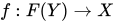
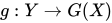
By definition, an adjunction between categories and is a pair of functors (assumed to be covariant)

and

and, for all objects in and in , a bijection between the respective morphism sets

such that this family of bijections is natural in and .[1] For locally small categories, naturality here means that there are natural isomorphisms between the pair of functors and for a fixed in , and also the pair of functors and for a fixed in . For other categories, naturality is defined as a generalisation of this.[1]

The functor is called a left adjoint functor or left adjoint to , while is called a right adjoint functor or right adjoint to . We write .[1]

An adjunction between categories and is somewhat akin to a "weak form" of an equivalence between and , and indeed every equivalence gives an adjunction, though the equivalence itself is not necessarily an adjunction.[2] In many situations, an adjunction can be "upgraded" to an equivalence, by a suitable natural modification of the involved categories and functors.

Terminology and notation

[edit]

The terms adjoint and adjunct are both used, and are cognates: one is taken directly from Latin, the other from Latin via French. In the classic text Categories for the Working Mathematician, Mac Lane makes a distinction between the two.[3] Given a family

of hom-set bijections, we call an adjunction or an adjunction between and .[1][3] If is an arrow in , Mac Lane calls the right adjunct of .[3] The functor is left adjoint to , and is right adjoint to .[1][3] (Note that may have itself a right adjoint that is quite different from ; see below for an example.)

In general, the phrases " is a left adjoint" and " has a right adjoint" are equivalent. We call a left adjoint because it is applied to the left argument of , and a right adjoint because it is applied to the right argument of .

If F is left adjoint to G, we also write

[1]

The terminology comes from the Hilbert space idea of adjoint operators , with , which is formally similar to the above relation between hom-sets. The analogy to adjoint maps of Hilbert spaces can be made precise in certain contexts.[4]

Introduction and motivation

[edit]

The slogan is "Adjoint functors arise everywhere".

Common mathematical constructions are very often adjoint functors. Consequently, general theorems about left/right adjoint functors encode the details of many useful and otherwise non-trivial results. Such general theorems include the equivalence of the various definitions of adjoint functors, the uniqueness of a right adjoint for a given left adjoint, the fact that left/right adjoint functors respectively preserve colimits/limits (which are also found in every area of mathematics), and the general adjoint functor theorems giving conditions under which a given functor is a left/right adjoint.

Solutions to optimization problems

[edit]

In a sense, an adjoint functor is a way of giving the most efficient solution to some problem via a method that is formulaic. For example, an elementary problem in ring theory is how to turn a rng (which is like a ring that might not have a multiplicative identity) into a ring. The most efficient way is to adjoin an element '1' to the rng, adjoin all (and only) the elements that are necessary for satisfying the ring axioms (e.g. r+1 for each r in the ring), and impose no relations in the newly formed ring that are not forced by axioms. Moreover, this construction is formulaic in the sense that it works in essentially the same way for any rng.

This is rather vague, though suggestive, and can be made precise in the language of category theory: a construction is most efficient if it satisfies a universal property, and is formulaic if it defines a functor. Universal properties come in two types: initial properties and terminal properties. Since these are dual notions, it is only necessary to discuss one of them.

The idea of using an initial property is to set up the problem in terms of some auxiliary category E, so that the problem at hand corresponds to finding an initial object of E. This has an advantage that the optimization—the sense that the process finds the most efficient solution—means something rigorous and recognisable, rather like the attainment of a supremum. The category E is also formulaic in this construction, since it is always the category of elements of the functor to which one is constructing an adjoint.

Back to our example: take the given rng R, and make a category E whose objects are rng homomorphisms RS, with S a ring having a multiplicative identity. The morphisms in E between RS1 and RS2 are commutative triangles of the form (RS1, RS2, S1S2) where S1 → S2 is a ring map (which preserves the identity). (Note that this is precisely the definition of the comma category of R over the inclusion of unitary rings into rng.) The existence of a morphism between RS1 and RS2 implies that S1 is at least as efficient a solution as S2 to our problem: S2 can have more adjoined elements and/or more relations not imposed by axioms than S1. Therefore, the assertion that an object RR is initial in E, that is, that there is a morphism from it to any other element of E, means that the ring R* is a most efficient solution to our problem.

The two facts that this method of turning rngs into rings is most efficient and formulaic can be expressed simultaneously by saying that it defines an adjoint functor. More explicitly: Let F denote the above process of adjoining an identity to a rng, so F(R)=R. Let G denote the process of "forgetting" whether a ring S has an identity and considering it simply as a rng, so essentially G(S)=S. Then F is the left adjoint functor of G.

Note however that we haven't actually constructed R yet; it is an important and not altogether trivial algebraic fact that such a left adjoint functor RR actually exists.

Symmetry of optimization problems

[edit]

It is also possible to start with the functor F, and pose the following (vague) question: is there a problem to which F is the most efficient solution?

The notion that F is the most efficient solution to the problem posed by G is, in a certain rigorous sense, equivalent to the notion that G poses the most difficult problem that F solves.

This gives the intuition behind the fact that adjoint functors occur in pairs: if F is left adjoint to G, then G is right adjoint to F.

Formal definitions

[edit]

There are various equivalent definitions for adjoint functors:

  • The definitions via universal morphisms are easy to state, and require minimal verifications when constructing an adjoint functor or proving two functors are adjoint. They are also the most analogous to our intuition involving optimizations.
  • The definition via hom-sets makes symmetry the most apparent, and is the reason for using the word adjoint.
  • The definition via counit–unit adjunction is convenient for proofs about functors that are known to be adjoint, because they provide formulas that can be directly manipulated.

The equivalency of these definitions is quite useful. Adjoint functors arise everywhere, in all areas of mathematics. Since the structure in any of these definitions gives rise to the structures in the others, switching between them makes implicit use of many details that would otherwise have to be repeated separately in every subject area.

Conventions

[edit]

The theory of adjoints has the terms left and right at its foundation, and there are many components that live in one of two categories C and D that are under consideration. Therefore it can be helpful to choose letters in alphabetical order according to whether they live in the "lefthand" category C or the "righthand" category D, and also to write them down in this order whenever possible.

In this article for example, the letters X, F, f, ε will consistently denote things that live in the category C, the letters Y, G, g, η will consistently denote things that live in the category D, and whenever possible such things will be referred to in order from left to right (a functor F : DC can be thought of as "living" where its outputs are, in C). If the arrows for the left adjoint functor F were drawn they would be pointing to the left; if the arrows for the right adjoint functor G were drawn they would be pointing to the right.

Definition via universal morphisms

[edit]

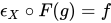
By definition, a functor is a left adjoint functor if for each object in there exists a universal morphism from to . Spelled out, this means that for each object in there exists an object in and a morphism such that for every object in and every morphism there exists a unique morphism with .

The latter equation is expressed by the following commutative diagram:

Here the counit is a universal morphism.

In this situation, one can show that can be turned into a functor in a unique way such that for all morphisms in ; is then called a left adjoint to .

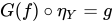
Similarly, we may define right-adjoint functors. A functor is a right adjoint functor if for each object in , there exists a universal morphism from to . Spelled out, this means that for each object in , there exists an object in and a morphism such that for every object in and every morphism there exists a unique morphism with .

The existence of the unit, a universal morphism, can prove the existence of an adjunction.

Again, this can be uniquely turned into a functor such that for a morphism in ; is then called a right adjoint to .

It is true, as the terminology implies, that is left adjoint to if and only if is right adjoint to .

These definitions via universal morphisms are often useful for establishing that a given functor is left or right adjoint, because they are minimalistic in their requirements. They are also intuitively meaningful in that finding a universal morphism is like solving an optimization problem.

Definition via Hom-sets

[edit]

Using hom-sets, an adjunction between two categories and can be defined as consisting of two functors and and a natural isomorphism

.

This specifies a family of bijections

for all objects and .

In this situation, is left adjoint to and is right adjoint to .

This definition is a logical compromise in that it is more difficult to establish its satisfaction than the universal morphism definitions, and has fewer immediate implications than the counit–unit definition. It is useful because of its obvious symmetry, and as a stepping-stone between the other definitions.

In order to interpret as a natural isomorphism, one must recognize and as functors. In fact, they are both bifunctors from to (the category of sets). For details, see the article on hom functors. Spelled out, the naturality of means that for all morphisms in and all morphisms in the following diagram commutes:

Naturality of Φ
Naturality of Φ

The vertical arrows in this diagram are those induced by composition. Formally, is given by for each is similar.

Definition via counit–unit

[edit]

A third way of defining an adjunction between two categories and consists of two functors and and two natural transformations
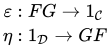
respectively called the counit and the unit of the adjunction (terminology from universal algebra), such that the compositions

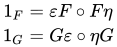
are the identity morphisms and on F and G respectively.

In this situation we say that F is left adjoint to G and G is right adjoint to F, and may indicate this relationship by writing  , or, simply  .
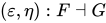
In equational form, the above conditions on are the counit–unit equations

which imply that for each and each

.

Note that denotes the identify functor on the category , denotes the identity natural transformation from the functor F to itself, and denotes the identity morphism of the object

String diagram for adjunction.

These equations are useful in reducing proofs about adjoint functors to algebraic manipulations. They are sometimes called the triangle identities, or sometimes the zig-zag equations because of the appearance of the corresponding string diagrams. A way to remember them is to first write down the nonsensical equation and then fill in either F or G in one of the two simple ways that make the compositions defined.

Note: The use of the prefix "co" in counit here is not consistent with the terminology of limits and colimits, because a colimit satisfies an initial property whereas the counit morphisms satisfy terminal properties, and dually for limit versus unit. The term unit here is borrowed from the theory of monads, where it looks like the insertion of the identity 1 into a monoid.

History

[edit]

The idea of adjoint functors was introduced by Daniel Kan in 1958.[5] Like many of the concepts in category theory, it was suggested by the needs of homological algebra, which was at the time devoted to computations. Those faced with giving tidy, systematic presentations of the subject would have noticed relations such as

hom(F(X), Y) = hom(X, G(Y))

in the category of abelian groups, where F was the functor (i.e. take the tensor product with A), and G was the functor hom(A,–) (this is now known as the tensor-hom adjunction). The use of the equals sign is an abuse of notation; those two groups are not really identical but there is a way of identifying them that is natural. It can be seen to be natural on the basis, firstly, that these are two alternative descriptions of the bilinear mappings from X × A to Y. That is, however, something particular to the case of tensor product. In category theory the 'naturality' of the bijection is subsumed in the concept of a natural isomorphism.

Examples

[edit]

Free groups

[edit]

The construction of free groups is a common and illuminating example.

Let F : SetGrp be the functor assigning to each set Y the free group generated by the elements of Y, and let G : GrpSet be the forgetful functor, which assigns to each group X its underlying set. Then F is left adjoint to G:

Initial morphisms.
For each set Y, the set GFY is just the underlying set of the free group FY generated by Y. Let be the set map given by "inclusion of generators". This is an initial morphism from Y to G, because any set map from Y to the underlying set GW of some group W will factor through via a unique group homomorphism from FY to W. This is precisely the universal property of the free group on Y.

Terminal morphisms.
For each group X, the group FGX is the free group generated freely by GX, the elements of X. Let be the group homomorphism that sends the generators of FGX to the elements of X they correspond to, which exists by the universal property of free groups. Then each is a terminal morphism from F to X, because any group homomorphism from a free group FZ to X will factor through via a unique set map from Z to GX. This means that (F,G) is an adjoint pair.
Hom-set adjunction.
Group homomorphisms from the free group FY to a group X correspond precisely to maps from the set Y to the set GX: each homomorphism from FY to X is fully determined by its action on generators, another restatement of the universal property of free groups. One can verify directly that this correspondence is a natural transformation, which means it is a hom-set adjunction for the pair (F,G).
counit–unit adjunction.
One can also verify directly that ε and η are natural. Then, a direct verification that they form a counit–unit adjunction is as follows:
The first counit–unit equation
says that for each set Y the composition
should be the identity. The intermediate group FGFY is the free group generated freely by the words of the free group FY. (Think of these words as placed in parentheses to indicate that they are independent generators.) The arrow is the group homomorphism from FY into FGFY sending each generator y of FY to the corresponding word of length one (y) as a generator of FGFY. The arrow is the group homomorphism from FGFY to FY sending each generator to the word of FY it corresponds to (so this map is "dropping parentheses"). The composition of these maps is indeed the identity on FY.

The second counit–unit equation
says that for each group X the composition
 
should be the identity. The intermediate set GFGX is just the underlying set of FGX. The arrow is the "inclusion of generators" set map from the set GX to the set GFGX. The arrow is the set map from GFGX to GX, which underlies the group homomorphism sending each generator of FGX to the element of X it corresponds to ("dropping parentheses"). The composition of these maps is indeed the identity on GX.

Free constructions and forgetful functors

[edit]

Free objects are all examples of a left adjoint to a forgetful functor, which assigns to an algebraic object its underlying set. These algebraic free functors have generally the same description as in the detailed description of the free group situation above.

Diagonal functors and limits

[edit]

Products, fibred products, equalizers, and kernels are all examples of the categorical notion of a limit. Any limit functor is right adjoint to a corresponding diagonal functor (provided the category has the type of limits in question), and the counit of the adjunction provides the defining maps from the limit object (i.e. from the diagonal functor on the limit, in the functor category). Below are some specific examples.

  • Products Let Π : Grp2Grp be the functor that assigns to each pair (X1, X2) the product group X1×X2, and let Δ : Grp → Grp2 be the diagonal functor that assigns to every group X the pair (X, X) in the product category Grp2. The universal property of the product group shows that Π is right-adjoint to Δ. The counit of this adjunction is the defining pair of projection maps from X1×X2 to X1 and X2 which define the limit, and the unit is the diagonal inclusion of a group X into X×X (mapping x to (x,x)).
The cartesian product of sets, the product of rings, the product of topological spaces etc. follow the same pattern; it can also be extended in a straightforward manner to more than just two factors. More generally, any type of limit is right adjoint to a diagonal functor.
  • Kernels. Consider the category D of homomorphisms of abelian groups. If f1 : A1B1 and f2 : A2B2 are two objects of D, then a morphism from f1 to f2 is a pair (gA, gB) of morphisms such that gBf1 = f2gA. Let G : DAb be the functor which assigns to each homomorphism its kernel and let F : Ab → D be the functor which maps the group A to the homomorphism A → 0. Then G is right adjoint to F, which expresses the universal property of kernels. The counit of this adjunction is the defining embedding of a homomorphism's kernel into the homomorphism's domain, and the unit is the morphism identifying a group A with the kernel of the homomorphism A → 0.
A suitable variation of this example also shows that the kernel functors for vector spaces and for modules are right adjoints. Analogously, one can show that the cokernel functors for abelian groups, vector spaces and modules are left adjoints.

Colimits and diagonal functors

[edit]

Coproducts, fibred coproducts, coequalizers, and cokernels are all examples of the categorical notion of a colimit. Any colimit functor is left adjoint to a corresponding diagonal functor (provided the category has the type of colimits in question), and the unit of the adjunction provides the defining maps into the colimit object. Below are some specific examples.

  • Coproducts. If F : Ab2 Ab assigns to every pair (X1, X2) of abelian groups their direct sum, and if G : AbAb2 is the functor which assigns to every abelian group Y the pair (Y, Y), then F is left adjoint to G, again a consequence of the universal property of direct sums. The unit of this adjoint pair is the defining pair of inclusion maps from X1 and X2 into the direct sum, and the counit is the additive map from the direct sum of (X,X) to back to X (sending an element (a,b) of the direct sum to the element a+b of X).
Analogous examples are given by the direct sum of vector spaces and modules, by the free product of groups and by the disjoint union of sets.

Further examples

[edit]

Algebra

[edit]
  • Adjoining an identity to a rng. This example was discussed in the motivation section above. Given a rng R, a multiplicative identity element can be added by taking RxZ and defining a Z-bilinear product with (r,0)(0,1) = (0,1)(r,0) = (r,0), (r,0)(s,0) = (rs,0), (0,1)(0,1) = (0,1). This constructs a left adjoint to the functor taking a ring to the underlying rng.
  • Adjoining an identity to a semigroup. Similarly, given a semigroup S, we can add an identity element and obtain a monoid by taking the disjoint union S {1} and defining a binary operation on it such that it extends the operation on S and 1 is an identity element. This construction gives a functor that is a left adjoint to the functor taking a monoid to the underlying semigroup.
  • Ring extensions. Suppose R and S are rings, and ρ : RS is a ring homomorphism. Then S can be seen as a (left) R-module, and the tensor product with S yields a functor F : R-ModS-Mod. Then F is left adjoint to the forgetful functor G : S-ModR-Mod.
  • Tensor products. If R is a ring and M is a right R-module, then the tensor product with M yields a functor F : R-ModAb. The functor G : AbR-Mod, defined by G(A) = homZ(M,A) for every abelian group A, is a right adjoint to F.
  • From monoids and groups to rings. The integral monoid ring construction gives a functor from monoids to rings. This functor is left adjoint to the functor that associates to a given ring its underlying multiplicative monoid. Similarly, the integral group ring construction yields a functor from groups to rings, left adjoint to the functor that assigns to a given ring its group of units. One can also start with a field K and consider the category of K-algebras instead of the category of rings, to get the monoid and group rings over K.
  • Field of fractions. Consider the category Domm of integral domains with injective morphisms. The forgetful functor FieldDomm from fields has a left adjoint—it assigns to every integral domain its field of fractions.
  • Polynomial rings. Let Ring* be the category of pointed commutative rings with unity (pairs (A,a) where A is a ring, a ∈ A and morphisms preserve the distinguished elements). The forgetful functor G:Ring*Ring has a left adjoint – it assigns to every ring R the pair (R[x],x) where R[x] is the polynomial ring with coefficients from R.
  • Abelianization. Consider the inclusion functor G : AbGrp from the category of abelian groups to category of groups. It has a left adjoint called abelianization which assigns to every group G the quotient group Gab=G/[G,G].
  • The Grothendieck group. In K-theory, the point of departure is to observe that the category of vector bundles on a topological space has a commutative monoid structure under direct sum. One may make an abelian group out of this monoid, the Grothendieck group, by formally adding an additive inverse for each bundle (or equivalence class). Alternatively one can observe that the functor that for each group takes the underlying monoid (ignoring inverses) has a left adjoint. This is a once-for-all construction, in line with the third section discussion above. That is, one can imitate the construction of negative numbers; but there is the other option of an existence theorem. For the case of finitary algebraic structures, the existence by itself can be referred to universal algebra, or model theory; naturally there is also a proof adapted to category theory, too.
  • Frobenius reciprocity in the representation theory of groups: see induced representation. This example foreshadowed the general theory by about half a century.

Topology

[edit]
  • A functor with a left and a right adjoint. Let G be the functor from topological spaces to sets that associates to every topological space its underlying set (forgetting the topology, that is). G has a left adjoint F, creating the discrete space on a set Y, and a right adjoint H creating the trivial topology on Y.
  • Suspensions and loop spaces. Given topological spaces X and Y, the space [SX, Y] of homotopy classes of maps from the suspension SX of X to Y is naturally isomorphic to the space [X, ΩY] of homotopy classes of maps from X to the loop space ΩY of Y. The suspension functor is therefore left adjoint to the loop space functor in the homotopy category, an important fact in homotopy theory.
  • Stone–Čech compactification. Let KHaus be the category of compact Hausdorff spaces and G : KHausTop be the inclusion functor to the category of topological spaces. Then G has a left adjoint F : TopKHaus, the Stone–Čech compactification. The unit of this adjoint pair yields a continuous map from every topological space X into its Stone–Čech compactification.
  • Direct and inverse images of sheaves. Every continuous map f : XY between topological spaces induces a functor f from the category of sheaves (of sets, or abelian groups, or rings...) on X to the corresponding category of sheaves on Y, the direct image functor. It also induces a functor f−1 from the category of sheaves of abelian groups on Y to the category of sheaves of abelian groups on X, the inverse image functor. f−1 is left adjoint to f. Here a more subtle point is that the left adjoint for coherent sheaves will differ from that for sheaves (of sets).
  • Soberification. The article on Stone duality describes an adjunction between the category of topological spaces and the category of sober spaces that is known as soberification. Notably, the article also contains a detailed description of another adjunction that prepares the way for the famous duality of sober spaces and spatial locales, exploited in pointless topology.

Posets

[edit]

Every partially ordered set can be viewed as a category (where the elements of the poset become the category's objects and we have a single morphism from x to y if and only if xy). A pair of adjoint functors between two partially ordered sets is called a Galois connection (or, if it is contravariant, an antitone Galois connection). See that article for a number of examples: the case of Galois theory of course is a leading one. Any Galois connection gives rise to closure operators and to inverse order-preserving bijections between the corresponding closed elements.

As is the case for Galois groups, the real interest lies often in refining a correspondence to a duality (i.e. antitone order isomorphism). A treatment of Galois theory along these lines by Kaplansky was influential in the recognition of the general structure here.

The partial order case collapses the adjunction definitions quite noticeably, but can provide several themes:

  • adjunctions may not be dualities or isomorphisms, but are candidates for upgrading to that status
  • closure operators may indicate the presence of adjunctions, as corresponding monads (cf. the Kuratowski closure axioms)
  • a very general comment of William Lawvere[6] is that syntax and semantics are adjoint: take C to be the set of all logical theories (axiomatizations), and D the power set of the set of all mathematical structures. For a theory T in C, let G(T) be the set of all structures that satisfy the axioms T; for a set of mathematical structures S, let F(S) be the minimal axiomatization of S. We can then say that S is a subset of G(T) if and only if F(S) logically implies T: the "semantics functor" G is right adjoint to the "syntax functor" F.
  • division is (in general) the attempt to invert multiplication, but in situations where this is not possible, we often attempt to construct an adjoint instead: the ideal quotient is adjoint to the multiplication by ring ideals, and the implication in propositional logic is adjoint to logical conjunction.

Category theory

[edit]
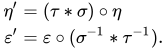
  • Equivalences. If F : DC is an equivalence of categories, then we have an inverse equivalence G : CD, and the two functors F and G form an adjoint pair. The unit and counit are natural isomorphisms in this case. If η : id → GF and ε : GF → id are natural isomorphisms, then there exist unique natural isomorphisms ε' : GF → id and η' : id → GF for which (η, ε') and (η', ε) are counit–unit pairs for F and G; they are
  • A series of adjunctions. The functor π0 which assigns to a category its set of connected components is left-adjoint to the functor D which assigns to a set the discrete category on that set. Moreover, D is left-adjoint to the object functor U which assigns to each category its set of objects, and finally U is left-adjoint to A which assigns to each set the indiscrete category[7] on that set.
  • Exponential object. In a cartesian closed category the endofunctor CC given by –×A has a right adjoint –A. This pair is often referred to as currying and uncurrying; in many special cases, they are also continuous and form a homeomorphism.

Categorical logic

[edit]
  • Quantification. If is a unary predicate expressing some property, then a sufficiently strong set theory may prove the existence of the set of terms that fulfill the property. A proper subset and the associated injection of into is characterized by a predicate expressing a strictly more restrictive property.
The role of quantifiers in predicate logics is in forming propositions and also in expressing sophisticated predicates by closing formulas with possibly more variables. For example, consider a predicate with two open variables of sort and . Using a quantifier to close , we can form the set
of all elements of for which there is an to which it is -related, and which itself is characterized by the property . Set theoretic operations like the intersection of two sets directly corresponds to the conjunction of predicates. In categorical logic, a subfield of topos theory, quantifiers are identified with adjoints to the pullback functor. Such a realization can be seen in analogy to the discussion of propositional logic using set theory but the general definition make for a richer range of logics.
So consider an object in a category with pullbacks. Any morphism induces a functor
on the category that is the preorder of subobjects. It maps subobjects of (technically: monomorphism classes of ) to the pullback . If this functor has a left- or right adjoint, they are called and , respectively.[8] They both map from back to . Very roughly, given a domain to quantify a relation expressed via over, the functor/quantifier closes in and returns the thereby specified subset of .
Example: In , the category of sets and functions, the canonical subobjects are the subset (or rather their canonical injections). The pullback of an injection of a subset into along is characterized as the largest set which knows all about and the injection of into . It therefore turns out to be (in bijection with) the inverse image .
For , let us figure out the left adjoint, which is defined via
which here just means
.
Consider . We see . Conversely, If for an we also have , then clearly . So implies . We conclude that left adjoint to the inverse image functor is given by the direct image. Here is a characterization of this result, which matches more the logical interpretation: The image of under is the full set of 's, such that is non-empty. This works because it neglects exactly those which are in the complement of . So
Put this in analogy to our motivation .
The right adjoint to the inverse image functor is given (without doing the computation here) by
The subset of is characterized as the full set of 's with the property that the inverse image of with respect to is fully contained within . Note how the predicate determining the set is the same as above, except that is replaced by .
See also powerset.

Probability

[edit]

The twin fact in probability can be understood as an adjunction: that expectation commutes with affine transform, and that the expectation is in some sense the best solution to the problem of finding a real-valued approximation to a distribution on the real numbers.

Define a category based on , with objects being the real numbers, and the morphisms being "affine functions evaluated at a point". That is, for any affine function and any real number , define a morphism .

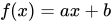
Define a category based on , the set of probability distribution on with finite expectation. Define morphisms on as "affine functions evaluated at a distribution". That is, for any affine function and any , define a morphism .

Then, the Dirac delta measure defines a functor: , and the expectation defines another functor , and they are adjoint: . (Somewhat disconcertingly, is the left adjoint, even though is "forgetful" and is "free".)

Adjunctions in full

[edit]

There are hence numerous functors and natural transformations associated with every adjunction, and only a small portion is sufficient to determine the rest.

An adjunction between categories C and D consists of

  • A functor F : DC called the left adjoint
  • A functor G : CD called the right adjoint
  • A natural isomorphism Φ : homC(F–,–) → homD(–,G–)
  • A natural transformation ε : FG → 1C called the counit
  • A natural transformation η : 1DGF called the unit

An equivalent formulation, where X denotes any object of C and Y denotes any object of D, is as follows:

For every C-morphism f : FYX, there is a unique D-morphism ΦY, X(f) = g : YGX such that the diagrams below commute, and for every D-morphism g : YGX, there is a unique C-morphism Φ−1Y, X(g) = f : FYX in C such that the diagrams below commute:

From this assertion, one can recover that:

  • The transformations ε, η, and Φ are related by the equations
  • The transformations ε, η satisfy the counit–unit equations

In particular, the equations above allow one to define Φ, ε, and η in terms of any one of the three. However, the adjoint functors F and G alone are in general not sufficient to determine the adjunction. The equivalence of these situations is demonstrated below.

Universal morphisms induce hom-set adjunction

[edit]

Given a right adjoint functor G : CD; in the sense of initial morphisms, one may construct the induced hom-set adjunction by doing the following steps.

  • Construct a functor F : DC and a natural transformation η.
    • For each object Y in D, choose an initial morphism (F(Y), ηY) from Y to G, so that ηY : YG(F(Y)). We have the map of F on objects and the family of morphisms η.
    • For each f : Y0Y1, as (F(Y0), ηY0) is an initial morphism, then factorize ηY1F with ηY0 and get F(f) : F(Y0) → F(Y1). This is the map of F on morphisms.
    • The commuting diagram of that factorization implies the commuting diagram of natural transformations, so η : 1DGF is a natural transformation.
    • Uniqueness of that factorization and that G is a functor implies that the map of F on morphisms preserves compositions and identities.
  • Construct a natural isomorphism Φ : homC(F−,−) → homD(−,G−).
    • For each object X in C, each object Y in D, as (F(Y), ηY) is an initial morphism, then ΦY, X is a bijection, where ΦY, X(f : F(Y) → X) = G(F) ∘ ηY.
    • η is a natural transformation, G is a functor, then for any objects X0, X1 in C, any objects Y0, Y1 in D, any x : X0X1, any y : Y1Y0, we have ΦY1, X1(xfF(y)) = G(x) ∘ G(f) ∘ G(f(y)) ∘ ηY1 = G(x) ∘ G(f) ∘ ηY0y = G(x) ∘ ΦY0, X0(∘) ∘ y, and then Φ is natural in both arguments.

A similar argument allows one to construct a hom-set adjunction from the terminal morphisms to a left adjoint functor. (The construction that starts with a right adjoint is slightly more common, since the right adjoint in many adjoint pairs is a trivially defined inclusion or forgetful functor.)

counit–unit adjunction induces hom-set adjunction

[edit]

Given functors F : DC, G : CD, and a counit–unit adjunction (ε, η) : FG, we can construct a hom-set adjunction by finding the natural transformation Φ : homC(F−,−) → homD(−,G−) in the following steps:

  • For each f : FYX and each g : YGX, define
The transformations Φ and Ψ are natural because η and ε are natural.
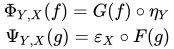
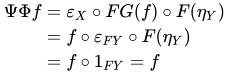
  • Using, in order, that F is a functor, that ε is natural, and the counit–unit equation 1FY = εFYFY), we obtain
hence ΨΦ is the identity transformation.
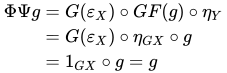
  • Dually, using that G is a functor, that η is natural, and the counit–unit equation 1GX = GX) ∘ ηGX, we obtain
hence ΦΨ is the identity transformation. Thus Φ is a natural isomorphism with inverse Φ−1 = Ψ.
Hom-set adjunction induces all of the above

[edit]

Given functors F : DC, G : CD, and a hom-set adjunction Φ : homC(F−,−) → homD(−,G−), one can construct a counit–unit adjunction

 ,

which defines families of initial and terminal morphisms, in the following steps:

  • Let for each X in C, where is the identity morphism.
  • Let for each Y in D, where is the identity morphism.
  • The bijectivity and naturality of Φ imply that each (GX, εX) is a terminal morphism from F to X in C, and each (FY, ηY) is an initial morphism from Y to G in D.
  • The naturality of Φ implies the naturality of ε and η, and the two formulas

for each f: FYX and g: YGX (which completely determine Φ).
  • Substituting FY for X and ηY = ΦY, FY(1FY) for g in the second formula gives the first counit–unit equation
,
and substituting GX for Y and εX = Φ−1GX, X(1GX) for f in the first formula gives the second counit–unit equation
.

Properties

[edit]

Existence

[edit]

Not every functor G : CD admits a left adjoint. If C is a complete category, then the functors with left adjoints can be characterized by the adjoint functor theorem of Peter J. Freyd: G has a left adjoint if and only if it is continuous and a certain smallness condition is satisfied: for every object Y of D there exists a family of morphisms

fi : YG(Xi)

where the indices i come from a set I, not a proper class, such that every morphism

h : YG(X)

can be written as

h = G(t) fi

for some i in I and some morphism

t : XiXC.

An analogous statement characterizes those functors with a right adjoint.

An important special case is that of locally presentable categories. If is a functor between locally presentable categories, then

  • F has a right adjoint if and only if F preserves small colimits
  • F has a left adjoint if and only if F preserves small limits and is an accessible functor

Uniqueness

[edit]

If the functor F : DC has two right adjoints G and G, then G and G are naturally isomorphic. The same is true for left adjoints.

Conversely, if F is left adjoint to G, and G is naturally isomorphic to G then F is also left adjoint to G. More generally, if 〈F, G, ε, η〉 is an adjunction (with counit–unit (ε,η)) and

σ : FF
τ : GG

are natural isomorphisms then 〈F, G, ε, η〉 is an adjunction where

Here denotes vertical composition of natural transformations, and denotes horizontal composition.

Composition

[edit]

Adjunctions can be composed in a natural fashion. Specifically, if 〈F, G, ε, η〉 is an adjunction between C and D and 〈F, G, ε, η〉 is an adjunction between D and E then the functor

is left adjoint to

More precisely, there is an adjunction between F F′ and G′ G with unit and counit given respectively by the compositions:
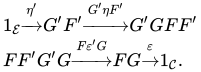
This new adjunction is called the composition of the two given adjunctions.

Since there is also a natural way to define an identity adjunction between a category C and itself, one can then form a category whose objects are all small categories and whose morphisms are adjunctions.

Limit preservation

[edit]

The most important property of adjoints is their continuity: every functor that has a left adjoint (and therefore is a right adjoint) is continuous (i.e. commutes with limits in the category theoretical sense); every functor that has a right adjoint (and therefore is a left adjoint) is cocontinuous (i.e. commutes with colimits).

Since many common constructions in mathematics are limits or colimits, this provides a wealth of information. For example:

  • applying a right adjoint functor to a product of objects yields the product of the images;
  • applying a left adjoint functor to a coproduct of objects yields the coproduct of the images;
  • every right adjoint functor between two abelian categories is left exact;
  • every left adjoint functor between two abelian categories is right exact.

Additivity

[edit]

If C and D are preadditive categories and F : DC is an additive functor with a right adjoint G : CD, then G is also an additive functor and the hom-set bijections

are, in fact, isomorphisms of abelian groups. Dually, if G is additive with a left adjoint F, then F is also additive.

Moreover, if both C and D are additive categories (i.e. preadditive categories with all finite biproducts), then any pair of adjoint functors between them are automatically additive.

Relationships

[edit]

Universal constructions

[edit]

As stated earlier, an adjunction between categories C and D gives rise to a family of universal morphisms, one for each object in C and one for each object in D. Conversely, if there exists a universal morphism to a functor G : CD from every object of D, then G has a left adjoint.

However, universal constructions are more general than adjoint functors: a universal construction is like an optimization problem; it gives rise to an adjoint pair if and only if this problem has a solution for every object of D (equivalently, every object of C).

Equivalences of categories

[edit]

If a functor F : DC is one half of an equivalence of categories then it is the left adjoint in an adjoint equivalence of categories, i.e. an adjunction whose unit and counit are isomorphisms.

Every adjunction 〈F, G, ε, η〉 extends an equivalence of certain subcategories. Define C1 as the full subcategory of C consisting of those objects X of C for which εX is an isomorphism, and define D1 as the full subcategory of D consisting of those objects Y of D for which ηY is an isomorphism. Then F and G can be restricted to D1 and C1 and yield inverse equivalences of these subcategories.

In a sense, then, adjoints are "generalized" inverses. Note however that a right inverse of F (i.e. a functor G such that FG is naturally isomorphic to 1D) need not be a right (or left) adjoint of F. Adjoints generalize two-sided inverses.

Monads

[edit]

Every adjunction 〈F, G, ε, η〉 gives rise to an associated monadT, η, μ〉 in the category D. The functor

is given by T = GF. The unit of the monad

is just the unit η of the adjunction and the multiplication transformation

is given by μ = GεF. Dually, the triple 〈FG, ε, FηG〉 defines a comonad in C.

Every monad arises from some adjunction—in fact, typically from many adjunctions—in the above fashion. Two constructions, called the category of Eilenberg–Moore algebras and the Kleisli category are two extremal solutions to the problem of constructing an adjunction that gives rise to a given monad.

Notes

[edit]

References

[edit]
[edit]
Revisions and contributorsEdit on WikipediaRead on Wikipedia
from Grokipedia
In category theory, adjoint functors are a pair of functors F:CDF: \mathcal{C} \to \mathcal{D} and G:DCG: \mathcal{D} \to \mathcal{C} between categories C\mathcal{C} and D\mathcal{D} that, through their relationship known as an adjunction, "arise everywhere" in mathematics, generalizing many universal constructions such as free algebras and limits.[1]

Introduction and Motivation

Adjoint functors provide a framework for understanding dualities and optimizations in mathematical structures. The left adjoint FF and right adjoint GG satisfy a natural bijection HomD(F(c),d)HomC(c,G(d))\mathrm{Hom}_{\mathcal{D}}(F(c), d) \cong \mathrm{Hom}_{\mathcal{C}}(c, G(d)) for all objects cCc \in \mathcal{C}, dDd \in \mathcal{D}, or equivalently via a unit η:IdCGF\eta: \mathrm{Id}_{\mathcal{C}} \to G \circ F and counit ϵ:FGIdD\epsilon: F \circ G \to \mathrm{Id}_{\mathcal{D}} obeying the triangular identities. This structure captures symmetric relationships in categories, where left and right adjoints play complementary roles, mirroring concepts like limits and colimits.[1]

Optimization problems and adjunctions

Adjunctions model optimization by providing universal solutions to problems of approximation or extension. For instance, the left adjoint often constructs "free" or "initial" objects that best approximate targets in D\mathcal{D} from C\mathcal{C}, minimizing or maximizing certain hom-set mappings in a categorical sense. This perspective unifies variational principles across algebra, topology, and logic.[1]

Symmetry in categorical structures

The symmetry inherent in adjunctions reflects deeper dualities in category theory, such as the interchange of limits and colimits via adjoints. Left adjoints preserve colimits, while right adjoints preserve limits, enabling balanced transitions between "algebraic" (colimit-heavy) and "order-theoretic" (limit-heavy) perspectives on structures. This duality underpins much of modern mathematics, from representation theory to homotopy theory.[1]

Introduction and Motivation

Optimization problems and adjunctions

Adjoint functors provide a categorical framework for solving universal optimization problems, where one seeks the "best" morphism or construction that satisfies certain constraints across categories. In this context, an adjunction between functors F:CDF: \mathcal{C} \to \mathcal{D} and G:DCG: \mathcal{D} \to \mathcal{C} identifies FF as the optimal solution that maximizes the imposition of structure from C\mathcal{C} into D\mathcal{D}, while GG optimally extracts information back to C\mathcal{C} with minimal loss of relational data. This perspective arises from viewing categories as arenas for constrained mappings, where adjoint pairs formalize the trade-offs between freedom and fidelity in inter-category translations.[2] The left adjoint FF can be understood as the least restrictive solution to a construction problem, imposing the maximal amount of structure possible while preserving essential properties, akin to generating the "freest" object that extends given data without unnecessary impositions. Conversely, the right adjoint GG acts as the most informative embedding, minimizing the loss of categorical relations by optimizing the preservation of limits or other universal features during the return mapping. This duality captures the bilateral optimization inherent in adjunctions, where each functor complements the other in achieving an efficient, canonical correspondence between categories.[2] Adjunctions thus formalize the notion that, for opposing functors F:CDF: \mathcal{C} \to \mathcal{D} and G:DCG: \mathcal{D} \to \mathcal{C}, FF optimizes the maximization of structure transfer—such as adjoining operations or relations—while GG optimizes the minimization of information loss, often through preservation of colimits or other dual constructs. This optimization is realized through universal properties, which ensure the uniqueness and optimality of the solutions up to natural isomorphism.[2] A concrete illustration occurs in the category of vector spaces over a field kk, denoted Vectk\mathbf{Vect}_k, where the tensor product functor k:Vectk×VectkVectk-\otimes_k -: \mathbf{Vect}_k \times \mathbf{Vect}_k \to \mathbf{Vect}_k serves as the left adjoint to the internal Hom functor Homk(,):Vectkop×VectkVectk\mathbf{Hom}_k(-, -): \mathbf{Vect}_k^\mathrm{op} \times \mathbf{Vect}_k \to \mathbf{Vect}_k. Here, the tensor product optimizes dimension-matching by providing the universal bilinear map from pairs of spaces, maximizing the span of generated elements while respecting linearity constraints, whereas the Hom functor optimizes linear functional preservation, minimizing loss in dual representations for applications like solving systems of equations or computing invariants. This pair solves dimension-optimization problems, such as finding minimal bases or maximal quotients, central to linear algebra.[2]

Symmetry in categorical structures

Adjoint functors embody a profound symmetry in categorical structures, where a left adjoint functor F:CDF: \mathcal{C} \to \mathcal{D} and its right adjoint G:DCG: \mathcal{D} \to \mathcal{C}, denoted FGF \dashv G, operate in a dual manner: FF effectively "lifts" objects from C\mathcal{C} to D\mathcal{D} by adding structure, while GG "projects" them back by removing it, establishing a balanced correspondence that mirrors arrows in opposite directions.[1] This duality ensures that the composite functors GFGF and FGFG are equipped with natural transformations—the counit ε:FGIdD\varepsilon: FG \to \mathrm{Id}_\mathcal{D} and unit η:IdCGF\eta: \mathrm{Id}_\mathcal{C} \to GF—which together form a Galois-like connection, symmetrizing the interplay between construction and deconstruction across categories.[1] Such symmetry highlights how adjunctions reverse the direction of hom-sets via the defining isomorphism D(Fc,d)C(c,Gd)\mathcal{D}(Fc, d) \cong \mathcal{C}(c, Gd), preserving universal properties in a reciprocal fashion.[3] This symmetric framework extends the unilateral intuitions from optimization problems by providing a bidirectional balance, where the adjunction ensures that the "best" approximations in one direction correspond precisely to those in the reverse, achieved through the natural transformations that mediate between FF and GG. In essence, composing FGF \dashv G yields a monad GFGF on C\mathcal{C} and a comonad FGFG on D\mathcal{D} that enforce this equilibrium, symmetrizing the addition and removal of structure.[1] The duality inherent in adjunctions thus transforms potentially asymmetric categorical mappings into harmonious dual pairs, underscoring their role in unifying diverse mathematical constructions. A concrete manifestation of this symmetry appears in the category of posets, where adjunctions between posets PP and QQ correspond directly to Galois connections: for monotone functions f:PQf: P \to Q and g:QPg: Q \to P forming fgf \dashv g, the defining condition is f(x)yf(x) \leq y if and only if xg(y)x \leq g(y) for all xPx \in P and yQy \in Q.[1] This equivalence captures the arrow-reversing duality at the order-theoretic level, with ff as the left adjoint preserving joins (suprema) and gg as the right adjoint preserving meets (infima). In this posetal setting, the preservation properties illustrate the duality explicitly: if fgf \dashv g, then
supf(A)=f(supA) \sup f(A) = f(\sup A)
for any subset APA \subseteq P, and
infg(B)=g(infB) \inf g(B) = g(\inf B)
for any subset BQB \subseteq Q. These equations demonstrate how the left adjoint elevates suprema while the right adjoint lowers infima, embodying the symmetric preservation of dual concepts central to adjunctions.[1]

Definitions and Notation

Basic conventions and terminology

In category theory, an adjoint pair consists of functors F:CDF: \mathcal{C} \to \mathcal{D} and G:DCG: \mathcal{D} \to \mathcal{C}, denoted as (F,G)(F, G) with FF the left adjoint and GG the right adjoint, and the adjunction symbolized by FGF \dashv G or FGF \bot G.[4] The left adjoint FF is often described as providing "free" or "initial" constructions, reflecting its role in generating universal objects from source category elements, while the right adjoint GG yields "cofree" or "terminal" constructions, capturing universal properties in the target category.[4][5] The components of the adjunction include the unit natural transformation η:1CGF\eta: 1_{\mathcal{C}} \to G F, whose components are ηC:CG(F(C))\eta_C: C \to G(F(C)) for objects CC in C\mathcal{C}, and the counit natural transformation ε:FG1D\varepsilon: F G \to 1_{\mathcal{D}}, with components εD:F(G(D))D\varepsilon_D: F(G(D)) \to D for objects DD in D\mathcal{D}.[4] These natural transformations satisfy the triangular identities, ensuring the bijection between hom-sets is natural in both variables.[4] Standard conventions assume categories C\mathcal{C} and D\mathcal{D} are small—meaning their collections of objects and morphisms form sets—unless explicitly stated otherwise, to avoid foundational set-theoretic issues with proper classes.[6] Functors are taken to be covariant, preserving the direction of morphisms, except when involving opposite categories, which reverse arrows and are denoted Cop\mathcal{C}^{\mathrm{op}}.[4] The overall adjunction between categories is sometimes compactly written as CD\mathcal{C} \leftrightarrows \mathcal{D} via FGF \dashv G, emphasizing the bidirectional relationship.[5]

Universal morphism definition

In category theory, a pair of functors F:ABF: \mathcal{A} \to \mathcal{B} and G:BAG: \mathcal{B} \to \mathcal{A} forms an adjunction, denoted FGF \dashv G, if for every object AA in A\mathcal{A}, there exists a morphism ηA:AGFA\eta_A: A \to G F A in A\mathcal{A} that is universal initial with respect to GG. This means that ηA\eta_A is the structure morphism for the initial object in the comma category (AG)(A \downarrow G).[7] The comma category (AG)(A \downarrow G) has as objects all pairs (B,f)(B, f) where BB is an object in B\mathcal{B} and f:AGBf: A \to G B is a morphism in A\mathcal{A}; a morphism from (B,f)(B, f) to (B,f)(B', f') is a morphism q:BBq: B \to B' in B\mathcal{B} such that the diagram
AfGBGqAfGB \begin{CD} A @>f>> G B \\ @| @VG q VV \\ A @>>f'> G B' \end{CD}
commutes, i.e., f=Gqff' = G q \circ f. The pair (FA,ηA)(F A, \eta_A) is initial in (AG)(A \downarrow G) if, for every object (B,f)(B, f) in (AG)(A \downarrow G), there exists a unique morphism fˉ:FAB\bar{f}: F A \to B in B\mathcal{B} such that GfˉηA=fG \bar{f} \circ \eta_A = f, as depicted in the diagram
AηAGFAfGfˉGB=GB \begin{CD} A @>\eta_A>> G F A \\ @V f VV @VV G \bar{f} V \\ G B @= G B \end{CD}
This uniqueness ensures that ηA\eta_A factors any compatible morphism from AA to an object in the image of GG uniquely through GFAG F A.[7] This universal property characterizes FF as the left adjoint to GG, making FAF A the "freest" or most initial object in B\mathcal{B} that GG can map back to connect with AA via ηA\eta_A. The collection of all such ηA\eta_A forms a natural transformation η:IdAGF\eta: \mathrm{Id}_\mathcal{A} \to G F, known as the unit of the adjunction. The concept of adjoint functors via this universal initiality was originally introduced by Daniel M. Kan.[8] Dually, GG as the right adjoint is characterized by a couniversal terminal morphism: for every object BB in B\mathcal{B}, there exists εB:FGBB\varepsilon_B: F G B \to B that is the structure morphism for the terminal object in the comma category (FB)(F \downarrow B). Here, objects are pairs (A,g:FAB)(A, g: F A \to B) with AA in A\mathcal{A}, and morphisms from (A,g)(A, g) to (A,g)(A', g') are h:AAh: A \to A' in A\mathcal{A} such that the square
FAgBFhFAgB \begin{CD} F A @>g>> B \\ @V F h VV @| \\ F A' @>>g'> B \end{CD}
commutes, i.e., gFh=gg' \circ F h = g. The pair (GB,εB)(G B, \varepsilon_B) is terminal in (FB)(F \downarrow B) if, for every object (A,g)(A, g) in (FB)(F \downarrow B), there exists a unique gˉ:AGB\bar{g}: A \to G B such that εBFgˉ=g\varepsilon_B \circ F \bar{g} = g. This makes ε:FGIdB\varepsilon: F G \to \mathrm{Id}_\mathcal{B} the counit, providing the terminal factorization.[7]

Hom-set isomorphism definition

One prominent definition of an adjunction between functors F:CDF: \mathcal{C} \to \mathcal{D} and G:DCG: \mathcal{D} \to \mathcal{C} is given by the existence of a family of bijections ϕX,Y:\HomD(FX,Y)\HomC(X,GY)\phi_{X,Y}: \Hom_{\mathcal{D}}(F X, Y) \to \Hom_{\mathcal{C}}(X, G Y) for all objects XCX \in \mathcal{C} and YDY \in \mathcal{D}, where each ϕX,Y\phi_{X,Y} is a bijection of sets.[1] These bijections assemble into a natural isomorphism of bifunctors \HomD(F,)\HomC(,G):Cop×DSet\Hom_{\mathcal{D}}(F-, -) \cong \Hom_{\mathcal{C}}(-, G-): \mathcal{C}^{\mathrm{op}} \times \mathcal{D} \to \mathbf{Set}.[1] Naturality means that for any morphisms u:XXu: X \to X' in C\mathcal{C} and v:YYv: Y \to Y' in D\mathcal{D}, the diagram
\HomD(FX,Y)ϕX,Y\HomC(X,GY)\HomD(Fu,v)\HomC(u,Gv)\HomD(FX,Y)ϕX,Y\HomC(X,GY) \begin{CD} \Hom_{\mathcal{D}}(F X, Y) @>\phi_{X,Y}>> \Hom_{\mathcal{C}}(X, G Y)\\ @V{\Hom_{\mathcal{D}}(F u, v)}VV @VV{\Hom_{\mathcal{C}}(u, G v)}V\\ \Hom_{\mathcal{D}}(F X', Y') @>>\phi_{X',Y'}> \Hom_{\mathcal{C}}(X', G Y') \end{CD}
commutes.[1] Explicitly, the forward map ϕX,Y\phi_{X,Y} sends a morphism f:FXYf: F X \to Y in D\mathcal{D} to the composite GfηX:XGYG f \circ \eta_X: X \to G Y in C\mathcal{C}, where ηX:XG(FX)\eta_X: X \to G (F X) is the component at XX of a natural transformation η:idCGF\eta: \mathrm{id}_{\mathcal{C}} \to G F (the unit of the adjunction).[1] Conversely, the inverse map ϕX,Y1\phi_{X,Y}^{-1} sends a morphism g:XGYg: X \to G Y in C\mathcal{C} to g:FXY\overline{g}: F X \to Y in D\mathcal{D}, satisfying ϕ(g)=g\phi(\overline{g}) = g.[1] These correspondences ensure the bijections are well-defined and respect the categorical structure.[1] This hom-set isomorphism definition is equivalent to the universal morphism characterization of adjunctions and generalizes the notion of representable functors: for a fixed object AA in C\mathcal{C}, the representable functor \HomC(A,):CSet\Hom_{\mathcal{C}}(A, -): \mathcal{C} \to \mathbf{Set} is the right adjoint GG to the left adjoint FF that freely generates objects from sets into C\mathcal{C} via coproducts of copies of AA.[1]

Unit-counit definition

An adjunction between two functors F:CDF: \mathcal{C} \to \mathcal{D} and G:DCG: \mathcal{D} \to \mathcal{C} can be defined using a pair of natural transformations known as the unit and counit. Specifically, FF is left adjoint to GG, denoted FGF \dashv G, if there exist natural transformations η:IdCGF\eta: \mathrm{Id}_{\mathcal{C}} \to GF (the unit) and ε:FGIdD\varepsilon: FG \to \mathrm{Id}_{\mathcal{D}} (the counit) satisfying the triangular identities:
εFcFηc=idFcfor all cOb(C), \varepsilon_{F c} \circ F \eta_c = \mathrm{id}_{F c} \quad \text{for all } c \in \mathrm{Ob}(\mathcal{C}),
GεdηGd=idGdfor all dOb(D). G \varepsilon_d \circ \eta_{G d} = \mathrm{id}_{G d} \quad \text{for all } d \in \mathrm{Ob}(\mathcal{D}).
[1] These identities were introduced in the foundational work on adjoint functors. The triangular identities can be visualized as two commuting triangles. The first identity corresponds to the diagram
FcFηcFGFcidFcεFcFc=Fc \begin{CD} F c @>F \eta_c>> F G F c \\ @V \mathrm{id}_{F c} VV @VV \varepsilon_{F c} V \\ F c @= F c \end{CD}
where the composite path equals the identity morphism on FcF c. Dually, the second identity is captured by
GdηGdGFGdidGdGεdGd=Gd \begin{CD} G d @> \eta_{G d} >> G F G d \\ @V \mathrm{id}_{G d} VV @VV G \varepsilon_d V \\ G d @= G d \end{CD}
ensuring the composite equals the identity on GdG d. These diagrams emphasize the invertible nature of the compositions involving the unit and counit, guaranteeing that the adjunction behaves coherently across the categories.[1]
The triangular identities ensure that the adjunction is "full and faithful" in the sense of compositions between FF and GG, meaning that applying FF followed by GG (or vice versa) can be inverted naturally through η\eta and ε\varepsilon. This structure uniquely determines the pair: given an adjunction, the unit and counit are mates, where each can be recovered from the other via the hom-set bijections they induce, making them interchangeable in defining the adjunction.[1]

Examples

Free constructions and forgetful functors

One of the most fundamental examples of adjoint functors arises in the category of groups, where the free group functor $ F: \mathbf{Set} \to \mathbf{Grp} $ is left adjoint to the forgetful functor $ U: \mathbf{Grp} \to \mathbf{Set} $, denoted $ F \dashv U $. The functor $ F $ sends a set $ X $ to the free group $ F(X) $ generated by $ X $, with elements of $ X $ serving as generators, while $ U $ maps a group $ G $ to its underlying set $ U(G) $, forgetting the group operation. This adjunction is characterized by a natural isomorphism of hom-sets
HomGrp(F(X),G)HomSet(X,U(G)), \mathbf{Hom}_{\mathbf{Grp}}(F(X), G) \cong \mathbf{Hom}_{\mathbf{Set}}(X, U(G)),
natural in both $ X $ and $ G $, which equates group homomorphisms from the free group on $ X $ to $ G $ with functions from $ X $ to the underlying set of $ G $.[1] The unit $ \eta $ of this adjunction is the natural transformation $ \eta: \mathrm{Id}{\mathbf{Set}} \to U F $, where for each set $ X $, the component $ \eta_X: X \to U(F(X)) $ includes the elements of $ X $ as generators in the free group $ F(X) $, typically represented as one-letter words. The counit $ \varepsilon: F U \to \mathrm{Id}{\mathbf{Grp}} $ is given by the components $ \varepsilon_G: F(U(G)) \to G $, which is the canonical surjective homomorphism sending each generator (element of $ U(G) $) to its image in $ G $, with relations imposed by the group structure of $ G $. These natural transformations satisfy the usual triangular identities, ensuring the bijection in the hom-set isomorphism is induced by composing with $ \eta $ and $ \varepsilon $.[1] Under this correspondence, a group homomorphism $ \phi: F(X) \to G $ is uniquely determined by its restriction to the generators $ X $, which yields a set function $ X \to U(G) $ via $ \phi \circ \eta_X $, and conversely, any set function $ f: X \to U(G) $ extends uniquely to a group homomorphism $ F(f): F(X) \to G $ by the universal property of the free group. This illustrates how the free construction provides the "freest" algebraic structure on a set, minimally extending it to satisfy the required operations while preserving all possible homomorphisms.[1] This free-forgetful adjunction generalizes to other algebraic categories. For instance, in the category of rings, the free ring functor from sets to rings is left adjoint to the forgetful functor to sets, generating the free ring on a set via non-commutative polynomials. Similarly, for modules over a ring $ R $, the free module functor $ F: \mathbf{Set} \to \mathbf{Mod}_R $ (sending a set to the direct sum of copies of $ R $) is left adjoint to the forgetful functor $ U: \mathbf{Mod}R \to \mathbf{Set} $, with the hom-set isomorphism $ \mathbf{Hom}{\mathbf{Mod}R}(F(X), M) \cong \mathbf{Hom}{\mathbf{Set}}(X, U(M)) $ reflecting the universal property of free modules as direct sums. These examples highlight how free functors systematically construct initial objects in algebraic varieties, paired with their underlying-set forgetful right adjoints.[9][1]

Limits, colimits, and diagonal functors

In category theory, the diagonal functor provides a fundamental example of adjoint functors in the context of limits and colimits. For a small category II and a category CC, the diagonal functor Δ:CCI\Delta: C \to C^I sends each object XX in CC to the constant diagram ΔX:IC\Delta X: I \to C that maps every object in II to XX and every morphism to the identity on XX.[1] This functor embeds CC into the functor category CIC^I, where objects are diagrams indexed by II. When CC has all colimits of II-shaped diagrams, the colimit functor colim:CIC\operatorname{colim}: C^I \to C, which assigns to each diagram its colimit, is left adjoint to the diagonal functor Δ\Delta. This adjunction is witnessed by the natural isomorphism
C(colimD,X)(CI)(D,ΔX), C(\operatorname{colim} D, X) \cong (C^I)(D, \Delta X),
natural in the diagram D:ICD: I \to C and the object XCX \in C.[1] Here, the left side consists of morphisms from the colimit of DD to XX, while the right side consists of natural transformations from DD to the constant diagram ΔX\Delta X. The unit of the adjunction provides canonical morphisms from each component of DD to XX that coequalize the diagram, universal among such families.[1] Dually, when CC has all limits of II-shaped diagrams, the diagonal functor Δ\Delta is left adjoint to the limit functor lim:CIC\operatorname{lim}: C^I \to C. The corresponding natural isomorphism is
C(X,limD)(CI)(ΔX,D), C(X, \operatorname{lim} D) \cong (C^I)(\Delta X, D),
natural in XX and DD.[1] The counit of this adjunction yields the canonical projections from limD\operatorname{lim} D to each component of DD, universal among families of morphisms into DD from a common object. This setup mirrors the universal approximating property of colimits but in the opposite direction.[1] These adjunctions unify various universal constructions as special cases of limits and colimits. For instance, when II is the discrete category with two objects and no non-identity morphisms, colim\operatorname{colim} recovers the coproduct (disjoint union), while lim\operatorname{lim} recovers the product; more generally, for II with parallel arrows, equalizers arise as limits and coequalizers as colimits, all characterized via the hom-set isomorphisms with constant diagrams.[1] Infinite products, coproducts, and equalizers follow similarly for arbitrary indexing categories II, demonstrating how adjunctions provide a uniform framework for these approximations without presupposing their existence in CC.[1]

Applications in algebra and topology

In algebra, a fundamental example of an adjoint pair arises in the category of modules over a commutative ring RR, denoted ModR\mathrm{Mod}_R. The functor RN:ModRModR-\otimes_R N: \mathrm{Mod}_R \to \mathrm{Mod}_R, which takes a module MM to MRNM \otimes_R N for a fixed module NN, is left adjoint to the Hom functor HomR(N,):ModRModR\mathrm{Hom}_R(N, -): \mathrm{Mod}_R \to \mathrm{Mod}_R. This tensor-Hom adjunction is witnessed by the natural isomorphism
HomR(MRN,P)HomR(M,HomR(N,P)) \mathrm{Hom}_R(M \otimes_R N, P) \cong \mathrm{Hom}_R(M, \mathrm{Hom}_R(N, P))
for all modules M,N,PM, N, P, where the bijection sends a module homomorphism f:MRNPf: M \otimes_R N \to P to the induced map MHomR(N,P)M \to \mathrm{Hom}_R(N, P) given by m(nf(mn))m \mapsto (n \mapsto f(m \otimes n)). This adjunction underpins many constructions in homological algebra, such as the interpretation of Ext groups via projective resolutions, and extends to non-commutative rings under suitable bimodule assumptions.[4] Another key algebraic application is the abelianization functor Ab:GrpAb\mathrm{Ab}: \mathrm{Grp} \to \mathrm{Ab}, which sends a group GG to its quotient G/[G,G]G/[G,G] by the commutator subgroup, making it abelian. This functor is left adjoint to the inclusion functor I:AbGrpI: \mathrm{Ab} \hookrightarrow \mathrm{Grp}, which forgets the abelian structure. The adjunction provides a natural bijection
HomAb(Ab(G),A)HomGrp(G,I(A)) \mathrm{Hom}_{\mathrm{Ab}}(\mathrm{Ab}(G), A) \cong \mathrm{Hom}_{\mathrm{Grp}}(G, I(A))
for any group GG and abelian group AA, where the map from the left sends a homomorphism ϕ:G/[G,G]A\phi: G/[G,G] \to A to the composition GG/[G,G]ϕAG \to G/[G,G] \xrightarrow{\phi} A, and the inverse factors through the universal property of the commutator quotient. This pair illustrates how adjunctions capture free or universal approximations in group theory, preserving colimits such as coproducts.[4] In topology, the Stone-Čech compactification functor β:TopCompHaus\beta: \mathrm{Top} \to \mathrm{CompHaus} assigns to a Tychonoff space XX its compact Hausdorff compactification βX\beta X, which is left adjoint to the inclusion I:CompHausTopI: \mathrm{CompHaus} \hookrightarrow \mathrm{Top}. The adjunction yields the natural isomorphism
HomCompHaus(βX,K)HomTop(X,I(K))=HomTop(X,K) \mathrm{Hom}_{\mathrm{CompHaus}}(\beta X, K) \cong \mathrm{Hom}_{\mathrm{Top}}(X, I(K)) = \mathrm{Hom}_{\mathrm{Top}}(X, K)
for any compact Hausdorff space KK, reflecting the universal property that every continuous map XKX \to K extends uniquely to βXK\beta X \to K. This construction is central to embedding theorems and the study of remainders in topological spaces.[4] A prominent adjunction in algebraic topology involves the geometric realization functor :sSetTop|-|: \mathrm{sSet} \to \mathrm{Top}, which realizes a simplicial set as a topological space by gluing standard simplices along faces, and is left adjoint to the singular functor Sing:TopsSet\mathrm{Sing}: \mathrm{Top} \to \mathrm{sSet}, which sends a space XX to the simplicial set of singular simplices in XX. The pair satisfies
HomTop(K,X)HomsSet(K,Sing(X)) \mathrm{Hom}_{\mathrm{Top}}(|K|, X) \cong \mathrm{Hom}_{\mathrm{sSet}}(K, \mathrm{Sing}(X))
for any simplicial set KK and topological space XX. The singular functor induces singular homology groups H(X;Z)H_*(X; \mathbb{Z}) via the homology of the associated normalized chain complex of free abelian groups on Sing(X)\mathrm{Sing}(X), providing a bridge between combinatorial and continuous structures; limits and colimits in sSet\mathrm{sSet} thus correspond to those in Top\mathrm{Top} up to weak homotopy equivalence.[10] In homotopy theory, an adjunction related to path spaces appears through the suspension-loop pair in the category of pointed compactly generated Hausdorff spaces, CGHaus\mathrm{CGHaus}_*. The reduced suspension functor Σ:CGHausCGHaus\Sigma: \mathrm{CGHaus}_* \to \mathrm{CGHaus}_*, given by ΣX=XS1\Sigma X = X \wedge S^1, is left adjoint to the loop space functor Ω:CGHausCGHaus\Omega: \mathrm{CGHaus}_* \to \mathrm{CGHaus}_*, defined as ΩX={γXS1γ(0S)=}\Omega X = \{ \gamma \in X^{S^1} \mid \gamma(0_{\mathbb{S}}) = * \}. This yields
HomCGHaus(ΣY,Z)HomCGHaus(Y,ΩZ), \mathrm{Hom}_{\mathrm{CGHaus}_*}(\Sigma Y, Z) \cong \mathrm{Hom}_{\mathrm{CGHaus}_*}(Y, \Omega Z),
capturing the topology of based paths and loops, with the loop space encoding higher homotopy groups inversely to suspension. This adjunction simplifies the fundamental groupoid structure by relating path components to algebraic invariants.[4]

Examples in posets and logic

In the category Pos of partially ordered sets and order-preserving maps, adjoint functors correspond precisely to Galois connections. A Galois connection between posets PP and QQ consists of order-preserving functions f:PQf: P \to Q (left adjoint) and g:QPg: Q \to P (right adjoint) satisfying f(x)yf(x) \leq y if and only if xg(y)x \leq g(y) for all xPx \in P, yQy \in Q. This equivalence characterizes adjunctions in Pos, where the unit and counit of the adjunction arise naturally from the order relations. Such adjunctions yield closure operators when the right adjoint is the identity functor on a poset PP, making the left adjoint f:PPf: P \to P a closure operator: ff is extensive (xf(x)x \leq f(x)), idempotent (f(f(x))=f(x)f(f(x)) = f(x)), and monotone. Conversely, every closure operator defines a reflective subcategory of Pos, with the inclusion as right adjoint to the closure functor. In categorical logic, the Lindenbaum-Tarski construction provides a canonical example of an adjunction involving Boolean algebras. The functor from the category of classical propositional theories (or sets of propositional variables) to the category BA of Boolean algebras sends a theory to its Lindenbaum-Tarski algebra, the quotient of formulas modulo logical equivalence, forming the free Boolean algebra on the generators; this is left adjoint to the forgetful functor BA to Set (or to the category of theories).[11] This adjunction captures the syntactic-semantic duality in classical propositional logic, where models correspond to homomorphisms from the Lindenbaum algebra.[12] In topos theory, a key adjunction is given by the unique geometric morphism π:ESet\pi: \mathcal{E} \to \mathbf{Set}, consisting of the inverse image functor π:SetE\pi^*: \mathbf{Set} \to \mathcal{E}, which sends sets to constant objects, left adjoint to the direct image functor π:ESet\pi_*: \mathcal{E} \to \mathbf{Set}, the global sections functor π(X)=HomE(1,X)\pi_*(X) = \mathrm{Hom}_{\mathcal{E}}(1, X). The subobject classifier Ω=π(2)\Omega = \pi^*(2) in E\mathcal{E} classifies subobjects via characteristic morphisms, enabling the internal higher-order logic of the topos; this adjunction underpins the interpretation of logic within E\mathcal{E}.[13] In categories of measures, such as Markov categories modeling probability, the Dirac delta functor (sending points to Dirac measures) from deterministic kernels to stochastic kernels is left adjoint to the expectation (or barycenter) functor, which integrates over measures to yield expected values; this reflects the "free" probabilistic extension versus averaging.

Properties

Existence and uniqueness

The existence of adjoint functors is not guaranteed in general for arbitrary functors between categories, but specific conditions on the categories and the functor in question can ensure their existence. A fundamental result in this regard is Freyd's adjoint functor theorem, which provides criteria for the existence of a left adjoint to a functor $ G: \mathcal{C} \to \mathbf{Set} $. Specifically, if $ \mathcal{C} $ is a locally small and complete category, $ G $ preserves all small limits, and for every object $ c $ in $ \mathcal{C} $, there exists a small solution set—a small set of arrows $ G(d_i) \to c $ such that every arrow $ G(d) \to c $ factors through one of these arrows—then $ G $ admits a left adjoint.[14] This solution set condition is crucial in ordinary categories to prevent the left adjoint from being "too large" and ensures the pointwise Kan extension defining the adjoint exists. In more general settings, such as enriched categories over a monoidal category $ \mathcal{V} $, analogous adjoint functor theorems require the solution set condition to hold with respect to $ \mathcal{V} $-enriched colimits, guaranteeing the existence of an enriched left adjoint under suitable completeness assumptions.[15] Dually, for the existence of a right adjoint to a functor $ F: \mathcal{D} \to \mathbf{Set} $, the functor must preserve all small colimits, with $ \mathcal{D} $ locally small and cocomplete, and a dual solution set condition must be satisfied. In broader contexts beyond $ \mathbf{Set} $-valued functors, existence can be established via Kan extensions: the prospective left adjoint to $ G: \mathcal{C} \to \mathcal{D} $ is the left Kan extension of the identity functor on $ \mathcal{D} $ along $ G $, which exists pointwise if $ \mathcal{C} $ has appropriate colimits and $ G $ satisfies reflectivity conditions.[16] If $ G $ preserves all small limits, this construction yields a left adjoint under the assumption that $ \mathcal{C} $ is cocomplete. Conversely, if $ F $ preserves all small colimits, a right adjoint exists when $ \mathcal{D} $ is complete.[17] Regarding uniqueness, adjoint functors, when they exist, are unique up to unique natural isomorphism. That is, if $ F \dashv G $ and $ F' \dashv G $, then there exists a unique natural isomorphism $ \eta: F \to F' $ such that the corresponding unit-counit transformations compose appropriately. This uniqueness follows directly from the hom-set isomorphism definition of adjunctions, as any two left adjoints to the same right adjoint must be naturally isomorphic via the universal property.[16] The same holds dually for right adjoints to a fixed left adjoint.

Composition and naturality

Adjoint functors admit a natural composition operation. Given categories C\mathcal{C}, D\mathcal{D}, and E\mathcal{E}, suppose F:CDF: \mathcal{C} \to \mathcal{D} is left adjoint to G:DCG: \mathcal{D} \to \mathcal{C} and F:DEF': \mathcal{D} \to \mathcal{E} is left adjoint to G:EDG': \mathcal{E} \to \mathcal{D}. Then the composite functor FF:CEF' \circ F: \mathcal{C} \to \mathcal{E} is left adjoint to the composite GG:ECG \circ G': \mathcal{E} \to \mathcal{C}.[18] The unit of this composite adjunction is the natural transformation whose components are given by (GηF())η:GGFF()(G \eta'_{F(-)}) \circ \eta_{-}: - \to G G' F' F (-), where η:idCGF\eta: \mathrm{id}_{\mathcal{C}} \to G F is the unit of the first adjunction and η:idDGF\eta': \mathrm{id}_{\mathcal{D}} \to G' F' is the unit of the second; this is often denoted η=GηFη\eta'' = G \eta' F \circ \eta. Similarly, the counit is ε=εF(εG):FFGGidE\varepsilon'' = \varepsilon' \circ F' (\varepsilon G'): F' F G G' \to \mathrm{id}_{\mathcal{E}}, where ε:FGidD\varepsilon: F G \to \mathrm{id}_{\mathcal{D}} and ε:FGidE\varepsilon': F' G' \to \mathrm{id}_{\mathcal{E}} are the respective counits; this is commonly written as ε=εFεG\varepsilon'' = \varepsilon' F \varepsilon G. These unit and counit for the composite satisfy the triangular identities:
(GG)εη(GG)=idGG,ε(FF)(FF)η=idFF. \begin{aligned} &(G G') \varepsilon'' \circ \eta'' (G G') = \mathrm{id}_{G G'}, \\ &\varepsilon'' (F' F) \circ (F' F) \eta'' = \mathrm{id}_{F' F}. \end{aligned}
These identities follow from the triangular identities of the original adjunctions and the functoriality of the functors involved.[18] The units and counits of any adjunction are natural transformations, hence natural in their arguments: for any morphism f:aaf: a \to a' in the domain category, the unit satisfies GFfηa=ηafG F f \circ \eta_a = \eta_{a'} \circ f, and dually for the counit, Fgεb=εbFGgF g \circ \varepsilon_b = \varepsilon_{b'} \circ F G g for g:bbg: b \to b'. This naturality ensures that the adjunction bijection homD(Fa,b)homC(a,Gb)\mathrm{hom}_{\mathcal{D}}(F a, b) \cong \mathrm{hom}_{\mathcal{C}}(a, G b) is natural in both aa and bb. In the context of 2-categories, this extends to a mates correspondence: given an adjunction FGF \dashv G between parallel pairs of 1-morphisms, there is a canonical bijection between 2-morphisms α:FK\alpha: F \Rightarrow K and β:LG\beta: L \Rightarrow G (for suitable K,LK, L), preserving composition and identities, which arises from pre- and post-composing with the unit and counit.[18] Adjunctions themselves assemble into a 2-category Adj\mathbf{Adj}, where the 0-cells are categories, the 1-cells are adjunctions (pairs of adjoint functors equipped with unit and counit), and the 2-cells are conjugate pairs of natural transformations (α:FF,τ:GG)(\alpha: F \to F', \tau: G' \to G) that are mates under the adjunction bijections, with vertical and horizontal compositions defined via whiskering and the mates correspondence. This structure satisfies the 2-categorical axioms, including the interchange law for horizontal and vertical composition of 2-cells.[18]

Preservation of limits and additivity

A fundamental property of adjoint functors is their behavior with respect to limits and colimits in categories. If $ F: \mathcal{C} \to \mathcal{D} $ is left adjoint to $ G: \mathcal{D} \to \mathcal{C} $, then $ F $ preserves all colimits; that is, for any small diagram $ \phi: J \to \mathcal{C} $ admitting a colimit, there is a natural isomorphism
lim(Fϕ)F(limϕ). \varinjlim (F \circ \phi) \cong F \left( \varinjlim \phi \right).
[1] Dually, the right adjoint $ G $ preserves all limits, yielding the natural isomorphism
lim(Gϕ)G(limϕ) \varprojlim (G \circ \phi) \cong G \left( \varprojlim \phi \right)
for any small diagram $ \phi: J \to \mathcal{D} $ admitting a limit.[1] In the context of Ab-enriched categories (preadditive categories where the hom-sets form abelian groups and composition is bilinear), adjoint functors exhibit additional compatibility with additive structure. If $ G $ is additive, then its left adjoint $ F $ is also additive, and the hom-set isomorphism of the adjunction is an isomorphism of abelian groups.[1] Additive functors between additive categories preserve the zero object and finite biproducts, where biproducts coincide with both finite products and coproducts. Thus, if one adjoint preserves biproducts, the other does as well, since the preservation of the product structure follows from the right adjoint's limit preservation and the coproduct structure from the left adjoint's colimit preservation, with additivity ensuring the full biproduct axioms hold.[1] A key consequence of the adjunction is that the left adjoint $ F $ preserves colimits that are created by the right adjoint $ G $. A colimit is created by $ G $ if $ G $ reflects it (i.e., if a cone over $ G \circ \phi $ is a colimit cone whenever its image under $ G $ is) and the colimit object in $ \mathcal{D} $ is isomorphic to $ G $ applied to the colimit in $ \mathcal{C} $; the colimit preservation by $ F $ then ensures these created colimits are mapped accordingly.[1] This property underscores the structural harmony between $ F $ and $ G $, extending beyond general preservation to specific constructions defined via the right adjoint.

Relationships and Advanced Concepts

Connections to universal constructions

Adjoint functors provide a unifying framework for universal constructions in category theory, generalizing concepts such as initial and terminal objects to more abstract settings. In an adjunction FGF \dashv G between functors F:CDF: \mathcal{C} \to \mathcal{D} and G:DCG: \mathcal{D} \to \mathcal{C}, the unit η:IdCGF\eta: \mathrm{Id}_\mathcal{C} \to G F and counit ε:FGIdD\varepsilon: F G \to \mathrm{Id}_\mathcal{D} natural transformations induce universal morphisms for each object. Specifically, for any object XX in C\mathcal{C}, the morphism ηX:XGFX\eta_X: X \to G F X is initial among all morphisms into objects of the form GYG Y, meaning that any morphism f:XGYf: X \to G Y factors uniquely as f=GgηXf = G g \circ \eta_X for some g:FXYg: F X \to Y. Dually, the counit εY:FGYY\varepsilon_Y: F G Y \to Y is terminal among morphisms from objects of the form FZF Z. This structure shows how adjunctions encapsulate universal properties through their defining hom-set bijections. Conversely, many universal constructions in category theory arise as instances or generalizations of adjoint functors. Limits and colimits, for example, can be characterized via adjunctions involving diagonal functors, though the full scope extends further. A key illustration of this reciprocity is the theory of Kan extensions, introduced by Daniel Kan as part of the foundational work on adjoints. Kan extensions offer a universal method to "extend" a functor G:CEG: \mathcal{C} \to \mathcal{E} along another functor F:CDF: \mathcal{C} \to \mathcal{D}, preserving the original data in a canonical way. These extensions are precisely the adjoints to the precomposition functor induced by FF.[19] Given categories C\mathcal{C}, D\mathcal{D}, and E\mathcal{E}, the precomposition functor ()F:[D,E][C,E](-) \circ F: [\mathcal{D}, \mathcal{E}] \to [\mathcal{C}, \mathcal{E}] has a left adjoint LanF:[C,E][D,E]\mathrm{Lan}_F: [\mathcal{C}, \mathcal{E}] \to [\mathcal{D}, \mathcal{E}], called the left Kan extension along FF, and a right adjoint RanF:[C,E][D,E]\mathrm{Ran}_F: [\mathcal{C}, \mathcal{E}] \to [\mathcal{D}, \mathcal{E}], the right Kan extension along FF. This yields the composite adjunction LanF()FRanF\mathrm{Lan}_F \dashv (-) \circ F \dashv \mathrm{Ran}_F, where the universal property of the Kan extensions ensures that they provide the "freest" or "most conservative" extensions of GG consistent with FF. In particular, for reindexing contexts—such as changing the indexing category in a functor—the pointwise Kan extensions satisfy RanFGLanFG\mathrm{Ran}_F G \dashv \mathrm{Lan}_F G, capturing how data transforms under reindexing while preserving universal properties.[19] The pointwise formula for the right Kan extension further exemplifies this link to universal constructions, expressing it as a limit over a comma category:
(RanFG)(Y)=lim(FY)G (\mathrm{Ran}_F G)(Y) = \lim_{(F \downarrow Y)} G
Here, the comma category (FY)(F \downarrow Y) consists of objects (C,ϕ:FCY)(C, \phi: F C \to Y) for CCC \in \mathcal{C}, with morphisms being pairs (f:CC,IdY)(f: C \to C', \mathrm{Id}_Y) such that the evident square commutes, and the limit is taken by projecting GG along the forgetful functor from (FY)(F \downarrow Y) to C\mathcal{C}. This construction demonstrates how right Kan extensions generalize limits, as the right adjoint RanF\mathrm{Ran}_F preserves them when they exist in the codomain.[19]

Adjunctions and monads

Given an adjunction $ F \dashv G $ with $ F: \mathcal{C} \to \mathcal{D} $ and $ G: \mathcal{D} \to \mathcal{C} $, the composite functor $ T = G F: \mathcal{C} \to \mathcal{C} $ carries the structure of a monad on $ \mathcal{C} $. The unit of this monad is the unit $ \eta: \mathrm{Id}{\mathcal{C}} \to T $ of the adjunction. The multiplication $ \mu: T^{2} \to T $ is given by postcomposing the counit $ \varepsilon: F G \to \mathrm{Id}{\mathcal{D}} $ of the adjunction with $ G $ on the left and $ F $ on the right, yielding
μ=GεF. \mu = G \varepsilon F.
This construction equips $ T $ with the necessary structure to form a monad, a concept originally termed a "triple" in the foundational work establishing the link between adjunctions and such algebraic structures.[20] The triangular identities characterizing the adjunction---namely, $ \varepsilon F \circ F \eta = \mathrm{id}{F} $ and $ G \varepsilon \circ \eta G = \mathrm{id}{G} \ )---guarantee that ( (T, \eta, \mu) $ satisfies the monad axioms of unit and associativity. In detail, these identities ensure
μηT=idT,μμT=μTμ, \mu \circ \eta_{T} = \mathrm{id}_{T}, \quad \mu \circ \mu_{T} = \mu \circ T \mu,
where $ \eta_{T} = T \eta: T \to T^{2} $ and $ \mu_{T} = T \mu: T^{2} \to T^{3} $; the second equation follows from substituting the definition of $ \mu $, confirming $ \mu \circ \mu = \mu \circ (G \varepsilon F)_{T} $. This monadification process extracts an algebraic structure on $ \mathcal{C} $ from the relational duality of the adjunction.[20][18] Conversely, every monad on a category arises from an adjunction, up to idempotents. For a monad $ (T, \eta, \mu) $ on $ \mathcal{C} $, the Eilenberg-Moore category $ \mathcal{C}{T} $ consists of T-algebras---objects $ X $ in $ \mathcal{C} $ equipped with a structure map $ \alpha: T X \to X $ satisfying the unit and associativity axioms compatible with $ \eta $ and $ \mu \ )---and algebra homomorphisms preserving these structures. The forgetful functor ( U{T}: \mathcal{C}{T} \to \mathcal{C} $ has a left adjoint $ F{T} $, the free T-algebra functor, defined by $ F_{T} X = (T X, \mu_{X}) $ with unit maps $ \eta_{X} $; the induced monad on $ \mathcal{C} $ from this free-forgetful adjunction $ F_{T} \dashv U_{T} $ recovers $ T $.[20][18] Associated to the monad is the Kleisli category $ \mathcal{C}{T} $, whose objects are those of $ \mathcal{C} $ and whose morphisms $ X \to Y $ are morphisms $ T X \to Y $ in $ \mathcal{C} $, composed via the monad structure. This category is equivalent to the full subcategory of $ \mathcal{C}{T} $ on free T-algebras, providing a "free resolution" of the monad's algebraic effects. Monads thus encode universal properties akin to those of adjoint functors themselves.[18]

Equivalences and full adjunctions

An adjunction FGF \dashv G between categories C\mathcal{C} and D\mathcal{D}, equipped with unit η ⁣:1CGF\eta \colon 1_{\mathcal{C}} \to GF and counit ϵ ⁣:FG1D\epsilon \colon FG \to 1_{\mathcal{D}}, constitutes an equivalence of categories precisely when both η\eta and ϵ\epsilon are natural isomorphisms. In this case, FF and GG serve as quasi-inverses, inducing an isomorphism between C\mathcal{C} and D\mathcal{D} up to the natural isomorphisms provided by the unit and counit. This strengthens the notion of equivalence beyond merely existing quasi-inverses, as any equivalence can be rigidified to an adjoint equivalence via suitable adjustments to the unit and counit. A full adjunction arises when the Hom-set bijection Φ ⁣:homC(F(),)homD(,G())\Phi \colon \hom_{\mathcal{C}}(F(-), -) \to \hom_{\mathcal{D}}(-, G(-)) behaves as an isomorphism in a manner compatible with the category structure, accompanied by natural isomorphisms GF1CGF \cong 1_{\mathcal{C}} and FG1DFG \cong 1_{\mathcal{D}}. This configuration implies that GG is full and faithful, with the counit ϵ\epsilon serving as the isomorphism FG1DFG \cong 1_{\mathcal{D}}, while the unit η\eta provides 1CGF1_{\mathcal{C}} \cong GF. Such adjunctions characterize situations where one category embeds as a full reflective subcategory of the other, with GG as the inclusion and FF as the reflector. Reflective subcategories are intimately linked to idempotent monads through full adjunctions. Specifically, given an adjunction FGF \dashv G where GG is full and faithful, the induced monad T=GFT = GF on C\mathcal{C} is idempotent, meaning that its multiplication μ ⁣:T2T\mu \colon T^2 \to T is a natural isomorphism (with inverse ηT ⁣:TT2\eta T \colon T \to T^2, satisfying ηTμ=idT2\eta T \circ \mu = \mathrm{id}_{T^2}).[21] The Eilenberg-Moore category of TT-algebras then embeds as a reflective subcategory of C\mathcal{C} via the forgetful functor, which acts as the right adjoint in a full adjunction. Conversely, every reflective subcategory inclusion yields an idempotent monad on the ambient category. This correspondence highlights how full adjunctions encode projections onto coreflective or reflective structures. The idempotent completion of a category C\mathcal{C}, also known as the Karoubi envelope C~\tilde{\mathcal{C}}, is the universal enlargement of C\mathcal{C} in which every idempotent morphism splits. The full and faithful embedding i ⁣:CC~i \colon \mathcal{C} \to \tilde{\mathcal{C}} sends each object XX to (X,idX)(X, \mathrm{id}_X), and every object in C~\tilde{\mathcal{C}} is a retract of one in the image of ii. This completion preserves colimits that exist in C\mathcal{C} and is essential for embedding C\mathcal{C} into a category where direct summands are formally adjoined.[22]

History

Early developments

The precursors to adjoint functors can be traced to developments in order theory and functional analysis during the 1930s. In order theory, Øystein Ore introduced the concept of Galois connections, which formalize dualities between partially ordered sets and prefigure the covariant structure of adjunctions, in his 1944 paper building on earlier work from 1936. Independently, in functional analysis, John von Neumann advanced the notion of adjoint operators on Hilbert spaces, starting with his 1929 paper on Hermitian functional operators and continuing through his 1930 work on the algebra of functional operations, where self-adjointness played a central role in quantum mechanics and operator theory.[23] These ideas echoed early motivations from optimization in analysis, where dual problems involve adjoint-like pairings.[24] The formalization of adjoint functors awaited the birth of category theory. Samuel Eilenberg and Saunders Mac Lane established the foundational concepts of categories, functors, and natural transformations in their 1945 paper, providing the abstract framework necessary for generalizing such dualities across mathematical structures. The term "adjoint" was borrowed directly from linear algebra and functional analysis, where it denotes the dual operator satisfying Tx,y=x,Ty\langle Tx, y \rangle = \langle x, T^* y \rangle for self-adjoint cases, reflecting a canonical pairing that inspired the categorical notion.[25] During the 1950s, ideas related to adjoint functors gained traction in European mathematical circles, particularly in Henri Cartan's seminars at the École Normale Supérieure, where discussions on homological algebra and representation theory explored dualities akin to adjunctions in the context of sheaves and group actions.[26] The explicit definition of adjoint functors was provided by Daniel M. Kan in 1958, who formalized pairs of functors FGF \dashv G between categories via a natural bijection Hom(F,)Hom(,G)\mathrm{Hom}(F-, -) \cong \mathrm{Hom}(-, G-), marking the transition from ad hoc dualities to a systematic theory. Building on this, the 1960s saw rapid advancements: Peter Freyd formulated the General Adjoint Functor Theorem and its special variant in his 1964 book Abelian Categories, providing existence criteria under category-theoretic conditions.[27] Concurrently, William Lawvere applied adjunctions to functorial semantics in his 1963 work, linking them to algebraic theories and categorical logic.[26] In 1965, Samuel Eilenberg and John C. Moore connected adjunctions to monads (or triples) in their paper "Adjoint functors and triples," laying groundwork for algebraic structures arising from adjunctions.[20]

Modern contributions

In the 1970s and 1980s, the theory of adjoint functors advanced through generalizations to enriched settings and monoidal structures. Ross Street and R.F.C. Walters developed the concept of Yoneda structures on 2-categories, providing a framework for enriched adjunctions that extends classical notions to categories enriched over a monoidal category, enabling deeper analysis of coherence and limits in such contexts.[28] Concurrently, Brian Day introduced the convolution product, which equips the functor category between two monoidal categories with a monoidal structure, often arising from an adjunction that preserves the necessary closed properties and facilitates constructions in algebraic topology and representation theory.[29] Francis Borceux's Handbook of Categorical Algebra (1994) played a pivotal role in standardizing the exposition of adjoint functors, offering a comprehensive treatment of their properties, Kan extensions, and relations to limits within basic category theory, serving as a foundational reference for subsequent research. In the 2010s, adjunctions were integrated into homotopy type theory (HoTT), where they underpin synthetic definitions of homotopy-theoretic concepts, such as half 2-adjoint equivalences, aligning type-theoretic constructions with ∞-categorical adjunctions for univalent foundations. Applications in physics have highlighted adjoint functors' role in topological quantum field theories (TQFTs), where they mediate between bordism categories and Hilbert spaces, preserving monoidal structures and enabling computations of invariants via functorial assignments. Similarly, in quantum groups, adjoint functors arise in the representation theory of Hopf algebras, relating categories of modules and comodules to model braided structures and duality in non-commutative geometry. Ongoing developments in higher category theory, as detailed in Jacob Lurie's Higher Topos Theory (2009), extend adjunctions to ∞-categories, defining them via homotopy coherent diagrams and applying them to derived algebraic geometry and stable homotopy theory.[30] Despite these advances, adjoint functors lack a comprehensive treatment in probability theory, though recent categorical approaches introduce adjunctions for stochastic processes, using duality and optimal transport to abstract probabilistic models and inference in coalgebraic frameworks. These extensions underscore adjoint functors' versatility in computer science applications, such as program equivalence and type inference via HoTT-inspired semantics.
User Avatar
No comments yet.