



Community hub
Recent from talks
Contribute something
Nothing was collected or created yet.
Al Holbert
View on WikipediaKey Information


 | This article needs additional citations for verification. (August 2025) |
Alvah Robert Holbert (November 11, 1946 – September 30, 1988) was an American automobile racing driver who was a five-time champion of the IMSA Camel GT series and the fifth driver to complete the informal triple Crown of endurance racing.[1] He once held the record with the most IMSA race wins at 50.[2]
Life and career
[edit]Holbert was born in Abington, Pennsylvania. He was the son of racecar driver Bob Holbert, who also ran a Volkswagen-Porsche dealership in Warrington, PA, near Philadelphia (one of the first Porsche dealerships in the USA). Holbert worked for Roger Penske while studying at Lehigh University, where he graduated with a B.S. in Mechanical Engineering in 1968.[3] Holbert began racing Porsches in the northeast division of the SCCA, racing a C-production Porsche 914/6 against, among others, Bob Tullius (Triumph TR6) and Bob Sharp (Datsun 240Z). In 1971, Holbert scored his first race win in a Porsche and would turn professional in 1974. He would score his first of his two IMSA titles in 1976 and 1977 in a Dekon Monza. Being a Porsche supporter, Holbert allowed Porsche technicians to inspect his Monza, which would eventually lead to Porsche entering the series with turbocharged cars such as the 934 that led to a Porsche dominance for the following years. During that time Holbert jumped ship to the Stuttgart marque.
From 1976 to 1979, Holbert raced 19 career races in NASCAR. In those 19 races, in which he drove primarily for James Hylton, Holbert scored 4 top ten finishes.

Holbert also added an IMSA GTP title during 1983 in a Chevrolet and Porsche powered March 83G when Porsche were unable to make their 956 eligible for competition that year. February 27, 1983, he won the Grand Prix of Miami. Holbert finished fourth in the 1984 Indianapolis 500, and led the Porsche IndyCar effort in 1987–1988. He won the 24 Hours of Le Mans in 1983, 1986, and 1987, the 24 Hours of Daytona in 1986 and 1987 and the 12 Hours of Sebring in 1976 and 1981. Holbert was the head of the Porsche North America's Motorsports Division and ran his own racing team, Holbert Racing. He clinched two more IMSA GTP championships back to back in both 1985 and 1986 driving a Lowenbrau sponsored Porsche 962. In 1988, Holbert realised that the Porsche 962 that had brought him success in his earlier years was becoming outmoded by the newer generation of racers from the likes of the Jaguar XJR-9 and the Electramotive's Nissan GTP ZX-Turbo. His plan was to build an open top Porsche-engined racer for customer teams. Porsche eventually built such a car nearly a decade later, although the WSC-95 would never be built for customer teams as Holbert and Porsche intended.
Death and afterwards
[edit] |
On September 30, 1988, Holbert was at the IMSA Columbus Ford Dealers 500. That evening, Holbert was fatally injured when his privately owned propeller driven Piper PA-60 aircraft crashed shortly after takeoff near Columbus, Ohio, when a clamshell door was not closed. At the end of the season, the team was disbanded and IMSA would retire his race number 14.
Former Holbert Racing chief mechanic Kevin Doran later became a noted team owner. Son, Todd Holbert was also a mechanic, and is currently with Toyota developing their NASCAR Tundra and Camry vehicles.
Awards
[edit]Holbert was inducted into the International Motorsports Hall of Fame in 1993.[1]
He was inducted into the Motorsports Hall of Fame of America in 1993.[4]
Gallery
[edit]-
 Holbert's 1974 Porsche 911 Carrera RSR 3.0 on static display at the Porsche Rennsport Reunion IV
 -
 Holbert driving a VDS in the 1982 Can-Am.
 -
 Holbert in a March 83G-Porsche in 1983.
 -
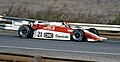 Holbert drove a March 84C in the 1984 CART series.
.jpg)


Racing record
[edit]SCCA National Championship Runoffs
[edit]| Year | Track | Car | Engine | Class | Finish | Start | Status |
|---|---|---|---|---|---|---|---|
| 1971 | Road Atlanta | Porsche 914/6 | Porsche | C Production | 16 | 6 | Retired |
| 1972 | Road Atlanta | Porsche 914/6 | Porsche | C Production | 4 | 4 | Running |
Complete 24 Hours of Le Mans results
[edit]| Year | Class | Tyres | Car | Team | Co-Drivers | Laps | Pos. | Class Pos. |
|---|---|---|---|---|---|---|---|---|
| 1977 | S +2.0 |
G | Inaltera LM77 Ford Cosworth DFV 3.0L V8 |
 Inaltera Inaltera
|
Jean-Pierre Beltoise
|
275 | 13th | 5th |
| 1980 | GTP | D | Porsche 924 Carrera GT Porsche 2.0L Turbo I4 |
 Porsche System Porsche System
|
 Derek Bell Derek Bell
|
305 | 13th | 6th |
| 1982 | C | D | Porsche 956 Porsche Type-935 2.6L Turbo Flat-6 |
Rothmans Porsche System
|
 Hurley Haywood Jürgen Barth Hurley Haywood Jürgen Barth
|
340 | 3rd | 3rd |
| 1983 | C | D | Porsche 956 Porsche Type-935 2.6L Turbo Flat-6 |
Rothmans Porsche
|
 Vern Schuppan Hurley Haywood Vern Schuppan Hurley Haywood
|
370 | 1st | 1st |
| 1985 | C1 | D | Porsche 962C Porsche Type-935 2.6L Turbo Flat-6 |
Rothmans Porsche
|
Vern Schuppan John Watson
|
299 | DNF | DNF |
| 1986 | C1 | D | Porsche 962C Porsche Type-935 2.6L Turbo Flat-6 |
Rothmans Porsche
|
Derek Bell Hans-Joachim Stuck
|
368 | 1st | 1st |
| 1987 | C1 | D | Porsche 962C Porsche Type-935 3.0L Turbo Flat-6 |
Rothmans Porsche
|
Hans-Joachim Stuck Derek Bell
|
355 | 1st | 1st |
American open–wheel racing results
[edit](key)
CART
[edit]| Year | Team | 1 | 2 | 3 | 4 | 5 | 6 | 7 | 8 | 9 | 10 | 11 | 12 | 13 | 14 | 15 | 16 | Rank | Points | Ref |
|---|---|---|---|---|---|---|---|---|---|---|---|---|---|---|---|---|---|---|---|---|
| 1984 | Alex Morales Motorsports | LBH 15 |
PHX1 23 |
INDY 4 |
MIL 20 |
POR 24 |
MEA 5 |
CLE 7 |
MIS1 19 |
ROA 22 |
POC 29 |
MDO 17 |
SAN | MIS2 13 |
PHX2 22 |
LS 22 |
LVG DNS |
18th | 28 | [5] |
| 1987 | Porsche Motorsports | LBH | PHX | INDY | MIL | POR | MEA | CLE | TOR | MIS | POC | ROA | MDO | NAZ | LS | MIA DNQ |
NC | - | [6] |
References
[edit]- ^ a b "Al Holbert - 1946-1988". International Motorsports Hall of Fame. Archived from the original on 14 February 2019. Retrieved 23 April 2017.
- ^ "Most wins by driver - IMSA SportsCar (1971–2024)". 20 October 2024.
- ^ "Distinguished Alumni - Al Holbert". Lehigh University. Retrieved 23 April 2017.
- ^ Al Holbert at the Motorsports Hall of Fame of America
- ^ "Al Holbert – 1984 CART Results". Racing-Reference. NASCAR Digital Media, LLC. Retrieved August 17, 2023.
- ^ "Al Holbert – 1987 CART Results". Racing-Reference. NASCAR Digital Media, LLC. Retrieved August 17, 2023.
External links
[edit]
| Volkswagen Group marques & companies | |||||||
|---|---|---|---|---|---|---|---|
| Cars |
| ||||||
| Tractors | |||||||
| Motorsport |
| ||||||
| Engines and technologies | |||||||
| People |
| ||||||
| See also | |||||||

Al Holbert
View on GrokipediaEarly Life and Education
Family Background
Alvah Robert "Al" Holbert was born on November 11, 1946, in Abington, Pennsylvania.[6] He was the eldest son of Robert McCormick "Bob" Holbert and Elinor (Weiss) Holbert.[7] Bob Holbert, a prominent figure in American road racing, owned and operated a Volkswagen-Porsche dealership in Warrington, Pennsylvania, which served as a hub for the local motorsport community.[8] Bob Holbert achieved significant success in sports car racing, securing four SCCA National Championships in 1958, 1960, 1961, and 1962, primarily driving Porsche 550s and 718s.[9] His victories established him as a pioneer in promoting Porsche vehicles in the United States through both competition and business.[10] Elinor Holbert supported the family while raising their children, though specific details of her professional role are limited in biographical accounts.[11] Al had at least one brother, Laurence "Larry" Holbert, who later joined the family business.[12] From a young age, Al was immersed in the world of motorsports due to his father's racing endeavors and dealership activities, including participation in SCCA events that often involved the family. This environment provided early access to race cars, tracks, and industry figures, fostering a deep connection to automotive racing.[12]Academic and Early Influences
Al Holbert enrolled at Lehigh University in Bethlehem, Pennsylvania, pursuing a Bachelor of Science degree in mechanical engineering, a field that aligned with his growing interest in automotive technology.[13][14] Influenced by his family's Porsche dealership and racing heritage, Holbert's academic path provided a strong technical foundation for future endeavors in motorsports engineering.[4][2] During his studies at Lehigh, Holbert gained practical experience by working for Roger Penske in Reading, Pennsylvania, where he contributed to automotive-related tasks that honed his mechanical skills outside the classroom.[15] This hands-on involvement complemented his engineering coursework, emphasizing principles of design and mechanics relevant to vehicle performance, though specific projects from his university tenure remain undocumented in available records. Upon graduating in 1968, Holbert transitioned from academia by joining the family automobile business, focusing on sales and operations of Porsche vehicles, which further immersed him in the automotive industry and set the stage for his initial pursuits in racing.[16][2] This period bridged his formal education with professional opportunities, allowing him to apply mechanical engineering knowledge in a real-world context before fully committing to competitive driving.Racing Career
Entry into Motorsports
Al Holbert entered competitive motorsports in the late 1960s, heavily influenced by his family's longstanding involvement with Porsche through their Volkswagen-Porsche dealership in Warrington, Pennsylvania, established by his father, Bob Holbert, one of the earliest authorized Porsche dealers in the United States.[4][17] Growing up around racing, as his father was a four-time SCCA National Champion, Holbert developed an early affinity for the brand, which shaped his initial foray into the sport.[15] After earning a B.S. in Mechanical Engineering from Lehigh University in 1968, he leveraged this technical background to pursue racing while working at Roger Penske's operation, where Penske served as a key early mentor in the professional aspects of the sport.[15] Holbert's debut came in the Sports Car Club of America (SCCA) Northeast Division, where he competed in C-Production class events starting around 1968-1970, piloting a Porsche 914/6, a mid-engine sports car well-suited to regional road racing.[15] His early entries included regional SCCA Nationals, such as the 1972 event at Bridgehampton, New York, where he drove the Porsche 914 against established competitors like Bob Tullius in a Triumph TR6, marking his formative experiences on demanding circuits that honed his skills in handling and setup.[18] At Watkins Glen later that year, he finished 14th overall in a similar field, demonstrating steady adaptation to competitive pressures despite the car's relative novelty in the class.[18] As a newcomer, Holbert faced challenges in securing initial sponsorships beyond family support, relying on the dealership's resources for vehicle maintenance while navigating the financial demands of travel and entries in a pre-professional era.[15] Balancing these pursuits with engineering job prospects proved demanding, as he weighed stable career paths against the uncertainties of racing, yet his technical expertise allowed him to contribute to car preparations, fostering team affiliations like Penske's that provided crucial guidance outside the family circle.[15] These regional outings built his confidence, setting the stage for deeper involvement without immediate national prominence.SCCA and Domestic Championships
Holbert entered SCCA competition in the early 1970s through the Northeast Division, piloting a Porsche 914/6 in the C Production class. Drawing on his family's Porsche heritage—his father Bob Holbert was a four-time SCCA national champion and prominent dealer—he secured consistent results against established rivals like Bob Tullius in a Triumph TR6. In 1972, he earned podium finishes at key national events, including second places at Nelson Ledges and Lime Rock Park, a third at Bridgehampton, and a fourth overall at the SCCA National Championship Runoffs at Road Atlanta.[18][19][4] By 1973, Holbert shifted focus to the SCCA Trans-Am Championship, a premier domestic GT series, campaigning a Porsche Carrera RSR prepared by his own team. He achieved multiple top finishes, including a third-place finish at Road America, and clinched second in the drivers' standings behind Peter Gregg, establishing a notable rivalry that defined much of the era's Porsche dominance in U.S. production-based racing. The 1974 season saw him win the opener at Lime Rock Park—outpacing Gregg in a 61.2-mile contest at an average of 95.236 mph—and conclude fourth in points with 32, behind Gregg's championship tally of 60.[20][21][22][23] Holbert's involvement in Trans-Am continued into 1975 amid series restructuring to incorporate Group 4 and 5 cars alongside production classes, where he finished 14th in points while adapting to heightened competition from drivers like Hurley Haywood. Throughout the decade, his engineering background from a Lehigh University B.S. in mechanical engineering enabled a progression from pure driving to integrated roles in vehicle setup and strategy, often collaborating with co-drivers such as Gregg in endurance-style nationals. This technical acumen laid the groundwork for Holbert Racing's expansion, contributing to SCCA successes in classes like D Production by the late 1970s, though his primary achievements remained as a driver in C Production and Trans-Am events.[20][24][4][25]IMSA GT and Endurance Racing
Al Holbert entered the IMSA Camel GT series in the mid-1970s, initially competing in the GT class with Porsche 911 Carrera RSR models for Holbert Racing, building on his foundational success in SCCA national events. His early IMSA outings included strong performances in endurance races, such as a second-place finish in the 1974 Daytona 250-mile season finale in a No. 14 Porsche 911 Carrera RSR. By 1976, Holbert transitioned to a Chevrolet-powered DeKon Monza for the GT class, securing his first IMSA driver's championship with six victories that season, including wins at Road Atlanta and Riverside.[4][18][26] In 1977, Holbert defended his IMSA GT title driving the same No. 14 Holbert Racing DeKon Monza, achieving four wins and clinching the championship at Laguna Seca despite fierce competition from Porsche 935s. The team's setup emphasized reliable preparation and Holbert's engineering acumen, allowing consistent podium finishes in a season marked by intense rivalry in the GT category. His IMSA dominance continued into the GTP era; in 1983, he captured the IMSA GTP driver's championship with the No. 14 Holbert Racing March 83G, powered by a Porsche engine, highlighted by four victories including a win at Road America.[2][4] Holbert's pinnacle in IMSA came in the mid-1980s with back-to-back GTP championships in 1985 and 1986, piloting the Lowenbrau-sponsored No. 14 Porsche 962 for Holbert Racing. In 1985, he and co-driver Derek Bell secured the title with key wins at Sebring and Mid-Ohio, culminating in a season finale victory at Daytona alongside Al Unser Jr. The 1986 campaign featured a repeat championship, bolstered by a dominant 1-2 finish for Porsche at the 24 Hours of Daytona, where Holbert shared driving duties with Bell, Unser Jr., and Chip Robinson in the No. 14 entry. These efforts contributed to Holbert's all-time record of 49 IMSA wins, spanning GT and GTP classes.[4][2] Throughout his IMSA tenure, Holbert's technical contributions were integral, particularly in the development of the Porsche 962, where he collaborated on testing and refinements to enhance aerodynamics and reliability for endurance racing. As a mechanical engineering graduate, he applied his expertise to optimize car setups, influencing Porsche's success in the GTP class and solidifying his role as both driver and innovator within the series.[4][2]International and Open-Wheel Ventures
Holbert ventured into the Canadian-American Challenge Cup (Can-Am) series in the 1970s, seeking opportunities in high-powered, unrestricted single-seater racing that complemented his growing IMSA success. In 1974, he made his debut at Road America driving a McLaren, though he did not start the race due to mechanical issues.[18] His commitment intensified in 1978 with Hogan Racing, where he campaigned a Lola T332 and later T333 Chevrolet-powered cars across the North American schedule. That season, Holbert achieved notable results, including second places at Road Atlanta and Watkins Glen, third at Road America and Mosport, and a victory at Laguna Seca, finishing fourth overall in the championship with consistent podium contention despite challenges like retirements at Mid-Ohio and Trois-Rivières.[18] He continued in 1979 with a Hogan HR-001, securing a fourth at Road Atlanta before a less competitive 16th at Charlotte.[18] Holbert continued in Can-Am through 1982, adding victories at Road America and Laguna Seca in 1980, at Watkins Glen and Trois-Rivières in 1981, and at Mid-Ohio in 1982, for a career total of 10 wins in the series.[27] Transitioning to open-wheel racing in the 1980s, Holbert entered the CART PPG IndyCar World Series for a full campaign in 1984 with Kraco Racing, driving a March 84C-Cosworth as a rookie. His standout performance was a fourth-place finish at the Indianapolis 500, leading briefly and earning Rookie of the Race honors amid a field of established stars, though he ended the season 20th in points with additional top-10 results at Michigan and Pocono.[28] He made 14 starts total across 1984 to 1987, including sporadic appearances in 1985 and 1986, demonstrating adaptability to the demanding oval and road course formats.[6] In 1987 and 1988, Holbert led Porsche's factory IndyCar program as driver and director, testing and racing the innovative Porsche 2708 V8 engine in a custom chassis before switching to a March platform in 1988 for better competitiveness; he attempted qualification at the season finale in Miami but did not make the field, highlighting Porsche's struggles against dominant Ilmor-Chevrolet powertrains.[1][29] Beyond open-wheel, Holbert explored international endurance events outside his IMSA core, co-driving a Porsche 911 Carrera RSR with Peter Gregg at the 1974 1000 km of Mexico, though the entry did not arrive at the circuit.[18] Earlier, in 1972, he shared a Porsche 911 with George Oest and Dick Tillson to a 16th-place finish at the 12 Hours of Sebring, an international fixture predating full IMSA integration.[18] Demonstrating further versatility, Holbert competed in 19 NASCAR Winston Cup Series events from 1976 to 1979, primarily for owner James Hylton in Chevrolet and Ford entries, achieving four top-10 finishes—including seventh at Charlotte in 1979—without a victory but proving his skill in stock car ovals like Darlington and Pocono.[30]Business and Team Roles
Holbert Racing Operations
Al Holbert founded Holbert Racing in the mid-1970s in Warrington, Pennsylvania, initially operating as a customer team focused on competitive entries in the IMSA Camel GT series. Drawing on his mechanical engineering background from Lehigh University and his family's longstanding Porsche dealership, the team began with a No. 14 Chevrolet Monza, securing back-to-back IMSA GT championships in 1976 and 1977 through six wins in the former year and four in the latter. This early success established the team's reputation for meticulous preparation and performance, transitioning to Porsche machinery in the early 1980s as a dedicated customer outfit, leveraging access to factory components and support.[1][12][15] Under Holbert's management, the team emphasized operational efficiency, including in-house car tuning informed by his engineering expertise, which optimized Porsche 935s and later 962 prototypes for endurance racing. Sponsorships played a crucial role, with Lowenbräu beer becoming the primary backer starting in 1985, enabling the acquisition of the Porsche 962-HR1 chassis and funding a professional crew of mechanics based in Pennsylvania. The team's workshop also developed aftermarket performance parts for Porsche models like the 924 and 944, extending its influence beyond competition into the enthusiast community. Holbert's hands-on approach to setup and strategy ensured reliability, contributing to the team's dominance in IMSA GTP.[31][32][1] Holbert Racing achieved peak success in the 1980s with the Lowenbräu-liveried Porsche 962, clinching IMSA GTP drivers' championships in 1985 and 1986, highlighted by numerous victories over those seasons. The team recruited elite drivers such as Derek Bell, Al Unser Jr., and Chip Robinson, who shared driving duties and helped secure overall wins at events like the 24 Hours of Daytona. Factory Porsche support provided essential updates to the 962, allowing Holbert Racing to compete against manufacturer-backed efforts while maintaining its independent customer status. These accomplishments not only amplified the team's legacy but also underscored Holbert's personal racing victories as a foundation for attracting top talent and resources.[31][15][1]Porsche North America Leadership
In 1984, Al Holbert was appointed as the head of Porsche North America's Motorsports Division, taking over the leadership of the company's racing activities in the region following Porsche's separation from Volkswagen of America.[33] This role leveraged his extensive background as a Porsche racer and team owner, allowing him to dedicate over 50% of his time to corporate racing efforts while continuing to manage family-owned Porsche and Volkswagen dealerships in Warrington, Pennsylvania.[33] Under Holbert's leadership, Porsche provided enhanced factory support for IMSA GTP programs, particularly through the deployment of the 956 and 962 models, which became cornerstones of the brand's success in North American endurance racing.[34] These initiatives included technical assistance and parts supply to customer teams like Holbert Racing, contributing to the 962's dominance in the IMSA Camel GT Championship, where it secured 41 victories out of 50 races from 1985 to 1987.[34] Holbert also extended this support to international efforts, such as Le Mans, where factory-backed 956 and 962 entries achieved multiple wins, reinforcing Porsche's global endurance racing profile.[17] Holbert also spearheaded Porsche's entry into IndyCar racing in 1987, providing engineering and logistical support for their initial campaigns.[2] Holbert's strategic oversight involved key decisions on driver contracts and series participation, fostering partnerships with top talents and prioritizing IMSA entries that aligned with Porsche's competitive goals.[4] These choices helped solidify Porsche's market leadership in North American motorsports during the mid-1980s.[35] Balancing these corporate responsibilities with business interests, Holbert integrated racing success into dealership growth, building on his family's legacy as one of the earliest U.S. Porsche dealers established in 1954.[17] His prior experience running Holbert Racing provided a practical foundation for these executive strategies.[4]Personal Life and Death
Family and Interests
Al Holbert was a devoted family man, married to Joy Holbert, a devoutly religious woman whose faith profoundly influenced his own spiritual life.[4][1] Together, they raised two children, son Todd and daughter Laura, prioritizing family amidst his demanding racing schedule.[1][36] Holbert often flew home between races to attend family dinners and events, such as Todd's youth football games, demonstrating how his career intersected with personal commitments by ensuring active involvement in his children's lives.[1] Beyond racing, Holbert's interests included engineering pursuits, reflecting his Lehigh University degree in mechanical engineering, though he channeled much of this passion into motorsport innovations rather than separate projects.[2][1] Family travels and time together formed a core part of his non-racing life, helping maintain close bonds in the dynamic environment of professional motorsports.[36] Following his conversion to born-again Christianity, inspired by Joy, he embraced faith as a central interest, attending church regularly with his family.[4][1] Holbert contributed to his Pennsylvania community through quiet acts of support for friends, employees, and extended networks, often without seeking recognition.[36] In the racing scene of Bucks County, where his family operated Holbert Racing from Warrington, he fostered lasting connections that touched local lives and perpetuated a racing tradition rooted in his father's influence.[12] Additionally, he assisted Motorsports Ministries by helping provide chapel services to the broader racing community during events, blending his personal faith with outreach in the sport he loved.[2]Plane Crash and Immediate Aftermath
On September 30, 1988, Al Holbert, aged 41, was killed when his privately owned Piper PA-60-601P Aerostar (registration N14HR) crashed shortly after takeoff from Ohio State University Airport (also known as Don Scott Field) in Columbus, Ohio.[37][38] The accident occurred at 21:24 Eastern Daylight Time during night visual meteorological conditions, with clear skies, 10-mile visibility, light winds from the south, and a temperature of 20°C.[37] Holbert, a certificated commercial pilot with approximately 1,802 total flight hours, was the sole occupant and had departed intending to return home to Doylestown, Pennsylvania, after attending practice sessions for his team's entry in the upcoming IMSA Camel GT Championship race, the Columbus Ford Dealers 500, scheduled for October 2.[37][39] Witnesses reported that the twin-engine aircraft exhibited erratic flight shortly after takeoff, failing to gain sufficient altitude before banking sharply, stalling aerodynamically, and pitching nose-down into a nearby field, where it was destroyed by impact forces and a post-crash fire.[37][38] Holbert sustained fatal injuries from blunt force trauma and thermal burns.[38] The National Transportation Safety Board (NTSB) investigation concluded that the probable cause was an aerodynamic stall during the takeoff-initial climb, resulting from the pilot's distraction due to an unsecured clamshell door from inadequate preflight inspection, at an altitude too low to allow recovery; there was no evidence of mechanical malfunction, improper fueling, or adverse weather contributing factors, the aircraft had been properly maintained, and post-accident examination revealed no anomalies in engines, controls, or structure.[37] In the immediate aftermath, Holbert's Porsche-backed IMSA team withdrew its entries—driven by Chip Robinson and Derek Bell—from the Columbus 500 race as a mark of respect, impacting the event just days before its start.[39] IMSA President John Bishop issued a personal tribute, describing Holbert as "a man so competitive [who] could be so human and soft," adding, "He was a gentleman all the way through."[39] Porsche Cars North America officials, including public relations director Robert Carlson, expressed resolve to continue the IndyCar program Holbert had led, stating that the effort would proceed with sponsor support despite the loss, though decisions on the IMSA Porsche 962 program were deferred pending the funeral.[13] No public statements from Holbert's immediate family—wife Joy and children Todd and Laura—were reported in contemporary accounts, reflecting the private nature of their grief.[13] Holbert's funeral service was held on October 5, 1988, in his hometown of Doylestown, Pennsylvania, attended by family, racing colleagues, and Porsche representatives; the service underscored his dual legacy as a driver and team leader, with initial memorials focusing on his contributions to American sports car racing.[13] At the time of his death, Holbert's team was actively pursuing IMSA commitments, including the Columbus event, highlighting the abrupt disruption to ongoing operations.[39]Legacy and Honors
Championships and Records
Al Holbert secured five IMSA Camel GT Championship titles during his career, winning in 1976 and 1977 driving a DeKon Monza, followed by victories in 1983, 1985, and 1986 with Porsche entries.[2][3] He was the all-time leader in IMSA overall race wins with 49 victories in the series, a record later surpassed that underscored his dominance in American sports car racing.[2] At the international level, Holbert achieved three victories in the 24 Hours of Le Mans, triumphing in 1983 aboard a Porsche 956 alongside Vern Schuppan and Hurley Haywood, and in 1986 and 1987 with the Porsche 962 partnered by Derek Bell and Hans-Joachim Stuck.[40][41] These successes highlighted Porsche's engineering prowess in endurance racing during the Group C era, where Holbert's driving contributed to the manufacturer's string of seven consecutive Le Mans wins from 1981 to 1987.[3] In addition to his professional accolades, Holbert excelled in SCCA-sanctioned events early in his career, earning multiple class wins and establishing himself as a top amateur competitor before turning professional. He also recorded 10 victories in the SCCA Can-Am series, placing him third on the all-time wins list for that high-powered open-wheel category.[3] Under his leadership as president of Porsche Motorsports North America starting in 1982, the brand achieved unprecedented success in IMSA and endurance racing, including multiple manufacturer championships that amplified Holbert's personal records.[2]Hall of Fame Inductions
Al Holbert's contributions to motorsport, particularly his dominance in IMSA GT series with five championships and multiple endurance race victories including three at the 24 Hours of Le Mans, earned him posthumous recognition through several prestigious hall of fame inductions. These honors highlight his prowess as both a driver and a team leader in sports car racing.[2] In 1989, Holbert was inducted into the Eastern Motorsports Press Association (EMPA) Hall of Fame, acknowledging his roots as the son of professional driver Bob Holbert and his own achievements in regional and national racing circuits before his professional breakthrough. This induction, occurring shortly after his death in 1988, underscored his impact on East Coast motorsport communities and his transition from amateur SCCA events to international success.[42] Holbert received dual inductions in 1993: first into the International Motorsports Hall of Fame, where he was celebrated as a leader in American racing both on the track—through his Porsche campaigns—and off it, as a family man and strategist who elevated sports car competition. That same year, he was enshrined in the Motorsports Hall of Fame of America, recognizing his exceptional skills as a driver, team manager, and innovator in endurance racing, particularly his role in Porsche's North American successes. These concurrent honors reflected the breadth of his influence across GTP and GT categories during the 1970s and 1980s.[2][6][3] More recently, in 2023, Holbert was selected for the inaugural class of the IMSA Hall of Fame, inducted alongside drivers like Peter Gregg and Hurley Haywood for his record 49 overall IMSA race wins and pivotal role in the series' growth. This recognition emphasized his unparalleled victory tally and leadership in team operations, solidifying his legacy as a cornerstone of IMSA's golden era. In the same year, he was inducted into the Philadelphia Sports Hall of Fame, honoring his achievements as a Pennsylvania native and racing legend.[43] Holbert was also a member of the Road Racing Drivers Club, an elite organization that honors top road racers, further affirming his status among the sport's most respected figures for his strategic acumen and endurance racing triumphs.[15]Racing Record
SCCA National Championship Runoffs
Al Holbert participated in the SCCA National Championship Runoffs during the early 1970s, competing in the C Production class with a Porsche 914/6. These appearances marked his involvement in the event's amateur national showdowns, where regional champions vied for titles at Road Atlanta. He entered solo without co-drivers, focusing on production-based sports cars. The following table summarizes Holbert's known entries and results from the Runoffs in this period:| Year | Track | Class | Car | Finishing Position | Status/Notes |
|---|---|---|---|---|---|
| 1971 | Road Atlanta | C Production | Porsche 914/6 | Did not finish | Competed against dominant Datsun 240Z entries from John Morton, Bob Sharp, and others.[44] |
| 1972 | Road Atlanta | C Production | Porsche 914/6 | 4th | Finished behind Datsun 240Z drivers Bob Sharp, Jim Fitzgerald, and another competitor.[19] |
24 Hours of Le Mans Results
Al Holbert participated in seven editions of the 24 Hours of Le Mans between 1977 and 1987, primarily driving factory-supported Porsche prototypes in the later years under the Rothmans banner. He secured overall victories in 1983, 1986, and 1987, contributing to Porsche's dominance in the Group C era. His results reflect a progression from privateer efforts in his debut to consistent front-running performances with official teams.[40] The following table summarizes Holbert's complete Le Mans results, including teams, co-drivers, vehicles, finishing positions, laps completed, and status for non-finishes.| Year | Team | Co-Drivers | Car Model | Finishing Position | Laps Completed | Status/Reason |
|---|---|---|---|---|---|---|
| 1977 | Inaltera (F) | Jean-Pierre Beltoise (F) | Inaltera LM (Ford Cosworth DFV) | 13th | 275 | Finished |
| 1980 | Porsche System (D) | Derek Bell (GB) | Porsche 924 Carrera Turbo | 13th | 305 | Finished |
| 1982 | Rothmans Porsche (D) | Hurley Haywood (USA), Jürgen Barth (D) | Porsche 956 | 3rd | 340 | Finished |
| 1983 | Rothmans Porsche (D) | Vern Schuppan (AUS), Hurley Haywood (USA) | Porsche 956 | 1st | 370 | Finished (Winner) |
| 1985 | Rothmans Porsche (D) | Vern Schuppan (AUS), John Watson (GB) | Porsche 962 C | DNF (32nd) | 299 | Engine failure |
| 1986 | Rothmans Porsche (D) | Derek Bell (GB), Hans-Joachim Stuck (D) | Porsche 962 C | 1st | 367 | Finished (Winner) |
| 1987 | Rothmans Porsche AG (D) | Hans-Joachim Stuck (D), Derek Bell (GB) | Porsche 962 C | 1st | 354 | Finished (Winner) |
IMSA Camel GT Victories
Al Holbert amassed 49 victories in the IMSA Camel GT series between 1974 and 1988, a record that stood as the series' all-time high for overall wins until surpassed years later. His triumphs evolved from the GT class, where he dominated with production-derived sports cars, to the GTP class featuring advanced prototypes, reflecting the series' shift toward more sophisticated machinery. Holbert's wins often came aboard Porsche-supported entries, starting with the reliable 911 Carrera and culminating in the dominant 962 prototype, which powered his later championships.[2] Holbert's victories were concentrated in his five championship seasons, where he clinched titles in both GT and GTP divisions. In the GT class during the mid-1970s, he piloted a Dick Guldstrand-designed Chevrolet Monza for Holbert Racing, securing back-to-back championships with consistent performances on road courses like Road Atlanta and Laguna Seca. Transitioning to GTP in the 1980s, he adapted to ground-effect prototypes, first with a March 83G and later the Porsche 962, emphasizing endurance and outright speed in longer races such as the 24 Hours of Daytona. Outside championship years, he added sporadic wins in 1974–1975 and 1978–1984, often sharing drives with teammates to build his total.[1][52]| Season | Class | Primary Car | Wins | Notable Co-Drivers and Tracks |
|---|---|---|---|---|
| 1976 | GT | Chevrolet Monza | 6 | Solo in most; e.g., Riverside, Sebring (with George Keyser) |
| 1977 | GT | Chevrolet Monza | 4 | Solo; e.g., Road Atlanta, Mid-Ohio |
| 1983 | GTP | March 83G (Porsche-powered) | 4 | Hurley Haywood, John Morton; e.g., Laguna Seca, Portland |
| 1985 | GTP | Porsche 962 | 9 | Al Unser Jr., Derek Bell; e.g., Road America, Watkins Glen |
| 1986 | GTP | Porsche 962 | 6 | Derek Bell; e.g., Watkins Glen, Sears Point |