


Community hub
Recent from talks
Contribute something
Nothing was collected or created yet.
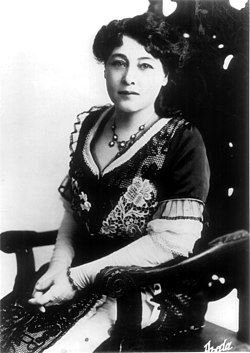
Alice Guy-Blaché
View on Wikipedia
Alice Ida Antoinette Guy-Blaché (née Guy; French pronunciation: [alis gi blɑʃe] ; 1 July 1873 – 24 March 1968) was a French pioneer film director.[2] She was one of the first filmmakers to make a narrative fiction film,[3] as well as the first woman to direct a film. From 1896 to 1906, she was probably the only female filmmaker in the world.[4] She experimented with Gaumont's Chronophone sync-sound system, and with color-tinting, interracial casting, and special effects.[5]
Key Information


She was artistic director and a co-founder of Solax Studios in Flushing, New York. In 1912, Solax invested $100,000 ($3.26 million in 2024) for a new studio in Fort Lee, New Jersey, the center of American filmmaking prior to the establishment of Hollywood. That year, she made the film A Fool and His Money, probably the first to have an all-African-American cast. The film is now preserved at the National Center for Film and Video Preservation at the American Film Institute for its historical and aesthetic significance.[6]
Early life and education
[edit]In 1865,[7] Guy's father, Émile Guy, an owner of a bookstore and publishing company in Santiago, Chile and Valparaíso, Chile, married Marie Clotilde Franceline Aubert. The couple returned to Santiago after the wedding in Paris. In early 1873, Marie and Émile lived in Santiago, with Alice's four siblings; during her early years, her father's bookstore had give her the passion for storytelling.[citation needed]
There was a devastating smallpox epidemic in Chile in 1872 and 1873.[8] Émile and Marie Guy brought all four of their children to Paris, where Alice was born. In her autobiography, Alice refers to this as her mother's attempt to make sure "her fifth child should be truly French".[9] Her father returned to Chile soon after her birth, and her mother followed a few months later. Alice was left in the care of her grandmother in Carouge, Switzerland.[a] When Alice was three or four, her mother took her to South America.[10]
At the age of six, Guy was taken back to France by her father to attend the Faithful Companions of Jesus boarding school. It was sometimes referred to as Sacred Heart after it was relocated to France- The Sacred Heart is associated with the Jesuits who were banned in Switzerland, whereas The Faithful Companions of Jesus was a separate order. The school where Alice Guy lived was in Veyrier-sous-Saleve in France. The building still exists 100 meters from the Swiss border, but had only been running for two years when Alice arrived.[b] Her sisters were already there. The mother superior, Emilie Guers, a native of Geneva, expelled from her own country on short notice, regularly told the story of her expulsion.[c] Alice heard the story repeatedly and mentioned it in her memoirs. Alice called the Mother Superior "a very great lady who wanted to make us strong, accomplished women."[d]
Alice's older brother died on 16 May 1880 at age 13.[11] Guy and her sister Louise were moved to a convent in Ferney a few years later and then brought back to Paris.[citation needed]
Guy's father died on 5 January 1891 of unknown causes.[12] Following his death, Guy's mother got a job with Mutualité maternelle which was founded on 20 May 1891.[13] Her mother was unable to keep that job and thereafter Guy trained as a typist and stenographer, a new field at the time, to support herself and her mother. She landed her first stenography-typist job at a varnish factory. In March 1894, she began working at the 'Comptoir général de la photographie' owned by Félix-Max Richard. Léon Gaumont later took over and headed the company.[14][15]
Career
[edit]Secretary to Léon Gaumont
[edit]In 1894, Alice Guy was hired by Félix-Max Richard to work as a secretary for a camera manufacturing and photography supply company. The company changed hands in 1895 due to a court decision against Félix-Max Richard, who sold the company to four men: Gustave Eiffel, Joseph Vallot, Alfred Besnier, and Léon Gaumont. Gustave Eiffel was president of the company, and Léon Gaumont, thirty years Eiffel's junior, was the manager. The company was named after Gaumont because Eiffel was the subject of a national scandal regarding the Panama Canal.[16] L. Gaumont et Cie became a major force in the fledgling motion-picture industry in France. Alice continued to work at Gaumont et Cie, a decision that led to a pioneering career in filmmaking that spanned more than 25 years and involved her directing, producing, writing and/or overseeing more than 700 films.[17]
Although she initially began working for Léon Gaumont as his secretary, Guy became familiar with his clients, relevant marketing strategies, and the company's stock of cameras. She also met a handful of pioneering film engineers such as Georges Demenÿ and Auguste and Louis Lumière.[18]
Alice Guy and Gaumont attended the "surprise"[19] Lumière event on March 22, 1895. It was the first demonstration of film projection, an obstacle that Gaumont, the Lumières, and Edison were all racing to solve. They screened one of their early films Workers Leaving the Lumière Factory, which consisted of a simple scene of workmen leaving the Lumière plant in Lyon. Bored with the idea of captured film only being used for the scientific and/or promotional purpose of selling cameras in the form of "demonstration films," Guy was confident that she could incorporate fictional story-telling elements into film. She asked Gaumont for permission to make her own film, and he granted it.[20]
Early filmmaking at Gaumont Film Company
[edit]Alice Guy made her first film in 1896. Its original title may have been La Fée aux Choux (The Fairy of the Cabbages) or The Birth of Children, or it may have had no title at first. The scene Alice described as her debut effort does not match either the 1900 version of La Fée aux choux or the 1902 version, retitled Sage-femme de première classe which has been found in film archives. By comparing Alice's descriptions of her debut effort with the two films that are available for us to view, we discover differences that indicate there was a third film that came first. The 1896 film seems to be lost. However, multiple points of confirmation indicate that there were three different La Fée aux choux.[21] A 30 July 1896 newspaper describes a "chaste fiction of children born under the cabbages in a wonderfully framed chromo landscape," and provides other details that confirm Alice Guy's description of her first film. "Before very long," Alice Guy reported in 1912, "every moving picture house in the country was turning out stories instead of spectacles and plots instead of panoramas."[22]
From 1896 to 1906, Alice Guy was Gaumont's head of production and is generally considered the first filmmaker to systematically develop narrative filmmaking. She was probably the only female director from 1896 to 1906.[23] Her earlier films share many characteristics and themes with her contemporary competitors, such as the Lumières and Méliès. She explored dance and travel films, often combining the two, such as Le Boléro performed by Saharet (1905) and Tango (1905). Many of Guy's early dance films were popular in music-hall attractions such as the serpentine dance films – also a staple of the Lumières and Thomas Edison film catalogs.[14]
In 1906, Guy made The Life of Christ, a big-budget production for the time, which included 300 extras. She used the illustrated James Tissot New Testament as reference material for the film, which featured 25 episodes and was her largest production at Gaumont to date. In addition to this, she was one of the pioneers in the use of audio recordings in conjunction with the images on screen in Gaumont's "Chronophone" system, which used a vertical-cut disc synchronized to the film. She employed some of the first special effects, including using double exposure, masking techniques, and running a film backward.[24] During her tenure at Gaumont, Guy hired and trained Louis Feuillade and Étienne Arnaud as writers and directors and hired set designer Henri Ménessier and art director Ben Carré.[25]
Later works at The Solax Company
[edit]
In 1907, Alice Guy married Herbert Blaché, who was soon appointed the production manager for Gaumont's operations in the United States. After working with her husband for Gaumont in the U.S., the two established their own business in 1910, partnering with George A. Magie in the formation of The Solax Company, the largest pre-Hollywood studio in America.[17][24]
With production facilities for their new company in Flushing, New York, her husband served as production manager and cinematographer. Alice Guy-Blaché worked as the artistic director and directed many of its releases. Within two years, they had become so successful that they invested more than $100,000 ($3.26 million in 2024) into new and technologically advanced production facilities in Fort Lee, New Jersey. Many early film studios were based in Fort Lee at the beginning of the 20th century.[26][27][28] This made her the first woman to own her own studio and studio plant.[25] It was mentioned in publications of the era that Guy-Blaché placed a large sign in her studio that read: 'Be Natural'.[29]
In 1913, Guy-Blaché directed The Thief, the first script sold by future Wonder Woman creator William Moulton Marston.[20]
Guy-Blaché and her husband divorced several years later, and with the rise of the more hospitable and cost-effective climate in Hollywood, their film partnership also ended.[citation needed]
Legacy
[edit]"There is nothing connected with the staging of a motion picture that a woman cannot do as easily as a man, and there is no reason she cannot master every technicality of the art...In the arts of acting, painting, music, and literature women have long held their place among the most successful workers, and when it is considered how vitally these arts enter into the production of motion pictures one wonders why the names of scores of women are not found among the most successful creators of photodrama offerings."—Alice Guy-Blaché in The Moving Picture World, July 11, 1914.[30]
In the late 1940s, Alice Guy-Blaché wrote an autobiography. It was published, in French, in 1976 and was translated into English a decade later with the help of her daughter Simone, daughter-in-law Roberta Blaché, and the film writer Anthony Slide. Guy-Blaché was concerned with her unexplained absence from the historical record of the film industry. She regularly communicated with colleagues and film historians, correcting previously made and supposedly factual statements about her life. She crafted lengthy lists of her films as she remembered them, with the hope of being able to assume creative ownership and receive legitimate credit for them.[31]
Guy-Blaché was the subject of a National Film Board of Canada documentary The Lost Garden: The Life and Cinema of Alice Guy-Blaché by director Marquise Lepage, which received Quebec's Gémeaux Award for Best Documentary.[32] In 2002, film scholar Alison McMahan published Alice Guy Blaché: Lost Visionary of the Cinema.[33] Guy-Blaché is considered by some to have been the first female filmmaker,[34] and from 1896 to 1920, she directed over 1,000 films, some 150 of which survive, and 22 of which are feature-length. She was one of the first women, along with Lois Weber, to manage and own her own studio: The Solax Company. Few of her films survive in an easily viewable format. In December 2018, Kino Lorber released a six-disc box, Pioneers: First Women Filmmakers, in cooperation with the Library of Congress, the British Film Institute, and others. The first disc of the set is devoted to the films of Alice Guy-Blaché. It includes Matrimony's Speed Limit (1913), which was selected for preservation in the National Film Registry of the Library of Congress in 2003.[35][36][37] The 2018 documentary film Be Natural: The Untold Story of Alice Guy-Blaché, directed by Pamela B. Green and narrated by Jodie Foster, which opened at the Cannes Film Festival (Cannes Classics), deals with Guy-Blaché's life, career, and legacy.[38]
Because of Be Natural: The Untold Story of Alice Guy-Blaché, many of Guy-Blaché's films were restored and preserved, and a pillar in her name is featured at the Academy Museum of Motion Pictures.[39]
In September 2019, Guy-Blaché was included in The New York Times series "Overlooked No More".[40]
As reported by Deadline in 2021, Pamela B. Green is developing a feature biopic about Alice Guy-Blaché.[41]
Guy-Blaché was an early influence on both Alfred Hitchcock and Sergei Eisenstein. Hitchcock remarked, "I'd be over the moon with the Frenchman George Méliès. I was thrilled by the movies of D.W. Griffith and the early French director Alice Guy."[42]
In his Memoirs, Eisenstein described an unnamed film he had seen as a child that continued to be very important to him. This film was identified as Alice Guy-Blaché's The Consequences of Feminism (1906) during the making of the documentary Be Natural: The Untold Story of Alice Guy-Blaché.[43]
Personal life
[edit]
_-_2.jpg)
Alice Guy-Blaché's marriage meant that she had to resign from her position working with Gaumont. The couple was sent by the Gaumont company to Cleveland to facilitate the franchise of Gaumont equipment. Early in 1908, the couple went to New York City where Guy-Blaché gave birth to her daughter, Simone, in September 1908.[44] Two years later, Guy-Blaché became the first woman to run her own studio when she created Solax in Gaumont's Flushing studio. In 1912, when she was pregnant with her second child, she built a studio in Fort Lee, New Jersey, and continued to complete one to three films a week. On 27 June 1912, Reginald, her son, was born. To focus on writing and directing, Guy-Blaché took her husband into Solax in 1913 "for feature production and executive direction".[45]
Shortly after taking the position, Herbert Blaché started a film company named Blaché Features, Inc. The couple maintained a personal and business partnership for the next few years, working together on many projects. In 1918, Herbert Blaché left his wife and children to pursue a career in Hollywood.[46] Alice Guy-Blaché almost died from the Spanish flu pandemic in October 1918 while filming her final film Tarnished Reputations.[47] Following her illness, she joined Herbert in Hollywood in 1919 but they lived separately. She worked as Herbert's directing assistant on his two films starring Alla Nazimova.[48]
Alice Guy-Blaché directed her last film in 1919. In 1921, she was forced to auction her film studio and other possessions in bankruptcy. Alice and Herbert were officially divorced in 1922. She returned to France in 1922 and never made another film.[49]
Death
[edit]Alice Guy-Blaché never remarried, and in 1964 she returned to the United States to live in Wayne, New Jersey, with her older child, her daughter, Simone. On 24 March 1968, at 94, Alice Guy-Blaché died in a nursing home[50] in New Jersey. She is interred at Maryrest Cemetery.
Accolades and tributes
[edit]On December 12, 1958, Guy-Blaché was awarded the Légion d'honneur, the highest non-military award France offers. On 16 March 1957, she was honored in a Cinémathèque française ceremony that went almost unnoticed by the press.[50]
In 2002, Circle X Theatre in Los Angeles produced Laura Comstock's Bag-punching Dog, a musical about the invention of cinema, and Alice Guy-Blaché was the lead character. The musical was written by Jillian Armenante, Alice Dodd, and Chris Jeffries. In 2011, an off-Broadway production of Flight[51] premiered at the Connelly Theatre, featuring a fictionalized portrayal of Guy-Blaché as a 1913 documentary filmmaker.[citation needed]
In 2004, the Fort Lee Film Commission unveiled a historical marker dedicated to Alice Guy-Blaché at the location of Solax Studio. In 2012, for the centennial of the founding and building of the studio, the Commission raised funds to replace her grave marker in Maryrest Cemetery in Mahwah, New Jersey. The new marker notes Guy-Blaché's role as a cinema pioneer.[52]
In 2010, the Academy Film Archive preserved Alice Guy-Blaché's short film The Girl in the Arm-Chair.[53] In 2011, the Fort Lee Film Commission successfully lobbied the Directors Guild of America to accept Alice Guy-Blaché as a member.[54] She was subsequently awarded a posthumous "Special Directorial Award for Lifetime Achievement" at the 2011 DGA Honors.[55] In 2013, Guy-Blaché was inducted into the New Jersey Hall of Fame.[56][57]
In 2018, film journalist Véronique Le Bris founded the Alice Guy Prize, granted yearly to highlight the woman film-maker of the year.[58]
A square in the 14th arrondissement of Paris is named the Place Alice-Guy in her honor.[59]
In 2019, the re-edited and expanded version of Eisenstein's memoirs, Yo. Memoirs by Sergei Eisenstein mention Alice's The Consequences of Feminism and its influence on Eisenstein.[43]
In 2021, Yale University opened its new state-of-the-art screening room, named the Alice Cinema, after Alice Guy-Blaché.[60]
In 2021, French-German TV channel Arte produced a documentary on Alice Guy-Blaché titled Alice Guy, the unknown lady of the 7th art, directed by Valérie Urréa and Nathalie Masduraud, voiced by Agnès Jaoui and Maud Wyler.[61]
In 2022, Rowman & Littlefield published a new edition of The Memoirs of Alice Guy Blaché, edited by Anthony Slide and translated by Simone Blaché and Roberta Blaché. This memoir contains a new introduction by Slide.[62]
The Golden Door Film Festival gives an award named in her honor.[63]
On the occasion of the 150th anniversary of her birth, around July 1, 2023, several French institutions celebrated Alice Guy and her legacy:
- The Cinémathèque Française held a special day of hommage with the showing of 8 of her films.[64] It also uploaded a 2K resolution digitization of the very first known making-of in the history of cinéma, Alice Guy tourne une phonoscène (Alice Guy shoots a phonoscene - [the ancestor of the music video], 1907, by anonym) on its online film portal, Henri.[65]
- French postal service La Poste launched a special edition stamp at her effigy which was presented by her great-grandson Thierry Peeters at philately center Carré d'Encre on July 3, 2023.[66][67]
- Newly re-opened Paris museum of history of immigration Cité nationale de l'histoire de l'immigration shares within its new permanent exhibition several of Alice Guy's films, amongst which L'Américanisé (1912), to illustrate the experience of immigrants to the United States (like Alice Guy herself).[68]
Selected filmography
[edit]These films were produced by Gaumont (1896–1907), Solax (1910–1913), or others (1914–1920).[69]
- La Fée aux Choux (The Fairy of the Cabbages; 1896)
- Le pêcheur dans le torrent (The fisherman in the stream; 1897)
- Le chiffonnier (1898)
- Danse serpentine (1900)
- Les Fredaines de Pierrette (1900)
- Les chiens savants (1902)
- Esméralda (1905) (based on the 1831 Victor Hugo novel The Hunchback of Notre-Dame)
- La Statue (1905)
- Une histoire roulante (1906)
- The Birth, the Life and the Death of Christ (1906)
- Les Résultats du féminisme (1906)
- The Game-Keeper's Son (1906)
- Madame a des envies (1906)
- La barricade (1907)
- Fanfan la Tulipe (1907)
- One Touch of Nature (1910)
- The Sergeant's Daughter (1910)
- The Pawnshop (1910)
- Greater Love Hath No Man (1911)
- Algie the Miner (1912)
- Falling Leaves (1912)
- A Fool and His Money (1912)
- Making an American Citizen (1912)
- The Girl in the Armchair (1912)
- The Pit and the Pendulum (1913)
- Matrimony's Speed Limit (1913)
- A House Divided (1913)
- Shadows of the Moulin Rouge (1913)
- The Lure (1914)
- The Shooting of Dan McGrew (1915)
- The Vampire (1915)
- The Ocean Waif (1916)
- What Will People Say? (1916)
- The Adventurer (1917)
- The Empress (1917)
- The Great Adventure (1918)
- Tarnished Reputations (1920)[70]
See also
[edit]Notes
[edit]- ^ Nicolas Aubert, her grandfather, died 11 October 1872[citation needed]
- ^ The mother superior, Emilie Guers, was close to the foundress, Marie-Madeleine de Bengy, for 25 years (1833-1858). They lived together in the Mother House in Carouge for 15 years (1833-1848). When Sophie Barat's Sacred Heart convents were expelled from Switzerland in 1847, the foundress Marie-Madeleine and Emilie Guers went to Veyrier-sous-Saleve in France to purchase a property just in case the Faithful Companions were also expelled from Switzerland. The foundress moved to Paris in 1848 to give the boarding school a lower profile. After that, Emilie Guers managed to stay in Carouge for another 28 years, until 1875. Other religious groups left voluntarily under pressure, but Mother Emilie made the government of Geneva kick her out. When the school was finally expelled in 1875, Mother Emilie moved the school to Viry for two years while the school was being built in Veyrier-sous-Saleve. The school moved from Viry to Veyrier-sous-Saleve in 1877, two years before Alice arrived.
- ^ Vie de Emilie Guers, Therese de Rancé, fcj, Paris, 2000, p.23.
- ^ The Famous Boarding School at Veyrier, Janelle Dietrick, 2022.
References
[edit]- ^ As reported in the margins of p. 91 of birth certificate Archived March 31, 2014, at the Wayback Machine from the city of Saint-Mandé.
- ^ "Overlooked No More: Alice Guy Blaché, the World's First Female Filmmaker". The New York Times. 6 September 2019. ISSN 0362-4331. Retrieved 19 May 2022.
- ^ "Alice Guy-Blaché". Biography.com. A&E Television Networks. Archived from the original on 23 March 2018.
- ^ "Alice Guy-Blaché". Women Film Pioneers Project. Archived from the original on 23 June 2019. Retrieved 25 February 2018.
- ^ Weitzman, Elizabeth (26 April 2019). "A Century Late, a Giant of Early Cinema Gets Her Closeup". The New York Times. Retrieved 29 April 2019.
- ^ "AFI FEST". Archived from the original on 23 October 2019. Retrieved 25 February 2018.
- ^ Archives de Paris, Marriages, 18 Juilliet 1865, Clichy Hauts de Seine, 4 E/CLI_66.
- ^ New York Times, South America, Terrible Ravages of Small-Pox on the West Coast, 26 September 1872. British Medical Journal, vol. 1, 1875
- ^ Guy-Blaché 1996, p. 2.
- ^ Guy-Blaché 1996, p. 3.
- ^ Actes d'état civil, Archives de Paris, 1880 Décès, 18eme, V4E5022, page 20
- ^ Archives de Paris, Décès 6e arr. 5 Janvier 1891 V4E5962
- ^ Le Temps, 25 February 1892, La mutualité maternelle
- ^ a b Simon, Joan (2009). Alice Guy Blaché Cinema Pioneer. Yale University Press. ISBN 978-0-300-15250-0.
- ^ Dietrick 2016, p. [page needed].
- ^ Les premieres annees de la societe L. Gaumont et Cie, Correspondance commercialed de Leon Gaumont 1895–1899. Corcy, Malthete, Mannoni, Laurent, Meusy, 1998
- ^ a b "The Lost Garden: The Life and Cinema of Alice Guy-Blaché". Nfb.ca. 2 May 2012. Retrieved 24 June 2012.
- ^ Alice Guy (1 January 1996). The Memoirs of Alice Guy Blaché. Scarecrow Press. ISBN 978-0-8108-3104-9.
- ^ Bachy, Victor. Entretiens avec Alice Guy. p. 41.
- ^ a b Rudy Cecera (27 February 2021). "INTERVIEW - Pamela Green, director of "Be Natural: The Untold Story of Alice Guy-Blaché"". Screen Comment.
- ^ Dietrick 2022, pp. 43–50.
- ^ "How a Woman Makes a Fortune out of "Movies"". Part V: Drama and Fashion. New York Tribune. 72 (24115). Tribune Association: 6. 24 November 1912. ISSN 1941-0646. OCLC 730033564.
- ^ "Alice Guy Blaché – Women Film Pioneers Project". wfpp.cdrs.columbia.edu. Archived from the original on 1 April 2019. Retrieved 31 March 2016.
- ^ a b McMahan 2002, p. [page needed].
- ^ a b "ALICE GUY BLACHÉ". Artforum. November 2009.
- ^ Koszarski, Richard (2004), Fort Lee: The Film Town, Rome, Italy: John Libbey Publishing, ISBN 978-0-86196-653-0
- ^ "Fort Lee Film Commission". Fort Lee Film Commission. Archived from the original on 5 April 2011. Retrieved 19 December 2016.
- ^ Fort Lee Film Commission (2006), Fort Lee Birthplace of the Motion Picture Industry, Arcadia Publishing, ISBN 978-0-7385-4501-1
- ^ Peter Bradshaw (15 January 2020). "Be Natural: The Untold Story of Alice Guy-Blaché review – a paean to a movie pioneer". Guardian.
- ^ Koszarski 1976, pp. 8, 11; composite quote.
- ^ Simon, Joan (2009). The Great Adventure: Alice Guy Blaché, Cinema Pioneer. Whitney Museum of American Art. pp. 1–5. ISBN 978-0-300-15250-0.
- ^ "The Lost Garden: The Life and Cinema of Alice Guy-Blaché". Collection. National Film Board of Canada. Retrieved 6 August 2012.
- ^ "Alice Guy Blaché: Lost Visionary of the Cinema". Bloomsbury Press. Retrieved 25 May 2018.
- ^ Justin Morrow (9 March 2017). "Alice Guy-Blaché, the World's First Female Filmmaker, Wrote, Directed, and Produced Over 700 Films". No Film School. Retrieved 25 May 2018.
- ^ Castillo, Monica (26 December 2018). "Kino Lorber's Pioneers: First Women Filmmakers Box Set is a Treasure Trove of Silent Film History | TV/Streaming | Roger Ebert". www.rogerebert.com. Retrieved 5 May 2020.
- ^ "'Pioneers: First Women Filmmakers' Brings Forth a Time When, Unlike Today, Women Made Lots of Movies". PopMatters. 25 January 2019. Retrieved 5 May 2020.
- ^ "Complete National Film Registry Listing". Library of Congress. Retrieved 5 May 2020.
- ^ Leslie Felperin (13 May 2018). "'Be Natural: The Untold Story of Alice Guy-Blache': Film Review | Cannes 2018". The Hollywood Reporter. Retrieved 25 May 2018.
- ^ "Alice Guy, Cinema Pioneer". Golden Globes. Retrieved 27 May 2025.
- ^ New York Times (6 September 2019). "Overlooked No More: Alice Guy Blaché, the World's First Female Filmmaker". New York Times.
- ^ Wiseman, Andreas (11 January 2021). "Filmmaking Pioneer Alice Guy-Blaché, The First Ever Female Movie Director, Subject Of New Biopic From 'The Great Hack' Duo". Deadline. Retrieved 19 May 2021.
- ^ Chandler, Charlotte (2006). It's Only a Movie Alfred Hitchcock: A Personal Biography. New York, London, Toronto, Sydney: Pocket Books. p. 39. ISBN 0743492293.
- ^ a b Eisenstein, Sergei (2019). Yo. Memoirs. The Eisenstein Center. Russia: Garage Museum of Contemporary Art. pp. 283, 443.
- ^ McMahan 2009, p. 126.
- ^ "Herbert Blaché joins Solax". Moving Picture World. 16 (11). New York: Moving Picture Exhibitors' Association: 1145. 14 June 1913. OCLC 894174294 – via Internet Archive.
- ^ McMahan 2009, p. 128.
- ^ "Mme. Blache Ill". Wid's Daily. 6 (21). New York: Wid's Films and Film Folk Inc. 27 October 1918. OCLC 1045399826.
- ^ McMahan 2009, pp. 128–129.
- ^ McMahan 2009, p. 129.
- ^ a b McMahan 1997.
- ^ "Flight". Pacific Performance Project East. 2012. Archived from the original on 28 December 2013. Retrieved 23 June 2012.
- ^ "Walk in the Footsteps of Alice Guy". Art Travel List. Retrieved 27 May 2025.
- ^ "Preserved Projects". Academy Film Archive. Retrieved 19 December 2016.
- ^ Svetlana Shkolnikova. "North.Jersey.com". NorthJersey.com. Retrieved 11 November 2014.
- ^ "2011 DGA Honors Recipients Announced -". www.dga.org.
- ^ Svetlana Shkolnikova. "New Jersey Hall of Fame". NorthJersey.com. Retrieved 11 November 2014.
- ^ "2013 Inductees". New Jersey Hall of Fame. 9 April 2014. Retrieved 25 April 2020.
- ^ Le Bris, Véronique (8 February 2019). "Récompenser la réalisatrice de l'année" (in French). Retrieved 7 July 2023.
- ^ "Pl. Alice Guy · 75014 Paris, France". Pl. Alice Guy · 75014 Paris, France. Retrieved 20 January 2022.
- ^ Gonzalez, Susan (1 April 2021). "Humanities Quadrangle: A cherished Yale icon reimagined". YaleNews. Retrieved 19 May 2021.
- ^ "Alice Guy - L'inconnue du 7e art" (in French). Retrieved 7 July 2023.
- ^ Guy-Blaché 2022.
- ^ "Golden Door International Film Festival". Serve Jersey City. Retrieved 27 May 2025.
- ^ "HOMMAGE À ALICE GUY LE 1 JUILLET 2023 - JOURNÉE ANNIVERSAIRE" (in French). Retrieved 7 July 2023.
- ^ "The work of film-making - Alice Guy shoots a phonoscene" (in French). Retrieved 7 July 2023.
- ^ "Le 3 juillet 2023, La Poste émet un timbre à l'effigie d'Alice GUY, 1ère femme réalisatrice et productrice au monde, à l'occasion du 150e anniversaire de sa naissance" (in French). Retrieved 7 July 2023.
- ^ "Séquence émotion en direct du Carré d'Encre avec Thierry Peeters, arrière-petit-fils d'Alice Guy, Françoise et Dominique Allignet et Véronique Le Bris fondatrice du Prix Alice Guy" (in French). Retrieved 7 July 2023.
- ^ Dagen, Philippe (17 June 2023). "Au Palais de la Porte-Dorée, à Paris, un nouveau récit de l'immigration". Le Monde.fr (in French). Retrieved 7 July 2023.
- ^ Dietrick 2017, pp. 1, 3–326.
- ^ "Silent Era : Progressive Silent Film List". Silent Era. 1 January 2021. Retrieved 28 March 2021.
Sources
[edit]- Acker, Ally (1991). Reel Women: Pioneers of the Cinema, 1896 to the Present. New York: Continuum. ISBN 9780826405791. OCLC 644078883 – via Internet Archive. Contains one chapter about Alice Guy Blaché.
- Acker, Ally (2012). Reel Women: Pioneers of the Cinema, The First Hundred Years. New York, NY: Reel Women Media. ISBN 9781440489617. OCLC 1037267982. Contains one chapter about Alice Guy Blaché.
- Guy-Blaché, Alice (1996). Slide, Anthony (ed.). The Memoirs of Alice Guy Blache. Translated by Blache, Roberta; Blache, Simone. Lanham, Md: Scarecrow Press. ISBN 9780810872745. OCLC 891930835 – via Internet Archive. Updated as:
- Guy-Blaché, Alice (2022). Slide, Anthony (ed.). The Memoirs of Alice Guy Blache. Translated by Blache, Roberta; Blache, Simone. Lanham: Rowman & Littlefield Publishers. ISBN 978-1-5381-6551-5. OCLC 1294292954.
- Dietrick, Janelle (2016). Alice & Eiffel, A New History of Early Cinema and the Love Story Kept Secret for a Century. Portland, OR: BookBaby. ISBN 9781682227664. OCLC 941877015, 946975989.
- Dietrick, Janelle (2017). Illuminating Moments : the Films of Alice Guy Blache. Cork: BookBaby. ISBN 9781543911015. OCLC 1006407794.
- Dietrick, Janelle (2022). La Fée Aux Choux : Alice Guy's Garden of Dreams. Las Vegas, NV: Paradis Perdu Press. ISBN 9798986175300.
- Koszarski, Richard (1976). Hollywood directors, 1914-1940. Oxford University Press: London. ISBN 9780195020861. OCLC 863369819.
- McMahan, Alison J (1997). Madame a des envies (Madam has her cravings): A critical analysis of the short films of Alice Guy Blaché, the first woman filmmaker (PhD). Cincinnati, OH: Union Institute. ISBN 9781501340239. OCLC 781770689.
- McMahan, Alison (2002). Alice Guy Blaché: Lost Visionary of the Cinema. New York: Continuum. ISBN 9781501302695. OCLC 1201427000, 884280169.
- McMahan, Alison (2009). "Key Events and Dates: Alice Guy Blaché". In Simon, Joan (ed.). Alice Guy Blaché: Cinema Pioneer. New Haven, CT; New York: Yale University Press; Whitney Museum of American Art. pp. 124–131. ISBN 9780300152500. OCLC 317471816. See also: McMahan 2019
Further reading
[edit]- Guy-Blaché, Alice (1976). Autobiographie d'une pionnière du cinéma : 1873-1968 (in French). Denoël-Gonthier. OCLC 1033084385. This contains many passages and words not translated into the English editions.
External links
[edit]

- Excerpt from Ephemeral Podcast about three different La Fée aux Choux https://www.youtube.com/watch?v=UnYopp6VuzQ
- Ephemeral Podcast - Alice Guy https://www.ephemeral.show/episode/alice-guy Archived 12 April 2022 at the Wayback Machine
- Alice Guy Blaché, Lost Visionary of the Cinema
- Alice Guy-Blaché at IMDb
- Falling Leaves is available for free viewing and download at the Internet Archive
- "Books by Allison McMahan on Guy-Blaché and DVDs". aliceguyblache.com.
- Literature on Alice Guy-Blaché
- Lepage, Marquise (1995). "The Lost Garden: The Life and Cinema of Alice Guy-Blaché". Montreal: National Film Board of Canada. OCLC 904762045. Archived from the original on 8 March 2021. Retrieved 20 May 2019.
- "The Lost Garden: The Life and Cinema of Alice Guy-Blaché". Women Make Movies. 2005. Archived from the original on 3 October 2018.
- McMahan, Alison (September 2019). "Key Events in the Life and Legacy of Alice Guy Blaché". Alice Guy Blaché. Retrieved 3 April 2021.
- Alice Guy-Blaché at Find a Grave
- The films of Alice Guy-Blaché, Hell Is For Hyphenates, January 31, 2014
- Alice Guy; at kinotv(kinotv)
- "Alice Guy Blaché". New Jersey Hall of Fame. 14 April 2014. Retrieved 2 June 2017.
- The Incredible Story of the First Woman Film Director - a video on her life
- Filming of a phonoscene that was directed by Alice Guy-Blaché

Alice Guy-Blaché
View on GrokipediaEarly Life
Family and Childhood
Alice Ida Antoinette Guy was born on July 1, 1873, in Saint-Mandé, a suburb east of Paris, France, to French parents Émile Guy and Mariette Guy.[4][6] She was the fifth of five children born to the couple.[7] Her mother had undertaken a seven-week sea voyage from Chile back to France specifically to ensure the child's birth occurred on French soil, as the family was then residing in South America.[7] Émile Guy, aged 35 at the time of Alice's birth, managed a printing and publishing business in Chile, which provided the family's livelihood during her early years.[6][4] The family's time abroad exposed Guy to diverse environments, though details of her upbringing remain limited in primary records. Following Émile Guy's death in 1890, Alice and her mother relocated permanently to France, where financial constraints necessitated her entering the workforce.[4][8]Education and Early Career Aspirations
Alice Guy began her formal education around 1879 at the Convent of the Sacred Heart in Veyrier, on the French-Swiss border, where she joined her older sisters in a Catholic boarding school environment emphasizing religious instruction and traditional values.[7] [9] In 1884, following her father's business failure in Chile, financial constraints prompted a transfer to a more affordable school in Ferney, France. She completed her secondary schooling in Paris at a modest institution on Rue du Cardinet from approximately 1886 to 1888, amid family tragedies including her brother's death in 1886 and her parents' passing around the same time.[7] With her family impoverished and her mother dependent on her, Guy's early career aspirations prioritized financial self-sufficiency over creative pursuits. By 1890, at age 17, she trained in typing and shorthand, practical skills suited to clerical roles available to women of her class. These qualifications led to secretarial positions by 1893, reflecting a pragmatic focus on stable employment to sustain her household rather than artistic or performative ambitions, though some accounts suggest an initial interest in acting that was set aside due to economic necessities.[7] [8] In 1894, at 21, she secured a stenographer and typist role at a still-camera manufacturing firm owned by Léon Gaumont, marking her entry into a technical field adjacent to emerging photographic technologies.[10]Entry into the Film Industry
Position as Secretary to Léon Gaumont
In 1894, at the age of 21, Alice Guy secured employment as a stenographer and secretary at the Paris-based firm of Léon Gaumont, an inventor and manufacturer specializing in photographic and optical equipment. Gaumont's company, founded in 1895 as the Compagnie Française du Phonographe, Edison et les Appareils de Cinématographe but evolving under his leadership, was transitioning toward motion picture technology amid rapid innovations in the field. Guy's responsibilities encompassed administrative tasks such as transcription, correspondence, and organizational support, positioning her at the intersection of clerical work and emerging cinematic experiments.[4][1] This role granted Guy intimate exposure to the nascent film industry, including attendance at pivotal events like the Lumière brothers' inaugural public demonstration of projected motion pictures on December 28, 1895, at the Grand Café in Paris—an occasion Gaumont's firm leveraged for equipment distribution. Unlike routine secretarial positions, her proximity to Gaumont facilitated informal involvement in production discussions, though her primary duties remained supportive rather than creative or technical at this stage. Gaumont, recognizing her initiative, later authorized her to pursue narrative filmmaking experiments, marking a gradual shift from administrative to directorial functions by 1896.[4][11] Guy's tenure as secretary underscored the era's limited opportunities for women in technical fields, yet her position within Gaumont's operation—bolstered by her typographic skills and reliability—enabled unprecedented access to resources like cameras and chronophotographic apparatus. This administrative foundation, rather than formal training, catalyzed her contributions to early cinema, though contemporary accounts emphasize Gaumont's patronage as a key enabler over any inherent directorial mandate in her secretarial capacity.[1]Initial Experiments in Filmmaking
In 1895, following a demonstration of the Lumière brothers' Cinématographe at the Société d'Encouragement pour l'Industrie Nationale, Alice Guy, then secretary to Léon Gaumont, urged her employer to produce films beyond mere actualities, emphasizing narratives with actors and staging to enhance commercial appeal.[12] Gaumont permitted her to experiment using his company's chronophotographe camera, leading to her reported first directorial effort.[4] Guy later claimed in her autobiography to have directed La Fée aux choux (The Cabbage Fairy) in 1896, a lost 20-second short depicting a fairy (played by Guy herself) extracting infants from cabbages, symbolizing folklore on birth origins; this work is often cited as an early narrative film predating Georges Méliès's similar efforts.[13] However, no surviving prints exist, and contemporary catalogs omit the title under her direction, prompting historians to question the 1896 attribution based on lack of primary evidence, with some suggesting her initial behind-the-camera involvement occurred in 1897 or 1898.[12] Reliable early attributions include the 1897 or 1898 short Le Cheval qui s'est tué (The Horse That Killed Itself), a two-minute piece demonstrating basic editing and action sequencing.[12] These initial shorts, typically under two minutes, prioritized simple plots, comedic vignettes, and rudimentary effects like superimpositions over Lumière-style documentation, reflecting Guy's push for fiction to differentiate Gaumont's output.[11] By 1900, she incorporated Gaumont's Chronophone system for synchronized sound experiments, directing over 100 films pairing projected images with phonograph-recorded dialogue and music, though technical limitations like lip-sync drift confined them to short formats and limited theatrical runs.[11][14]Career in France
Directorial Work at Gaumont
Alice Guy began her directorial career at Gaumont in 1896, initially as secretary to company founder Léon Gaumont, but quickly transitioning to filmmaking after viewing the Lumière brothers' early projections. She is credited with directing La Fée aux choux (The Cabbage Fairy) that year, a one-minute short often regarded as one of the earliest narrative films, featuring a fairy producing children from cabbages in a garden setting.[1][15] While Guy's autobiography asserts this as her debut, some film historians question the attribution due to the absence of contemporary primary documentation, suggesting her confirmed directorial efforts may date to around 1902.[12] By the early 1900s, she had risen to head of production, overseeing the company's shift from actualités to fictional narratives. Under her leadership, Gaumont produced hundreds of short films annually, with Guy directing, writing, or supervising an estimated 300 to 600 silent shorts between 1896 and 1907, typically lasting 1 to 30 minutes and confined to single reels.[1][15] These works spanned genres including comedies, dramas, and fairy tales, emphasizing storytelling over mere documentation. From 1906 to 1907, she directed or supervised approximately 150 synchronized sound films using Gaumont's Chronophone system, which coupled disc-recorded audio with projected images—a pioneering effort in early sound cinema predating widespread adoption.[1] Guy's Gaumont productions demonstrated technical innovations such as close-up shots for dramatic emphasis, as in Madame a des envies (Madame Has Her Cravings, 1906), where they conveyed a character's intense desire for strawberries years before D.W. Griffith's similar applications.[14] Other films like L'Assassinat du courrier de Lyon (1904) and Esmeralda (1905) explored multi-scene narratives, while her ambitious La Vie du Christ (1906)—a 30-minute passion play with 25 sets, multiple locations, and over 300 extras—highlighted her capacity for large-scale coordination and location shooting to achieve realism.[12][1] These efforts established narrative conventions and production efficiencies that influenced Gaumont's pre-war output.[1]Key Innovations and Techniques
Guy-Blaché advanced early cinema by prioritizing narrative fiction over documentary-style actualities, directing La Fée aux choux in 1896, which depicted a fairy conjuring infants from cabbages and is recognized as one of the earliest films with a structured plot and character actions.[16] This approach contrasted with contemporaneous Lumière brothers' recordings of everyday events, emphasizing storytelling elements like motivation and resolution that she refined across subsequent shorts.[14] She introduced close-up shots for dramatic emphasis in Madame a des envies (1906), zooming in on a pregnant woman's face to convey craving and emotion, predating similar uses by filmmakers like D. W. Griffith.[14] [16] In editing, her productions incorporated intercutting and psychological perspectives, evident in La Marâtre (1906), which explored stepmotherly conflict through evolving character insights.[14] Guy-Blaché conducted extensive experiments with sound synchronization using Gaumont's Chronophone device, patented in 1901, to pair film with phonograph audio; she directed over 100 such phonoscènes starting around 1905, including lip-synced performances and an operatic adaptation of Mignon filmed in Paris in 1906.[14] [16] These efforts predated widespread talkie adoption by two decades, though limited by mechanical synchronization challenges. For visual enhancement, she applied hand-tinting to add color to black-and-white footage, as in Le départ d'Arlequin et de Pierrette (1900) and Au bal de Flore (1900), where individual frames were painted to evoke period costumes and atmospheres.[16] Special effects drew from photographic tricks, featured in ambitious works like the 34-minute La Vie du Christ (1906), which used superimpositions for miracles and favored on-location shooting over studio backdrops.[14] [17] As Gaumont's production head from 1897 to 1906, she oversaw hundreds of shorts, establishing a consistent "house style" of narrative-driven films that integrated these techniques and influenced European output.[18] [1]Emigration and American Ventures
Marriage to Herbert Blaché and Move to the US
In 1906, Alice Guy met Herbert Blaché, a 24-year-old English-born cameraman employed by Gaumont, during a company expedition.[3] [12] The two married on March 6, 1907, despite Guy being nine years his senior at age 33 and initially expressing reservations about marrying an Englishman.[7] [19] Their union marked a pivotal shift for Guy, who had built a distinguished career as Gaumont's head of production in France. Shortly after the wedding, Gaumont dispatched Herbert Blaché to the United States to promote its Chronophone sound system and establish a franchise operation, prompting Guy to resign her prominent position at the company.[7] [20] Accompanying her husband across the Atlantic in 1907, Guy relocated to New York, where Blaché assumed management of Gaumont's American office.[12] [14] This emigration ended her directorial output in France and positioned the couple amid the burgeoning U.S. film industry, though Guy initially subordinated her professional ambitions to support Blaché's endeavors.[21] [22]Establishment of Solax Company
In 1910, Alice Guy-Blaché co-founded the Solax Company with her husband Herbert Blaché and associate George A. Magie, initially operating out of the underutilized Gaumont Chronophone studio in Flushing, Queens, New York, to produce independent silent films independently of Gaumont's direct oversight.[1][4][23] The venture capitalized on Guy-Blaché's prior experience directing over 300 films in France, allowing her to leverage existing equipment for rapid output while retaining creative and financial control as the company's head of production.[1][5] Solax commenced operations in October 1910, with Guy-Blaché directing and supervising an average of three films per week, focusing on short narratives, westerns, and adaptations that targeted the growing U.S. market for affordable one- and two-reel productions.[5][11] This independent model positioned Solax as a pioneer, being the first film production company owned and managed by a woman in the United States, predating Hollywood's dominance and enabling Guy-Blaché to implement her hierarchical yet collaborative studio system.[11][1] By 1912, buoyed by early commercial success, Solax invested $100,000 (equivalent to approximately $3.2 million in 2023 dollars) to construct a purpose-built glass-enclosed studio on Lemoine Avenue in Fort Lee, New Jersey—the era's hub for East Coast filmmaking due to its proximity to New York City and natural landscapes suitable for exterior shots.[1][11] This expansion included modern facilities for indoor shooting, processing, and distribution, briefly making Solax one of the largest and most advanced independent studios on the East Coast before competitive pressures from emerging California-based operations intensified.[24][25]Career in the United States
Productions and Output at Solax
Solax Studios, under Alice Guy-Blaché's leadership as president and primary creative force, produced 233 films from 1910 to 1913, consisting mainly of one-reel short subjects released at an average rate of about 78 per year.[26] These included dramas, comedies, and military-themed pictures, with Guy-Blaché supervising all productions and directing the majority, often drawing from literary sources or current events for narratives.[26] Early output emphasized efficient weekly releases, averaging two shorts per week, such as action films like Beasts of the Jungle and comedies featuring the Burstup Holmes series.[27] Notable shorts directed by Guy-Blaché included The Violin Maker of Nuremberg (1911), a one-reel adaptation inspired by her European travels; Falling Leaves (1912), a poignant drama about tuberculosis starring Mace Greenleaf; and Mignon (1912), a one-reel operatic adaptation.[26] A Fool and His Money (1912), also directed by Guy-Blaché, featured an all-African American cast in a comedy, marking an early instance of such representation in American cinema.[28] By 1912, Solax began experimenting with longer formats through the Blaché Features unit, producing multi-reel films amid industry shifts toward features.[29] Key features included Fra Diavolo (1912, three reels), which Guy-Blaché scripted, produced, and directed; Dick Whittington and His Cat (March 1, 1913, three reels), her most ambitious Solax project with a $35,000 budget involving elaborate sets and effects; and The Rogues of Paris (October 20, 1913, four reels), filmed on location.[26][30] These six features, spanning three to four reels, highlighted Guy-Blaché's push toward extended storytelling while maintaining Solax's focus on volume production of accessible narratives.[30]Business Challenges and Decline
By 1913, Solax encountered significant distribution hurdles following Gaumont's shift to independence, necessitating laborious state-by-state negotiations for film releases that strained operational efficiency.[1] Concurrently, the American film market pivoted toward feature-length productions of five or more reels, rendering Solax's core output of short films—initially produced at a rate of up to three per week—economically unviable due to escalating production costs and diminishing demand.[1][14] This transition was compounded by the company's 1912 investment of $100,000 in a new studio facility in Fort Lee, New Jersey, which amplified financial pressures amid these market realignments.[1] Internal restructuring exacerbated the decline; Herbert Blaché assumed the role of Solax president in 1913 before resigning to establish Blaché Features, Inc., which repurposed Solax resources for longer films at a slower pace of one per month, effectively sidelining the original studio's short-film focus.[14] Solax ceased its bi-weekly production schedule on October 31, 1913, with only five subsequent films released under its label before operations effectively halted.[3] Herbert's development of a rival sound synchronization system further impeded Solax by clashing with Gaumont's Chronophone technology, limiting distribution channels controlled by the Motion Picture Patents Company (MPPC) and Thomas Edison's trust, which dominated film stock, production, and exhibition.[31] The advent of World War I in 1914 inflicted additional financial strain on Solax as an independent East Coast operation, disrupting supply chains, talent availability, and export opportunities while major studios consolidated power.[32] By the late 1910s, these cumulative pressures—industry monopolization, resource diversion, and wartime disruptions—forced Alice Guy-Blaché to freelance for other studios, marking Solax as virtually defunct by 1914 despite nominal persistence.[14] The studio's remnants faced a catastrophic fire, compounded by debts and the 1918 Spanish flu pandemic, culminating in bankruptcy proceedings and an auction of assets in 1922.[31]Personal Life
Family Dynamics and Children
Alice Guy married Herbert Blaché, a British-born cameraman and Gaumont employee, in 1907 following a romance that developed during a business trip to the United States.[3][4] The couple relocated to New York to manage Gaumont's American operations, where their professional collaboration initially intertwined with family life; Guy-Blaché continued directing and producing films while adapting to her role as a wife in a foreign country.[1] Their first child, daughter Simone, was born in 1908, shortly after the family's establishment in the U.S., coinciding with Guy-Blaché's active involvement in early American film production.[33] A second child, son Reginald, arrived on June 27, 1912, the same year Guy-Blaché constructed a dedicated studio for her Solax Company in Fort Lee, New Jersey, demonstrating her commitment to balancing motherhood with entrepreneurial demands in the male-dominated industry.[7][1] Family responsibilities did not halt her output, as she directed numerous shorts and features amid childcare, often crediting the era's limited domestic support structures for necessitating such multitasking.[33] While early family dynamics reflected a partnership in both marriage and filmmaking— with Blaché occasionally directing under her production oversight— tensions emerged from Herbert's professional ambitions and personal conduct.[1] By the mid-1910s, reports indicate Herbert's infidelities, including a relationship with an actress, contributed to relational strain, alongside mounting business debts that burdened the household.[34] Guy-Blaché prioritized family stability for the children amid these challenges, maintaining primary responsibility for their upbringing even as Solax's operations faltered, though the couple's collaboration persisted in credits for some joint projects until irreconcilable differences surfaced.[35]Divorce and Financial Hardships
The marriage of Alice Guy and Herbert Blaché began to falter in the late 1910s, strained by Herbert's infidelities with young actresses and diverging career paths. In the fall of 1917, amid these tensions and the children's illnesses, Guy relocated temporarily to North Carolina, marking an effective separation, while Herbert moved to Hollywood to direct films.[7] The couple divorced formally in 1922, following years of professional and personal discord.[7][1] These marital issues compounded the financial collapse of their enterprises. After Herbert founded Blaché Features in 1913 using Solax resources without adequate compensation, Solax's output dwindled by 1914 amid distribution bottlenecks and the costly transition to feature-length productions.[1][36] Rising competition from Hollywood studios further eroded viability, leading to insolvency; Guy oversaw the auction of Solax assets in 1920 during early bankruptcy steps, with proceedings finalized in 1922.[7] In the divorce's aftermath, Guy assumed sole custody of their two children and returned to France in 1922, ending her American film career.[36][7] As a single mother, she sustained herself through secretarial work, film lectures, and fiction writing, never remarrying or resuming directing despite prior innovations.[1] These hardships reflected broader industry upheavals, including capital-intensive shifts that disadvantaged independents like Solax.[36]Later Years
Return to France
In 1922, following the auction of the Solax studio assets amid financial collapse and her divorce from Herbert Blaché, Alice Guy-Blaché returned to France with her two children, arriving penniless and at age 49.[1][34][21] Upon repatriation, Guy-Blaché sought to resume her filmmaking career, approaching French studios and producers with proposals for production and distribution, but encountered rejection, as industry networks had evolved without her and opportunities for women directors remained scarce.[1][7] She expressed discouragement in personal accounts, noting the difficulty of reestablishing herself after years abroad.[21] Unable to secure film work, she pivoted to lecturing on cinema history and techniques at universities and cultural institutions across France for approximately three decades, drawing on her extensive experience to educate audiences while supporting herself through writing novels and children's stories.[1][11][10] This period marked a shift from active production to archival and educational roles, though her contributions faded from public recognition.[7]Obscurity and Rediscovery Attempts
Following her return to France in 1922 amid financial ruin and the dissolution of her American studio, Alice Guy-Blaché entered a period of profound obscurity, her extensive filmography overshadowed by the consolidation of major Hollywood studios and the perishability of early nitrate film stock, which led to the loss or degradation of many prints.[3] Her works were frequently misattributed to male contemporaries, such as Victorin-Hippolyte Jasset or Émile Cohl in France, and to her husband Herbert Blaché or assistants in the United States, compounded by a film historiography dominated by male scholars who prioritized later canonical figures.[3] Living in modest circumstances, she attempted to reclaim copyrights and secure recognition but received limited support, dying on March 24, 1968, with her pioneering role in narrative cinema—spanning over 1,000 films from 1896 to 1920—largely unknown to contemporaries.[37][38] Early rediscovery efforts emerged in the late 1960s through archival persistence, notably by French film historian Francis Lacassin, who interviewed Guy-Blaché shortly before her death and cross-referenced surviving stills with prints to reconstruct her oeuvre, publishing findings in Sight and Sound in summer 1971.[3] This groundwork facilitated the posthumous English publication of her memoirs, The Memoirs of Alice Guy Blaché, in 1976, edited and introduced by film scholar Anthony Slide from her original French manuscript, which provided firsthand accounts of her methods and ignited scholarly interest after decades of neglect.[34] Subsequent institutional efforts, including a 1985 retrospective screening at the Museum of Modern Art in New York, preserved and screened surviving Solax Company films, though challenges persisted due to incomplete credits and destroyed negatives from her U.S. period.[37] Renewed attempts in the 21st century have focused on digital restoration and public outreach, with French company Lobster Films undertaking comprehensive digitization of her Gaumont-era shorts starting around 2002, recovering techniques like hand-tinted color and early sound synchronization.[3] The 2018 documentary Be Natural: The Untold Story of Alice Guy-Blaché, directed by Pamela B. Green and narrated by Jodie Foster, premiered at the Cannes Film Festival and amplified these labors through archival hunts, family interviews, and consultations with over 70 experts, emphasizing verifiable prints while acknowledging attribution uncertainties.[37][38] Despite such initiatives, her rediscovery remains partial, as empirical verification of directorial claims relies on fragmented evidence, prompting cautious reassessments by film archivists rather than unqualified canonization.[3]Death
Final Years and Passing
In her final years, Alice Guy-Blaché resided in New Jersey, primarily in Mahwah, after returning to the United States in 1964 following time spent in Switzerland during the latter stages of World War II with her daughter Simone, who worked for the American Foreign Service.[34][39] She suffered a stroke in 1963 at age 90 and relocated permanently to the U.S. to be near her children, living modestly with financial support from family amid ongoing obscurity in her filmmaking legacy.[22][10] Guy-Blaché spent her last days in a nursing home in Wayne, New Jersey, where she died on March 24, 1968, at the age of 94.[10][34] She was buried in Maryrest Cemetery in Mahwah, New Jersey, having never remarried after her divorce and maintaining a low profile without further involvement in film production.[1][40] At the time of her death, she believed nearly all of her extensive film output—over 1,000 titles—had been lost, unaware of the gradual rediscovery efforts that would follow posthumously.[41]Immediate Aftermath
Alice Guy-Blaché died on March 24, 1968, at the age of 94 in a nursing home in Mahwah, New Jersey, where she had resided with her daughter Simone in her final years.[11][39] She was interred at Maryrest Cemetery and Mausoleum in Mahwah, Bergen County, New Jersey. The initial gravestone marking her burial site contained no reference to her extensive career in filmmaking, reflecting the widespread lack of recognition for her contributions at the time of her passing.[42] Her death elicited no significant public attention or obituaries in major outlets, underscoring her status in obscurity despite her foundational role in the medium.[43]Historiography and Legacy
Claims of Being the First Female Director
Alice Guy-Blaché has been widely described as the world's first female film director, a claim rooted in her supervision of La Fée aux choux (The Cabbage Fairy) in 1896 while employed as a secretary at the Gaumont company in France.[1] This one-minute film, featuring a woman producing infants from cabbage patches, is regarded as one of the earliest narrative works in cinema history, predating more famous experiments by Georges Méliès and distinguishing itself from the Lumière brothers' predominantly documentary shorts of 1895.[13] Guy-Blaché herself recounted initiating story-based films after viewing the Lumières' La Sortie de l'usine Lumière à Lyon in 1895, prompting her to experiment without explicit Gaumont approval, thereby establishing her role in narrative filmmaking.[2] The attribution stems from primary evidence of her directing credits at Gaumont from 1896 onward, with over 300 films produced under her guidance by 1906, during which period historical records indicate no other verified female directors existed globally.[1] Contemporary accounts, such as a 1911 Moving Picture News profile, highlighted her as a pioneering female figure in the industry, though early recognition was limited by the nascent state of film historiography.[44] Later scholarship, including analyses of surviving prints and Gaumont archives, corroborates her hands-on direction, including scripting, casting, and technical oversight, without reliance on male intermediaries.[4] While the claim is broadly accepted in film studies, some qualifiers persist: proponents occasionally overstate her as the inaugural narrative filmmaker overall, ignoring precursors like Lumière actualités with minimal plot elements or Méliès' trick films starting in 1896.[14] No substantive evidence has emerged of female directors predating her, such as in amateur or regional experiments, though the opacity of early cinema records—many films lost or unattributed—leaves marginal room for undiscovered contemporaries.[1] Rediscovery efforts, amplified by the 2018 documentary Be Natural: The Untold Story of Alice Guy-Blaché, have reinforced the designation without introducing credible challengers, emphasizing her empirical primacy amid male-dominated narratives in film history.[45]Debates on Attributions and Verifiable Contributions
Scholars have debated the precise scope of Alice Guy-Blaché's directorial attributions, as early cinema production at Gaumont rarely included on-screen credits, leading to reliance on her later memoirs and surviving prints for verification.[1] Her 1940s autobiographical writings claimed she directed nearly all Gaumont films from 1896 unless otherwise specified, totaling around 600 shorts, but archival evidence confirms her hands-on supervision while questioning personal direction of every title due to collaborative workflows and the era's industrial scale.[46] Alison McMahan's comprehensive catalog, drawing from production logs and extant footage, attributes approximately 150 surviving Gaumont-era films to her, emphasizing verifiable techniques like hand-tinted color and close-ups in works such as Madame a des envies (1906).[46][41] A focal point of contention is La Fée aux choux (1896), which Guy-Blaché identified as her debut and the first narrative film, produced to test Gaumont's chronophone device.[1] The original version is lost, with surviving remakes from 1900 and 1902 depicting a simple tableau of a fairy harvesting cabbage-patch babies, lacking developed plot or character arcs that define narrative cinema.[47] Historians note this undermines claims of pioneering storytelling, as contemporaneous actualités by Lumière brothers preceded it, and the film's evidentiary basis rests solely on her retrospective account rather than production records or witness corroboration.[47] Such self-reported primacy, echoed in popular accounts, invites skepticism given the memoirs' composition amid post-obscurity efforts to reclaim her legacy, potentially inflating attributions amid forgotten contributions.[14] In the American Solax period (1910–1913), Guy-Blaché's role as founder and head of the studio is undisputed, overseeing 325 films, but directorial credits for 35 to 50 remain partially debated due to subcontracted directors under her employ.[5] Verifiable contributions include surviving titles like A Fool and His Money (1912), an early all-Black cast narrative confirmed via prints and contemporary press, and Two Little Strangers (1912), showcasing her oversight of multi-reel comedies.[4][1] Scholarly filmographies, cross-referencing Library of Congress and BFI archives, affirm her direction of features such as The Ocean Waif (1916), a three-reel drama with innovative editing, while cautioning against over-attribution to her alone in ensemble productions.[41][1] Broader debates extend to technical innovations, where Guy-Blaché claimed precedence in synchronized sound via 150 Gaumont Chronophone phono-scènes and narrative devices like parallel editing, yet parallel developments by Edison and others complicate "first" assertions absent dated prototypes.[47] Extant evidence solidifies her as a prolific producer-director of over 300 verifiable titles across genres, including religious epics like La Vie du Christ (1906) with 300 extras and 25 sets, but underscores the need for empirical cross-verification over memoir-driven tallies to counter historiographic tendencies toward hagiography.[1][46]Modern Reassessments and Tributes
In the late 2010s, the documentary Be Natural: The Untold Story of Alice Guy-Blaché (2018), directed by Pamela B. Green and narrated by Jodie Foster, significantly elevated scholarly and public interest in her career, compiling archival footage and interviews to argue for her foundational role in narrative filmmaking and industrial practices.[48] The film premiered at the Cannes Film Festival's Classic section in 2018 and received awards, including recognition for footage research in 2020, prompting retrospectives that reassessed her innovations in synchronized sound experiments and multi-reel productions as precursors to later cinematic developments.[49] Posthumous honors include her 2011 induction into the Directors Guild of America (DGA), where Martin Scorsese presented a tribute highlighting her as a pioneering director who produced over 1,000 films between 1896 and 1920.[50] In 2024, during the Paris Olympics cultural program, her work was featured in screenings and discussions as part of efforts to spotlight early female filmmakers, linking her Gaumont-era contributions to modern preservation initiatives.[51] Academic reassessments in the 21st century, such as those in the Women Film Pioneers Project at Columbia University, have emphasized verifiable outputs like her direction of La Vie du Christ (1906) for its scale—over 25 scenes and 300 extras—and narrative complexity, while critiquing earlier historiographies for underattributing credits amid the era's chaotic documentation.[1] Recent media tributes include a 2025-announced HBO Max and France Télévisions series starring Berenice Bejo as Guy-Blaché, focusing on her transatlantic career and Solax Studios founding in 1910.[52] Festival programs, like Il Cinema Ritrovato's dedicated retrospective, continue to screen restored prints, affirming her influence on genres from fairy tales to biblical epics without unsubstantiated claims of primacy.[53]Selected Works
Notable French Films
Alice Guy-Blaché directed hundreds of short films during her tenure as head of production at Gaumont from 1896 to 1907, pioneering narrative storytelling, location shooting, and synchronized sound experiments via the Chronophone system.[1] Her output included over 100 sound films between 1902 and 1907, shifting Gaumont's focus from actualities to longer fictions by 1903.[12] [7] Her debut, La Fée aux choux (The Cabbage Fairy), released in 1896, demonstrated early narrative intent and in-camera special effects, showing a fairy extracting babies from cabbage patches in a one-minute fantasy.[7] [54] Among her ambitious fictions, L'Assassinat du Courrier de Lyon (1904) marked an advance in dramatic staging, while Esmeralda (1905), adapted from Victor Hugo's The Hunchback of Notre-Dame, showcased her adaptation of literary sources into visual narratives.[12] Madame a des envies (Madame Has Cravings, 1906) innovated with close-ups to convey a pregnant woman's desires, predating similar techniques in American cinema and reflecting a distinctive female viewpoint.[12] Les Résultats du féminisme (The Consequences of Feminism, 1906) satirized reversed gender roles in a comedic reversal of societal norms, with the film surviving to illustrate her social commentary.[1] Her largest production, La Vie du Christ (The Life of Christ, 1906), spanned 660 meters across 25 scenes with over 300 extras, drawing on James Tissot's biblical illustrations for a 30-minute epic filmed on multiple sets and locations.[54] [1] [7]Notable American Films
In 1910, Alice Guy-Blaché co-founded the Solax Company in Fort Lee, New Jersey, the first film studio owned and operated by a woman in the United States, where she directed, produced, or supervised approximately 300 short films by 1913.[1] Among these, Falling Leaves (released March 15, 1912), a one-reel drama, depicts a young girl attempting to halt autumn leaves from falling—believed to exacerbate her sister's tuberculosis—by painting them green on tree branches, culminating in a doctor's revelation that research has found a cure; the film survives and exemplifies Guy-Blaché's use of child actors and sentimental narrative structures in early American cinema.[26][36] A Fool and His Money (1912), also a Solax one-reeler, features an all-African-American cast led by James Russell as a whitewasher who finds a wallet of cash, briefly elevates his social standing to woo a wealthy woman, only to lose it all; recognized as the earliest known motion picture with an entirely Black cast, it survives and highlights Guy-Blaché's experimental casting amid prevailing racial stereotypes in early film.[55] Other significant Solax works include His Musical Soul (January 3, 1912), employing stop-motion animation to depict musical notes coming alive from sheet music, demonstrating her technical innovation; and Greater Love Hath No Man (June 30, 1911), a military-themed drama ending in a pietà tableau, both surviving examples of her dramatic versatility.[26] After Solax's decline amid industry shifts to California, Guy-Blaché directed feature-length films independently or with partners, including The Ocean Waif (1916), a three-reel survival drama starring Doris Kenyon as a shipwrecked woman rescued and reformed by a fisherman, noted for its character study and coastal location shooting; only three of her 22 features survive, underscoring preservation challenges.[14] Her final directorial effort, Tarnished Reputations (1920), produced under her Lejrain Film Corporation, explores social scandal and redemption in a five-reel melodrama, marking the end of her active filmmaking amid financial and personal difficulties.[4] ![Still from Two Little Strangers (1912)][float-right]Two Little Strangers (1912), another Solax short under Guy-Blaché's direction, portrays separated twins reuniting through coincidence, reflecting her interest in coincidence-driven plots and family themes prevalent in her American output.[26]