Hubbry Logo
AnimatorAnimatorMain
Open search
Animator
Community hub
Animator
logo
8 pages, 0 posts
0 subscribers
Be the first to start a discussion here.
Contribute something
Animator
Animator
from Wikipedia

Animator
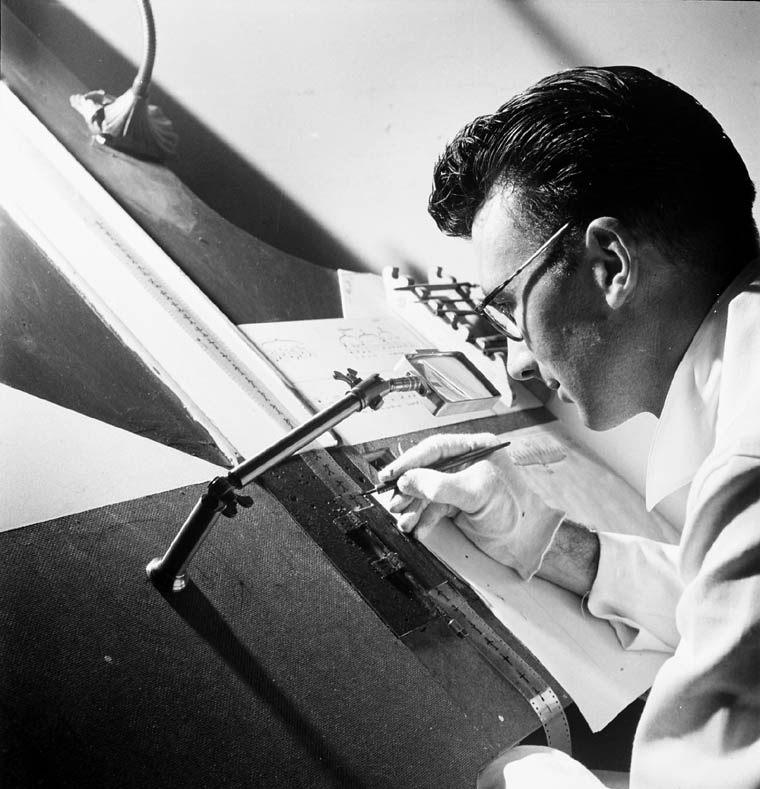
Scottish Canadian animator Norman McLaren drawing on film, 1944
Occupation
Occupation type
Art
Activity sectors
Film, television, internet, mass media, video games
Description
CompetenciesDrawing, fine arts, acting, computer software
Fields of
employment
Animation

An animator is an artist who creates images, known as frames, which give an illusion of movement called animation when displayed in rapid sequence. Animators can work in a variety of fields including film, television, and video games. Animation is closely related to filmmaking and like filmmaking is extremely labor-intensive, which means that most significant works require the collaboration of several animators. The methods of creating the images or frames for an animation piece depend on the animators' artistic styles and their field.

Other artists who contribute to animated cartoons, but who are not animators, include layout artists (who design the backgrounds, lighting, and camera angles), storyboard artists (who draw panels of the action from the script), and background artists (who paint the "scenery"). Animated films share some film crew positions with regular live action films, such as director, producer, sound engineer, and editor, but differ radically in that for most of the history of animation, they did not need most of the crew positions seen on a physical set.

In hand-drawn Japanese animation productions, such as in Hayao Miyazaki's films, the key animator handles both layout and key animation. Some animators in Japan such as Mitsuo Iso take full responsibility for their scenes, making them become more than just the key animator.

Specialized fields

[edit]

Animators often specialize. One important distinction is between character animators (artists who specialize in character movement, dialogue, acting, etc.) and special effects animators (who animate anything that is not a character; most commonly vehicles, machinery, and natural phenomena such as rain, snow, and water).

Stop motion animators do not draw their images, instead they move models or cut-outs frame-by-frame,[1] famous animators of this genre being Ray Harryhausen and Nick Park.

Stop-motion animated character from 20 Million Miles to Earth (1957)

Inbetweeners and cleanup artists

[edit]

In large-scale productions by major studios, each animator usually has one or more assistants, "inbetweeners" and "clean-up artists", who make drawings between the "key poses" drawn by the animator, and also re-draw any sketches that are too roughly made to be used as such.[2] The terms "assistant animator" and "clean-up artists" tend to be used in place of each other.[3] Usually, a young artist seeking to break into animation is hired for the first time in one of these categories, and can later advance to the rank of full animator (usually after working on several productions).

Methods

[edit]

Historically, the creation of animation was a long and arduous process. Each frame of a given scene was hand-drawn, then transposed onto celluloid, where it would be traced and painted. These finished "cels" were then placed together in sequence over painted backgrounds and filmed, one frame at a time.[4]

Animation methods have become far more varied in recent years.[5] Today's cartoons could be created using any number of methods, mostly using computers to make the animation process cheaper and faster. These more efficient animation procedures have made the animator's job less tedious and more creative.

Audiences generally find animation to be much more interesting with sound. Voice actors and musicians, among other talent, may contribute vocal or music tracks. Some early animated films asked the vocal and music talent to synchronize their recordings to already-extant animation (and this is still the case when films are dubbed for international audiences). For the majority of animated films today, the soundtrack is recorded first in the language of the film's primary target market and the animators are required to synchronize their work to the soundtrack.[5]

Evolution of animator's roles

[edit]

As a result of the ongoing transition from traditional 2D to 3D computer animation, the animator's traditional task of redrawing and repainting the same character 24 times a second (for each second of finished animation) has now been superseded by the modern task of developing dozens (or hundreds) of movements of different parts of a character in a virtual scene.

Because of the transition to computer animation, many additional support positions have become essential, with the result that the animator has become but one component of a very long and highly specialized production pipeline. In the 21st century, visual development artists design a character as a 2D drawing or painting, then hand it off to modelers who build the character as a collection of digital polygons. Texture artists "paint" the character with colorful or complex textures, and technical directors set up rigging so that the character can be easily moved and posed. For each scene, layout artists set up virtual cameras and rough blocking. Finally, when a character's bugs have been worked out and its scenes have been blocked, it is handed off to an animator (that is, a person with that actual job title) who can start developing the exact movements of the character's virtual limbs, muscles, and facial expressions in each specific scene.

At that point, the role of the modern computer animator overlaps in some respects with that of his or her predecessors in traditional animation: namely, trying to create scenes already storyboarded in rough form by a team of story artists, and synchronizing lip or mouth movements to dialogue already prepared by a screenwriter and recorded by vocal talent. Despite those constraints, the animator is still capable of exercising significant artistic skill and discretion in developing the character's movements to accomplish the objective of each scene. There is an obvious analogy here between the art of animation and the art of acting, in that actors also must do the best they can with the lines they are given; it is often encapsulated by the common industry saying that animators are "actors with pencils".[6] In 2015, Chris Buck noted in an interview that animators have become "actors with mice."[7] Some studios bring in acting coaches on feature films to help animators work through such issues. Once each scene is complete and has been perfected through the "sweat box" feedback process, the resulting data can be dispatched to a render farm, where computers handle the tedious task of actually rendering all the frames. Each finished film clip is then checked for quality and rushed to a film editor, who assembles the clips together to create the film.

While early computer animation was heavily criticized for rendering human characters that looked plastic or even worse, eerie (see uncanny valley), contemporary software can now render strikingly realistic clothing, hair, and skin. The solid shading of traditional animation has been replaced by very sophisticated virtual lighting in computer animation, and computer animation can take advantage of many camera techniques used in live-action filmmaking (i.e., simulating real-world "camera shake" through motion capture of a cameraman's movements). As a result, some studios now hire nearly as many lighting artists as animators for animated films, while costume designers, hairstylists, choreographers, and cinematographers have occasionally been called upon as consultants to computer-animated projects.

See also

[edit]

References

[edit]
[edit]
Revisions and contributorsEdit on WikipediaRead on Wikipedia
from Grokipedia
An animator is an who creates sequences of images, known as , that when displayed in rapid succession, produce the illusion of movement referred to as . These professionals develop two- and three-dimensional models, , and moving images for various media, including films, television, video games, advertisements, and websites. Animators collaborate with directors, artists, and production teams to bring stories to life, often specializing in character movements, emotions, or specific effects while adhering to project briefs and timelines. Animators employ a range of techniques depending on the project and medium, with common types including traditional hand-drawn animation, where images are sketched frame by frame on paper or cels; 2D vector-based animation using digital software for scalable graphics; 3D computer-generated animation involving modeling, rigging, and rendering in three dimensions; stop-motion animation that manipulates physical models incrementally; and motion graphics for abstract visual storytelling in titles or infographics. Each technique requires distinct tools and software, such as Adobe Animate for 2D work, Autodesk Maya for 3D modeling, or Dragonframe for stop-motion capture. Essential skills for animators include strong artistic ability to convey and physics through movement, technical proficiency in software and principles like timing and squash-and-stretch, as well as communication and organizational skills to collaborate in team environments and meet deadlines. Becoming an animator typically involves earning a bachelor's degree in animation, computer graphics, fine arts, or a related discipline, which usually takes about four years, followed by time spent developing a strong professional portfolio showcasing original work to demonstrate skills and attract employers. Many aspiring animators also gain practical experience through internships, freelance projects, or entry-level positions to build their careers and portfolios. In the United States, the profession employs about 57,100 workers as of 2024, with a median annual wage of $99,800 and projected job growth of 2% through 2034, driven by demand in and despite competition from automated tools.

Definition and Role

Core Responsibilities

Animators are professionals who simulate movement by rapidly displaying a sequence of static images or models, creating the illusion of motion in media such as films, television, and video games. This process involves transforming static artwork into dynamic visuals that convey , , and action. Core tasks of animators include developing storyboards to outline sequences, creating keyframes that establish major poses and actions, and adjusting timing and spacing to control the pace and rhythm of movements for natural flow. They also handle lip-syncing by synchronizing character mouth movements with dialogue audio, and apply fundamental motion principles such as to depict flexibility, to prepare viewers for actions, and follow-through to show lingering momentum after motion stops. These responsibilities ensure animations adhere to realistic or stylized physics, enhancing impact. Essential skills for animators encompass strong drawing proficiency for constructing poses and expressions, a solid grasp of physics and human to achieve believable motion, meticulous in crafting individual frames, and effective with directors, writers, and production teams to align on creative visions. Understanding allows for accurate depiction of body mechanics, while physics knowledge informs weight, balance, and in sequences. In a typical daily , animators begin by sketching rough animations to block out broad movements, refine poses through iterative adjustments for consistency and , and test playback sequences to evaluate and timing before final integration. This iterative process often involves reviewing feedback and revising elements to meet project deadlines. Over time, these roles have evolved from manual frame-by-frame to incorporating digital tools for efficiency.

Professional Contexts

Animators operate across a diverse array of industries, including the motion picture and video sectors, software publishing, and , computer systems design, television production, , creation, and theme park attractions. In the film and television industries, animators contribute to and character movements for movies and series, while the sector employs them for creating interactive character animations and environments. Advertising utilizes animators for dynamic promotional content, web platforms leverage short-form animations for , and theme parks integrate animation into immersive rides and shows to enhance visitor experiences. Within these industries, animators typically collaborate in multidisciplinary teams at studios, working alongside directors to align visuals with vision, modelers to develop 3D assets, riggers to prepare characters for movement, and sound designers to synchronize audio with motion. This team-based approach is essential for large-scale productions, where individual contributions integrate into cohesive outputs. Approximately 62% of animators are self-employed, allowing for freelance flexibility across projects, whereas in-house roles at studios provide stable collaboration but often involve structured hierarchies and company-specific pipelines. Freelancers may handle end-to-end tasks for smaller clients, while in-house animators focus on specialized segments within broader team workflows. Animators engage in varied project types tailored to industry demands, such as feature films where they perform for narrative-driven stories, as seen in productions emphasizing expressive movements to convey emotion. In television, they produce episodic cartoons requiring consistent character arcs across weekly installments, maintaining visual style under serial production cycles. Commercials demand short-form bursts of animation, often 15-30 seconds, to deliver high-impact messaging for brands within tight creative constraints. Ethical considerations in animation production include prioritizing diverse representation in character design and to avoid and promote inclusivity, with studies showing only 17% of top animated from 2007-2018 featuring female leads and just 3% with women of color. Animators and teams must navigate production deadlines and budget constraints, which often pressure creative decisions; for instance, projects adhere to fixed schedules and financial limits to ensure timely delivery without compromising quality, as emphasized in collaborative pipelines that balance artistic goals with .

Education and Entry into the Field

Animators typically require a bachelor's degree in fine art, computer graphics, animation, or a related field to enter the profession. A strong portfolio of work, demonstrating artistic talent, technical proficiency in animation software, and understanding of animation principles, is essential for securing employment. Important qualities for success include artistic ability, computer skills for using specialized software, communication skills for team collaboration, and time-management skills to meet project deadlines. Entry-level positions, internships, or freelance opportunities often serve as starting points, allowing individuals to gain practical experience and refine their portfolios. The time required to become a professional animator varies depending on factors such as educational path, talent, networking, and opportunities, but formal education generally involves several years of study followed by additional time to build professional experience.

Historical Development

Early Pioneers

The origins of animation as a profession trace back to the late 19th century, when French inventor Émile Reynaud developed the Théâtre Optique, a projection device that enabled the public display of hand-drawn animated sequences. Patented in 1888 and first presented on October 28, 1892, at the Musée Grévin in Paris, the system used perforated strips of hand-painted images to create moving pictures, marking one of the earliest instances of projected animation for audiences. Among the key pioneers who advanced into film, Anglo-American filmmaker produced in 1906, widely recognized as the first animated film recorded on standard motion picture film. This short featured stop-motion techniques with chalk drawings and cut-out figures coming to life on a blackboard, demonstrating the potential of within live-action cinema. Winsor McCay further elevated the craft with in 1914, a groundbreaking work that introduced personality animation by endowing the titular character with expressive, lifelike behaviors such as shyness and playfulness. McCay hand-drew approximately 10,000 frames on onion-skin paper for this one-reel film, performing it live alongside the projection to interact with the dinosaur on screen. Preceding these film-based efforts, early animation techniques relied on optical toys as precursors, including the phenakistoscope—a spinning disk with sequential drawings viewed through slits to simulate motion—and the , a cylindrical drum with interior images that created illusory movement when rotated. Flipbooks, patented in 1868, offered a portable method by binding stacks of illustrated pages that animated when thumbed through rapidly. These devices laid the groundwork for persistent visual illusion but were limited to individual viewing. A pivotal transition occurred around with the adoption of sheets, or cels, patented by Earl Hurd, which allowed animators to draw characters on transparent plastic overlays separate from static backgrounds, greatly enhancing production efficiency by reducing redundant redrawing. Early animators faced significant challenges due to the labor-intensive nature of hand-drawing each frame without standardized workflows, often requiring thousands of individual illustrations per and resulting in typical lengths of just one reel (about 10-15 minutes). This painstaking process, exemplified by McCay's solitary efforts on Gertie, demanded precise single-frame exposures and limited output to brief, experimental works.

Key Milestones

In the 1920s and 1930s, Walt Disney's studio introduced groundbreaking technical innovations that elevated animation from silent novelties to sophisticated sound films, fundamentally shaping the animator's craft. The release of Steamboat Willie in 1928 marked the first widespread use of synchronized sound in animation, where character movements precisely matched audio effects like whistles and music, revolutionizing audience engagement and setting a new standard for post-production integration. This milestone, produced under Disney's direction, propelled Mickey Mouse to stardom and influenced global animation practices by demonstrating sound's potential to enhance narrative depth. Complementing this, the multiplane camera, developed by Disney Studios in 1937 and first used in the short film The Old Mill (1937), with its debut in a feature film in Snow White and the Seven Dwarfs (1937), allowed animators to layer multiple cels at varying distances from the camera lens, creating parallax effects that simulated three-dimensional depth in two-dimensional scenes. This device, which earned a Scientific and Technical Academy Award in 1938, reduced the need for complex perspective drawings and enabled more immersive storytelling, as seen in sequences like the forest chase in Snow White. Ub Iwerks, Disney's key collaborator and primary animator during this era, single-handedly animated the initial Mickey Mouse shorts, including Plane Crazy (1928) and Steamboat Willie, contributing essential character designs and fluid motion that defined the rodent's iconic style. The 1940s and 1960s saw innovations in production efficiency driven by economic pressures, particularly the shift to television, which demanded faster and cheaper animation workflows. United Productions of America (UPA) pioneered limited animation in the late 1940s, exemplified by Gerald McBoing-Boing (1950), where animators reused static poses and minimized frame-by-frame movement to focus on stylized graphics, sound design, and psychological depth, drastically cutting labor costs while earning an Academy Award for Best Animated Short. This technique, born from post-World War II artistic rebellion against Disney's realism, allowed smaller studios to compete by emphasizing graphic design over full motion, influencing a wave of modernist cartoons. Building on UPA's model, Hanna-Barbera adapted limited animation for television in the 1950s, producing series like The Ruff and Reddy Show (1957) and The Flintstones (1960–1966), which used techniques such as panning static backgrounds and dialogue-driven scenes to reduce per-episode costs from theatrical short levels (around $30,000–$50,000) to as low as $3,000 per 5-minute segment (or about $18,000 for a 30-minute show), enabling weekly broadcasts and sustaining animator employment amid declining theater shorts. The 1980s and 1990s heralded the rise of computer-generated imagery (CGI), transitioning animation from hand-drawn dominance to digital realms and expanding the animator's toolkit. Pixar's Toy Story (1995), the first fully CGI feature-length film, showcased photorealistic modeling, lighting, and character rigging that allowed for complex interactions impossible in traditional media, grossing over $373 million worldwide and signaling a paradigm shift toward computer-assisted production. This breakthrough, developed through Pixar's RenderMan software, empowered animators to iterate designs rapidly and integrate 3D elements, diminishing 2D's market share from 90% in the early 1990s to under 50% by the early 2000s. These advancements intertwined with cultural recognitions that legitimized animation as high art. The Academy of Motion Picture Arts and Sciences introduced the Best Animated Short Subject category at the in 1932, with Disney's becoming the inaugural winner for its innovative three-strip process, establishing annual benchmarks for technical and artistic excellence in the field. In , Osamu Tezuka's (1963) launched the first serialized television series, blending aesthetics with weekly episodic storytelling to captivate audiences and spawn a multibillion-yen industry, influencing global anime exports and animator training in character-driven narratives. The 1960 founding of the International Animated Film Association (ASIFA) further professionalized the field by promoting animator education and festivals. During , studios like expanded animator teams for training and propaganda films, increasing employment and refining collaborative workflows.

Animation Techniques

Traditional Methods

Cel animation, a cornerstone of traditional 2D animation, involved hand-drawing character elements on transparent sheets of celluloid—commonly called cels—which were layered atop static painted backgrounds and photographed frame by frame to produce fluid motion. The process typically started with storyboarding to plan sequences, followed by lead animators creating key frames that captured primary poses and expressions. In-between artists then filled in the intermediate drawings to ensure smooth transitions, after which outlines were inked onto the cels and colors applied to the reverse side to avoid visible brush strokes. Backgrounds were painted separately on opaque paper or board, and during filming, multiple cels representing different moving parts (such as foreground characters, arms, or effects) were stacked over the background using pegs for precise registration. To refine the work, pencil tests were conducted by photographing rough sketches on animation paper under a camera, allowing directors to review and approve the timing and flow before committing to final cels. Stop-motion animation represented another manual technique, where physical models were posed incrementally and photographed sequentially to create the appearance of independent movement upon playback. , a subset using malleable plasticine figures, allowed animators to sculpt and reshape characters directly, often without internal supports for simpler sequences, as seen in early experiments by in films like (1925). For more complex motions, puppet animation employed armatures—rigid wire skeletons embedded within fabric, foam, or replacement parts—to maintain poses, with animators using strings, rods, or wires to manipulate limbs frame by frame during shooting. This labor-intensive method demanded precise lighting and camera setup to minimize flicker, typically capturing 12 to 24 frames per second of screen time. Central to these techniques were the 12 principles of animation, formalized by veteran Disney animators Ollie Johnston, Frank Thomas, and their colleagues in the 1981 book The Illusion of Life: Disney Animation, which distilled decades of hand-crafted expertise into guidelines for lifelike motion. Among them, squash and stretch gave objects elasticity to convey weight and flexibility, anticipation prepared viewers for actions through preparatory poses, and follow through and overlapping action ensured parts of a body moved at different speeds for natural momentum. Slow in and slow out (also known as ease in and ease out) adjusted timing for acceleration and deceleration to smooth transitions. Straight ahead and pose to pose described contrasting drawing approaches—spontaneous versus planned—for dynamic versus controlled sequences. Secondary action added supporting details to primary motions, timing controlled pace to reflect emotion or physics. Appeal focused on charismatic design, exaggeration intensified gestures and expressions for emphasis and entertainment while preserving essence, staging required composing each frame to spotlight the core idea or mood without clutter, arcs emphasized that organic movements trace curved paths rather than rigid lines to mimic real physics, and solid drawing ensured forms conveyed three-dimensional volume, weight, and solidity to avoid flat appearances. The principle of emphasized that organic movements, like a thrown ball or swinging arm, trace curved paths rather than rigid lines, mimicking real physics to avoid mechanical stiffness; in Bambi (1942), the young deer's leaps follow pronounced arcs to heighten the sense of playful bounding and forest depth. Staging required composing each frame to spotlight the core idea or mood without clutter, using camera angles and poses for clarity; for instance, in The Jungle Book (1967), Baloo's relaxed lounging is staged frontally with minimal background distraction to convey carefree confidence. Exaggeration intensified gestures and expressions for emphasis and while preserving essence, preventing bland realism; a prime example appears in Peter Pan (1953), where Captain Hook's sword thrusts and tantrums are amplified in scale and velocity to amplify his villainous flair. Key tools enhanced these processes, including the rotoscope, invented by Max Fleischer in 1915 as a mechanical projector that framed live-action footage onto a drawing easel for tracing outlines frame by frame, yielding more lifelike human motions in cartoons. Patented in 1917 as "Method of Producing Moving-Picture Cartoons," it was first applied in Fleischer's Out of the Inkwell series to blend animated characters with real performers. Complementing this, the multiplane camera, pioneered by Walt Disney Studios in the 1930s, stacked multiple cels and artwork layers at varying vertical distances from the lens, allowing camera pans or tilts to generate parallax—the differential motion of nearer elements against farther ones—for simulated depth in flat images. Debuting in Snow White and the Seven Dwarfs (1937), it created immersive scenes like the forest journey, where foreground branches shifted faster than distant trees. These analog innovations directly influenced digital methods by inspiring virtual layering and motion simulation in software.

Digital and Computer-Assisted Methods

Digital and computer-assisted methods in leverage software to streamline the creation of both 2D and 3D content, enabling animators to manipulate vectors, automate frame , and simulate complex movements. In 2D digital , tools like facilitate vector-based drawing, where shapes are defined by mathematical paths that allow scalable, resolution-independent artwork without . This software supports tweening, an automated technique that generates intermediate frames between keyframes, adjusting properties such as position, rotation, scale, and color to create smooth transitions. Similarly, Toon Boom Harmony provides advanced vector and drawing tools, allowing animators to create scalable and integrate cut-out rigging for efficient character deformation across frames. These platforms adapt traditional animation principles, such as , into digital workflows for consistent application. In 3D animation, software like and enables , the process of adding skeletal structures to 3D models to control deformation during movement. in Maya involves creating joint hierarchies with (IK) solvers, which calculate bone rotations to reach a target endpoint, and forward kinematics (FK) for sequential joint control, often blended for realistic limb motion. 's armature system similarly supports IK constraints, where positioning the end of a bone chain automatically adjusts upstream bones, simplifying posing for complex characters. Keyframe animation in these tools records poses at specific frames, with the software interpolating in-betweens, while rendering pipelines—sequences of lighting, shading, and output—produce final images or sequences using engines like Maya's Arnold or 's Cycles. Motion capture enhances computer-assisted animation by recording real human movements via sensors or cameras and mapping them onto digital characters, reducing manual keyframing for lifelike results. In James Cameron's Avatar (2009), performance capture technology captured actors' facial expressions and body motions on virtual sets, applying the data to Na'vi characters through rigging systems in Maya, which revolutionized integration of live performance with CGI. This method uses optical or inertial sensors to track markers, generating data streams that animators clean up and refine in software. These digital methods offer advantages such as faster iteration through real-time previews and non-destructive edits, allowing animators to revise scenes without redrawing entire sequences. Easier revisions stem from parametric controls in vector tools and undo histories, while seamless integration with (VFX) pipelines enables animation into live-action footage. However, challenges include steep learning curves for mastering complex interfaces and solvers, requiring specialized training to avoid inefficient workflows or unnatural results.

Specialized Roles

Inbetweening and Cleanup

Inbetweening involves the creation of intermediate frames, known as in-betweens, placed between key poses drawn by lead animators to produce smooth motion transitions in sequences. Historically, this task relied on junior artists, often entry-level animators, who filled in the frames to connect the extremes of actions, a practice prominent in early studios like where many senior animators, such as and among the Nine Old Men, began their careers as inbetweeners. Cleanup follows inbetweening in the traditional pipeline, where artists trace the rough sketches—now including in-betweens—onto transparent cels or digital layers, refining lines for consistency, correcting distortions, and incorporating details such as or outlines to prepare for inking and . This step ensures visual uniformity across frames, preserving the original animator's intent while enhancing clarity and appeal for final production. Positioned after key animation in the , and cleanup integrate closely with lead animators' output, with inbetweeners typically handling the bulk of frames for standard film rates of 24 per second, as seen in Disney's classic era where this labor-intensive process supported full quality. Inbetweeners collaborate briefly with leads to clarify timing notes before proceeding. Essential skills for these roles include precision in timing and spacing to maintain realistic motion, along with a strong grasp of easing techniques—such as adding denser drawings at the beginning and end of actions to simulate and deceleration. While digital has reduced manual in many productions, these roles persist in high-end hand-drawn work to achieve nuanced control over fluidity and detail.

Field-Specific Specializations

Character animators specialize in infusing digital or traditional characters with personality and emotion, drawing on principles to create believable performances through gestures, facial expressions, and . They typically work frame-by-frame using keyframing techniques or data, refining movements to convey subtle nuances like surprise or , as seen in DreamWorks productions where animators study real-life references to enhance character relatability. This role demands a strong understanding of and to ensure characters drive narrative engagement. Effects animators focus on replicating complex physical phenomena, such as , flows, or explosions, by employing particle systems and dynamic simulations to model realistic behaviors like or dispersion. These professionals collaborate with directors to integrate effects seamlessly into scenes, using software tools to adjust parameters for scale and intensity, ensuring visual fidelity in high-stakes sequences. For instance, particle-based methods allow for efficient rendering of in splashes or fiery blasts, prioritizing procedural accuracy over manual keyframing. In genre-specific variants, 2D hand-drawn animators contribute to indie films by meticulously sketching each frame to achieve artistic, fluid styles that emphasize expressive line work and timing, often in limited budgets to evoke unique emotional tones. Conversely, 3D animators for video games, utilizing engines like Unity, develop interactive sequences that adapt to player actions, such as character locomotion or environmental responses, requiring optimization for real-time performance. Stop-motion animators, exemplified at Studios, manipulate physical puppets frame-by-frame on miniature sets to produce tactile, arthouse narratives with intricate detail and emotional depth, often taking days per second of footage. Emerging niches like VR/AR animation demand specialized skills in spatial awareness, where animators design 360-degree environments and interactions that maintain immersion across user viewpoints, incorporating realistic physics and user-tracking to prevent disorientation. These roles extend traditional techniques into interactive realms, blending with responsive behaviors for applications in simulations or experiential media. Support from ensures smooth interpolation in these specialized workflows. With the rise of in as of 2025, new specialized roles have emerged, including prompt animators who guide AI models to generate specific animations, AI workflow designers who integrate generative tools into production pipelines, and data ethicists focused on ethical use of AI in creative processes. These positions leverage AI to enhance efficiency while requiring expertise in both technology and artistic oversight.

Modern Evolution

Technological Impacts

Recent advancements in (AI) and have revolutionized the animator's toolkit by automating labor-intensive tasks and enhancing creative efficiency. Adobe's platform, integrated into tools like , employs AI for features such as auto lip-sync, which maps mouth poses to audio inflections automatically, reducing manual synchronization efforts that traditionally consumed hours per character sequence. Similarly, Adobe's Project In-Between uses to generate smooth animated transitions between multiple static images, creating video bridges that streamline and pose prediction without extensive keyframing. In the realm of storyboarding, generative AI models from the 2020s, such as StoryWeaver and Make-A-Storyboard, produce consistent scene visuals from text prompts, lowering barriers for and allowing animators to iterate designs rapidly. Industry surveys indicate that 22% of gaming industry businesses now incorporate generative AI for storyboarding, accelerating concept visualization. Real-time rendering technologies further transform workflows by providing immediate visual feedback, minimizing delays in the creative process. Engines like Unreal Engine's Sequencer enable animators to preview complex animations, lighting, and effects in real time, drastically cutting iteration cycles from weeks to hours compared to offline rendering methods. This immediacy fosters experimentation, as changes to character poses or environments can be assessed instantly, enhancing precision in productions like virtual production films. Cloud-based collaboration platforms have amplified these gains, particularly following the 2020 shift to remote work. Tools such as Frame.io facilitate seamless review and feedback on animation assets across distributed teams, integrating with editing software to enable real-time annotations and version control, which has become standard in post-production pipelines. Despite these benefits, technological integration poses significant challenges, including fears of job displacement and the imperative for upskilling. Reports from 2023-2025 highlight that AI threatens entry-level roles like and cleanup, with 55% of entertainment professionals anticipating major impacts on animators within two years, potentially eroding traditional pathways. A 2025 survey found 85.88% of animators believe AI is causing job losses, particularly in repetitive tasks, though it may create hybrid positions such as AI workflow specialists. To adapt, animators must acquire skills in AI tools and programming, with demand for generative AI-proficient professionals projected to rise over 25% in 2024, necessitating industry-wide initiatives to balance with creative roles.

Industry Shifts

The animation industry has undergone significant globalization since the early 2000s, with major studios outsourcing production to lower-cost regions like Canada, India, and South Korea to achieve cost efficiency through tax incentives and labor savings. In Canada, particularly Vancouver, tax credits introduced in 1995 have attracted projects such as Moana 2, contributing to a 71.6% rise in animation employment in British Columbia from 2019 to 2024, while California's share of top animated films dropped from 67% in 2010 to 27% in 2023. India emerged as a key hub for subcontracted work post-2000, with studios like Toonz handling inbetweening and cleanup for Western productions, driven by competitive wages and a skilled workforce. South Korea, which captured up to 50% of global subcontracted animation by the 1990s, transitioned toward original IP in the 2010s, exporting K-culture content while continuing service roles for U.S. shows, resulting in job dispersion and reduced entry-level opportunities in traditional U.S. centers like Los Angeles. This outsourcing trend has reshaped animators' careers, fostering international pipelines but exacerbating economic pressures in high-cost regions, with California's animation employment declining 4.7% over the same period. The rise of streaming platforms in the 2020s has spurred a demand surge for original animated content, transforming animators' workflows toward more episodic and adult-oriented productions. Netflix and Disney+ have invested heavily in bespoke series to differentiate from linear TV, with the pandemic accelerating this shift by enabling remote animation pipelines that maintained production amid lockdowns. A prime example is Netflix's Arcane (2021–2024), which cost $250 million for 18 episodes and became the platform's first streaming-exclusive winner of the Emmy for Outstanding Animated Program, highlighting the viability of high-budget, mature narratives that attracted over 34 million views in its first week. This boom has led to increased episodic work, as platforms prioritize serialized formats for subscriber retention; for instance, adult animation like Arcane and Invincible on Amazon Prime has expanded opportunities beyond family-friendly fare, with a 2025 Luminate report noting a pivot toward preschool and adult demographics amid declining all-ages TV output. Overall, streaming's global reach has diversified animator roles, emphasizing narrative depth and visual innovation to meet year-round content demands. Labor dynamics in the animation sector have evolved through heightened efforts and diversity initiatives, addressing exploitation and underrepresentation amid industry growth. The , lasting 118 days alongside the WGA action, significantly disrupted productions, delaying films like Pixar's while costing Southern California's economy $6.5 billion and 45,000 jobs, including many for animators covered under related contracts. Although voice actors were partially exempt, the strike amplified calls for protections against AI replication and better residuals, influencing ongoing negotiations for -specific agreements. Complementing these labor pushes, diversity initiatives have promoted inclusive hiring to counter historical imbalances; a 2019 USC Annenberg study found women comprised only 2.5% of animated film directors and 13% of TV directors, prompting efforts like affinity groups, inclusion goals, and reduced subjectivity in evaluations, with 62% of decision-makers reporting company-wide programs to foster belonging. These measures, including events and mandates observed by 37% of early-career women, aim to elevate underrepresented voices, though challenges like perceived persist, signaling a broader commitment to equitable career advancement. A 2024 USC Annenberg update indicates slight progress, with women directing 7.1% of top animated films from 2019-2023, though gaps remain significant. Looking ahead to and beyond, animators' opportunities are expanding into non-traditional media, driven by social platforms and immersive technologies. The global animation market, valued at $436 billion in , is projected to reach $896 billion by 2034, with significant growth in short-form content for , where 48.5% of adolescents now prefer animated videos—up from 42% the prior year—fueling demand for quick, mobile-optimized creations that leverage animators' skills in 2D and hybrid styles. Platforms like have normalized animator-driven shorts, with 58% of such content consumed on mobile, enabling freelance and episodic gigs beyond theatrical releases. In parallel, projects offer new frontiers, as the sector's market is expected to hit $507 billion by 2030, creating roles in avatar design, virtual environments, and NFT animations using tools like Unity and . This shift, briefly enabled by remote technologies, positions animators for diversified, interactive work in gaming and virtual retail, though it requires adaptation to real-time rendering demands.

References

Add your contribution
Related Hubs
Contribute something
User Avatar
No comments yet.