Hubbry Logo
Ascham SchoolAscham SchoolMain
Open search
Ascham School
Community hub
Ascham School
logo
8 pages, 0 posts
0 subscribers
Be the first to start a discussion here.
Ascham School
Ascham School
from Wikipedia

Ascham School is an independent, non-denominational, day and boarding school for girls, located in Edgecliff, an Eastern Suburb of Sydney, New South Wales, Australia.

Key Information

Established in 1886, the school has a non-selective enrolment policy and currently has approximately 1000 students from Kindergarten to Year 12, including 100 boarders from Years 6 to 12.[2]

Ascham follows the 'Dalton Plan', an educational philosophy created by Helen Parkhurst in 1916. The 'Dalton Plan' aims to produce independent and confident leaders.[3]

Ascham is a member of the Alliance of Girls' Schools Australasia (AGSA),[4] the Junior School Heads Association of Australia[5] the Association of Heads of Independent Schools of Australia (AHISA),[6] the Australian Boarding Schools' Association,[7] and the Association of Heads of Independent Girls' Schools (AHIGS).[8]

Ascham is operated as a not-for-profit company. All funds must be used to benefit the school. This function is administered by the school's Council of Governors who are elected by the school's members.

History

[edit]

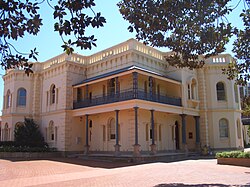
Ascham school was established in 1886 by Marie Wallis, as a private, day and boarding school for girls, in a terrace house in Darling Point. The school moved to its current site following the acquisition of Glenrock estate in 1911. The school was named after Roger Ascham, tutor to Queen Elizabeth I.

In 1914 Kathleen Gilman Jones (1880–1942) came from South Africa to be a joint head mistress at the school. She went on to lead Melbourne Church of England Girls' Grammar School.[9]

The school adopted the 'Dalton Plan' as its method of teaching in 1922.[10]

Ascham became a company, Ascham School Limited, in 1937 under the direction of Headmistress Margaret Bailey. This transferred ownership of the school from herself to ensure the long-term succession of the school.[11] The next head who served the school for some time was Dorothy Whitehead.[12] She had served in the war rising to the rank of temporary Major. She continued with the Dalton Plan, before she left in 1961 to lead Firbank Girls' Grammar School.[12]

School crest

[edit]

The Ascham school crest was developed in 1911 by Ascham art teacher, Albert Collins. Symbols on the crest were explained in the school's Charivari magazine in December 1911: the dolphins symbolise energy, persistence and the ability to swim against, as well as with, the tide; the wings suggest aspiration and ambition; the lamp and book represent learning; and the combination of the acorn and eucalyptus seed mark the historical union of Britain and Australia.[13]

Campus

[edit]

Ascham is composed of three school areas designed to accommodate for the different stages of the students' educational development.

Infant School

The youngest students, from Preparatory to Year 2, are taught in the Hillingdon building which has its own hall, library, classrooms and recreation area. The students at Hillingdon are taught according to the Spalding Method.

Junior School

Students from Years 3 to 6 live in the Fiona building. Junior School students have access to a broad range of school subjects and co-curricular activities.

Senior School

The senior school is for students from Year 7 to Year 12. They are taught according to the Dalton Plan. This method gives the older students increased flexibility while placing on them the responsibility to learn and participate in the school's numerous academic and cultural opportunities. The campus hosts the Packer Theatre, a studio theatre, an indoor heated pool, a gymnasium, tennis courts, playing fields, IT facilities, art rooms, science laboratories and three libraries.

Exchange programme

[edit]

Heads

[edit]

The following individuals have served as Head of School, or preceding title:

Ordinal Name Title Start date End date Time in office Notes
1 Marie Wallis Founding Principal 1886 1902 15–16 years [8]
2 Herbert J. Carter Principal 1902 1914 11–12 years [8]
3 Kathleen Gilman Jones Co-Principal 1914 1916 1–2 years
3 Margaret Bailey
Headmistress 1916 1946 29–30 years [8]
4 Hilda Rayward Headmistress 1947 1948 0–1 years [8]
5 Dorothy Whitehead[12] Headmistress 1949 1961 11–12 years [14][8]
6 Merrilee Roberts Headmistress 1962 1972 9–10 years [14][8]
7 Rowena Danziger Headmistress 1973 2003 29–30 years [15][8]
8 Susan Preedy Headmistress 2004 2005 0–1 years [16][8]
Rowena Danziger Acting Headmistress 2005 2005 0 years [17]
Frances Booth Acting Headmistress 2005 2005 0 years [8]
9 Louise Robert-Smith Headmistress 2006 2012 5–6 years [18][8]
10 Helen Wright Headmistress 2013 2014 0–1 years [19][8]
11 Andrew Powell Head of School 2014 incumbent 11–12 years [19][8]

Former students

[edit]

Old Girls' Union

[edit]

The Ascham Old Girls' Union (AOGU) was founded in 1899 by former students of the school. It now[when?] has a membership of over 4,000 alumnae. The AOGU encourages involvement of all past students in the Ascham community and helps alumnae remain in contact with their classmates.[20] The AOGU also funds bursaries for the daughters and granddaughters of past students. The recipients of bursaries are means-tested and reviewed annually, and also carry an obligation to uphold the ideals and values of Ascham.[20] The AOGU released[when?] three publications per year to its members.[20]

Notable alumnae

[edit]

Arts

[edit]

Creative arts

[edit]

Literary arts

[edit]

Performing arts

[edit]

Business

[edit]

Education

[edit]

Medicine and the sciences

[edit]

Sport

[edit]

See also

[edit]

References

[edit]

Further reading

[edit]
[edit]
Revisions and contributorsEdit on WikipediaRead on Wikipedia
from Grokipedia
Ascham School is an independent, non-denominational girls' school located in Edgecliff, adjacent to , , , , providing education from preparatory level to for day and boarding students. Founded in 1886 by Miss Marie Wallis in , the school relocated to its current 5-hectare campus at Edgecliff in 1910, where it has since expanded through acquisitions of heritage properties like and Dower House in 1948, including the opening of the redeveloped Hall in 2025. Ascham adopted the Dalton Plan educational philosophy in 1923, making it the only school in Australia to fully implement this approach, which emphasizes independence, collaboration, responsibility, and reflection to foster academic excellence and personal growth. The school's motto, Vi et Animo ("with heart, soul, strength and courage"), underscores its commitment to holistic development, including strong programs in music, sports, debating, and leadership, alongside a supportive boarding tradition that dates back to 1890. Notable milestones include the establishment of the Ascham Old Girls' Union in 1899, the school's first Olympian in 1936, and its first Rhodes Scholar in 1997, reflecting a legacy of producing resilient and accomplished alumnae.

School overview

Location and enrolment

Ascham School is situated at 188 New South Head Road in Edgecliff, an affluent suburb in the Eastern Suburbs of , , . The campus spans 5 hectares on the historic Glenrock estate, offering panoramic views over and proximity to Sydney Harbour, just three kilometres from the and five kilometres from coastal beaches. This central location facilitates easy access via , including buses from Edgecliff station on the T4 and ferries from nearby and wharves. As an independent, girls' school, Ascham enrols approximately 1,220 students across (Prep) to Year 12, fostering a diverse that includes day students from across and boarders primarily from rural , interstate, and overseas. The school maintains a non-selective entry policy, with formal entry points at Prep (for girls turning 4 by 31 March), (turning 5 by 31 March), , and Year 7, though additional places may be offered at other levels at the Head of School's discretion. Priority is given to daughters of alumnae and current families, alongside a limited number of full-fee-paying international students. Primarily a day school, Ascham provides boarding for over 120 students in Years 7 to 12, housed in four dedicated residences with live-in staff to support and independence. Boarding capacity accommodates the majority from regional areas, enhancing the school's holistic approach to personal and academic growth. For 2025, tuition fees are set at $40,732 for Years 7–10 and $43,982 for Years 11–12, with boarding fees at $33,192 annually, as outlined in school schedules and subject to annual review by the Council of Governors.

Educational philosophy and Dalton Plan

Ascham School adopted the in 1922 under the leadership of headmistress Margaret Bailey, who was inspired by the educational framework developed by in the United States. This progressive approach emphasizes three core elements—assignments, house activities, and —to promote independent learning and personal responsibility. Assignments involve flexible, self-paced tasks that encourage and deep engagement, while house activities foster collaboration and community building. Self-governance empowers students to take ownership of their educational choices, cultivating intrinsic motivation and resilience from an early age. The school's educational philosophy is grounded in core values of respect and kindness, collaboration and community, courage and resilience, acceptance and responsibility, and ambition, which align closely with the Dalton Plan's principles of independence, collaboration, responsibility, and reflection. These values nurture and creativity, enabling students to develop in their personal and academic decisions. As a institution without religious affiliation, Ascham integrates an of ethical awareness and , but does not mandate religious observance, allowing students to explore moral and spiritual questions in a supportive, inclusive environment. Over the decades, Ascham's philosophy has evolved from its roots in early 20th-century to contemporary adaptations that emphasize and holistic skill development. Initially focused on fostering in a traditional setting, the has been refined since the 1970s to incorporate modern teaching methods, such as integrated programs and wellbeing frameworks like Vi et Animo, which build academic buoyancy and emotional resilience. By 2025, these updates support a that prioritizes individualized pathways, enabling students to pursue broad and talent nurturing through flexible studies and one-on-one interactions, preparing them for in a dynamic world. Distinct features of Ascham's approach include a relaxed uniform policy in the early years to encourage comfort and self-expression, transitioning to more structured attire in senior levels, and a commitment to rewarding educational growth through diverse opportunities that broaden horizons rather than narrow . This philosophy underscores talent nurturing across academic, creative, and leadership domains, ensuring girls emerge confident and capable without rigid conformity.

History

Founding and early years

Ascham School was established in 1886 by Marie Wallis, a German-born , as a small private for girls in a terrace house on Marathon Road, , , initially enrolling nine students. The school began with a focus on academic rigor, preparing students for external examinations, as evidenced by early successes such as Ethel Lane Latham achieving top marks in 1894 and 1895. In 1891, Wallis named the institution Ascham after Sir , the 16th-century tutor to Queen Elizabeth I and author of The Scholemaster, to embody enlightened educational ideals centered on humanistic learning and gentle pedagogy. This reflected an early emphasis on , drawing from Ascham's advocacy for classical studies and moral development through kind instruction rather than harsh discipline. The curriculum also incorporated to promote holistic growth, aligning with progressive notions of well-rounded in the late . Key milestones in the pre-Dalton era included the introduction of boarding in 1890, with initial boarders housed at nearby Queenscliff and later at Mount Adelaide in 1903 to accommodate growing numbers. In 1899, Wallis founded the Ascham Old Girls' Union to foster connections and , starting with fundraising for hospitals and community causes. Herbert J. Carter joined as principal in 1902, overseeing expansion that necessitated relocation. Due to increasing enrollment, the school moved in 1910 to the Glenrock estate, a six-acre Italianate in , where Carter constructed additional classrooms and an assembly hall to support the burgeoning student body. This site has remained central to the school's operations since then.

Major developments and expansions

Under the leadership of headmistress Margaret Bailey from 1916 to 1946, Ascham School underwent pioneering progressive reforms, including the introduction of a modified in 1923 to foster student independence and prepare girls for university and beyond. This educational innovation, building on the original adopted in 1922, emphasized self-directed learning, collaboration, and real-world application, marking a significant shift toward modern pedagogy at the school. The school also celebrated its first Olympian alumna, swimmer Kitty (Mackay) Hodgson, who represented at the 1936 Olympics, highlighting the institution's early emphasis on and achievement. During Bailey's tenure, the school also expanded physically, with modern extensions to Glenrock and Dormitory 8 completed in 1929, followed by the opening of Macintosh House for junior boarders in 1933 and the Margaret Bailey classroom block in 1934. In 1937, the school was incorporated as Ascham School Limited, transitioning from private ownership to a non-profit company with a board of governors to ensure long-term stability and succession. Post-World War II, Ascham continued its growth with key acquisitions and constructions, including the purchase of Fiona and Dower House in 1948 to accommodate expanding enrollment and facilities. Further expansions included the opening of in 1959, serving as a central assembly space, and the broadening of the in 1973 to enhance academic rigor across disciplines. In the late 20th and early 21st centuries, Ascham marked major milestones, such as its 100th anniversary in 1986 with community events and the Ascham Old Girls' Union (AOGU) centenary in 1999, underscoring its enduring legacy. The 130th anniversary in 2016 coincided with the opening of the Centre for the Sciences, a state-of-the-art facility designed to advance STEM education through collaborative and . This was followed by the 2020 opening of the Margaret Bailey Building, honoring the founder's contributions with modern classrooms and administrative spaces. Recent developments include the Fiona Redevelopment Project, a multi-stage masterplan that began with a groundbreaking on December 21, 2023, aimed at reimagining facilities for Years 3–6. The first stage, featuring the new Hall, assembly spaces, art studios, and expanded playgrounds, was completed and opened for the 2025 school term, enhancing creative and linguistic programs while incorporating sustainable features like thermal break walls. In , the AOGU celebrated its 125th anniversary with events including performances and gatherings of over 140 alumnae, reflecting the union's ongoing philanthropic role since its founding in 1899.

Campus and facilities

Site layout and divisions

Ascham School occupies a 5-hectare in the Sydney suburb of Edgecliff, featuring expansive gardens, sports fields, and courts, with its bushland setting providing scenic views and close proximity to Harbour, approximately 3 kilometers from the city center. The site integrates heritage buildings with modern structures, fostering an environment that supports outdoor learning spaces designed to align with the school's philosophy of flexible, . The is organized into distinct divisions corresponding to the school's year levels: the , encompassing Preschool to Year 2, is housed at ; the , for Years 3 to 6, operates from ; and the Senior School, for Years 7 to 12, is primarily located at the central Glenrock area, with additional facilities like the Margaret Bailey Building. These divisions allow for age-appropriate environments while maintaining a unified experience, with shared green spaces promoting interaction across year groups. Historically, the layout evolved from its origins in 1910, when the school relocated to the Glenrock estate—a six-acre Italianate house built in 1876—and added new classrooms and an , marking the first major expansion to accommodate growing enrollment. Subsequent developments included the 1948 acquisition of , a heritage building from 1864 that became the site, and the 1965 purchase of , constructed in 1909, which was repurposed for the Preparatory School. Over time, the campus expanded through additions like the War Memorial Hall in 1959 for assemblies and performances, the Packer Theatre in 1989 to enhance facilities, and further extensions such as the 2010 Hillingdon upgrades and the 2025 Fiona Hall redevelopment, transforming the original 1910 footprint into a cohesive 5-hectare site. The bushland environment enhances accessibility to natural features, with pathways and outdoor areas integrated for seamless movement between divisions, while public transport options like buses, trains, and ferries provide convenient access without on-site parking. This layout supports the school's emphasis on a holistic, nature-connected , with views of the harbor and surrounding greenery contributing to a serene yet vibrant campus atmosphere.

Infrastructure and recent upgrades

Ascham School's core facilities include an indoor heated , which supports aquatic programs and activities. The Centre for the Sciences, opened in 2016, features a three-storey building with nine specialized laboratories and a 130-seat tiered lecture designed to foster collaborative scientific inquiry. Performing arts spaces encompass the Packer , a full-sized venue for productions and assemblies, alongside a studio for rehearsals and smaller performances. The school maintains three dedicated libraries across its divisions, equipped with extensive print and digital resources to support research and reading initiatives. Sports and recreational amenities at Ascham comprise an all-weather oval for , competition-sized courts with seating, and a gymnasium integrated into the campus's heritage and modern structures. Ascham offers boarding across four houses, including Duntrim House, for over 120 residents in total from Years 7 to 12, with recent upgrades enhancing capacity and communal areas. Recent upgrades have focused on modernizing learning environments through the school's Blueprint Project. The Margaret Bailey Building, completed and opened in early 2020, provides a four-storey facility with flexible classrooms and collaborative spaces, including a refurbished library, for the Senior School. As part of the Blueprint initiative, the Fiona Hall redevelopment—encompassing extensions to the heritage Fiona Wing and new multifunctional spaces—was finalized for the January 2025 school year, creating enhanced areas for assemblies, performances, and group learning in the Junior School. Sustainability efforts are integrated into these recent builds, with eco-friendly designs such as thermal breaks in the Fiona Hall walls—making Ascham the first school in to implement this energy-efficient feature—to reduce and lower operational emissions as of 2025. Additional green elements in the Blueprint Project, including sustainable materials and energy-efficient systems in the new boarding accommodations, align with the school's strategic commitment to .

Governance and leadership

Heads of school

Ascham School has been led by a series of dedicated Heads since its founding in 1886, each contributing to its evolution while upholding its commitment to girls' education and the introduced in 1922. The Head of School is appointed by the Council of Governors, with selections emphasizing alignment with the school's Dalton principles of responsibility, collaboration, and self-direction. The school's first Head, Marie Wallis, served from 1886 to 1902, founding Ascham as a private day and for girls in a terrace house at and establishing the Ascham Old Girls’ Union in 1899 to foster lifelong connections among alumnae. Her successor, Herbert J. Carter, led from 1902 to 1914, promoting inter-school sports to build community and designing the school's crest in 1912, which symbolizes its values of excellence and tradition. Margaret Bailey held the position from 1916 to 1946, becoming the sole Headmistress after co-purchasing the school with a colleague in 1914; her 30-year tenure marked progressive reforms, including the introduction of the in 1922, which revolutionized the curriculum by emphasizing individualized learning and student autonomy. Following her, Hilda Rayward served briefly from 1947 to 1949, bringing expertise from her academic background in multiple universities and teaching experience across states to stabilize post-war operations. Dorothy Whitehead guided the school from 1950 to 1961, deepening the integration of the and becoming the first Head to reside in the , enhancing her oversight of boarding life. Merrilie Roberts led from 1962 to 1972, overseeing infrastructure growth such as the opening of the Merrilie Roberts Gymnasium and Swimming Pool in 1976, which supported and co-curricular activities. The longest-serving Head, Rowena Danziger, directed Ascham from 1974 to 2004 over 31 years, driving modern expansions in academics and co-curriculars, including the introduction of Chinese and as Higher School Certificate subjects in 2003 to broaden global and creative opportunities. Subsequent leaders included Susan Preedy (2004–2005), who launched a lecture series to enrich senior studies; Louise Robert-Smith (2006–2012), drawing from her experience to strengthen ; and Helen Wright (2013–2014), who at age 30 brought fresh Oxford-educated perspectives to curriculum innovation. Since 2014, has served as Head, the second male in the role after Carter; a former Science teacher at Ascham for 21 years, he has overseen the Blueprint masterplan—a 10-year campus renewal started in 2016 to enhance teaching, learning, and boarding facilities in line with Dalton principles—with key Junior School upgrades at the Fiona campus completed for 2025 use. Under his leadership, initiatives like the 2025 Ascham Leadership Scholarship have been advanced to support promising students, reinforcing the school's focus on future-oriented education.

Administrative structure

Ascham School is structured as a not-for-profit under Ascham School Limited, with provided by the Council of Governors, a comprising volunteer experts from diverse fields including at least three Old Girls, as well as representatives from current parents, former parents, and the broader community. The Council collaborates with the Head of School and Senior Leadership Team to establish strategic objectives, oversee major initiatives, and ensure the school's long-term sustainability, while the school maintains non-denominational operations without formal religious affiliation. The leadership team supports the Head of School in day-to-day administration and includes key roles such as Deputy Head Mrs. Pascale Drever, who assists in strategic delivery and school management; Head of Junior School Ms. Peta Howley, responsible for early years education; and department heads overseeing academics, boarding (led by Mrs. Allysia Heness-Pugh), and student welfare. These positions, current as of 2025, emphasize collaborative decision-making to align with the school's educational philosophy and operational needs. Support structures include specialized committees, such as the Finance Committee chaired by Dr. Alex Birrell, which manages budgeting, audits, and risk oversight, alongside integrated relations through Old Girls' representation on the . The school adheres to rigorous annual reporting practices, publishing comprehensive reports that detail financials, achievements, and strategic progress, while ensuring full compliance with education standards on , , and . In line with its Strategic Plan Towards 2030, Ascham announced an enhanced emphasis on student positions for 2025, designed to foster core values including and within the administrative framework.

Academic and extracurricular programs

Curriculum and teaching approach

Ascham School follows the curriculum from through to the Higher School Certificate (HSC) in , providing a comprehensive academic program that emphasizes intellectual growth and . The curriculum is structured to build foundational skills in the early years, transitioning to more specialized and self-directed learning in the senior school, with a strong focus on fostering independence and . Central to the school's teaching approach is the , integrated since 1922 and fully implemented from to 12, which replaces a traditional timetable with three core elements: assignments, lessons, and studies. Assignments provide students with an entire unit of work in advance, allowing them to plan their time, select differentiated tasks suited to their abilities, and complete requirements during dedicated study periods or as , due weekly on Tuesdays. Lessons, comprising about two-thirds of a conventional schedule, are teacher-led sessions that deliver key content and facilitate group . Studies serve as student-led laboratory-style sessions, where individuals work independently or seek one-on-one guidance from teachers to address questions, reflect on progress, and deepen understanding, promoting contracts between students and educators. This framework, adapted from Helen Parkhurst's original model, underscores four pillars—independence, responsibility, , and reflection—to develop resilient, intrinsically motivated learners. The curriculum highlights strengths in STEM, supported by the state-of-the-art Centre for the Sciences opened in 2016, which enables hands-on experimentation and innovation in subjects like physics, chemistry, and . , modern languages (including French, Japanese, and Latin), and creative arts such as and are equally emphasized, with interdisciplinary approaches that encourage critical analysis and creative expression across year levels. House-based collaboration, drawing from Dalton's , fosters peer support and group projects within smaller cohorts, enhancing social and academic skills. Assessment prioritizes well-rounded development over rote memorization, combining formative feedback through assignments and studies with formal HSC examinations. In 2023, Ascham students achieved marks of 70% or above in 603 out of 615 HSC exams, with 56% securing an ATAR above 90 and 100% offered university places. These results were consistent in 2024, with the same metrics: 603 out of 615 exams at 70% or above and 56% of students achieving an ATAR above 90. Recent updates include the completion of the first stage of the school's Blueprint masterplan for the start of the 2025 school year.

Exchange programme and international opportunities

Ascham's International Student Exchange program, established to promote cultural immersion and real-world learning in line with the school's principles of responsibility and , has operated for many years to connect students with global peers. The program features partnerships with schools in various countries including , , , and , enabling reciprocal visits that expose participants to diverse educational systems and societal perspectives. Typically, exchanges last from two to six weeks, with some extended term-long stays, and target students in Years 9-11, though opportunities extend to a wider range of year groups; each partnership involves two to four Ascham girls traveling abroad, matched by an equivalent number of visiting students. Complementing the core exchange program, Ascham offers additional international initiatives to broaden students' global awareness, including trips such as the exchanges to institutions like Humboldt Gymnasium in for focused linguistic and cultural engagement. Students also participate in the Assembly (MUNA), where they simulate diplomatic negotiations to hone problem-solving, , and interpersonal skills on international issues. Virtual exchanges and digital platforms further support these efforts, facilitating ongoing connections with overseas partners. These programs cultivate global citizenship by fostering adaptability, empathy, and cross-cultural competence. Outcomes emphasize personal growth, as participants return with deepened understandings of diverse worldviews, aligning with the broader curriculum's focus on independent, real-world application of knowledge.

Student life and community

Boarding and daily life

Ascham School provides dedicated boarding facilities for over 120 girls in Years 7 to 12, housed across four well-appointed residences that foster a homely atmosphere. These facilities include single rooms for Year 12 students to promote independence, communal spaces for social interaction, and a central Dining Room where healthy, nutritionally balanced meals are served daily under the oversight of a dietitian, accommodating special dietary requirements. The majority of boarders hail from rural New South Wales, with others from Sydney suburbs, interstate, and overseas, creating a diverse residential community integrated with the school's day students. As part of the Blueprint masterplan, plans are progressing for updates to boarding spaces, including new sustainable accommodation at 19 Darling Point Road featuring energy-efficient designs and enhanced amenities to support long-term resident well-being (as of 2025). Daily life in the boarding houses follows structured routines aligned with the school's , emphasizing self-directed learning and responsibility. Boarders participate in supervised study sessions led by Prep Tutors, with breakfast and dinner taken communally in and lighter snacks provided during recess and lunch. Uniform policies require neat, prescribed attire without modifications, including seasonal variations such as checked summer dresses and winter tunics to maintain a of unity and discipline. Organization is supported through the Ascham Diary, a comprehensive tool introduced early in students' education to aid planning, reflection, and proactive habits, which boarders use to track assignments, events, and personal goals. Weekends feature organized activities like outings, sports matches, and themed evenings, balancing rest with engagement to build community bonds. Community events and leadership opportunities enhance the boarding experience, promoting integration and personal growth. House competitions in sports and co-curricular areas instill school spirit and teamwork, while programs like the Residential Boarding initiative allow Years 9-10 day students to experience boarding life, fostering connections across the student body. Leadership roles, such as house prefects and boarding buddies pairing younger and older residents, encourage mentorship and responsibility, with first-term "IN" weekends dedicated to orientation and bonding. Pastoral care forms the cornerstone of boarding support, emphasizing holistic well-being through the school's Vi et Animo framework. All staff share responsibility for student development, with dedicated roles including Heads of House for daily oversight, a Boarding Coordinator for residential operations, and a Prep Coordinator for academic guidance. Services encompass on-site counseling via school psychologists, health support at Holmwood House medical center, and regular family communication protocols to address concerns promptly. These measures ensure a nurturing environment focused on emotional resilience and personal safety.

Extracurricular activities

Ascham School provides a wide array of extracurricular activities designed to foster creativity, physical development, and leadership among its students, complementing the school's framework. These programs encourage high participation, with over 1,000 girls engaging in sports weekly and numerous opportunities in arts and clubs available from to Year 12. The arts programs at Ascham emphasize performance and expression through , , and . offerings include tuition in over 18 instruments, choirs, ensembles, and more than 62 annual performance opportunities, such as concerts and soirees held in the 700-seat Packer Theatre. activities feature speech and drama classes focusing on voice, , and , culminating in senior school productions like the 2025 musical Mamma Mia! performed in the Packer Theatre, as well as participation in eisteddfods and examinations. programs support exhibitions of student work, including the annual HSC Art Show showcasing Year 12 bodies of work—such as the 2025 exhibition featuring 33 artists—and selections for the state-wide ARTEXPRESS display. Sports form a core component of extracurricular life, with teams competing in inter-school events through the Independent Girls' Schools Sporting Association (IGSA). Offerings include , hockey, and diving in the indoor pool, equestrian events like the North West Equestrian Expo, , , , , and athletics, among others. Students participate in IGSA carnivals, such as the annual Swim and Dive Carnival, and international tours, providing pathways for competitive development though not designated Olympic programs. Clubs and societies promote intellectual and civic engagement, including debating through the Independent Schools Debating Association (ISDA) and Archdale competitions, events like the Plain English Speaking Award, Assembly, , and STEAM clubs. Environmental groups focus on sustainability initiatives, such as the Sustainability Leadership Symposium and efforts recognized with a Highly Commended award in the 2024 NSW Awards for reducing emissions and waste. Community service opportunities include the Vietnam Service Learning Tour, emphasizing global awareness and volunteering. In 2025, leadership development was highlighted through expanded and debating programs integrated with school-wide initiatives. Co-curricular activities are integrated with academics via the Dalton Plan's , where house-based events build community spirit and link pursuits like debating or service to broader learning goals, promoting and resilience. High participation rates are evident in awards, including IGSA sporting successes, wins, and ARTEXPRESS selections, underscoring the programs' impact on student growth.

Old Girls' Union and notable alumnae

Old Girls' Union

The Ascham Old Girls' Union (AOGU) was established in to foster connections among alumnae of the school. As of 2025, it boasts a membership exceeding 7,000, providing a lifelong network for graduates. The organization is governed by an elected committee that includes key roles such as co-presidents Emma Martin (1997) and Yianoula Henderson (1997), vice-president Amy Hale (2000), and committee members like Kate Arkins (2014). The AOGU organizes a variety of activities to engage its members, including milestone reunions for the 10th, 20th, 30th, 40th, and 50th anniversaries of leaving school. programs, such as the Program for women aged 18–25, offer paid professional opportunities with partner businesses. In 2024, the Union marked its 125th anniversary with a lunch at the Royal Sydney Golf Club, attended by approximately 150 members aged 21 to 90. Biannual careers showcases, like the one held in May 2025 featuring over 50 speakers across 11 professional fields, provide inspiration and networking for current students. Support initiatives form a core part of the AOGU's mission, with funds directed toward bursaries and scholarships for current and former students. Notable examples include the Ascham Leadership Scholarship, which awarded up to $10,000 in 2025 to Ruby Riethmuller (2015) for attending the Social Enterprise World Forum in and studying and in Okinawa and , and Sacks (2019) for work on autonomous navigation for NASA's lunar rover mission. Career networking is enhanced through a community , LinkedIn engagement, and events that connect alumnae with emerging professionals. The AOGU's relationship with the school emphasizes , including fundraising that contributes to campus developments like strategic plan for facilities and infrastructure. Traditions such as annual reunions and dedicated gatherings, including the Goldies Afternoon Tea for senior alumnae, strengthen community ties and support ongoing school initiatives.

Notable alumnae in arts and culture

Ascham School has produced several distinguished alumnae who have made significant contributions to and , particularly in , , and media. Yvonne Audette (1930–2015), an abstract painter, is recognized as one of Australia's pioneering abstract expressionists, having introduced radical post-war artistic ideas to the local scene through her lyrical, veiled imagery in works like Conversation Between the Stars (1964). Audette attended Ascham in the late 1940s, where she began exploring art alongside her studies, later furthering her training at the Julian Ashton Art School. Her seven-decade career, marked by expatriate influences from and the , has been celebrated in major retrospectives, underscoring her impact on Australian abstraction. In the performing arts, early 20th-century graduates like Sylvia Breamer (1897–1943) and Dorothy Cumming (1894–1983) achieved prominence in and . Breamer, educated at Ascham from around 1909 to 1913, transitioned from amateur theatricals and training to a Hollywood career, appearing in over 40 films including the flapper classic Flaming Youth (1923) and The Woman on the Jury (1924). Her work as an Australian expatriate actress helped bridge local talent to international cinema during the silent era. Similarly, Cumming, an Ascham student who began stage appearances in 1907, pursued acting in and Hollywood, featuring in films such as The Wind (1928) after studies that launched her professional path. More contemporary figures include actresses Marta Dusseldorp (b. 1973) and Poppy Montgomery (b. 1972), both of whom attended Ascham before pursuing international careers. Dusseldorp, who studied at the school prior to Geelong Grammar, has earned acclaim for roles in Australian television and film, including winning the AACTA Award for Best Lead Actress in a Television Drama for Janet King (2017) and starring in series like A Place to Call Home. Her performances often explore complex female narratives, contributing to the visibility of Australian stories globally. Montgomery, an Ascham attendee who left school early, gained recognition in the US for portraying FBI agent Samantha Spade in Without a Trace (2002–2009) and detective Carrie Wells in Unforgettable (2011–2016), drawing on her Sydney upbringing for authentic roles. These alumnae's successes in awards and cultural institutions highlight Ascham's role in nurturing creative talent. In media and podcasting, (b. 1971), an Ascham graduate, has become a leading voice as a and podcaster, co-founding Mamamia in 2007 and hosting influential shows like Mamamia Out Loud and No Filter, which reach millions monthly and address , pop culture, and women's issues. Through the Old Girls' Union, such figures maintain ties that support emerging artists.

Notable alumnae in business and professions

Ascham School alumnae have distinguished themselves in and professional spheres, demonstrating across , design, entrepreneurship, and engineering. Peita Burton Taylor (1998) developed expertise in , client management, and while working with global brands in experiential , later applying these skills to her family's agricultural , Kenny's Creek Angus. As CEO of the Burton Taylor Foundation, she oversees strategic initiatives, and as Deputy Chair of the Country Education Foundation of Australia, she contributes to board-level decision-making on educational investments for regional communities. Lavinia Chrystal (2006), after a career in professional , pursued advanced studies including a Master's in International Management and transitioned into . At , a leading company, she serves as a Principal on the Echo project, developing digital twins of offshore assets through augmented and technologies. Her work involves user research, journey mapping, and to address real-world challenges faced by offshore workers, enhancing in the sector. Entrepreneurial contributions are evident in the work of Ruby Riethmuller (2015), who founded and leads Womn-Kind, a providing preventative workshops in schools and a digital app tailored for young women. The organization has supported over 30,000 individuals, focusing on advocacy for youth and regional . Similarly, Sacks (2019), a high-achieving graduate now studying Space Mechatronic Engineering, Physics, and Spanish at the , innovates in as a Visiting Student Researcher at NASA's . There, she contributes to the mission, advancing STEM applications with potential impacts on engineering consulting and . Both Riethmuller and Sacks received the 2025 Ascham Scholarship, recognizing their emerging influence. These professionals highlight Ascham alumnae's broader impact on women's advancement in male-dominated fields like , , and , often through board roles and innovative ventures that promote inclusivity and . The Old Girls' Union facilitates networking that sustains these careers, connecting graduates for and .

Notable alumnae in sports and public service

Ascham School has produced several alumnae who have excelled in sports, particularly in Olympic-level competition. Kitty Hodgson (née Mackay), a 1933 graduate, became the school's first Olympian when she represented in at the 1936 Olympics, competing in the 100m freestyle and events. In sciences and , alumnae have contributed to and medical practice. Helen Wiles, who attended Ascham before studying at the , pursued a career as a paediatrician, becoming the first to practice in and dedicating her professional life to child health during the mid-20th century. Public service alumnae have made significant impacts in education and community leadership. Joan Bernard (1918–2012), an Ascham graduate, advanced women's education as the founding principal of Trevelyan College at the University of Durham from 1963 to 1978, where she established it as a key institution for female students in the UK. Elizabeth Stone (class of 1990) and Harriet Gee (class of 1998) both earned Rhodes Scholarships, the first and second from Ascham, enabling their leadership in and international affairs. Beatrice Bligh (1916–1973), another alumna, led community horticultural efforts as a prominent gardener and author of Cherish the Earth: The Story of Gardening in (1973), promoting through her work with the Royal Horticultural Society and development of Pejar Park as a model for sustainable . Recent alumnae continue this legacy in and , aligning with the school's emphasis on environmental responsibility. Geena Dunne and Izzy Jensen (both class of 2011) have emerged as leaders in , focusing on and environmental projects through their roles at global firms, as highlighted in their contributions to the 2024 Impact Investment Summit .

References

Add your contribution
Related Hubs
User Avatar
No comments yet.