Hubbry Logo
Atlanta StreetcarAtlanta StreetcarMain
Open search
Atlanta Streetcar
Community hub
Atlanta Streetcar
logo
8 pages, 0 posts
0 subscribers
Be the first to start a discussion here.
Atlanta Streetcar
Atlanta Streetcar
from Wikipedia

Atlanta Streetcar
Overview
OwnerMARTA
LocaleAtlanta, Georgia, United States
Transit typeStreetcar
Number of lines1
Number of stations12
Daily ridership900 (weekdays, Q2 2025)[1]
Annual ridership342,700 (2024)[2]
Operation
Began operationDecember 30, 2014; 10 years ago (2014-12-30)
CharacterAt-grade street running
Rolling stock4 × Siemens S70
Train length1 car
Headway15 minutes (planned avg.)
Technical
System length2.7 mi (4.3 km)
Track gauge4 ft 8+12 in (1,435 mm) standard gauge
ElectrificationOverhead line750 V DC[3]
System map
Map Atlanta Streetcar highlighted in black
Centennial Olympic Park
Carnegie at Spring
Luckie at Cone
Peachtree Center
Woodruff Park
Park Place
Hurt Park
Auburn at Piedmont
Sweet Auburn Market
Dobbs Plaza
vehicle
maintenance facility
Edgewood at Hilliard
King Historic District
 
East Extension
to the BeltLine (2028)
 
to the BeltLine (2028)
 
Edgewood at Boulevard
Auburn at Irwin
BeltLine Eastside Trail
Freedom-Highland
Ralph McGill
Ponce de Leon
BeltLine Eastside Trail

Handicapped/disabled access All stations are accessible
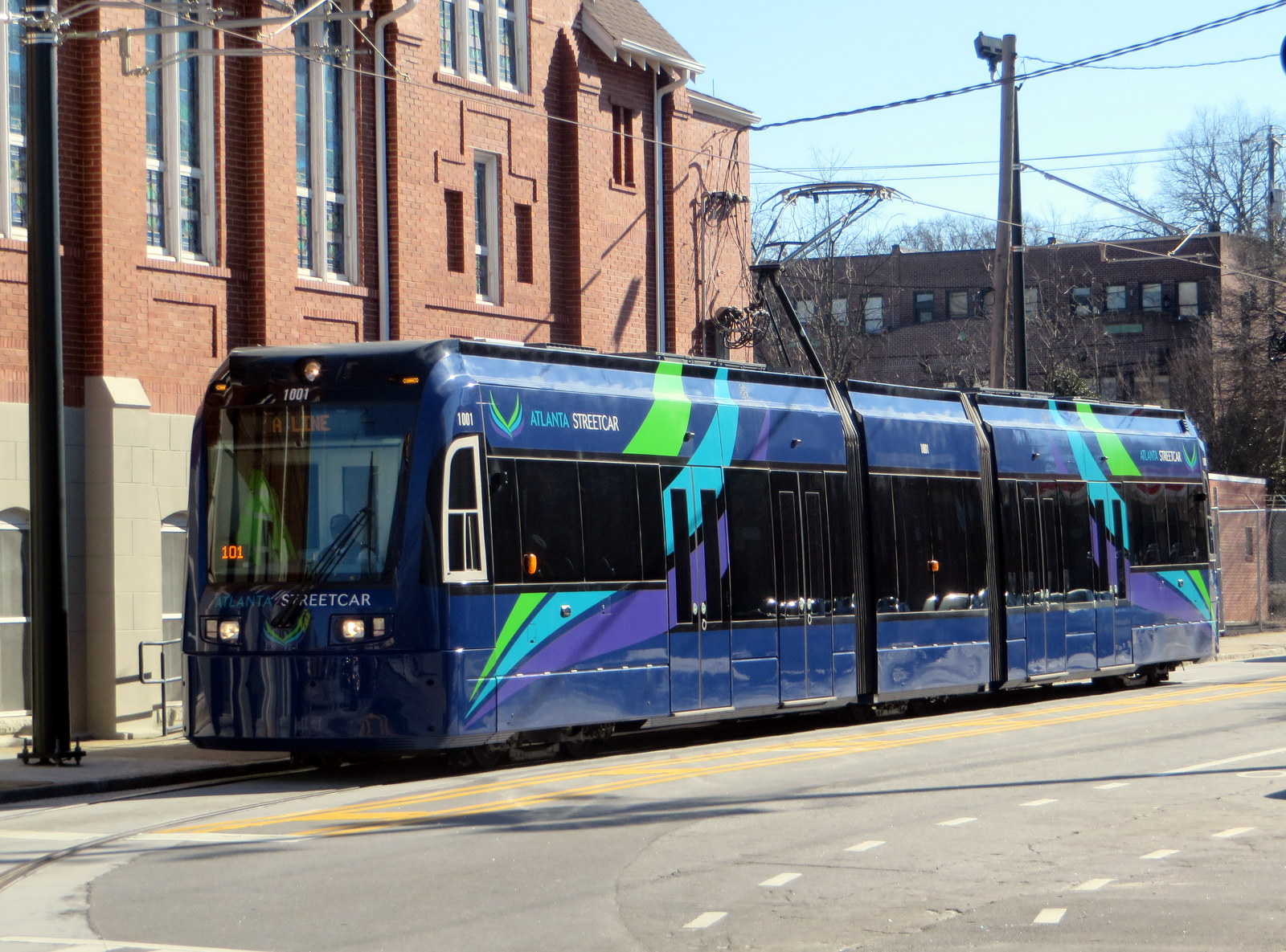
A streetcar turning onto Auburn Avenue from Jackson Street, approaching the King Historic District stop, in 2017

The Atlanta Streetcar (also known as the Downtown Loop) is a streetcar line in Atlanta, Georgia. Testing on the line began in summer 2014[4] with passenger service beginning as scheduled on December 30, 2014.[5][6][7][8][9] In 2024, the line had 342,700 rides, or about 900 per weekday in the second quarter of 2025.

The Downtown Loop is the Phase 1 of the Atlanta Streetcar project, which is planning to expand onto the BeltLine surrounding central Atlanta. The project is the first regular passenger streetcar service in Atlanta since the original Atlanta streetcars were phased out in 1949.

Operations

[edit]

Route

[edit]

The Downtown Loop runs 2.7 miles (4.3 km) east-west, serving 12 stops,[10] from Centennial Olympic Park to the Martin Luther King, Jr. National Historic Site, with tracks that converge at Woodruff Park.[11] The route provides access to MARTA heavy rail lines at Peachtree Center.[12] The vehicle maintenance facility is located under the I-75/I-85 overpass on Edgewood Avenue[13]

The exact route is:

  • From the King Historic Site at Jackson Street and Auburn Avenue, westbound along Auburn Avenue to Peachtree Street.
  • North on Peachtree Street, stopping at Peachtree Center MARTA station, to Ellis Street.
  • West on Ellis Street to Carnegie Way.
  • Northwest on Carnegie Way to Andrew Young International Boulevard.
  • West on Andrew Young International Blvd. to Centennial Olympic Park Drive.
  • South on Centennial Olympic Park Drive to Luckie Street.
  • Southeast on Luckie Street, crossing Peachtree Street to Park Place.
  • South on Park Place to Edgewood Avenue.
  • East on Edgewood Avenue to Jackson Street.
  • North on Jackson Street to Auburn Avenue.[14]

Rolling stock

[edit]

The Atlanta Streetcar system uses Siemens S70 light rail vehicles (LRVs).[15] A total of four S70 cars were purchased[9] and were built at two different facilities; the cars themselves were built in Sacramento, California while most other major components, like the propulsion system, were assembled at a plant about 30 miles (48 km) north of Atlanta, in Alpharetta.[16][17] They were delivered in the first months of 2014 and are numbered 1001–1004.[18]

History

[edit]

Atlanta Streetcar, Inc.

[edit]

Atlanta Streetcar, Inc. (ASC) is a non-profit organization founded in 2003 with the mission to bring streetcars back to downtown Atlanta. ASC's board members include the leaders of Georgia Tech and Georgia State University, MARTA, Georgia World Congress Center, Buckhead Community Improvement District, Buckhead Coalition, Underground Atlanta, Central Atlanta Progress, Woodruff Arts Center, and many local corporate business leaders as well.[19]

Peachtree Corridor Partnership

[edit]

In the summer of 2007, a new privately funded group called the Peachtree Corridor Partnership was formed, with the goal of determining how best to move forward the proposed rebuilding of Peachtree Street as a more attractive and pedestrian-friendly thoroughfare.[20] The addition of a modern streetcar line was (and remains) one of the main components of the proposed transformation of the corridor, so many of the board members of ASC became members of the Peachtree Corridor Task Force, and the partnership eventually replaced the function of ASC as the organization advocating for a streetcar line along Peachtree Street.

In July 2009, the Atlanta city council approved funding a feasibility study to work out certain details of the proposed streetcar line in time to apply for federal economic-stimulus funds for the construction of such a line.[21] However, several council members later expressed doubts over whether the remainder of the funding necessary to bring the project to fruition was likely, particularly during a time of recession.[22]

Downtown Loop route funded

[edit]

In September 2010, it was announced that Phase I of the Atlanta Streetcar Project had received $47 million in federal Transportation Investment Generating Economic Recovery (TIGER) II funding. The funding represents 8% of the overall TIGER II allotment, and will fund the construction of the downtown loop, not the Peachtree Corridor line, which is now regarded as Phase V of the project.[23][24]

In May 2011, Siemens announced that it had won the $17.2 million contract to build the four streetcars that will run on the Downtown Connector line. They would be based on the company's S70 light rail vehicle platform, with the cars themselves being built in Sacramento, California, while other major components, including the propulsion system, were to be assembled at a Siemens plant about 30 miles (48 km) north of Atlanta, in Alpharetta.[16][17]

In February 2012, the city announced that the budget would increase from $70 million to $90 million. The city attributed the increase to:[25]

  • about $9 million to purchase newer and more expensive streetcars that could last 20 years longer than the refurbished ones that were originally planned to be purchased
  • $4 million so that the Atlanta Regional Commission's Livable Centers Initiative could provide grants for sidewalk improvements and bicycle lanes.
  • Additional work by the water department to move water and sewer pipes

In March 2012, the MARTA Board of Directors formally approved the design-build contract with URS Corporation for the Atlanta Streetcar.[26]

Construction and opening

[edit]

Groundbreaking for the project took place on February 1, 2012.[25][27] At that time, the line was projected to open in May 2013, but various delays pushed the opening back, first to summer 2014 and later to December.[9] The first two S70 streetcars were delivered in February 2014[18] and began test runs on the line in the spring. The initial 2.7 mile loop cost $98M which was almost $30M higher than originally projected.

The 2.7-mile (4.3 km) loop opened for service on December 30, 2014,[5] with all rides free until January 1, 2016.[8][9]

MARTA takeover

[edit]

By June 2018, MARTA agreed to take control and ownership of the streetcar; the route is planned to be integrated into a larger MARTA light rail system.[28] Operations were placed under the control of the newly formed Office of Light Rail Operations on July 1, 2018.[29]

BeltLine expansion

[edit]

In 2015, the city of Atlanta applied for a TIGER 7 grant in 2015 to fund an Atlanta BeltLine public transit expansion project, but was unsuccessful.[30]

In November 2016, 71% of Atlanta voters approved a half-penny sales tax increase to fund More MARTA projects, projected to raise $2.5 billion over 40 years, to fund additional bus rapid transit lines, light rail, and infill stations.[31][32][33] $66 million was allocated to buying the remaining right-of-way to complete the Atlanta BeltLine loop.[33] The tax increase became effective in March 2017.[32]

In October 2018, MARTA's board approved a concrete list of "More MARTA" projects, including $570 million to build a streetcar line on 15 miles of the Atlanta BeltLine, to fulfill the BeltLine's original vision as a multimodal transportation corridor offering light rail transit and urban trails.[34][35] The first phase of expansion, known as the Streetcar East Extension, was scheduled to begin operations in 2028.[36] The extension planned to extend streetcar tracks by 2 miles, east along Edgewood Avenue, Randolph St, and Auburn Ave, then north along the BeltLine to Ponce City Market, and five new light rail stations.[37][38] In June 2023, MARTA selected a designer for the extension.[38] In March 2024, the extension was estimated to cost $200 million.[39] Construction was forecasted to begin in 2025.[40]

In March 2025, Atlanta mayor Andre Dickens withdrew his support from the Streetcar East Extension, and reprioritized a streetcar extension into the Southside corridor instead.[41][42] Various lobbying groups, including Better Atlanta Transit had lobbied against this extension, while advocates of BeltLine transit, including Beltline Rail Now criticized the late-breaking decision.[42][41]

List of streetcar stations

[edit]

Counter-clockwise loop between Centennial Olympic Park and King Historic District

Stop Direction Notes
Centennial Olympic Park Southbound Serves Centennial Olympic Park, CNN Center, Georgia Aquarium, Mercedes-Benz Stadium, GWCC, National Center for Civil and Human Rights, State Farm Arena and World of Coca-Cola
Terminus
Luckie at Cone Eastbound Serves Fairlie−Poplar Historic District
Park Place Southbound Serves Woodruff Park and Underground Atlanta (walking distance)
Hurt Park Eastbound Serves Georgia State Capitol, Georgia State University and Hurt Park
Sweet Auburn Market Eastbound Island side platform in middle of street
Serves Grady Hospital and Sweet Auburn Curb Market
Edgewood at Hilliard Eastbound In walking distance of Selena S. Butler Park
King Historic District Westbound Intersection of Auburn and Jackson Streets
Serves Martin Luther King Jr. National Historical Park and Oakland Cemetery (walking distance)
Dobbs Plaza Westbound Platform located under the Downtown Connector (I-75/85)
Serves Dobbs Plaza and Sweet Auburn
Auburn at Piedmont Westbound Serves Calhoun Park
Woodruff Park Westbound Serves Woodruff Park
Peachtree Center Northbound Direct connection to MARTA rapid transit at Peachtree Center station
Serves Peachtree Center district
Carnegie at Spring Westbound Serves Fairlie−Poplar Historic District
Final stop before reaching terminus at Centennial Olympic Park stop

Criticism

[edit]

Since opening for service, the Atlanta Streetcar has been criticized by officials and residents for its short route, safety, poor management, and lower-than-expected ridership. Although boosters have claimed that up to $2.5 billion worth of new development can be attributed to the streetcar, independent analysis shows that many of those projects (totaling at least $323 million) pre-date it, and others—such as the College Football Hall of Fame—had not taken the streetcar into consideration. Regardless, the streetcar has contributed to at least some economic growth; for example, Southeast Capital Companies stated that it directly influenced their decision to build residential housing near Edgewood Avenue, and the Atlantic Seafood Market saw business rise 10% in the months following the start of service.[43]

In September 2015, officials from the Federal Transit Administration expressed concerns with the system's lack of safety, poor management, and failure to comply with requirements for reporting accidents. Atlanta mayor Kasim Reed and MARTA CEO Keith Parker have laid out steps to address those issues.[44]

On May 23, 2016, state officials sent a letter to then-mayor Kasim Reed and MARTA CEO Keith Parker threatening to shut down the streetcar unless the city fixed numerous problems with it that had been outlined in multiple then-recent audits.[45]

See also

[edit]

References

[edit]
[edit]
Revisions and contributorsEdit on WikipediaRead on Wikipedia
from Grokipedia
The Atlanta Streetcar, also known as the Downtown Loop, is a 2.7-mile modern streetcar line operating as a single loop in downtown Atlanta, Georgia, linking 12 stops across the central business district and the adjacent Sweet Auburn neighborhood. Passenger service began on December 30, 2014, following months of testing, with the system utilizing low-floor Siemens S70 streetcars powered by overhead electric catenary wires and providing average headways of 15 minutes during peak hours. Originally conceived to improve east-west transit connectivity and spur urban revitalization after Atlanta's historic streetcar era ended in 1949, the project cost approximately $98 million in federal and local funds but has underperformed in delivering substantial ridership or alleviating traffic congestion. Ridership initially surged under a free-fare policy but declined sharply by nearly 50% after a $1 fare was imposed in 2016, stabilizing at low levels—around 185,000 annual boardings in 2023 and roughly 900 weekday trips in mid-2025—far below projections amid criticisms of slow speeds in mixed street traffic and limited utility for commuters compared to buses or existing rail. Operation transitioned to the Metropolitan Atlanta Rapid Transit Authority (MARTA) in recent years, with plans for a two-mile eastward extension targeted for 2028, though the core loop continues to face operational pauses and questions about cost-effectiveness.

Operations

Route and Alignment

The Atlanta Streetcar operates on a 2.7-mile (4.3 km) counter-clockwise loop aligned primarily east-west through , linking the on the western end with the National Historical Park and neighborhood on the eastern end. The alignment follows existing city streets in mixed-traffic conditions, with streetcars sharing lanes with vehicles and pedestrians, and includes short dedicated track segments for passing and operations at termini. This configuration prioritizes connectivity to tourist attractions, business districts, and MARTA rail stations, such as , while traversing areas like the Fairlie-Poplar historic district and government buildings near Woodruff Park. The route begins at and proceeds eastward along streets including International Boulevard and Auburn Avenue, reaching the King Historic District before curving westward via Edgewood Avenue and Piedmont Avenue to complete the loop back through and Woodruff Park. Single-track sections predominate, with bidirectional capability supported by crossovers, enabling efficient loop service without full double-tracking. As of 2025, no permanent extensions beyond the original loop have been implemented, though preliminary planning for an eastward extension along Edgewood Avenue to the Atlanta BeltLine has been evaluated. The system serves 12 stops, providing access to major landmarks and transit hubs: This stop distribution emphasizes walkable access to cultural sites, with intervals averaging 0.23 miles between stations to support short-hop urban travel.

Stations and Accessibility

The Atlanta Streetcar comprises 12 stations along its 2.7-mile counter-clockwise loop, connecting downtown Atlanta's commercial core with the Historic District and providing linkages to cultural sites, parks, and employment centers. The stations, which facilitate pedestrian access to landmarks such as , Woodruff Park, and the National Historical Park, include: (with direct connection), Carnegie at Spring, , Luckie at Cone, Park Place (serving ), Hurt Park (adjacent to ), Sweet Auburn Market, Edgewood at Hilliard, King Historic District, Dobbs Plaza, Auburn at Piedmont, and Woodruff Park. Station platforms are uniformly elevated 14 inches above the roadway to minimize boarding steps while maintaining compatibility with standard street-level operations, and each incorporates at least one ADA-compliant access ramp from the adjacent sidewalk, typically with two entry points per platform for efficient passenger flow. These designs ensure level boarding for the low-floor vehicles, which feature dedicated wheelchair spaces, priority seating for mobility-impaired passengers, and audible announcements indicating door-side openings to assist visually impaired riders. Post-2018 integration under MARTA oversight has included ongoing enhancements to platform markings and tactile paving for further sensory accessibility, though some critiques note occasional gaps in real-time service announcements during peak disruptions.

Rolling Stock and Maintenance

![Siemens S70 streetcar of the Atlanta Streetcar][float-right] The Atlanta Streetcar fleet consists of four S70 vehicles, introduced in 2014. These bi-directional, double-articulated streetcars feature a six-axle configuration with two powered trucks—one at each end—and a non-powered center truck. Each vehicle measures over 79 feet in length, weighs approximately 100,000 pounds, and includes eight wide-opening sliding plug doors (four per side) located in the low-floor sections for level boarding. Powered by a 750 Vdc overhead catenary system, the S70 streetcars are equipped with four 174 hp motors, enabling maximum speeds of 35 mph and a capacity for up to 195 passengers, including spaces for wheelchairs and bicycles, HVAC systems, and passenger information displays. The partially low-floor design facilitates ADA-compliant accessibility in the center section. Vehicle maintenance is performed at the dedicated Vehicle Maintenance Facility (VMF) located beneath the I-75/I-85 overpass on Edgewood Avenue, between Edgewood and Auburn Avenues. This 11,767-square-foot facility supports storage for up to seven streetcars and light maintenance tasks, including periodic inspections. Since the 2018 operational handover to the (MARTA), maintenance integrates with broader agency practices, supplemented by on-call emergency repairs for vehicles and related infrastructure. The under-freeway location has prompted concerns due to limited ventilation and access.

Service Schedules, Fares, and Ridership Patterns

The Atlanta Streetcar operates daily with varying hours: from 6:00 a.m. to 11:00 p.m. through , 6:00 a.m. to 1:00 a.m. on Fridays, 8:30 a.m. to 1:00 a.m. on Saturdays, and 9:00 a.m. to 11:00 p.m. on Sundays. Vehicles run at headways of approximately 10 to 15 minutes, adjusted based on demand and traffic. Service was suspended starting September 8, 2025, for several months to facilitate underground utility repairs by and deep cleaning along the route, reflecting ongoing maintenance challenges. The standard one-way fare is $1.00, with no transfers permitted to MARTA bus or rail services; children under 46 inches in height ride free. A one-day unlimited pass costs $3.00. Fares, introduced after an initial free period ending in 2016, have not generated significant revenue relative to operating costs, covering only a small fraction of expenses. Ridership has consistently fallen short of projections since opening, averaging below capacity even during the free introductory phase, with further declines after fares were implemented due to factors including rates exceeding 50% and competition from other transit modes. In 2024, annual ridership reached 342,700 trips, recovering to 97% of 2019 pre-pandemic levels by October but remaining among the lowest compared to peer streetcar systems, with about 900 weekday boardings in the second quarter of 2025. Operating expenses per ride averaged over $10 in 2022, highlighting heavy subsidization. Patterns show seasonal peaks in tourism-driven usage but overall stagnation, exacerbated by post-pandemic shifts and service reliability issues.

Historical Development

Predecessor Streetcar Systems

Atlanta's earliest public transit system emerged in the post-Civil War era with the introduction of mule-drawn streetcars in 1871, operated by the Atlanta Street Railway Company on a line connecting to the of Clifton. By , the company had expanded to six lines totaling 11 miles of track, employing 17 cars powered by 114 mules. Additional companies constructed lines in 1883 and 1884 amid growing demand, facilitating suburban development and land value increases along routes. Electrification transformed the system starting in the late 1880s, with the first debuting on August 22, 1889, and widespread adoption by 1890, replacing animal power and enabling faster, more reliable service. In 1901, Henry M. Atkinson consolidated operations under the Georgia Railway & Electric Company, which integrated streetcar services with the city's and expanded , including pole supports for overhead lines documented prior to 1924. By 1928, the network had grown extensive enough to connect distant areas like East Point to North Druid Hills with minimal transfers. The system's peak coincided with interurban extensions and facilities like the 1923 trolley waiting station in Druid Hills, but financial pressures mounted in the 1930s, leading to the introduction of trolleybuses in 1937 as a cost-saving alternative to rail. , the successor to Georgia Railway & Power, discontinued the last streetcar line in 1949 amid rising automobile use and postwar suburbanization, shifting to buses and trackless trolleys that persisted until 1963. These historical lines, while not directly ancestral to the modern Atlanta Streetcar's alignment, represented the city's foray into fixed-rail urban transit, influencing later revival efforts through demonstrated viability in dense corridors.

Planning and Initial Funding (2000s)

The revival of streetcar service in was first conceptualized in the early as part of initiatives to improve urban connectivity and stimulate economic redevelopment in the . These efforts sought to link major employment hubs, tourist attractions, and emerging residential areas while addressing through low-capacity, circulator transit aligned with existing roadways. Planning gained organizational momentum with the establishment of advocacy groups and inclusion in city transportation visions, building on regional studies from the late that highlighted gaps in MARTA's heavy rail coverage for short-haul downtown trips. By , streetcar alignments were outlined in Atlanta's Connect Atlanta comprehensive plan, proposing integration with the BeltLine and other multimodal corridors to support mixed-use growth. Feasibility assessments in the late focused on a 2.7-mile downtown loop, evaluating routes along Peachtree, Luckie, and Drive to minimize disruption to vehicular traffic. Initial funding for planning and preliminary engineering drew from local sources, including city capital budgets and contributions from business improvement districts like Central Atlanta Progress, which prioritized . In July 2009, the allocated funds for a detailed to refine alignment, ridership projections, and cost estimates, estimated at $72 million for the core loop excluding vehicles. Federal grant pursuits began in earnest with unsuccessful applications to the inaugural program in 2009 for a larger $300 million network extension, prompting a scaled-back proposal for the segment. These early allocations totaled under $10 million, primarily for environmental reviews and design concepts, with no dedicated state secured until later federal commitments.

Construction Phase (2010–2014)

In October 2010, the Atlanta Streetcar project secured a $47.6 million grant from the U.S. , the largest award in the program's second round, enabling the advancement of construction for the 2.7-mile loop. The total project cost was estimated at $72 million, supplemented by $15.6 million from the City of and contributions from the Atlanta Downtown Improvement District. This funding followed environmental assessments completed in November 2010, which outlined the project's integration with existing transit infrastructure to enhance connectivity. Construction commenced with a groundbreaking ceremony on February 1, 2012, attended by federal and local officials, marking the start of the design-build phase led by G.W. Peoples Contracting for the downtown loop segment. In 2011, Siemens had been contracted by the Metropolitan Atlanta Rapid Transit Authority to supply four S70 low-floor streetcars at a cost of $17 million, with the vehicles intended for delivery ahead of testing. Track installation and infrastructure work, including overhead catenary systems and platform preparations at 12 stops, progressed through 2012 and 2013, focusing on the east-west route linking Centennial Olympic Park to Martin Luther King Jr. National Historical Park. The first two streetcars arrived in February 2014, initiating on-track testing in the spring, while final utility relocations and signal integrations extended into late 2014. Delays in vehicle certification and infrastructure completion pushed the anticipated spring 2014 operational start to December, reflecting challenges in coordinating urban construction amid active downtown traffic. H.J. Russell & Company provided oversight during this period to ensure compliance with historical preservation requirements near sites like the Martin Luther King Jr. National Historical Park. By the end of 2014, the core infrastructure was substantially complete, setting the stage for revenue service.

Opening and Early Operations (2015–2017)

The Atlanta Streetcar, a 2.7-mile (4.3 km) bidirectional loop serving , began revenue operations on December 30, 2014, after multiple delays from its originally projected May 2013 opening. The featured a ceremonial ride from the maintenance facility to Woodruff Park, followed by public access with complimentary fares offered for the initial three months to encourage usage and system familiarization. The route connected 12 stops, including linkages to existing MARTA heavy rail stations at and , traversing key areas such as , , and the National Historical Park. Service operated with four S70 low-floor vehicles, capable of bi-directional travel without turning loops at terminals, running at speeds up to 30 mph but frequently limited by urban traffic integration. Initial performance in early 2015 revealed operational shortcomings, including slow travel times averaging over 50 minutes for the full loop due to signal prioritization issues, frequent stops, and interference from mixed street traffic. Ridership in the first reached 102,000 passengers, falling 18% short of the city's pre-opening projection of 124,000, attributed partly to winter and limited awareness despite promotional efforts. Full-year 2015 ridership totaled approximately 809,000, buoyed by the fare-free period but still below expectations for a system designed to catalyze economic activity. Fares of $1 per ride were introduced on March 1, 2015, coinciding with a sharp decline in usage; first-quarter 2016 ridership dropped 48% compared to the prior year, yielding only 91,373 boardings and $45,186 in revenue amid reports of widespread . By 2016, average daily ridership hovered below projections, with operational data indicating underutilization as passengers opted for faster alternatives like walking or buses in the compact . In 2017, ridership further declined 58% from 2016 levels, averaging around 700 daily passengers against a target of 2,000, exacerbated by persistent mechanical issues, inconsistent scheduling, and inadequate enforcement of payments. These early years highlighted systemic challenges in integrating the streetcar with Atlanta's automobile-centric infrastructure, where causal factors such as low speeds and redundant coverage relative to pedestrian distances undermined viability.

MARTA Takeover and Integration (2018 Onward)

On July 1, 2018, the (MARTA) assumed operations of the Atlanta Streetcar from the City of , marking a shift to centralized management under MARTA's newly created Office of Operations. This office handles daily service, maintenance, and inspections, with support from MARTA's existing departments for ancillary functions. MARTA also acquired full ownership, enabling unified oversight of assets alongside its heavy rail and bus networks. The integration preserved the $1 single-ride fare while incorporating compatibility with MARTA's Breeze system, facilitating transfers across modes under a transparent regional . Operational standards aligned with MARTA's FY 2019 service guidelines, emphasizing reliability enhancements for the 2.7-mile loop serving 12 stations. Early post-takeover costs for operations and totaled about $3 million through May 2019. MARTA's management introduced consolidated light rail protocols, contributing to safety advancements amid ongoing infrastructure challenges. Service disruptions occurred for repairs, including utility work in 2018 and wheel assembly replacements in 2025 due to degradation concerns. Ridership remained low relative to peer systems, recording the second-lowest annual figures among eight comparable streetcars in 2023, though recovering to 97% of 2019 levels by October 2024. Integration supported planning for system enhancements, such as operational tweaks to boost ridership through better scheduling and event coordination.

Recent Operations and Challenges

Service Disruptions and Repairs (2020s)

In response to the , the Atlanta Streetcar experienced significant ridership declines but maintained reduced operations rather than full suspension, aligning with broader MARTA service modifications that prioritized essential routes. On November 29, 2022, MARTA halted all streetcar service after engineers identified wheel degradation posing a , requiring the removal of all four vehicles from operation. The agency expedited repairs, including full replacements, assembly overhauls, and system upgrades, with service resuming partially in March 2023 as the first vehicle returned to revenue operation; shuttle vans supplemented the route during the approximately four-month outage. MARTA suspended streetcar service again starting September 8, 2025, for an estimated three to four months to facilitate urgent underground electrical utility repairs by Georgia Power along the alignment, marking the second major prolonged outage in roughly two years. The work addressed potential failures in aging infrastructure, with concurrent MARTA-led upgrades to track and overhead wiring; replacement shuttle vans, branded to mimic streetcars, provided alternative service to all stops during the closure. These disruptions highlight ongoing challenges with the system's legacy components, originally procured in the mid-2010s, which have necessitated reactive maintenance to ensure operational reliability.

Post-Pandemic Recovery Efforts

Following the pandemic's onset in 2020, which prompted service reductions and sharp ridership drops across , the Atlanta Streetcar saw passenger volumes plummet due to shifts, health precautions, and economic disruptions. Pre-pandemic ridership in 2019 served as a baseline of approximately 350,000 annual trips, but 2020 figures fell dramatically amid lockdowns and capacity limits. Under MARTA's management since 2018, recovery began incrementally from 2021 onward, with ridership rebounding through fare integration with the broader system and resumed full operations. By 2023, annual trips reached levels second-lowest among peer U.S. streetcar systems, reflecting persistent underutilization despite national transit recovery trends. Through October 2024, ridership attained 97% of 2019 volumes, per Federal Transit Administration data, though absolute numbers stayed modest at around 342,700 for the full year. MARTA's post-pandemic efforts emphasized rehabilitation over ridership marketing, addressing deferred that worsened during low-usage periods. A key initiative involved a planned 3- to 4-month service suspension starting September 8, 2025, coinciding with Georgia Power's urgent underground utility repairs, to execute comprehensive upgrades including wire inspections and repairs, track , station refurbishments, modernization, vehicle updates, deep cleaning of the alignment, and tree trimming to mitigate overhead wire interference. Shuttle vans substituted along the route during this period to maintain connectivity. These measures targeted reliability issues, such as frequent disruptions from aging , which had compounded pandemic-era service gaps. Complementary planning included the November 2024 Existing System Enhancement Report, which assessed operational safety, customer amenities, and traffic integration for the core line ahead of potential extensions, incorporating data on low speeds (averaging 5 mph) and security needs to inform targeted fixes. Despite these steps, Atlanta's streetcar recovery lagged national peers, with MARTA's overall system below 50% of pre-2019 ridership in some metrics by 2024, attributed to hybrid work patterns and competition from alternatives like ridesharing.

Expansion Initiatives

Proposed Downtown Extensions

The primary proposed extension for the Atlanta Streetcar involves an eastward route from its current downtown terminus, designated as the Streetcar East Extension, aimed at connecting to the Atlanta BeltLine's Eastside Trail. This project, the first planned expansion since the system's 2014 opening, would add approximately 2.2 miles of track, traversing Edgewood Avenue, Randolph Street, Auburn Avenue, and Irwin Street, with the final stop near Ponce City Market adjacent to the BeltLine corridor. The extension seeks to enhance connectivity between downtown Atlanta and emerging transit-oriented developments along the BeltLine, utilizing existing streetcar infrastructure for shared operations under MARTA management. Initial planning advanced through design contracts awarded by MARTA in 2023, with environmental assessments and preliminary engineering completed by late 2024, targeting construction commencement in 2025 pending approval. The estimated stands at around $200 million, drawn from and federal grants, though timelines have faced delays due to revised alignments that limit streetcar incursion into the BeltLine itself, instead terminating service near Krog Street Market to avoid conflicts with pedestrian-heavy paths. In March 2025, officials briefly shifted emphasis toward a southern extension alternative, citing potential savings and integration with other downtown revitalization efforts, but this was not formalized, and eastbound plans retained priority amid ongoing MARTA board deliberations. Proponents argue the extension would boost ridership by linking high-density areas like Sweet Auburn historic district and Inman Park, projecting up to 1,000 additional daily boardings based on existing system data extrapolated to new stops. However, critics, including Atlanta Mayor Andre Dickens, have questioned fiscal viability following independent audits highlighting overruns in the original streetcar's operations, leading to temporary withholding of city support in early 2025 until enhanced cost-benefit analyses are provided. As of October 2025, MARTA continues public forums and digital infrastructure upgrades in preparation, with final alignment approvals pending regional transportation authority input.

BeltLine Integration Plans

The Atlanta Streetcar East Extension represents the primary plan to integrate the existing downtown streetcar loop with the Atlanta BeltLine, by extending service eastward to connect directly with the BeltLine's Eastside Trail. This approximately 1.1-mile extension would run from the current eastern terminus at King Memorial station along Edgewood Avenue, intersecting the BeltLine at Irwin Street and continuing northward to Ponce de Leon Avenue near . The project, developed as the initial phase of broader BeltLine transit ambitions, aims to enhance regional connectivity by linking downtown attractions to the popular Eastside Trail, which sees heavy pedestrian and cyclist use, while facilitating future development along the 22-mile BeltLine corridor. Managed by MARTA in partnership with the City of Atlanta and Atlanta BeltLine, Inc., the extension is funded through the More MARTA half-penny approved by voters in 2016, with an estimated cost of $230 million. Preliminary engineering has advanced, with 30% design drawings submitted for BeltLine review by early 2025, and full construction documents in development; construction is slated to begin in 2025, targeting operational service by 2028. Proponents argue it aligns with the 2016 Atlanta Streetcar System Plan's vision for crosstown streetcar corridors feeding into BeltLine transit, potentially boosting ridership by providing seamless access without transfers. However, the project has faced opposition from neighborhood groups, including residents, who cite concerns over construction disruptions, traffic impacts on residential streets, and the extension's cost-effectiveness given the streetcar's historically low ridership. In March 2025, Mayor proposed prioritizing a southward extension from the downtown loop toward as an alternative or complement, potentially redirecting resources from the east route amid ongoing debates, though official planning documents as of mid-2025 continued to list the East Extension in the design phase with a projected completion around 2027. This southward option would not directly connect to the BeltLine but could indirectly support integration via improved downtown-BeltLine linkages through other modes; the BeltLine's broader $3.5 billion vision, unveiled in August 2025, emphasizes dedicated rights-of-way separate from trails, potentially superseding streetcar-only extensions in future phases. Despite these evolutions, the East Extension remains the designated mechanism for initial Streetcar-BeltLine linkage, with engineering firm selection pending detailed alignment refinements.

Performance and Economic Analysis

Ridership Data and Projections vs. Reality

Prior to opening on December 30, 2014, Atlanta Streetcar planners projected average weekday ridership of 2,600, as stated in federal TIGER grant applications and city promotional materials. These estimates assumed the 2.7-mile loop would serve as a vital downtown connector, drawing commuters and tourists between key destinations like Centennial Olympic Park and Martin Luther King Jr. National Historical Park. Initial operations, with fares waived through much of 2015 to boost adoption, yielded ridership 18 percent below projections in the first weeks, with approximately 100,000 total trips in the opening eight weeks averaging under 1,800 daily. By fiscal year 2019, prior to the pandemic, average daily ridership had stabilized below 600 despite paid fares of $1 per ride. The COVID-19 pandemic exacerbated declines, with service disruptions and reduced downtown activity pushing 2023 annual unlinked passenger trips to 184,500, or just over 500 daily on average. Recovery efforts post-2023 repairs and MARTA's operational tweaks returned 2024 ridership through October to 97 percent of 2019 levels, per data, equating to roughly 343,000 annual trips overall—still only about one-third of the annualized projection equivalent of 650,000 trips. This persistent gap, documented across independent policy analyses, underscores overly optimistic modeling that overestimated utility in a car-dependent urban core with limited integration to broader transit networks. Recent weekday averages hover around 900, reflecting partial rebound but no closure of the foundational shortfall.

Cost Structure and Funding Sources

The construction of the Streetcar's initial 2.7-mile downtown loop totaled $92.6 million in . This encompassed track installation, four vehicles, stations, and related , with primarily from a $47.6 million federal discretionary grant awarded by the U.S. in October 2010. The City of contributed $21.6 million in matching capital funds, drawn from local bonds and (TIF) districts including the Atlanta Downtown Improvement District (ADID). Remaining costs were covered by state contributions and private development incentives tied to urban revitalization pledges along the route. Prior to the (MARTA) assuming operations in September 2018, annual operating expenses—estimated at several million dollars—were structured around fixed costs for vehicle maintenance, utilities, and a small staff of operators and supervisors, offset by variable revenues from $1 fares, , and supplemental federal . Commitments secured operations for 20 years through ADID TIF allocations and farebox recovery, though actual fare revenues consistently fell short due to limited ridership. Under MARTA management, the streetcar's operating budget integrates into the agency's broader $652 million annual net operating funds for 2026, funded mainly by a 1% approved by voters in 2016 (the "More MARTA" program), which generated over $371 million by 2022 across transit initiatives. Of this, MARTA allocated $15.3 million specifically to streetcar operations and maintenance through mid-2022, covering labor for up to 12 operators, track repairs, and power systems amid persistent service disruptions. Passenger contribute minimally, with cost-per-trip metrics exceeding $77 in low-ridership months like July, driven by high fixed expenses and underutilization relative to projections. Federal operating assistance and state aid provide supplementary support, but taxpayer revenues predominate, highlighting a subsidy-heavy model with recovery below 5%.

Operational Efficiency Metrics

The Atlanta Streetcar's is marked by reliable scheduling adherence but elevated costs driven by low ridership and fixed demands in mixed-traffic environments. On-time , defined as departures within scheduled windows, consistently exceeds MARTA benchmarks, with rates reaching 98.6% in select months as of December 2024. This reliability stems from predictable low-speed operations averaging under 10 mph along the 2.7-mile loop, minimizing delays from or bunching common in higher-capacity systems. Cost per passenger metrics highlight inefficiencies, with operating expenses per unlinked trip reported at $77.91 for July, surpassing forecasts by $66.80 due to elevated labor, , and costs amid subdued demand. Per-passenger-mile costs average $48.60, reflecting sparse boarding—often below 20 passengers per vehicle—and the overhead of dedicated tracks and systems that yield minimal throughput in downtown Atlanta's . Farebox recovery ratios remain under 5%, necessitating subsidies of approximately $40 per rider from local taxes and federal grants, as ridership has hovered around 500,000 annual trips post-2020 despite service expansions. Productivity indicators, such as passengers per revenue vehicle hour, lag behind regional bus and rail averages, typically under 25 boardings per hour versus MARTA bus figures exceeding 30. Mean distance between failures meets expectations per MARTA KPIs, supported by S70 vehicles designed for 35 mph maximums, though actual utilization rarely approaches capacity for 195 passengers due to short trips and competition from walking or rideshares. These metrics collectively indicate that while mechanically sound, the streetcar's design prioritizes fixed-route presence over scalable throughput, yielding net operational losses exceeding $10 million annually.

Impacts and Evaluations

Claimed Urban Revitalization Effects

Proponents of the Atlanta Streetcar, including city officials, asserted that the 2.6-mile line would act as a catalyst for downtown revitalization by spurring private investment and redevelopment along its corridor from through Historic Sweet Auburn to the National Historical Park. They claimed the project would enhance connectivity to existing transit hubs, fostering multimodal access that would attract businesses, residential development, and while revitalizing underutilized historic districts. In planning documents, the streetcar was projected to generate over $167 million in new over 30 years through induced economic activity, including higher property values and commercial leasing in adjacent blocks. These claims positioned the streetcar as a tool for broader , linking it to initiatives like the Atlanta BeltLine to amplify development in surrounding neighborhoods by improving pedestrian-oriented circulation and signaling commitment to sustainable growth. Advocates, drawing from precedents in other cities, argued it would drive "tremendous potential" by anchoring mixed-use projects and countering vacancy rates, with early forecasts emphasizing its role in transforming obsolete infrastructure into a vibrant economic spine. City applications for federal funding highlighted anticipated spillover effects, such as increased foot traffic benefiting legacy institutions and small businesses in areas like , which had faced decades of disinvestment. Such projections were echoed in promotional materials, where the streetcar was described as integral to a "smart investment" strategy, expected to leverage public dollars into private-sector commitments for , retail, and expansions totaling hundreds of millions in value. However, these assertions often relied on optimistic modeling from consultants rather than rigorous , with officials emphasizing qualitative benefits like enhanced "place-making" alongside quantitative revenue estimates to justify the $72 million construction cost borne largely by federal grants.

Measured Transportation and Environmental Outcomes

Ridership on the Atlanta Streetcar averaged just over 500 passengers per day in 2023, equating to 178,173 unlinked trips for the year, based on manual counts by operators. This figure positioned it as the second-lowest among eight peer streetcar systems reviewed by MARTA, reflecting limited adoption for routine transportation. Through October 2024, annual ridership recovered to 97% of pre-pandemic 2019 levels, per data, but absolute volumes remained modest given the system's 2.7-mile downtown loop serving primarily tourists and short-haul users rather than commuters. No empirical data demonstrate significant modal shift from automobiles to the streetcar, as its design and operations—lacking dedicated right-of-way in key segments—fail to offer competitive travel times or connectivity for broader trip purposes. Instead, the system contends with traffic-induced delays, including up to 10 minutes during evening peaks on Edgewood Avenue SE and frequent missed runs during special events at due to congestion and interference. These operational challenges underscore an absence of measurable congestion relief, with the streetcar embedded in mixed traffic flows that exacerbate rather than mitigate bottlenecks. Environmental outcomes remain unquantified in specific studies for the Atlanta Streetcar, with no reported metrics on net emissions savings from displaced vehicle trips. Its overhead-wire electric propulsion eliminates direct tailpipe emissions, but low ridership and average trip distances under two miles constrain any substantive reduction in regional CO2e, particularly against Georgia's grid carbon intensity. Broader MARTA system analyses attribute emissions avoidance to high-capacity modes like rail and bus, but the streetcar's marginal usage yields negligible causal contribution to Atlanta's transportation-related GHG profile.

Criticisms and Debates

Financial Waste and Opportunity Costs

The Atlanta Streetcar's initial 2.7-mile loop required approximately $97 million in capital expenditures to construct and open in December 2014, drawing from federal grants totaling $47.6 million, city bonds, and local contributions. Operating costs have since imposed ongoing subsidies, with federal data indicating an average of $10.80 per ride across U.S. streetcar systems in 2022, where farebox recovery remains minimal at under 10% of expenses. For Atlanta specifically, MARTA reports document costs per passenger trip spiking to $77.91 in low-ridership months like July 2023, reflecting annual operational shortfalls funded by local sales taxes and transfers from the broader transit budget. These expenditures have drawn sharp rebukes as financial waste, with analysts labeling the system a "" that transports few riders despite heavy taxpayer funding, including federal dollars better allocated elsewhere. Extension plans exacerbate the issue, projecting $230 million for just two additional miles to the BeltLine as of 2023, equating to over $100 million per mile amid persistent underutilization of the core loop. Ridership averages under 1,000 daily passengers post-fare implementation in 2016, far below projections, yielding subsidies that dwarf those of comparable bus services and underscoring inefficient in a city with strained MARTA funding needs. Opportunity costs manifest in diverted funds from higher-impact alternatives, such as (BRT) corridors or expansions, which could deliver greater connectivity across Atlanta's sprawling metro area at lower per-mile capital costs—often under $50 million—and higher ridership potential without street-level conflicts. Economic evaluations prior to funding highlighted the streetcar's weak benefit-cost ratio, suggesting reallocations to flexible bus enhancements or regional express services might have yielded measurable reductions in and emissions for far more users. Instead, the emphasis on fixed-guideway legacy modes has constrained fiscal flexibility, with critics arguing that equivalent investments in demand-responsive options like expanded microtransit or highway capacity improvements would address Atlanta's auto-dependent commute patterns more effectively.

Design and Utility Shortcomings

The Atlanta Streetcar operates on a 2.7-mile loop without dedicated right-of-way, sharing lanes with vehicular traffic, cyclists, and pedestrians, which results in frequent obstructions from parked cars and . This design choice limits average operating speeds to 4-5 miles per hour, often making end-to-end trips no faster than walking and impeding overall street flow with 12 closely spaced stops along the route. Track alignment and physical site constraints exacerbate operational inefficiencies, including challenges in maintaining consistent speeds and integrating with urban infrastructure, such as a maintenance facility located under a highway overpass that prioritizes automotive dominance over transit optimization. Vehicle engineering has proven unreliable, with recurring wheel degradation, electrical system failures, and mechanical breakdowns reducing available cars to as few as one operational unit at times, necessitating substitutions like paratransit vans and leading to extended service suspensions. In terms of utility, the system's short length and single subway transfer point (westbound only) provide limited connectivity to broader transit networks, rendering it ineffective for commuters reliant on rapid movement across the city and more suited to short tourist or discretionary trips among affluent users rather than essential mobility. Fixed streetcar capacity lacks the scalability of buses, which can accommodate 50-60 passengers and adjust to demand fluctuations, further diminishing its role as a high-utility transport option amid over 60 unresolved operational problems including poor maintenance and accident handling.

Policy Lessons on Transit Revival Projects

The Atlanta Streetcar's implementation reveals critical pitfalls in reviving legacy transit modes without prioritizing empirical validation over political symbolism. Despite an initial capital investment exceeding $70 million, including federal TIGER grants, the system has generated annual ridership of approximately 342,700 in 2024, far below projections that anticipated robust usage for downtown connectivity. This shortfall, coupled with operating subsidies reaching $40 per rider, exemplifies how optimistic demand forecasts—often influenced by development advocacy rather than disaggregate travel modeling—lead to persistent fiscal burdens, with opportunity costs including foregone investments in scalable bus or rapid transit options. A core lesson pertains to the mismatch between streetcar design and urban operational realities: vehicles sharing lanes with automobiles achieve average speeds below 10 mph, undermined by signal priority limitations and frequent stops, rendering them inferior to flexible bus services for reliability and cost-effectiveness. Capital costs per mile for extensions have escalated to $88–107.5 million, driven by utility relocations and infrastructure demands, yet without dedicated rights-of-way, these systems fail to alleviate congestion or attract choice riders, as causal analyses show minimal mode-shift impacts in mixed-traffic environments. Proponents' claims of revitalization often conflate correlation with causation, attributing development to streetcars in areas primed for growth independently, while data indicate negligible transportation benefits relative to expenditures. Transit revival policies should mandate independent, pre-funding cost-benefit analyses incorporating sensitivity to low-density demand and alternatives like , which deliver comparable access at fractions of the cost. Atlanta's post-opening shutdowns for repairs and extension debates despite underperformance underscore the dangers of driven by sunk costs, eroding accountability; instead, frameworks emphasizing measurable outcomes—such as passenger miles per dollar—and phased pilots can mitigate risks. Ultimately, resources prove most effective when allocated to high-capacity, grade-separated systems in corridors with proven ridership potential, avoiding the allure of fixed-rail nostalgia in contexts where induced traffic interference and maintenance overheads predominate.

References

Add your contribution
Related Hubs
User Avatar
No comments yet.