Hubbry Logo
Base of skullBase of skullMain
Open search
Base of skull
Community hub
Base of skull
logo
8 pages, 0 posts
0 subscribers
Be the first to start a discussion here.
Base of skull
Base of skull
from Wikipedia
Skull base
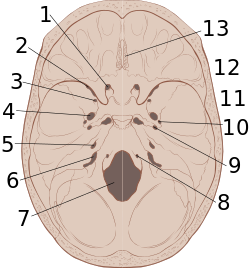
Base of the skull, inferior or inner surface
Base of the skull, exterior or outer surface. Showing various muscle attachments.
Details
Identifiers
Latinbasis cranii
externa et. interna
MeSHD019291
TA98A02.1.00.044
TA2447
FMA52801
Anatomical terms of bone

The base of skull, also known as the cranial base or the cranial floor, is the most inferior area of the skull. It is composed of the endocranium and the lower parts of the calvaria.

Structure

[edit]
Base of the skull. Inferior surface, attachment of muscles marked in red.

Structures found at the base of the skull are for example:

Bones

[edit]

There are five bones that make up the base of the skull:

Exobasis

Sinuses

[edit]

Foramina of the skull

[edit]
Endobasis-resistances beams
Endobasis-resistances nodes

Sutures

[edit]

Other

[edit]
The foramina in the base of the skull are exit and entry points for veins, arteries and cranial nerves.
The cranial nerves as they exit through various foramina.

Additional images

[edit]
Revisions and contributorsEdit on WikipediaRead on Wikipedia
from Grokipedia
The base of the skull, also known as the cranial base, is the inferior surface of the cranium that forms the floor of the , providing structural support for the while allowing the passage of neurovascular structures and the . It is a complex, irregular region composed of five primary bones: the unpaired ethmoid, sphenoid, occipital, and frontal bones, along with the paired temporal bones. This bony platform separates the intracranial contents from the extracranial spaces and is characterized by varying depths and numerous foramina that facilitate the transit of , arteries, veins, and other vital elements. The base of the skull is anatomically divided into three distinct fossae, corresponding to the major compartments of the brain. The anterior cranial fossa, the shallowest division, is formed anteriorly by the frontal bone and posteriorly by the lesser wings of the sphenoid and the ethmoid bone; it supports the frontal lobes of the brain and includes the cribriform plate for olfactory nerve passage. The middle cranial fossa, deeper and butterfly-shaped, extends from the lesser wings of the sphenoid to the petrous ridges of the temporal bones, housing the temporal lobes and featuring key openings like the optic canal, superior orbital fissure, foramen rotundum, foramen ovale, and foramen spinosum for cranial nerves II–VI and associated vessels. The posterior cranial fossa, the deepest section, is bounded anteriorly by the petrous temporal bones and posteriorly by the occipital bone, accommodating the cerebellum and brainstem with major foramina such as the foramen magnum (for the spinal cord and vertebral arteries), jugular foramen (for cranial nerves IX–XI and the internal jugular vein), and hypoglossal canal (for cranial nerve XII). These divisions and foramina underscore the base of the skull's critical role in protecting neural and vascular pathways, making it a frequent site of in trauma, tumors, and infections. For instance, basilar skull fractures, often resulting from high-impact , can disrupt these passages, leading to complications like or vascular damage such as epidural hematomas from rupture. The region's intricate anatomy also poses unique challenges in surgical approaches, particularly for skull base tumors, where precise navigation of neurovascular elements is essential.

Overview

Definition and boundaries

The base of the skull, also referred to as the cranial base, constitutes the inferior aspect of the cranium and serves as the floor of the , providing structural support for the while permitting the passage of neurovascular elements. This region effectively separates the intracranial contents from the underlying (viscerocranium) and neck structures, forming a critical barrier that maintains compartmentalization between the and extracranial spaces. Externally, the boundaries of the skull base are delineated anteriorly by the , which interfaces with the ; posteriorly by the , encompassing the as the primary exit for the ; and laterally by the temporal bones, which contribute to the lateral margins and petrous ridges. These external limits integrate the skull base with adjacent skeletal elements, ensuring continuity between the cranium and the orofacial and cervical regions. Internally, the endocranial surface presents a complex characterized by fossae and ridges that create impressions accommodating the contours of the frontal and temporal lobes, as well as the , while also featuring sulci for the that facilitate cerebral venous drainage. In relation to the overall cranium, the skull base is distinctly positioned as the foundational floor of the , contrasting with the calvaria—the domed superior vault formed primarily by the frontal, parietal, and occipital bones—that provides overhead protection for the . This architectural distinction underscores the skull base's role in both supporting and insulating neural structures from inferior threats.

Divisions

The base of the skull is subdivided into three primary fossae: the anterior, middle, and posterior cranial fossae, which collectively form distinct compartments that accommodate specific regions of the and facilitate neurovascular passage. These divisions are defined by bony ridges and sulci that create natural boundaries, allowing for compartmentalized protection and support of intracranial structures. The is the shallowest and most anterior of the three, formed primarily by the , , and parts of the . It houses the anteroinferior portions of the frontal lobes of the and is bounded posteriorly by the lesser wings of the laterally and the limbus of the medially. This fossa plays a key role in supporting the frontal brain regions involved in and olfaction. The middle cranial fossa, located centrally and deeper than the anterior, is shaped by the and the temporal bones. It accommodates the temporal lobes of the laterally and the centrally within the , with anterior boundaries formed by the lesser wings of the sphenoid and the limbus, and posterior boundaries defined by the superior borders of the petrous parts of the temporal bones medially and laterally, along with the . This compartment is essential for housing auditory and memory-related brain areas while providing space for the hypophyseal structures. The represents the deepest and most posterior division, constructed from the , temporal bones, and contributions from the . It contains the and , bounded anteriorly by the of the sphenoid medially and the superior aspects of the petrous temporal bones laterally. This fossa is critical for enclosing structures responsible for coordination, balance, and vital autonomic functions. Transitions between these fossae are marked by prominent bony ridges and sulci, such as the sphenoidal ridges (formed by the lesser wings of the sphenoid), which separate the anterior from the middle fossa, and the petrous ridges of the temporal bones, which delineate the middle from the posterior fossa. These features ensure structural integrity and guide the spatial organization of the intracranial cavity.

Anatomical structure

Constituent bones

The base of the skull is formed by portions of five primary bones: the frontal, ethmoid, sphenoid, temporal (paired), and occipital bones, which collectively create a stable platform supporting the and facilitating its compartmentalization into fossae. These bones articulate through sutures to form a continuous bony structure that varies in thickness and contour across the anterior, middle, and posterior regions. The contributes to the through its orbital plates, which form the roof of the orbits and provide a smooth, concave surface for the overlying frontal lobes of the brain. These plates are thin and horizontally oriented, extending posteriorly from the supraorbital margins to articulate with adjacent bones. The also participates in the via its , a horizontal sieve-like structure that lies between the orbital plates of the and the body of the . Additionally, the perpendicular plate of the descends medially to form part of the , anchoring the ethmoid's contribution to the skull base. The is a central, keystone element spanning all three cranial fossae, with its body forming the core of the base and housing the —a saddle-shaped depression that accommodates the . The lesser wings project anteriorly to contribute to the anterior fossa and orbital roofs, while the greater wings extend laterally to form the floor of the middle fossa; posteriorly, the body and pterygoid processes help delineate the posterior fossa boundaries. Each temporal bone, paired on either side, contributes to the middle and posterior cranial fossae through its petrous and squamous parts; the petrous portion, a dense, pyramid-shaped structure, forms the medial wall of the middle fossa and extends into the posterior fossa, providing robust support for the temporal lobes and . The squamous part lies superiorly, forming a flatter contribution to the lateral aspect of the middle fossa. The dominates the with its basilar part, a quadrilateral plate that slopes anteriorly to articulate with the sphenoid and temporal bones, creating the clivus—a smooth incline supporting the . The squamous part forms the posterior wall of the fossa, while the paired on the basilar region's inferior surface enable articulation with the . These bones integrate seamlessly through fibrous sutures, such as the frontoethmoidal, sphenofrontal, and occipitomastoid sutures, ensuring a unified, load-bearing platform that withstands intracranial pressures and transmits forces from the head to the spine.

Sutures and articulations

The base of the skull features a network of fibrous joints known as sutures and cartilaginous joints called synchondroses that interconnect its constituent bones, ensuring structural stability while permitting controlled expansion during early growth phases. These articulations are classified by their morphological characteristics, with serrate sutures exhibiting interlocking, saw-tooth-like edges for enhanced interlocking strength, as seen in the frontosphenoidal suture uniting the frontal and sphenoid bones. Plane sutures involve relatively flat opposing surfaces, exemplified by the spheno-occipital synchondrosis, which functions similarly despite its cartilaginous composition. Schindylesis represents a specialized type where a thin bony sheet fits into a fissure of an adjacent bone, such as in the ethmosphenoidal articulation between the ethmoid and sphenoid bones. Prominent sutures specific to the skull base include the sphenofrontal suture, which obliquely joins the lesser wings of the sphenoid to the along the ; the frontoethmoidal suture, connecting the to the ethmoid's ; and the sphenoethmoidal suture, linking the sphenoid body to the ethmoid posteriorly. In the posterior region, the occipitomastoid suture binds the to the mastoid process of the , while the petro-occipital suture secures the petrous portion of the to the , both contributing to the robust architecture of the . These interconnections distribute mechanical stresses effectively across the skull base. Synchondroses in the skull base, such as the spheno-occipital , are temporary cartilaginous joints that bridge the sphenoid and occipital bones, facilitating longitudinal growth before eventual to reinforce stability in maturity. This joint's persistence as cartilage longer than typical sutures underscores its role in accommodating brain expansion. The skull base also forms a critical articulation with the cervical spine via the , a paired synovial where the of the engage the superior facets of the atlas (C1 ), enabling nodding motions of the head while maintaining overall cranial poise.

Foramina and openings

The base of the skull contains numerous foramina, fissures, and canals that serve as passages through the bony structure. These openings are distributed across the anterior, middle, and posterior cranial fossae, as well as associated regions, and vary in size and shape depending on their anatomical position. Their precise locations and dimensions are critical for understanding the structural integrity of the skull base. In the anterior cranial fossa, the primary openings are the multiple small foramina within the cribriform plate of the ethmoid bone, forming a sieve-like structure on the floor of the fossa. These foramina are irregularly spaced and measure approximately 1-2 mm in diameter each, collectively spanning the midline ethmoid region. The middle cranial fossa hosts several prominent foramina and fissures. The optic canal is a short, funnel-shaped passage in the lesser wing of the sphenoid bone, located at the anterior-lateral corner of the sella turcica, with a diameter of about 5-6 mm. Adjacent to it, the superior orbital fissure is a cleft between the greater and lesser wings of the sphenoid, measuring roughly 20 mm in length. More posteriorly on the sphenoid floor, the foramen rotundum is a round opening, approximately 3 mm in diameter, situated inferior to the superior orbital fissure; the foramen ovale is an oval-shaped aperture, about 7 mm long and 3 mm wide, located posterolateral to the rotundum; and the foramen spinosum is a smaller, round foramen, around 2.5 mm in diameter, positioned posterior to the ovale. The carotid canal, formed by the temporal bone, is a zigzag passage entering anteromedial to the styloid process and exiting near the apex of the petrous temporal bone, with a variable diameter of 4-7 mm. The vidian canal, also known as the pterygoid canal, runs through the base of the pterygoid process of the sphenoid bone, inferior and medial to the foramen rotundum, measuring about 1.5-2 mm in diameter. The posterior cranial fossa includes larger, more robust openings, as well as the internal auditory meatus, a short canal in the petrous part of the temporal bone on the posterior surface within the fossa, with a diameter of around 4 mm. The foramen magnum is the largest aperture in the skull base, a midline oval in the occipital bone, measuring approximately 30-35 mm in length and 25-30 mm in width. Laterally, the jugular foramen is an irregular, keyhole-shaped passage formed at the junction of the temporal and occipital bones, with dimensions varying from 10-15 mm in its transverse diameter. The hypoglossal canal is a paired, short tunnel in the occipital bone, anterolateral to the foramen magnum, about 6-8 mm long and 4-5 mm wide. The condyloid canal, also termed the posterior condylar canal, is an inconstant emissary passage in the lateral part of the occipital bone near the condylar fossa, typically 2-3 mm in diameter when present.
Fossa/RegionOpeningBone(s) InvolvedLocationApproximate Size
AnteriorCribriform plate foraminaEthmoidFloor, midline1-2 mm each (multiple)
MiddleOptic canalSphenoid (lesser wing)Anterior-lateral sella turcica5-6 mm diameter
MiddleSuperior orbital fissureSphenoid (greater/lesser wings)Anterior wall, lateral to optic canal20 mm length
MiddleForamen rotundumSphenoidFloor, inferior to superior orbital fissure3 mm diameter
MiddleForamen ovaleSphenoidFloor, posterolateral to rotundum7 mm x 3 mm
MiddleForamen spinosumSphenoidFloor, posterior to ovale2.5 mm diameter
MiddleCarotid canalTemporalAnteromedial to styloid, petrous apex4-7 mm diameter
MiddleVidian (pterygoid) canalSphenoid (pterygoid process)Inferior-medial to rotundum1.5-2 mm diameter
PosteriorInternal auditory meatusTemporal (petrous)Posterior surface within fossa4 mm diameter
PosteriorForamen magnumOccipitalMidline floor30-35 mm x 25-30 mm
PosteriorJugular foramenTemporal, occipitalLateral floor10-15 mm transverse
PosteriorHypoglossal canalOccipitalAnterolateral to magnum6-8 mm x 4-5 mm
PosteriorCondyloid canalOccipitalLateral condylar fossa2-3 mm (inconstant)

Paranasal sinuses

The paranasal sinuses are air-filled cavities located within the bones of the skull base, including the frontal, ethmoid, and sphenoid bones, contributing to the lightweight structure of the cranium while maintaining its integrity. These sinuses form extensions of the and are lined with , playing a role in the overall architecture of the anterior, middle, and posterior cranial fossae. The frontal, ethmoidal, and sphenoidal sinuses are particularly relevant to the skull base, as their floors often form thin bony partitions adjacent to intracranial structures. The frontal sinuses are paired cavities situated within the , superior to the orbits and anterior to the . They vary in size and may be absent in some individuals, typically developing as irregular, pyramid-shaped spaces that drain into the middle via the frontonasal duct. The ethmoidal sinuses consist of multiple small air cells grouped into anterior, middle, and posterior ethmoidal chambers within the ethmoid , which occupies the space between the orbits and forms part of the floor of the ; these cells drain into various es depending on their group. The sphenoidal sinuses are paired recesses located within the body of the , posterior to the and inferior to the , draining into the sphenoethmoidal recess of the superior . In relation to the skull base, the floors of these sinuses often consist of thinned bone, particularly the ethmoidal and sphenoidal sinuses, which can measure as little as 0.5–1 mm in thickness between the sinus cavities and the cranial fossae, providing a potential pathway for expansion or pneumatization into adjacent bony regions such as the orbital or temporal areas. This thinning facilitates the sinuses' growth but also underscores their proximity to critical neurovascular structures. The develop embryologically through invaginations of the into the surrounding bony walls during fetal life, beginning around the third month of for the sphenoidal sinus and progressing postnatally for the others, with full pneumatization often not complete until .

Associated structures

Muscle and ligament attachments

The base of the skull serves as a critical attachment site for several muscles that facilitate head movement, mastication, and ocular function. The originates from the , encompassing the inferior portions of the temporal lines on the parietal and frontal bones, as well as the infratemporal crest and surface of the greater wing of the , which form part of the base boundaries. The attaches superiorly to the infratemporal crest of the greater wing of the sphenoid and the lateral surface of the lateral pterygoid plate, while the medial pterygoid originates from the medial surface of the lateral pterygoid plate and the pyramidal process of the adjacent to the sphenoid. The inserts onto the basilar part of the , anterior to the pharyngeal and lateral to the insertion of the rectus capitis anterior. Additionally, the superior rectus muscle, an extraocular muscle, originates from the superior aspect of the (annulus of Zinn) attached to the surrounding the . Several ligaments anchor to specific bony surfaces on the base of the skull, providing structural support between the cranium and adjacent bones. The sphenomandibular ligament attaches superiorly to the spine of the sphenoid bone (spina angularis) and inferiorly to the lingula of the mandible, forming a thin fibrous band that stabilizes the temporomandibular joint. The petroclinoid ligaments, dural folds bridging the petrous apex of the temporal bone to the anterior and posterior clinoid processes of the sphenoid, consist of anterior and posterior components that limit the superior extent of the cavernous sinus. The tentorium cerebelli, a dural reflection, attaches along the superior border of the petrous part of the temporal bone (petrous ridge) and extends to the posterior clinoid processes, separating the cerebrum from the cerebellum. The alar ligaments originate from the lateral aspects of the dens of the axis and insert onto the medial surfaces of the occipital condyles, acting as paired cord-like structures that constrain rotational movements at the atlanto-occipital joint. These muscle and ligament attachments collectively contribute to head stabilization and cranial support by anchoring soft tissues to the bony framework of the base, enabling coordinated movements such as flexion, rotation, and jaw elevation while maintaining positional integrity against gravitational and dynamic forces. For instance, the longus capitis and alar s reinforce the craniocervical junction, preventing excessive motion that could compromise neural structures, whereas the pterygoid muscles and support mandibular function integral to cranial stability.

Neurovascular relations

The base of the skull serves as a critical conduit for cranial nerves, facilitating their passage from the intracranial cavity to peripheral targets. The olfactory nerve (CN I) consists of multiple filaments that traverse the cribriform plate of the ethmoid bone, transmitting olfactory sensations from the nasal mucosa to the olfactory bulbs. The optic nerve (CN II) exits the cranial cavity via the optic canal in the lesser wing of the sphenoid bone, carrying visual fibers from the retina to the optic chiasm. In the anterior and middle cranial fossae, the oculomotor (CN III), trochlear (CN IV), abducens (CN VI), and the ophthalmic division of the trigeminal nerve (CN V1) pass through the superior orbital fissure, entering the orbit to innervate extraocular muscles and provide sensory input from the forehead and eye. The maxillary division of the trigeminal nerve (CN V2) proceeds through the foramen rotundum, while its mandibular division (CN V3) exits via the foramen ovale, both in the greater wing of the sphenoid, distributing sensory and motor fibers to the midface and lower jaw, respectively. Posteriorly, in the , the (CN VII) and (CN VIII) enter the before CN VII exits the stylomastoid foramen to innervate and glands. The glossopharyngeal (CN IX), vagus (CN X), and accessory (CN XI) nerves traverse the , with CN IX providing sensory and motor functions to the and , CN X extending to thoracic and abdominal viscera, and CN XI innervating sternocleidomastoid and muscles. The spinal root of CN XI ascends through the to join the cranial root. The (CN XII) passes through the , supplying motor innervation to the muscles. Major arteries relate intimately to the skull base, supplying the and extracranial structures. The enters the skull via the in the petrous , ascending within the before perforating the dura to contribute to the circle of Willis. The vertebral arteries ascend through the , uniting on the clivus—a midline depression formed by the basiocciput and basisphenoid—to form the , which courses along the clivus to supply the and via its branches. Venous drainage and dural sinuses are integral to the skull base's neurovascular framework. The cavernous sinuses, located lateral to the sphenoid body, surround the and receive drainage from the ophthalmic veins, superior and inferior petrosal sinuses, while housing segments of CN III, IV, V1, V2, and VI within its lateral walls. The sigmoid sinuses, continuations of the , course along the posterior temporal and occipital bones before exiting the to form the internal jugular veins, draining blood from the posterior fossa. The exhibits specific attachments at the base, integrating with neurovascular elements. Its periosteal layer adheres firmly to the inner surface, particularly at the cranial base sutures and foramina, forming sheaths around exiting that fuse with their . The meningeal layer, continuous with spinal dura through the , gives rise to dural folds such as the , which attaches anteriorly to the of the and posteriorly to the tentorium cerebelli, providing structural support between cerebral hemispheres while enclosing . These attachments create potential spaces like the epidural region between dura and , containing and vessels.

Development

Embryological origins

The base of the skull, or chondrocranium, originates from mesenchymal tissues surrounding the and developing vesicles during early embryonic development. In humans, this cartilaginous framework begins to form between weeks 4 and 7 of , initially as condensations of that differentiate into precursors under the influence of signaling from the and surrounding structures. The process starts caudally with parachordal adjacent to the , progressing rostrally to encompass the trabecular and nasal regions, ultimately fusing into a continuous cartilaginous base that supports the . This chondrocranium provides the foundational template for the cranial floor, distinct from the membranous dermatocranium that forms the vault. Ossification of the skull base primarily occurs through endochondral mechanisms for its key bones, including the sphenoid and occipital, where cartilage models are gradually replaced by bone via hypertrophic chondrocyte maturation and vascular invasion. The sphenoid body, for instance, derives from the fusion of presphenoid and basisphenoid centers within the trabecular and parachordal cartilages, while the occipital bone ossifies from multiple centers around the basioccipital region. In contrast, portions of the ethmoid bone, particularly its cribriform plate and perpendicular plate, undergo endochondral ossification from the nasal capsule cartilage, though some superficial aspects may incorporate intramembranous elements; the frontal bone's orbital portion, bordering the anterior base, ossifies intramembranously from mesenchymal condensations. These processes ensure the structural integrity of the skull base, accommodating neural and vascular passages. Neural crest cells play a critical role in the embryological origins of the anterior skull base, migrating from the dorsal neural tube to contribute to the ethmoid and sphenoid bones via interactions with the branchial arches. These ectomesenchymal cells populate the frontonasal prominence and first branchial arch regions, differentiating into chondrocytes that form the nasal capsule and trabecular cartilages of the presphenoid. Posteriorly, mesodermal contributions from paraxial somites predominate, forming the basioccipital bone. Key developmental stages include the formation of somitomeres in the occipital region during early somitogenesis, which give rise to sclerotomal that condenses into the chondrocranium's caudal segments around the . Anteriorly, the prosencephalon induces mesenchymal condensations for the by directing migration and trabecular cartilage formation, establishing the foundational divisions of the base. These stages ensure coordinated growth and fusion, setting the stage for later .

Postnatal growth

The base of the skull continues to mature postnatally through at key , which serve as primary growth sites until their progressive closure. The spheno-occipital , a major contributor to anteroposterior elongation, begins fusing around age 15 years and achieves complete closure by age 17 years, with ossification progressing from superior to inferior. The petro-occipital fuses earlier, reaching partial closure (in at least 50% of individuals) by age 11 years, though complete bilateral fusion occurs infrequently even into late . These closures mark the transition from active growth to stabilization, with most dimensional changes occurring before age 5 years. Postnatal expansion of the skull base is unequal across its fossae, driven by differential volume increases, particularly from cerebellar expansion in the posterior region. The exhibits the least growth; in males, it shows rapid anterior projection, while in females, it is primarily concentric. The posterior fossa demonstrates greater volumetric and linear expansion, especially in females, to accommodate development. The middle fossa grows rapidly in both sexes, with a notable increase in the sphenoid body contributing to overall central widening. This vectorial disparity results in the longitudinal dimension of the skull base increasing to an average of 17.1 cm by ages 15-20 years. Angle adjustments in the cranial base remain minimal after the first year of life, with little further flexion or retroflexion observed as growth stabilizes. Hormonal factors, particularly (GH), influence this endochondral process by stimulating proliferation and within the synchondroses. GH deficiency leads to reduced cranial base length and delayed , while supplementation accelerates cartilaginous growth and enhances overall craniofacial dimensions, underscoring its role in postnatal maturation.

Clinical significance

Trauma and fractures

Trauma to the base of the skull arises predominantly from high-velocity blunt force mechanisms, including accidents (MVAs), falls from height, and assaults, which account for the majority of cases while penetrating injuries represent less than 10%. These injuries often propagate through the cranial fossae due to the thin bony architecture, with the sphenoid and temporal bones being particularly susceptible. Basilar skull fractures occur in approximately 19-21% of all skull fractures and about 4% of severe head traumas, frequently complicating associated traumatic brain injuries. Fractures are classified by location and morphology, with linear fractures commonly affecting the (involving the ethmoid and frontal bones), depressed fractures seen in the of the middle cranial fossa, and basilar fractures in the (often involving the occipital and petrous temporal bones). Anterior linear fractures typically result from frontal impacts and may extend to the orbital roof, while middle fossa depressed fractures arise from lateral blows, potentially disrupting the petrous apex. Posterior basilar fractures, linked to occipital or lateral impacts, carry a heightened risk of dural tears and (CSF) leakage, occurring in up to 45% of cases. Characteristic clinical signs aid in early recognition: , manifesting as retroauricular ecchymosis, indicates middle or posterior fossa involvement and typically appears 1-3 days post-injury, while , or bilateral periorbital ecchymosis, signal anterior fossa fractures with similar delayed onset. Additional indicators include and CSF or otorrhea, the latter confirmed by the "halo" sign on bedding. Immediate risks include cranial nerve palsies, with anterior fractures affecting (CN I) leading to , middle fossa injuries impairing oculomotor (CN III, IV, VI), trigeminal (CN V), and facial (CN VII) nerves, and posterior fractures involving vestibulocochlear (CN VIII) and lower cranial nerves (IX-XII). Vascular complications, such as dissection or fistula in middle fossa fractures, pose risks of stroke or hemorrhage, while indicates air entry through dural breaches, often associated with CSF leaks. These leaks, present in 80% of cases within 48 hours, elevate the risk of , reported as less than 5% in recent series if untreated. Diagnosis centers on high-resolution non-contrast computed tomography (CT) scans, which detect linear fractures and bony disruptions with 92% sensitivity, often using thin-section multiplanar reformations for subtle base involvement. (MRI) complements CT by assessing injuries, cranial integrity, and CSF fistulas, particularly with intrathecal enhancement for leak localization. Beta-2 testing confirms CSF presence in or otorrhea samples.

Pathological conditions

Pathological conditions of the skull base encompass a range of non-traumatic disorders, including neoplasms, infections, congenital malformations, and degenerative processes, which can lead to significant neurological compromise due to the region's proximity to critical neurovascular structures. Tumors represent a primary category of skull base , with chordomas arising from notochordal remnants and frequently involving the clivus in approximately 35% of cases. These slow-growing, locally invasive lesions often present with due to and from cranial nerve VI (abducens) dysfunction. Meningiomas of the skull base, which account for 36-50% of all meningiomas, typically originate from dural sites such as the sphenoid wings, olfactory groove, or petroclival region, manifesting with symptoms like , , or ophthalmoplegia depending on location. Metastatic lesions, commonly from primaries like , , or , affect the clivus, petrous apex, or in about 4% of cancer patients, often remaining clinically silent until causing cranial nerve palsies or neurological deficits through bone destruction. Infections of the skull base, particularly , frequently complicate chronic otogenic or sinogenic processes and are strongly associated with diabetes mellitus, where vascular compromise facilitates spread from caused by in 90-98% of cases. Patients typically experience severe otalgia, purulent otorrhea, and cranial neuropathies such as abducens palsy, with an overall mortality rate of 10% despite treatment. , an aggressive , often originates in the and extends to the skull base in diabetic or immunocompromised individuals, presenting with headaches, , and sixth cranial nerve palsy due to invasive hyphal growth and bony erosion, as seen in cases of isolated involvement. Congenital anomalies affecting the skull base include variants of , such as those in Crouzon or Pfeiffer syndromes, where premature fusion of coronal, lambdoid, or multiple sutures leads to skull base , midface , and increased . type 1, characterized by cerebellar tonsillar descent greater than 5 mm through the , impacts the posterior fossa by crowding neural structures and obstructing flow, often associating with skull base alterations like platybasia or . This malformation occurs in up to 5.8% of patients with isolated sagittal synostosis, with higher incidence (9.2%) in late presentations, potentially exacerbating or . Degenerative conditions like involve the skull base through excessive osteoblastic activity, resulting in cortical and trabecular thickening, bone expansion, and deformities that can compress or cause . Skull involvement, seen in many cases, leads to complications such as , vertigo, migraines, or secondary , with the petrous particularly affected.

Surgical approaches

Surgical approaches to the skull base are designed to provide access to complex regions while minimizing damage to surrounding neurovascular structures. These techniques have evolved to include minimally invasive options that prioritize direct tumor access and reduced morbidity. Selection depends on lesion location, size, and involvement of critical , often requiring preoperative for planning. The endoscopic endonasal approach offers a direct corridor to the ventral skull base, particularly for lesions in the anterior and middle fossae accessed via the . It enables superior visualization with wide-angle endoscopes, avoids retraction, and allows early devascularization of tumor blood supply, facilitating resection of midline tumors such as pituitary adenomas and craniopharyngiomas. In a series of 42 endoscopic endonasal skull base surgeries, total resection was achieved in 83.3% (5 out of 6) of tuberculum sellae meningiomas using this method, with advantages including decreased nasal morbidity compared to microscopic transsphenoidal techniques. Limitations include challenges with laterally extending lesions beyond the intracavernous , necessitating hybrid approaches in select cases. Transcranial approaches remain essential for lesions requiring broader exposure, such as those in the middle or posterior fossae. The pterional approach, involving a frontotemporal often combined with orbitozygomatic , provides access to the middle fossa floor, including the , for tumors like meningiomas or aneurysms. It offers wide visualization but challenges include limited access to the contralateral and potential atrophy if not carefully managed. For posterior fossa pathology, the suboccipital approach targets the occipital region, enabling resection while navigating risks like cranial nerve injury. These methods emphasize meticulous sylvian fissure dissection and CSF diversion via lumbar drain to enhance working space. Skull base surgery adheres to core principles of multidisciplinary collaboration between neurosurgeons, otorhinolaryngologists ( specialists), and reconstructive surgeons to address the interface of intracranial and extracranial structures. Neurosurgeons handle transcranial routes for deeper access, while ENT surgeons lead endoscopic nasal corridors for anterior and lateral regions, often employing four-hand techniques for synergy. Reconstruction is integral, using vascularized grafts like the nasoseptal flap or patches to seal dural defects and prevent complications, achieving up to 90% closure rates in endoscopic repairs. Common complications include (CSF) leaks and infections, which can lead to significant morbidity if unmanaged. CSF leak rates range from 7-14% across approaches, with endoscopic cases at 13.8%, often managed by for low-flow leaks or surgical repair with multilayer closure techniques like nasoseptal flaps. Infections occur in 0-28% of cases, mitigated by perioperative antibiotics and sterile protocols, though risks increase with prior or . Meticulous preoperative planning and intraoperative sealing are key to prevention. Post-2020 advances have integrated neuronavigation systems with augmented reality and artificial intelligence to enhance precision and reduce operative times. Intraoperative navigation, combined with 3D endoscopy and MRI, supports real-time trajectory adjustments, particularly in endoscopic procedures, while AI aids preoperative tumor prediction and intraoperative decision-making. Robotic assistance and virtual reality simulations further refine training and planning, promising expanded minimally invasive capabilities. As of 2025, emerging integrations of AI for real-time imaging fusion have improved outcomes in complex skull base resections.

References

Add your contribution
Related Hubs
User Avatar
No comments yet.